Share
Embed
Class 24: Return of ROCA
cs2102: Discrete Mathematics
University of Virginia, Fall 2017
See course site for notes:
https://uvacs2102.github.io
David Evans
November 21, 2017
Transcript
65 slides
-
Class 24: Return of ROCA Attack cs2102: Discrete Mathematics |
F17 uvacs2102.github.io David Evans University of Virginia -
Recap (last class): Diffie-Hellman-Merkle Key Exchange " = " mod
* = * mod Picks secret Picks secret Public values: (primitive root), (large prime) "* = * " mod *" = " * mod As long as discrete log problem is “hard”, eavesdropper cannot learn anything useful about "* from , , " = " mod , * = *mod . -
Encryption 7 Encrypt Decrypt Plaintext Ciphertext Plaintext Insecure Channel Key
Key Symmetric Crypto: channel encrypted with shared secret key. MightBeEvil.org Client (Browser) Server -
Symmetric Encryption 8 Jefferson’s Cipher Wheel (1802) “on the periphery
of each, and between the black lines, put all the letters of the alphabet, not in their established order, but jumbled, & without order, so that no two shall be alike.” -
Modern Symmetric Encryption 9 AES Round 128 or more key
bits ~1017 J needed for most efficient possible brute force attack Very inexpensive: instructions built in to most processors -
Modern Symmetric Encryption 10 AES Round 128 or more key
bits ~1017 J needed for most efficient possible brute force attack Very inexpensive: instructions built in to most processors -
11 “virginia.edu”, = … = ... signed by Certificate Authority
Verify and Decrypt: 7 9 () = Verify signature on certificate Server Recap (before Halloween): Is D-H-M Key Exchange enough to solve digital signatures? -
Asymmetry Required Need a function f that is: Easy to
compute: given x, easy to compute f (x) Hard to invert: given f (x), hard to compute x Has a trap-door: given f (x) and t, easy to compute x 12 -
Asymmetric (Public Key) Encryption: Confidentiality 13 Encrypt Decrypt Plaintext Ciphertext
Plaintext Bunny’s Public Key Bunny’s Private Key Insecure Channel Asymmetric Crypto: Armadillo obtains Bunny’s Public Key, and can send private messages to Bob. -
14 Encrypt Decrypt Plaintext Ciphertext Plaintext Bunny’s Public Key Bunny’s
Private Key Insecure Channel Signatures: Bunny signs a message with her Private Key; Armadillo verifies signature with Bunny’s Public Key. Asymmetric (Public Key) Encryption: Confidentiality Signatures -
19 RSA Cryptosystem 9 = 9 mod = mod Encryption
using public key (, ): Decryption using private key and public : -
20 Correctness of RSA Cryptosystem 9 = 9 mod =
mod Correctness property: for all messages ∈ , = -
21 Correctness of RSA Cryptosystem 9 = 9 mod =
mod Correctness property: for all messages ∈ , = 7 9 () = (9mod ) = 9 mod = For RSA to be correct, and must be chosen to ensure this property! -
22 Ensuring Correctness 7 9 () = (9mod ) =
9 mod = 9 mod = 9 EF mod = 1 Divide by Euler Fermat -
Fermat’s Little Theorem GEF ≡ 1 (mod ) If is
not divisible by : -
Fermat’s Little Theorem GEF ≡ 1 (mod ) If is
not divisible by : -
Fermat’s Little Theorem GEF ≡ 1 (mod ) If is
not divisible by : mod , 2 mod , … , − 1 mod = {1, 2, … , − 1 } × 2 × ⋯ × − 1 ≡ 1 × 2 × … × ( − 1) mod − 1 ! GEF ≡ − 1 ! mod GEF ≡ 1 mod -
Euler’s Totient Function = number of numbers between 1 and
that are relatively prime to . -
= number of numbers between 1 and that are relatively
prime to . If is prime, = − 1. If is composite, (maybe) hard to compute . -
Euler’s Theorem Euler R(S) ≡ 1 mod For and relatively
prime: Case 1: is prime = − 1 So, R(S) ≡ 1 mod by Fermat’s Little Theorem -
Euler’s Theorem Euler R(S) ≡ 1 mod For and relatively
prime: Case 2: is not prime =number of numbers between 1 and that are relatively prime to -
Euler Case 2: is not prime =number of numbers between
1 and that are relatively prime to -
Euler’s Theorem Euler R(S) ≡ 1 mod For and relatively
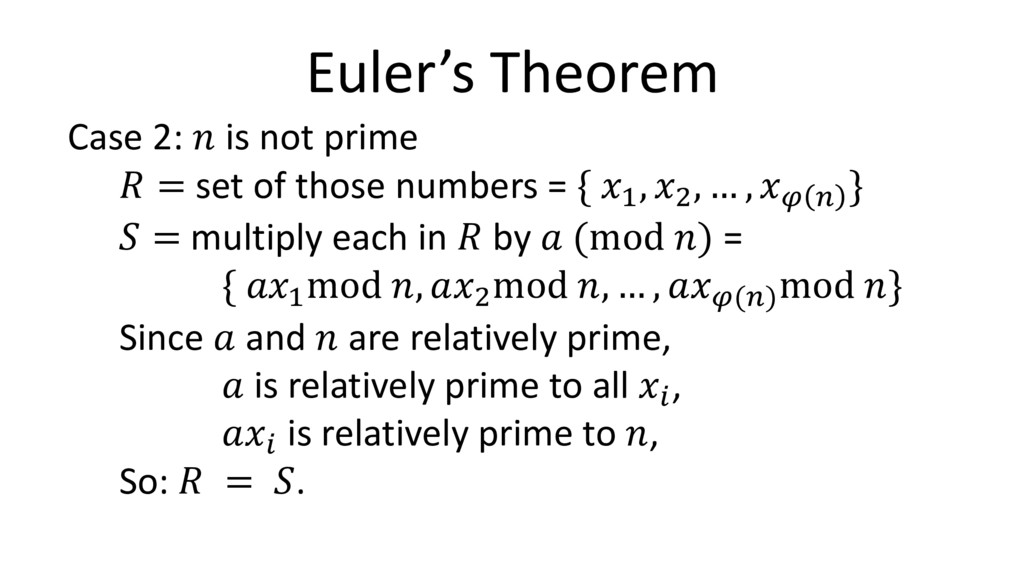
prime: Case 2: is not prime =number of numbers between 1 and that are relatively prime to . = set of those numbers = { F , V , … , R S } = multiply each in by (mod ) = { F mod , V mod , … , R(S) mod } -
Euler’s Theorem Euler Case 2: is not prime = set
of those numbers = { F , V , … , R S } = multiply each in by (mod ) = { F mod , V mod , … , R(S) mod } Since and are relatively prime, is relatively prime to all X, X is relatively prime to , So: = . -
Euler’s Theorem Euler Case 2: is not prime = set
of numbers < relatively prime to = { F , V , … , R S } = = { F mod , V mod , … , R(S) mod } So, product() = product(): -
Euler’s Theorem Euler Case 2: is not prime = set
of numbers < relatively prime to = { F , V , … , R S } = = { F mod , V mod , … , R(S) mod } So, product() = product(): F ×V × ⋯ × R S = F mod × ⋯ ×R S mod F ×V × ⋯ × R S = R S F ×V × ⋯ ×R S mod 1 ≡ R S mod -
38 Correctness of RSA Cryptosystem 9 = 9 mod =
mod 7 9 () = (9mod ) = 9 mod = Euler’s Theorem For and relatively prime: R(S) ≡ 1 mod -
Totient of Product of Primes? = for primes and =
− 1 − − 1 − − 1 numbers between 1 and numbers divisible by numbers divisible by -
Totient of Product of Primes? = for primes and =
− 1 − − 1 − − 1 = − + + 1 = − 1 − 1 -
42 9 = 9 mod = mod 7 9 ()
= (9mod ) = 9 mod = Euler’s Theorem For and relatively prime: R(S) ≡ 1 mod = = − 1 − 1 -
43 7 9 () = (9mod ) = 9 mod
= Euler’s Theorem For and relatively prime: R(S) ≡ 1 mod = = − 1 − 1 e⋅R(S) ≡ 1 mod e⋅R S gF ≡ mod Pick , such that: ≡ 1 mod -
44 9 = 9 mod = mod 7 9 ()
= (9mod ) = 9 mod = Euler’s Theorem For and relatively prime: R(S) ≡ 1 mod = = − 1 − 1 relatively prime to ≡ 1 mod ( − 1)( − 1) ≡ EF mod ( − 1)( − 1) -
Summary: RSA Cryptosystem ≡ EF mod ( − 1)( −
1) 9 = 9 mod = mod = ( and are prime) Pick , public exponent -
Asymmetry Required Need a function f that is: Easy to
compute: given x, easy to compute f (x) Hard to invert: given f (x), hard to compute x Has a trap-door: given f (x) and t, easy to compute x 46 -
Easy (Enough) to Compute Easy to compute: 47 9 =
9 mod Using fast exponentiation, compute mod about log2 multiplications -
Hard to Invert 48 Given ( ), and , hard
to compute M. ≡ EF mod ( − 1)( − 1) -
Hard to Invert 49 Given ( ), and , hard
to compute M. If attacker can factor = , easy to find : = EF ( – 1)( – 1) All other attacks seem to be equivalent to factoring . -
Is Factoring Hard? 352432324251959084756578934940271832400483985714292821262 040320277771378360436620207075955562640185258807844069182 906412495150821892985591491761845028084891200728449926873 928072877767359714183472702618963750149718246911650776133 798590957000973304597488084284017974291006424586918171951 187461215151726546322822168699875491824224336372590851418 654620435767984233871847744479207399342365848238242811981
638150106748104516603773060562016196762561338441436038339 044149526344321901146575444541784240209246165157233507787 077498171257724679629263863563732899121548314381678998850 404453640235273819513786365643912120103971228221207203578 -
Hard to Invert 51 Given ( ), and , hard
to compute M. If attacker can factor = , easy to find : = EF ( – 1)( – 1) All other attacks seem to be equivalent to factoring . No one seems to know a fast way to factor in general, except with a quantum computer (and building a large one seems pretty hard). -
Hard to Invert 52 Given ( ), and , hard
to compute M. If attacker can factor = , easy to find : = EF ( – 1)( – 1) All other attacks seem to be equivalent to factoring . No one seems to know a fast way to factor, except with a quantum computer (and building a large one seems pretty hard). RSA paper, 1977 -
Easy to Invert with Trapdoor 53 9 = 9 mod
= mod 9 mod = -
Generating RSA Keys Pick two large primes: , Generate modulus:
= Pick public exponent: Compute secret exponent: = EF mod − 1 − 1 Publish public key: (, ) Store secret key securely: Destroy and -
Generating RSA Keys (1) Pick two large primes: , (2)
Generate modulus: = (3) Pick public exponent: (4) Compute secret exponent: = EF mod − 1 − 1 (5) Publish public key: (, ) (6) Store secret key securely: Which is the hardest step? -
Finding Large Random Primes “Hard” way: def find_prime_above(k): p =
k while not is_prime(p): p += 1 return p -
How many guesses? To find a prime around , need
about log guesses. = number of primes up ≤ ≈ log -
Finding Large Random Primes “Hard” way: def find_prime_above(k): p =
k while not is_prime(p): p += 1 return p Problems with the hard way: 1. Expensive to compute: is_prime is fairly expense, expect about log () guesses 2. Might pick a “bad” prime: also need − 1 and + 1 having large prime factors, etc. -
Finding Large Random Primes Infineon’s way (RSALib): pick random ∈
ℤ (about 37 bits) pick random ∈ ℤ (62 bits for 512-bit RSA) v = product of first primes = 2 ×3 ×5 × ⋯ ×v = v + (65537" v ) (for RSA-512, = 39) -
Charge Happy Thanksgiving! Be careful when you factorize your turkey,
not to violate any primorial traditions!