Upgrade to Pro
— share decks privately, control downloads, hide ads and more …
Speaker Deck
Features
Speaker Deck
PRO
Sign in
Sign up for free
Search
Search
Architecting is Difficult: London Web March 2014
Search
Jack Franklin
March 20, 2014
Technology
310
3
Share
Embed
Copy iframe code
Copy JS code
Copy link
Start on current slide
Architecting is Difficult: London Web March 2014
Jack Franklin
March 20, 2014
More Decks by Jack Franklin
See All by Jack Franklin
Advanced React Meetup: Testing JavaScript
jackfranklin
1
280
Components on the Web: Frontend NE
jackfranklin
1
850
ReactiveConf: Lessons Migrating Complex Software
jackfranklin
0
530
Front Trends: Migrating complex software
jackfranklin
1
860
Migrating from Angular to React: Manc React
jackfranklin
1
220
Half Stack Fest: Webpack
jackfranklin
4
600
FullStackFest: Elm for JS Developers
jackfranklin
1
270
Codelicious: Intro to ES2015
jackfranklin
0
460
PolyConf: Elm for JS Developers
jackfranklin
0
310
Other Decks in Technology
See All in Technology
人依存からAIネイティブの体制へ:バックエンド開発の裏側【SORACOM Discovery 2026】
soracom
PRO
0
110
システム監視入門
grimoh
5
720
AIエージェントの知識表現と推論に なぜグラフが使われるのか - 記号的AIの復権とニューラルAIとの統合
yohei1126
1
180
数値で見る Microsoft MVP 〜Spec Kit と GitHub Copilot Agent で作るデータ可視化ダッシュボード〜
yutakaosada
0
160
SRENEXT_2026_Chairs__Talks_in_Tamachi.sre.pdf
srenext
1
160
なぜ、あなたのAPIは使われないのか? AX時代の設計原則、ガードレール、運用体制
yokawasa
1
250
脱Jenkins、インターン生が挑んだCIツールGitHubActions移行
mixi_engineers
PRO
1
230
どこまでAIに任せるか 〜確率論と決定論の境界決定〜
shukob
0
550
Vポイント分析基盤におけるデータモデリング20年史
taromatsui_cccmkhd
4
790
システム監視を 「システムを監視するだけ」で 終わらせないために
seiud
0
140
データエンジニアリングとドメイン駆動設計
masuda220
PRO
15
2.7k
ウォーターフォール開発案件のPMとしてAI活用を模索している話
hatahata021
2
120
Featured
See All Featured
Kristin Tynski - Automating Marketing Tasks With AI
techseoconnect
PRO
0
420
A Modern Web Designer's Workflow
chriscoyier
698
190k
How to Ace a Technical Interview
jacobian
281
24k
We Are The Robots
honzajavorek
0
290
Sharpening the Axe: The Primacy of Toolmaking
bcantrill
46
2.9k
Heart Work Chapter 1 - Part 1
lfama
PRO
8
36k
Exploring anti-patterns in Rails
aemeredith
3
450
The Success of Rails: Ensuring Growth for the Next 100 Years
eileencodes
47
8.2k
Navigating Team Friction
lara
192
16k
The Curse of the Amulet
leimatthew05
2
13k
The Limits of Empathy - UXLibs8
cassininazir
1
560
CoffeeScript is Beautiful & I Never Want to Write Plain JavaScript Again
sstephenson
162
16k
Transcript
Architecting is Difficult @Jack_Franklin
Any fool can write code that a computer can understand.
Good programmers write code that humans can understand. ! Martin Fowler [@martinfowler]
What makes code difficult to work with?
YMMV
you’re never going to get it perfect first time
Defer concrete decisions as late as possible - you'll never
again know less about the problem than you do right now and the correct abstraction will become clearer over time. ! Andy Appleton [@appltn]
writing good code improving existing code
Writing Good Code: Tests
drive your API design
difficult to test == difficult to use
confidence when refactoring (but we’ll come back to this later)
Writing Good Code: Naming Conventions
There are only two hard things in Computer Science: cache
invalidation and naming things. ! Phil Karlton
There are only two hard things in Computer Science: cache
invalidation, naming things and off by one errors. ! ???
prefer verbosity
be consistent use the same nouns and verbs
Writing Good Code: Coding Standards
editorconfig.org
actual standard is irrelevant pick one and stick to it
Writing Good Code: Single Responsibility
do one thing and do it well
Not one thing well class EmailSender def initialize(csv) ! def
parse_csv_for_emails ! def send_email end
Better class EmailSender def initialize(csv) def parse_csv_for_emails Parser.new(csv).emails def send_email
end ! class Parser def initialize(csv) def emails end
Writing Good Code: Decoupled Components
class EmailSender def initialize(csv) def parse_csv_for_emails Parser.new(csv).emails def send_email end
! class Parser def initialize(csv) def emails end This knowledge isn’t needed here
class EmailSender def initialize(emails) def send_email end ! class Parser
def initialize(csv) def emails end ! emails = Parser.new(csv).emails EmailSender.new(emails).send_email knows how to send an email to an array of emails knows how to parse a CSV and get the email addresses
Writing Good Code: Separate Aggressively
don’t be afraid to create classes / objects
easier to merge two tiny classes than split up one
massive one
Refactoring
None
Refactoring: alter code without changing behaviour
you have to have tests!
Code Smells
Code Smell: some code which may indicate a problem
You don’t fix code smells. You look at them and
see if they indicate a problem you can fix. ! Joe Ferris [@joe_ferris]
class SomeMapThing def initialize(x, y) end ! class LatLong def
self.get_lat_long(x, y) end ! class User def coords [x, y] end
data clumps continually passing round two objects as arguments
class SomeMapThing def initialize(coords) ! class LatLong def self.get_lat_long(coords) !
class User def coords ! class Coords def x def y ! coords = Coords.new(2, 3) LatLong.get_lat_long(coords)
if two arguments are tightly related, encapsulate that knowledge
class GraphDrawer def draw width = 165 + bar_width height
= 170.2 + bar_height … end
why 165? why 170.2? This is very common in JavaScript
/ jQuery code, and CSS too.
class GraphDrawer GRAPH_HEIGHT_PADDING = 170.2 GRAPH_WIDTH_PADDING = 165 def draw
width = GRAPH_WIDTH_PADDING * bar_width height=GRAPH_HEIGHT_PADDING + bar_height end
no knowledge should be left in your head
<% if user != nil %> <h2><%= user.welcome_message %></h2> <%
else %> <h2>Please sign in</h2> <% end %>
checking for nil / undefined
what does nil mean? no first name? system error? no
name yet? no user logged in?
implicit knowledge in a codebase is bad
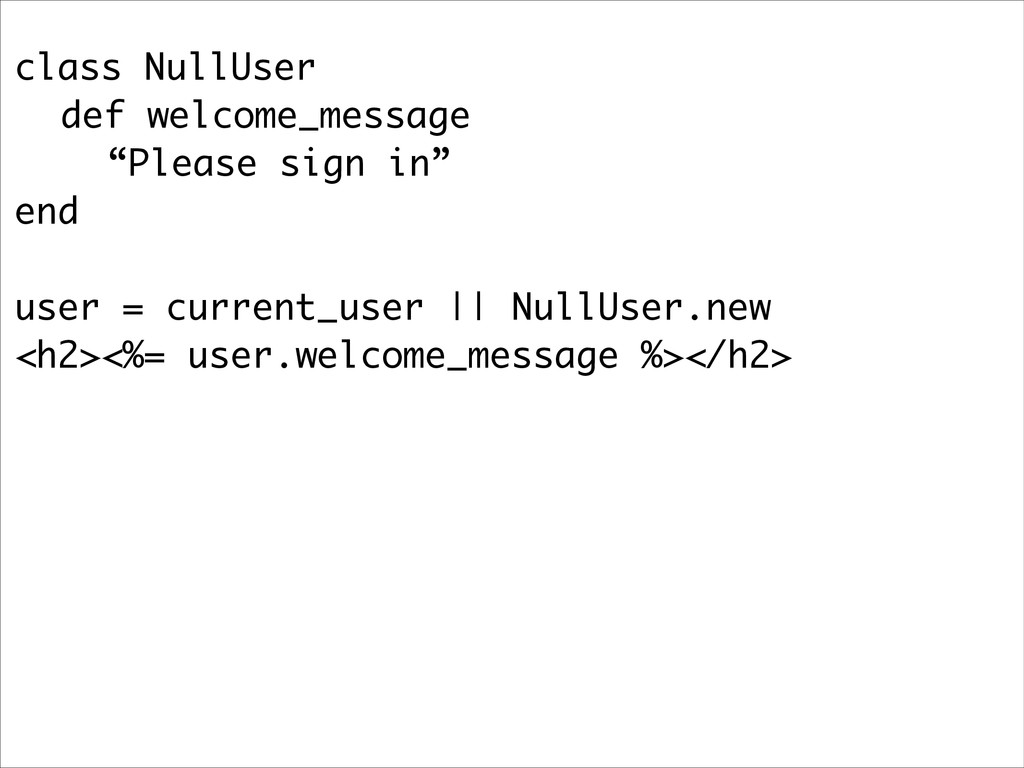
class NullUser def welcome_message “Please sign in” end ! user
= current_user || NullUser.new <h2><%= user.welcome_message %></h2>
don’t check for nil
def check_for_overheating(system_monitor) if system_monitor.temperature > 100 system_monitor.sound_alarms end end
def check_for_overheating(system_monitor) if system_monitor.temperature > 100 system_monitor.sound_alarms end end
tell, don’t ask http://robots.thoughtbot.com/tell-dont-ask
system_monitor.check_for_overheating ! class SystemMonitor def check_for_overheating if temperature > 100
sound_alarms end end end
we’re now telling the object what to do rather than
asking it if it can do it
coupling http://robots.thoughtbot.com/types-of-coupling
def save(should_run_validations=true) if should_run_validations validate store else store ! #
in our app, everywhere user.save post.save(false)
control coupling
if I update the save method every usage of the
method has to change
(this actually happened in Rails)
better solution would be to split the methods up
you have to have some coupling, else nothing could talk
to anything
“If I change this method, how many changes do I
have to make else where?”
Publish and Subscribe
class ModuleA def init(b) def a_thing do_a_thing b.do_thing ! !
class ModuleB def do_thing # has to happen after ModuleA#a_thing
Module A knows too much
class ModuleA def init(event) def a_thing do_a_thing event.publish(‘a_thing_complete’) ! !
class ModuleB def init(event) event.subscribe(‘a_thing_complete’) { do_thing } ModuleA doesn’t know (or care) what modules listen to a_thing_complete
Now no module knows about the other
class ModuleA def init(event) def a_thing do_a_thing event.publish(‘a_thing_complete’) ! class
ModuleB … class ModuleC def init(event) event.subscribe(‘a_thing_complete’) { do_thing }
class User def posts_by_user blog.posts.where(user_id: id) end
The Law of Demeter
It’s an actual law!
A method of an object should only invoke only the
methods of the following kinds of objects: ! 1. itself 2. its parameters 3. any objects it creates 4. its direct component objects
class User def posts_by_user blog.posts.where(user_id: id) end multiple dots
class User def posts_by_user blog.posts_by_user(id) end ! class Blog def
posts_by_user(id) posts.where(user_id: id) end
avoid duplication of knowledge across your system
OK, so it’s not an actual law
Approaches to maintaining code
Every time you work with some code, leave it a
tiny bit better than when you left it
don’t ignore a problem or leave #FIXME comments
#todo: this entire class is screwed, fix it
if you need to make the change, but the change
is difficult
first refactor to make the change easy then make the
change!
you can’t get it right first time every time
keep friction to running tests low
because then you’ll run them
code reviews
http://robots.thoughtbot.com/ ! https://speakerdeck.com/jackfranklin ! http://refactoring.com/
Thanks! javascriptplayground.com @Jack_Franklin


 jackfranklin
 soracom
 grimoh
 yohei1126
 yutakaosada
 srenext
 yokawasa
 mixi_engineers
 shukob
 taromatsui_cccmkhd
 seiud
seiud
 masuda220
 hatahata021
 techseoconnect
 chriscoyier
 jacobian
 honzajavorek
 bcantrill
 lfama
lfama
 aemeredith
 eileencodes
 lara
lara
 leimatthew05
 cassininazir
 sstephenson