Share
Embed
Finally Understand Monads with this One Weird Trick
A talk about understanding monoids, functors, and monads by translating Haskell into Swift.
Andy Bartholomew
March 13, 2016
Transcript
65 slides
-
Understand Monads with this One Weird Trick Andy Bartholomew Airbnb
@jqsilver github.com/jqsilver -
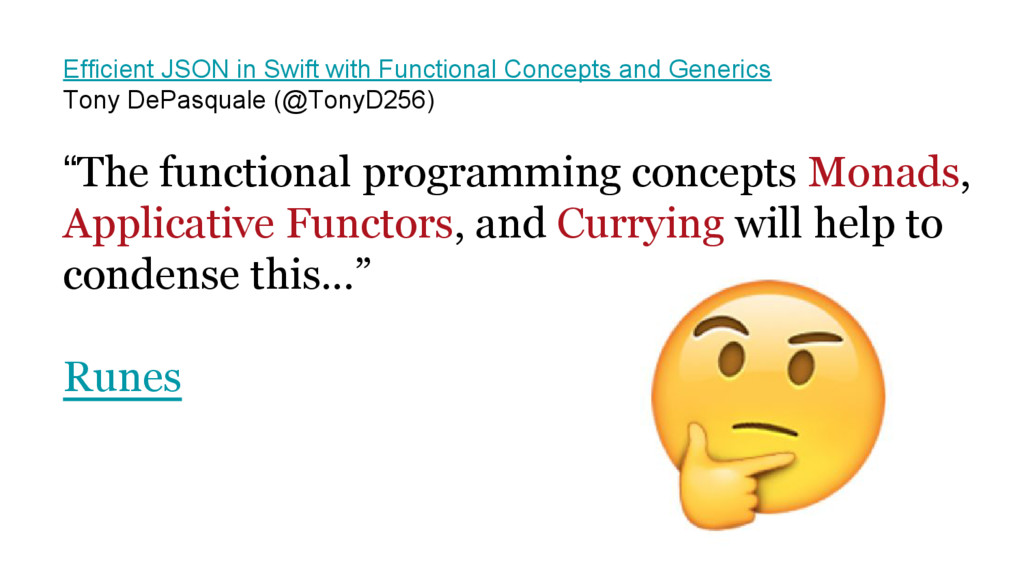
Efficient JSON in Swift with Functional Concepts and Generics Tony
DePasquale (@TonyD256) “The functional programming concepts Monads, Applicative Functors, and Currying will help to condense this...” Runes -
Haskell is hard to read class Functor f where fmap
:: (a -> b) -> f a -> f b instance Functor ((->) r) where fmap = (.) class (Functor f) => Applicative f where pure :: a -> f a (<*>) :: f (a -> b) -> f a -> f b -
The Formula Describe in Natural Language Write Type Signature Name
everything Implement logic Test your code Not necessarily in this order -
Monoid class Monoid m where mempty :: m mappend ::
m -> m -> m mconcat :: [m] -> m mconcat = foldr mappend mempty -
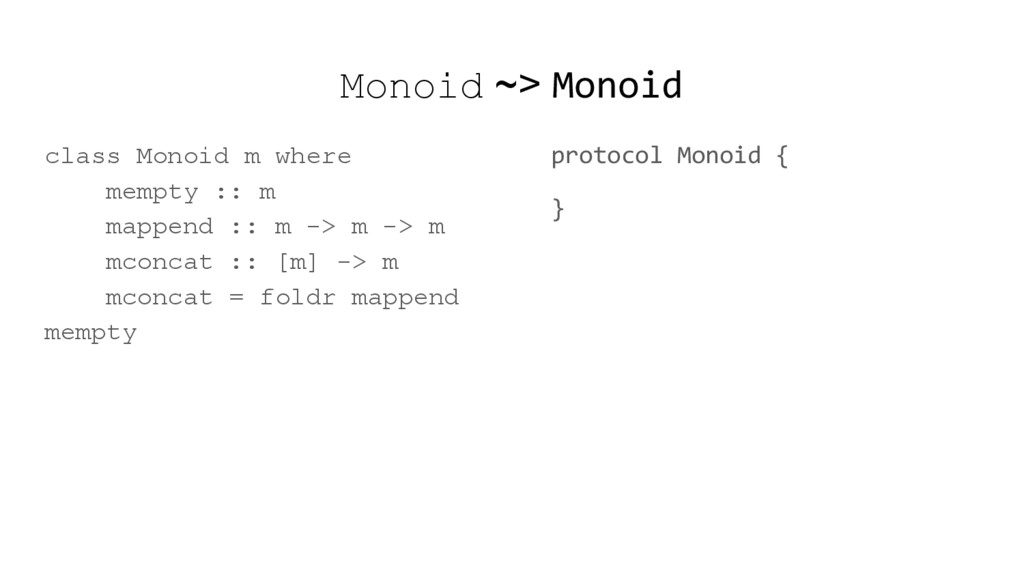
Monoid ~> Monoid class Monoid m where mempty :: m
mappend :: m -> m -> m mconcat :: [m] -> m mconcat = foldr mappend mempty protocol Monoid { } -
Monoid ~> Monoid class Monoid m where mempty :: m
mappend :: m -> m -> m mconcat :: [m] -> m mconcat = foldr mappend mempty protocol Monoid { static func empty() -> m static func append(m, m) -> m static func concat([m]) -> m } -
What is m? class Monoid m where mempty :: m
mappend :: m -> m -> m mconcat :: [m] -> m -
m ~> Self class Monoid m where mempty :: m
mappend :: m -> m -> m mconcat :: [ m] -> m mconcat = foldr mappend mempty protocol Monoid { static func empty() -> Self static func append(Self, Self) -> Self static func concat([Self]) -> Self } -
class Monoid m where mempty :: m mappend :: m
-> m -> m mconcat :: [m] -> m mconcat = foldr mappend mempty protocol Monoid { static func empty() -> Self static func append(left: Self, right: Self) -> Self static func concat(list: [Self]) -> Self } Named arguments -
Concat class Monoid m where mempty :: m mappend ::
m -> m -> m mconcat :: [m] -> m mconcat = foldr mappend mempty protocol Monoid { static func makeEmpty() -> Self static func concat(left: Self, right: Self) -> Self static func concat(list: [Self]) -> Self } -
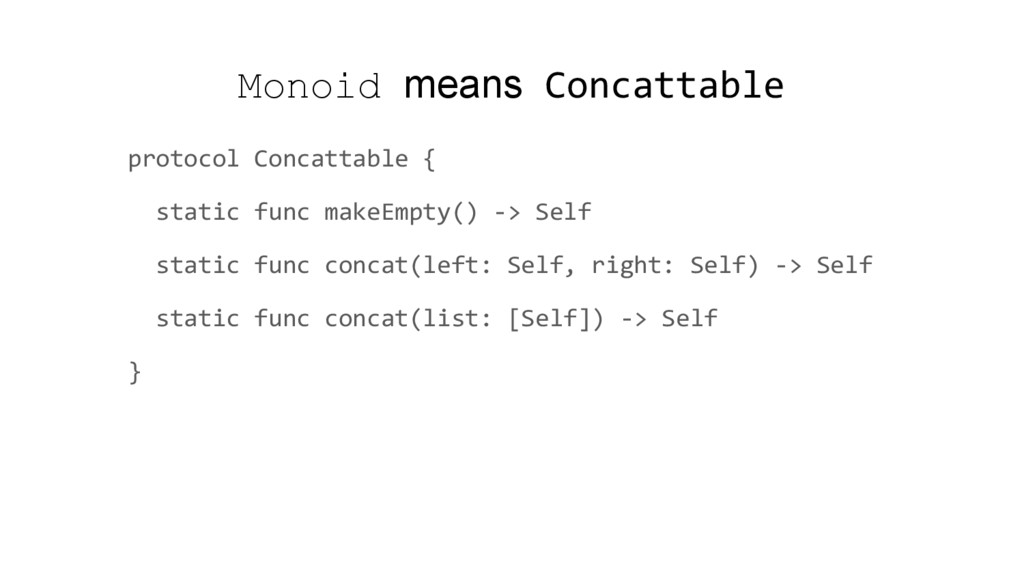
Monoid means Concattable protocol Concattable { static func makeEmpty() ->
Self static func concat(left: Self, right: Self) -> Self static func concat(list: [Self]) -> Self } -
init() protocol Concattable { init() static func concat(left: Self, right:
Self) -> Self static func concat(list: [Self]) -> Self } -
+ protocol Concattable { init() func +(left: Self, right: Self)
-> Self static func concat(list: [Self]) -> Self } -
mconcat = foldr mappend mempty extension Concattable { static func
concat(list: [Self]) -> Self { return list.reduce(Self(), combine: +) } } -
concrete implementations extension Int: Concattable {} extension Float: Concattable {}
extension String: Concattable {} extension Array: Concattable {} -
More implementations func +(left: Set, right: Set) { return left.union(right)
} func +(left: Bool, right: Bool) { return left || right } http://learnyouahaskell.com/functors-applicative-functors-and-monoids#monoids -
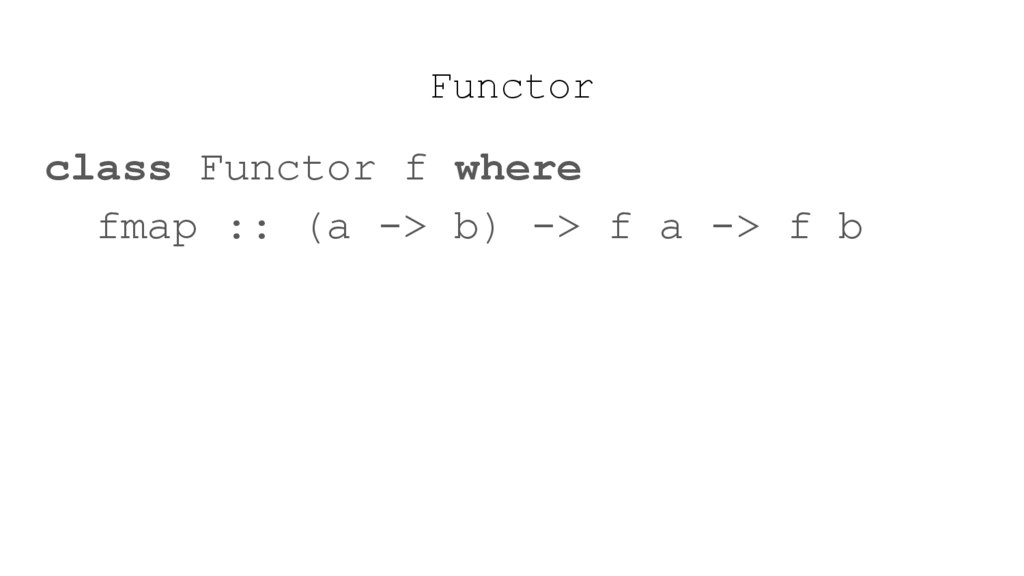
Functor class Functor f where fmap :: (a -> b)
-> f a -> f b -
Functor ~> Mappable class Functor f where fmap :: (a
-> b) -> f a -> f b protocol Mappable { static func map(a -> b, f a) -> f b } -
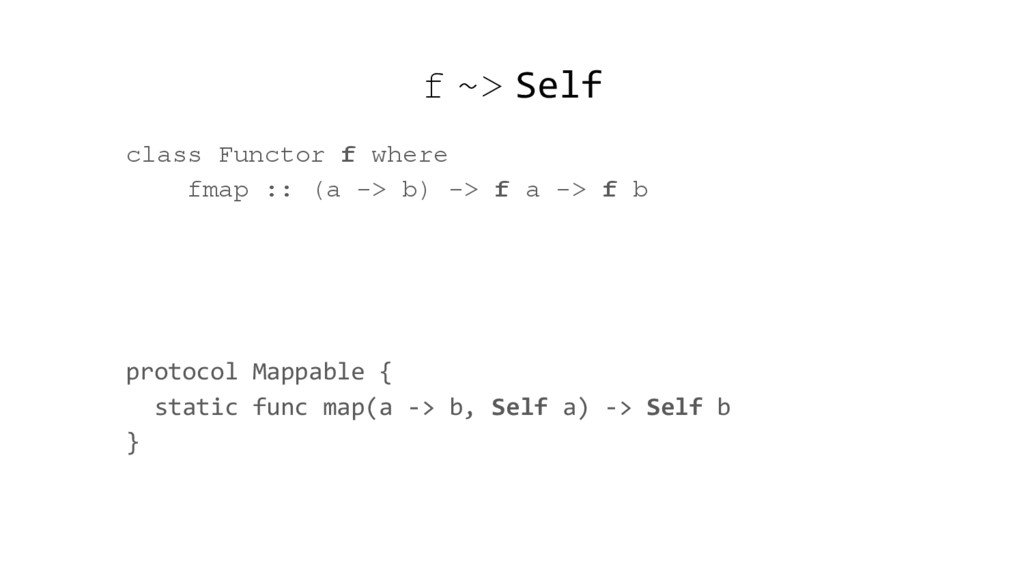
f ~> Self class Functor f where fmap :: (a
-> b) -> f a -> f b protocol Mappable { static func map(a -> b, Self a) -> Self b } -
naming class Functor f where fmap :: (a -> b)
-> f a -> f b protocol Mappable { static func map(transform: a -> b, input: Self a) -> Self b } -
what is f a? class Functor f where fmap ::
(a -> b) -> f a -> f b protocol Mappable { static func map(transform: a -> b, input: Self a) -> Self b } -
Parameterized Types, aka Generics struct Array<Element> { … } let
x = Array // Invalid let x = Array<Int> protocol SequenceType { typealias associatedtype Element } -
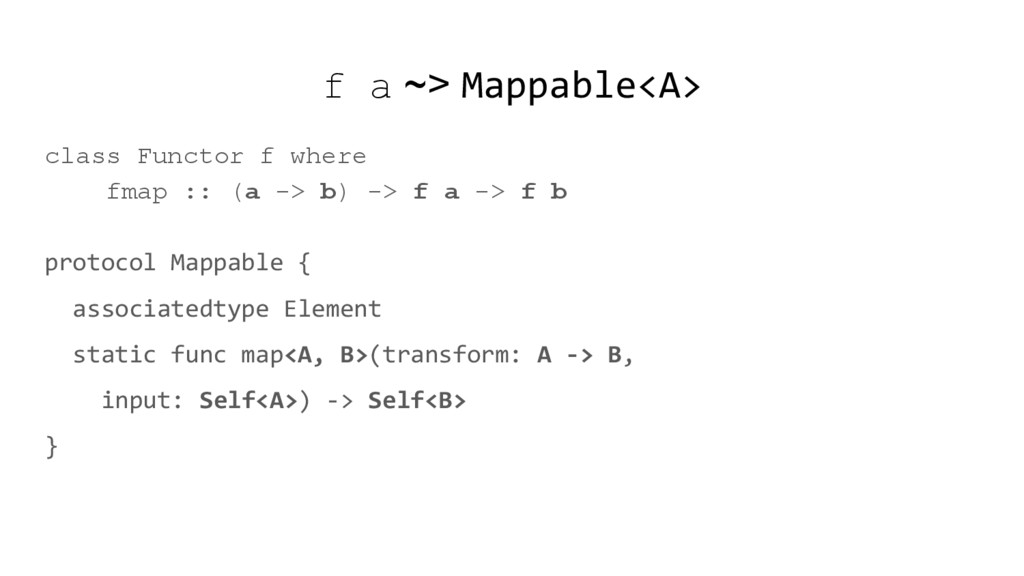
f a ~> Mappable<A> class Functor f where fmap ::
(a -> b) -> f a -> f b protocol Mappable { associatedtype Element static func map<A, B>(transform: A -> B, input: Self<A>) -> Self<B> } -
a ~> InType b ~> OutType class Functor f where
fmap :: (a -> b) -> f a -> f b protocol Mappable { associatedtype Element static func map<InType, OutType>( transform: InType -> OutType, input: Self<InType>) -> Self<OutType> } -
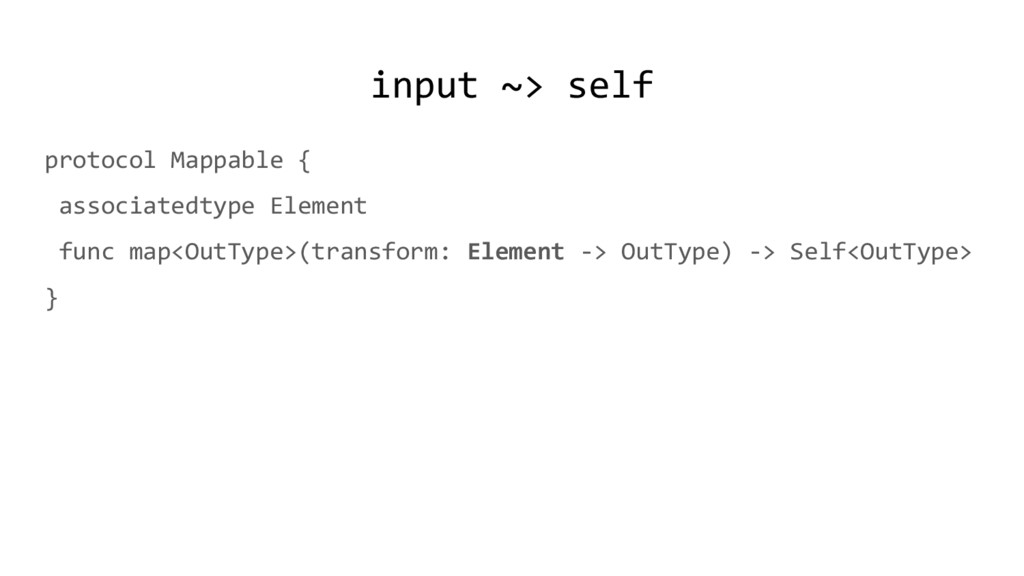
input ~> self protocol Mappable { associatedtype Element func map<OutType>(transform:
Element -> OutType) -> Self<OutType> } -
input ~> self protocol Mappable { associatedtype Element func map<OutType>(transform:
Element -> OutType) -> Self<OutType> } protocol SequenceType { typealias Element func map<OutType>(transform: Element -> OutType) -> [OutType] } -
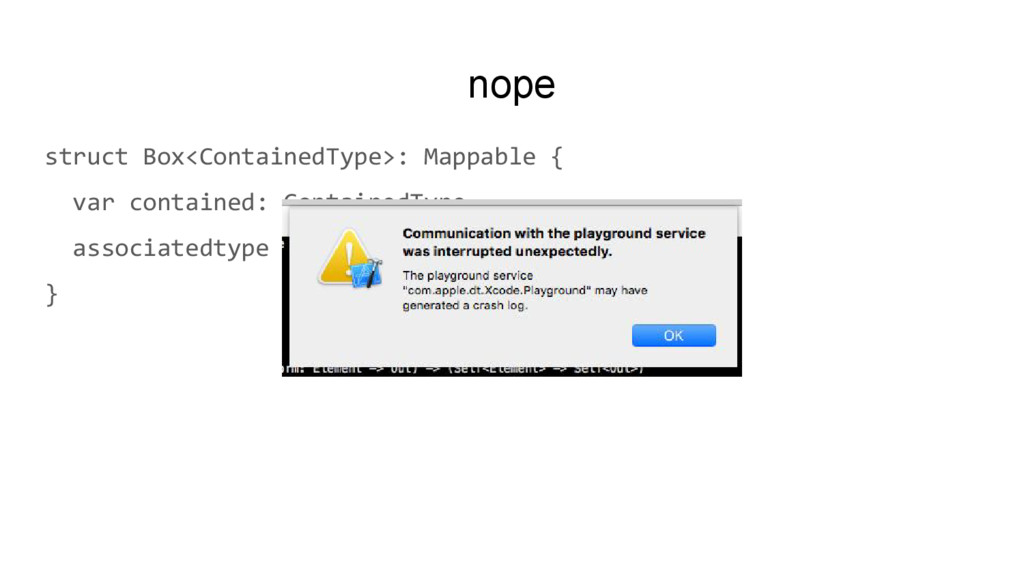
“cannot specialize non-generic type Self” protocol Mappable { associatedtype Element
func map<OutType>(transform: Element -> OutType) -> Self<OutType> } protocol SequenceType { typealias Element func map<OutType>(transform: Element -> OutType) -> [OutType] } -
trying type constraints protocol Mappable { associatedtype Element func map<OutType,
OutMappable: Mappable where Element == OutType>( transform: (Element -> OutType) ) -> OutMappable } -
Mappable protocol Mappable { associatedtype Element func map<OutType>(transform: Element ->
OutType) -> Self<OutType> } -
Concrete Implementations extension Array: Mappable { func map<OutType>(transform: Element ->
OutType) -> [OutType] } extension Optional: Mappable { func map<OutType>(transform: Wrapped -> OutType) -> OutType? } let maybeValue = maybeObject.map { $0.property } let maybeValue = maybeObject?.property -
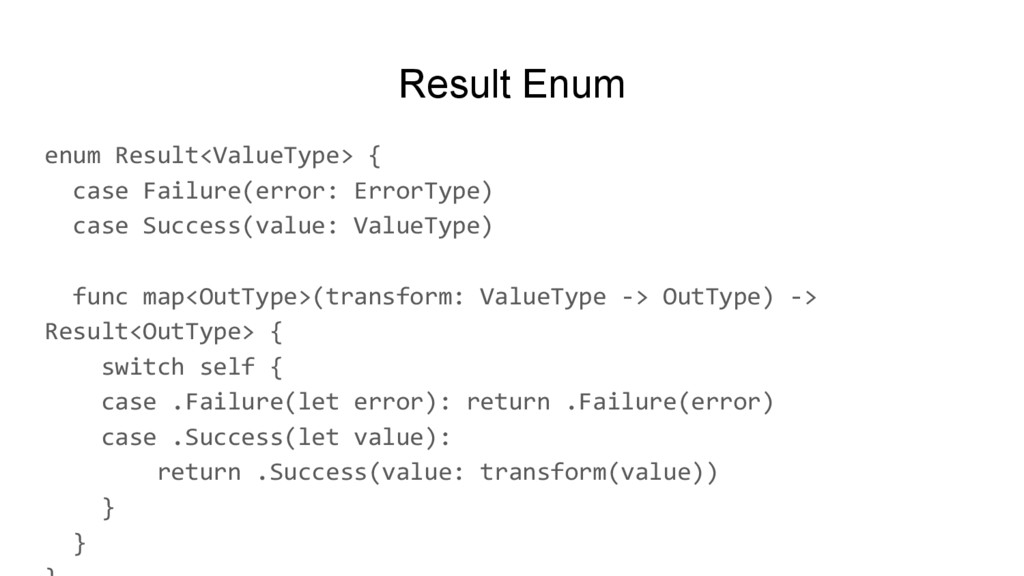
Result Enum enum Result<ValueType> { case Failure(error: ErrorType) case Success(value:
ValueType) func map<OutType>(transform: ValueType -> OutType) -> Result<OutType> { switch self { case .Failure(let error): return .Failure(error) case .Success(let value): return .Success(value: transform(value)) } } -
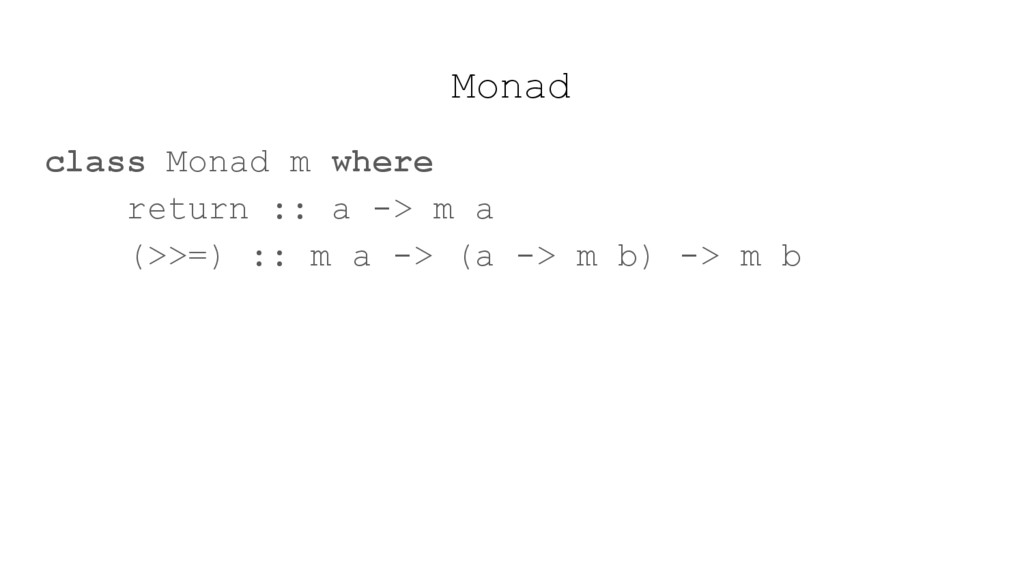
Monad class Monad m where return :: a -> m
a (>>=) :: m a -> (a -> m b) -> m b -
Monad ~> Bindable class Monad m where return :: a
-> m a (>>=) :: m a -> (a -> m b) -> m b protocol Bindable: Mappable { init(element: Element) static func bind<Out>( input: Self<In>, transform: In -> Self<Out>) -> Self<Out> } -
Monad ~> Bindable class Monad m where return :: a
-> m a (>>=) :: m a -> (a -> m b) -> m b protocol Bindable: Mappable { init(element: Element) func bind<Out>(transform: Element -> Self<Out>) -> Self<Out> } -
Optional as Bindable extension Optional: Bindable { associatedtype Element =
Wrapped func bind<Out>(transform: Wrapped -> Out?) -> Out? { if let value = self { return transform(value) } else { return nil } } } let maybeResult = maybeValue.bind(someMethod) -
Array as Bindable extension Array: Bindable { func bind<Out>(transform: Element
-> [Out]) -> [Out] { let arrayOfArrays: [[Out]] = self.map(transform) return arrayOfArrays.flatten } } -
Array as Bindable extension Array: Bindable { func bind<Out>(transform: Element
-> [Out]) -> [Out] { return flatMap(transform) } } -
Back to Optional func someTransform(val: InType) -> OutType? let result1:
OutType?? = maybeValue.map(someTransform) let result2: OutType? = maybeValue.flatMap(someTransform) -
Optional Chaining as Monad // property: OutType? let result1: OutType??
= maybeObject.map { $0.property } let result2: OutType? = maybeObject.flatMap { $0.property } let result3= maybeObject?.property let maybeValue: String? = maybeObject?.property?.stringValue -
Monad ~> FlatMappable class Monad m where return :: a
-> m a (>>=) :: m a -> (a -> m b) -> m b protocol FlatMappable: Mappable { init(element: Element) func flatMap<Out>(transform: Element -> Self<Out>) -> Self<Out> } -
Functions as Container Types instance Functor ((->) r) where fmap
f g = (\x -> f (g x)) instance Applicative ((->) r) where pure x = (\_ -> x) f <*> g = \x -> f x (g x) -
Type Class Laws as Unit Tests fmap (p . q)
= (fmap p) . (fmap q) func assertComposition(mappable: SomeMappable, ...) { let composedTransforms: FirstIn -> SecondOut = { ... return secondTransform(firstTransform(input)) } let dotThenMap = mappable.map(composedTransforms) let mapThenDot = mappable.map(firstTransform) .map(secondTransform) assertEquals(dotThenMap, mapThenDot) } -
Proposing New Swift Syntax Maybe: someFunction.curry.bind(arg1)?.bind(arg2).run() Or Maybe: someFunction(if let
maybeVal, arg2: if let maybeVal2) Or Maybe: @nullfriendly func someFunction(arg1: Int) -> Int