Upgrade to Pro — share decks privately, control downloads, hide ads and more …

Abstract Base Classes

Abstract Base Classes

A review of Abstract Base Classes in Python.
Themes: Polymorphism, behaviours and delegation, collection, registering, Abstract Base Classes, categories, metaclasses, interfaces

Leonardo Giordani

April 15, 2016

Transcript

43 slides
  1. Abstract Base Classes A smart use of metaclasses in Python

    LEonardo GIordani @LGiordani http://thedigitalcatonline.com
  2. Abstract Base Classes – LEonardo GIordani - @LGiordani About Me

    Born in 1977 with Star Wars, bash, Apple ][, BSD, finger, Zork, Galaxy Express 999, Little Pollon, Dire Straits, The Police, Rumours, The Silmarillion, Squad Leader. Interested in operating systems and computer languages, photography, fantasy and science fiction, video- and boardgames, guitar playing, climbing, horseback riding, Aikido, rollerskating, drawing, painting, bookbinding. I programmed in Z80 and x86 Assembly, GW-Basic, Logo, Borland Turbo Pascal, Prolog, C, C++, PHP, Lisp, Ada, Objective-C, bash, Python, Erlang, Clojure, Scala, JavaScript. I love mathematics and cryptography. tl; dr me = nerd + coder
  3. Abstract Base Classes – LEonardo GIordani - @LGiordani Overview Level

    1 Level 2 Polymorphism - Behaviours and delegation - Collections Registering - Abstract Base Classes - Categories Level 3 Build your ABCs - Metaclasses - ABCs as interfaces
  4. Abstract Base Classes – LEonardo GIordani - @LGiordani Python EAFP

    Test the behaviour, not the structure try: someobj[1] except TypeError: # object is not subscriptable ...
  5. Abstract Base Classes – LEonardo GIordani - @LGiordani Example of

    behaviour class ListView(View): def status(self): ... class ItemView(View): def status(self): ...
  6. Abstract Base Classes – LEonardo GIordani - @LGiordani How to

    check how an object behaves? try: someobj.status except AttributeError: ...
  7. Abstract Base Classes – LEonardo GIordani - @LGiordani How to

    check if something behaves like a list? try: someobj.append someobj.extend someobj.index except AttributeError: ... This is checking the structure: wrong
  8. Abstract Base Classes – LEonardo GIordani - @LGiordani Temptation if

    isinstance(someobj, list): ... This is checking the type: wrong
  9. Abstract Base Classes – LEonardo GIordani - @LGiordani Temptation -

    Part 2 if isinstance(someobj, list) or \ isinstance(someobj, tuple) or \ isinstance(someobj, str): ... And quickly becomes unmaintainable
  10. Abstract Base Classes – LEonardo GIordani - @LGiordani Original version

    of isinstance()* def isinstance(obj, _class): return _class in obj.__class__.__bases__ *simplified version
  11. Abstract Base Classes – LEonardo GIordani - @LGiordani New version

    of isinstance()* def isinstance(obj, _class): return _class.__instancecheck__(obj) *simplified version
  12. Abstract Base Classes – LEonardo GIordani - @LGiordani This is

    now possible if isinstance(someobj, ListBehaviour): ... We just need to implement “behaviour” classes
  13. Abstract Base Classes – LEonardo GIordani - @LGiordani Collections classes

    that represent interesting behaviours >>> import collections >>> >>> isinstance(“a string”, collections.Sequence) True >>> >>> isinstance(“a string”, collections.Mapping) False >>> https://docs.python.org/3/library/collections.abc.html
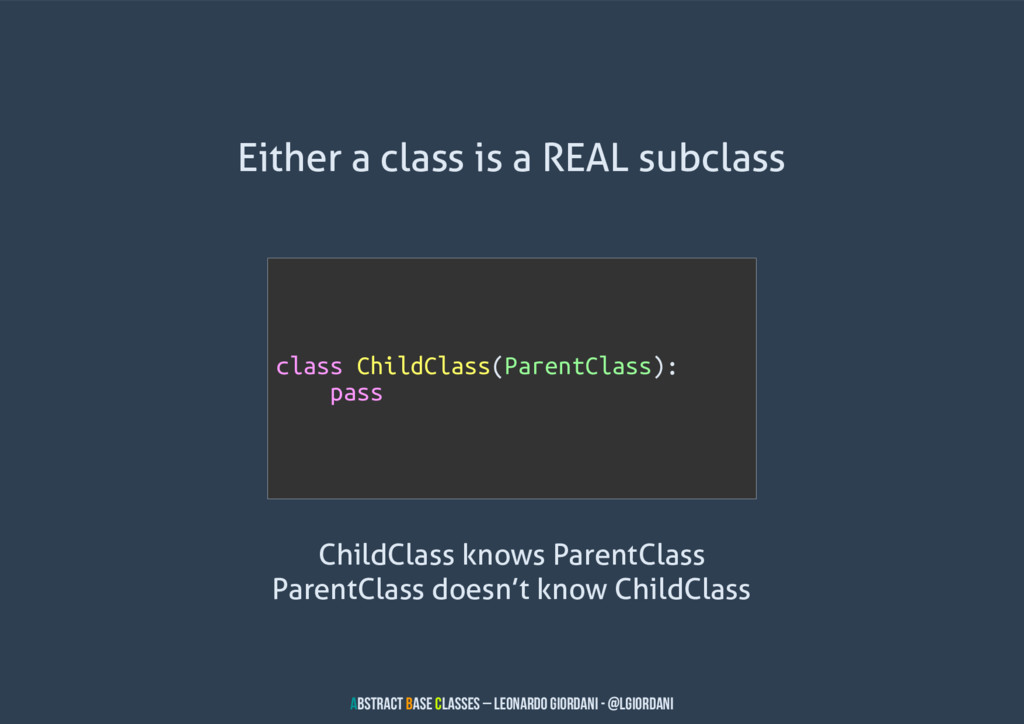
  14. Abstract Base Classes – LEonardo GIordani - @LGiordani Either a

    class is a REAL subclass class ChildClass(ParentClass): pass ChildClass knows ParentClass ParentClass doesn’t know ChildClass
  15. Abstract Base Classes – LEonardo GIordani - @LGiordani Or a

    VIRTUAL subclass ParentClass.register(ChildClass) ParentClass knows ChildClass ChildClass doesn’t know ParentClass
  16. Abstract Base Classes – LEonardo GIordani - @LGiordani Classes that

    can register other classes are called Abstract Base Classes or ABCs. ... Sequence.register(tuple) Sequence.register(str) Sequence.register(range) ... MutableSequence.register(list) ... https://github.com/python/cpython/blob/master/Lib/_collections_abc.py
  17. Abstract Base Classes – LEonardo GIordani - @LGiordani Example >>>

    import collections >>> class MyClass: ... pass ... >>>
  18. Abstract Base Classes – LEonardo GIordani - @LGiordani Example >>>

    import collections >>> class MyClass: ... pass ... >>> issubclass(MyClass, collections.Sequence) False >>>
  19. Abstract Base Classes – LEonardo GIordani - @LGiordani Example >>>

    import collections >>> class MyClass: ... pass ... >>> issubclass(MyClass, collections.Sequence) False >>> collections.Sequence.register(MyClass) <class '__main__.MyClass'> >>>
  20. Abstract Base Classes – LEonardo GIordani - @LGiordani Example >>>

    import collections >>> class MyClass: ... pass ... >>> issubclass(MyClass, collections.Sequence) False >>> collections.Sequence.register(MyClass) <class '__main__.MyClass'> >>> issubclass(MyClass, collections.Sequence) True >>>
  21. Abstract Base Classes – LEonardo GIordani - @LGiordani Build your

    own Abstract Base Class (straight from the docs) from abc import ABCMeta class MyABC(metaclass=ABCMeta): pass MyABC.register(tuple) assert issubclass(tuple, MyABC) assert isinstance((), MyABC)
  22. Abstract Base Classes – LEonardo GIordani - @LGiordani When you

    build an instance you use a class. The class can put things into the instance. # Class definition class Book(): def __init__(self): self.answer = 42 # Link instance and class b = Book() # Use the instance assert b.answer == 42
  23. Abstract Base Classes – LEonardo GIordani - @LGiordani When you

    build a class you use a metaclass. The metaclass can put things into the class. # Metaclass definition class AnswerType(type): def __init__(self, name, bases, namespace): self.answer = 42 # Link class and metaclass class Book(metaclass=AnswerType): pass # Use the class assert Book.answer == 42
  24. Abstract Base Classes – LEonardo GIordani - @LGiordani Let’s compare

    the two side by side # Class definition class Book(): def __init__(self): self.answer = 42 # Link instance and class b = Book() # Use the instance assert b.answer == 42 # Metaclass definition class AnswerType(type): def __init__(self, ...): self.answer = 42 # Link class and metaclass class Book(metaclass=AnswerType): pass # Use the class assert Book.answer == 42
  25. Abstract Base Classes – LEonardo GIordani - @LGiordani Here the

    metaclass puts the register() method in the new class from abc import ABCMeta class MyABC(metaclass=ABCMeta): pass MyABC.register(tuple) assert issubclass(tuple, MyABC) assert isinstance((), MyABC)
  26. Abstract Base Classes – LEonardo GIordani - @LGiordani Metaclasses are

    inherited from abc import ABCMeta class MyABC(metaclass=ABCMeta): pass class OtherABC(MyABC): pass OtherABC.register(tuple) assert issubclass(tuple, OtherABC) assert issubclass(tuple, MyABC)
  27. Abstract Base Classes – LEonardo GIordani - @LGiordani You can

    use ABCs to build interfaces from abc import ABCMeta, abstractmethod class StatusInterface(metaclass=ABCMeta): @abstractmethod def status(self): pass si = StatusInterface() TypeError: Can't instantiate abstract class StatusInterface with abstract methods status
  28. Abstract Base Classes – LEonardo GIordani - @LGiordani You can

    use ABCs to build interfaces from abc import ABCMeta, abstractmethod class StatusInterface(metaclass=ABCMeta): @abstractmethod def status(self): pass class MyStatusView(StatusInterface): pass msv = MyStatusView() TypeError: Can't instantiate abstract class MyStatusView with abstract methods status
  29. Abstract Base Classes – LEonardo GIordani - @LGiordani AMQP -

    architectures - C - Clojure - compilers concurrent programming - C++ decorators - Django - Erlang functional programming - generators - Git - metaclasses metaprogramming - Notebook - OOP - operating systems Python - Python2 - Python3 - RabbitMQ - Scala - TDD testing - versioning http://thedigitalcatonline.com @thedigicat

More Decks by Leonardo Giordani

Other Decks in Programming