Share
Embed
Dive Into Object-oriented Python
Slides of a tutorial on Python Object-oriented programming.

Leonardo Giordani
April 17, 2016
Transcript
167 slides
-
Dive into Object-Oriented Python – Leonardo Giordani - @lgiordani About
Me Born in 1977 with Star Wars, bash, Apple ][, BSD, finger, Zork, Galaxy Express 999, Little Pollon, Dire Straits, The Police, Rumours, The Silmarillion, Squad Leader. Interested in operating systems and computer languages, photography, fantasy and science fiction, video- and boardgames, guitar playing, climbing, horseback riding, Aikido, rollerskating, drawing, painting, bookbinding. I programmed in Z80 and x86 Assembly, GW-Basic, Logo, Borland Turbo Pascal, Prolog, C, C++, PHP, Lisp, Ada, Objective-C, bash, Python, Erlang, Clojure, Scala, JavaScript. I love mathematics and cryptography. tl; dr me = nerd + coder -
Dive into Object-Oriented Python – Leonardo Giordani - @lgiordani The
Digital Cat thedigitalcatonline.com @thedigicat @tw_lgiordani lgiordani LeonardoGiordani Get in touch -
Dive into Object-Oriented Python – Leonardo Giordani - @lgiordani import
users import talk assert all([a >= users.beginner for a in talk.attendees]) About You -
Dive into Object-Oriented Python – Leonardo Giordani - @lgiordani Objects
Class and instance Delegation Polymorphism Overview -
Dive into Object-Oriented Python – Leonardo Giordani - @lgiordani Source
Code Repository http://github.com/lgiordani/oopy -
Dive into Object-Oriented Python – Leonardo Giordani - @lgiordani data
= (13, 63, 5, 378, 58, 40) def avg(d): return sum(d)/len(d) >>> avg(data) 92.83333333333333 Plain old procedures -
Dive into Object-Oriented Python – Leonardo Giordani - @lgiordani door1
= [1, 'closed'] door2 = [2, 'closed'] def open_door(door): door[1] = 'open' >>> open_door(door1) >>> door1 [1, 'open'] Procedures can modify data -
Dive into Object-Oriented Python – Leonardo Giordani - @lgiordani door1
= [1, 'closed'] door2 = [2, 'closed'] ldoor1 = [1, 'closed', 'unlocked'] def open_door(door): door[1] = 'open' def open_ldoor(door): if door[2] == 'unlocked': door[1] = 'open' Things can get complicated -
Dive into Object-Oriented Python – Leonardo Giordani - @lgiordani door1
= [1, 'closed'] door2 = [2, 'closed'] ldoor1 = [1, 'closed', 'unlocked'] def open_door(door): door[1] = 'open' def open_ldoor(door): if door[2] == 'unlocked': door[1] = 'open' >>> open_door(door1) >>> door1 [1, 'open'] >>> open_ldoor(ldoor1) >>> ldoor1 [1, 'open', 'unlocked'] Things can get complicated -
Dive into Object-Oriented Python – Leonardo Giordani - @lgiordani The
meaning of the word 'type' Behavioural meaning -
Dive into Object-Oriented Python – Leonardo Giordani - @lgiordani The
meaning of the word 'type' Structural meaning -
Dive into Object-Oriented Python – Leonardo Giordani - @lgiordani The
behavioural meaning is important -
Dive into Object-Oriented Python – Leonardo Giordani - @lgiordani ©
2000 Alex Martelli on comp.lang.python Duck typing: make it behave like a duck -
Dive into Object-Oriented Python – Leonardo Giordani - @lgiordani The
meaning of the word 'class' -
Dive into Object-Oriented Python – Leonardo Giordani - @lgiordani The
meaning of the word 'instance' -
Dive into Object-Oriented Python – Leonardo Giordani - @lgiordani >>>
a = 6 >>> a 6 >>> type(a) <class 'int'> >>> a = int(6) >>> a 6 >>> a.__class__ <class 'int'> You already used classes -
Dive into Object-Oriented Python – Leonardo Giordani - @lgiordani You
already used classes >>> a = 6 >>> a 6 >>> type(a) <type 'int'> >>> a = int(6) >>> a 6 >>> a.__class__ <type 'int'> 2.x -
Dive into Object-Oriented Python – Leonardo Giordani - @lgiordani Exercises
1. Find some types that Python provides out of the box. 2. Can you create a float variable without using the '.' character? (i.e. do not write a=5.4). 3. What is the difference between {1,2,3} and {'a':1, 'b':2}? How can you tell it? -
Dive into Object-Oriented Python – Leonardo Giordani - @lgiordani Exercises
1. Find some types that Python provides out of the box. >>> type(4) <class 'int'> >>> type(4.5) <class 'float'> >>> type('some words') <class 'str'> >>> type([1,2,3,4]) <class 'list'> >>> type((1,2,3,4)) <class 'tuple'> >>> type({1,2,3,4}) <class 'set'> >>> type({'first name':'Ray', 'last name':'Stantz'}) <class 'dict'> >>> type(True) <class 'bool'> -
Dive into Object-Oriented Python – Leonardo Giordani - @lgiordani Exercises
2. Can you create a float variable without using the '.' character? (i.e. do not write a=5.4). >>> a = float(4) >>> type(a) <class 'float'> -
Dive into Object-Oriented Python – Leonardo Giordani - @lgiordani Exercises
3. What is the difference between {1,2,3} and {'a':1, 'b':2}? How can you tell it? >>> type({1,2,3}) <class 'set'> >>> type({'a':1, 'b':2}) <class 'dict'> -
Dive into Object-Oriented Python – Leonardo Giordani - @lgiordani class
Door: def __init__(self, number, status): self.number = number self.status = status def open(self): self.status = 'open' def close(self): self.status = 'closed' The first class -
Dive into Object-Oriented Python – Leonardo Giordani - @lgiordani class
Door(object): def __init__(self, number, status): self.number = number self.status = status def open(self): self.status = 'open' def close(self): self.status = 'closed' The first class 2.x -
Dive into Object-Oriented Python – Leonardo Giordani - @lgiordani class
Door: def __init__(self, number, status): self.number = number self.status = status def open(self): self.status = 'open' def close(self): self.status = 'closed' The first class -
Dive into Object-Oriented Python – Leonardo Giordani - @lgiordani >>>
door1 = Door(1, 'closed') The first class class Door: def __init__(self, number, status): self.number = number self.status = status def open(self): self.status = 'open' def close(self): self.status = 'closed' -
Dive into Object-Oriented Python – Leonardo Giordani - @lgiordani >>>
door1 = Door(1, 'closed') >>> type(door1) <class '__main__.Door'> The first class class Door: def __init__(self, number, status): self.number = number self.status = status def open(self): self.status = 'open' def close(self): self.status = 'closed' -
Dive into Object-Oriented Python – Leonardo Giordani - @lgiordani >>>
door1 = Door(1, 'closed') >>> type(door1) <class '__main__.Door'> >>> door1.number 1 >>> door1.status 'closed' The first class class Door: def __init__(self, number, status): self.number = number self.status = status def open(self): self.status = 'open' def close(self): self.status = 'closed' -
Dive into Object-Oriented Python – Leonardo Giordani - @lgiordani >>>
door1 = Door(1, 'closed') >>> type(door1) <class '__main__.Door'> >>> door1.number 1 >>> door1.status 'closed' >>> door1.open() The first class class Door: def __init__(self, number, status): self.number = number self.status = status def open(self): self.status = 'open' def close(self): self.status = 'closed' -
Dive into Object-Oriented Python – Leonardo Giordani - @lgiordani >>>
door1 = Door(1, 'closed') >>> type(door1) <class '__main__.Door'> >>> door1.number 1 >>> door1.status 'closed' >>> door1.open() >>> door1.number 1 >>> door1.status 'open' The first class class Door: def __init__(self, number, status): self.number = number self.status = status def open(self): self.status = 'open' def close(self): self.status = 'closed' -
Dive into Object-Oriented Python – Leonardo Giordani - @lgiordani Exercises
1. Create a ColouredDoor class that has the colour attribute. 2. Create a ClosedDoor class that has a default status of 'closed'. 3. Create a ToggleDoor class that has a method toggle() that toggles the status of the door. -
Dive into Object-Oriented Python – Leonardo Giordani - @lgiordani 1.
Create a ColouredDoor class that has the colour attribute. class ColouredDoor: def __init__(self, number, status, colour): self.number = number self.status = status self.colour = colour def open(self): self.status = 'open' def close(self): self.status = 'closed' Exercises -
Dive into Object-Oriented Python – Leonardo Giordani - @lgiordani 2.
Create a ClosedDoor class that has a default status of 'closed'. class ClosedDoor: def __init__(self, number, status='closed'): self.number = number self.status = status def open(self): self.status = 'open' def close(self): self.status = 'closed' Exercises -
Dive into Object-Oriented Python – Leonardo Giordani - @lgiordani 3.
Create a ToggleDoor class that has a method toggle() that toggles the status of the door. class ToggleDoor: def __init__(self, number, status): self.number = number self.status = status def open(self): self.status = 'open' def close(self): self.status = 'closed' def toggle(self): d = {'open': 'closed', 'closed': 'open'} self.status = d[self.status] Exercises -
Dive into Object-Oriented Python – Leonardo Giordani - @lgiordani Class
and instance PART 2 -
Dive into Object-Oriented Python – Leonardo Giordani - @lgiordani Where
is the class of an object? >>> door1 = Door(1, 'closed') >>> door2 = Door(1, 'closed') -
Dive into Object-Oriented Python – Leonardo Giordani - @lgiordani Where
is the class of an object? >>> door1 = Door(1, 'closed') >>> door2 = Door(1, 'closed') >>> hex(id(door1)) '0xb67e148c' >>> hex(id(door2)) '0xb67e144c' -
Dive into Object-Oriented Python – Leonardo Giordani - @lgiordani Where
is the class of an object? >>> door1 = Door(1, 'closed') >>> door2 = Door(1, 'closed') >>> hex(id(door1)) '0xb67e148c' >>> hex(id(door2)) '0xb67e144c' >>> hex(id(door1.__class__)) '0xb685f56c' >>> hex(id(door2.__class__)) '0xb685f56c' -
Dive into Object-Oriented Python – Leonardo Giordani - @lgiordani Class
attributes class Door: colour = 'brown' def __init__(self, number, status): self.number = number self.status = status def open(self): self.status = 'open' def close(self): self.status = 'closed' -
Dive into Object-Oriented Python – Leonardo Giordani - @lgiordani Class
attributes >>> door1 = Door(1, 'closed') >>> door2 = Door(2, 'closed') -
Dive into Object-Oriented Python – Leonardo Giordani - @lgiordani Class
attributes >>> door1 = Door(1, 'closed') >>> door2 = Door(2, 'closed') >>> Door.colour 'brown' >>> door1.colour 'brown' >>> door2.colour 'brown' -
Dive into Object-Oriented Python – Leonardo Giordani - @lgiordani Class
attributes >>> Door.colour = 'white' -
Dive into Object-Oriented Python – Leonardo Giordani - @lgiordani Class
attributes >>> Door.colour = 'white' >>> Door.colour 'white' >>> door1.colour 'white' >>> door2.colour 'white' -
Dive into Object-Oriented Python – Leonardo Giordani - @lgiordani Class
attributes >>> Door.colour = 'white' >>> Door.colour 'white' >>> door1.colour 'white' >>> door2.colour 'white' >>> hex(id(Door.colour)) '0xb67e1500' >>> hex(id(door1.colour)) '0xb67e1500' >>> hex(id(door2.colour)) '0xb67e1500' -
Dive into Object-Oriented Python – Leonardo Giordani - @lgiordani Class
attributes >>> Door.__dict__ mappingproxy({'open': <function Door.open at 0xb68604ac>, 'colour': 'white', '__dict__': <attribute '__dict__' of 'Door' objects>, '__weakref__': <attribute '__weakref__' of 'Door' objects>, '__init__': <function Door.__init__ at 0xb7062854>, '__module__': '__main__', '__doc__': None, 'close': <function Door.close at 0xb686041c>}) -
Dive into Object-Oriented Python – Leonardo Giordani - @lgiordani Class
attributes >>> Door.__dict__ mappingproxy({'open': <function Door.open at 0xb68604ac>, 'colour': 'white', '__dict__': <attribute '__dict__' of 'Door' objects>, '__weakref__': <attribute '__weakref__' of 'Door' objects>, '__init__': <function Door.__init__ at 0xb7062854>, '__module__': '__main__', '__doc__': None, 'close': <function Door.close at 0xb686041c>}) >>> door1.__dict__ {'number': 1, 'status': 'closed'} -
Dive into Object-Oriented Python – Leonardo Giordani - @lgiordani Class
attributes >>> Door.__dict__ mappingproxy({'open': <function Door.open at 0xb68604ac>, 'colour': 'white', '__dict__': <attribute '__dict__' of 'Door' objects>, '__weakref__': <attribute '__weakref__' of 'Door' objects>, '__init__': <function Door.__init__ at 0xb7062854>, '__module__': '__main__', '__doc__': None, 'close': <function Door.close at 0xb686041c>}) >>> door1.__dict__ {'number': 1, 'status': 'closed'} >>> door1.__dict__['colour'] Traceback (most recent call last): File "<stdin>", line 1, in <module> KeyError: 'colour' -
Dive into Object-Oriented Python – Leonardo Giordani - @lgiordani Class
attributes >>> Door.__dict__ mappingproxy({'open': <function Door.open at 0xb68604ac>, 'colour': 'white', '__dict__': <attribute '__dict__' of 'Door' objects>, '__weakref__': <attribute '__weakref__' of 'Door' objects>, '__init__': <function Door.__init__ at 0xb7062854>, '__module__': '__main__', '__doc__': None, 'close': <function Door.close at 0xb686041c>}) >>> door1.__dict__ {'number': 1, 'status': 'closed'} >>> door1.__dict__['colour'] Traceback (most recent call last): File "<stdin>", line 1, in <module> KeyError: 'colour' >>> door1.__class__.__dict__['colour'] 'white' >>> door1.colour is Door.colour True -
Dive into Object-Oriented Python – Leonardo Giordani - @lgiordani Attribute
resolution Door door1 __getattribute__() door1.colour Door.colour door2 -
Dive into Object-Oriented Python – Leonardo Giordani - @lgiordani >>>
door1 = Door(1, 'closed') >>> door1.colour = 'white' >>> door1.__dict__['colour'] 'white' >>> door1.__class__.__dict__['colour'] 'brown' Attribute resolution -
Dive into Object-Oriented Python – Leonardo Giordani - @lgiordani >>>
door1 = Door(1, 'closed') >>> door1.colour = 'white' >>> door1.__dict__['colour'] 'white' >>> door1.__class__.__dict__['colour'] 'brown' >>> door1.colour 'white' >>> Door.colour 'brown' Attribute resolution -
Dive into Object-Oriented Python – Leonardo Giordani - @lgiordani >>>
door1 = Door(1, 'closed') >>> door1.colour = 'white' >>> door1.__dict__['colour'] 'white' >>> door1.__class__.__dict__['colour'] 'brown' >>> door1.colour 'white' >>> Door.colour 'brown' >>> Door.colour = 'red' Attribute resolution -
Dive into Object-Oriented Python – Leonardo Giordani - @lgiordani >>>
door1 = Door(1, 'closed') >>> door1.colour = 'white' >>> door1.__dict__['colour'] 'white' >>> door1.__class__.__dict__['colour'] 'brown' >>> door1.colour 'white' >>> Door.colour 'brown' >>> Door.colour = 'red' >>> door1.__dict__['colour'] 'white' >>> door1.__class__.__dict__['colour'] 'red' Attribute resolution -
Dive into Object-Oriented Python – Leonardo Giordani - @lgiordani Exercises
1. Modify the Door class adding a class attribute 'status' with value 'undefined'. Does it work? What happens to instances? 2. Modify the Door class adding a class attribute 'status' with value 'closed' and remove status from __init__(). Does it work? 3. Add a toggle() method to the previous class. What happens if you call toggle() on a fresh instance? Why? -
Dive into Object-Oriented Python – Leonardo Giordani - @lgiordani 1.
Modify the Door class adding a class attribute 'status' with value 'undefined'. Does it work? What happens to instances? class Door: colour = 'brown' status = 'undefined' def __init__(self, number, status): self.number = number self.status = status def open(self): self.status = 'open' def close(self): self.status = 'closed' Exercises -
Dive into Object-Oriented Python – Leonardo Giordani - @lgiordani 2.
Modify the Door class adding a class attribute 'status' with value 'closed' and remove status from __init__(). Does it work? class Door: colour = 'brown' status = 'closed' def __init__(self, number): self.number = number def open(self): self.status = 'open' def close(self): self.status = 'closed' Exercises -
Dive into Object-Oriented Python – Leonardo Giordani - @lgiordani 3.
Add a toggle() method to the previous class. What happens if you call toggle() on a fresh instance? Why? class Door: colour = 'brown' status = 'closed' def __init__(self, number): self.number = number def toggle(self): d = {'open': 'closed', 'closed': 'open'} self.status = d[self.status] Exercises -
Dive into Object-Oriented Python – Leonardo Giordani - @lgiordani >>>
Door.__dict__ mappingproxy({'open': <function Door.open at 0xb68604ac>, 'colour': 'white', ...}) >>> door1.__dict__ {'number': 1, 'status': 'closed'} >>> door1.colour is Door.colour True Method resolution -
Dive into Object-Oriented Python – Leonardo Giordani - @lgiordani >>>
Door.__dict__ mappingproxy({'open': <function Door.open at 0xb68604ac>, 'colour': 'white', ...}) >>> door1.__dict__ {'number': 1, 'status': 'closed'} >>> door1.colour is Door.colour True >>> door1.open is Door.open False Method resolution -
Dive into Object-Oriented Python – Leonardo Giordani - @lgiordani >>>
Door.__dict__ mappingproxy({'open': <function Door.open at 0xb68604ac>, 'colour': 'white', ...}) >>> door1.__dict__ {'number': 1, 'status': 'closed'} >>> door1.colour is Door.colour True >>> door1.open is Door.open False >>> Door.__dict__['open'] <function Door.open at 0xb68604ac> >>> Door.open <function Door.open at 0xb68604ac> >>> door1.open <bound method Door.open of <__main__.Door object at 0xb67e162c>> Method resolution -
Dive into Object-Oriented Python – Leonardo Giordani - @lgiordani >>>
Door.__dict__ mappingproxy({'open': <function Door.open at 0xb68604ac>, 'colour': 'white', ...}) >>> door1.__dict__ {'number': 1, 'status': 'closed'} >>> door1.colour is Door.colour True >>> door1.open is Door.open False >>> Door.__dict__['open'] <function Door.open at 0xb68604ac> >>> Door.open <unbound method Door.open> >>> door1.open <bound method Door.open of <__main__.Door object at 0xb67e162c>> Method resolution 2.x -
Dive into Object-Oriented Python – Leonardo Giordani - @lgiordani Class
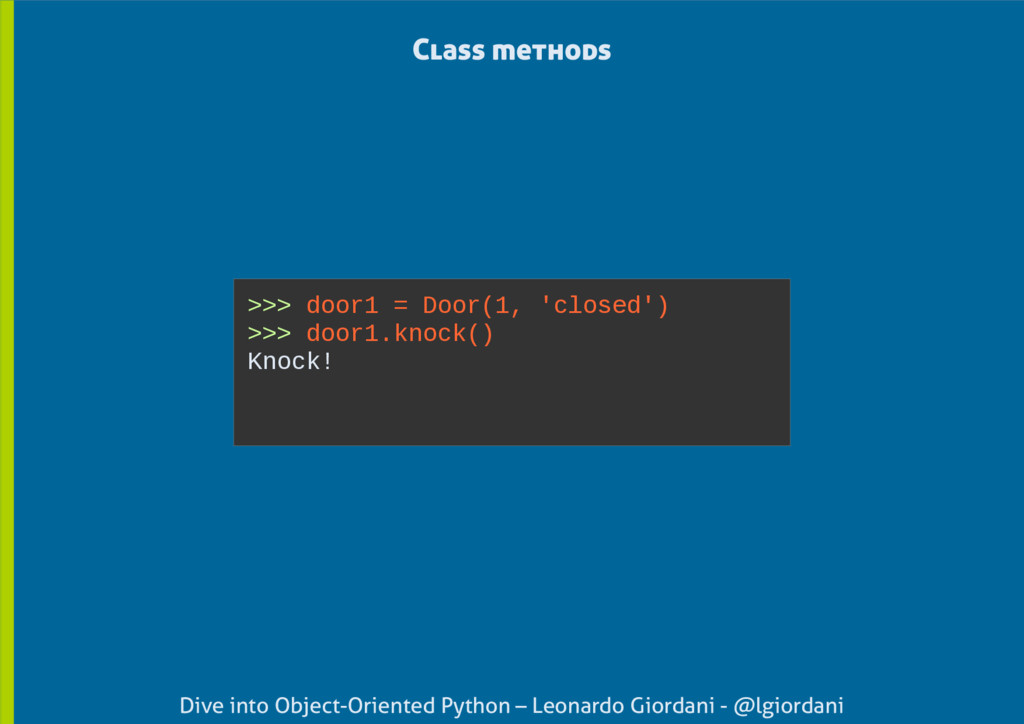
methods class Door: colour = 'brown' def __init__(self, number, status): self.number = number self.status = status @classmethod def knock(cls): print('Knock!') def open(self): self.status = 'open' def close(self): self.status = 'closed' -
Dive into Object-Oriented Python – Leonardo Giordani - @lgiordani >>>
door1 = Door(1, 'closed') >>> door1.knock() Knock! Class methods -
Dive into Object-Oriented Python – Leonardo Giordani - @lgiordani >>>
door1 = Door(1, 'closed') >>> door1.knock() Knock! >>> Door.knock() Knock! Class methods -
Dive into Object-Oriented Python – Leonardo Giordani - @lgiordani Class
methods class Door: colour = 'brown' def __init__(self, number, status): self.number = number self.status = status @classmethod def knock(cls): print('Knock!') @classmethod def paint(cls, colour): cls.colour = colour ... -
Dive into Object-Oriented Python – Leonardo Giordani - @lgiordani >>>
door1 = Door(1, 'closed') >>> door2 = Door(2, 'closed') Class methods -
Dive into Object-Oriented Python – Leonardo Giordani - @lgiordani >>>
door1 = Door(1, 'closed') >>> door2 = Door(2, 'closed') >>> Door.colour 'brown' >>> door1.colour 'brown' >>> door2.colour 'brown' Class methods -
Dive into Object-Oriented Python – Leonardo Giordani - @lgiordani >>>
Door.paint('white') >>> Door.colour 'white' >>> door1.colour 'white' >>> door2.colour 'white' Class methods -
Dive into Object-Oriented Python – Leonardo Giordani - @lgiordani >>>
Door.paint('white') >>> Door.colour 'white' >>> door1.colour 'white' >>> door2.colour 'white' >>> door1.paint('yellow') >>> Door.colour 'yellow' >>> door1.colour 'yellow' >>> door2.colour 'yellow' Class methods -
Dive into Object-Oriented Python – Leonardo Giordani - @lgiordani Exercises
1. Modify the Door class adding a class method 'paint' that accepts a 'colour' arg and changes the class attribute 'colour'. 2. Modify the Door class adding both a class method 'paint' and a standard method 'paint'. What happens? -
Dive into Object-Oriented Python – Leonardo Giordani - @lgiordani 1.
Modify the Door class adding a class method 'paint' that accepts a 'colour' arg and changes the class attribute 'colour'. class Door: colour = 'brown' def __init__(self, number, status): self.number = number self.status = status @classmethod def paint(cls, colour): cls.colour = colour def paint(self, colour): self.colour = colour [...] Exercises -
Dive into Object-Oriented Python – Leonardo Giordani - @lgiordani 2.
Modify the Door class adding both a class method 'paint' and a standard method 'paint'. What happens? Exercises class Door: colour = 'brown' def __init__(self, number, status): self.number = number self.status = status @classmethod def open(cls, colour): cls.colour = colour def open(self): self.status = 'open' def close(self): self.status = 'closed' -
Dive into Object-Oriented Python – Leonardo Giordani - @lgiordani Specialization
Cat Animal Cat has all the features of Animal, i.e. 'moves' -
Dive into Object-Oriented Python – Leonardo Giordani - @lgiordani Specialization
Cat Animal Cat can provide new features, i.e. 'has whiskers' -
Dive into Object-Oriented Python – Leonardo Giordani - @lgiordani Specialization
Cat Animal Cat performs some or all the tasks performed by Animal in a different way, i.e. 'moves silently' -
Dive into Object-Oriented Python – Leonardo Giordani - @lgiordani Delegation
Cat Animal Cat implements only 'new' or 'changed' features and delegates the remaining features to Animal -
Dive into Object-Oriented Python – Leonardo Giordani - @lgiordani Composition:
'to have' Car Engine Wheels turn_on() get_color() steer() turn_on() steer() -
Dive into Object-Oriented Python – Leonardo Giordani - @lgiordani Inheritance:
'to be' Cat move() mew() hiss() Animal move() -
Dive into Object-Oriented Python – Leonardo Giordani - @lgiordani Inheritance
class SecurityDoor(Door): pass -
Dive into Object-Oriented Python – Leonardo Giordani - @lgiordani Inheritance
class SecurityDoor(Door): pass >>> sdoor = SecurityDoor(1, 'closed') -
Dive into Object-Oriented Python – Leonardo Giordani - @lgiordani Inheritance
class SecurityDoor(Door): pass >>> sdoor = SecurityDoor(1, 'closed') >>> SecurityDoor.colour is Door.colour True >>> sdoor.colour is Door.colour True -
Dive into Object-Oriented Python – Leonardo Giordani - @lgiordani Inheritance
class SecurityDoor(Door): pass >>> sdoor = SecurityDoor(1, 'closed') >>> SecurityDoor.colour is Door.colour True >>> sdoor.colour is Door.colour True sdoor.colour SecurityDoor.colour Door.colour -
Dive into Object-Oriented Python – Leonardo Giordani - @lgiordani Inheritance
>>> sdoor.__dict__ {'number': 1, 'status': 'closed'} -
Dive into Object-Oriented Python – Leonardo Giordani - @lgiordani Inheritance
>>> sdoor.__dict__ {'number': 1, 'status': 'closed'} >>> sdoor.__class__.__dict__ mappingproxy({'__doc__': None, '__module__': '__main__'}) -
Dive into Object-Oriented Python – Leonardo Giordani - @lgiordani Inheritance
>>> sdoor.__dict__ {'number': 1, 'status': 'closed'} >>> sdoor.__class__.__dict__ mappingproxy({'__doc__': None, '__module__': '__main__'}) >>> Door.__dict__ mappingproxy({'__dict__': <attribute '__dict__' of 'Door' objects>, 'colour': 'yellow', 'open': <function Door.open at 0xb687e224>, '__init__': <function Door.__init__ at 0xb687e14c>, '__doc__': None, 'close': <function Door.close at 0xb687e1dc>, 'knock': <classmethod object at 0xb67ff6ac>, '__weakref__': <attribute '__weakref__' of 'Door' objects>, '__module__': '__main__', 'paint': <classmethod object at 0xb67ff6ec>}) -
Dive into Object-Oriented Python – Leonardo Giordani - @lgiordani >>>
sdoor.__dict__ {'number': 1, 'status': 'closed'} >>> sdoor.__class__.__dict__ mappingproxy({'__doc__': None, '__module__': '__main__'}) >>> Door.__dict__ mappingproxy({'__dict__': <attribute '__dict__' of 'Door' objects>, 'colour': 'yellow', 'open': <function Door.open at 0xb687e224>, '__init__': <function Door.__init__ at 0xb687e14c>, '__doc__': None, 'close': <function Door.close at 0xb687e1dc>, 'knock': <classmethod object at 0xb67ff6ac>, '__weakref__': <attribute '__weakref__' of 'Door' objects>, '__module__': '__main__', 'paint': <classmethod object at 0xb67ff6ec>}) >>> SecurityDoor.__bases__ (<class '__main__.Door'>,) Inheritance -
Dive into Object-Oriented Python – Leonardo Giordani - @lgiordani >>>
sdoor.__dict__ {'number': 1, 'status': 'closed'} >>> sdoor.__class__.__dict__ mappingproxy({'__doc__': None, '__module__': '__main__'}) >>> Door.__dict__ mappingproxy({'__dict__': <attribute '__dict__' of 'Door' objects>, 'colour': 'yellow', 'open': <function Door.open at 0xb687e224>, '__init__': <function Door.__init__ at 0xb687e14c>, '__doc__': None, 'close': <function Door.close at 0xb687e1dc>, 'knock': <classmethod object at 0xb67ff6ac>, '__weakref__': <attribute '__weakref__' of 'Door' objects>, '__module__': '__main__', 'paint': <classmethod object at 0xb67ff6ec>}) >>> SecurityDoor.__bases__ (<class '__main__.Door'>,) >>> sdoor.knock <bound method type.knock of <class '__main__.SecurityDoor'>> Inheritance -
Dive into Object-Oriented Python – Leonardo Giordani - @lgiordani Overriding
class SecurityDoor(Door): colour = 'grey' locked = True def open(self): if not self.locked: self.status = 'open' -
Dive into Object-Oriented Python – Leonardo Giordani - @lgiordani Overriding
class SecurityDoor(Door): colour = 'grey' locked = True def open(self): if not self.locked: self.status = 'open' >>> SecurityDoor.__dict__ mappingproxy({'__doc__': None, '__module__': '__main__', 'open': <function SecurityDoor.open at 0xb6fcf89c>, 'colour': 'grey', 'locked': True}) -
Dive into Object-Oriented Python – Leonardo Giordani - @lgiordani Exercises
1. Modify the SecurityDoor class adding a custom close_and_lock() method that changes status to 'closed' and locked to True. Test it. 2. Modify the SecurityDoor class adding a custom close() method that accepts a locked flag (with default). 3. Modify the SecurityDoor class adding a custom __init__() method that sets self.locked. -
Dive into Object-Oriented Python – Leonardo Giordani - @lgiordani 1.
Modify the SecurityDoor class adding a custom close_and_lock() method that changes status to 'closed' and locked to True. Test it. class SecurityDoor(Door): colour = 'grey' locked = False def open(self): if not self.locked: self.status = 'open' def close_and_lock(self): self.status = 'closed' self.locked = True Exercises -
Dive into Object-Oriented Python – Leonardo Giordani - @lgiordani 2.
Modify the SecurityDoor class adding a custom close() method that accepts a locked flag (with default). class SecurityDoor(Door): colour = 'grey' locked = False def open(self): if not self.locked: self.status = 'open' def close(self, locked=False): self.status = 'closed' self.locked = locked Exercises -
Dive into Object-Oriented Python – Leonardo Giordani - @lgiordani 3.
Modify the SecurityDoor class adding a custom __init__() method that sets self.locked. class SecurityDoor(Door): colour = 'grey' def __init__(self, number, status, locked=False): self.number = number self.status = status self.locked = locked def open(self): if not self.locked: self.status = 'open' Exercises -
Dive into Object-Oriented Python – Leonardo Giordani - @lgiordani Overriding
class SecurityDoor(Door): colour = 'grey' locked = True def open(self): if self.locked: return Door.open(self) -
Dive into Object-Oriented Python – Leonardo Giordani - @lgiordani Overriding
class SecurityDoor(Door): colour = 'grey' locked = True def open(self): if self.locked: return Door.open(self) >>> sdoor = SecurityDoor(1, 'closed') >>> sdoor.status 'closed' -
Dive into Object-Oriented Python – Leonardo Giordani - @lgiordani Overriding
class SecurityDoor(Door): colour = 'grey' locked = True def open(self): if self.locked: return Door.open(self) >>> sdoor = SecurityDoor(1, 'closed') >>> sdoor.status 'closed' >>> sdoor.open() >>> sdoor.status 'closed' -
Dive into Object-Oriented Python – Leonardo Giordani - @lgiordani Overriding
class SecurityDoor(Door): colour = 'grey' locked = True def open(self): if self.locked: return Door.open(self) >>> sdoor = SecurityDoor(1, 'closed') >>> sdoor.status 'closed' >>> sdoor.open() >>> sdoor.status 'closed' >>> sdoor.locked = False >>> sdoor.open() >>> sdoor.status 'open' -
Dive into Object-Oriented Python – Leonardo Giordani - @lgiordani Avoid
strong coupling class SecurityDoor(Door): colour = 'grey' locked = True def open(self): if self.locked: return super().open() -
Dive into Object-Oriented Python – Leonardo Giordani - @lgiordani Avoid
strong coupling class SecurityDoor(Door): colour = 'grey' locked = True def open(self): if self.locked: return super(SecurityDoor, self).open() 2.x -
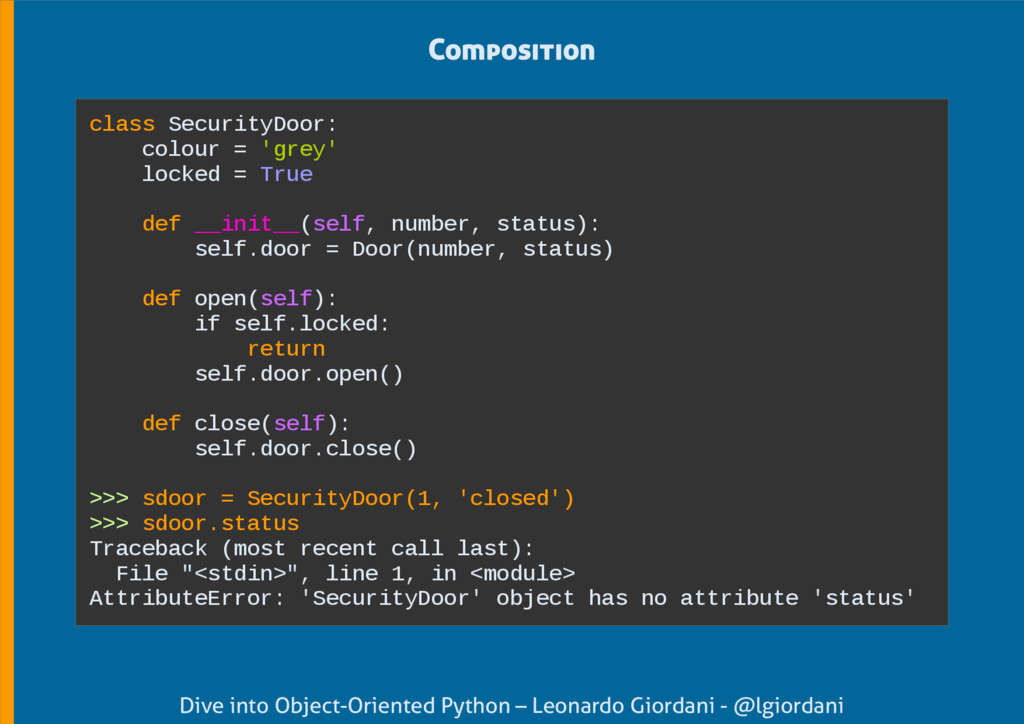
Dive into Object-Oriented Python – Leonardo Giordani - @lgiordani Composition
class SecurityDoor: colour = 'grey' locked = True def __init__(self, number, status): self.door = Door(number, status) def open(self): if self.locked: return self.door.open() def close(self): self.door.close() -
Dive into Object-Oriented Python – Leonardo Giordani - @lgiordani Composition
class SecurityDoor: colour = 'grey' locked = True def __init__(self, number, status): self.door = Door(number, status) def open(self): if self.locked: return self.door.open() def close(self): self.door.close() >>> sdoor = SecurityDoor(1, 'closed') >>> sdoor.status Traceback (most recent call last): File "<stdin>", line 1, in <module> AttributeError: 'SecurityDoor' object has no attribute 'status' -
Dive into Object-Oriented Python – Leonardo Giordani - @lgiordani Composition
class SecurityDoor: colour = 'grey' locked = True def __init__(self, number, status): self.door = Door(number, status) def open(self): if self.locked: return self.door.open() def close(self): self.door.close() def get_status(self): return self.door.status status = property(get_status) >>> sdoor = SecurityDoor(1, 'closed') >>> sdoor.status 'closed' -
Dive into Object-Oriented Python – Leonardo Giordani - @lgiordani Python
magic to the rescue class SecurityDoor: colour = 'grey' locked = True def __init__(self, number, status): self.door = Door(number, status) def open(self): if self.locked: return self.door.open() # def close(self): # self.door.close() def __getattr__(self, attr): return getattr(self.door, attr) >>> sdoor = SecurityDoor(1, 'closed') >>> sdoor.status 'closed' -
Dive into Object-Oriented Python – Leonardo Giordani - @lgiordani Composed
inheritance? class ComposedDoor: def __init__(self, number, status): self.door = Door(number, status) def __getattr__(self, attr): return getattr(self.door, attr) -
Dive into Object-Oriented Python – Leonardo Giordani - @lgiordani Exercises
1. Modify the SecurityDoor class adding a custom close_and_lock() method. Use super(). Try to implement it with composition. 2. Modify the SecurityDoor class adding a custom close() method that accepts a locked flag (with default). Use super(). Try to implement it with composition. -
Dive into Object-Oriented Python – Leonardo Giordani - @lgiordani 1.
Modify the SecurityDoor class adding a custom close_and_lock() method. Use super(). Try to implement it with composition. class SecurityDoor(Door): #inheritance colour = 'grey' def __init__(self, number, status, locked=False): super().__init__(number, status) self.locked = locked def open(self): if self.locked: return super().open() def close_and_lock(self): super().close() self.locked = True Exercises -
Dive into Object-Oriented Python – Leonardo Giordani - @lgiordani class
SecurityDoor: #composition colour = 'grey' def __init__(self, number, status, locked=False): self.door = Door(number, status) self.locked = locked def open(self): if self.locked: return self.door.open() def __getattr__(self, attr): return getattr(self.door, attr) def close_and_lock(self): self.door.close() self.locked = True Exercises -
Dive into Object-Oriented Python – Leonardo Giordani - @lgiordani 2.
Modify the SecurityDoor class adding a custom close() method that accepts a locked flag (with default). Use super(). Try to implement it with composition. class SecurityDoor(Door): #inheritance colour = 'grey' def __init__(self, number, status, locked=False): super().__init__(number, status) self.locked = locked def open(self): if self.locked: return super().open() def close(self, locked=False): super().close() self.locked = locked Exercises -
Dive into Object-Oriented Python – Leonardo Giordani - @lgiordani class
SecurityDoor: #composition colour = 'grey' def __init__(self, number, status, locked=False): self.door = Door(number, status) self.locked = locked def open(self): if self.locked: return self.door.open() def __getattr__(self, attr): return getattr(self.door, attr) def close(self, locked=False): self.door.close() self.locked = locked Exercises -
Dive into Object-Oriented Python – Leonardo Giordani - @lgiordani getattr()
>>> l = [1,2,3] >>> dir(l) ['__add__', '__class__', '__contains__', '__delattr__', '__delitem__', '__dir__', '__doc__', '__eq__', '__format__', '__ge__', '__getattribute__', '__getitem__', '__gt__', '__hash__', '__iadd__', '__imul__', '__init__', '__iter__', '__le__', '__len__', '__lt__', '__mul__', '__ne__', '__new__', '__reduce__', '__reduce_ex__', '__repr__', '__reversed__', '__rmul__', '__setattr__', '__setitem__', '__sizeof__', '__str__', '__subclasshook__', 'append', 'clear', 'copy', 'count', 'extend', 'index', 'insert', 'pop', 'remove', 'reverse', 'sort'] -
Dive into Object-Oriented Python – Leonardo Giordani - @lgiordani getattr()
>>> l = [1,2,3] >>> dir(l) [..., '__subclasshook__', 'append', 'clear', ...] -
Dive into Object-Oriented Python – Leonardo Giordani - @lgiordani getattr()
>>> l = [1,2,3] >>> dir(l) [..., '__subclasshook__', 'append', 'clear', ...] >>> l.append <built-in method append of list object at 0xb70a2c2c> -
Dive into Object-Oriented Python – Leonardo Giordani - @lgiordani getattr()
>>> l = [1,2,3] >>> dir(l) [..., '__subclasshook__', 'append', 'clear', ...] >>> l.append <built-in method append of list object at 0xb70a2c2c> >>> a = l.append >>> a <built-in method append of list object at 0xb70a2c2c> -
Dive into Object-Oriented Python – Leonardo Giordani - @lgiordani getattr()
>>> l = [1,2,3] >>> dir(l) [..., '__subclasshook__', 'append', 'clear', ...] >>> l.append <built-in method append of list object at 0xb70a2c2c> >>> a = l.append >>> a <built-in method append of list object at 0xb70a2c2c> >>> b = getattr(l, 'append') >>> b <built-in method append of list object at 0xb70a2c2c> -
Dive into Object-Oriented Python – Leonardo Giordani - @lgiordani getattr()
>>> l = [1,2,3] >>> dir(l) [..., '__subclasshook__', 'append', 'clear', ...] >>> l.append <built-in method append of list object at 0xb70a2c2c> >>> a = l.append >>> a <built-in method append of list object at 0xb70a2c2c> >>> b = getattr(l, 'append') >>> b <built-in method append of list object at 0xb70a2c2c> >>> a == b True >>> a is b False -
Dive into Object-Oriented Python – Leonardo Giordani - @lgiordani >>>
a = 5 >>> a 5 References -
Dive into Object-Oriented Python – Leonardo Giordani - @lgiordani >>>
a = 5 >>> a 5 >>> type(a) <class 'int'> >>> hex(id(a)) '0x83fe540' References -
Dive into Object-Oriented Python – Leonardo Giordani - @lgiordani >>>
a = 5 >>> a 5 >>> type(a) <class 'int'> >>> hex(id(a)) '0x83fe540' >>> a = 'five' >>> a 'five' References -
Dive into Object-Oriented Python – Leonardo Giordani - @lgiordani >>>
a = 5 >>> a 5 >>> type(a) <class 'int'> >>> hex(id(a)) '0x83fe540' >>> a = 'five' >>> a 'five' >>> type(a) <class 'str'> >>> hex(id(a)) '0xb70d6560' References -
Dive into Object-Oriented Python – Leonardo Giordani - @lgiordani >>>
a = 5 >>> a 5 >>> type(a) <class 'int'> >>> hex(id(a)) '0x83fe540' >>> a = 'five' >>> a 'five' >>> type(a) <class 'str'> >>> hex(id(a)) '0xb70d6560' References Strong type system: every variable has a type -
Dive into Object-Oriented Python – Leonardo Giordani - @lgiordani >>>
a = 5 >>> a 5 >>> type(a) <class 'int'> >>> hex(id(a)) '0x83fe540' >>> a = 'five' >>> a 'five' >>> type(a) <class 'str'> >>> hex(id(a)) '0xb70d6560' References Dynamic type system: the type changes with the content -
Dive into Object-Oriented Python – Leonardo Giordani - @lgiordani def
echo(a): return a Variables are references -
Dive into Object-Oriented Python – Leonardo Giordani - @lgiordani def
echo(a): return a >>> echo(5) 5 >>> echo('five') 'five' Variables are references -
Dive into Object-Oriented Python – Leonardo Giordani - @lgiordani What
is polymorphism? >>> 5 + 6 11 -
Dive into Object-Oriented Python – Leonardo Giordani - @lgiordani What
is polymorphism? >>> 5 + 6 11 >>> 5.5 + 6.6 12.1 -
Dive into Object-Oriented Python – Leonardo Giordani - @lgiordani What
is polymorphism? >>> 5 + 6 11 >>> 5.5 + 6.6 12.1 >>> "just a" + " string" 'just a string' -
Dive into Object-Oriented Python – Leonardo Giordani - @lgiordani What
is polymorphism? >>> 5 + 6 11 >>> 5.5 + 6.6 12.1 >>> "just a" + " string" 'just a string' >>> [1,2,3] + [4,5,6] [1, 2, 3, 4, 5, 6] >>> (1,2,3) + (4,5,6) (1, 2, 3, 4, 5, 6) -
Dive into Object-Oriented Python – Leonardo Giordani - @lgiordani What
is polymorphism? >>> 5 + 6 11 >>> 5.5 + 6.6 12.1 >>> "just a" + " string" 'just a string' >>> [1,2,3] + [4,5,6] [1, 2, 3, 4, 5, 6] >>> (1,2,3) + (4,5,6) (1, 2, 3, 4, 5, 6) >>> {'a':4, 'b':5} + {'c':7} Traceback (most recent call last): File "<stdin>", line 1, in <module> TypeError: unsupported operand type(s) for +: 'dict' and 'dict' -
Dive into Object-Oriented Python – Leonardo Giordani - @lgiordani What
is polymorphism? >>> s = "Just a sentence" >>> len(s) 15 >>> l = [1, 2, 3] >>> len(l) 3 >>> d = {'a': 1, 'b': 2} >>> len(d) 2 -
Dive into Object-Oriented Python – Leonardo Giordani - @lgiordani What
is polymorphism? >>> s = "Just a sentence" >>> len(s) 15 >>> l = [1, 2, 3] >>> len(l) 3 >>> d = {'a': 1, 'b': 2} >>> len(d) 2 >>> i = 5 >>> len(i) Traceback (most recent call last): File "<stdin>", line 1, in <module> TypeError: object of type 'int' has no len() -
Dive into Object-Oriented Python – Leonardo Giordani - @lgiordani What
is polymorphism? >>> s.__len__() 15 >>> l.__len__() 3 >>> d.__len__() 2 -
Dive into Object-Oriented Python – Leonardo Giordani - @lgiordani What
is polymorphism? >>> s.__len__() 15 >>> l.__len__() 3 >>> d.__len__() 2 >>> i.__len__() Traceback (most recent call last): File "<stdin>", line 1, in <module> AttributeError: 'int' object has no attribute '__len__' -
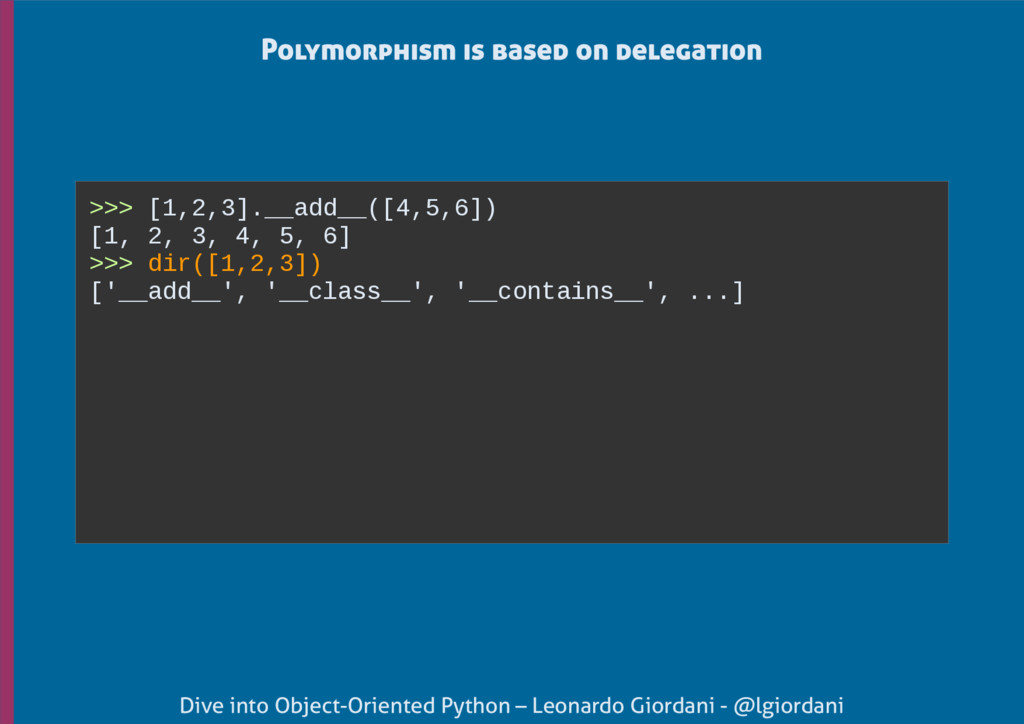
Dive into Object-Oriented Python – Leonardo Giordani - @lgiordani Polymorphism
is based on delegation >>> [1,2,3].__add__([4,5,6]) [1, 2, 3, 4, 5, 6] -
Dive into Object-Oriented Python – Leonardo Giordani - @lgiordani Polymorphism
is based on delegation >>> [1,2,3].__add__([4,5,6]) [1, 2, 3, 4, 5, 6] >>> dir([1,2,3]) ['__add__', '__class__', '__contains__', ...] -
Dive into Object-Oriented Python – Leonardo Giordani - @lgiordani Polymorphism
is based on delegation >>> [1,2,3].__add__([4,5,6]) [1, 2, 3, 4, 5, 6] >>> dir([1,2,3]) ['__add__', '__class__', '__contains__', ...] >>> 1 in [1,2,3] True >>> [1,2,3].__contains__(1) True -
Dive into Object-Oriented Python – Leonardo Giordani - @lgiordani Polymorphism
is based on delegation >>> [1,2,3].__add__([4,5,6]) [1, 2, 3, 4, 5, 6] >>> dir([1,2,3]) ['__add__', '__class__', '__contains__', ...] >>> 1 in [1,2,3] True >>> [1,2,3].__contains__(1) True >>> 6 in [1,2,3] False >>> [1,2,3].__contains__(6) False -
Dive into Object-Oriented Python – Leonardo Giordani - @lgiordani Polymorphism
is based on delegation def sum(a, b): return a + b -
Dive into Object-Oriented Python – Leonardo Giordani - @lgiordani Polymorphism
is based on delegation def sum(a, b): return a + b >>> sum(5,6) 11 >>> sum("Being ", "polymorphic") 'Being polymorphic' >>> sum([1,2,3], [4,5,6]) [1, 2, 3, 4, 5, 6] -
Dive into Object-Oriented Python – Leonardo Giordani - @lgiordani Polymorphism
is based on delegation def sum(a, b): return a + b >>> sum(5,6) 11 >>> sum("Being ", "polymorphic") 'Being polymorphic' >>> sum([1,2,3], [4,5,6]) [1, 2, 3, 4, 5, 6] >>> sum([1,2,3], 8) Traceback (most recent call last): File "<stdin>", line 1, in <module> File "<stdin>", line 2, in sum TypeError: can only concatenate list (not "int") to list -
Dive into Object-Oriented Python – Leonardo Giordani - @lgiordani Exercises
1. Create a class that contains an integer as self.value and with a __len__() method that returns the number of digits of the integer. Does len() work for instances of this class? 2. Add a __contains__() method that returns True if self.value contains the given digit. Does 'in' work for this type? 3. Try str() on an instance of your class. What happens? How can you return a better string representation (e.g. to show the actual value)? -
Dive into Object-Oriented Python – Leonardo Giordani - @lgiordani 1.
Create a class that contains an integer as self.value and with a __len__() method that returns the number of digits of the integer. Does len() work for instances of this class? class CustomInteger: def __init__(self, value): self.value = value def __len__(self): return len(str(self.value)) Exercises -
Dive into Object-Oriented Python – Leonardo Giordani - @lgiordani 2.
Add a __contains__() method that returns True if self.value contains the given digit. Does 'in' work for this type? class CustomInteger: def __init__(self, value): self.value = value def __len__(self): return len(str(self.value)) def __contains__(self, digit): return str(digit) in str(self.value) Exercises -
Dive into Object-Oriented Python – Leonardo Giordani - @lgiordani 3.
Try str() on an instance of your class. What happens? How can you return a better string representation (e.g. to show the actual value)? class CustomInteger: def __init__(self, value): self.value = value def __len__(self): return len(str(self.value)) def __contains__(self, digit): return str(digit) in str(self.value) def __str__(self): return super().__str__() + ' [{}]'.format(self.value) Exercises -
Dive into Object-Oriented Python – Leonardo Giordani - @lgiordani Polymorphism
in action class Room: def __init__(self, door): self.door = door def open(self): self.door.open() def close(self): self.door.close() def is_open(self): return self.door.is_open() -
Dive into Object-Oriented Python – Leonardo Giordani - @lgiordani Polymorphism
in action class Door: def __init__(self): self.status = "closed" def open(self): self.status = "open" def close(self): self.status = "closed" def is_open(self): return self.status == "open" -
Dive into Object-Oriented Python – Leonardo Giordani - @lgiordani Polymorphism
in action class BooleanDoor: def __init__(self): self.status = True def open(self): self.status = True def close(self): self.status = False def is_open(self): return self.status -
Dive into Object-Oriented Python – Leonardo Giordani - @lgiordani >>>
door = Door() >>> bool_door = BooleanDoor() Polymorphism in action -
Dive into Object-Oriented Python – Leonardo Giordani - @lgiordani >>>
door = Door() >>> bool_door = BooleanDoor() >>> room = Room(door) >>> bool_room = Room(bool_door) Polymorphism in action -
Dive into Object-Oriented Python – Leonardo Giordani - @lgiordani >>>
door = Door() >>> bool_door = BooleanDoor() >>> room = Room(door) >>> bool_room = Room(bool_door) >>> room.open() >>> room.is_open() True >>> room.close() >>> room.is_open() False Polymorphism in action -
Dive into Object-Oriented Python – Leonardo Giordani - @lgiordani >>>
door = Door() >>> bool_door = BooleanDoor() >>> room = Room(door) >>> bool_room = Room(bool_door) >>> room.open() >>> room.is_open() True >>> room.close() >>> room.is_open() False >>> bool_room.open() >>> bool_room.is_open() True >>> bool_room.close() >>> bool_room.is_open() False Polymorphism in action -
Dive into Object-Oriented Python – Leonardo Giordani - @lgiordani Exercises
1. Modify the Room, the Door and the BooleanDoor classes to add a toggle() method that changes open status to closed and vice versa. 2. Change the Room class such that it accepts a class instead of an instance. How do you manage it into __init__()? Does it still work? 3. Create a PetDoor object that inherits from Door (or BooleanDoor). Add the suitable methods to manage the small pet door. Does the Room work? 4. May you reuse the Door to create the pet door? -
Dive into Object-Oriented Python – Leonardo Giordani - @lgiordani 1.
Modify the Room, the Door and the BooleanDoor classes to add a toggle() method that changes open status to closed and vice versa. class Room: def __init__(self, door): self.door = door def open(self): self.door.open() def close(self): self.door.close() def is_open(self): return self.door.is_open() def toggle(self): if self.door.is_open(): self.door.close() else: self.door.open() Exercises -
Dive into Object-Oriented Python – Leonardo Giordani - @lgiordani 2.
Change the Room class such that it accepts a class instead of an instance. How do you manage it into __init__()? Does it still work? class Room: def __init__(self, door_cls): self.door = door_cls() def open(self): self.door.open() def close(self): self.door.close() def is_open(self): return self.door.is_open() >>> room = Room(Door) >>> bool_room = Room(BooleanDoor) Exercises -
Dive into Object-Oriented Python – Leonardo Giordani - @lgiordani 3.
Create a PetDoor object that inherits from Door (or BooleanDoor). Add the suitable methods to manage the small pet door. Does the Room work? class PetDoor(BooleanDoor): def __init__(self): super().__init__() self.pet_door = 'open' def open_pet_door(self): self.pet_door = 'open' def close_pet_door(self): self.pet_door = 'closed' Exercises -
Dive into Object-Oriented Python – Leonardo Giordani - @lgiordani 4.
May you reuse the Door to create the pet door? class PetDoor(BooleanDoor): def __init__(self): super().__init__() self.pet_door = BooleanDoor() def open_pet_door(self): self.pet_door.open() def close_pet_door(self): self.pet_door.close() Exercises -
Dive into Object-Oriented Python – Leonardo Giordani - @lgiordani if
hasattr(someobj, 'open'): [...] else: [...] “Ask for permission” style -
Dive into Object-Oriented Python – Leonardo Giordani - @lgiordani try:
someobj.open() [...] except AttributeError: [...] “Ask for forgiveness” style -
Dive into Object-Oriented Python – Leonardo Giordani - @lgiordani Cast
Font awesome icons by Freepik Guido van Rossum and the Python core developers Open source programmers, stackoverflow and forum contributors, blog authors, convention and meetup attendees Many hours spent studying and experimenting -
Dive into Object-Oriented Python – Leonardo Giordani - @lgiordani Cast
thedigitalcatonline.com Interested in AMQP, C, Clojure, concurrent programming, C++, decorators, Django, Erlang, functional programming, generators, Git, metaclasses, metaprogramming, Notebook, OOP, operating systems, Python, Qt, RabbitMQ, Scala, TDD, versioning? @thedigicat
 lgiordani
 izawa
 uwabami
 slobodan
 youto
 yosuke_furukawa
 j5ik2o
 dalinaum
 omatty198
 ochtum
 ryunakayama
 kumaiu
 nextbeatdev
 madoxten
 inesmontani
 soysaucechin
 mlcsv
 bluesmoon
 ryanjones
 rkaga
 aarron
 sonatard
 garrettdimon
 denniskardys
 palkan