Share
Embed
Cerberus
Data Validation for Humans (and Python)
Presented at
- PiterPy 2017, St. Petersburg
- PyConUK 2016, Cardiff
- PyCon Italy 2016, Florence

Nicola Iarocci
April 15, 2016
Transcript
61 slides
-
NICOLA IAROCCI CO-FOUNDER @CIR2K LEAD DEV @AMICA MICROSOFT MVP MONGODB
MASTER CODERDOJO OPEN SOURCE TL;DR CODER AT HEART -
CERBERUS IS A LIGHTWEIGHT AND EXTENSIBLE DATA VALIDATION LIBRARY FOR
PYTHON python-cerberus.org -
BSD LICENSED NO DEPENDENCIES PYTHON 2.6+ PYTHON 3.3+ PYPY 3
github.com/pyeve/cerberus -
CERBERUS, NOUN. THE WATCH-DOG OF HADES, WHOSE DUTY IT WAS
TO GUARD THE ENTRANCE. EVERYBODY, SOONER OR LATER, HAD TO GO THERE, AND NOBODY WANTED TO CARRY OFF THE ENTRANCE. Ambrose Bierce The Devil’s Dictionary CERBERUS, THE NAME -
CERBERUS AT A GLANCE 1. DEFINE A SCHEMA AND PASS
IT TO A VALIDATOR INSTANCE >>> from cerberus import Validator >>> schema = {'name': {'type': 'string'}} >>> v = Validator(schema) -
CERBERUS AT A GLANCE 2. PASS A DOCUMENT TO THE
VALIDATE() METHOD >>> document = {'name': 'john doe'} >>> v.validate(document) True -
CERBERUS AT A GLANCE ALL TOGETHER NOW >>> from cerberus
import Validator >>> v = Validator() >>> schema = {'name': {'type': 'string'}} >>> document = {'name': 'john doe’} >>> v.validate(document, schema) True -
CERBERUS AT A GLANCE ‘ERRORS’ RETURNS HUMAN-READABLE ERRORS >>> schema
= { ... 'name': {'type': 'string'}, ... 'age': {'type': 'integer', 'min': 10} ... } >>> document = {'name': 'Little Joe', 'age': 5} >>> v.validate(document, schema) False >>> v.errors {'age': [‘min value is 10’]} -
CERBERUS AT A GLANCE UNKNOWN FIELDS NOT ALLOWED BY DEFAULT
>>> v.validate({'name': 'john', 'sex': 'M'}) False >>> v.errors {'sex': [‘unknown field’]} -
CERBERUS AT A GLANCE BUT YOU CAN SET ‘ALLOW_UNKNOWN’ TO
ALLOW FOR… THE UNKNOWN >>> v.allow_unknown = True >>> v.validate({'name': 'john', 'sex': 'M'}) True -
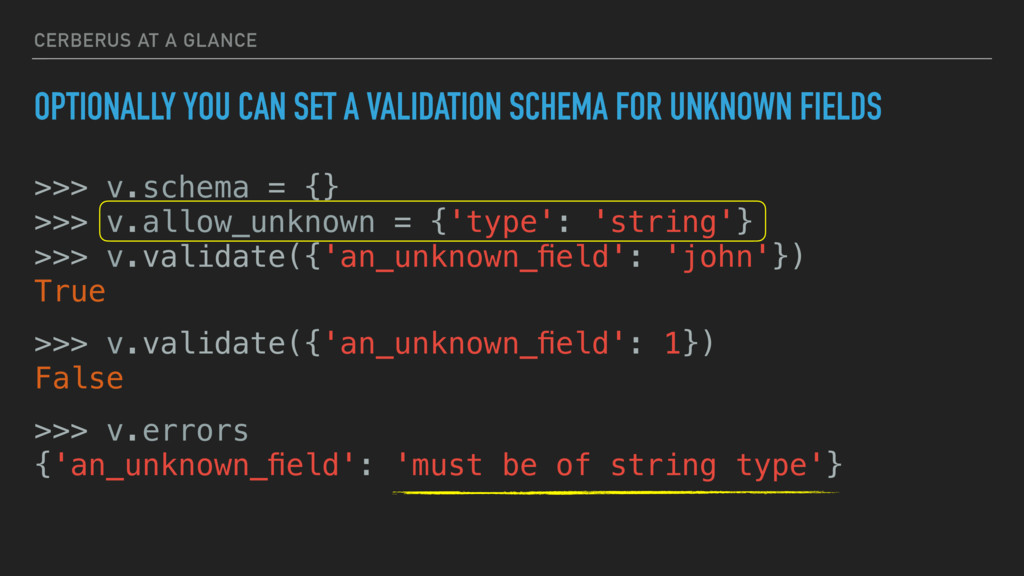
CERBERUS AT A GLANCE OPTIONALLY YOU CAN SET A VALIDATION
SCHEMA FOR UNKNOWN FIELDS >>> v.schema = {} >>> v.allow_unknown = {'type': 'string'} >>> v.validate({'an_unknown_field': 'john'}) True >>> v.validate({'an_unknown_field': 1}) False >>> v.errors {'an_unknown_field': 'must be of string type'} -
CERBERUS AT A GLANCE ‘ALLOW_UNKNOWN’ CAN BE USED IN NESTED
MAPPINGS >>> v = Validator() >>> v.allow_unknown False >>> v.schema = { ... 'name': {'type': 'string'}, ... 'a_dict': { ... 'type': 'dict', ... 'allow_unknown': True, ... 'schema': { ... 'address': {'type': 'string'} ... } ... } ... } OVERRIDES THE BEHAVIOUR, JUST FOR ‘A_DICT’ -
CERBERUS AT A GLANCE ‘ALLOW_UNKNOWN’ CAN BE USED IN NESTED
MAPPINGS >>> v.validate({'name': 'john', ... 'a_dict': {'an_unknown_field': 'is allowed'}}) True >>> v.validate({'name': 'john', ... 'a_dict':{'an_unknown_field': 'is allowed’}, ... 'but_this': 'is not allowed'}) False >>> v.errors {‘but_this’: ['unknown field’]} -
CERBERUS AT A GLANCE VALIDATED() RETURNS THE VALIDATED DOCUMENT >>>
v = Validator(schema) >>> valid_documents = [ ... valid for valid in [ ... v.validated(doc) for doc in documents] ... if valid is not None] -
CERBERUS AT A GLANCE NORMALIZED() RETURNS A NORMALIZED COPY (NO
VALIDATION) >>> schema = {'amount': {'coerce': int}} >>> document = {'model': 'consumerism', 'amount': '1'} >>> normalized_document = v.normalized(document, ... schema) >>> type(normalized_document['amount']) <type 'int'> -
CERBERUS AT A GLANCE USING YAML TO DEFINE A VALIDATION
SCHEMA >>> import yaml >>> schema_text = ''' ... name: ... type: string ... age: ... type: integer ... min: 10 ... ''' >>> schema = yaml.load(schema_text) >>> document = {'name': 'Little Joe', 'age': 5} >>> v.validate(document, schema) False >>> v.errors {'age': [‘min value is 10’]} -
CERBERUS VALIDATION RULES ‘TYPE’ CHECKING >>> v.schema = {'quotes': {'type':
'string'}} >>> v.validate({'quotes': 1}) False OR: BOOLEAN, DATE, DATETIME, MAPPING/DICT, FLOAT, INTEGER, SEQUENCE/LIST, NUMBER, SET, STRING, BINARY -
CERBERUS VALIDATION RULES ‘TYPE’ CHECKING >>> v.schema = { ...
'quotes': {'type':['string','list']}} >>> v.validate({'quotes': 'Hello world!'}) True >>> v.validate({'quotes': ... ['Do not disturb my circles!', 'Heureka!']}) True IF A LIST, ALL LISTED TYPES ARE ALLOWED -
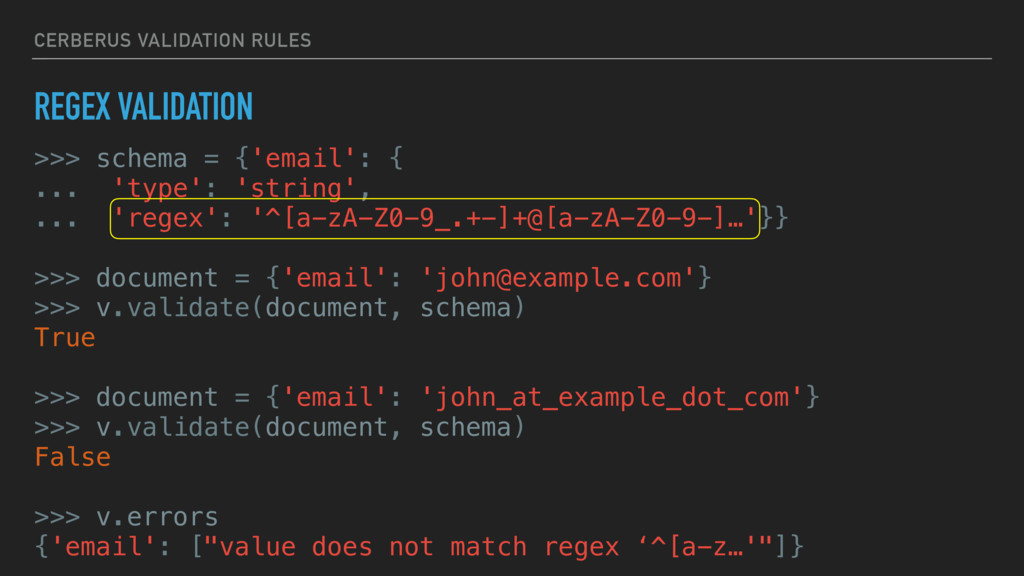
CERBERUS VALIDATION RULES REGEX VALIDATION >>> schema = {'email': {
... 'type': 'string', ... 'regex': '^[a-zA-Z0-9_.+-]+@[a-zA-Z0-9-]…'}} >>> document = {'email': '[email protected]'} >>> v.validate(document, schema) True >>> document = {'email': 'john_at_example_dot_com'} >>> v.validate(document, schema) False >>> v.errors {'email': ["value does not match regex ‘^[a-z…'"]} -
CERBERUS VALIDATION RULES ALLOWED VALUES (STRING, LIST, INT) >>> v.schema
= { ... 'role': {'type': 'list', ... 'allowed': ['agent', 'client', 'supplier']}} >>> v.validate({'role': ['agent', 'supplier']}) True >>> v.validate({'role': ['intern']}) False >>> v.errors {'role': ["unallowed values [‘intern']"]} -
CERBERUS VALIDATION RULES DEPENDENCIES >>> schema = {'field1': {'required': False},
... 'field2': {'required': False, ... 'dependencies': ['field1']}} >>> document = {'field1': 7} >>> v.validate(document, schema) True >>> document = {'field2': 7} >>> v.validate(document, schema) False >>> v.errors {'field2': ["field 'field1' is required”]} -
CERBERUS VALIDATION RULES DEPENDENCIES, WITH RESTRICTED VALUES >>> schema =
{'field1': {'required': False}, ... 'field2': {'required': True, ... 'dependencies': {'field1': ['one', 'two']}}} >>> document = {'field1': 'one', 'field2': 7} >>> v.validate(document, schema) True >>> document = {'field1': 'three', 'field2': 7} >>> v.validate(document, schema) False >>> v.errors {'field2': ["depends on these values: {'field1': ['one', ‘two']}"]} -
CERBERUS VALIDATION RULES EXCLUDES >>> v.schema = { ... 'first':
{'type': 'dict', ... 'excludes': 'second'}, ... 'second': {'type': 'dict', ... 'excludes': 'first'}} >>> v.validate({'first': {}, 'second': {}}) False >>> v.validate({'first': {}}) True >>> v.validate({'second': {}}) True >>> v.validate({}) True -
CERBERUS VALIDATION RULES EXCLUDES, WITH EXCLUSIVE OR >>> v.schema =
{ ... 'first': {'type': 'dict', ... 'excludes': 'second', 'required': True}, ... 'that_field': {'type': 'dict', ... 'excludes': 'first', 'required': True}} >>> v.validate({'first': {}, 'second': {}}) False >>> v.validate({'first': {}}) True >>> v.validate({'second': {}}) True >>> v.validate({}) False -
CERBERUS VALIDATION RULES MULTIPLE FIELD EXCLUDE >>> v.schema = {
... 'first': {'type': 'dict', ... 'excludes': ['second', 'third']}, ... 'second': {'type': 'dict', ... 'excludes': 'first'}, ... 'three': {'type': 'dict'}} >>> v.validate({'first': {}, 'third': {}}) False -
CERBERUS VALIDATION RULES SUBDOCUMENT VALIDATION >>> v.schema = { ...
'a_dict': { ... 'type': 'dict', ... 'schema': { ... 'address': {'type': 'string'}, ... 'city': {'type': 'string', ... 'required': True}}}} >>> v.validate({'a_dict': ... {'address': 'my address’, 'city': 'my town'}}) True -
CERBERUS VALIDATION RULES LISTS AND OTHER SEQUENCES OF ARBITRARY VALUES
>>> schema = { ... 'a_list': { ... 'type': 'list', ... 'schema': {'type': 'integer'}}} >>> document = {'a_list': [3, 4, 5]} >>> v.validate(document, schema) True -
CERBERUS VALIDATION RULES SUBDOCUMENTS LIST >>> v.schema = {'rows': ...
{'type': 'list', ... 'schema': { ... 'type': 'dict', ... 'schema': { ... 'sku': {'type': 'string'}, ... 'price': {'type': 'integer'}}}}} >>> document = { ... 'rows': [{'sku': 'KT123', 'price': 100}]} >>> v.validate(document) True -
CERBERUS VALIDATION RULES ALLOF / ANYOF / NONEOF / ONEOF
>>> schema = {'prop': ... {'type': 'number', ... 'anyof': ... [{'min': 0, 'max': 10}, {'min': 100, 'max': 110}]}} >>> document = {'prop': 5} >>> v.validate(document, schema) True >>> document = {'prop': 105} >>> v.validate(document, schema) True -
CERBERUS VALIDATION RULES >>> schema = {'prop': ... {'type': 'number',
... 'anyof': ... [{'min': 0, 'max': 10}, {'min': 100, 'max': 110}]}} >>> document = {'prop': 55} >>> v.validate(document, schema) False ALLOF / ANYOF / NONEOF / ONEOF -
CERBERUS VALIDATION RULES *OF-RULES MAGIC TYPESAVER {'foo': {'anyof_type': ['string', 'integer']}}
# is equivalent to: {'foo': { ... 'anyof': [ ... {'type': 'string'}, ... {'type': ‘integer'} ... ]}} -
CERBERUS VALIDATION RULES *OF-RULES ALLOW VALIDATION AGAINST MULTIPLE SCHEMAS >>>
schemas = [{'department': {'required': True, 'regex': '^IT$'}, ... 'phone': {'nullable': True}}, ... {'department': {'required': True}, ... 'phone': {'required': True}}] >>> employee_vldtr = Validator({'employee': {'oneof_schema': schemas, ... 'type': 'dict'}}, ... allow_unknown=True) >>> invalid_employees_phones = [] >>> for employee in employees: ... if not employee_vldtr.validate(employee): ... invalid_employees_phones.append(employee) -
CERBERUS VALIDATION RULES ALLOWS TO ‘MAGICALLY’ VALIDATE AGAINST MULTIPLE SCHEMAS
>>> schemas = [{'department': {'required': True, 'regex': '^IT$'}, ... 'phone': {'nullable': True}}, ... {'department': {'required': True}, ... 'phone': {'required': True}}] >>> employee_vldtr = Validator({'employee': {'oneof_schema': schemas, ... 'type': 'dict'}}, ... allow_unknown=True) >>> invalid_employees_phones = [] >>> for employee in employees: ... if not employee_vldtr.validate(employee): ... invalid_employees_phones.append(employee) -
CERBERUS VALIDATION RULES STANDARD RULES SET ALSO INCLUDES ▸ required
▸ nullable ▸ forbidden ▸ readonly ▸ empty (wether a string can be empty) ▸ min, max (arbitrary types) ▸ minlength, maxlength (iterable) ▸ valueschema (validation schema for all values of a dict/mapping) ▸ keyschema (validates the keys of a dict/mapping) ▸ and (a lot) more. -
CERBERUS AT A GLANCE SCHEMA REGISTRY >>> from cerberus import
schema_registry >>> schema_registry.add( ... 'user', {'uid': {'min': 1000, 'max': 0xffff}}) >>> schema = { ... 'sender': {'schema': 'user', ... 'allow_unknown': True}, ... 'receiver': {'schema': 'user', ... 'allow_unknown': True}} -
CERBERUS AT A GLANCE RULES SET REGISTRY >>> from cerberus
import rules_set_registry >>> rules_set_registry.extend(( ... ('boolean', {'type': 'boolean'}), ... ('booleans', {'valueschema': 'boolean'}))) >>> schema = {'foo': 'booleans'} -
CERBERUS AT A GLANCE RULES SET REGISTRY >>> from cerberus
import rules_set_registry >>> rules_set_registry.extend(( ... ('boolean', {'type': 'boolean'}), ... ('booleans', {'valueschema': 'boolean'}))) >>> schema = {'foo': 'booleans'} -
CERBERUS NORMALIZATION FIELD RENAMING >>> v = Validator({'foo': {'rename': 'bar'}})
>>> v.normalized({'foo': 0}) {'bar': 0} -
CERBERUS NORMALIZATION FIELD RENAMING, WITH CUSTOM HANDLER >>> v =
Validator( ... {}, ... allow_unknown={'rename_handler': int} ... ) >>> v.normalized({'0': 'foo'}) {0: 'foo'} -
CERBERUS NORMALIZATION RENAMING, WITH PIPELINE >>> even_digits = lambda x:
'0' + x if len(x) % 2 else x >>> v = Validator( ... {}, ... allow_unknown={ ... 'rename_handler': [str, even_digits]}) >>> v.normalized({1: 'foo'}) {'01': 'foo'} APPLY STR() FIRST, THEN EVEN_DIGITS() -
CERBERUS NORMALIZATION PURGING OF UNKNOWN FIELDS >>> v = Validator({
... 'foo': {'type': 'string'}}, purge_unknown=True) >>> v.normalized({'bar': 'not really', 'foo': 'yup'}) {'foo': 'yup'} -
CERBERUS NORMALIZATION DEFAULT VALUES >>> v.schema = { ... 'amount':
{'type': 'integer'}, ... 'kind': {'type': 'string', 'default': 'purchase'}} >>> v.normalized({'amount': 1}) {'amount': 1, 'kind': 'purchase'} >>> v.normalized({'amount': 1, 'kind': None}) {'amount': 1, 'kind': 'purchase'} >>> v.normalized({'amount': 1, 'kind': 'other'}) {'amount': 1, 'kind': 'other'} -
CERBERUS NORMALIZATION DEFAULT VALUES, WITH CUSTOM SETTER >>> v.schema =
{ ... 'a': {'type': 'integer', 'required': True}, ... 'b': { ... 'type': 'integer', ... 'default_setter': lambda doc: doc['a'] + 1}} >>> v.normalized({'a': 1}) {'a': 1, 'b': 2} -
CERBERUS NORMALIZATION VALUE COERCION >>> to_bool = lambda v: v.lower()
in ['true', '1'] >>> v.schema = {'flag': {'type': 'boolean', 'coerce': to_bool}} >>> v.validate({'flag': 'true'}) True >>> v.document {'flag': True} -
EXTENDING CERBERUS CUSTOM RULES >>> schema = {'amount': ... {'isodd':
True, 'type': 'integer'}} >>> class MyValidator(Validator): ... def _validate_isodd(self, isodd, field, value): ... if isodd and not bool(value & 1): ... self._error(field, "Must be an odd number") >>> v = MyValidator(schema) >>> v.validate({'amount': 10}) False >>> v.errors {'amount': 'Must be an odd number'} >>> v.validate({'amount': 9}) True -
EXTENDING CERBERUS CUSTOM DATA TYPES >>> schema = {'id': {'type':
'objectid'}} >>> class MyValidator(Validator): ... def _validate_type_objectid(self, field, value): ... if not re.match('[a-f0-9]{24}', value): ... self._error(field, errors.BAD_TYPE) >>> v = MyValidator(schema) >>> v.validate({'id': 'dont think so'}) False >>> v.validate({'id': '56a245e738345b1ca2b25164'}) True -
CERBERUS VALIDATION RULES CUSTOM VALIDATION FUNCTIONS >>> def oddity(field, value,
error): ... if not value & 1: ... error(field, "Must be an odd number") >>> schema = {'amount': {'validator': oddity}} >>> v = Validator(schema) >>> v.validate({'amount': 10}) False >>> v.errors {'amount': 'Must be an odd number'} >>> v.validate({'amount': 9}) True -
EXTENDING CERBERUS CUSTOM COERCES class MyNormalizer(Validator): def __init__(self, multiplier, *args,
**kwargs): super(MyNormalizer, self).__init__(*args, **kwargs) self.multiplier = multiplier def _normalize_coerce_multiply(self, value): try: return value * self.multiplier except Exception as e: self._error(field, errors.COERCION_FAILED, e) >>> schema = {'foo': {'coerce': 'multiply'}} >>> document = {'foo': 2} >>> MyNormalizer(2).normalized(document, schema) {'foo': 4} -
EXTENDING CERBERUS CUSTOM DEFAULT SETTERS from datetime import datetime class
MyNormalizer(Validator): def _normalize_default_setter_utcnow(self, document): return datetime.utcnow() >>> schema = {'date': {'type': 'datetime', ... 'default_setter': ‘utcnow'}} >>> MyNormalizer().normalized({}, schema) {'date': datetime.datetime(...)} -
CERBERUS USE CASES UNORTHODOX USE: VALIDATING USER OBJECTS (SIMPLE) >>>
class ObjectValidator(Validator): ... def validate_object(self, obj): ... return self.validate(obj.__dict__) ... >>> v = ObjectValidator(schema) >>> v.validate_object(person) False >>> v.errors {'age': 'min value is 0'} >>> person.age = 44 >>> v.validate_object(person) True http://nicolaiarocci.com/validating-user-objects-cerberus/ -
CERBERUS API LEVERAGE THE CERBERUS API ▸ Validator. Normalizes and/or
validates any mapping against a validation-schema. ▸ ErrorHandlers. BaseErrorHandler is the base class for all error handlers. Subclasses are identified as error-handlers with an instance-test. ▸ ValidationError. A simple class to store and query basic error information. ▸ ErrorList. A list for ValidationError instances that can be queried with the in keyword for a particular error code. ▸ ErrorTree. Base class for DocumentErrorTree and SchemaErrorTree. ▸ validator_factory. Dynamically create a Validator subclass. -
WE LOVE IT AT GITPRIME. THE WORLD NEEDS MORE CERBERUS!
Vincent Driessen CTO, GitPrime @nvie CERBERUS IN THE WILD
 nicola
 phigasui
 ziobrando
 leegeunhyeok
 kasacchiful
 seosoft
 yuuu
 dalinaum
 fuqda
 akihisaikeda
 l2hyunwoo
 yukikurage
 mitohato14
 seathinner
 jnunemaker
 palkan
 reverentgeek
 chikuwait
 trallard
 inesmontani
 chrislema
 raygrieselhuber
 marktimemedia
 marcduiker
 denniskardys