Share
Embed
Nebenläufigkeit auf der JVM und anderswo
Folien meines Objektforum-Vortrag vom 28.11.2011 in Stuttgart

jlink
November 30, 2011
Transcript
94 slides
-
Nebenläufigkeit auf der JVM (und anderswo) 28. November 2011 ObjektForum
Stuttgart Johannes Link [email protected] @johanneslink -
Was ist das Problem? • Safety: Nothing bad ever happens
• Liveness: Something good eventually happens • Speed & Responsiveness: Things (seem to) happen faster -
Safety - Alles ist korrekt public class Counter { private
long count = 0; public long value() { return count; } public void inc() { count++; } } Counter counter = new Counter(); //in Thread A: counter.inc(); //in Thread B: counter.inc(); //danach: assert counter.value() == 2; temp = 0 temp = 0 + 1 count = 1 Thread A: Thread B: temp = 0 temp = 0 + 1 count = 1 -
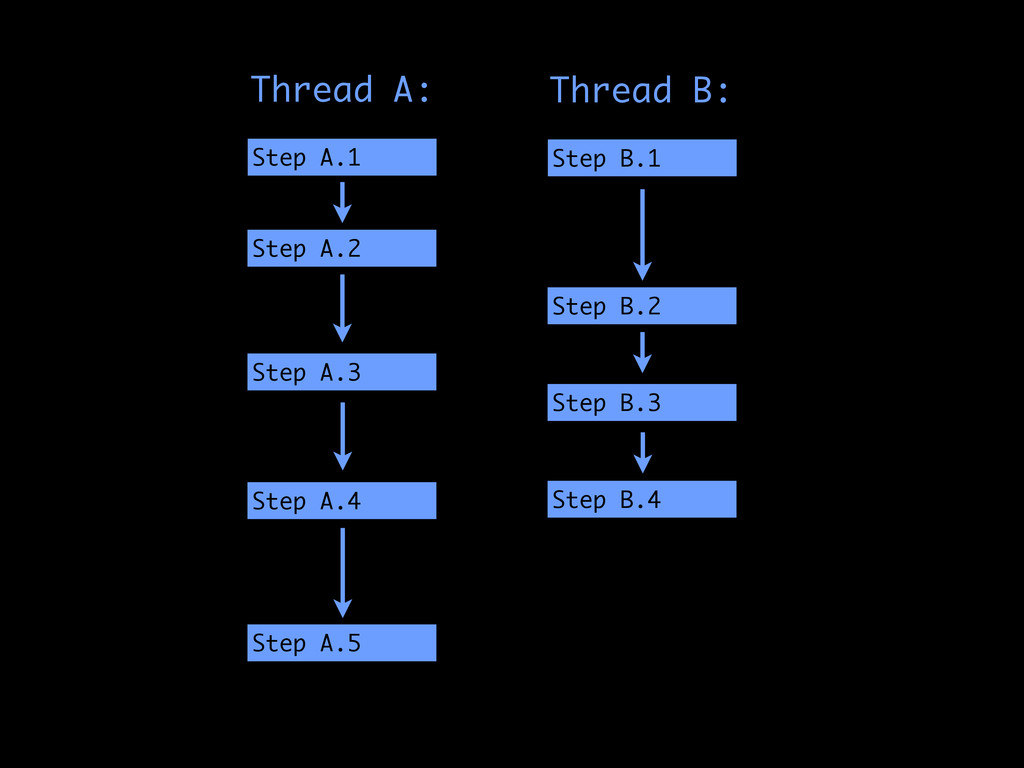
Step A.1 Step A.2 Step A.3 Thread A: Thread B:
Step B.1 Step B.2 Step A.4 Step A.5 Step B.3 Step B.4 -
Step A.1 Step A.2 Step A.3 Thread A: Thread B:
Step B.1 Step A.4 Step A.5 Step B.4 Step B.2 Step B.3 -
Step A.1 Step A.3 Step A.2 Thread A: Thread B:
Step B.1 Step B.3 Step A.5 Step A.4 Step B.2 Step B.4 -
Quiescent Consistency In einer "Ruhephase" ist ein Objekt in einem
Zustand, der einer beliebigen sequentiellen Ausführung aller vorangegangenen Methoden-Aufrufe entspricht -
Synchronisation nebenläufiger Objekte Bestimmte Programmbereiche werden durch Schlösser (Lock) in
eine definierte sequenzielle Reihenfolge gebracht -
Locks public class LockedCounter { private long count = 0;
private Lock lock = new ReentrantLock(); public long value() { lock.lock(); long value = count; lock.unlock(); return value; } public void inc() { lock.lock(); count++; lock.unlock(); } } temp = 0 Thread A: Thread B: temp = 1 count = 2 lock.lock() lock.unlock() lock.lock() lock.unlock() muss warten -
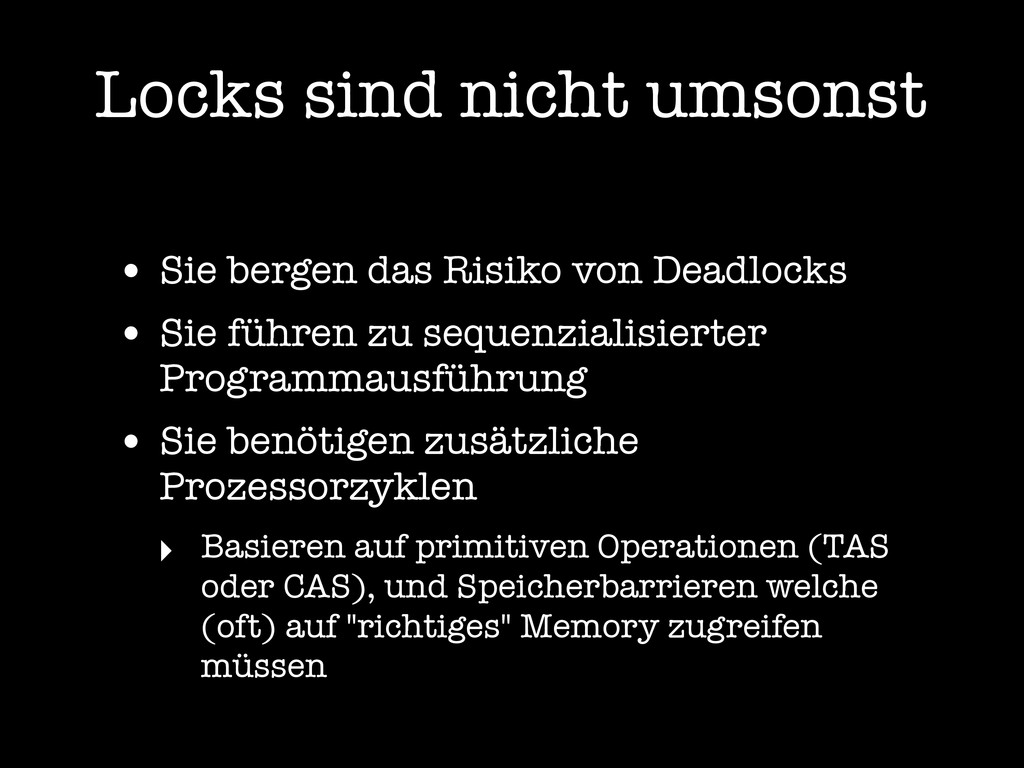
Locks sind nicht umsonst • Sie bergen das Risiko von
Deadlocks • Sie führen zu sequenzialisierter Programmausführung • Sie benötigen zusätzliche Prozessorzyklen ‣ Basieren auf primitiven Operationen (TAS oder CAS), und Speicherbarrieren welche (oft) auf "richtiges" Memory zugreifen müssen -
Caching, Memory & Co Prozessor Core L1/2-Cache L3-Cache Core L1/2-Cache
Memory Prozessor 1-5 20-30 300-400 Zyklen Unshared Object Shared Object -
Grundsätze für die Verwendung von Locks Halte genau dann einen
Lock, • wenn du auf gemeinsamen und veränder- lichen Zustand zugreifst • wenn du atomare Operationen ausführst ‣ check then act ‣ read-modify-write Halte den Lock nicht länger als nötig -
Liveness - Jeder sollte an die Reihe kommen • Gefahr
1: Deadlocks • Gefahr 2: Starvation -
Lock-ordering Deadlock public class SimpleDeadlock... private final Object left =
new Object(); private final Object right = new Object(); public void leftRight() { synchronized (left) { synchronized (right) { doSomething(); } } } public void rightLeft() { synchronized (right) { synchronized (left) { doSomething(); } } } lock left try to lock right Thread A: Thread B: lock right wait for ever try to lock left wait for ever -
Speed • Mehr Prozessoren/Kerne sollten zu besserer Performance führen ‣
Responsiveness ‣ Throughput -
Responsiveness • Besseres Antwortverhalten durch Verlagerung lang-laufender Aufgaben in parallele
Threads • Asynchrone Benachrichtigung bei Beendigung / Fortschritt der Berechnung -
Throughput • Gleichzeitiges Anstoßen mehrerer Aufgaben, um die Gesamtlaufzeit zu
verkleinern ‣ CPU-bound tasks ‣ I/O-bound tasks -
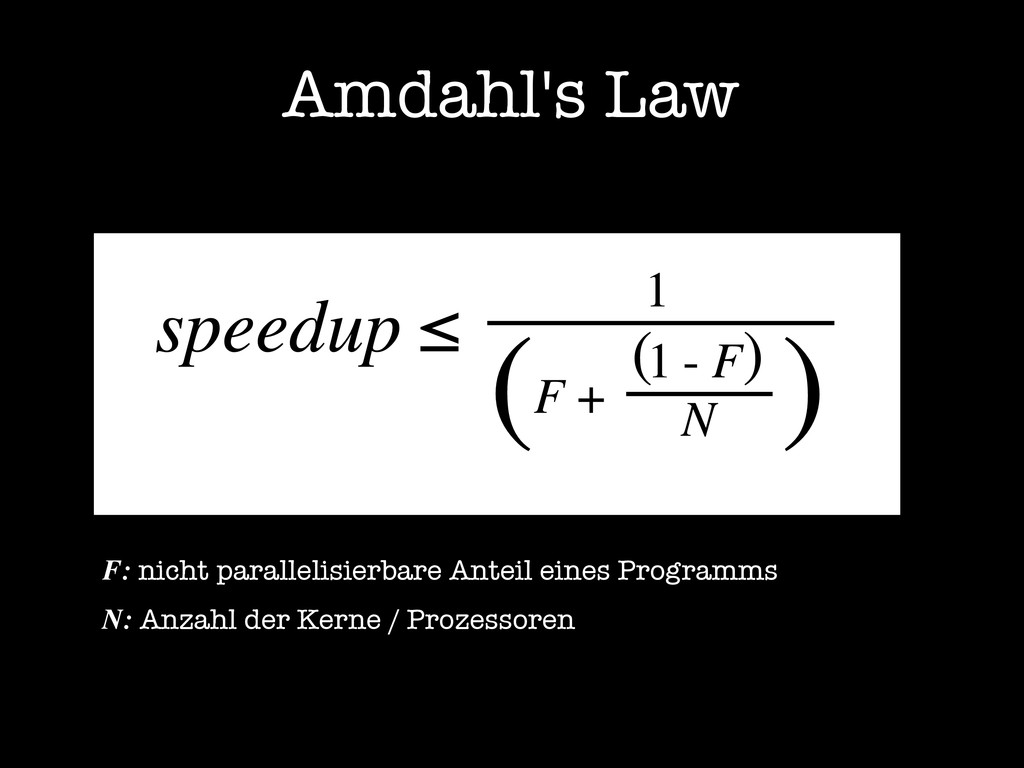
Amdahl's Law F: nicht parallelisierbare Anteil eines Programms N: Anzahl
der Kerne / Prozessoren -
0 1,25 2,50 3,75 5,00 1 2 3 4 5
10 20 100 F = 0,2 Beschleunigung Anzahl der Kerne / Prozessoren -
Wie parallelisiert man ein Programm? • Embarassingly Parallel? • Übliche
Strategien ‣ Parallelisierung des Kontrollflusses ‣ Parallellisierung der Daten ‣ Kombination beider Arten -
Parallelisierung des Kontrollflusses Step 1 Step 2 Step 3 Step
4 Step 5 Step 6 Step 1 Step 2 Step 3 Step 4a Step 5 Step 6 Step 4b Step 4c -
Rekursive Zerlegung des Kontrollflusses (Fork/Join) Step 1 Step 2 Step
3 Step 4 Step 5 Step 6 Step 1 Step 6 Steps 2-5 2-5.1 2-5.2 2-5.n 2-5.1.1 2-5.1.2 2-5.1.n -
for 1..n do Step 1 Step 2 Step 3 Step
4 Step 5 Parallelisierung der Daten for each element do in parallel: Step 1 Step 2 Step 3 Step 4 Step 5 Step 1 Step 2 Step 3 Step 4 Step 5 Step 1 Step 2 Step 3 Step 4 Step 5 Step 1 Step 2 Step 3 Step 4 Step 5 Step 1 Step 2 Step 3 Step 4 Step 5 -
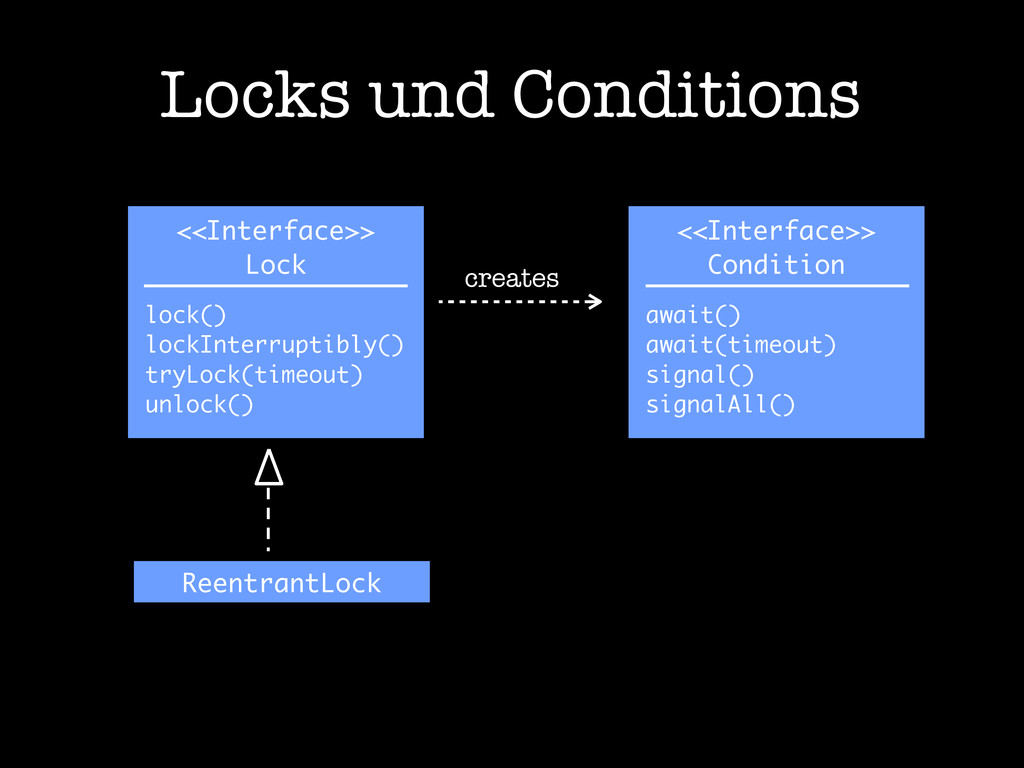
Locks und Conditions <<Interface>> Lock lock() lockInterruptibly() tryLock(timeout) unlock() <<Interface>>
Condition await() await(timeout) signal() signalAll() creates ReentrantLock -
public class MyNewClass... private String myProp = ""; private Lock
lock = new ReentrantLock(); public String getMyProp() { lock.lock(); try { return myProp; } finally {lock.unlock();} } public void setMyProp(String value) { lock.lock(); try { myProp = value; } finally {lock.unlock();} } public class MyNewClass... private String myProp = ""; public synchronized String getMyProp() { return myProp; } public synchronized void setMyProp(String value) { myProp = value; } -
Das Executor-Framework new Thread(...).start() ! <<Interface>> Executor execute(Runnable) <<Interface>> ExecutorService
submit(Runnable):Future<?> submit(Callable<T>):Future<T> shutdown() awaitTermination(timeout) <<Interface>> Future<T> cancel(mayInterrupt) get(): T get(timeout): T <<Interface>> Callable<T> call(): T Nie wieder -
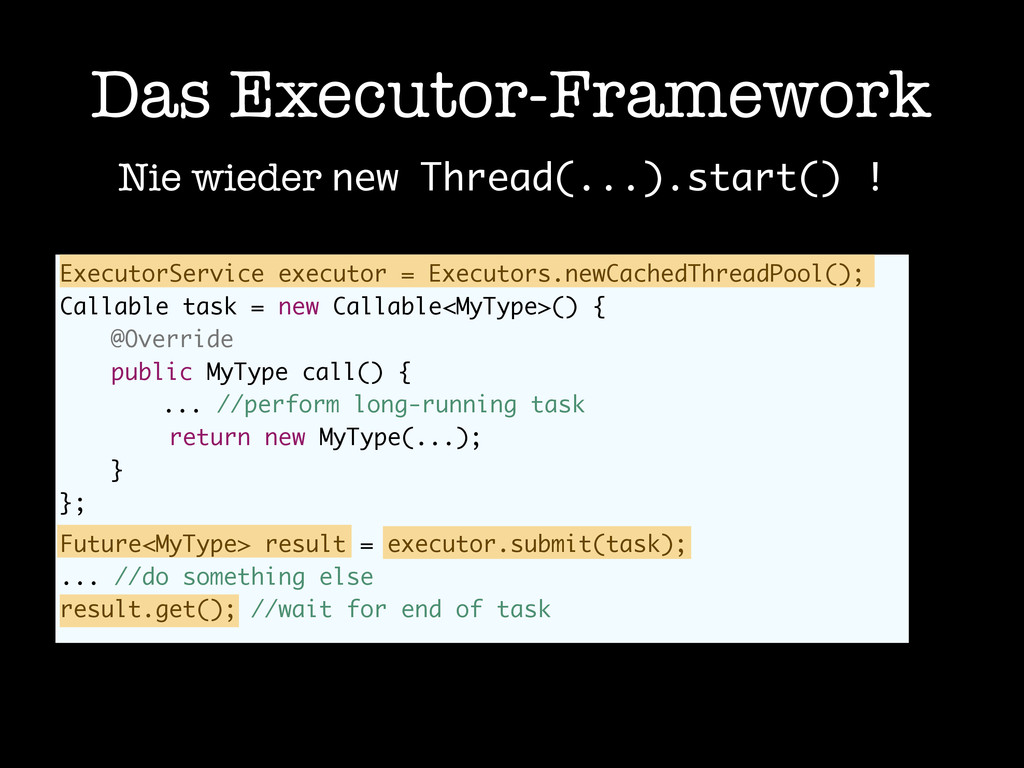
ExecutorService executor = Executors.newCachedThreadPool(); Callable task = new Callable<MyType>() {
@Override public MyType call() { ... //perform long-running task return new MyType(...); } }; Future<MyType> result = executor.submit(task); ... //do something else result.get(); //wait for end of task Das Executor-Framework Nie wieder new Thread(...).start() ! -
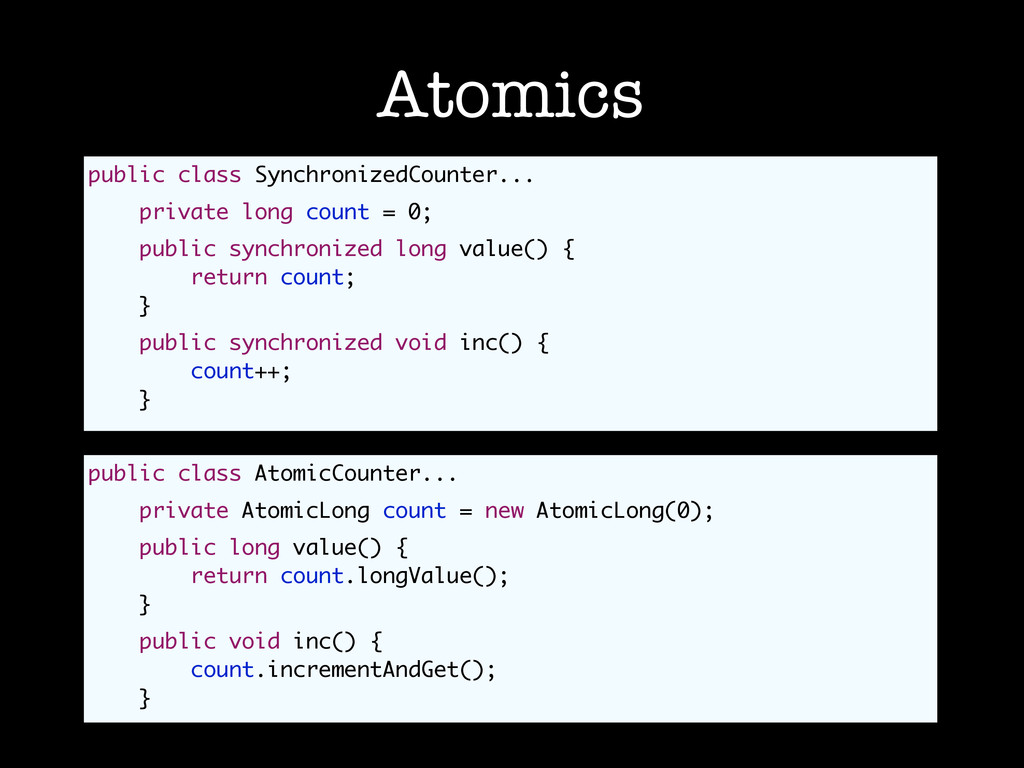
Atomics public class SynchronizedCounter... private long count = 0; public
synchronized long value() { return count; } public synchronized void inc() { count++; } public class AtomicCounter... private AtomicLong count = new AtomicLong(0); public long value() { return count.longValue(); } public void inc() { count.incrementAndGet(); } -
Und noch mehr... • Concurrent Collections • BlockingQueue • Latches,
Barriers, Exchangers & Co • Fork/Join (Java 7) -
Shelf capacity: int products: List<Product> putIn(product) takeOut(product): boolean isFull(): boolean
Product type: String Storehouse newShelf(name, size): Shelf getShelf(name): Shelf move(product, from, to): boolean shelves: Map<String, Shelf> name -
public class Shelf { private int capacity; private List<Product> products
= new ArrayList<Product>(); public Shelf(int capacity) { this.capacity = capacity; } public List<Product> getProducts() { return products; } public boolean isFull() { return products.size() == capacity; } public void putIn(Product product) { if (isFull()) throw new StorageException("shelf is full."); products.add(product); } public boolean takeOut(Product aBook) { return products.remove(aBook); } } -
public class Storehouse { private Map<String, Shelf> shelves = new
HashMap<String, Shelf>(); public Shelf newShelf(String name, int capacity) { Shelf newShelf = new Shelf(capacity); shelves.put(name, newShelf); return newShelf; } public Shelf getShelf(String name) { return shelves.get(name); } } -
public class ConcurrentShelfCreationTest extends ParallelTestCase { private volatile Storehouse store
= new Storehouse(); @Test public void createAccountsInManyThreads() throws Exception { final int numberOfShelves = 100; final AtomicInteger shelf = new AtomicInteger(0); Runnable createShelfTask = new Runnable() { @Override public void run() { String shelfName = "n" + shelf.incrementAndGet(); Shelf shelf = store.newShelf(shelfName, 1); assertNotNull("No shelf: " + shelfName, store.getShelf(shelfName)); } }; runInParallelThreads(numberOfShelves, createShelfTask); } } -
public class Storehouse { private Map<String, Shelf> shelves = new
HashMap<String, Shelf>(); public Shelf newShelf(String name, int capacity) { Shelf newShelf = new Shelf(capacity); shelves.put(name, newShelf); return newShelf; } public Shelf getShelf(String name) { return shelves.get(name); } } "No shelf: n28" -
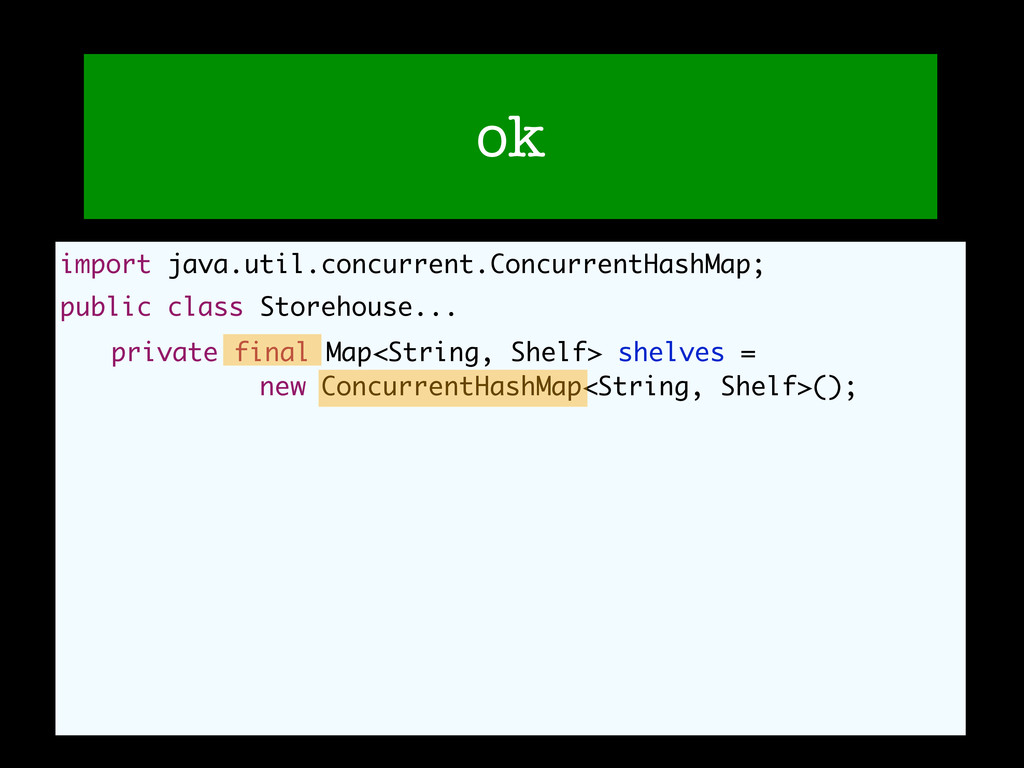
import java.util.concurrent.ConcurrentHashMap; public class Storehouse... private final Map<String, Shelf> shelves
= new ConcurrentHashMap<String, Shelf>(); ok -
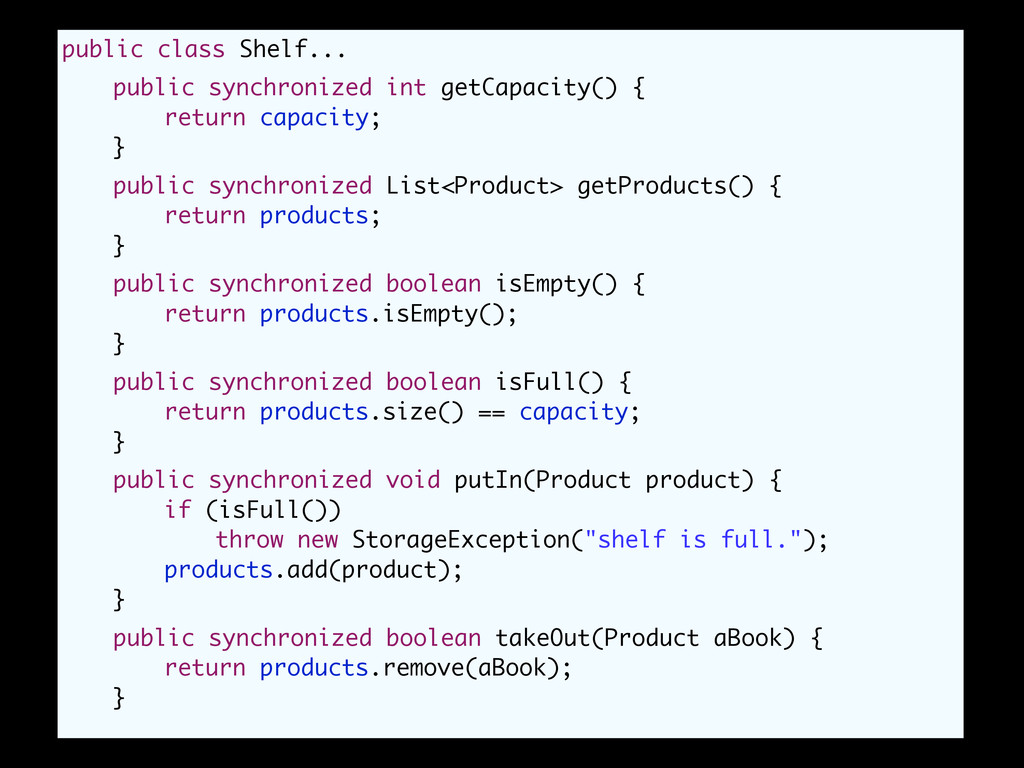
public class Shelf... public synchronized int getCapacity() { return capacity;
} public synchronized List<Product> getProducts() { return products; } public synchronized boolean isEmpty() { return products.isEmpty(); } public synchronized boolean isFull() { return products.size() == capacity; } public synchronized void putIn(Product product) { if (isFull()) throw new StorageException("shelf is full."); products.add(product); } public synchronized boolean takeOut(Product aBook) { return products.remove(aBook); } -
public class Storehouse... public boolean move( Product product, String from,
String to ) { if (!shelves.get(from).takeOut(product)) { return false; } try { shelves.get(to).putIn(product); return true; } catch (StorageException se) { shelves.get(from).putIn(product); return false; } ( public synchronized boolean move( -
public class Storehouse... public boolean move(Product product, String from, String
to) { Shelf source = shelves.get(from); Shelf target = shelves.get(to); synchronized (source) { synchronized (target) { return doMove(product, source, target); } } } private boolean doMove(Product product, Shelf src, Shelf trg) { ... } // Thread A: storehouse.move(aBook, "shelf a", "shelf b"); // Thread B: storehouse.move(anIPod, "shelf b", "shelf a"); ( -
public class Storehouse... public boolean move(Product product, String from, String
to) { Shelf source = shelves.get(from); Shelf target = shelves.get(to); Object[] locks = new Object[] { source, target }; Arrays.sort(locks); synchronized (locks[0]) { synchronized (locks[1]) { return doMove(product, source, target); } } } public class Shelf implements Comparable<Shelf>... public int compareTo(Shelf other) { return System.identityHashCode(this) - System.identityHashCode(other); } -
Für normal sterbliche Entwickler liegt die Erstellung korrekter Multi-Thread- Programme
außerhalb ihrer Fähigkeiten -
Nicht-erwähnte Probleme • Safe Publication, Java Memory Model • Cache
Lines, False Sharing • Symmetric / Asymmetric Memory • Blocking Locks vs. Spin Locks vs. Non- blocking Synchronization • Fair vs Unfair Locking • Live Locks / Starvation • etc etc etc etc -
public class ValueHolder { private List<Listener> listeners = new LinkedList<Listener>();
private int value; public static interface Listener { public void valueChanged(int newValue); } public void addListener(Listener listener) { listeners.add(listener); } public void setValue(int newValue) { value = newValue; for (Listener each : listeners) { each.valueChanged(newValue); } } } The Problem with Threads http://www.eecs.berkeley.edu/Pubs/TechRpts/2006/EECS-2006-1.pdf -
Zugrundeliegende Programmiermodell Shared mutable state (aka objects) is accessed in
multiple concurrent threads, and we use locks to synchronize / sequentialize access to the state -
Das Objekt wird zur "undichten" Abstraktion Um aus einzelnen thread-sicheren
Objekten komplexere thread-sichere Objekte zu bauen, muss der Locking-Mechanismus der Einzelobjekte bekannt sein ‣ Verletzt das Prinzip der Kapselung ‣ Verletzt das Prinzip der Modularisierung -
Alternative Paradigmen • Immutability • Transactional Memory • Actors •
Agents • Fork/Join • Map / Filter / Reduce • Dataflow Concurrency -
Immutability to rescue? • Ohne veränderlichen Zustand, müssen Veränderungen auch
nicht synchronisiert werden • Eine verändernde Operation gibt ein neues Objekt zurück -
Unveränderliches Java-Objekt public class ImmutableName { private final String first,
last; public ImmutableName(String first, String last) { this.first = first; this.last = last; } public String getFirst() { return first; } public String getLast() { return last; } @Override public int hashCode() { final int prime = 31; ... return result; } @Override public boolean equals(Object obj) { if (this == obj) ... return true; } @Override public String toString() { return ...; } } -
Unveränderliches Groovy-Objekt @Immutable class ImmutableName { String first String last
} ImmutableName setLast(newLast) { new ImmutableName(first, newLast) } } -
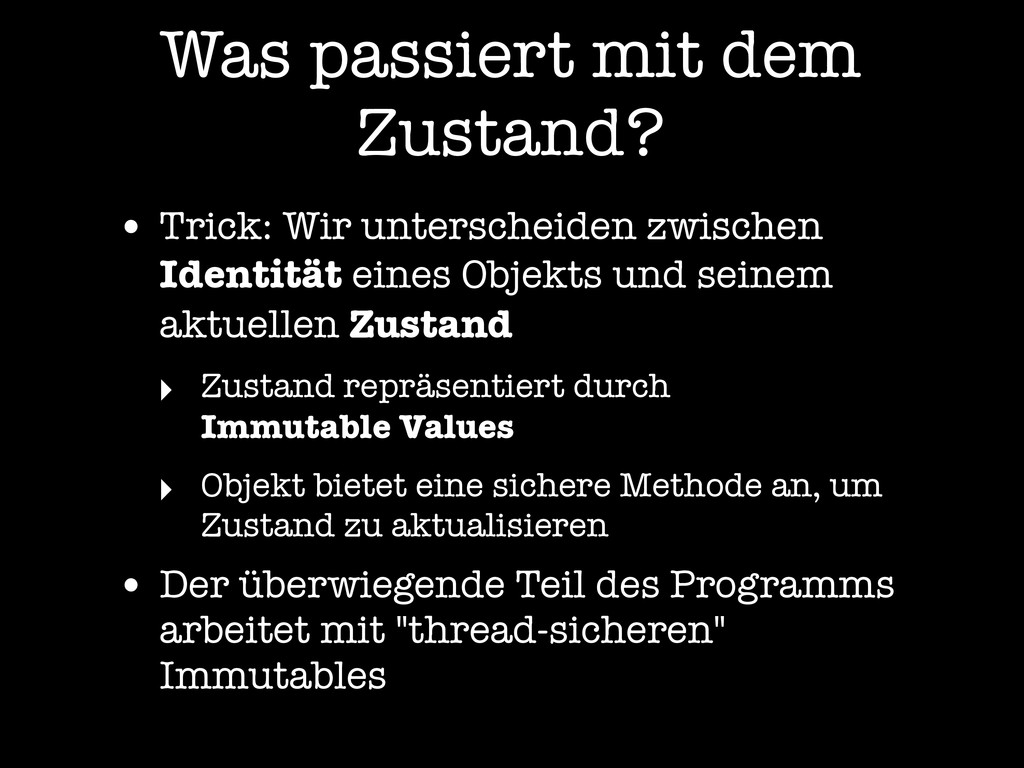
Was passiert mit dem Zustand? • Trick: Wir unterscheiden zwischen
Identität eines Objekts und seinem aktuellen Zustand ‣ Zustand repräsentiert durch Immutable Values ‣ Objekt bietet eine sichere Methode an, um Zustand zu aktualisieren • Der überwiegende Teil des Programms arbeitet mit "thread-sicheren" Immutables -
@Immutable class Shelf... int capacity List products Shelf putIn(Product product)
{ if (isFull()) throw new StorageException("shelf is full.") return cloneWith(products: new ArrayList(products) << product) } Shelf takeOut(Product product) { if (!products.contains(product)) return this return cloneWith(products: new ArrayList(products).minus(product)) } private Shelf cloneWith(changes) { def newProps = ... return new Shelf(newProps) } -
class Storehouse... final shelves = [:] as ConcurrentHashMap Shelf newShelf(String
name, int size) { def newShelf = new Shelf(size, [], 0) shelves[name] = newShelf return newShelf } Shelf getAt(String name) { return shelves[name] } synchronized boolean update(Map shelvesToUpdate) { if (shelvesToUpdate.any {name, shelf -> shelves[name].version != shelf.version }) return false shelvesToUpdate.each {name, shelf -> shelves[name] = shelf.incVersion() } return true } -
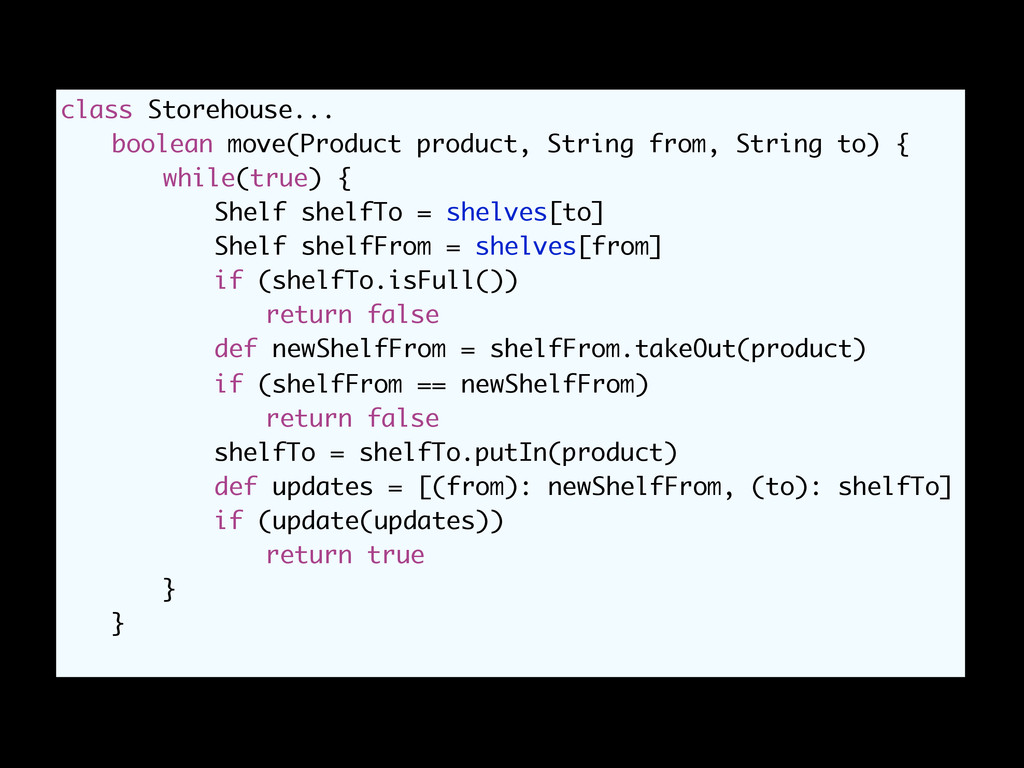
class Storehouse... boolean move(Product product, String from, String to) {
while(true) { Shelf shelfTo = shelves[to] Shelf shelfFrom = shelves[from] if (shelfTo.isFull()) return false def newShelfFrom = shelfFrom.takeOut(product) if (shelfFrom == newShelfFrom) return false shelfTo = shelfTo.putIn(product) def updates = [(from): newShelfFrom, (to): shelfTo] if (update(updates)) return true } } -
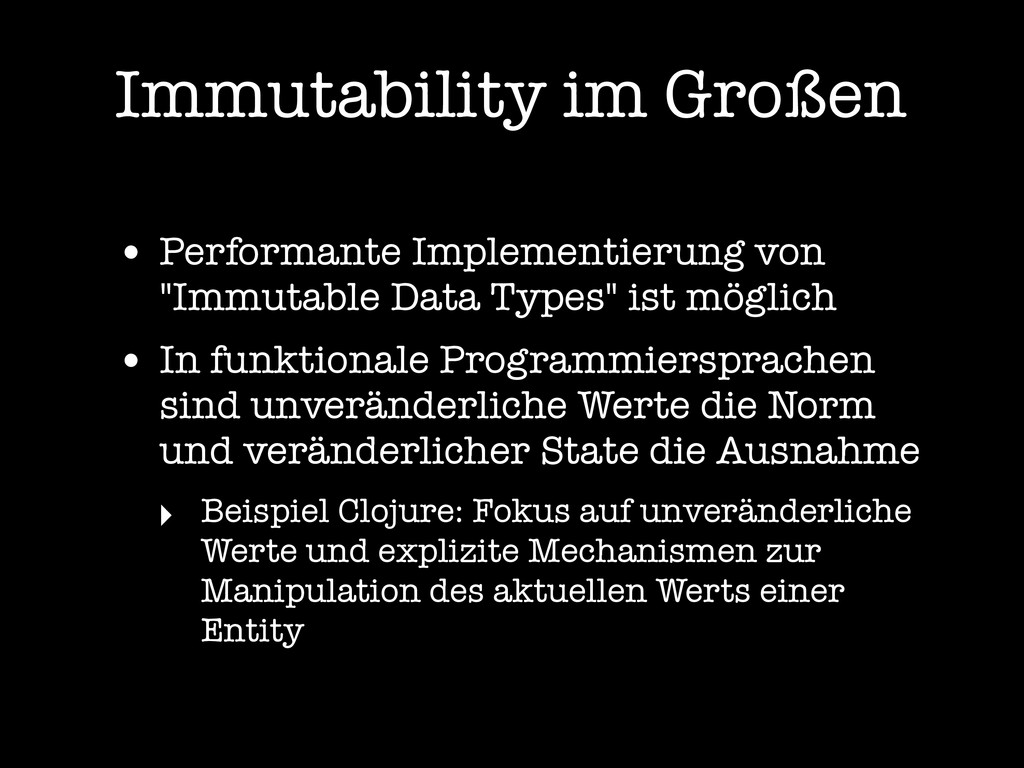
Immutability im Großen • Performante Implementierung von "Immutable Data Types"
ist möglich • In funktionale Programmiersprachen sind unveränderliche Werte die Norm und veränderlicher State die Ausnahme ‣ Beispiel Clojure: Fokus auf unveränderliche Werte und explizite Mechanismen zur Manipulation des aktuellen Werts einer Entity -
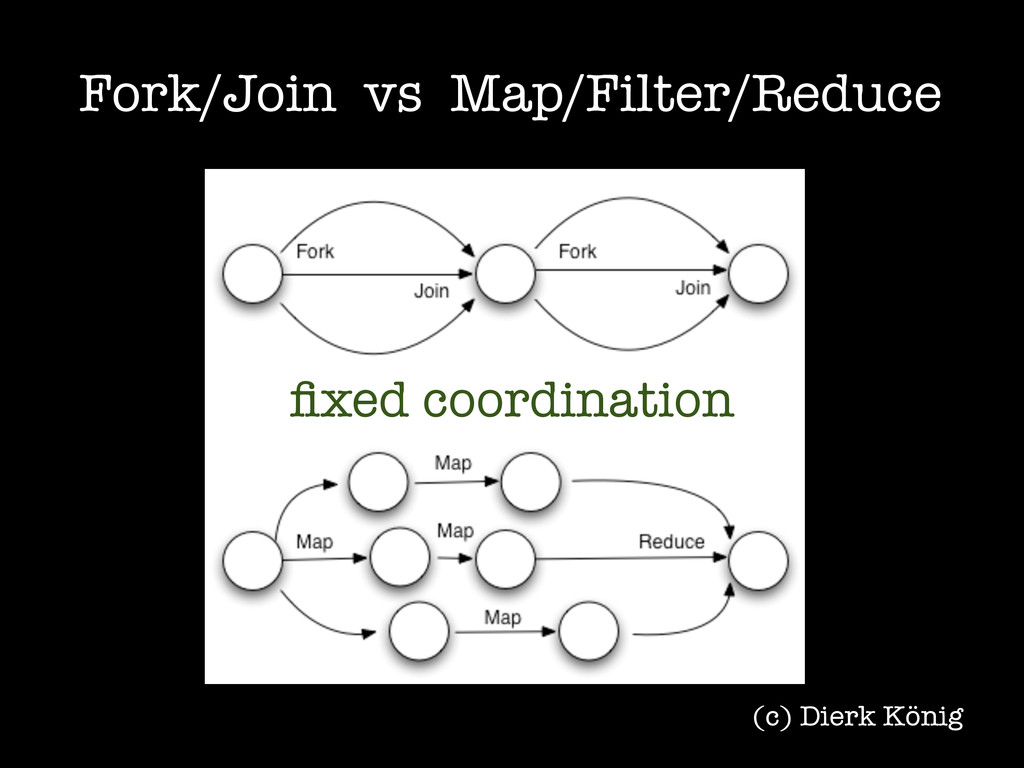
It‘s the coordination, stupid! Paradigma Koordination Immutability No coordination Fork/Join
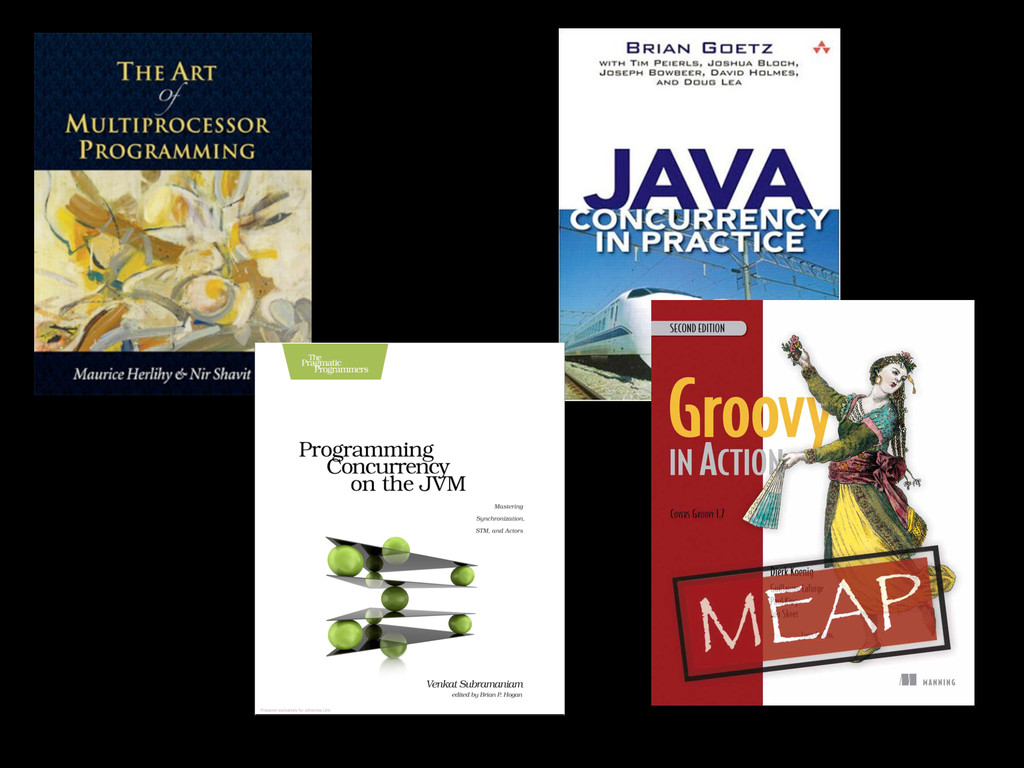
Map/Reduce Working on collections with fixed coordination Locking, Actors Explicit coordination Agent, STM Delegated coordination Dataflow Implicit coordination (c) Dierk König: Groovy in Action, 2nd ed, ch. 17 -
Transactional Memory • Heap als transaktionale Datenmenge • Transaktionseigenschaften ähnlich
wie bei einer Datenbank (ACID) • Optimistische Transaktionen ‣ Transaktionen werden bei einer Kollision automatisch wiederholt • Transaktionen können geschachtelt werden ✘ -
public class Shelf... void putIn(Product product) { atomic { if
(isFull()) throw new StorageException("...") products << product } } boolean takeOut(Product product) { atomic { return products.remove(product); } } public class Storehouse... boolean move(Bank bank) { atomic { if (!shelves[to].isFull() && shelves[from].takeOut(product)) { shelves[to].putIn(product) return true } return false } } -
• Wir können weiterhin in "shared state" und Transaktionen denken
• Die korrekte Verwendung ist wesentlich einfacher als bei Locks: Deadlocks sind ausgeschlossen! • Wir gewinnen die Komponierbarkeit von Objekten zurück Vorteile von TM -
• Keinerlei Hilfe, wie wir unser sequenzielles Programm parallelisieren. •
Der Fortschritt ist nicht garantiert. Livelocks sind möglich. • Ein Programm mit Transaktionen bleibt nicht deterministisch. • Keine Seiteneffekte in Transaktion erlaubt • Die performante und semantisch intuitive Implementierung ist noch Forschungsthema. Nachteile von TM -
• Hardware Transactional Memory • Software Transactional Memory ‣ Clojure:
Programmiersprache auf der JVM, die STM eingebaut hat ‣ Java-STM-Frameworks: Akka, Deuce, Multiverse, Gpars TM-Implementierungen -
STM in Clojure • Nur explizit gekennzeichneter State (References) wird
in Transaktion mit einbezogen • Alle anderen Daten / Objekte sind immutable -
Clojure-Beispiel: Shelf (defn empty-shelf [capacity] {:products '() :capacity capacity}) (defn
put-in [shelf product] (if (= (count (shelf :products )) (shelf :capacity )) (throw (Exception. "Shelf is full.")) (assoc shelf :products (conj (shelf :products ) product)))) (defn take-out [shelf product] (assoc shelf :products (remove #(= % product) (shelf :products )))) -
Clojure-Beispiel: Storehouse (defn empty-storehouse [] (ref {})) (defn add-shelf [map
name shelf] (assoc map name shelf)) (defn replace-shelf [map name shelf] (add-shelf map name shelf)) (defn new-shelf [store name capacity] (dosync (alter store add-shelf name (empty-shelf capacity)))) (defn update-shelf [store shelf-map] (dosync ...)) (defn put-in-shelf [store shelf-name product] (dosync ...)) (defn take-from-shelf [store shelf-name product] (dosync ...)) (defn move [store product from-name to-name] (dosync (put-in-shelf store to-name product) (take-from-shelf store from-name product))) -
class Storehouse... boolean move(Product product, String from, String to) {
while(true) { Shelf shelfTo = shelves[to] Shelf shelfFrom = shelves[from] if (shelfTo.isFull()) return false def newShelfFrom = shelfFrom.takeOut(product) if (shelfFrom == newShelfFrom) return false shelfTo = shelfTo.putIn(product) def updates = [(from): newShelfFrom, (to): shelfTo] if (update(updates)) return true } } -
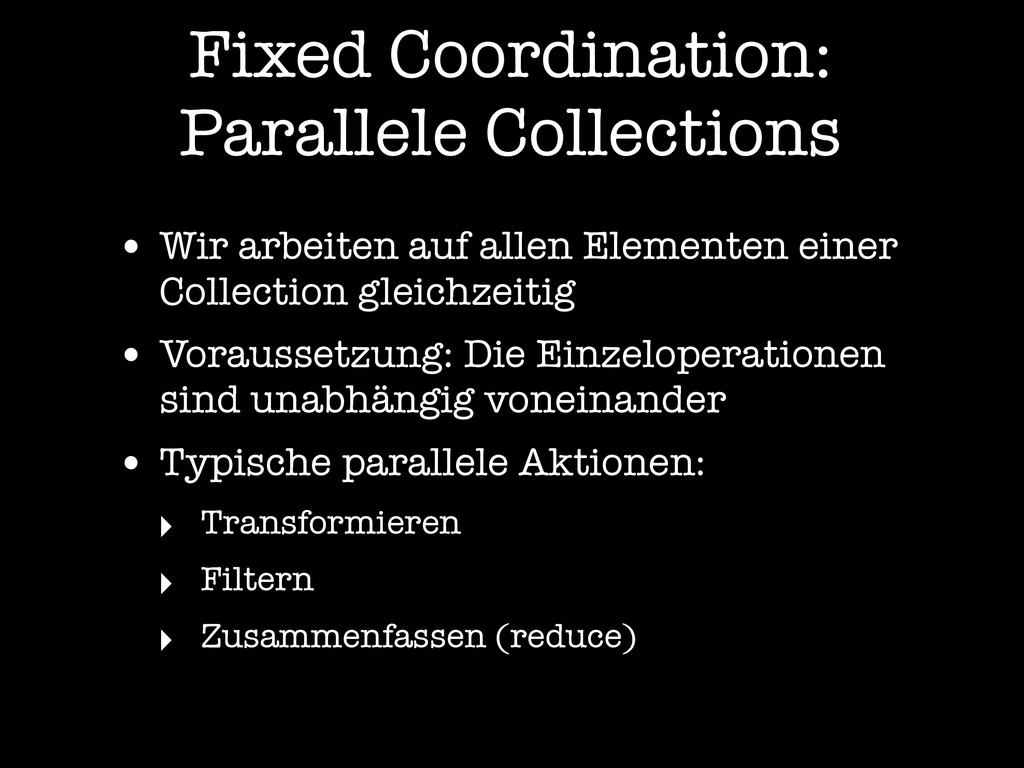
Fixed Coordination: Parallele Collections • Wir arbeiten auf allen Elementen
einer Collection gleichzeitig • Voraussetzung: Die Einzeloperationen sind unabhängig voneinander • Typische parallele Aktionen: ‣ Transformieren ‣ Filtern ‣ Zusammenfassen (reduce) -
Fork/Join on collections import static groovyx.gpars.GParsPool.withPool def numbers = [1,
2, 3, 4, 5, 6] withPool { assert 91 == numbers .collectParallel { it * it } .sumParallel() } -
More such methods any { ... } collect { ...
} count(filter) each { ... } eachWithIndex { ... } every { ... } find { ... } findAll { ... } findAny { ... } fold { ... } fold(seed) { ... } grep(filter) groupBy { ... } max { ... } max() min { ... } min() split { ... } sum() -
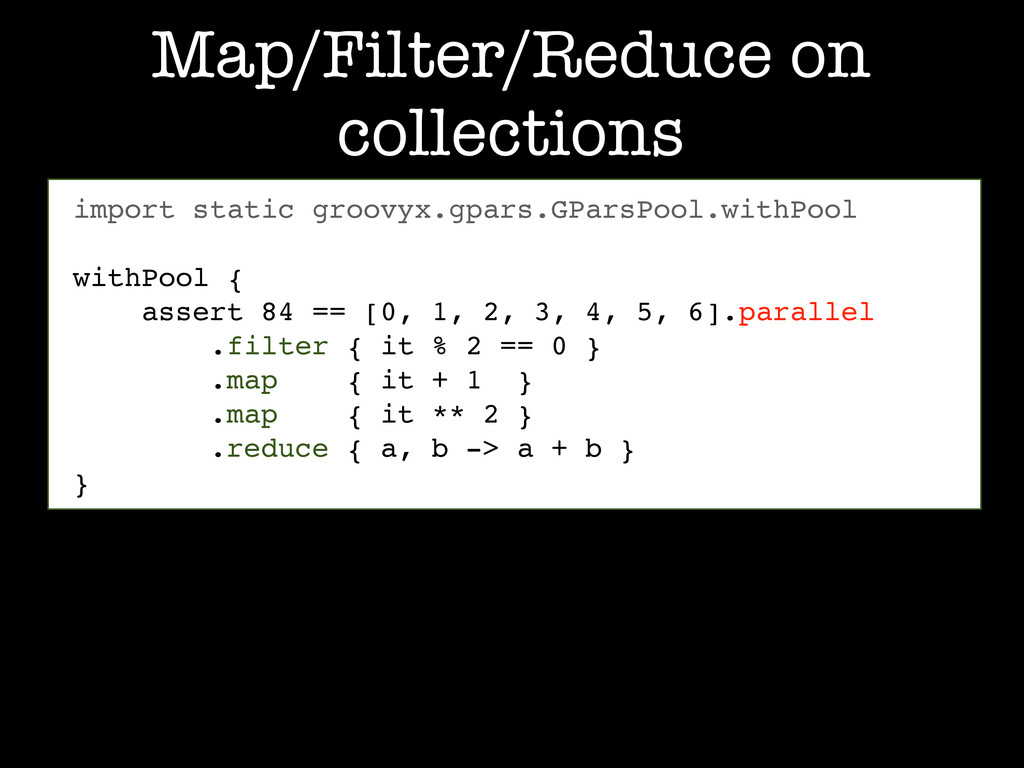
Map/Filter/Reduce on collections import static groovyx.gpars.GParsPool.withPool withPool { assert 84
== [0, 1, 2, 3, 4, 5, 6].parallel .filter { it % 2 == 0 } .map { it + 1 } .map { it ** 2 } .reduce { a, b -> a + b } } -
Explicit Coordination: Message Passing - Actors • Vollständiger Verzicht auf
"shared state" • Aktoren empfangen und verschicken Nachrichten ‣ Asynchron und nicht-blockierend ‣ Jeder Actor hat seine "Mailbox" • Immer nur ein aktiver Thread pro Aktor -
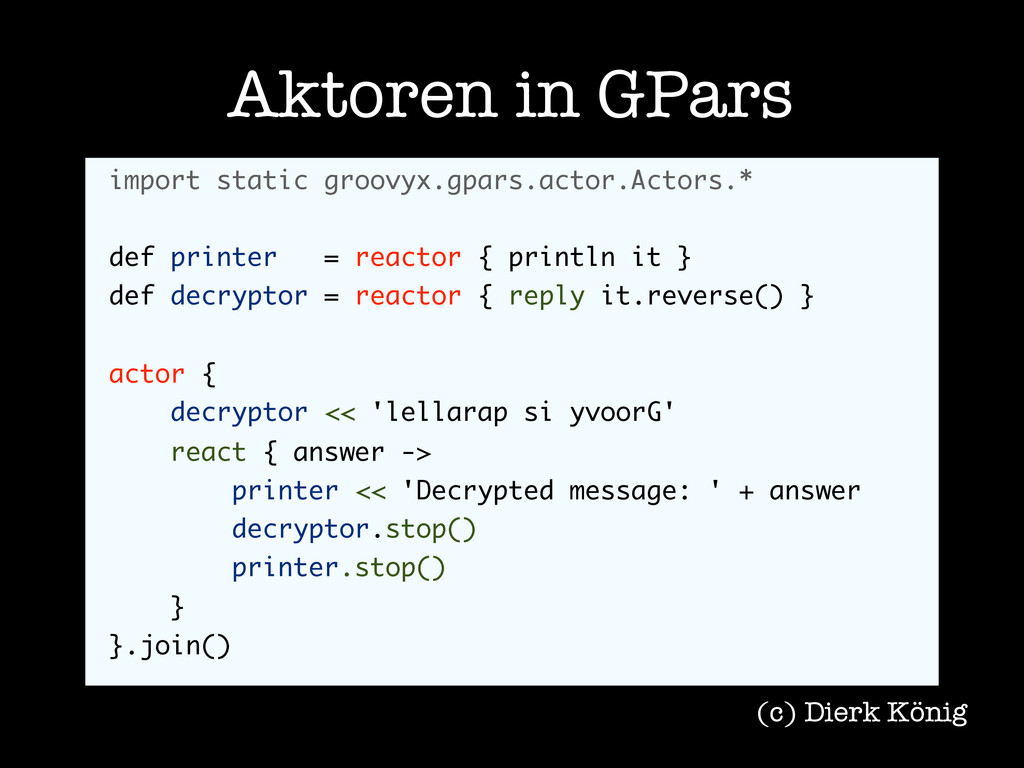
Aktoren in GPars import static groovyx.gpars.actor.Actors.* def printer = reactor
{ println it } def decryptor = reactor { reply it.reverse() } actor { decryptor << 'lellarap si yvoorG' react { answer -> printer << 'Decrypted message: ' + answer decryptor.stop() printer.stop() } }.join() (c) Dierk König -
Actors - Vorteile • Unabhängige Aktoren • Skalierbar • Verteilbar
• Leichtere Vermeidung von ‣ Race Conditions ‣ Dead Locks ‣ Starvation -
Actors - Nachteile • Explizite Koordination notwendig! • Kommunikation über
asynchrone Nachrichten ist für viele Problemstellungen eine Komplizierung • Nicht geeignet für Probleme, die einen echten Konsens über gemeinsame Objekte erfordern -
Aktoren in Erlang • Aktoren: Prozesse + Modul • Selektiver
Nachrichtenempfang • "Warten auf Nachrichten" als Continuation • Endrekursive Funktionen zur Zustands -
loop(KeyValues) -> receive {key, Sender, Key} -> receive {value, Sender,
Value} -> NewElement = {Key, Value}, loop([NewElement | KeyValues]) end; {get, Sender, Key} -> reply(Sender, getValue(KeyValues, Key)), loop(KeyValues); stop -> ok end. reply(Sender, ReplyMsg) -> Sender ! {self(), ReplyMsg}. getValue(..,..) -> ... -
Erlang Process Patterns • Process should encapsulate an activity, not
a task • Archetypes of processes ‣ Client / Server ‣ Finite State Machine ‣ Event Manager / Event Handler • Supervisor hierarchies for robustness and fault tolerance -
JVM-Probleme für nebenläufiges Programmieren • Kurz- und mittelfristig ‣ keine
Closures ‣ keine nativen persistenten Datenstrukturen ‣ die meisten Java-Bibliotheken nicht thread-sicher • Langfristig ‣ Keine Unterstützung von Coroutines/Continuations ‣ Late binding verhindert Sicherheit ‣ Task-basierte Concurrency skaliert nicht gut ‣ Keine performante Kommunikation zwischen Tasks ‣ Keine Optimierung für End-Rekursion -
Delegate to an Agent import groovyx.gpars.agent.Agent def safe = new
Agent<Storehouse>( storehouse ) safe << { move ... } println safe.val -
Agents • Sie kapseln nicht threadsichere (Java-) Komponenten • Konzeptionell
ähnlich wie Agents in Clojure • Implementierung unterscheiden sich stark in Effizienz -
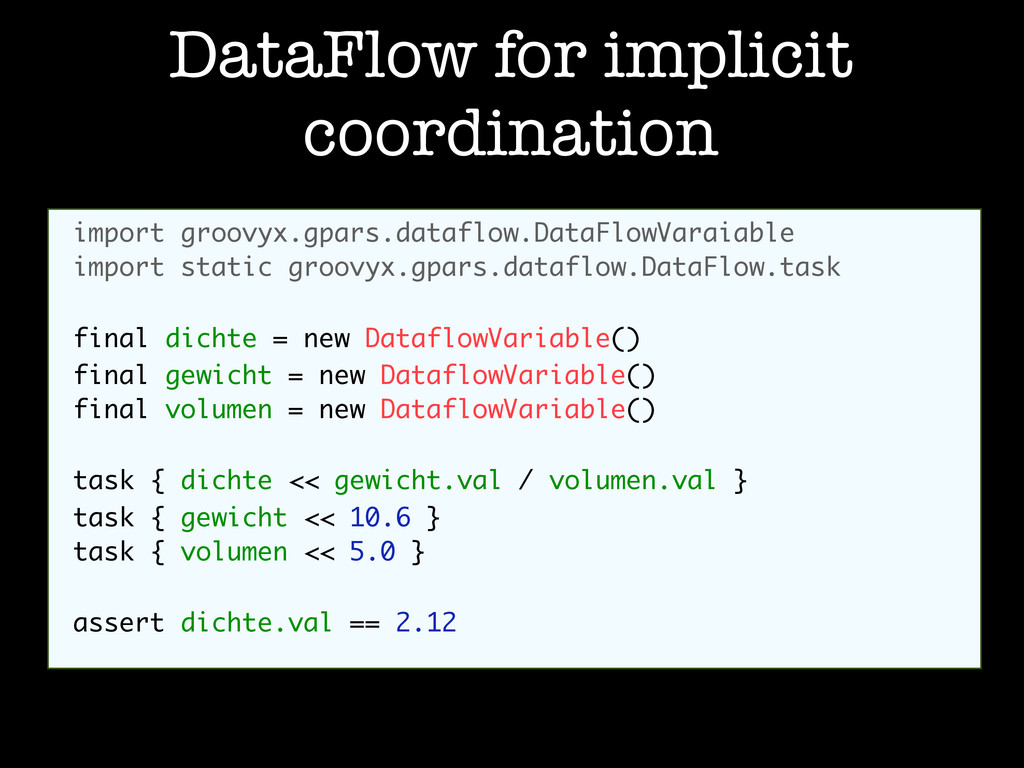
DataFlow for implicit coordination import groovyx.gpars.dataflow.DataFlowVaraiable import static groovyx.gpars.dataflow.DataFlow.task final
dichte = new DataflowVariable() final gewicht = new DataflowVariable() final volumen = new DataflowVariable() task { dichte << gewicht.val / volumen.val } task { gewicht << 10.6 } task { volumen << 5.0 } assert dichte.val == 2.12 -
DataFlow • Write-Once, Read-Many (non-blocking) • Flavors: variables, streams, operators,
tasks, flows • Model the flow of data, not the control flow! -
Dataflow-Operators final leftAddend = new DataflowQueue() final rightAddend = new
DataflowQueue() final sum = new DataflowQueue() operator(inputs: [leftAddend, rightAddend], outputs: [sum], { left, right -> sum << left + right }) task { [10, 20, 30].each { leftAddend << it } } task { [100, 200, 300].each { rightAddend << it } } [110, 220, 330].each { assert it == sum.val } -
Vorteile von Dataflows • Kein Locking notwendig • Keine Race-Conditions
• Deterministisch ‣ Deadlocks sind möglich, sie passieren dann aber immer! • Kein Unterschied zwischen sequenziellem und nebenläufigem Code • Skalieren gut -
Mehr über Data Flows • Einschränkungen ‣ Nicht für jede
Problemstellung geeignet ‣ Berechnungen dürfen keine Seiteneffekte haben • Erweiterungen ‣ Data flow streams, Data flow operators • Andere JVM-Implementierungen ‣ Scala Dataflow (akka), FlowJava (akademisch & tot) -
Takeaways • Shared mutable state ist böse • Andere Paradigmen
sind einfacher zu verstehen, erfordern aber häufig ein Umdenken bei Design / Architektur • Java als Sprache hat zu viel Zeremonie, um alternative Ansätze knapp und lesbar schreiben zu können ‣ Groovy / Gpars sehr gut zum Experimentieren • JVM als Plattform ist für manche Ansätze nicht optimal geeignet -
Links Code-Beispiele https://github.com/jlink/ ConcurrencyOnJvmAndElsewhere Hinweise http://jax.de http://www.parallel2012.de Sonderheft iX Multicore
(Dez. 2011) Zum Ausprobieren http://gpars.codehaus.org/ http://clojure.org/ http://www.erlang.org
 kishida
 minodriven
 barnbarn
 allegrogiken
 hrmstrsmgs
 picopico
 shivamsaraswat
 a_okui
 oukayuka
 ssssota
 shiita0903
 steliosf
 smashingmag
 philnash
 szymonslowik
 watany
 minecr
 sstephenson
 jlugia
 sabderemane
 tammyeverts
 aemeredith
 axbom
 lara