Share
Embed
You Used Python For WHAT?!
A talk I gave on various things I've attempted to do in Python over the years. Given 2012-03-22 at the Boston Python Meetup.
James Tauber
March 22, 2012
Transcript
81 slides
-
THE TOPICS •Some Mathematics •Some Weird Programming Languages •Analyzing Keyboard
Performances •Generating Ancient Greek Graded Readers •Emulating the Apple ][ •Writing an Operating System -
EIGHT COMMANDS > increment the data pointer < decrement the
data pointer + increment the byte at the data pointer - decrement the byte at the data pointer . output the byte at the data pointer as an ASCII-encoded character , accept one byte of input, storing its value in the byte at the data pointer [ if the byte at the data pointer is zero, jump forward after matching ] ] if the byte at the data pointer is nonzero, jump back after matching [ -
>+++++++++[<++++++++>-]<. >+++++++[<++++>-]<+. +++++++. . +++. [-]>++++++++[<++++>-]<. >+++++++++++[<++++++++>-]<-. --------. +++. ------.
--------. [-]>++++++++[<++++>-]<+. [-]++++++++++. -
class brainf: def __init__(self, program): self.mem = [0] * 65536
self.p = 0 self.pc = 0 self.program = program -
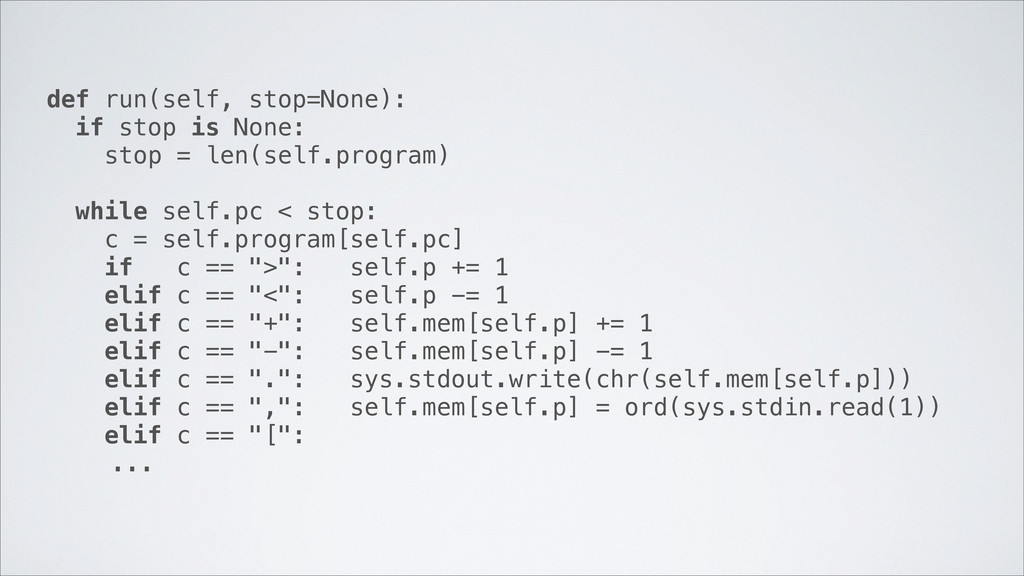
def run(self, stop=None): if stop is None: stop = len(self.program)
while self.pc < stop: c = self.program[self.pc] if c == ">": self.p += 1 elif c == "<": self.p -= 1 elif c == "+": self.mem[self.p] += 1 elif c == "-": self.mem[self.p] -= 1 elif c == ".": sys.stdout.write(chr(self.mem[self.p])) elif c == ",": self.mem[self.p] = ord(sys.stdin.read(1)) elif c == "[": ... -
elif c == "[": depth = 1 start = end
= self.pc while depth: end += 1 if self.program[end] == "[": depth += 1 if self.program[end] == "]": depth -= 1 while self.mem[self.p]: self.pc = start + 1 self.run(end) self.pc = end elif c == "]": raise "unbalanced ]" else: pass self.pc += 1 -
def reciprocal((n, d)): return (d, n) def one_take((n, d)): return
(d - n, d) def proper_fraction((n, d)): return (n // d, (n % d, d)) def improper_fraction(i, (n, d)): return ((d * i) + n, d) -
def rationals(): r = (0,1) while True: n, y =
proper_fraction(r) z = improper_fraction(n, one_take(y)) r = reciprocal(z) yield r -
def rationals(): r = (0,1) while True: r = (r[1],
(r[1] * (r[0] // r[1])) + (r[1] - (r[0] % r[1]))) yield r -
def rationals(r=(0,1)): while True: r = (r[1], (r[1] * (r[0]
// r[1])) + (r[1] - (r[0] % r[1]))) yield r -
def pi(): N = 0 n, d = 0, 1
while True: xn = (120*N**2 + 151*N + 47) xd = (512*N**4 + 1024*N**3 + 712*N**2 + 194*N + 15) n = ((16 * n * xd) + (xn * d)) % (d * xd) d *= xd yield 16 * n // d N += 1 -
EVEN WHEN I’VE IMPLEMENTED IT IN PYTHON, THAT DOESN’T MEAN
I UNDERSTAND IT -
TRUE = lambda a: lambda b: (a) FALSE = lambda
a: lambda b: (b) (TRUE)(True)(False) == True (FALSE)(True)(False) == False -
AND = lambda a: lambda b: (a)(b)(a) OR = lambda
a: lambda b: (a)(a)(b) NOT = lambda a: lambda b: lambda c: (a)(c)(b) (AND)(TRUE)(FALSE) == (FALSE) (AND)(TRUE)(FALSE)(True)(False) == False -
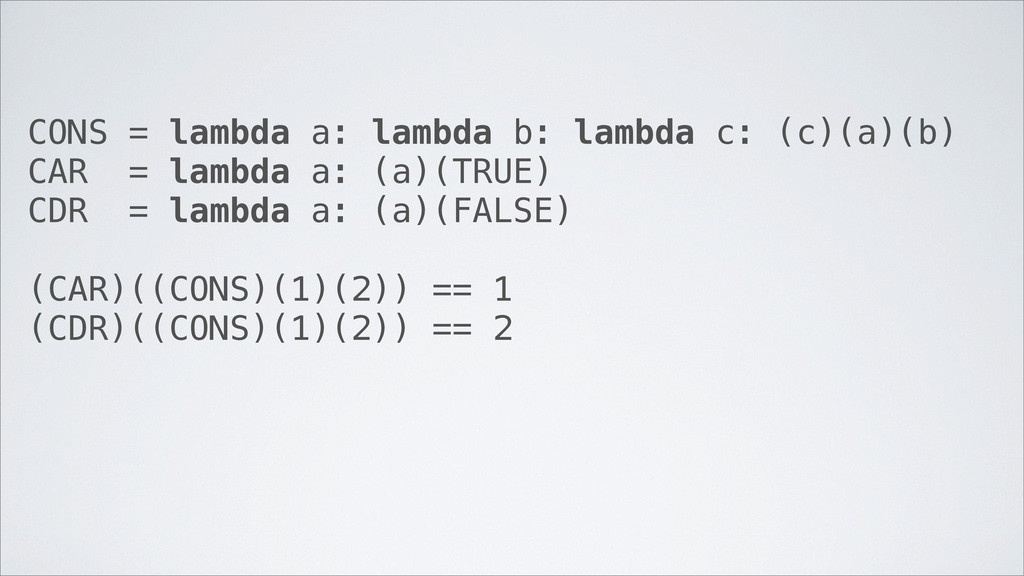
CONS = lambda a: lambda b: lambda c: (c)(a)(b) CAR
= lambda a: (a)(TRUE) CDR = lambda a: (a)(FALSE) (CAR)((CONS)(1)(2)) == 1 (CDR)((CONS)(1)(2)) == 2 -
ZERO = FALSE SUCC = lambda a: lambda b: lambda
c: (b)((a)(b)(c)) ONE = (SUCC)(ZERO) TWO = (SUCC)(ONE) THREE = (SUCC)(TWO) FOUR = (SUCC)(THREE) def church_number(n): return SUCC(church_number(n - 1)) if n else FALSE -
PLUS = lambda a: lambda b: lambda c: lambda d:
(a)(c)((b)(c)(d)) MULT = lambda a: lambda b: lambda c: (b)((a)(c)) EXP = lambda a: lambda b: (b)(a) UNCHURCH_NUMBER = lambda a: (a)(lambda b: b + 1)(0) -
(UNCHURCH_NUMBER)(ZERO) == 0 (UNCHURCH_NUMBER)(ONE) == 1 (UNCHURCH_NUMBER)(TWO) == 2 (UNCHURCH_NUMBER)((PLUS)(THREE)(TWO))
== 5 (UNCHURCH_NUMBER)((MULT)(THREE)(TWO)) == 6 (UNCHURCH_NUMBER)((EXP)(THREE)(TWO)) == 9 -
GIT FUNDAMENTALS • each file’s contents (called a blob) are
hashed and that hash becomes a key into a dictionary of files • each directory is viewed as a sorted list of filenames paired with hash of file’s contents • this directory listing can then be hashed and so an entire directory tree can be hashed • a tree’s hash + commit message + committer + timestamp + parent(s) can then be hashed -
class NodeBase: def __init__(self, repo, content): self.repo = repo self.content
= self.shrink(content) def __bytes__(self): return ("%s\n%r" % (self.__class__, self.content) ).encode("utf-8") class Atom(NodeBase): def shrink(self, content): return content def expand(self): return self.content -
class List(NodeBase): def shrink(self, content): return [ self.repo.shrink(item) for item
in content ] def expand(self): return [ self.repo.expand(item) for item in self.content ] -
class Repo: def __init__(self): self.objects = {} self.refs = {}
self.HEAD = "master" def store(self, obj): sha = hashlib.sha1(bytes(obj)).hexdigest() self.objects[sha] = obj return sha -
def shrink(self, content): if isinstance(content, dict): return self.store(Dictionary(self, content)) elif
isinstance(content, list): return self.store(List(self, content)) elif isinstance(content, tuple): return self.store(Tuple(self, content)) else: return self.store(Atom(self, content)) -
def create_commit(self, obj_sha, message, parents=None): if parents is None: parents
= [] return self.store( Commit(self, obj_sha, message, parents)) def commit(self, obj, message): obj_sha = self.shrink(obj) old_head = self.refs[self.HEAD] commit_sha = self.create_commit( obj_sha, message, parents=[old_head]) self.refs[self.HEAD] = commit_sha return commit_sha -
def create_branch(self, branch_name, commit_sha=None): if commit_sha is None: commit_sha =
self.refs[self.HEAD] self.refs[branch_name] = self.refs[self.HEAD] def checkout_branch(self, branch_name): self.HEAD = branch_name -
THE BASIC IDEA •record a performance of the exercise /
piece as MIDI (or similar) events •align the performed notes with the “score” notes •identify errors as well as fluctuations in timing, velocity, etc. •basically a performance “diff” -
A_notes = [1, 2, 3, 2, 1, 3, 4, 5,
6, 5, 4, 5, 6, 5, 4, 3] B_notes = [6, 5, 4, 5, 6, 4, 3, 2, 1, 2, 3, 2, 1, 2, 3, 4] C_notes = [6, 5, 4, 5, 6, 4, 3, 2, 1, 2, 3, 2, 1, 2, 3, 2] D_notes = [1] scale = [0, 2, 4, 5, 7, 9, 11] full_scale = scale + [12 + i for i in scale] + [24 + i for i in scale] sections = [ (A_notes, 4, [0, 1, 2, 3, 4, 5, 6, 7, 8, 9, 10, 11, 12, 13]), (B_notes, 4, [13, 12, 11, 10, 9, 8, 7, 6, 5, 4, 3, 2, 1]), (C_notes, 4, [0]), (D_notes, 32, [0]) ] for section in sections: pattern, duration_64, offset = section for o in offset: for note in pattern: print >>f, 48 + full_scale[note + o - 1], duration_64 -
48 4 50 4 52 4 50 4 48 4
52 4 ... SCORE -
#!/usr/bin/env python from mac import CoreMIDI import time start =
time.time() def callback(event): if event[0] == 156: print time.time() - start, event[1], event[2] CoreMIDI.pyCallback = callback while True: pass -
4.44376397133 48 73 4.6487929821 50 59 4.68273806572 48 0 4.81475901604
50 0 4.83673501015 52 66 5.03977394104 50 69 5.04273104668 52 0 5.23374605179 50 0 5.24569511414 48 70 5.45274806023 52 63 5.4536960125 48 0 5.63474702835 52 0 PERFORMANCE -
align with Needleman-Wunsch algorithm def note_similarity(score_note, performance_note): if score_note[0] ==
performance_note[1]: return 1 elif abs(score_note[0] - performance_note[1]) < 3: return 0.5 else: return 0 with a -1 for insertions and deletions plan to tweak to include velocity, duration, etc -
FUTURE PLANS •represent performance as MIDI file •represent score as
lilypond (and/or Sebastian) •generate anotated score showing mistakes •with fingering information, highlight deficiencies of particular fingers •grade performances •study expression -
THE BASIC IDEA •overcoming limitations of inductive, corpus-based learning of
a language •generate graded readers •build up from much smaller pieces •optimize ordering of vocabulary •present in larger context even when context is not yet understood in target language -
THE MYTH OF VOCABULARY COVERAGE The 10 most common words
account for 37% of the text The 100 most common words account for 66% of the text -
THE MYTH OF VOCABULARY COVERAGE if you learn top 100
words, you’ll know... one word in 99.9% of verses 50% of words in 91.3% of verses 75% of words in 24.4% of verses 90% of words in 2.1% of verses 95% of words in 0.6% of verses 100% of words in 0.4% of verses -
THE MYTH OF VOCABULARY COVERAGE if you learn top 100
words, you’ll know... one word in 99.9% of verses 50% of words in 91.3% of verses 75% of words in 24.4% of verses 90% of words in 2.1% of verses 95% of words in 0.6% of verses 100% of words in 0.4% of verses -
VOCABULARY ORDERING •frequency ordering is far from optimal •vocabulary ordering
as traveling salesman problem •simulated annealing -
def calc_score(self, target_list): known_items = set() score = 0.0 num_targets
= float(len(target_list)) for step, target in enumerate(target_list): to_learn = target.prereqs - known_items score += len(to_learn) * step / num_targets known_items.update(to_learn) return score SIMULATED ANNEALING -
while temp > final_temp: for i in range(iterations): s1 =
self.scorer.calc_score(target_list) p1 = randrange(0, num_targets) p2 = randrange(0, num_targets) new_list = self.swap(target_list, p1, p2) s2 = self.scorer.calc_score(new_list) if s2 > s1: target_list = new_list else: if random() < exp((s2 - s1) / temp): target_list = new_list temp = temp * alpha -
# a dictionary mapping targets to a set of items
that are # needed (and initially missing) MISSING_IN_TARGET = defaultdict(set) ... # for each item, a score of how bad it is that it is missing MISSING_ITEMS = defaultdict(int) for missing in MISSING_IN_TARGET.values(): for item in missing: MISSING_ITEMS[item] += 1. / (2 ** len(missing)) if not MISSING_ITEMS: break next_item = sorted(MISSING_ITEMS, key=MISSING_ITEMS.get)[-1] for target in TARGETS_MISSING[next_item]: MISSING_IN_TARGET[target].remove(next_item) -
OTHER WORK AND FUTURE PLANS •consideration of other prerequisite knowledge
•intrinsic difficulty of a word (cognates, etc) •partial dynamic interlinears •inline replacement -
THE BASIC IDEA •run the Python VM on bare metal
•remove parts of CPython that assume an operating system •minimize libc •add built-ins to directly access memory and I/O ports •write drivers, etc in Python •even “must be written in assembly” parts use python-like syntax -
static PyMethodDef ports_methods[] = { ! {"inb", ports_inb, METH_VARARGS, NULL},
! {"outb", ports_outb, METH_VARARGS, NULL}, ! {NULL, NULL}, }; PyObject * _Ports_Init(void) { ! return Py_InitModule4("ports", ports_methods, ! ! NULL, (PyObject *)NULL, PYTHON_API_VERSION); } -
static PyObject * ports_outb(PyObject *self, PyObject *args) { ! PyObject
*v, *a; ! if(!PyArg_UnpackTuple(args, "outb", 2, 2, &v, &a)) ! ! return NULL; ! if(!PyInt_CheckExact(a)) ! ! return NULL; ! if(PyInt_CheckExact(v)) ! ! outb(PyInt_AS_LONG(a),PyInt_AS_LONG(v)); ! else if(PyString_Check(v) && PyString_GET_SIZE(v) == 1) ! ! outb(PyInt_AS_LONG(a), PyString_AS_STRING(v)[0]); ! else ! ! return NULL; ! ! Py_INCREF(Py_True); ! return Py_True; } -
import ports def on(freq): if freq: ports.outb(freq, 0x42) ports.outb(freq >>
8, 0x42) ports.outb(ports.inb(0x61) | 0x03, 0x61) else: off() def off(): ! ports.outb(inb(0x61) & 0xFC, 0x61) SPEAKER -
import ports def get_scancode(): while not (ports.inb(0x64) & 0x21) ==
0x01: pass return ports.inb(0x60) KEYBOARD -
TWO APPROACHES TO VM •start with full CPython and remove
bits as you hit problems •start with nothing and add just the CPython bits you need -
FUTURE PLANS •proper memory management •less task-specific subsetting of CPython
•PyPy instead of CPython? -
self.ops[0xA8] = lambda: self.TAY() self.ops[0xA9] = lambda: self.LDA(self.immediate_mode()) self.ops[0xAA] =
lambda: self.TAX() self.ops[0xAC] = lambda: self.LDY(self.absolute_mode()) self.ops[0xAD] = lambda: self.LDA(self.absolute_mode()) -
def update_nz(self, value): value = value % 0x100 self.zero_flag =
[0, 1][(value == 0)] self.sign_flag = [0, 1][((value & 0x80) != 0)] return value -
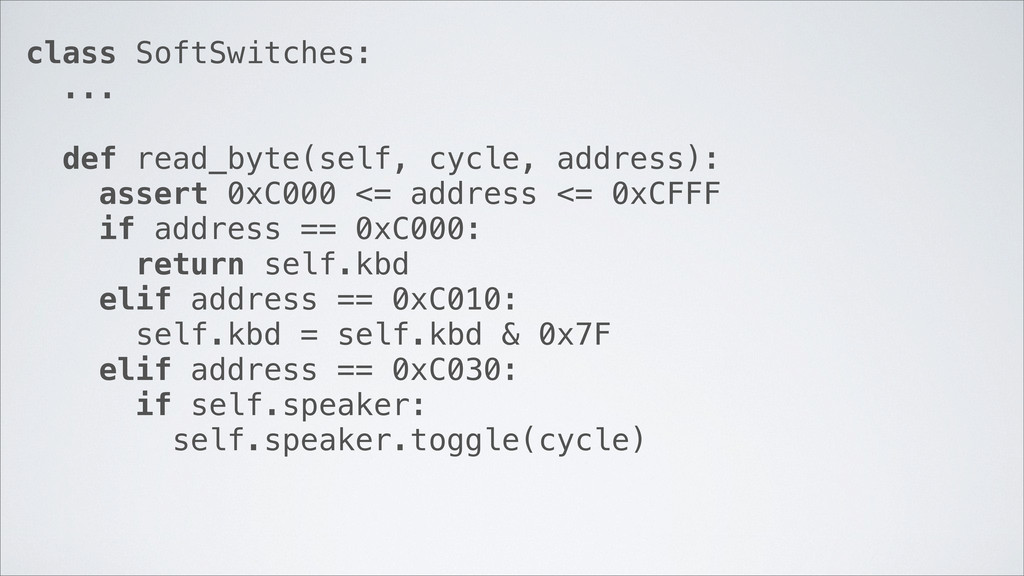
class SoftSwitches: ... def read_byte(self, cycle, address): assert 0xC000 <=
address <= 0xCFFF if address == 0xC000: return self.kbd elif address == 0xC010: self.kbd = self.kbd & 0x7F elif address == 0xC030: if self.speaker: self.speaker.toggle(cycle) -
OTHER THINGS •Forth Interpreter •Pascal Interpreter (as a prolegomenon to
even more insanity) •Relational Algebra Implementation •Quantum Computing •Unicode Collation Algorithm Implementation •Global Illumination Renderer •Hacking Data Files from Lord of the Rings Online and Skyrim