Upgrade to Pro — share decks privately, control downloads, hide ads and more …

How DRY impacts JavaScript performance // Faste...

How DRY impacts JavaScript performance // Faster JavaScript execution for the lazy developer

The slides for my Velocity Europe 2011 talk.

Mathias Bynens

November 17, 2011

Transcript

74 slides
  1. How DRY impacts JavaScript performance // Faster JavaScript execution for

    the lazy developer Mathias Bynens – Velocity Europe, November 2011
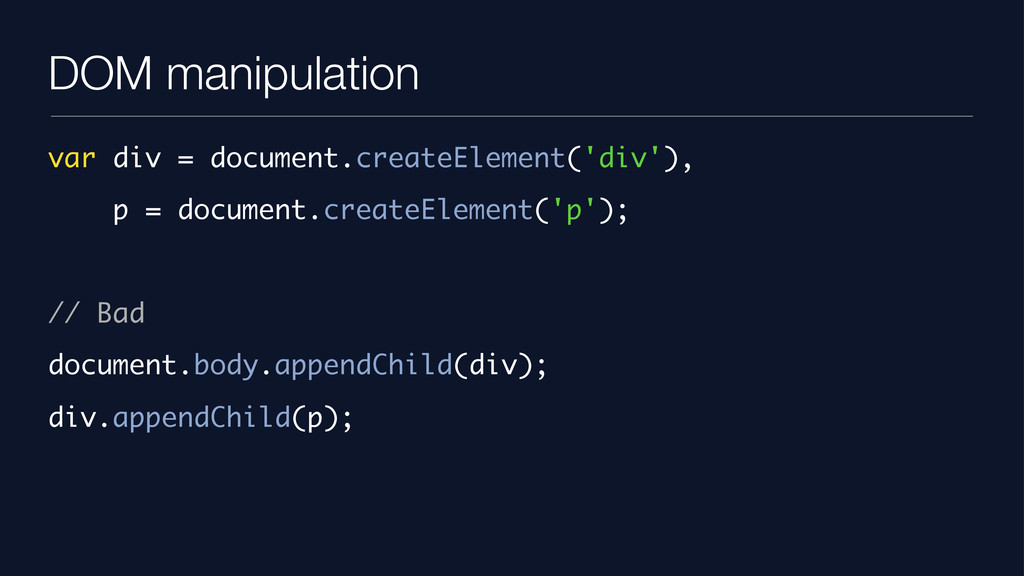
  2. DOM manipulation // Create the element in memory var el

    = document.createElement('p'); // Insert the element into the DOM document.body.appendChild(el);
  3. DOM manipulation var p = document.createElement('p'), i = 4; while

    (i--) { // Add four <p> elements document.body.appendChild(p.cloneNode(false)); }
  4. DOM manipulation var frag = document.createDocumentFragment(), p = document.createElement('p'), i

    = 4; while (i--) { // Add four <p> elements frag.appendChild(p.cloneNode(false)); } document.body.appendChild(frag);
  5. Property lookups var obj = { 'x': 42, 'y': {

    'foo': 'bar' } }; obj.x; // 42 obj.y.foo; // 'bar'
  6. Property lookups var foo = YAHOO.util.Dom.get('foo'), bar = YAHOO.util.Dom.get('bar'), baz

    = YAHOO.util.Dom.get('baz'), qux = YAHOO.util.Dom.get('qux');
  7. Property lookups var get = YAHOO.util.Dom.get, foo = get('foo'), bar

    = get('bar'), baz = get('baz'), qux = get('qux');
  8. Array item lookups var elems = document.getElementsByTagName('p'), length = elems.length;

    while (length--) { if (elems[length].className == 'foo') { // do something with elems[length] elems[length].innerHTML = 'LOLWAT'; } }
  9. Array item lookups var elems = document.getElementsByTagName('p'), length = elems.length,

    elem; while (length--) { elem = elems[length]; if (elem.className == 'foo') { // do something with elem elem.innerHTML = 'LOLWAT'; } }
  10. Scope lookups var foo = 42; (function() { foo; //

    one scope lookup }()); // IIFE – see http://mths.be/iife
  11. Scope lookups var foo = 42; (function() { (function() {

    foo; // two scope lookups }()); }());
  12. Scope lookups var foo = 42; (function(foo) { (function(foo) {

    foo; // ZOMG, no scope lookups!!1 }(foo)); }(foo));
  13. Scope lookups (function() { // every time you use `window`

    // or `document` here // that’s a scope lookup }());
  14. Scope lookups (function() { var doc = document, win =

    window; // lookup once, then cache }());
  15. Scope lookups (function(win, doc) { // use `win` and `doc`

    here // no scope lookups // no performance penalty! }(this, document));
  16. It happens to the best! // Don’t do this: $(window).scroll(function()

    { $('.foo').something(); }); // See http://mths.be/azs
  17. New objects var obj = new Object(); obj.x = 42;

    obj.y = 'foo'; obj.z = false;
  18. Avoid switch switch(foo) { case 'alpha': // do X break;

    case 'beta': // do Y break; default: // do Z break; }
  19. Avoid switch var switchObj = { 'alpha': function() { //

    do X }, 'beta': function() { // do Y }, '_default': function() { // do Z } }; (switchObj.hasOwnProperty(foo) && switchObj[foo] || switchObj._default)(args);
  20. Don’t use jQuery for everything $('.foo').click(function() { $(this).prop('id'); // same

    as this, before jQuery 1.6: // $(this).attr('id'); // also `href`, `checked`, `value`… });
  21. jQuery document ready (function() { // move <script>s to the

    bottom // and just use an IIFE* }()); // * unless you use .appendChild() / .innerHTML on document.documentElement or document.body: http://mths.be/ieoa
  22. jQuery collection size // jQuery source: $.fn.size = function() {

    return this.length; }; // …so, just use: $('.foo').length;

More Decks by Mathias Bynens

Other Decks in Technology