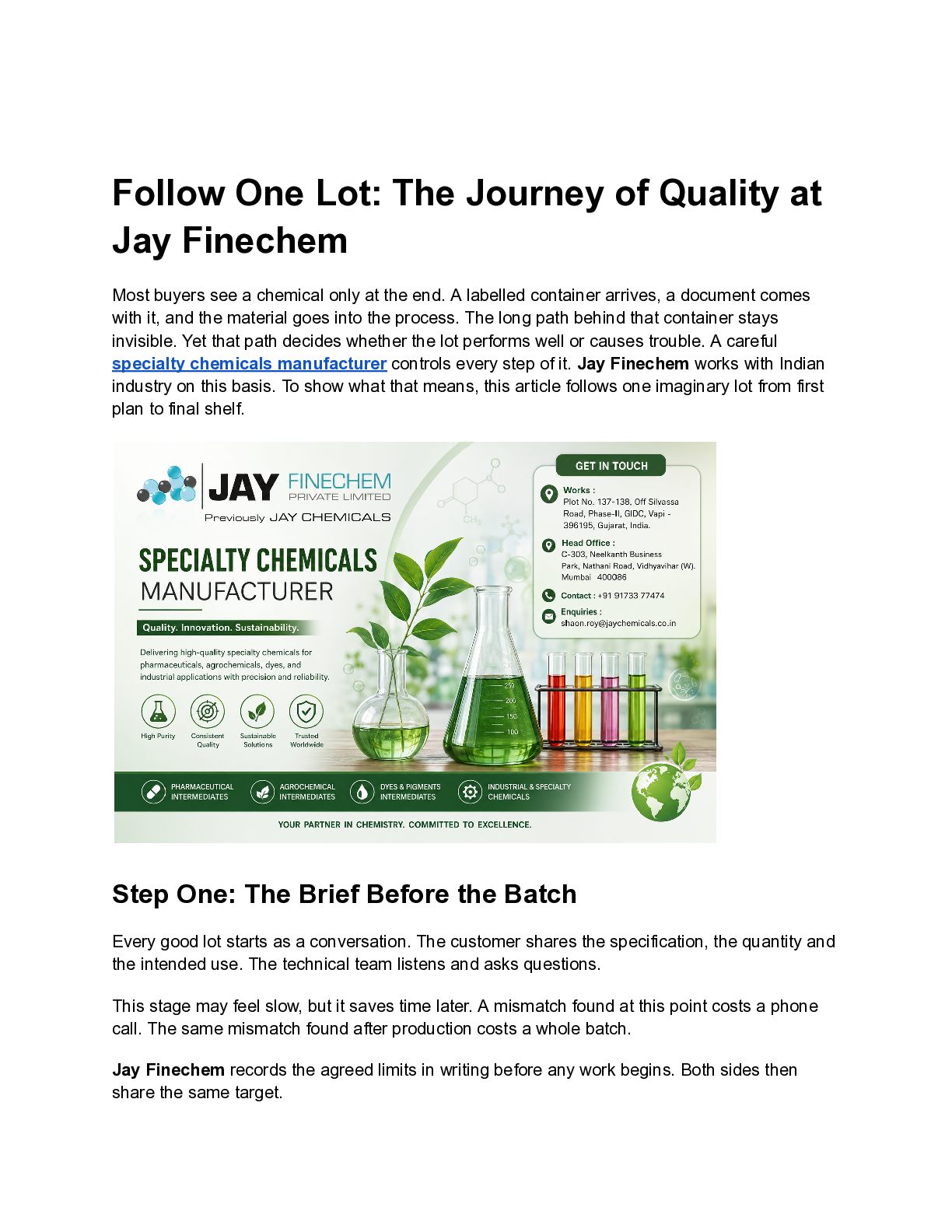
Most buyers see a chemical only at the end. A labelled container arrives, a document comes with it, and the material goes into the process. The long path behind that container stays invisible. Yet that path decides whether the lot performs well or causes trouble. A careful specialty chemicals manufacturer controls every step of it. Jay Finechem works with Indian industry on this basis. To show what that means, this article follows one imaginary lot from first plan to final shelf. Step One: The Brief Before the Batch Every good lot starts as a conversation. The customer shares the specification, the quantity and the intended use. The technical team listens and asks questions. This stage may feel slow, but it saves time later. A mismatch found at this point costs a phone call. The same mismatch found after production costs a whole batch. Jay Finechem records the agreed limits in writing before any work begins. Both sides then share the same target.
turns to its starting materials. A weak input can undo a perfect process. Incoming materials are checked against set limits for identity and key parameters. Any material that falls short is held back and reviewed. Only approved lots move forward. This habit, known as raw material qualification, also supports continuity. Approved sources and clear change rules prevent silent switches. The customer benefits because the final product stays consistent even when markets move. Step Three: The Reaction Itself Now the real chemistry begins. Operators follow a written procedure, adding materials in a set order and holding temperature within a set range. Small details matter here. A slightly fast addition can create unwanted by-products. A short mixing time can leave pockets of unreacted material. Careful teams take samples during the reaction and test them. These in-process checks show whether the batch is heading in the right direction. If a reading drifts, operators can correct course before the batch is finished. Step Four: Purification and Isolation After the reaction, the product must be separated and cleaned. This step often decides final purity. Depending on the material, the team may filter, wash, crystallise or dry. Each action removes a different kind of unwanted trace. Drying deserves special care, since moisture and residual solvents are common limits on specification sheets. A skilled specialty chemicals manufacturer treats this stage with patience. Rushing it saves minutes and risks the whole lot. Step Five: Testing Before Release Now the material faces its exam. Analysts test the lot against every agreed limit. These checks usually cover appearance, assay, moisture and relevant impurities. Results go into the batch record. A quality reviewer then compares them with the specification. Only a lot that meets every limit moves on.
not ship. The team investigates, records the cause and decides on corrective action. This discipline protects the customer from unpleasant surprises. Step Six: Packing, Labelling and Retained Samples Packing may look simple, but it carries real risk. Moisture, light and air can all harm sensitive materials during storage and transit. Packaging and labelling therefore follow clear rules. Each container shows its identity and batch number. A small portion of the lot is kept as a retained sample for later comparison. If a question arises weeks later, the team can compare the retained sample with the material in the field. This simple habit makes problem solving faster and fairer. Step Seven: Documents That Travel With the Lot A lot without paperwork is only half a delivery. Documents let your team verify and handle the material correctly. Customers of Jay Finechem can expect these supporting records: • • • • A Certificate of Analysis showing actual test results A Safety Data Sheet for storage and handling Batch identification for lot traceability Notice of any planned change in process or source Buyers in regulated fields can also ask about GMP-aligned documentation at the start of the relationship. Early discussion avoids last-minute pressure. Step Eight: Arrival and Your Own Checks The journey does not end at your gate. Your team plays a part too. On receipt, check that the label, batch number and COA match. Inspect the container for damage. Then store the material as advised and test it against your own incoming limits. When your results match the COA lot after lot, trust grows quickly. You may then reduce duplicate testing and free your laboratory for other work. A transparent specialty chemicals manufacturer welcomes this comparison, because it proves the data is honest. What Changes for Tailored Projects
an earlier chapter. With custom synthesis, chemists first design and test a route in the laboratory. They refine it, run pilot trials and share data with the customer. Only after approval does the process move to regular production. Contract manufacturing follows a similar path for established products that need dedicated capacity. A written scope sets quantity, limits, timing and responsibilities. Customers working on pharma intermediates and agrochemical intermediates often value this structure, since it brings clarity to long programmes. Careful impurity profiling supports each of these routes. Knowing what is present, and at what level, speeds up internal reviews. Why the Journey Should Stay Close to You Distance adds friction to every step. Samples travel longer. Questions wait for time zones. Visits become hard to plan. Working with a nearby plant shortens these loops. You can discuss a deviation in the morning and agree on a plan by evening. You can also visit the facility and watch the journey for yourself. For public information on sector policy, the Department of Chemicals and Petrochemicals is a helpful reference. Responsible Practice Along the Way Every step above involves people and materials. Responsible plants protect both. Jay Finechem treats process safety as part of everyday work. Teams review hazards before scaling any route. Waste streams are segregated and handled with care. Efficient processes use fewer resources, which also lowers cost. Customers increasingly ask about these practices, since they answer to their own stakeholders. Clear answers strengthen the relationship. A Short Story of a Lot That Almost Slipped Through Imagine a lot that looked perfect on appearance. Every visible check passed. Yet the moisture test came back slightly above the limit. In a weaker system, the lot might have shipped anyway. At Jay Finechem, the rule is simple. A lot that misses a limit does not go out. The team re-dried the material, retested it and released it only after it met the specification.
point. Good systems prevent problems quietly. Frequently Asked Questions How long does it take to produce a lot of fine chemical? Timing depends on the material and the process. Simple repeat products move faster, while tailored projects need development time first. The technical team can share a realistic plan after reviewing your brief. Why do buyers look for a fine chemicals manufacturer in India? Local plants offer faster samples, easier visits and quicker answers. These benefits help when schedules are tight. What happens if my lot fails my incoming test? Hold the lot and record your results. Contact the supplier with the batch number, so the team can compare it with the retained sample and investigate. Why are retained samples important? They let both sides compare the shipped material with a stored reference. This makes any investigation faster and fairer. How can I start a project with Jay Finechem? Visit the website and send your requirement, quantity and timeline. A technical expert will review it and reply with next steps. What Customers Say "Seeing how Jay Finechem handled one lot from brief to dispatch gave us real confidence. Every step had a record." Quality Head, Industrial Manufacturing Company "A lot once missed a moisture limit, and they held it back before we ever saw it. That honesty earned our trust." Purchase Manager, Formulation Business Conclusion
is a chain of careful steps from the first brief to the last label. Jay Finechem builds that chain with clear limits, honest records and steady communication. If you want a partner who guards every link, a dependable specialty chemicals manufacturer is the right place to start. Begin Your Enquiry Today Share your specification, quantity and timeline with Jay Finechem. A technical expert will review your needs and reply with clear next steps. Visit the website and request your quote now.


 jayfinechem
 coloredviolet
 aleyda
 rasmusluckow
 cassininazir
 tammyeverts
 axbom
 frankvandijk
 lara
 addyosmani
 jonyablonski
 jmmastey