Upgrade to Pro — share decks privately, control downloads, hide ads and more …

React Native Performance Guide: How to Build Fa...

Sponsored · Your Podcast. Everywhere. Effortlessly. Share. Educate. Inspire. Entertain. You do you. We'll handle the rest. →
Avatar for JustAcademy JustAcademy
November 05, 2026

React Native Performance Guide: How to Build Fast and Responsive Mobile Apps

Want to understand how React Native applications deliver smooth and responsive user experiences? This practical React Native performance guide explains the architecture, rendering process, and optimization strategies that help developers build high-performance mobile applications. Explore how React Native uses native views, JavaScript execution, Hermes, JSI, Fabric, and TurboModules to connect application logic with native Android and iOS capabilities.

This guide covers important performance factors such as frame rates, startup time, UI responsiveness, memory usage, network performance, and application stability. It also introduces practical optimization techniques, including FlatList, React.memo, useMemo, useCallback, image compression, caching, and efficient animation handling.

Avatar for JustAcademy

JustAcademy

November 05, 2026

More Decks by JustAcademy

Other Decks in Education

Transcript

  1. JUSTACADEMY // PERFORMANCE MATRIX THE PERFORMANCE MATRIX // 01 /

    10 BEYOND THE BRIDGE HOW REACT NATIVE APPS ACHIEVE NEAR-NATIVE PERFORMANCE Architecture • Rendering • Optimisation • Mobile App Speed JS Discover how JavaScript, native capabilities, and modern React Native architecture work together to create responsive mobile applications. NATIVE JUSTACADEMY
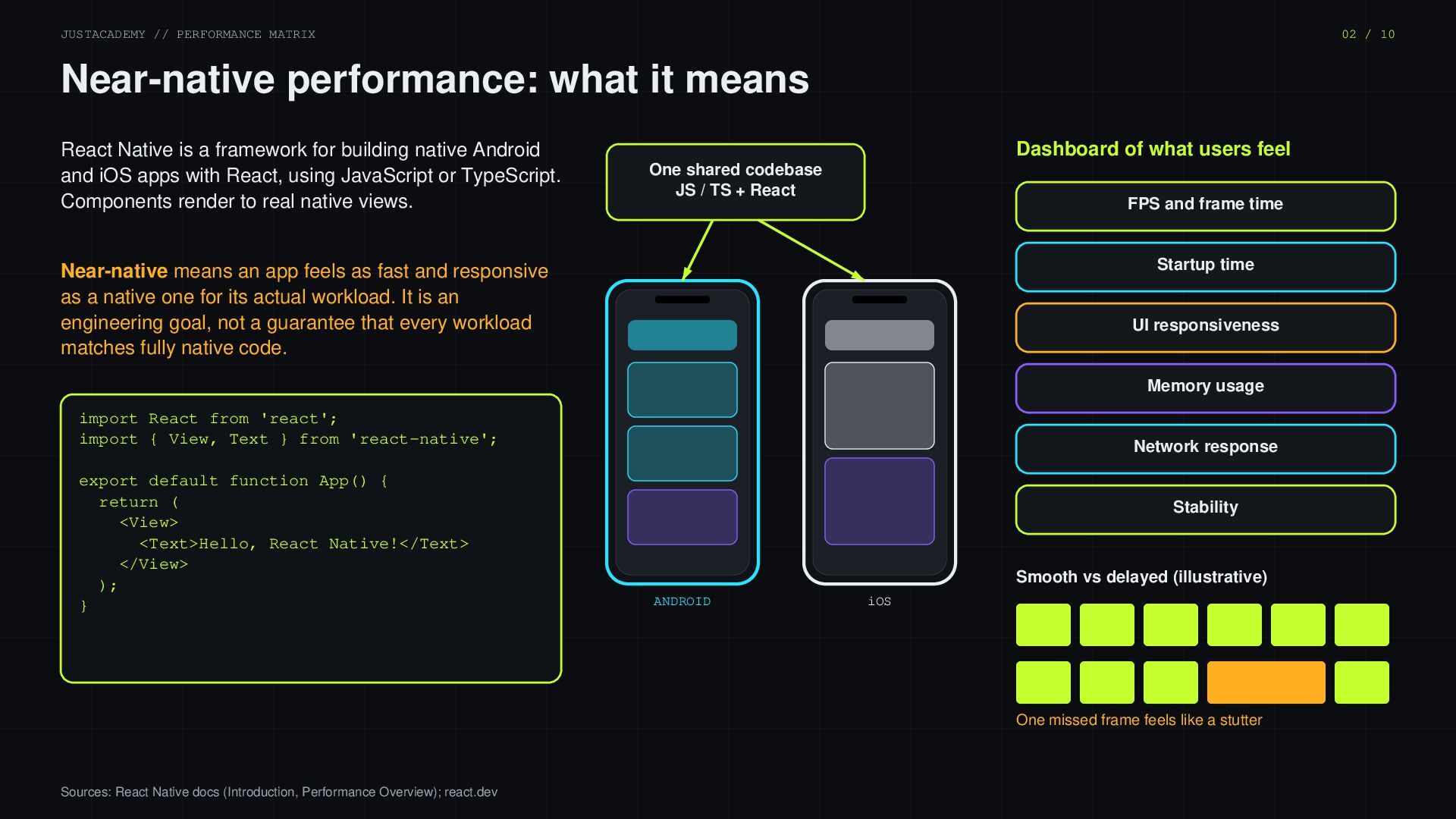
  2. JUSTACADEMY // PERFORMANCE MATRIX 02 / 10 Near-native performance: what

    it means React Native is a framework for building native Android and iOS apps with React, using JavaScript or TypeScript. Components render to real native views. Dashboard of what users feel One shared codebase JS / TS + React FPS and frame time Startup time Near-native means an app feels as fast and responsive as a native one for its actual workload. It is an engineering goal, not a guarantee that every workload matches fully native code. UI responsiveness Memory usage import React from 'react'; import { View, Text } from 'react-native'; export default function App() { return ( <View> <Text>Hello, React Native!</Text> </View> ); } Network response Stability Smooth vs delayed (illustrative) ANDROID iOS One missed frame feels like a stutter Sources: React Native docs (Introduction, Performance Overview); react.dev
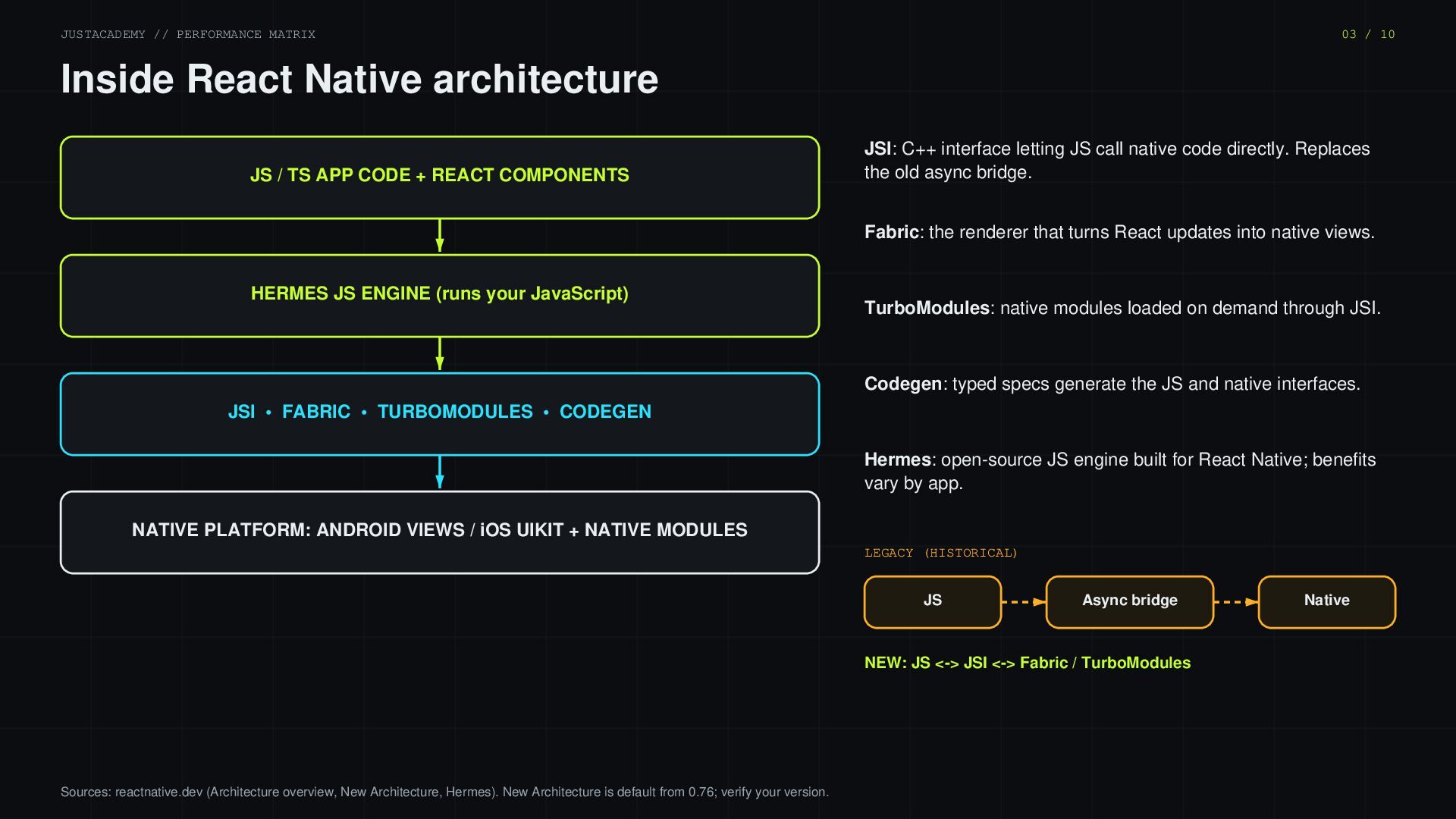
  3. JUSTACADEMY // PERFORMANCE MATRIX 03 / 10 Inside React Native

    architecture JS / TS APP CODE + REACT COMPONENTS JSI: C++ interface letting JS call native code directly. Replaces the old async bridge. Fabric: the renderer that turns React updates into native views. HERMES JS ENGINE (runs your JavaScript) TurboModules: native modules loaded on demand through JSI. Codegen: typed specs generate the JS and native interfaces. JSI • FABRIC • TURBOMODULES • CODEGEN Hermes: open-source JS engine built for React Native; benefits vary by app. NATIVE PLATFORM: ANDROID VIEWS / iOS UIKIT + NATIVE MODULES LEGACY (HISTORICAL) JS Async bridge NEW: JS <-> JSI <-> Fabric / TurboModules Sources: reactnative.dev (Architecture overview, New Architecture, Hermes). New Architecture is default from 0.76; verify your version. Native
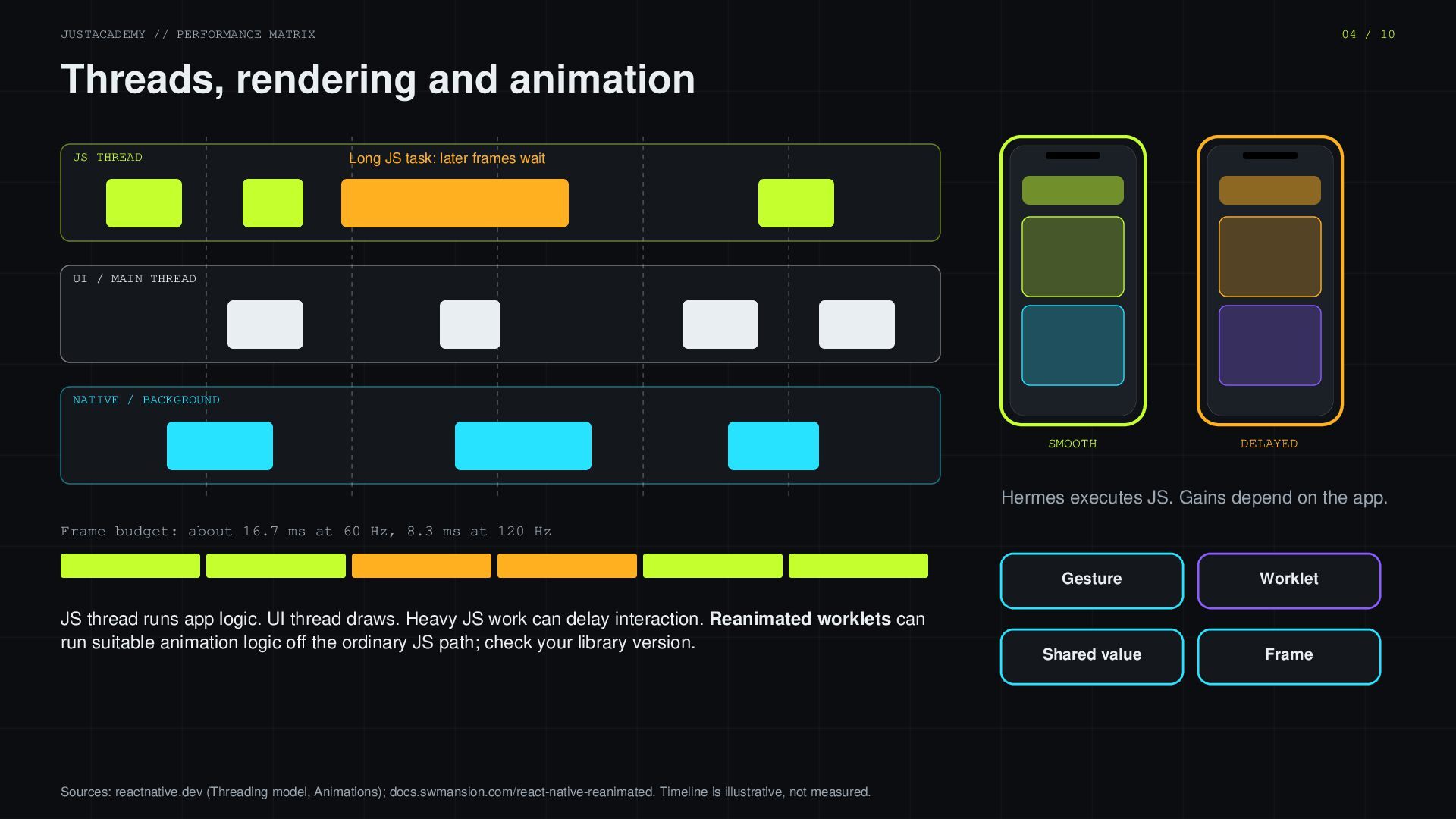
  4. JUSTACADEMY // PERFORMANCE MATRIX 04 / 10 Threads, rendering and

    animation JS THREAD Long JS task: later frames wait UI / MAIN THREAD NATIVE / BACKGROUND SMOOTH DELAYED Hermes executes JS. Gains depend on the app. Frame budget: about 16.7 ms at 60 Hz, 8.3 ms at 120 Hz JS thread runs app logic. UI thread draws. Heavy JS work can delay interaction. Reanimated worklets can run suitable animation logic off the ordinary JS path; check your library version. Sources: reactnative.dev (Threading model, Animations); docs.swmansion.com/react-native-reanimated. Timeline is illustrative, not measured. Gesture Worklet Shared value Frame
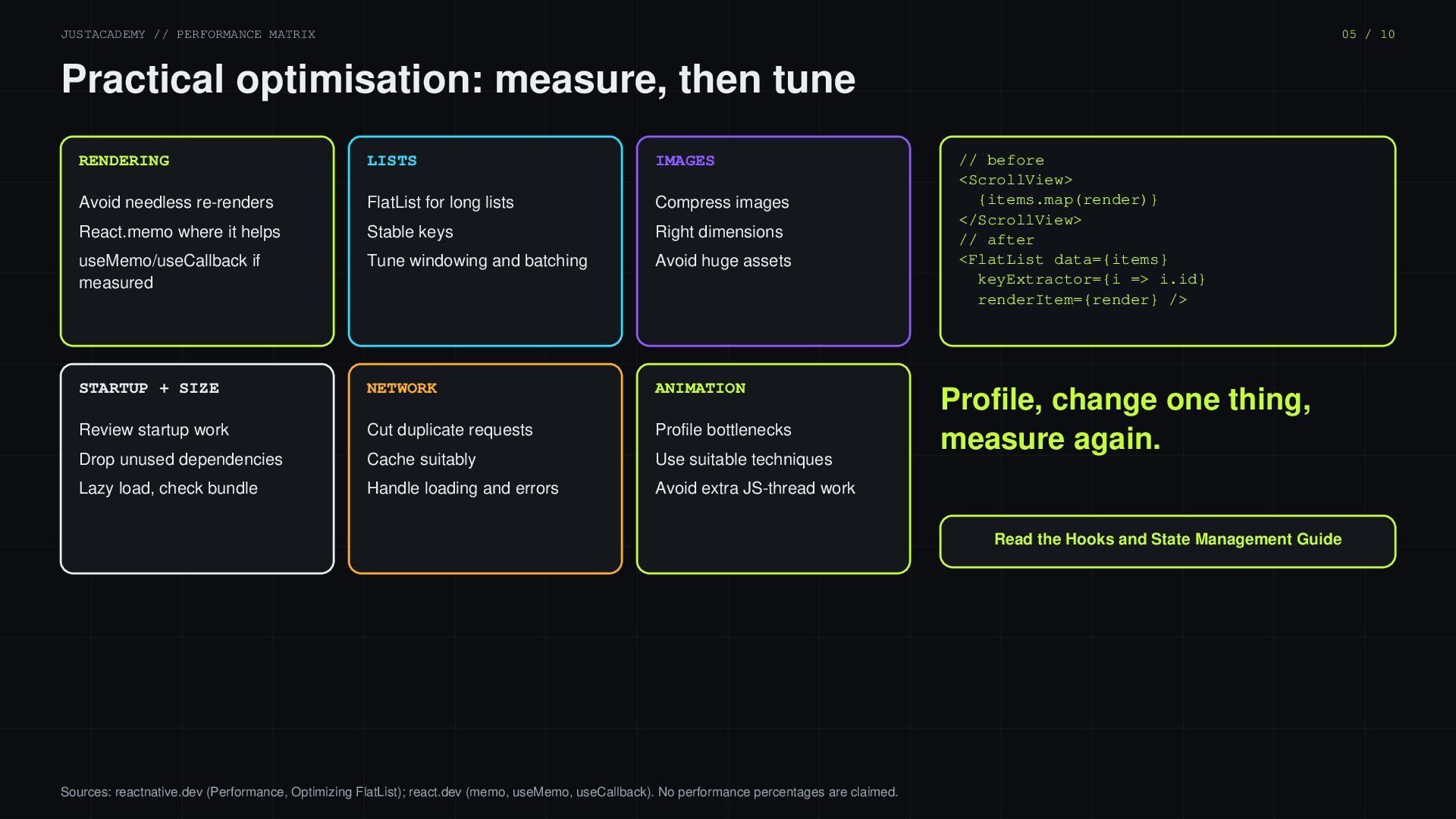
  5. JUSTACADEMY // PERFORMANCE MATRIX 05 / 10 Practical optimisation: measure,

    then tune RENDERING LISTS IMAGES Avoid needless re-renders FlatList for long lists Compress images React.memo where it helps Stable keys Right dimensions useMemo/useCallback if measured Tune windowing and batching Avoid huge assets STARTUP + SIZE NETWORK ANIMATION Review startup work Cut duplicate requests Profile bottlenecks Drop unused dependencies Cache suitably Use suitable techniques Lazy load, check bundle Handle loading and errors Avoid extra JS-thread work // before <ScrollView> {items.map(render)} </ScrollView> // after <FlatList data={items} keyExtractor={i => i.id} renderItem={render} /> Profile, change one thing, measure again. Read the Hooks and State Management Guide Sources: reactnative.dev (Performance, Optimizing FlatList); react.dev (memo, useMemo, useCallback). No performance percentages are claimed.
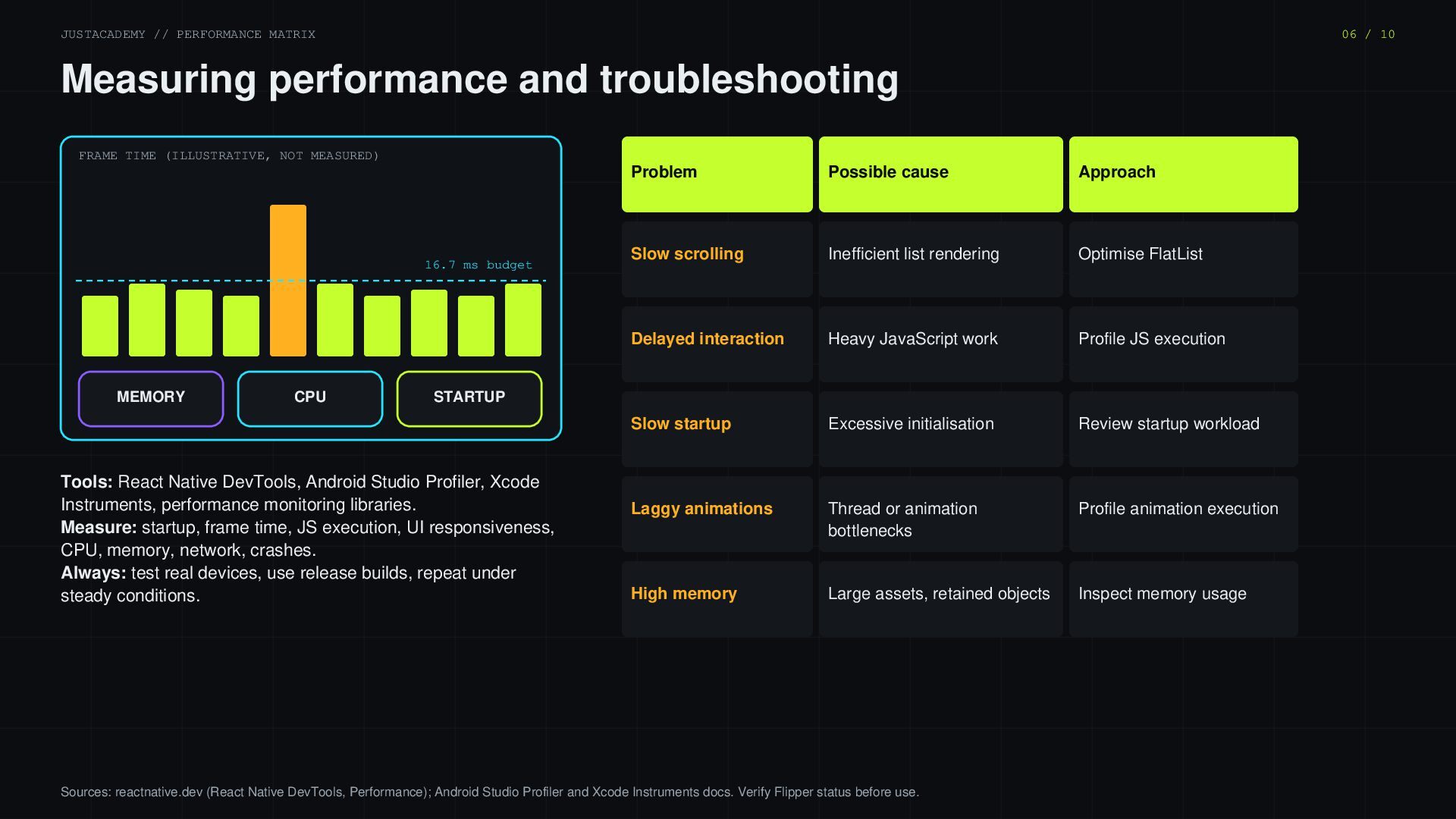
  6. JUSTACADEMY // PERFORMANCE MATRIX 06 / 10 Measuring performance and

    troubleshooting FRAME TIME (ILLUSTRATIVE, NOT MEASURED) 16.7 ms budget MEMORY CPU Problem Possible cause Approach Slow scrolling Inefficient list rendering Optimise FlatList Delayed interaction Heavy JavaScript work Profile JS execution Slow startup Excessive initialisation Review startup workload Laggy animations Thread or animation bottlenecks Profile animation execution High memory Large assets, retained objects Inspect memory usage STARTUP Tools: React Native DevTools, Android Studio Profiler, Xcode Instruments, performance monitoring libraries. Measure: startup, frame time, JS execution, UI responsiveness, CPU, memory, network, crashes. Always: test real devices, use release builds, repeat under steady conditions. Sources: reactnative.dev (React Native DevTools, Performance); Android Studio Profiler and Xcode Instruments docs. Verify Flipper status before use.
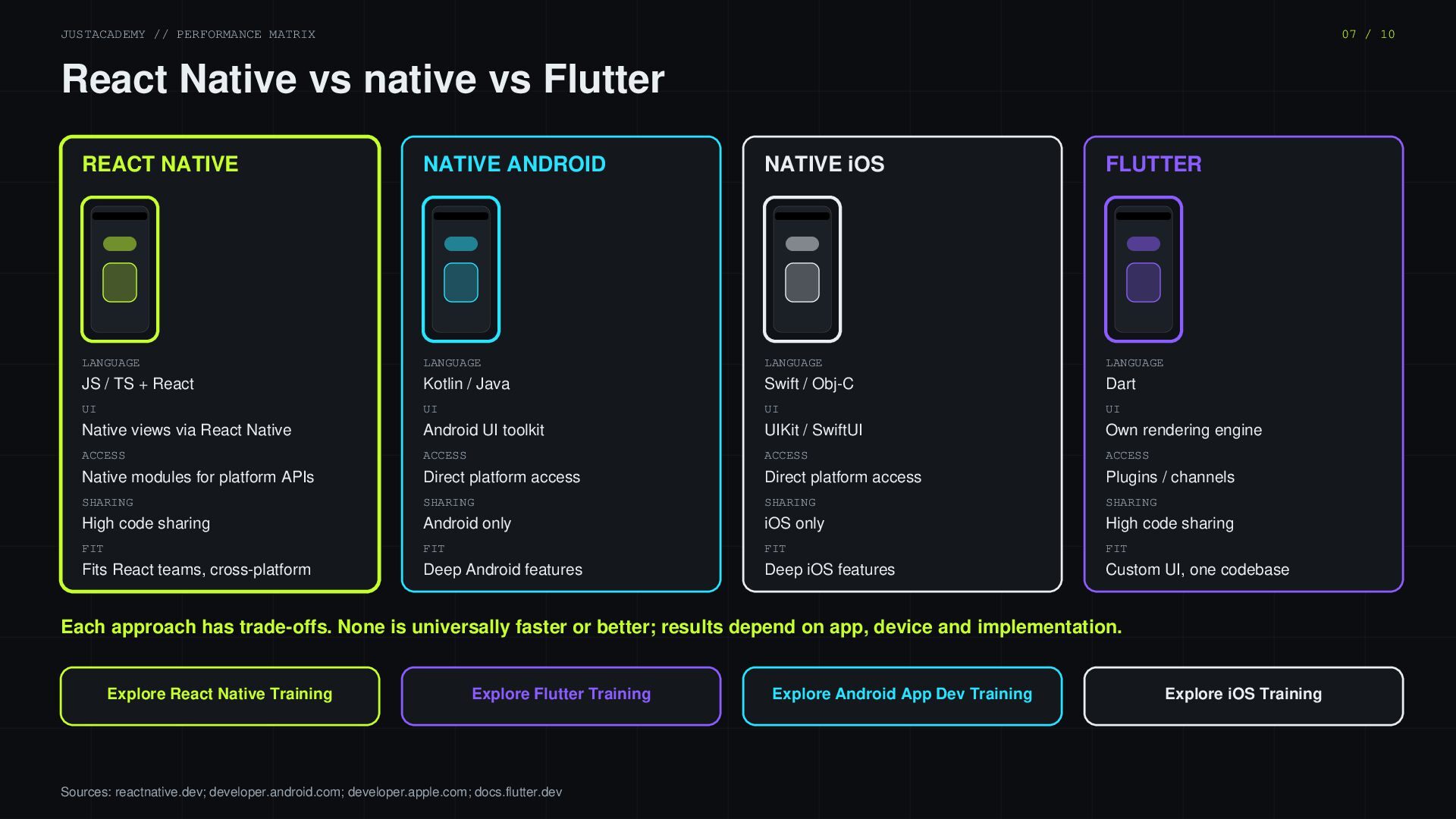
  7. JUSTACADEMY // PERFORMANCE MATRIX 07 / 10 React Native vs

    native vs Flutter REACT NATIVE NATIVE ANDROID NATIVE iOS FLUTTER LANGUAGE LANGUAGE LANGUAGE LANGUAGE JS / TS + React Kotlin / Java Swift / Obj-C Dart UI UI UI UI Native views via React Native Android UI toolkit UIKit / SwiftUI Own rendering engine ACCESS ACCESS ACCESS ACCESS Native modules for platform APIs Direct platform access Direct platform access Plugins / channels SHARING SHARING SHARING SHARING High code sharing Android only iOS only High code sharing FIT FIT FIT FIT Fits React teams, cross-platform Deep Android features Deep iOS features Custom UI, one codebase Each approach has trade-offs. None is universally faster or better; results depend on app, device and implementation. Explore React Native Training Explore Flutter Training Sources: reactnative.dev; developer.android.com; developer.apple.com; docs.flutter.dev Explore Android App Dev Training Explore iOS Training
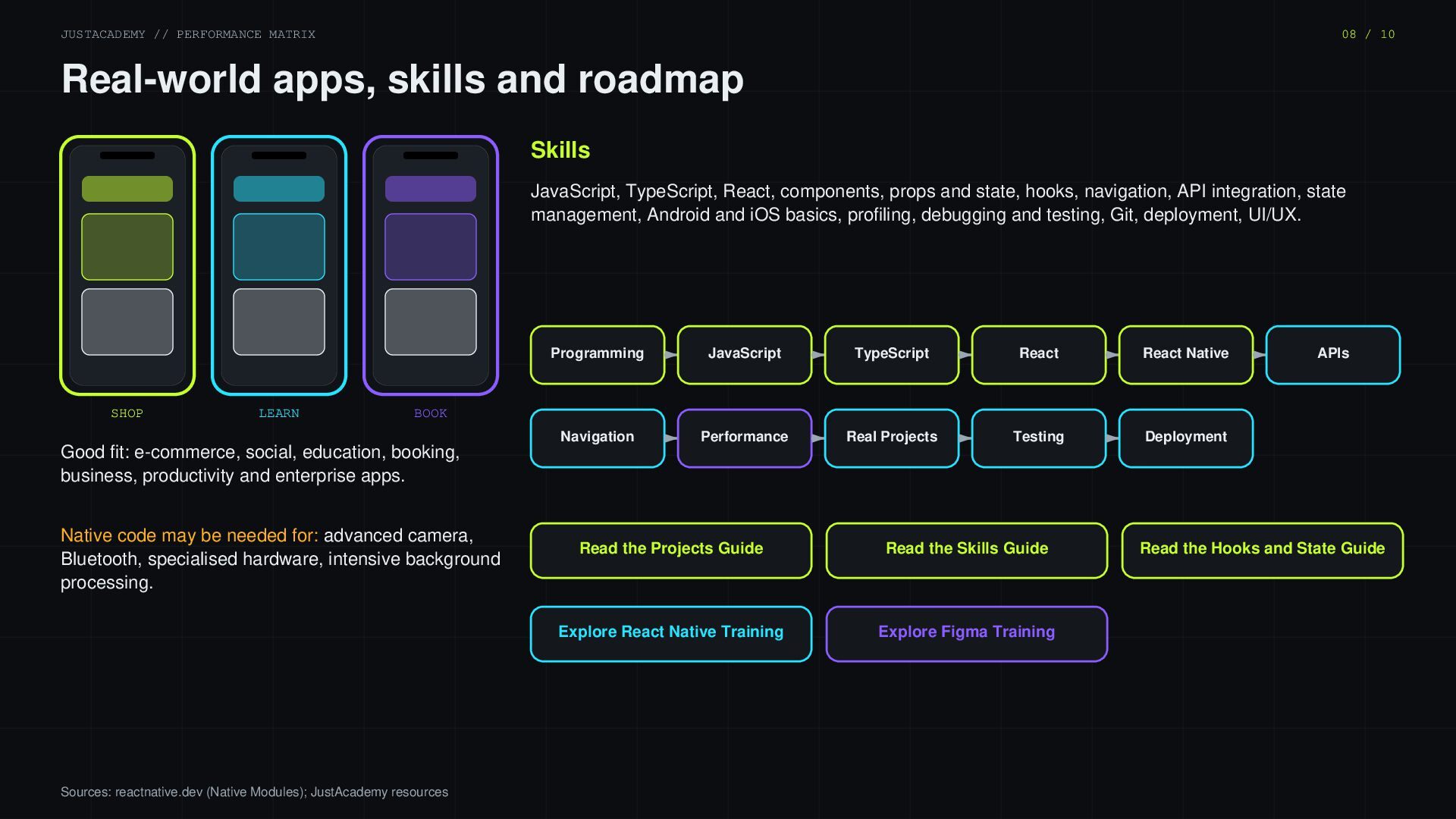
  8. JUSTACADEMY // PERFORMANCE MATRIX 08 / 10 Real-world apps, skills

    and roadmap Skills JavaScript, TypeScript, React, components, props and state, hooks, navigation, API integration, state management, Android and iOS basics, profiling, debugging and testing, Git, deployment, UI/UX. SHOP LEARN Programming JavaScript TypeScript React React Native Navigation Performance Real Projects Testing Deployment APIs BOOK Good fit: e-commerce, social, education, booking, business, productivity and enterprise apps. Native code may be needed for: advanced camera, Bluetooth, specialised hardware, intensive background processing. Sources: reactnative.dev (Native Modules); JustAcademy resources Read the Projects Guide Read the Skills Guide Explore React Native Training Explore Figma Training Read the Hooks and State Guide
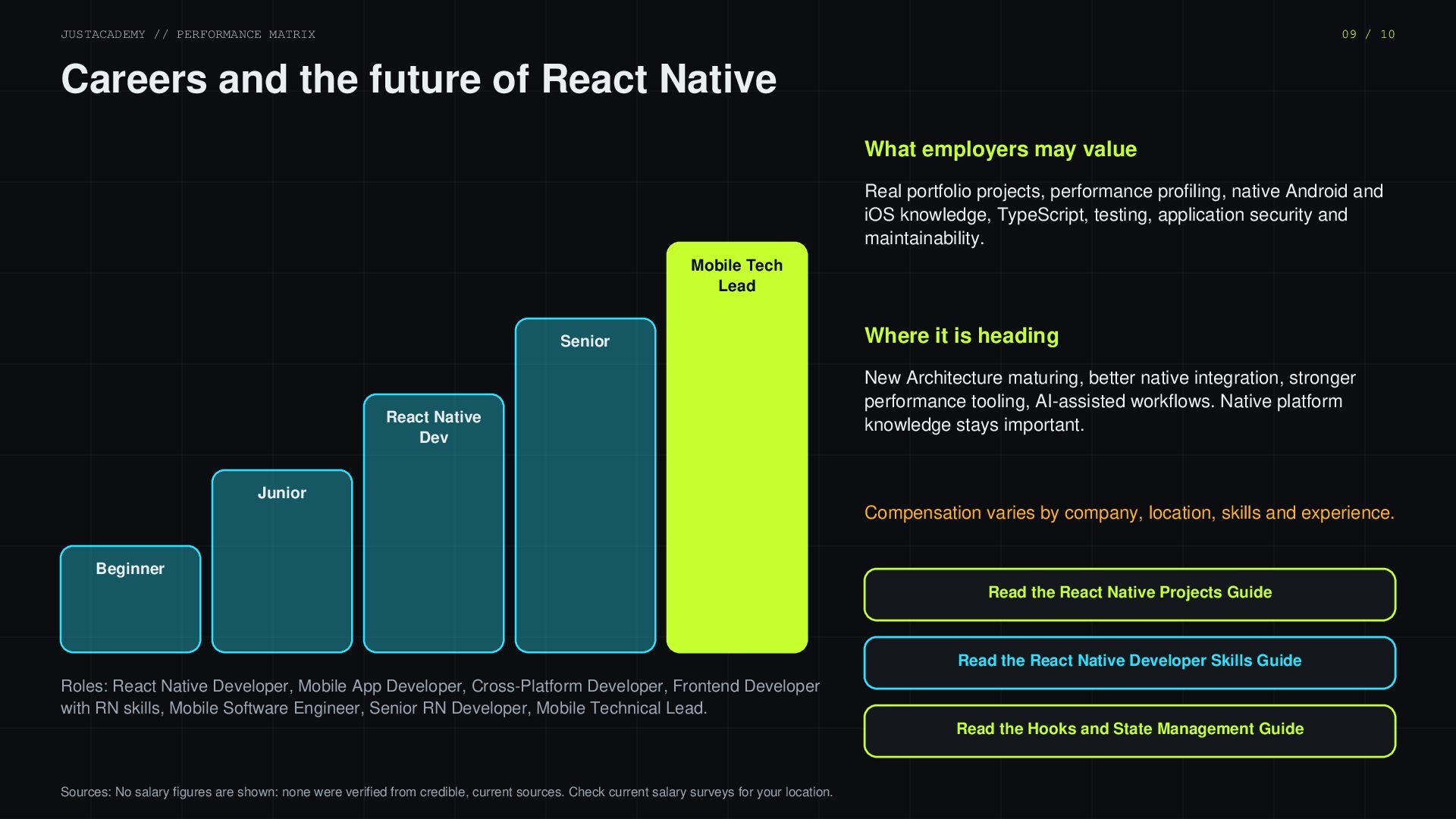
  9. JUSTACADEMY // PERFORMANCE MATRIX 09 / 10 Careers and the

    future of React Native What employers may value Real portfolio projects, performance profiling, native Android and iOS knowledge, TypeScript, testing, application security and maintainability. Mobile Tech Lead Senior React Native Dev Where it is heading New Architecture maturing, better native integration, stronger performance tooling, AI-assisted workflows. Native platform knowledge stays important. Junior Compensation varies by company, location, skills and experience. Beginner Read the React Native Projects Guide Read the React Native Developer Skills Guide Roles: React Native Developer, Mobile App Developer, Cross-Platform Developer, Frontend Developer with RN skills, Mobile Software Engineer, Senior RN Developer, Mobile Technical Lead. Read the Hooks and State Management Guide Sources: No salary figures are shown: none were verified from credible, current sources. Check current salary surveys for your location.
  10. JUSTACADEMY // PERFORMANCE MATRIX 10 / 10 READY TO BUILD

    HIGH-PERFORMANCE MOBILE APPS? Learn React Native, understand modern mobile architecture, optimise application performance, and build real-world Android and iOS applications. EXPLORE REACT NATIVE TRAINING Flutter Training RN Projects justacademy.co Android App Dev iOS Training Skills Guide Figma Training Hooks Guide