Upgrade to Pro
— share decks privately, control downloads, hide ads and more …
Speaker Deck
Features
Speaker Deck
PRO
Sign in
Sign up for free
Search
Search
Digital Future Design
Search
Sponsored
·
Your Podcast. Everywhere. Effortlessly.
Share. Educate. Inspire. Entertain. You do you. We'll handle the rest.
→
Fumiya Akasaka
October 29, 2023
Research
0
120
Digital Future Design
Presented at ServDes.2023, Rio de Janeiro, Brazil (July 12th, 2023)
Fumiya Akasaka
October 29, 2023
Tweet
Share
More Decks by Fumiya Akasaka
See All by Fumiya Akasaka
Values of LLs in RDI
fumiyaakasaka
0
40
Platform-level Living Lab Canvas
fumiyaakasaka
0
210
Consciously drifting
fumiyaakasaka
0
250
共創のための地域基盤としての非公式組織の形成 / Informal community as an infrastructure for co-creation
fumiyaakasaka
2
830
Infrastructuringsocial labs
fumiyaakasaka
0
150
超高齢社会における未来の暮らしとそれを支えるテクノロジーのデザイン / Designing future lives and supportive digital technologies in a super-aging society
fumiyaakasaka
0
210
OLLD2023参加報告会 / OLLD2023 Reporting Event
fumiyaakasaka
0
160
Other Decks in Research
See All in Research
Combining Deep Learning and Street View Imagery to Map Smallholder Crop Types
satai
3
570
svc-hook: hooking system calls on ARM64 by binary rewriting
retrage
1
100
HoliTracer:Holistic Vectorization of Geographic Objects from Large-Size Remote Sensing Imagery
satai
3
620
Agentic AI フレームワーク戦略白書 (2025年度版)
mickey_kubo
1
120
都市交通マスタープランとその後への期待@熊本商工会議所・熊本経済同友会
trafficbrain
0
120
さまざまなAgent FrameworkとAIエージェントの評価
ymd65536
1
420
世界モデルにおける分布外データ対応の方法論
koukyo1994
7
1.5k
Proposal of an Information Delivery Method for Electronic Paper Signage Using Human Mobility as the Communication Medium / ICCE-Asia 2025
yumulab
0
170
ForestCast: Forecasting Deforestation Risk at Scale with Deep Learning
satai
3
390
説明可能な機械学習と数理最適化
kelicht
2
930
離散凸解析に基づく予測付き離散最適化手法 (IBIS '25)
taihei_oki
PRO
1
680
2026.01ウェビナー資料
elith
0
210
Featured
See All Featured
Leveraging LLMs for student feedback in introductory data science courses - posit::conf(2025)
minecr
0
140
Visual Storytelling: How to be a Superhuman Communicator
reverentgeek
2
430
Context Engineering - Making Every Token Count
addyosmani
9
660
Game over? The fight for quality and originality in the time of robots
wayneb77
1
120
Site-Speed That Sticks
csswizardry
13
1.1k
Practical Orchestrator
shlominoach
191
11k
Jamie Indigo - Trashchat’s Guide to Black Boxes: Technical SEO Tactics for LLMs
techseoconnect
PRO
0
62
Agile Leadership in an Agile Organization
kimpetersen
PRO
0
83
Noah Learner - AI + Me: how we built a GSC Bulk Export data pipeline
techseoconnect
PRO
0
110
Fantastic passwords and where to find them - at NoRuKo
philnash
52
3.6k
The AI Revolution Will Not Be Monopolized: How open-source beats economies of scale, even for LLMs
inesmontani
PRO
3
3k
The browser strikes back
jonoalderson
0
390
Transcript
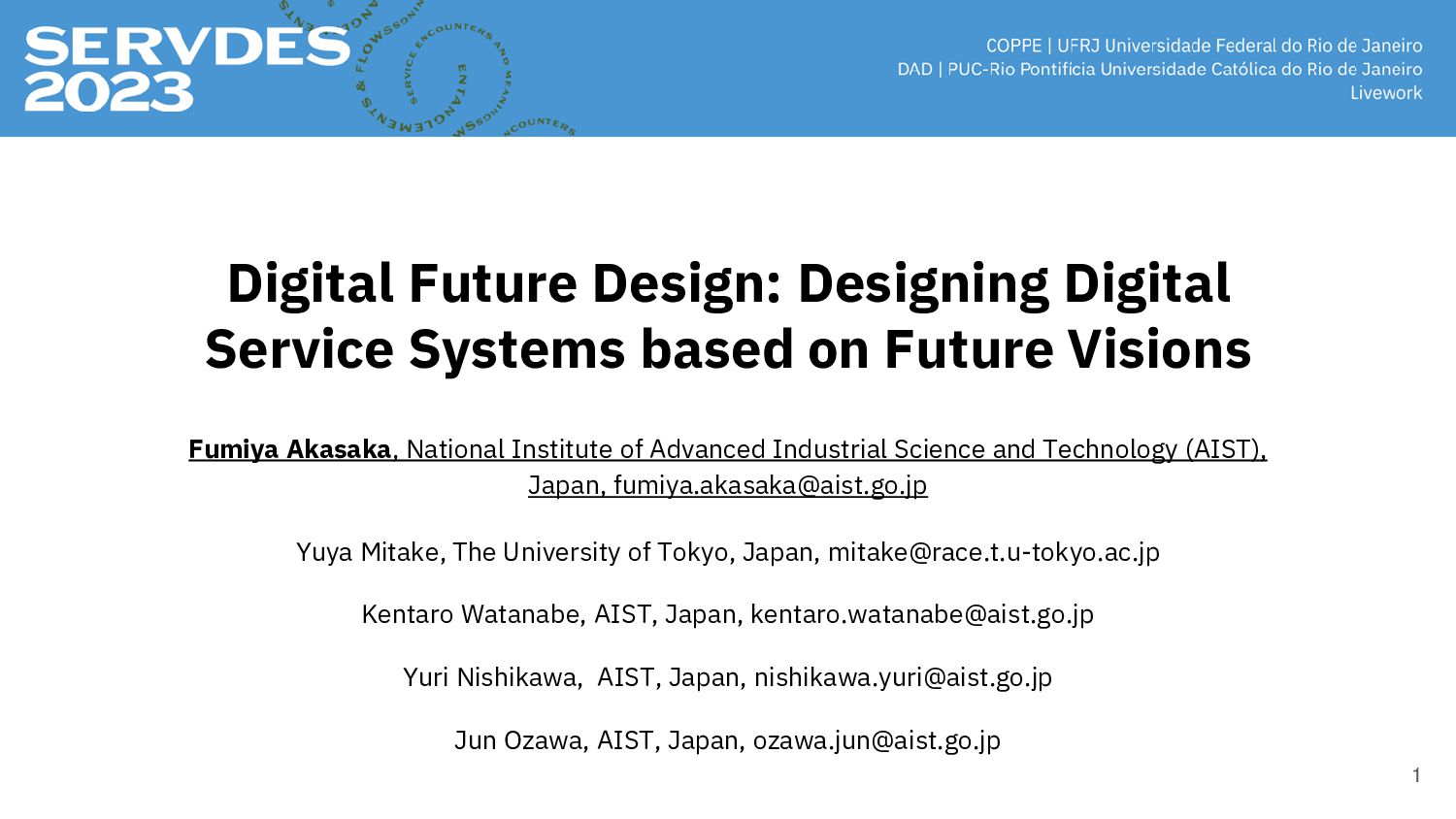
Digital Future Design: Designing Digital Service Systems based on Future
Visions Fumiya Akasaka, National Institute of Advanced Industrial Science and Technology (AIST), Japan,
[email protected]
Yuya Mitake, The University of Tokyo, Japan,
[email protected]
Kentaro Watanabe, AIST, Japan,
[email protected]
1 Yuri Nishikawa, AIST, Japan,
[email protected]
Jun Ozawa, AIST, Japan,
[email protected]
ServDes2023 | 11th-14th, July, 2023. Rio de Janeiro, Brazil Background
• Focus on “social innovation” (e.g., Manzini 14; Mulgan+ 07) ◦ Design for social innovation is required to achieve the sustainable society • “Digital tech” in service systems (e.g., Pekkala&Spohrer 19) ◦ Integrating advanced digital technologies with services is becoming important to increase the value and competitiveness ◦ Digital service also provide opportunities to address complex social issues • Smart city ◦ It originally aimed to overcome (urban) social issues using digital tech and services ◦ However, there are many criticisms on its technocentric approach that lacks a human-centered and social perspectives (Andreani+ 19) © 2023 AIST 2
ServDes2023 | 11th-14th, July, 2023. Rio de Janeiro, Brazil SD
focusing on “social” & “digital” aspects • Design for social transformation ◦ Transition Design (Irwin 18): design approach to achieve social transformation toward a desirable future. Stakeholders are involved in future visioning and the long-term interventions ◦ Transformative SD (Sangiorgi 11), SD for social innovation (Yang&Sung 16): a participatory action research to implement the transformative interventions for achieving social change • Service System + Digital tech ◦ New system concepts: Smart service system (Lim&Maglio 18), Smart PSS (Valencia+ 15), Digital service system (Watanabe+ 20) ◦ Design methods: Developed mainly in Sys. Eng. and PSS research arena (e.g., Halstenberg+ 19; Li&Lu 21; Tsunetomo+ 22) Research gap: These two approaches, design for social transformation and DSS design, have been dealt with separately and rarely intersected, although they are key to social innovation © 2023 AIST 3
ServDes2023 | 11th-14th, July, 2023. Rio de Janeiro, Brazil Objective
and research approach • Approach: Design Research Methodology (Blessing&Chakrabarti 09) 1. Develop a design method: “Digital Future Design Method” to support the creation of the DSSs for realizing the social transformation to a desirable future vision 2. Apply the method to a design practice: the design of next-generation smart mobility services in the Kashiwa-no-ha Smart City in Japan 3. Reflect the application results: discussion on the usefulness and limitation of the proposed method based on the application results © 2023 AIST 4 Objective of this study is… To develop a new design method that integrates the social transformation approach with the DSS design approach
ServDes2023 | 11th-14th, July, 2023. Rio de Janeiro, Brazil Digital
Future Design Method (DFDM) © 2023 AIST 5 Designed from the comprehensive perspectives of the socio cyber-physical- system (Rijswijk+ 21) <Core principle> DFDM begins with visioning the desirable future society, and then embodies the DSS concepts. Digital Social Physical Collaborative Design Design Models Refer Support Designed with collaborative approach supported by several design models
ServDes2023 | 11th-14th, July, 2023. Rio de Janeiro, Brazil Proposed
design process and models © 2023 AIST 6 Detailed design, Prototyping, Experiments, etc. Step1: Multi-perspective context analysis Collaborative Model-based Step2: Future visioning Collaborative Model-based Step3: Vision-based concept design Collaborative Model-based Digital Future Hexagon for the analysis of Socio-CPS context Future Life Snapshots for ideating ang analyzing possible future life scenes Vision-Life- Function Model to structure the relations between vision, life scenes, and DSS functions
ServDes2023 | 11th-14th, July, 2023. Rio de Janeiro, Brazil Application
case • A project to design next-generation smart mobility services (MaaS) in the Kashiwa-no- ha Smart City (incl. Level-4 automated buses, various personal mobility vehicles, etc) • How to design future mobility services in relation to various components such as user values, urban resources, vision, and other domain services ? © 2023 AIST 7 Restaur ant Shopping center Street Mobility data City vision Mobility vehicles Automated bus Personal mobility vehicle Kashiwa-no-ha smart city Users
ServDes2023 | 11th-14th, July, 2023. Rio de Janeiro, Brazil Social
Physi cal Digi tal Step1: Multi-perspective Context Analysis • DFDM begins with Digital Future Hexagon, a multi-perspective context analysis based on the socio- CPS domains: (social, physical and digital) before future visioning and DSS concept generation © 2023 AIST 8 Life with various shared mobilities to allow comfortable transportation without private cars Walkable city Comfortable city life without a private cars Shopping/resta urant services Shopping center Personal mobility vehicles Eco-friendly transportation Mobility reservation Mobility management system Personal mobility availability Personal mobility occupancy data
ServDes2023 | 11th-14th, July, 2023. Rio de Janeiro, Brazil Step2:
Future visioning © 2023 AIST 9 • Images of desirable future society (future life snapshot) are envisioned based on the hexagon; then, the snapshots are summarized to created a future vision. Ideating the future life snapshots Integrating to create a future vision 1 2
ServDes2023 | 11th-14th, July, 2023. Rio de Janeiro, Brazil Step3:
Vision-based concept design © 2023 AIST 10 • Designers explore and describe DSS concept (as a set of key functions) Vision Life DSS Functions Abstract Concrete Zig-zag thinking
ServDes2023 | 11th-14th, July, 2023. Rio de Janeiro, Brazil Findings
• Usefulness ◦ DFDM is useful for the integrated design of two systems that have different levels of abstraction: future vision and DSSs ◦ The hexagon’s six perspectives provide “constraints” and “clues” in DSS idea generation -> effective in supporting creative thinking to explore new opportunities ◦ The design models was useful in supporting co-creation by visualizing and managing the results of workshops and discussions • Limitations ◦ This study only covers the early phases (i.e., the conceptual design) ◦ We need to apply it to other cases for verifying general usefulness © 2023 AIST 11
ServDes2023 | 11th-14th, July, 2023. Rio de Janeiro, Brazil Concluding
summary • We propose the DFDM, a novel design method that supports the designing of DSSs for realizing the social transformation to a desirable future ◦ Design models (Digital future hexagon, VLF diagram) and design processes • The method was applied to a case of smart mobility service design • We found the method is effective in … ◦ Supporting integrated thinking of different levels of abstraction: future vision and DSSs ◦ Providing stimulus (constraints and clues) in DSS idea generation ◦ Supporting co-creation activities by visualizing and managing the results of workshops and discussions • Future works will include … ◦ Development of additional method for designing more detailed DSS architecture ◦ Application to other domain cases © 2023 AIST 12
Thank you !! / Obrigado !! Do not hesitate to
contact me at: 13 fumiya.akasaka [at] aist.go.jp https://www.fumiyaakasaka.com/ https://www.facebook.com/fumiya.akasaka


 fumiyaakasaka
.png) satai
satai
 retrage
 mickey_kubo
 trafficbrain
 ymd65536
 koukyo1994
 yumulab
 kelicht
 taihei_oki
 elith
elith
 minecr
 reverentgeek
 addyosmani
 wayneb77
 csswizardry
 shlominoach
 techseoconnect
 kimpetersen
 philnash
 inesmontani
 jonoalderson