change object state: grasp choice, approach/retreat, and occasional regrasping, not just collision-free paths. Example: a 6-DOF arm must pick a 0.5 kg bolt from a bin and place it into an assembly fixture. The planner selects a grasp, plans the approach, and retraction while avoiding the bin and fixture.
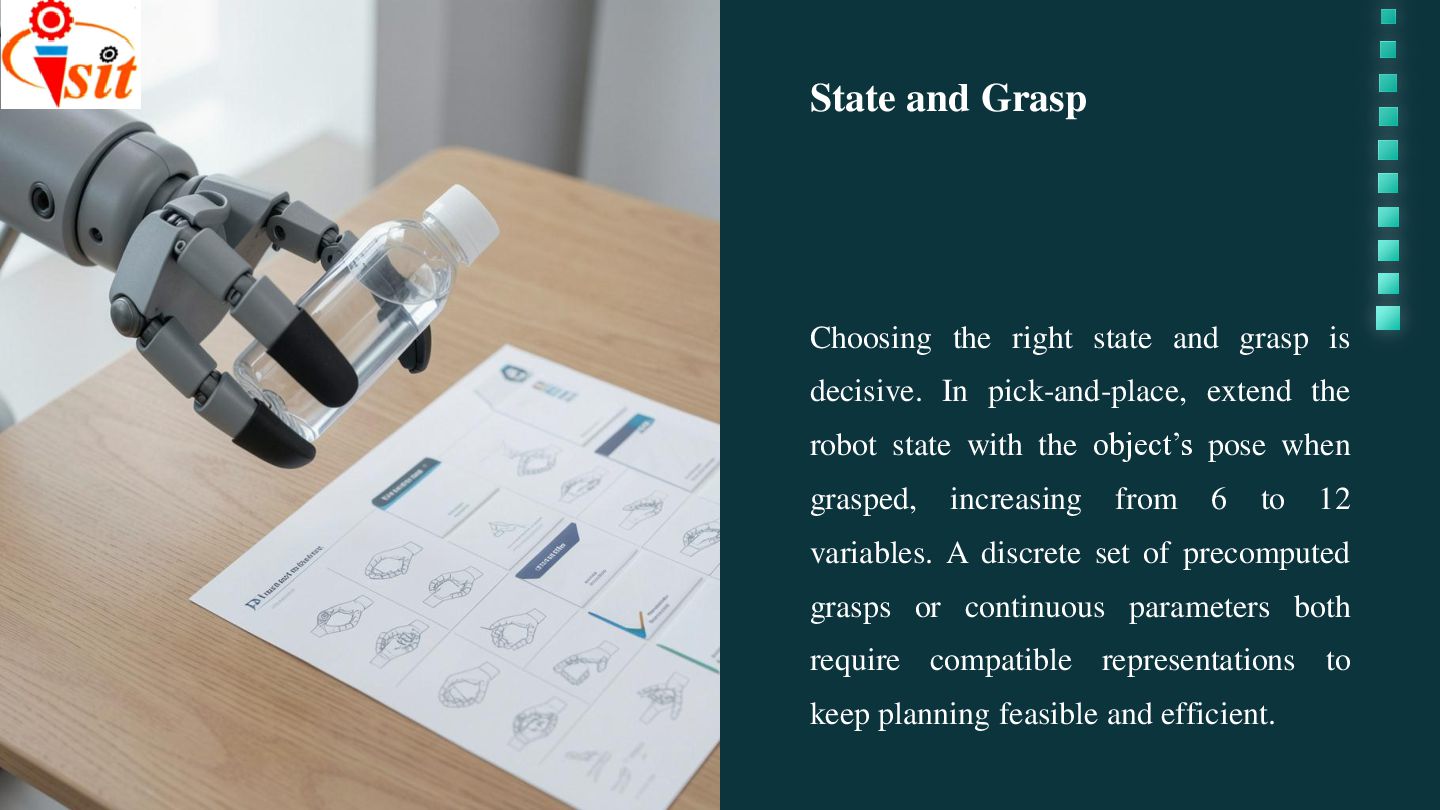
decisive. In pick-and-place, extend the robot state with the object’s pose when grasped, increasing from 6 to 12 variables. A discrete set of precomputed grasps or continuous parameters both require compatible representations to keep planning feasible and efficient.
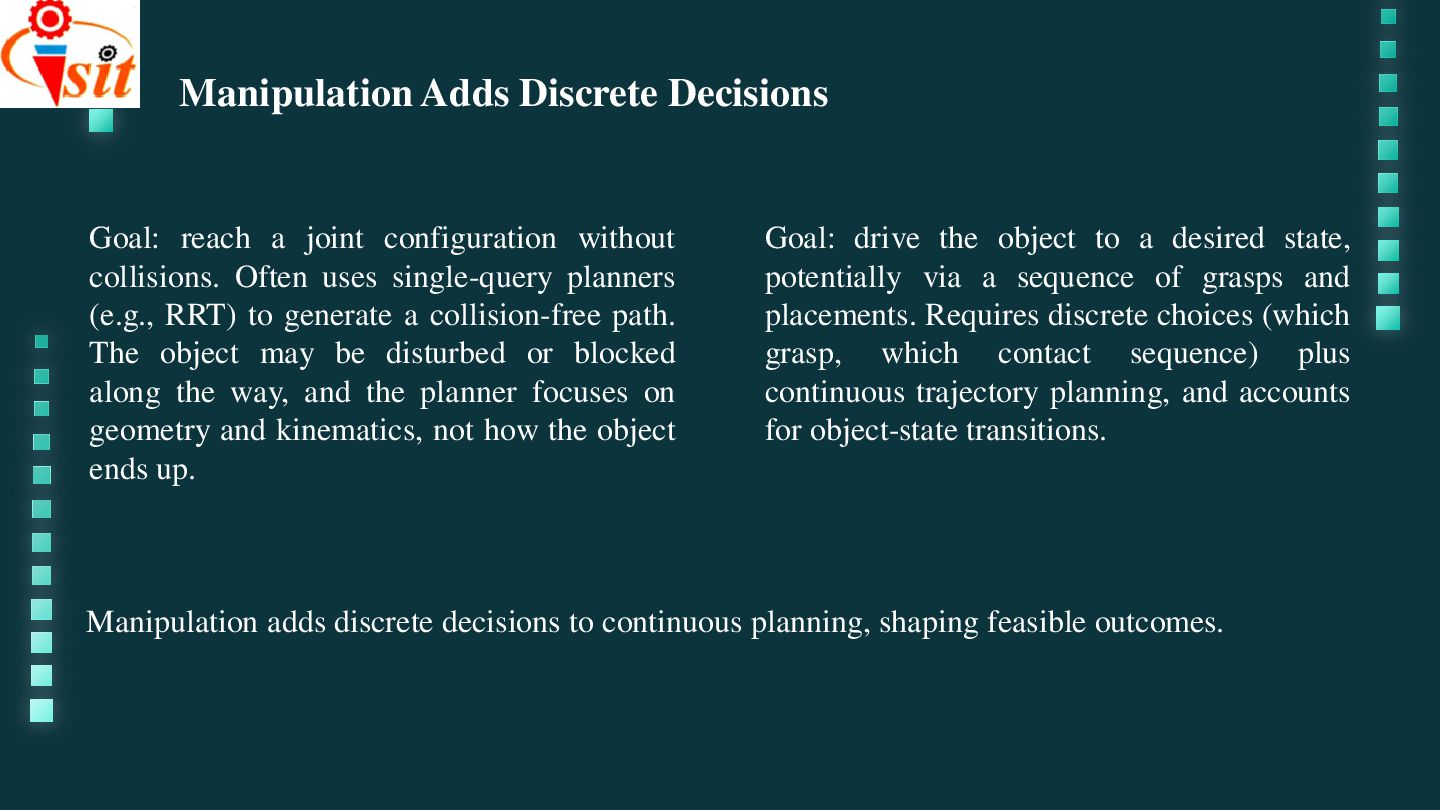
collisions. Often uses single-query planners (e.g., RRT) to generate a collision-free path. The object may be disturbed or blocked along the way, and the planner focuses on geometry and kinematics, not how the object ends up. Goal: drive the object to a desired state, potentially via a sequence of grasps and placements. Requires discrete choices (which grasp, which contact sequence) plus continuous trajectory planning, and accounts for object-state transitions. Manipulation adds discrete decisions to continuous planning, shaping feasible outcomes.
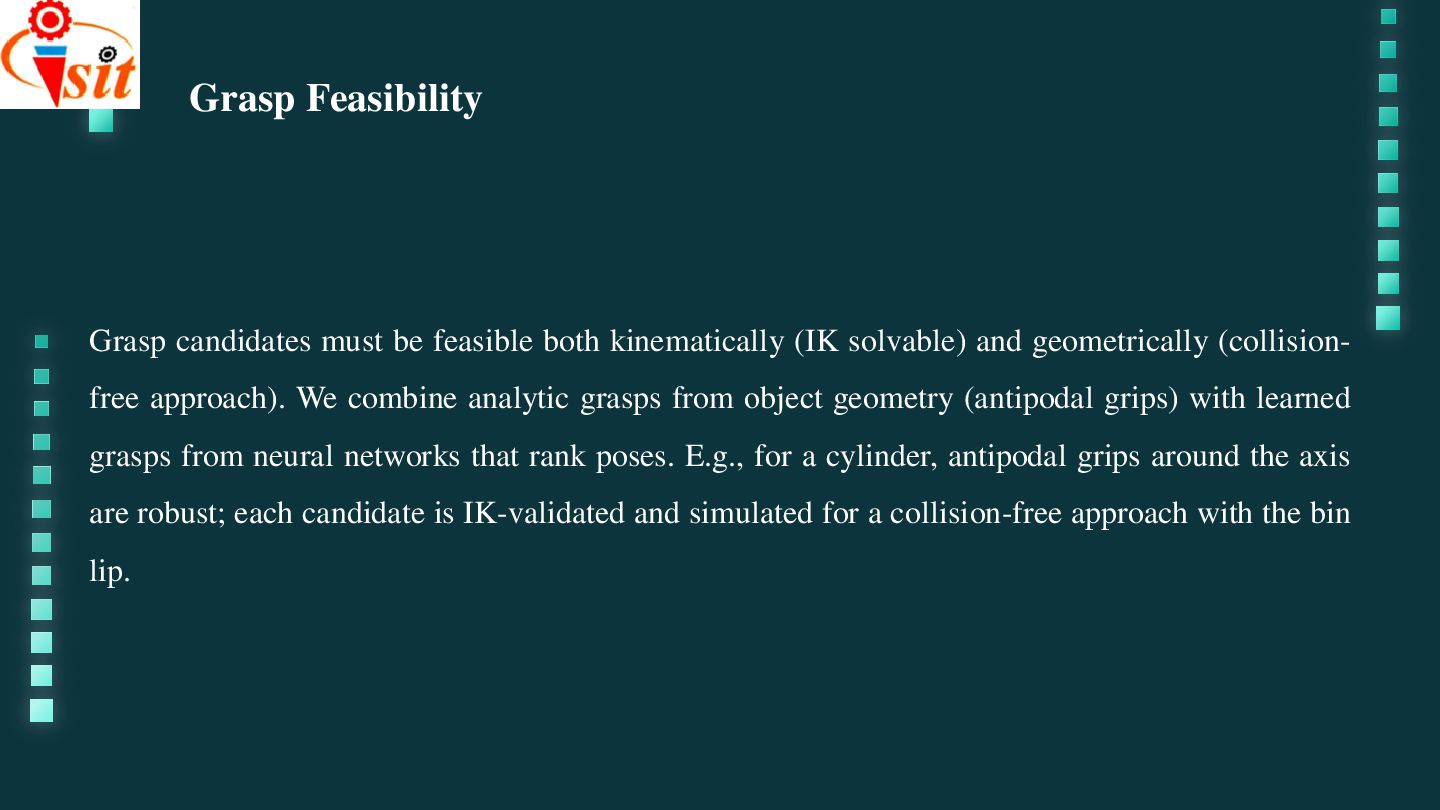
solvable) and geometrically (collisionfree approach). We combine analytic grasps from object geometry (antipodal grips) with learned grasps from neural networks that rank poses. E.g., for a cylinder, antipodal grips around the axis are robust; each candidate is IK-validated and simulated for a collision-free approach with the bin lip.
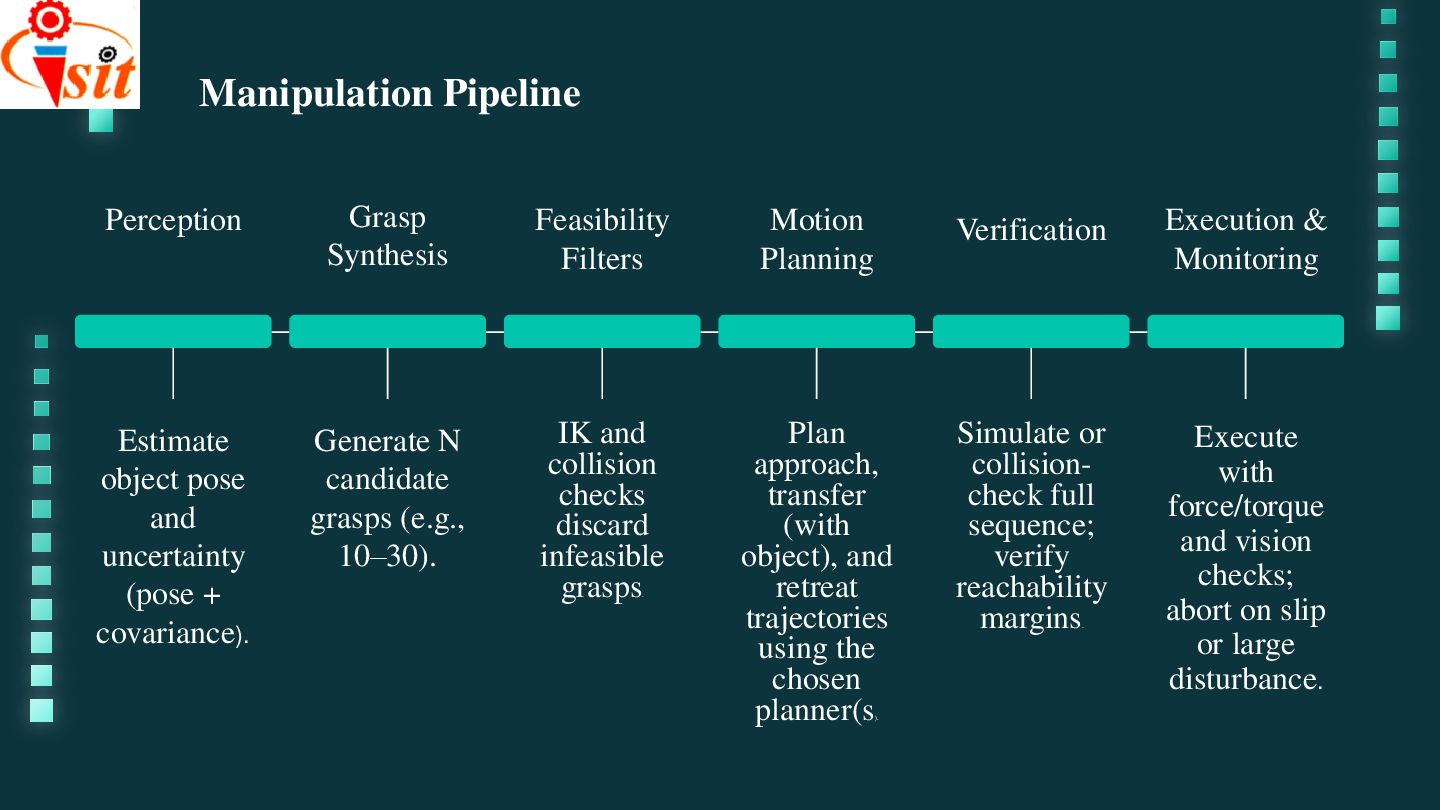
Execution & Monitoring Estimate object pose and uncertainty (pose + covariance). Generate N candidate grasps (e.g., 10–30). IK and collision checks discard infeasible grasps Plan approach, transfer (with object), and retreat trajectories using the chosen planner(s Simulate or collisioncheck full sequence; verify reachability margins Execute with force/torque and vision checks; abort on slip or large disturbance. . ). .
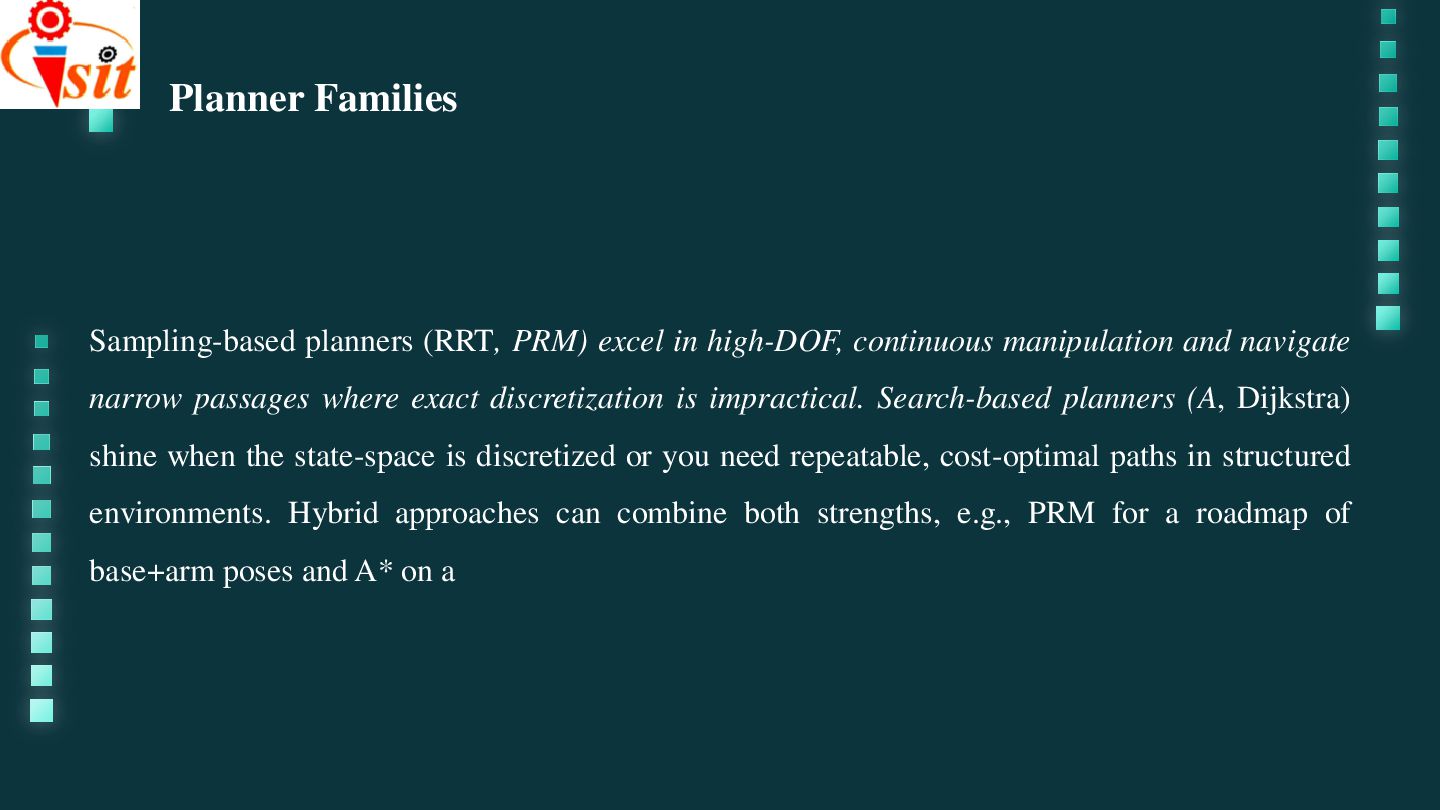
manipulation and navigate narrow passages where exact discretization is impractical. Search-based planners (A, Dijkstra) shine when the state-space is discretized or you need repeatable, cost-optimal paths in structured environments. Hybrid approaches can combine both strengths, e.g., PRM for a roadmap of base+arm poses and A* on a
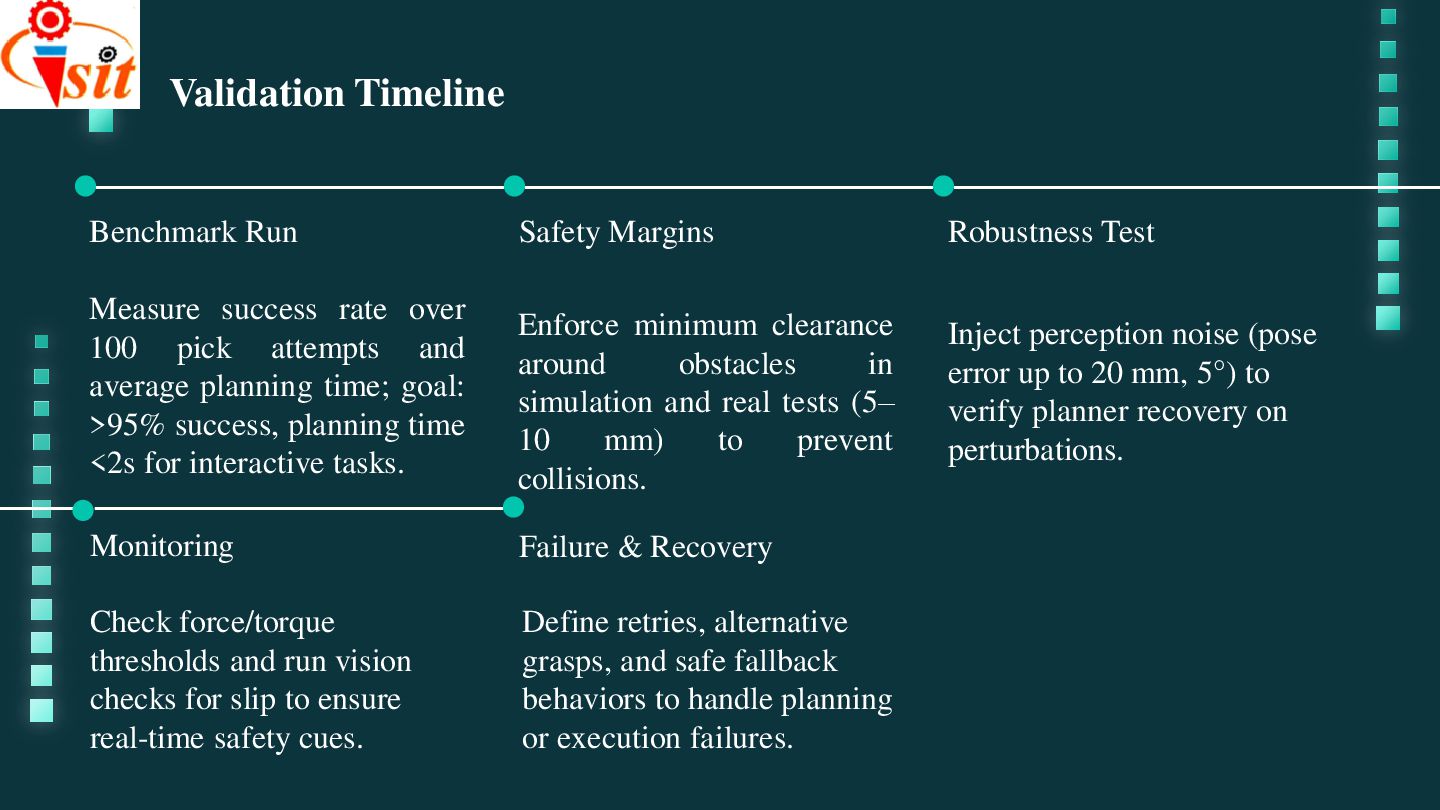
rate over 100 pick attempts and average planning time; goal: >95% success, planning time <2s for interactive tasks. Enforce minimum clearance around obstacles in simulation and real tests (5– 10 mm) to prevent collisions. Inject perception noise (pose error up to 20 mm, 5°) to verify planner recovery on perturbations. Monitoring Failure & Recovery Check force/torque thresholds and run vision checks for slip to ensure real-time safety cues. Define retries, alternative grasps, and safe fallback behaviors to handle planning or execution failures.
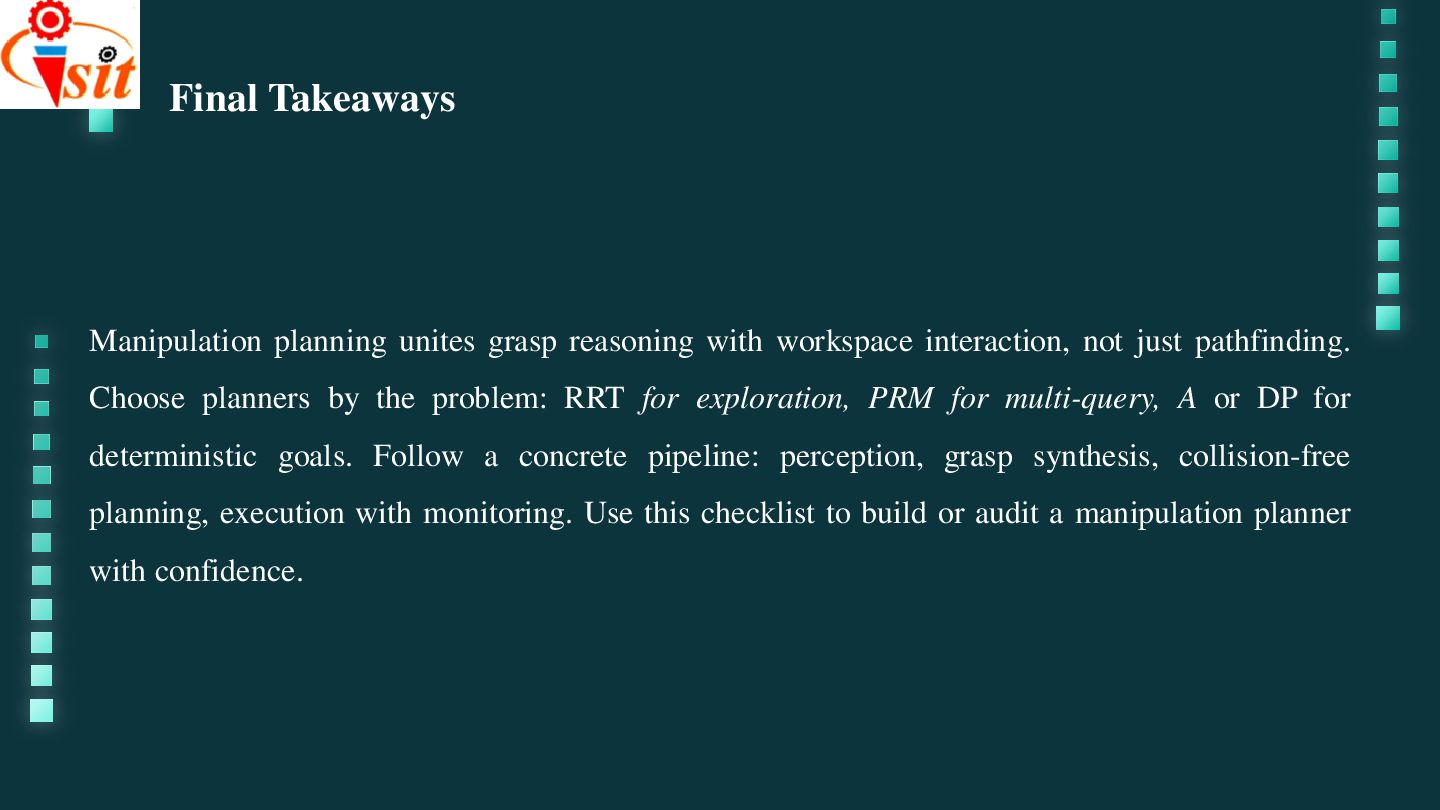
not just pathfinding. Choose planners by the problem: RRT for exploration, PRM for multi-query, A or DP for deterministic goals. Follow a concrete pipeline: perception, grasp synthesis, collision-free planning, execution with monitoring. Use this checklist to build or audit a manipulation planner with confidence.


 marktimemedia
 wayneb77
 tammyeverts
 inesmontani
 sergeychernyshev
 speakerdeck
 sarafernandez
 rkendrick25
 ryanjones
 dougneiner
 popppiees
 tessaabrams