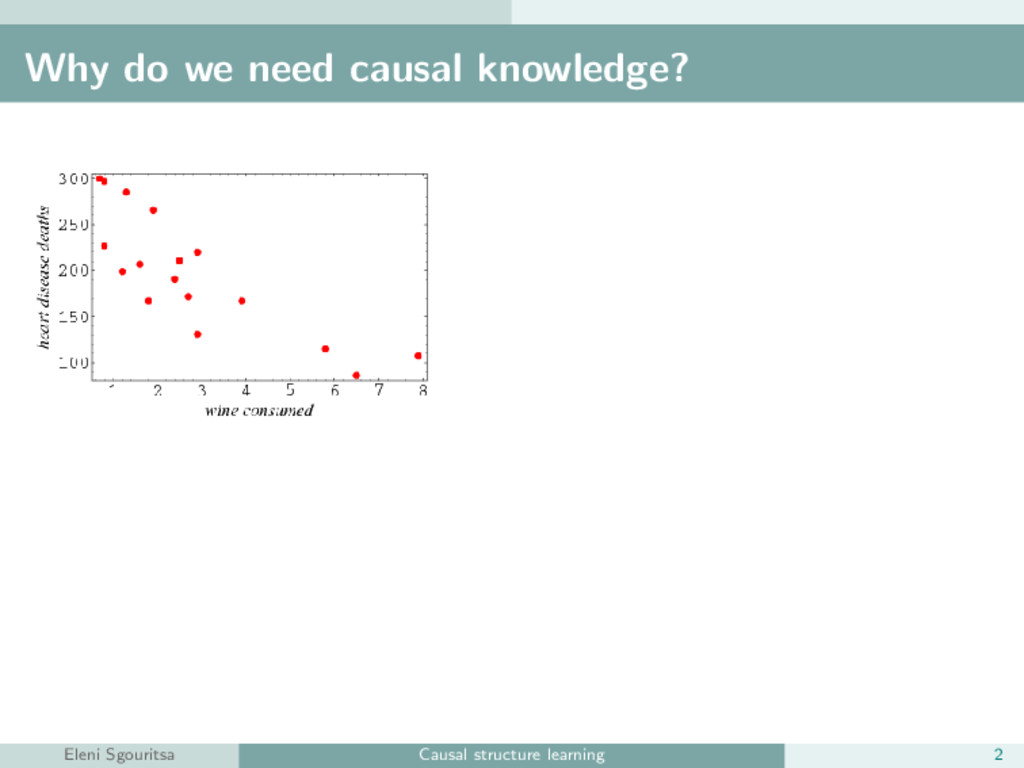
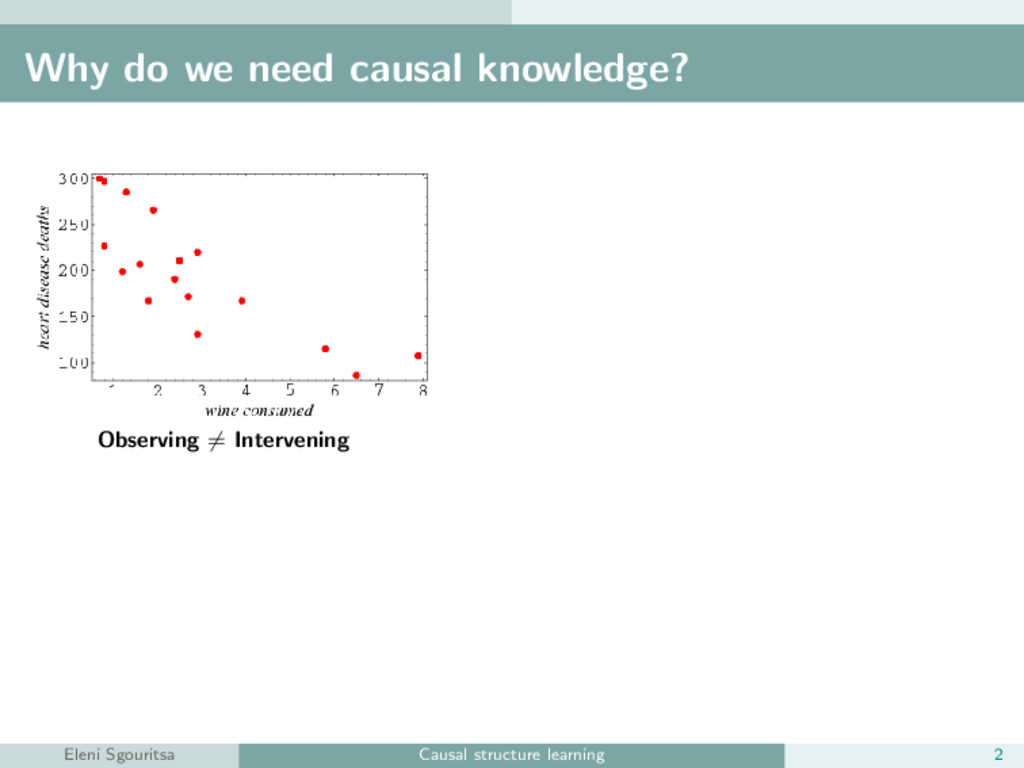
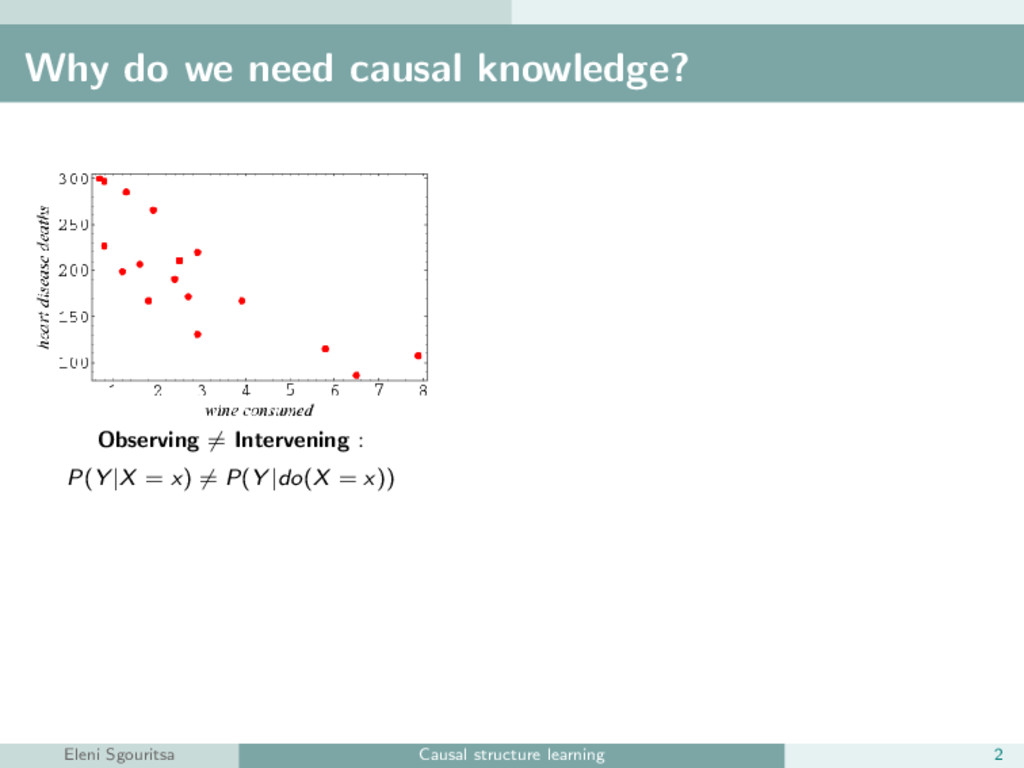
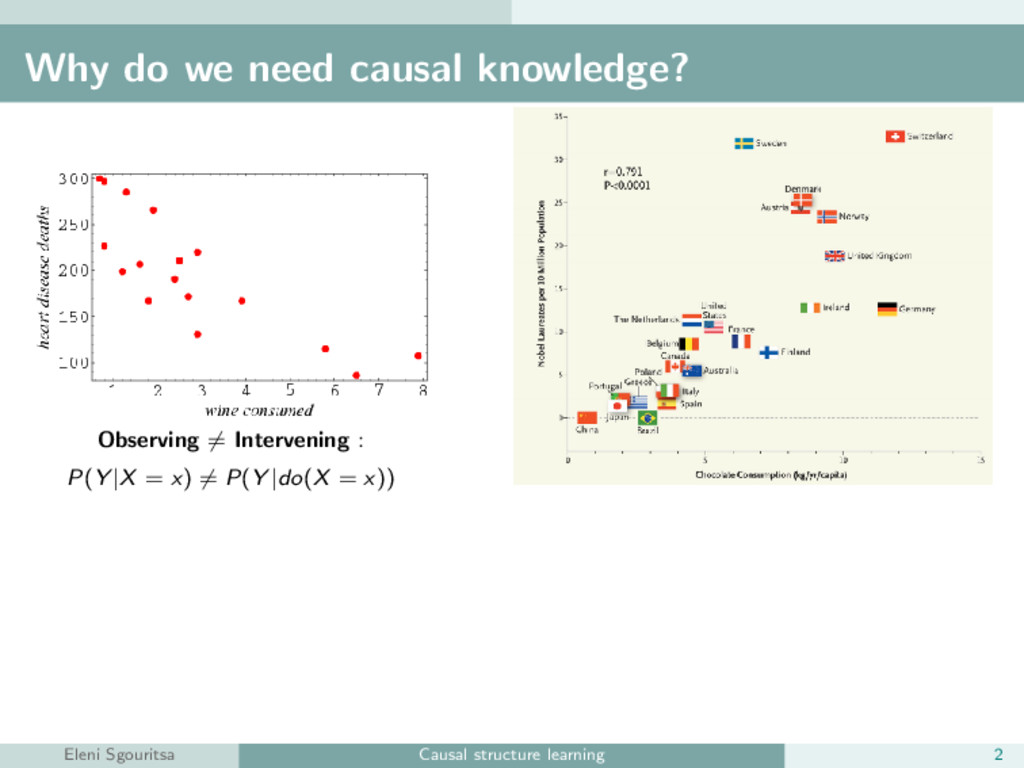
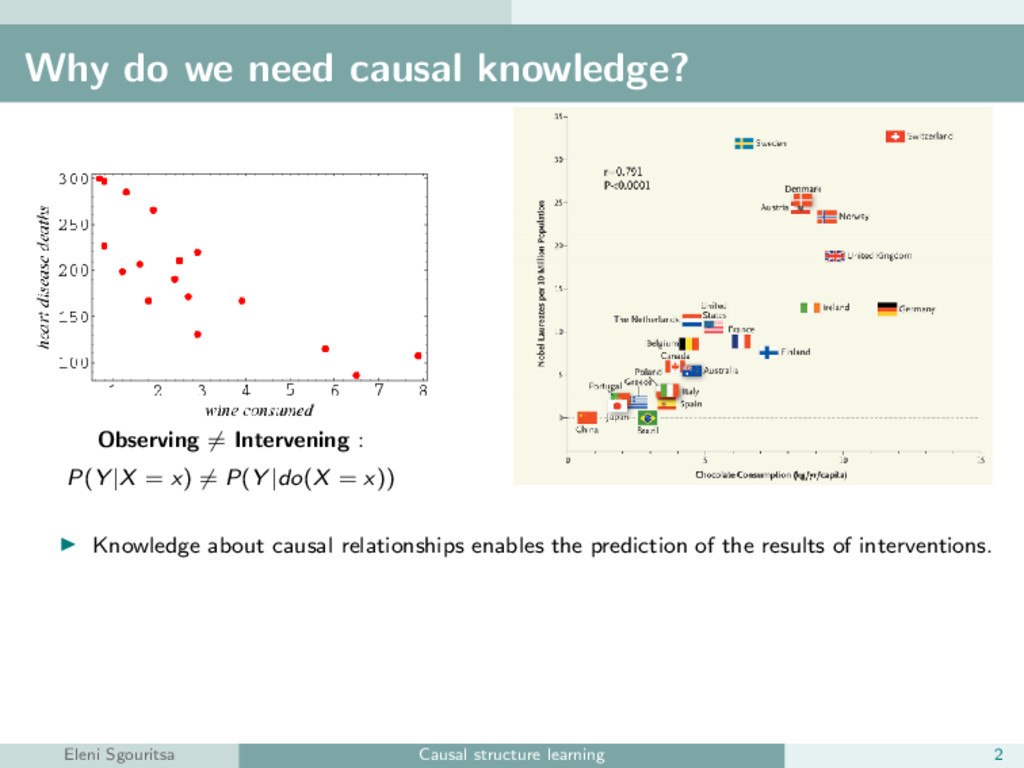
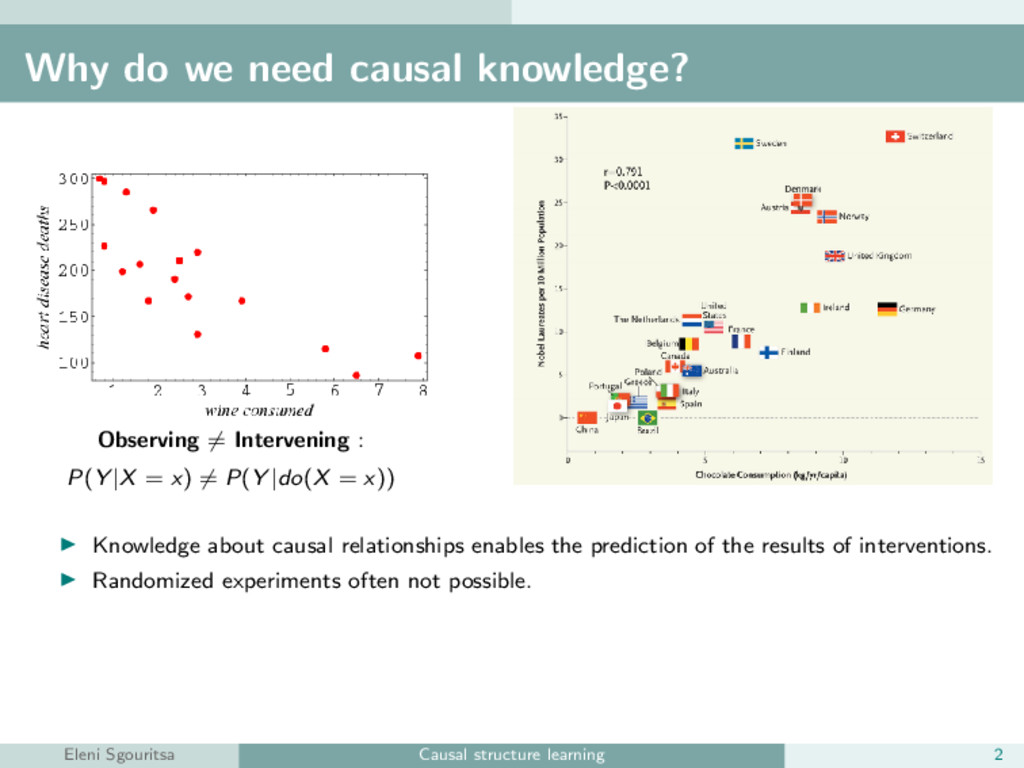
P(Y |X = x) = P(Y |do(X = x)) Knowledge about causal relationships enables the prediction of the results of interventions. Randomized experiments often not possible. Eleni Sgouritsa Causal structure learning 2
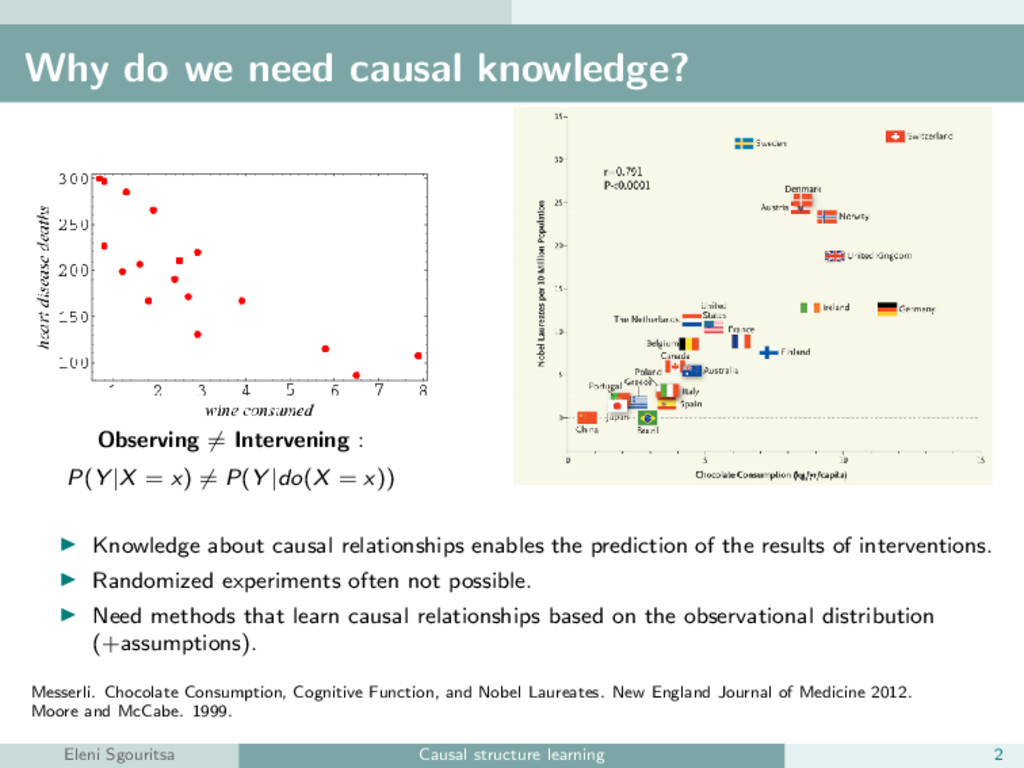
P(Y |X = x) = P(Y |do(X = x)) Knowledge about causal relationships enables the prediction of the results of interventions. Randomized experiments often not possible. Need methods that learn causal relationships based on the observational distribution (+assumptions). Messerli. Chocolate Consumption, Cognitive Function, and Nobel Laureates. New England Journal of Medicine 2012. Moore and McCabe. 1999. Eleni Sgouritsa Causal structure learning 2
independences Additive Noise Models Methods based on independence of causal mechanisms How can causal knowledge help machine learning? Eleni Sgouritsa Causal structure learning 3
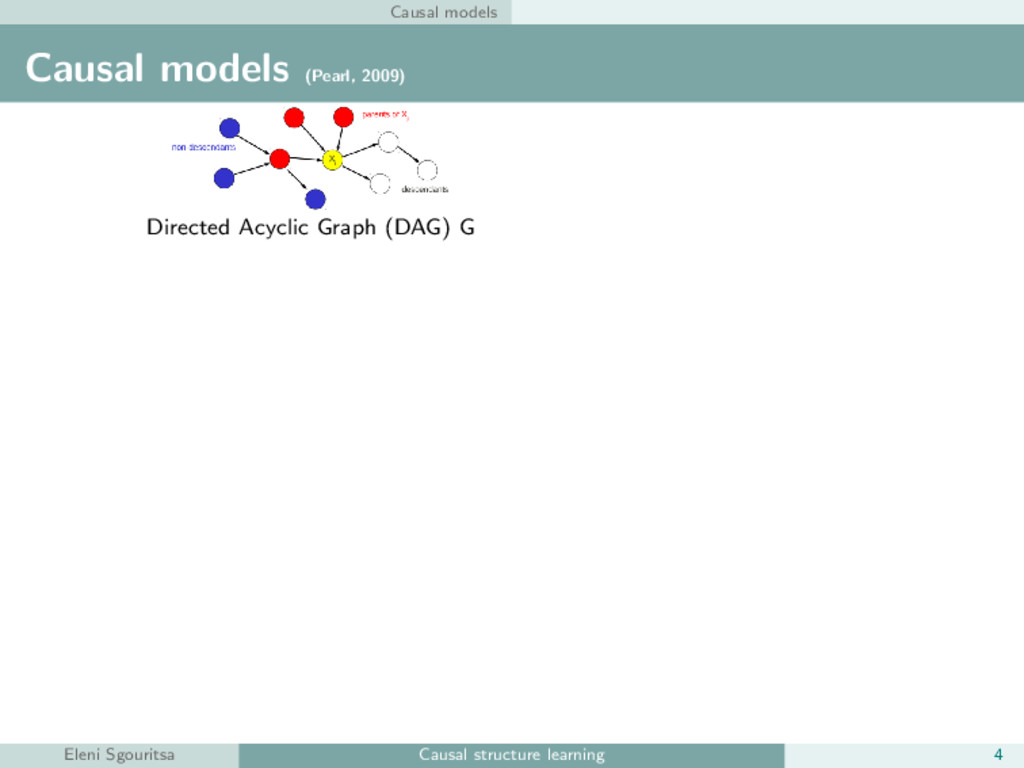
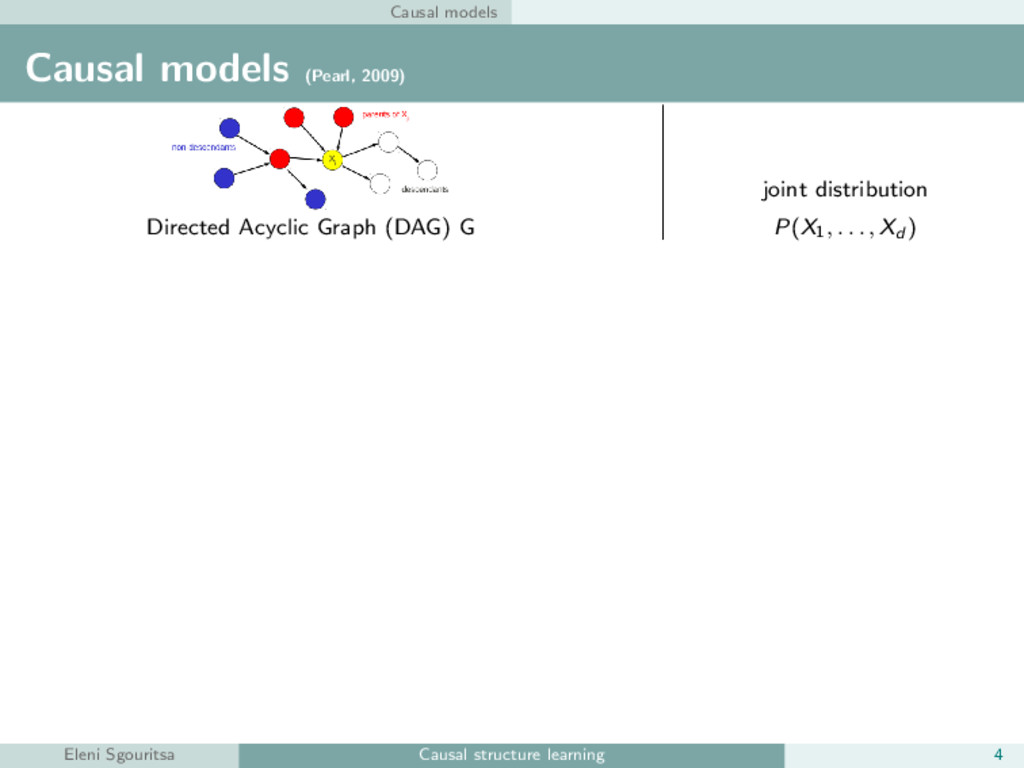
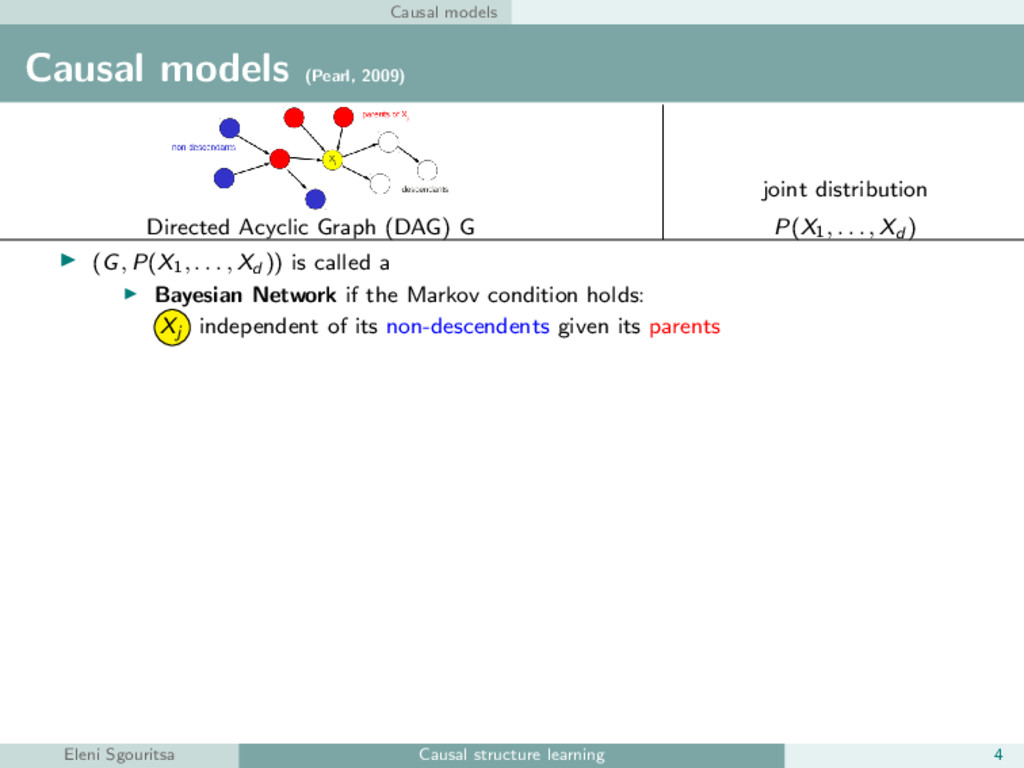
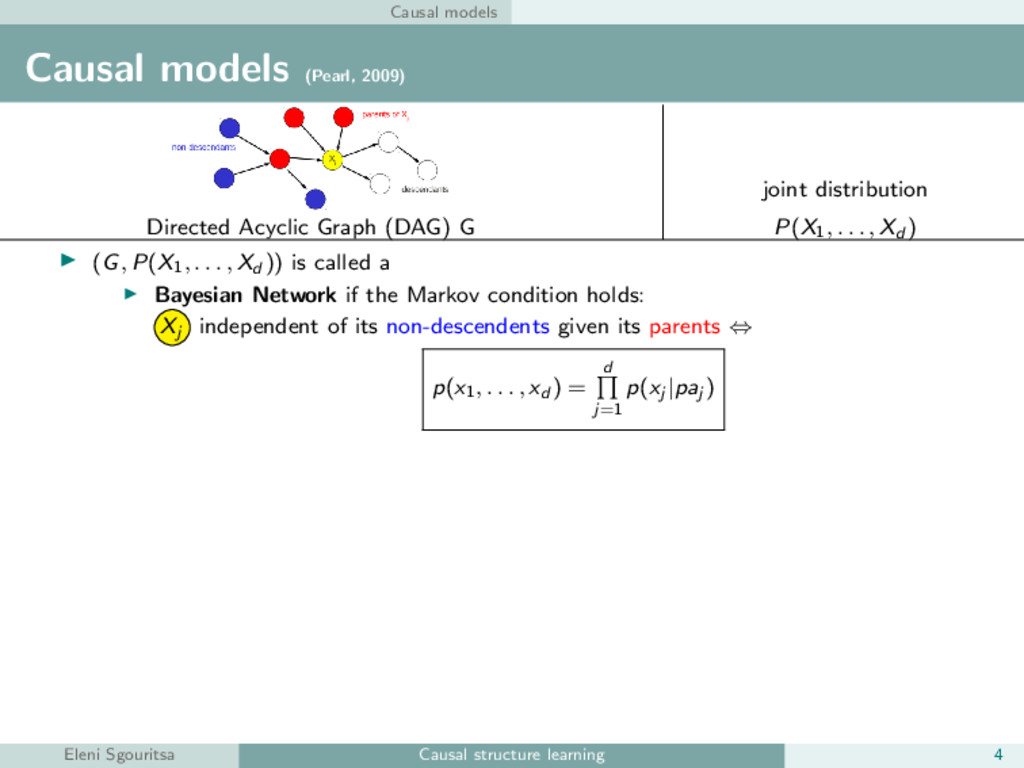
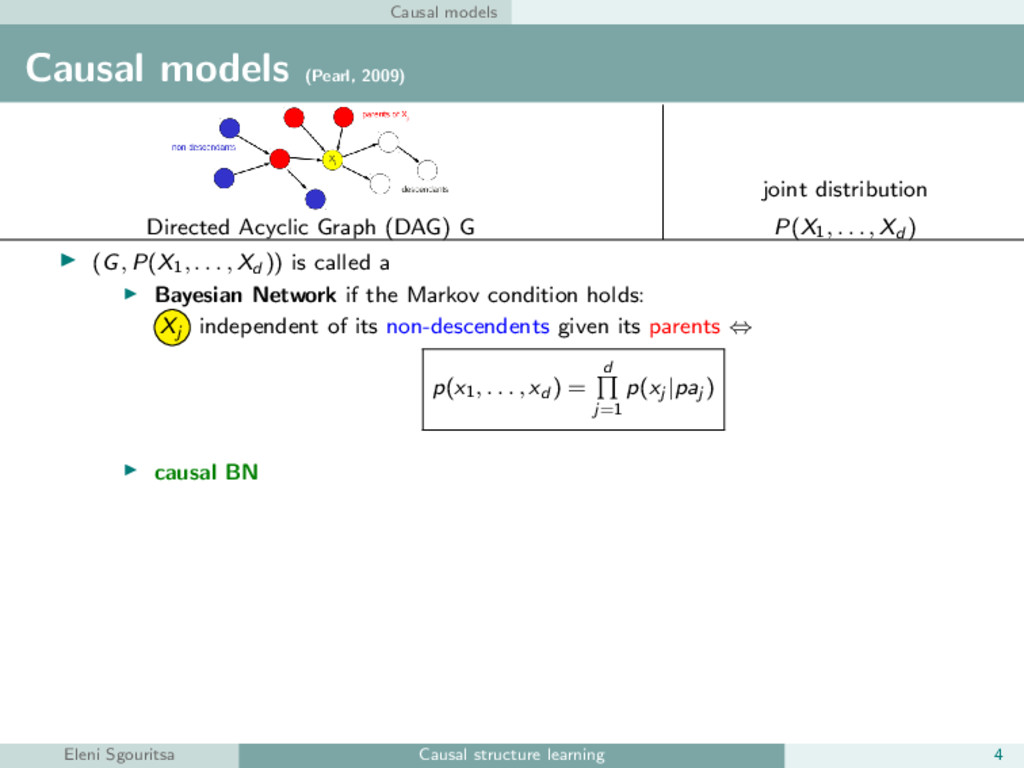
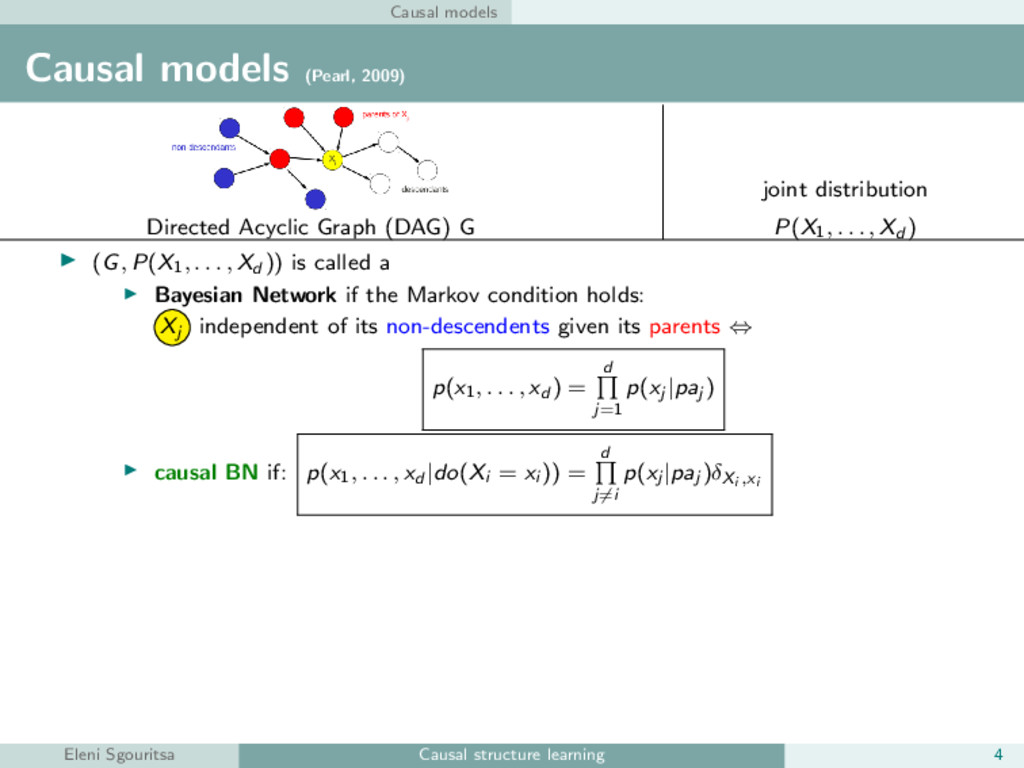
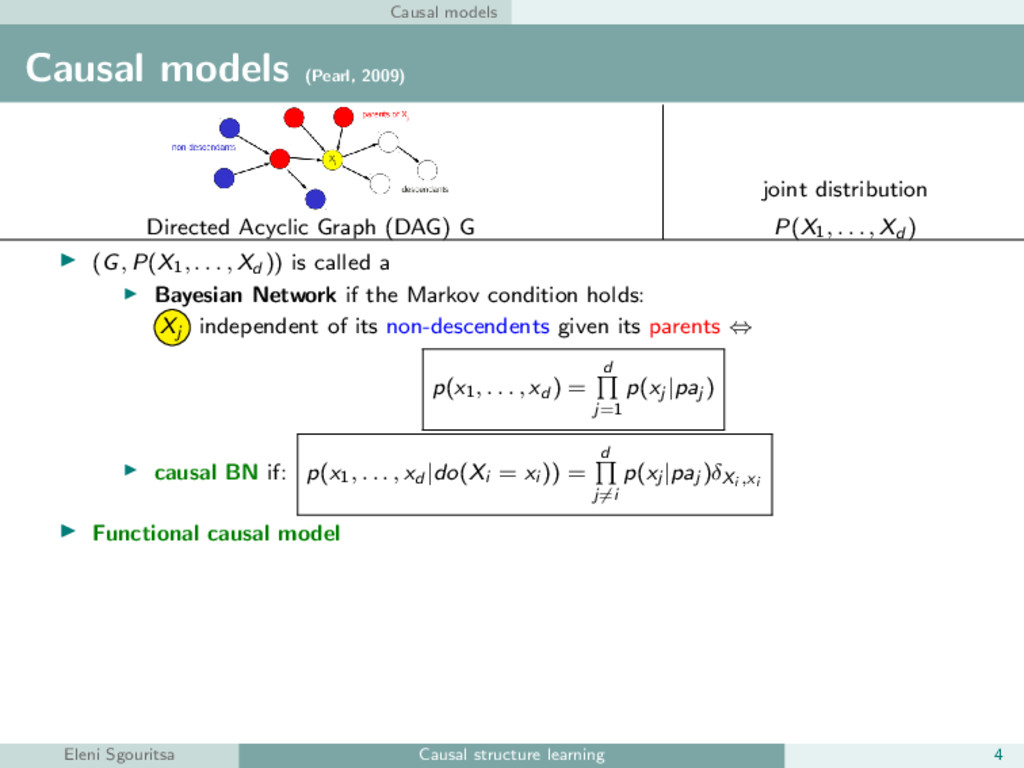
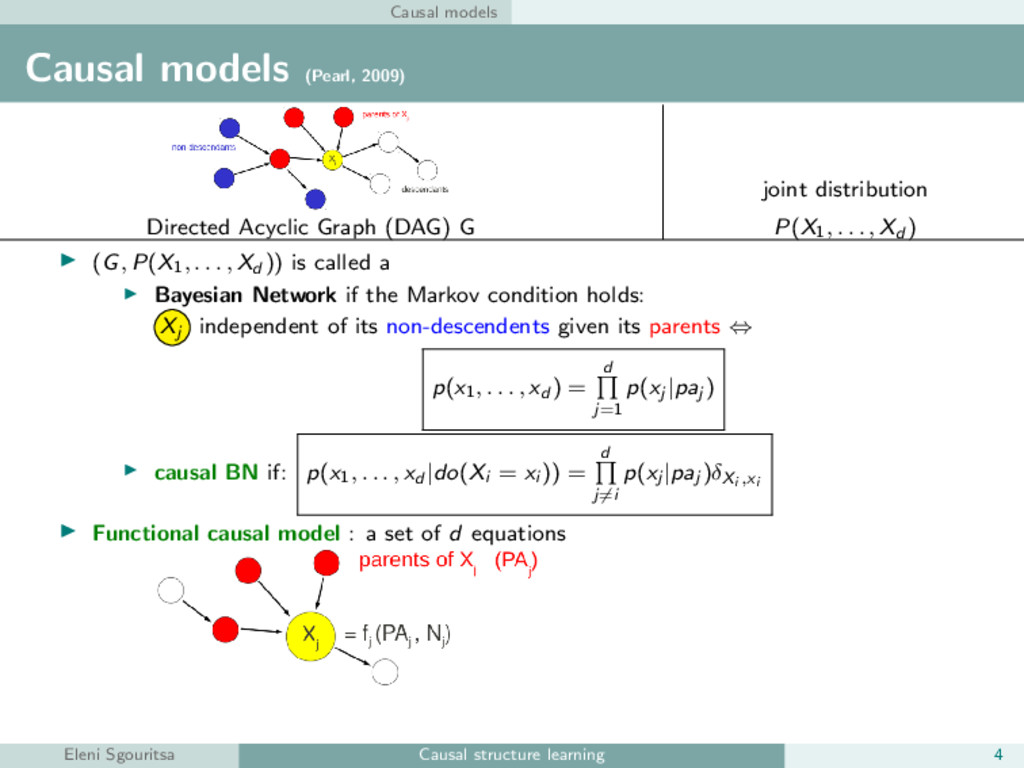
G joint distribution P(X1, . . . , Xd ) (G, P(X1, . . . , Xd )) is called a Bayesian Network if the Markov condition holds: Xj independent of its non-descendents given its parents Eleni Sgouritsa Causal structure learning 4
G joint distribution P(X1, . . . , Xd ) (G, P(X1, . . . , Xd )) is called a Bayesian Network if the Markov condition holds: Xj independent of its non-descendents given its parents ⇔ p(x1, . . . , xd ) = d j=1 p(xj |paj ) Eleni Sgouritsa Causal structure learning 4
G joint distribution P(X1, . . . , Xd ) (G, P(X1, . . . , Xd )) is called a Bayesian Network if the Markov condition holds: Xj independent of its non-descendents given its parents ⇔ p(x1, . . . , xd ) = d j=1 p(xj |paj ) causal BN Eleni Sgouritsa Causal structure learning 4
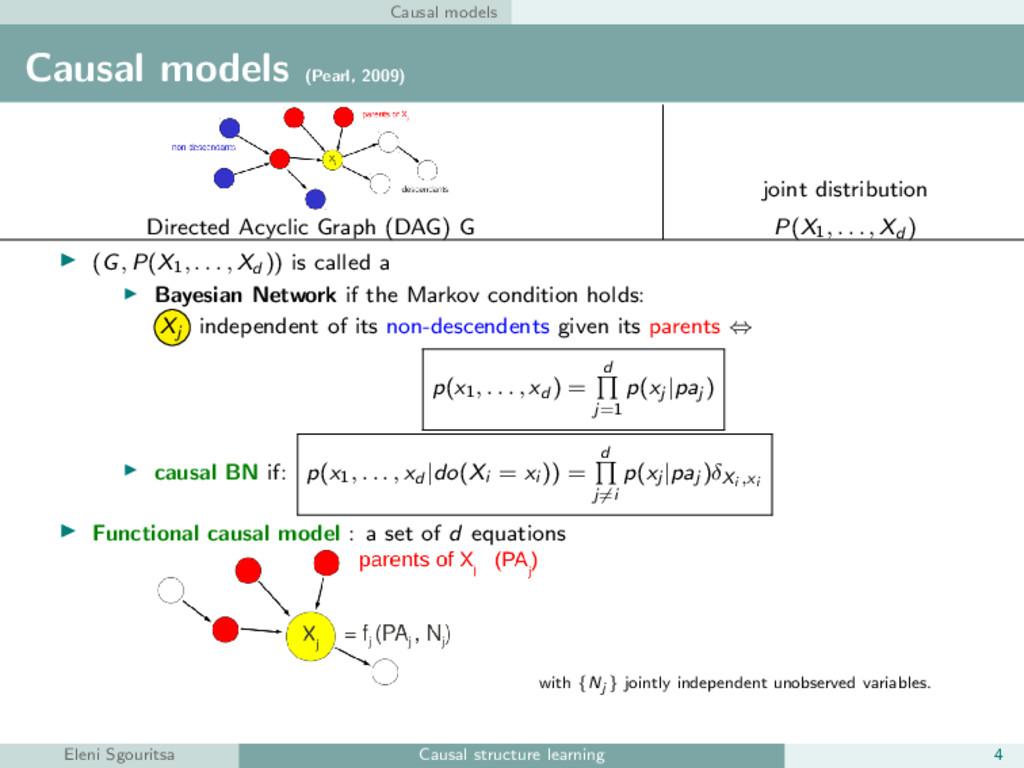
G joint distribution P(X1, . . . , Xd ) (G, P(X1, . . . , Xd )) is called a Bayesian Network if the Markov condition holds: Xj independent of its non-descendents given its parents ⇔ p(x1, . . . , xd ) = d j=1 p(xj |paj ) causal BN if: p(x1, . . . , xd |do(Xi = xi )) = d j=i p(xj |paj )δXi ,xi Functional causal model : a set of d equations Eleni Sgouritsa Causal structure learning 4
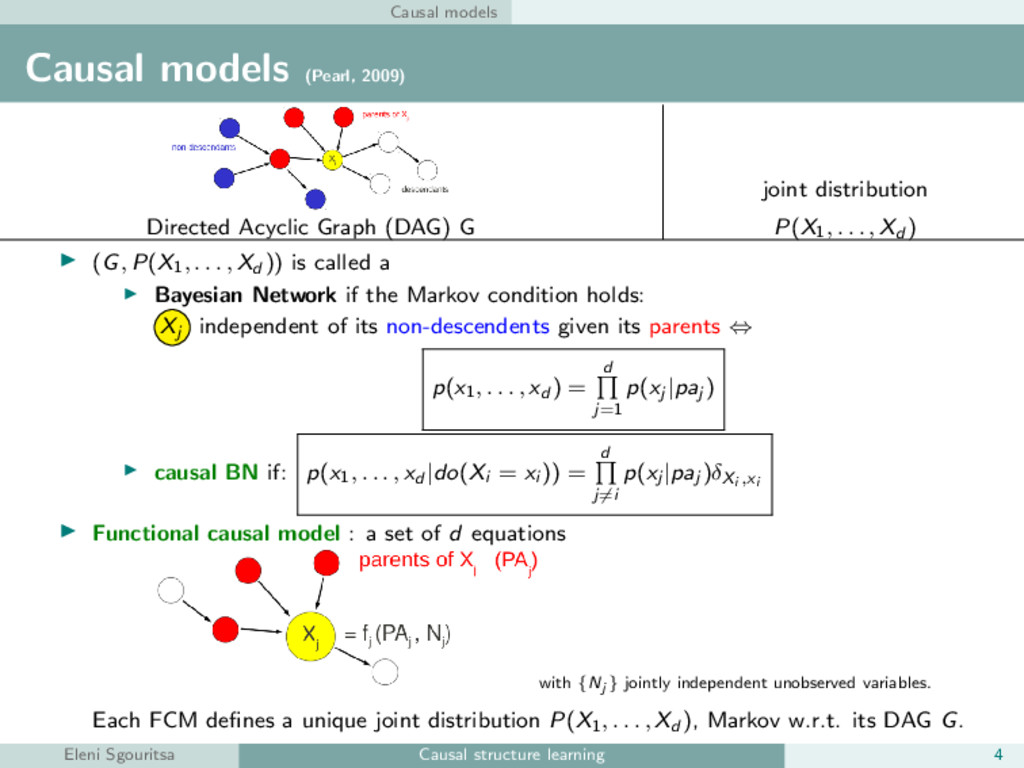
G joint distribution P(X1, . . . , Xd ) (G, P(X1, . . . , Xd )) is called a Bayesian Network if the Markov condition holds: Xj independent of its non-descendents given its parents ⇔ p(x1, . . . , xd ) = d j=1 p(xj |paj ) causal BN if: p(x1, . . . , xd |do(Xi = xi )) = d j=i p(xj |paj )δXi ,xi Functional causal model : a set of d equations with {Nj } jointly independent unobserved variables. Eleni Sgouritsa Causal structure learning 4
G joint distribution P(X1, . . . , Xd ) (G, P(X1, . . . , Xd )) is called a Bayesian Network if the Markov condition holds: Xj independent of its non-descendents given its parents ⇔ p(x1, . . . , xd ) = d j=1 p(xj |paj ) causal BN if: p(x1, . . . , xd |do(Xi = xi )) = d j=i p(xj |paj )δXi ,xi Functional causal model : a set of d equations with {Nj } jointly independent unobserved variables. Each FCM defines a unique joint distribution P(X1, . . . , Xd ), Markov w.r.t. its DAG G. Eleni Sgouritsa Causal structure learning 4
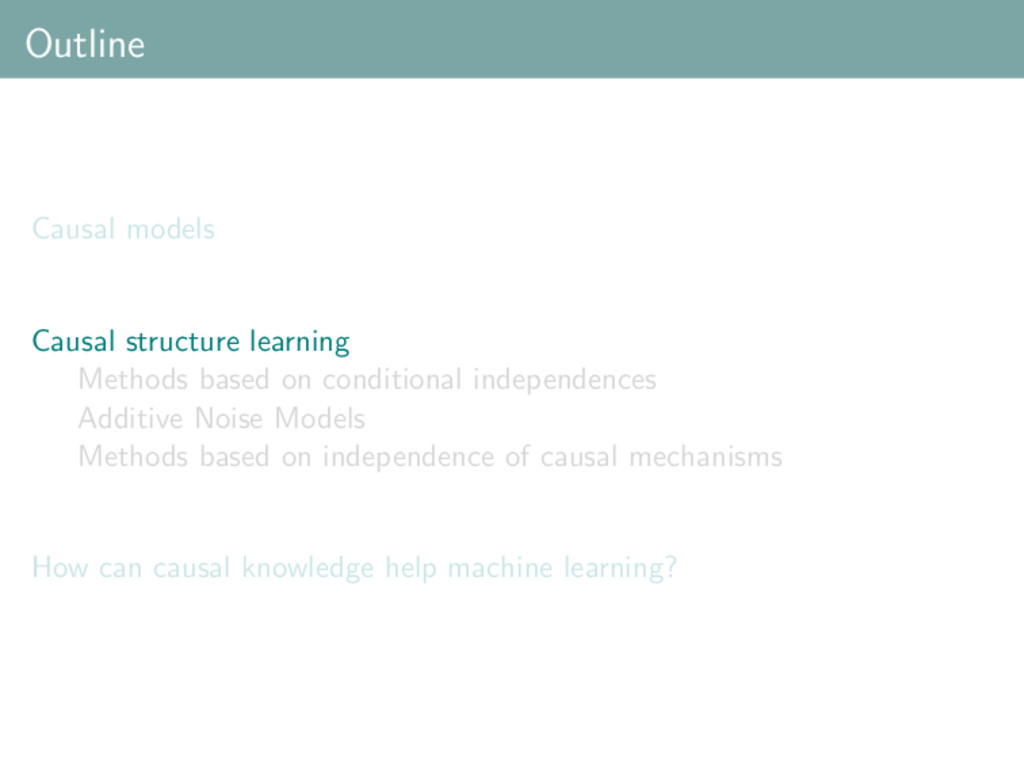
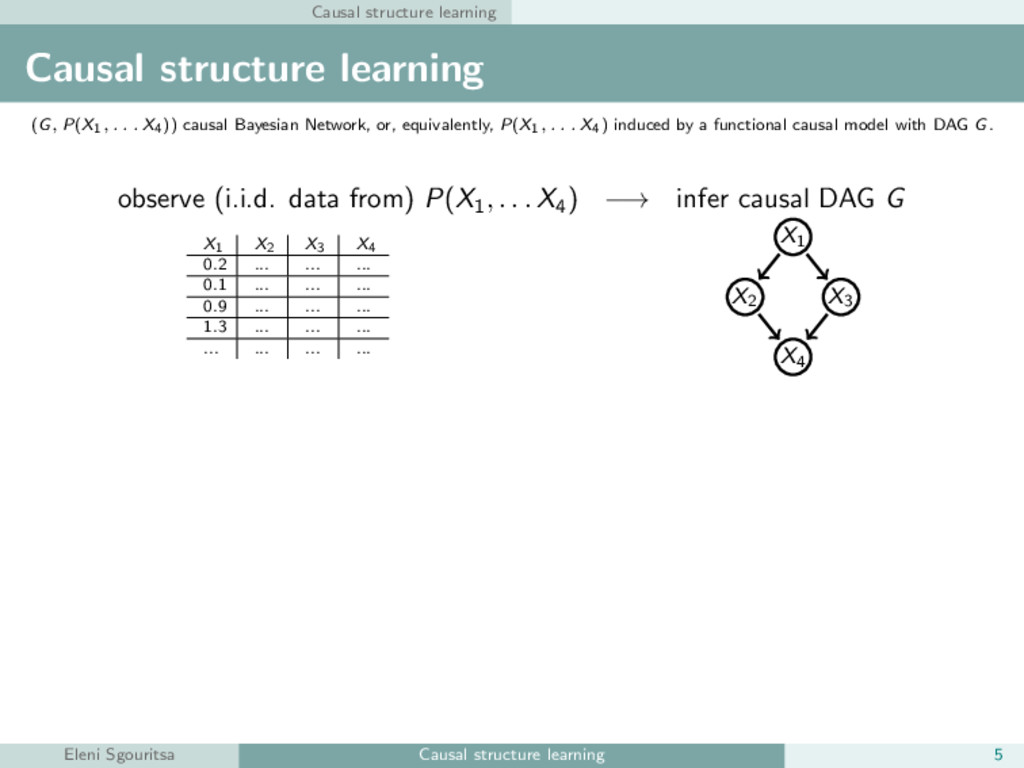
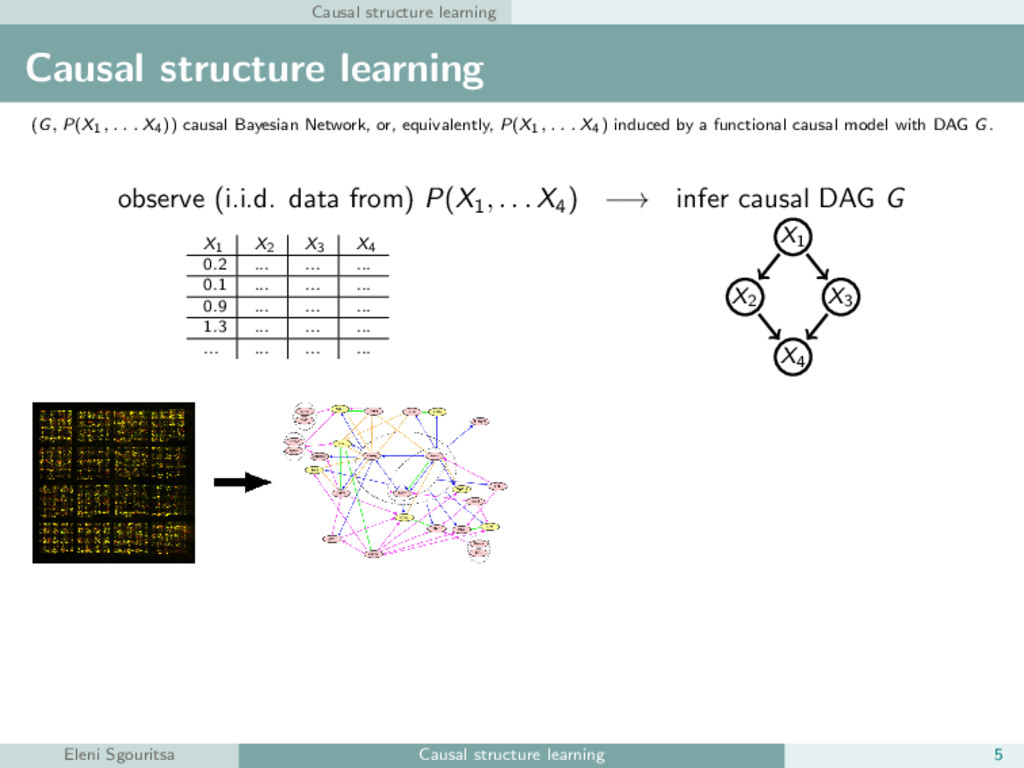
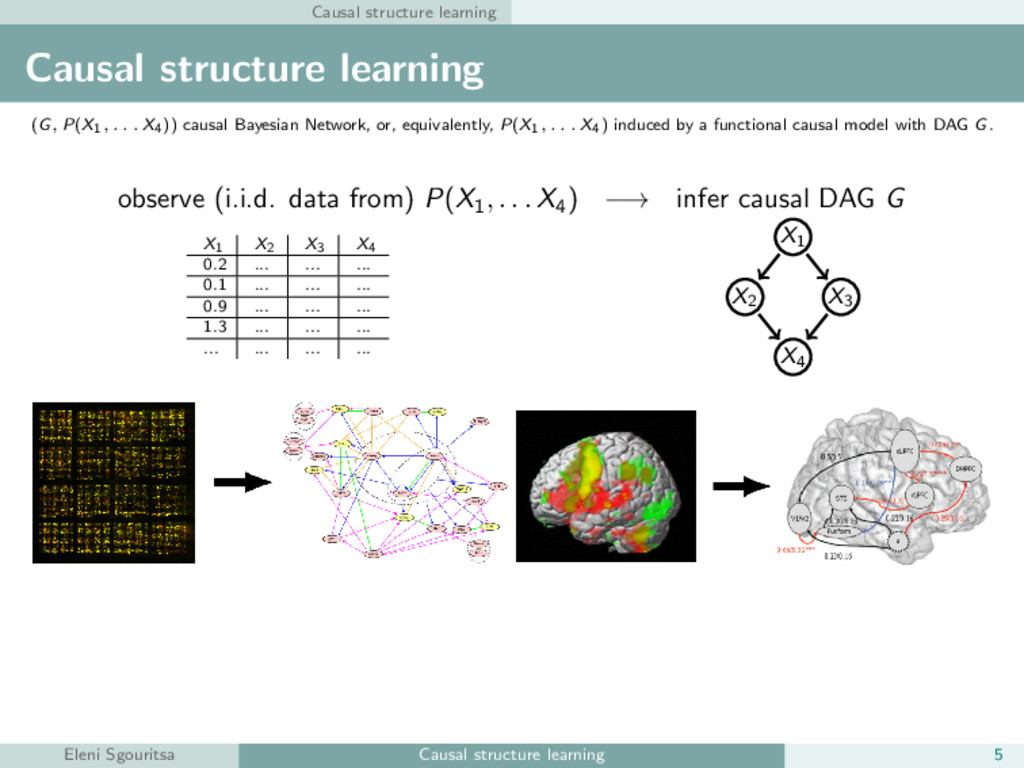
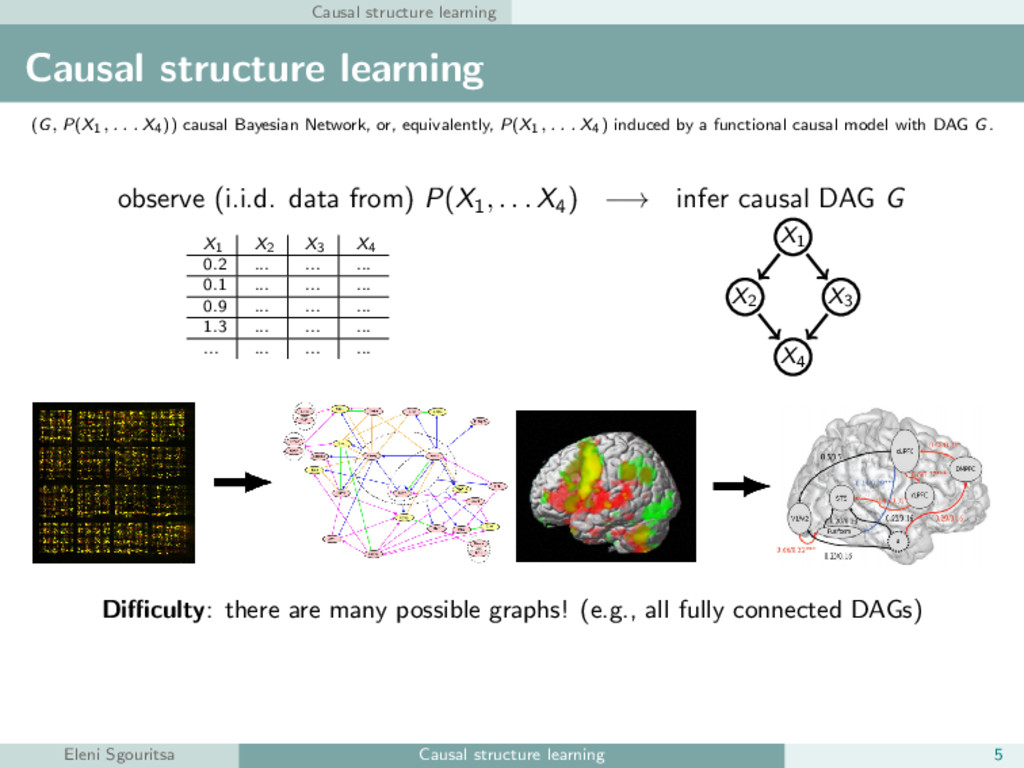
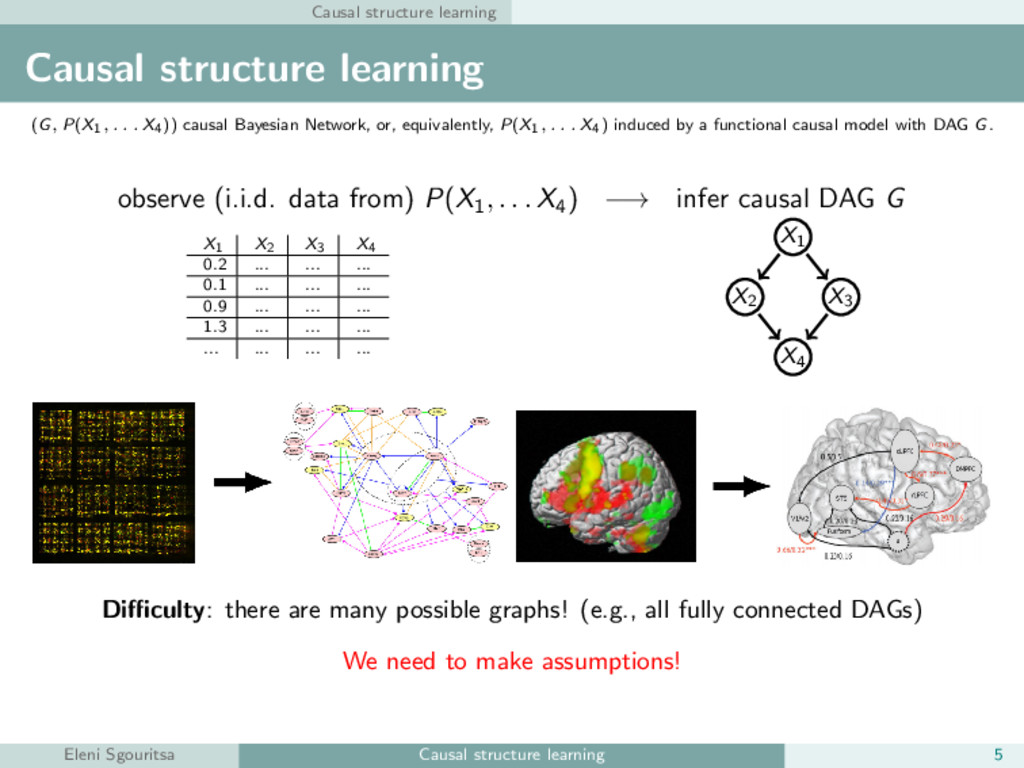
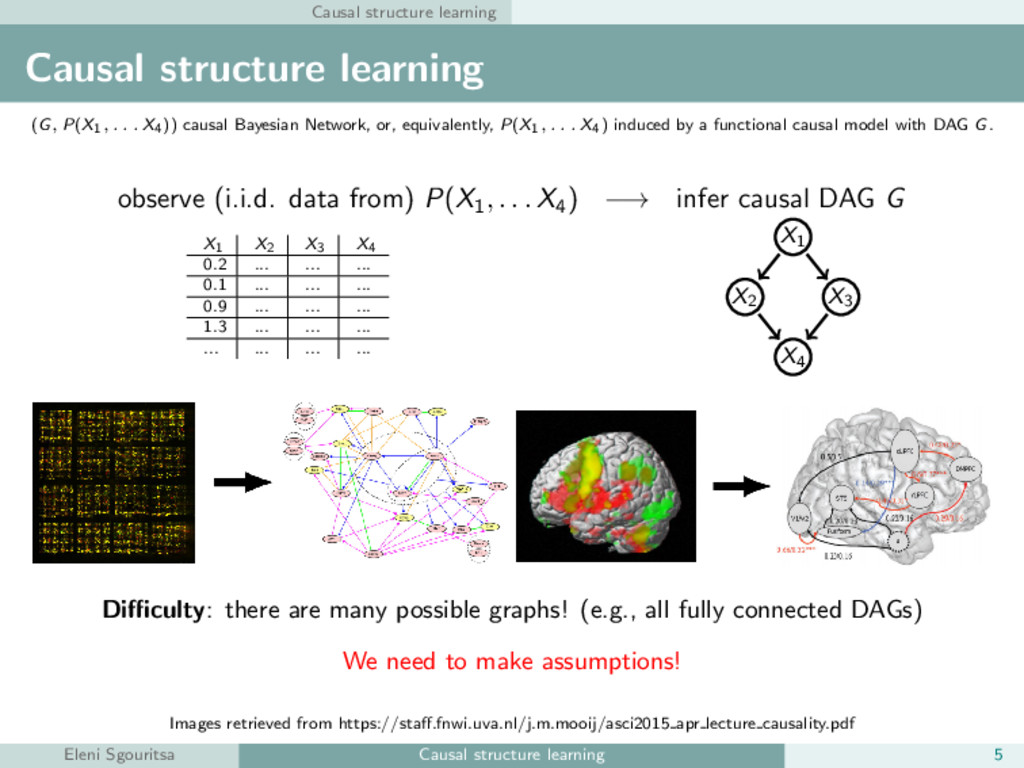
. X4)) causal Bayesian Network, or, equivalently, P(X1, . . . X4) induced by a functional causal model with DAG G. observe (i.i.d. data from) P(X1, . . . X4 ) −→ infer causal DAG G X1 X2 X3 X4 0.2 ... ... ... 0.1 ... ... ... 0.9 ... ... ... 1.3 ... ... ... ... ... ... ... X1 X2 X3 X4 Difficulty: there are many possible graphs! (e.g., all fully connected DAGs) We need to make assumptions! Eleni Sgouritsa Causal structure learning 5
. X4)) causal Bayesian Network, or, equivalently, P(X1, . . . X4) induced by a functional causal model with DAG G. observe (i.i.d. data from) P(X1, . . . X4 ) −→ infer causal DAG G X1 X2 X3 X4 0.2 ... ... ... 0.1 ... ... ... 0.9 ... ... ... 1.3 ... ... ... ... ... ... ... X1 X2 X3 X4 Difficulty: there are many possible graphs! (e.g., all fully connected DAGs) We need to make assumptions! Images retrieved from https://staff.fnwi.uva.nl/j.m.mooij/asci2015 apr lecture causality.pdf Eleni Sgouritsa Causal structure learning 5
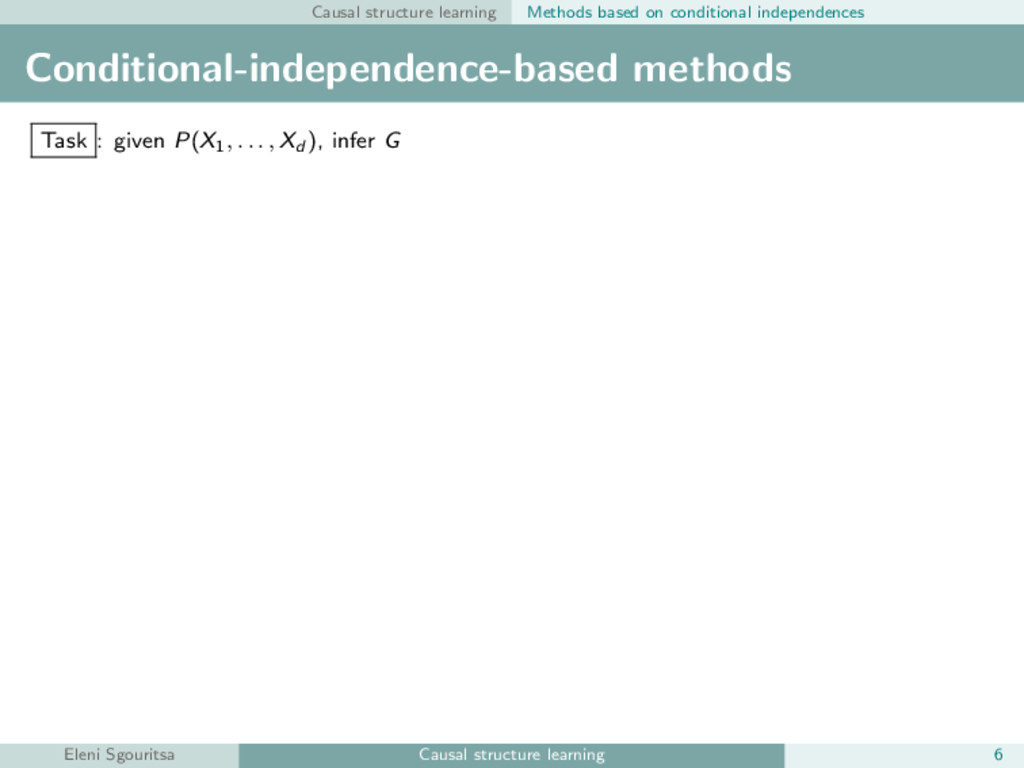
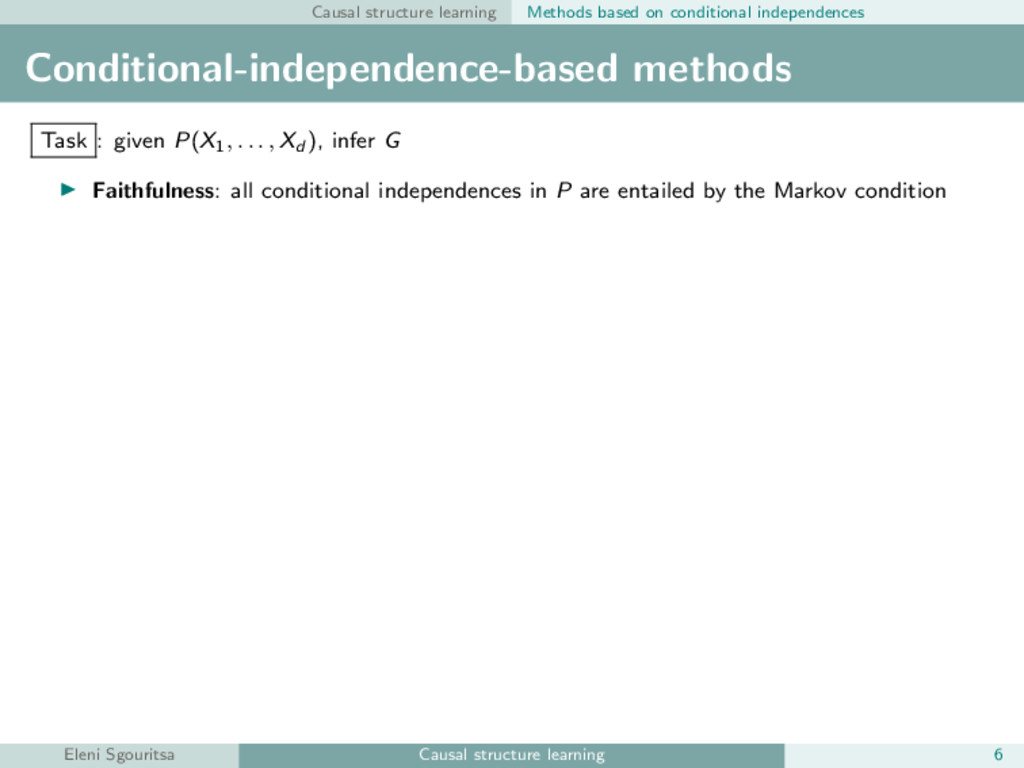
Task : given P(X1, . . . , Xd ), infer G Faithfulness: all conditional independences in P are entailed by the Markov condition Eleni Sgouritsa Causal structure learning 6
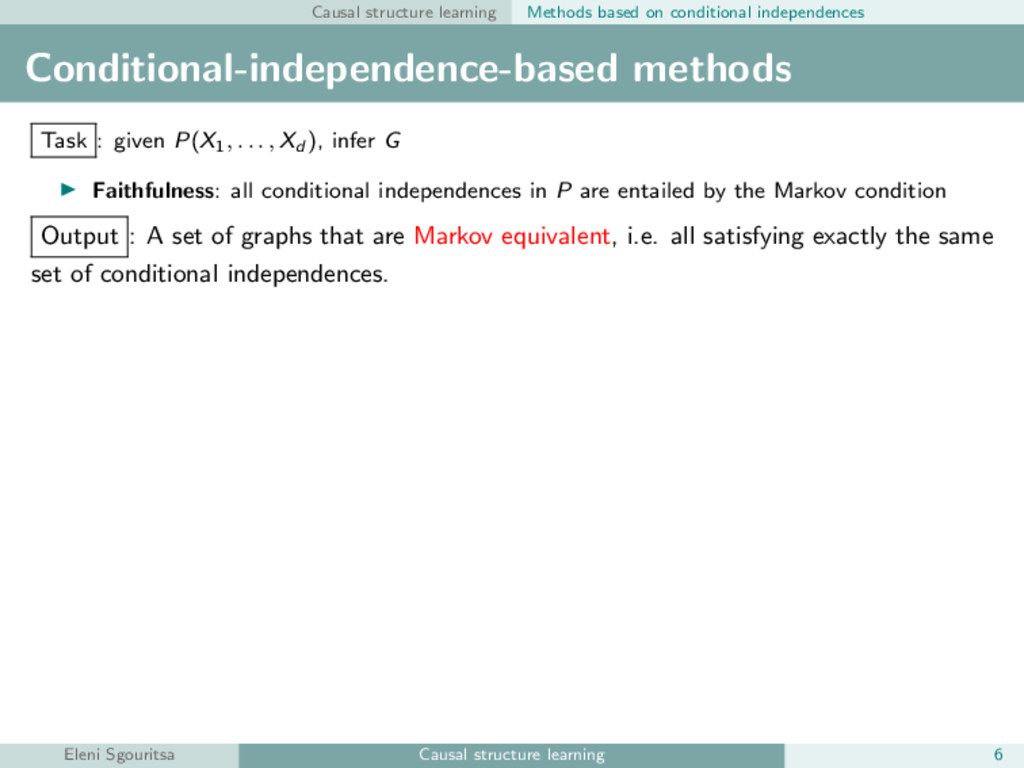
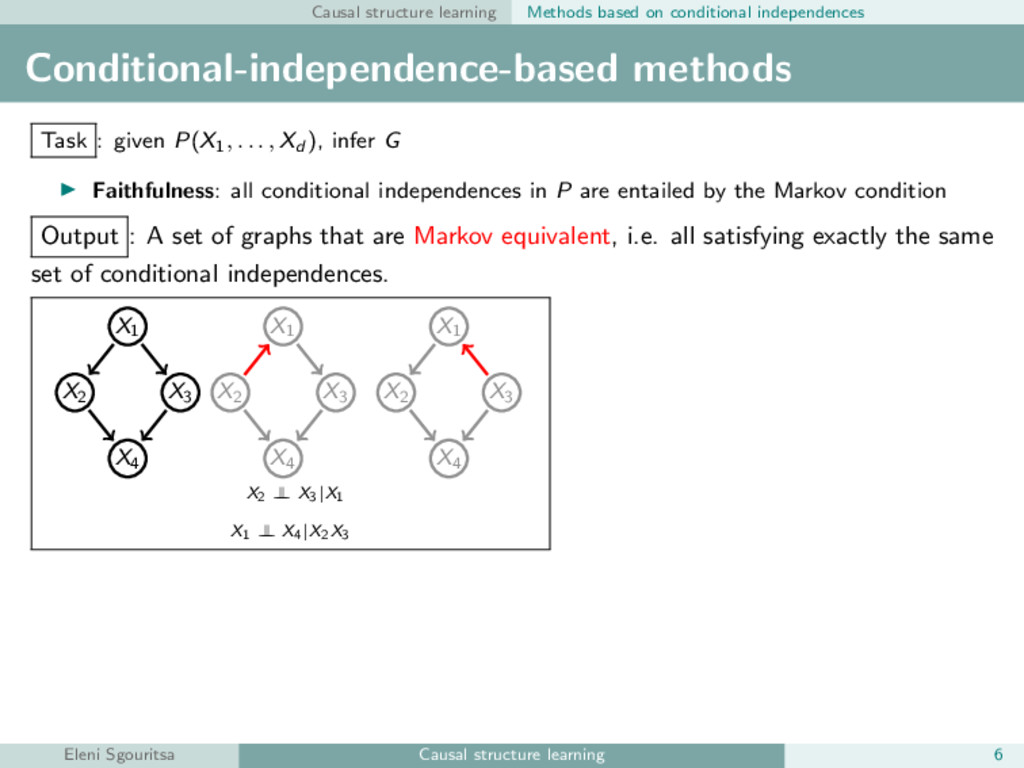
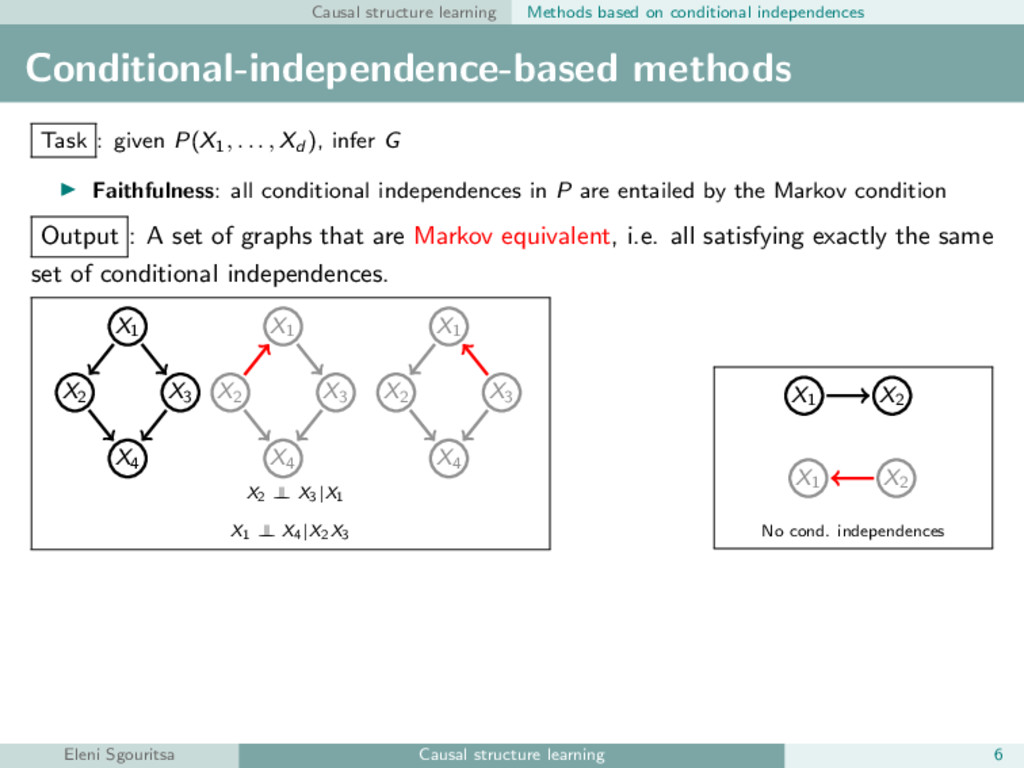
Task : given P(X1, . . . , Xd ), infer G Faithfulness: all conditional independences in P are entailed by the Markov condition Output : A set of graphs that are Markov equivalent, i.e. all satisfying exactly the same set of conditional independences. Eleni Sgouritsa Causal structure learning 6
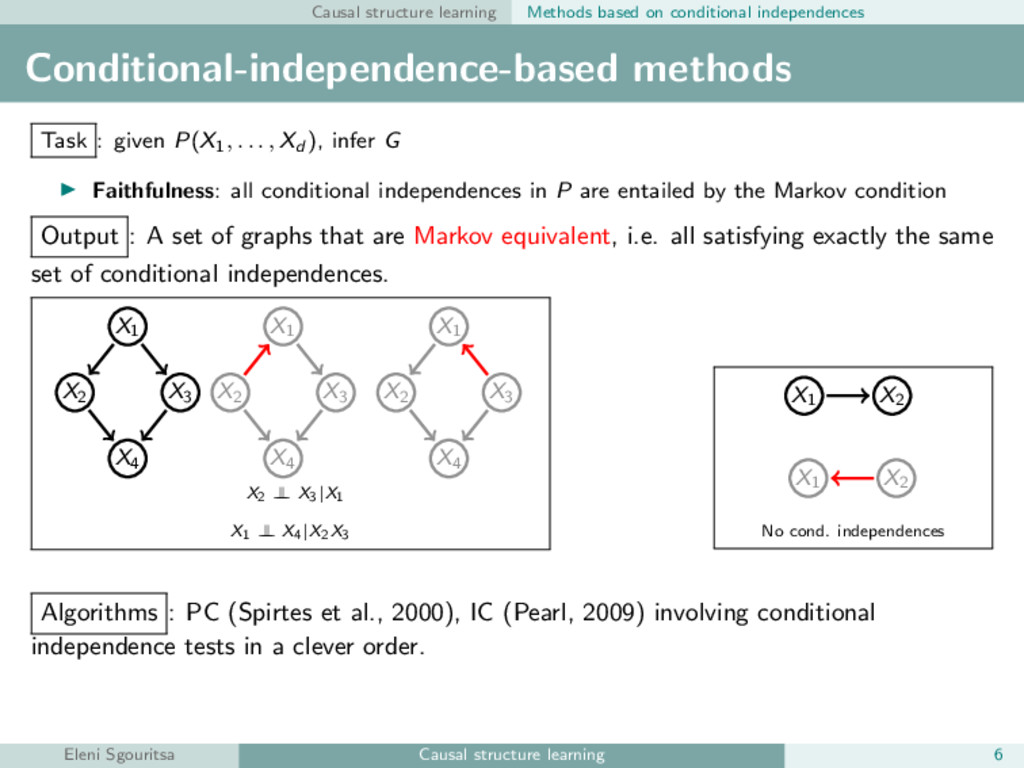
Task : given P(X1, . . . , Xd ), infer G Faithfulness: all conditional independences in P are entailed by the Markov condition Output : A set of graphs that are Markov equivalent, i.e. all satisfying exactly the same set of conditional independences. X1 X2 X3 X4 X1 X2 X3 X4 X1 X2 X3 X4 X2 ⊥ ⊥ X3|X1 X1 ⊥ ⊥ X4|X2X3 Eleni Sgouritsa Causal structure learning 6
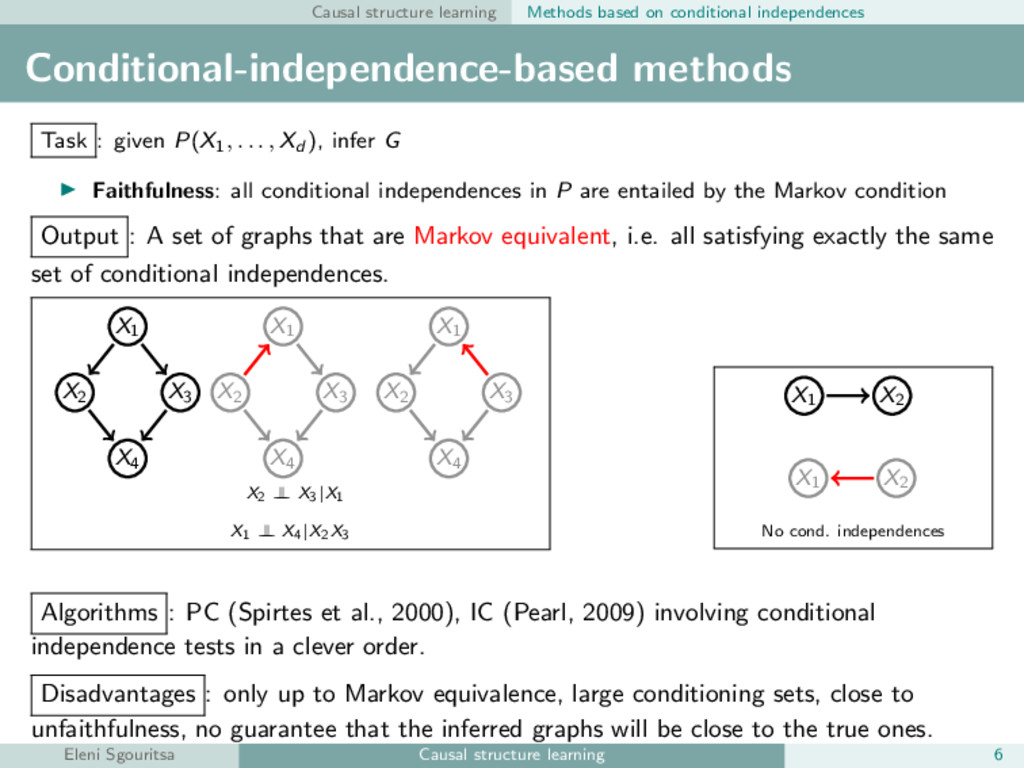
Task : given P(X1, . . . , Xd ), infer G Faithfulness: all conditional independences in P are entailed by the Markov condition Output : A set of graphs that are Markov equivalent, i.e. all satisfying exactly the same set of conditional independences. X1 X2 X3 X4 X1 X2 X3 X4 X1 X2 X3 X4 X2 ⊥ ⊥ X3|X1 X1 ⊥ ⊥ X4|X2X3 X1 X2 X1 X2 No cond. independences Eleni Sgouritsa Causal structure learning 6
Task : given P(X1, . . . , Xd ), infer G Faithfulness: all conditional independences in P are entailed by the Markov condition Output : A set of graphs that are Markov equivalent, i.e. all satisfying exactly the same set of conditional independences. X1 X2 X3 X4 X1 X2 X3 X4 X1 X2 X3 X4 X2 ⊥ ⊥ X3|X1 X1 ⊥ ⊥ X4|X2X3 X1 X2 X1 X2 No cond. independences Algorithms : PC (Spirtes et al., 2000), IC (Pearl, 2009) involving conditional independence tests in a clever order. Eleni Sgouritsa Causal structure learning 6
Task : given P(X1, . . . , Xd ), infer G Faithfulness: all conditional independences in P are entailed by the Markov condition Output : A set of graphs that are Markov equivalent, i.e. all satisfying exactly the same set of conditional independences. X1 X2 X3 X4 X1 X2 X3 X4 X1 X2 X3 X4 X2 ⊥ ⊥ X3|X1 X1 ⊥ ⊥ X4|X2X3 X1 X2 X1 X2 No cond. independences Algorithms : PC (Spirtes et al., 2000), IC (Pearl, 2009) involving conditional independence tests in a clever order. Disadvantages : only up to Markov equivalence, large conditioning sets, close to unfaithfulness, no guarantee that the inferred graphs will be close to the true ones. Eleni Sgouritsa Causal structure learning 6
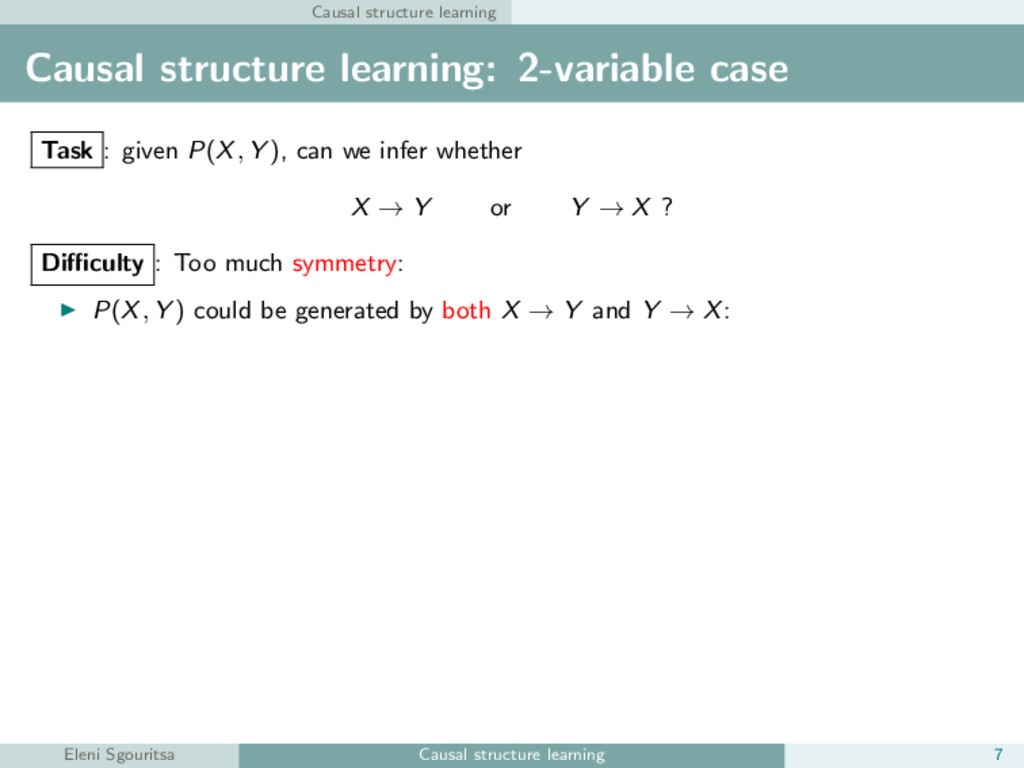
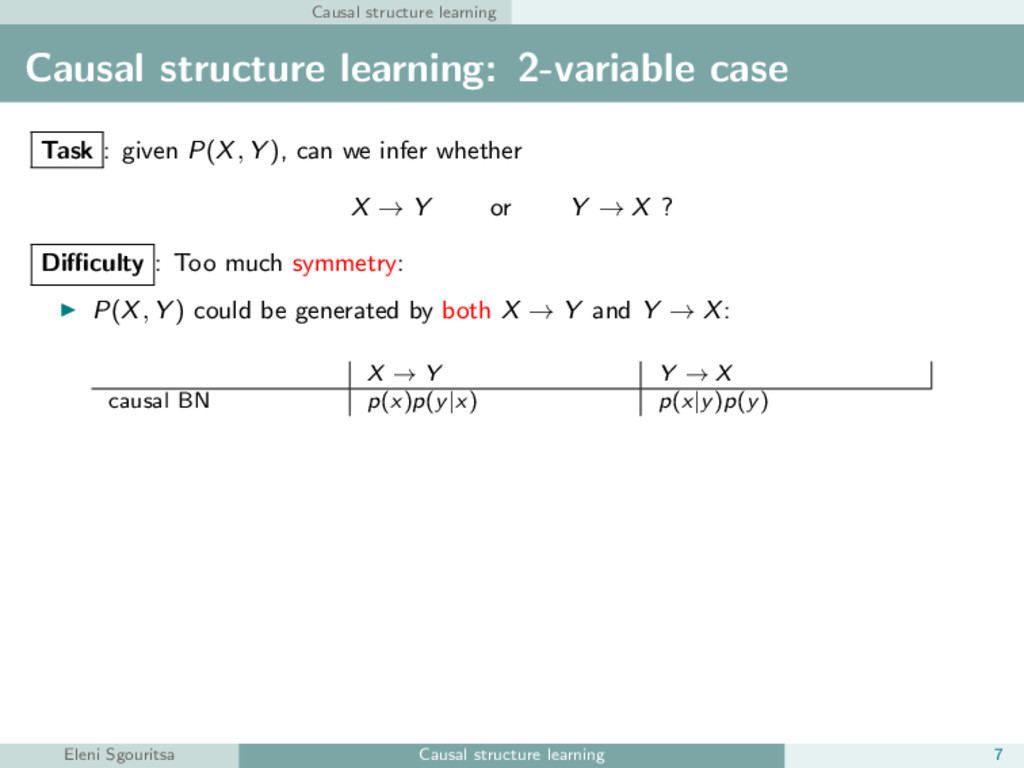
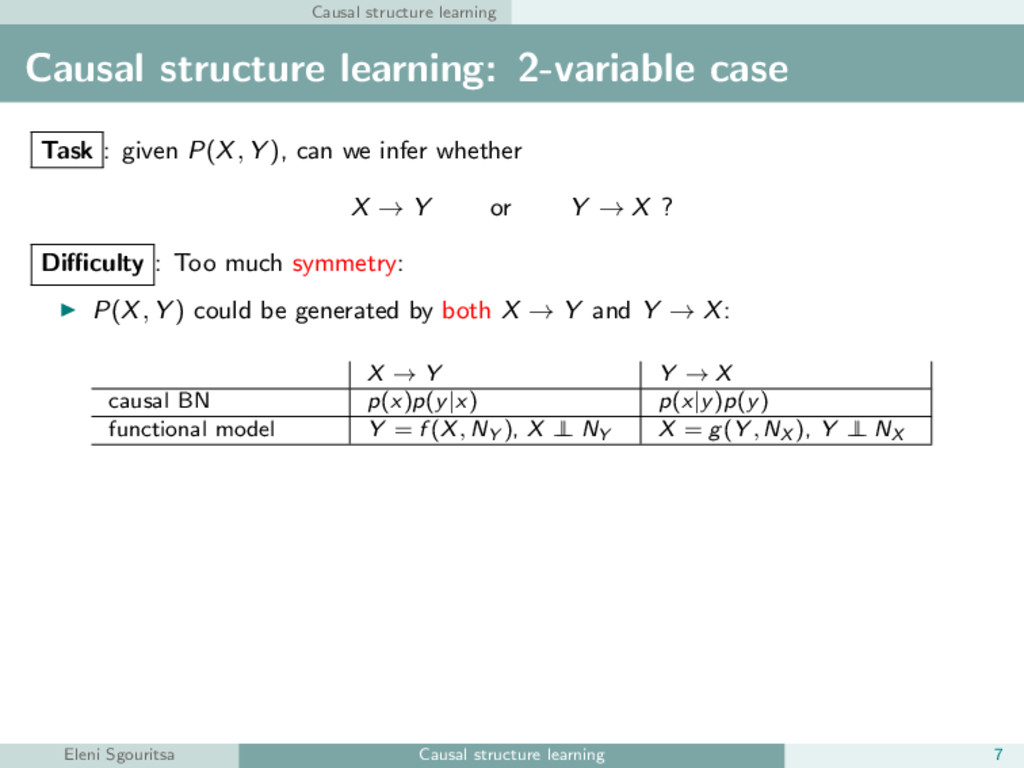
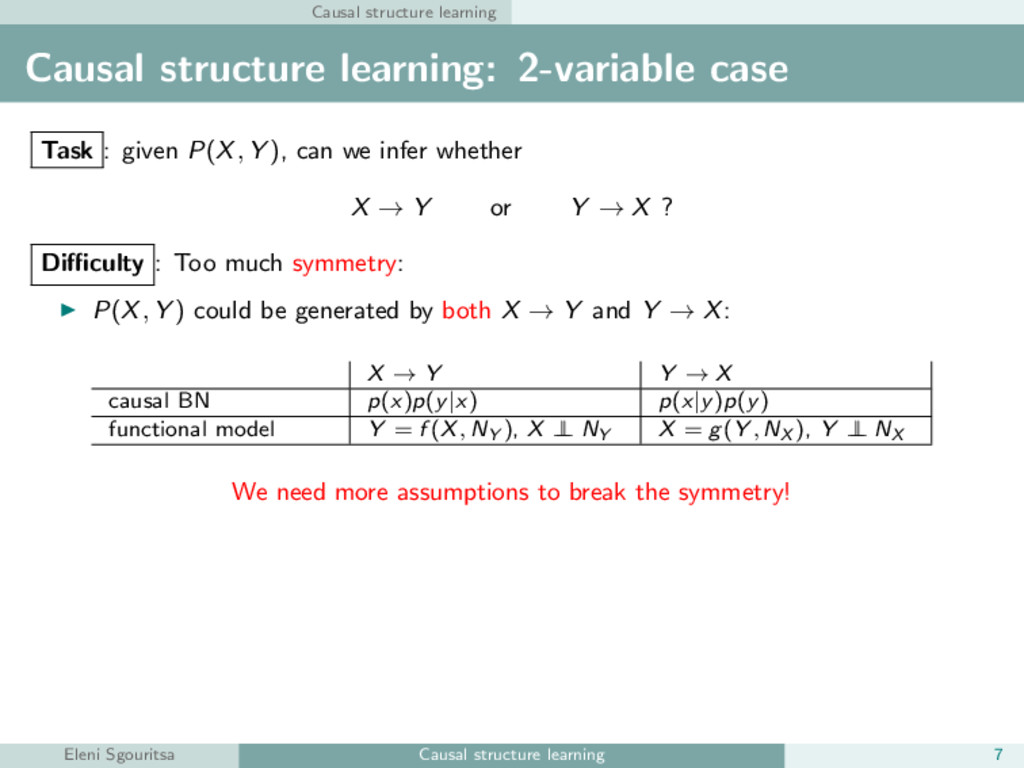
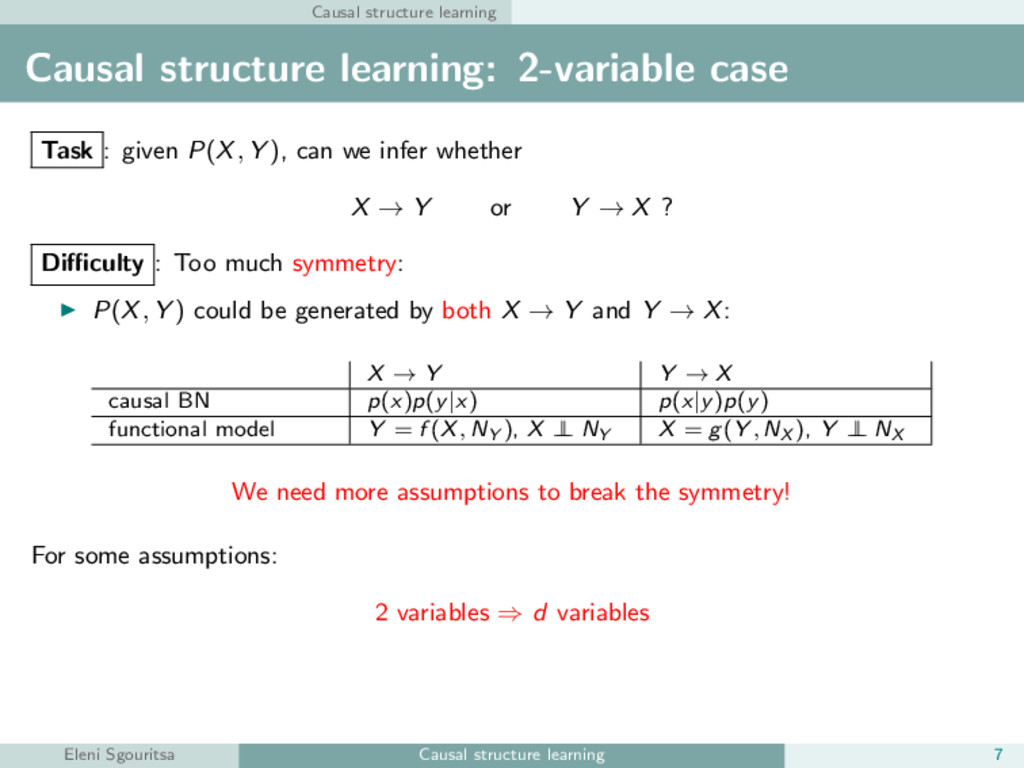
given P(X, Y ), can we infer whether X → Y or Y → X ? Difficulty : Too much symmetry: P(X, Y ) could be generated by both X → Y and Y → X: Eleni Sgouritsa Causal structure learning 7
given P(X, Y ), can we infer whether X → Y or Y → X ? Difficulty : Too much symmetry: P(X, Y ) could be generated by both X → Y and Y → X: X → Y Y → X causal BN p(x)p(y|x) p(x|y)p(y) Eleni Sgouritsa Causal structure learning 7
given P(X, Y ), can we infer whether X → Y or Y → X ? Difficulty : Too much symmetry: P(X, Y ) could be generated by both X → Y and Y → X: X → Y Y → X causal BN p(x)p(y|x) p(x|y)p(y) functional model Y = f (X, NY ), X ⊥ ⊥ NY X = g(Y , NX ), Y ⊥ ⊥ NX Eleni Sgouritsa Causal structure learning 7
given P(X, Y ), can we infer whether X → Y or Y → X ? Difficulty : Too much symmetry: P(X, Y ) could be generated by both X → Y and Y → X: X → Y Y → X causal BN p(x)p(y|x) p(x|y)p(y) functional model Y = f (X, NY ), X ⊥ ⊥ NY X = g(Y , NX ), Y ⊥ ⊥ NX We need more assumptions to break the symmetry! Eleni Sgouritsa Causal structure learning 7
given P(X, Y ), can we infer whether X → Y or Y → X ? Difficulty : Too much symmetry: P(X, Y ) could be generated by both X → Y and Y → X: X → Y Y → X causal BN p(x)p(y|x) p(x|y)p(y) functional model Y = f (X, NY ), X ⊥ ⊥ NY X = g(Y , NX ), Y ⊥ ⊥ NX We need more assumptions to break the symmetry! For some assumptions: 2 variables ⇒ d variables Eleni Sgouritsa Causal structure learning 7
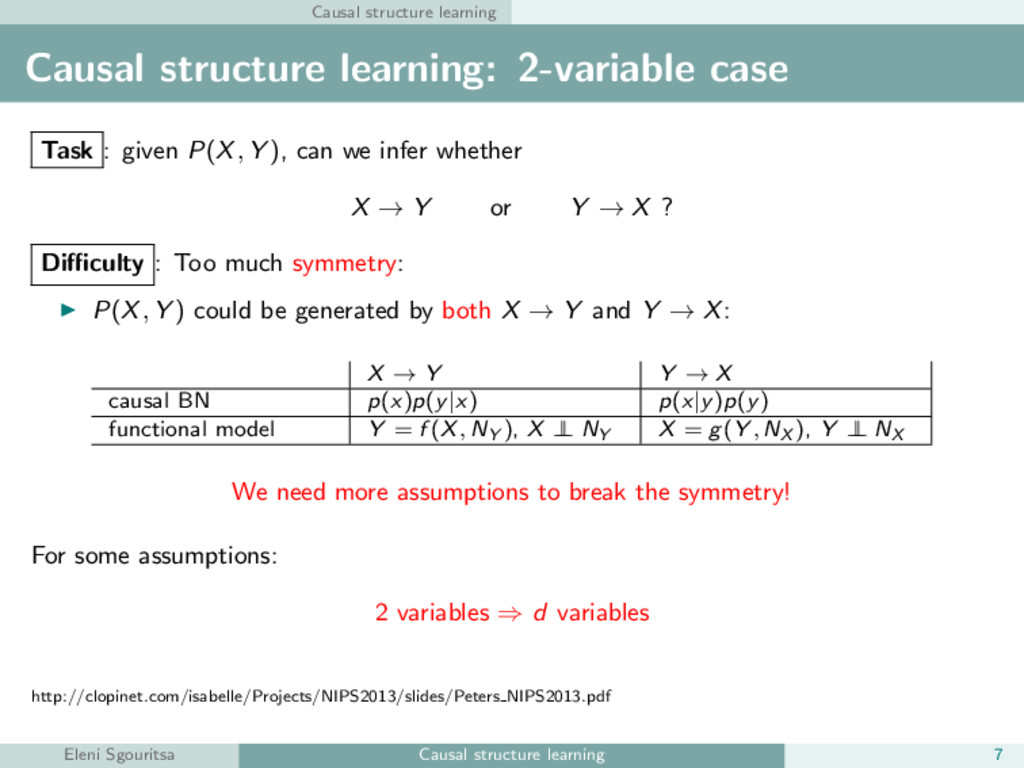
given P(X, Y ), can we infer whether X → Y or Y → X ? Difficulty : Too much symmetry: P(X, Y ) could be generated by both X → Y and Y → X: X → Y Y → X causal BN p(x)p(y|x) p(x|y)p(y) functional model Y = f (X, NY ), X ⊥ ⊥ NY X = g(Y , NX ), Y ⊥ ⊥ NX We need more assumptions to break the symmetry! For some assumptions: 2 variables ⇒ d variables http://clopinet.com/isabelle/Projects/NIPS2013/slides/Peters NIPS2013.pdf Eleni Sgouritsa Causal structure learning 7
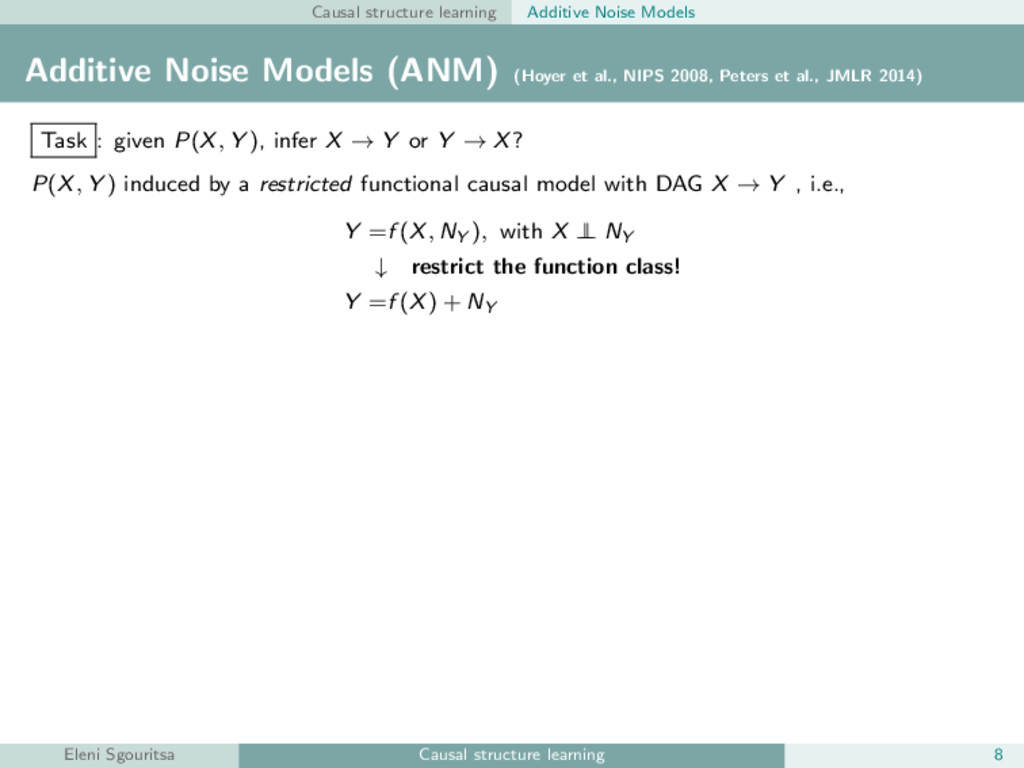
(Hoyer et al., NIPS 2008, Peters et al., JMLR 2014) Task : given P(X, Y ), infer X → Y or Y → X? P(X, Y ) induced by a restricted functional causal model with DAG X → Y Eleni Sgouritsa Causal structure learning 8
(Hoyer et al., NIPS 2008, Peters et al., JMLR 2014) Task : given P(X, Y ), infer X → Y or Y → X? P(X, Y ) induced by a restricted functional causal model with DAG X → Y , i.e., Y =f (X, NY ), with X ⊥ ⊥ NY ↓ restrict the function class! Y =f (X) + NY Eleni Sgouritsa Causal structure learning 8
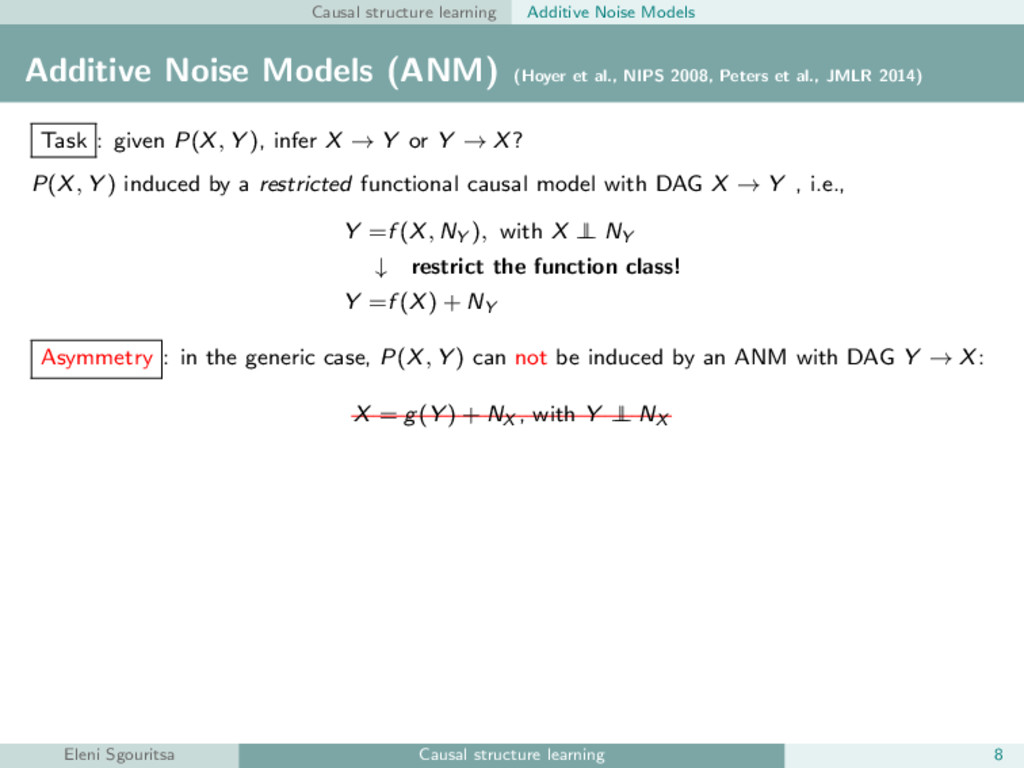
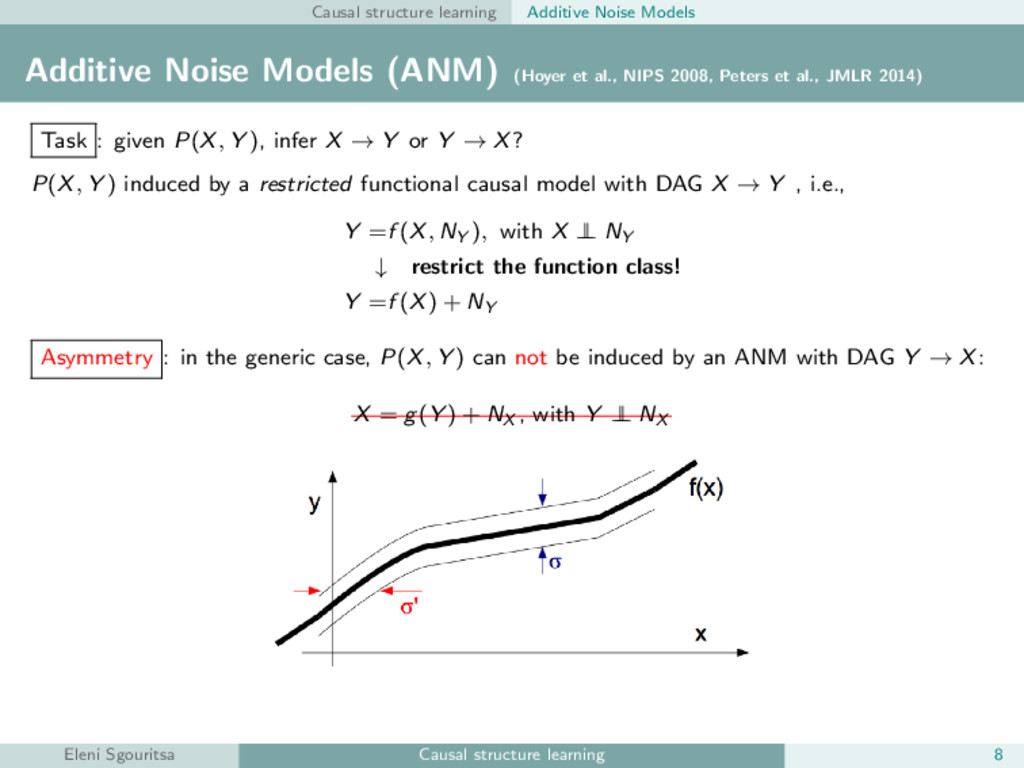
(Hoyer et al., NIPS 2008, Peters et al., JMLR 2014) Task : given P(X, Y ), infer X → Y or Y → X? P(X, Y ) induced by a restricted functional causal model with DAG X → Y , i.e., Y =f (X, NY ), with X ⊥ ⊥ NY ↓ restrict the function class! Y =f (X) + NY Asymmetry : in the generic case, P(X, Y ) can not be induced by an ANM with DAG Y → X: X = g(Y ) + NX , with Y ⊥ ⊥ NX Eleni Sgouritsa Causal structure learning 8
(Hoyer et al., NIPS 2008, Peters et al., JMLR 2014) Task : given P(X, Y ), infer X → Y or Y → X? P(X, Y ) induced by a restricted functional causal model with DAG X → Y , i.e., Y =f (X, NY ), with X ⊥ ⊥ NY ↓ restrict the function class! Y =f (X) + NY Asymmetry : in the generic case, P(X, Y ) can not be induced by an ANM with DAG Y → X: X = g(Y ) + NX , with Y ⊥ ⊥ NX Eleni Sgouritsa Causal structure learning 8
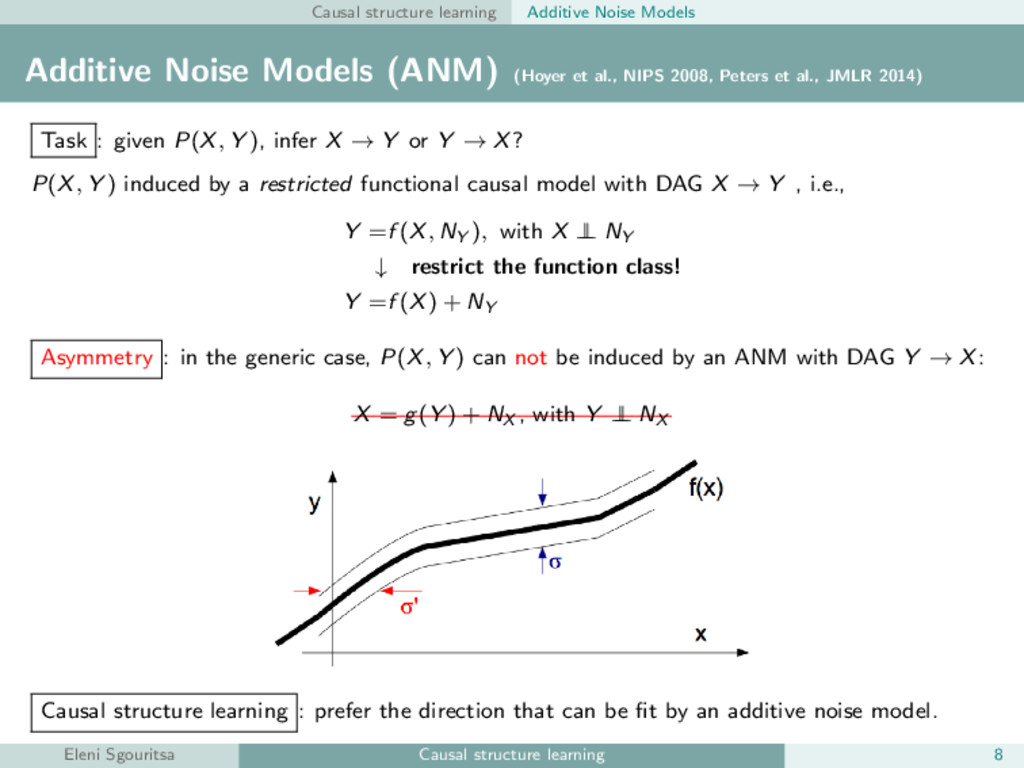
(Hoyer et al., NIPS 2008, Peters et al., JMLR 2014) Task : given P(X, Y ), infer X → Y or Y → X? P(X, Y ) induced by a restricted functional causal model with DAG X → Y , i.e., Y =f (X, NY ), with X ⊥ ⊥ NY ↓ restrict the function class! Y =f (X) + NY Asymmetry : in the generic case, P(X, Y ) can not be induced by an ANM with DAG Y → X: X = g(Y ) + NX , with Y ⊥ ⊥ NX Causal structure learning : prefer the direction that can be fit by an additive noise model. Eleni Sgouritsa Causal structure learning 8
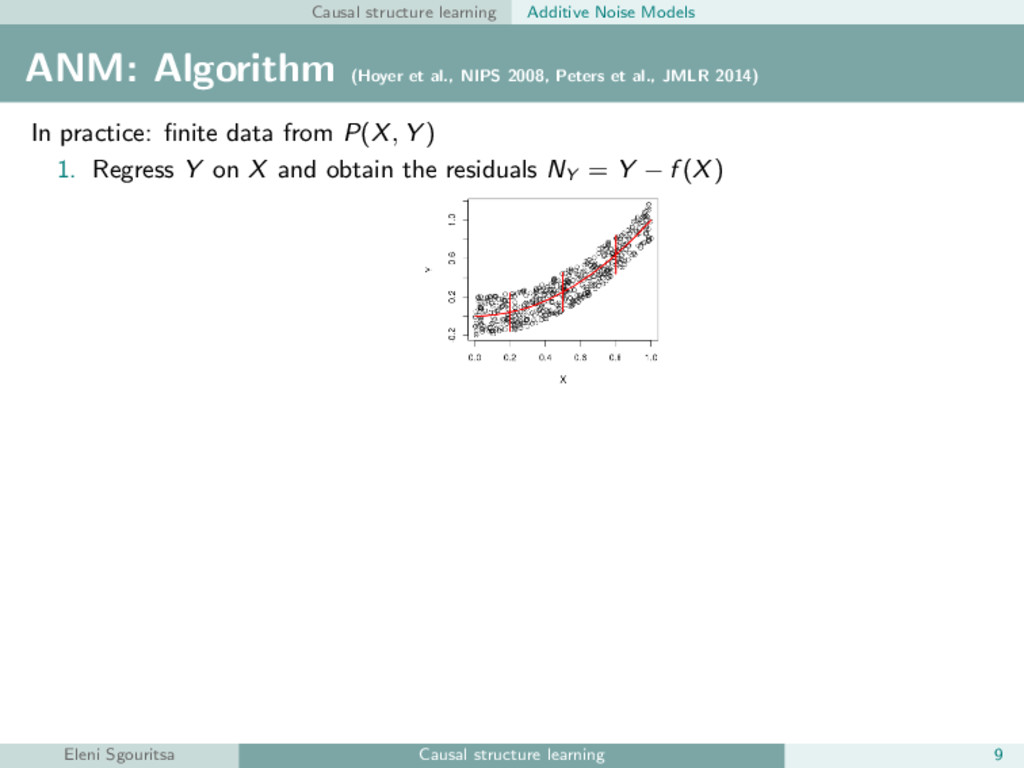
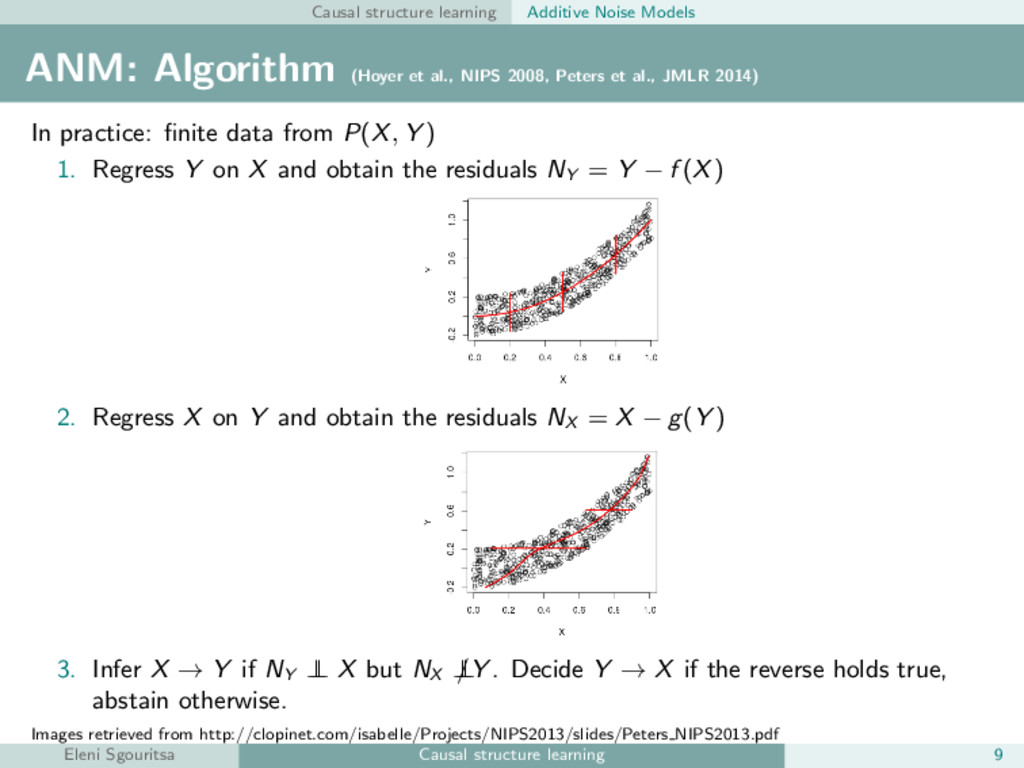
al., NIPS 2008, Peters et al., JMLR 2014) In practice: finite data from P(X, Y ) 1. Regress Y on X and obtain the residuals NY = Y − f (X) Eleni Sgouritsa Causal structure learning 9
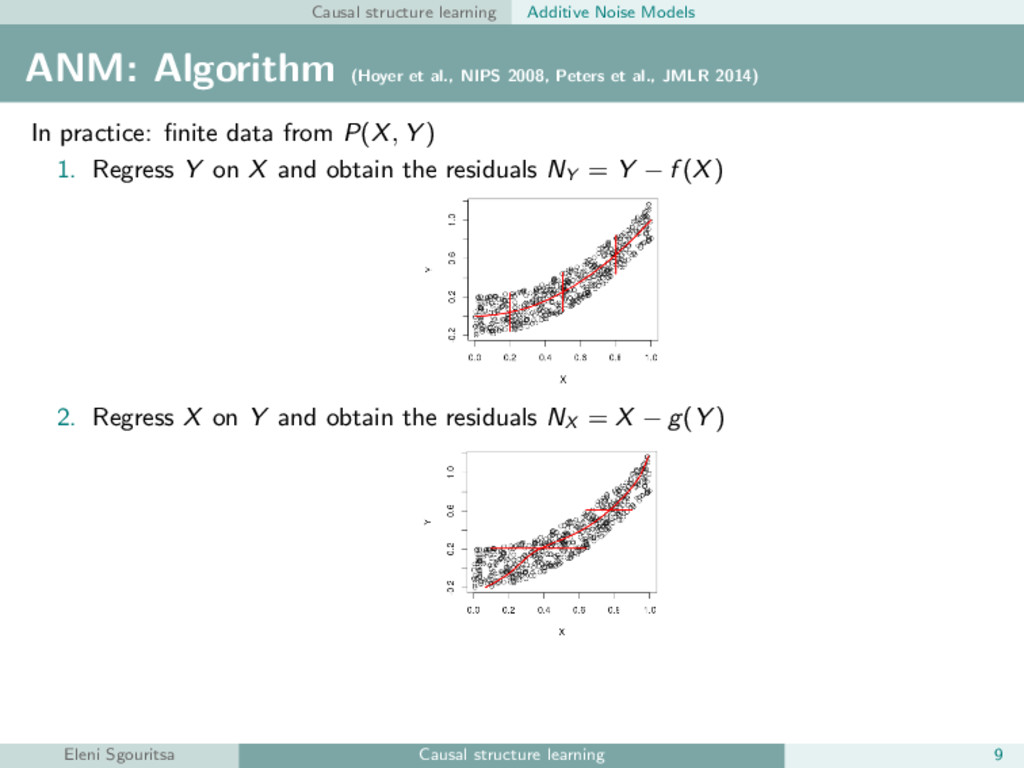
al., NIPS 2008, Peters et al., JMLR 2014) In practice: finite data from P(X, Y ) 1. Regress Y on X and obtain the residuals NY = Y − f (X) 2. Regress X on Y and obtain the residuals NX = X − g(Y ) Eleni Sgouritsa Causal structure learning 9
al., NIPS 2008, Peters et al., JMLR 2014) In practice: finite data from P(X, Y ) 1. Regress Y on X and obtain the residuals NY = Y − f (X) 2. Regress X on Y and obtain the residuals NX = X − g(Y ) 3. Infer X → Y if NY ⊥ ⊥ X but NX ⊥ ⊥ /Y . Decide Y → X if the reverse holds true, abstain otherwise. Eleni Sgouritsa Causal structure learning 9
al., NIPS 2008, Peters et al., JMLR 2014) In practice: finite data from P(X, Y ) 1. Regress Y on X and obtain the residuals NY = Y − f (X) 2. Regress X on Y and obtain the residuals NX = X − g(Y ) 3. Infer X → Y if NY ⊥ ⊥ X but NX ⊥ ⊥ /Y . Decide Y → X if the reverse holds true, abstain otherwise. Images retrieved from http://clopinet.com/isabelle/Projects/NIPS2013/slides/Peters NIPS2013.pdf Eleni Sgouritsa Causal structure learning 9
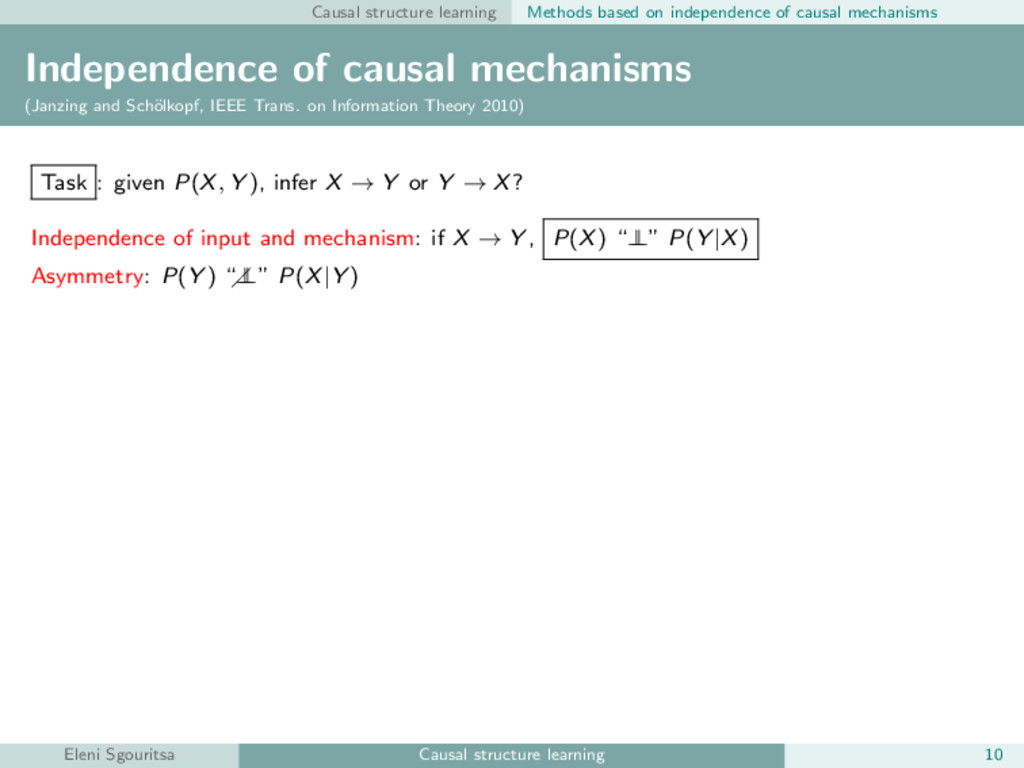
Independence of causal mechanisms (Janzing and Sch¨ olkopf, IEEE Trans. on Information Theory 2010) Task : given P(X, Y ), infer X → Y or Y → X? Eleni Sgouritsa Causal structure learning 10
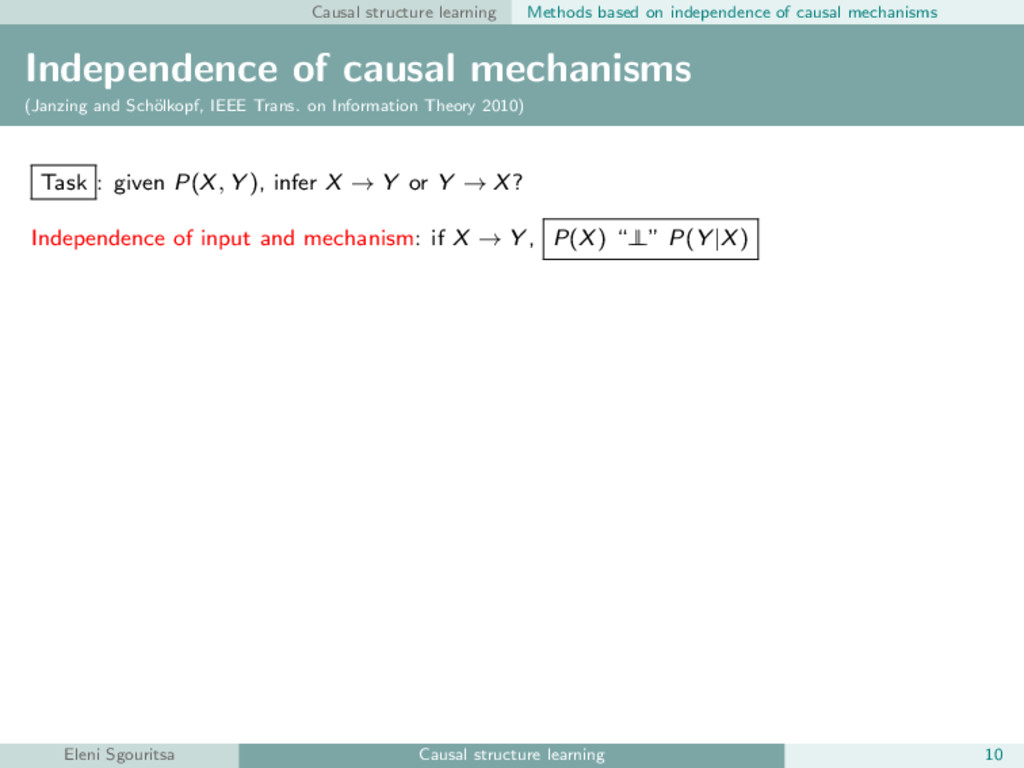
Independence of causal mechanisms (Janzing and Sch¨ olkopf, IEEE Trans. on Information Theory 2010) Task : given P(X, Y ), infer X → Y or Y → X? Independence of input and mechanism: if X → Y , P(X) “⊥ ⊥” P(Y |X) Eleni Sgouritsa Causal structure learning 10
Independence of causal mechanisms (Janzing and Sch¨ olkopf, IEEE Trans. on Information Theory 2010) Task : given P(X, Y ), infer X → Y or Y → X? Independence of input and mechanism: if X → Y , P(X) “⊥ ⊥” P(Y |X) Asymmetry: P(Y ) “⊥ ⊥” P(X|Y ) Eleni Sgouritsa Causal structure learning 10
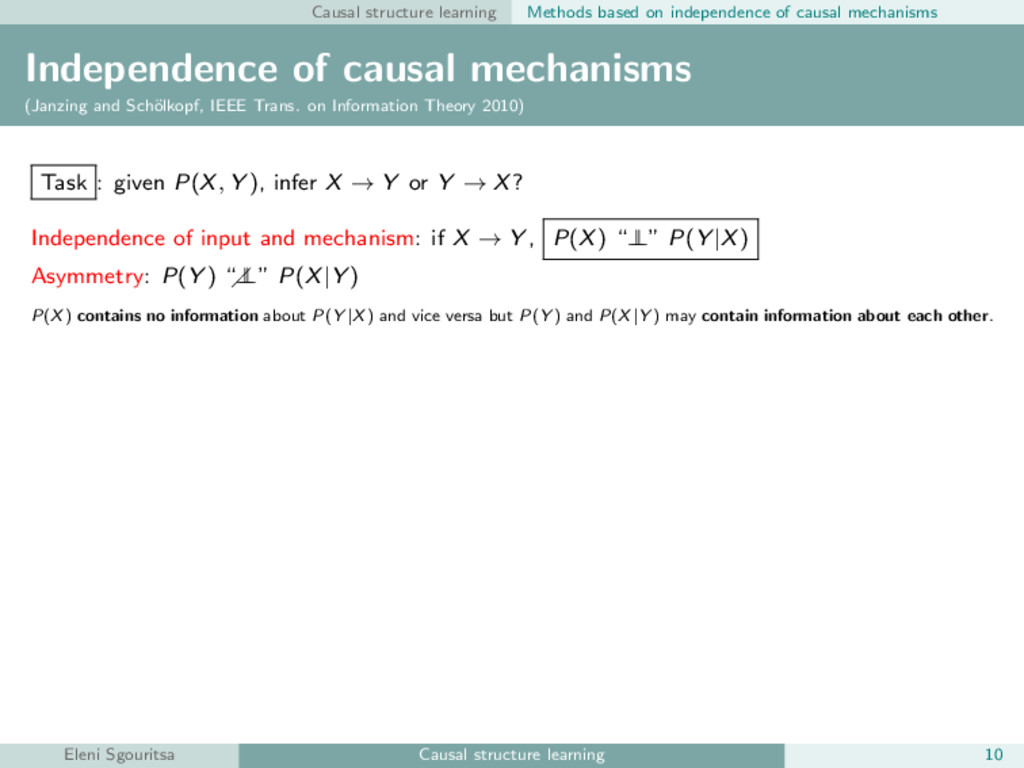
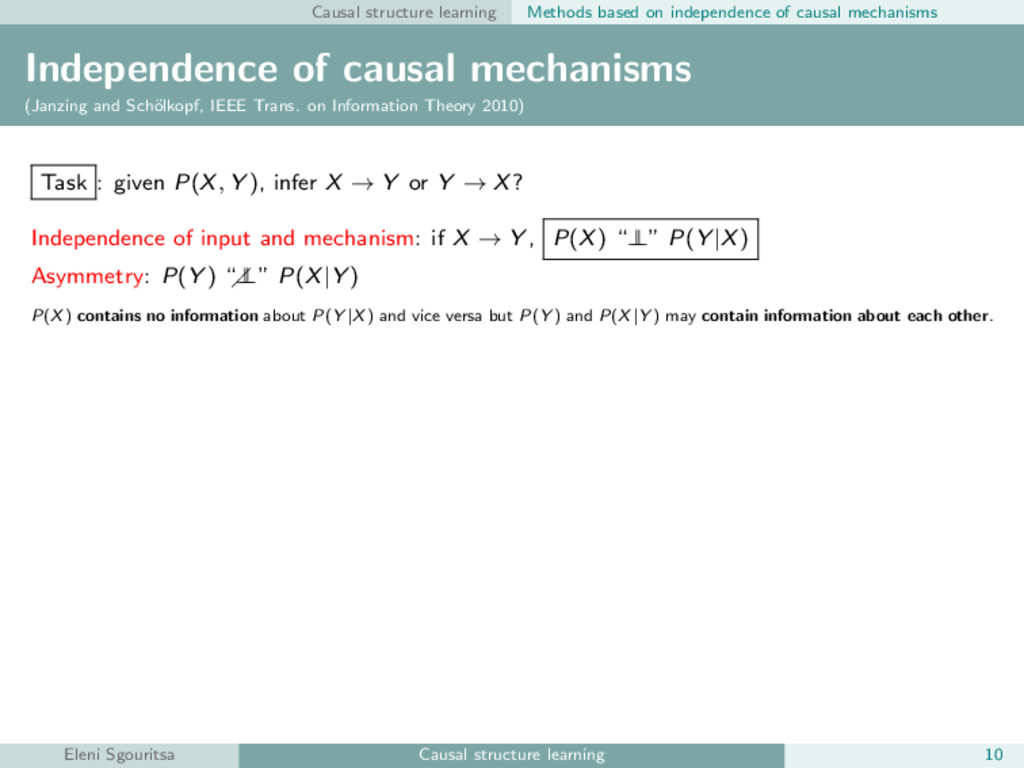
Independence of causal mechanisms (Janzing and Sch¨ olkopf, IEEE Trans. on Information Theory 2010) Task : given P(X, Y ), infer X → Y or Y → X? Independence of input and mechanism: if X → Y , P(X) “⊥ ⊥” P(Y |X) Asymmetry: P(Y ) “⊥ ⊥” P(X|Y ) P(X) contains no information about P(Y |X) and vice versa but P(Y ) and P(X|Y ) may contain information about each other. Eleni Sgouritsa Causal structure learning 10
Independence of causal mechanisms (Janzing and Sch¨ olkopf, IEEE Trans. on Information Theory 2010) Task : given P(X, Y ), infer X → Y or Y → X? Independence of input and mechanism: if X → Y , P(X) “⊥ ⊥” P(Y |X) Asymmetry: P(Y ) “⊥ ⊥” P(X|Y ) P(X) contains no information about P(Y |X) and vice versa but P(Y ) and P(X|Y ) may contain information about each other. Eleni Sgouritsa Causal structure learning 10
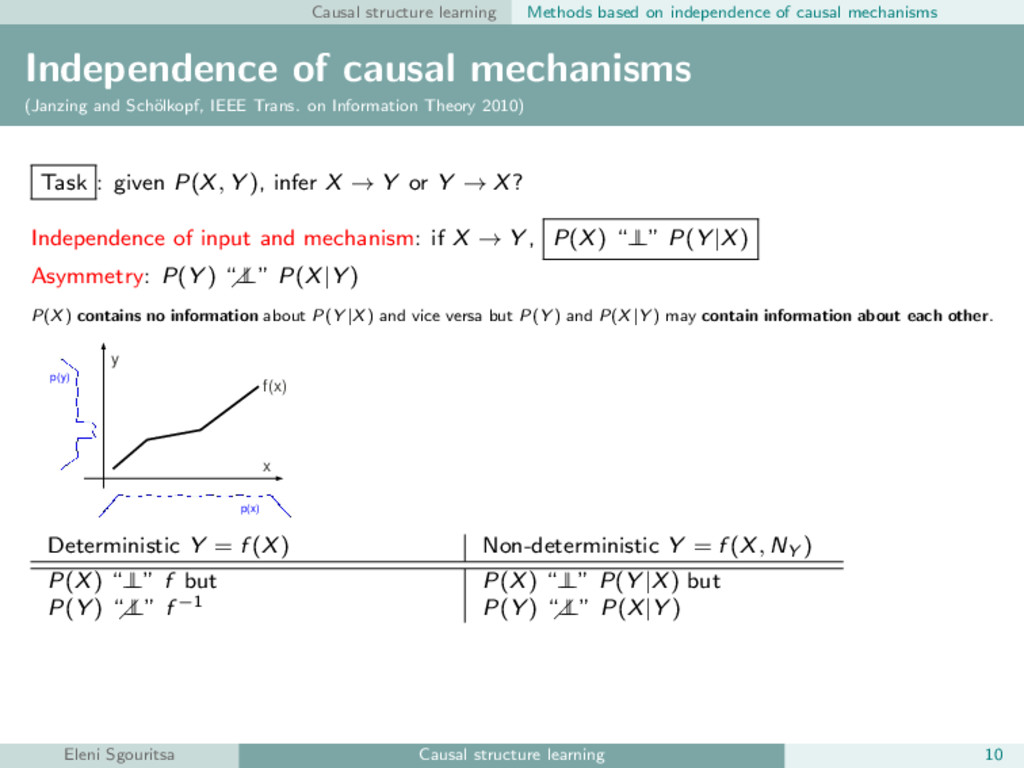
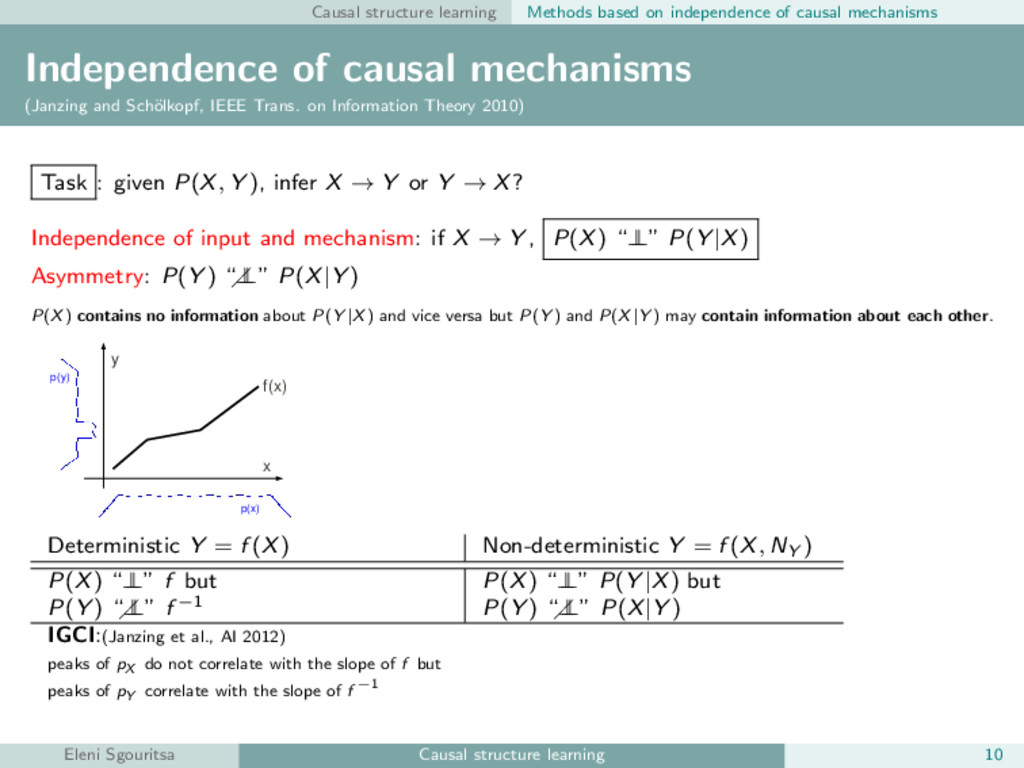
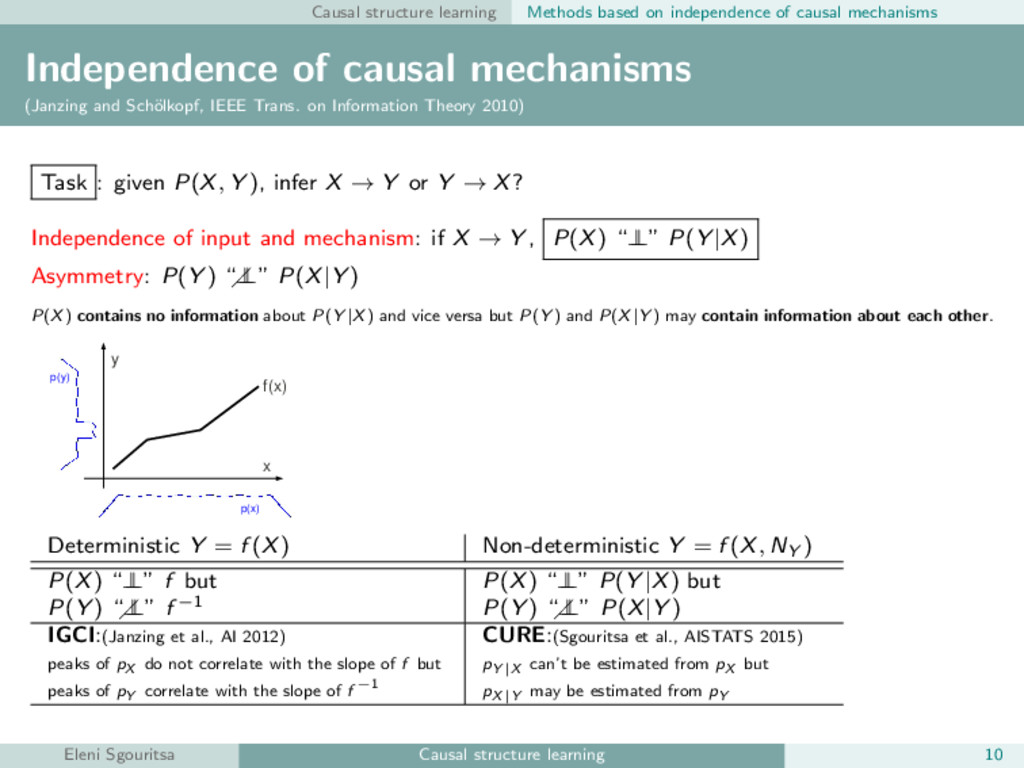
Independence of causal mechanisms (Janzing and Sch¨ olkopf, IEEE Trans. on Information Theory 2010) Task : given P(X, Y ), infer X → Y or Y → X? Independence of input and mechanism: if X → Y , P(X) “⊥ ⊥” P(Y |X) Asymmetry: P(Y ) “⊥ ⊥” P(X|Y ) P(X) contains no information about P(Y |X) and vice versa but P(Y ) and P(X|Y ) may contain information about each other. y x f(x) p(x) p(y) Deterministic Y = f (X) Non-deterministic Y = f (X, NY ) P(X) “⊥ ⊥” f but P(Y ) “⊥ ⊥” f −1 P(X) “⊥ ⊥” P(Y |X) but P(Y ) “⊥ ⊥” P(X|Y ) Eleni Sgouritsa Causal structure learning 10
Independence of causal mechanisms (Janzing and Sch¨ olkopf, IEEE Trans. on Information Theory 2010) Task : given P(X, Y ), infer X → Y or Y → X? Independence of input and mechanism: if X → Y , P(X) “⊥ ⊥” P(Y |X) Asymmetry: P(Y ) “⊥ ⊥” P(X|Y ) P(X) contains no information about P(Y |X) and vice versa but P(Y ) and P(X|Y ) may contain information about each other. y x f(x) p(x) p(y) Deterministic Y = f (X) Non-deterministic Y = f (X, NY ) P(X) “⊥ ⊥” f but P(Y ) “⊥ ⊥” f −1 P(X) “⊥ ⊥” P(Y |X) but P(Y ) “⊥ ⊥” P(X|Y ) IGCI:(Janzing et al., AI 2012) peaks of pX do not correlate with the slope of f but peaks of pY correlate with the slope of f −1 Eleni Sgouritsa Causal structure learning 10
Independence of causal mechanisms (Janzing and Sch¨ olkopf, IEEE Trans. on Information Theory 2010) Task : given P(X, Y ), infer X → Y or Y → X? Independence of input and mechanism: if X → Y , P(X) “⊥ ⊥” P(Y |X) Asymmetry: P(Y ) “⊥ ⊥” P(X|Y ) P(X) contains no information about P(Y |X) and vice versa but P(Y ) and P(X|Y ) may contain information about each other. y x f(x) p(x) p(y) Deterministic Y = f (X) Non-deterministic Y = f (X, NY ) P(X) “⊥ ⊥” f but P(Y ) “⊥ ⊥” f −1 P(X) “⊥ ⊥” P(Y |X) but P(Y ) “⊥ ⊥” P(X|Y ) IGCI:(Janzing et al., AI 2012) peaks of pX do not correlate with the slope of f but peaks of pY correlate with the slope of f −1 CURE:(Sgouritsa et al., AISTATS 2015) pY |X can’t be estimated from pX but pX|Y may be estimated from pY Eleni Sgouritsa Causal structure learning 10
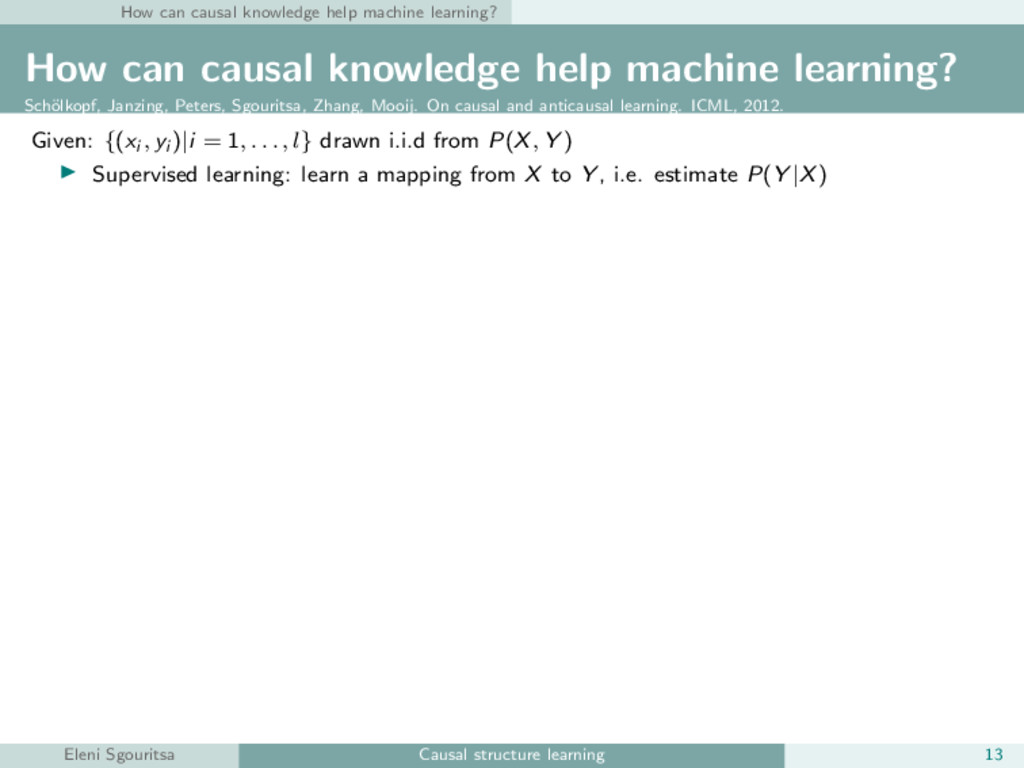
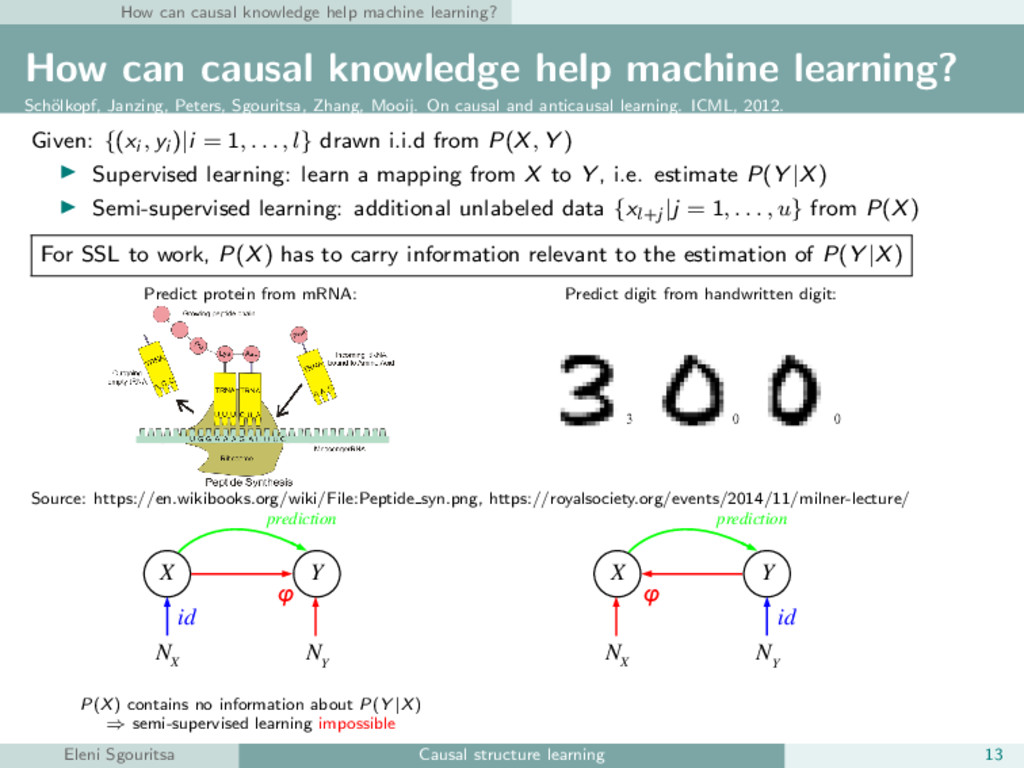
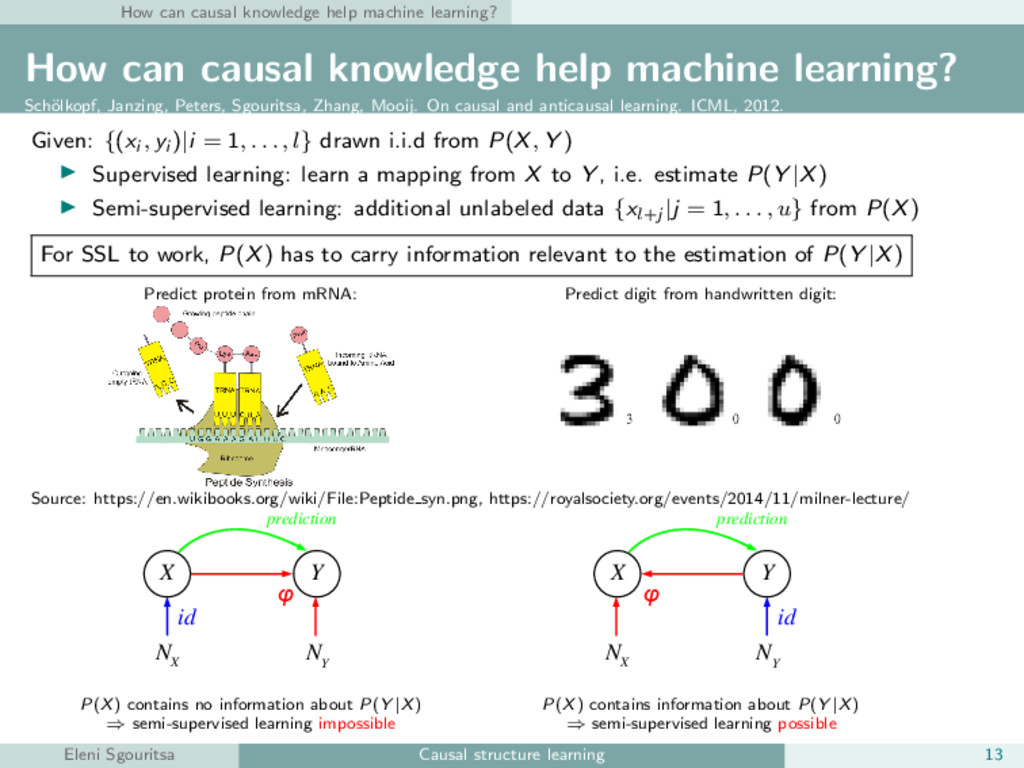
knowledge help machine learning? Sch¨ olkopf, Janzing, Peters, Sgouritsa, Zhang, Mooij. On causal and anticausal learning. ICML, 2012. Given: {(xi , yi )|i = 1, . . . , l} drawn i.i.d from P(X, Y ) Supervised learning: learn a mapping from X to Y , i.e. estimate P(Y |X) Eleni Sgouritsa Causal structure learning 13
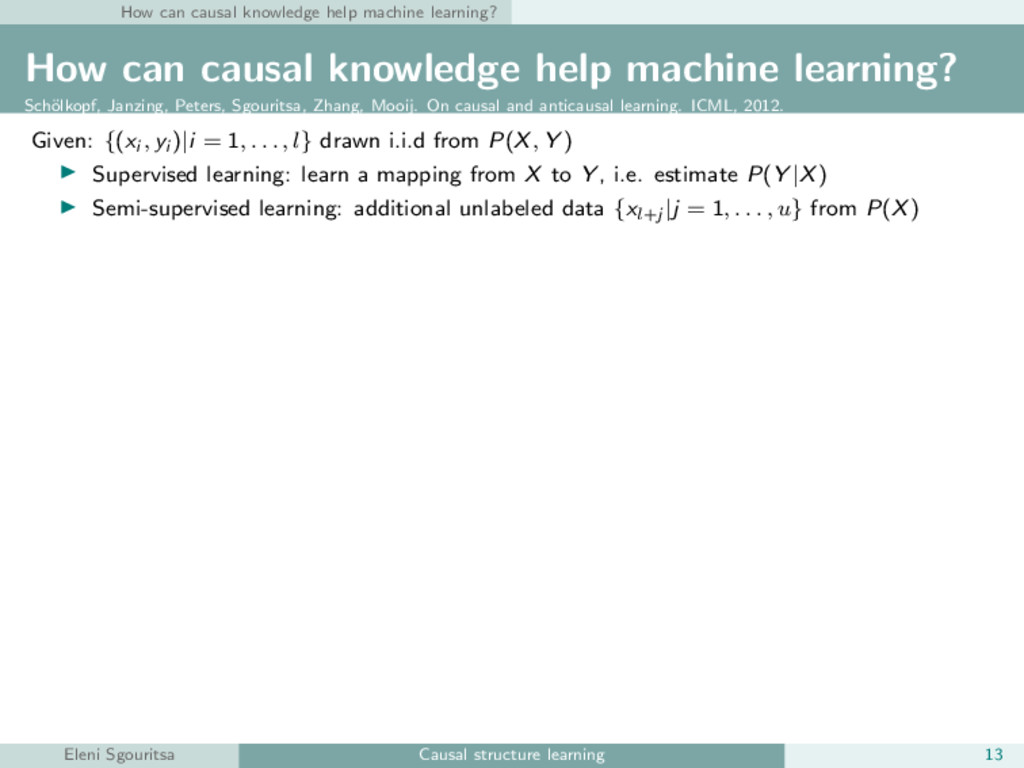
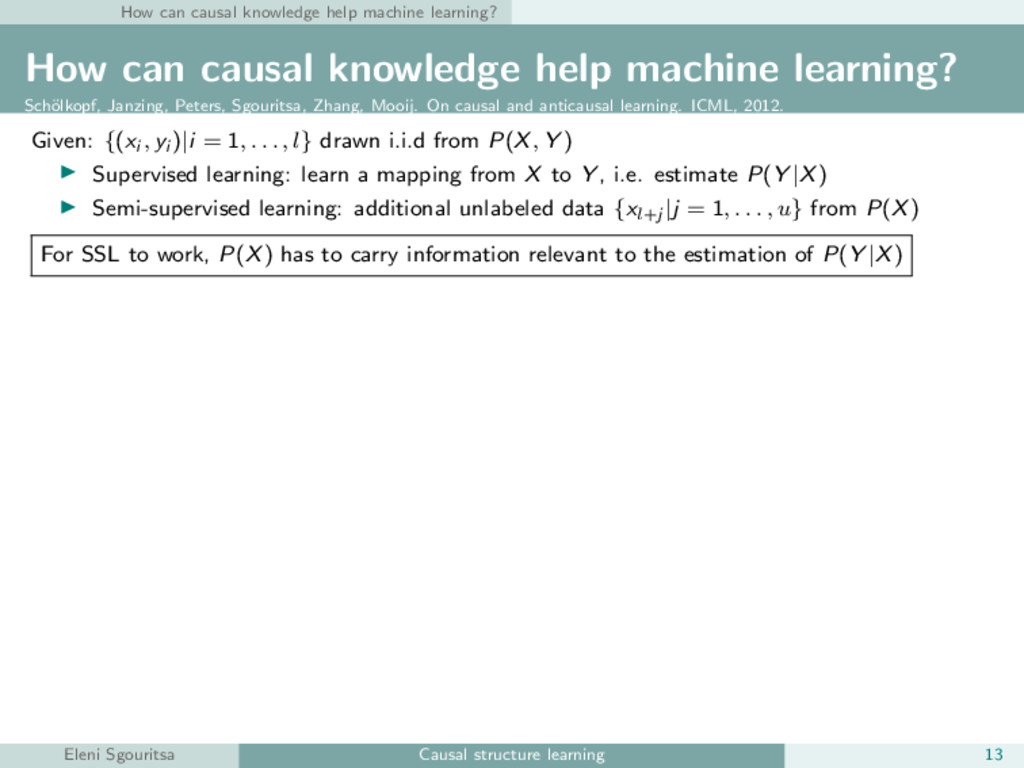
knowledge help machine learning? Sch¨ olkopf, Janzing, Peters, Sgouritsa, Zhang, Mooij. On causal and anticausal learning. ICML, 2012. Given: {(xi , yi )|i = 1, . . . , l} drawn i.i.d from P(X, Y ) Supervised learning: learn a mapping from X to Y , i.e. estimate P(Y |X) Semi-supervised learning: additional unlabeled data {xl+j |j = 1, . . . , u} from P(X) For SSL to work, P(X) has to carry information relevant to the estimation of P(Y |X) Eleni Sgouritsa Causal structure learning 13
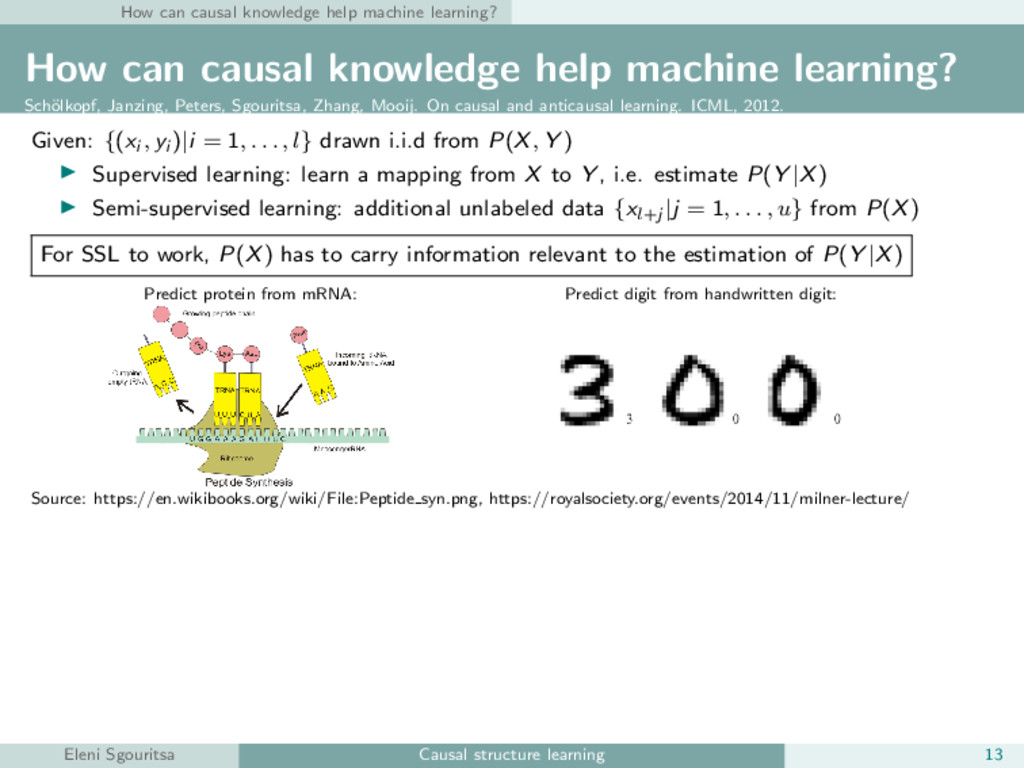
knowledge help machine learning? Sch¨ olkopf, Janzing, Peters, Sgouritsa, Zhang, Mooij. On causal and anticausal learning. ICML, 2012. Given: {(xi , yi )|i = 1, . . . , l} drawn i.i.d from P(X, Y ) Supervised learning: learn a mapping from X to Y , i.e. estimate P(Y |X) Semi-supervised learning: additional unlabeled data {xl+j |j = 1, . . . , u} from P(X) For SSL to work, P(X) has to carry information relevant to the estimation of P(Y |X) Predict protein from mRNA: Predict digit from handwritten digit: Source: https://en.wikibooks.org/wiki/File:Peptide syn.png, https://royalsociety.org/events/2014/11/milner-lecture/ Eleni Sgouritsa Causal structure learning 13
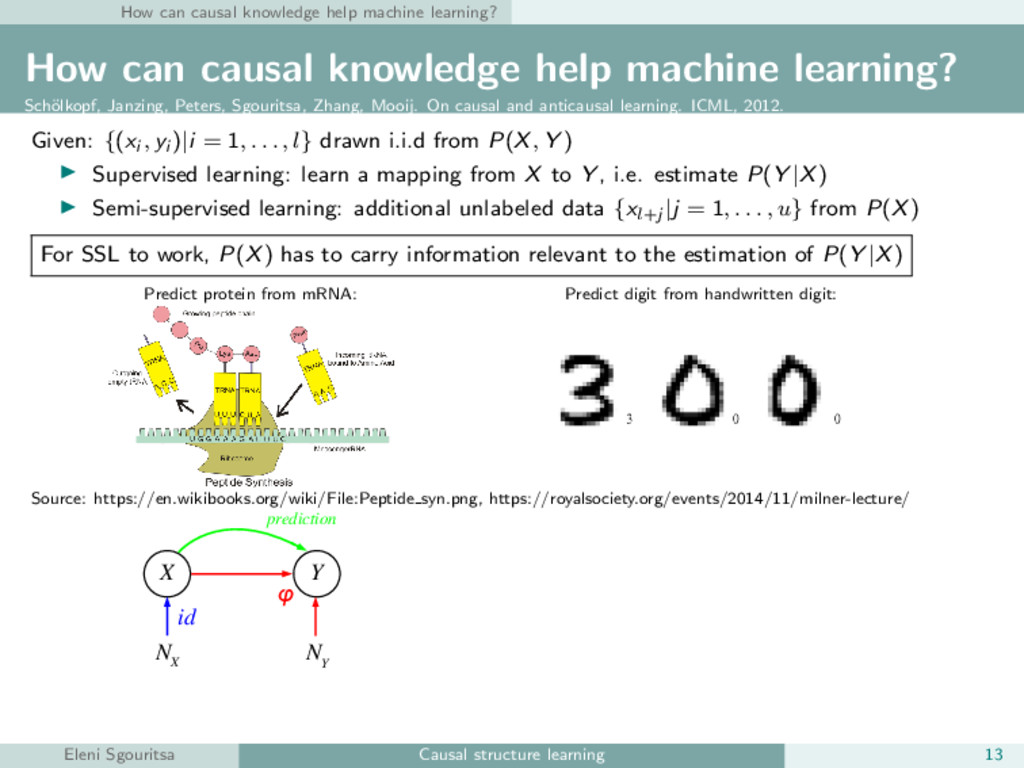
knowledge help machine learning? Sch¨ olkopf, Janzing, Peters, Sgouritsa, Zhang, Mooij. On causal and anticausal learning. ICML, 2012. Given: {(xi , yi )|i = 1, . . . , l} drawn i.i.d from P(X, Y ) Supervised learning: learn a mapping from X to Y , i.e. estimate P(Y |X) Semi-supervised learning: additional unlabeled data {xl+j |j = 1, . . . , u} from P(X) For SSL to work, P(X) has to carry information relevant to the estimation of P(Y |X) Predict protein from mRNA: Predict digit from handwritten digit: Source: https://en.wikibooks.org/wiki/File:Peptide syn.png, https://royalsociety.org/events/2014/11/milner-lecture/ X Y N X N Y φ id prediction Eleni Sgouritsa Causal structure learning 13
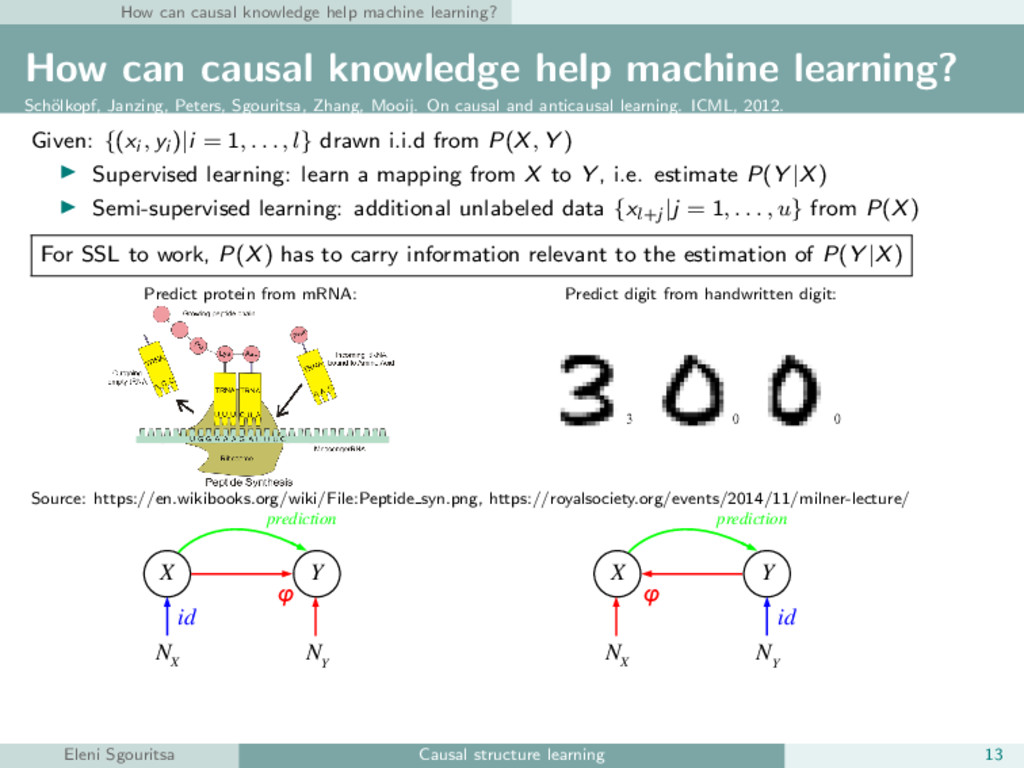
knowledge help machine learning? Sch¨ olkopf, Janzing, Peters, Sgouritsa, Zhang, Mooij. On causal and anticausal learning. ICML, 2012. Given: {(xi , yi )|i = 1, . . . , l} drawn i.i.d from P(X, Y ) Supervised learning: learn a mapping from X to Y , i.e. estimate P(Y |X) Semi-supervised learning: additional unlabeled data {xl+j |j = 1, . . . , u} from P(X) For SSL to work, P(X) has to carry information relevant to the estimation of P(Y |X) Predict protein from mRNA: Predict digit from handwritten digit: Source: https://en.wikibooks.org/wiki/File:Peptide syn.png, https://royalsociety.org/events/2014/11/milner-lecture/ X Y N X N Y φ id prediction X Y N X N Y φ id prediction Eleni Sgouritsa Causal structure learning 13
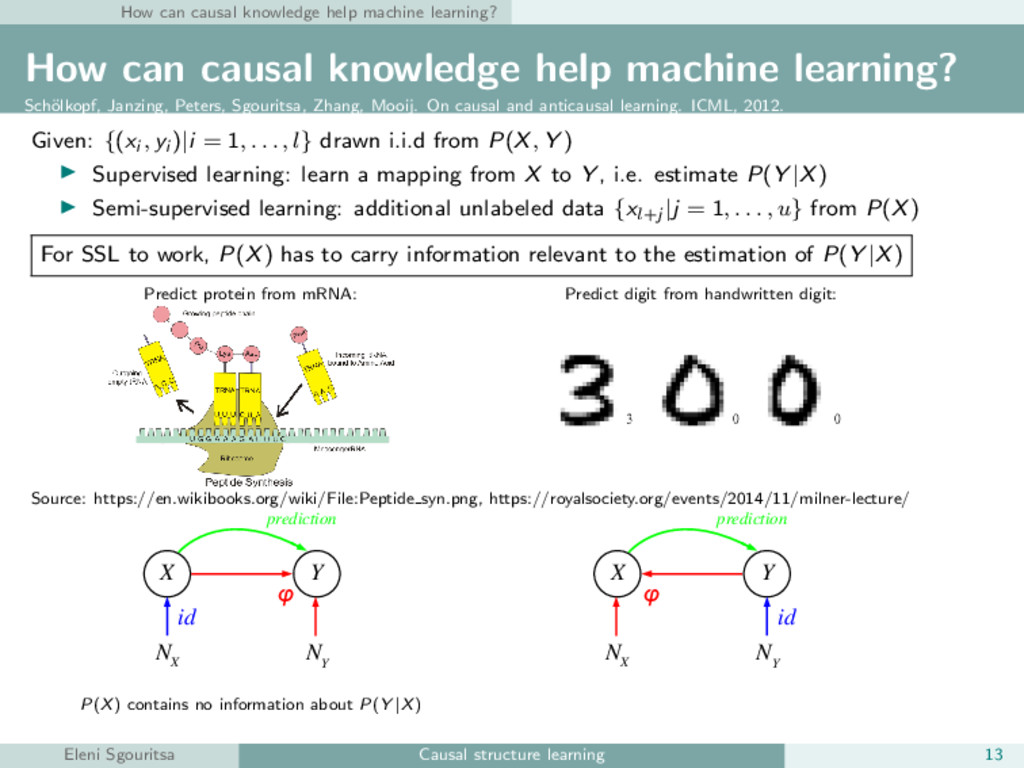
knowledge help machine learning? Sch¨ olkopf, Janzing, Peters, Sgouritsa, Zhang, Mooij. On causal and anticausal learning. ICML, 2012. Given: {(xi , yi )|i = 1, . . . , l} drawn i.i.d from P(X, Y ) Supervised learning: learn a mapping from X to Y , i.e. estimate P(Y |X) Semi-supervised learning: additional unlabeled data {xl+j |j = 1, . . . , u} from P(X) For SSL to work, P(X) has to carry information relevant to the estimation of P(Y |X) Predict protein from mRNA: Predict digit from handwritten digit: Source: https://en.wikibooks.org/wiki/File:Peptide syn.png, https://royalsociety.org/events/2014/11/milner-lecture/ X Y N X N Y φ id prediction X Y N X N Y φ id prediction P(X) contains no information about P(Y |X) Eleni Sgouritsa Causal structure learning 13
knowledge help machine learning? Sch¨ olkopf, Janzing, Peters, Sgouritsa, Zhang, Mooij. On causal and anticausal learning. ICML, 2012. Given: {(xi , yi )|i = 1, . . . , l} drawn i.i.d from P(X, Y ) Supervised learning: learn a mapping from X to Y , i.e. estimate P(Y |X) Semi-supervised learning: additional unlabeled data {xl+j |j = 1, . . . , u} from P(X) For SSL to work, P(X) has to carry information relevant to the estimation of P(Y |X) Predict protein from mRNA: Predict digit from handwritten digit: Source: https://en.wikibooks.org/wiki/File:Peptide syn.png, https://royalsociety.org/events/2014/11/milner-lecture/ X Y N X N Y φ id prediction X Y N X N Y φ id prediction P(X) contains no information about P(Y |X) ⇒ semi-supervised learning impossible Eleni Sgouritsa Causal structure learning 13
knowledge help machine learning? Sch¨ olkopf, Janzing, Peters, Sgouritsa, Zhang, Mooij. On causal and anticausal learning. ICML, 2012. Given: {(xi , yi )|i = 1, . . . , l} drawn i.i.d from P(X, Y ) Supervised learning: learn a mapping from X to Y , i.e. estimate P(Y |X) Semi-supervised learning: additional unlabeled data {xl+j |j = 1, . . . , u} from P(X) For SSL to work, P(X) has to carry information relevant to the estimation of P(Y |X) Predict protein from mRNA: Predict digit from handwritten digit: Source: https://en.wikibooks.org/wiki/File:Peptide syn.png, https://royalsociety.org/events/2014/11/milner-lecture/ X Y N X N Y φ id prediction X Y N X N Y φ id prediction P(X) contains no information about P(Y |X) ⇒ semi-supervised learning impossible P(X) contains information about P(Y |X) ⇒ semi-supervised learning possible Eleni Sgouritsa Causal structure learning 13
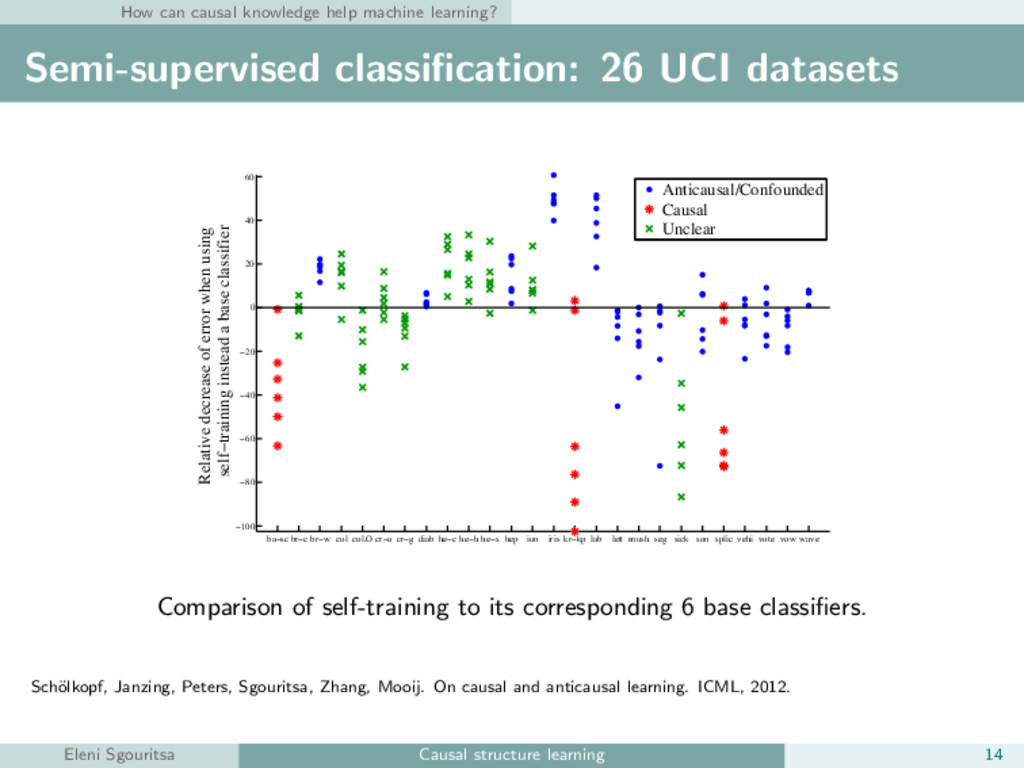
UCI datasets ba−sc br−c br−w col col.O cr−a cr−g diab he−c he−h he−s hep ion iris kr−kp lab lett mush seg sick son splic vehi vote vow wave −100 −80 −60 −40 −20 0 20 40 60 Relative decrease of error when using self−training instead a base classifier Anticausal/Confounded Causal Unclear Comparison of self-training to its corresponding 6 base classifiers. Sch¨ olkopf, Janzing, Peters, Sgouritsa, Zhang, Mooij. On causal and anticausal learning. ICML, 2012. Eleni Sgouritsa Causal structure learning 14
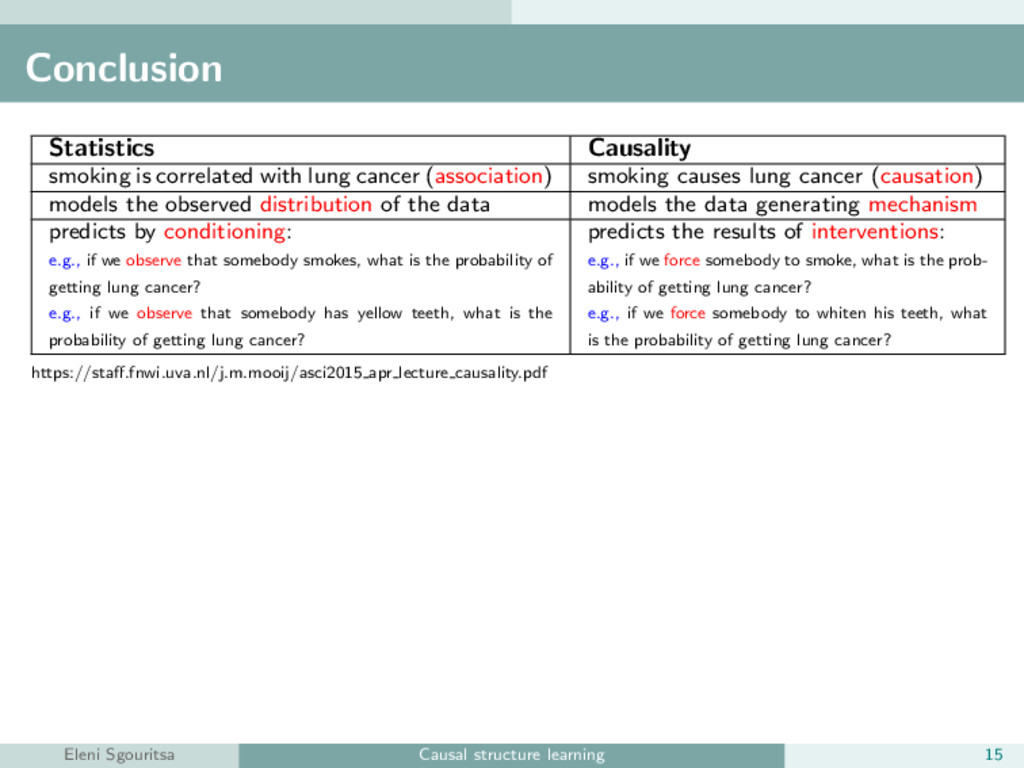
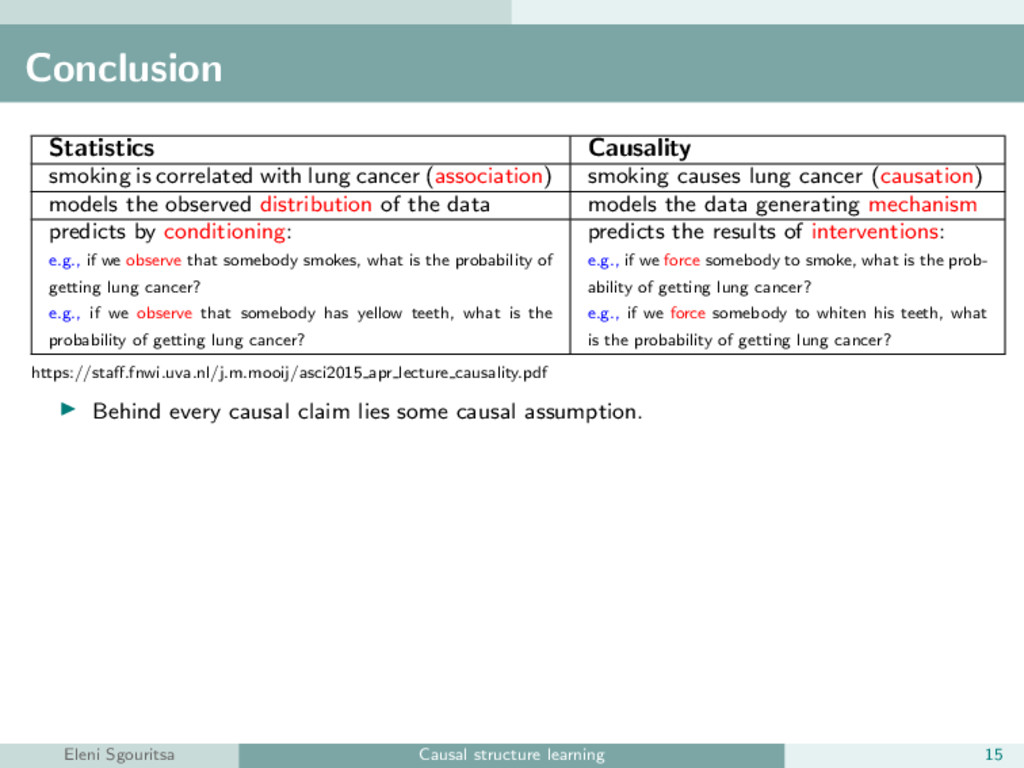
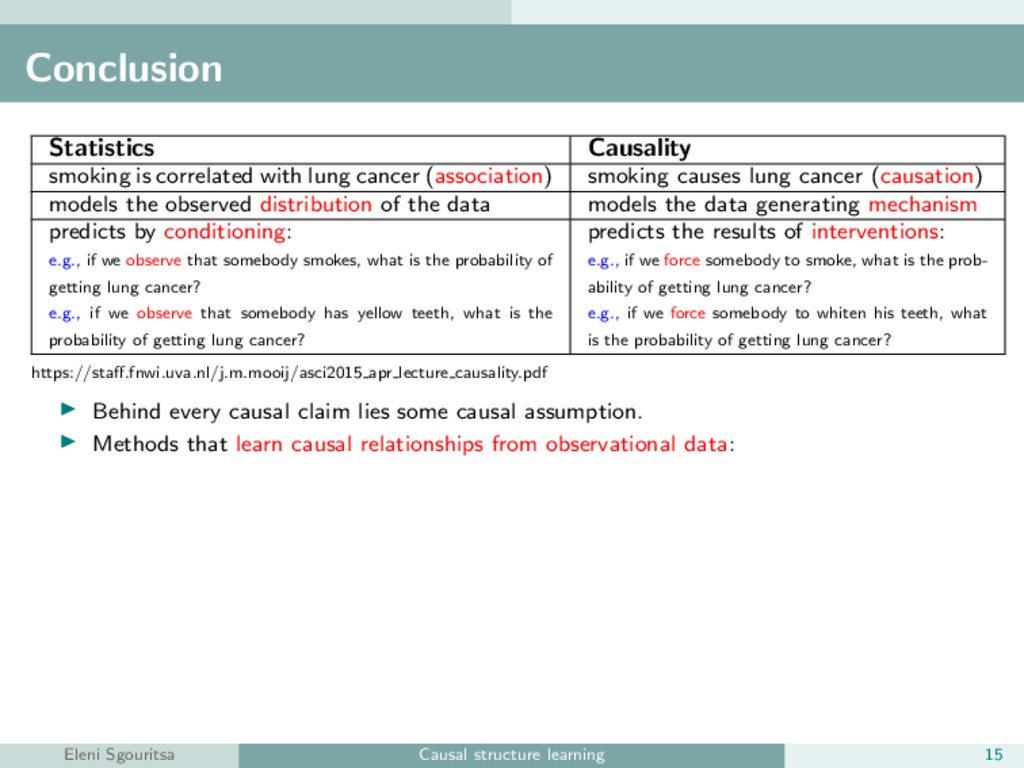
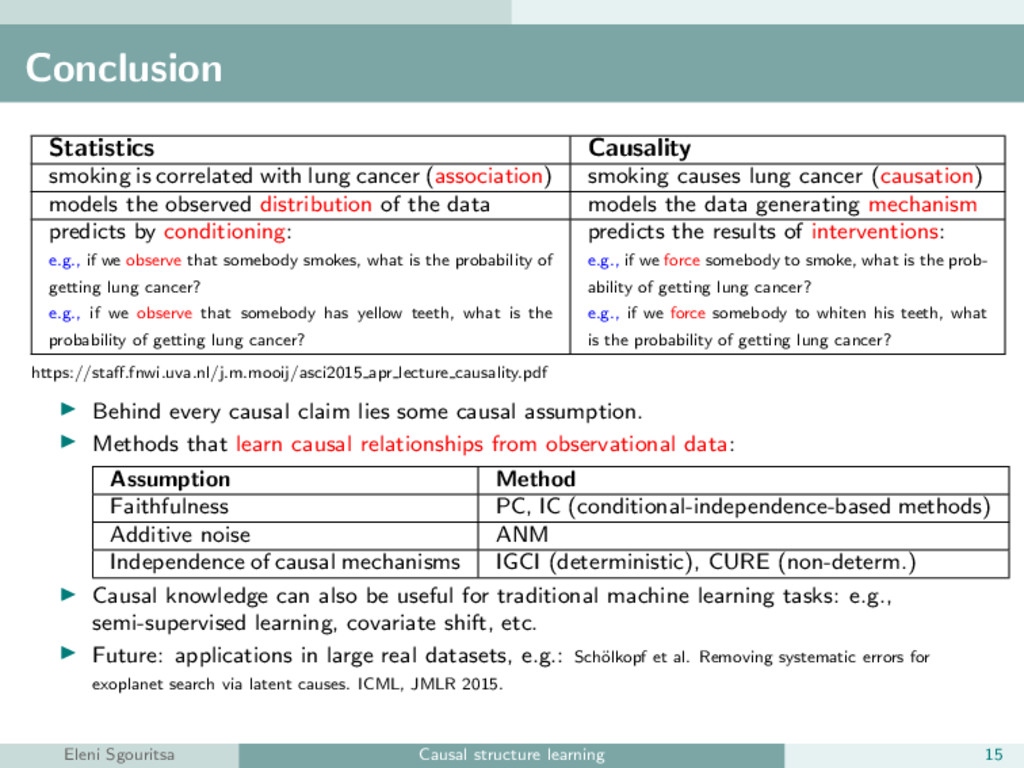
smoking causes lung cancer (causation) models the observed distribution of the data models the data generating mechanism predicts by conditioning: e.g., if we observe that somebody smokes, what is the probability of getting lung cancer? e.g., if we observe that somebody has yellow teeth, what is the probability of getting lung cancer? predicts the results of interventions: e.g., if we force somebody to smoke, what is the prob- ability of getting lung cancer? e.g., if we force somebody to whiten his teeth, what is the probability of getting lung cancer? https://staff.fnwi.uva.nl/j.m.mooij/asci2015 apr lecture causality.pdf Eleni Sgouritsa Causal structure learning 15
smoking causes lung cancer (causation) models the observed distribution of the data models the data generating mechanism predicts by conditioning: e.g., if we observe that somebody smokes, what is the probability of getting lung cancer? e.g., if we observe that somebody has yellow teeth, what is the probability of getting lung cancer? predicts the results of interventions: e.g., if we force somebody to smoke, what is the prob- ability of getting lung cancer? e.g., if we force somebody to whiten his teeth, what is the probability of getting lung cancer? https://staff.fnwi.uva.nl/j.m.mooij/asci2015 apr lecture causality.pdf Behind every causal claim lies some causal assumption. Eleni Sgouritsa Causal structure learning 15
smoking causes lung cancer (causation) models the observed distribution of the data models the data generating mechanism predicts by conditioning: e.g., if we observe that somebody smokes, what is the probability of getting lung cancer? e.g., if we observe that somebody has yellow teeth, what is the probability of getting lung cancer? predicts the results of interventions: e.g., if we force somebody to smoke, what is the prob- ability of getting lung cancer? e.g., if we force somebody to whiten his teeth, what is the probability of getting lung cancer? https://staff.fnwi.uva.nl/j.m.mooij/asci2015 apr lecture causality.pdf Behind every causal claim lies some causal assumption. Methods that learn causal relationships from observational data: Eleni Sgouritsa Causal structure learning 15
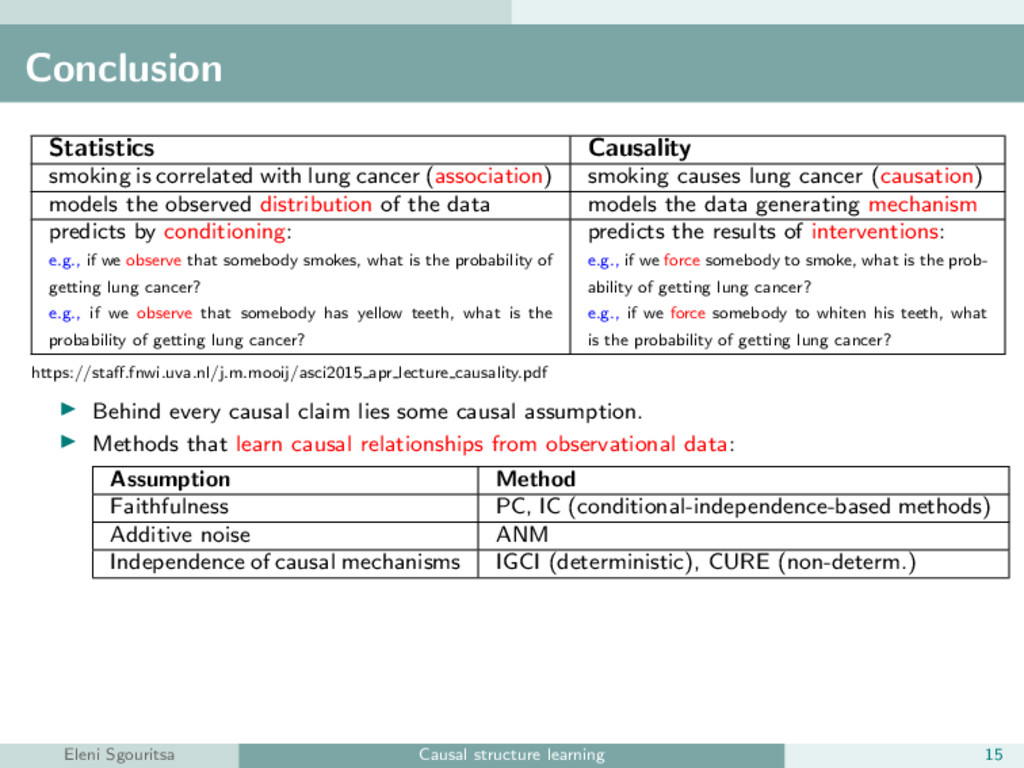
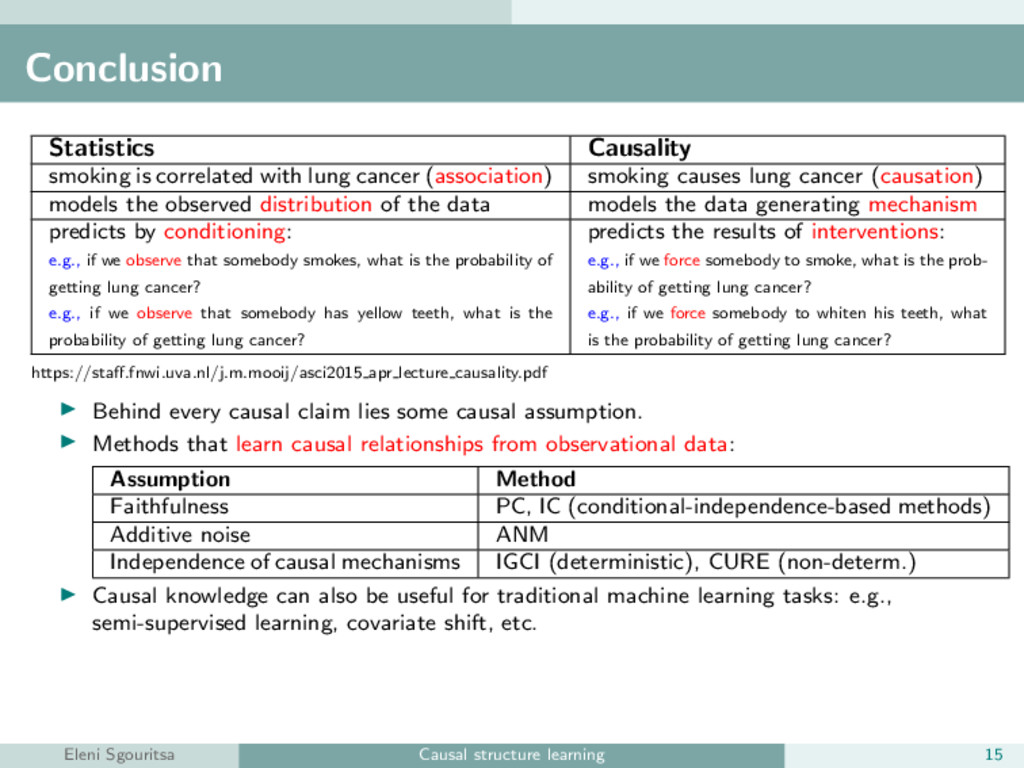
smoking causes lung cancer (causation) models the observed distribution of the data models the data generating mechanism predicts by conditioning: e.g., if we observe that somebody smokes, what is the probability of getting lung cancer? e.g., if we observe that somebody has yellow teeth, what is the probability of getting lung cancer? predicts the results of interventions: e.g., if we force somebody to smoke, what is the prob- ability of getting lung cancer? e.g., if we force somebody to whiten his teeth, what is the probability of getting lung cancer? https://staff.fnwi.uva.nl/j.m.mooij/asci2015 apr lecture causality.pdf Behind every causal claim lies some causal assumption. Methods that learn causal relationships from observational data: Assumption Method Faithfulness PC, IC (conditional-independence-based methods) Additive noise ANM Independence of causal mechanisms IGCI (deterministic), CURE (non-determ.) Eleni Sgouritsa Causal structure learning 15
smoking causes lung cancer (causation) models the observed distribution of the data models the data generating mechanism predicts by conditioning: e.g., if we observe that somebody smokes, what is the probability of getting lung cancer? e.g., if we observe that somebody has yellow teeth, what is the probability of getting lung cancer? predicts the results of interventions: e.g., if we force somebody to smoke, what is the prob- ability of getting lung cancer? e.g., if we force somebody to whiten his teeth, what is the probability of getting lung cancer? https://staff.fnwi.uva.nl/j.m.mooij/asci2015 apr lecture causality.pdf Behind every causal claim lies some causal assumption. Methods that learn causal relationships from observational data: Assumption Method Faithfulness PC, IC (conditional-independence-based methods) Additive noise ANM Independence of causal mechanisms IGCI (deterministic), CURE (non-determ.) Causal knowledge can also be useful for traditional machine learning tasks: e.g., semi-supervised learning, covariate shift, etc. Eleni Sgouritsa Causal structure learning 15
smoking causes lung cancer (causation) models the observed distribution of the data models the data generating mechanism predicts by conditioning: e.g., if we observe that somebody smokes, what is the probability of getting lung cancer? e.g., if we observe that somebody has yellow teeth, what is the probability of getting lung cancer? predicts the results of interventions: e.g., if we force somebody to smoke, what is the prob- ability of getting lung cancer? e.g., if we force somebody to whiten his teeth, what is the probability of getting lung cancer? https://staff.fnwi.uva.nl/j.m.mooij/asci2015 apr lecture causality.pdf Behind every causal claim lies some causal assumption. Methods that learn causal relationships from observational data: Assumption Method Faithfulness PC, IC (conditional-independence-based methods) Additive noise ANM Independence of causal mechanisms IGCI (deterministic), CURE (non-determ.) Causal knowledge can also be useful for traditional machine learning tasks: e.g., semi-supervised learning, covariate shift, etc. Future: applications in large real datasets, e.g.: Sch¨ olkopf et al. Removing systematic errors for exoplanet search via latent causes. ICML, JMLR 2015. Eleni Sgouritsa Causal structure learning 15
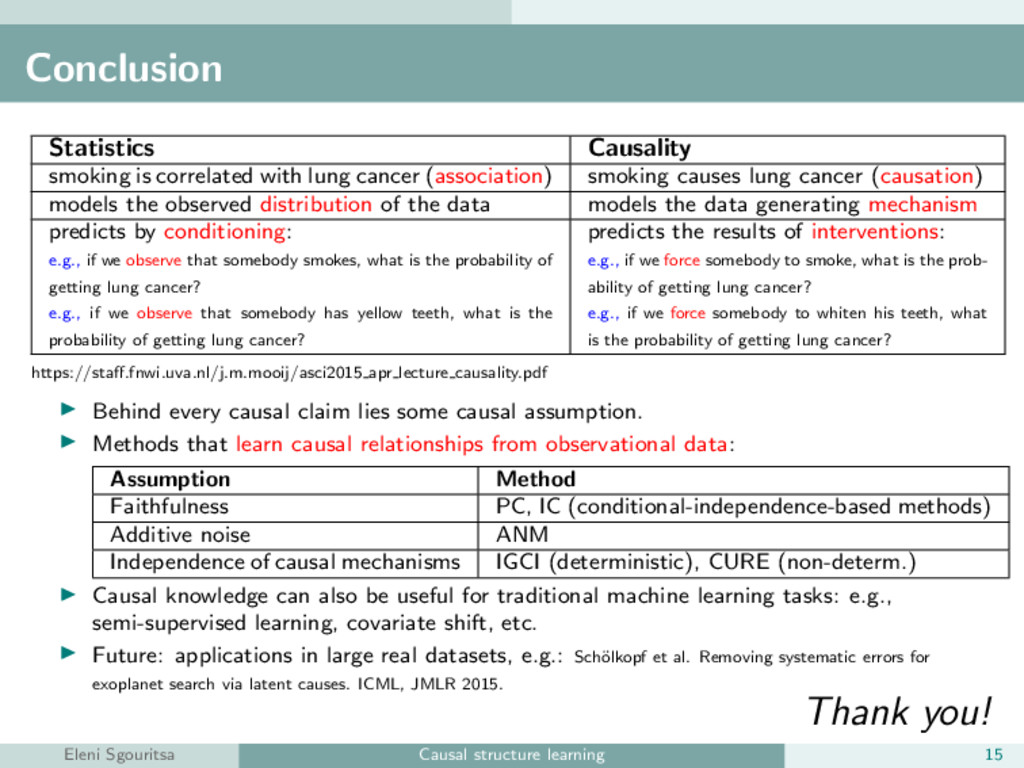
smoking causes lung cancer (causation) models the observed distribution of the data models the data generating mechanism predicts by conditioning: e.g., if we observe that somebody smokes, what is the probability of getting lung cancer? e.g., if we observe that somebody has yellow teeth, what is the probability of getting lung cancer? predicts the results of interventions: e.g., if we force somebody to smoke, what is the prob- ability of getting lung cancer? e.g., if we force somebody to whiten his teeth, what is the probability of getting lung cancer? https://staff.fnwi.uva.nl/j.m.mooij/asci2015 apr lecture causality.pdf Behind every causal claim lies some causal assumption. Methods that learn causal relationships from observational data: Assumption Method Faithfulness PC, IC (conditional-independence-based methods) Additive noise ANM Independence of causal mechanisms IGCI (deterministic), CURE (non-determ.) Causal knowledge can also be useful for traditional machine learning tasks: e.g., semi-supervised learning, covariate shift, etc. Future: applications in large real datasets, e.g.: Sch¨ olkopf et al. Removing systematic errors for exoplanet search via latent causes. ICML, JMLR 2015. Thank you! Eleni Sgouritsa Causal structure learning 15


 dougneiner
 katarinadahlin
 pedronauck
 szymonslowik
 tapps
 chrisshort
 mojombo
 skipperchong
 mfonobong
 samtorres
 colly
 livdayseo