Upgrade to Pro
— share decks privately, control downloads, hide ads and more …
Speaker Deck
Sign up for free
Menu
Search
Features
All features
Private URLs
Password Protection
Custom URLS
Scheduled publishing
Remove Branding
Restrict embedding
Deck Collections
Notes
Features
All features
Private URLs
Password Protection
Custom URLS
Scheduled publishing
Remove Branding
Restrict embedding
Deck Collections
Notes
Explore
Featured decks
Featured speakers
Programming
Technology
Storyboards
Explore
Featured decks
Featured speakers
Programming
Technology
Storyboards
Pricing
Search
Sign in
Sign up for free
リエナール_ヴィーヘルト_ポテンシャルの導出と回転する双極子の可視化について.pdf
Search
H.Hiroki
October 20, 2020
750
0
Share
Embed
Copy iframe code
Copy JS code
Copy link
Start on current slide
リエナール_ヴィーヘルト_ポテンシャルの導出と回転する双極子の可視化について.pdf
H.Hiroki
October 20, 2020
More Decks by H.Hiroki
See All by H.Hiroki
Juliaのススメ ~あなたをJuliaの沼におとしたい~
hayabusa0613
0
1.2k
Featured
See All Featured
Crafting Experiences
bethany
1
380
Agile Actions for Facilitating Distributed Teams - ADO2019
mkilby
0
310
The Anti-SEO Checklist Checklist. Pubcon Cyber Week
ryanjones
0
270
The Curious Case for Waylosing
cassininazir
1
570
The Psychology of Web Performance [Beyond Tellerrand 2023]
tammyeverts
49
3.6k
Redefining SEO in the New Era of Traffic Generation
szymonslowik
1
480
The AI Revolution Will Not Be Monopolized: How open-source beats economies of scale, even for LLMs
inesmontani
PRO
3
3.8k
Creating an realtime collaboration tool: Agile Flush - .NET Oxford
marcduiker
35
2.6k
Design in an AI World
tapps
1
350
Prompt Engineering for Job Search
mfonobong
0
520
Designing Dashboards & Data Visualisations in Web Apps
destraynor
232
55k
Large-scale JavaScript Application Architecture
addyosmani
516
110k
Transcript
リエナール・ヴィーヘルト・ポテンシャルの 導出について
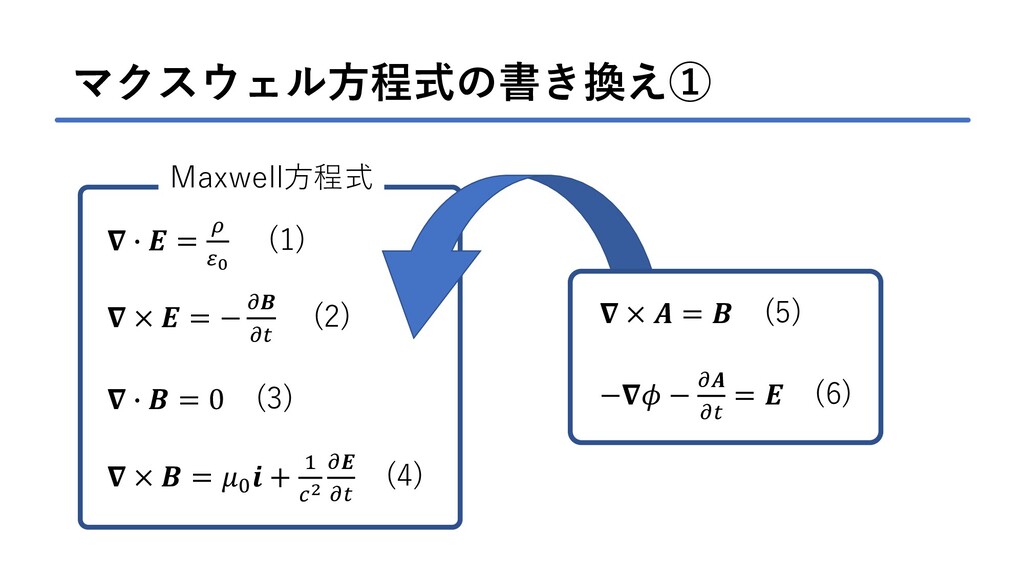
マクスウェル方程式の書き換え① ∙ = 0 (1) × = − (2) ∙
= 0 (3) × = 0 + 1 2 (4) Maxwell方程式 × = (5) − − = (6)
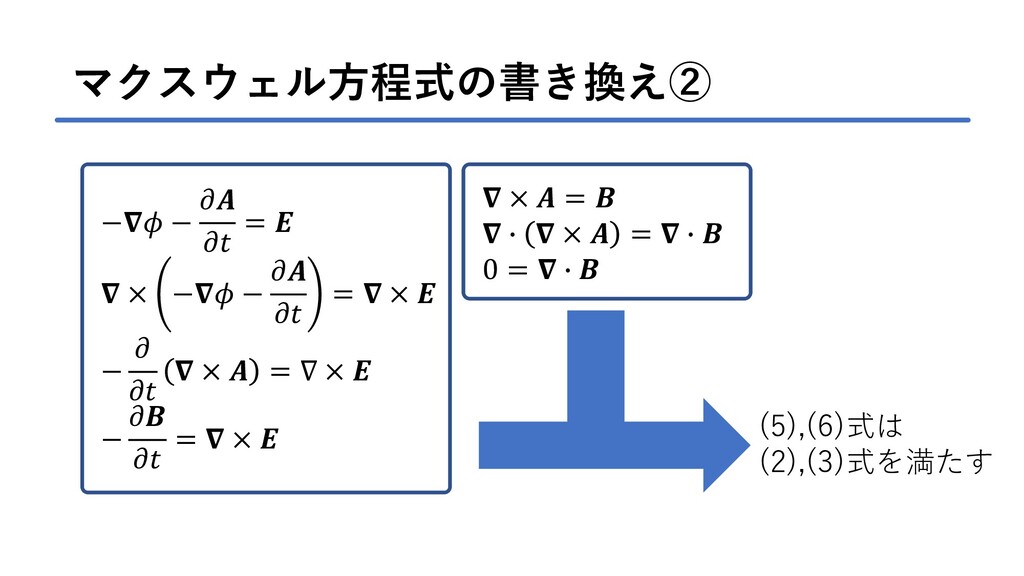
マクスウェル方程式の書き換え② × = ∙ × = ∙ 0 = ∙
− − = × − − = × − × = ∇ × − = × (5),(6)式は (2),(3)式を満たす
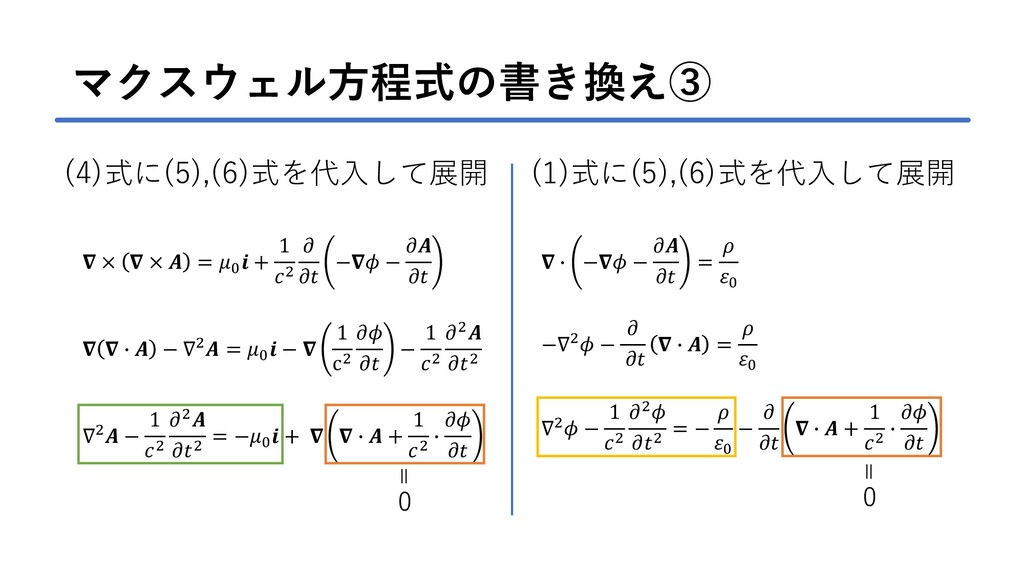
マクスウェル方程式の書き換え③ (4)式に(5),(6)式を代入して展開 × × = 0 + 1 2 −
− ∙ − ∇2 = 0 − 1 c2 − 1 2 2 2 ∇2 − 1 2 2 2 = −0 + ∙ + 1 2 ∙ (1)式に(5),(6)式を代入して展開 ∙ − − = 0 −∇2 − ∙ = 0 ∇2 − 1 2 2 2 = − 0 − ∙ + 1 2 ∙ = 0 = 0
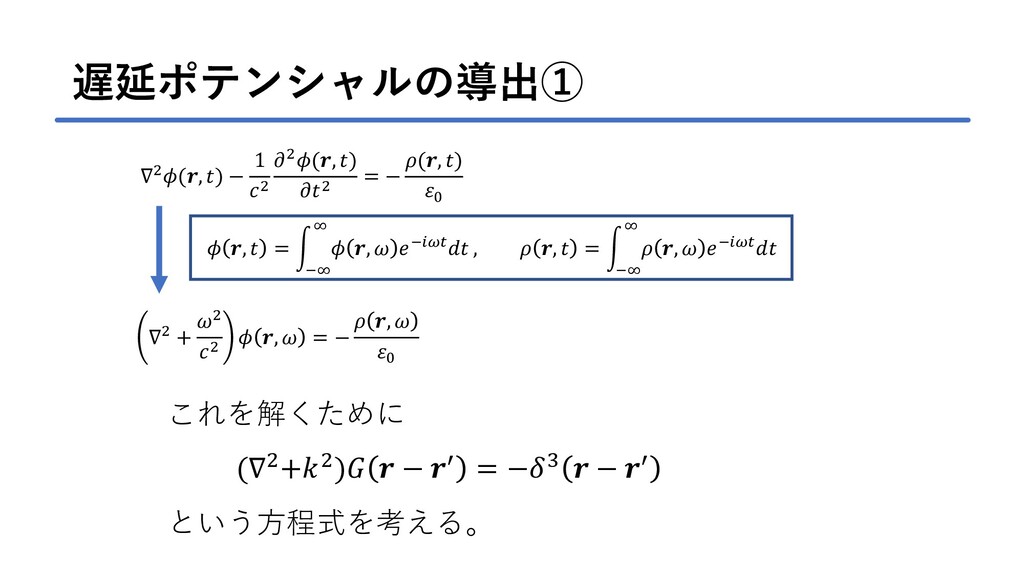
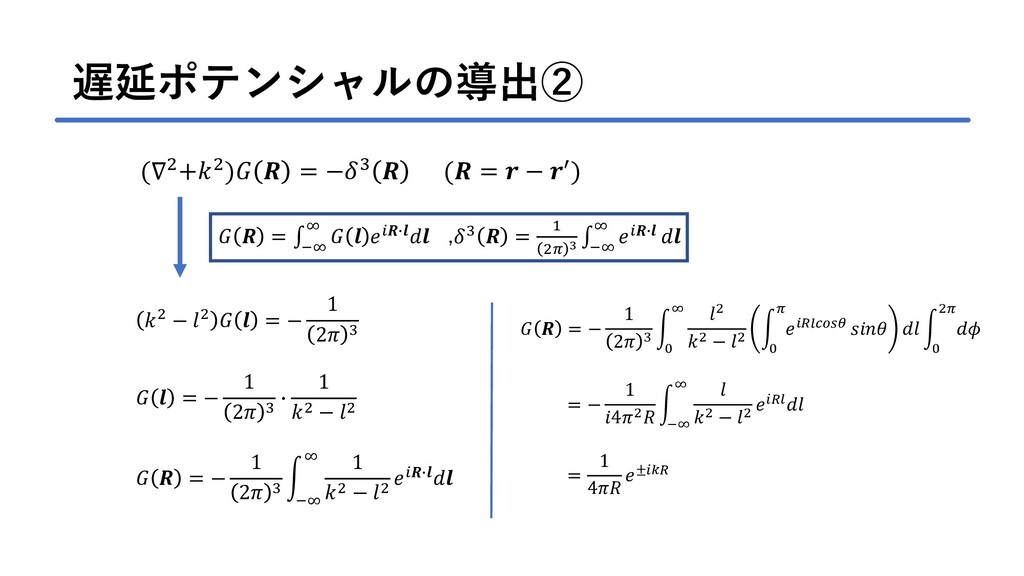
遅延ポテンシャルの導出① ∇2(, ) − 1 2 2(, ) 2 =
− (, ) 0 , = න −∞ ∞ , − , , = න −∞ ∞ , − ∇2 + 2 2 , = − , 0 これを解くために (∇2+2) − ′ = −3 − ′ という方程式を考える。
遅延ポテンシャルの導出② (∇2+2) = −3 ( = − ′) =
−∞ ∞ ∙ ,3 = 1 2 3 −∞ ∞ ∙ 2 − 2 = − 1 2 3 = − 1 2 3 ∙ 1 2 − 2 = − 1 2 3 න −∞ ∞ 1 2 − 2 ∙ = − 1 2 3 න 0 ∞ 2 2 − 2 න 0 න 0 2 = − 1 42 න −∞ ∞ 2 − 2 = 1 4 ±
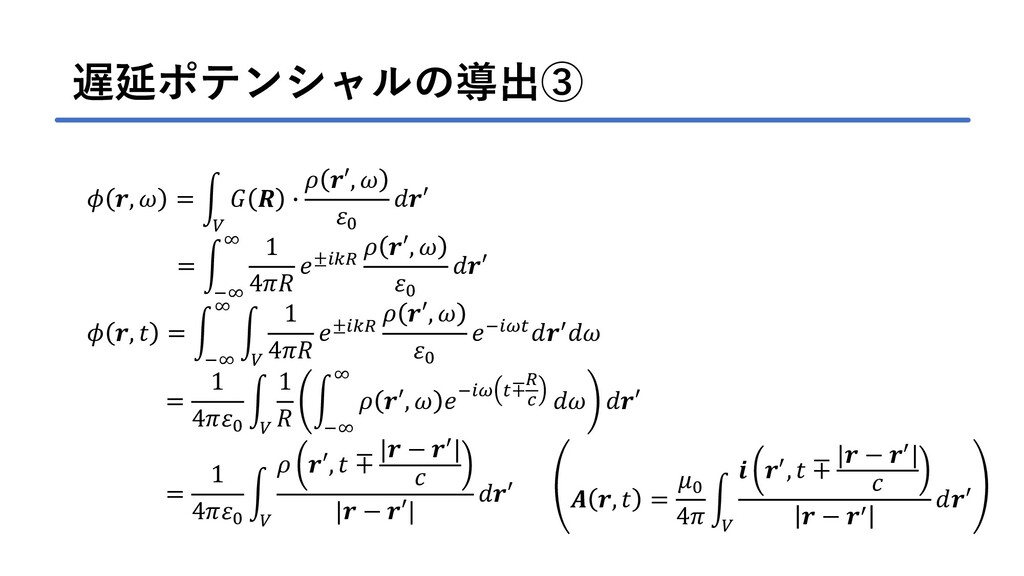
遅延ポテンシャルの導出③ , = න ∙ ′, 0 ′ = න
−∞ ∞ 1 4 ± ′, 0 ′ , = න −∞ ∞ න 1 4 ± ′, 0 −′ = 1 40 න 1 න −∞ ∞ ′, − ∓ ′ = 1 40 න ′, ∓ | − ′| | − ′| ′ , = 0 4 න ′, ∓ | − ′| − ′ ′
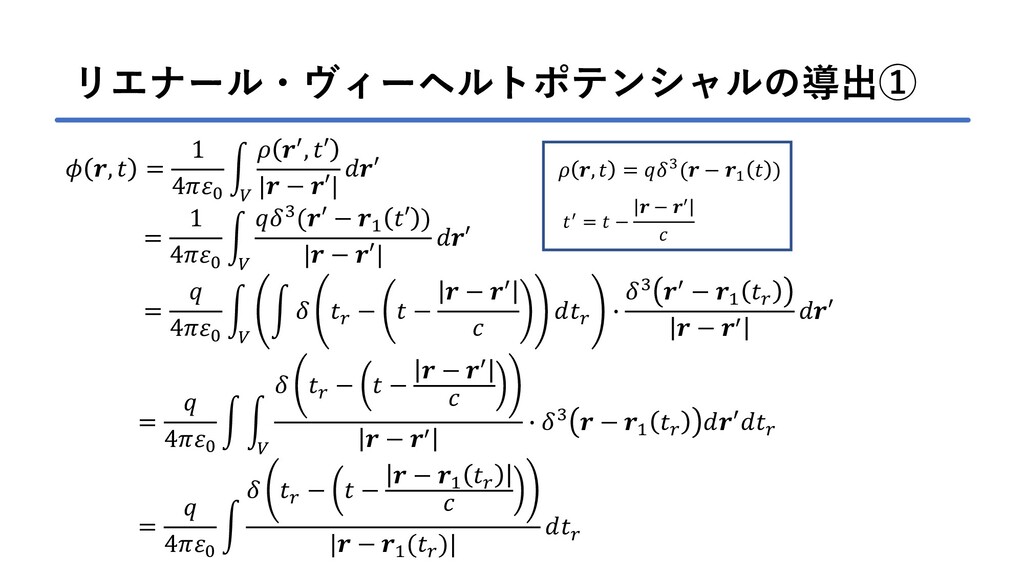
リエナール・ヴィーヘルトポテンシャルの導出① , = 1 40 න ′, ′ | −
′| ′ = 1 40 න 3(′ − 1 ′ ) | − ′| ′ = 40 න න − − − ′ ∙ 3 ′ − 1 − ′ ′ = 40 න න − − − ′ − ′ ∙ 3 − 1 ′ = 40 න − − − 1 | − 1 ( )| , = 3( − 1 ) ′ = − − ′
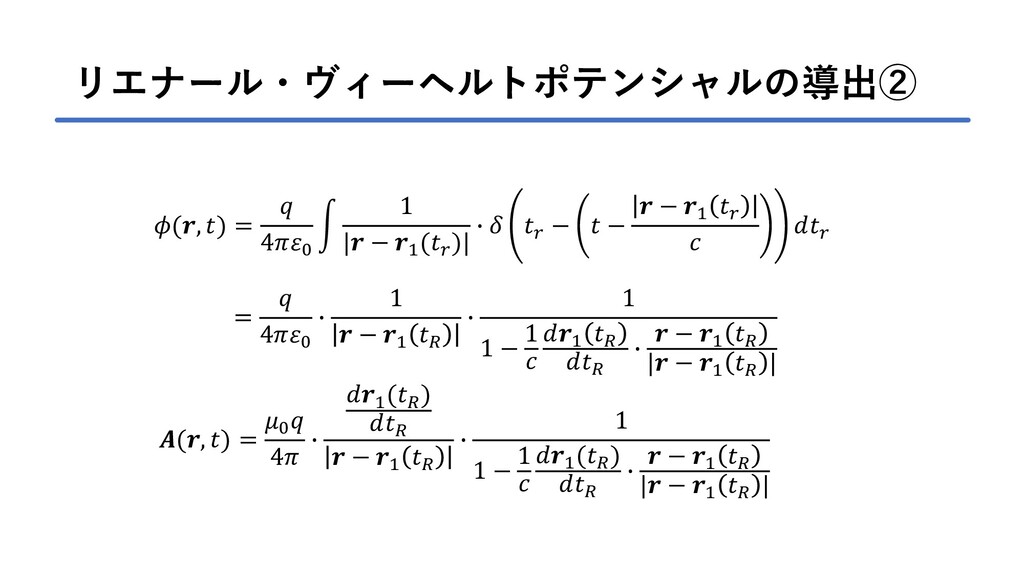
リエナール・ヴィーヘルトポテンシャルの導出② = 40 ∙ 1 − 1 ∙ 1 1
− 1 1 ∙ − 1 | − 1 | (, ) = 40 න 1 | − 1 ( )| ∙ − − − 1 (, ) = 0 4 ∙ 1 ( ) − 1 ∙ 1 1 − 1 1 ( ) ∙ − 1 | − 1 |
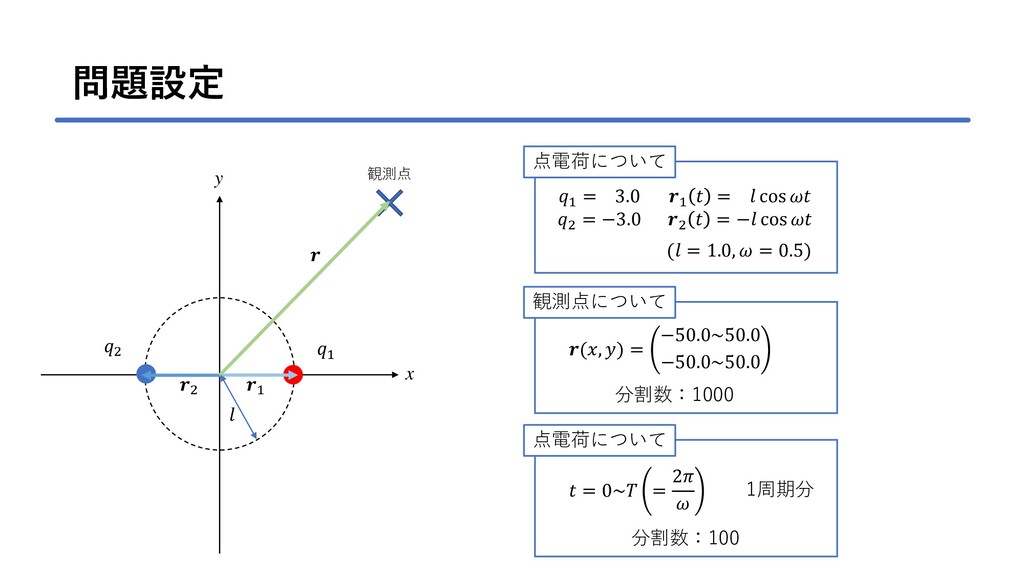
問題設定 y x 1 2 2 観測点 1 (, )
= −50.0~50.0 −50.0~50.0 1 = 3.0 2 = −3.0 1 = cos 2 = − cos ( = 1.0, = 0.5) 点電荷について 観測点について 分割数:1000 点電荷について = 0~ = 2 1周期分 分割数:100
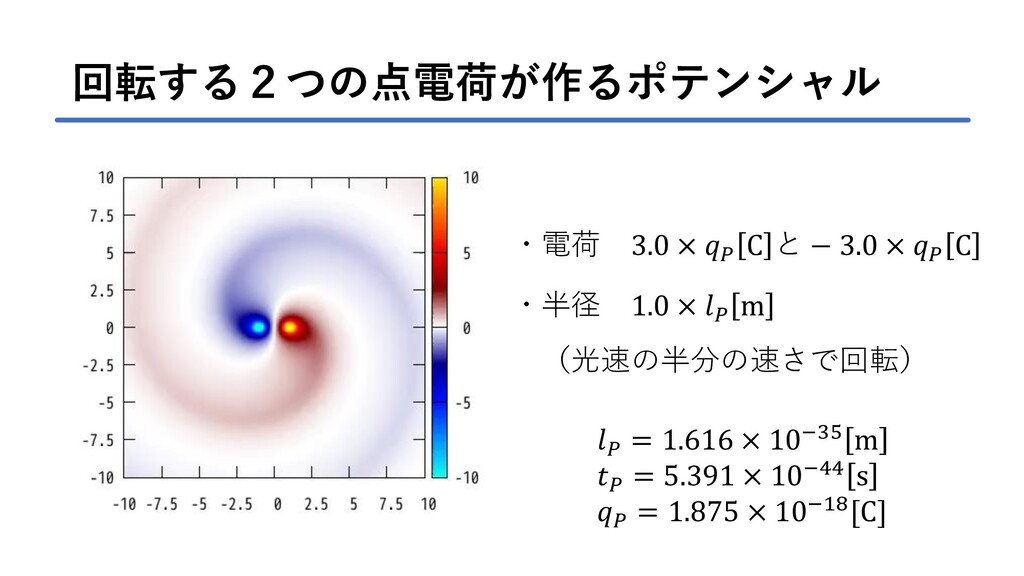
回転する2つの点電荷が作るポテンシャル = 1.616 × 10⁻³⁵ m = 5.391 × 10−44
s = 1.875 × 10⁻¹⁸[C] ・電荷 3.0 × C と − 3.0 × C ・半径 1.0 × m (光速の半分の速さで回転)


 hayabusa0613
 bethany
 mkilby
 ryanjones
 cassininazir
 tammyeverts
 szymonslowik
 inesmontani
 marcduiker
 tapps
tapps
 mfonobong
 destraynor
 addyosmani