Share
Embed
FastAPI Beyond CRUD, Build powerful, scalable Apps With Python
This talk on FastAPI is one I gave at Pycon Uganda 2025. Talking about FastAPI features that can be helpful for building a proffessional FastAPI backend

Ssali Jonathan Kiggundu
August 13, 2025
Transcript
73 slides
-
Build Powerful, Scalable Applications With Python Ssali Jonathan (jod35) FASTAPI
BEYOND CRUD (Build powerful,Scalable Apps with Python) #PyConUg2025 Ssali Jonathan (jod35) -
#PyConUg2025 About Me • I am a software engineer •
Teacher Works • FastAPI Beyond CRUD Course Links • github.com/jod35 • x.com/jod35_ • linkedin.com/in/jod35 • dev.to/jod35 -
#PyConUg2025 • Created in 2018 by Sebastian Ramirez • Most
popular Python Backend Framework -
#PyConUg2025 • You know the Python programming language • You
know the basics of API Development • You can build a server-side app with FastAPI, Flask or Django • You can build a CRUD API with FastAPI • You have an idea of an ORM like SQLAlchemy • You have an idea of Pydantic -
“You can build your FastAPI Backend in one file ”
#PyConUg2025 -
Here is a single-file simple CRUD APP Built with FastAPI
and SQLModel #PyConUg2025 -
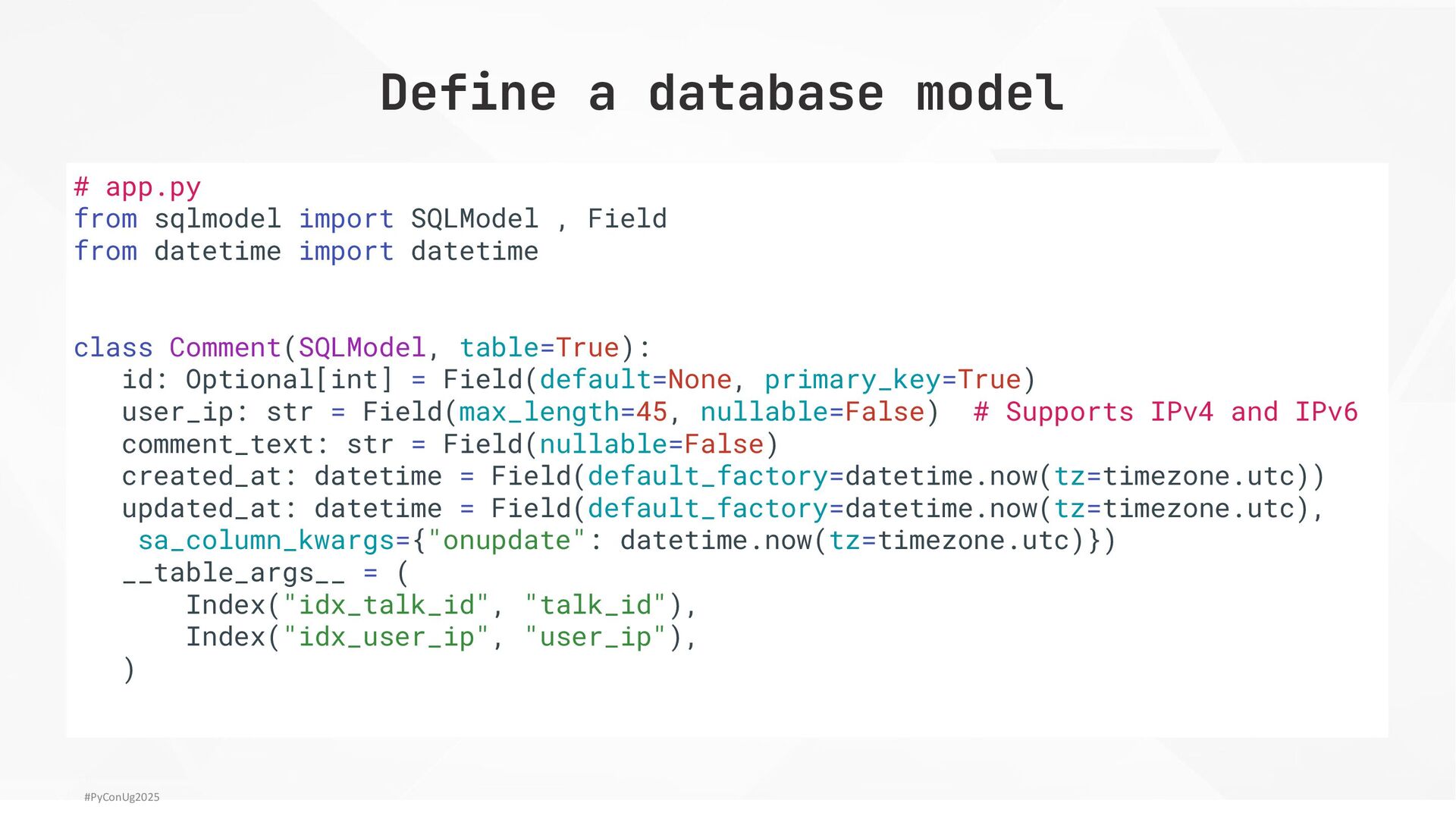
Define a database model #PyConUg2025 # app.py from sqlmodel import
SQLModel , Field from datetime import datetime class Comment(SQLModel, table=True): id: Optional[int] = Field(default=None, primary_key=True) user_ip: str = Field(max_length=45, nullable=False) # Supports IPv4 and IPv6 comment_text: str = Field(nullable=False) created_at: datetime = Field(default_factory=datetime.now(tz=timezone.utc)) updated_at: datetime = Field(default_factory=datetime.now(tz=timezone.utc), sa_column_kwargs={"onupdate": datetime.now(tz=timezone.utc)}) __table_args__ = ( Index("idx_talk_id", "talk_id"), Index("idx_user_ip", "user_ip"), ) -
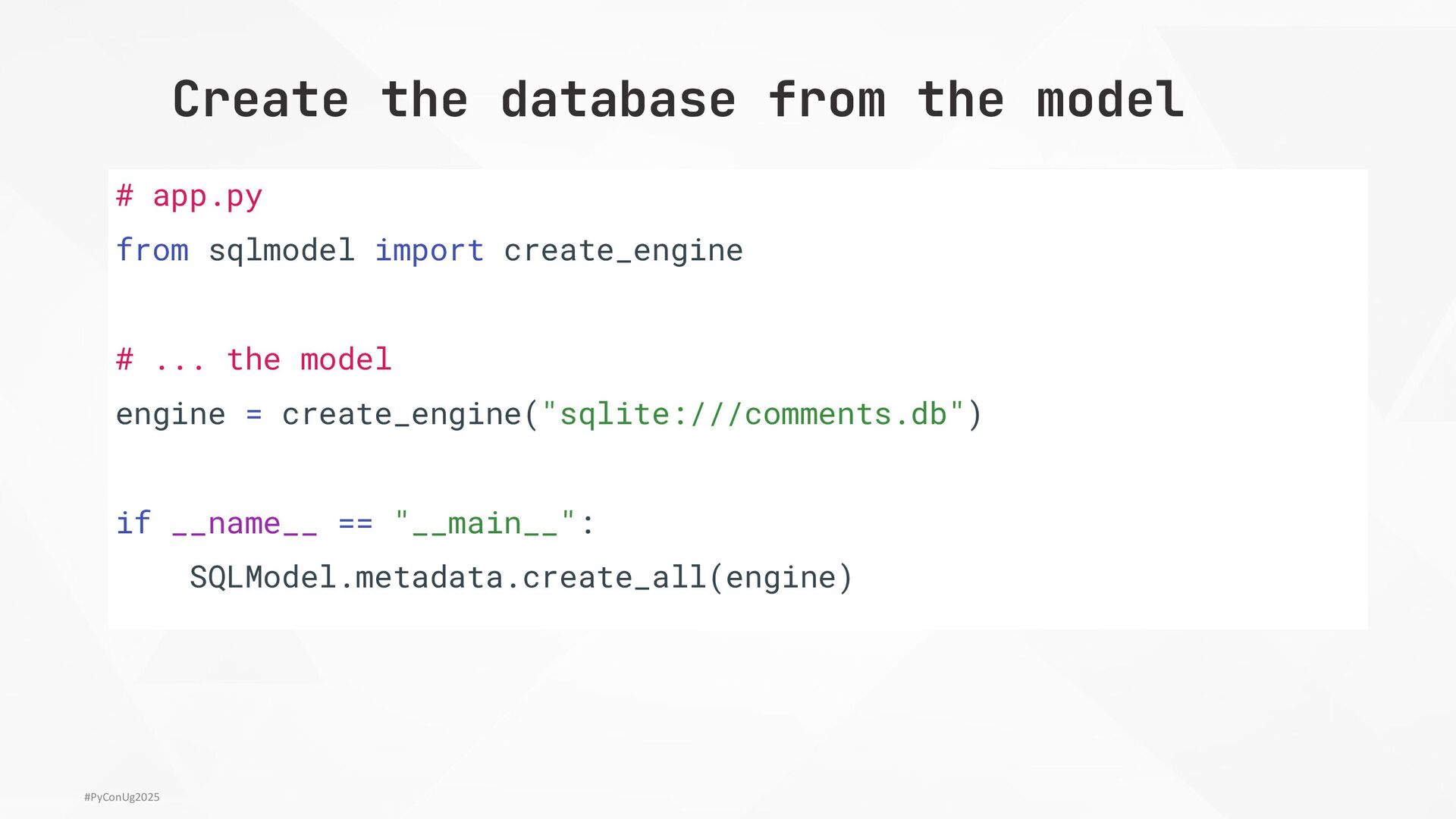
Create the database from the model #PyConUg2025 # app.py from
sqlmodel import create_engine # ... the model engine = create_engine("sqlite:///comments.db") if __name__ == "__main__": SQLModel.metadata.create_all(engine) -
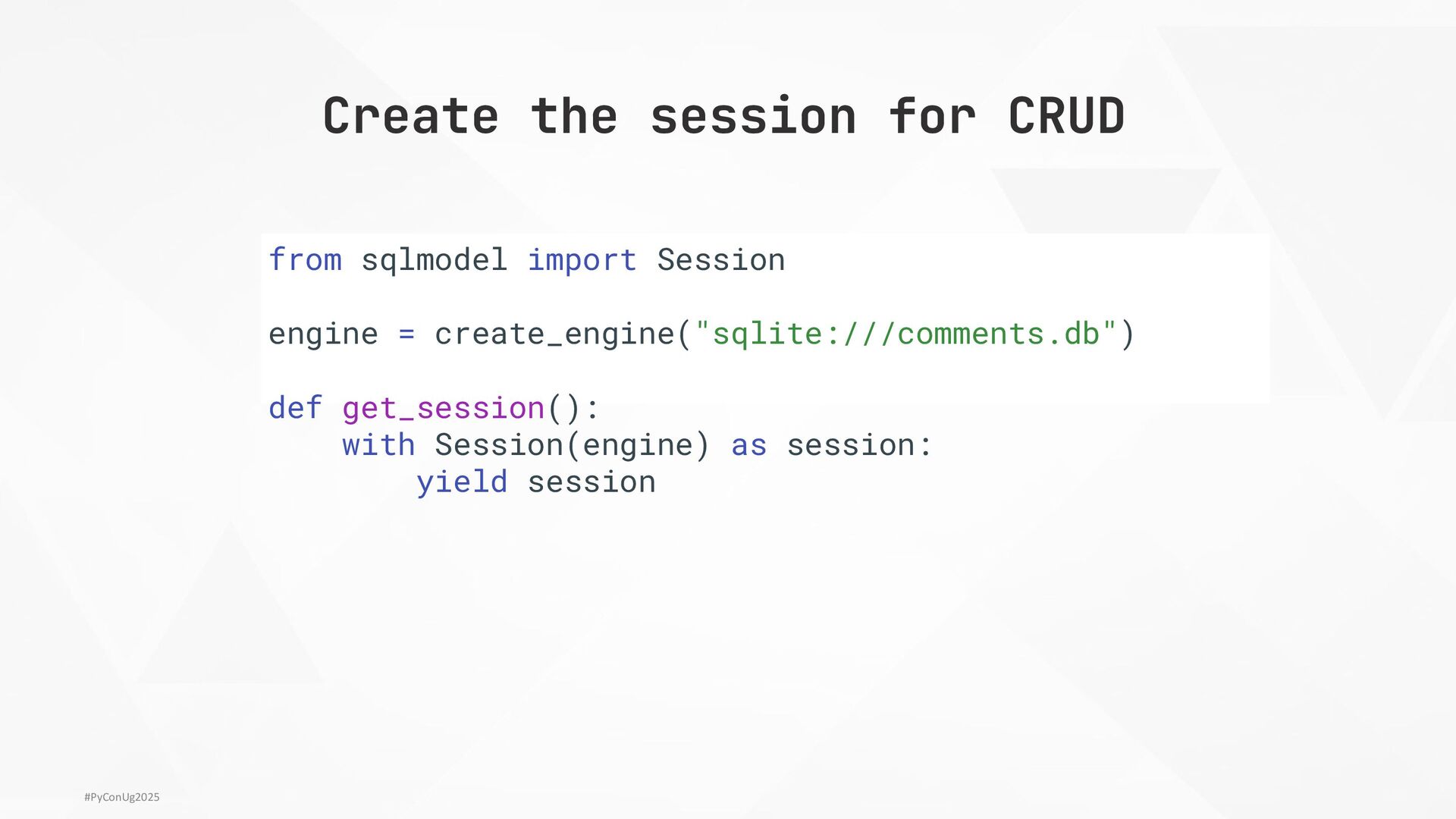
Create the session for CRUD #PyConUg2025 from sqlmodel import Session
engine = create_engine("sqlite:///comments.db") def get_session(): with Session(engine) as session: yield session -
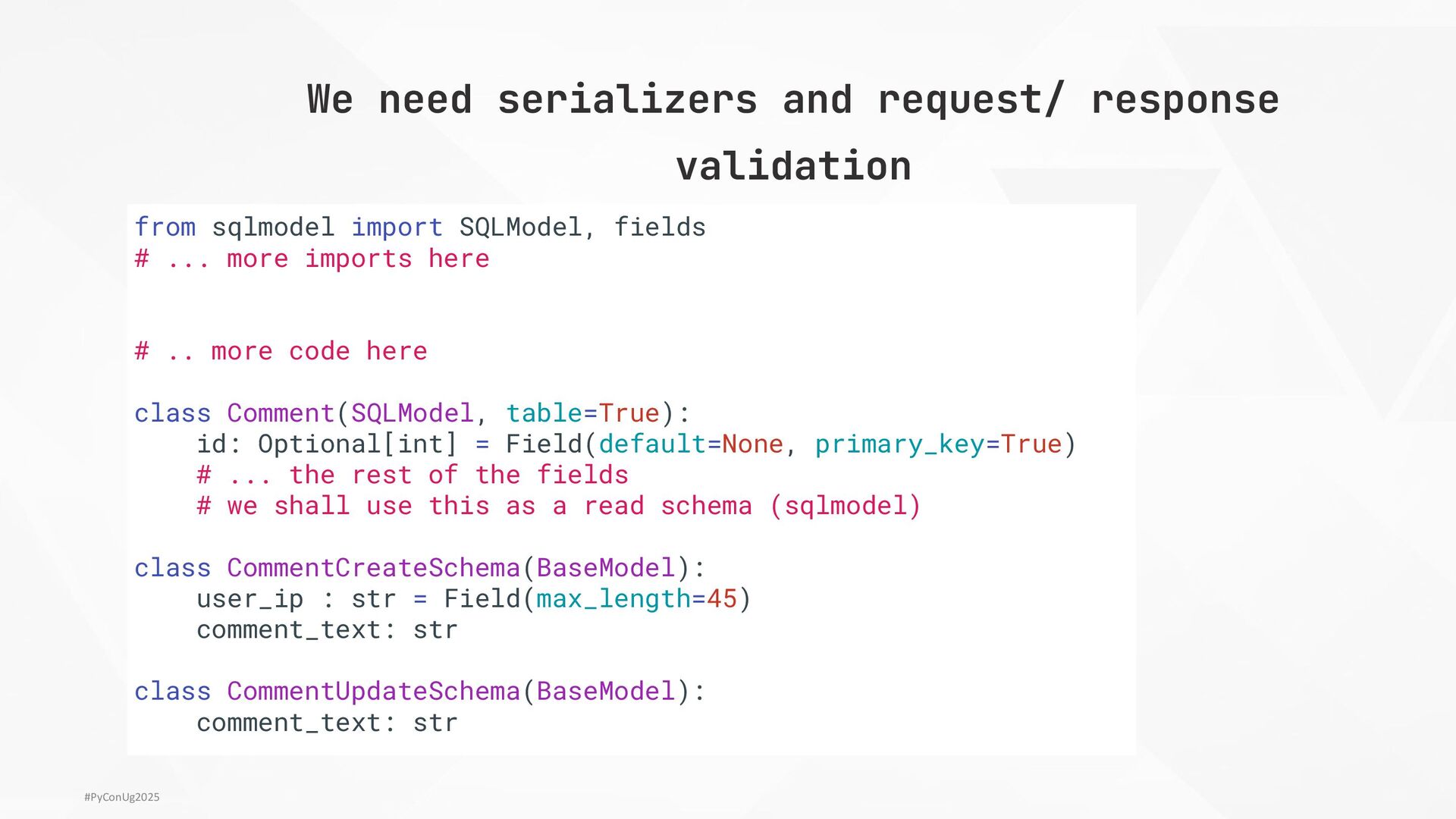
We need serializers and request/ response validation #PyConUg2025 from sqlmodel
import SQLModel, fields # ... more imports here # .. more code here class Comment(SQLModel, table=True): id: Optional[int] = Field(default=None, primary_key=True) # ... the rest of the fields # we shall use this as a read schema (sqlmodel) class CommentCreateSchema(BaseModel): user_ip : str = Field(max_length=45) comment_text: str class CommentUpdateSchema(BaseModel): comment_text: str -
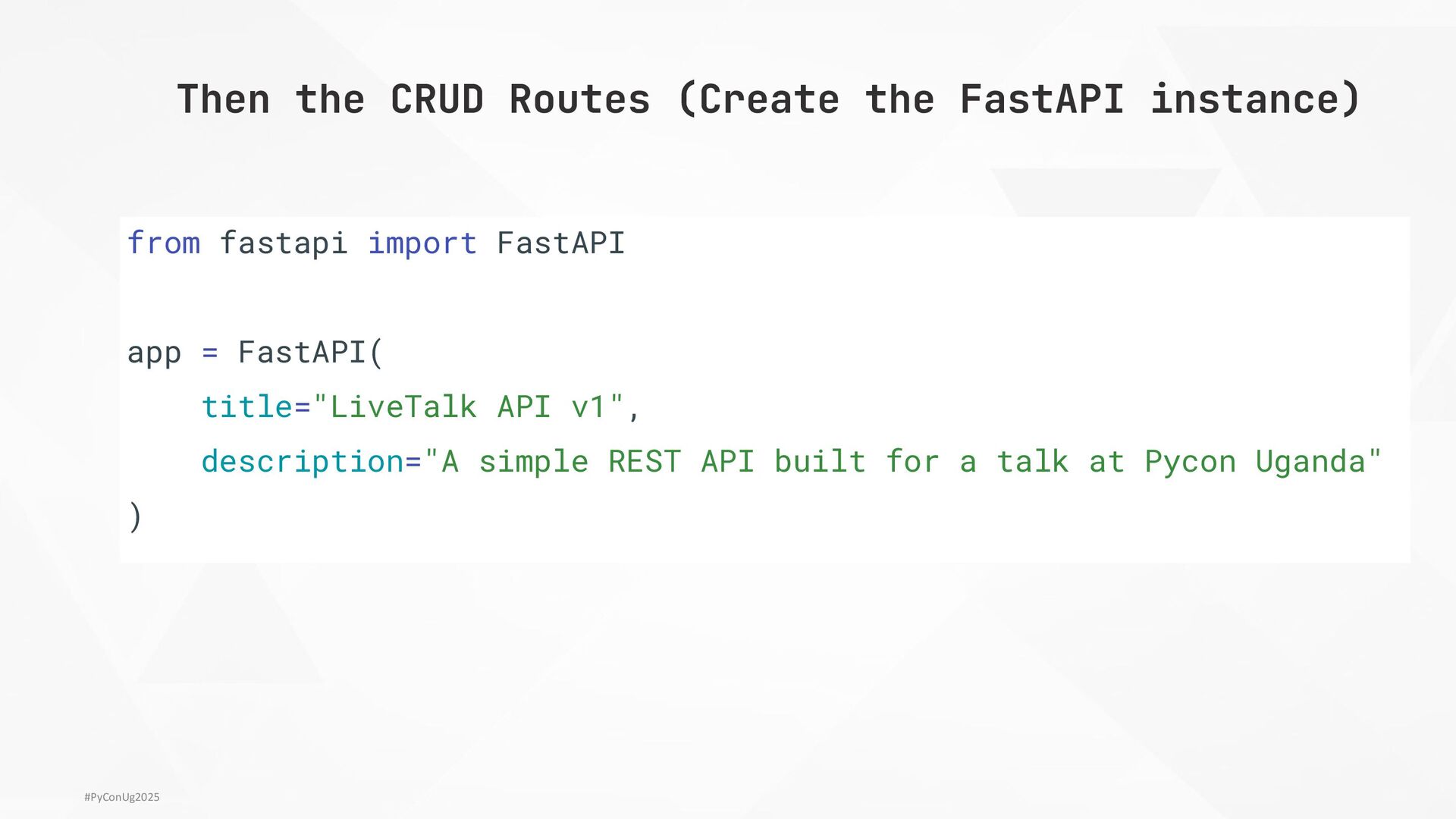
Then the CRUD Routes (Create the FastAPI instance) #PyConUg2025 from
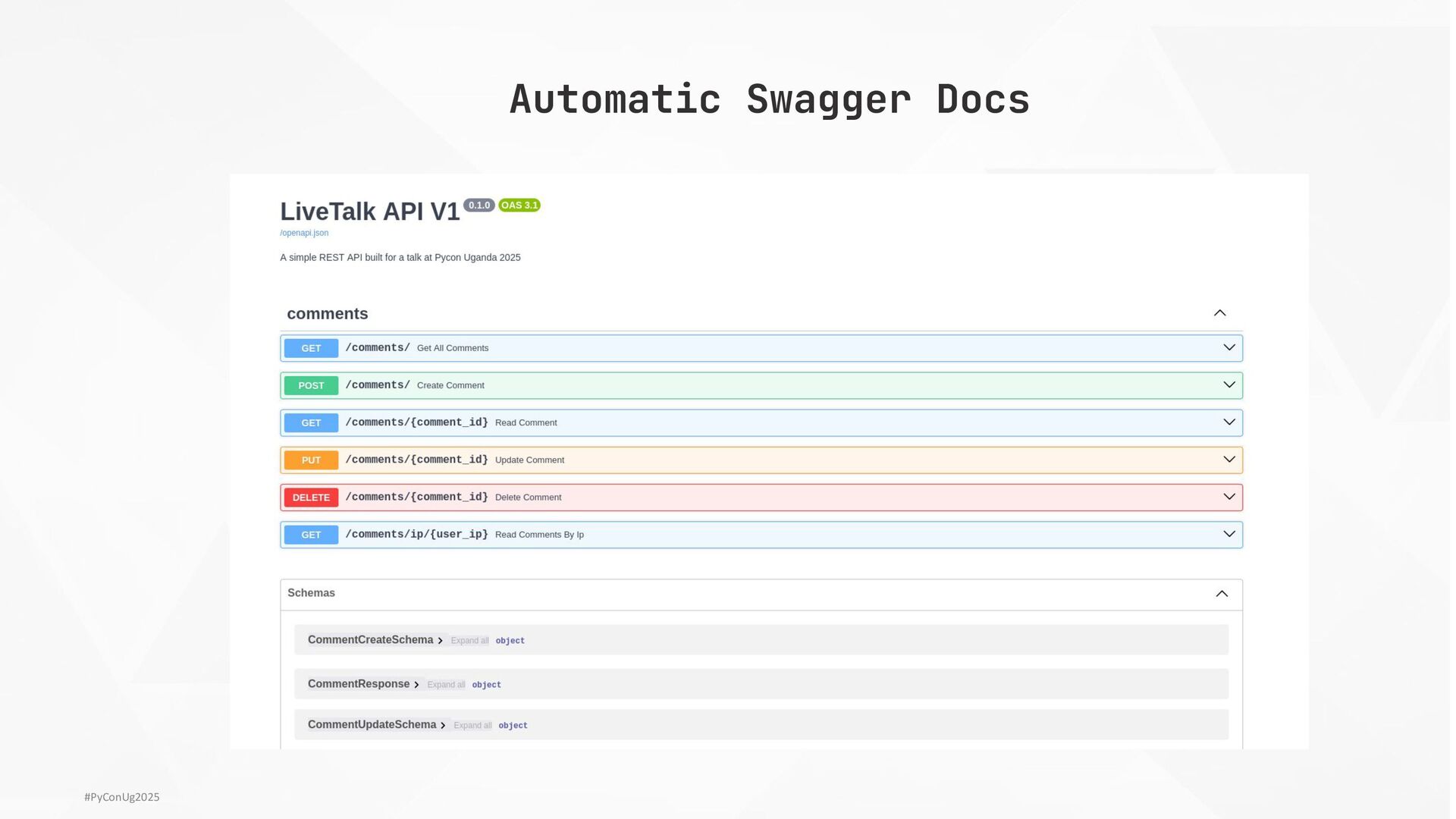
fastapi import FastAPI app = FastAPI( title="LiveTalk API v1", description="A simple REST API built for a talk at Pycon Uganda" ) -
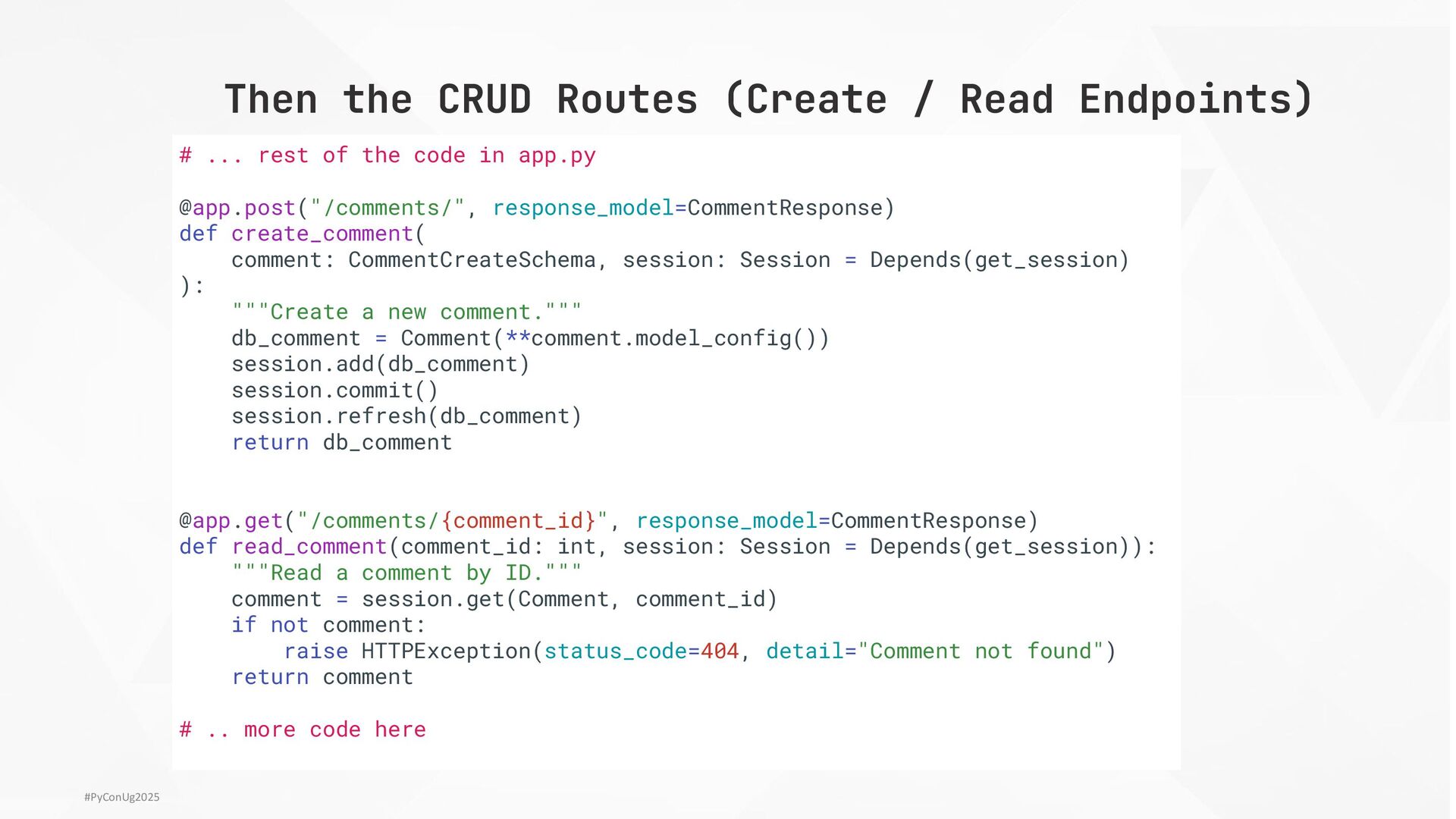
Then the CRUD Routes (Create / Read Endpoints) #PyConUg2025 #
... rest of the code in app.py @app.post("/comments/", response_model=CommentResponse) def create_comment( comment: CommentCreateSchema, session: Session = Depends(get_session) ): """Create a new comment.""" db_comment = Comment(**comment.model_config()) session.add(db_comment) session.commit() session.refresh(db_comment) return db_comment @app.get("/comments/{comment_id}", response_model=CommentResponse) def read_comment(comment_id: int, session: Session = Depends(get_session)): """Read a comment by ID.""" comment = session.get(Comment, comment_id) if not comment: raise HTTPException(status_code=404, detail="Comment not found") return comment # .. more code here -
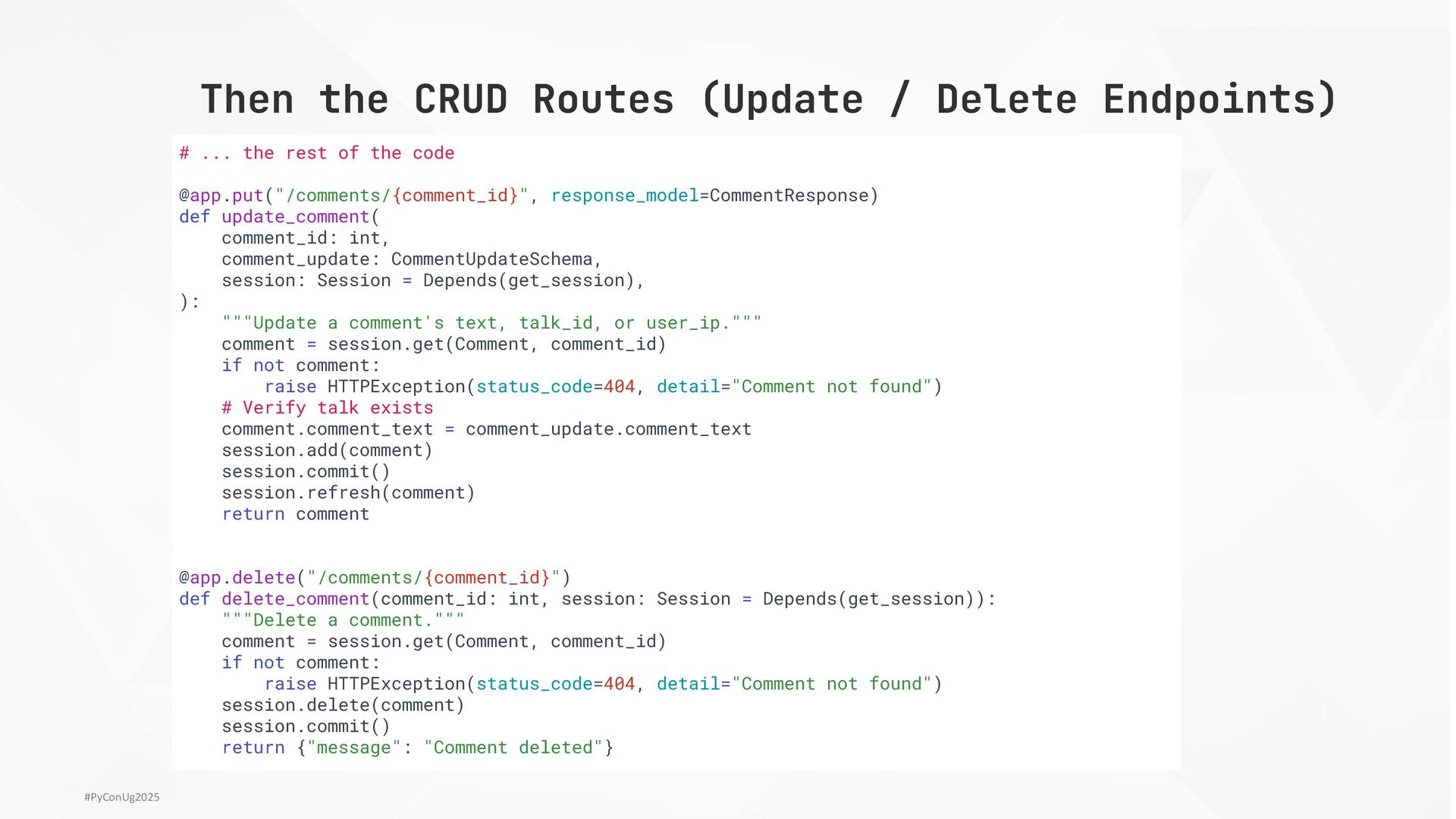
Then the CRUD Routes (Update / Delete Endpoints) #PyConUg2025 #
... the rest of the code @app.put("/comments/{comment_id}", response_model=CommentResponse) def update_comment( comment_id: int, comment_update: CommentUpdateSchema, session: Session = Depends(get_session), ): """Update a comment's text, talk_id, or user_ip.""" comment = session.get(Comment, comment_id) if not comment: raise HTTPException(status_code=404, detail="Comment not found") # Verify talk exists comment.comment_text = comment_update.comment_text session.add(comment) session.commit() session.refresh(comment) return comment @app.delete("/comments/{comment_id}") def delete_comment(comment_id: int, session: Session = Depends(get_session)): """Delete a comment.""" comment = session.get(Comment, comment_id) if not comment: raise HTTPException(status_code=404, detail="Comment not found") session.delete(comment) session.commit() return {"message": "Comment deleted"} -
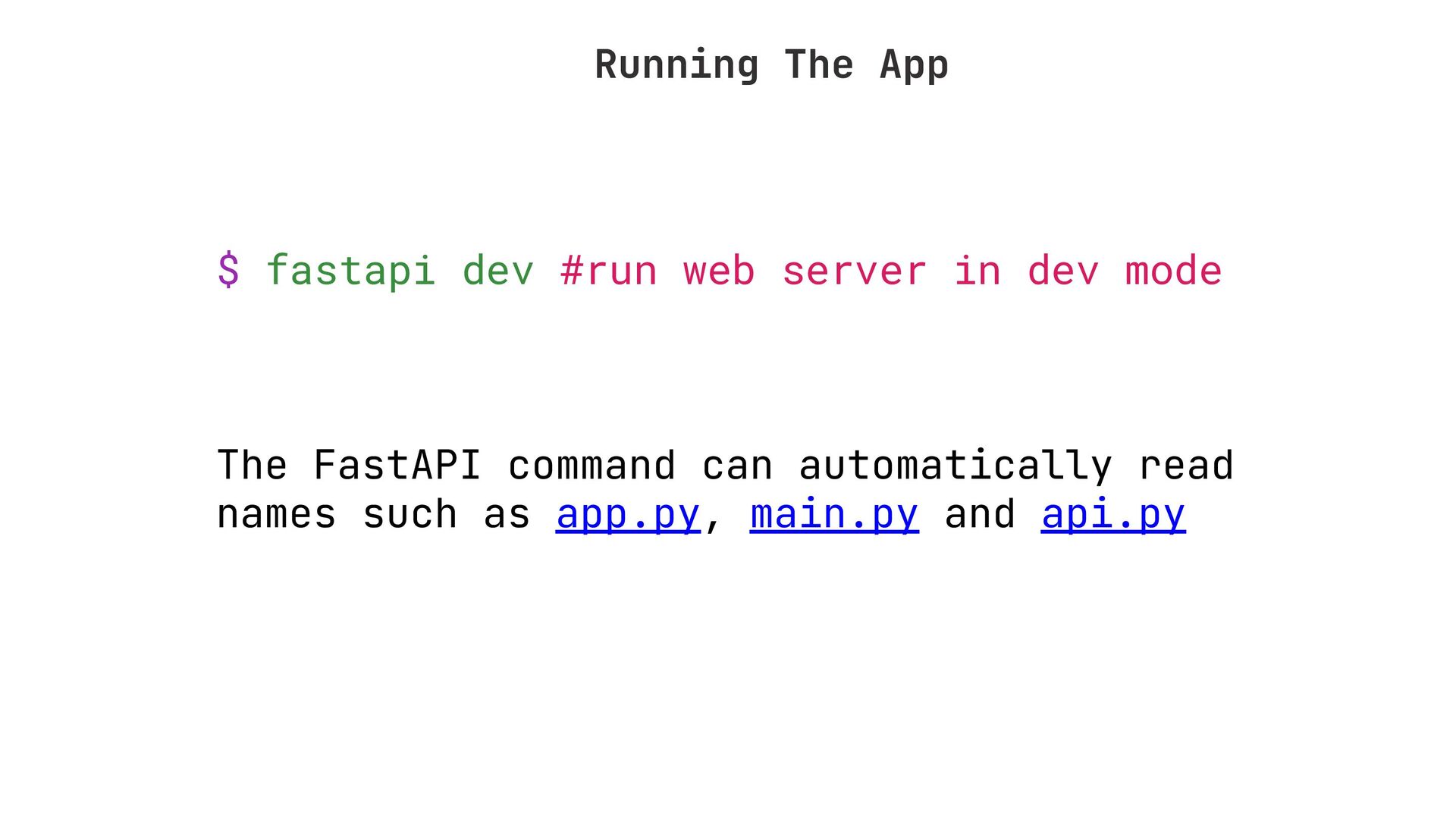
Running The App $ fastapi dev #run web server in
dev mode The FastAPI command can automatically read names such as app.py, main.py and api.py -
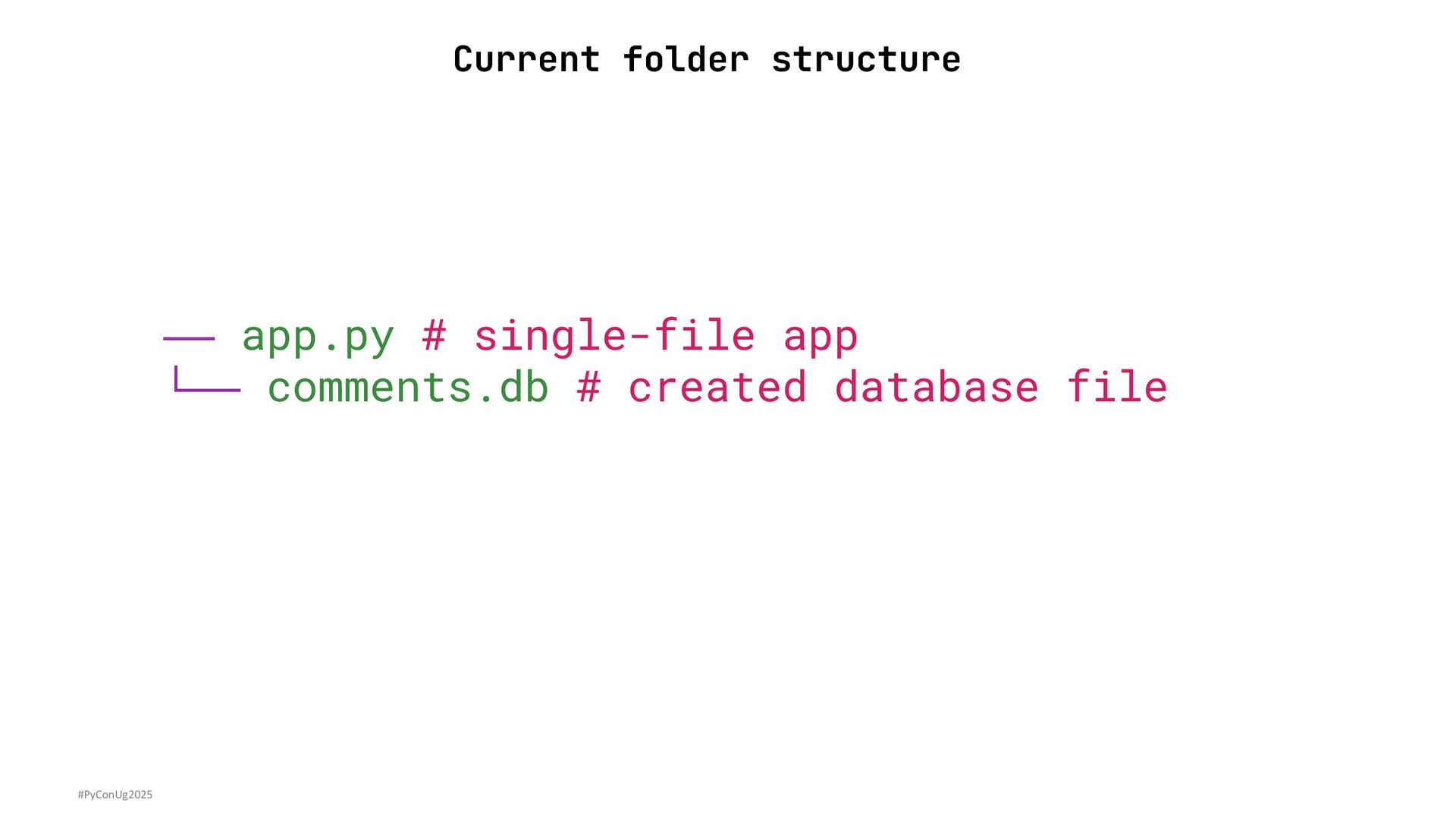
Current folder structure ── app.py # single-file app └── comments.db
# created database file #PyConUg2025 -
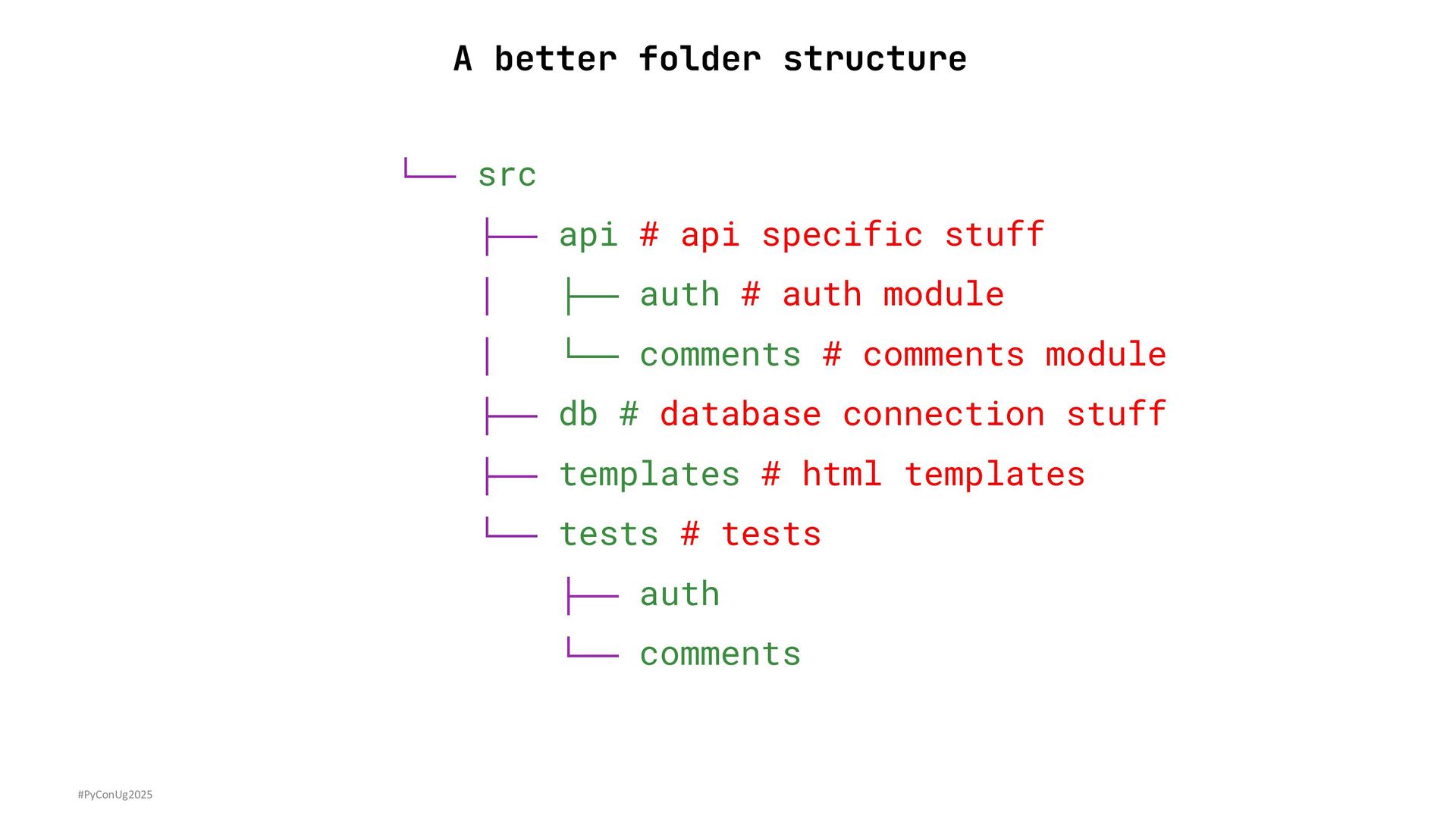
A better folder structure └── src ├── api # api
specific stuff │ ├── auth # auth module │ └── comments # comments module ├── db # database connection stuff ├── templates # html templates └── tests # tests ├── auth └── comments #PyConUg2025 -
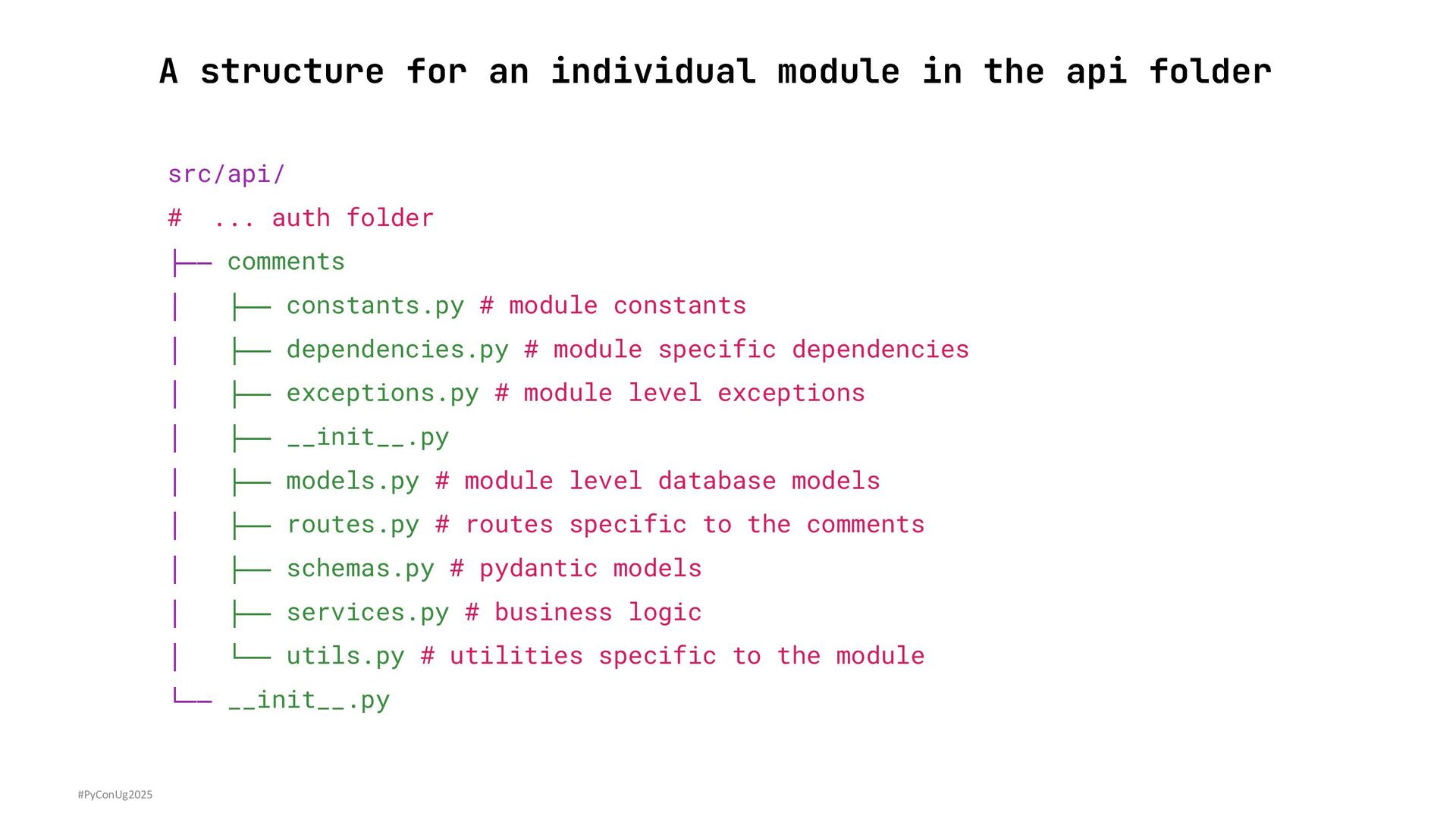
A structure for an individual module in the api folder
src/api/ # ... auth folder ├── comments │ ├── constants.py # module constants │ ├── dependencies.py # module specific dependencies │ ├── exceptions.py # module level exceptions │ ├── __init__.py │ ├── models.py # module level database models │ ├── routes.py # routes specific to the comments │ ├── schemas.py # pydantic models │ ├── services.py # business logic │ └── utils.py # utilities specific to the module └── __init__.py #PyConUg2025 -
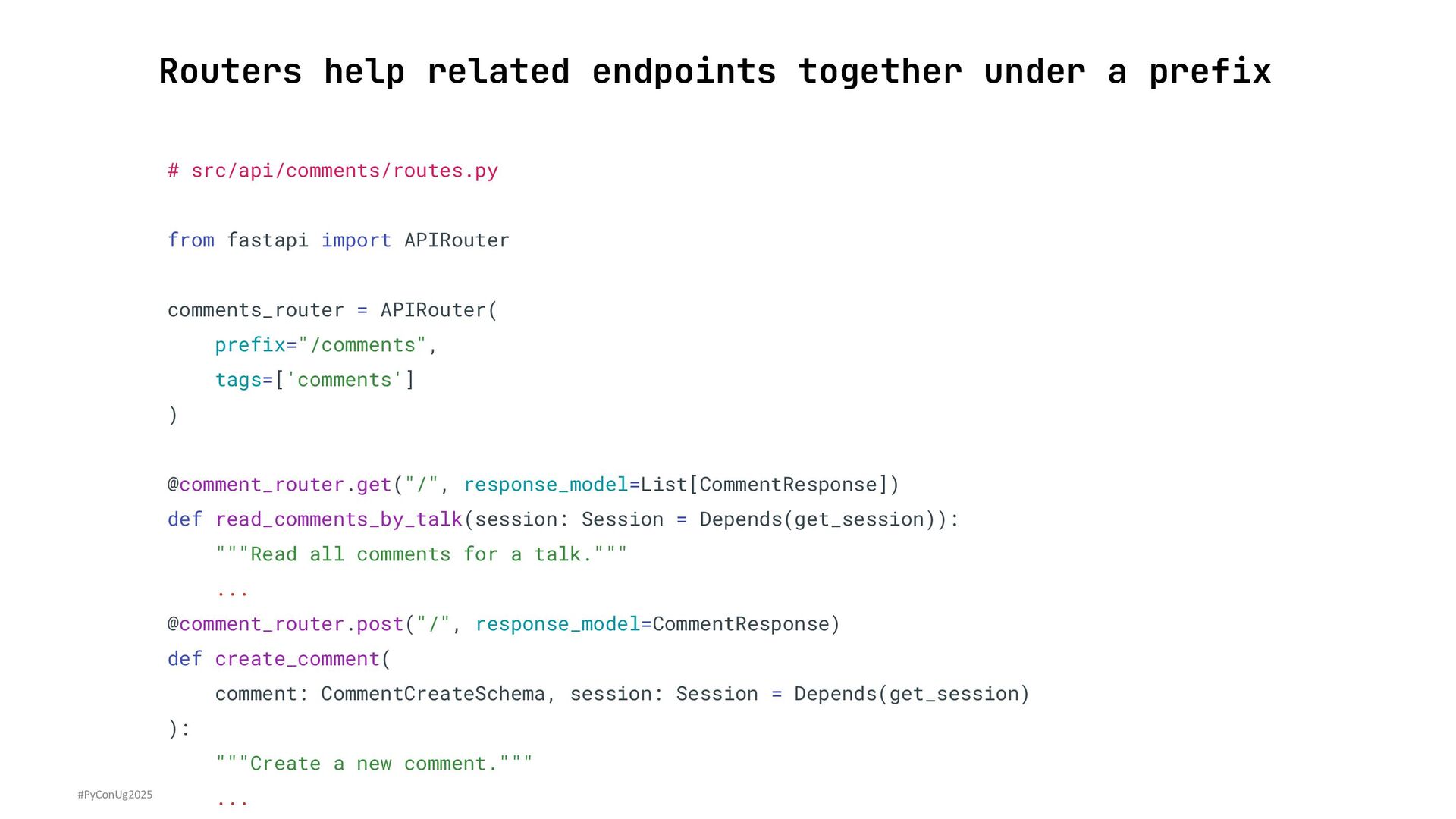
Routers help related endpoints together under a prefix # src/api/comments/routes.py
from fastapi import APIRouter comments_router = APIRouter( prefix="/comments", tags=['comments'] ) @comment_router.get("/", response_model=List[CommentResponse]) def read_comments_by_talk(session: Session = Depends(get_session)): """Read all comments for a talk.""" ... @comment_router.post("/", response_model=CommentResponse) def create_comment( comment: CommentCreateSchema, session: Session = Depends(get_session) ): """Create a new comment.""" ... #PyConUg2025 -
Register Routers # src/__init__.py from api.comments.routes import comment_router from api.auth.routes
import auth_router app = FastAPI( title="LiveTalk API V1", description="A simple REST API built for a talk at Pycon Uganda 2025" ) app.include_router(router=comment_router) app.include_router(router=auth_router) #PyConUg2025 -
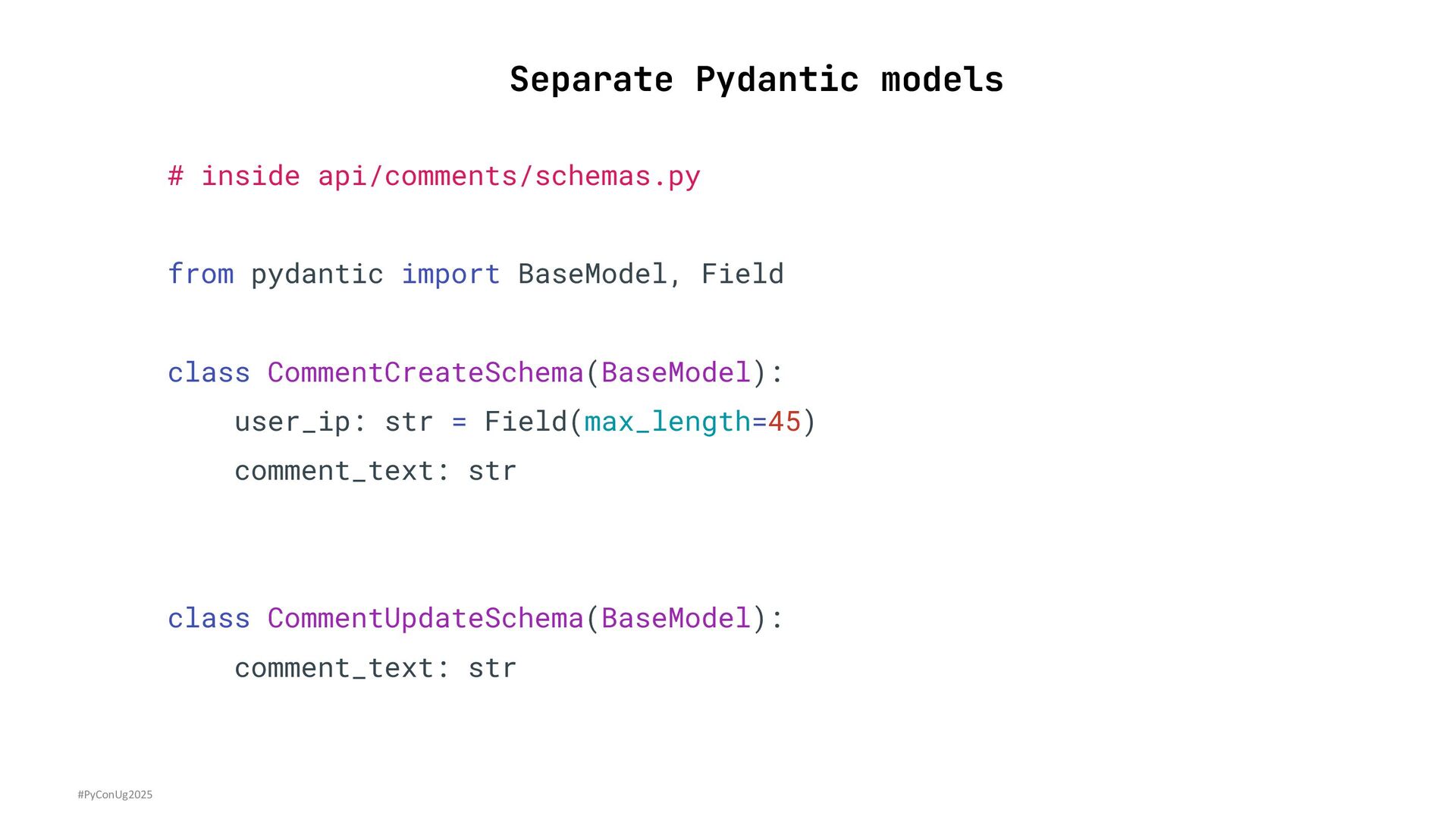
Separate Pydantic models # inside api/comments/schemas.py from pydantic import BaseModel,
Field class CommentCreateSchema(BaseModel): user_ip: str = Field(max_length=45) comment_text: str class CommentUpdateSchema(BaseModel): comment_text: str #PyConUg2025 -
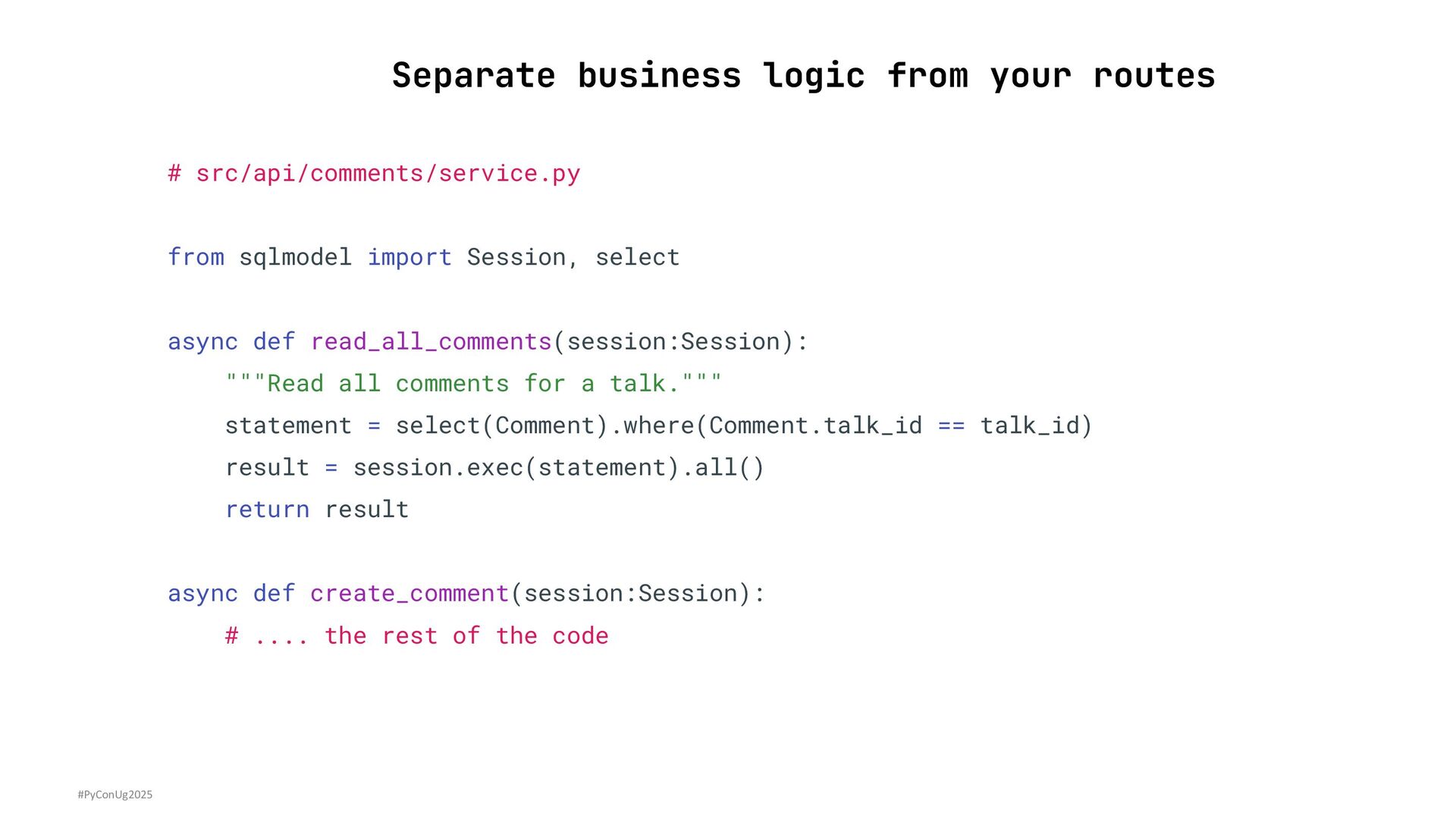
Separate business logic from your routes # src/api/comments/service.py from sqlmodel
import Session, select async def read_all_comments(session:Session): """Read all comments for a talk.""" statement = select(Comment).where(Comment.talk_id == talk_id) result = session.exec(statement).all() return result async def create_comment(session:Session): # .... the rest of the code #PyConUg2025 -
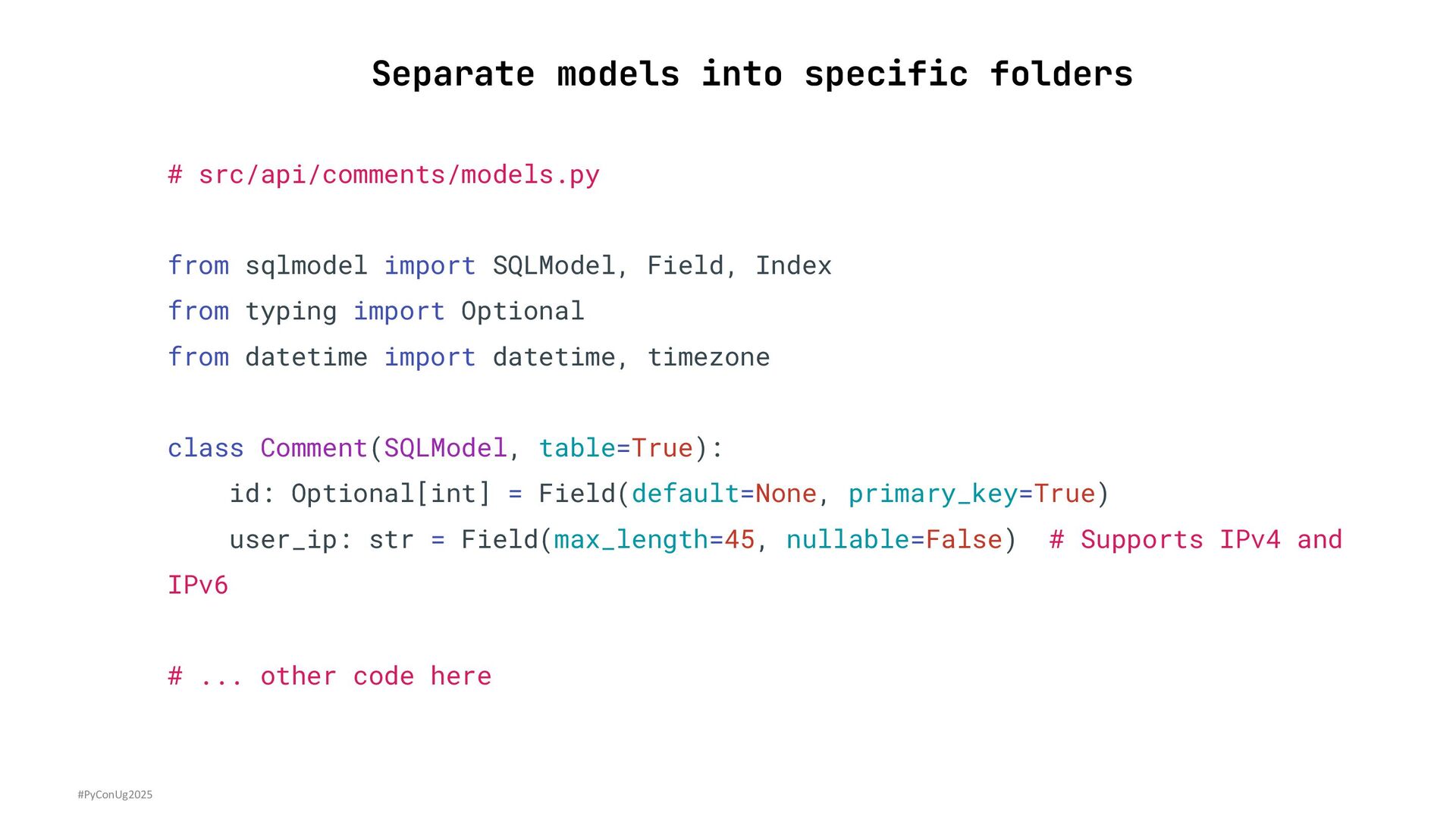
Separate models into specific folders # src/api/comments/models.py from sqlmodel import
SQLModel, Field, Index from typing import Optional from datetime import datetime, timezone class Comment(SQLModel, table=True): id: Optional[int] = Field(default=None, primary_key=True) user_ip: str = Field(max_length=45, nullable=False) # Supports IPv4 and IPv6 # ... other code here #PyConUg2025 -
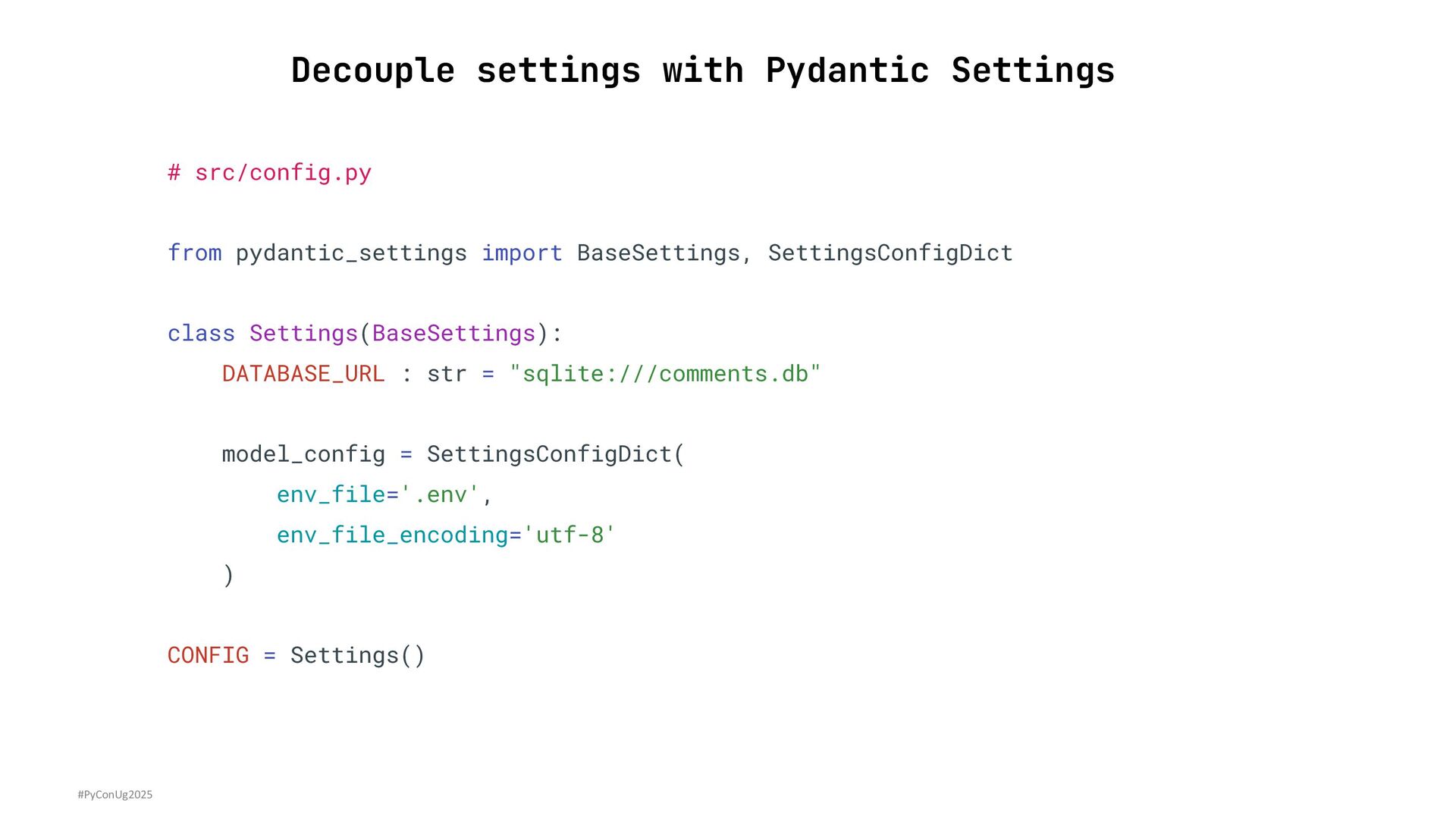
Decouple settings with Pydantic Settings # src/config.py from pydantic_settings import
BaseSettings, SettingsConfigDict class Settings(BaseSettings): DATABASE_URL : str = "sqlite:///comments.db" model_config = SettingsConfigDict( env_file='.env', env_file_encoding='utf-8' ) CONFIG = Settings() #PyConUg2025 -
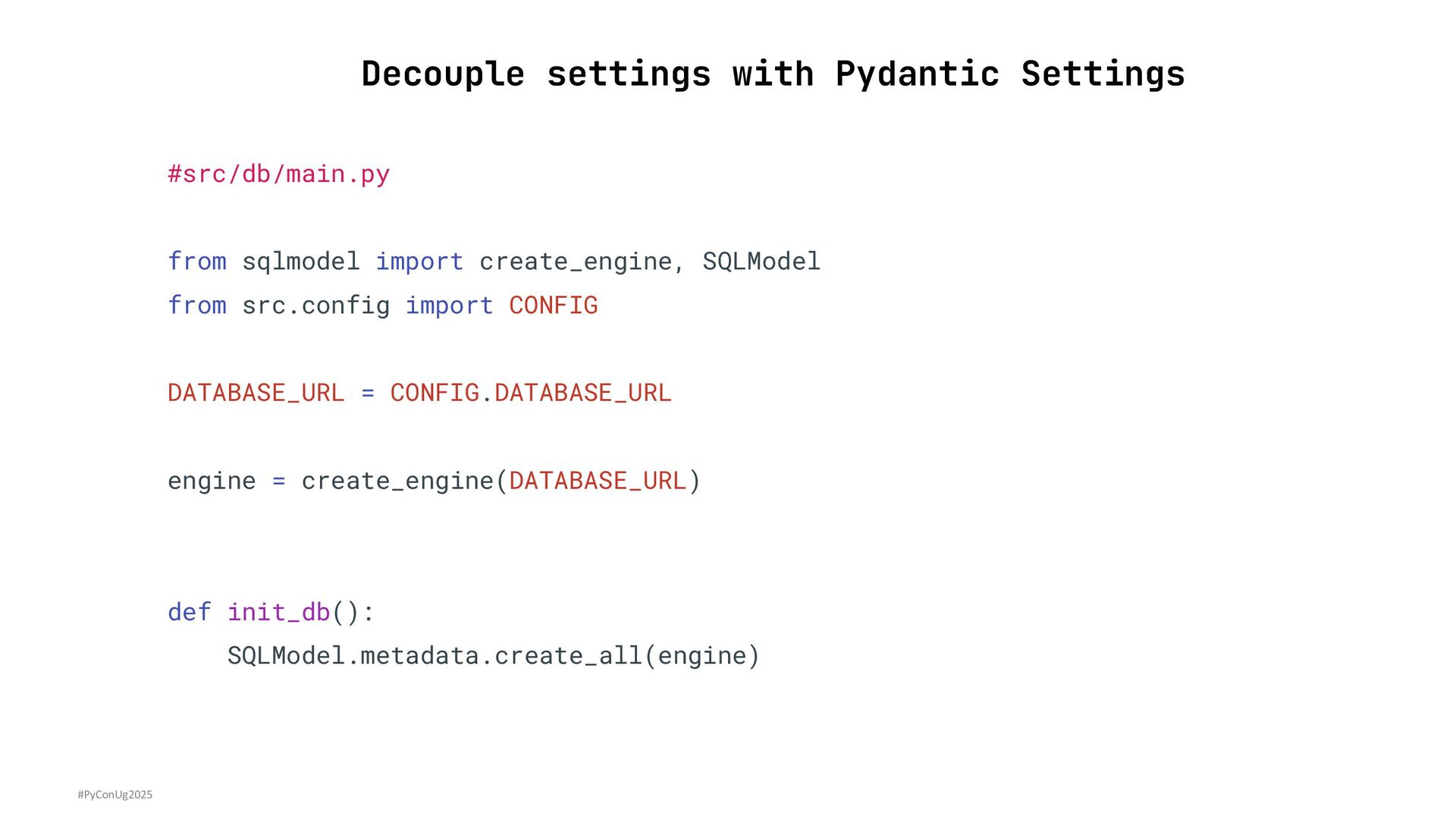
Decouple settings with Pydantic Settings #src/db/main.py from sqlmodel import create_engine,
SQLModel from src.config import CONFIG DATABASE_URL = CONFIG.DATABASE_URL engine = create_engine(DATABASE_URL) def init_db(): SQLModel.metadata.create_all(engine) #PyConUg2025 -
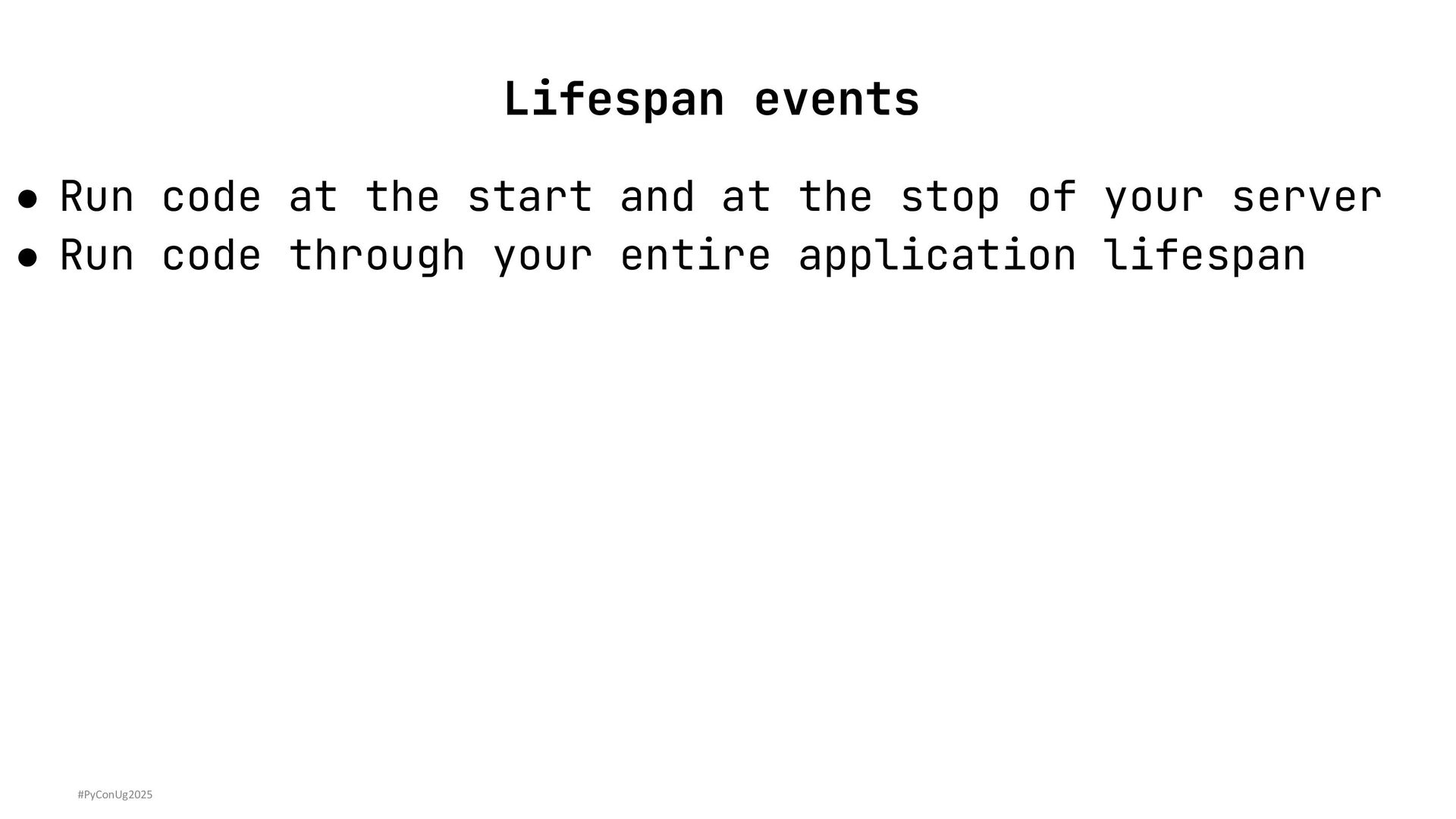
Lifespan events #PyConUg2025 • Run code at the start and
at the stop of your server • Run code through your entire application lifespan -
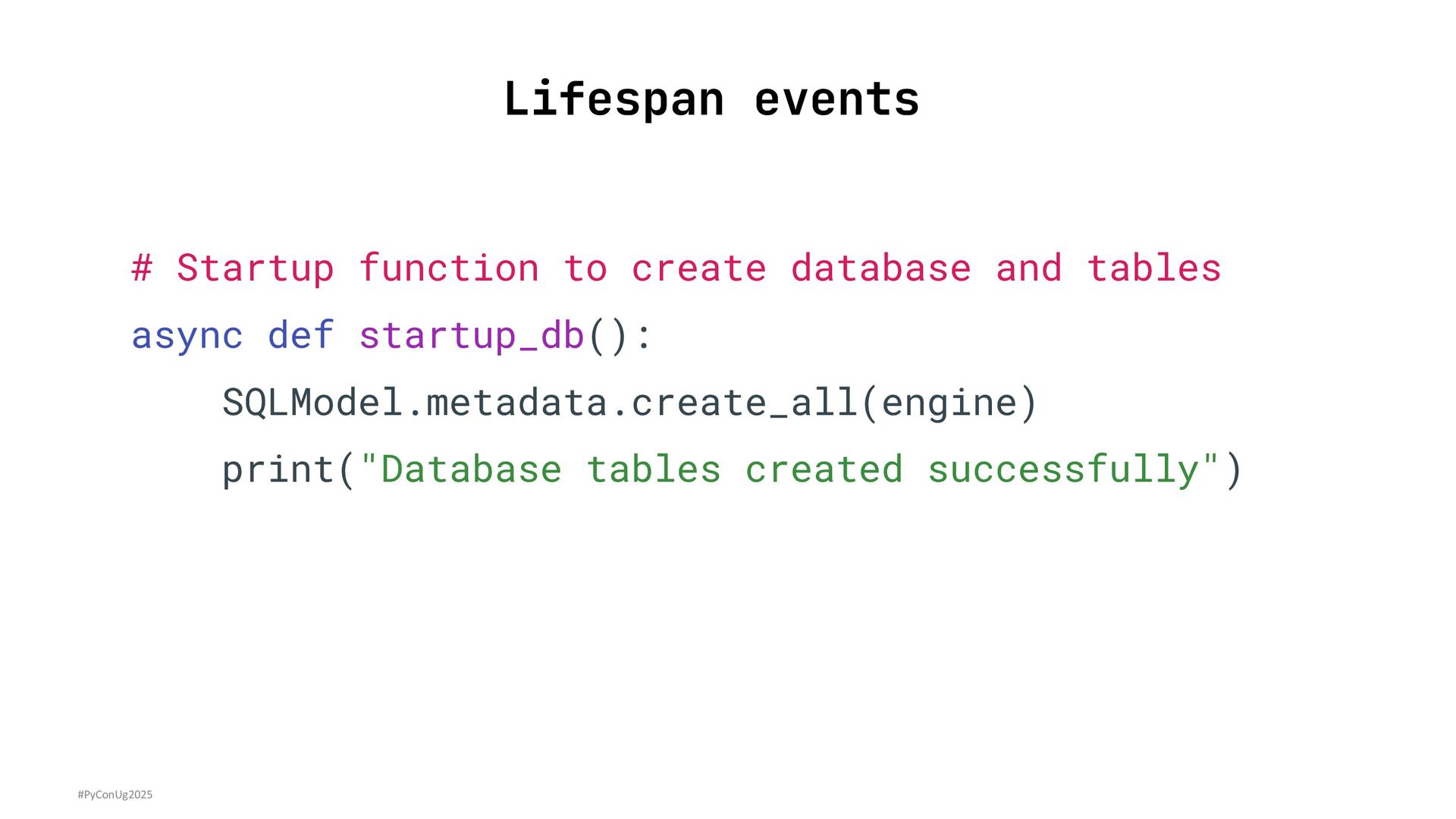
Lifespan events #PyConUg2025 # Startup function to create database and
tables async def startup_db(): SQLModel.metadata.create_all(engine) print("Database tables created successfully") -
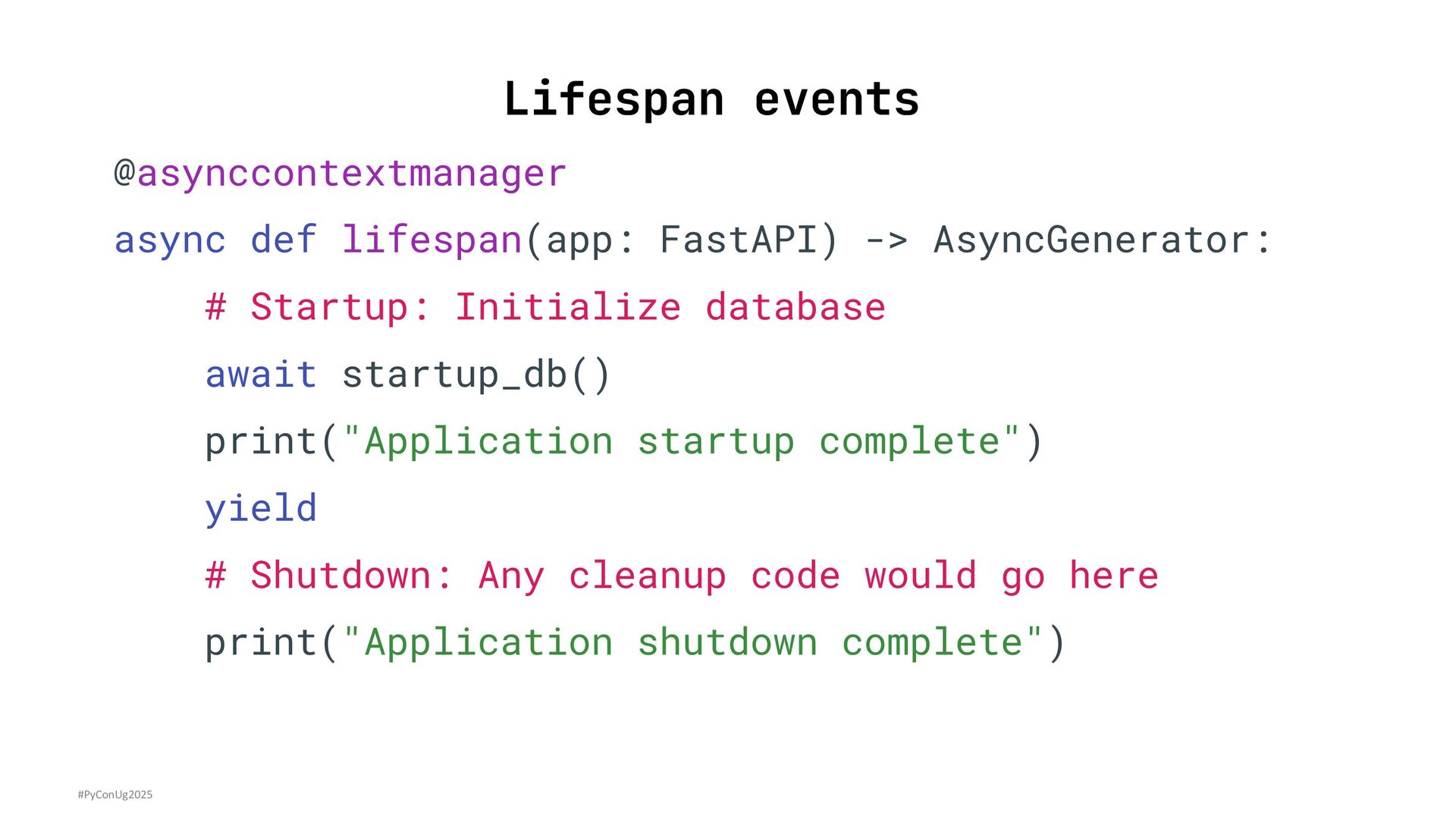
Lifespan events #PyConUg2025 @asynccontextmanager async def lifespan(app: FastAPI) -> AsyncGenerator:
# Startup: Initialize database await startup_db() print("Application startup complete") yield # Shutdown: Any cleanup code would go here print("Application shutdown complete") -
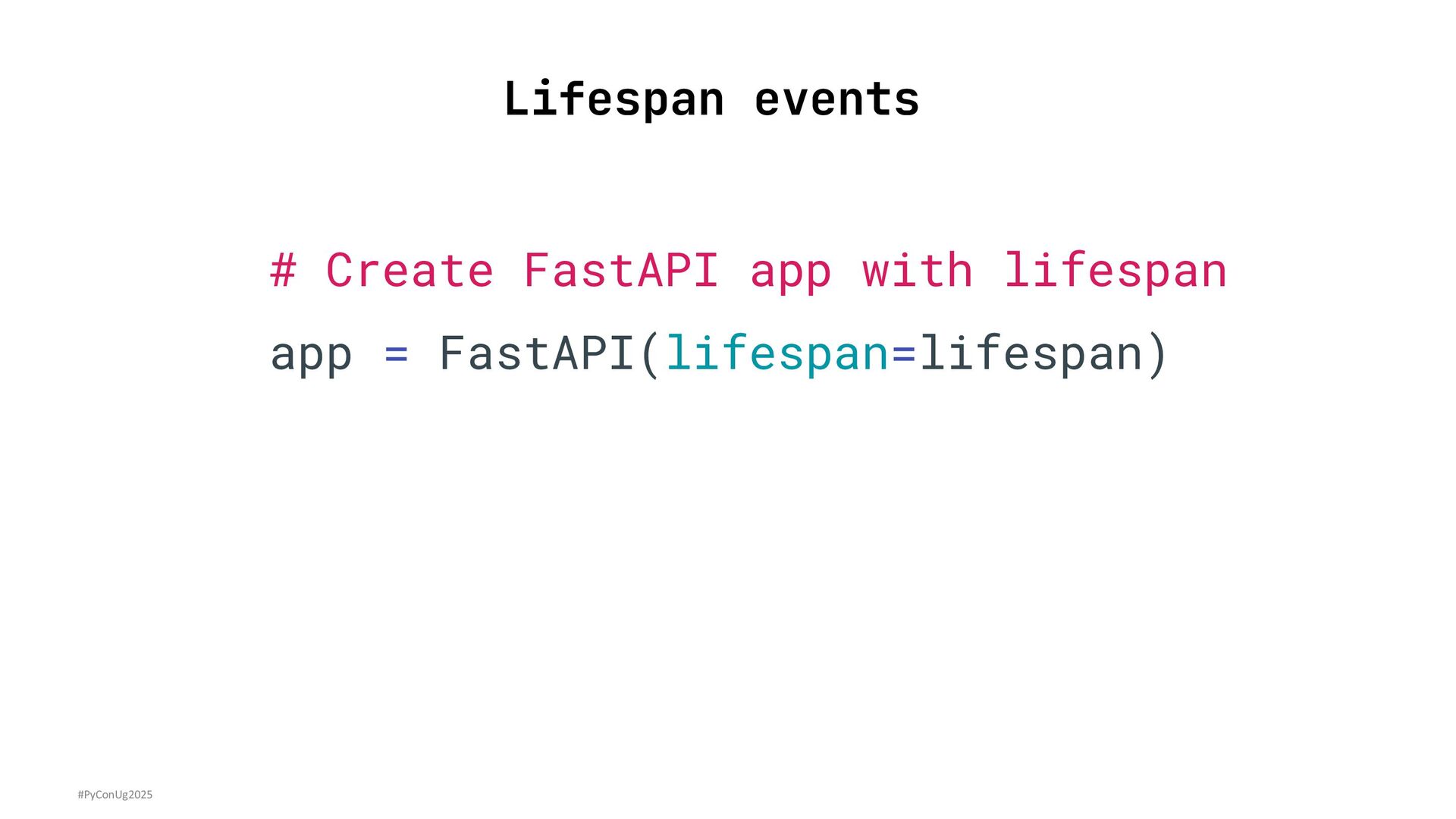
Lifespan events #PyConUg2025 # Create FastAPI app with lifespan app
= FastAPI(lifespan=lifespan) -
Dependency Injection (DI) Dependency injection is a technique where an
object gets its dependencies from external code, making programs loosely coupled and easier to manage. #PyConUg2025 -
Dependency Injection (DI) • Use Case: Manage users with a
database connection and token-based authentication • Benefits: ◦ Decouples logic from resources ◦ Ensures cleanup with generators ◦ Reusable and testable • Example: Inject database session #PyConUg2025 -
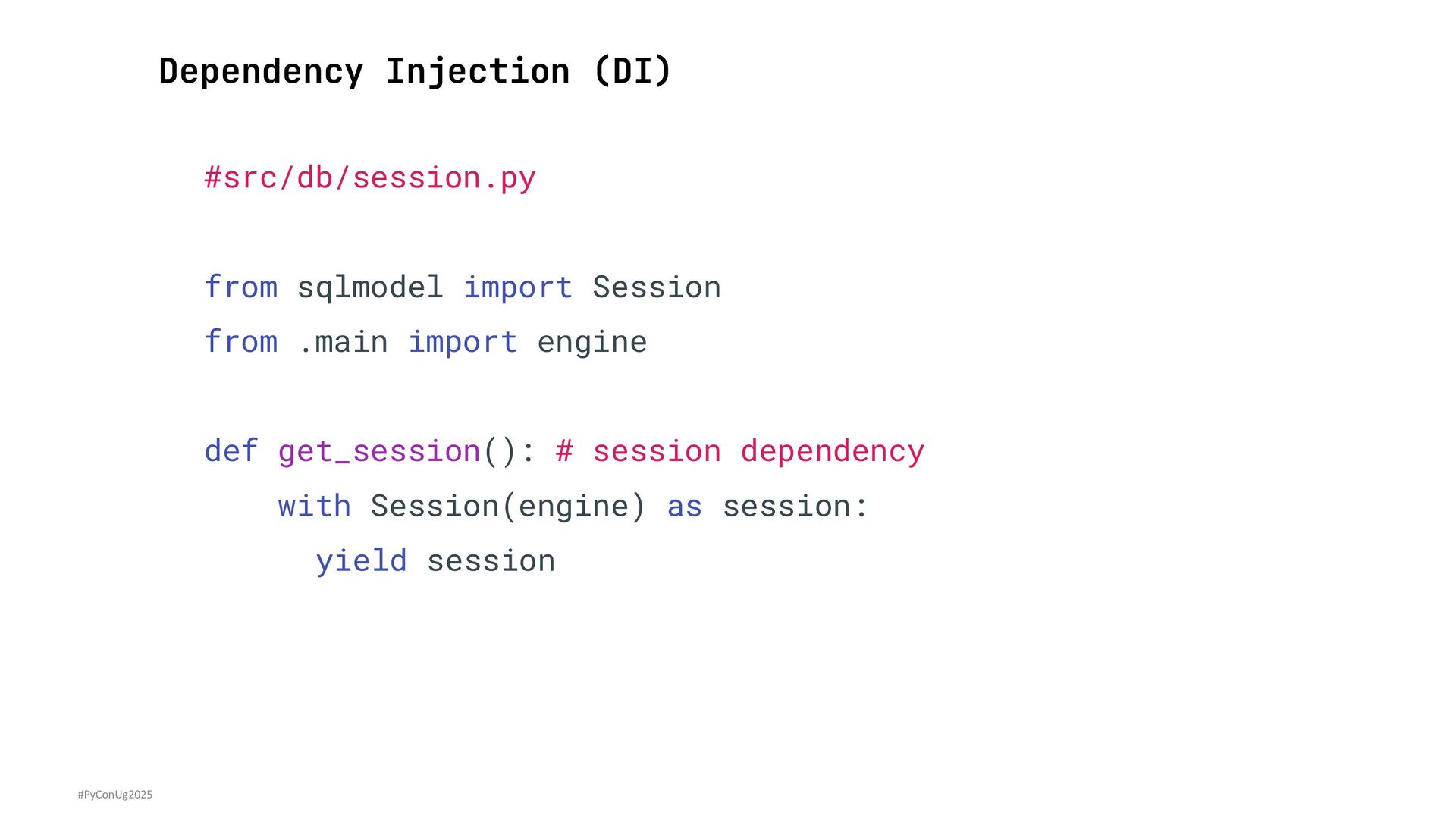
Dependency Injection (DI) #src/db/session.py from sqlmodel import Session from .main
import engine def get_session(): # session dependency with Session(engine) as session: yield session #PyConUg2025 -
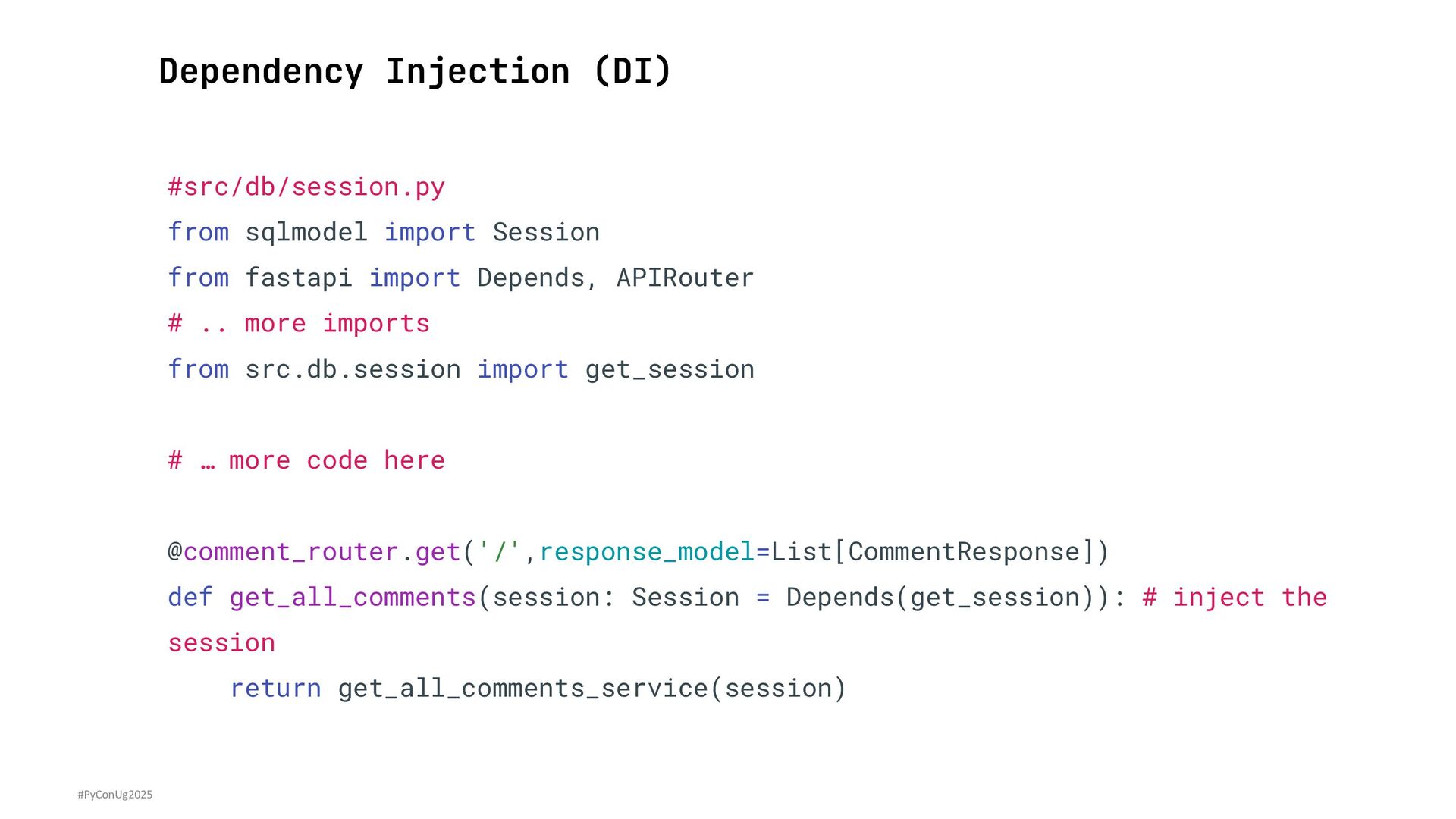
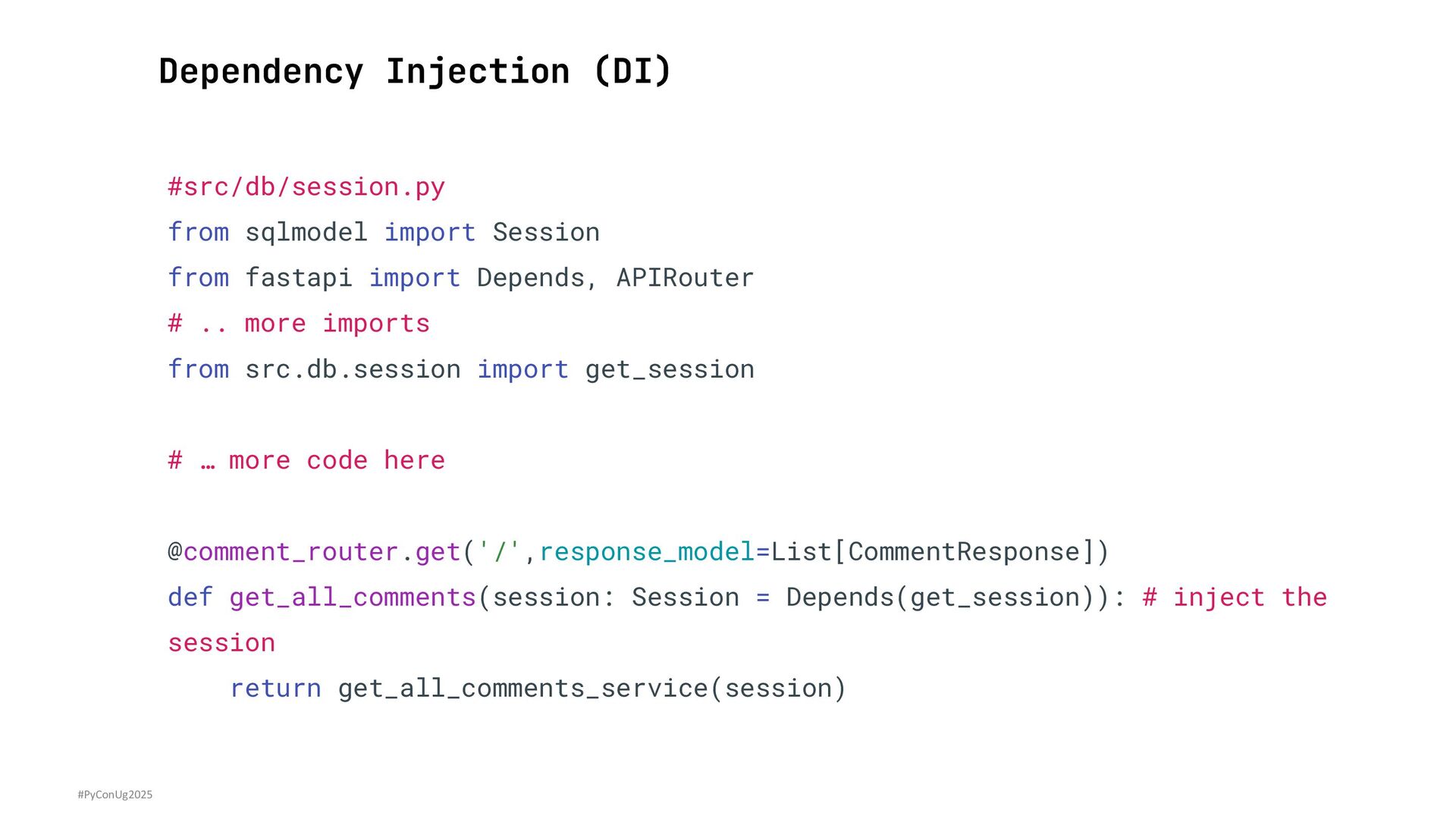
Dependency Injection (DI) #src/db/session.py from sqlmodel import Session from fastapi
import Depends, APIRouter # .. more imports from src.db.session import get_session # … more code here @comment_router.get('/',response_model=List[CommentResponse]) def get_all_comments(session: Session = Depends(get_session)): # inject the session return get_all_comments_service(session) #PyConUg2025 -
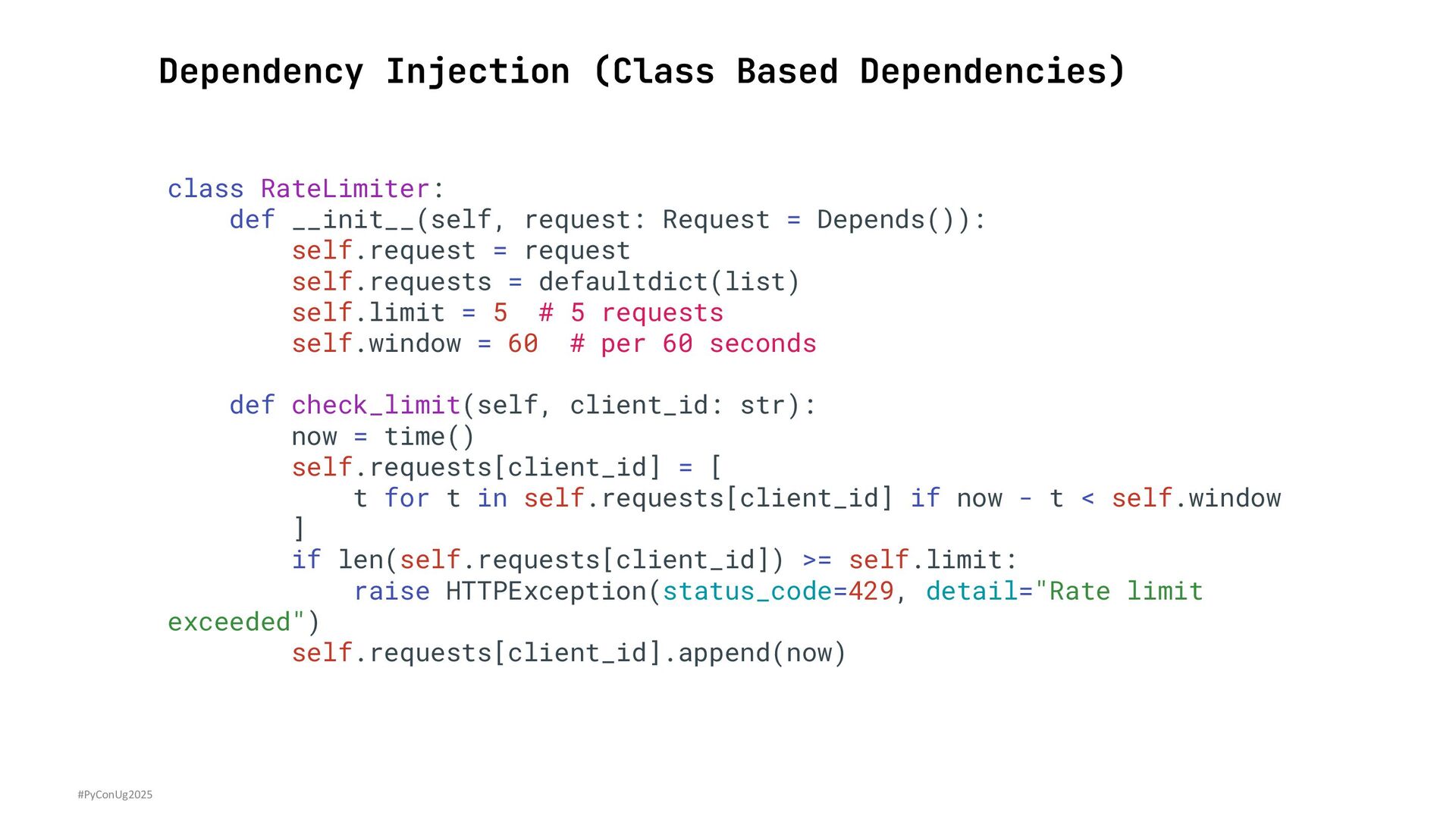
Dependency Injection (Class Based Dependencies) #PyConUg2025 class RateLimiter: def __init__(self,
request: Request = Depends()): self.request = request self.requests = defaultdict(list) self.limit = 5 # 5 requests self.window = 60 # per 60 seconds def check_limit(self, client_id: str): now = time() self.requests[client_id] = [ t for t in self.requests[client_id] if now - t < self.window ] if len(self.requests[client_id]) >= self.limit: raise HTTPException(status_code=429, detail="Rate limit exceeded") self.requests[client_id].append(now) -
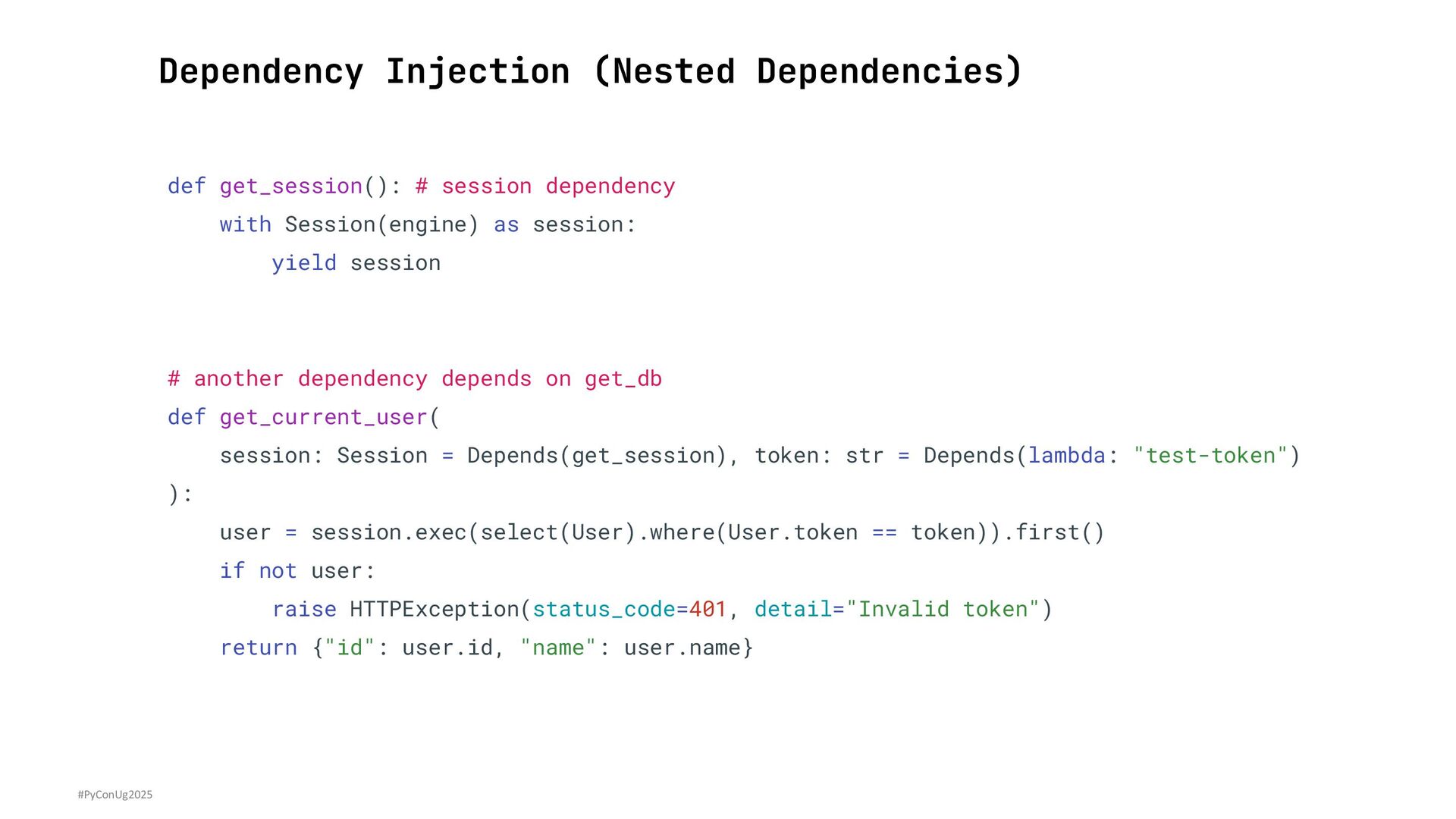
Dependency Injection (Nested Dependencies) #PyConUg2025 def get_session(): # session dependency
with Session(engine) as session: yield session # another dependency depends on get_db def get_current_user( session: Session = Depends(get_session), token: str = Depends(lambda: "test-token") ): user = session.exec(select(User).where(User.token == token)).first() if not user: raise HTTPException(status_code=401, detail="Invalid token") return {"id": user.id, "name": user.name} -
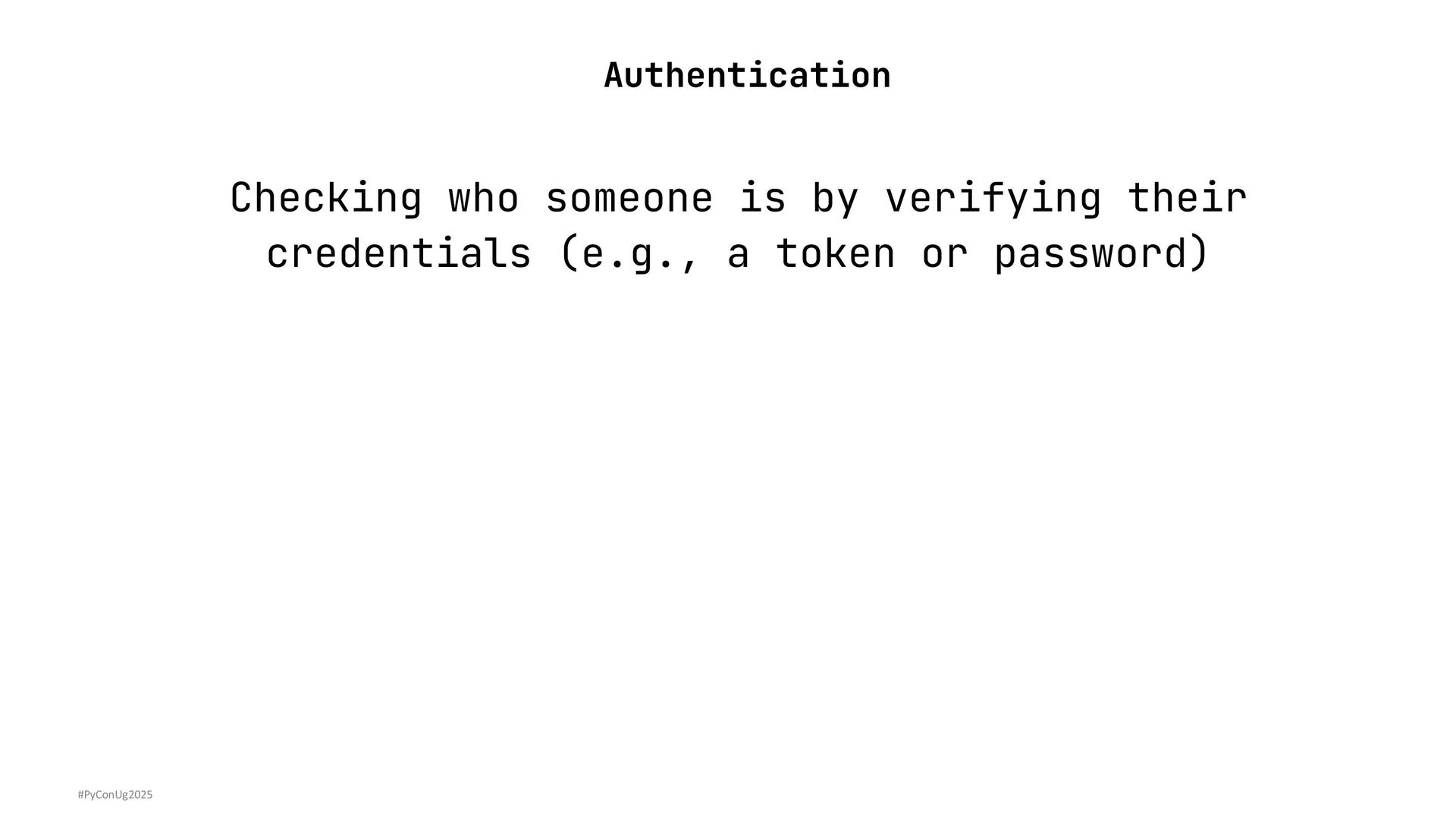
Authentication #PyConUg2025 Checking who someone is by verifying their credentials
(e.g., a token or password) -
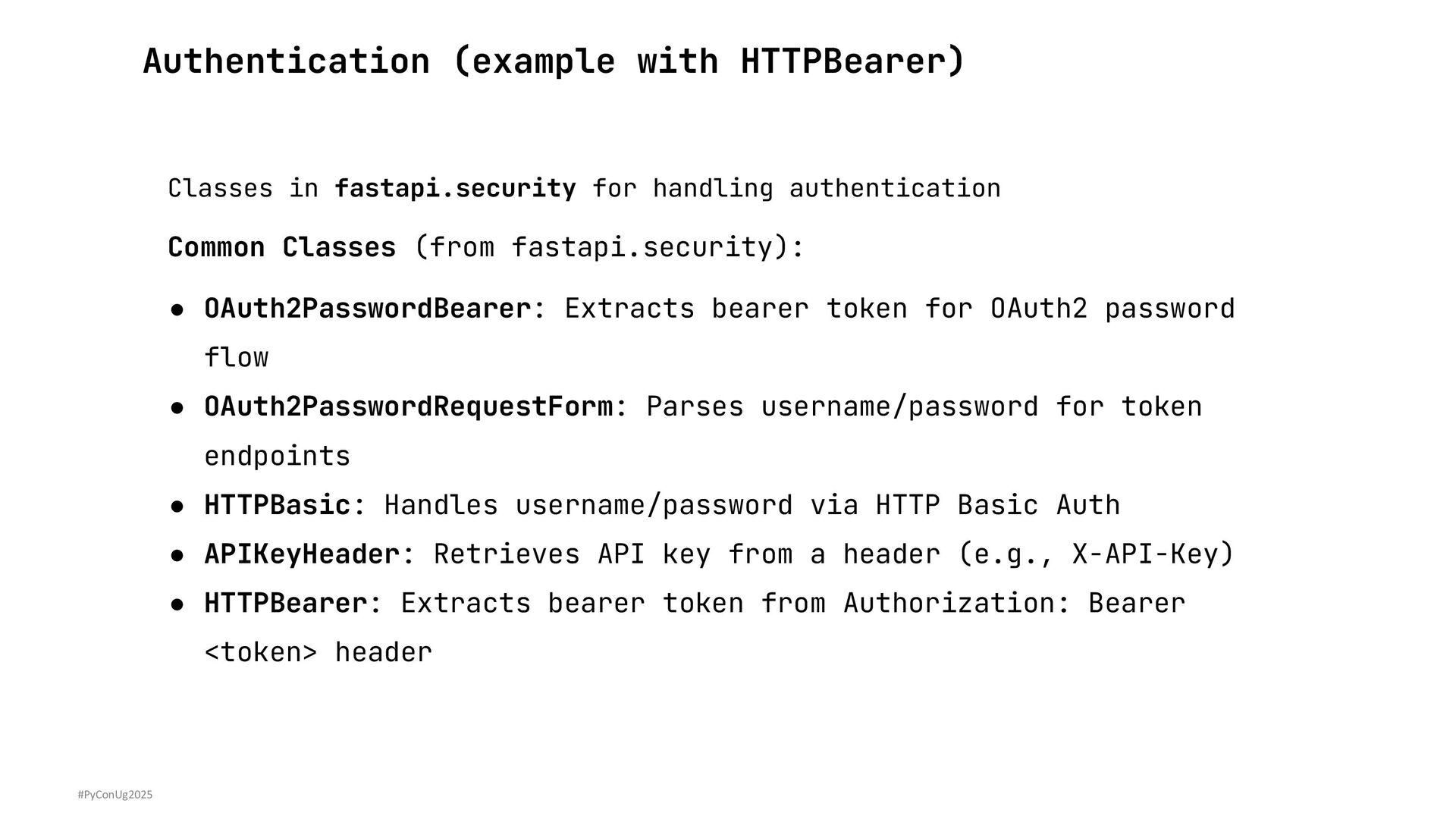
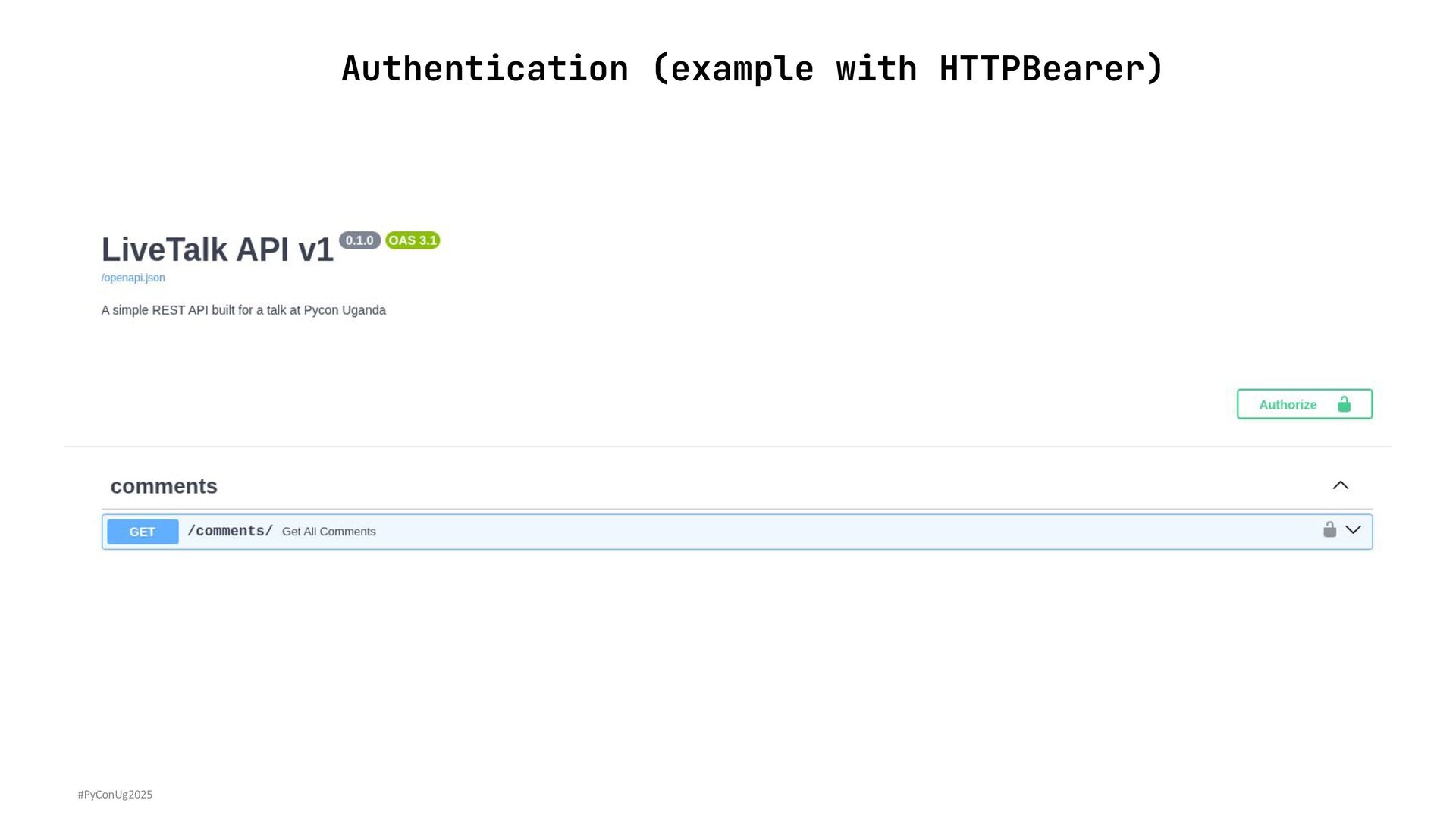
Authentication (example with HTTPBearer) #PyConUg2025 Classes in fastapi.security for handling
authentication Common Classes (from fastapi.security): • OAuth2PasswordBearer: Extracts bearer token for OAuth2 password flow • OAuth2PasswordRequestForm: Parses username/password for token endpoints • HTTPBasic: Handles username/password via HTTP Basic Auth • APIKeyHeader: Retrieves API key from a header (e.g., X-API-Key) • HTTPBearer: Extracts bearer token from Authorization: Bearer <token> header -
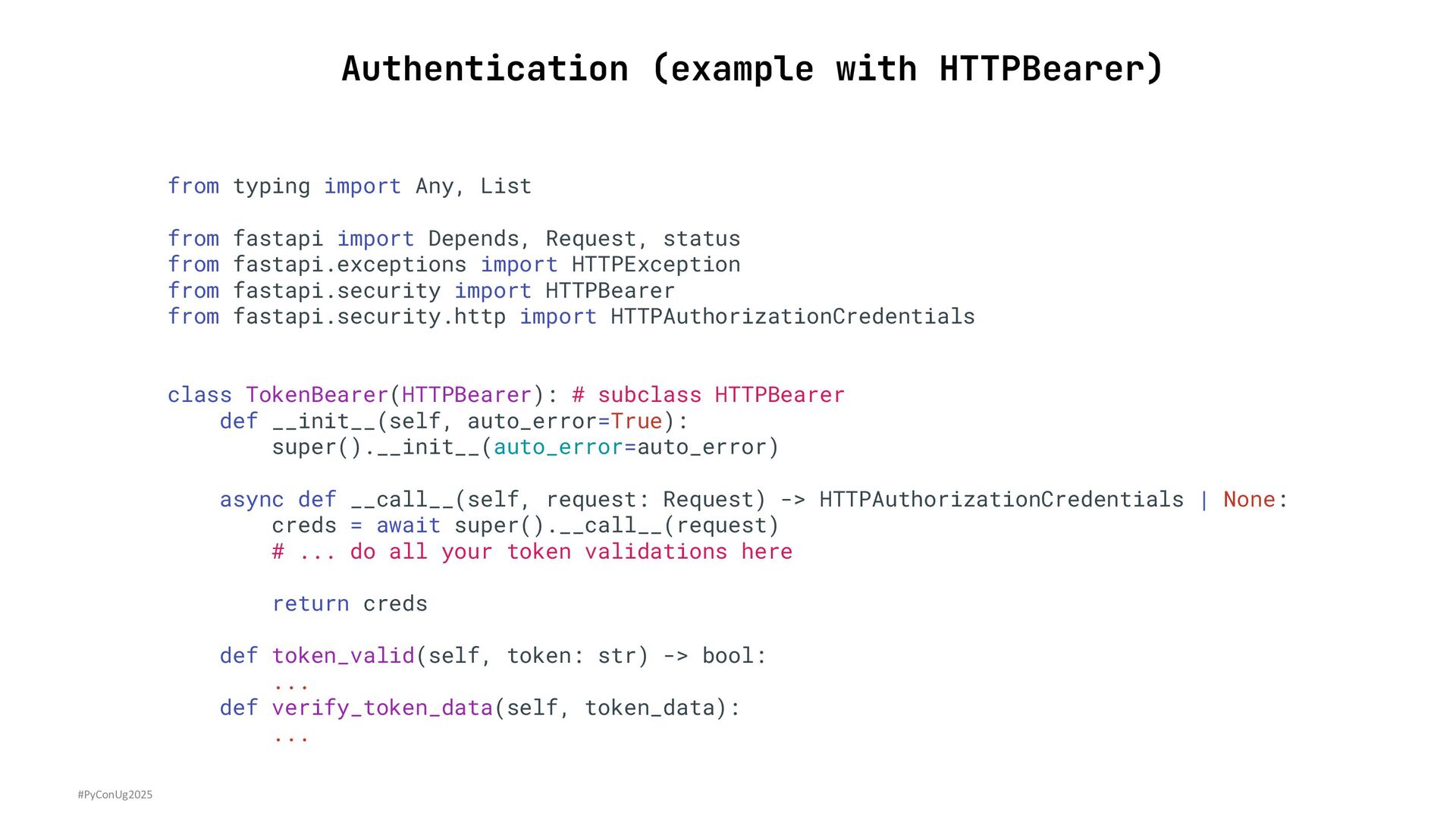
Authentication (example with HTTPBearer) #PyConUg2025 from typing import Any, List
from fastapi import Depends, Request, status from fastapi.exceptions import HTTPException from fastapi.security import HTTPBearer from fastapi.security.http import HTTPAuthorizationCredentials class TokenBearer(HTTPBearer): # subclass HTTPBearer def __init__(self, auto_error=True): super().__init__(auto_error=auto_error) async def __call__(self, request: Request) -> HTTPAuthorizationCredentials | None: creds = await super().__call__(request) # ... do all your token validations here return creds def token_valid(self, token: str) -> bool: ... def verify_token_data(self, token_data): ... -
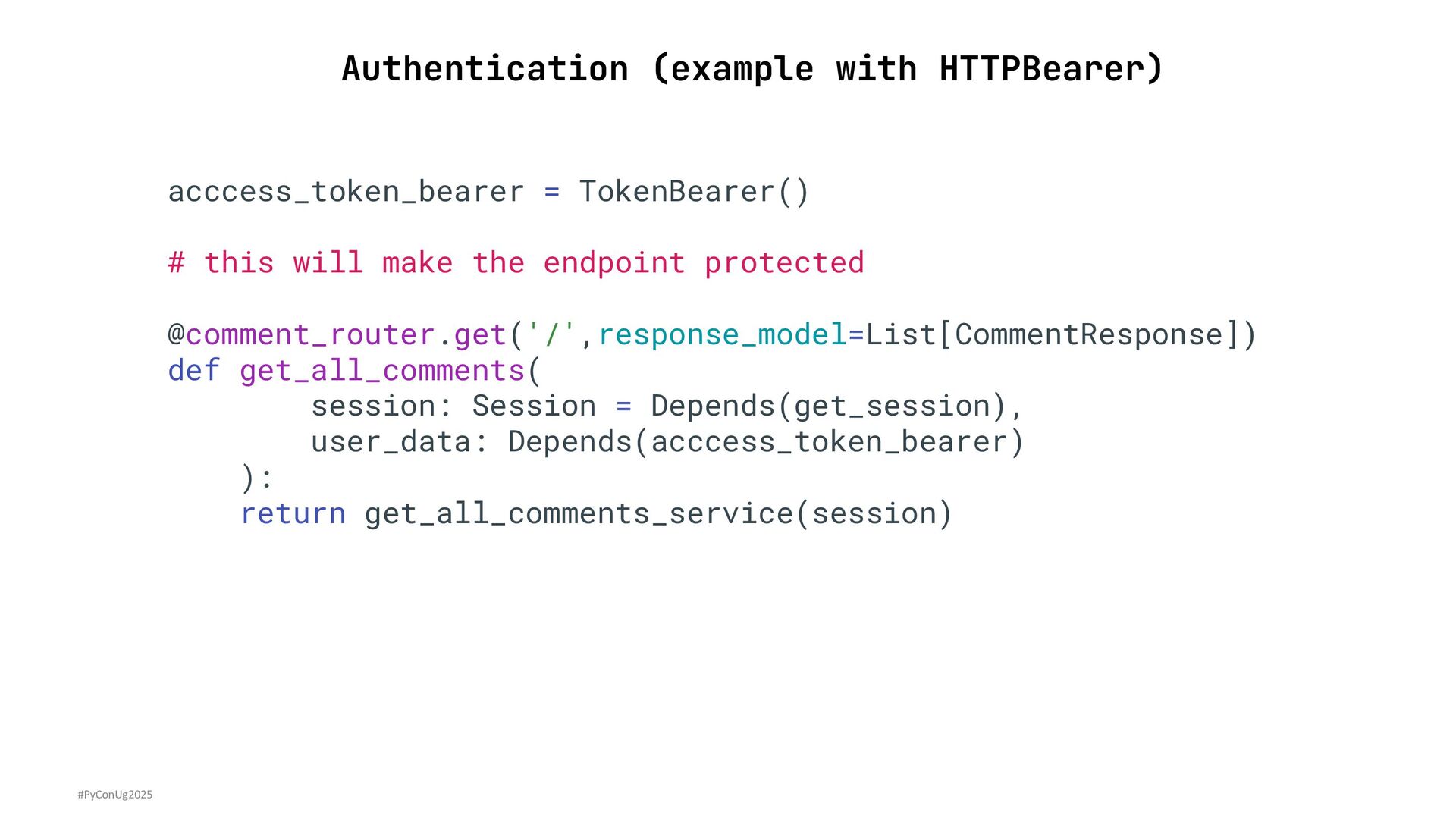
Authentication (example with HTTPBearer) #PyConUg2025 acccess_token_bearer = TokenBearer() # this
will make the endpoint protected @comment_router.get('/',response_model=List[CommentResponse]) def get_all_comments( session: Session = Depends(get_session), user_data: Depends(acccess_token_bearer) ): return get_all_comments_service(session) -
Async Routes #PyConUg2025 FastAPI is built for async I/O, enabling
high performance. -
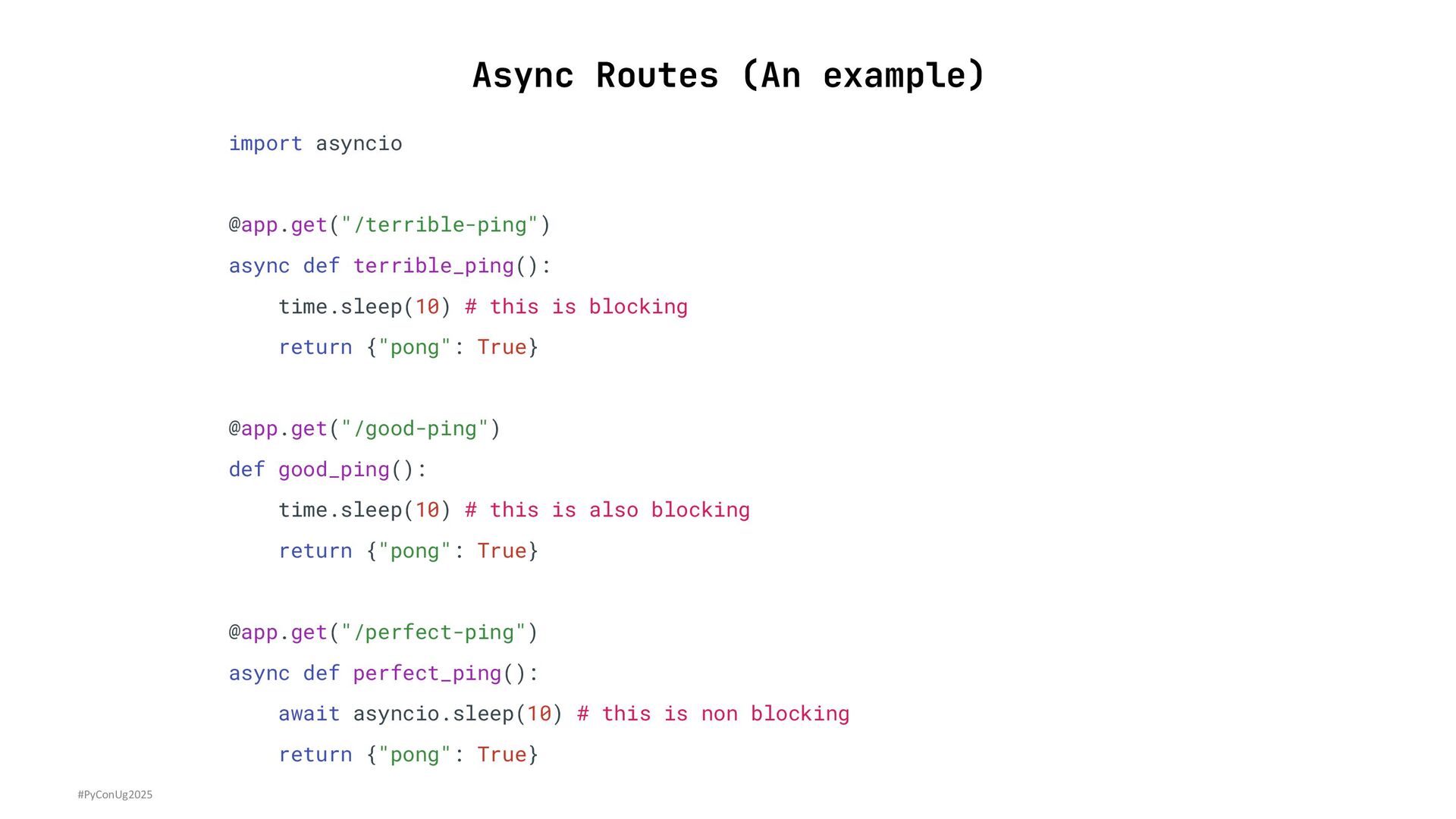
Async Routes (An example) #PyConUg2025 import asyncio @app.get("/terrible-ping") async def
terrible_ping(): time.sleep(10) # this is blocking return {"pong": True} @app.get("/good-ping") def good_ping(): time.sleep(10) # this is also blocking return {"pong": True} @app.get("/perfect-ping") async def perfect_ping(): await asyncio.sleep(10) # this is non blocking return {"pong": True} -
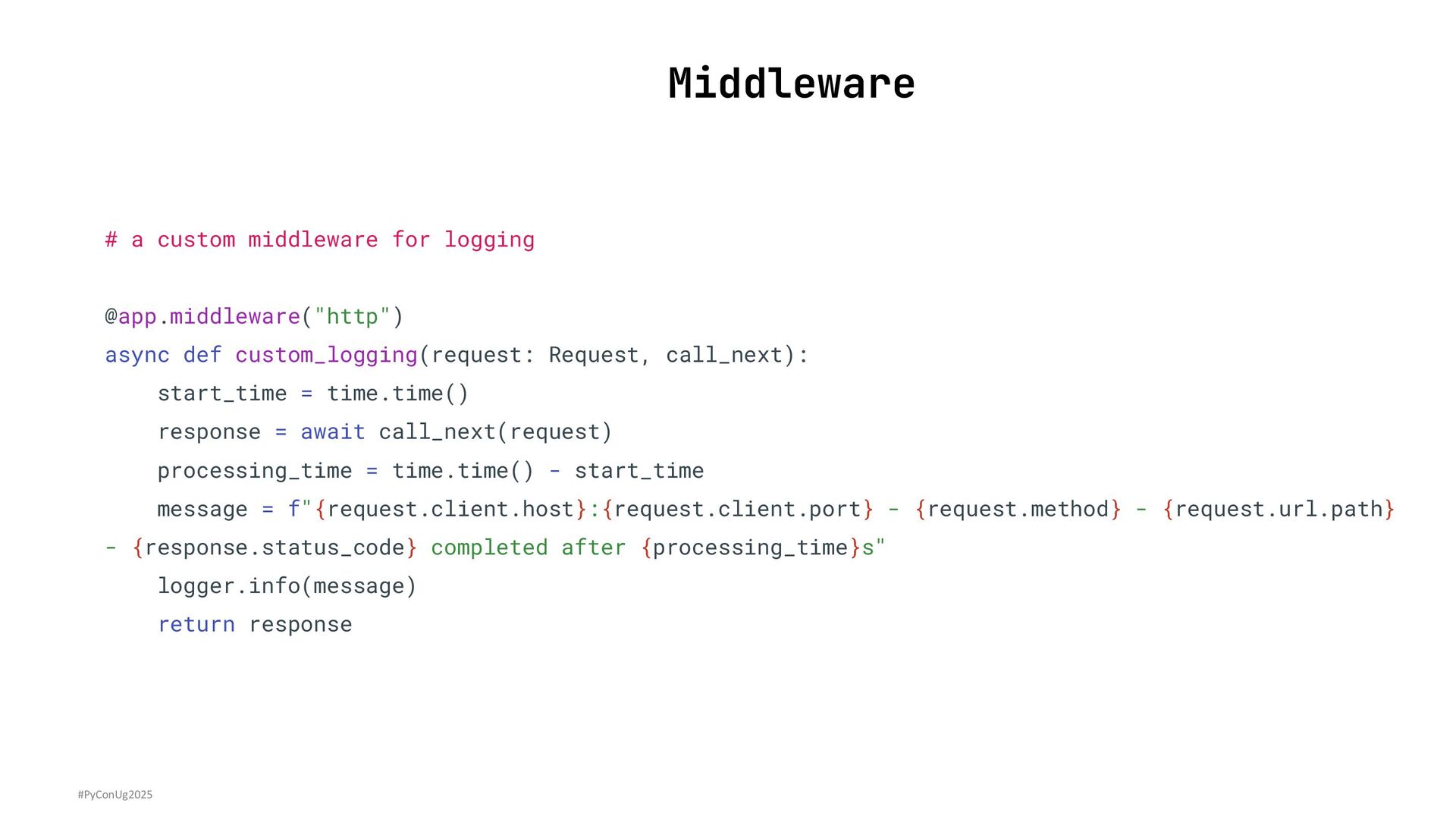
Middleware #PyConUg2025 Code that runs before/after every request to handle
cross-cutting concerns -
Middleware #PyConUg2025 # a custom middleware for logging @app.middleware("http") async
def custom_logging(request: Request, call_next): start_time = time.time() response = await call_next(request) processing_time = time.time() - start_time message = f"{request.client.host}:{request.client.port} - {request.method} - {request.url.path} - {response.status_code} completed after {processing_time}s" logger.info(message) return response -
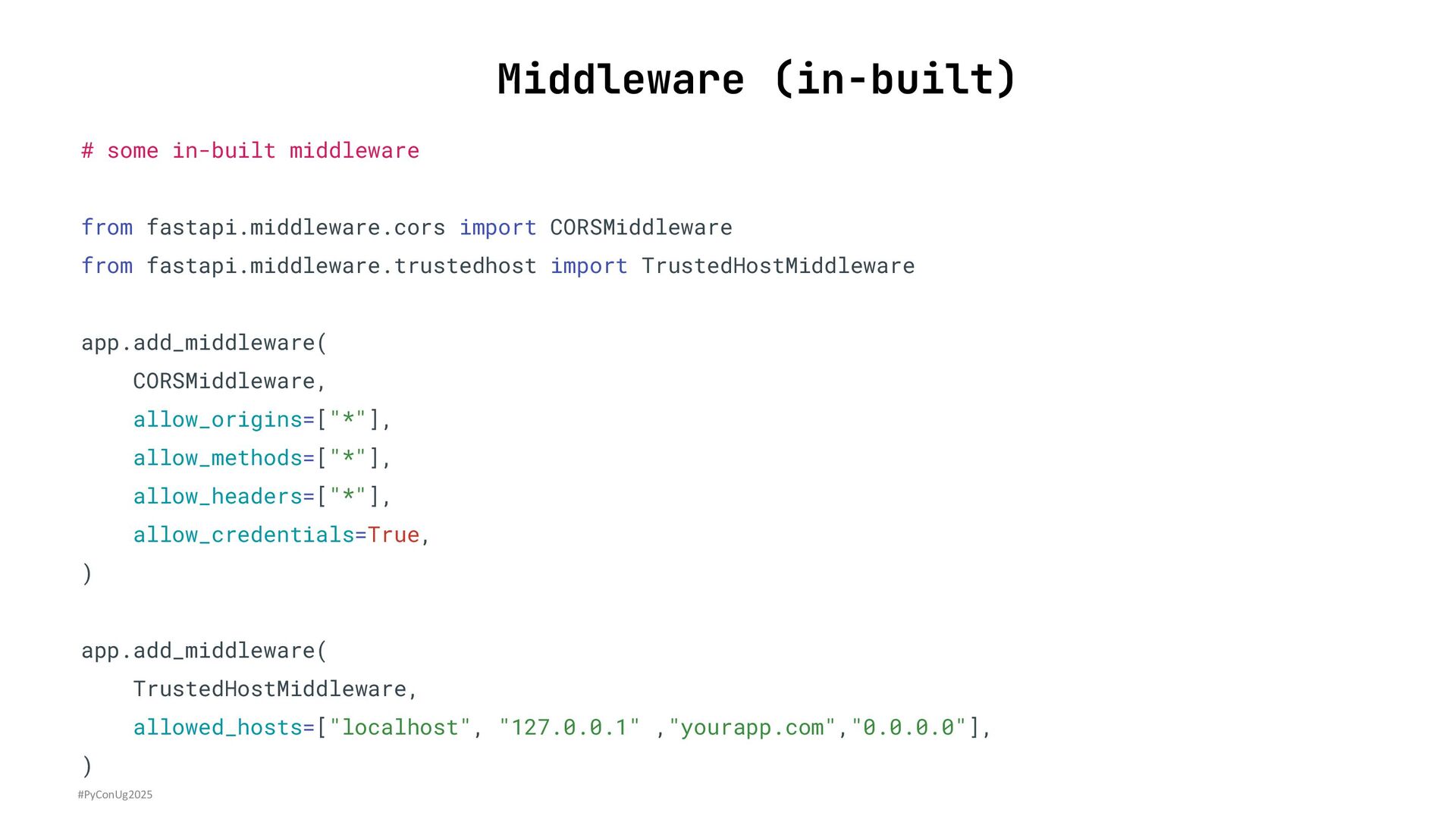
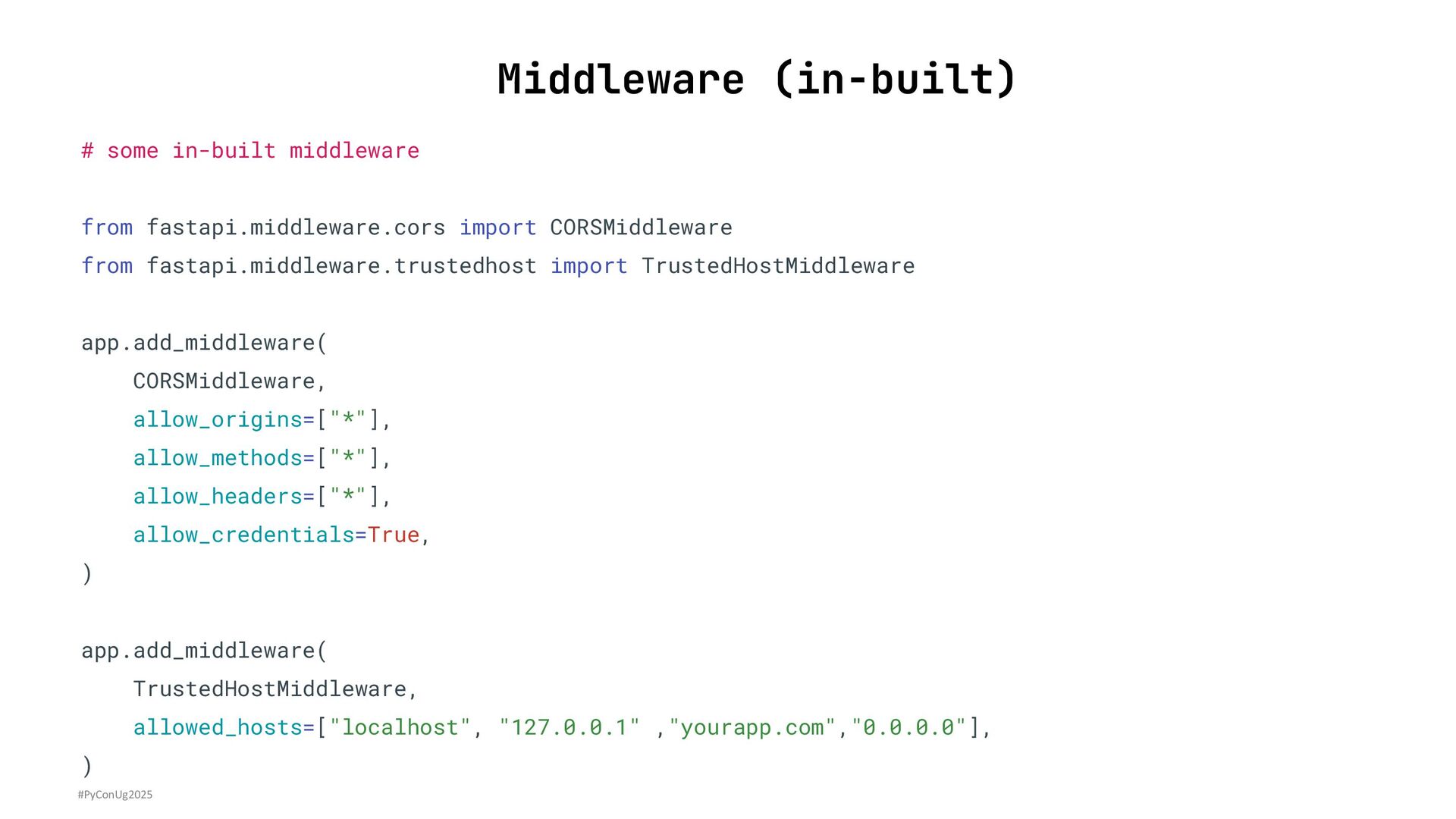
Middleware (in-built) #PyConUg2025 # some in-built middleware from fastapi.middleware.cors import
CORSMiddleware from fastapi.middleware.trustedhost import TrustedHostMiddleware app.add_middleware( CORSMiddleware, allow_origins=["*"], allow_methods=["*"], allow_headers=["*"], allow_credentials=True, ) app.add_middleware( TrustedHostMiddleware, allowed_hosts=["localhost", "127.0.0.1" ,"yourapp.com","0.0.0.0"], ) -
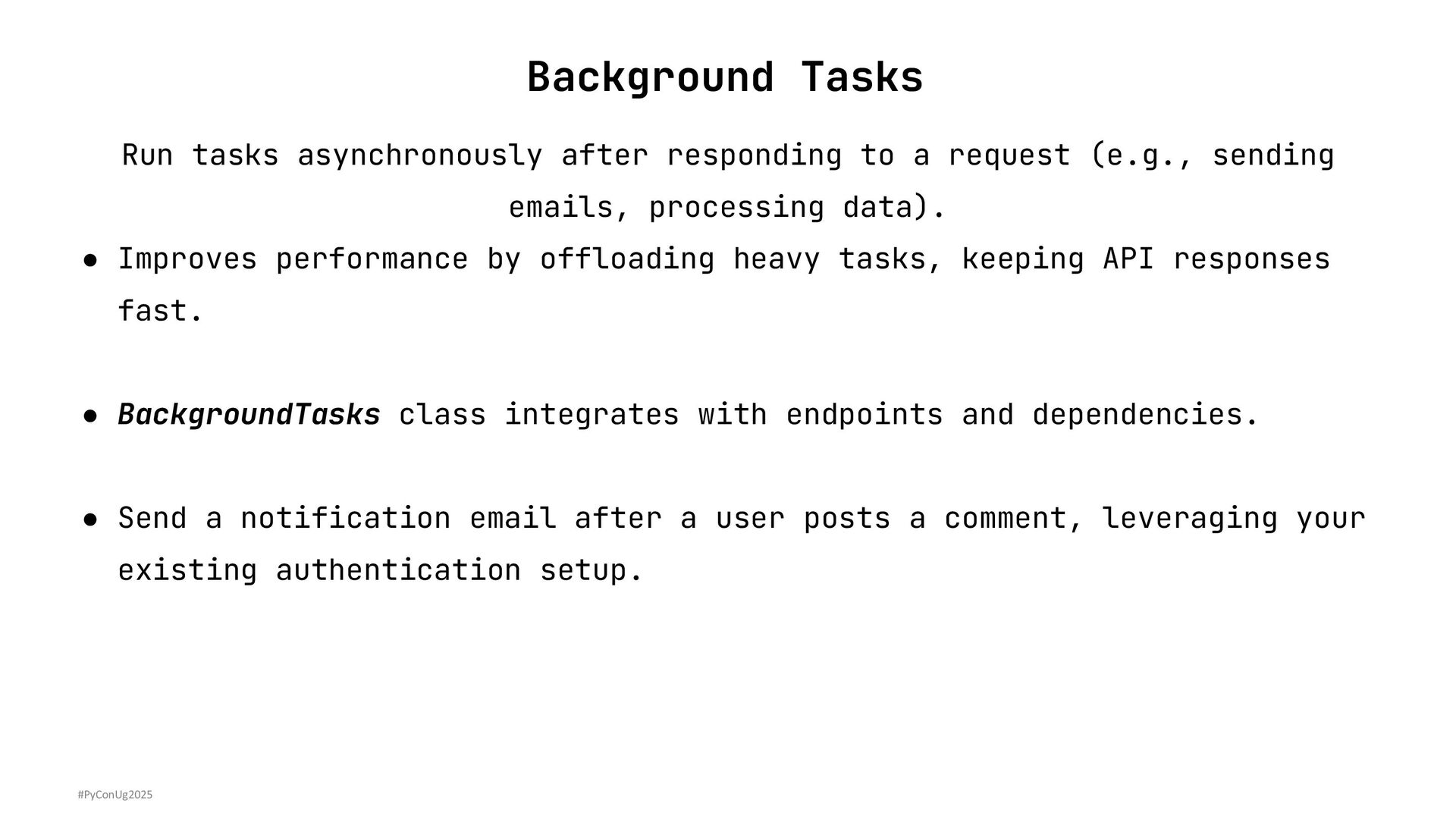
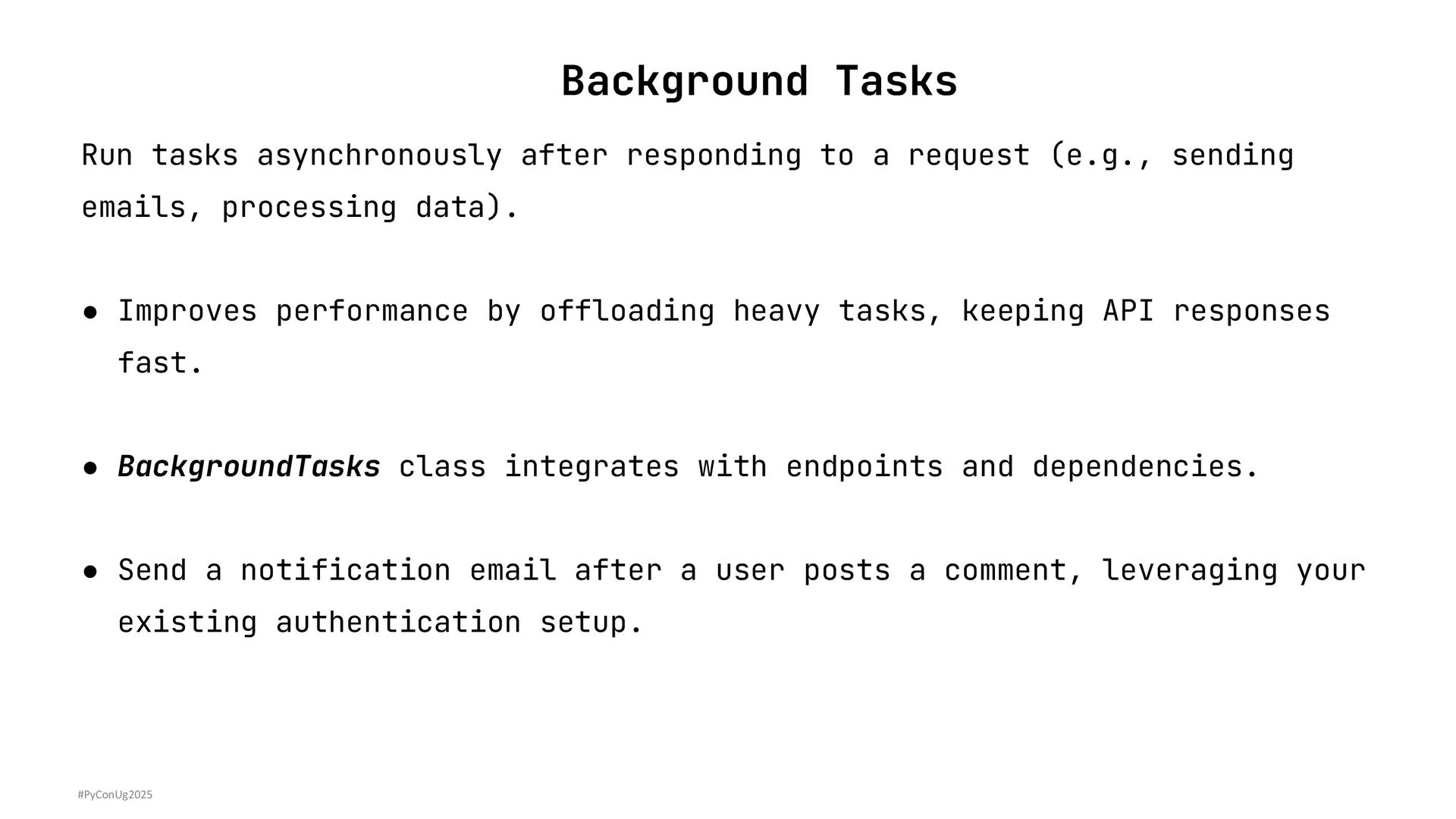
Background Tasks #PyConUg2025 Run tasks asynchronously after responding to a
request (e.g., sending emails, processing data). • Improves performance by offloading heavy tasks, keeping API responses fast. • BackgroundTasks class integrates with endpoints and dependencies. • Send a notification email after a user posts a comment, leveraging your existing authentication setup. -
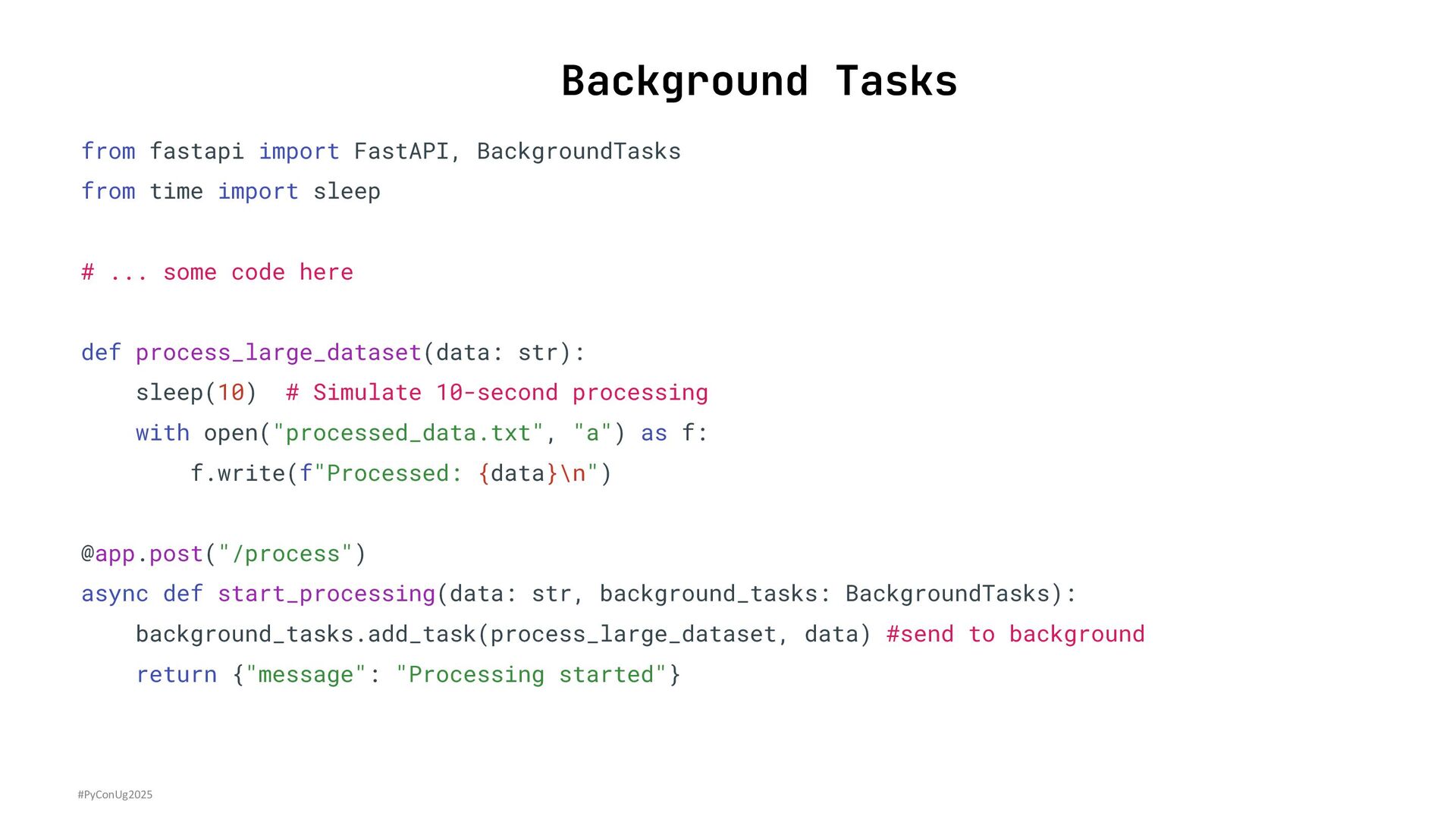
Background Tasks #PyConUg2025 from fastapi import FastAPI, BackgroundTasks from time
import sleep # ... some code here def process_large_dataset(data: str): sleep(10) # Simulate 10-second processing with open("processed_data.txt", "a") as f: f.write(f"Processed: {data}\n") @app.post("/process") async def start_processing(data: str, background_tasks: BackgroundTasks): background_tasks.add_task(process_large_dataset, data) #send to background return {"message": "Processing started"} -
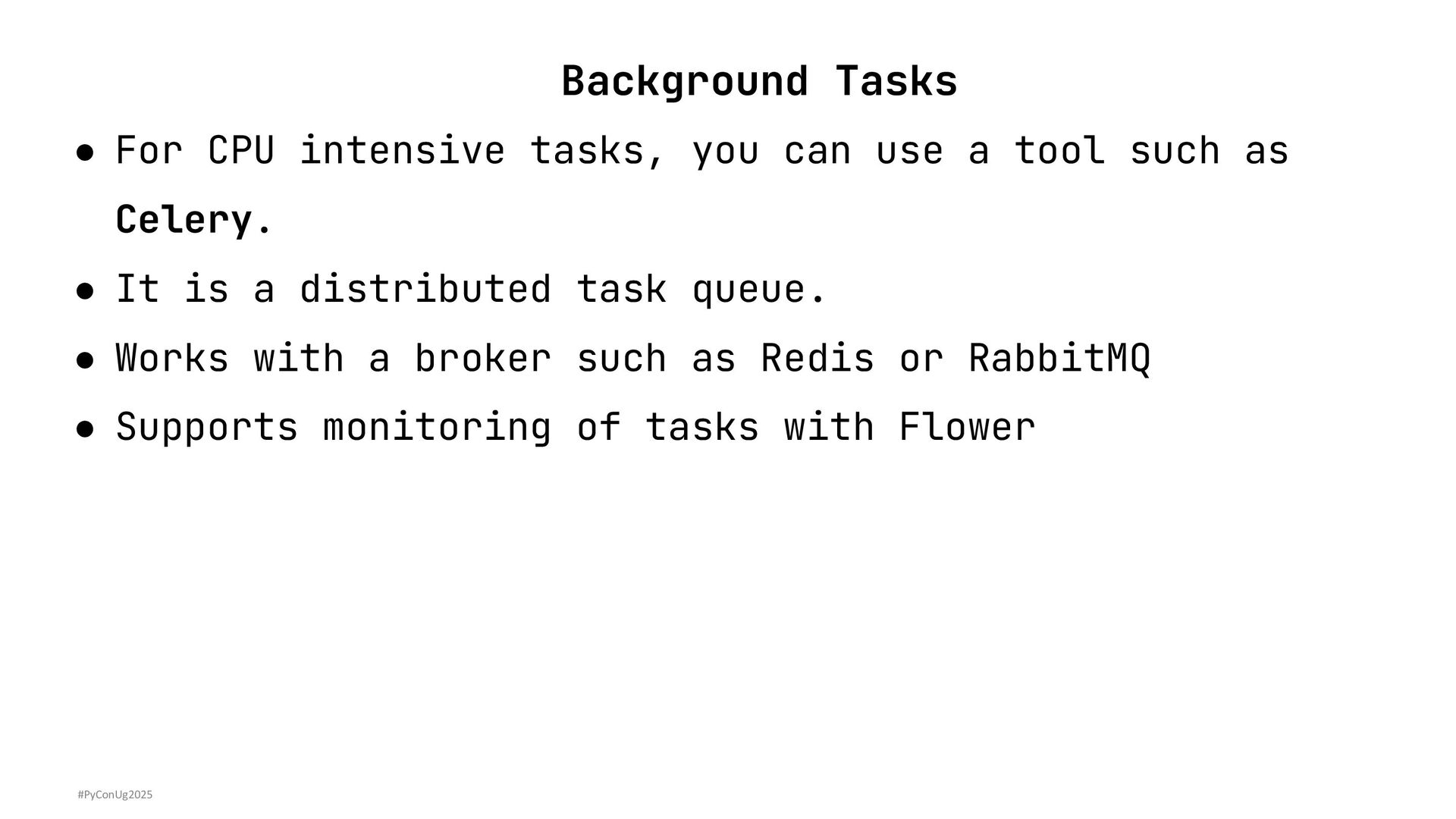
Background Tasks #PyConUg2025 • For CPU intensive tasks, you can
use a tool such as Celery. • It is a distributed task queue. • Works with a broker such as Redis or RabbitMQ • Supports monitoring of tasks with Flower -
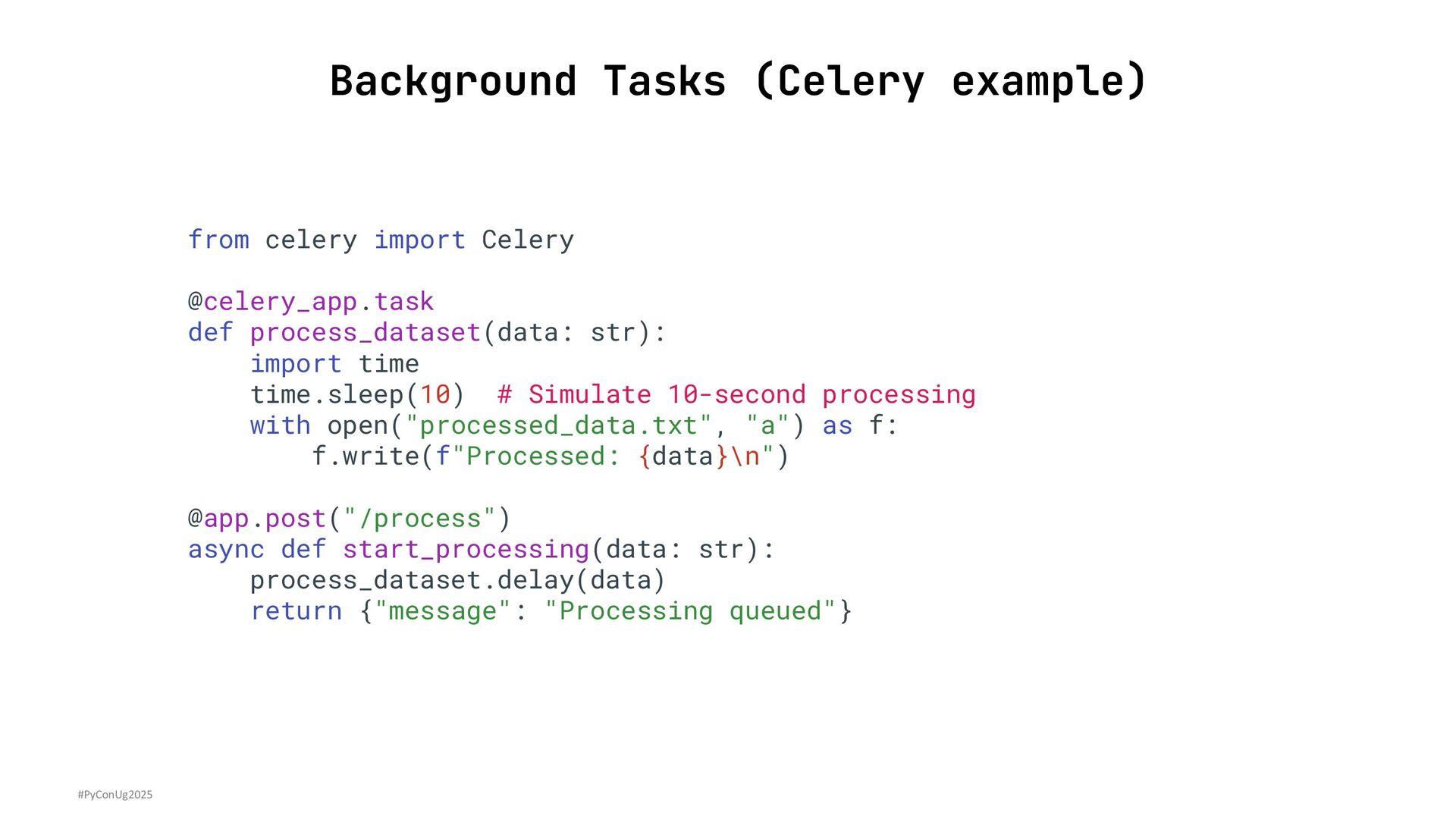
Background Tasks (Celery example) #PyConUg2025 from celery import Celery @celery_app.task
def process_dataset(data: str): import time time.sleep(10) # Simulate 10-second processing with open("processed_data.txt", "a") as f: f.write(f"Processed: {data}\n") @app.post("/process") async def start_processing(data: str): process_dataset.delay(data) return {"message": "Processing queued"} -
WebSockets #PyConUg2025 • Enable real-time, two-way communication between client and
server • Very useful for implementing real-time features like real-time chat, notifications, e.t.c. • Leverages FastAPI’s async capabilities for speed -
WebSockets #PyConUg2025 • Enable real-time, two-way communication between client and
server • Very useful for implementing real-time features like real-time chat, notifications, e.t.c. • Leverages FastAPI’s async capabilities for speed -
WebSockets #PyConUg2025 • Enable real-time, two-way communication between client and
server • Very useful for implementing real-time features like real-time chat, notifications, e.t.c. • Leverages FastAPI’s async capabilities for speed -
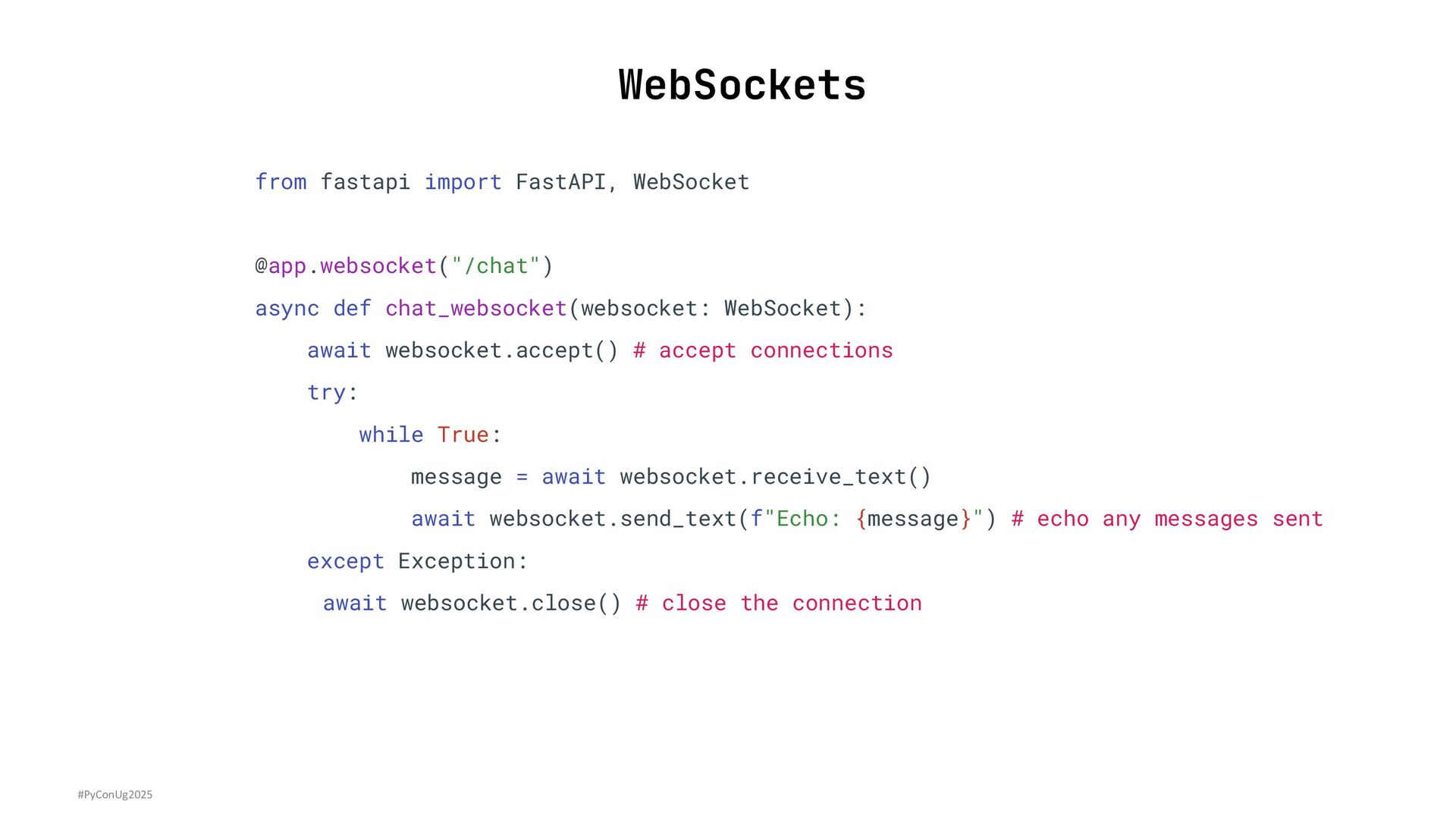
WebSockets #PyConUg2025 from fastapi import FastAPI, WebSocket @app.websocket("/chat") async def
chat_websocket(websocket: WebSocket): await websocket.accept() # accept connections try: while True: message = await websocket.receive_text() await websocket.send_text(f"Echo: {message}") # echo any messages sent except Exception: await websocket.close() # close the connection -
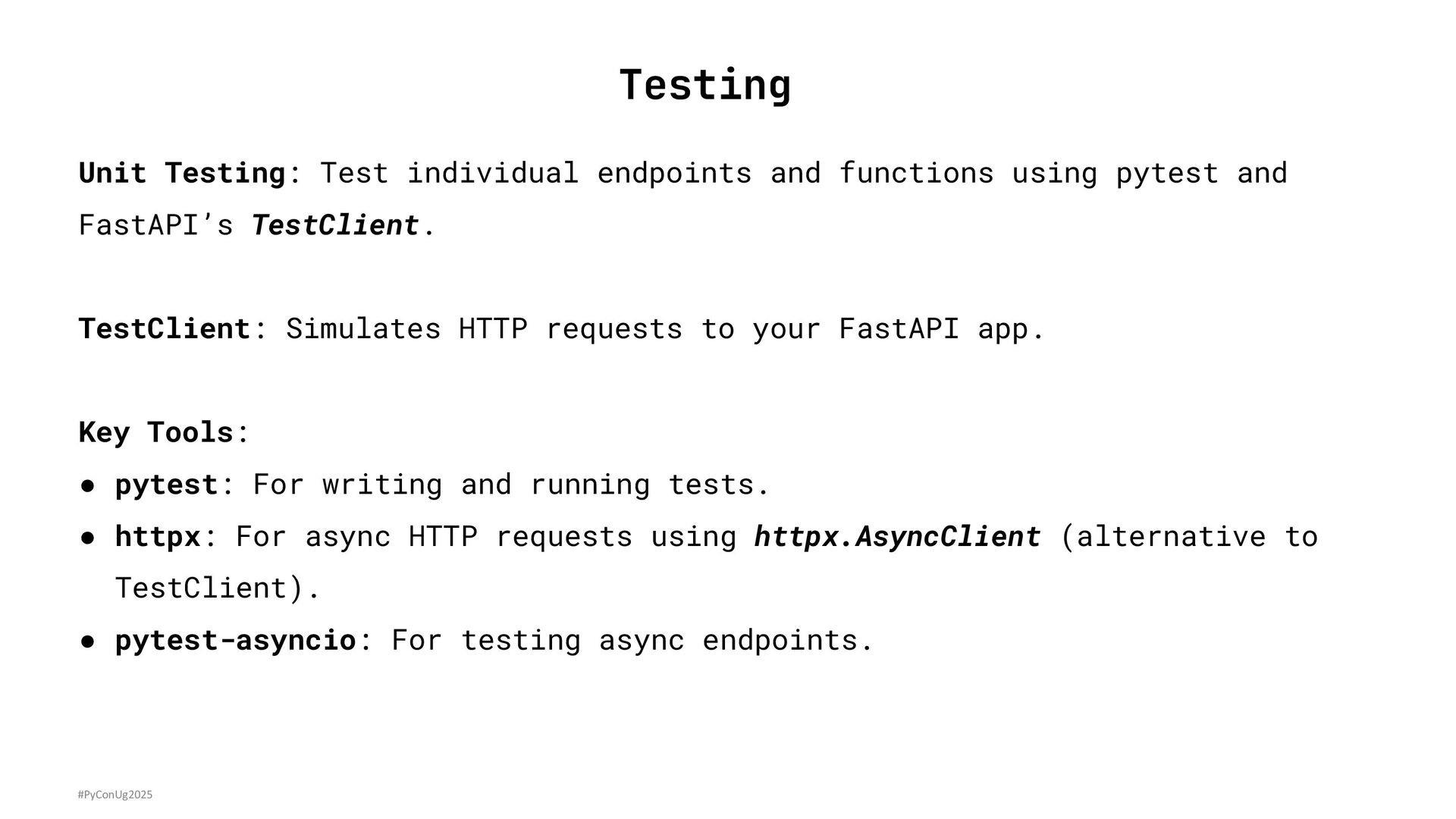
Testing #PyConUg2025 Unit Testing: Test individual endpoints and functions using
pytest and FastAPI’s TestClient. TestClient: Simulates HTTP requests to your FastAPI app. Key Tools: • pytest: For writing and running tests. • httpx: For async HTTP requests using httpx.AsyncClient (alternative to TestClient). • pytest-asyncio: For testing async endpoints. -
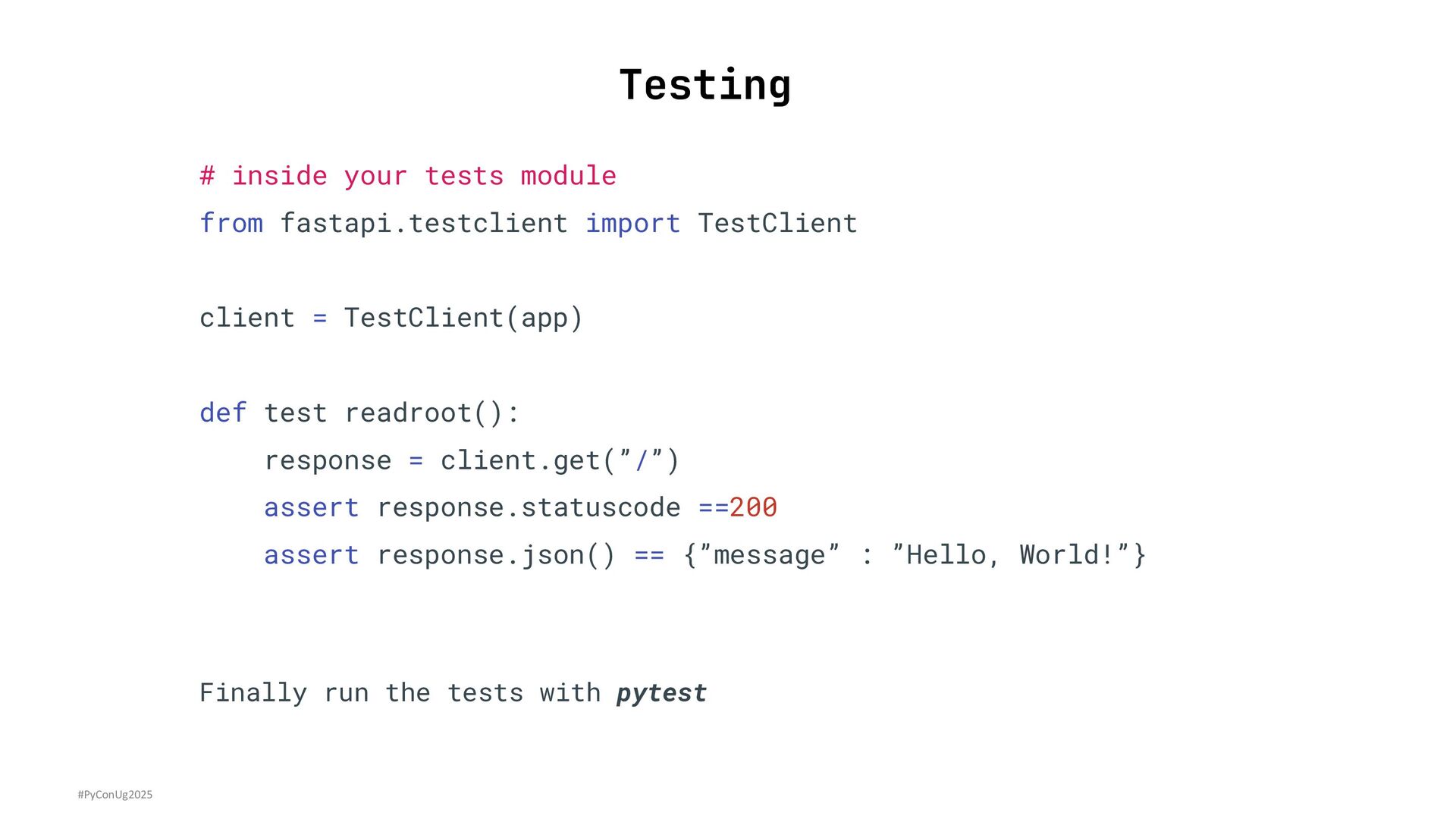
Testing #PyConUg2025 # inside your tests module from fastapi.testclient import
TestClient client = TestClient(app) def test readroot(): response = client.get(”/”) assert response.statuscode ==200 assert response.json() == {”message” : ”Hello, World!”} Finally run the tests with pytest -
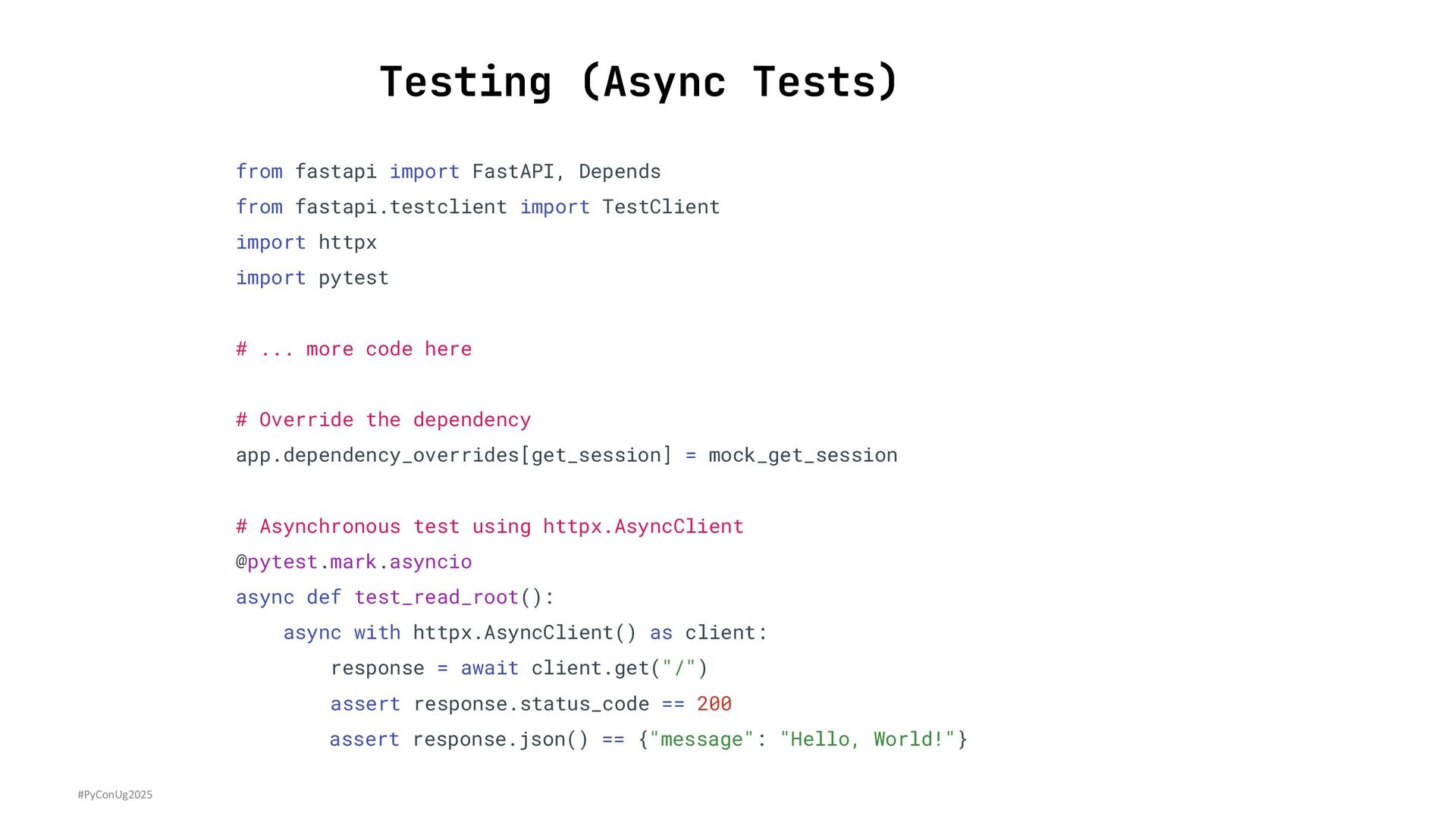
Testing (Async Tests) #PyConUg2025 from fastapi import FastAPI, Depends from
fastapi.testclient import TestClient import httpx import pytest # ... more code here # Override the dependency app.dependency_overrides[get_session] = mock_get_session # Asynchronous test using httpx.AsyncClient @pytest.mark.asyncio async def test_read_root(): async with httpx.AsyncClient() as client: response = await client.get("/") assert response.status_code == 200 assert response.json() == {"message": "Hello, World!"} -
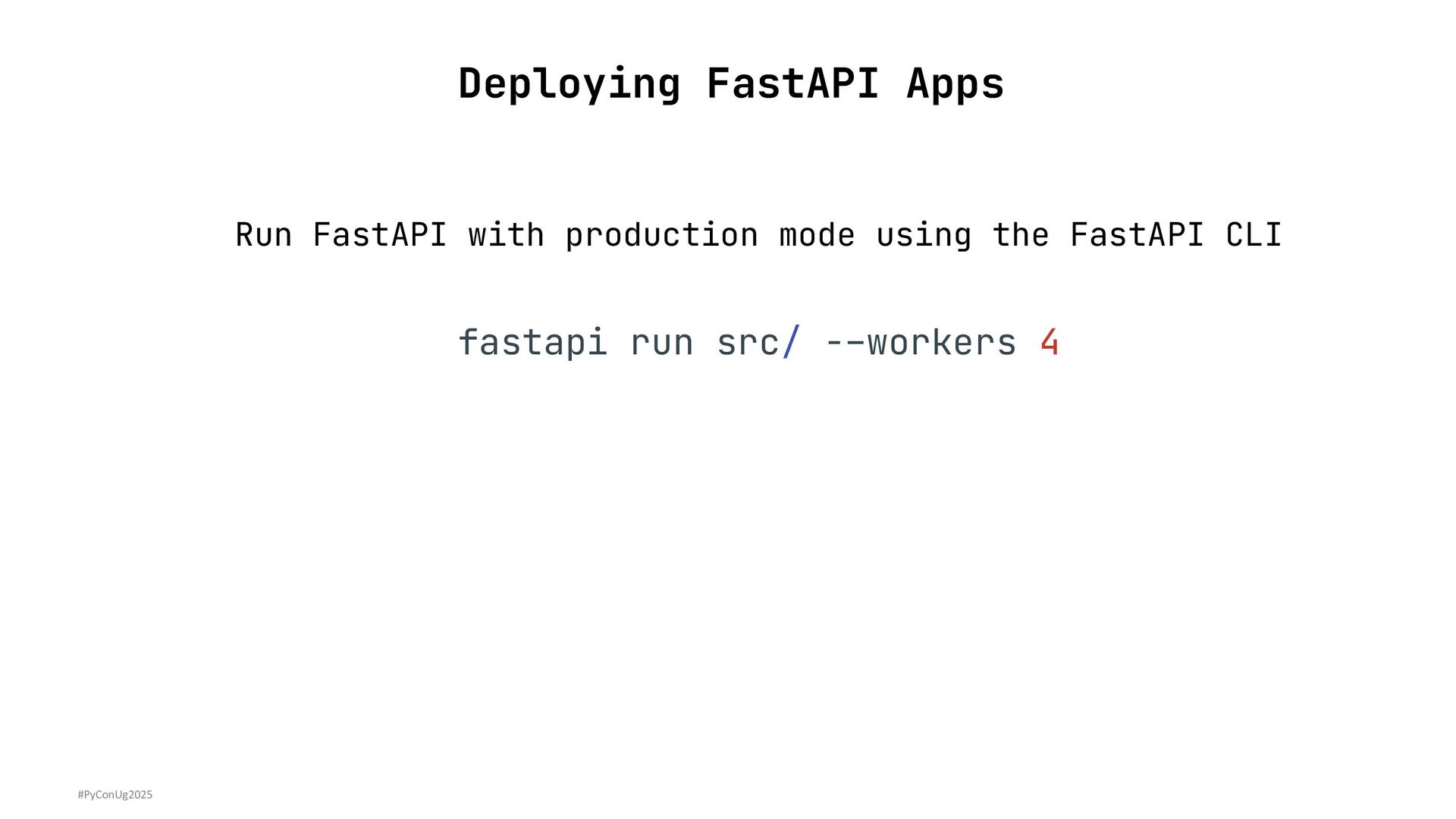
Deploying FastAPI Apps #PyConUg2025 Run FastAPI with production mode using
the FastAPI CLI fastapi run src/ -–workers 4 -
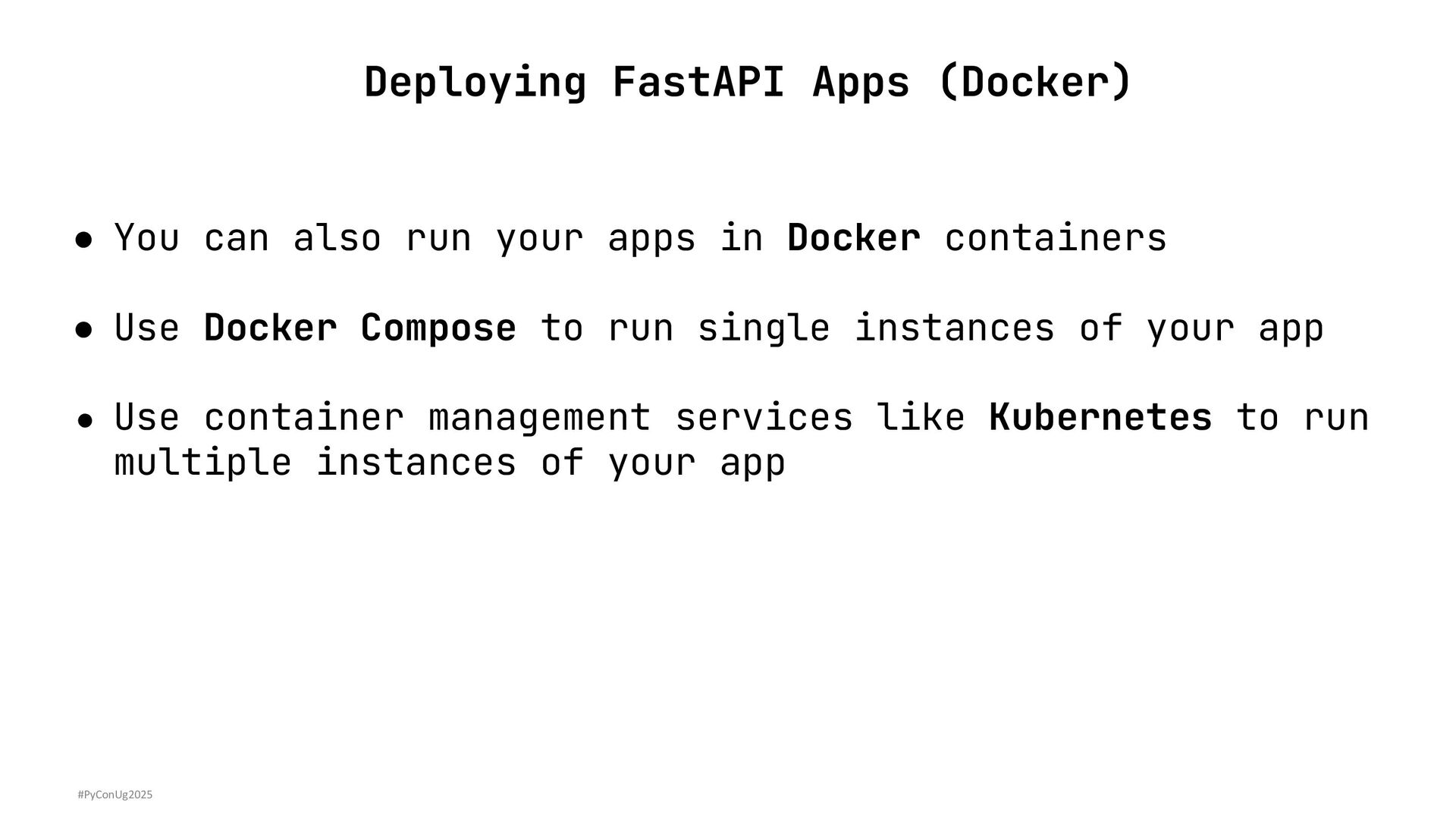
Deploying FastAPI Apps (Docker) #PyConUg2025 • You can also run
your apps in Docker containers • Use Docker Compose to run single instances of your app • Use container management services like Kubernetes to run multiple instances of your app -
Deploying FastAPI Apps (Docker) #PyConUg2025 • Utilize tools like Traefik
to handle automatic handling of HTTPS
 speakerdeck
 aarron
 rkendrick25
 tamaranovitovic
 jlugia
 sabderemane
 ryanjones
 chrislema
 ammeep
 tammyeverts
 lara
 orderedlist