DIGITAL SIGNAL PROCESSING Mr. K. Karthik Kumar AP/EEE DEPARTMENT OF ELECTRICAL AND ELECTRONICS ENGINEERING NATIONAL ENGINEERING COLLEGE, K.R. NAGAR, KOVILPATTI – 628 503 (An Autonomous Institution, Affiliated to Anna University – Chennai)
that focuses on analyzing, modifying, and synthesizing signals such as sound, images, and scientific measurements. Signal processing techniques can be used to improve transmission, storage efficiency and subjective quality and to also emphasize or detect components of interest in a measured signal.
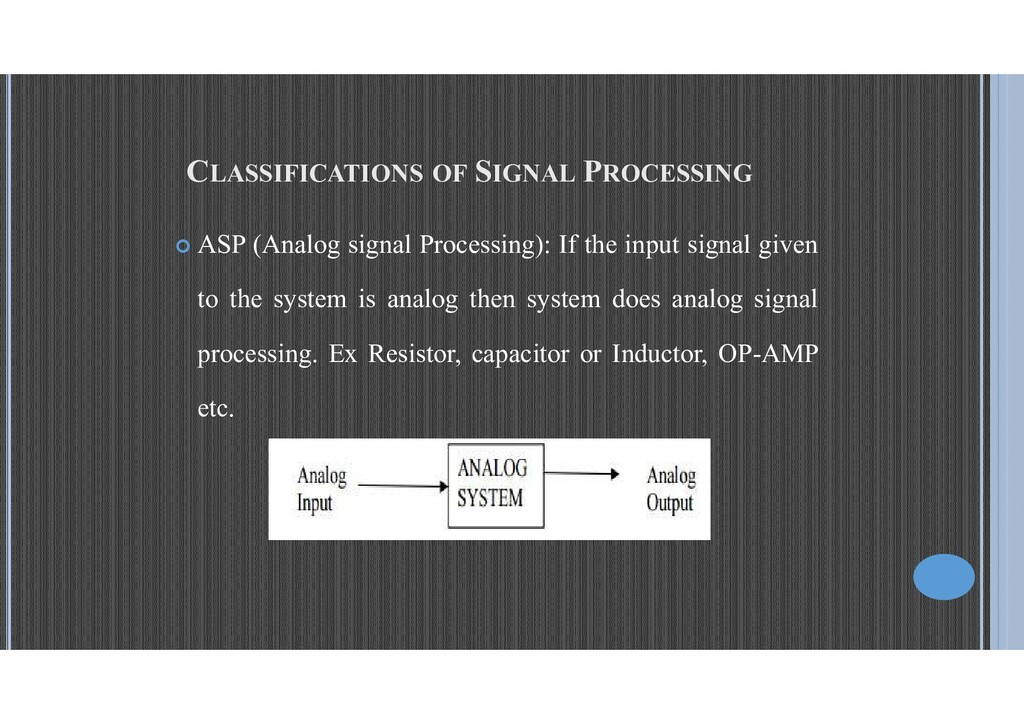
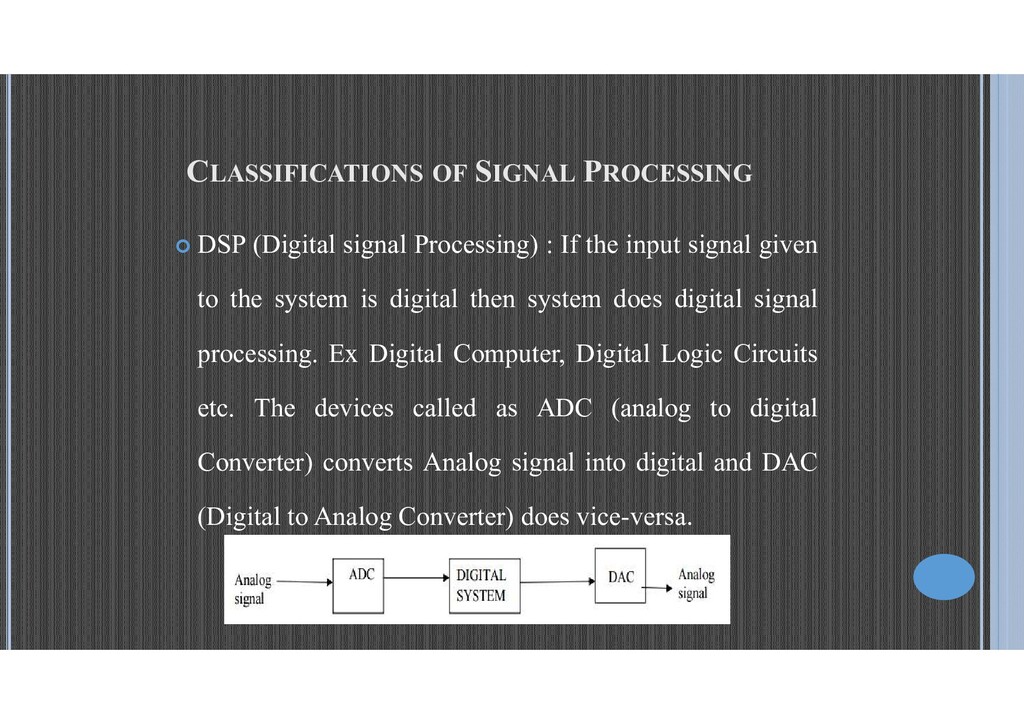
If the input signal given to the system is digital then system does digital signal processing. Ex Digital Computer, Digital Logic Circuits etc. The devices called as ADC (analog to digital Converter) converts Analog signal into digital and DAC (Digital to Analog Converter) does vice-versa.
analog in nature. Hence these signals are converted to digital form by the analog to digital converter. Thus AD Converter generates an array of samples and gives it to the digital signal processor. This array of samples or sequence of samples is the digital equivalent of input analog signal. The DSP performs signal processing operations like filtering, multiplication, transformation or amplification etc operations over these digital signals. The digital output signal from the DSP is given to the DAC.
we are usually concerned not only with its magnitude but also with how it changes. Oscilloscopes, strip chart recorders and other analog recording devices enable us to make observations of the signal by continuously recording and displaying the measurement data in the time domain. When digital computers are utilized for this purpose, however, the magnitude of the signal is sampled only at fixed intervals of time with a complete loss of continuity between.
form, the mathematics of digital signal processing can be used to analyze the signal in both the time and frequency domains. That is, we can know not only how the magnitude of the signal varied with time, but also what the amplitudes of any oscillations were over a spectrum of frequencies. This Tech Note is intended as a guide to understanding the necessary considerations for converting an analog signal into a useful series of discrete digital data.
systems is quite large while digital processors are more compact and light in weight. Analog systems are less accurate because of component tolerance ex R, L, C and active components. Digital components are less sensitive to the environmental changes, noise and disturbances. Digital system is most flexible as software programs & control programs can be easily modified. Digital signal can be stores on digital hard disk, floppy disk or magnetic tapes. Hence becomes transportable. Thus easy and lasting storage capacity.
be done offline. Mathematical signal processing algorithm can be routinely implemented on digital signal processing systems. Digital controllers are capable of performing complex computation with constant accuracy at high speed. Digital signal processing systems are upgradeable since that are software controlled. Possibility of sharing DSP processor between several tasks. The cost of microprocessors, controllers and DSP processors are continuously going down. For some complex control functions, it is not practically feasible to construct analog controllers. Single chip microprocessors, controllers and DSP processors are more versatile and powerful.
microprocessors, controllers and DSP processors are continuously going down. For some complex control functions, it is not practically feasible to construct analog controllers. Single chip microprocessors, controllers and DSP processors are more versatile and powerful.
D/A Converters) Limit in frequency. High speed AD converters are difficult to achieve in practice. In high frequency applications DSP are not preferred.


 codingconduct
 sergeychernyshev
 nmsamuel
 badams
 marcduiker
 tomoyanonymous
 eileencodes
 hannesfritz
 pauljervisheath
 malarkey
 hatefulcrawdad