at Starbucks with those at independent local coffee shops. Explore how customers currently experience and position Starbucks in everyday life. Identify which factors most influence customers’ emotional connection to Starbucks and their patterns of use in daily life. 1 Examine how Starbucks’ environment, staff, and digital touchpoints shape customers’ feelings of comfort, belonging, and brand meaning. 2 Research Objectives 4
Ethnographic Research 2 hours at a Starbucks + 2 hours at a local coffee shop 12 In-depth Interviews Each interview lasted for 1 hour Sample includes regular Starbucks drinkers
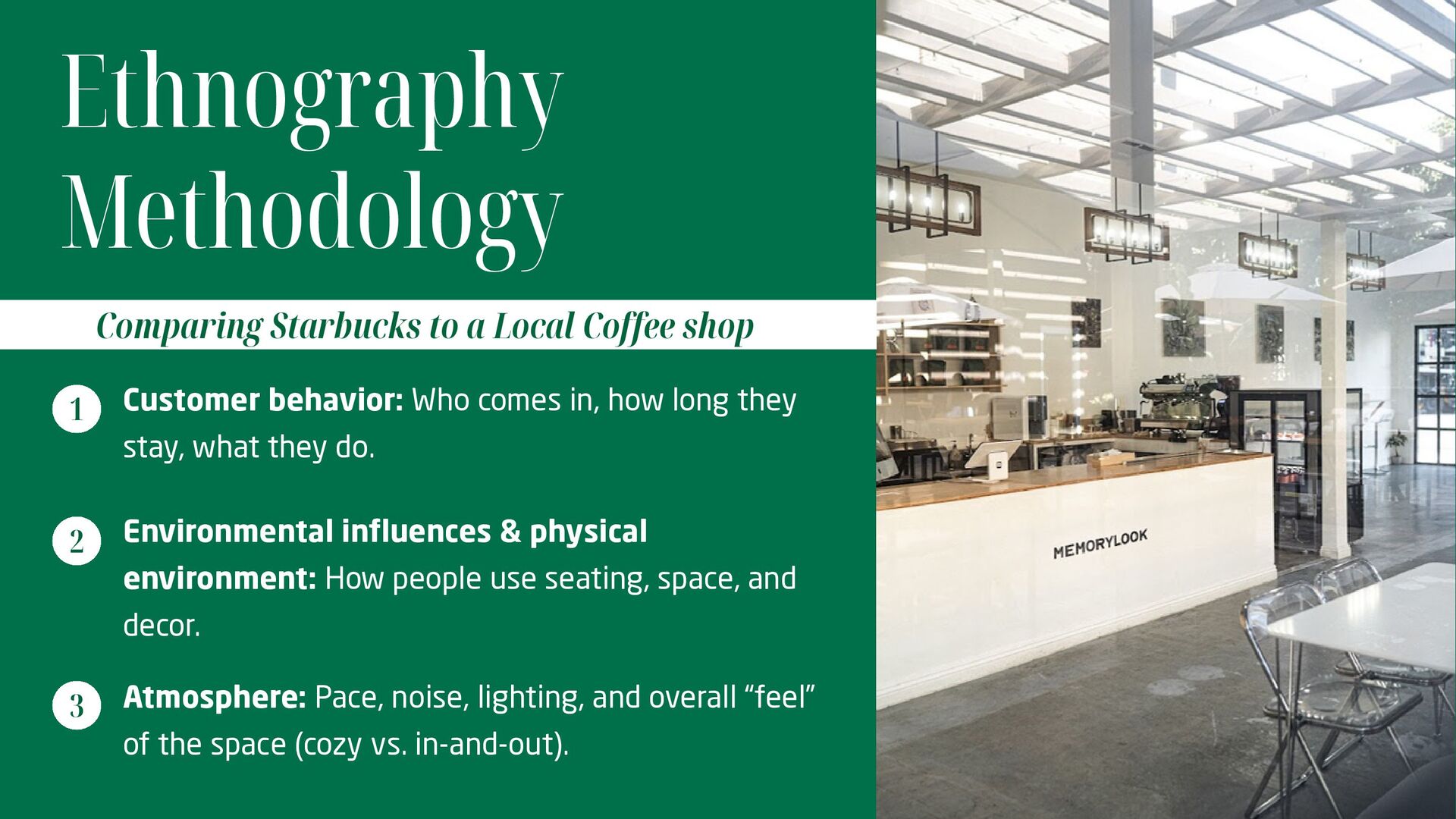
2 3 Customer behavior: Who comes in, how long they stay, what they do. Environmental influences & physical environment: How people use seating, space, and decor. Atmosphere: Pace, noise, lighting, and overall “feel” of the space (cozy vs. in-and-out).
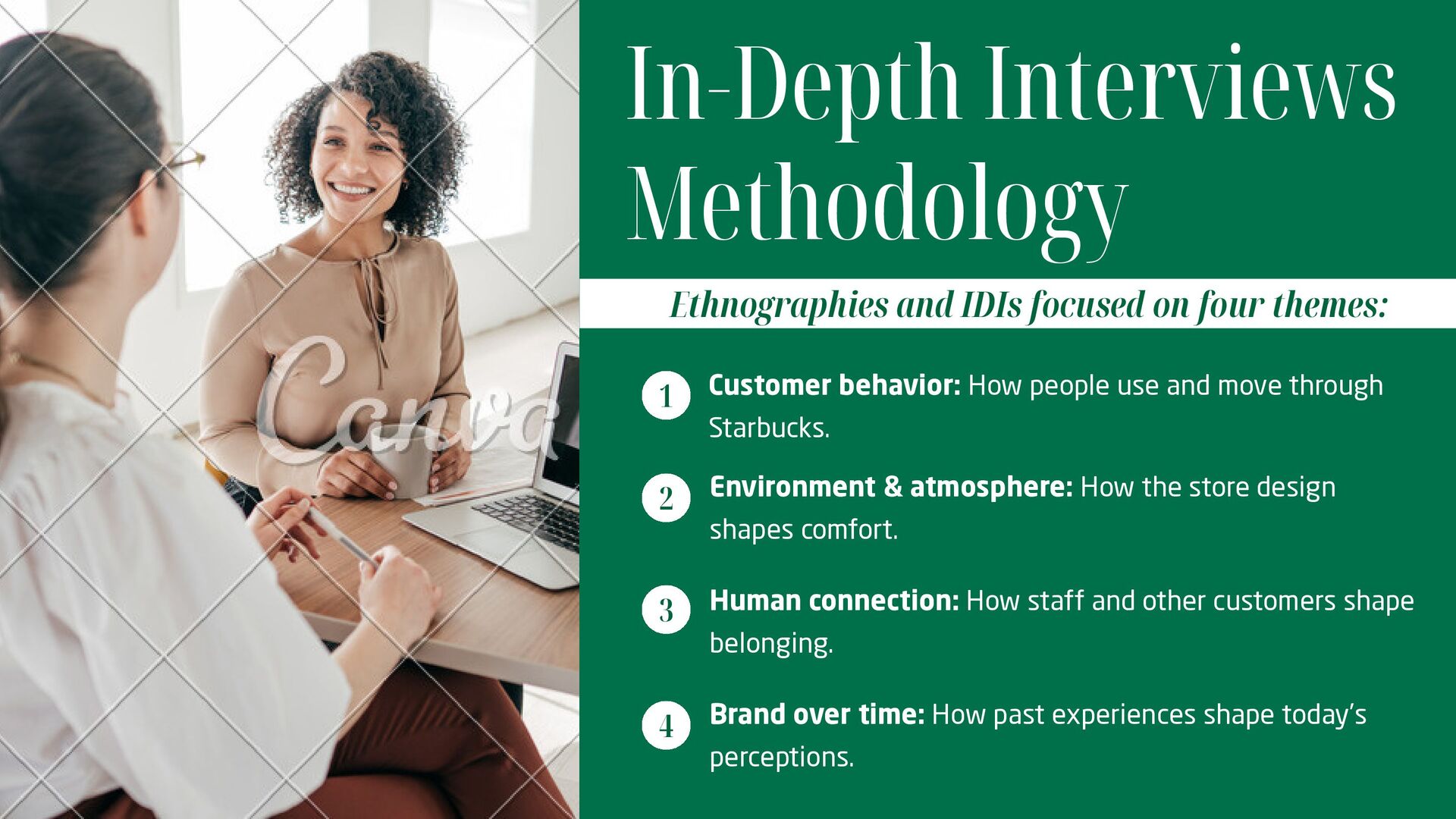
1 2 3 4 Brand over time: How past experiences shape today’s perceptions. Customer behavior: How people use and move through Starbucks. Environment & atmosphere: How the store design shapes comfort. Human connection: How staff and other customers shape belonging.
in-store ethnographic observation with 12 in-depth interviews, examines how Starbucks customers experience comfort and brand meaning. To clearly translate insights into action, we organized our findings into four sections: the current state of Starbucks today, what Starbucks is doing well, what Starbucks is doing poorly, and how they can improve. Findings show that Starbucks is now primarily used as a functional, efficient “thru-place” rather than a proper third place. Customers value speed, reliability, and digital convenience while perceiving Starbucks stores as corporate, interchangeable, and oriented toward solo, short visits. These results inform recommendations to improve physical comfort, add localized human touches to rebuild a more emotionally resonant third-place feel, and reinforce brand values through visible community and sustainability cues.
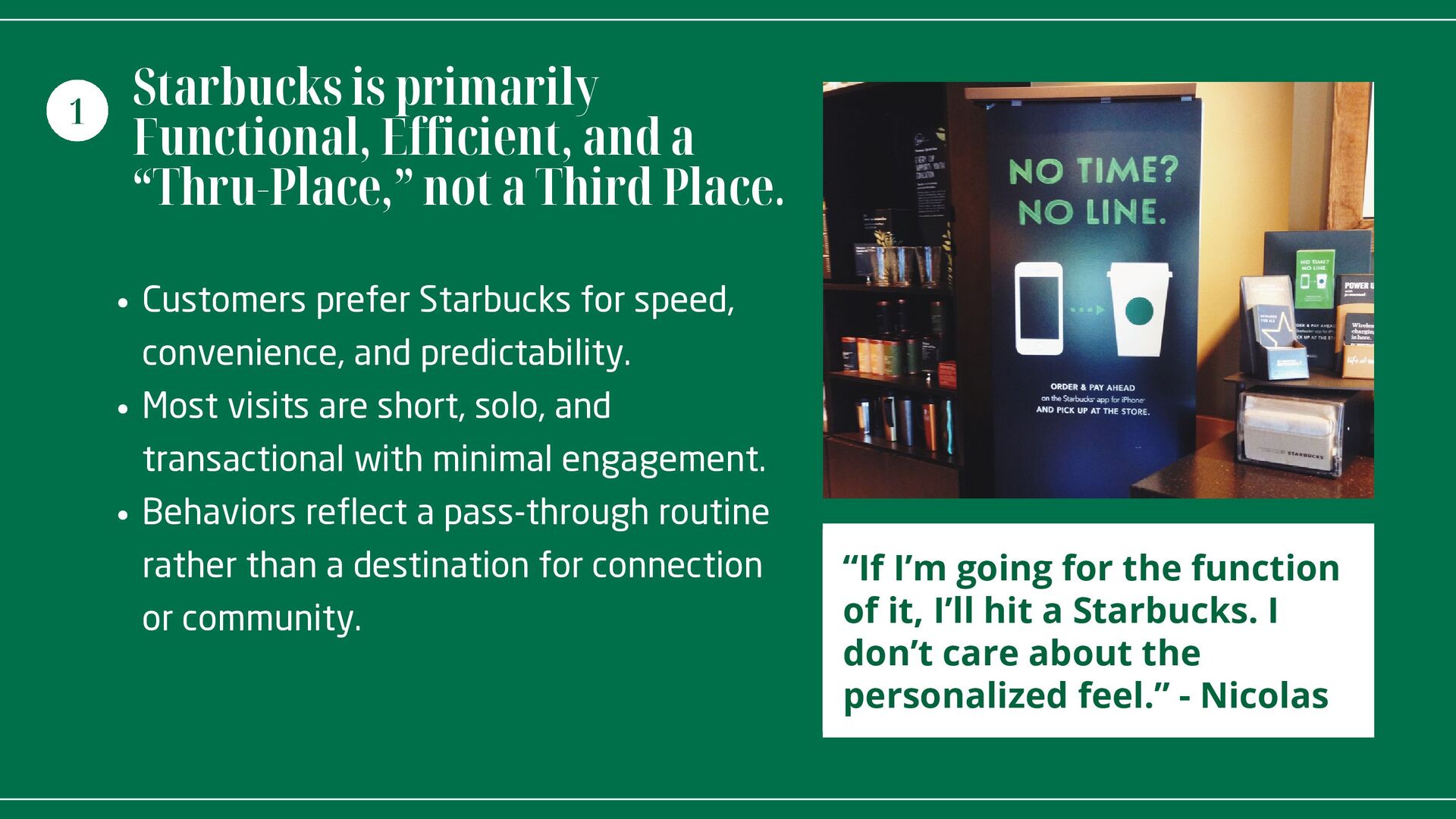
a Starbucks. I don’t care about the personalized feel.” - Nicolas 1 Starbucks is primarily Functional, Efficient, and a “Thru-Place,” not a Third Place. Customers prefer Starbucks for speed, convenience, and predictability. Most visits are short, solo, and transactional with minimal engagement. Behaviors reflect a pass-through routine rather than a destination for connection or community.
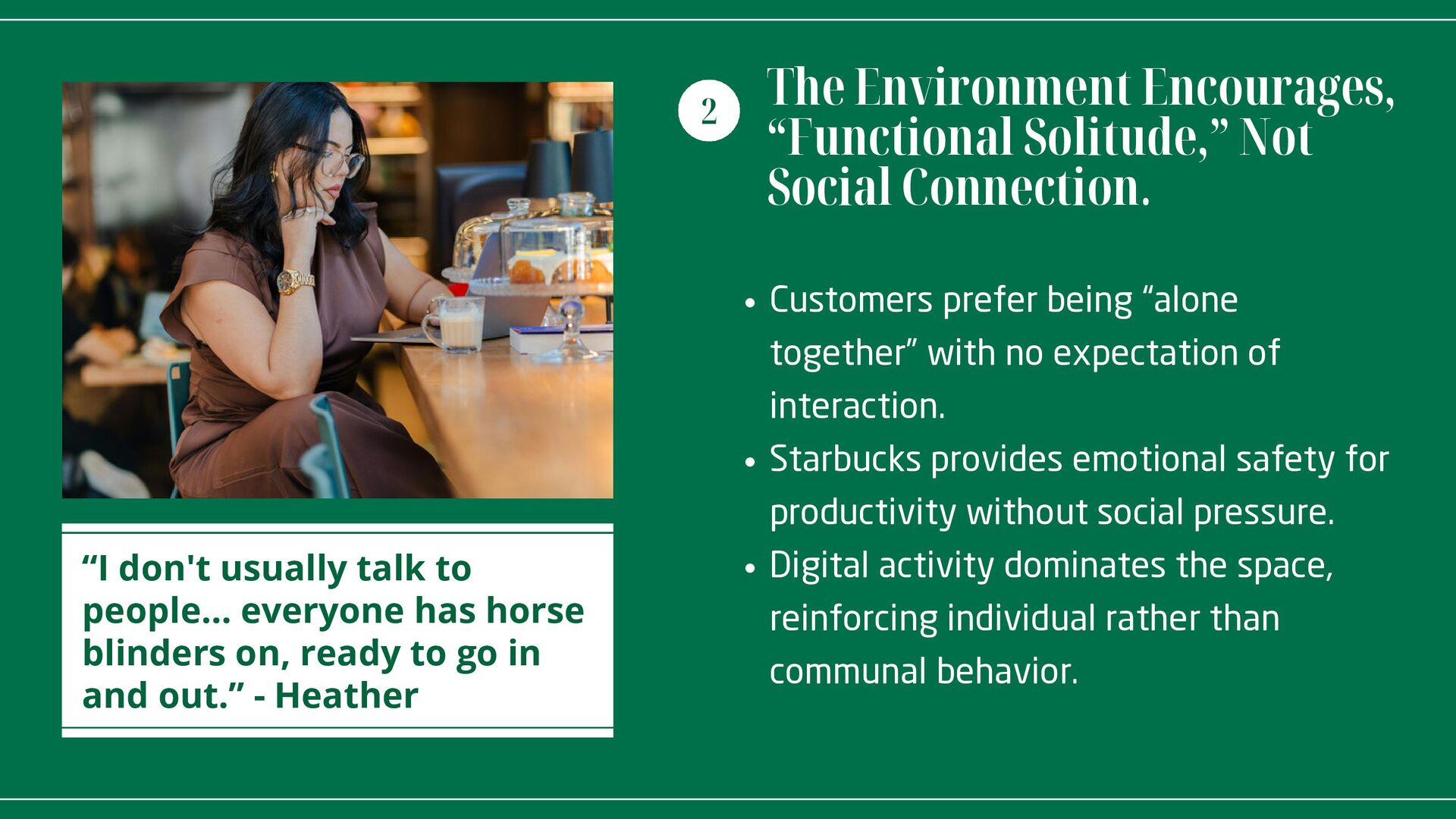
prefer being “alone together” with no expectation of interaction. Starbucks provides emotional safety for productivity without social pressure. Digital activity dominates the space, reinforcing individual rather than communal behavior. “I don't usually talk to people… everyone has horse blinders on, ready to go in and out.” - Heather
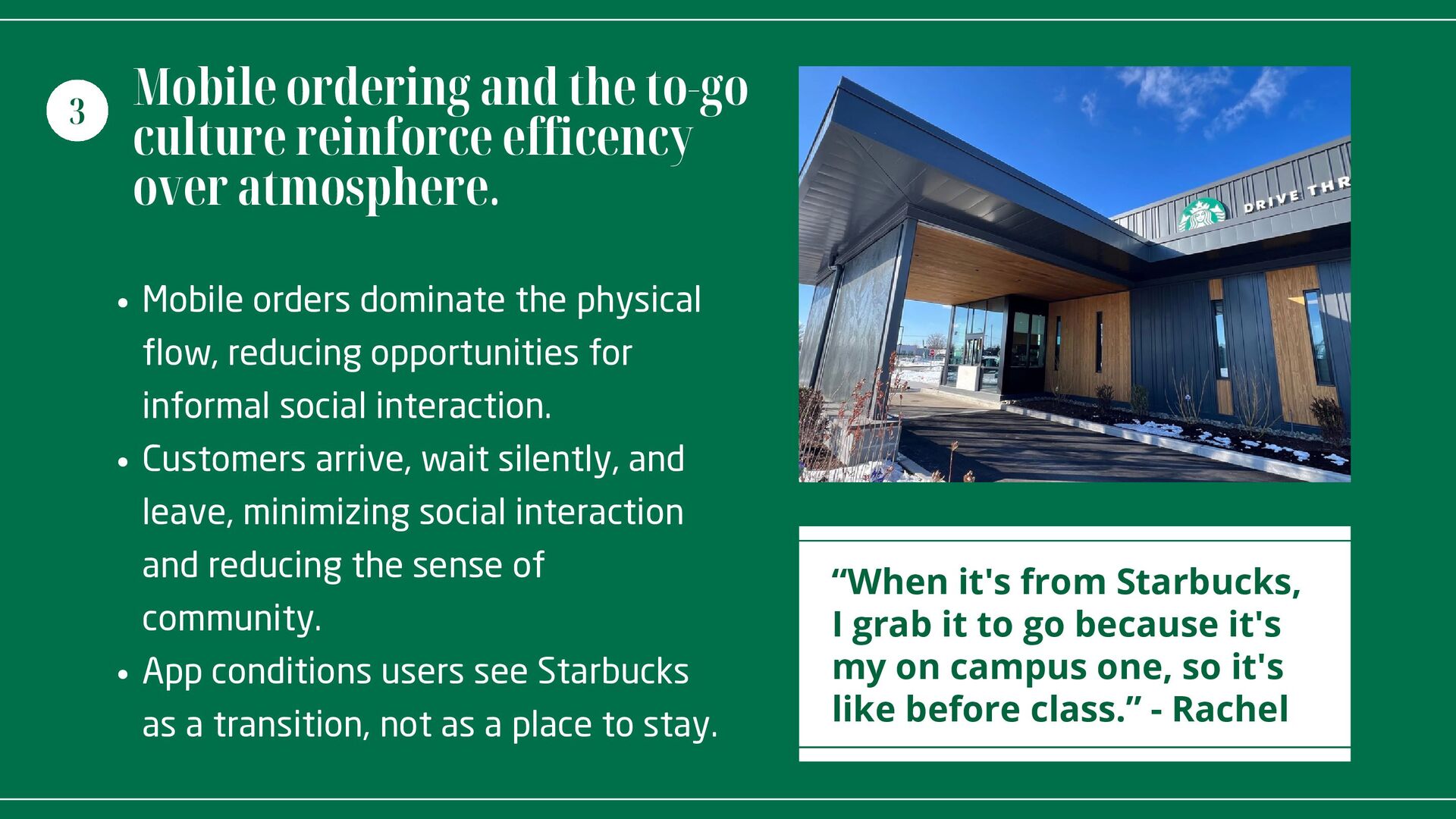
atmosphere. Mobile orders dominate the physical flow, reducing opportunities for informal social interaction. Customers arrive, wait silently, and leave, minimizing social interaction and reducing the sense of community. App conditions users see Starbucks as a transition, not as a place to stay. “When it's from Starbucks, I grab it to go because it's my on campus one, so it's like before class.” - Rachel
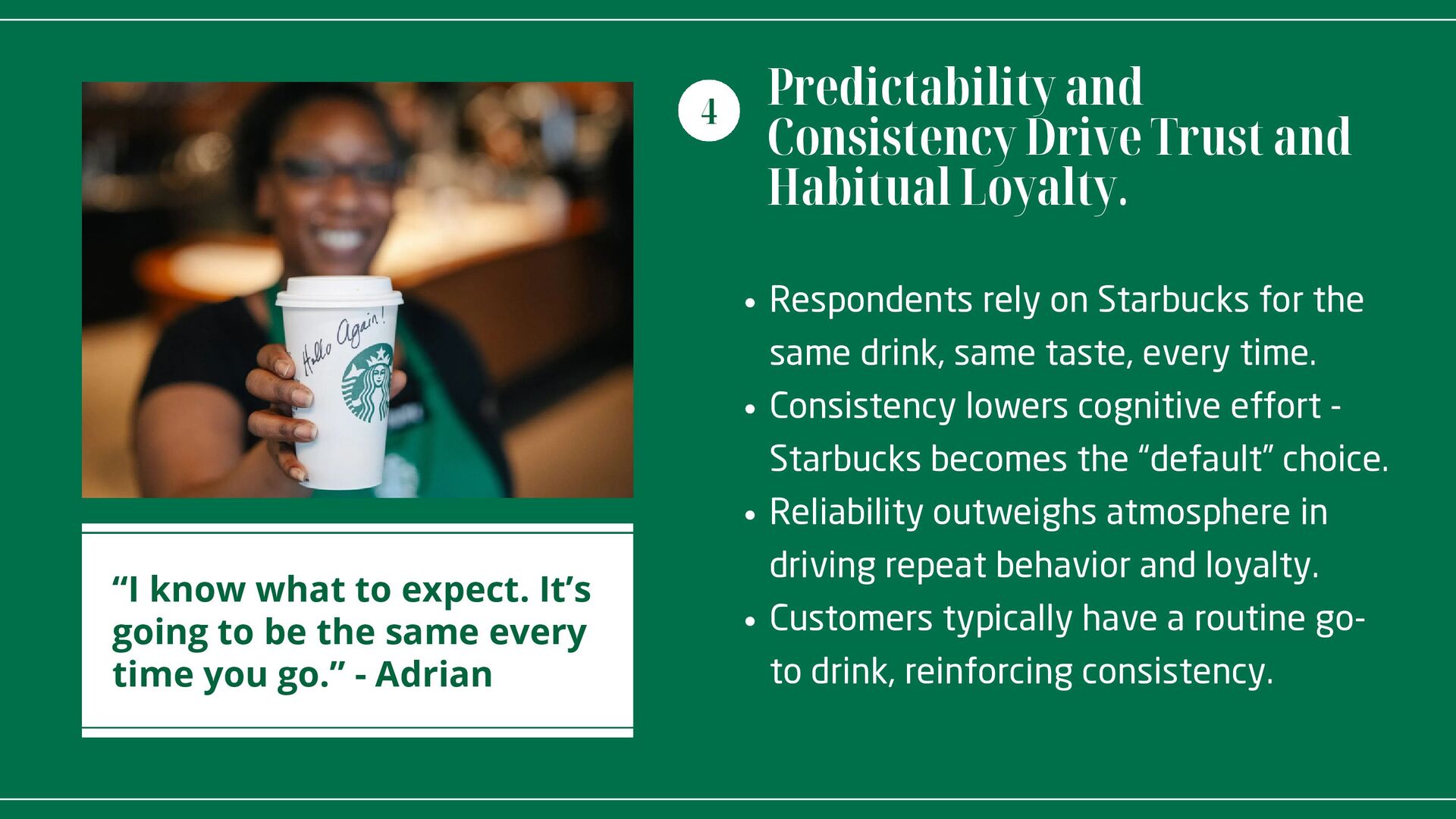
the same every time you go.” - Adrian Predictability and Consistency Drive Trust and Habitual Loyalty. Respondents rely on Starbucks for the same drink, same taste, every time. Consistency lowers cognitive effort - Starbucks becomes the “default” choice. Reliability outweighs atmosphere in driving repeat behavior and loyalty. Customers typically have a routine go- to drink, reinforcing consistency.
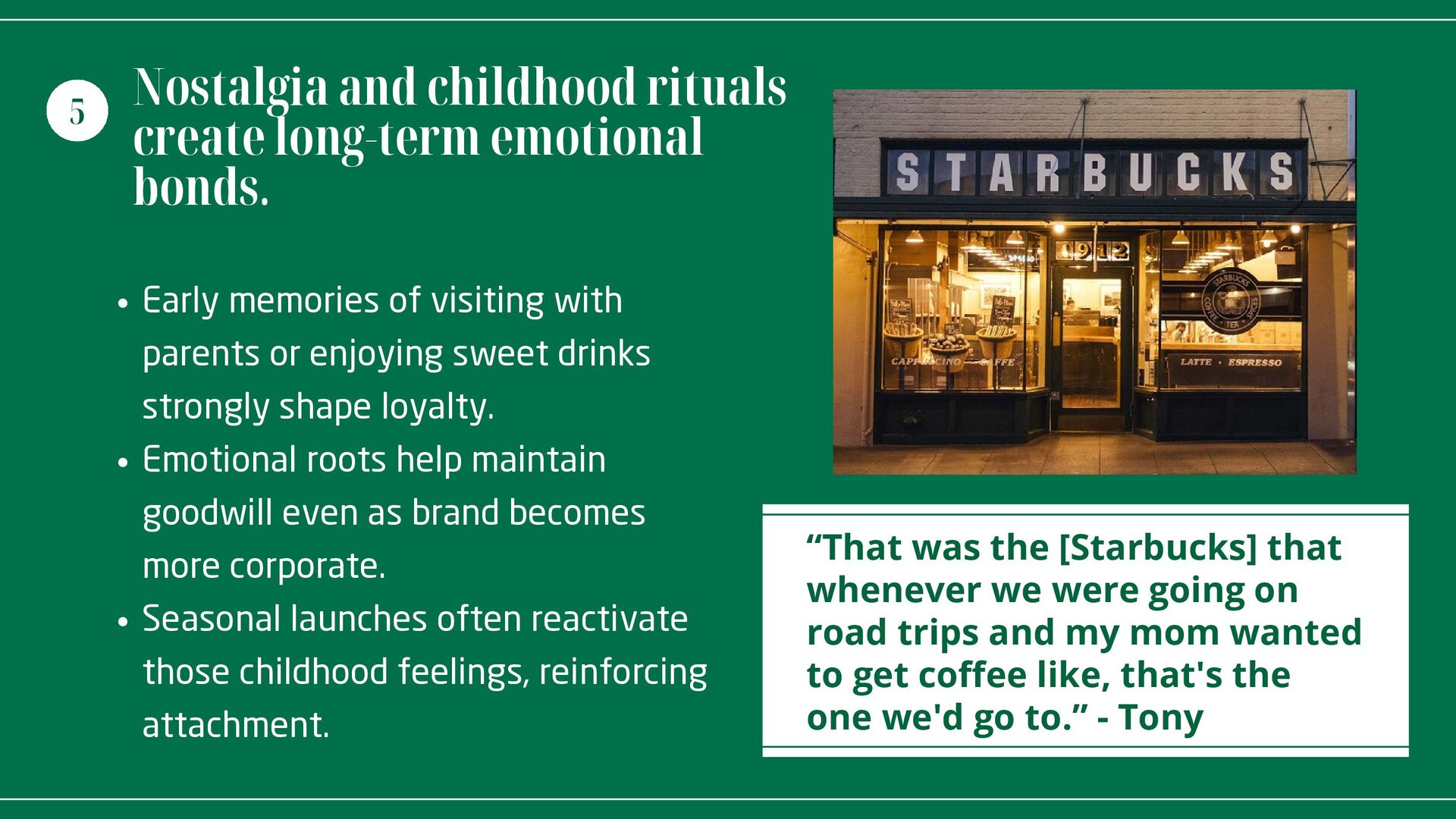
of visiting with parents or enjoying sweet drinks strongly shape loyalty. Emotional roots help maintain goodwill even as brand becomes more corporate. Seasonal launches often reactivate those childhood feelings, reinforcing attachment. “That was the [Starbucks] that whenever we were going on road trips and my mom wanted to get coffee like, that's the one we'd go to.” - Tony 5
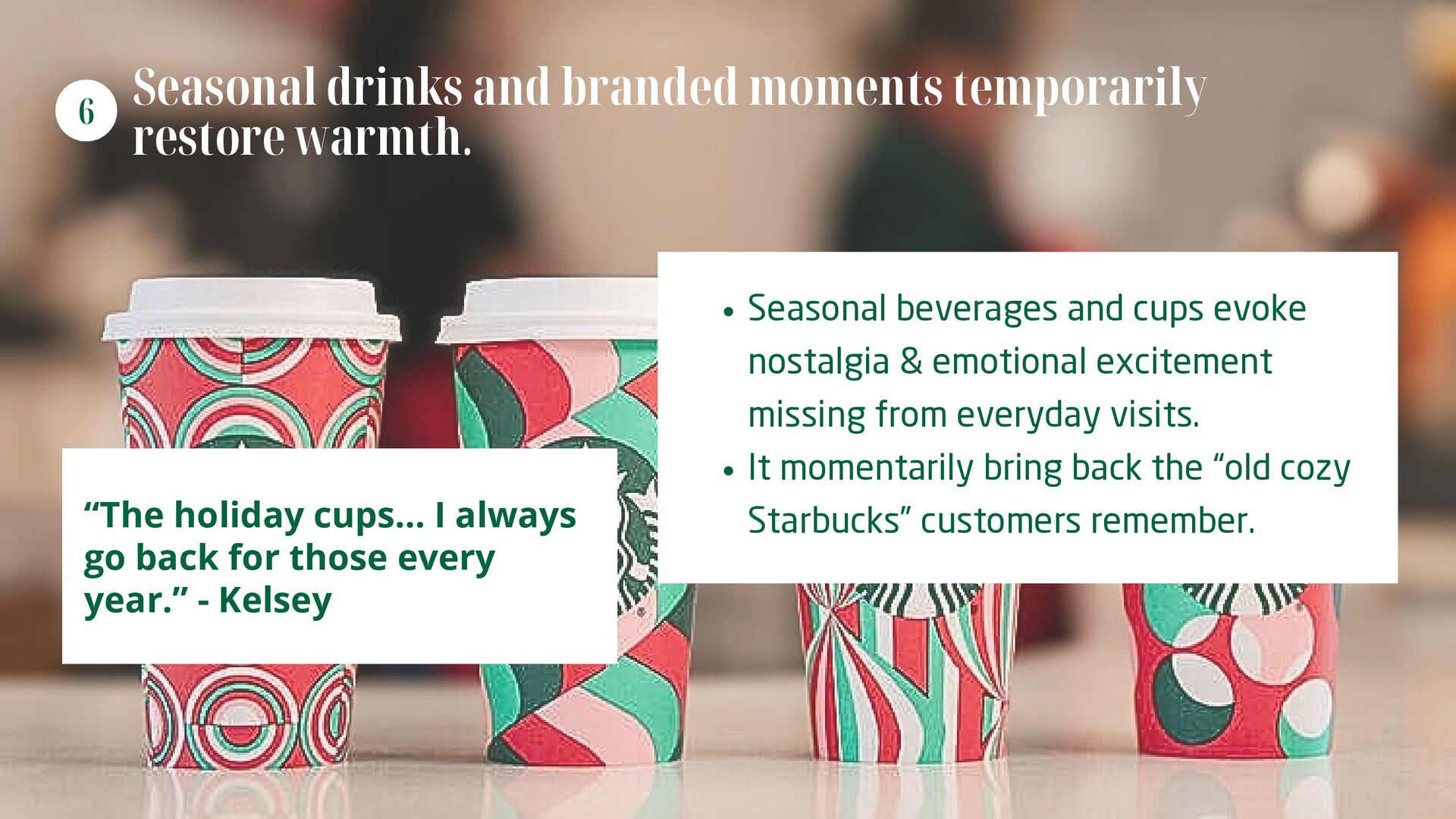
beverages and cups evoke nostalgia & emotional excitement missing from everyday visits. It momentarily bring back the “old cozy Starbucks” customers remember. “The holiday cups... I always go back for those every year.” - Kelsey
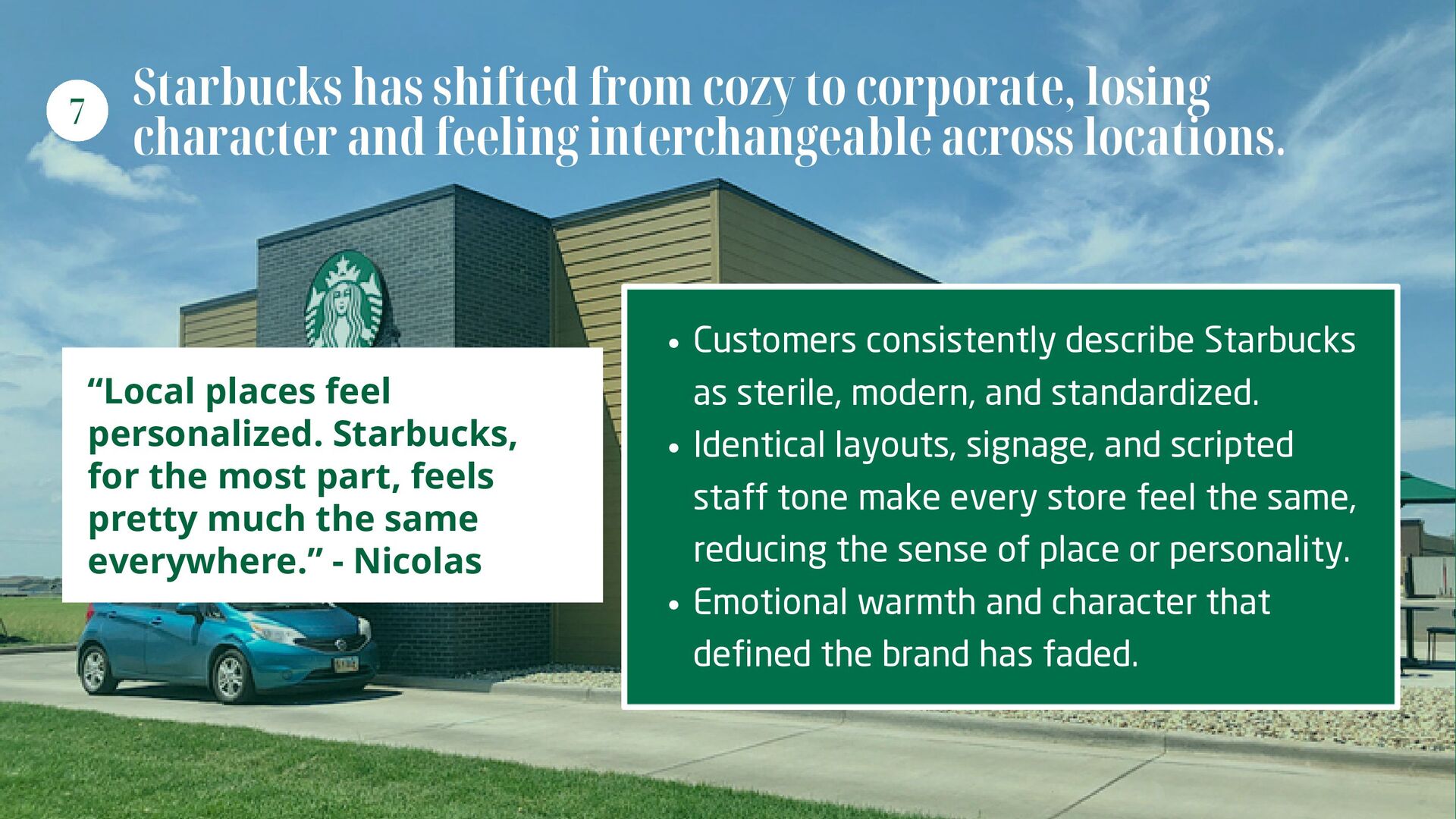
and feeling interchangeable across locations. Customers consistently describe Starbucks as sterile, modern, and standardized. Identical layouts, signage, and scripted staff tone make every store feel the same, reducing the sense of place or personality. Emotional warmth and character that defined the brand has faded. “Local places feel personalized. Starbucks, for the most part, feels pretty much the same everywhere.” - Nicolas
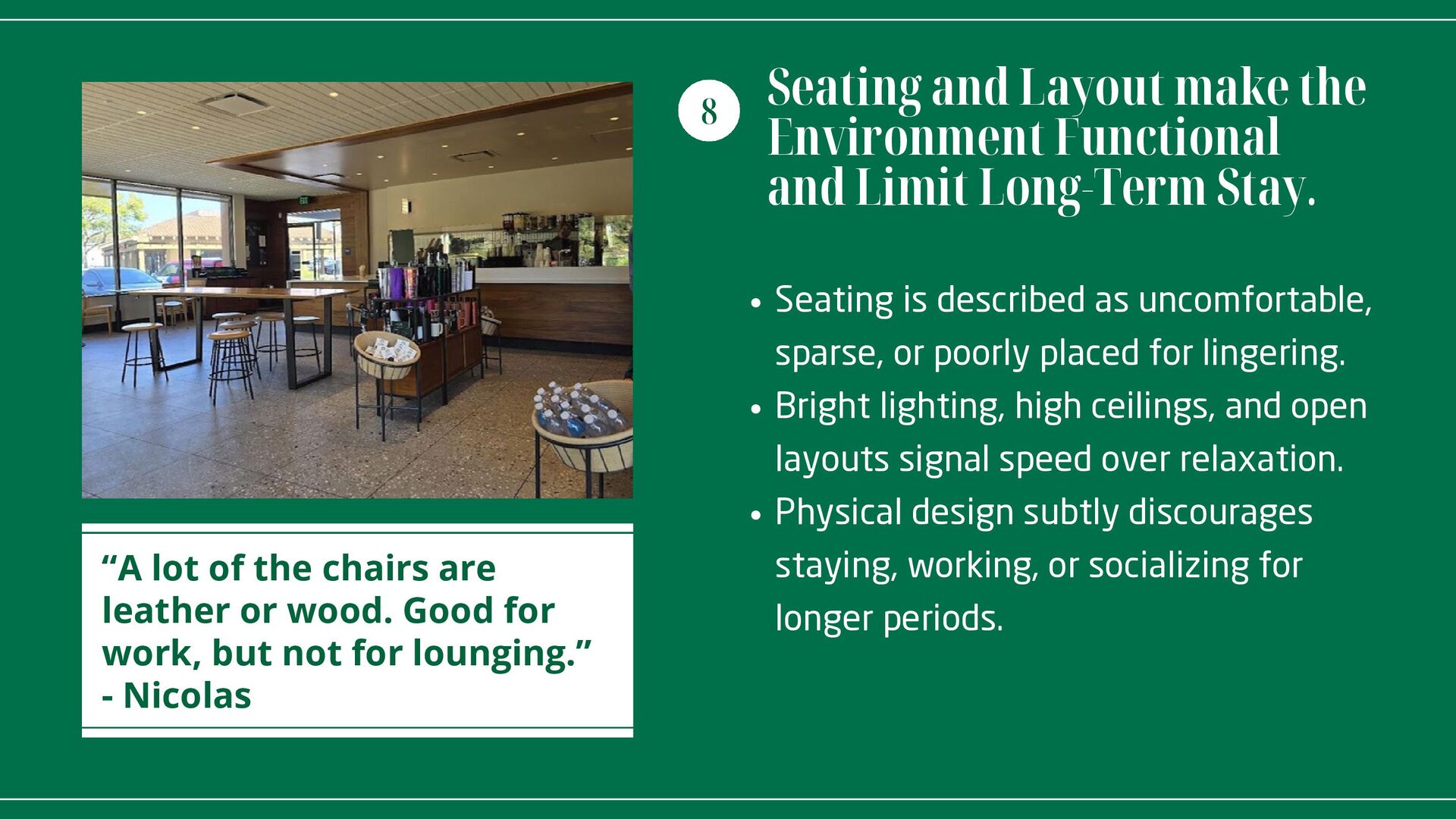
Good for work, but not for lounging.” - Nicolas Seating and Layout make the Environment Functional and Limit Long-Term Stay. Seating is described as uncomfortable, sparse, or poorly placed for lingering. Bright lighting, high ceilings, and open layouts signal speed over relaxation. Physical design subtly discourages staying, working, or socializing for longer periods.
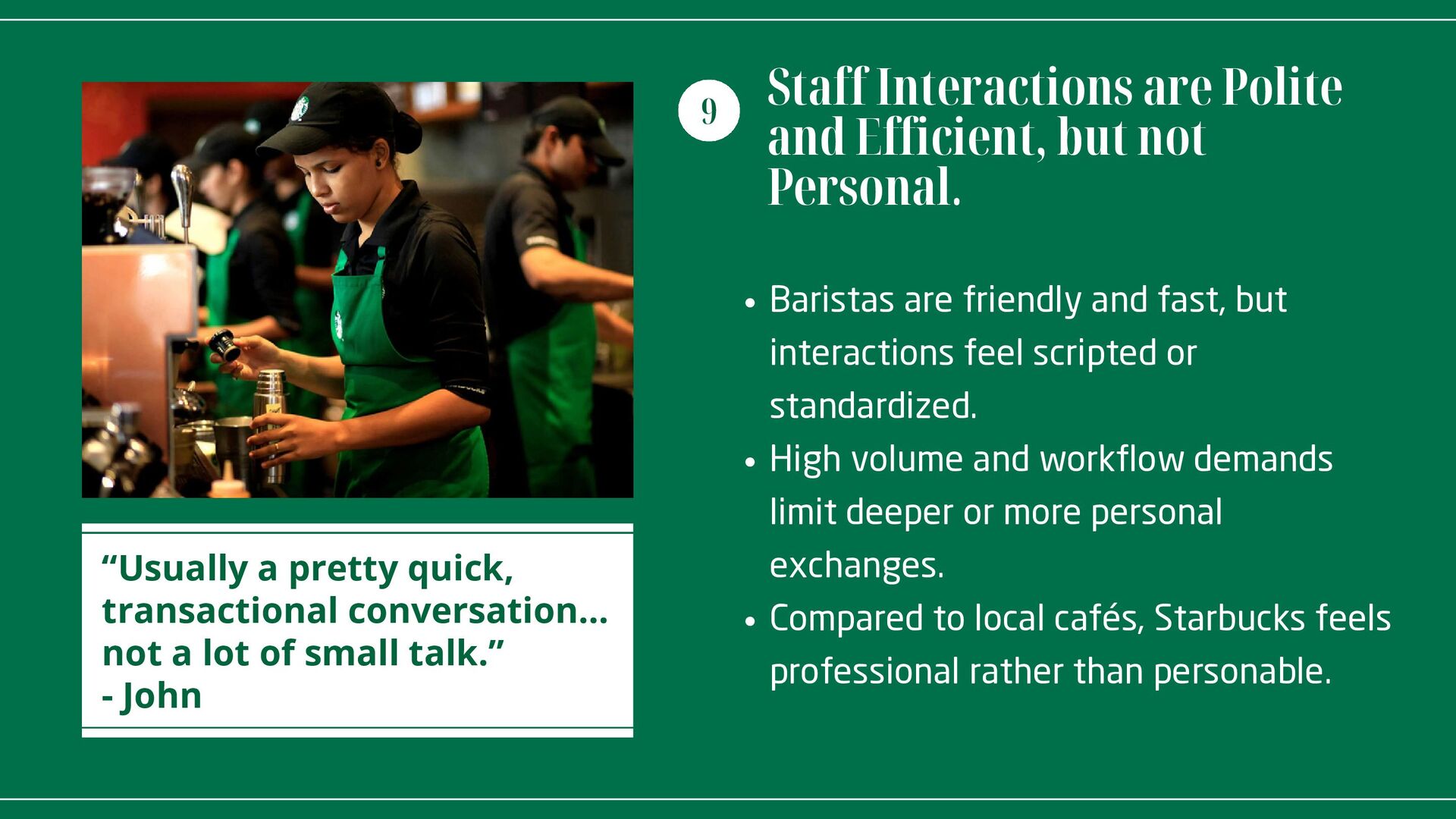
of small talk.” - John Staff Interactions are Polite and Efficient, but not Personal. Baristas are friendly and fast, but interactions feel scripted or standardized. High volume and workflow demands limit deeper or more personal exchanges. Compared to local cafés, Starbucks feels professional rather than personable.
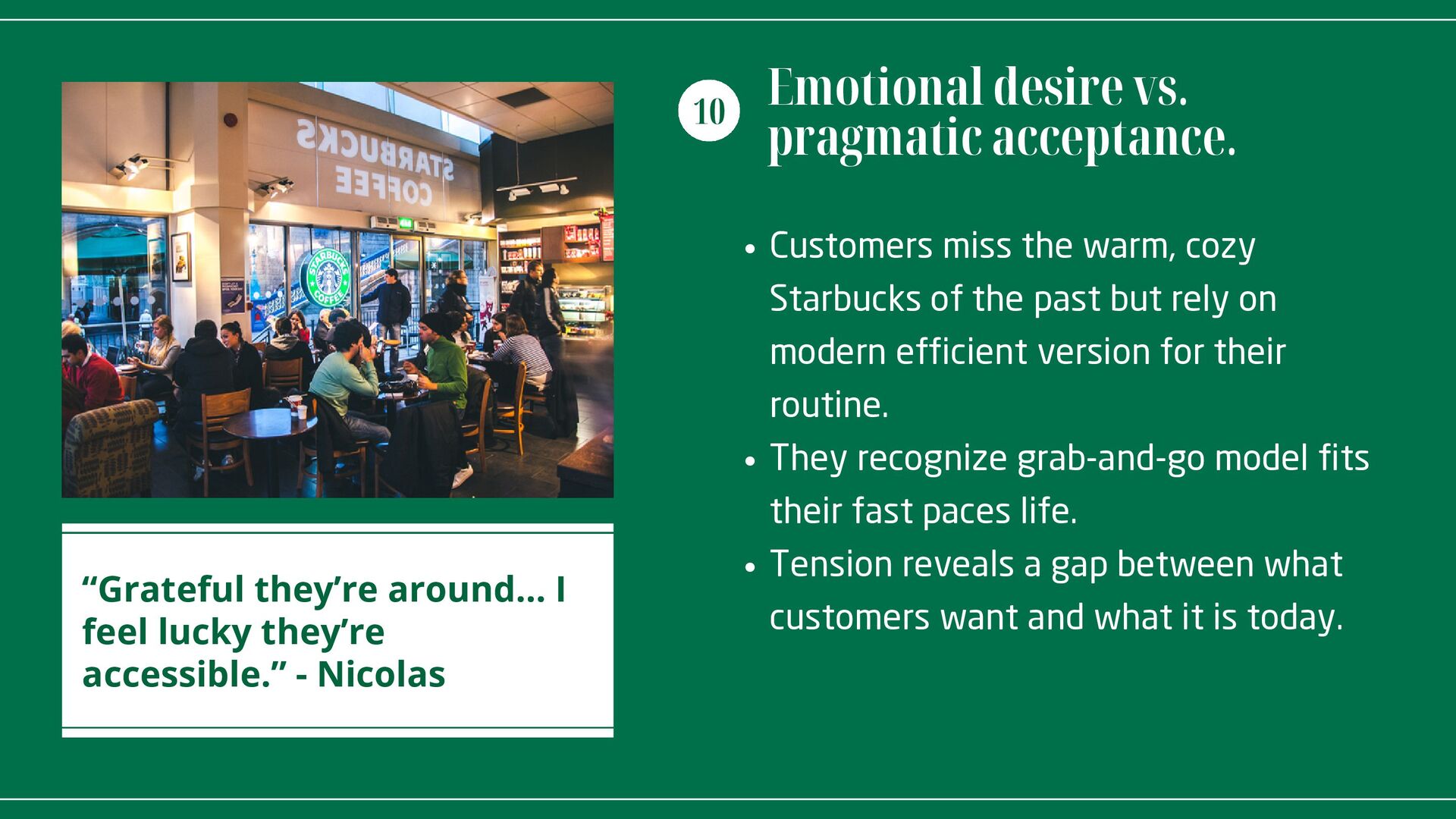
Nicolas Emotional desire vs. pragmatic acceptance. Customers miss the warm, cozy Starbucks of the past but rely on modern efficient version for their routine. They recognize grab-and-go model fits their fast paces life. Tension reveals a gap between what customers want and what it is today.
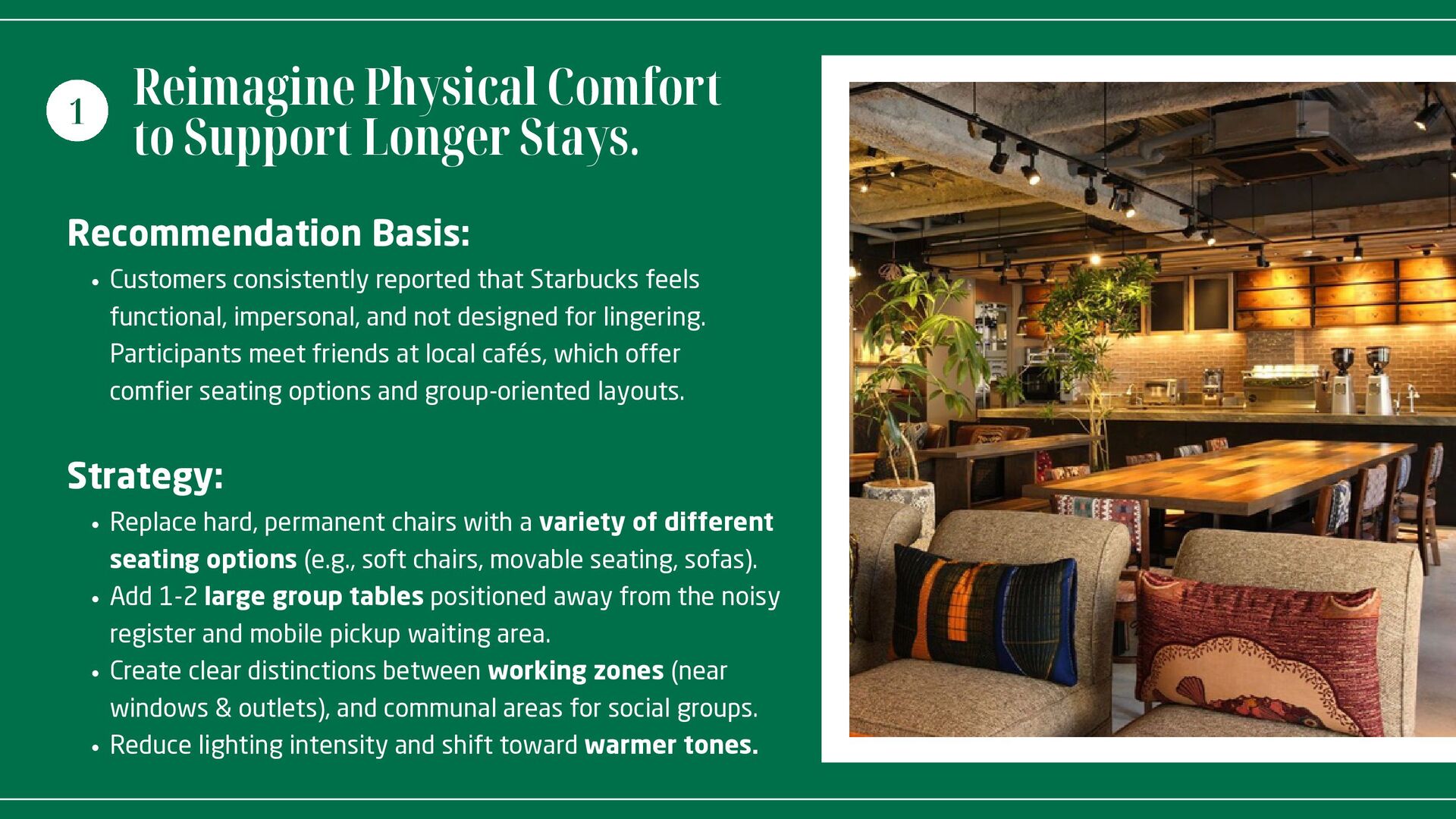
Customers consistently reported that Starbucks feels functional, impersonal, and not designed for lingering. Participants meet friends at local cafés, which offer comfier seating options and group-oriented layouts. Strategy: Replace hard, permanent chairs with a variety of different seating options (e.g., soft chairs, movable seating, sofas). Add 1-2 large group tables positioned away from the noisy register and mobile pickup waiting area. Create clear distinctions between working zones (near windows & outlets), and communal areas for social groups. Reduce lighting intensity and shift toward warmer tones.
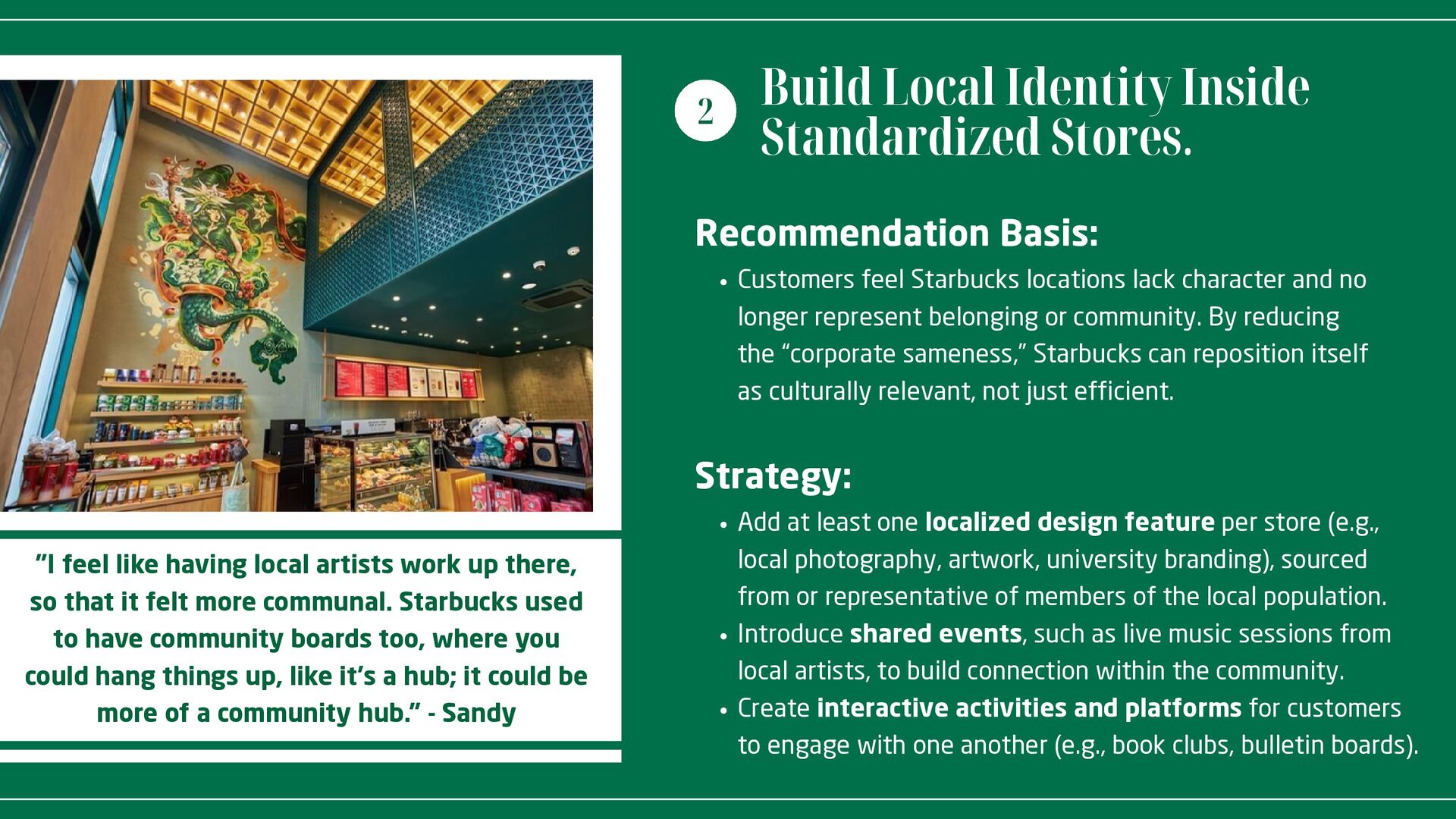
feel Starbucks locations lack character and no longer represent belonging or community. By reducing the “corporate sameness,” Starbucks can reposition itself as culturally relevant, not just efficient. Strategy: Add at least one localized design feature per store (e.g., local photography, artwork, university branding), sourced from or representative of members of the local population. Introduce shared events, such as live music sessions from local artists, to build connection within the community. Create interactive activities and platforms for customers to engage with one another (e.g., book clubs, bulletin boards). "I feel like having local artists work up there, so that it felt more communal. Starbucks used to have community boards too, where you could hang things up, like it's a hub; it could be more of a community hub." - Sandy
expressed confusion about what Starbucks stands for today, noting that the brand feels more corporate than value-driven. Starbucks can rebuild trust by visibly displaying and acting on its ethical brand roots. Strategy: Highlight “Community Contributions” through in-store signage, such as local partnerships, “pounds of beans ethically sourced,” and barista’s hired from the community. Promote the use of sustainable materials (e.g., cups, straws, tumblers) through posted descriptions of the products, and offer them via consistent free giveaways.


 varn
 notwaldorf
 afnizarnur
 stephaniewalter
 bermonpainter
 watany
 jacobian
 helmedeiros
 akashhashmi
 tmiket
 aleyda
 rmw