Ferguson. • Los Angeles-based, originally from Long Island NY • Areas of focus - Product Management, Web Development, and Technical Writing, focusing on early-stage content-driven businesses: fintech, and web3 domains’, specifically • Product discovery and user research • Business, creative and content strategist • UI/ UX research and design • Process implementation, for both project and business-level controls Slide Deck Overview : In this presentation I will be working through a theoretical product case for Carter’s mobile applications. This slide is a showcase of a product-case exercise that I completed, January 2022.
traded, leading multinational children’s apparel company, operating physical stores, eCommerce websites, and mobile applications –Maintains the largest market share of apparel in the children’s and toddler’s, segments. CRI owns and operates both Carter’s and OshKosh B’gosh stores Mission statement: “At Carter’s, we embrace creative leadership, innovative teamwork and a winning spirit to be the best for the benefit of our customers, our consumers, our employees and our shareholders • Owns and operates 750 retail locations across North America, and worldwide - this space has seen a dramatic increase in closures due to constraints brought on by COVID-19 and the changing business landscape ; push to eCommerce (Secular market shift to online) • Business goals & themes 2021: Forced to rethink our business model by optimizing supply-chain, strengthening our technology, and the in-store experience ◦ Supply chain optimization, rebalancing of inbound freight, 50% east and 50% west-coast - store supported fulfillment accounting for 25% of all online sales, and same day delivery
the same theme, and further strengthen our omni channel shopping experience by innovating on top of our existing tech-stack • Fiscal year 2021, company goal: Strengthen omnichannel capabilities by investing heavily in tech • Changing business and market conditions: COVID- 19 has forced retailers to reevaluate their business strategies by adopting new, and more innovative solutions that bring more immersive and personalized shopping experiences into the customer’s home - 25% of retail locations closed, 200-stores • Hybrid retail: Year-long effort to shape the online shopping experience, improved product presentations, navigation, search, checkout experience, and general usability improvements • Synthesis: Our strategy for 2022, and beyond must consider how we can continue to support our physical stores by amalgamating our business channels into a more unified experience
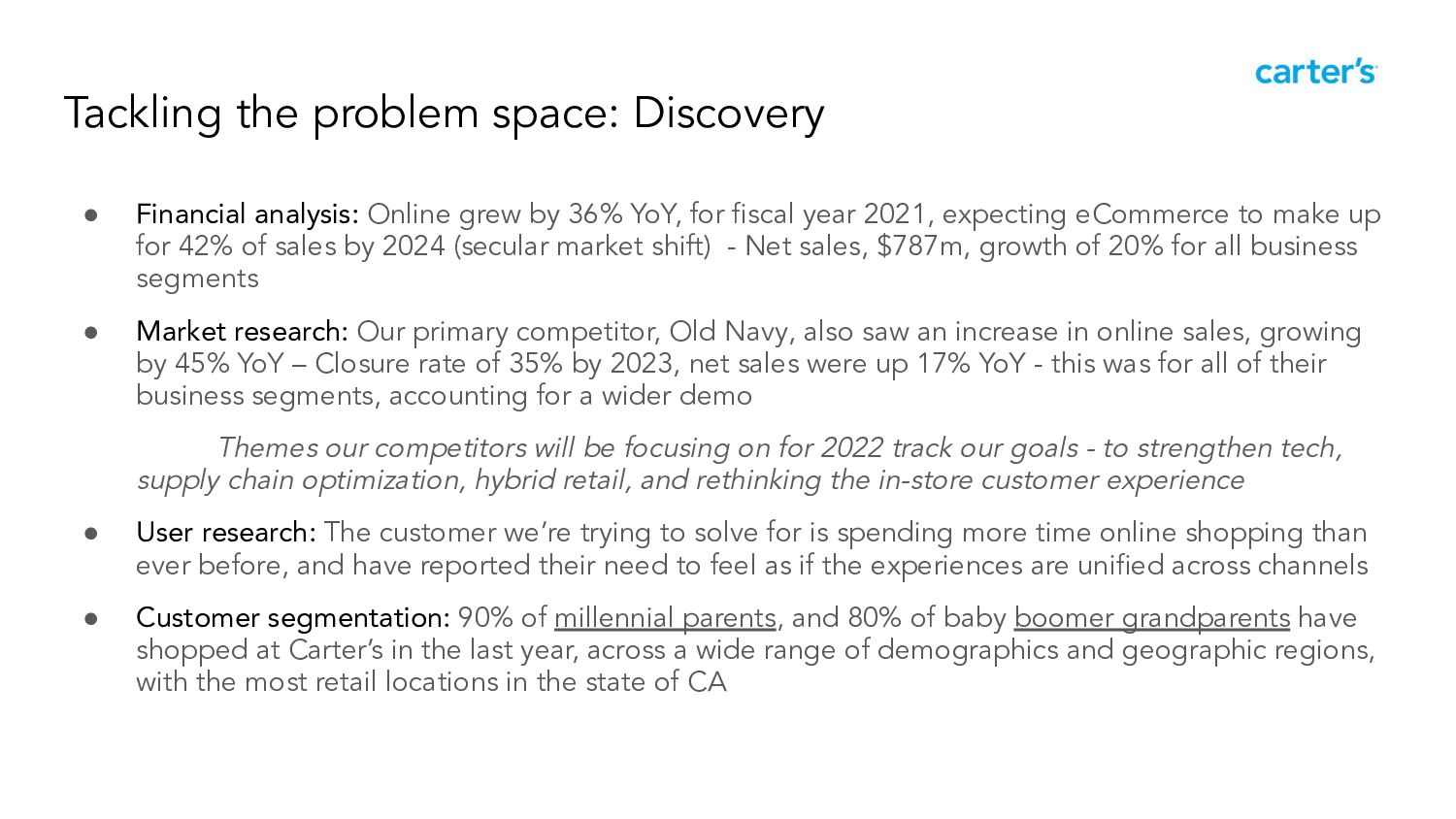
by 36% YoY, for fiscal year 2021, expecting eCommerce to make up for 42% of sales by 2024 (secular market shift) - Net sales, $787m, growth of 20% for all business segments • Market research: Our primary competitor, Old Navy, also saw an increase in online sales, growing by 45% YoY – Closure rate of 35% by 2023, net sales were up 17% YoY - this was for all of their business segments, accounting for a wider demo Themes our competitors will be focusing on for 2022 track our goals - to strengthen tech, supply chain optimization, hybrid retail, and rethinking the in-store customer experience • User research: The customer we’re trying to solve for is spending more time online shopping than ever before, and have reported their need to feel as if the experiences are unified across channels • Customer segmentation: 90% of millennial parents, and 80% of baby boomer grandparents have shopped at Carter’s in the last year, across a wide range of demographics and geographic regions, with the most retail locations in the state of CA
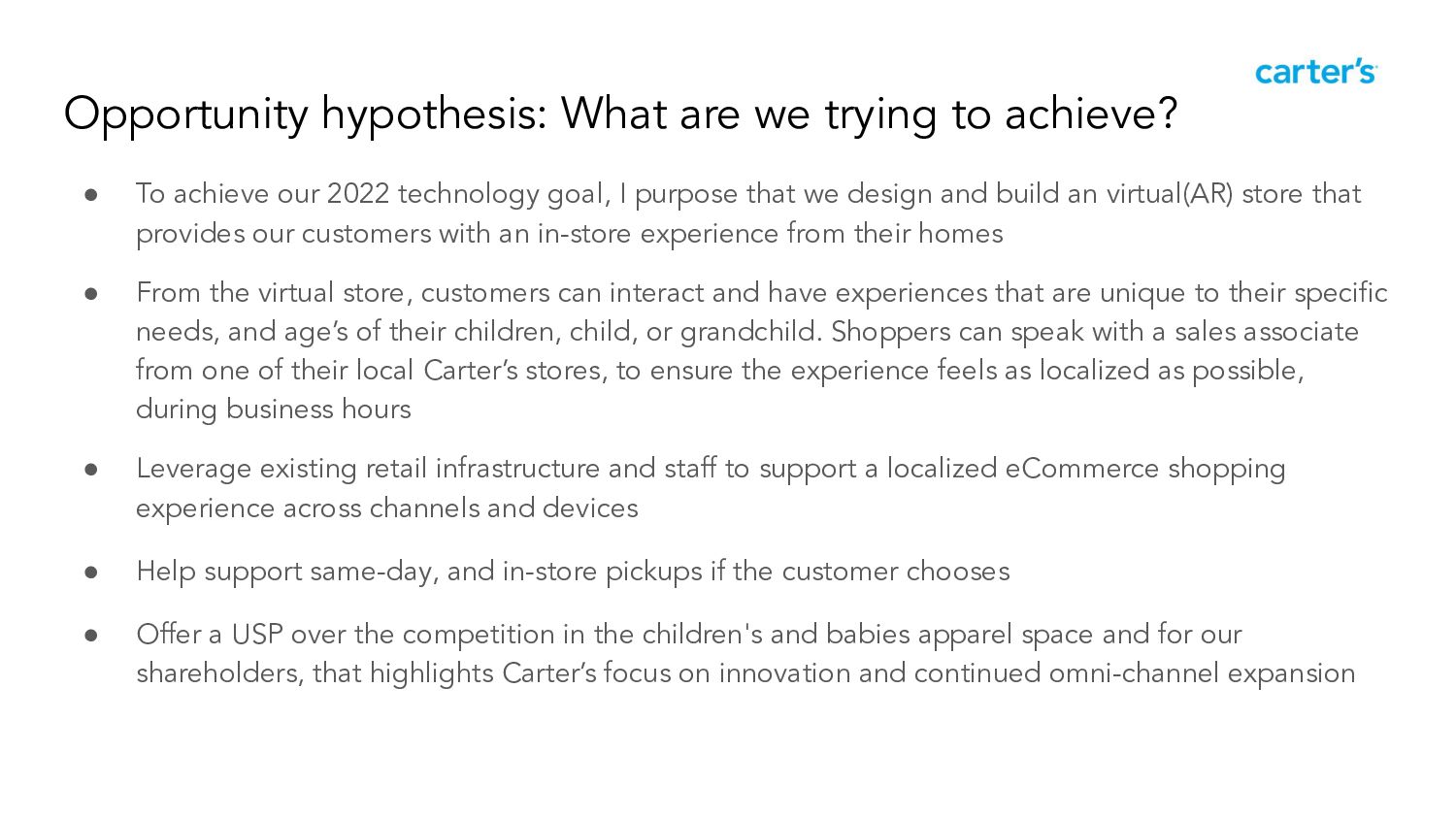
achieve our 2022 technology goal, I purpose that we design and build an virtual(AR) store that provides our customers with an in-store experience from their homes • From the virtual store, customers can interact and have experiences that are unique to their specific needs, and age’s of their children, child, or grandchild. Shoppers can speak with a sales associate from one of their local Carter’s stores, to ensure the experience feels as localized as possible, during business hours • Leverage existing retail infrastructure and staff to support a localized eCommerce shopping experience across channels and devices • Help support same-day, and in-store pickups if the customer chooses • Offer a USP over the competition in the children's and babies apparel space and for our shareholders, that highlights Carter’s focus on innovation and continued omni-channel expansion
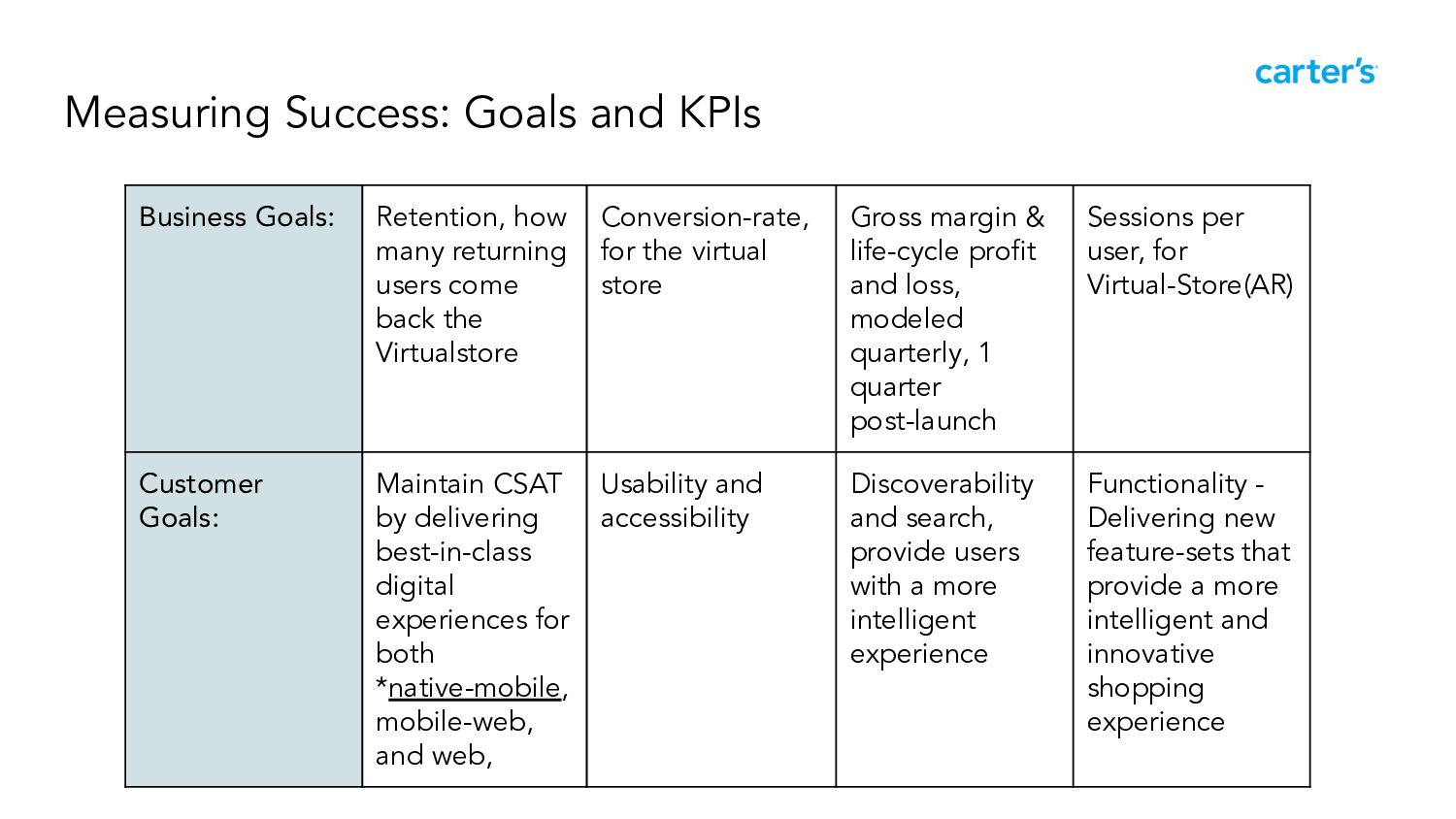
returning users come back the Virtualstore Conversion-rate, for the virtual store Gross margin & life-cycle profit and loss, modeled quarterly, 1 quarter post-launch Sessions per user, for Virtual-Store(AR) Customer Goals: Maintain CSAT by delivering best-in-class digital experiences for both *native-mobile, mobile-web, and web, Usability and accessibility Discoverability and search, provide users with a more intelligent experience Functionality - Delivering new feature-sets that provide a more intelligent and innovative shopping experience
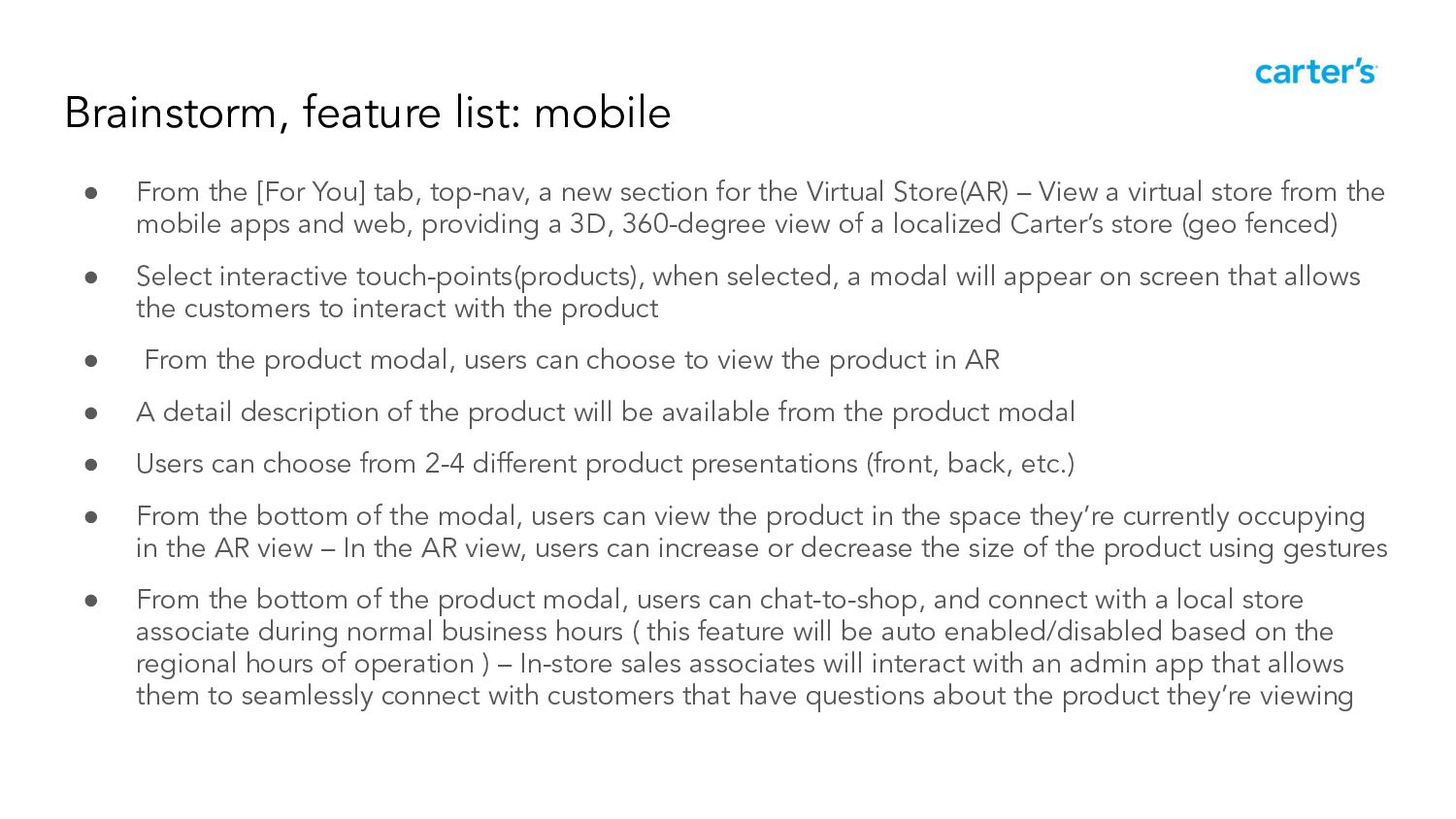
top-nav, a new section for the Virtual Store(AR) – View a virtual store from the mobile apps and web, providing a 3D, 360-degree view of a localized Carter’s store (geo fenced) • Select interactive touch-points(products), when selected, a modal will appear on screen that allows the customers to interact with the product • From the product modal, users can choose to view the product in AR • A detail description of the product will be available from the product modal • Users can choose from 2-4 different product presentations (front, back, etc.) • From the bottom of the modal, users can view the product in the space they’re currently occupying in the AR view – In the AR view, users can increase or decrease the size of the product using gestures • From the bottom of the product modal, users can chat-to-shop, and connect with a local store associate during normal business hours ( this feature will be auto enabled/disabled based on the regional hours of operation ) – In-store sales associates will interact with an admin app that allows them to seamlessly connect with customers that have questions about the product they’re viewing
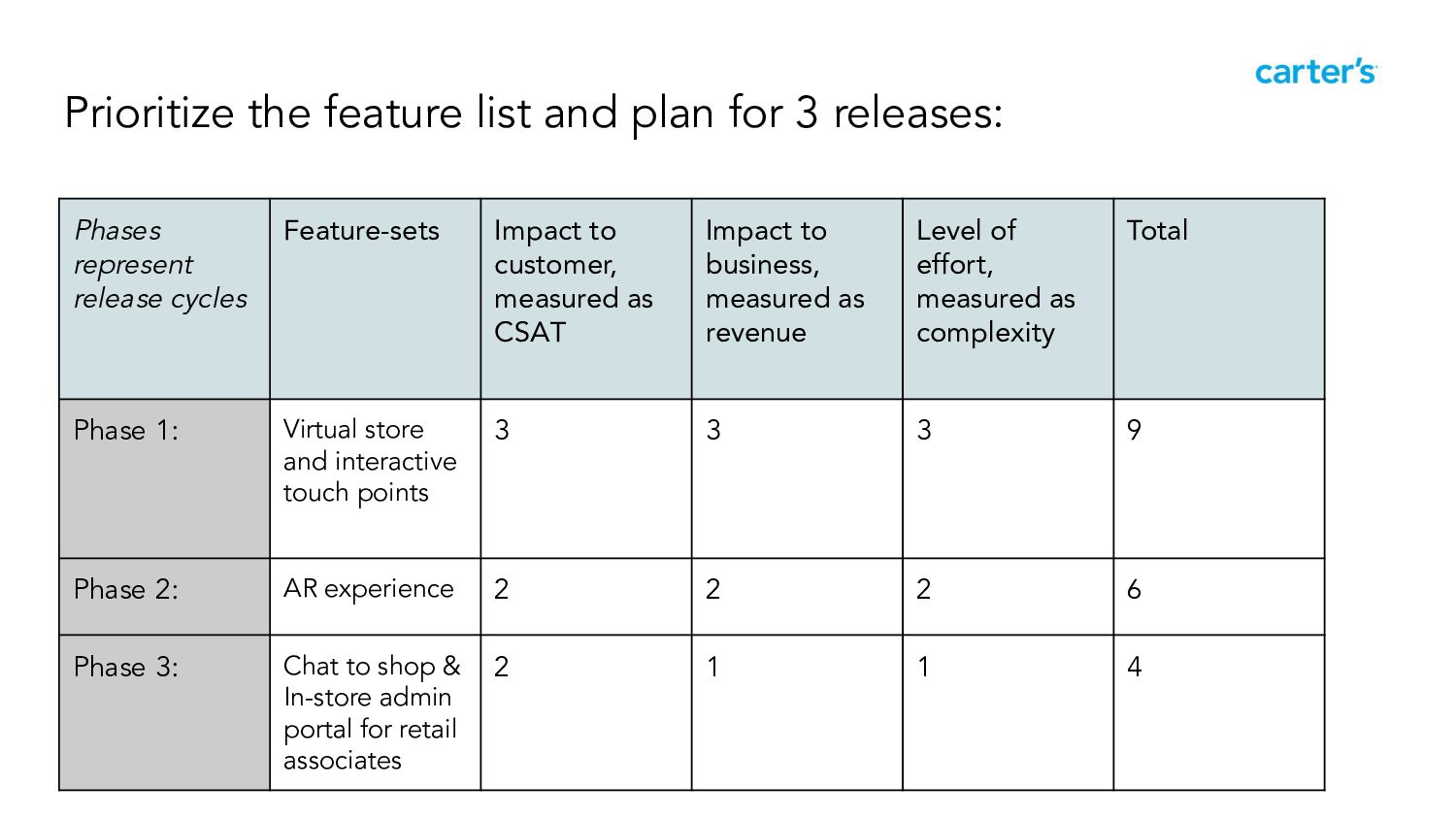
represent release cycles Feature-sets Impact to customer, measured as CSAT Impact to business, measured as revenue Level of effort, measured as complexity Total Phase 1: Virtual store and interactive touch points 3 3 3 9 Phase 2: AR experience 2 2 2 6 Phase 3: Chat to shop & In-store admin portal for retail associates 2 1 1 4
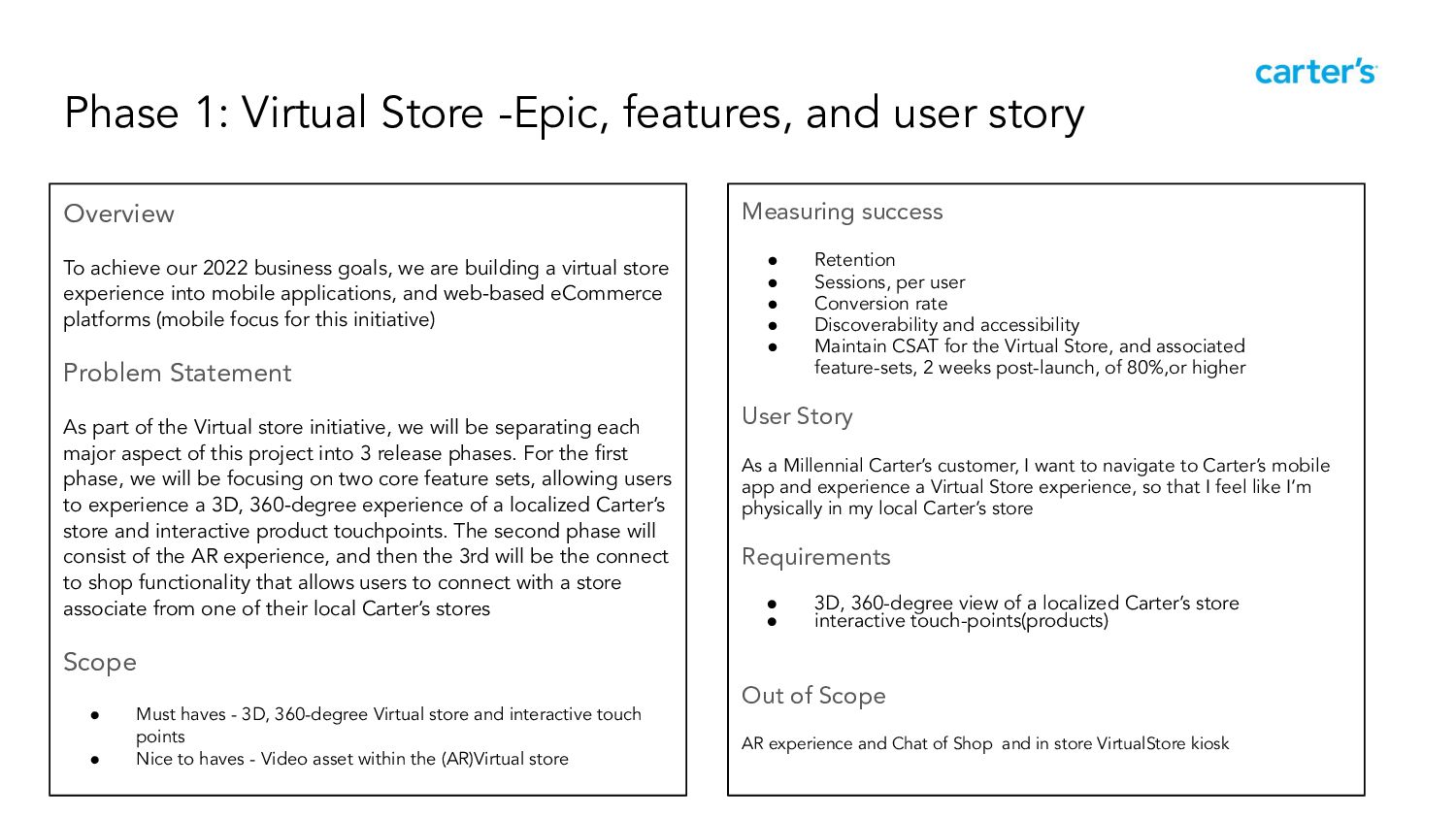
To achieve our 2022 business goals, we are building a virtual store experience into mobile applications, and web-based eCommerce platforms (mobile focus for this initiative) Problem Statement As part of the Virtual store initiative, we will be separating each major aspect of this project into 3 release phases. For the first phase, we will be focusing on two core feature sets, allowing users to experience a 3D, 360-degree experience of a localized Carter’s store and interactive product touchpoints. The second phase will consist of the AR experience, and then the 3rd will be the connect to shop functionality that allows users to connect with a store associate from one of their local Carter’s stores Scope • Must haves - 3D, 360-degree Virtual store and interactive touch points • Nice to haves - Video asset within the (AR)Virtual store Measuring success • Retention • Sessions, per user • Conversion rate • Discoverability and accessibility • Maintain CSAT for the Virtual Store, and associated feature-sets, 2 weeks post-launch, of 80%,or higher User Story As a Millennial Carter’s customer, I want to navigate to Carter’s mobile app and experience a Virtual Store experience, so that I feel like I’m physically in my local Carter’s store Requirements • 3D, 360-degree view of a localized Carter’s store • interactive touch-points(products) Out of Scope AR experience and Chat of Shop and in store VirtualStore kiosk
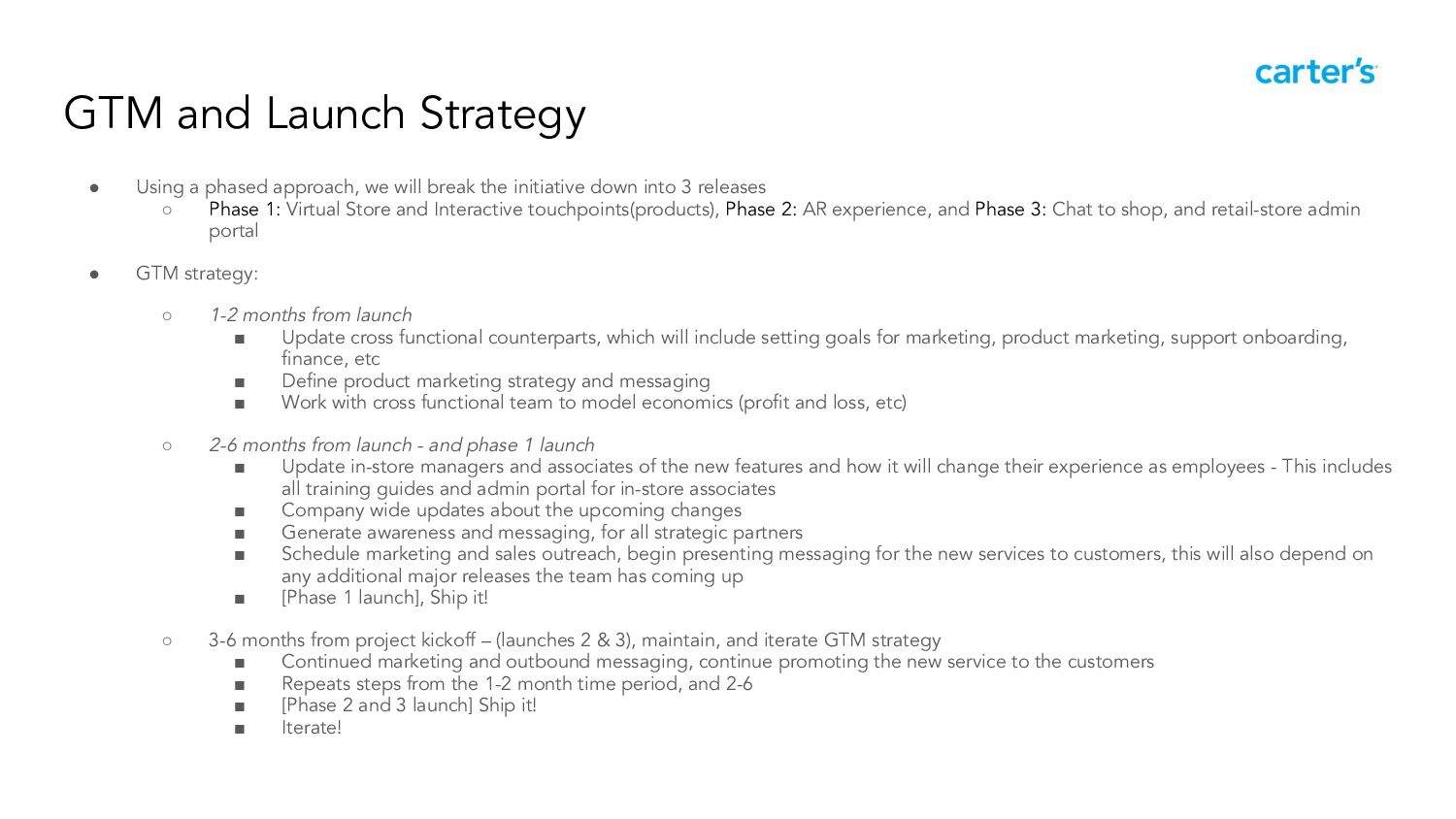
will break the initiative down into 3 releases ◦ Phase 1: Virtual Store and Interactive touchpoints(products), Phase 2: AR experience, and Phase 3: Chat to shop, and retail-store admin portal • GTM strategy: ◦ 1-2 months from launch ▪ Update cross functional counterparts, which will include setting goals for marketing, product marketing, support onboarding, finance, etc ▪ Define product marketing strategy and messaging ▪ Work with cross functional team to model economics (profit and loss, etc) ◦ 2-6 months from launch - and phase 1 launch ▪ Update in-store managers and associates of the new features and how it will change their experience as employees - This includes all training guides and admin portal for in-store associates ▪ Company wide updates about the upcoming changes ▪ Generate awareness and messaging, for all strategic partners ▪ Schedule marketing and sales outreach, begin presenting messaging for the new services to customers, this will also depend on any additional major releases the team has coming up ▪ [Phase 1 launch], Ship it! ◦ 3-6 months from project kickoff – (launches 2 & 3), maintain, and iterate GTM strategy ▪ Continued marketing and outbound messaging, continue promoting the new service to the customers ▪ Repeats steps from the 1-2 month time period, and 2-6 ▪ [Phase 2 and 3 launch] Ship it! ▪ Iterate!
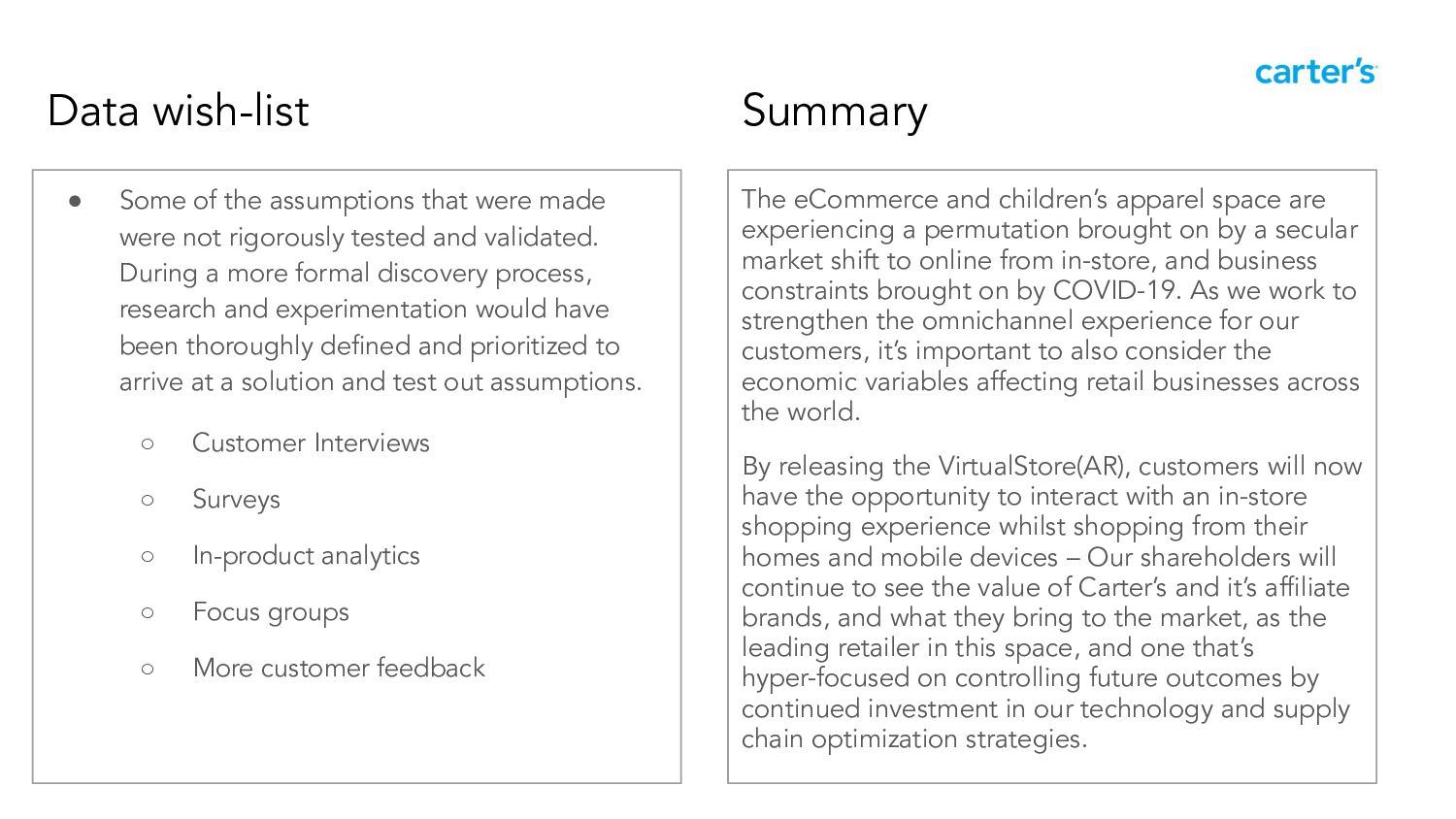
permutation brought on by a secular market shift to online from in-store, and business constraints brought on by COVID-19. As we work to strengthen the omnichannel experience for our customers, it’s important to also consider the economic variables affecting retail businesses across the world. By releasing the VirtualStore(AR), customers will now have the opportunity to interact with an in-store shopping experience whilst shopping from their homes and mobile devices – Our shareholders will continue to see the value of Carter’s and it’s affiliate brands, and what they bring to the market, as the leading retailer in this space, and one that’s hyper-focused on controlling future outcomes by continued investment in our technology and supply chain optimization strategies. • Some of the assumptions that were made were not rigorously tested and validated. During a more formal discovery process, research and experimentation would have been thoroughly defined and prioritized to arrive at a solution and test out assumptions. ◦ Customer Interviews ◦ Surveys ◦ In-product analytics ◦ Focus groups ◦ More customer feedback Data wish-list


 taylorjalpha
 reverentgeek
 tenderlove
 davidcarrasco
 takai
 baasie
 davetheseo
 pwiseman
 addyosmani
 skipperchong
 samlambert
 lindahogenes