Upgrade to Pro — share decks privately, control downloads, hide ads and more …

Pessimism, optimism, realism and Django databas...

Pessimism, optimism, realism and Django database concurrency

Most developers know a thing or two about multi-threading and concurrent programming. But the database often is treated as a black box not behaving as we expect it to and leading to weird bugs. We will look at concurrency in the database through programming language concepts and try to understand what happens behind the scenes of pessimistic and optimistic locking. We will discover how to use Django ORM and database locking and blocking to achieve correct, concurrent, and performant database updates.

Avatar for Aivars Kalvāns

Aivars Kalvāns

May 26, 2023

Other Decks in Programming

Transcript

  1. Me 2002 - 2020 @ TietoEvry (Payment cards) C++, SQL,

    Python, … Hundreds and thousands of transactions per second 2021 - now @ Ebury (Forex, Payments) Python, ORM, Kafka, Kubernetes, AWS, … Hundreds of thousands of € per transaction
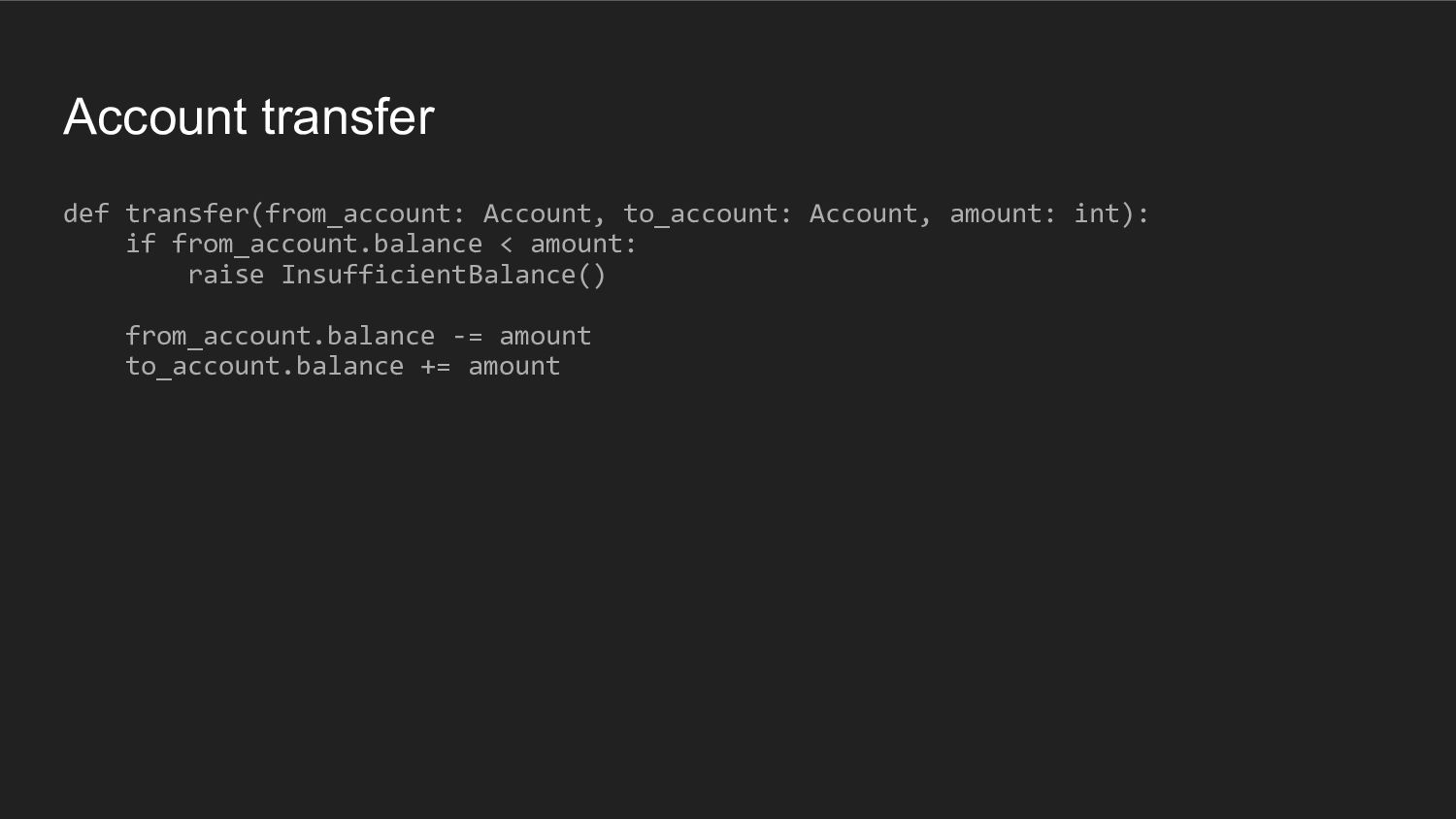
  2. Account transfer def transfer(from_account: Account, to_account: Account, amount: int): if

    from_account.balance < amount: raise InsufficientBalance() from_account.balance -= amount to_account.balance += amount
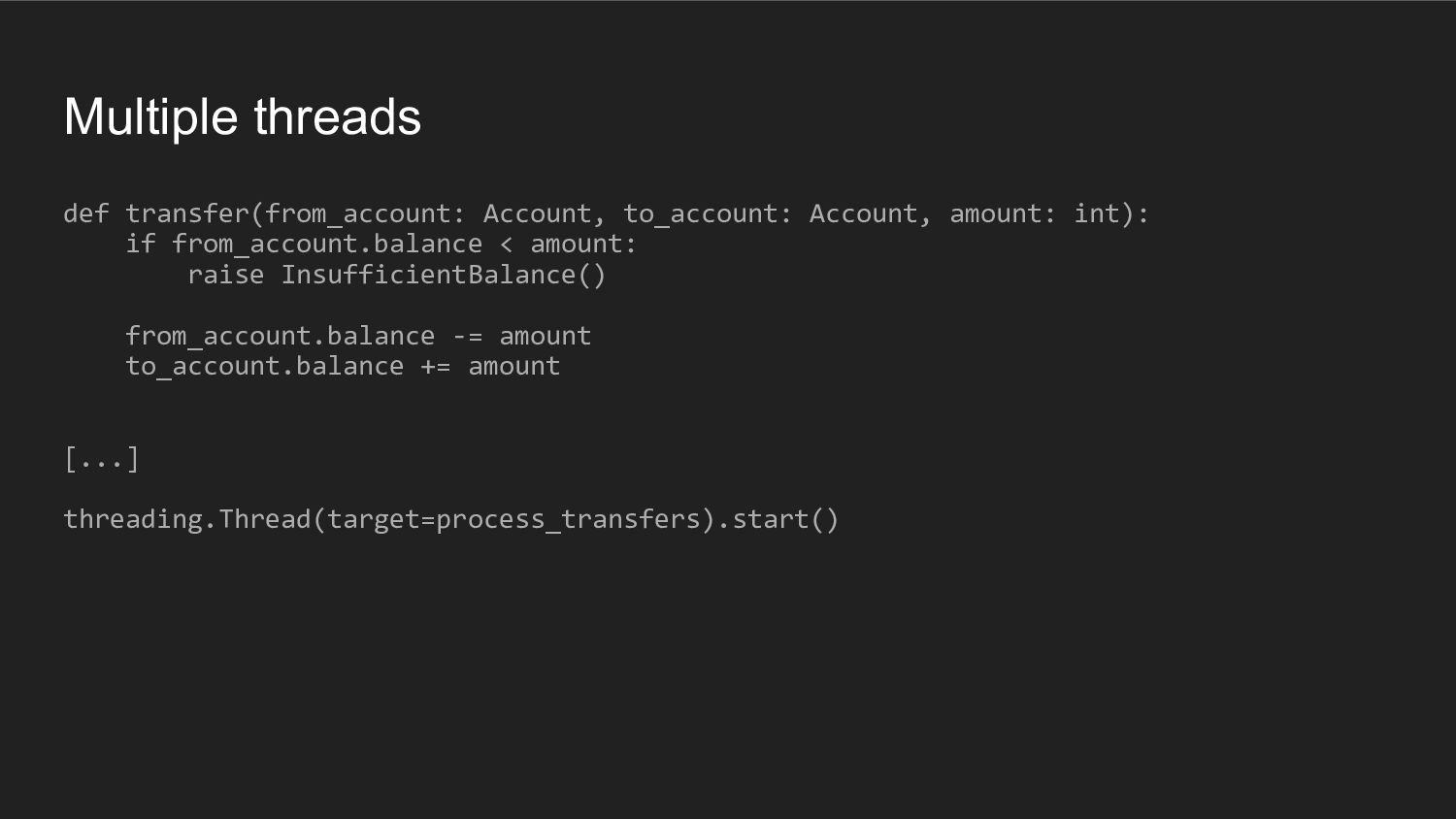
  3. Multiple threads def transfer(from_account: Account, to_account: Account, amount: int): if

    from_account.balance < amount: raise InsufficientBalance() from_account.balance -= amount to_account.balance += amount [...] threading.Thread(target=process_transfers).start()
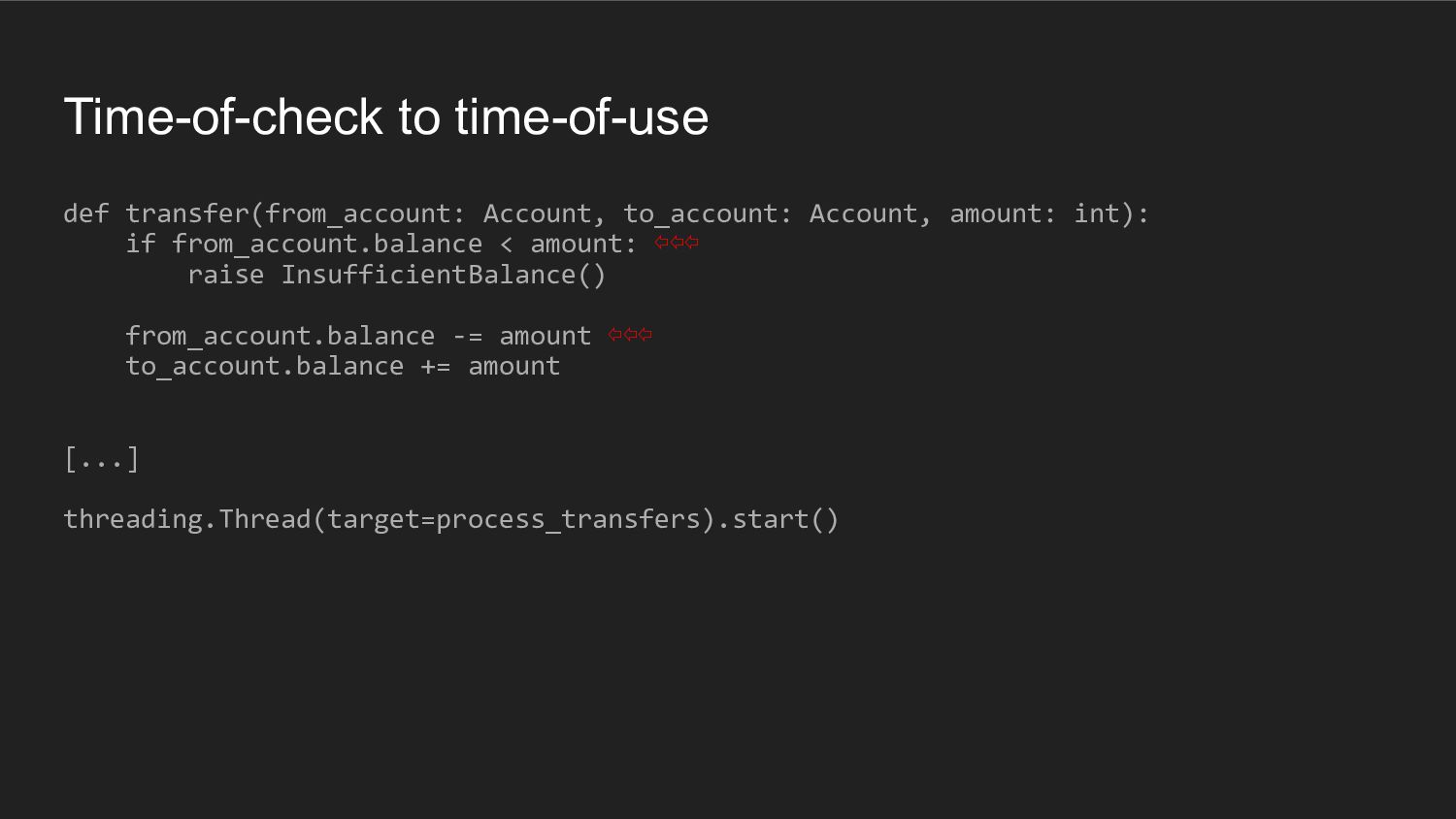
  4. Time-of-check to time-of-use def transfer(from_account: Account, to_account: Account, amount: int):

    if from_account.balance < amount: ⇦⇦⇦ raise InsufficientBalance() from_account.balance -= amount ⇦⇦⇦ to_account.balance += amount [...] threading.Thread(target=process_transfers).start()
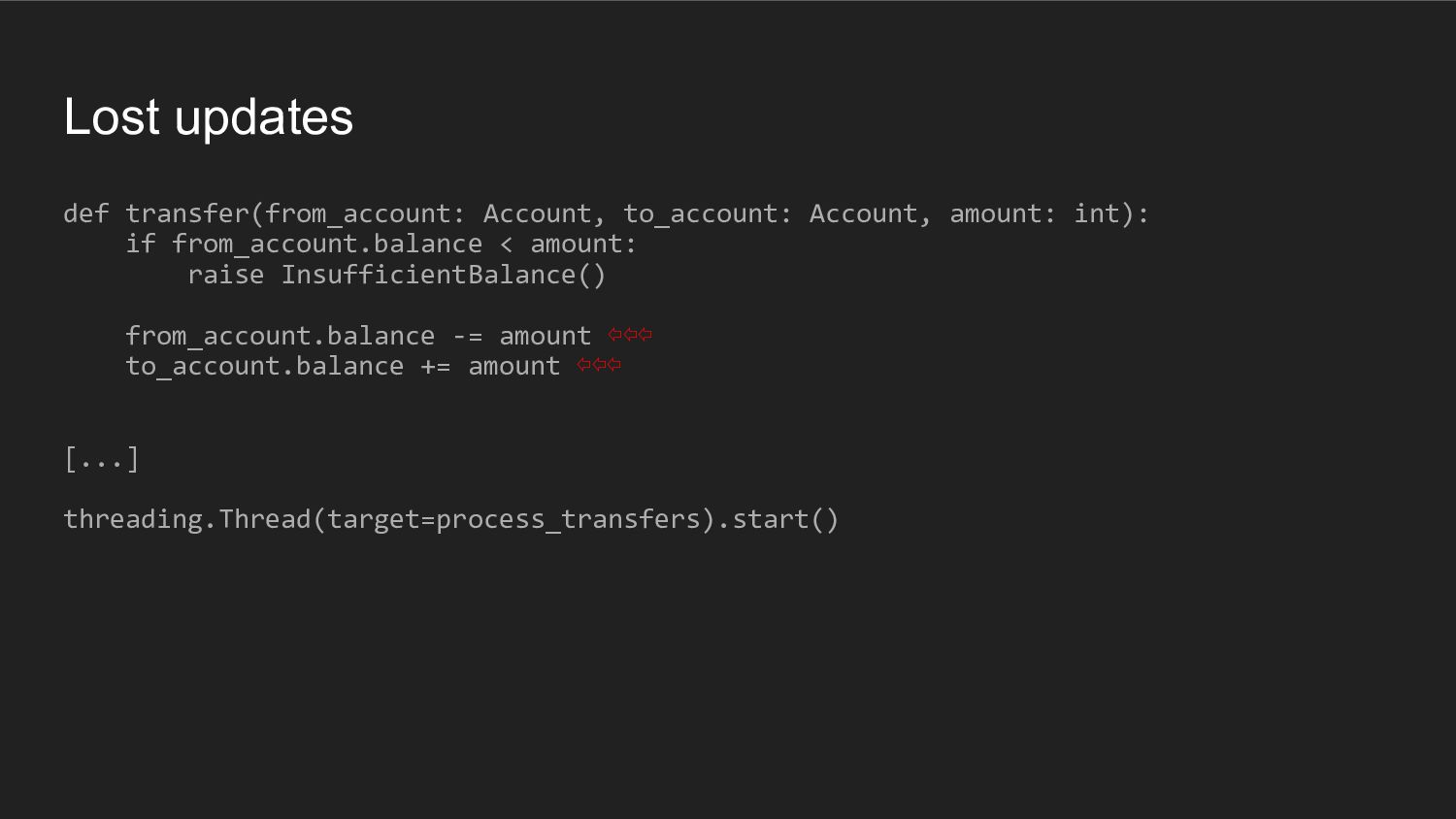
  5. Lost updates def transfer(from_account: Account, to_account: Account, amount: int): if

    from_account.balance < amount: raise InsufficientBalance() from_account.balance -= amount ⇦⇦⇦ to_account.balance += amount ⇦⇦⇦ [...] threading.Thread(target=process_transfers).start()
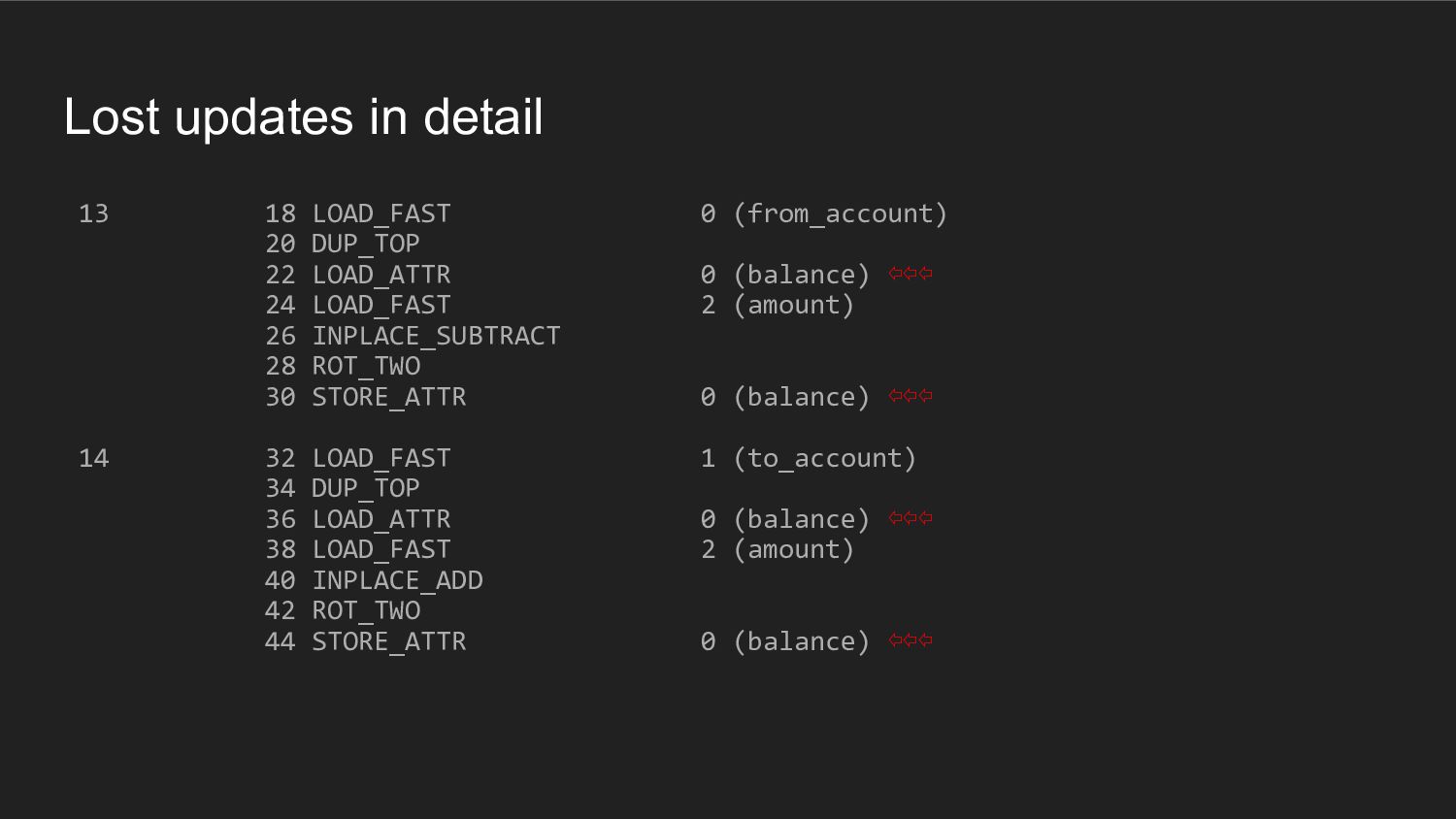
  6. Lost updates in detail 13 18 LOAD_FAST 0 (from_account) 20

    DUP_TOP 22 LOAD_ATTR 0 (balance) ⇦⇦⇦ 24 LOAD_FAST 2 (amount) 26 INPLACE_SUBTRACT 28 ROT_TWO 30 STORE_ATTR 0 (balance) ⇦⇦⇦ 14 32 LOAD_FAST 1 (to_account) 34 DUP_TOP 36 LOAD_ATTR 0 (balance) ⇦⇦⇦ 38 LOAD_FAST 2 (amount) 40 INPLACE_ADD 42 ROT_TWO 44 STORE_ATTR 0 (balance) ⇦⇦⇦
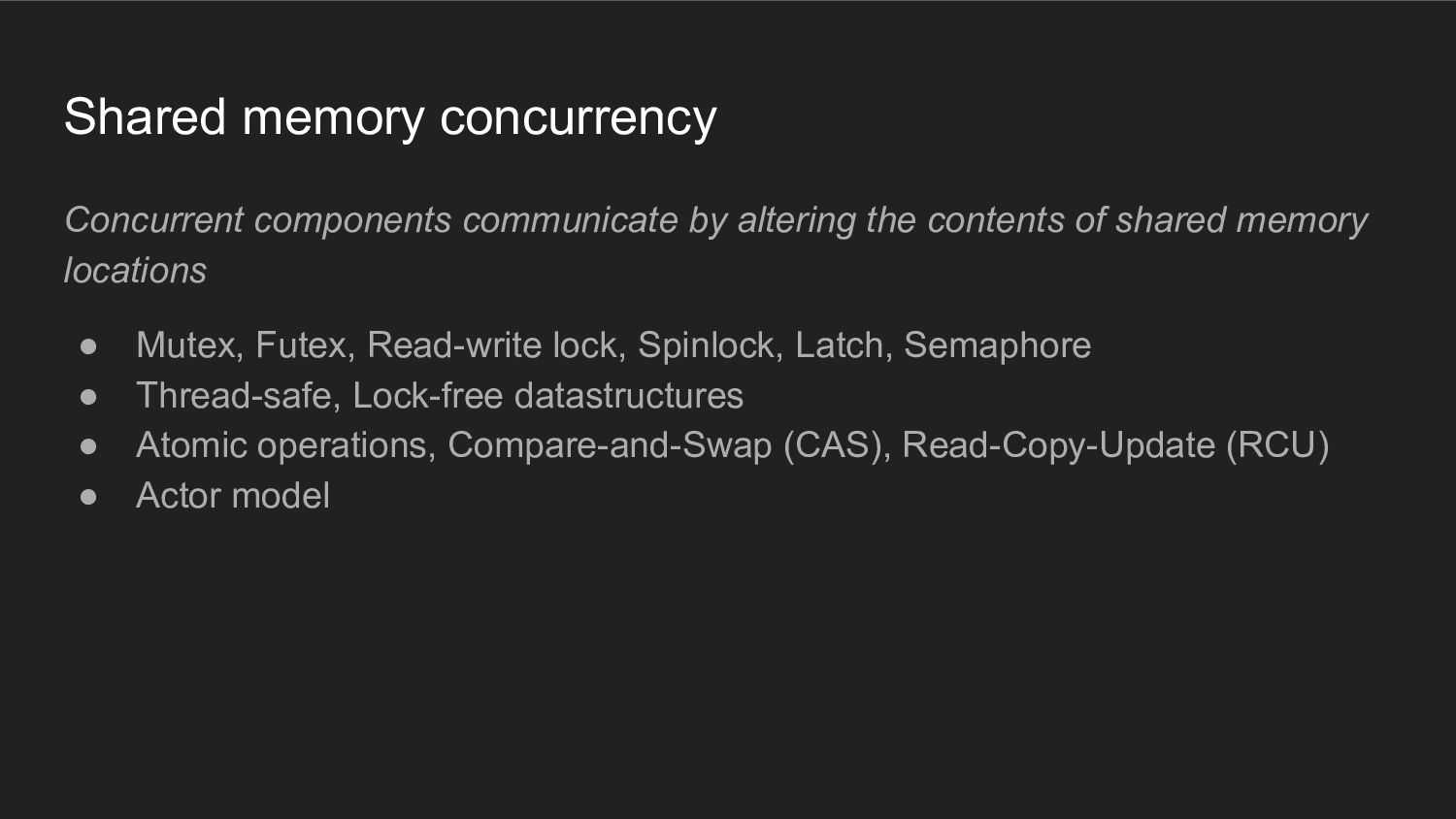
  7. Shared memory concurrency Concurrent components communicate by altering the contents

    of shared memory locations • Mutex, Futex, Read-write lock, Spinlock, Latch, Semaphore • Thread-safe, Lock-free datastructures • Atomic operations, Compare-and-Swap (CAS), Read-Copy-Update (RCU) • Actor model
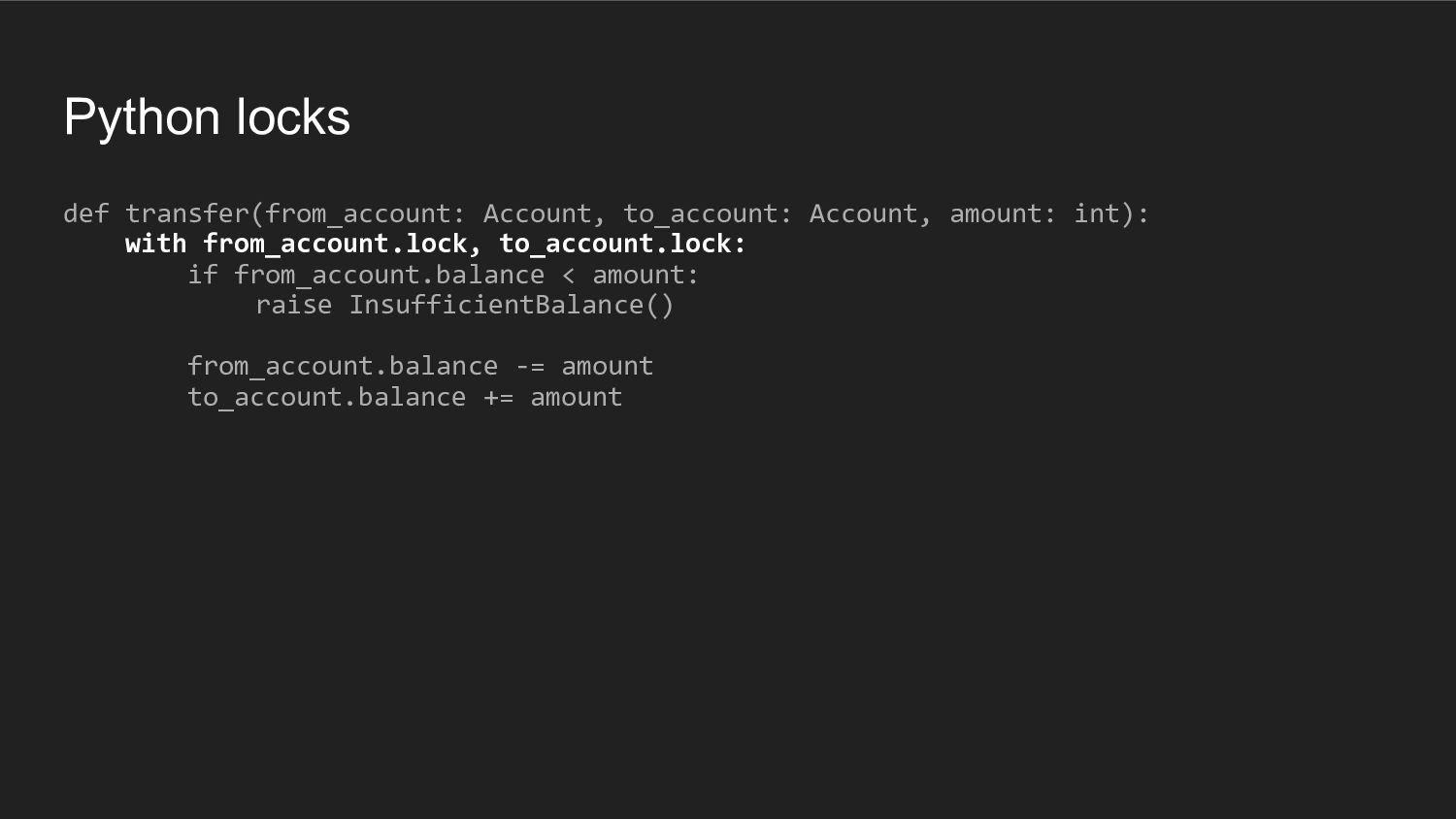
  8. Python locks def transfer(from_account: Account, to_account: Account, amount: int): with

    from_account.lock, to_account.lock: if from_account.balance < amount: raise InsufficientBalance() from_account.balance -= amount to_account.balance += amount
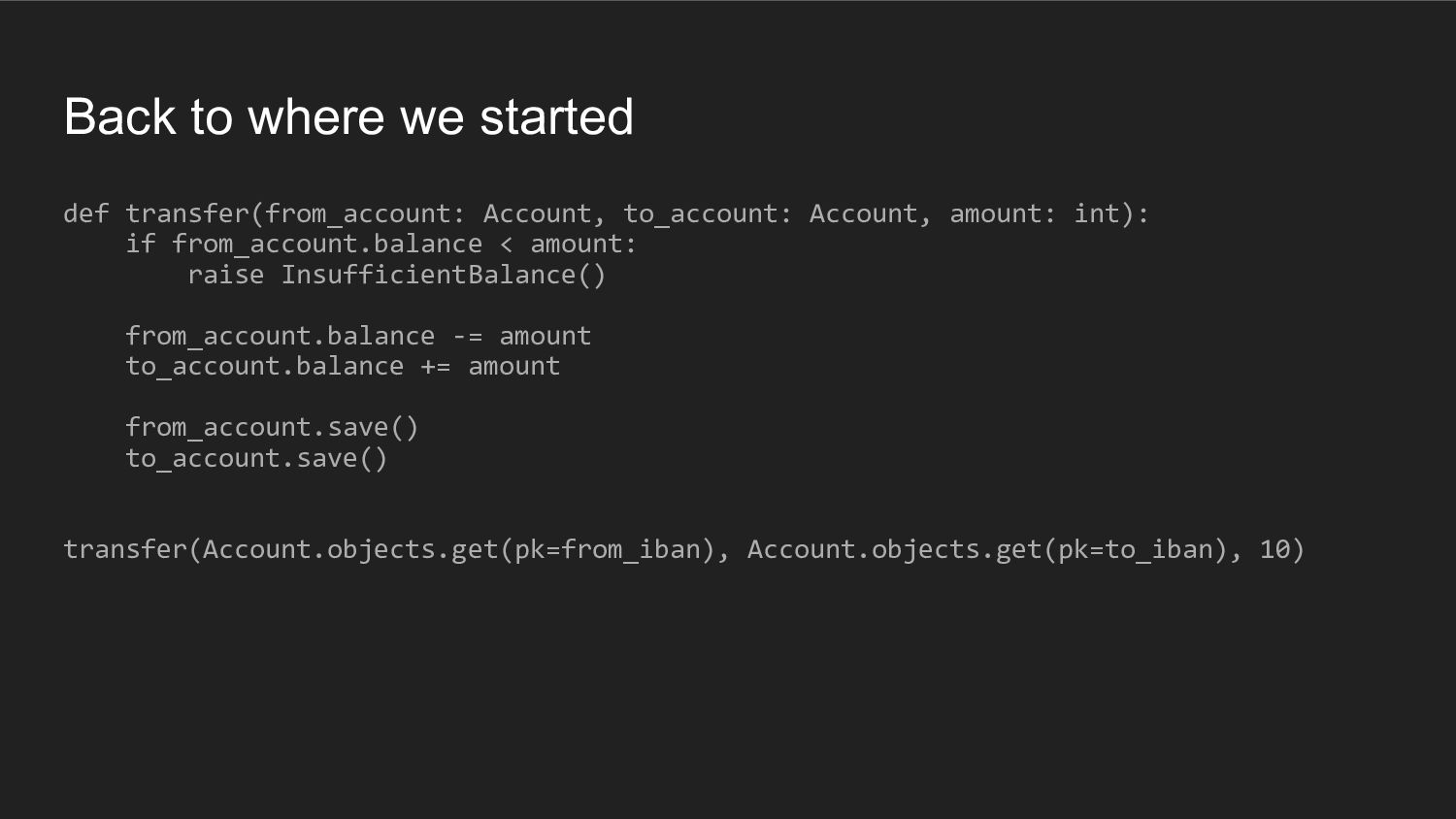
  9. Back to where we started def transfer(from_account: Account, to_account: Account,

    amount: int): if from_account.balance < amount: raise InsufficientBalance() from_account.balance -= amount to_account.balance += amount from_account.save() to_account.save() transfer(Account.objects.get(pk=from_iban), Account.objects.get(pk=to_iban), 10)
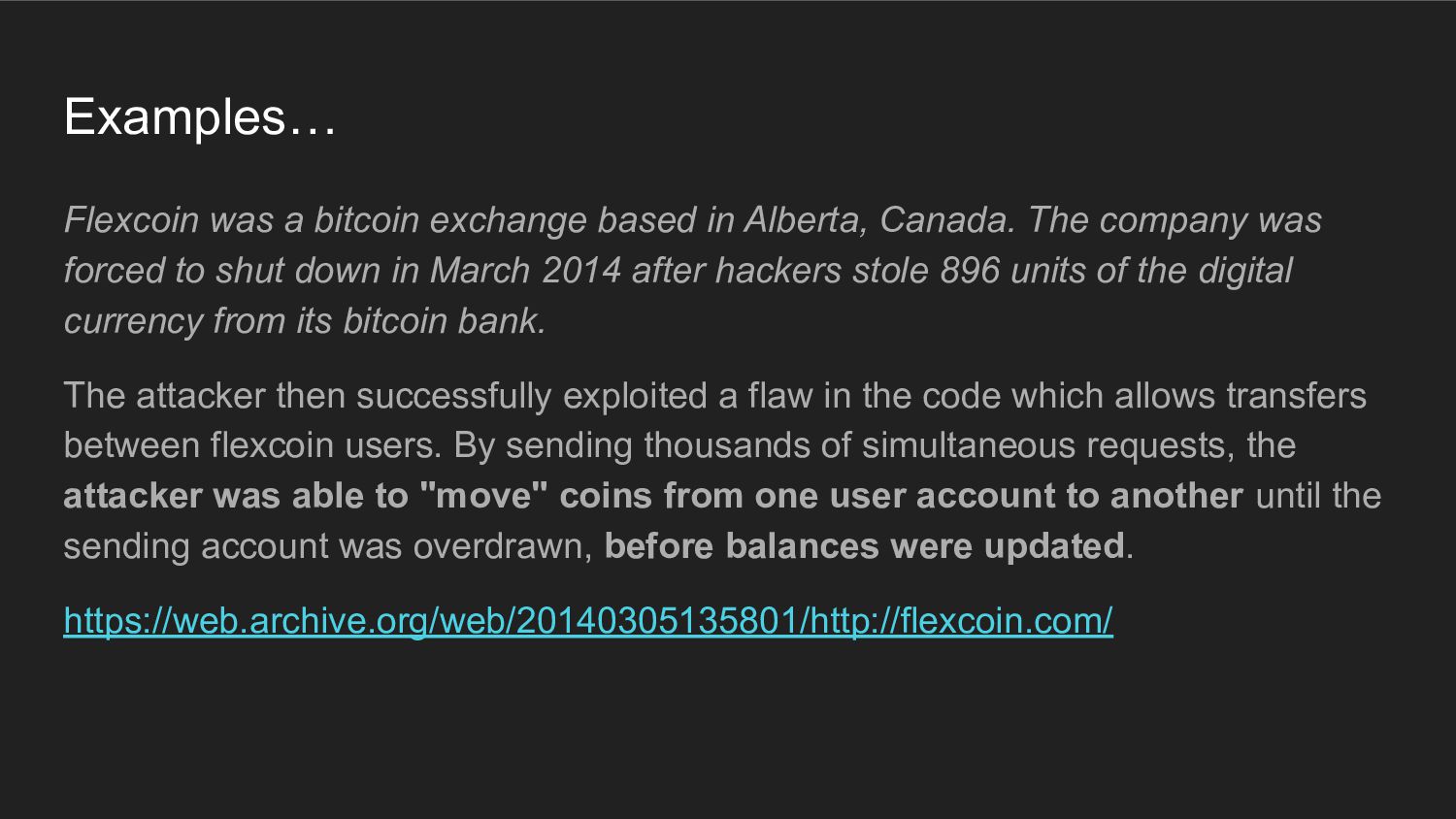
  10. Examples… Flexcoin was a bitcoin exchange based in Alberta, Canada.

    The company was forced to shut down in March 2014 after hackers stole 896 units of the digital currency from its bitcoin bank. The attacker then successfully exploited a flaw in the code which allows transfers between flexcoin users. By sending thousands of simultaneous requests, the attacker was able to "move" coins from one user account to another until the sending account was overdrawn, before balances were updated. https://web.archive.org/web/20140305135801/http://flexcoin.com/
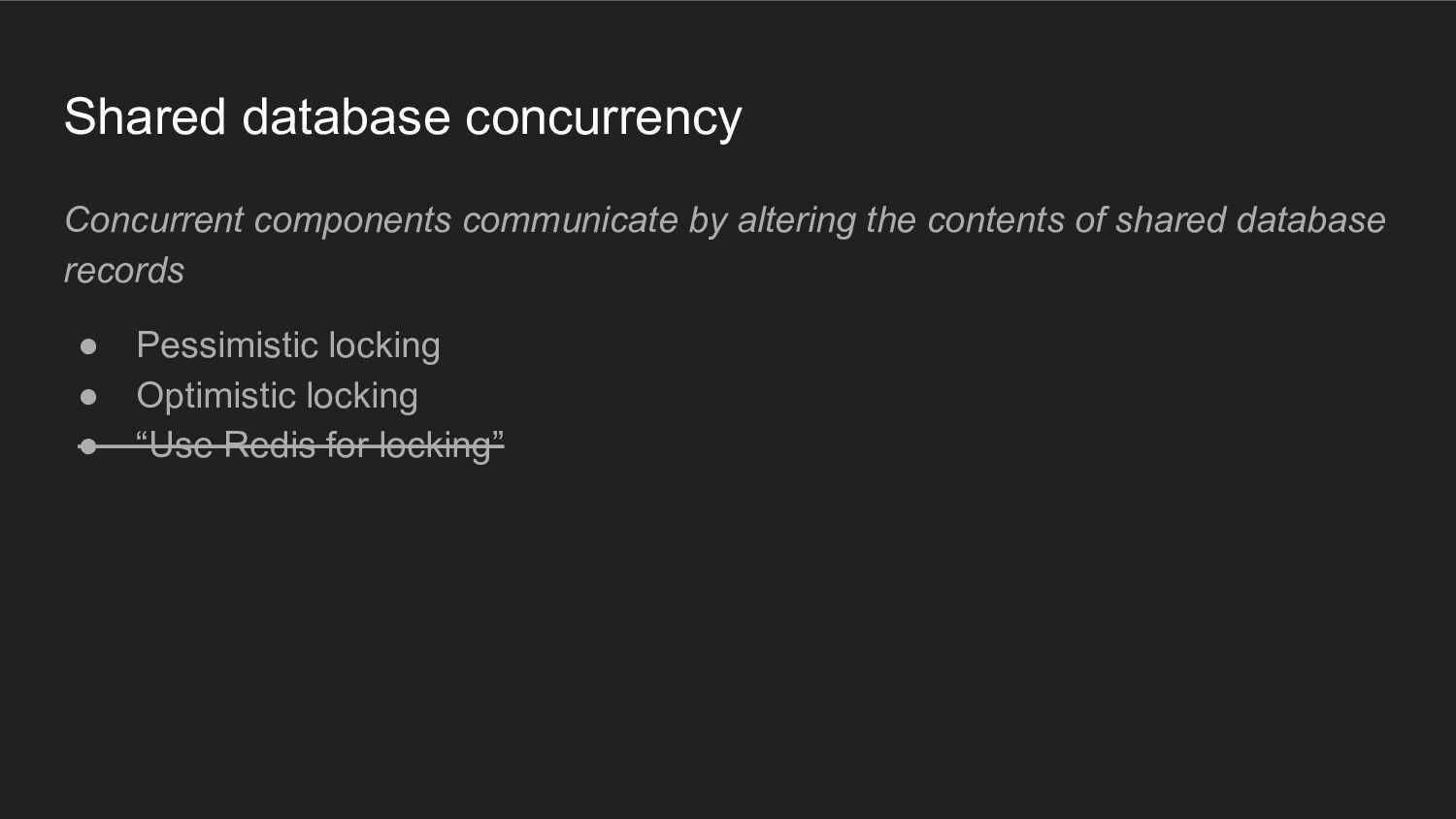
  11. Shared database concurrency Concurrent components communicate by altering the contents

    of shared database records • Pessimistic locking • Optimistic locking • “Use Redis for locking”
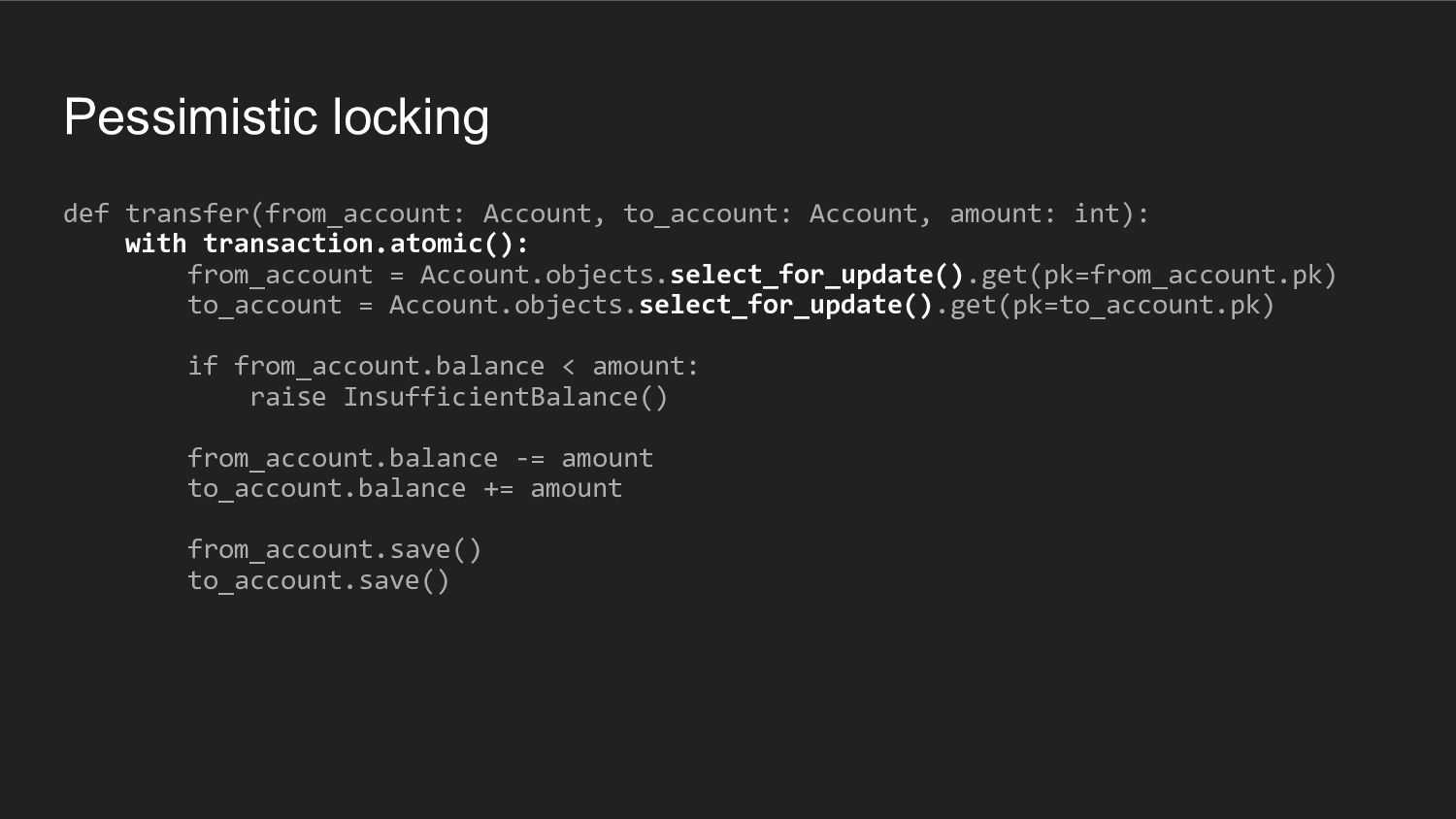
  12. Pessimistic locking def transfer(from_account: Account, to_account: Account, amount: int): with

    transaction.atomic(): from_account = Account.objects.select_for_update().get(pk=from_account.pk) to_account = Account.objects.select_for_update().get(pk=to_account.pk) if from_account.balance < amount: raise InsufficientBalance() from_account.balance -= amount to_account.balance += amount from_account.save() to_account.save()
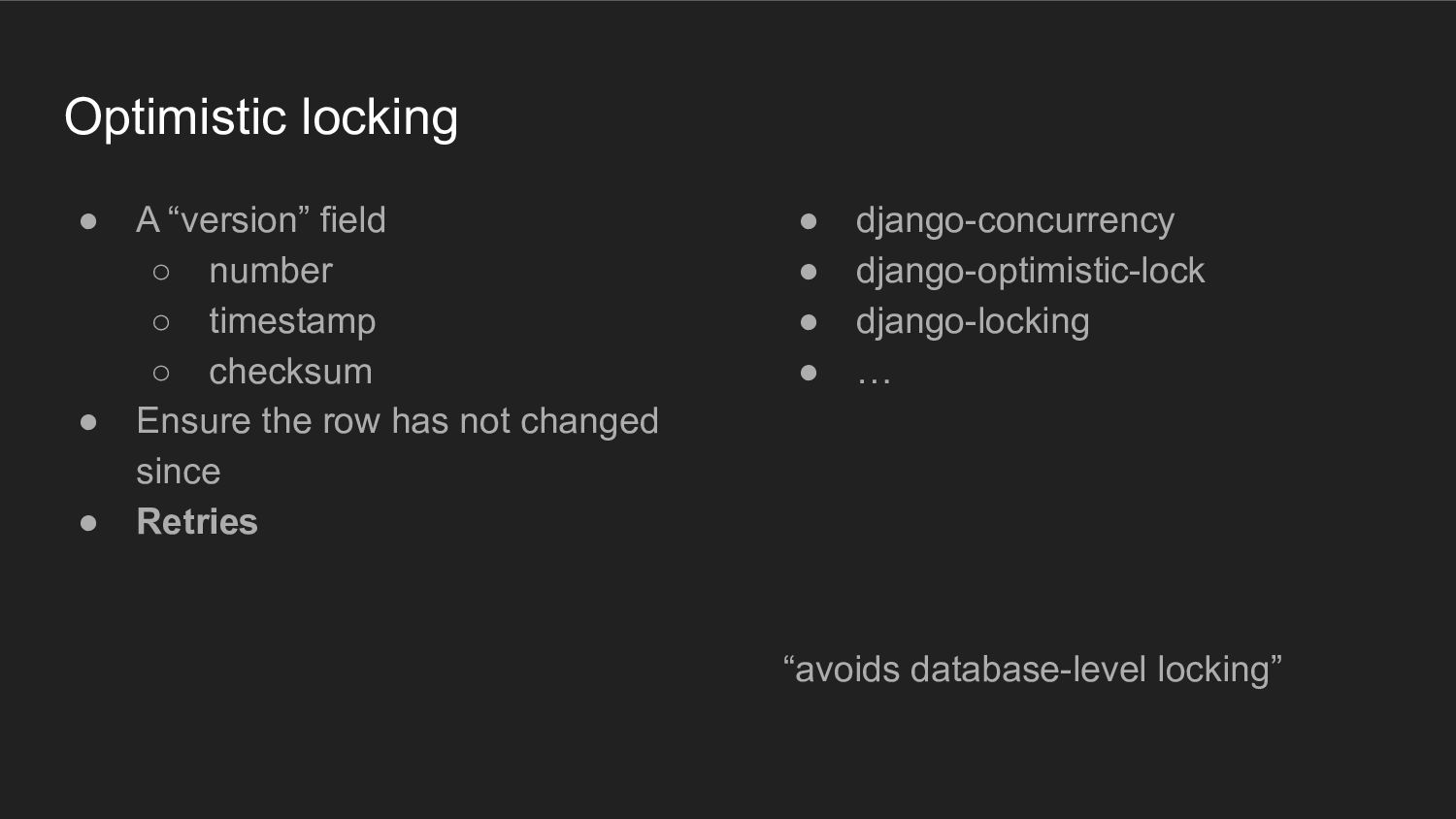
  13. Optimistic locking • A “version” field ◦ number ◦ timestamp
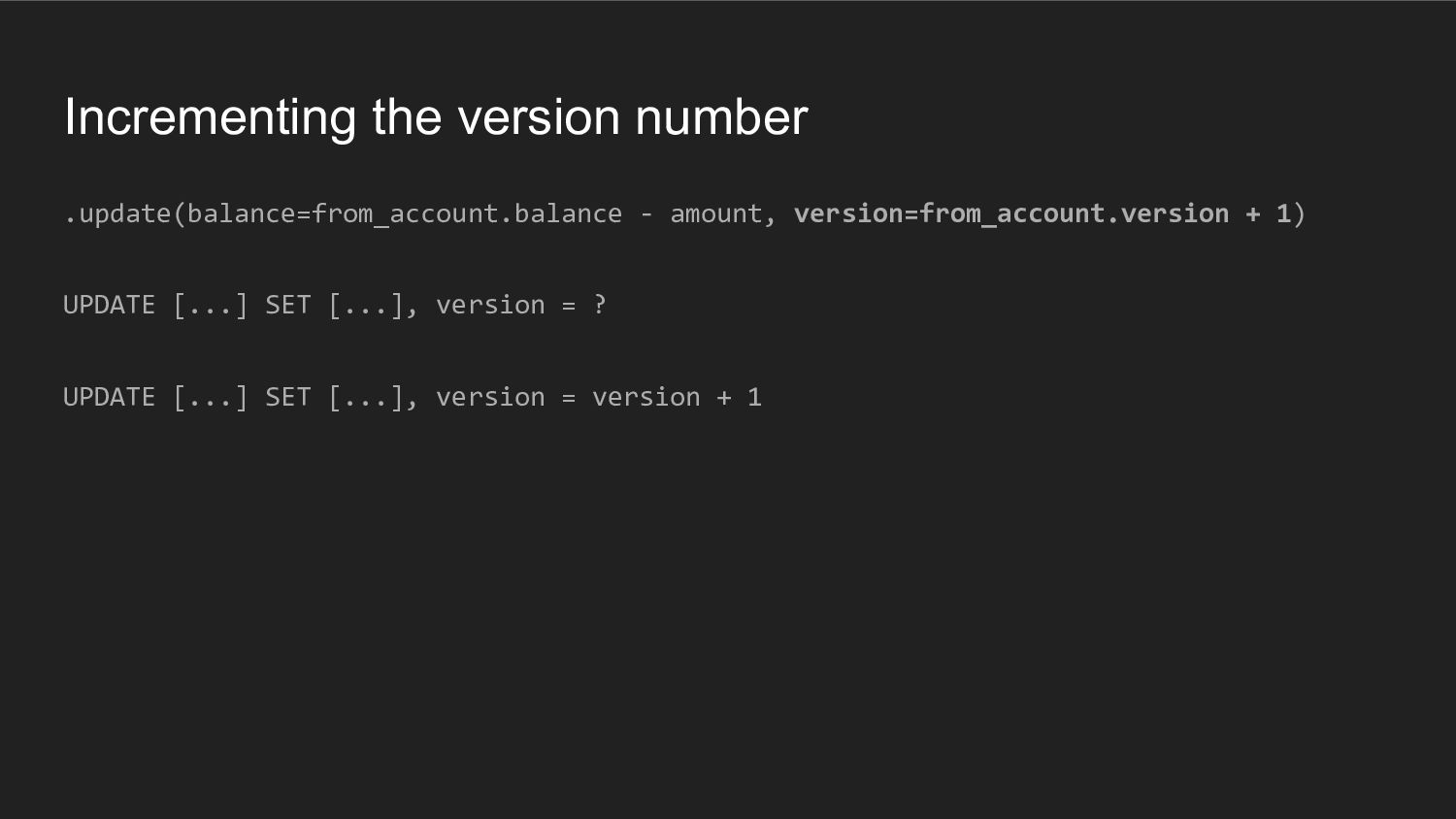
    ◦ checksum • Ensure the row has not changed since • Retries • django-concurrency • django-optimistic-lock • django-locking • … “avoids database-level locking”
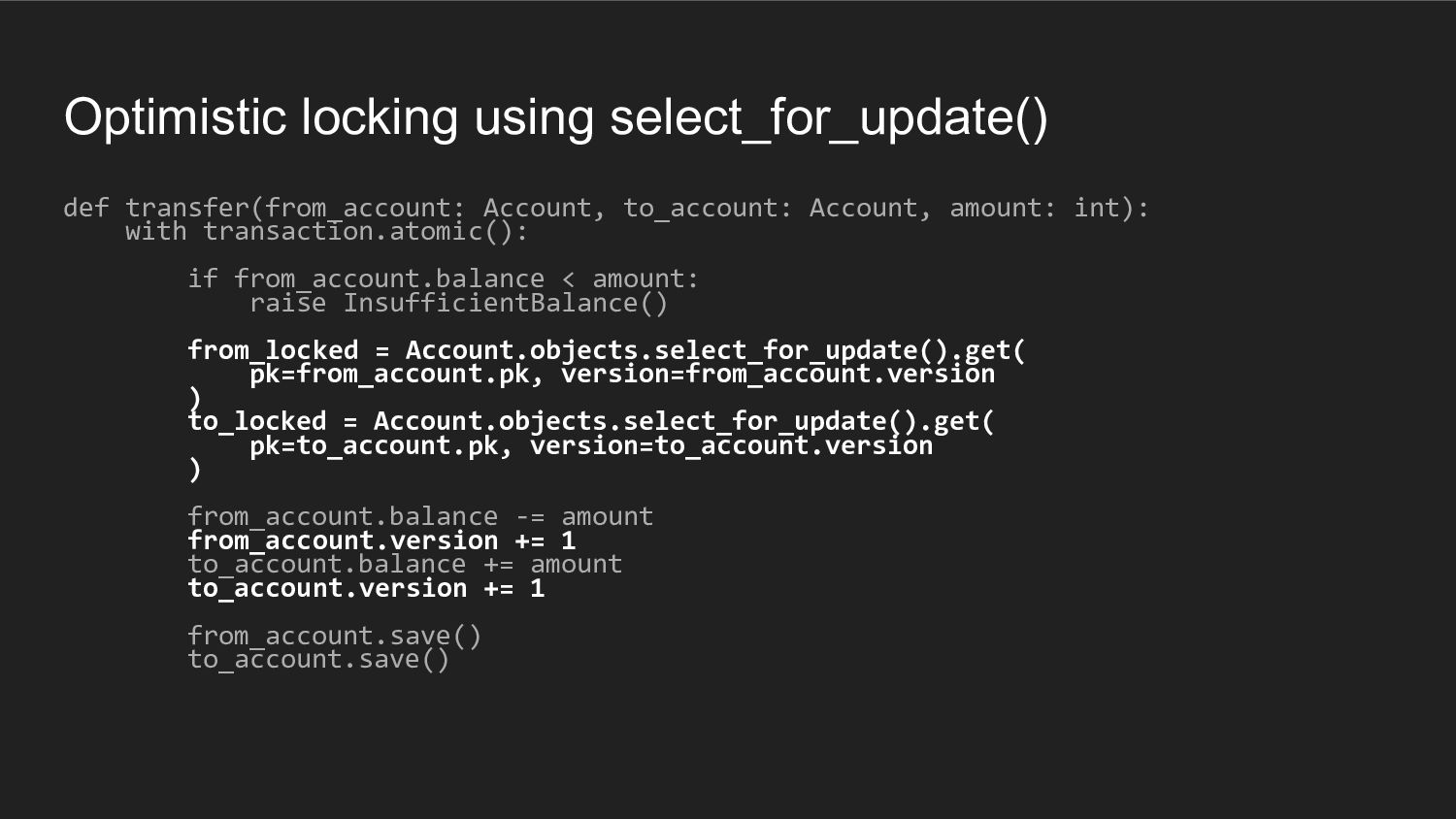
  14. Optimistic locking using select_for_update() def transfer(from_account: Account, to_account: Account, amount:

    int): with transaction.atomic(): if from_account.balance < amount: raise InsufficientBalance() from_locked = Account.objects.select_for_update().get( pk=from_account.pk, version=from_account.version ) to_locked = Account.objects.select_for_update().get( pk=to_account.pk, version=to_account.version ) from_account.balance -= amount from_account.version += 1 to_account.balance += amount to_account.version += 1 from_account.save() to_account.save()
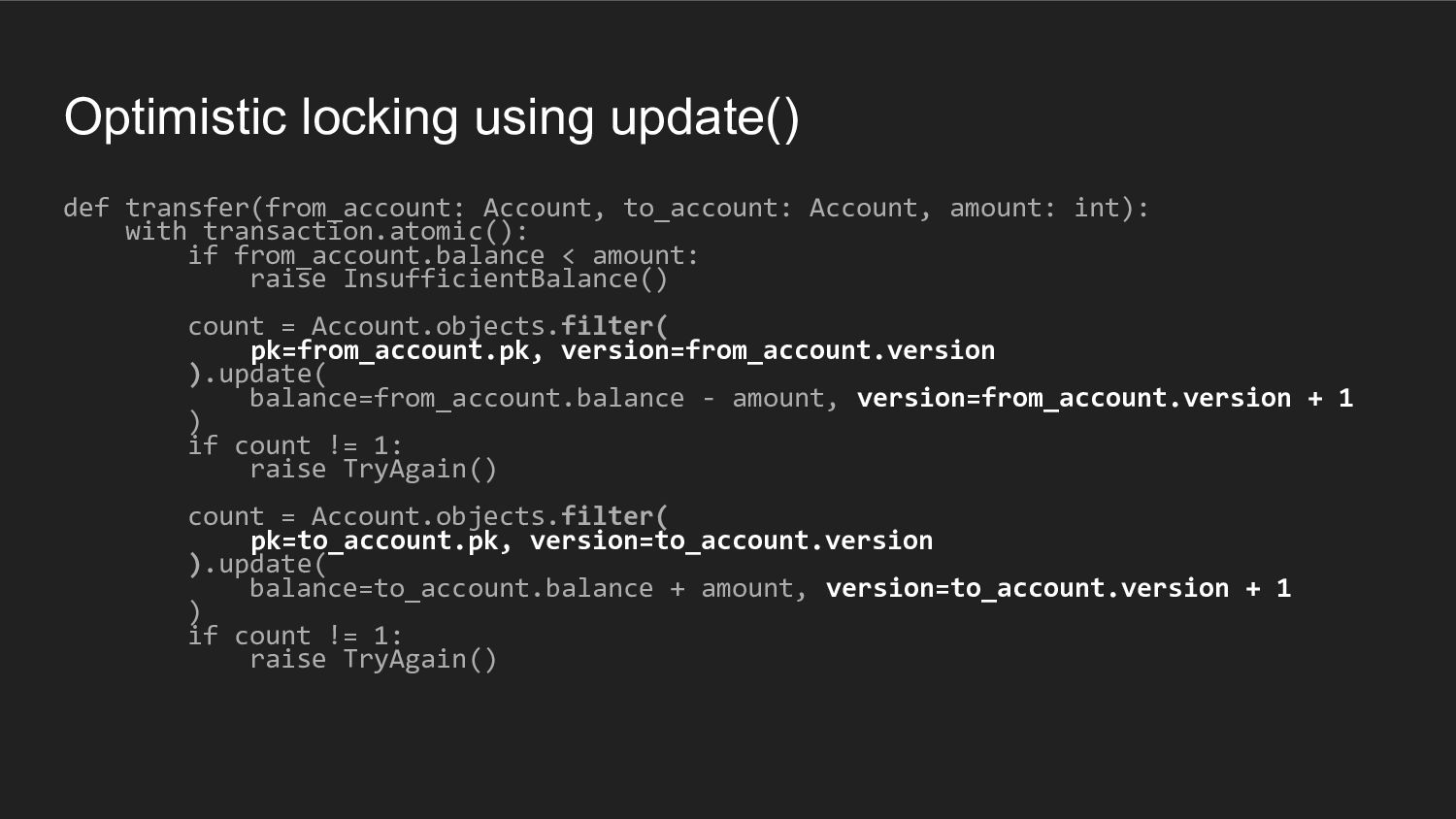
  15. Optimistic locking using update() def transfer(from_account: Account, to_account: Account, amount:

    int): with transaction.atomic(): if from_account.balance < amount: raise InsufficientBalance() count = Account.objects.filter( pk=from_account.pk, version=from_account.version ).update( balance=from_account.balance - amount, version=from_account.version + 1 ) if count != 1: raise TryAgain() count = Account.objects.filter( pk=to_account.pk, version=to_account.version ).update( balance=to_account.balance + amount, version=to_account.version + 1 ) if count != 1: raise TryAgain()
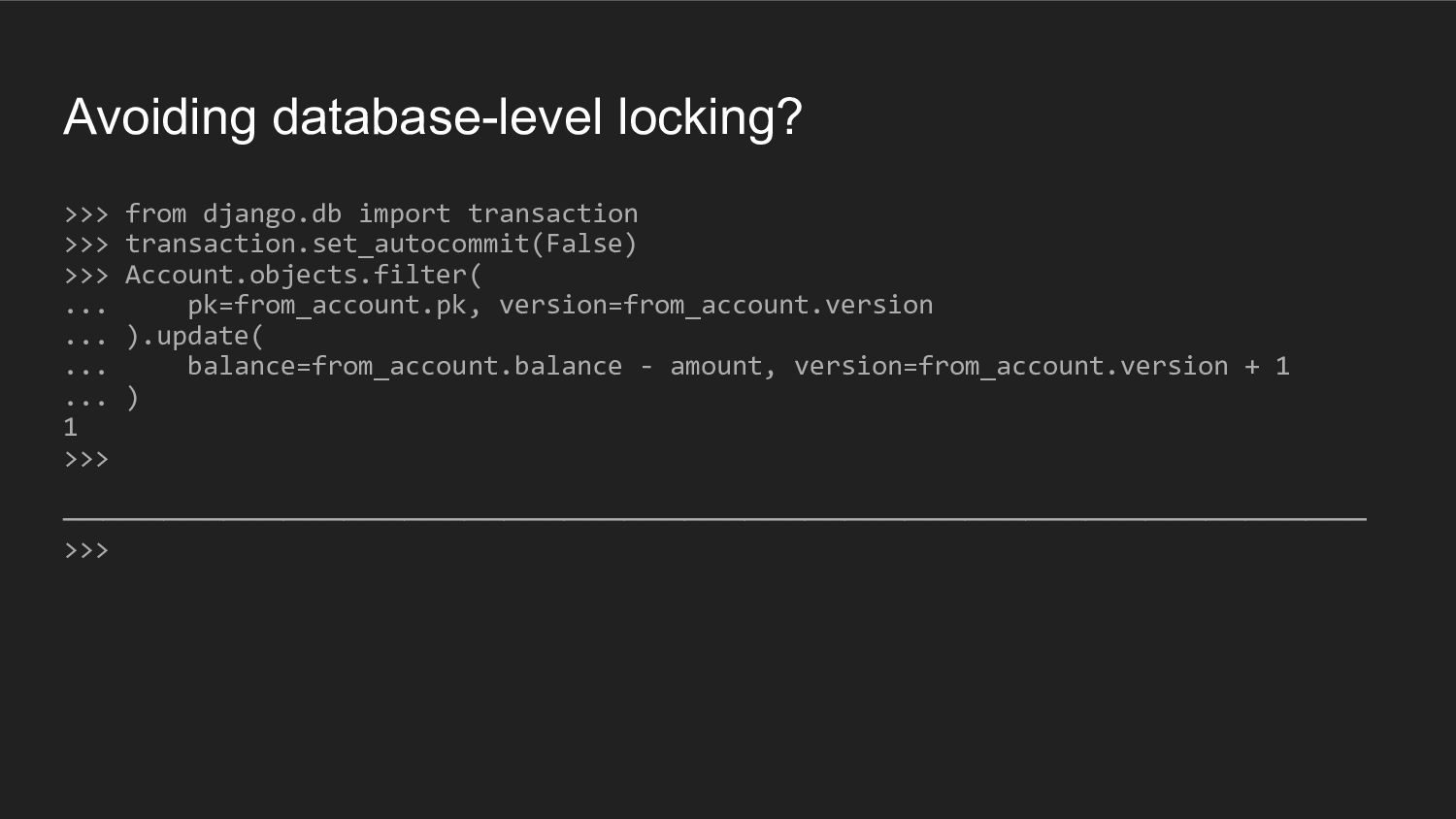
  16. Avoiding database-level locking? >>> from django.db import transaction >>> transaction.set_autocommit(False)

    >>> Account.objects.filter( ... pk=from_account.pk, version=from_account.version ... ).update( ... balance=from_account.balance - amount, version=from_account.version + 1 ... ) 1 >>> ───────────────────────────────────────────────────────────────── >>>
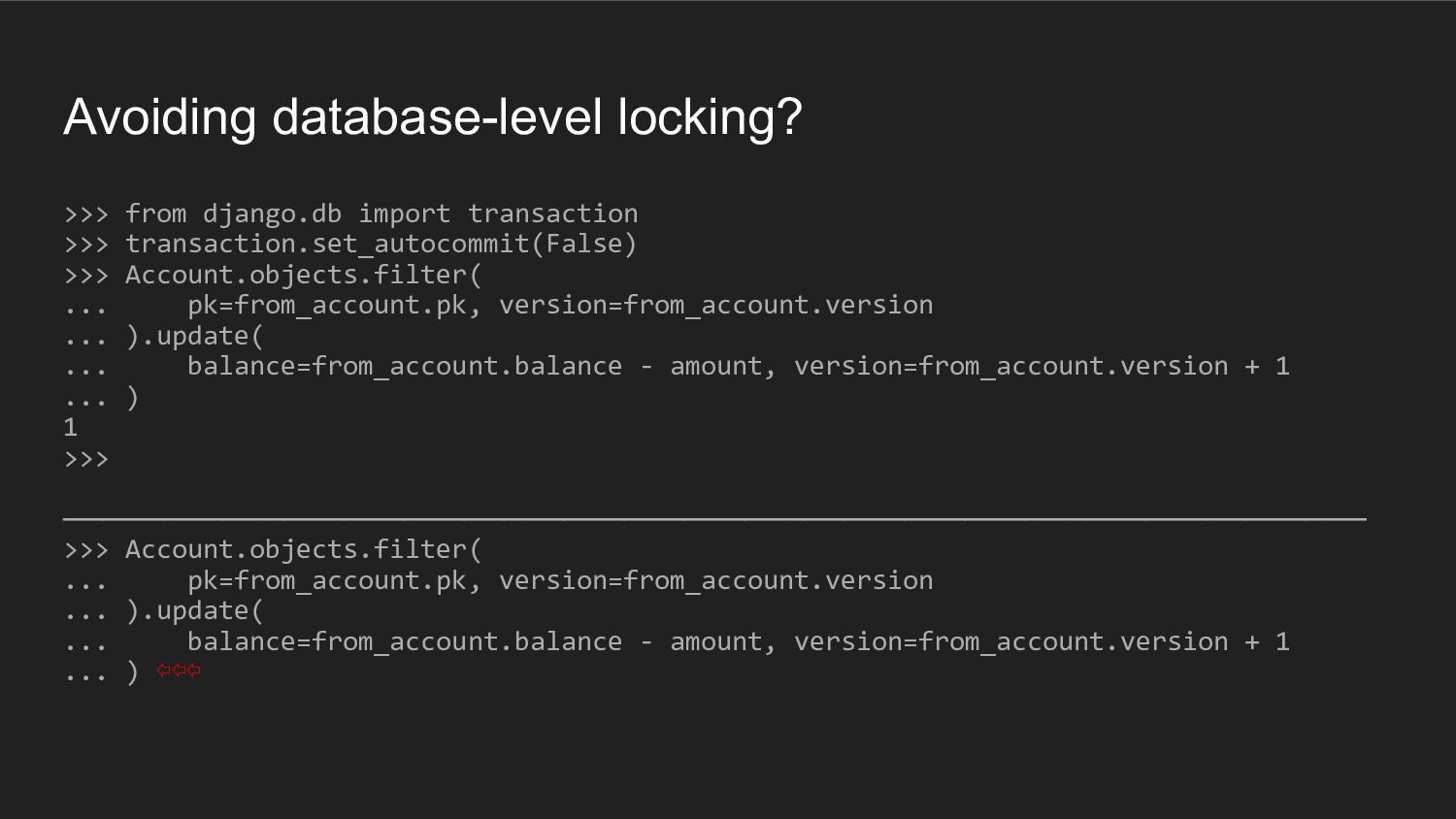
  17. Avoiding database-level locking? >>> from django.db import transaction >>> transaction.set_autocommit(False)

    >>> Account.objects.filter( ... pk=from_account.pk, version=from_account.version ... ).update( ... balance=from_account.balance - amount, version=from_account.version + 1 ... ) 1 >>> ───────────────────────────────────────────────────────────────── >>> Account.objects.filter( ... pk=from_account.pk, version=from_account.version ... ).update( ... balance=from_account.balance - amount, version=from_account.version + 1 ... ) ⇦⇦⇦
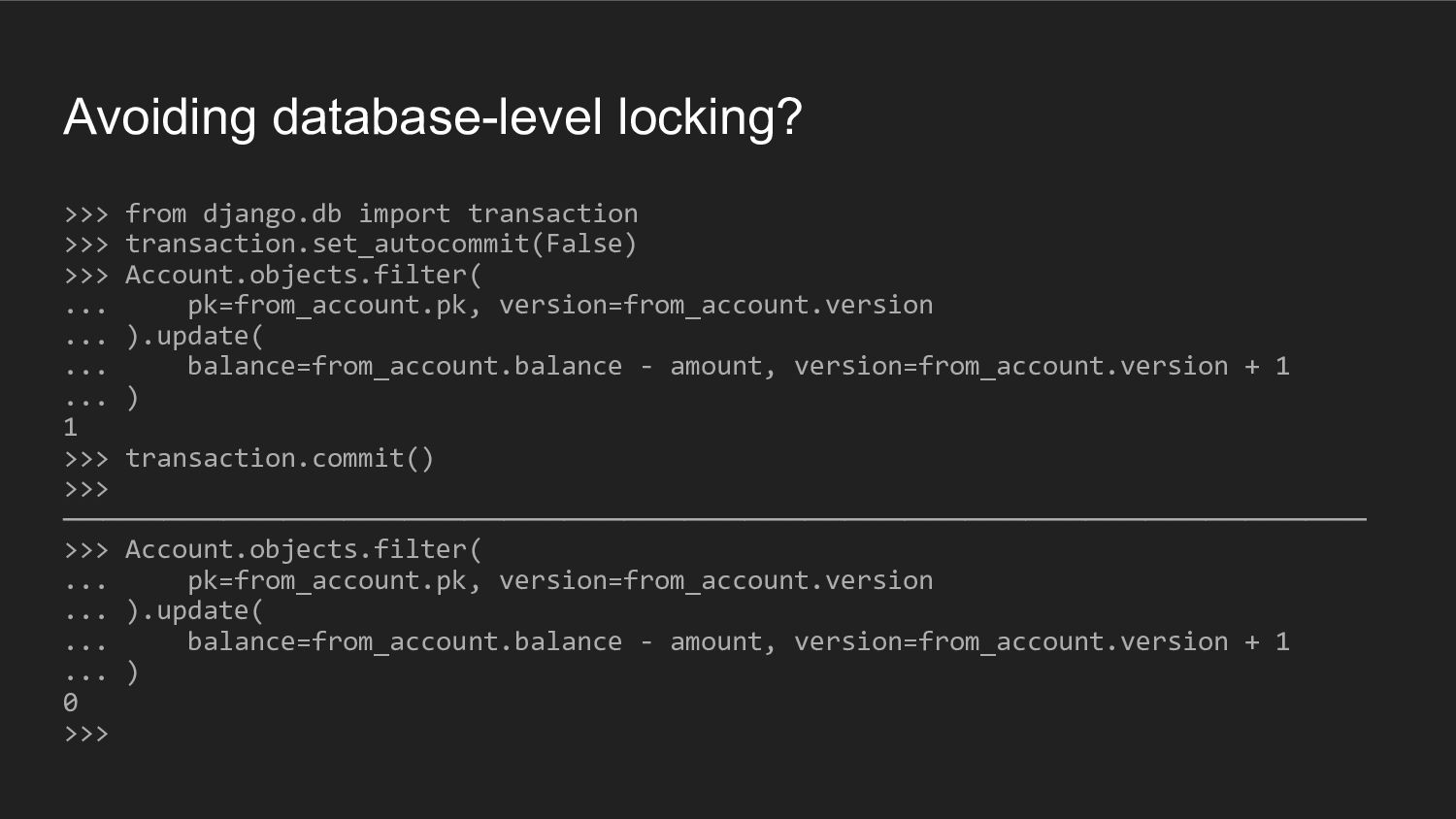
  18. Avoiding database-level locking? >>> from django.db import transaction >>> transaction.set_autocommit(False)

    >>> Account.objects.filter( ... pk=from_account.pk, version=from_account.version ... ).update( ... balance=from_account.balance - amount, version=from_account.version + 1 ... ) 1 >>> transaction.commit() >>> ───────────────────────────────────────────────────────────────── >>> Account.objects.filter( ... pk=from_account.pk, version=from_account.version ... ).update( ... balance=from_account.balance - amount, version=from_account.version + 1 ... ) 0 >>>
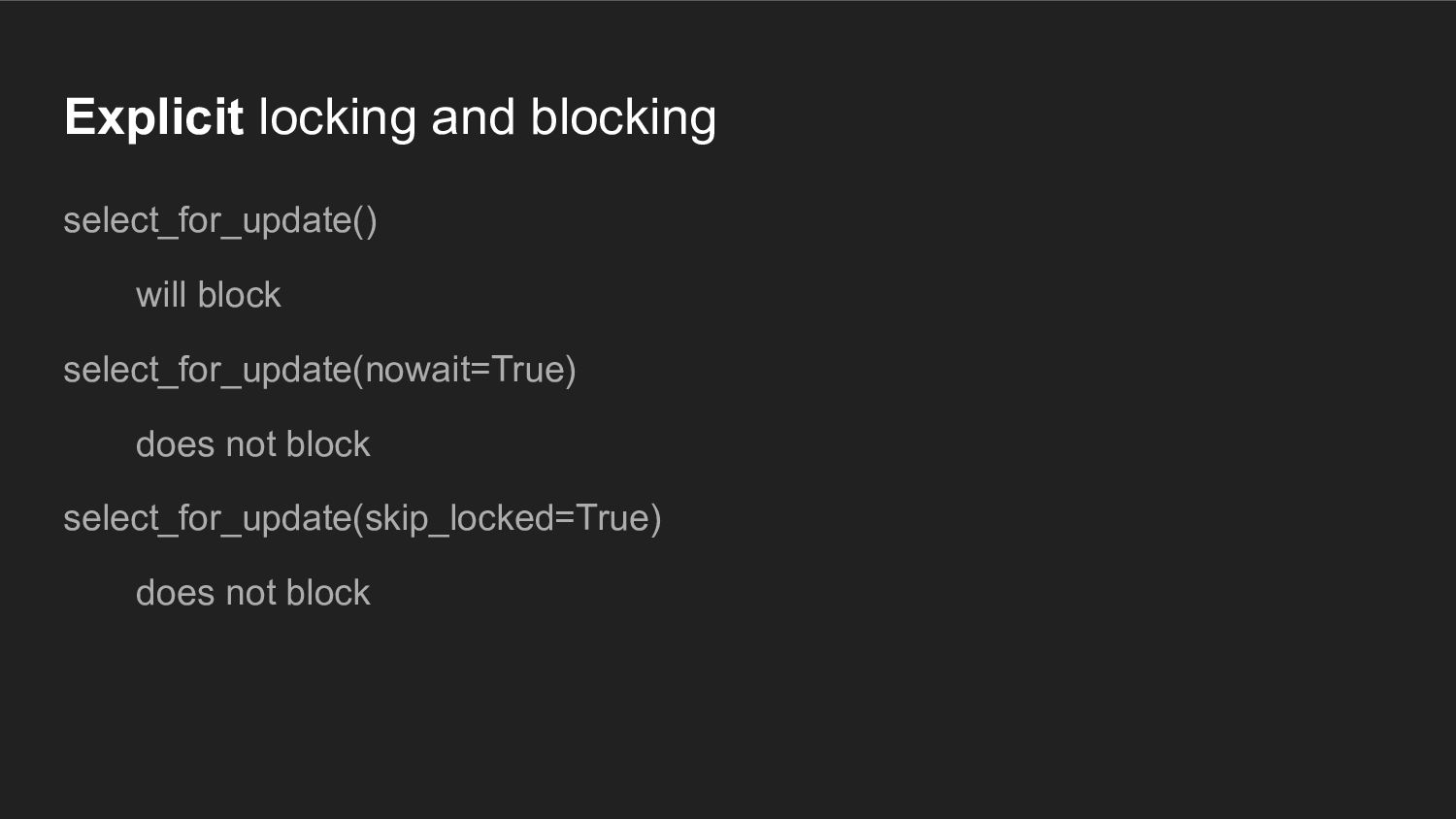
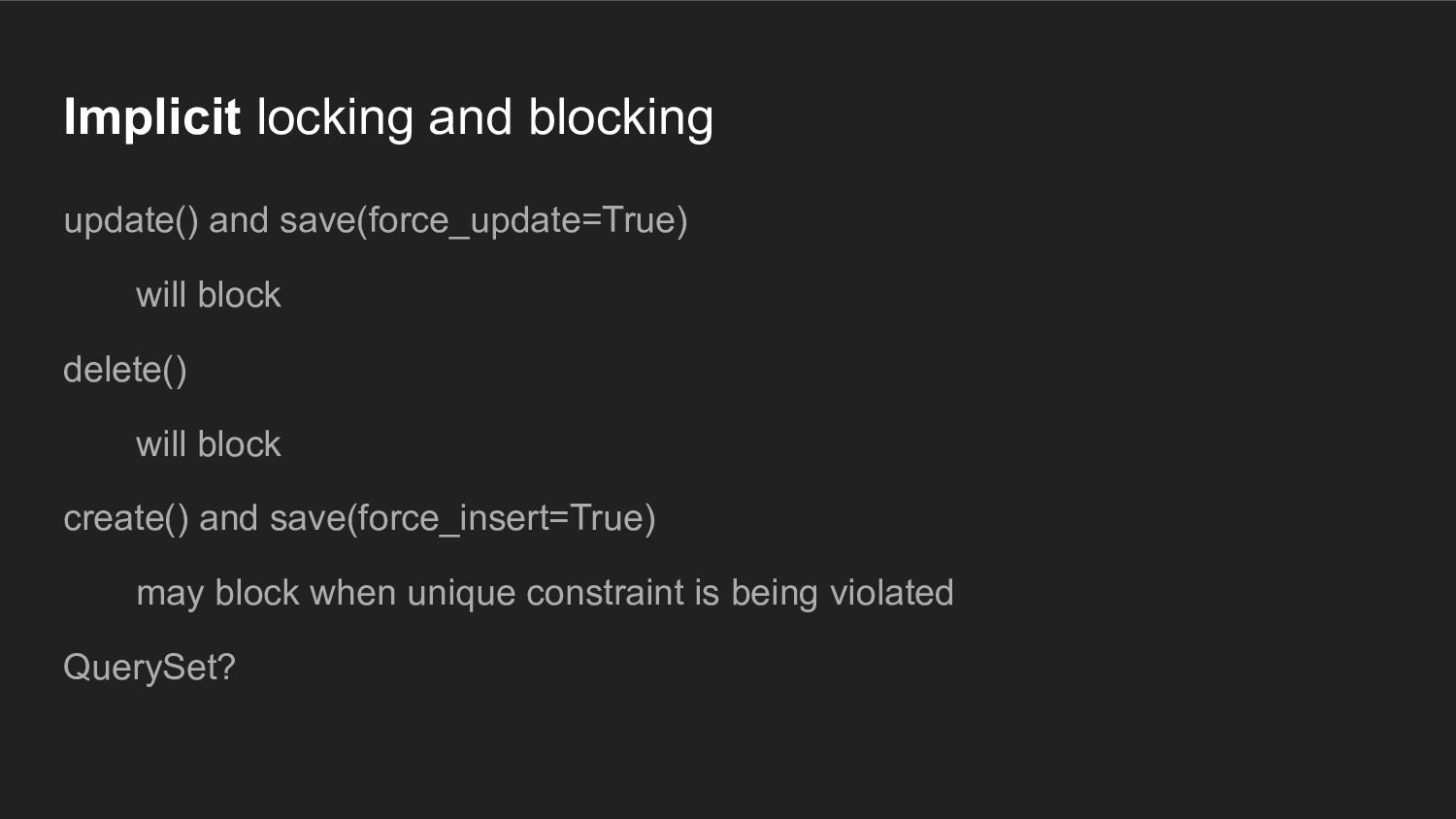
  19. Implicit locking and blocking update() and save(force_update=True) will block delete()

    will block create() and save(force_insert=True) may block when unique constraint is being violated QuerySet?
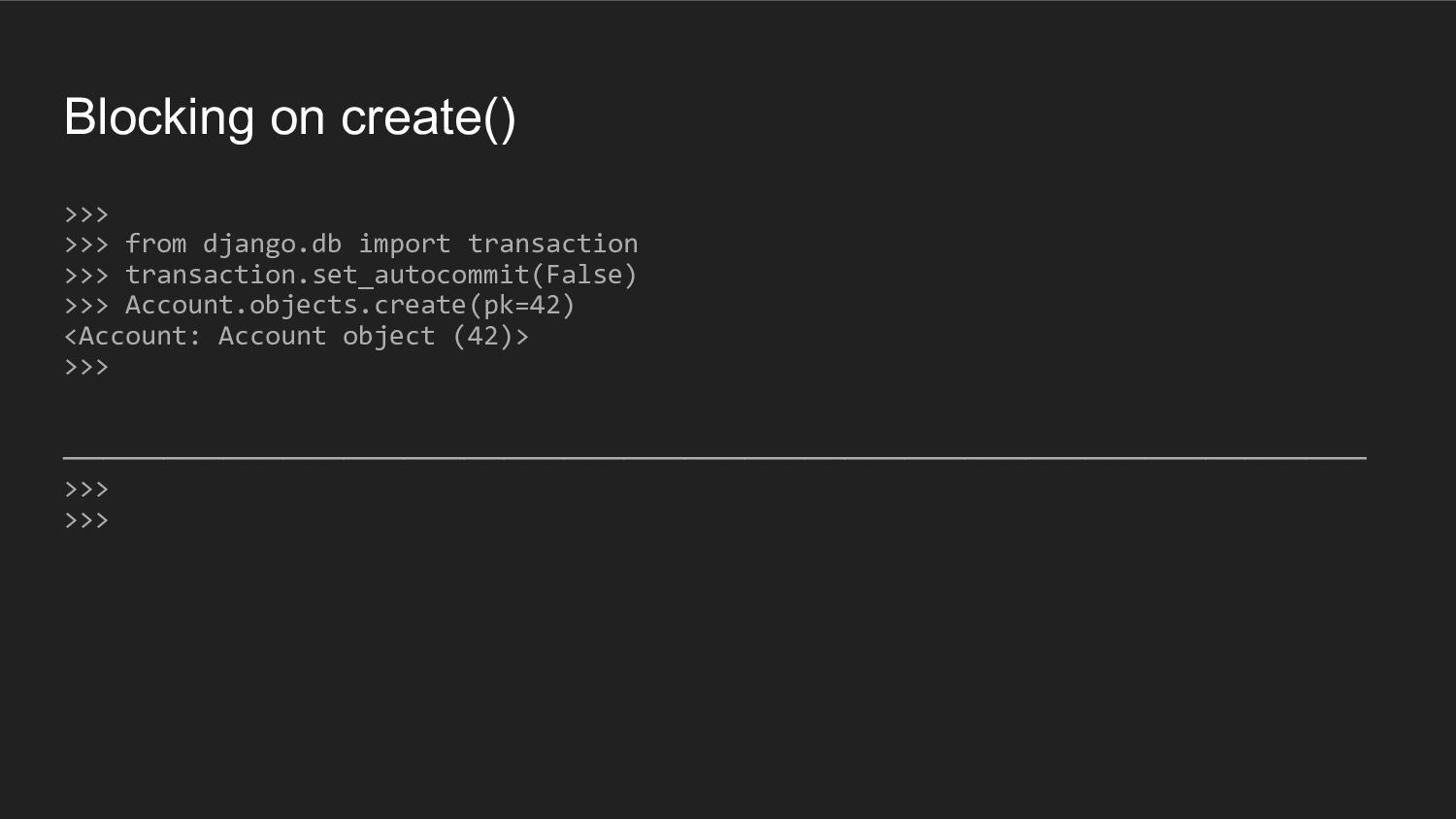
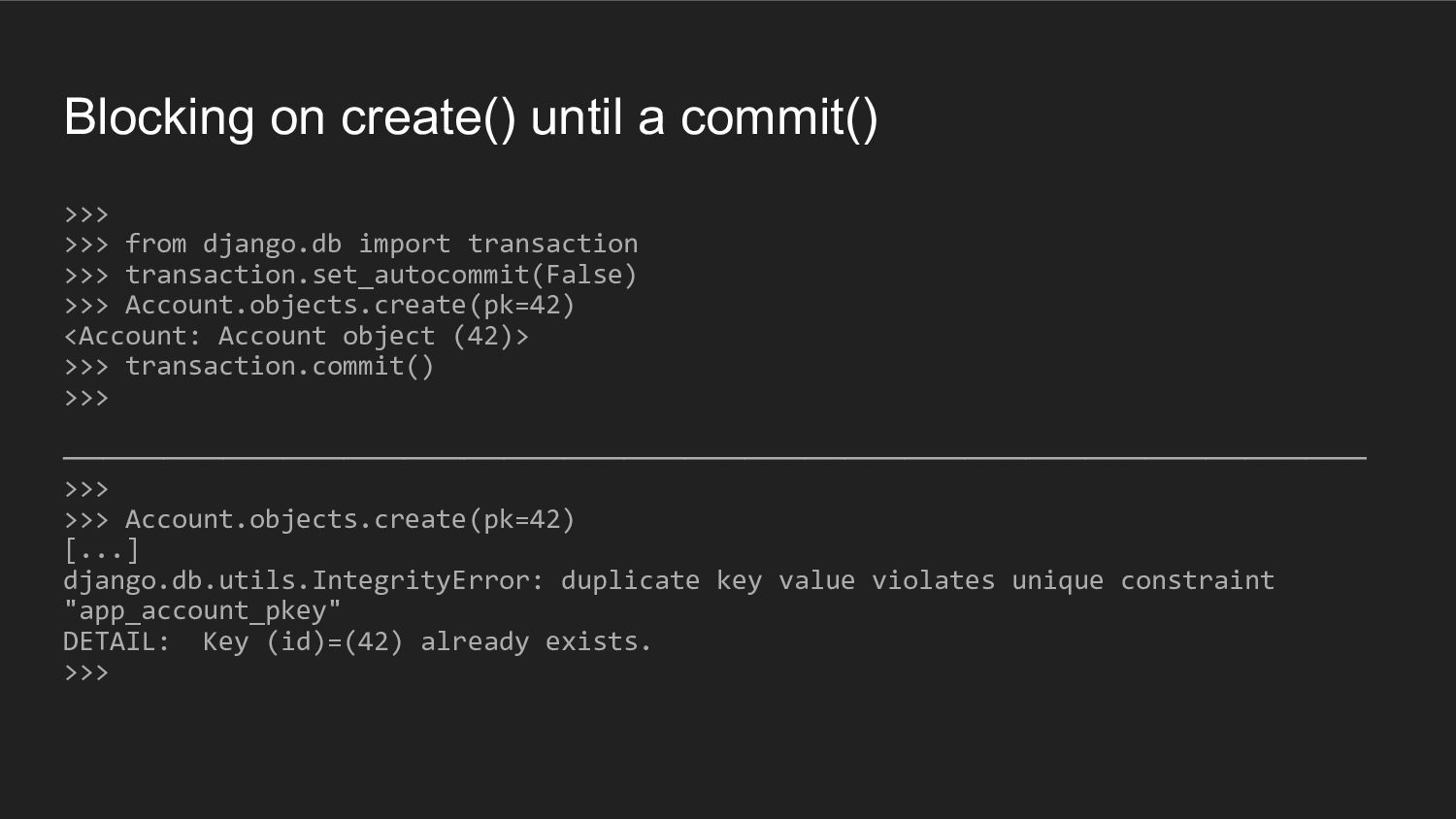
  20. >>> >>> from django.db import transaction >>> transaction.set_autocommit(False) >>> Account.objects.create(pk=42)

    <Account: Account object (42)> >>> ───────────────────────────────────────────────────────────────── >>> >>> Blocking on create()
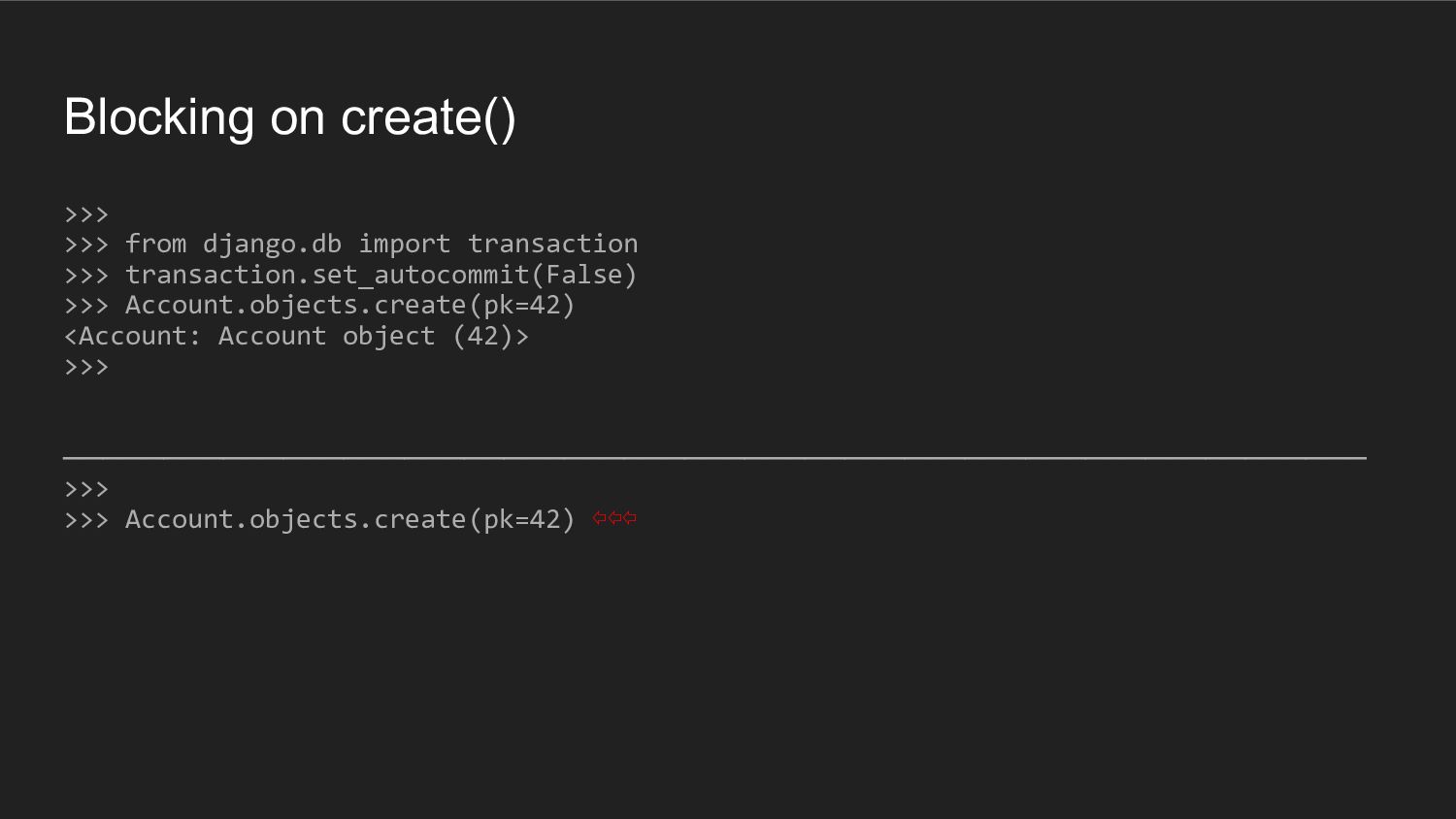
  21. >>> >>> from django.db import transaction >>> transaction.set_autocommit(False) >>> Account.objects.create(pk=42)

    <Account: Account object (42)> >>> ───────────────────────────────────────────────────────────────── >>> >>> Account.objects.create(pk=42) ⇦⇦⇦ Blocking on create()
  22. >>> >>> from django.db import transaction >>> transaction.set_autocommit(False) >>> Account.objects.create(pk=42)

    <Account: Account object (42)> >>> transaction.commit() >>> ───────────────────────────────────────────────────────────────── >>> >>> Account.objects.create(pk=42) [...] django.db.utils.IntegrityError: duplicate key value violates unique constraint "app_account_pkey" DETAIL: Key (id)=(42) already exists. >>> Blocking on create() until a commit()
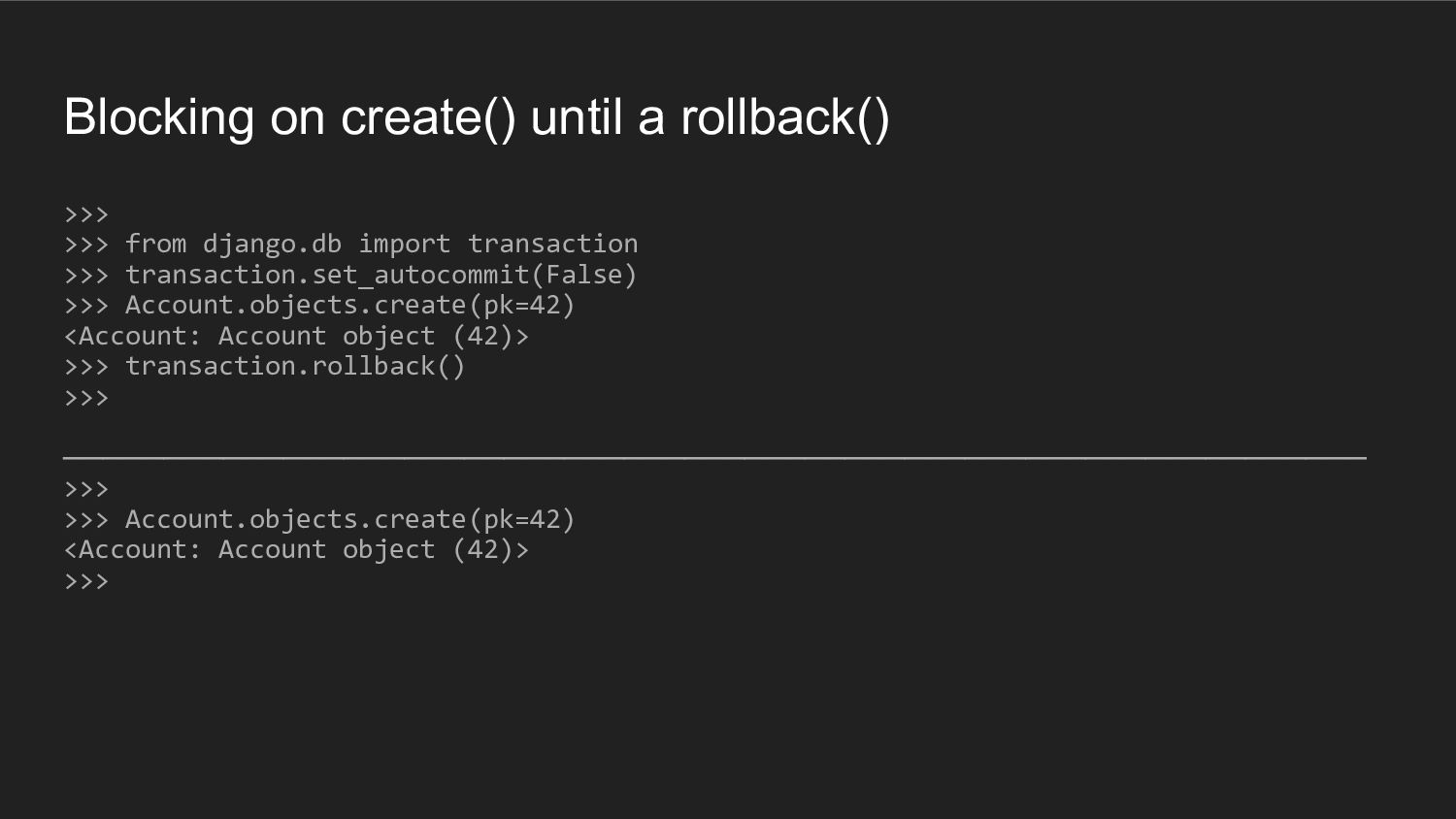
  23. >>> >>> from django.db import transaction >>> transaction.set_autocommit(False) >>> Account.objects.create(pk=42)

    <Account: Account object (42)> >>> transaction.rollback() >>> ───────────────────────────────────────────────────────────────── >>> >>> Account.objects.create(pk=42) <Account: Account object (42)> >>> Blocking on create() until a rollback()
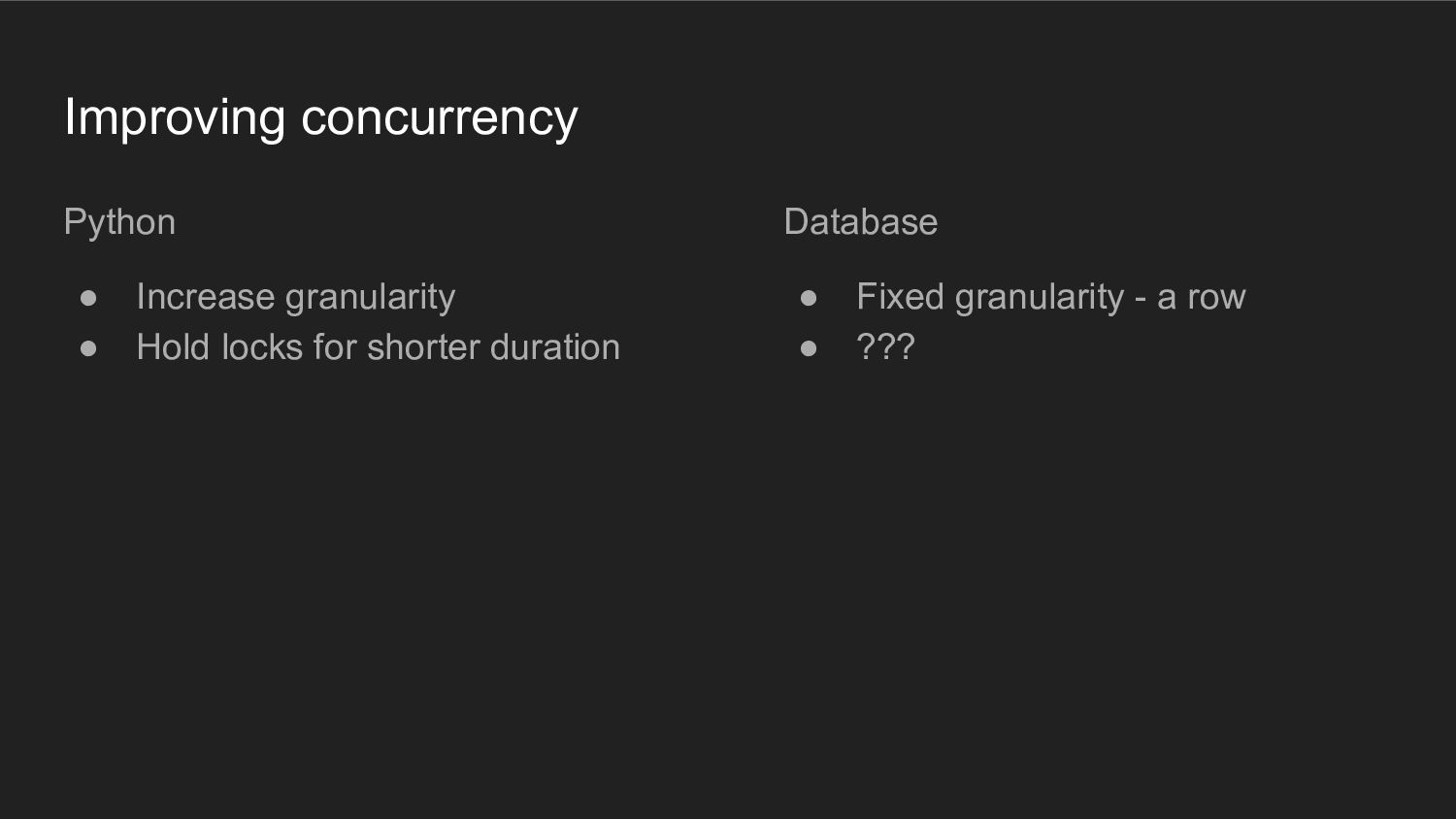
  24. Improving concurrency Python • Increase granularity • Hold locks for

    shorter duration Database • Fixed granularity - a row • ???
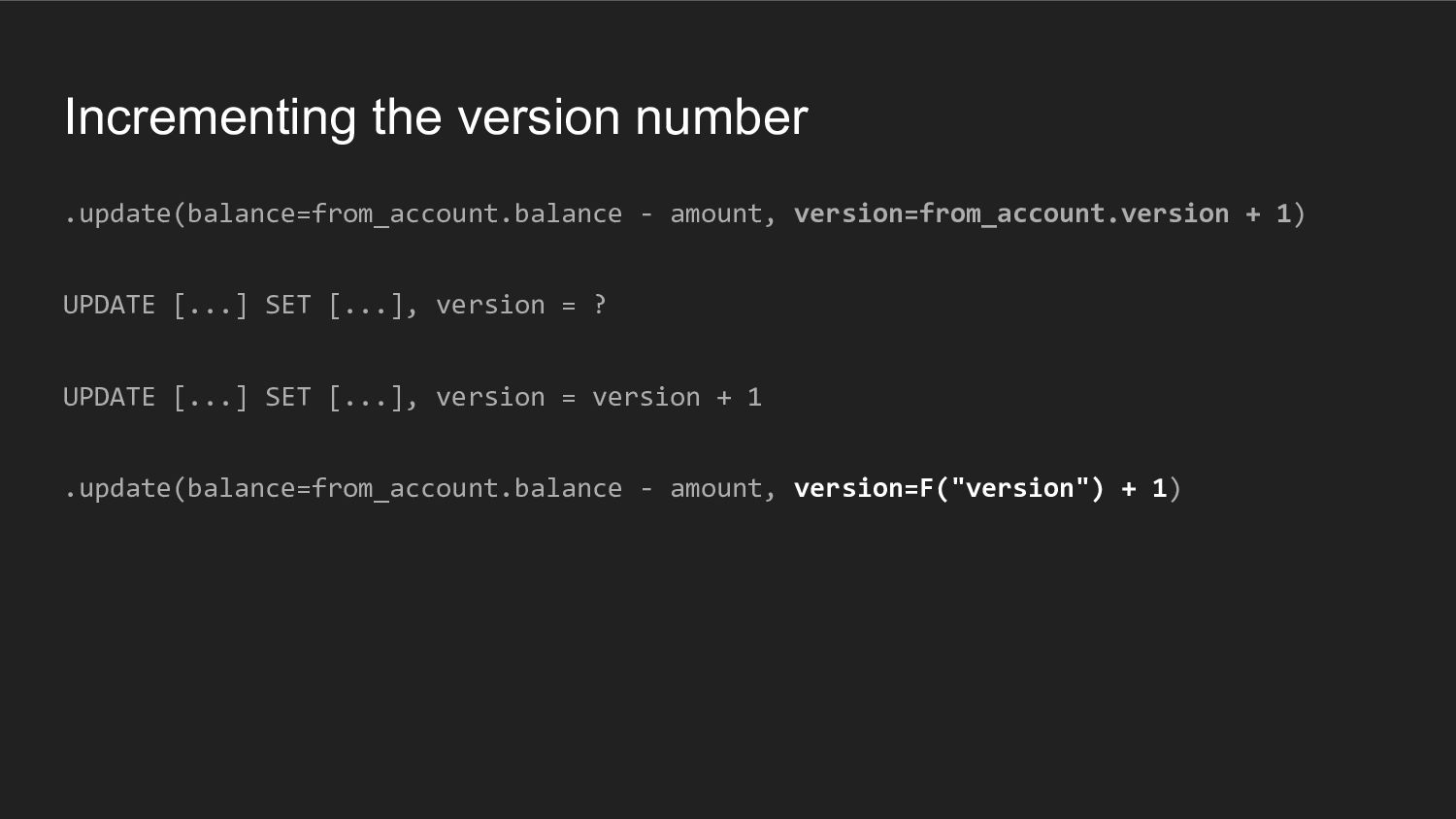
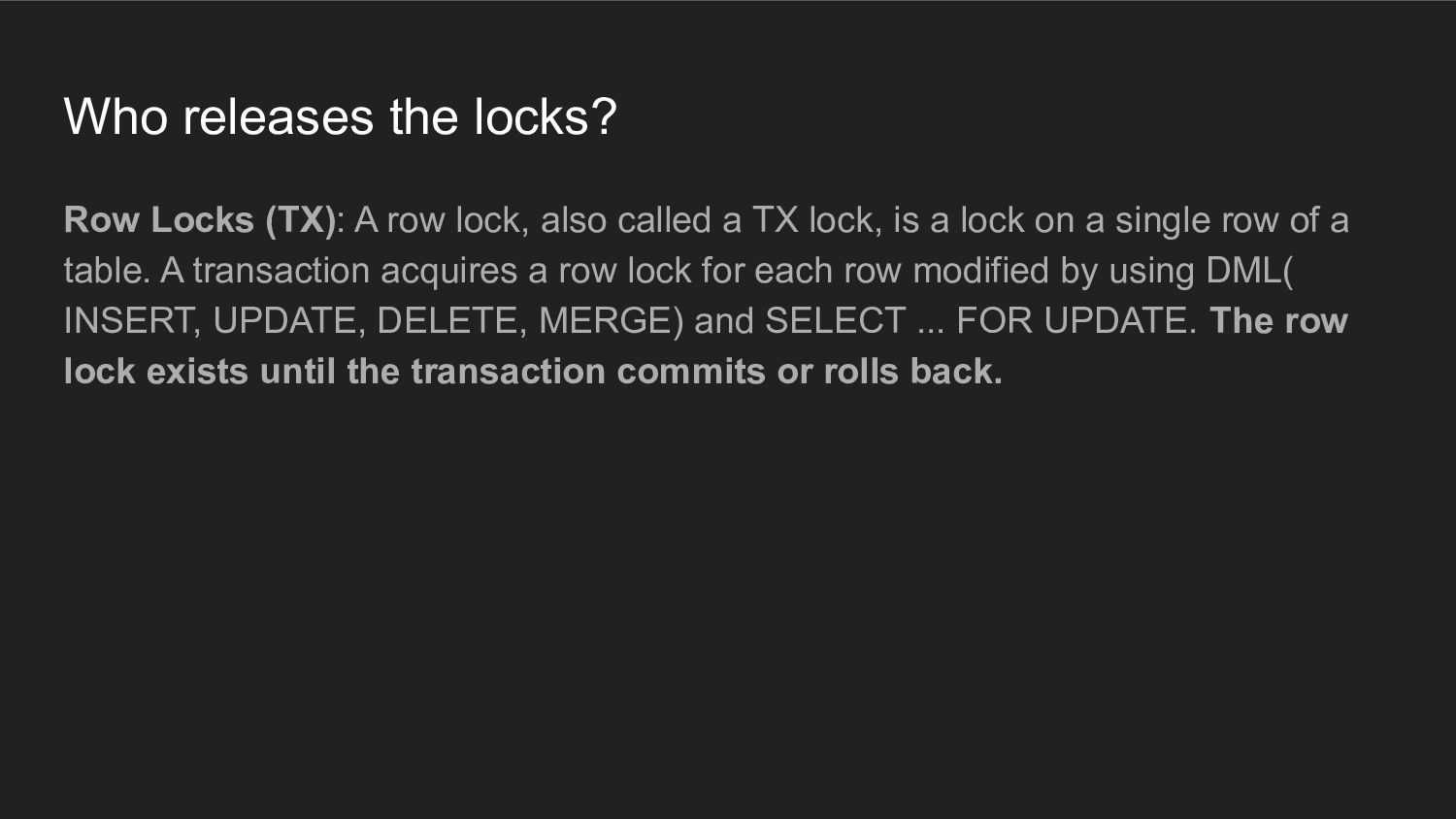
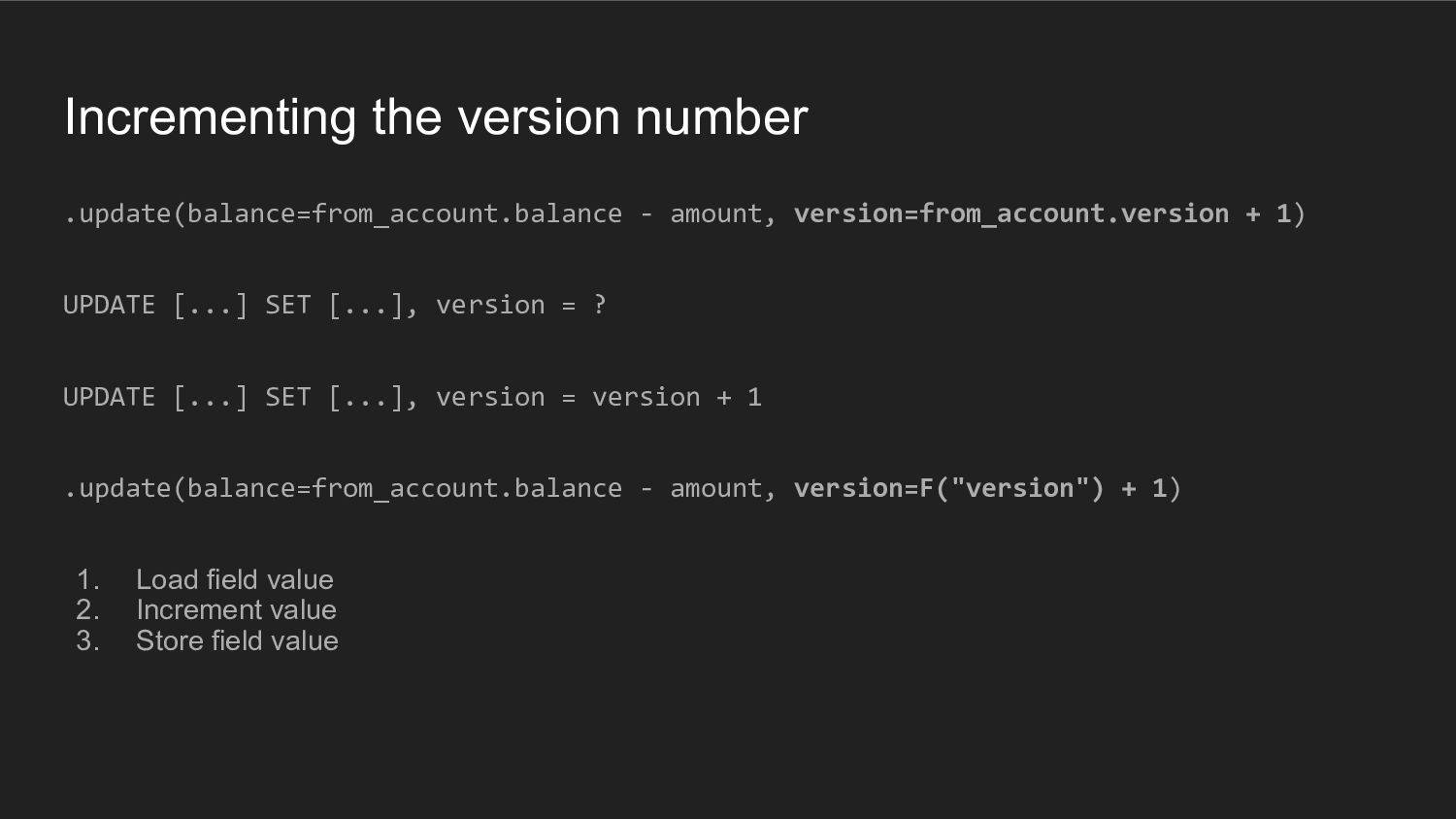
  25. Who releases the locks? Row Locks (TX): A row lock,

    also called a TX lock, is a lock on a single row of a table. A transaction acquires a row lock for each row modified by using DML( INSERT, UPDATE, DELETE, MERGE) and SELECT ... FOR UPDATE. The row lock exists until the transaction commits or rolls back.
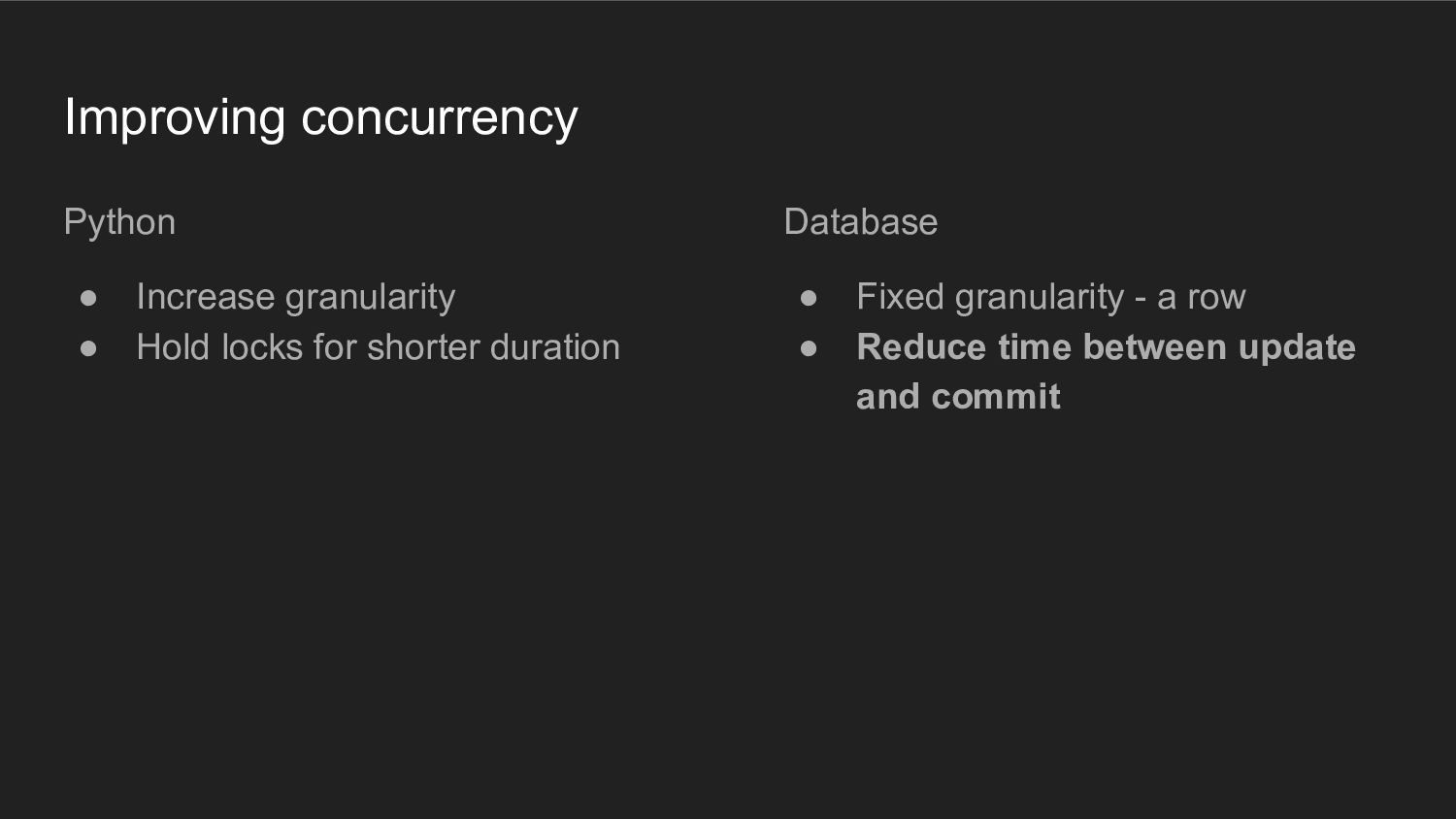
  26. Improving concurrency Python • Increase granularity • Hold locks for

    shorter duration Database • Fixed granularity - a row • Reduce time between update and commit
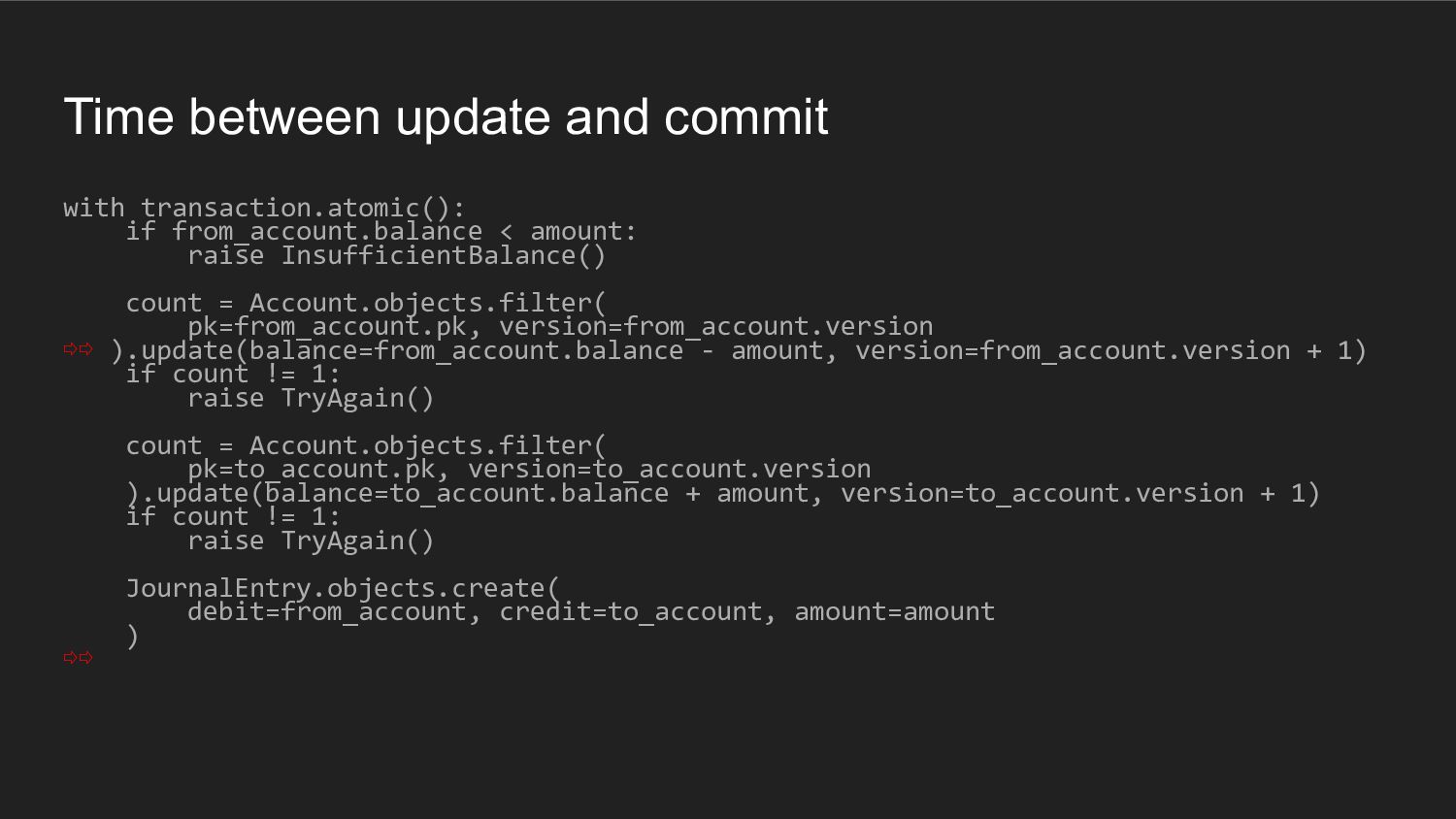
  27. Time between update and commit with transaction.atomic(): if from_account.balance <

    amount: raise InsufficientBalance() count = Account.objects.filter( pk=from_account.pk, version=from_account.version ⇨⇨ ).update(balance=from_account.balance - amount, version=from_account.version + 1) if count != 1: raise TryAgain() count = Account.objects.filter( pk=to_account.pk, version=to_account.version ).update(balance=to_account.balance + amount, version=to_account.version + 1) if count != 1: raise TryAgain() JournalEntry.objects.create( debit=from_account, credit=to_account, amount=amount ) ⇨⇨
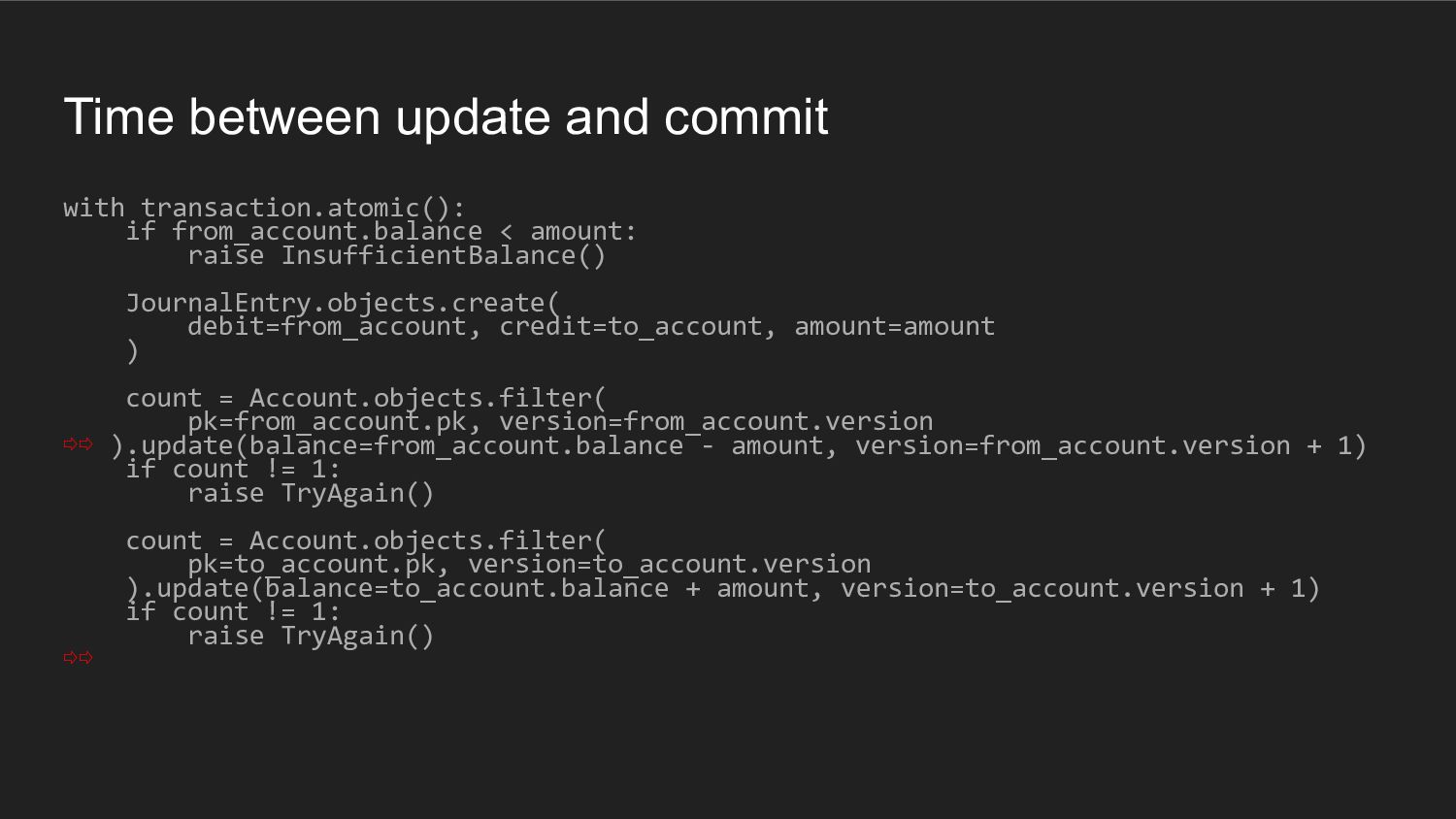
  28. Time between update and commit with transaction.atomic(): if from_account.balance <

    amount: raise InsufficientBalance() JournalEntry.objects.create( debit=from_account, credit=to_account, amount=amount ) count = Account.objects.filter( pk=from_account.pk, version=from_account.version ⇨⇨ ).update(balance=from_account.balance - amount, version=from_account.version + 1) if count != 1: raise TryAgain() count = Account.objects.filter( pk=to_account.pk, version=to_account.version ).update(balance=to_account.balance + amount, version=to_account.version + 1) if count != 1: raise TryAgain() ⇨⇨
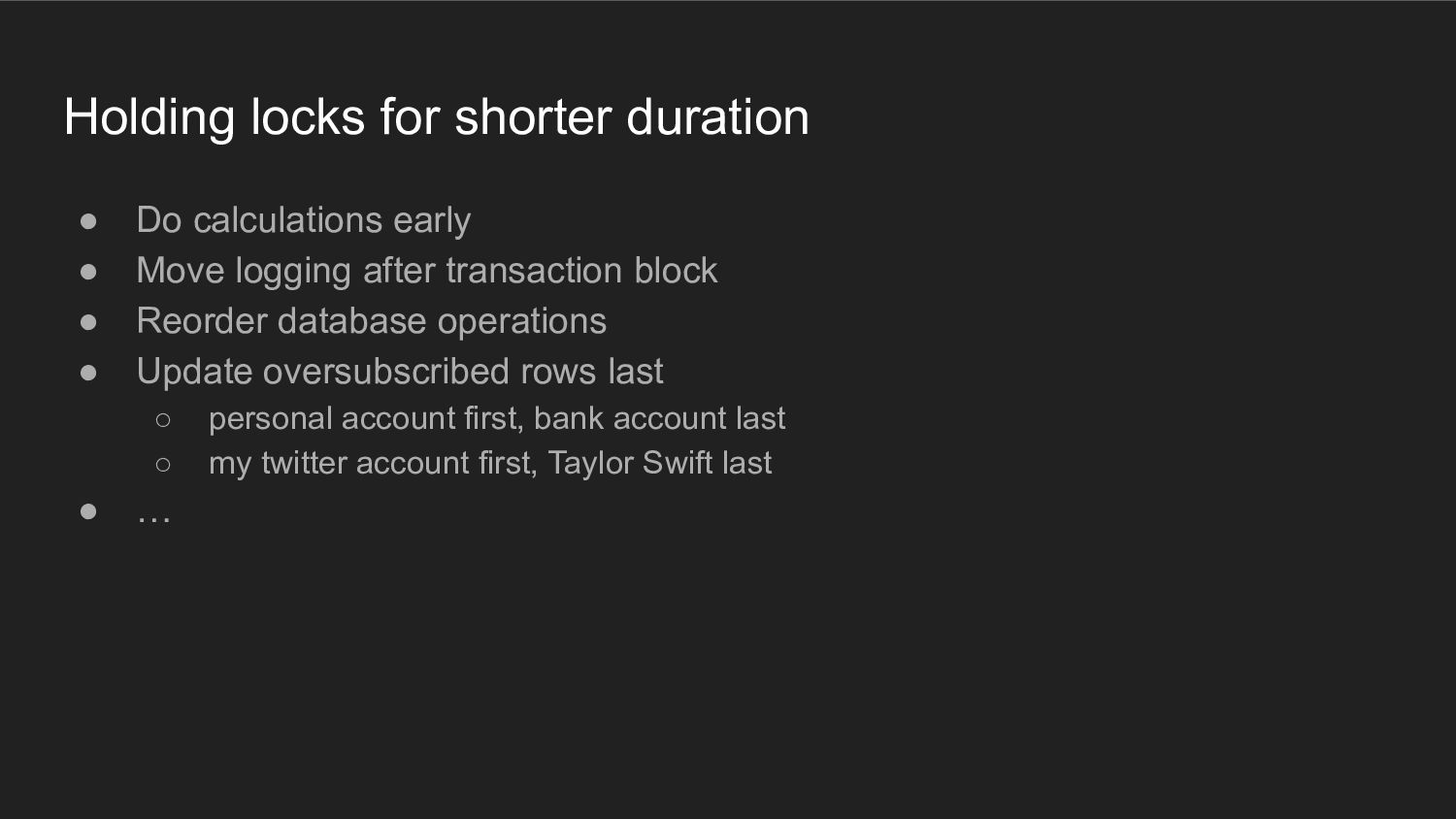
  29. Holding locks for shorter duration • Do calculations early •

    Move logging after transaction block • Reorder database operations • Update oversubscribed rows last ◦ personal account first, bank account last ◦ my twitter account first, Taylor Swift last • …
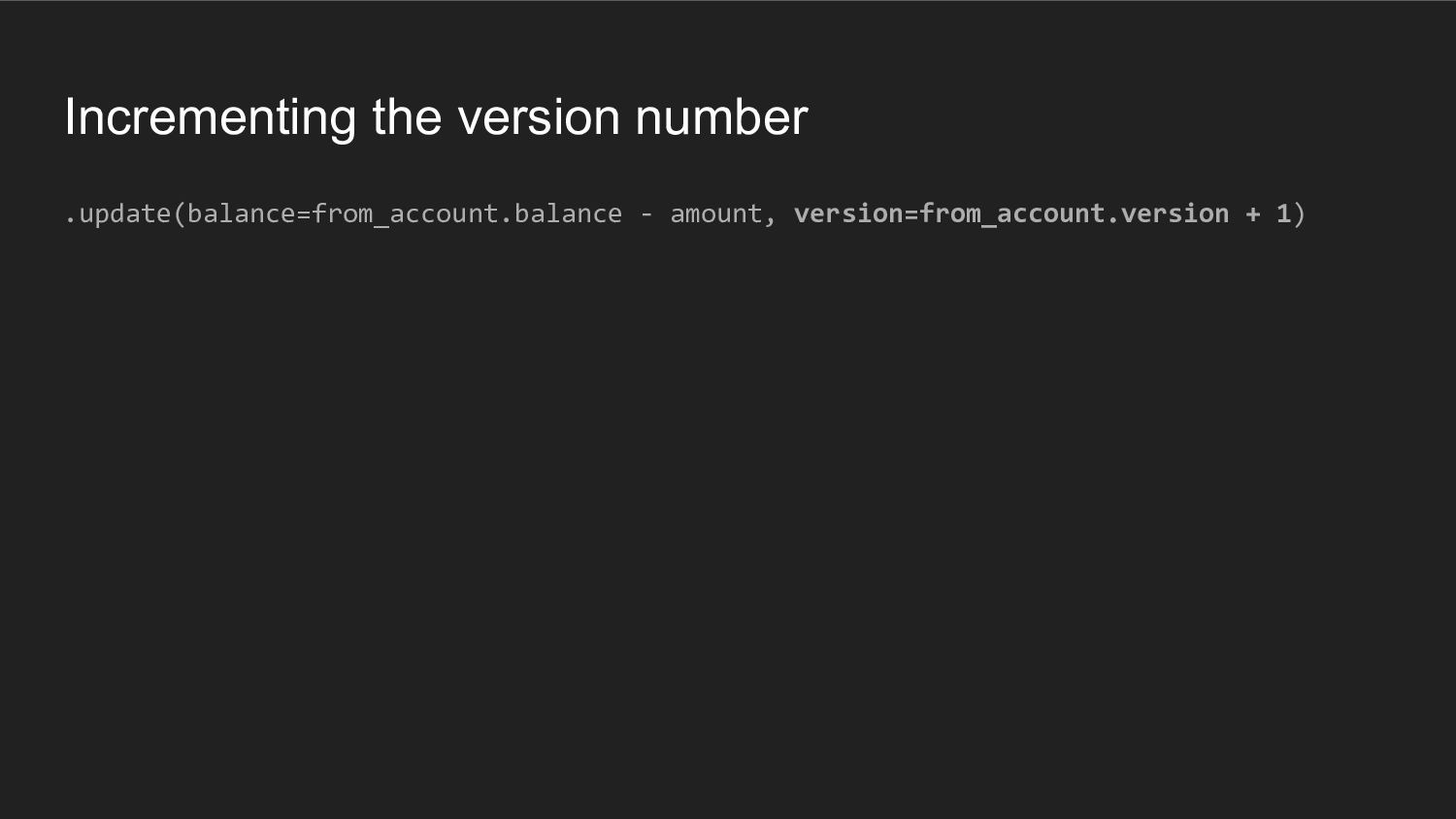
  30. Incrementing the version number .update(balance=from_account.balance - amount, version=from_account.version + 1)

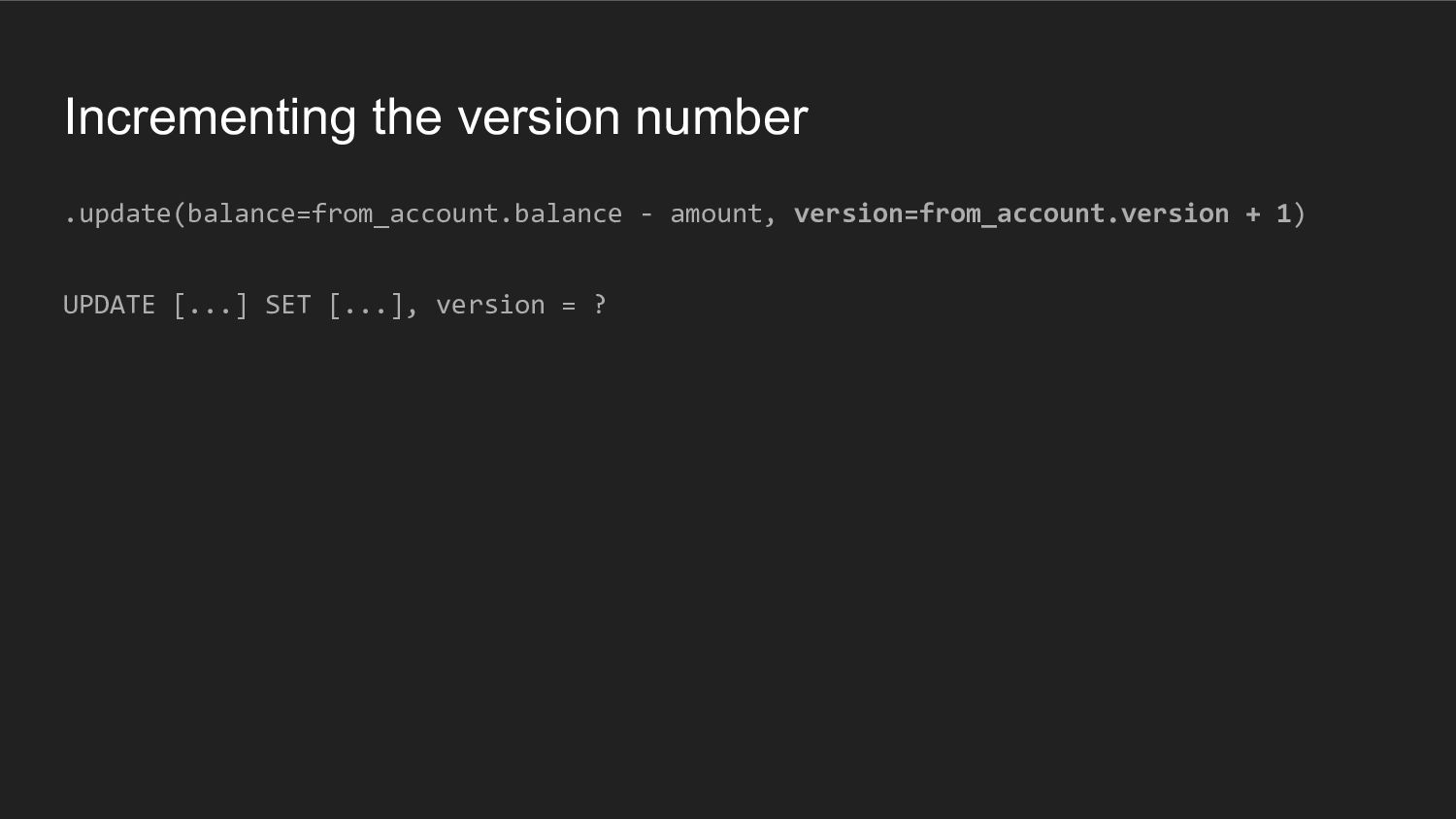
    UPDATE [...] SET [...], version = ? UPDATE [...] SET [...], version = version + 1
  31. Incrementing the version number .update(balance=from_account.balance - amount, version=from_account.version + 1)

    UPDATE [...] SET [...], version = ? UPDATE [...] SET [...], version = version + 1 .update(balance=from_account.balance - amount, version=F("version") + 1)
  32. Incrementing the version number .update(balance=from_account.balance - amount, version=from_account.version + 1)

    UPDATE [...] SET [...], version = ? UPDATE [...] SET [...], version = version + 1 .update(balance=from_account.balance - amount, version=F("version") + 1) 1. Load field value 2. Increment value 3. Store field value
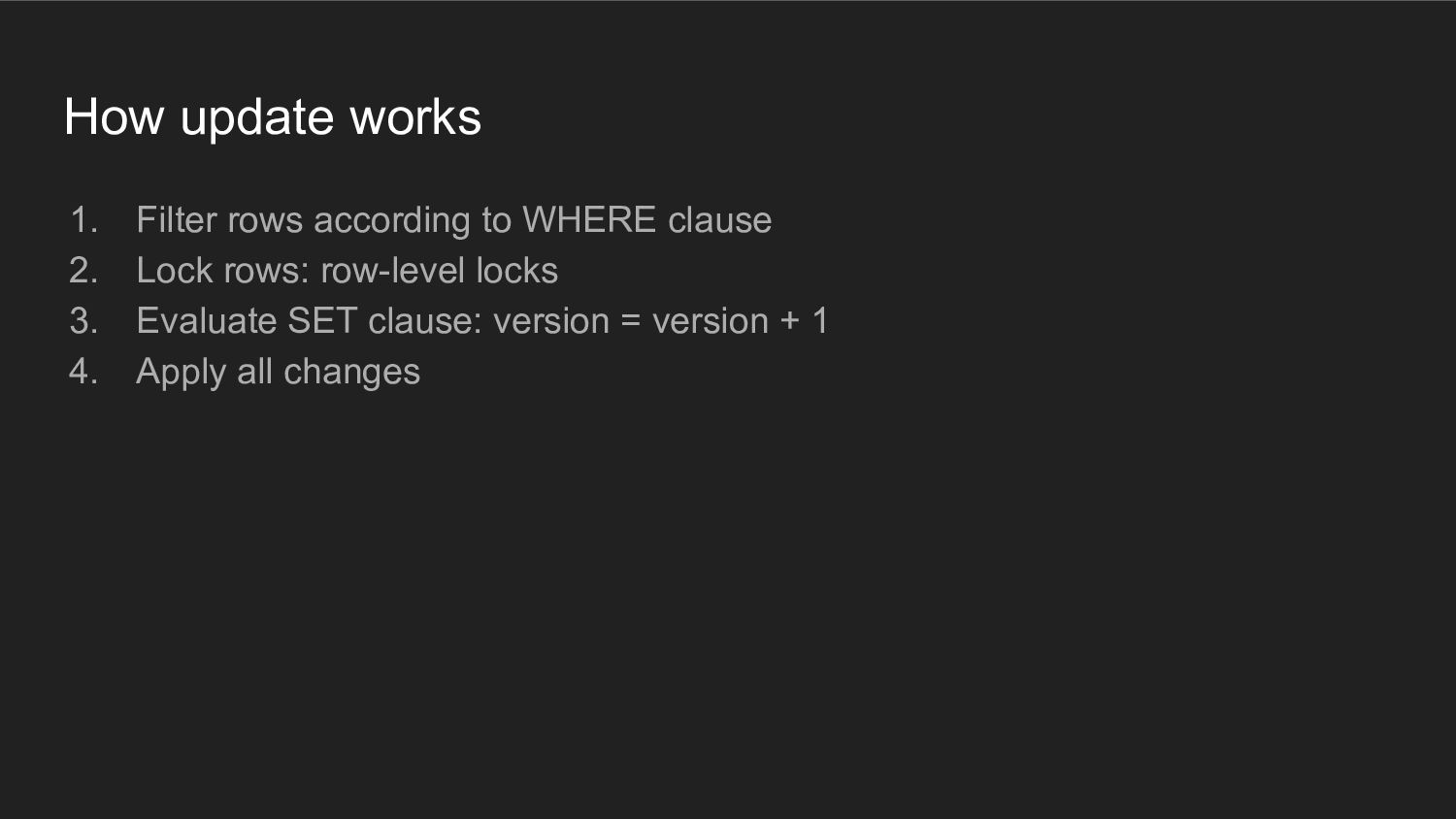
  33. How update works 1. Filter rows according to WHERE clause

    2. Lock rows: row-level locks 3. Evaluate SET clause: version = version + 1 4. Apply all changes
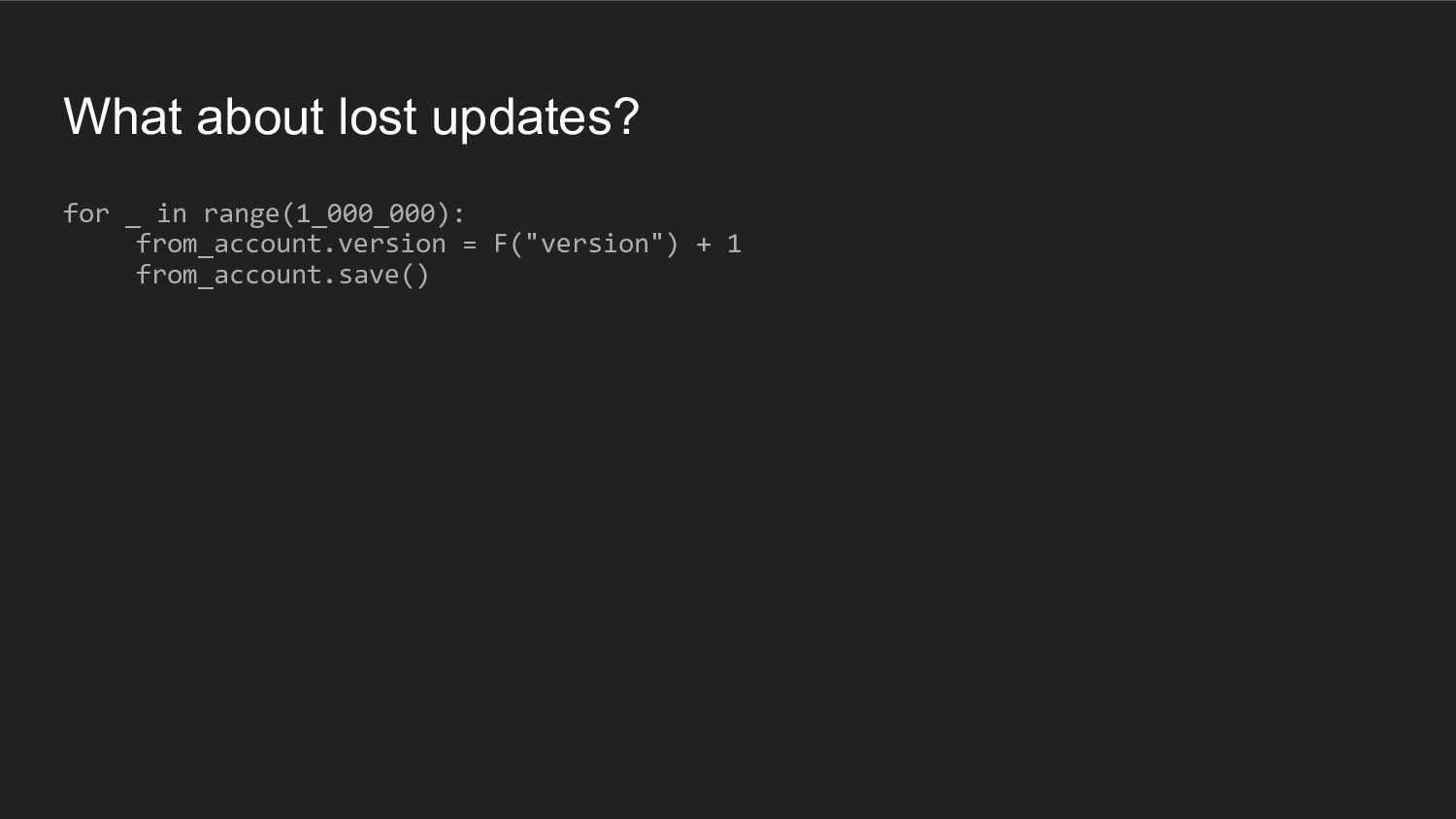
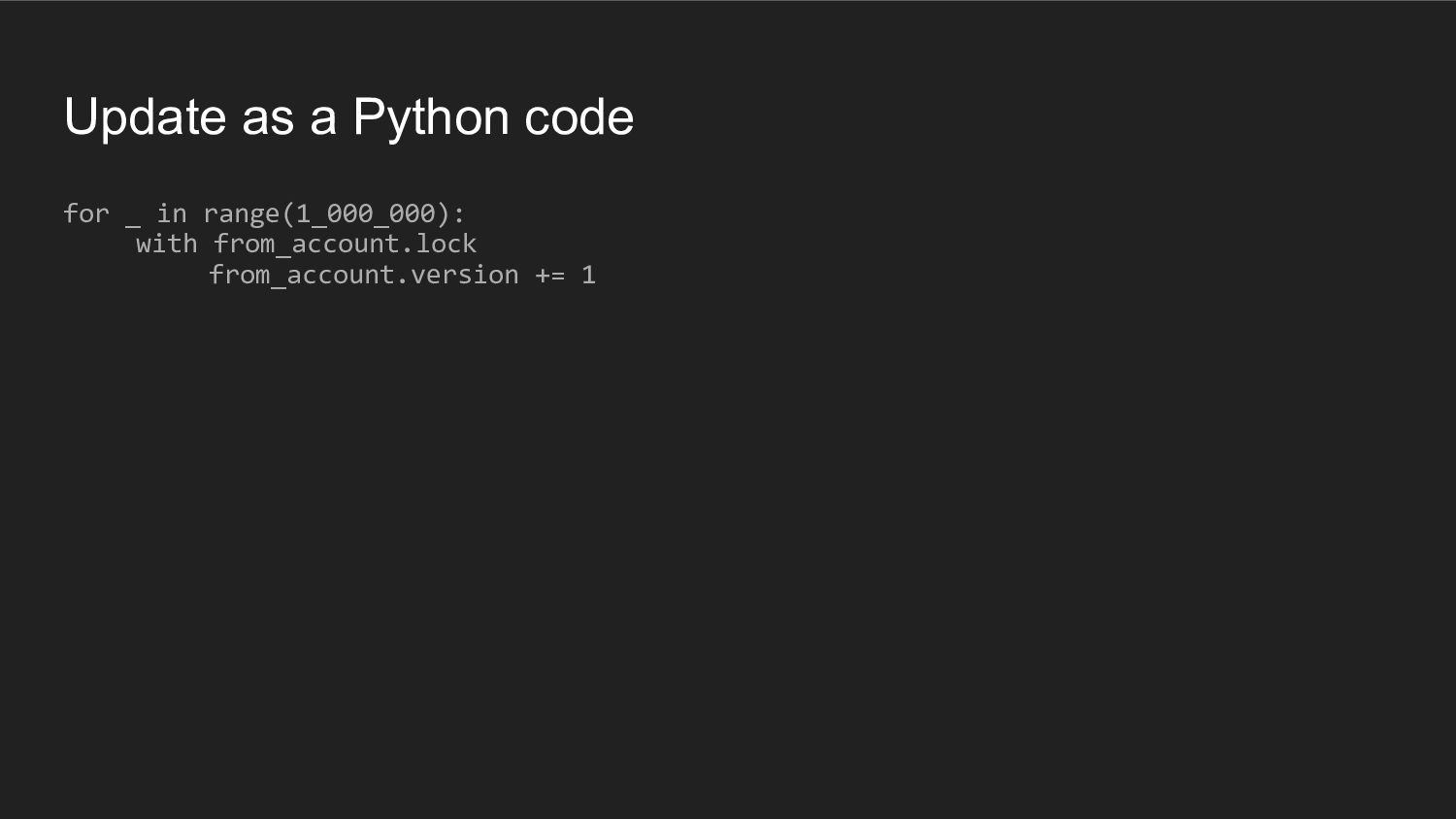
  34. Update as a Python code for _ in range(1_000_000): with

    from_account.lock from_account.version += 1
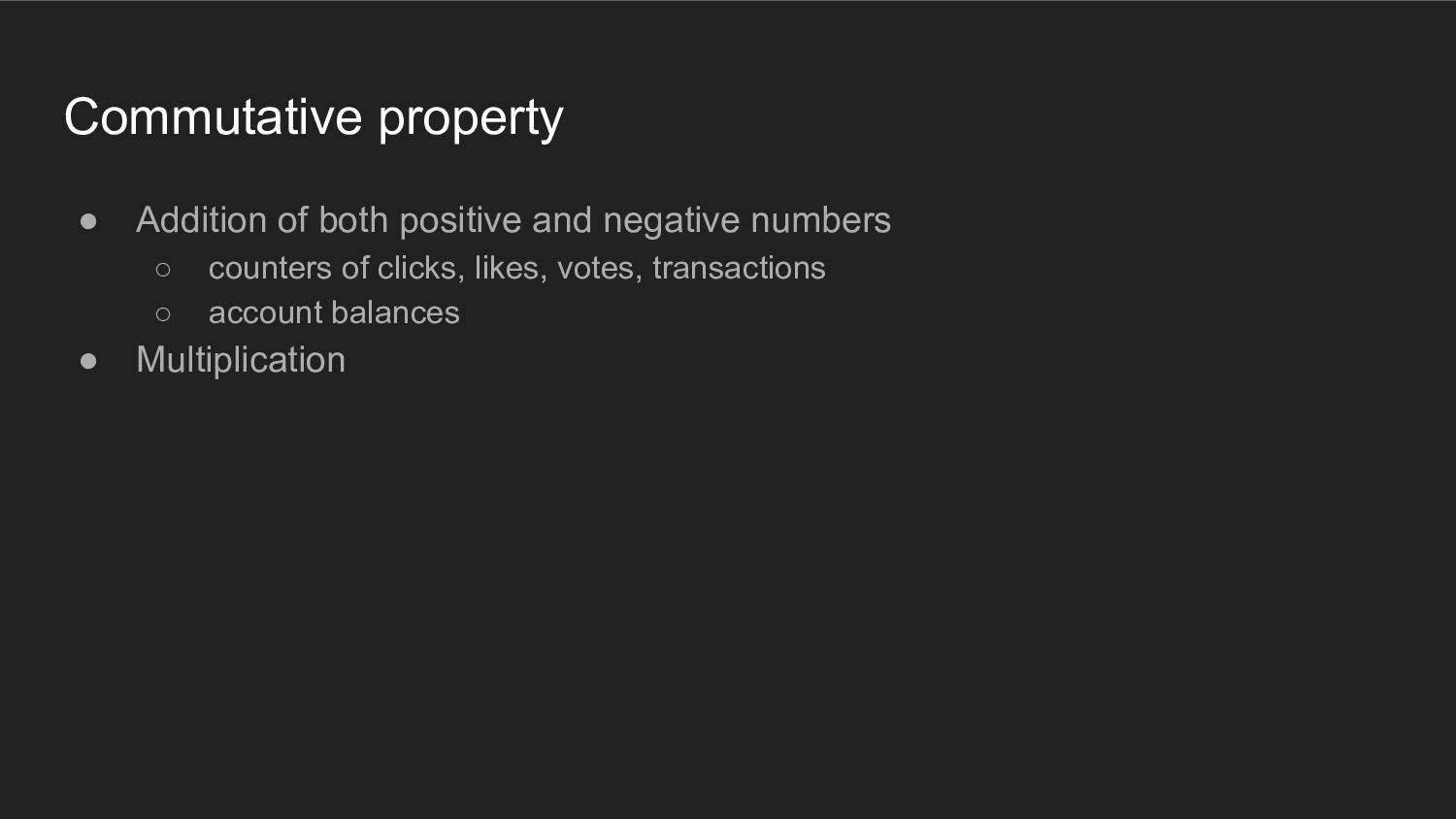
  35. Commutative property • Addition of both positive and negative numbers

    ◦ counters of clicks, likes, votes, transactions ◦ account balances • Multiplication
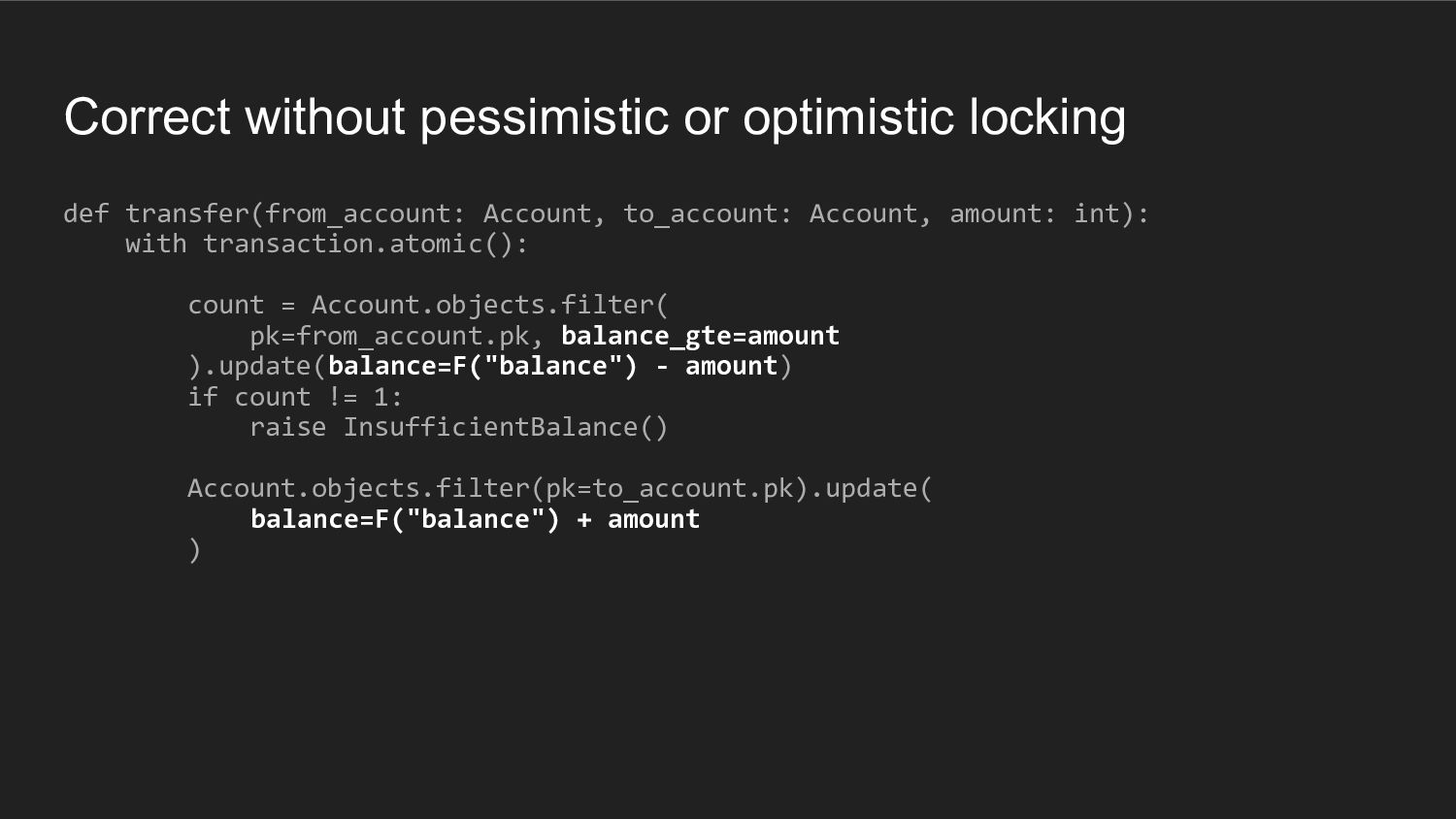
  36. Correct without pessimistic or optimistic locking def transfer(from_account: Account, to_account:

    Account, amount: int): with transaction.atomic(): count = Account.objects.filter( pk=from_account.pk, balance_gte=amount ).update(balance=F("balance") - amount) if count != 1: raise InsufficientBalance() Account.objects.filter(pk=to_account.pk).update( balance=F("balance") + amount )
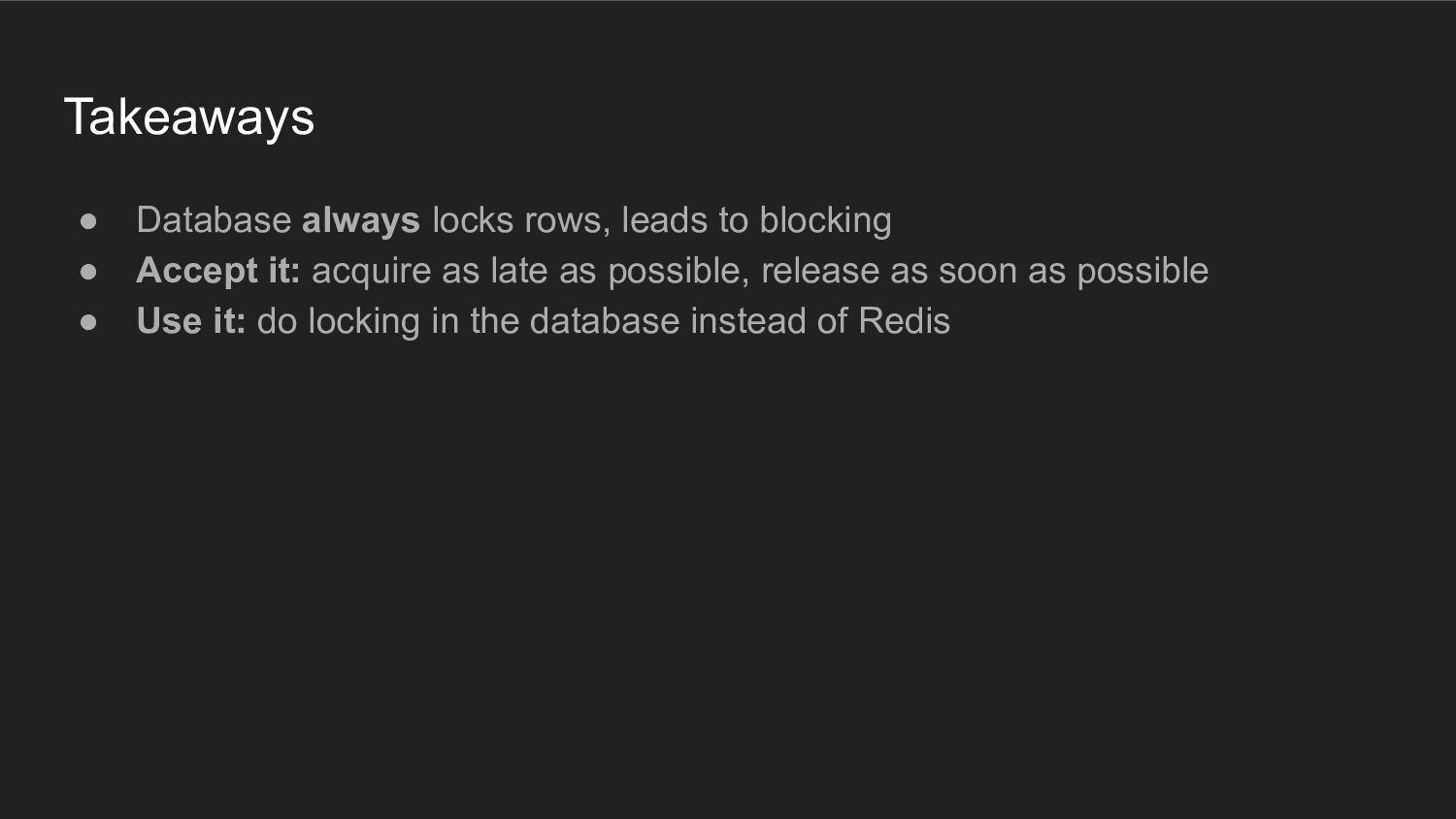
  37. Takeaways • Database always locks rows, leads to blocking •

    Accept it: acquire as late as possible, release as soon as possible • Use it: do locking in the database instead of Redis