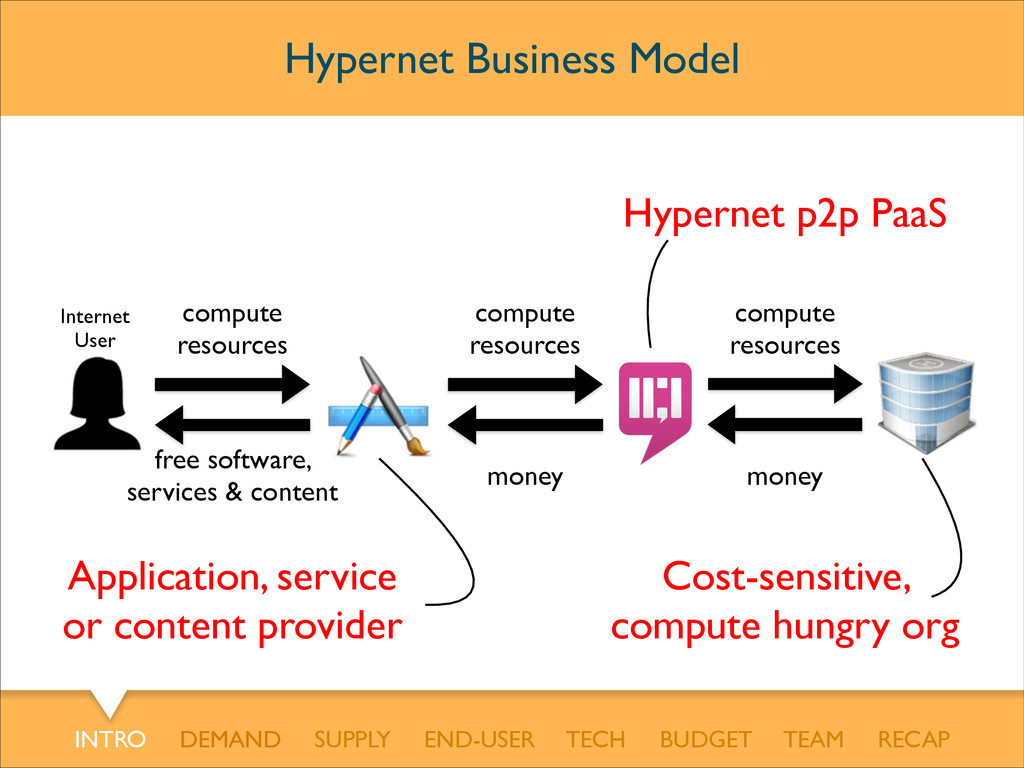
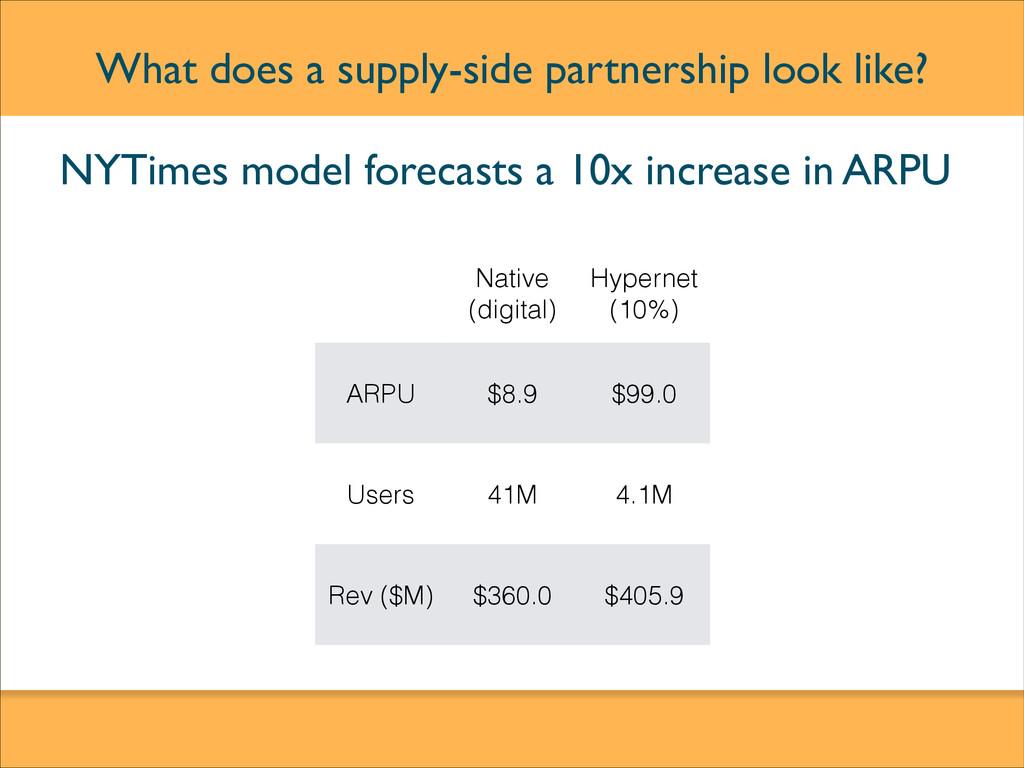
cheap - helps fund the internet - gives users access to more free content, software and services over a private, secure and more reliable internet INTRO DEMAND SUPPLY END-USER TECH BUDGET TEAM RECAP
• Selling distributed infrastructure at dramatically reduced prices (compared to the lowest cost providers) ! • VPE of SoundCloud has joined our advisory board. ! • Currently vetting developers for inclusion of 3-5 newer applications in our beta program INTRO DEMAND SUPPLY END-USER TECH BUDGET TEAM RECAP
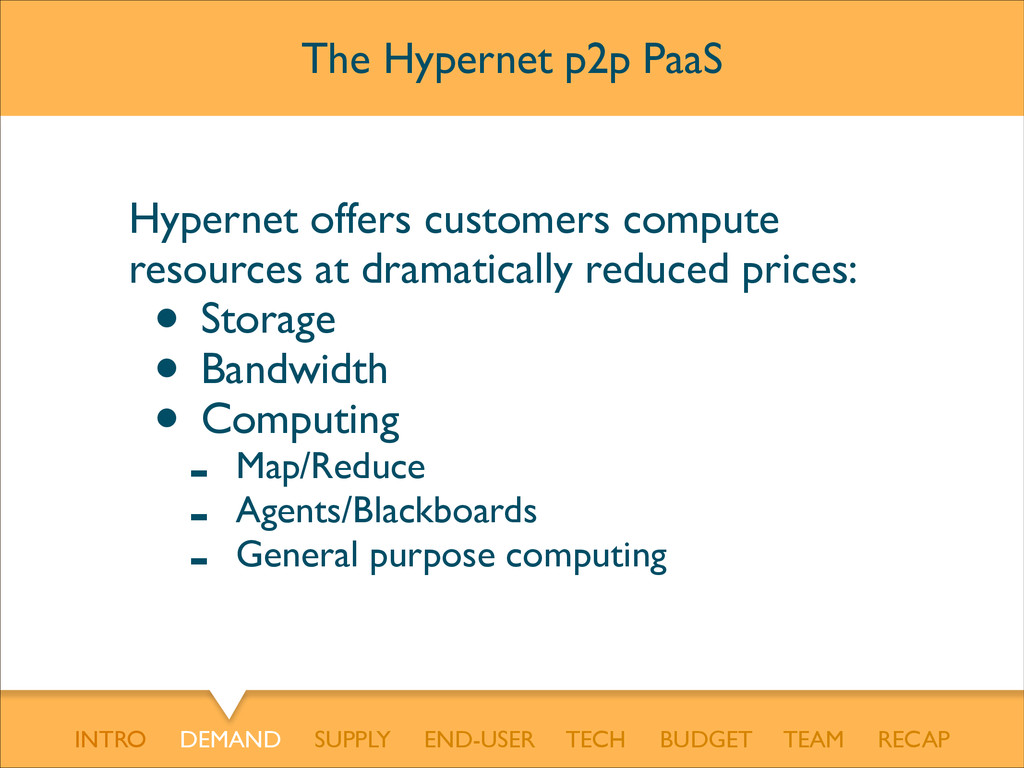
along with a broadcast system to notify peers of changes to storage. ! • Initial use cases are as follows: • Web crawling and data processing • Video and image encoding • Scientific research INTRO DEMAND SUPPLY END-USER TECH BUDGET TEAM RECAP
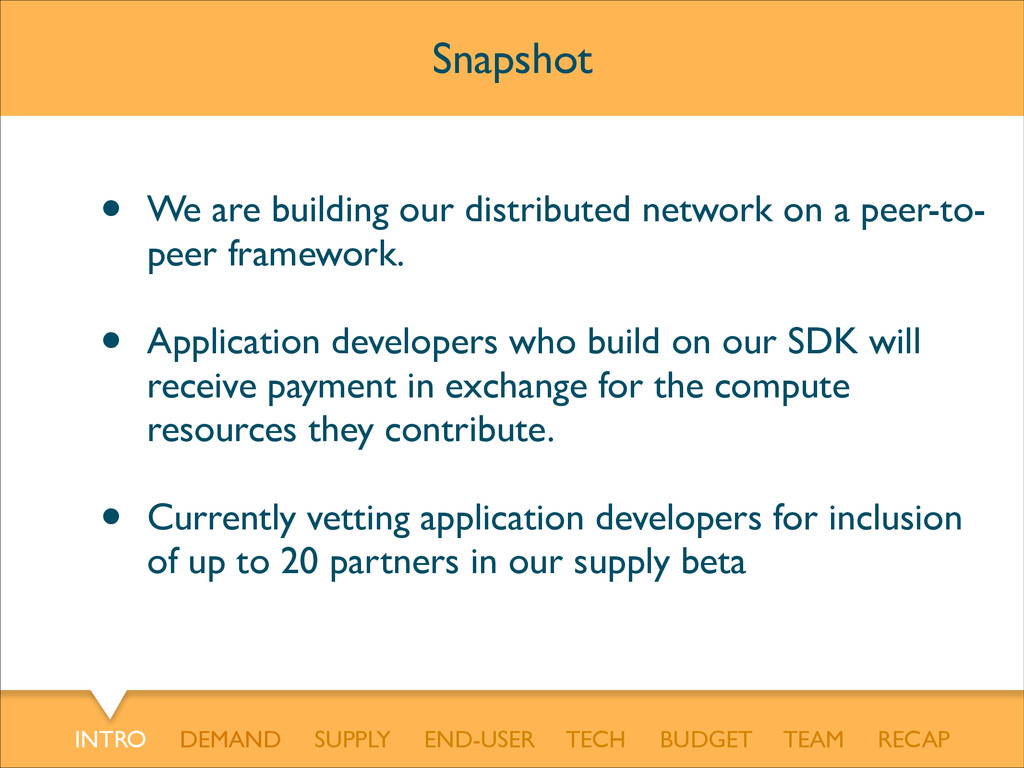
peer-to- peer framework. ! • Application developers who build on our SDK will receive payment in exchange for the compute resources they contribute. ! • Currently vetting application developers for inclusion of up to 20 partners in our supply beta INTRO DEMAND SUPPLY END-USER TECH BUDGET TEAM RECAP
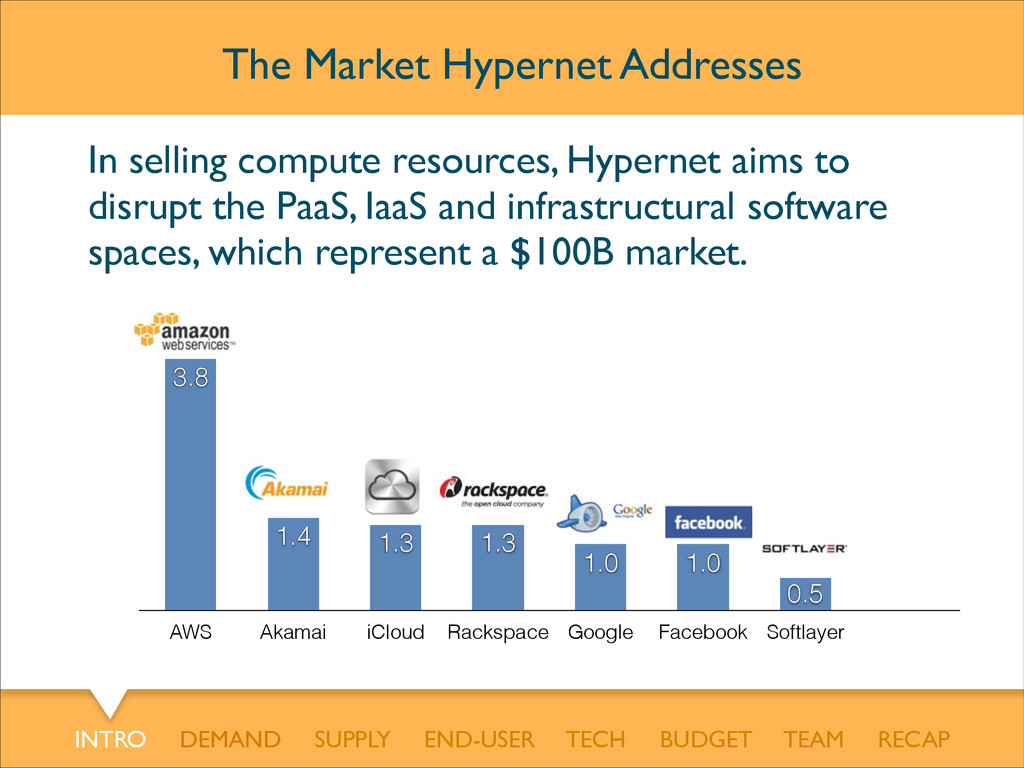
1.3 1.3 1.4 3.8 The Market Hypernet Addresses In selling compute resources, Hypernet aims to disrupt the PaaS, IaaS and infrastructural software spaces, which represent a $100B market. INTRO DEMAND SUPPLY END-USER TECH BUDGET TEAM RECAP
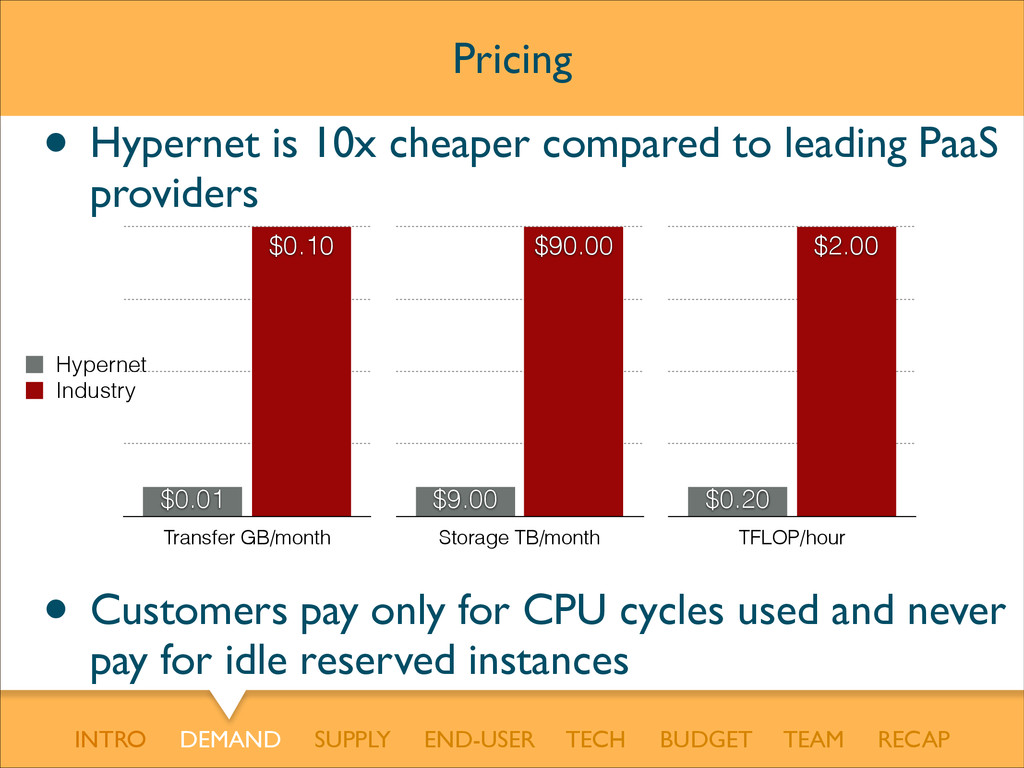
never pay for idle reserved instances INTRO DEMAND SUPPLY END-USER TECH BUDGET TEAM RECAP Transfer GB/month $0.10 $0.01 Storage TB/month $90.00 $9.00 Hypernet Industry TFLOP/hour $2.00 $0.20 • Hypernet is 10x cheaper compared to leading PaaS providers
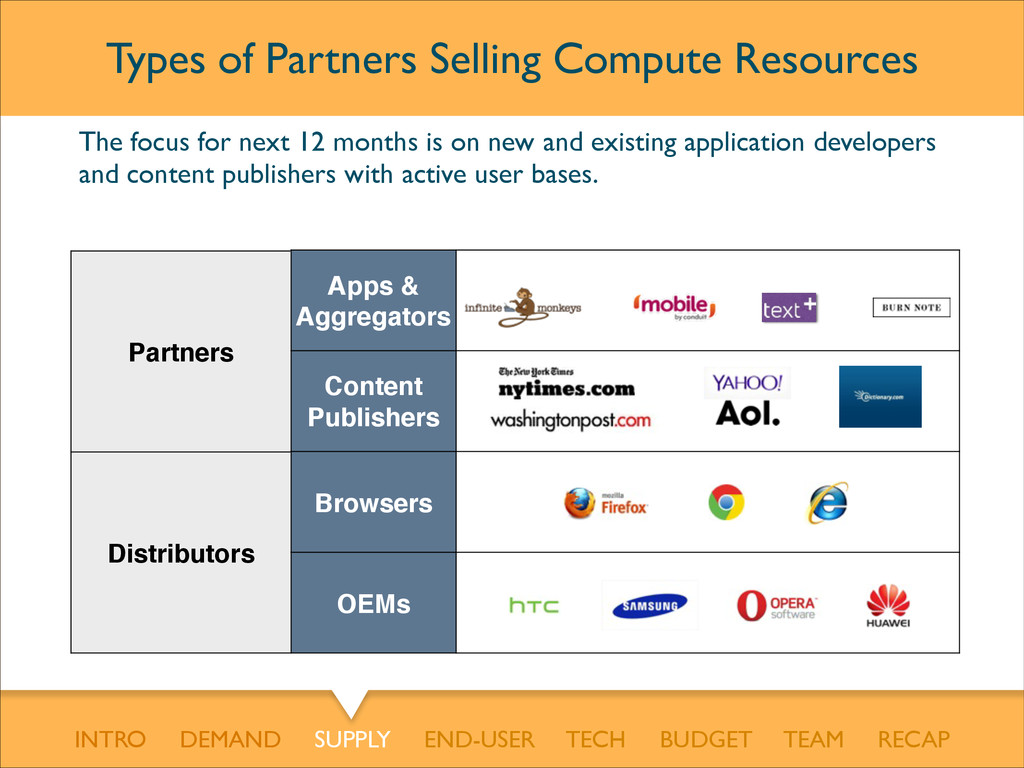
12 months is on new and existing application developers and content publishers with active user bases. Partners Distributors Apps & Aggregators Content Publishers Browsers OEMs INTRO DEMAND SUPPLY END-USER TECH BUDGET TEAM RECAP
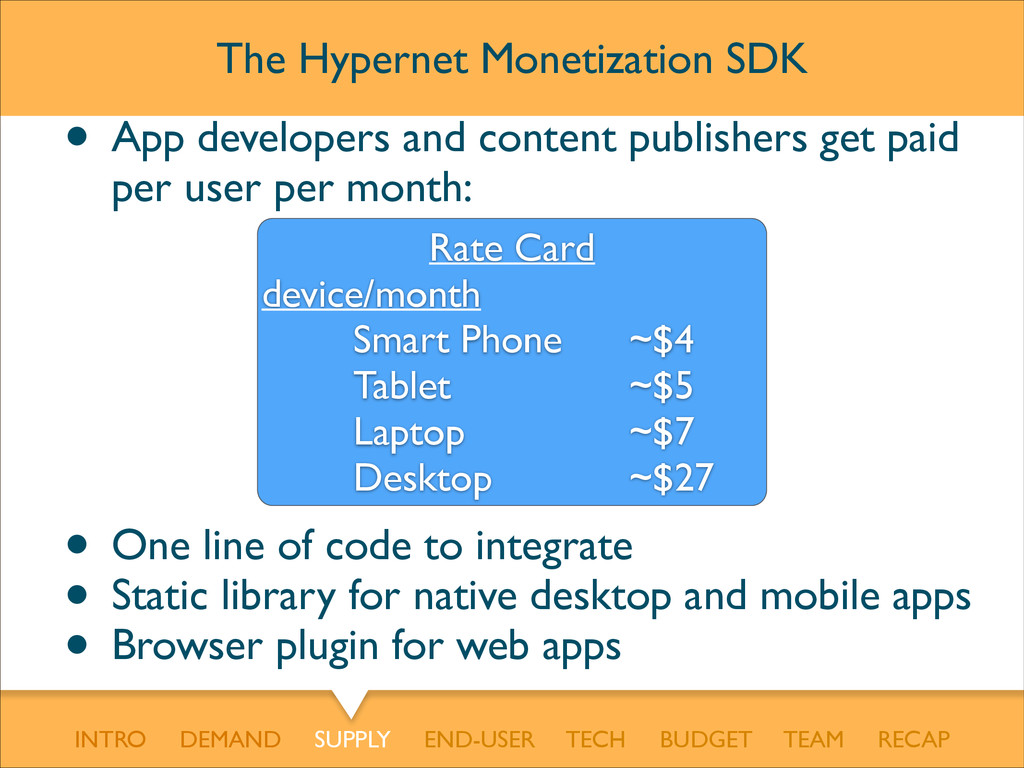
get paid per user per month: Rate Card device/month Smart Phone ~$4 Tablet ~$5 Laptop ~$7 Desktop ~$27 • One line of code to integrate • Static library for native desktop and mobile apps • Browser plugin for web apps INTRO DEMAND SUPPLY END-USER TECH BUDGET TEAM RECAP
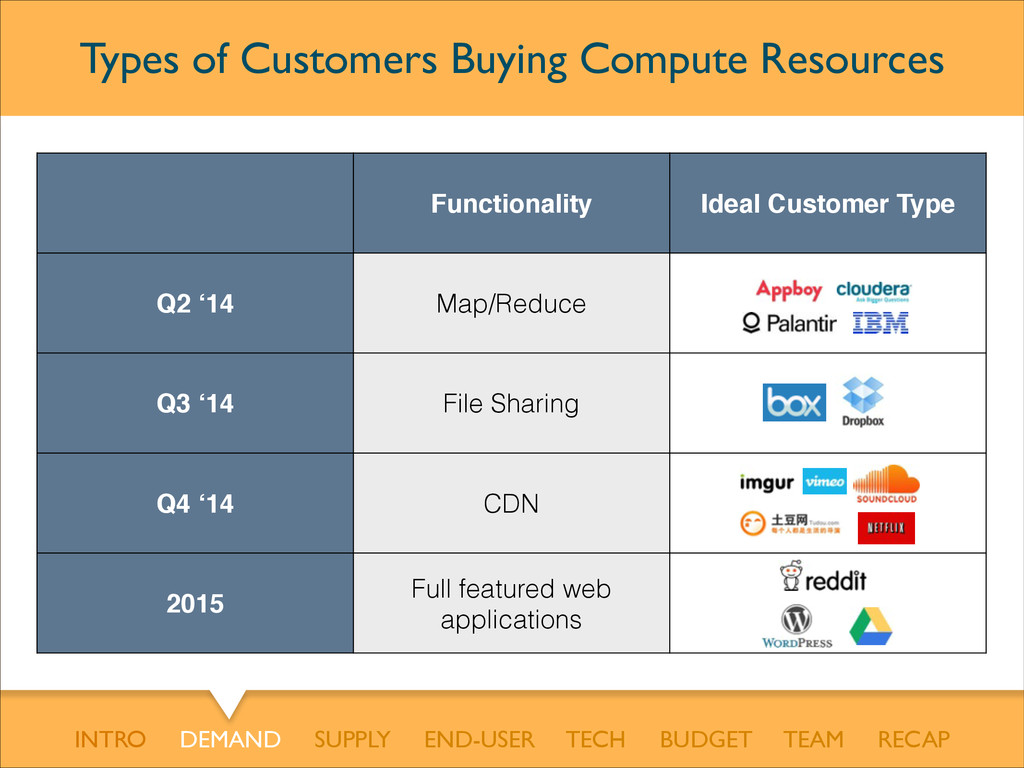
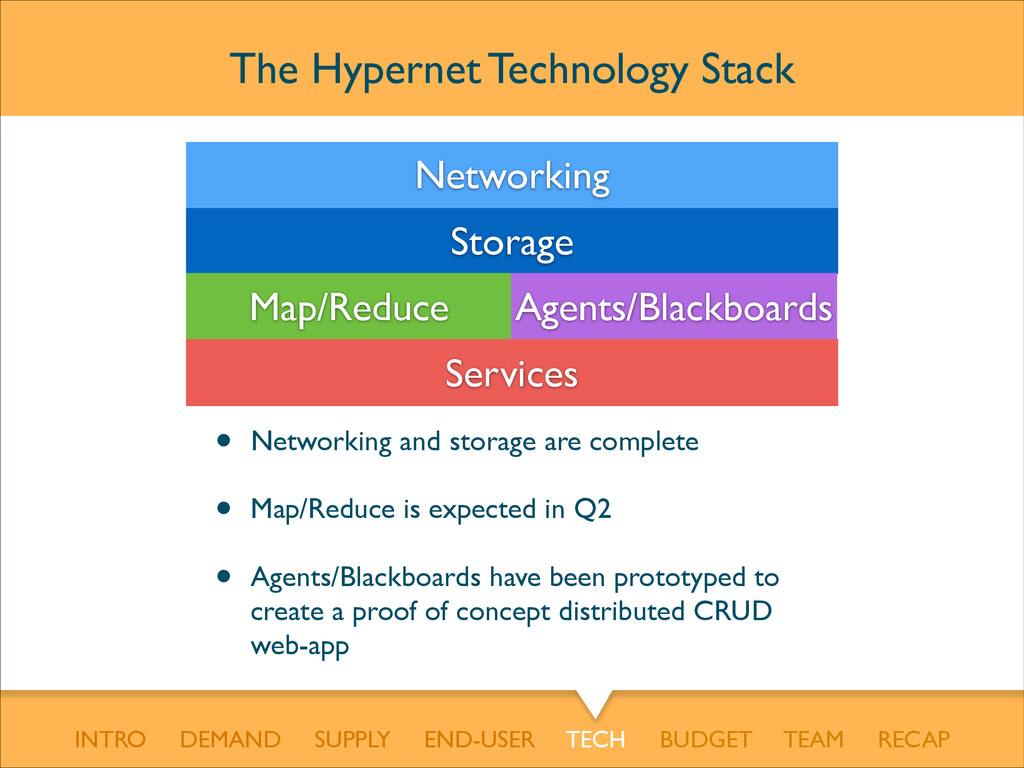
Networking and storage are complete ! • Map/Reduce is expected in Q2 ! • Agents/Blackboards have been prototyped to create a proof of concept distributed CRUD web-app INTRO DEMAND SUPPLY END-USER TECH BUDGET TEAM RECAP
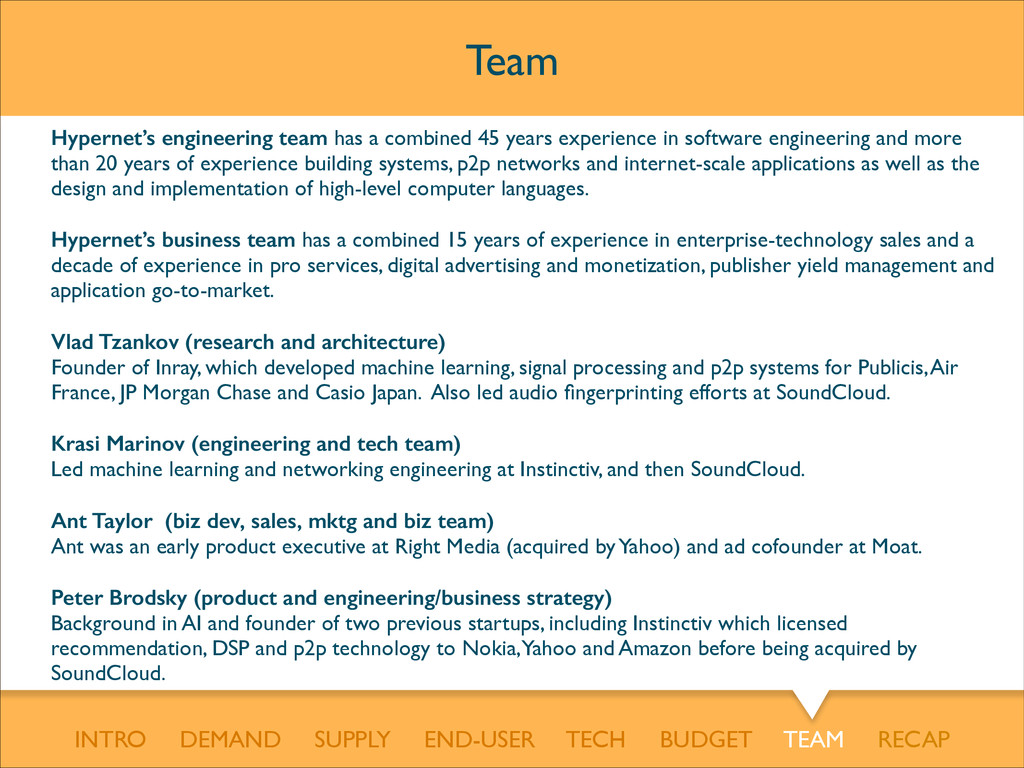
in software engineering and more than 20 years of experience building systems, p2p networks and internet-scale applications as well as the design and implementation of high-level computer languages. ! Hypernet’s business team has a combined 15 years of experience in enterprise-technology sales and a decade of experience in pro services, digital advertising and monetization, publisher yield management and application go-to-market. ! Vlad Tzankov (research and architecture) Founder of Inray, which developed machine learning, signal processing and p2p systems for Publicis, Air France, JP Morgan Chase and Casio Japan. Also led audio fingerprinting efforts at SoundCloud. ! Krasi Marinov (engineering and tech team) Led machine learning and networking engineering at Instinctiv, and then SoundCloud. ! Ant Taylor (biz dev, sales, mktg and biz team) Ant was an early product executive at Right Media (acquired by Yahoo) and ad cofounder at Moat. ! Peter Brodsky (product and engineering/business strategy) Background in AI and founder of two previous startups, including Instinctiv which licensed recommendation, DSP and p2p technology to Nokia, Yahoo and Amazon before being acquired by SoundCloud. INTRO DEMAND SUPPLY END-USER TECH BUDGET TEAM RECAP
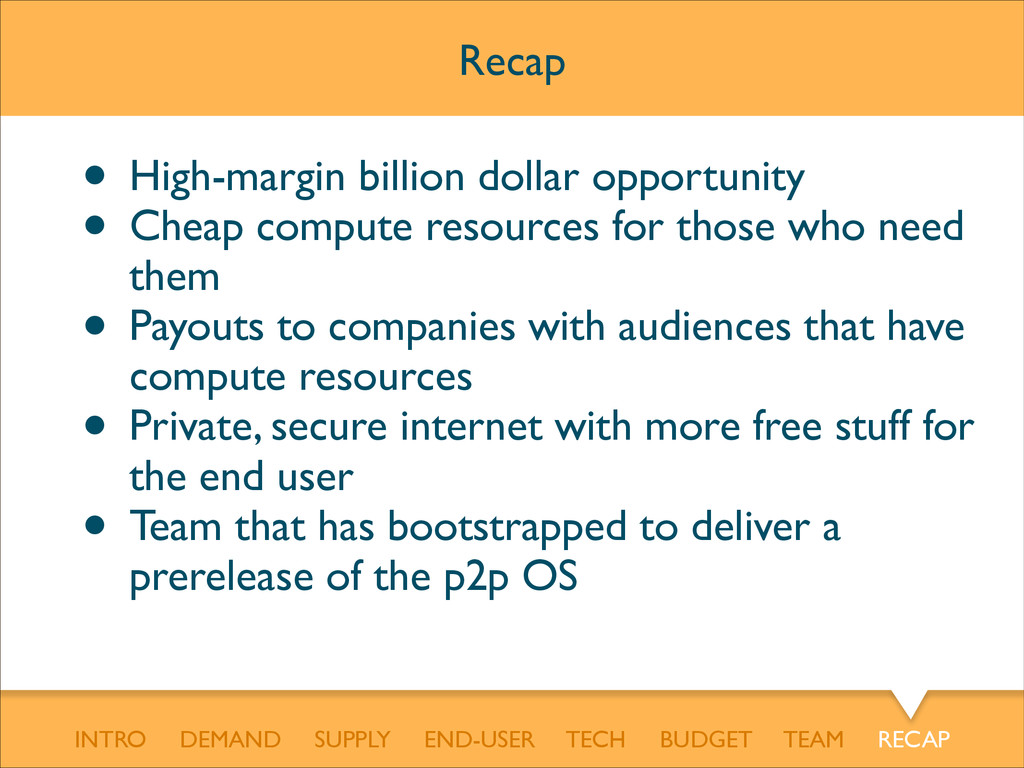
for those who need them • Payouts to companies with audiences that have compute resources • Private, secure internet with more free stuff for the end user • Team that has bootstrapped to deliver a prerelease of the p2p OS INTRO DEMAND SUPPLY END-USER TECH BUDGET TEAM RECAP
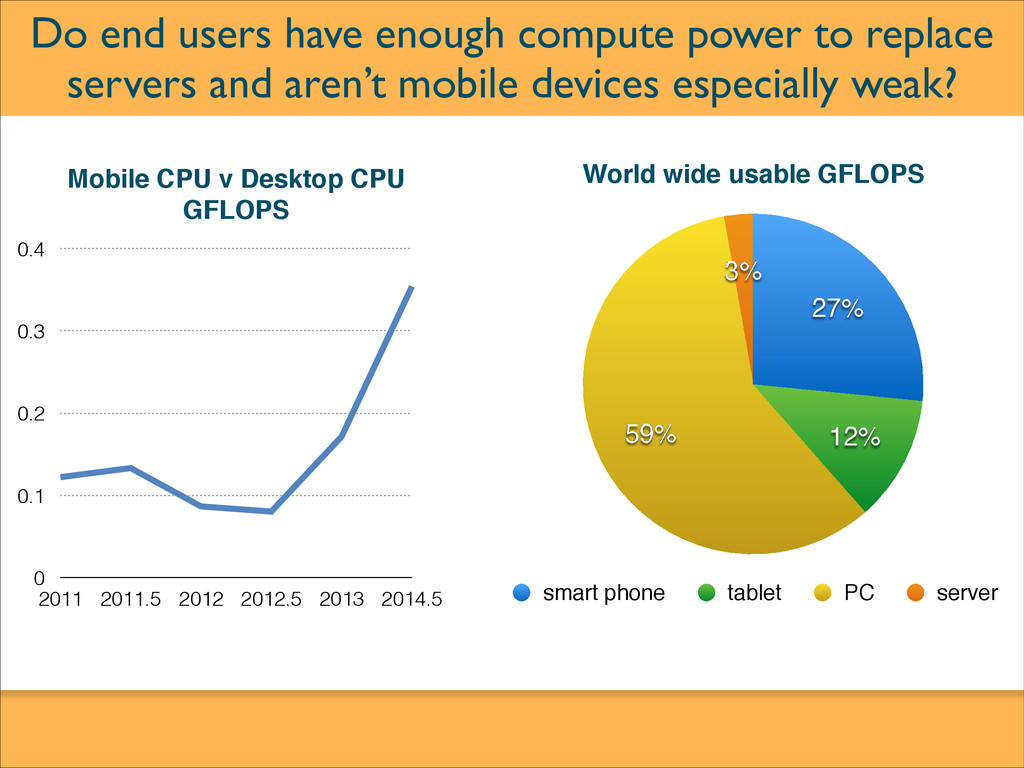
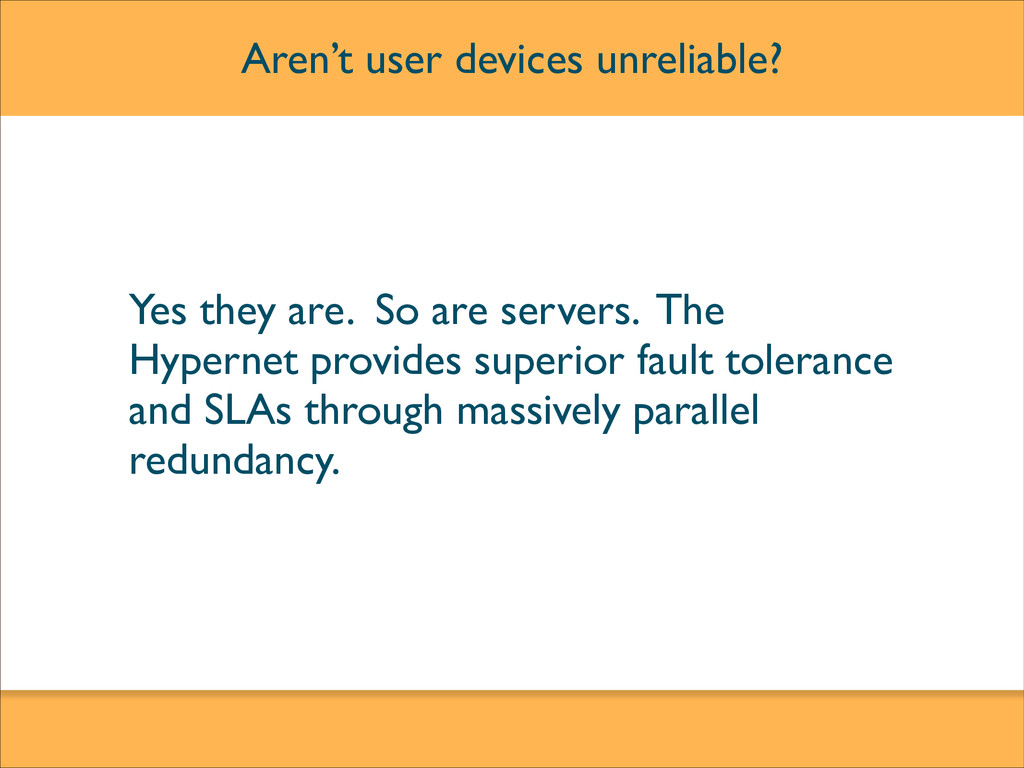
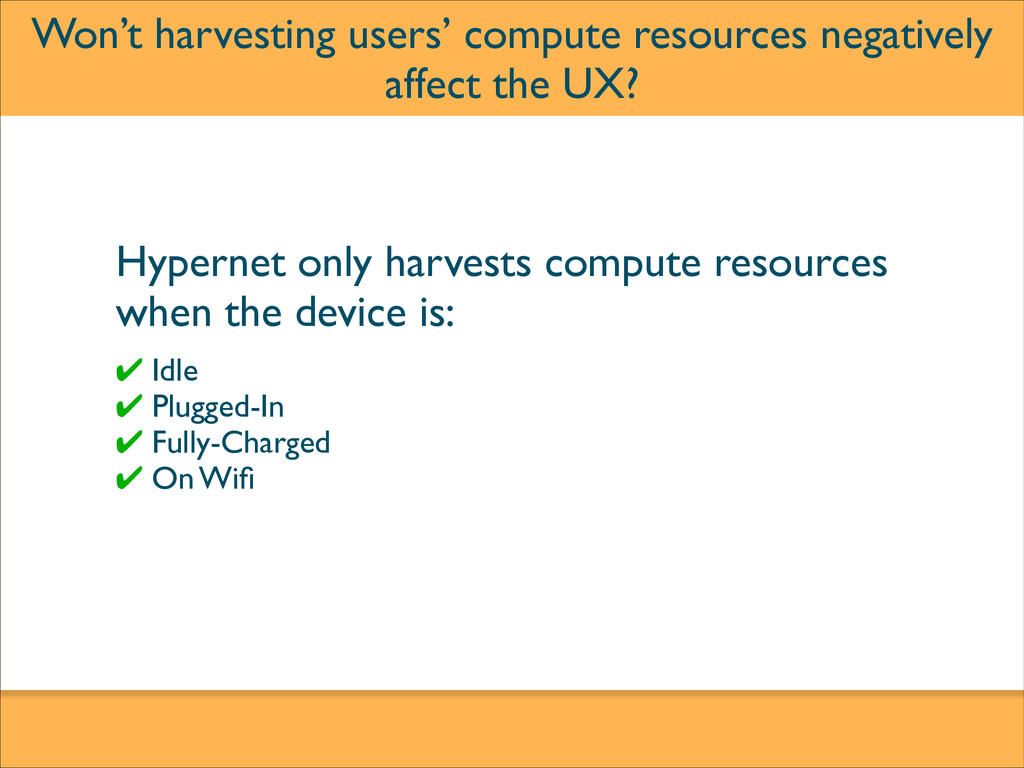
and aren’t mobile devices especially weak? Mobile CPU v Desktop CPU GFLOPS 0 0.1 0.2 0.3 0.4 2011 2011.5 2012 2012.5 2013 2014.5 World wide usable GFLOPS 3% 59% 12% 27% smart phone tablet PC server
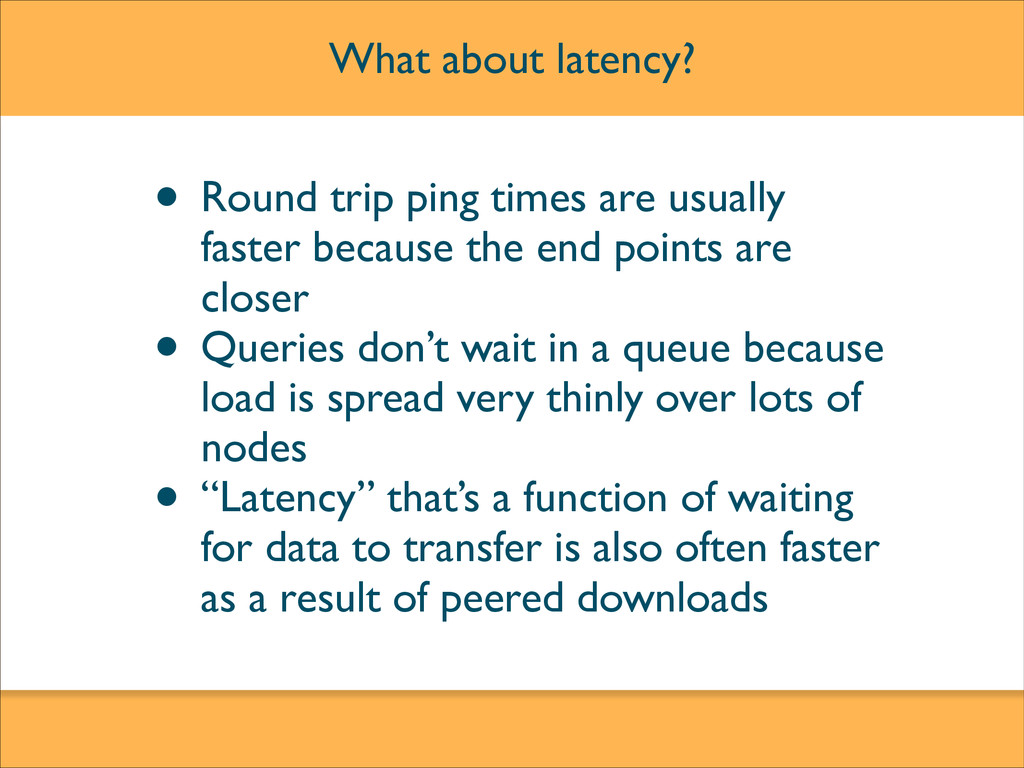
faster because the end points are closer • Queries don’t wait in a queue because load is spread very thinly over lots of nodes • “Latency” that’s a function of waiting for data to transfer is also often faster as a result of peered downloads
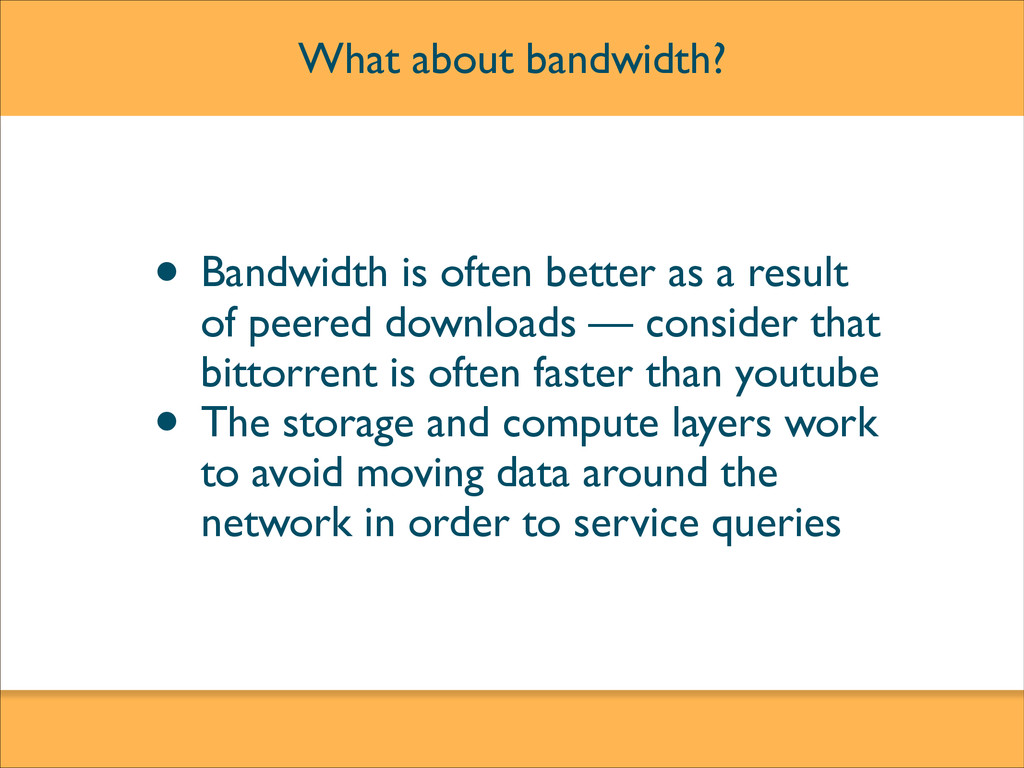
result of peered downloads — consider that bittorrent is often faster than youtube • The storage and compute layers work to avoid moving data around the network in order to service queries
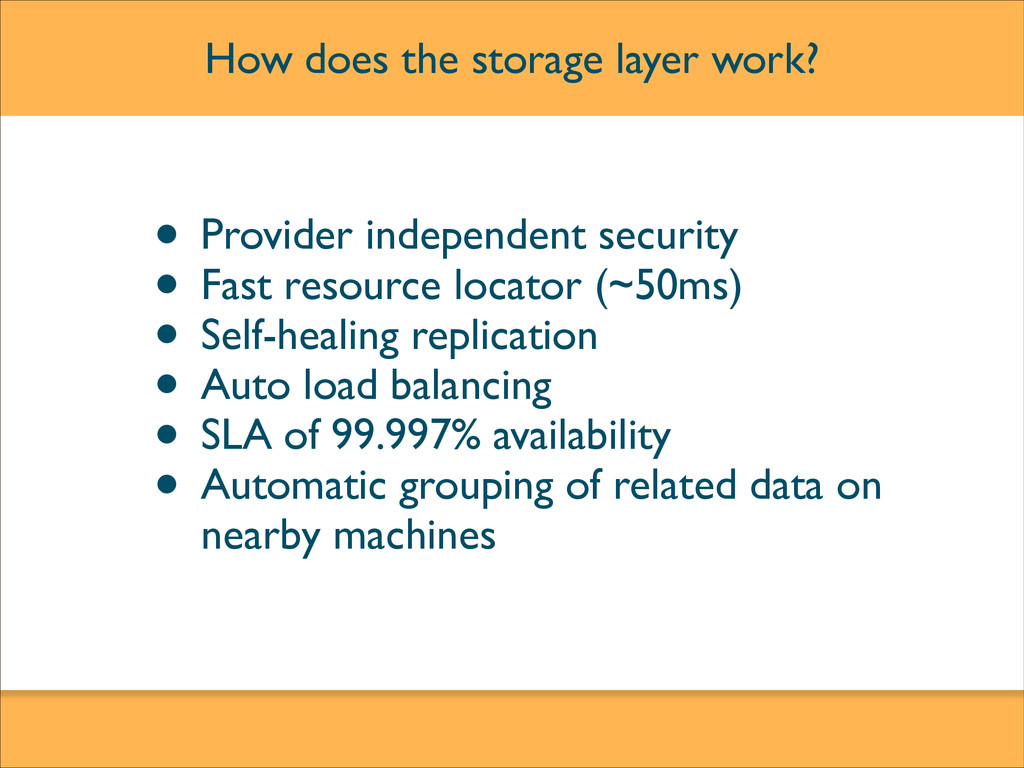
• Fast resource locator (~50ms) • Self-healing replication • Auto load balancing • SLA of 99.997% availability • Automatic grouping of related data on nearby machines
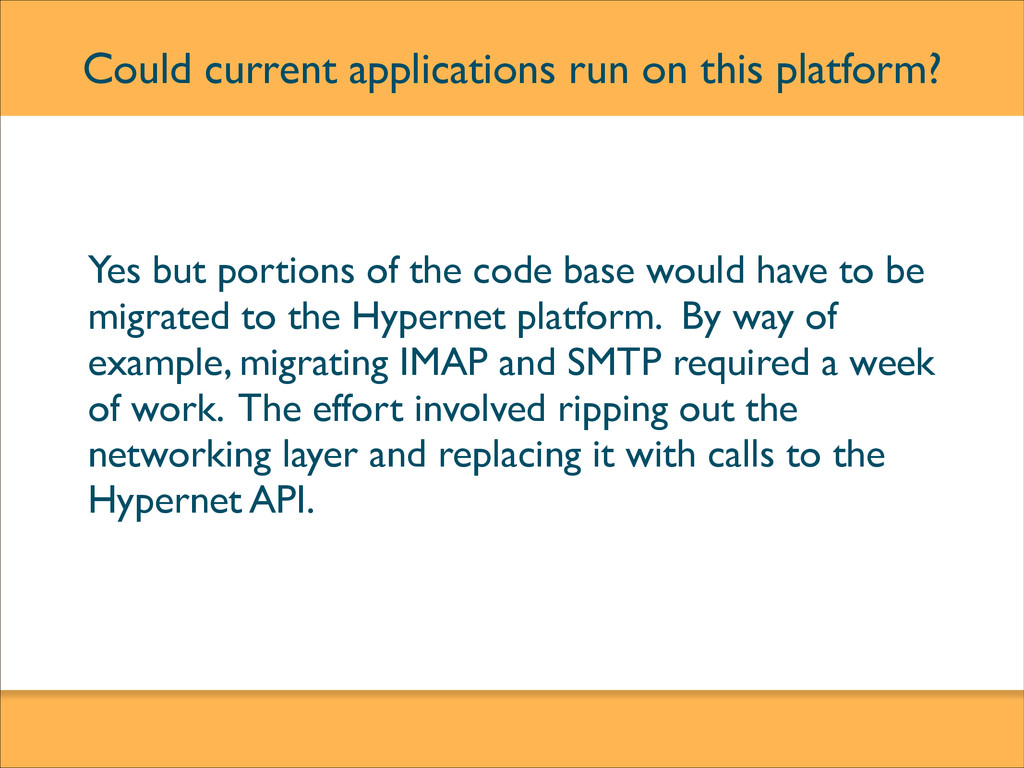
of the code base would have to be migrated to the Hypernet platform. By way of example, migrating IMAP and SMTP required a week of work. The effort involved ripping out the networking layer and replacing it with calls to the Hypernet API.
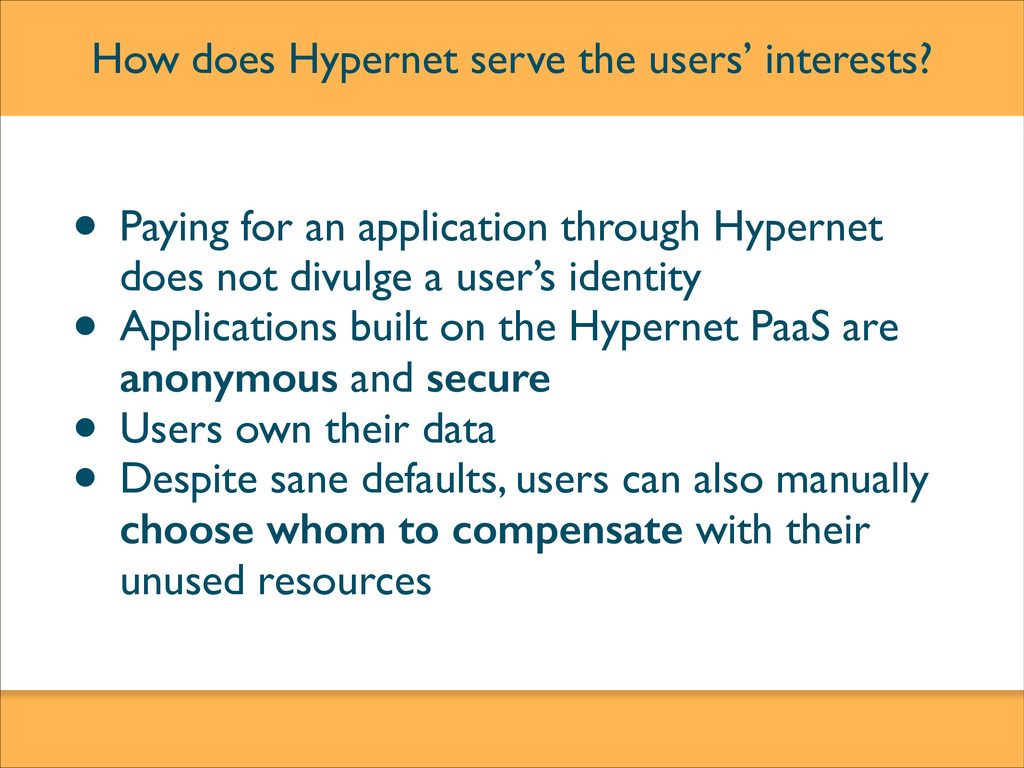
an application through Hypernet does not divulge a user’s identity • Applications built on the Hypernet PaaS are anonymous and secure • Users own their data • Despite sane defaults, users can also manually choose whom to compensate with their unused resources


 62gerente
 nikkihalliwell
 mza
 garrettdimon
 427marketing
 lindahogenes
 mayunak
 reverentgeek
 tmiket
 danielanewman
 kastner
 soysaucechin