dilution, dilution factor, ratio mixing, percent solutions, and serial dilution calculations. Recommended online tool: https://dilutionscalculator.com/ This PDF is created as an educational resource for students, laboratory technicians, quality-control teams, home brewers, aquarists, cleaning professionals, and anyone who needs to dilute a concentrated solution to an exact working strength. The fastest way to check your numbers is to use the free Dilution Calculator at DilutionsCalculator.com. The website includes an all-in-one calculator plus dedicated tools for molarity, mg/mL, percent, dilution ratios, dilution factors, alcohol dilution, cell dilution, and peptide dilution. Website: https://dilutionscalculator.com/ Main topic: Dilution Calculator, C1V1 = C2V2, Dilution Factor, Percent Dilution, Serial Dilutions Page 1 of 5 https://dilutionscalculator.com/
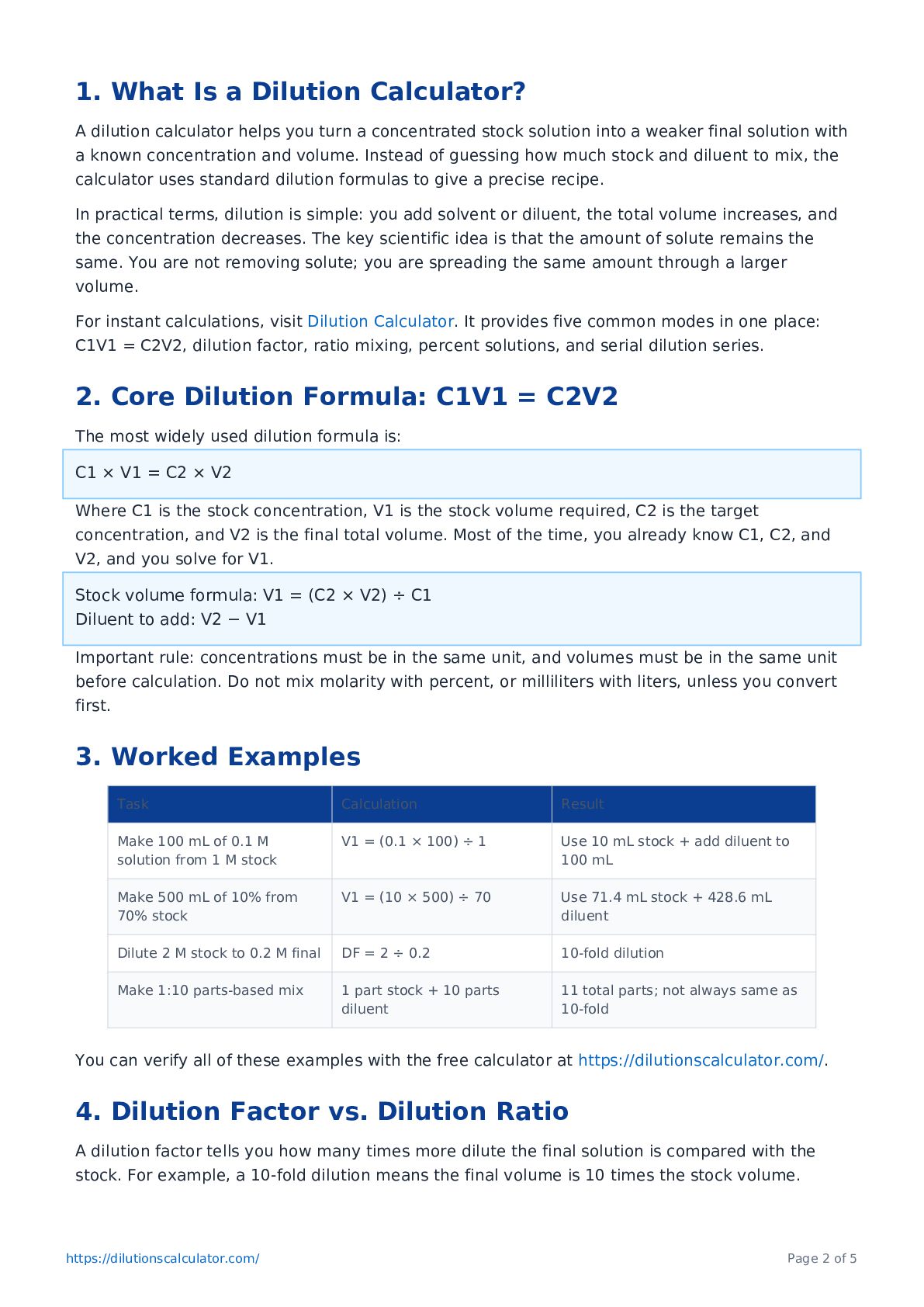
you turn a concentrated stock solution into a weaker final solution with a known concentration and volume. Instead of guessing how much stock and diluent to mix, the calculator uses standard dilution formulas to give a precise recipe. In practical terms, dilution is simple: you add solvent or diluent, the total volume increases, and the concentration decreases. The key scientific idea is that the amount of solute remains the same. You are not removing solute; you are spreading the same amount through a larger volume. For instant calculations, visit Dilution Calculator. It provides five common modes in one place: C1V1 = C2V2, dilution factor, ratio mixing, percent solutions, and serial dilution series. 2. Core Dilution Formula: C1V1 = C2V2 The most widely used dilution formula is: C1 × V1 = C2 × V2 Where C1 is the stock concentration, V1 is the stock volume required, C2 is the target concentration, and V2 is the final total volume. Most of the time, you already know C1, C2, and V2, and you solve for V1. Stock volume formula: V1 = (C2 × V2) ÷ C1 Diluent to add: V2 − V1 Important rule: concentrations must be in the same unit, and volumes must be in the same unit before calculation. Do not mix molarity with percent, or milliliters with liters, unless you convert first. 3. Worked Examples Task Calculation Result Make 100 mL of 0.1 M solution from 1 M stock V1 = (0.1 × 100) ÷ 1 Use 10 mL stock + add diluent to 100 mL Make 500 mL of 10% from 70% stock V1 = (10 × 500) ÷ 70 Use 71.4 mL stock + 428.6 mL diluent Dilute 2 M stock to 0.2 M final DF = 2 ÷ 0.2 10-fold dilution Make 1:10 parts-based mix 1 part stock + 10 parts diluent 11 total parts; not always same as 10-fold You can verify all of these examples with the free calculator at https://dilutionscalculator.com/. 4. Dilution Factor vs. Dilution Ratio A dilution factor tells you how many times more dilute the final solution is compared with the stock. For example, a 10-fold dilution means the final volume is 10 times the stock volume. Page 2 of 5 https://dilutionscalculator.com/
different fields use it differently. Sometimes it means 1 part stock in 10 total parts; in other cases it means 1 part stock plus 10 parts diluent. The safest method is to write the parts clearly. For ratios, use the dedicated tool: Dilution Ratio Calculator. For fold calculations, use Dilution Factor Calculator. Page 3 of 5 https://dilutionscalculator.com/
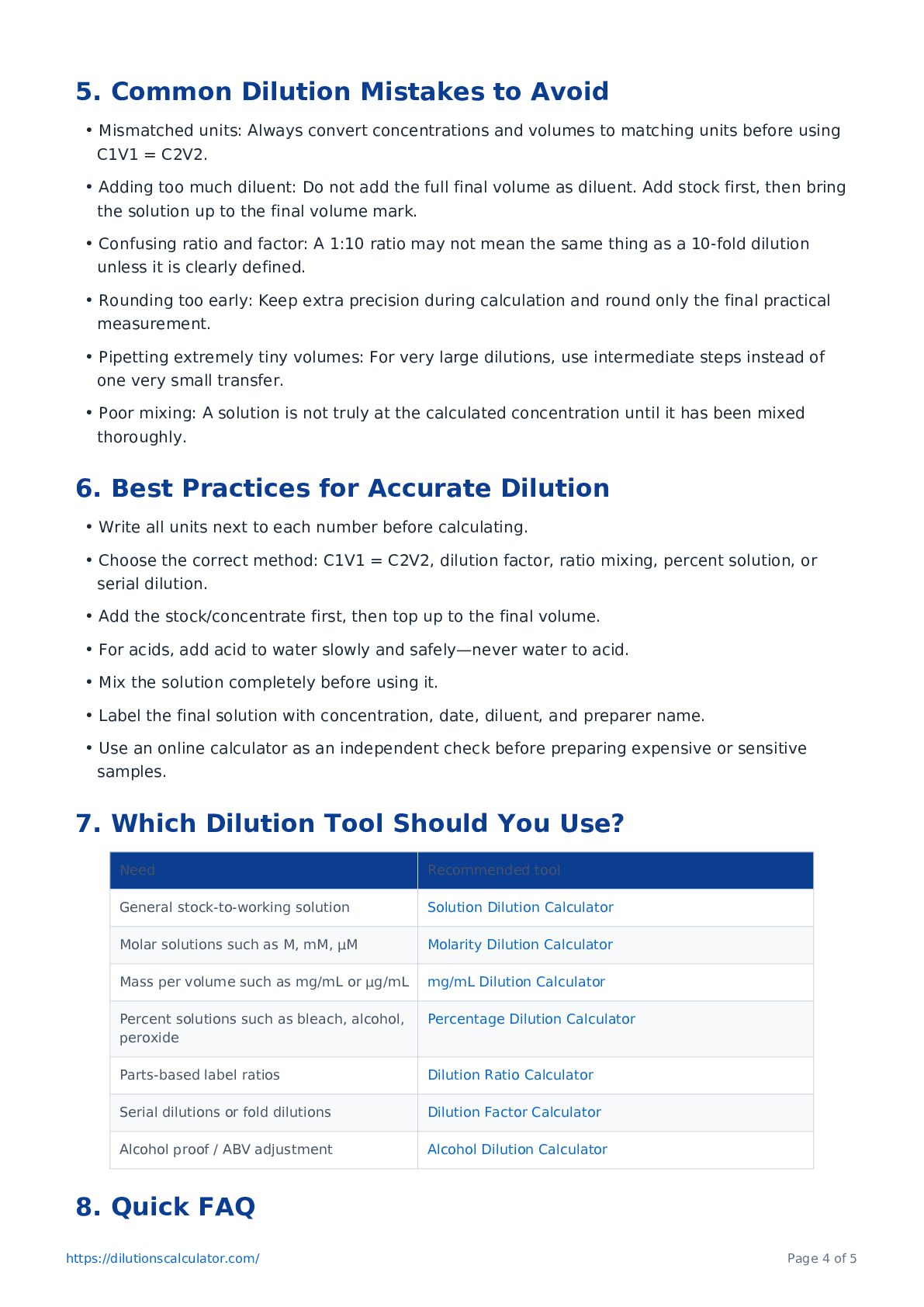
convert concentrations and volumes to matching units before using C1V1 = C2V2. • Adding too much diluent: Do not add the full final volume as diluent. Add stock first, then bring the solution up to the final volume mark. • Confusing ratio and factor: A 1:10 ratio may not mean the same thing as a 10-fold dilution unless it is clearly defined. • Rounding too early: Keep extra precision during calculation and round only the final practical measurement. • Pipetting extremely tiny volumes: For very large dilutions, use intermediate steps instead of one very small transfer. • Poor mixing: A solution is not truly at the calculated concentration until it has been mixed thoroughly. 6. Best Practices for Accurate Dilution • Write all units next to each number before calculating. • Choose the correct method: C1V1 = C2V2, dilution factor, ratio mixing, percent solution, or serial dilution. • Add the stock/concentrate first, then top up to the final volume. • For acids, add acid to water slowly and safely—never water to acid. • Mix the solution completely before using it. • Label the final solution with concentration, date, diluent, and preparer name. • Use an online calculator as an independent check before preparing expensive or sensitive samples. 7. Which Dilution Tool Should You Use? Need Recommended tool General stock-to-working solution Solution Dilution Calculator Molar solutions such as M, mM, µM Molarity Dilution Calculator Mass per volume such as mg/mL or µg/mL mg/mL Dilution Calculator Percent solutions such as bleach, alcohol, peroxide Percentage Dilution Calculator Parts-based label ratios Dilution Ratio Calculator Serial dilutions or fold dilutions Dilution Factor Calculator Alcohol proof / ABV adjustment Alcohol Dilution Calculator 8. Quick FAQ Page 4 of 5 https://dilutionscalculator.com/
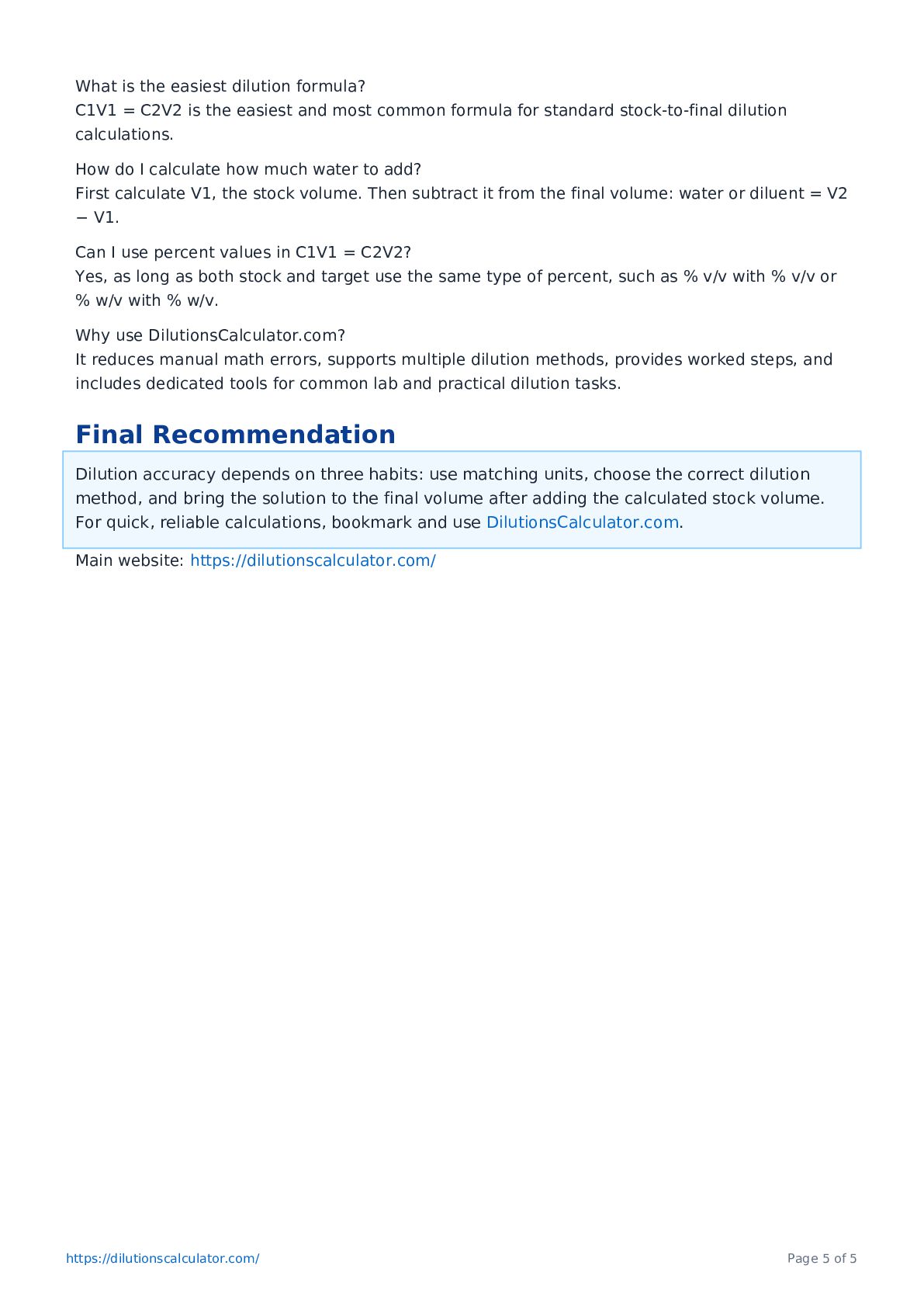
the easiest and most common formula for standard stock-to-final dilution calculations. How do I calculate how much water to add? First calculate V1, the stock volume. Then subtract it from the final volume: water or diluent = V2 − V1. Can I use percent values in C1V1 = C2V2? Yes, as long as both stock and target use the same type of percent, such as % v/v with % v/v or % w/v with % w/v. Why use DilutionsCalculator.com? It reduces manual math errors, supports multiple dilution methods, provides worked steps, and includes dedicated tools for common lab and practical dilution tasks. Final Recommendation Dilution accuracy depends on three habits: use matching units, choose the correct dilution method, and bring the solution to the final volume after adding the calculated stock volume. For quick, reliable calculations, bookmark and use DilutionsCalculator.com. Main website: https://dilutionscalculator.com/ Page 5 of 5 https://dilutionscalculator.com/


 techseoconnect
 sarafernandez
 tamaranovitovic
 sachag
 frankvandijk
 cassininazir
 bkeepers
 caitiem20
 baasie
 tammyeverts
 rkendrick25
 nwiizo