Upgrade to PRO for Only $50/Year—Limited-Time Offer! 🔥

GraphQL, Pothos & SQLite: a perfect match

Avatar for Matthias Le Brun Matthias Le Brun
December 11, 2025
38

GraphQL, Pothos & SQLite: a perfect match

Exploring how GraphQL and SQLite give us a strong foundation for building production applications, with a great developer experience.

Avatar for Matthias Le Brun

Matthias Le Brun

December 11, 2025
Tweet

Transcript

  1. Matthias Le Brun software engineer lead AI hater chief shitpost

    of fi cer who am I Paris.JS organizer ReScript core team Putain de Code co-founder bsky: @bloodyowl.io
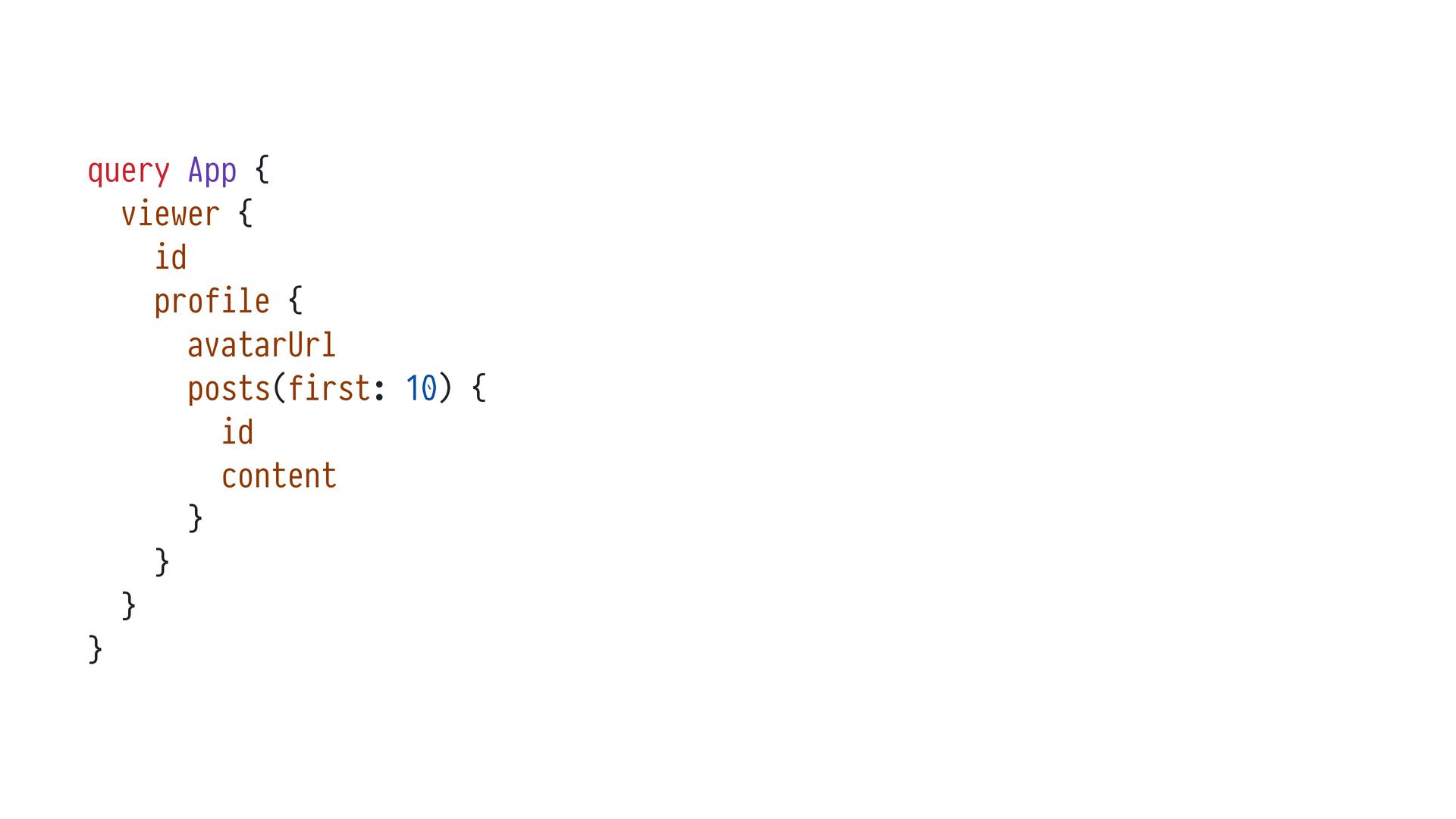
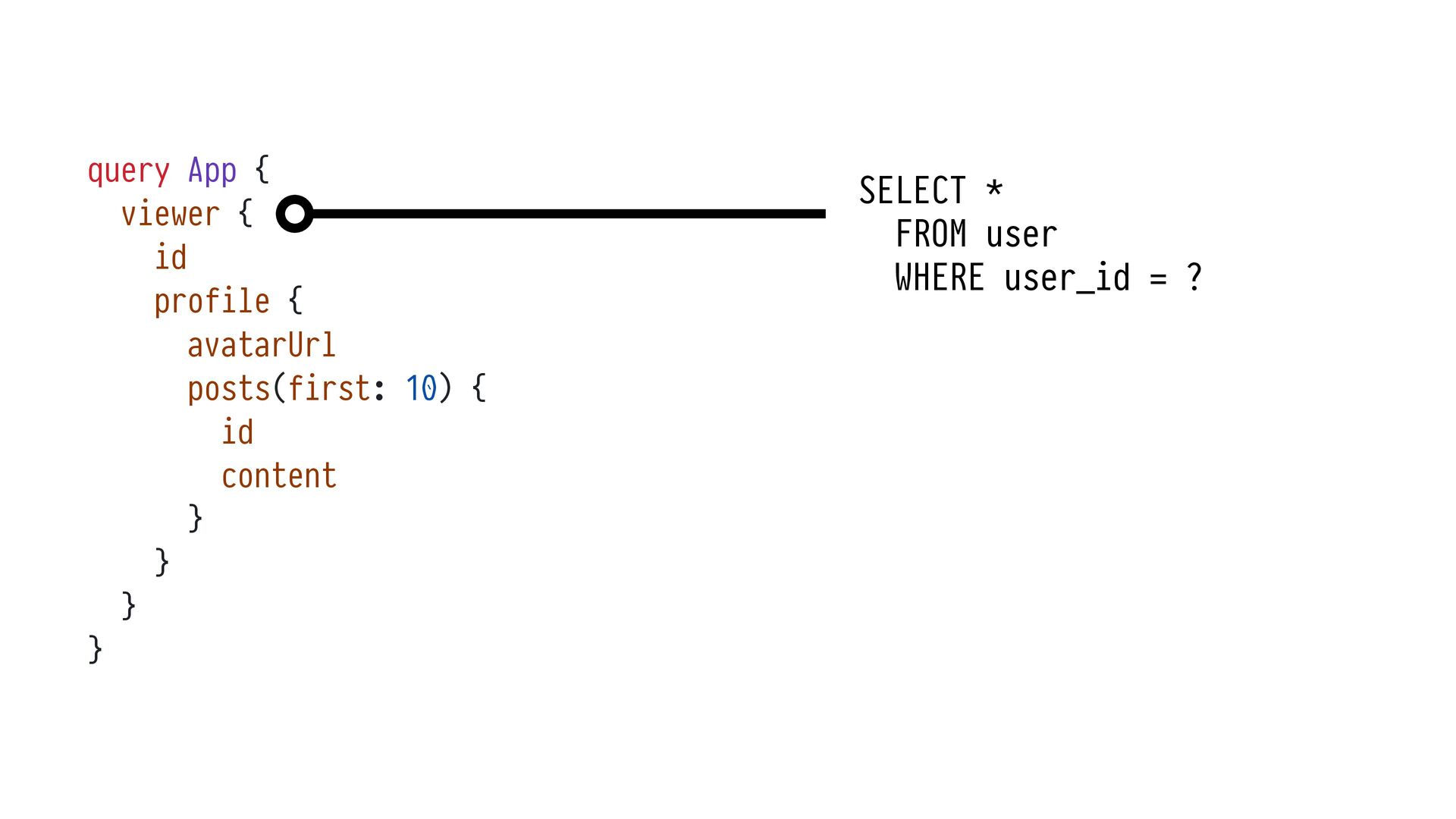
  2. query App { viewer { id profile { avatarUrl posts(first:

    10) { id content } } } } SELECT * FROM user WHERE user_id = ?
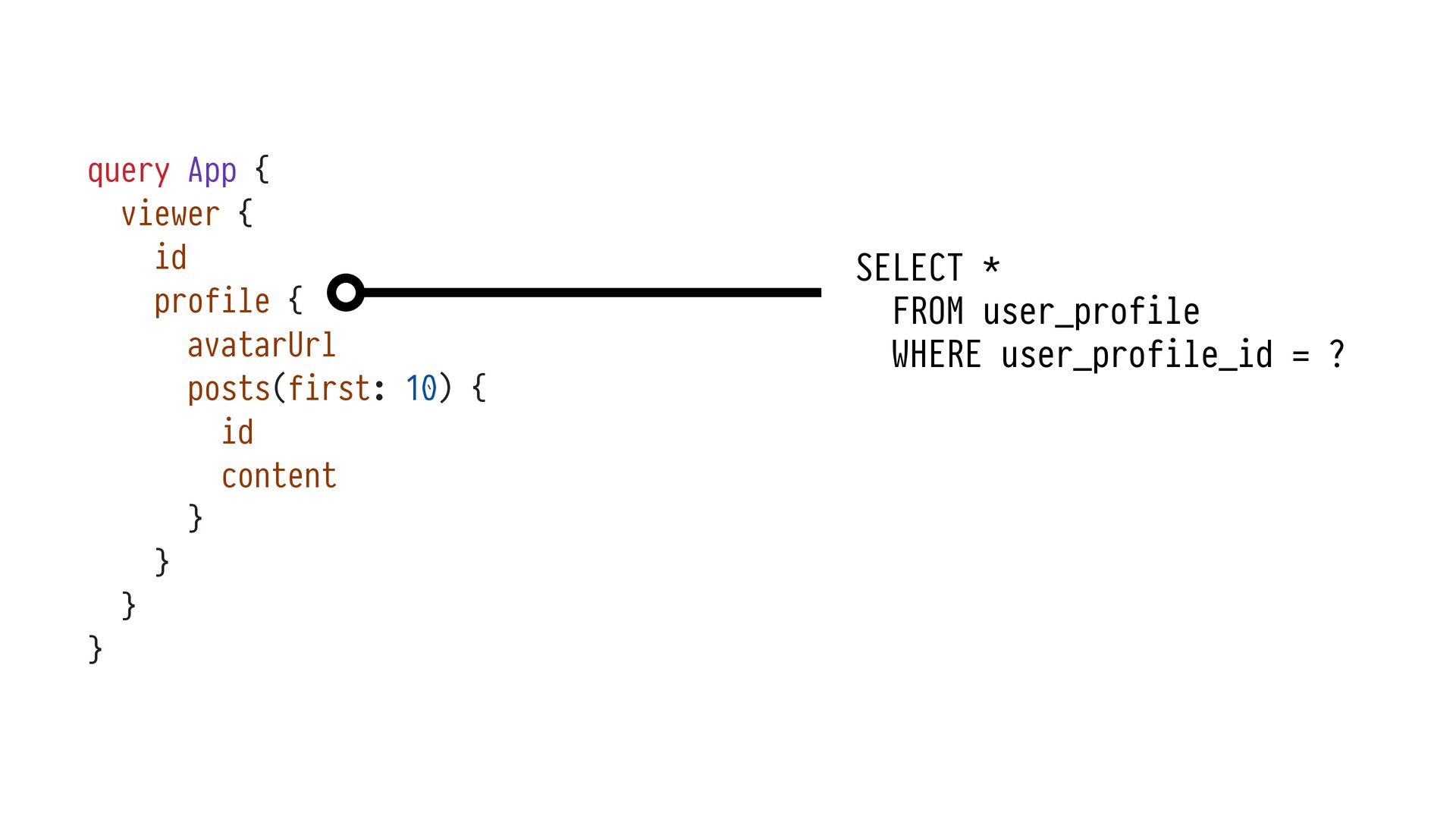
  3. query App { viewer { id profile { avatarUrl posts(first:

    10) { id content } } } } SELECT * FROM user_profile WHERE user_profile_id = ?
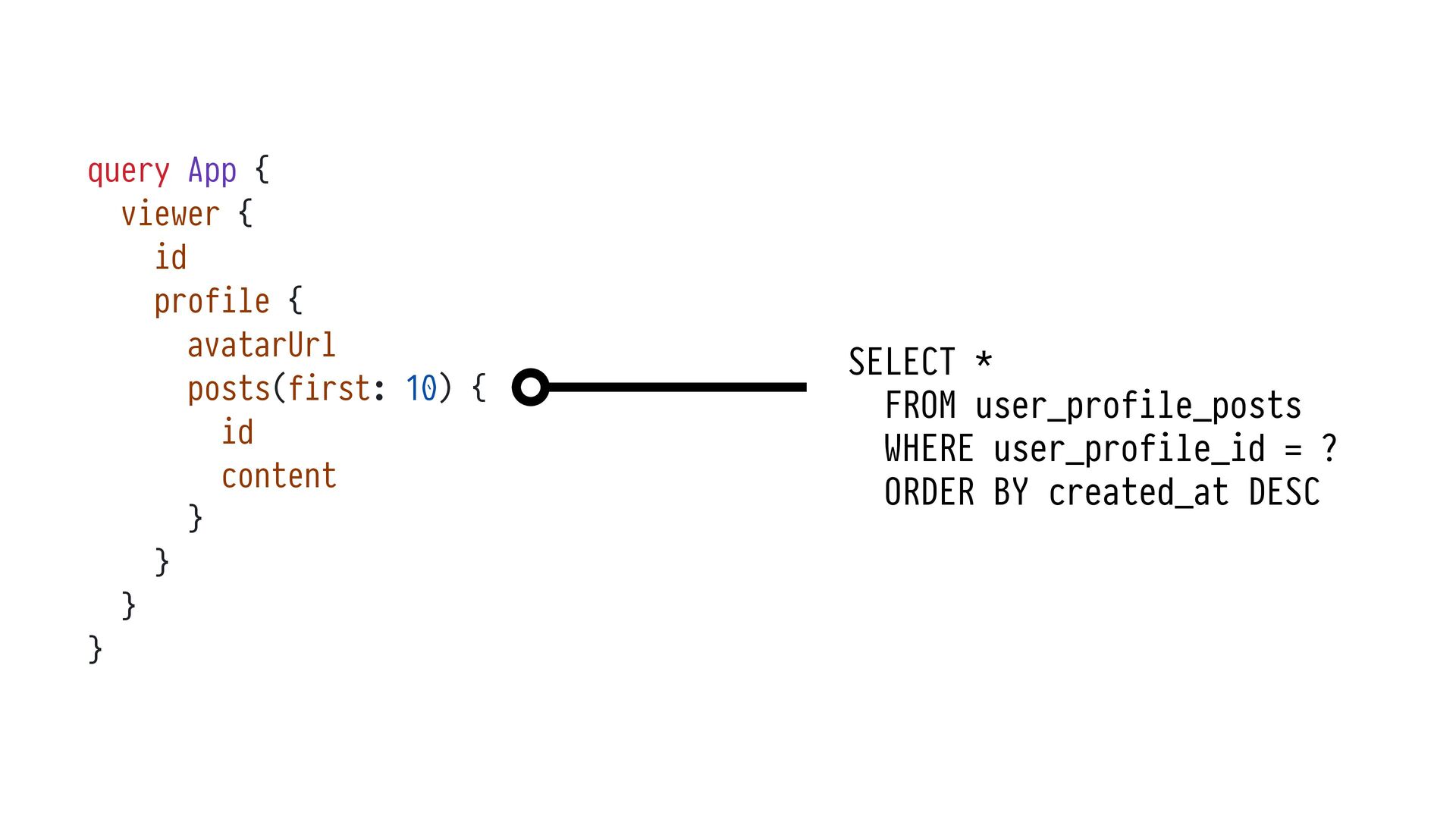
  4. query App { viewer { id profile { avatarUrl posts(first:

    10) { id content } } } } SELECT * FROM user_profile_posts WHERE user_profile_id = ? ORDER BY created_at DESC
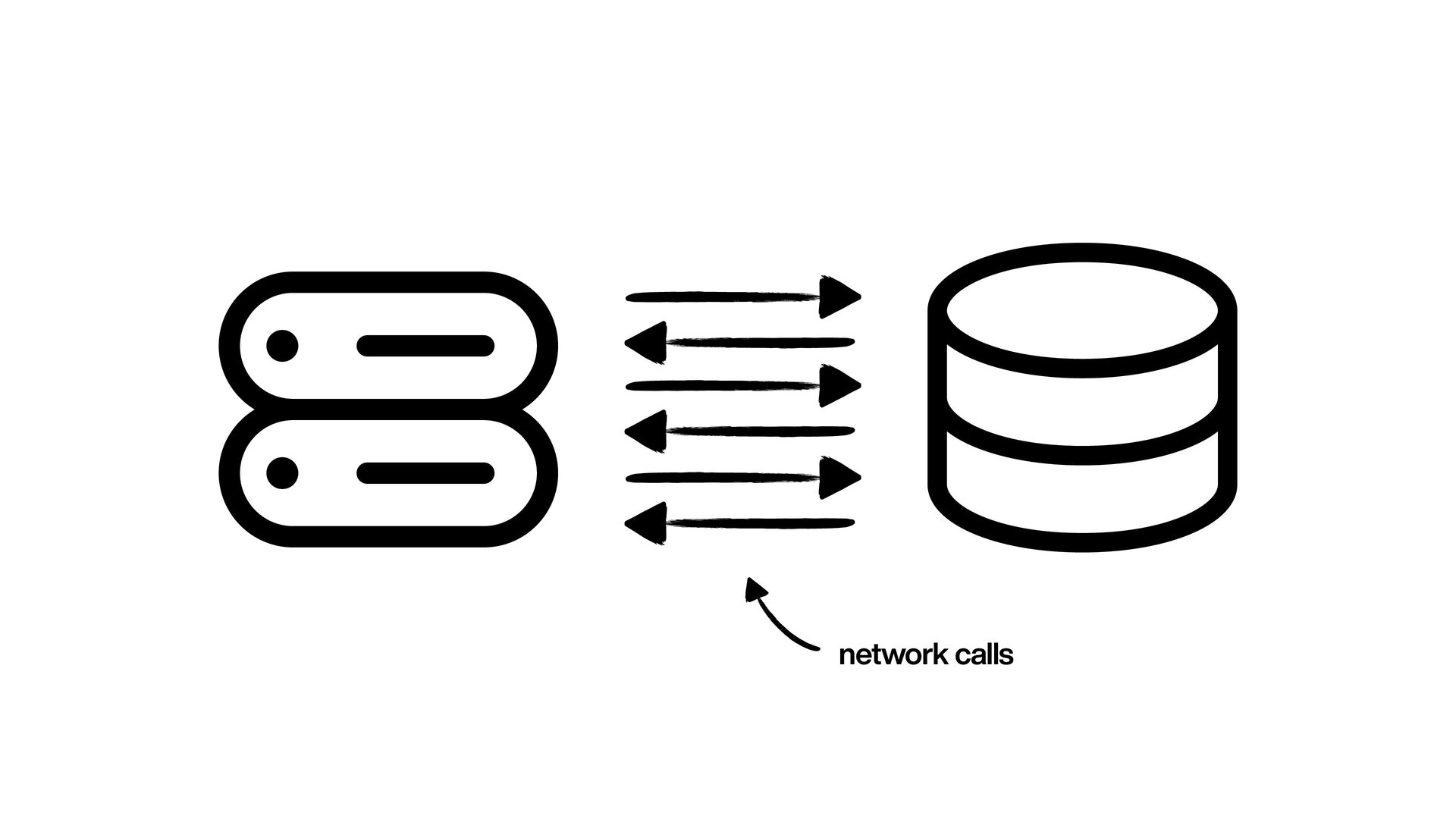
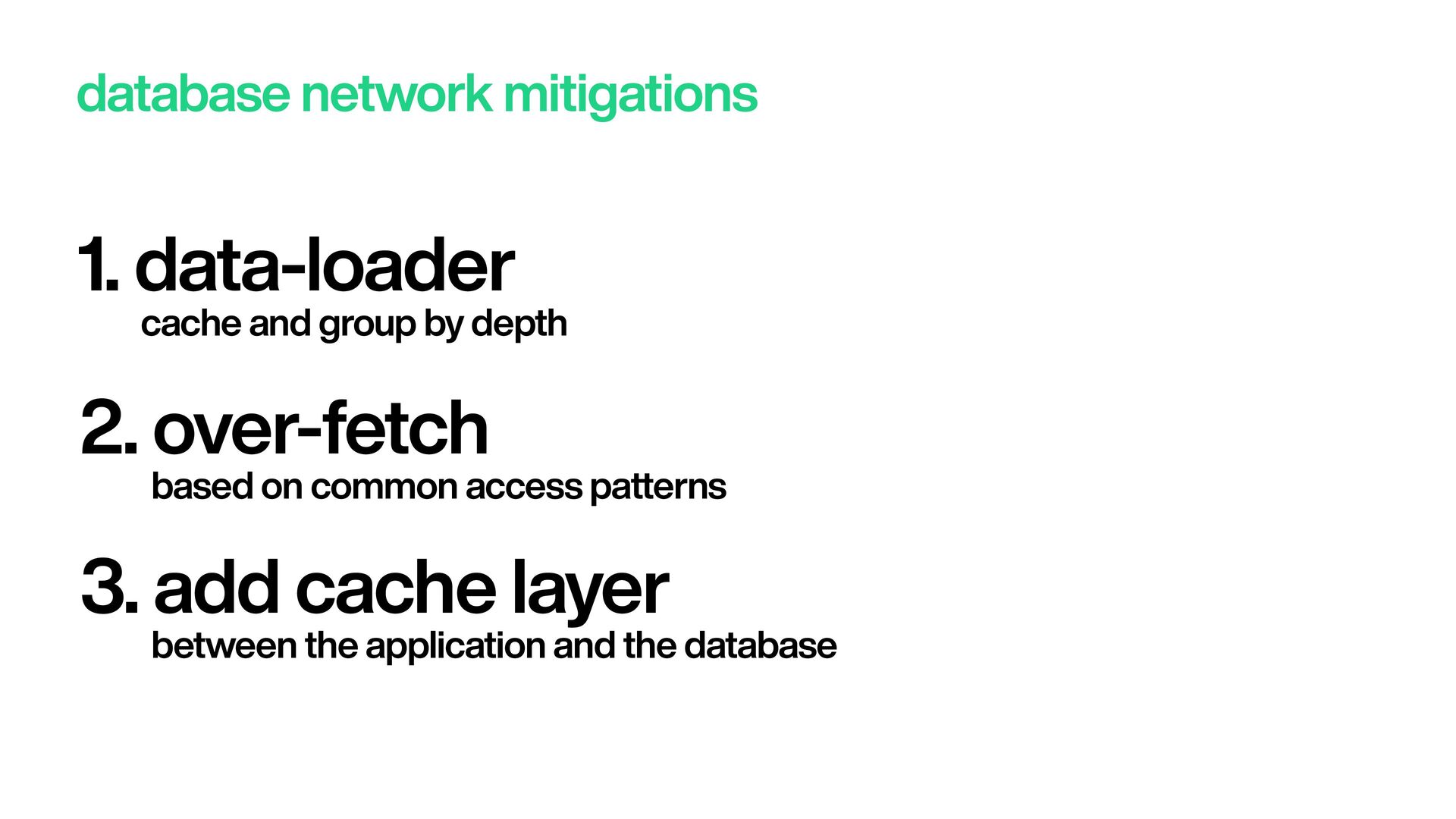
  5. database network mitigations 1. data-loader cache and group by depth

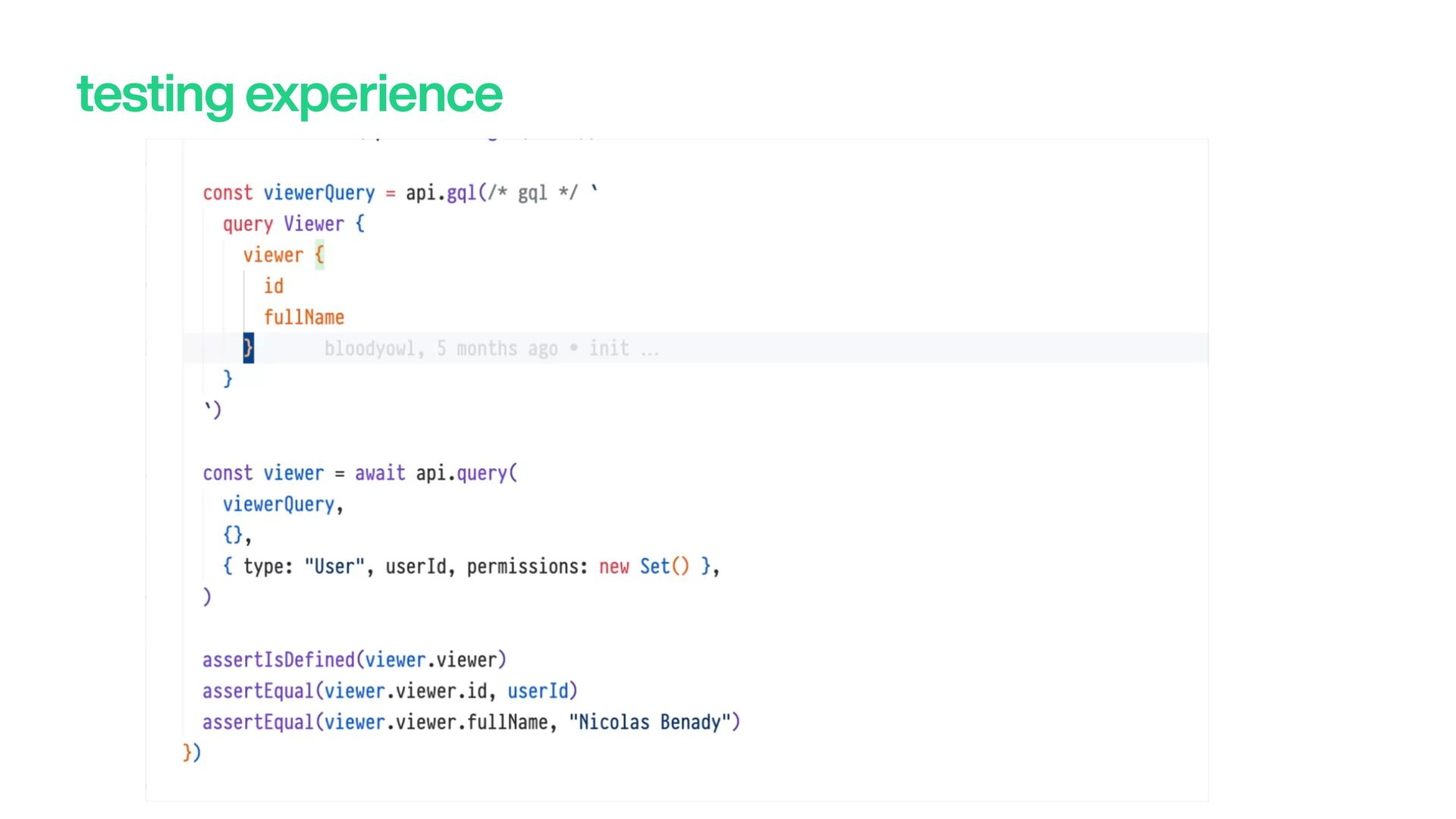
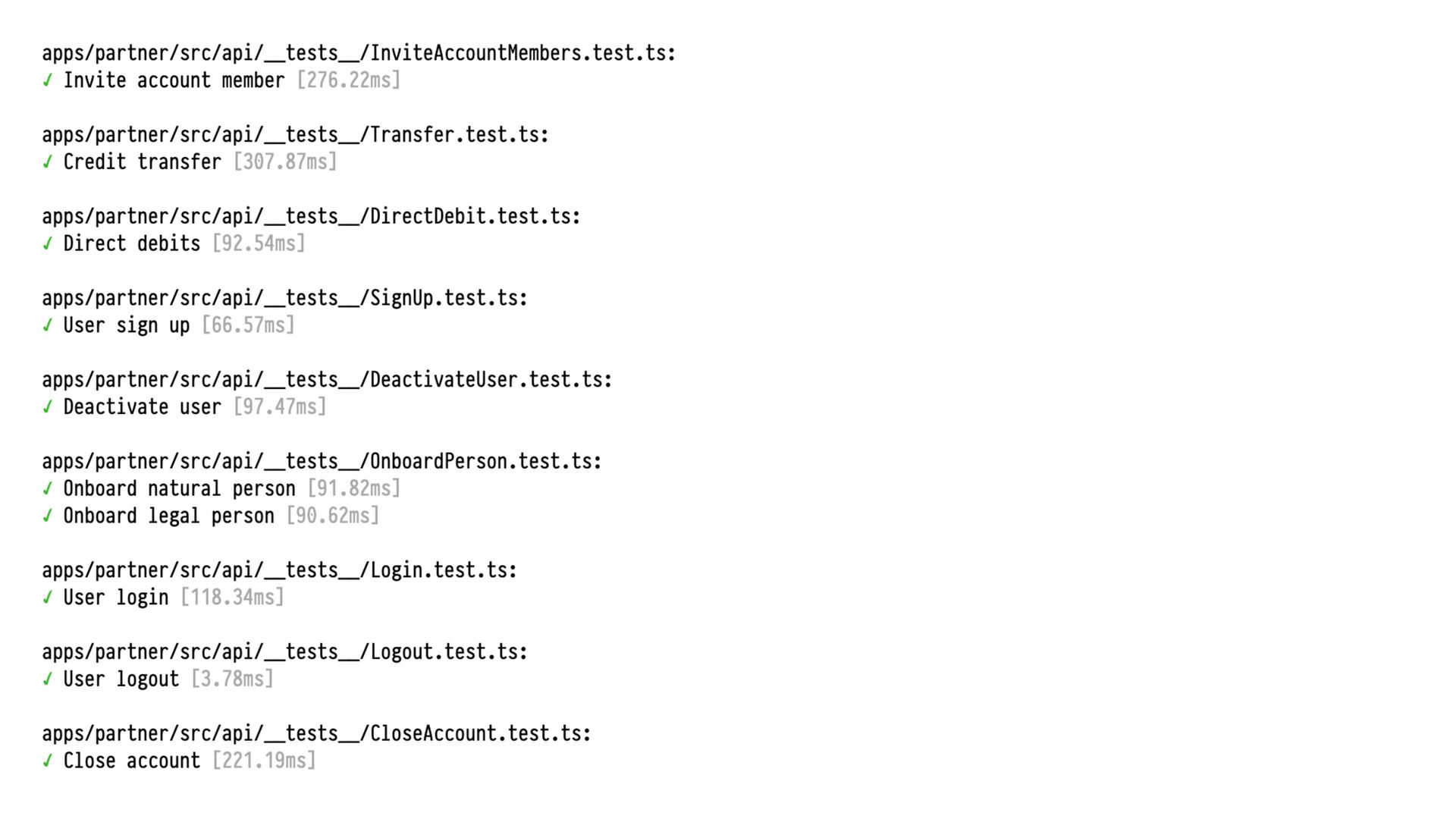
    2. over-fetch based on common access patterns 3. add cache layer between the application and the database
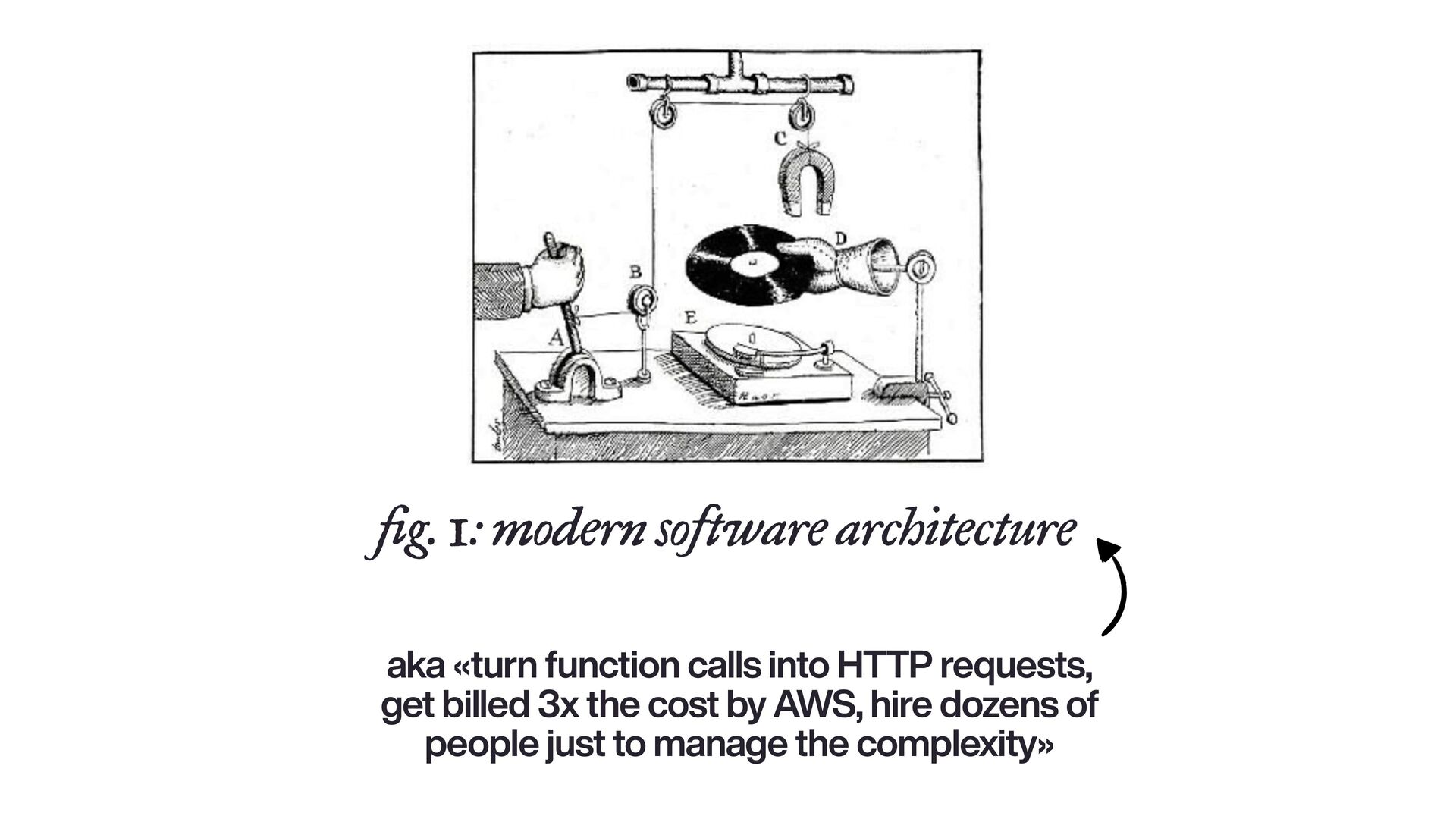
  6. fi g. 1: modern software architecture aka «turn function calls

    into HTTP requests, get billed 3x the cost by AWS, hire dozens of people just to manage the complexity»
  7. database SQLite aka: "you probably won't need more for quite

    a while" has the reputation of being a toy database because we don't reassess technology when hardware evolves dramatically (ie. SSD being slightly faster than hard drives)
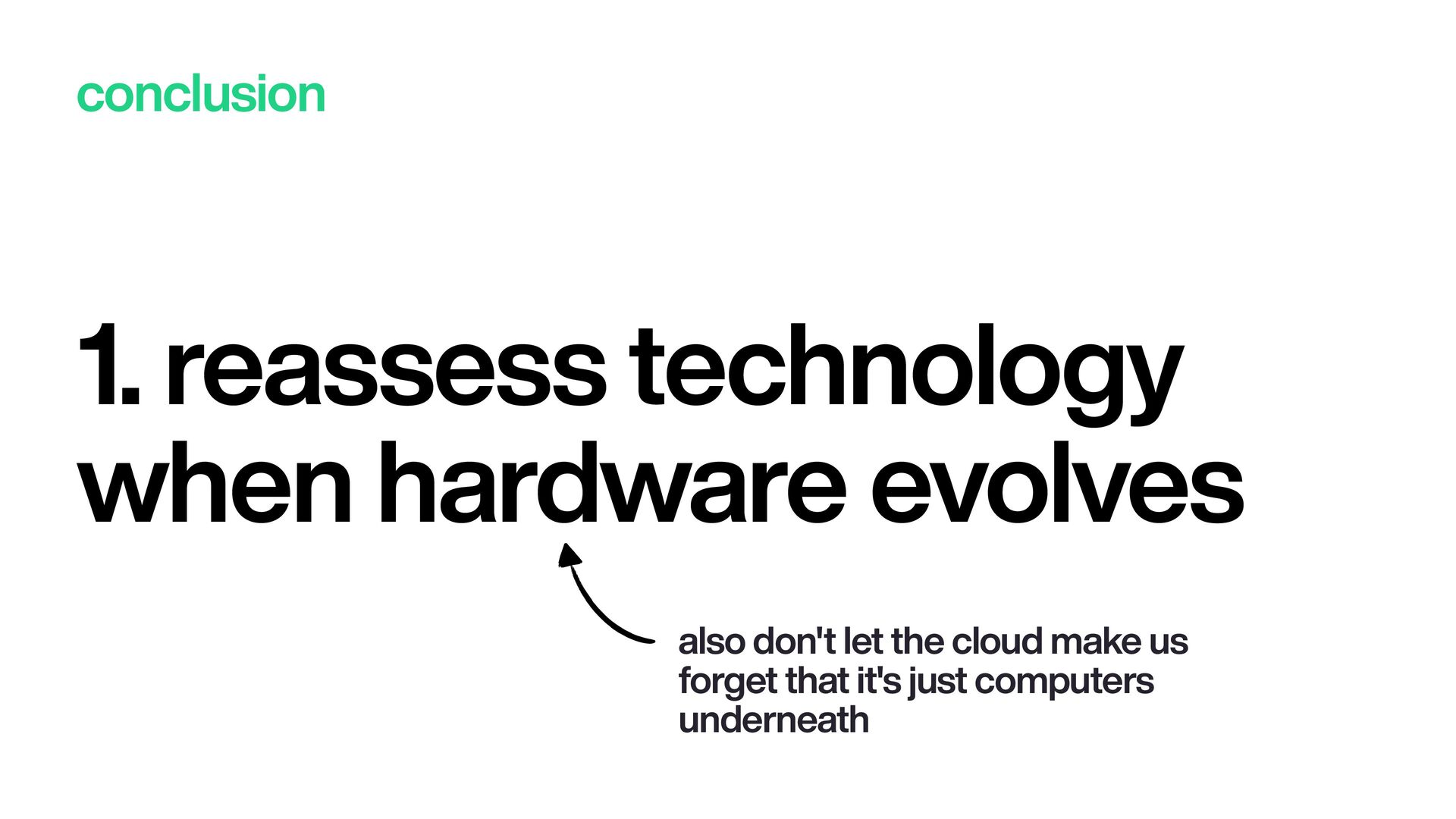
  8. SQLite limitations → size of your physical storage → hard

    limit on 281TB for a single database → no long synchronous transactions → 200K read/s → 50K writes/s table with indexes, M1 chip (requires a few fl ags)
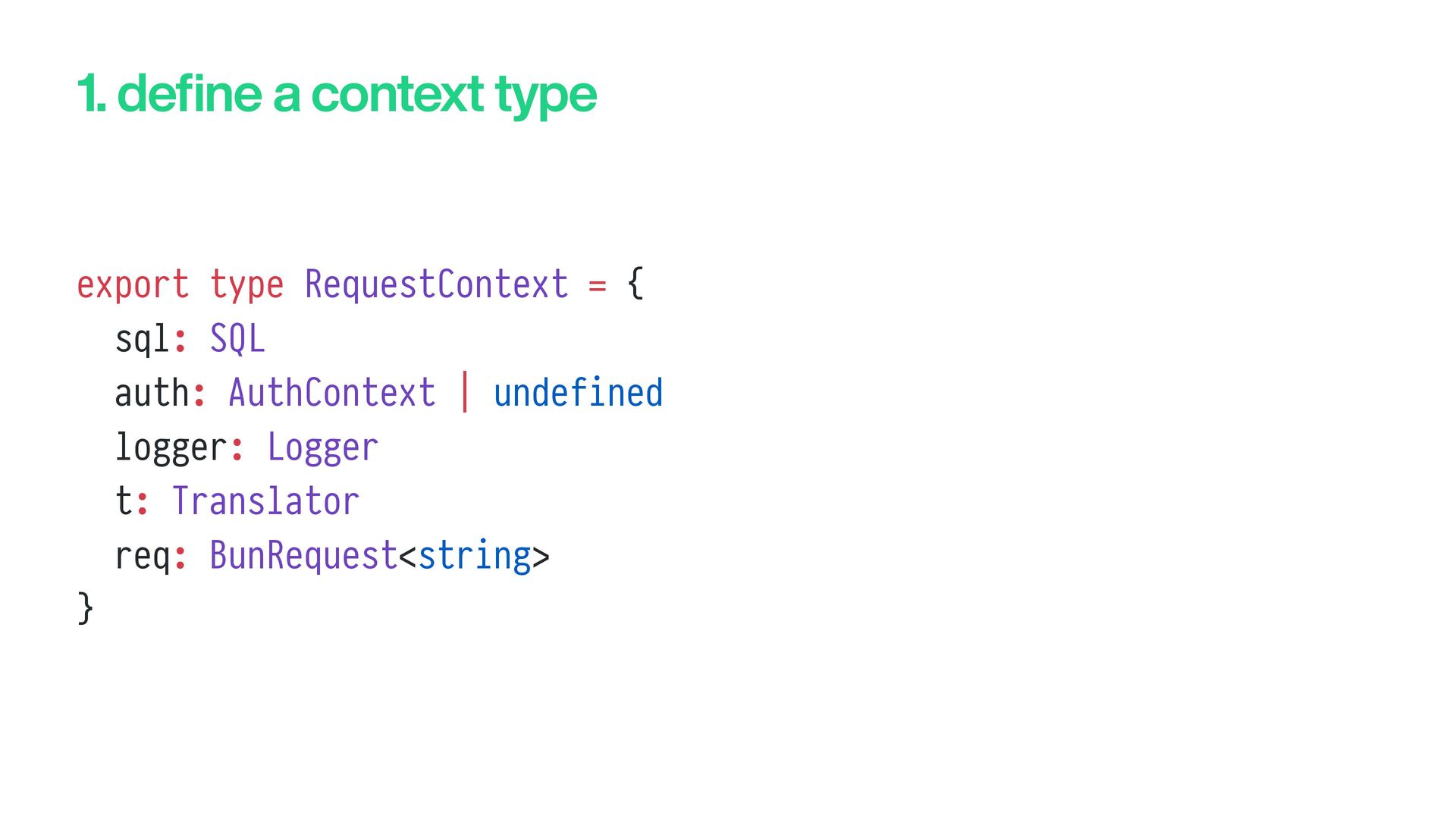
  9. 1. de fi ne a context type export type RequestContext

    = { sql: SQL auth: AuthContext | undefined logger: Logger t: Translator req: BunRequest<string> }
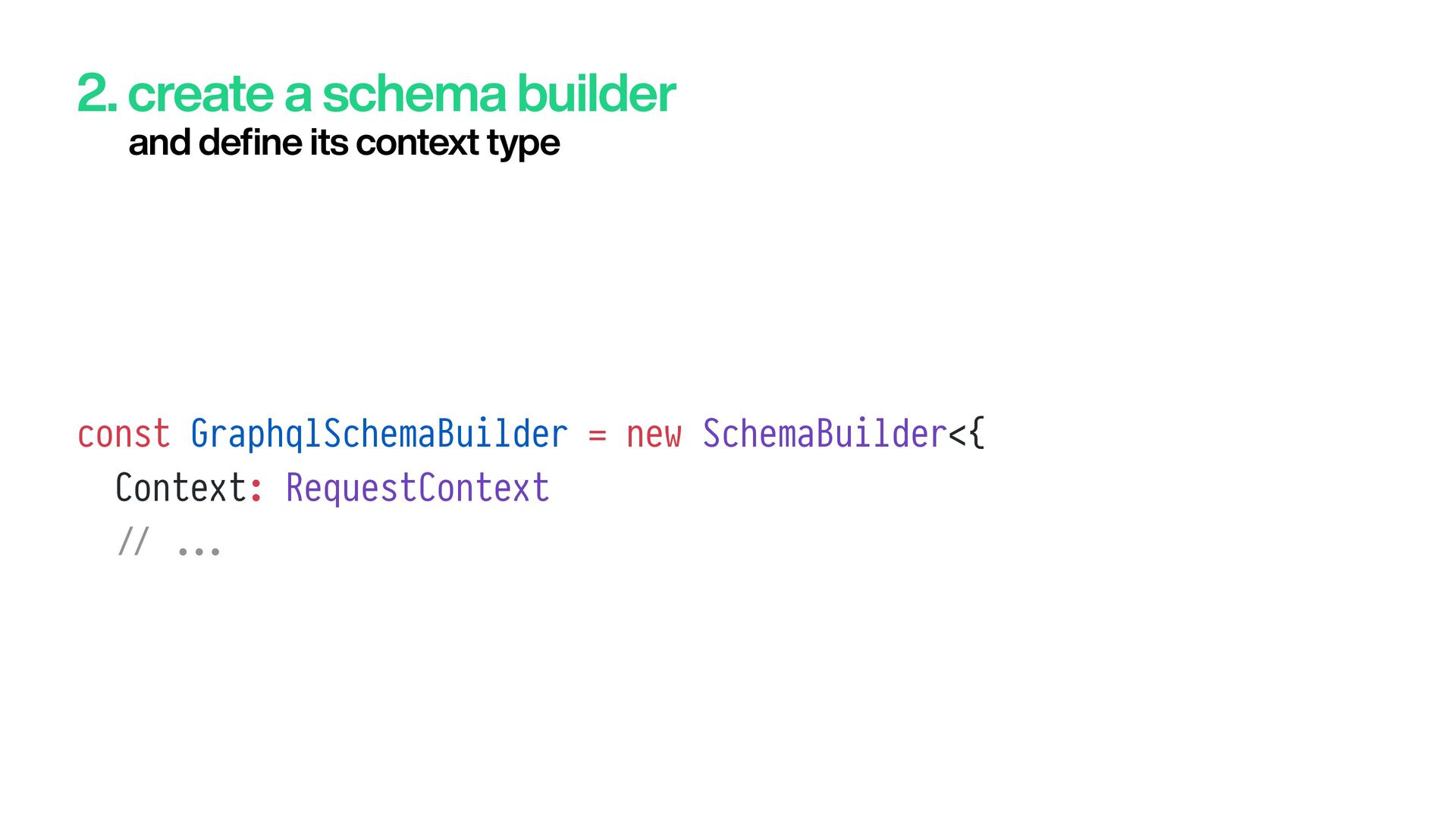
  10. 2. create a schema builder const GraphqlSchemaBuilder = new SchemaBuilder<{

    Context: RequestContext // ... and de fi ne its context type
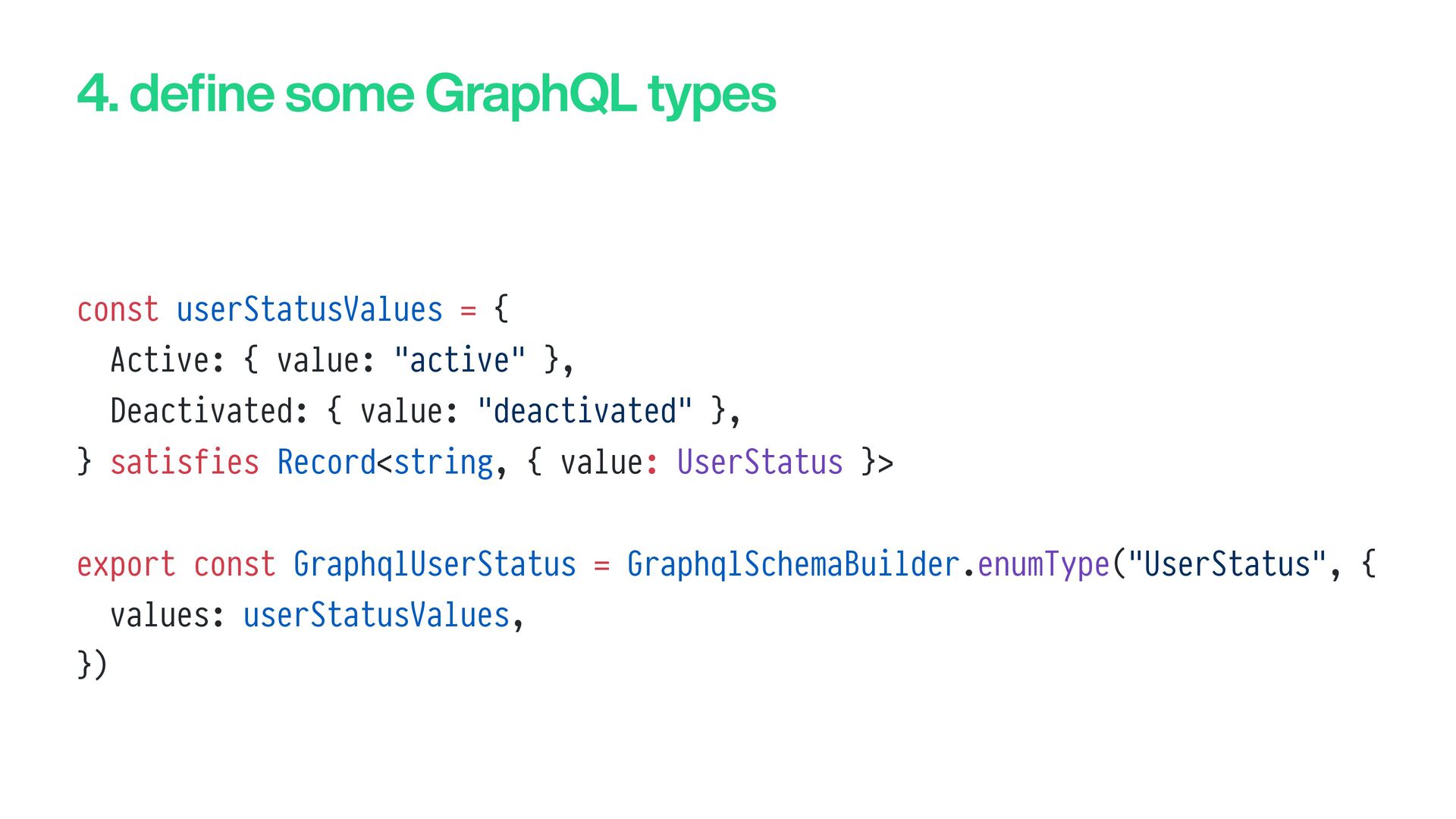
  11. 4. de fi ne some GraphQL types const userStatusValues =

    { Active: { value: "active" }, Deactivated: { value: "deactivated" }, } satisfies Record<string, { value: UserStatus }> export const GraphqlUserStatus = GraphqlSchemaBuilder.enumType("UserStatus", { values: userStatusValues, })
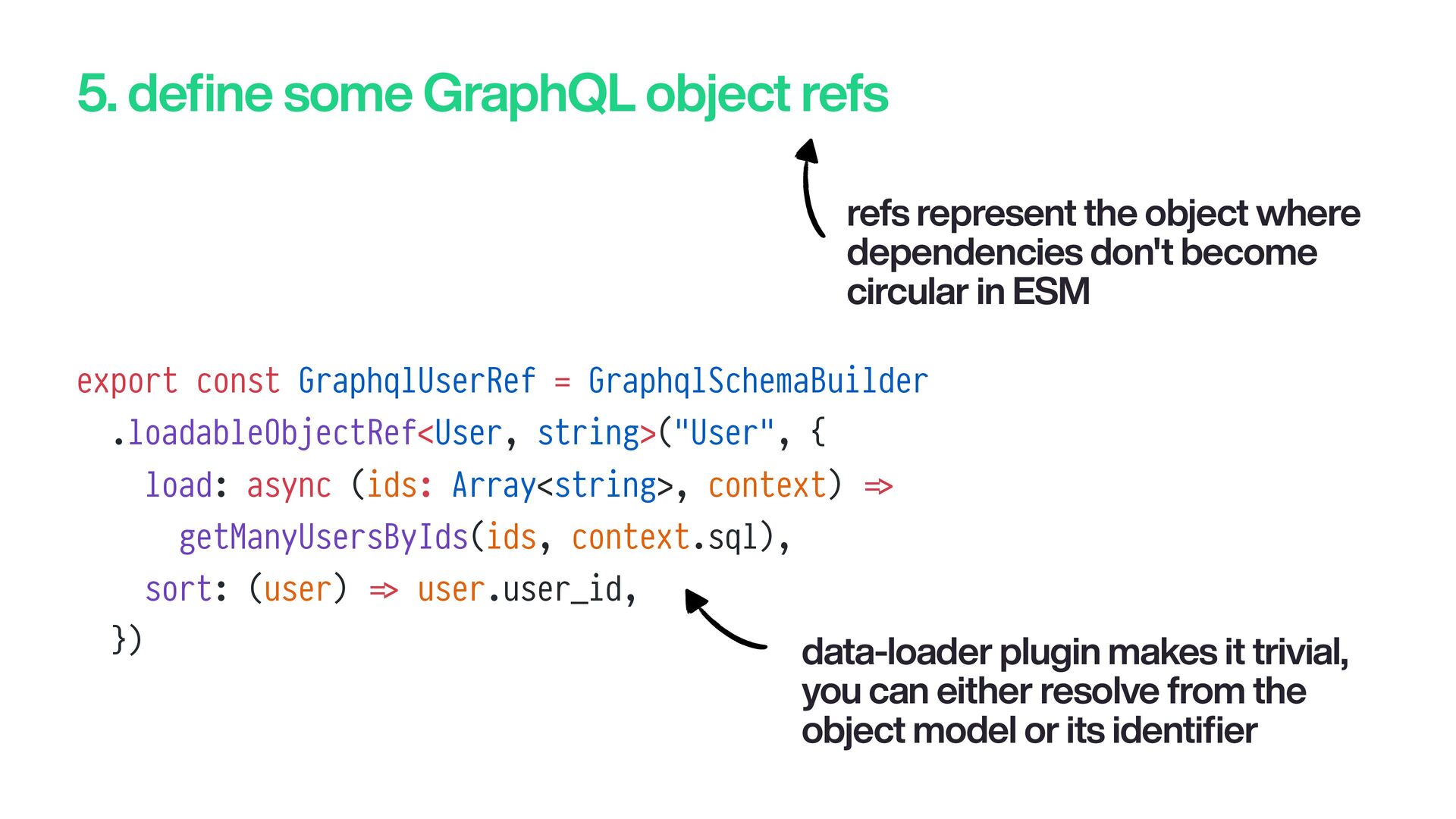
  12. 5. de fi ne some GraphQL object refs export const

    GraphqlUserRef = GraphqlSchemaBuilder .loadableObjectRef<User, string>("User", { load: async (ids: Array<string>, context) => getManyUsersByIds(ids, context.sql), sort: (user) => user.user_id, }) refs represent the object where dependencies don't become circular in ESM data-loader plugin makes it trivial, you can either resolve from the object model or its identi fi er
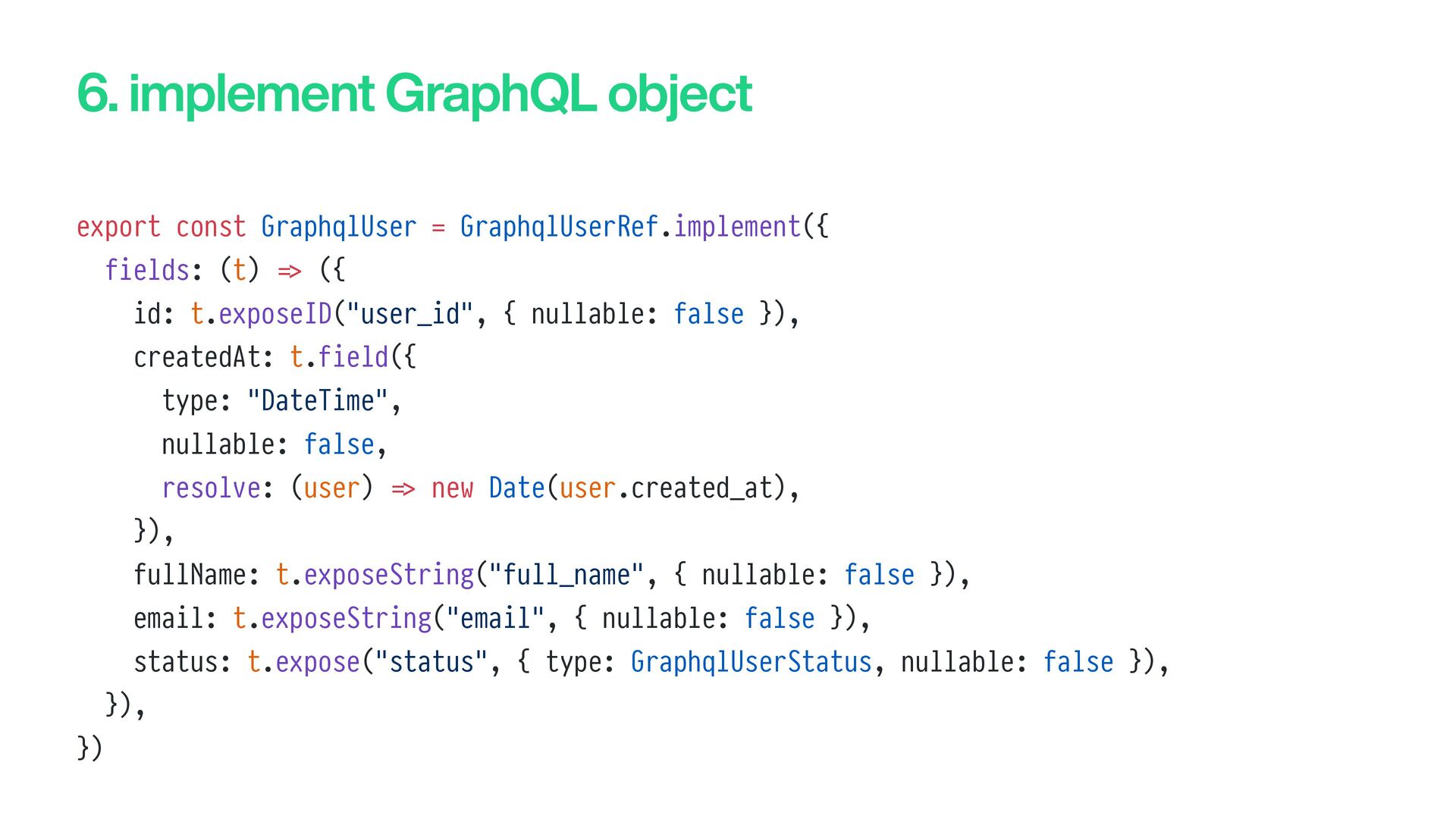
  13. 6. implement GraphQL object export const GraphqlUser = GraphqlUserRef.implement({ fields:

    (t) => ({ id: t.exposeID("user_id", { nullable: false }), createdAt: t.field({ type: "DateTime", nullable: false, resolve: (user) => new Date(user.created_at), }), fullName: t.exposeString("full_name", { nullable: false }), email: t.exposeString("email", { nullable: false }), status: t.expose("status", { type: GraphqlUserStatus, nullable: false }), }), })
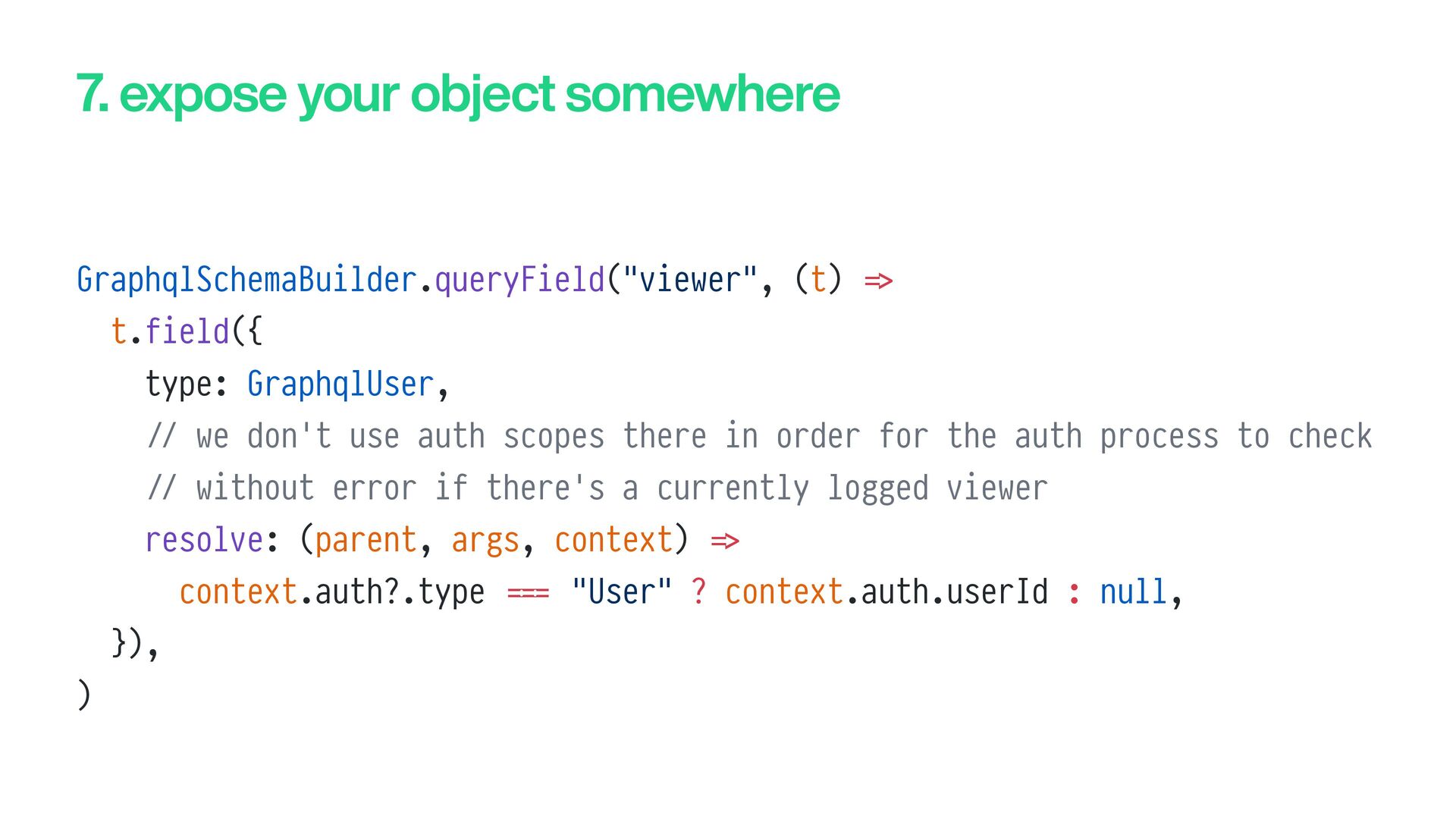
  14. 7. expose your object somewhere GraphqlSchemaBuilder.queryField("viewer", (t) => t.field({ type:

    GraphqlUser, // we don't use auth scopes there in order for the auth process to check // without error if there's a currently logged viewer resolve: (parent, args, context) => context.auth?.type === "User" ? context.auth.userId : null, }), )
  15. niceties: error management GraphqlSchemaBuilder.objectType(CloseAccountError, { name: "CloseAccountError", interfaces: [GraphqlError], fields:

    (t) => ({ message: t.string({ nullable: false, resolve: (parent, args, { t }) => t("api.CloseAccountError.message"), }), }), }) map an error subclass to an object type
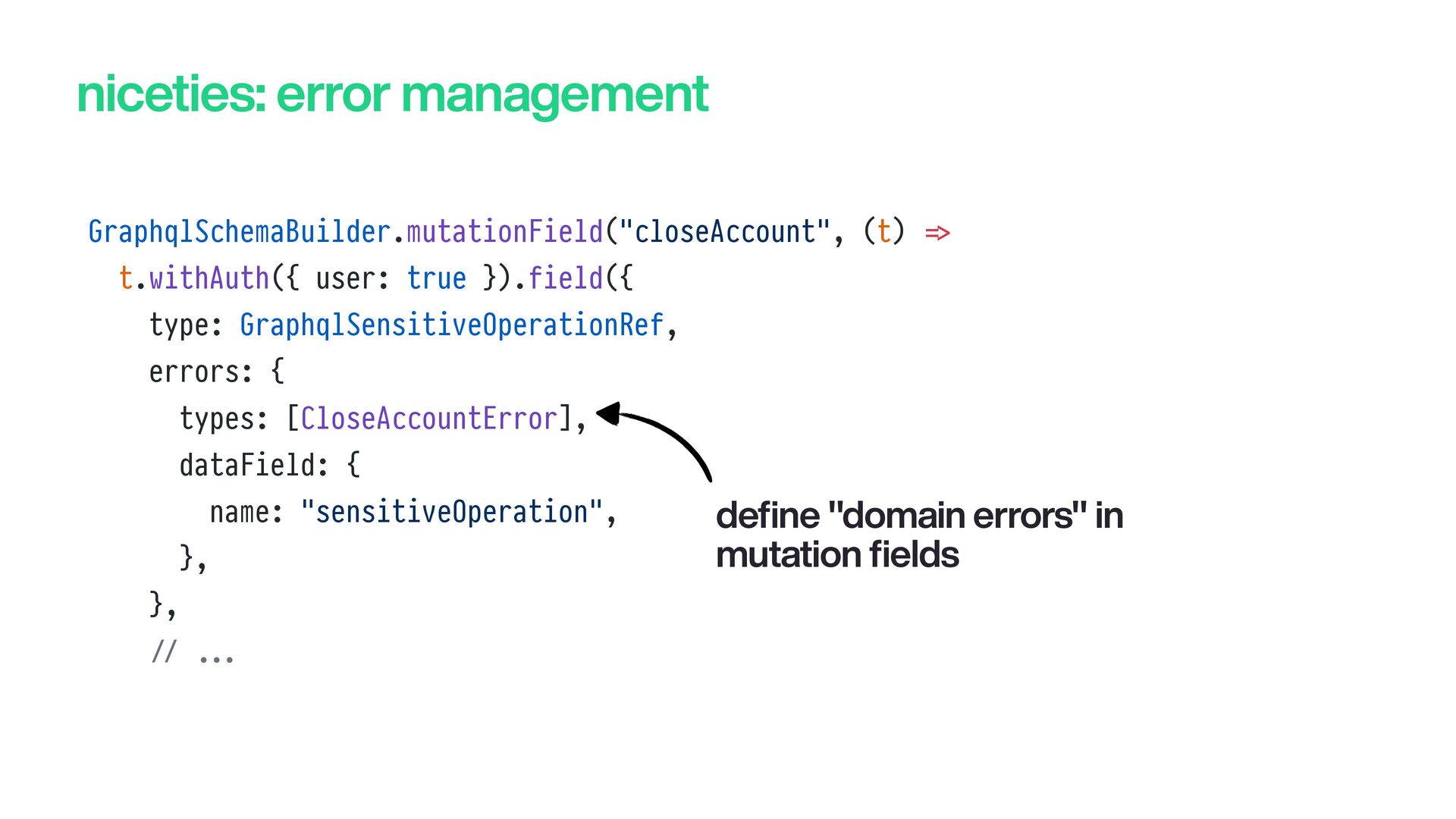
  16. niceties: error management GraphqlSchemaBuilder.mutationField("closeAccount", (t) => t.withAuth({ user: true }).field({

    type: GraphqlSensitiveOperationRef, errors: { types: [CloseAccountError], dataField: { name: "sensitiveOperation", }, }, // ... de fi ne "domain errors" in mutation fi elds
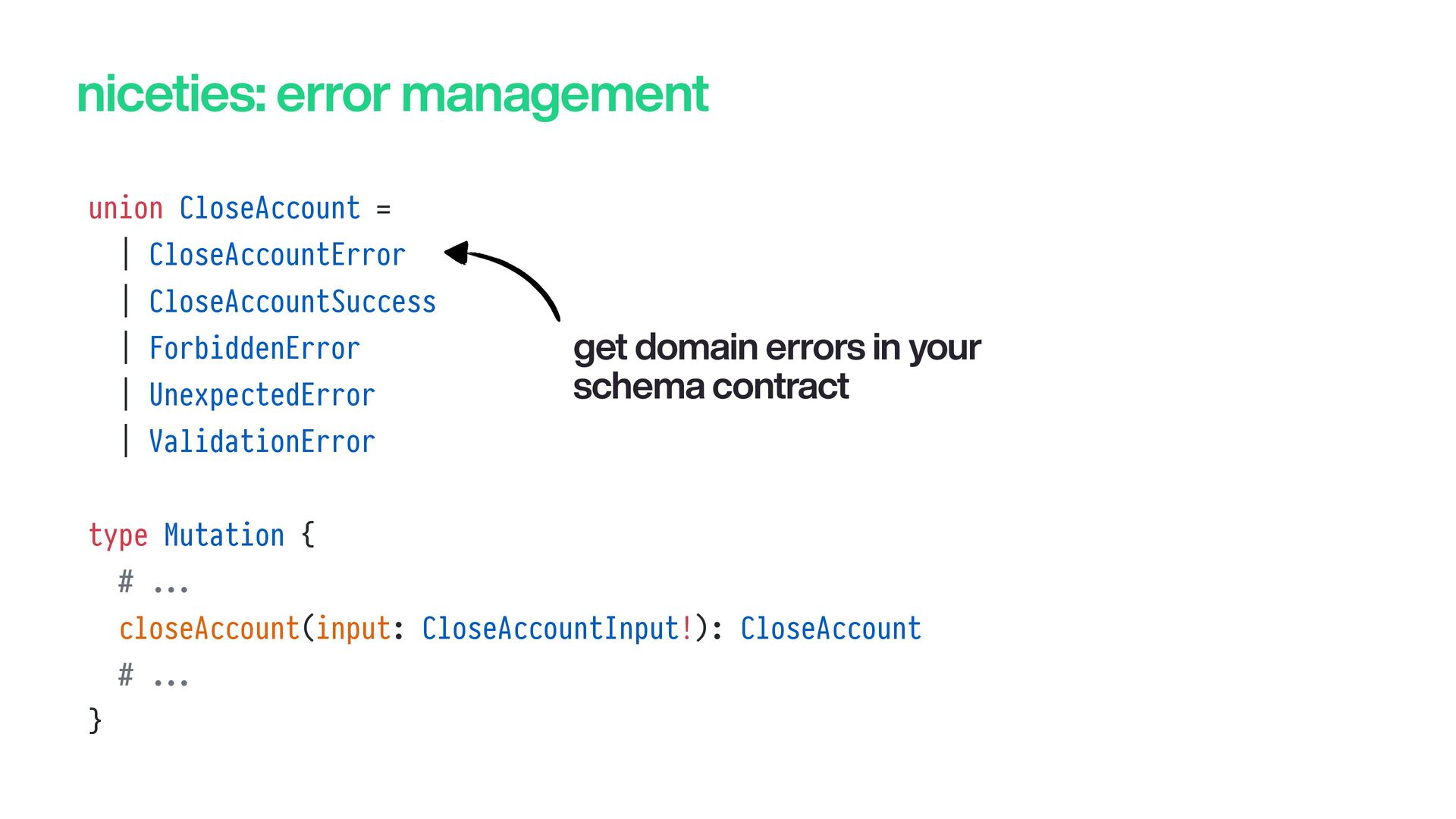
  17. niceties: error management union CloseAccount = | CloseAccountError | CloseAccountSuccess

    | ForbiddenError | UnexpectedError | ValidationError type Mutation { # ... closeAccount(input: CloseAccountInput!): CloseAccount # ... } get domain errors in your schema contract
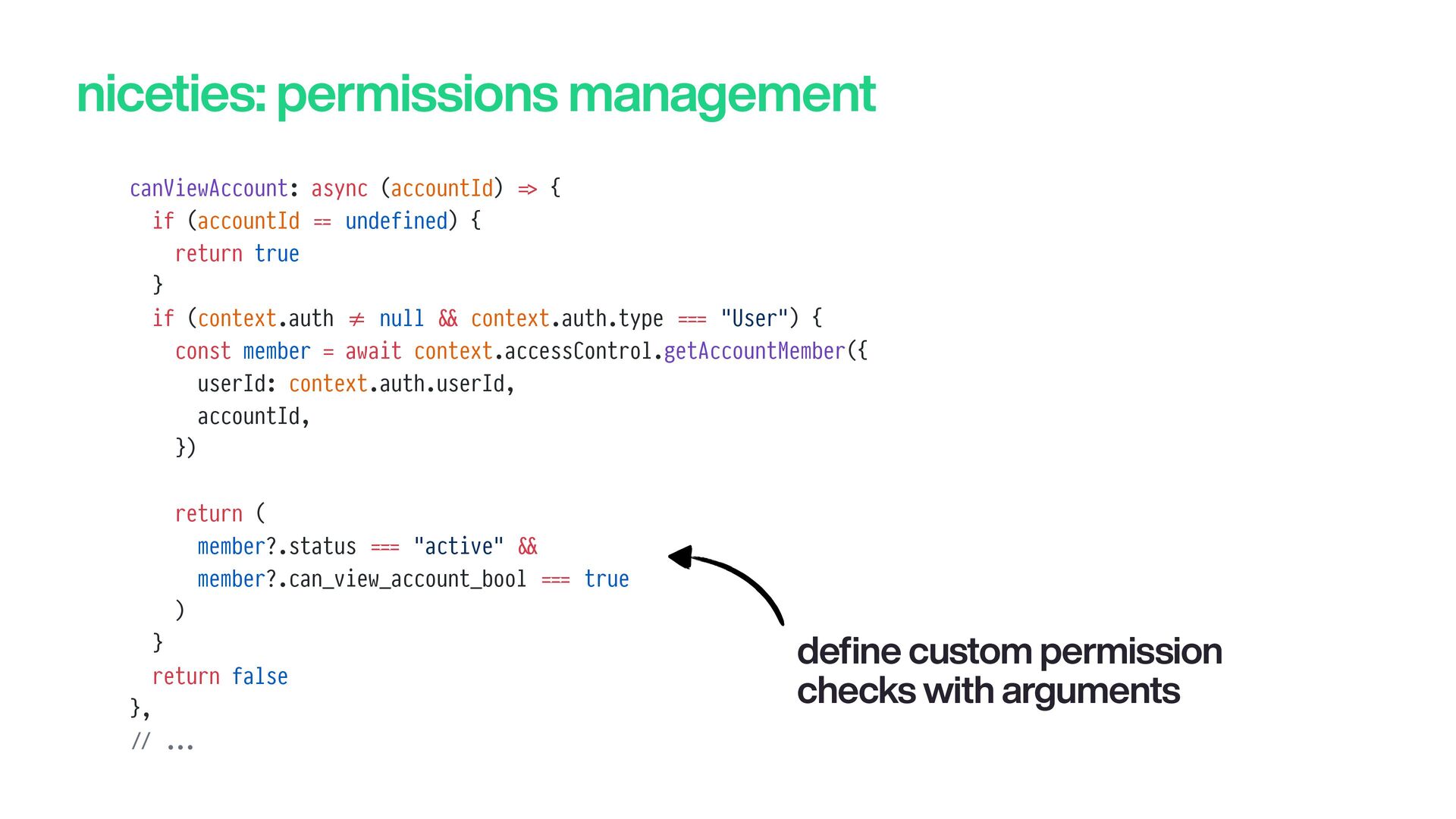
  18. niceties: permissions management canViewAccount: async (accountId) => { if (accountId

    == undefined) { return true } if (context.auth != null && context.auth.type === "User") { const member = await context.accessControl.getAccountMember({ userId: context.auth.userId, accountId, }) return ( member?.status === "active" && member?.can_view_account_bool === true ) } return false }, // ... de fi ne custom permission checks with arguments
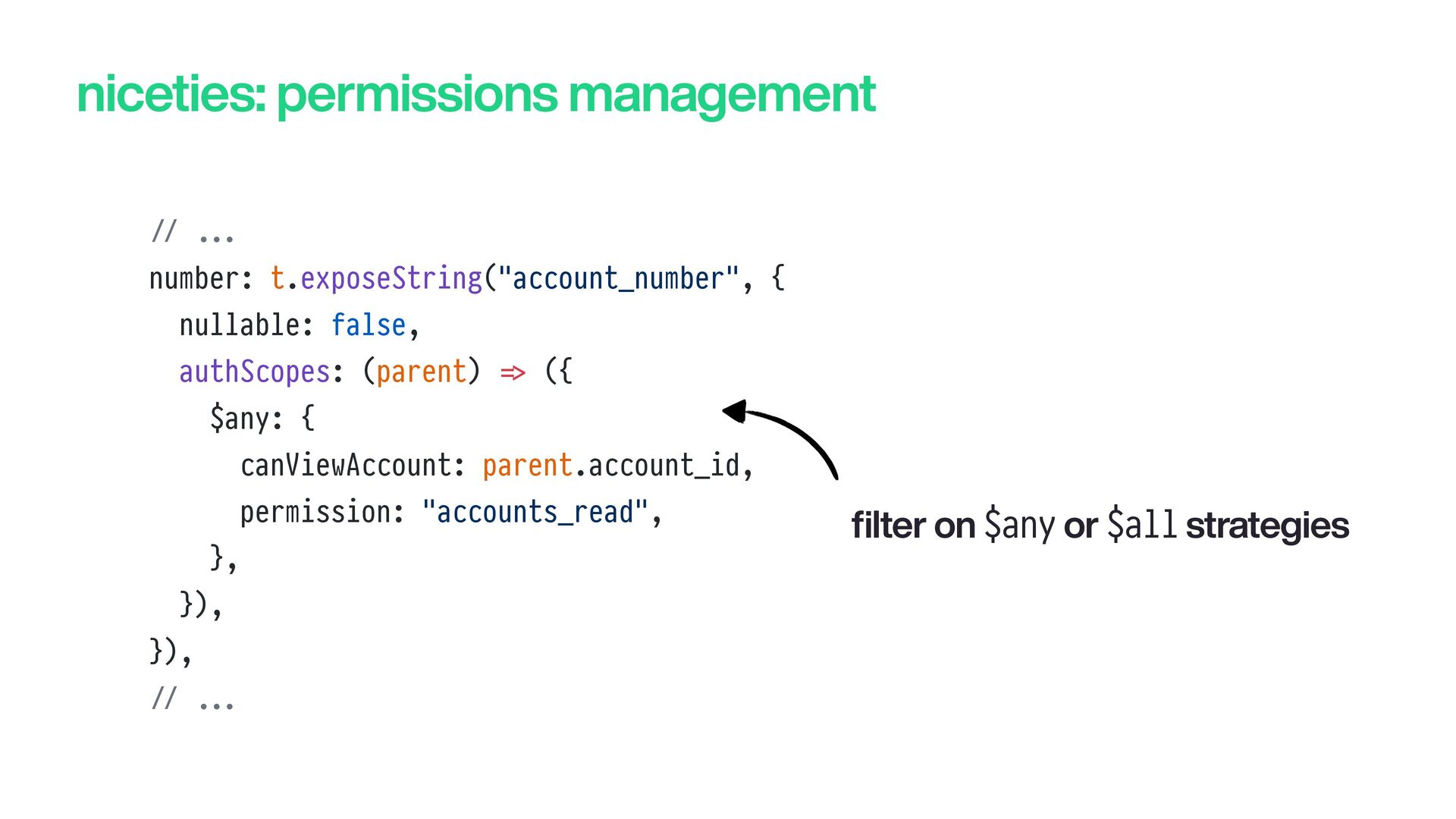
  19. niceties: permissions management // ... number: t.exposeString("account_number", { nullable: false,

    authScopes: (parent) => ({ $any: { canViewAccount: parent.account_id, permission: "accounts_read", }, }), }), // ... fi lter on $any or $all strategies
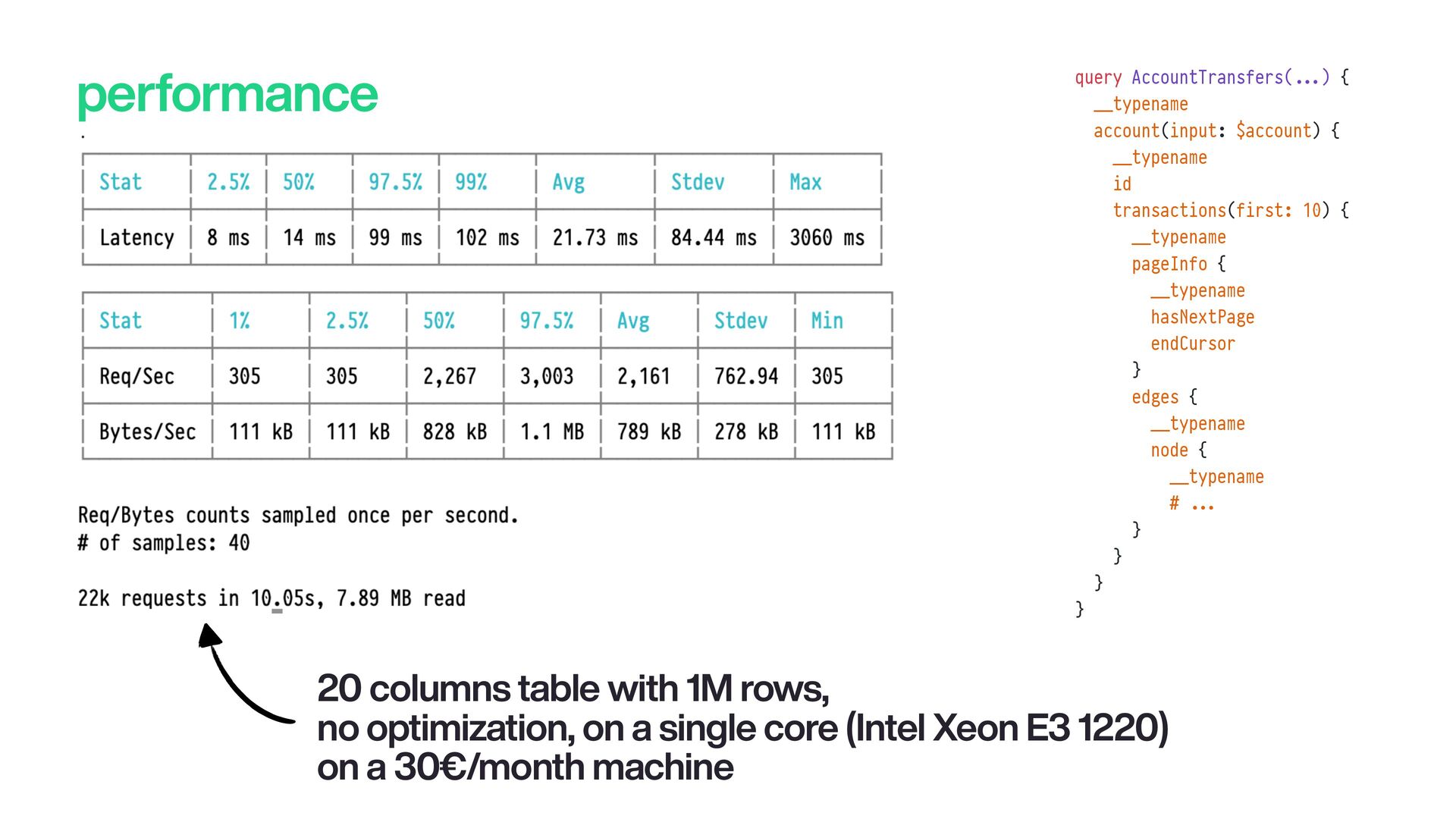
  20. performance 20 columns table with 1M rows, no optimization, on

    a single core (Intel Xeon E3 1220) on a 30€/month machine query AccountTransfers( ... ) { __typename account(input: $account) { __typename id transactions(first: 10) { __typename pageInfo { __typename hasNextPage endCursor } edges { __typename node { __typename # ... } } } }
  21. testing how about having tests that verify behavior? and ideally

    without having to instantiate 30 modules per suite
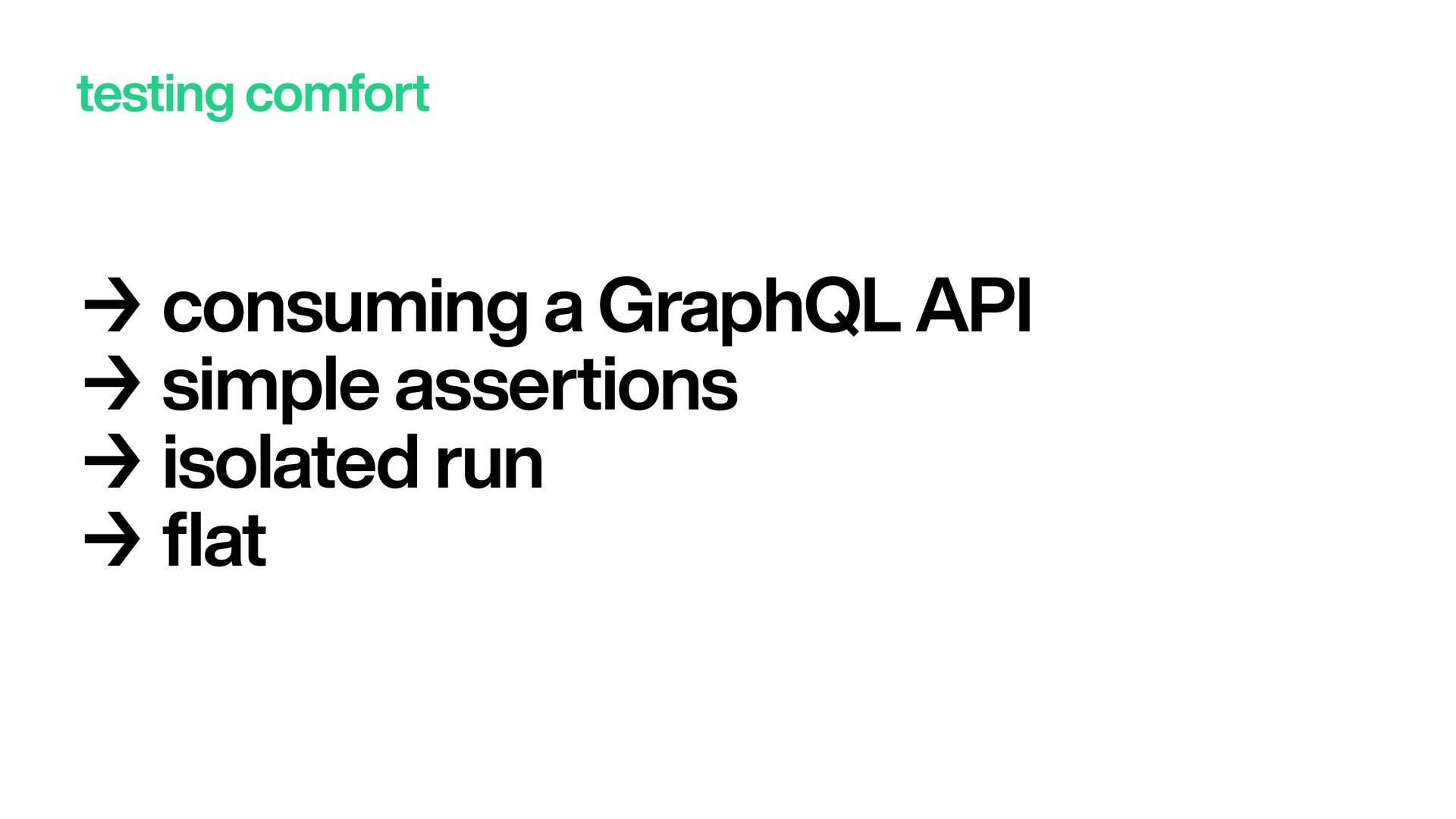
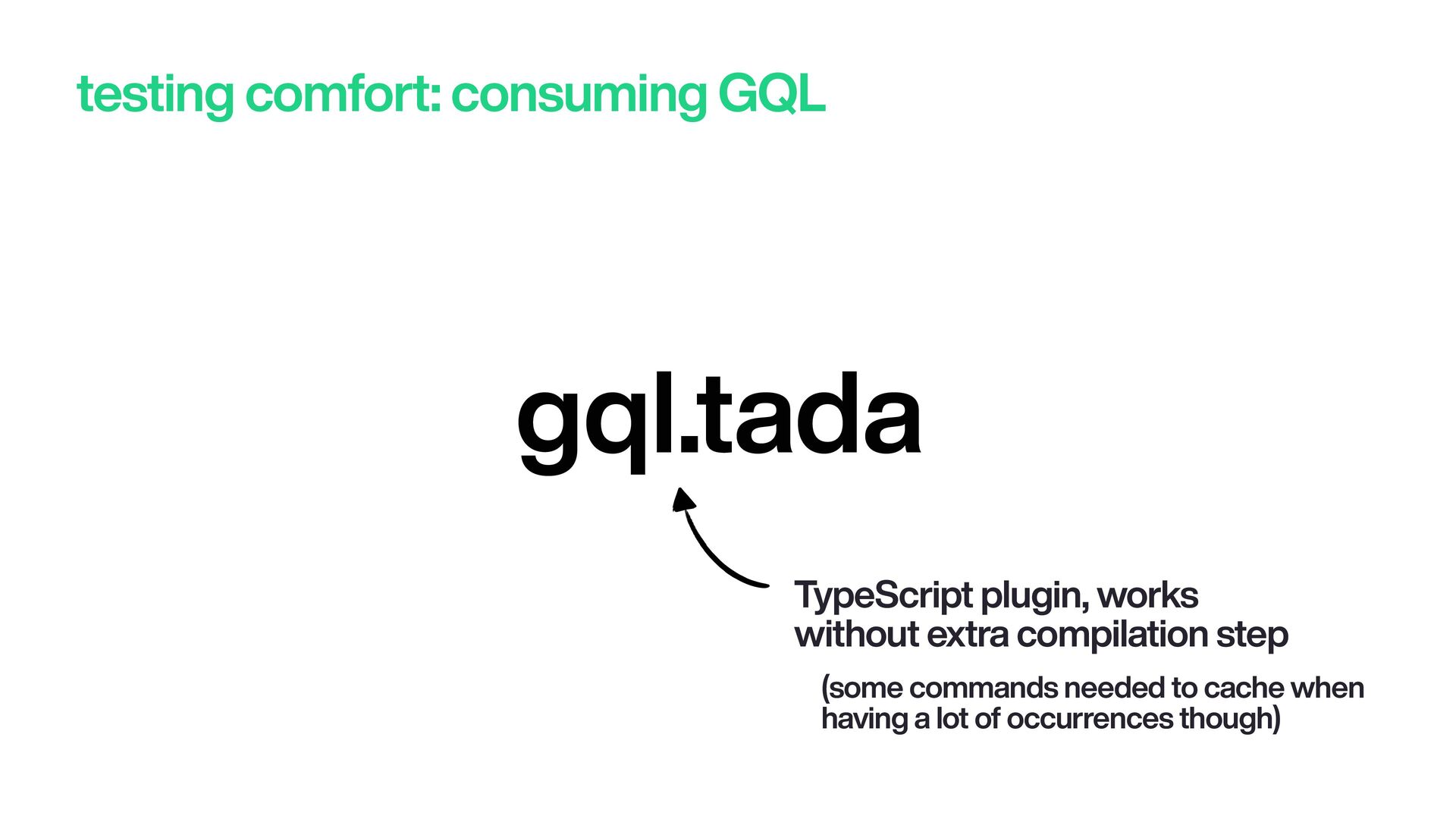
  22. testing comfort: consuming GQL gql.tada TypeScript plugin, works without extra

    compilation step (some commands needed to cache when having a lot of occurrences though)
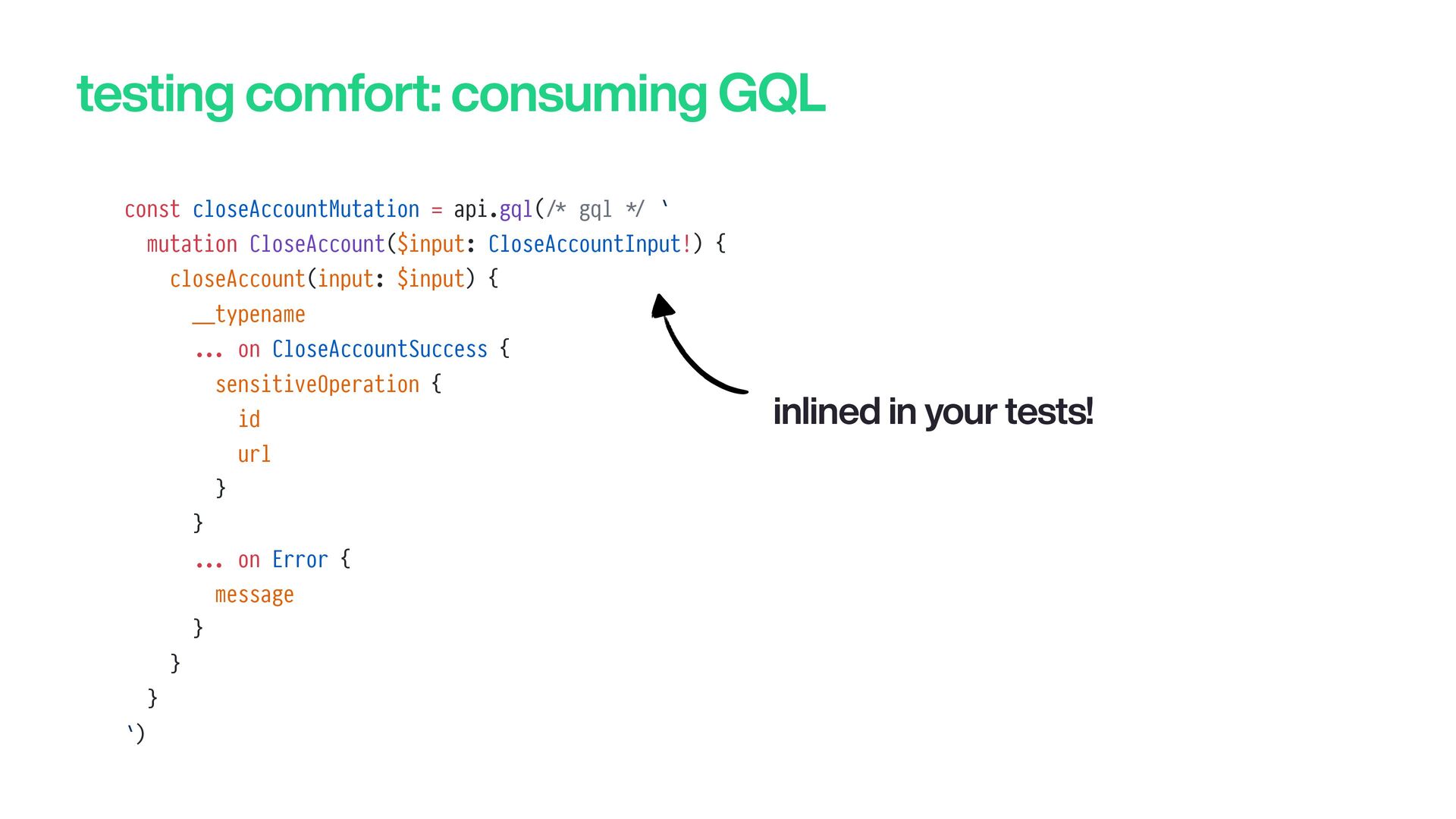
  23. testing comfort: consuming GQL const closeAccountMutation = api.gql( /* gql

    */ ` mutation CloseAccount($input: CloseAccountInput!) { closeAccount(input: $input) { __typename ... on CloseAccountSuccess { sensitiveOperation { id url } } ... on Error { message } } } `) inlined in your tests!
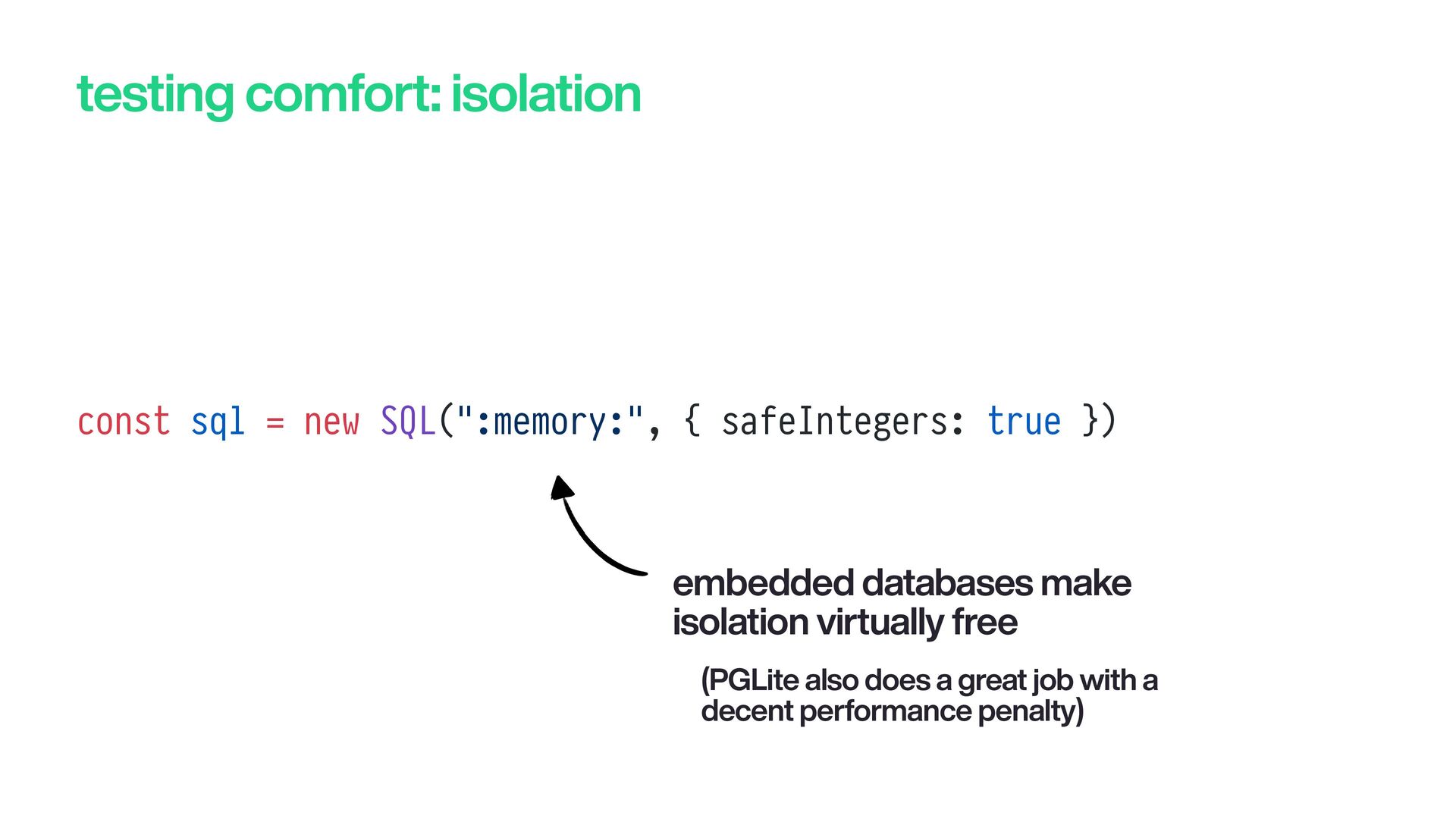
  24. testing comfort: isolation const sql = new SQL(":memory:", { safeIntegers:

    true }) embedded databases make isolation virtually free (PGLite also does a great job with a decent performance penalty)
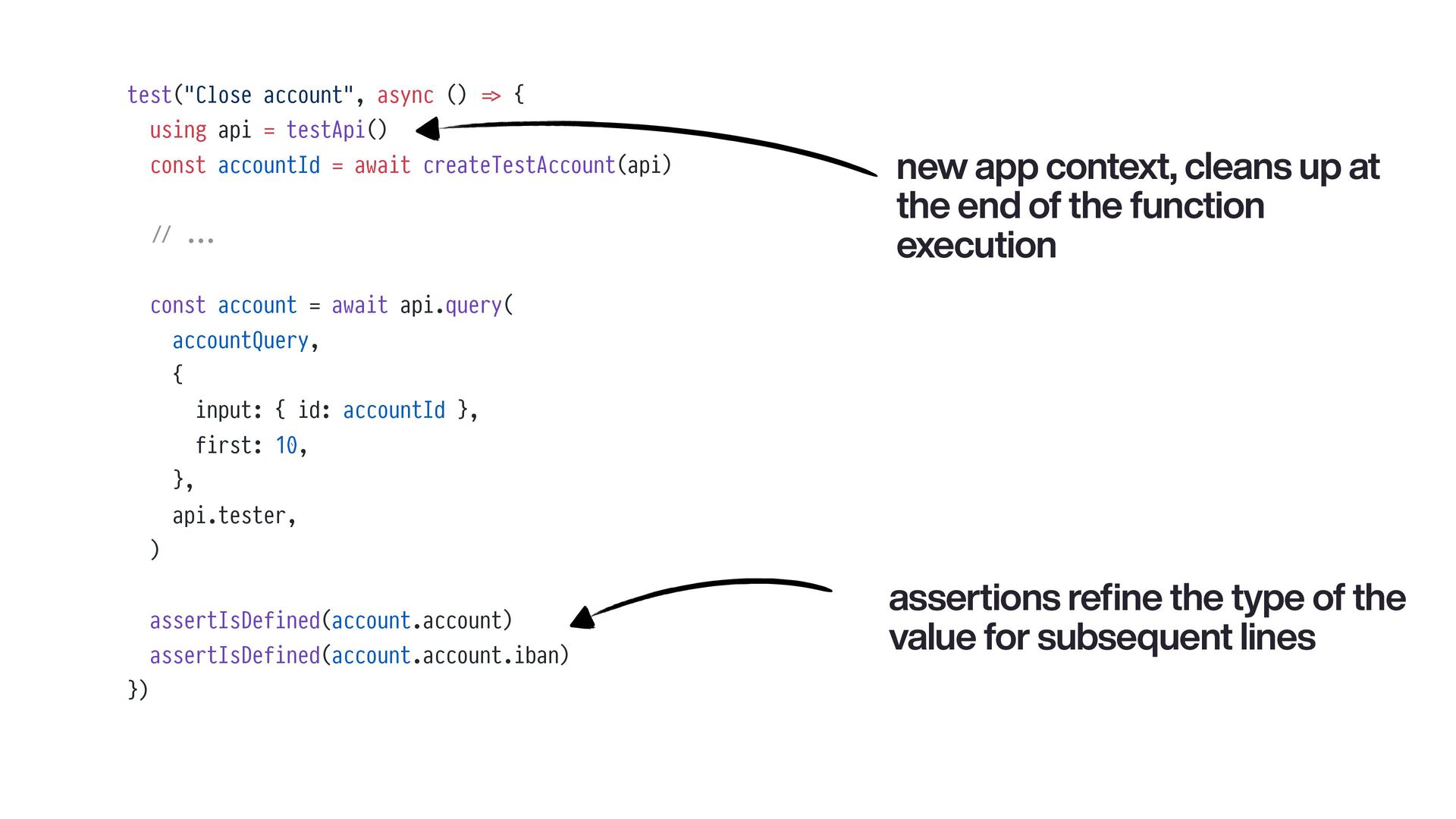
  25. test("Close account", async () => { using api = testApi()

    const accountId = await createTestAccount(api) // ... const account = await api.query( accountQuery, { input: { id: accountId }, first: 10, }, api.tester, ) assertIsDefined(account.account) assertIsDefined(account.account.iban) }) new app context, cleans up at the end of the function execution assertions re fi ne the type of the value for subsequent lines
  26. conclusion 1. reassess technology when hardware evolves also don't let

    the cloud make us forget that it's just computers underneath
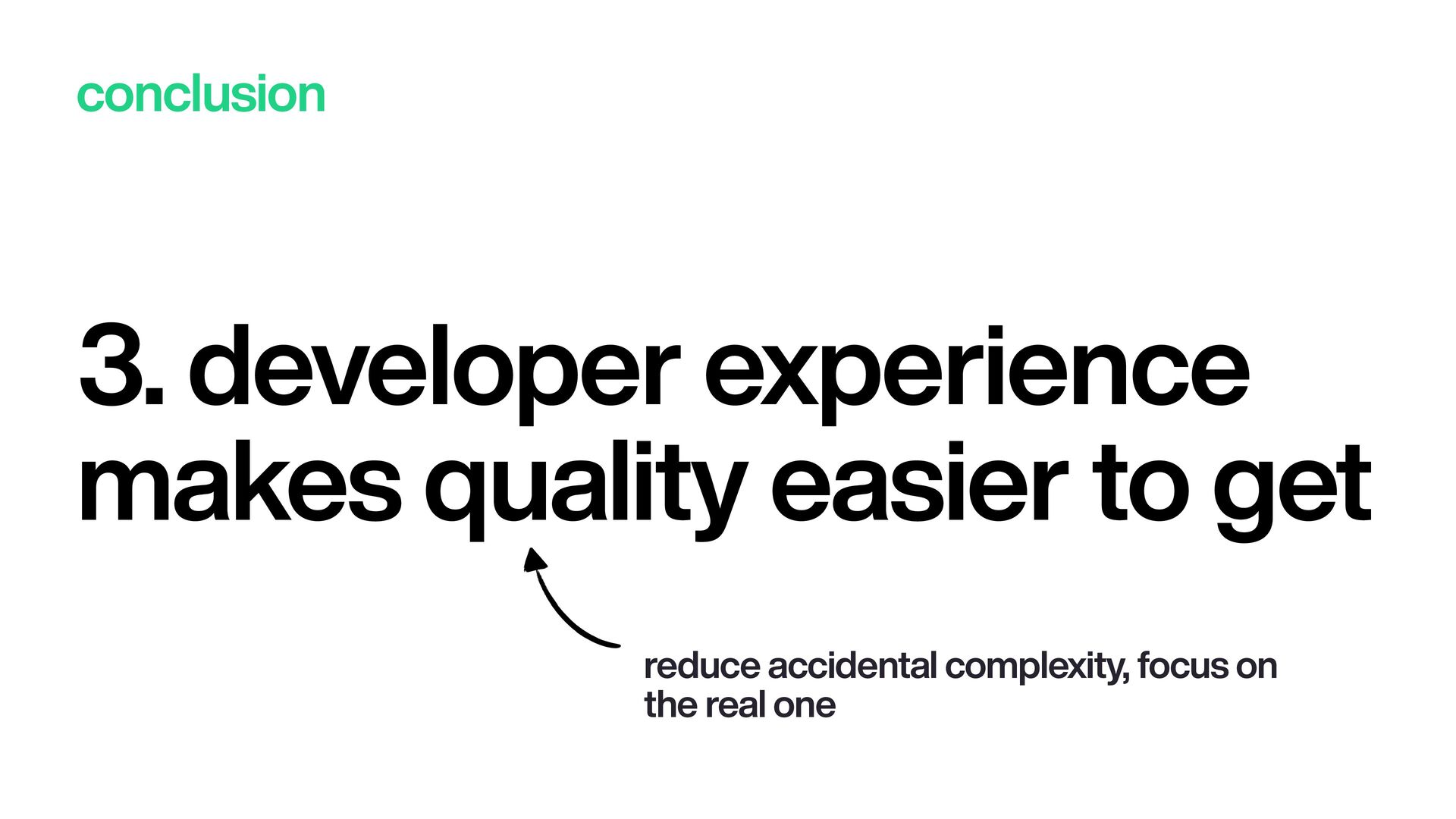
  27. conclusion 3. developer experience makes quality easier to get reduce

    accidental complexity, focus on the real one
  28. Matthias Le Brun frontend engineer lead AI hater chief shitpost

    of fi cer thank you! Paris.JS organizer ReScript core team Putain de Code co-founder bsky: @bloodyowl.io