Upgrade to Pro — share decks privately, control downloads, hide ads and more …

CMPA MUIH

Avatar for Milk Protein Allergy Milk Protein Allergy
December 01, 2017
37

CMPA MUIH

Avatar for Milk Protein Allergy

Milk Protein Allergy

December 01, 2017

Transcript

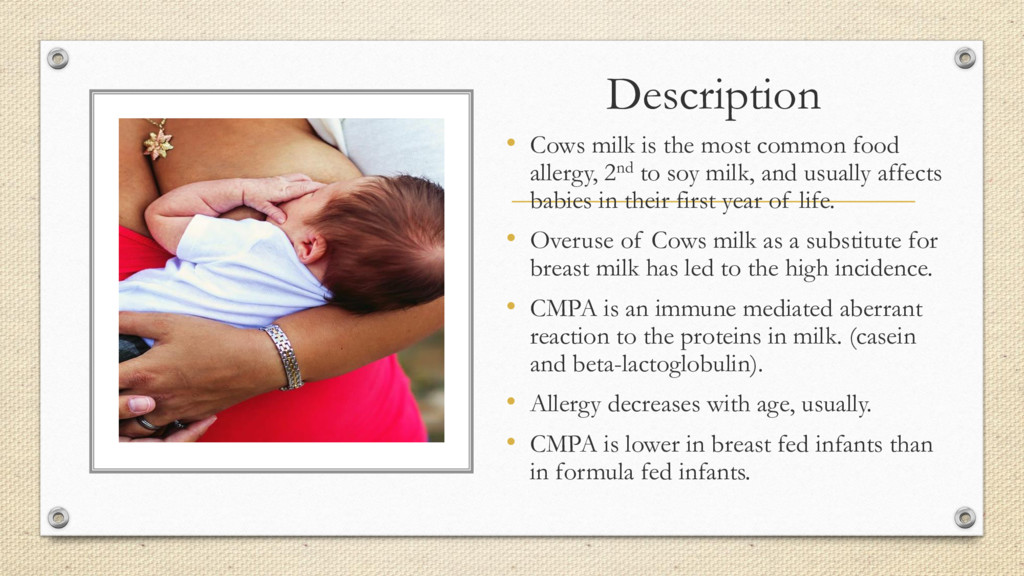
  1. Description • Cows milk is the most common food allergy,

    2nd to soy milk, and usually affects babies in their first year of life. • Overuse of Cows milk as a substitute for breast milk has led to the high incidence. • CMPA is an immune mediated aberrant reaction to the proteins in milk. (casein and beta-lactoglobulin). • Allergy decreases with age, usually. • CMPA is lower in breast fed infants than in formula fed infants.
  2. My story As I look back 19 years, I recognize

    these symptoms in my daughter. Many frustrated nights of inconsolable crying and being homebound for many months was just the beginning. There is no other way to describe the helplessness a parent feels when they can’t help their infant stop crying. As a mother, you know there is something amiss, but not one doctor would listen. I exclusively breastfed my daughter for almost 3 years, never realizing she had a milk protein allergy. After many trips to the pediatrician, and changes in doctors, not one diagnosed her with CMPA. In fact, they all stated it was all in our heads. This leaves a parent feeling very vulnerable, helpless, and almost reminiscent of an inferior parent. I remember many nights crying at my daughter’s bedroom door because there was nothing further to execute to relieve her desperate cries. People, books, doctors, all said to let her cry herself to sleep. Well, I can tell you, that did not last even one night. We would hold her until she fell asleep. Her stomach ached severely every day and night. As a breastfeeding parent who majored in Nutrition, you look at your consumption of foods and try to imagine be what could be instigating the gastrointestinal problems. I never thought to eliminate dairy from my diet. Everything else, like spicy foods, cruciferous vegetables, caffeine, soda, coffee, were all eliminated. Her colicky crying persisted. The first 6 months of her life were torture for her and us, yet so beautiful. She continued to breastfeed for a long time, so I always thought it couldn’t be my breast milk. Sometime within in her first year, I eliminated dairy for personal reasons. Her distress disappeared, and our lives became normal. When she reached the age 2, I introduced soy milk, despite my reservations. The soy milk seemed to ameliorate her g.i issues. Till this day, she does not consume dairy. Anything made from dairy produces gastrointestinal distress with lethargic, malaise feeling all over, she states. Years later, I work for WIC (Women, Infants and children) like most nutrition graduates. As the public Health Nutritionist, I see thousands of parents dealing with the same thing, even today. Parents are striving to help their baby, but still, doctors ignore their seeming less cries for help. I empower parents to buy hypoallergenic or amino acid formulas if they can afford it, and if the baby is formula fed. As a Lactation consultant, I empower all new moms to breastfeed always. If a baby exhibits these symptoms, I educate and empower the parents to be their own advocate and listen to their heart. I educate breastfeeding moms to examine their diet daily, journal what foods they eat and write down times infant seems in tummy distress. This can help identify what initiates the problems. Parents are always right about their children, always. I only wish I had someone to educate and empower me 19 years ago.
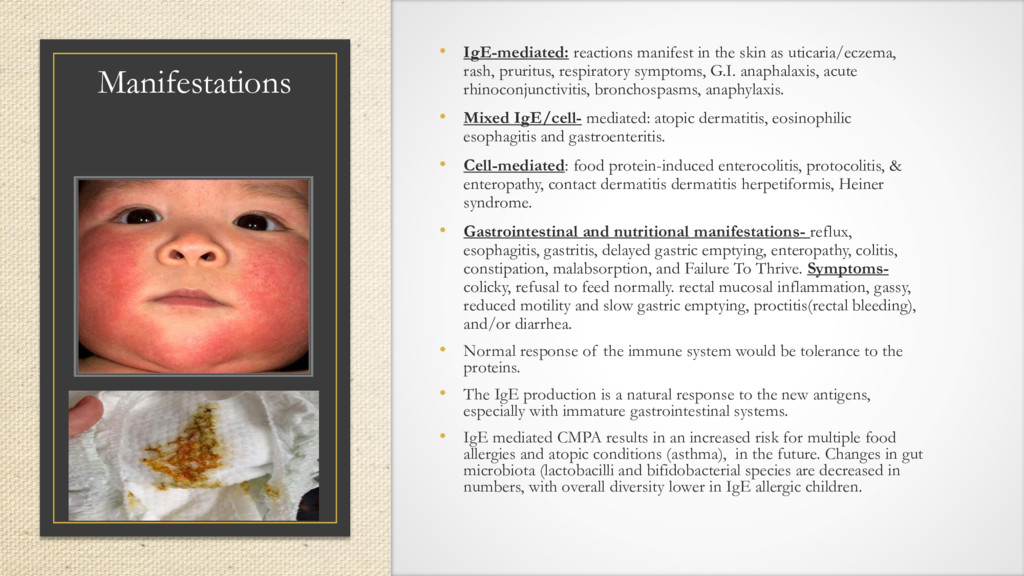
  3. Manifestations • IgE-mediated: reactions manifest in the skin as uticaria/eczema,

    rash, pruritus, respiratory symptoms, G.I. anaphalaxis, acute rhinoconjunctivitis, bronchospasms, anaphylaxis. • Mixed IgE/cell- mediated: atopic dermatitis, eosinophilic esophagitis and gastroenteritis. • Cell-mediated: food protein-induced enterocolitis, protocolitis, & enteropathy, contact dermatitis dermatitis herpetiformis, Heiner syndrome. • Gastrointestinal and nutritional manifestations- reflux, esophagitis, gastritis, delayed gastric emptying, enteropathy, colitis, constipation, malabsorption, and Failure To Thrive. Symptoms- colicky, refusal to feed normally. rectal mucosal inflammation, gassy, reduced motility and slow gastric emptying, proctitis(rectal bleeding), and/or diarrhea. • Normal response of the immune system would be tolerance to the proteins. • The IgE production is a natural response to the new antigens, especially with immature gastrointestinal systems. • IgE mediated CMPA results in an increased risk for multiple food allergies and atopic conditions (asthma), in the future. Changes in gut microbiota (lactobacilli and bifidobacterial species are decreased in numbers, with overall diversity lower in IgE allergic children.
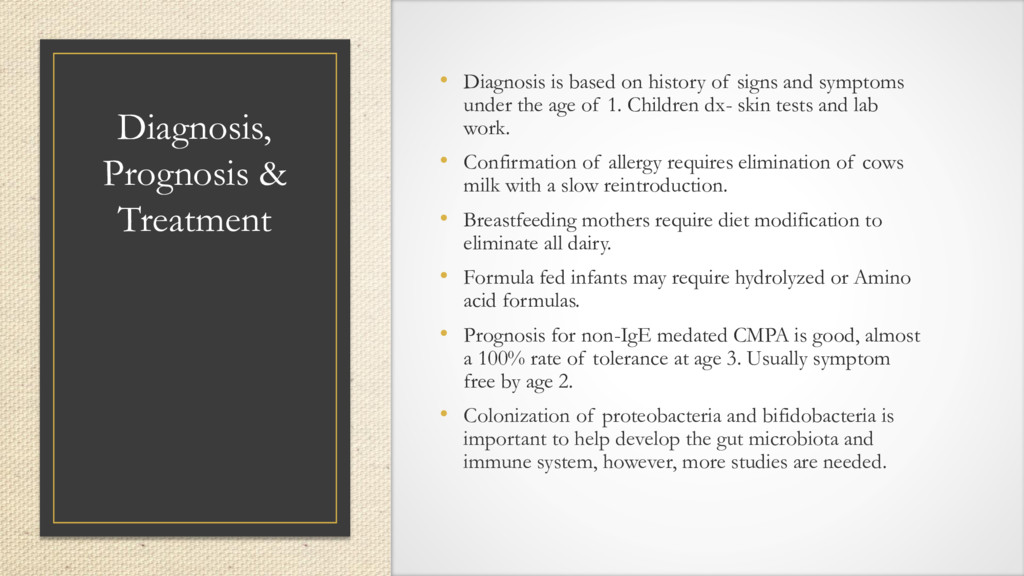
  4. Diagnosis, Prognosis & Treatment • Diagnosis is based on history

    of signs and symptoms under the age of 1. Children dx- skin tests and lab work. • Confirmation of allergy requires elimination of cows milk with a slow reintroduction. • Breastfeeding mothers require diet modification to eliminate all dairy. • Formula fed infants may require hydrolyzed or Amino acid formulas. • Prognosis for non-IgE medated CMPA is good, almost a 100% rate of tolerance at age 3. Usually symptom free by age 2. • Colonization of proteobacteria and bifidobacteria is important to help develop the gut microbiota and immune system, however, more studies are needed.
  5. References • Pictures- Baby face picture on slide 4 retrieved

    from www.rash-pictures.com • - Diaper picture retrieved from www. https://community.babycenter.com/post/a55000231/tmi_is_this_a_bloody_diaper_pic. • Jo, J., Garssen, J., Knippels, L., Sandalova, E. (2014). Role of Cellular Immunity in Cows milk allergy: pathogenesis tolerance induction, and beyond. Mediators of inflammation. Doi: 10.1155/2014/249784. • Motala, C., Fiocchi, A. (2012). Cow’s Milk allergy in Children. World Allergy Organization. Retrieved from http://www.worldallergy.org/professional/allergic_diseases_center/cows_milk_allergy_in_children/. • Brill, H. (2008) Approach to milk protein allergy in infants. Canada Family Physician. 45(9), p. 1258-1264. Retrieved from https://www.ncbi.nlm.nih.gov/pmc/articles/PMC2553152/. • Benhamou, A., Schappi Tempia, M., Belli, D., and Eigenmann, P. ( 2009) An overview of cow’s milk allergy in children. Swiss Medical Weekly. 139(21-22), p. 300-307. Retrieved from https://www.researchgate.net/publication/26262727_An_overview_of_cow%27s_milk_allergy_in_children