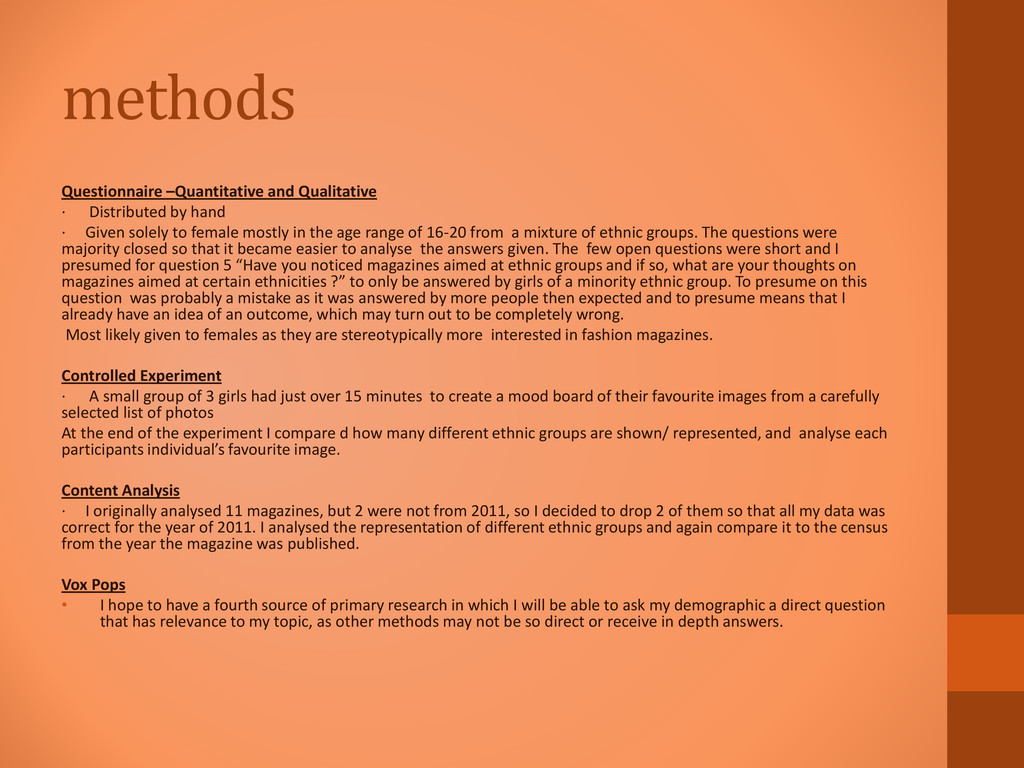
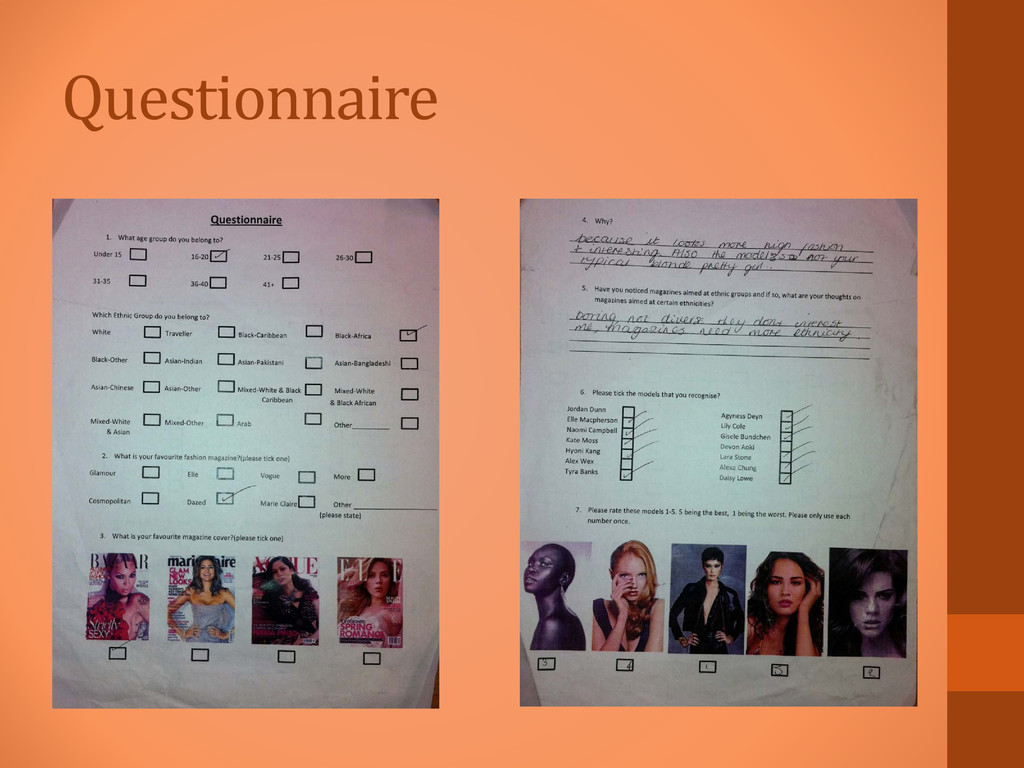
Given solely to female mostly in the age range of 16-20 from a mixture of ethnic groups. The questions were majority closed so that it became easier to analyse the answers given. The few open questions were short and I presumed for question 5 “Have you noticed magazines aimed at ethnic groups and if so, what are your thoughts on magazines aimed at certain ethnicities ?” to only be answered by girls of a minority ethnic group. To presume on this question was probably a mistake as it was answered by more people then expected and to presume means that I already have an idea of an outcome, which may turn out to be completely wrong. Most likely given to females as they are stereotypically more interested in fashion magazines. Controlled Experiment · A small group of 3 girls had just over 15 minutes to create a mood board of their favourite images from a carefully selected list of photos At the end of the experiment I compare d how many different ethnic groups are shown/ represented, and analyse each participants individual’s favourite image. Content Analysis · I originally analysed 11 magazines, but 2 were not from 2011, so I decided to drop 2 of them so that all my data was correct for the year of 2011. I analysed the representation of different ethnic groups and again compare it to the census from the year the magazine was published. Vox Pops • I hope to have a fourth source of primary research in which I will be able to ask my demographic a direct question that has relevance to my topic, as other methods may not be so direct or receive in depth answers.
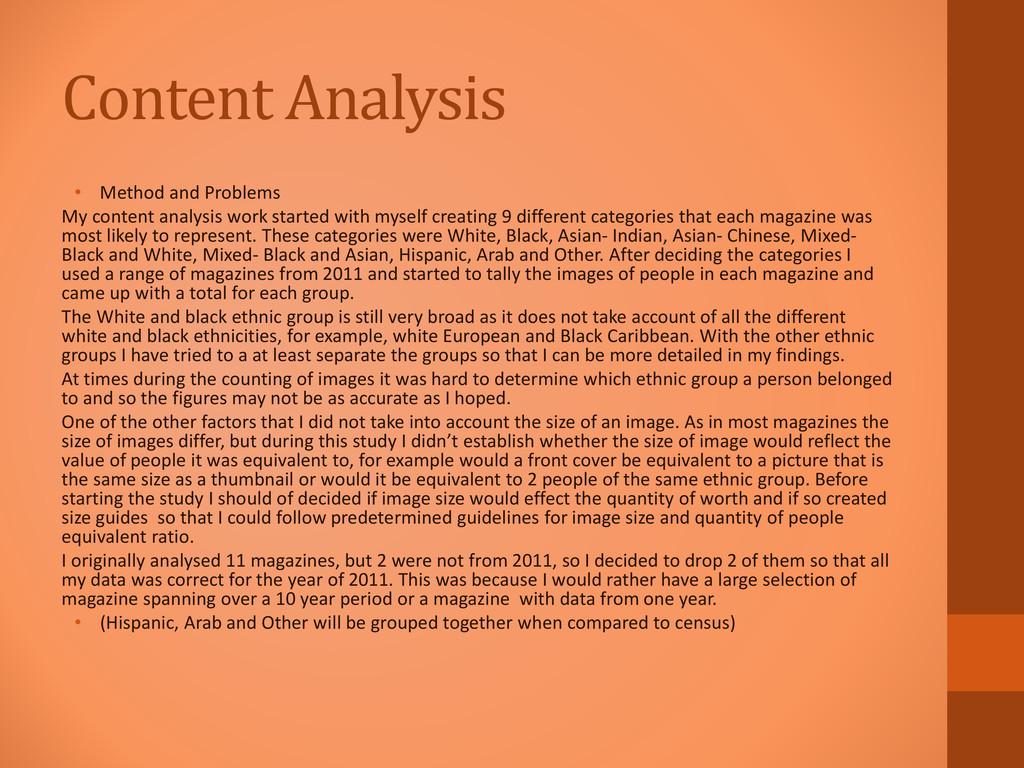
started with myself creating 9 different categories that each magazine was most likely to represent. These categories were White, Black, Asian- Indian, Asian- Chinese, Mixed- Black and White, Mixed- Black and Asian, Hispanic, Arab and Other. After deciding the categories I used a range of magazines from 2011 and started to tally the images of people in each magazine and came up with a total for each group. The White and black ethnic group is still very broad as it does not take account of all the different white and black ethnicities, for example, white European and Black Caribbean. With the other ethnic groups I have tried to a at least separate the groups so that I can be more detailed in my findings. At times during the counting of images it was hard to determine which ethnic group a person belonged to and so the figures may not be as accurate as I hoped. One of the other factors that I did not take into account the size of an image. As in most magazines the size of images differ, but during this study I didn’t establish whether the size of image would reflect the value of people it was equivalent to, for example would a front cover be equivalent to a picture that is the same size as a thumbnail or would it be equivalent to 2 people of the same ethnic group. Before starting the study I should of decided if image size would effect the quantity of worth and if so created size guides so that I could follow predetermined guidelines for image size and quantity of people equivalent ratio. I originally analysed 11 magazines, but 2 were not from 2011, so I decided to drop 2 of them so that all my data was correct for the year of 2011. This was because I would rather have a large selection of magazine spanning over a 10 year period or a magazine with data from one year. • (Hispanic, Arab and Other will be grouped together when compared to census)
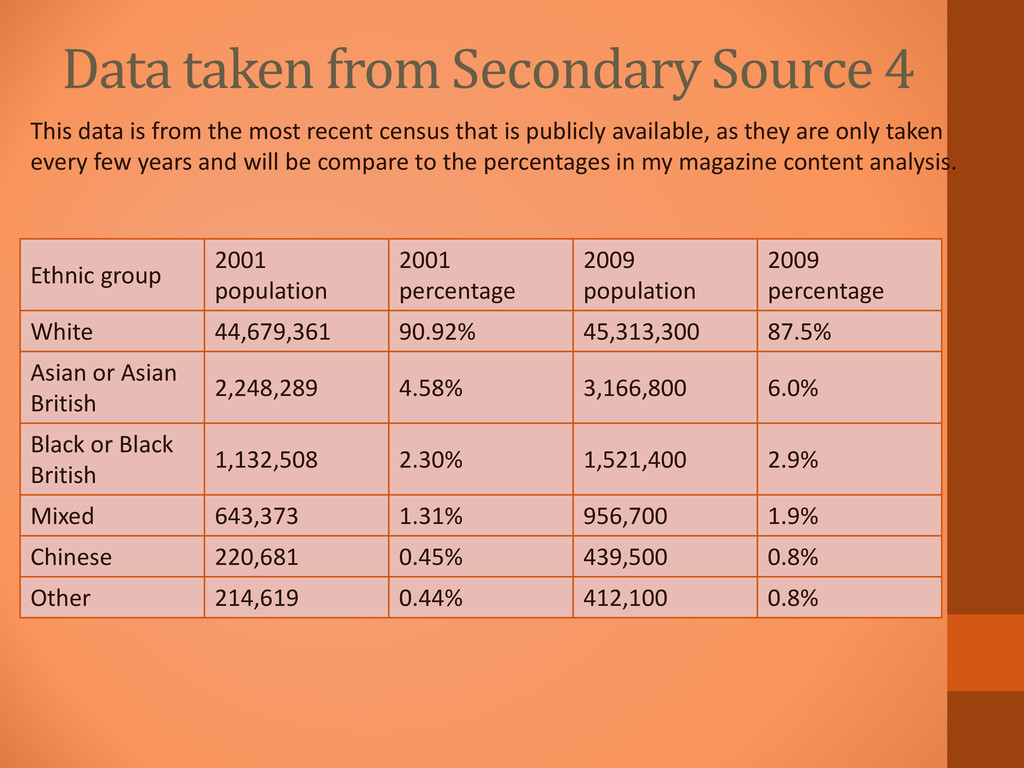
2001 percentage 2009 population 2009 percentage White 44,679,361 90.92% 45,313,300 87.5% Asian or Asian British 2,248,289 4.58% 3,166,800 6.0% Black or Black British 1,132,508 2.30% 1,521,400 2.9% Mixed 643,373 1.31% 956,700 1.9% Chinese 220,681 0.45% 439,500 0.8% Other 214,619 0.44% 412,100 0.8% This data is from the most recent census that is publicly available, as they are only taken every few years and will be compare to the percentages in my magazine content analysis.
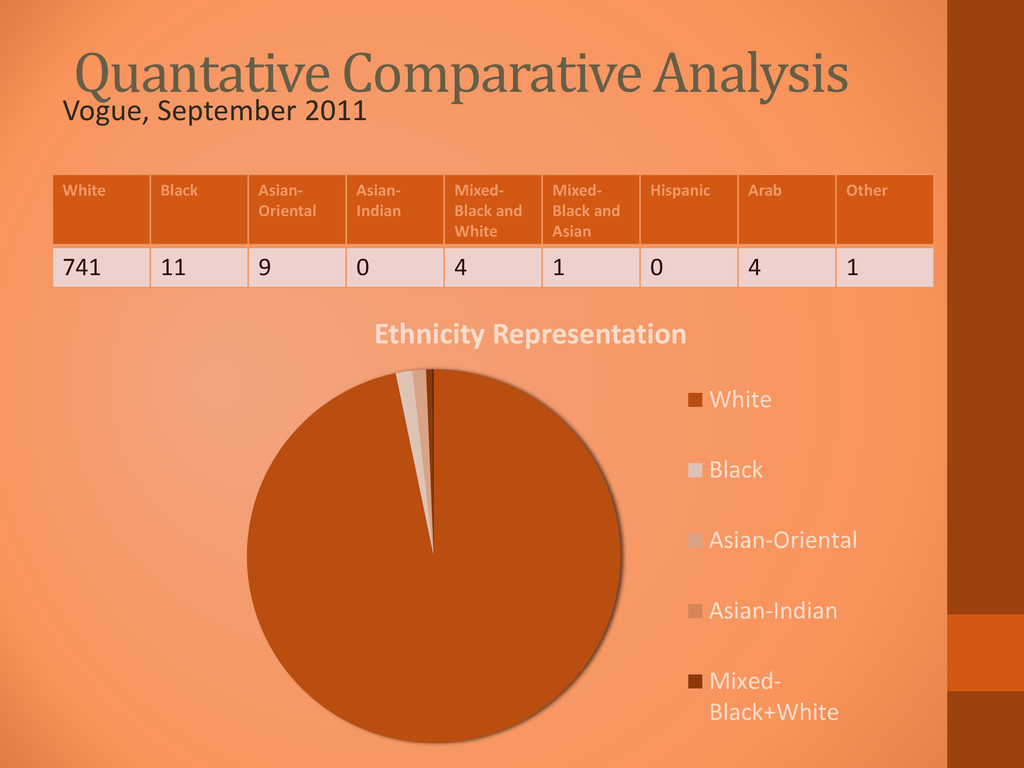
Asian-Oriental Asian-Indian Mixed- Black+White White Black Asian- Oriental Asian- Indian Mixed- Black and White Mixed- Black and Asian Hispanic Arab Other 741 11 9 0 4 1 0 4 1
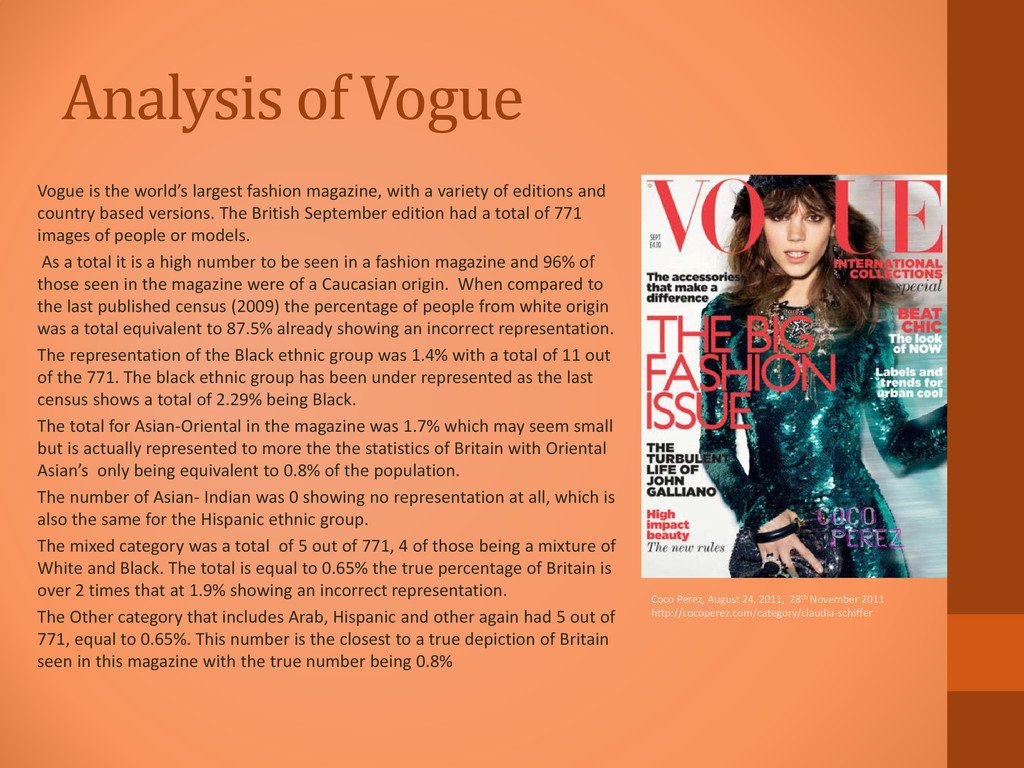
with a variety of editions and country based versions. The British September edition had a total of 771 images of people or models. As a total it is a high number to be seen in a fashion magazine and 96% of those seen in the magazine were of a Caucasian origin. When compared to the last published census (2009) the percentage of people from white origin was a total equivalent to 87.5% already showing an incorrect representation. The representation of the Black ethnic group was 1.4% with a total of 11 out of the 771. The black ethnic group has been under represented as the last census shows a total of 2.29% being Black. The total for Asian-Oriental in the magazine was 1.7% which may seem small but is actually represented to more the the statistics of Britain with Oriental Asian’s only being equivalent to 0.8% of the population. The number of Asian- Indian was 0 showing no representation at all, which is also the same for the Hispanic ethnic group. The mixed category was a total of 5 out of 771, 4 of those being a mixture of White and Black. The total is equal to 0.65% the true percentage of Britain is over 2 times that at 1.9% showing an incorrect representation. The Other category that includes Arab, Hispanic and other again had 5 out of 771, equal to 0.65%. This number is the closest to a true depiction of Britain seen in this magazine with the true number being 0.8% Coco Perez, August 24, 2011, 28th November 2011 http://cocoperez.com/category/claudia-schiffer
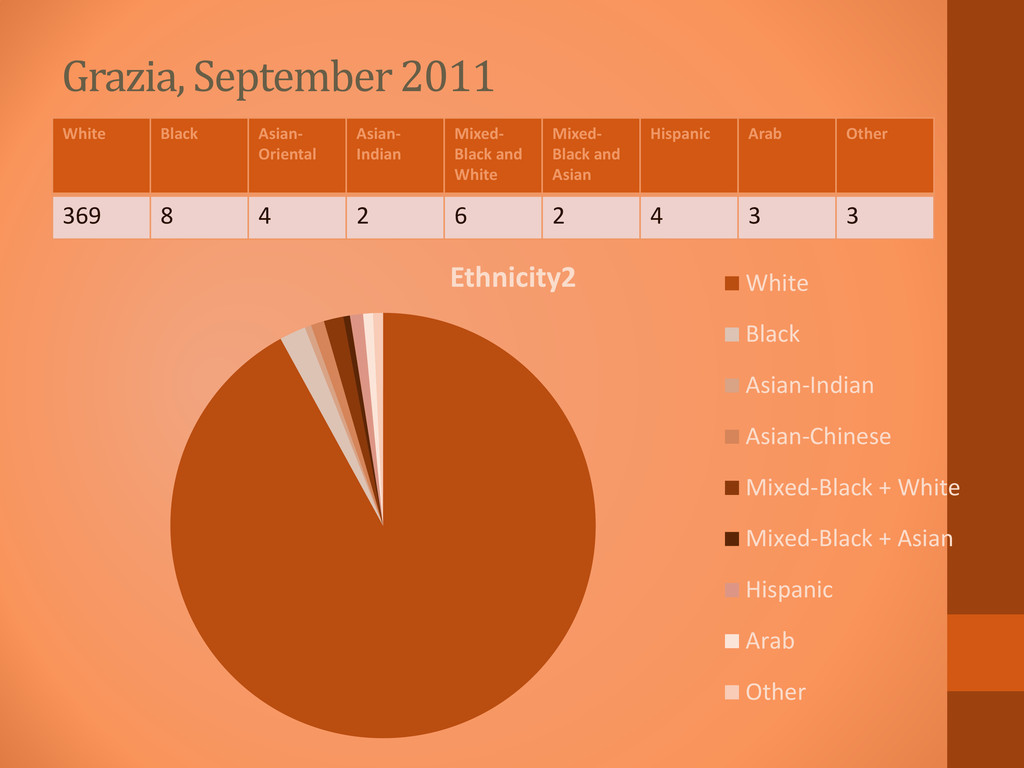
White Mixed-Black + Asian Hispanic Arab Other White Black Asian- Oriental Asian- Indian Mixed- Black and White Mixed- Black and Asian Hispanic Arab Other 369 8 4 2 6 2 4 3 3
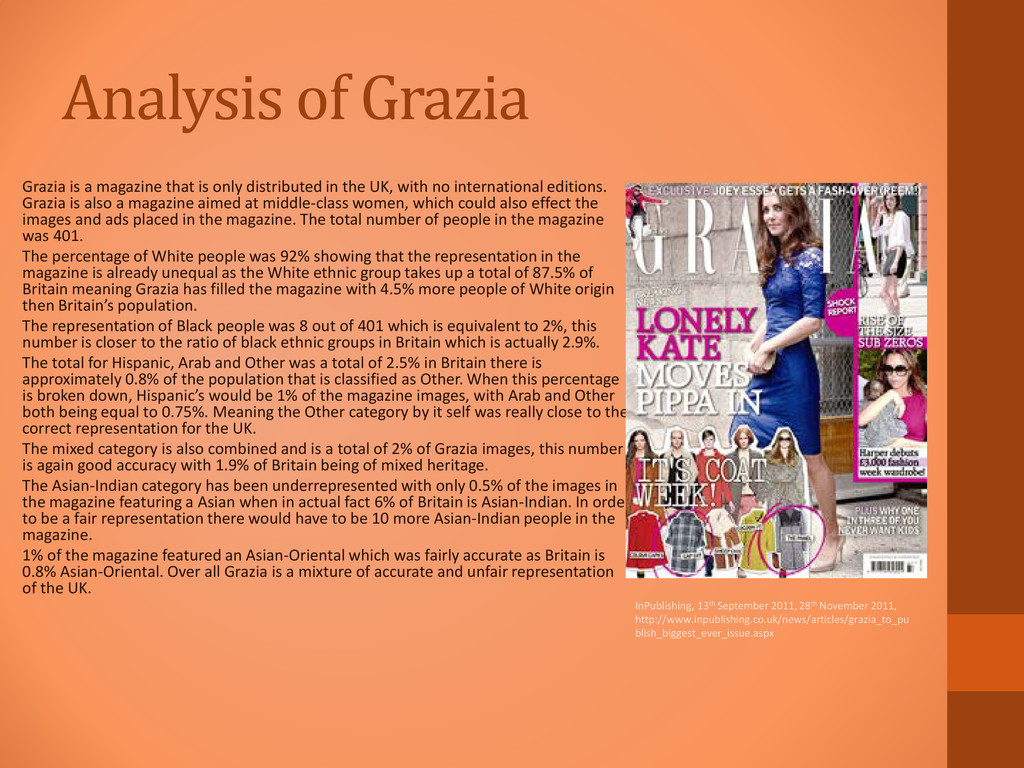
distributed in the UK, with no international editions. Grazia is also a magazine aimed at middle-class women, which could also effect the images and ads placed in the magazine. The total number of people in the magazine was 401. The percentage of White people was 92% showing that the representation in the magazine is already unequal as the White ethnic group takes up a total of 87.5% of Britain meaning Grazia has filled the magazine with 4.5% more people of White origin then Britain’s population. The representation of Black people was 8 out of 401 which is equivalent to 2%, this number is closer to the ratio of black ethnic groups in Britain which is actually 2.9%. The total for Hispanic, Arab and Other was a total of 2.5% in Britain there is approximately 0.8% of the population that is classified as Other. When this percentage is broken down, Hispanic’s would be 1% of the magazine images, with Arab and Other both being equal to 0.75%. Meaning the Other category by it self was really close to the correct representation for the UK. The mixed category is also combined and is a total of 2% of Grazia images, this number is again good accuracy with 1.9% of Britain being of mixed heritage. The Asian-Indian category has been underrepresented with only 0.5% of the images in the magazine featuring a Asian when in actual fact 6% of Britain is Asian-Indian. In order to be a fair representation there would have to be 10 more Asian-Indian people in the magazine. 1% of the magazine featured an Asian-Oriental which was fairly accurate as Britain is 0.8% Asian-Oriental. Over all Grazia is a mixture of accurate and unfair representation of the UK. InPublishing, 13th September 2011, 28th November 2011, http://www.inpublishing.co.uk/news/articles/grazia_to_pu blish_biggest_ever_issue.aspx
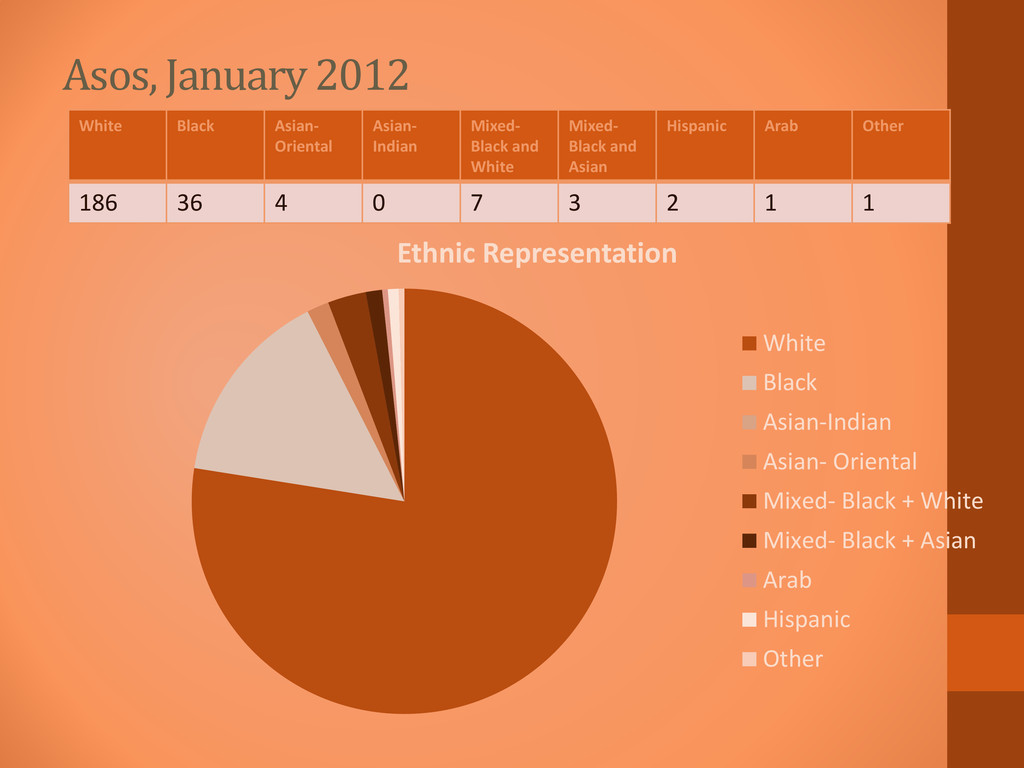
Mixed- Black + White Mixed- Black + Asian Arab Hispanic Other White Black Asian- Oriental Asian- Indian Mixed- Black and White Mixed- Black and Asian Hispanic Arab Other 186 36 4 0 7 3 2 1 1
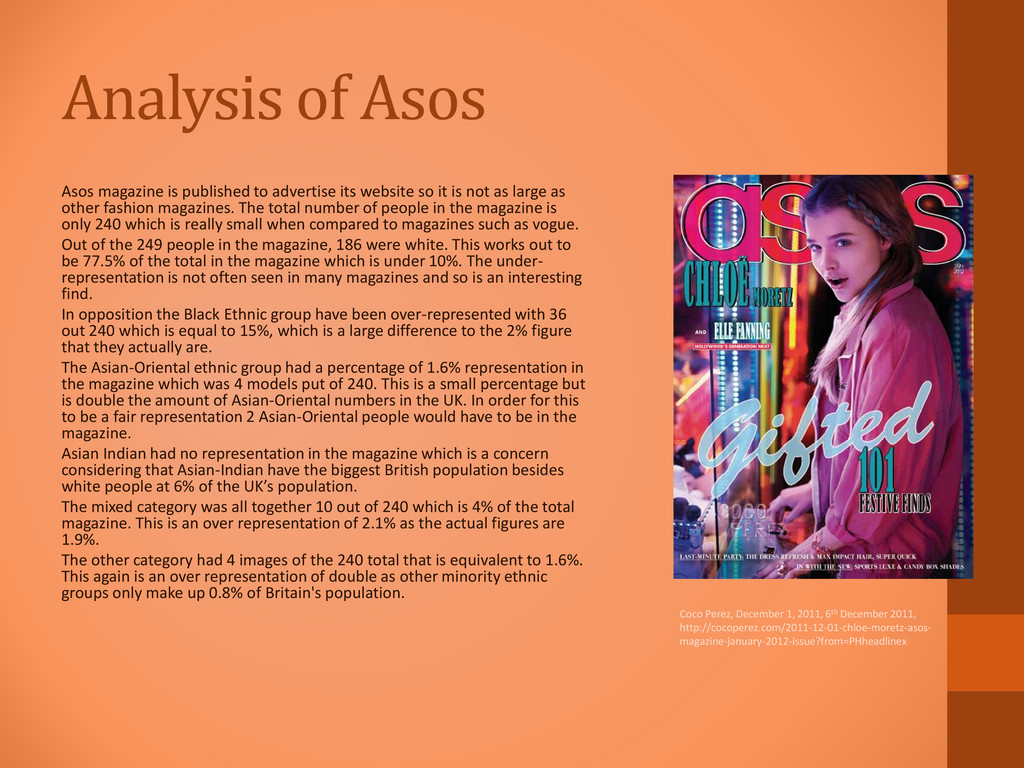
website so it is not as large as other fashion magazines. The total number of people in the magazine is only 240 which is really small when compared to magazines such as vogue. Out of the 249 people in the magazine, 186 were white. This works out to be 77.5% of the total in the magazine which is under 10%. The under- representation is not often seen in many magazines and so is an interesting find. In opposition the Black Ethnic group have been over-represented with 36 out 240 which is equal to 15%, which is a large difference to the 2% figure that they actually are. The Asian-Oriental ethnic group had a percentage of 1.6% representation in the magazine which was 4 models put of 240. This is a small percentage but is double the amount of Asian-Oriental numbers in the UK. In order for this to be a fair representation 2 Asian-Oriental people would have to be in the magazine. Asian Indian had no representation in the magazine which is a concern considering that Asian-Indian have the biggest British population besides white people at 6% of the UK’s population. The mixed category was all together 10 out of 240 which is 4% of the total magazine. This is an over representation of 2.1% as the actual figures are 1.9%. The other category had 4 images of the 240 total that is equivalent to 1.6%. This again is an over representation of double as other minority ethnic groups only make up 0.8% of Britain's population. Coco Perez, December 1, 2011, 6th December 2011, http://cocoperez.com/2011-12-01-chloe-moretz-asos- magazine-january-2012-issue?from=PHheadlinex
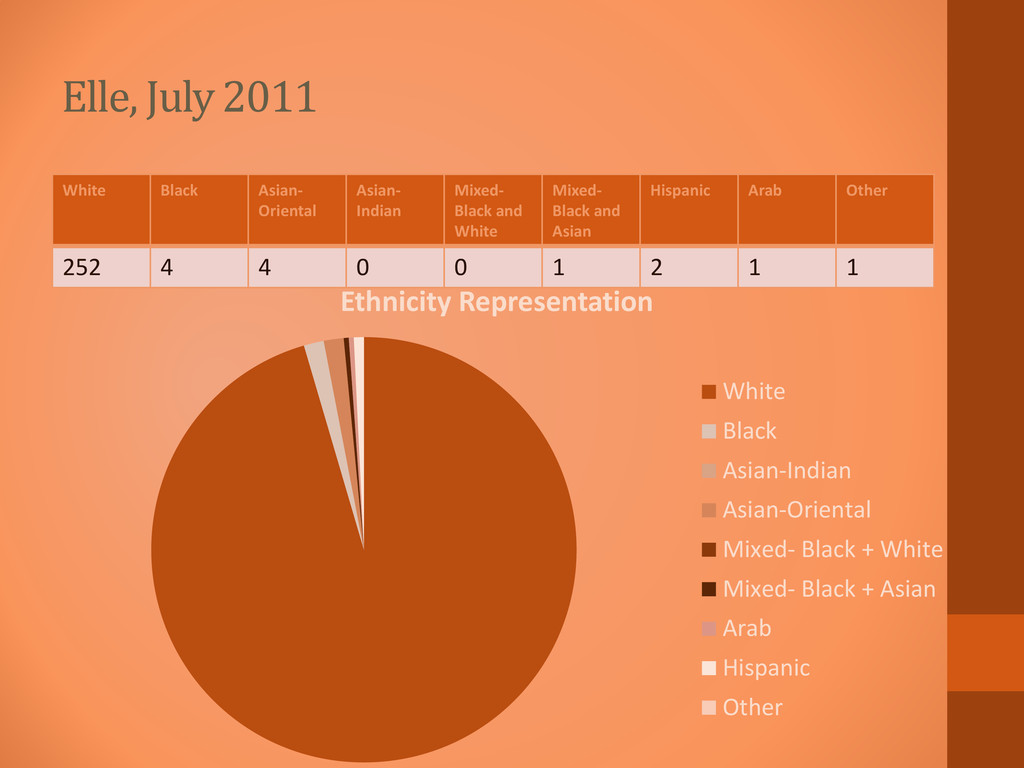
Black + White Mixed- Black + Asian Arab Hispanic Other White Black Asian- Oriental Asian- Indian Mixed- Black and White Mixed- Black and Asian Hispanic Arab Other 252 4 4 0 0 1 2 1 1
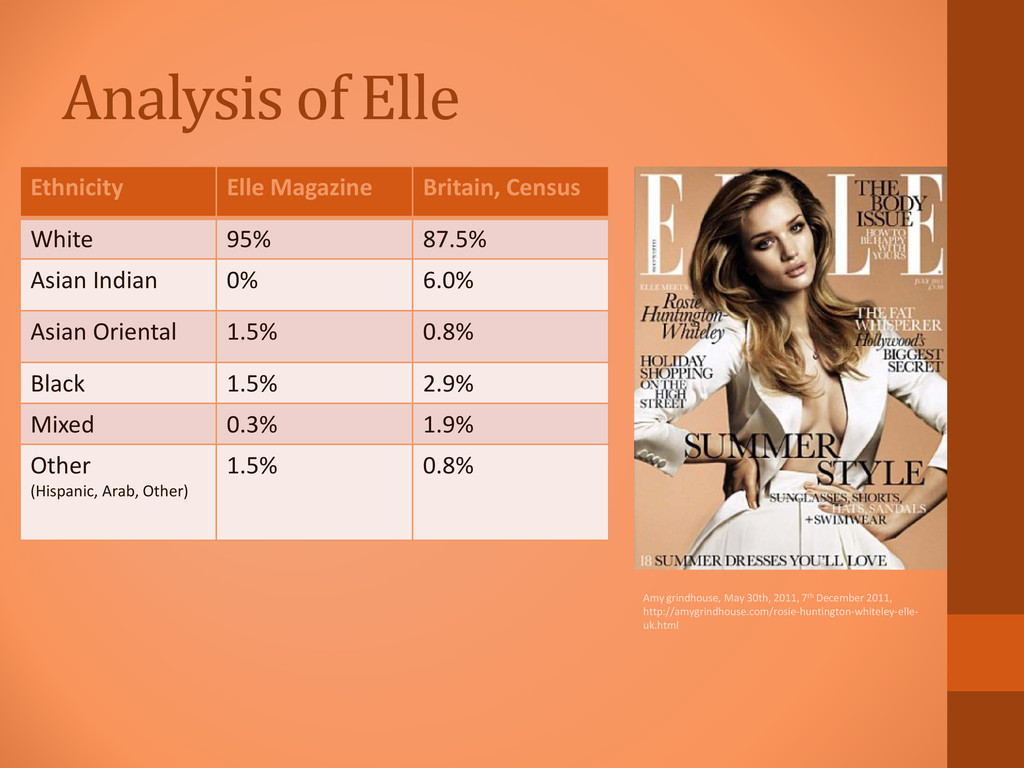
2011, http://amygrindhouse.com/rosie-huntington-whiteley-elle- uk.html Ethnicity Elle Magazine Britain, Census White 95% 87.5% Asian Indian 0% 6.0% Asian Oriental 1.5% 0.8% Black 1.5% 2.9% Mixed 0.3% 1.9% Other (Hispanic, Arab, Other) 1.5% 0.8%
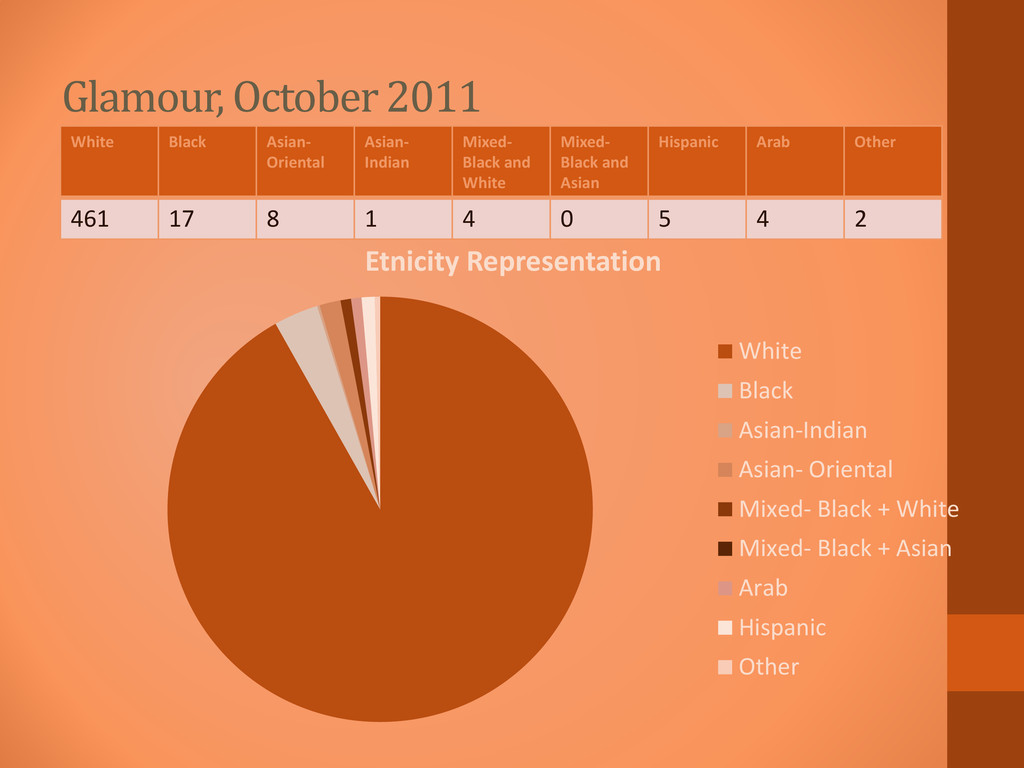
Mixed- Black + White Mixed- Black + Asian Arab Hispanic Other White Black Asian- Oriental Asian- Indian Mixed- Black and White Mixed- Black and Asian Hispanic Arab Other 461 17 8 1 4 0 5 4 2
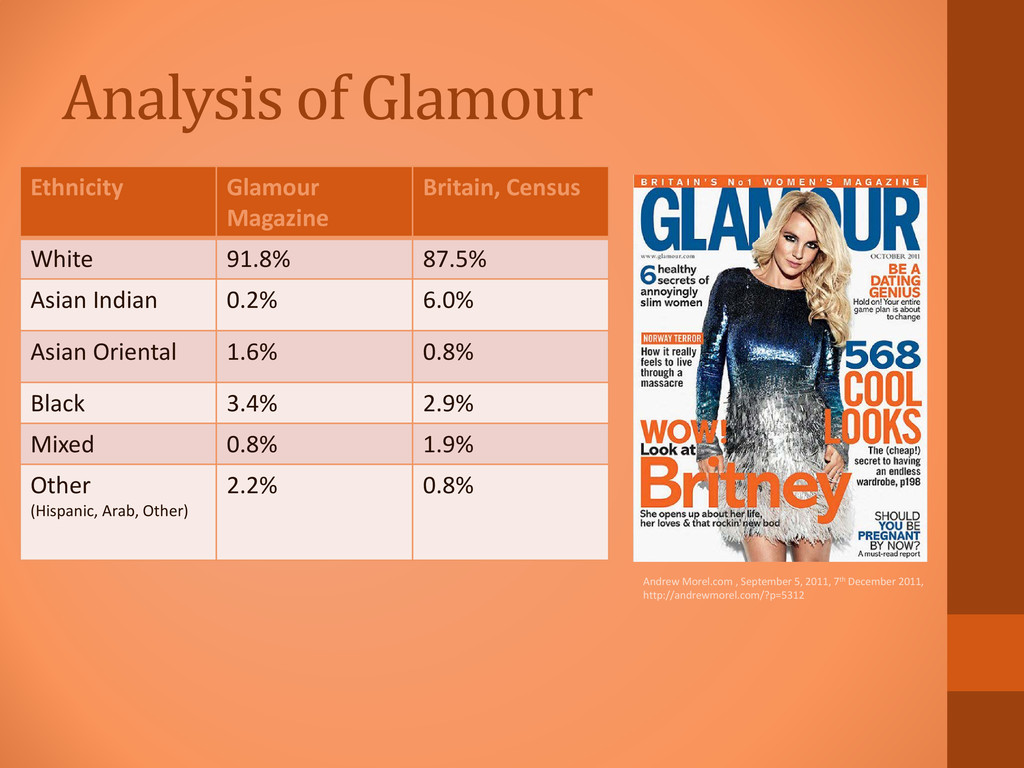
December 2011, http://andrewmorel.com/?p=5312 Ethnicity Glamour Magazine Britain, Census White 91.8% 87.5% Asian Indian 0.2% 6.0% Asian Oriental 1.6% 0.8% Black 3.4% 2.9% Mixed 0.8% 1.9% Other (Hispanic, Arab, Other) 2.2% 0.8%
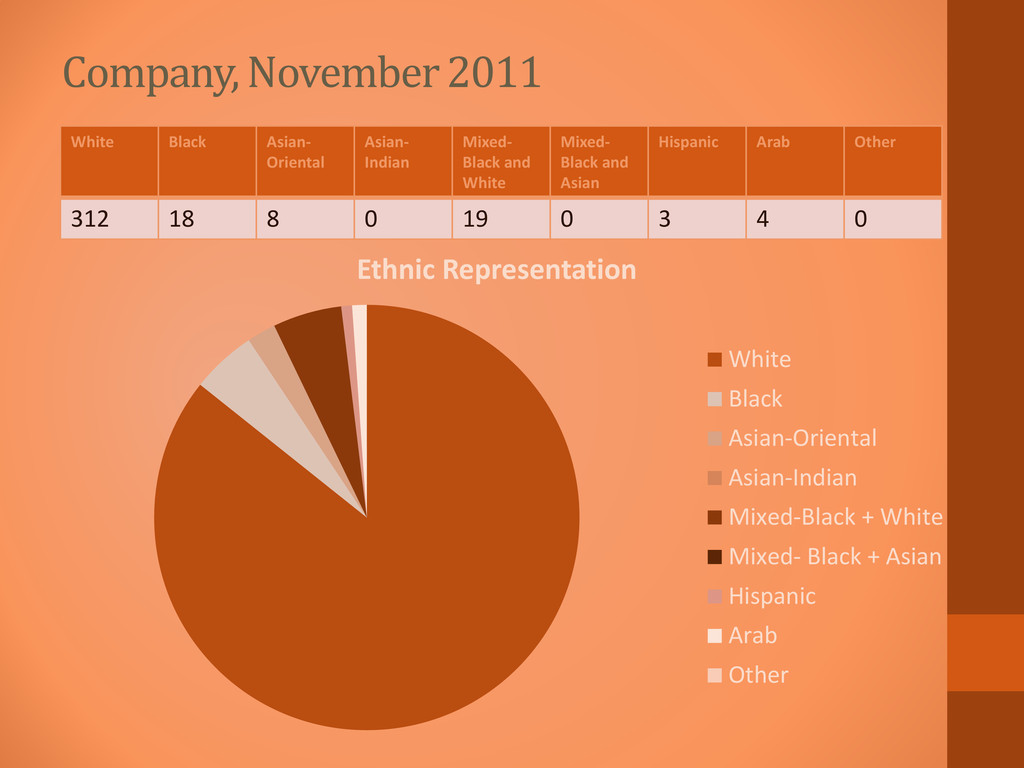
+ White Mixed- Black + Asian Hispanic Arab Other White Black Asian- Oriental Asian- Indian Mixed- Black and White Mixed- Black and Asian Hispanic Arab Other 312 18 8 0 19 0 3 4 0
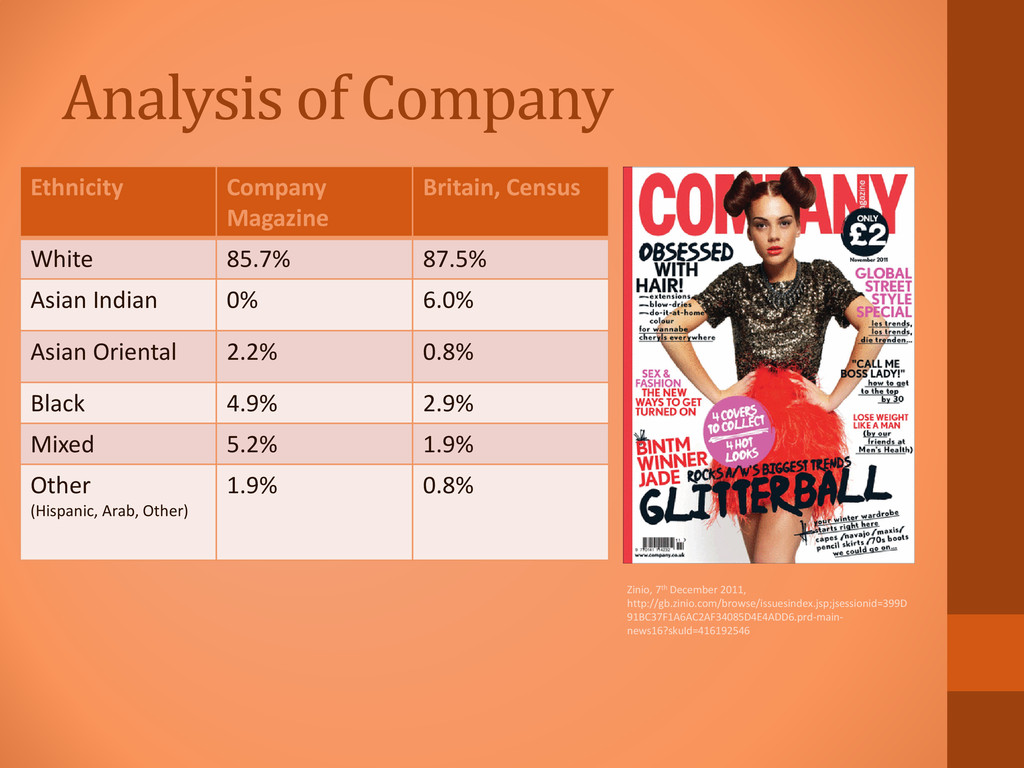
Ethnicity Company Magazine Britain, Census White 85.7% 87.5% Asian Indian 0% 6.0% Asian Oriental 2.2% 0.8% Black 4.9% 2.9% Mixed 5.2% 1.9% Other (Hispanic, Arab, Other) 1.9% 0.8%
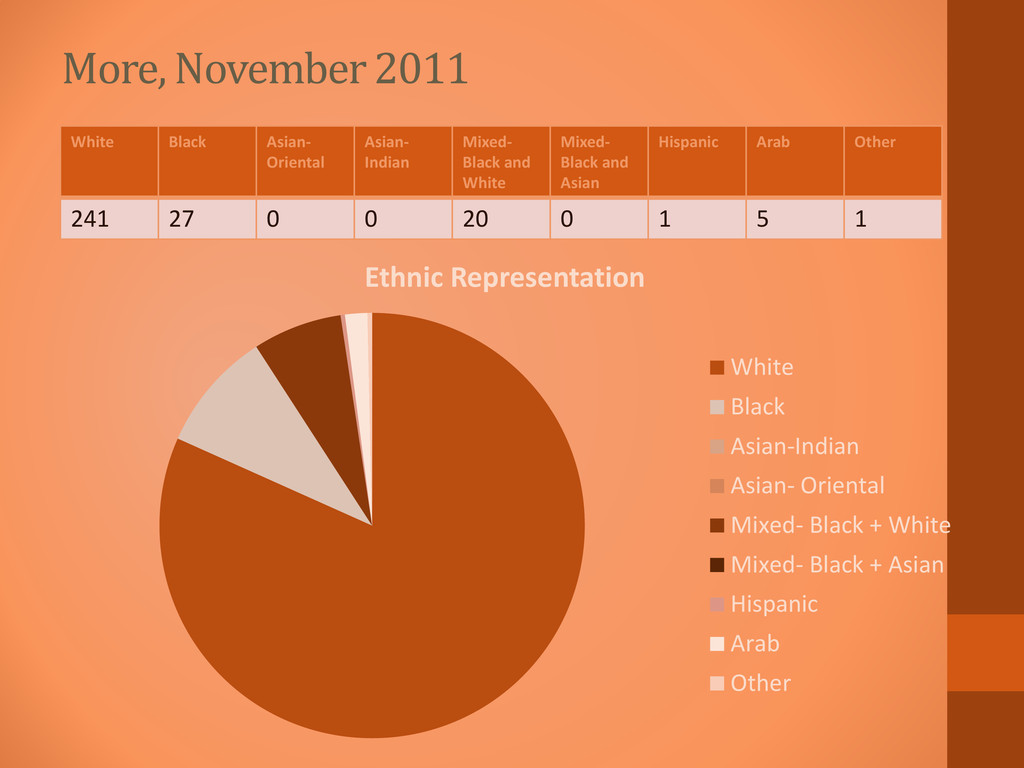
Mixed- Black + White Mixed- Black + Asian Hispanic Arab Other White Black Asian- Oriental Asian- Indian Mixed- Black and White Mixed- Black and Asian Hispanic Arab Other 241 27 0 0 20 0 1 5 1
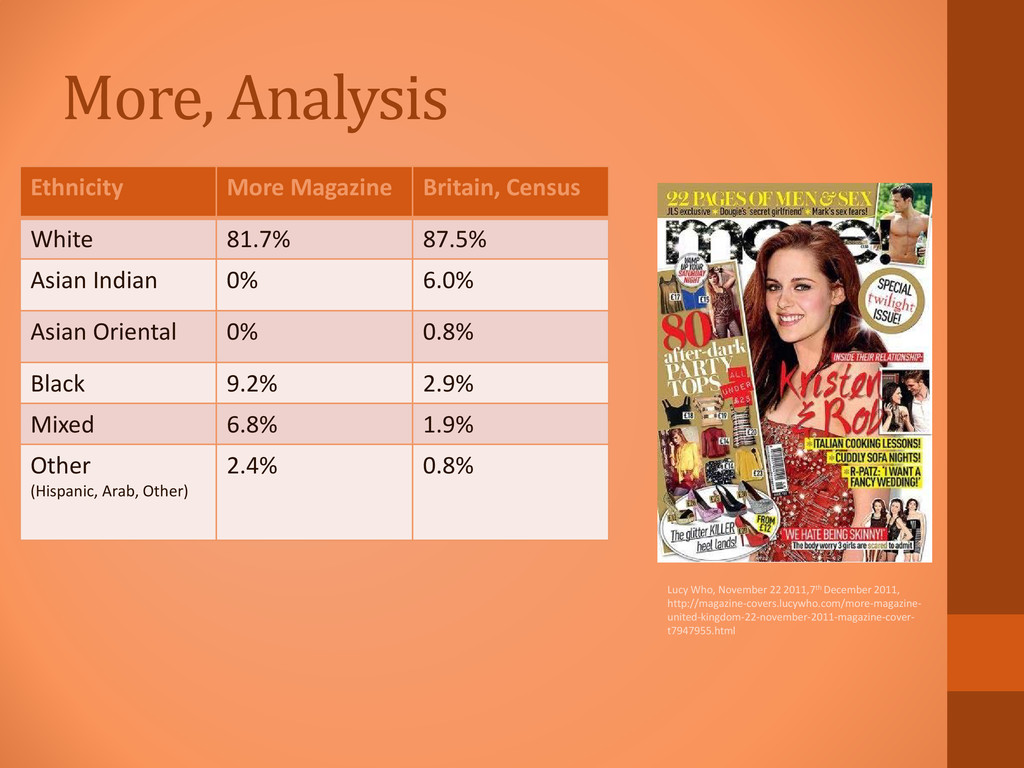
united-kingdom-22-november-2011-magazine-cover- t7947955.html Ethnicity More Magazine Britain, Census White 81.7% 87.5% Asian Indian 0% 6.0% Asian Oriental 0% 0.8% Black 9.2% 2.9% Mixed 6.8% 1.9% Other (Hispanic, Arab, Other) 2.4% 0.8%
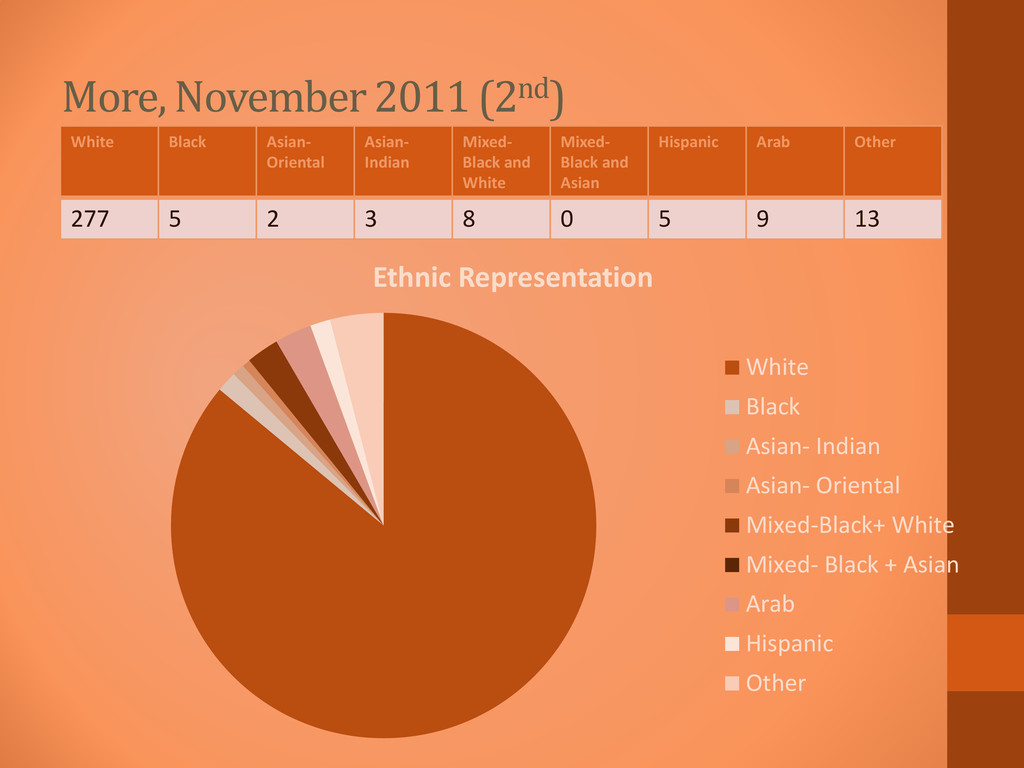
Asian- Oriental Mixed-Black+ White Mixed- Black + Asian Arab Hispanic Other White Black Asian- Oriental Asian- Indian Mixed- Black and White Mixed- Black and Asian Hispanic Arab Other 277 5 2 3 8 0 5 9 13
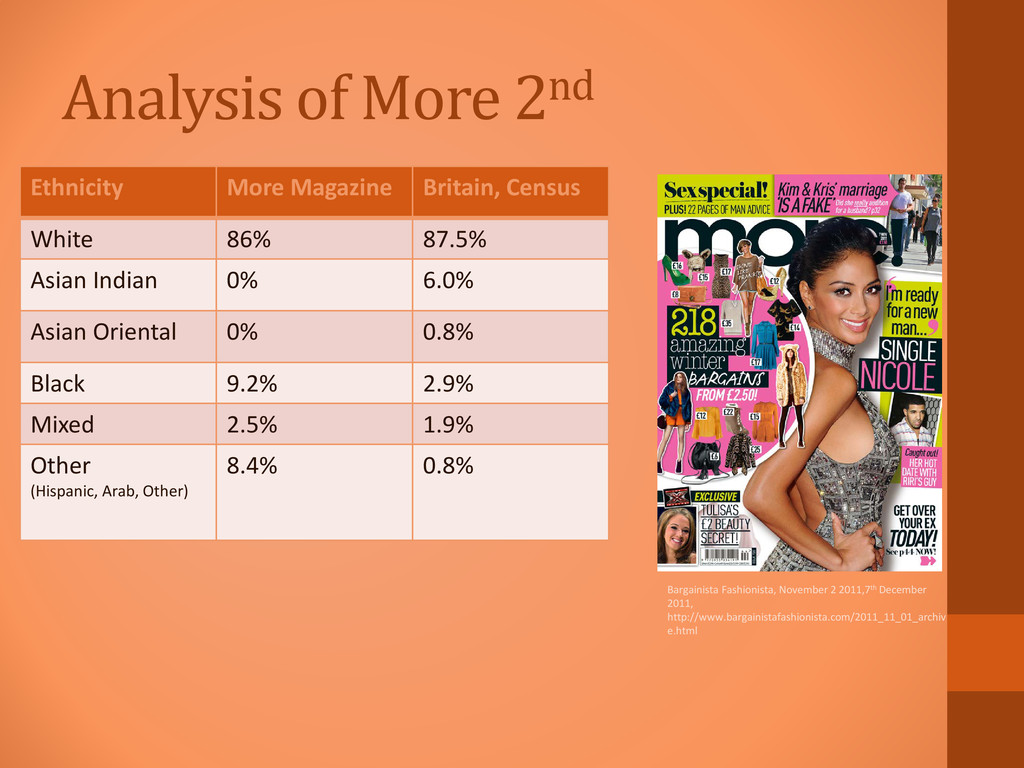
2011, http://www.bargainistafashionista.com/2011_11_01_archiv e.html Ethnicity More Magazine Britain, Census White 86% 87.5% Asian Indian 0% 6.0% Asian Oriental 0% 0.8% Black 9.2% 2.9% Mixed 2.5% 1.9% Other (Hispanic, Arab, Other) 8.4% 0.8%
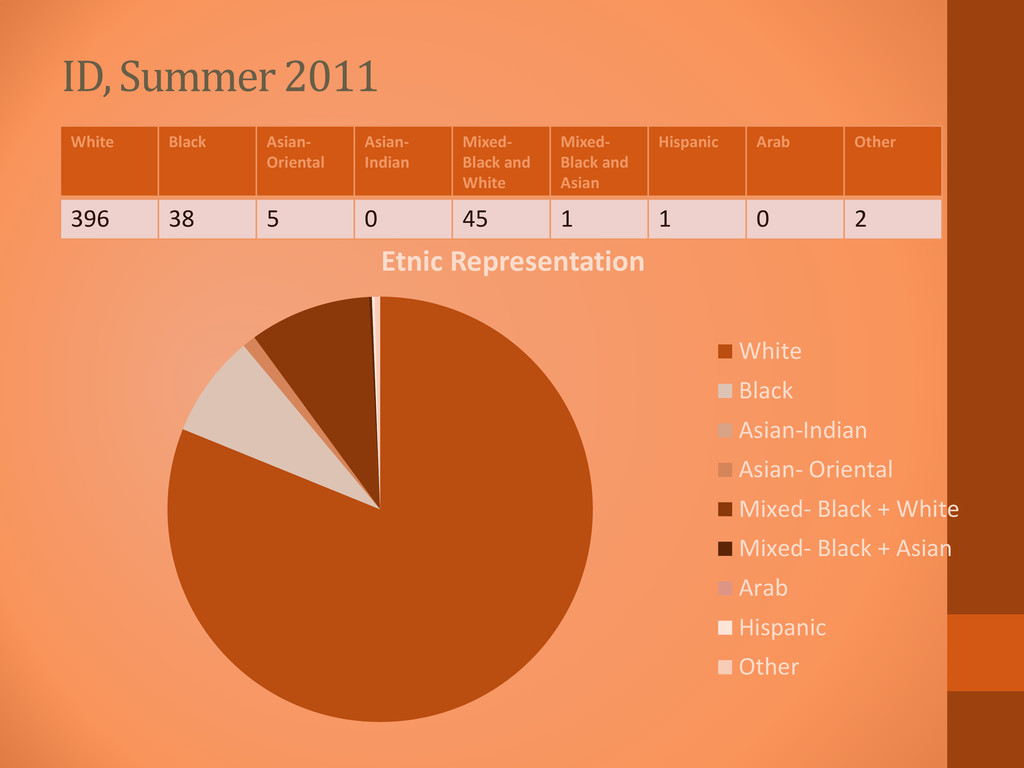
Mixed- Black + White Mixed- Black + Asian Arab Hispanic Other White Black Asian- Oriental Asian- Indian Mixed- Black and White Mixed- Black and Asian Hispanic Arab Other 396 38 5 0 45 1 1 0 2
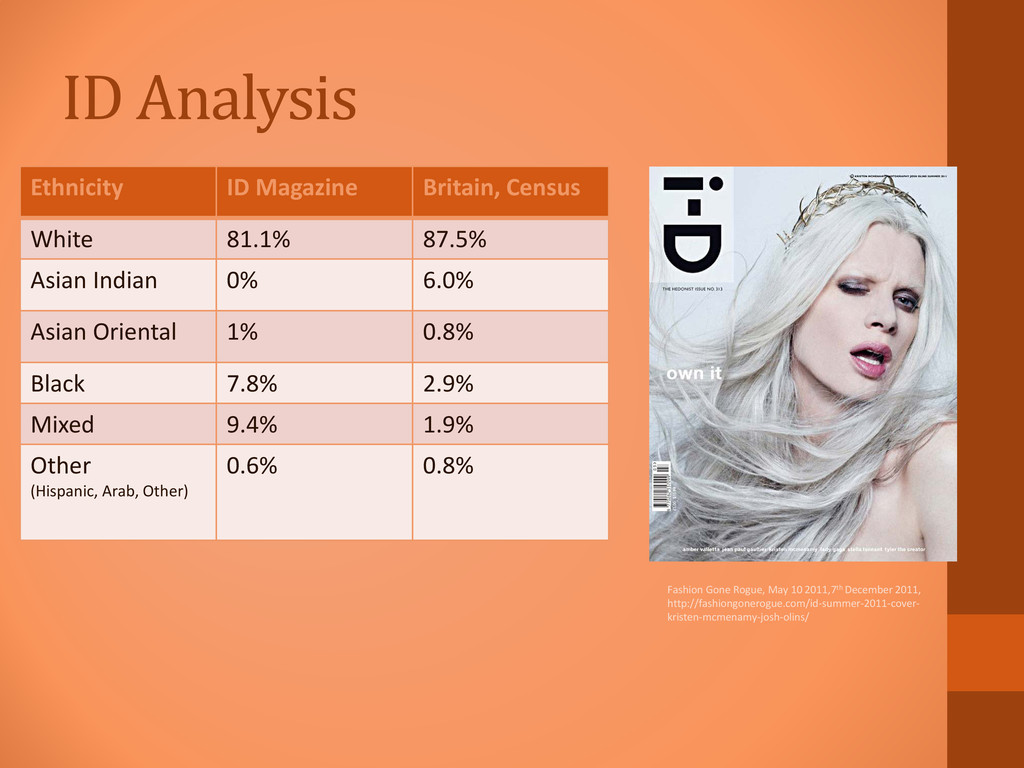
http://fashiongonerogue.com/id-summer-2011-cover- kristen-mcmenamy-josh-olins/ Ethnicity ID Magazine Britain, Census White 81.1% 87.5% Asian Indian 0% 6.0% Asian Oriental 1% 0.8% Black 7.8% 2.9% Mixed 9.4% 1.9% Other (Hispanic, Arab, Other) 0.6% 0.8%
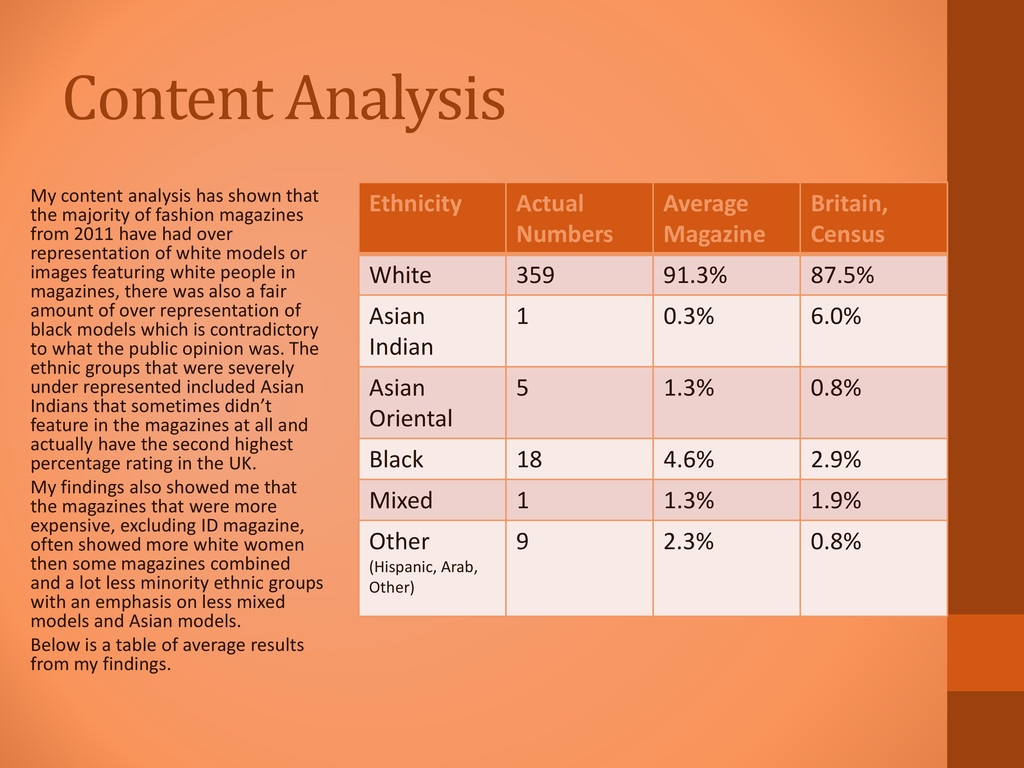
of fashion magazines from 2011 have had over representation of white models or images featuring white people in magazines, there was also a fair amount of over representation of black models which is contradictory to what the public opinion was. The ethnic groups that were severely under represented included Asian Indians that sometimes didn’t feature in the magazines at all and actually have the second highest percentage rating in the UK. My findings also showed me that the magazines that were more expensive, excluding ID magazine, often showed more white women then some magazines combined and a lot less minority ethnic groups with an emphasis on less mixed models and Asian models. Below is a table of average results from my findings. Ethnicity Actual Numbers Average Magazine Britain, Census White 359 91.3% 87.5% Asian Indian 1 0.3% 6.0% Asian Oriental 5 1.3% 0.8% Black 18 4.6% 2.9% Mixed 1 1.3% 1.9% Other (Hispanic, Arab, Other) 9 2.3% 0.8%
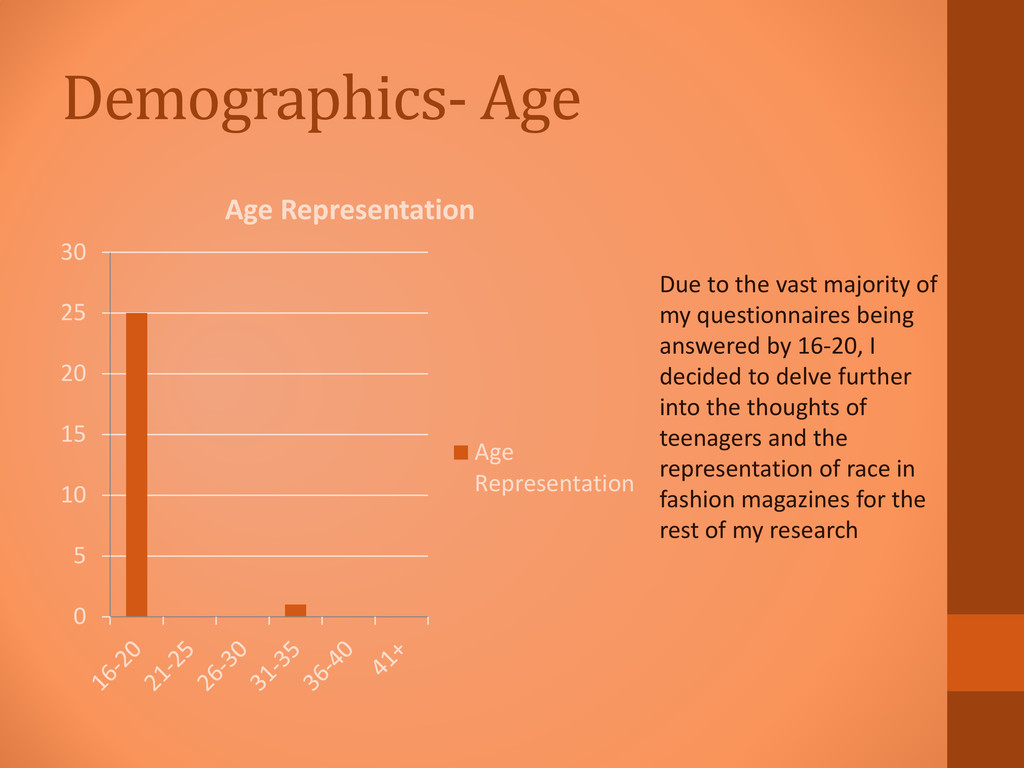
females only as I believed they would have more knowledge and opinion on fashion magazines and the other aspects of my questionnaire. My questionnaire was also a convenient questionnaire as they were handed out to various classes throughout my school. This resulted in my demographics being in the same age range with one exception. I think my questionnaire had questions that were relevant to my research but I could have achieved a more definite answer for my findings by asking more direct questions such as “Do you think fashion magazines are racist?”
Representation Age Representation Due to the vast majority of my questionnaires being answered by 16-20, I decided to delve further into the thoughts of teenagers and the representation of race in fashion magazines for the rest of my research
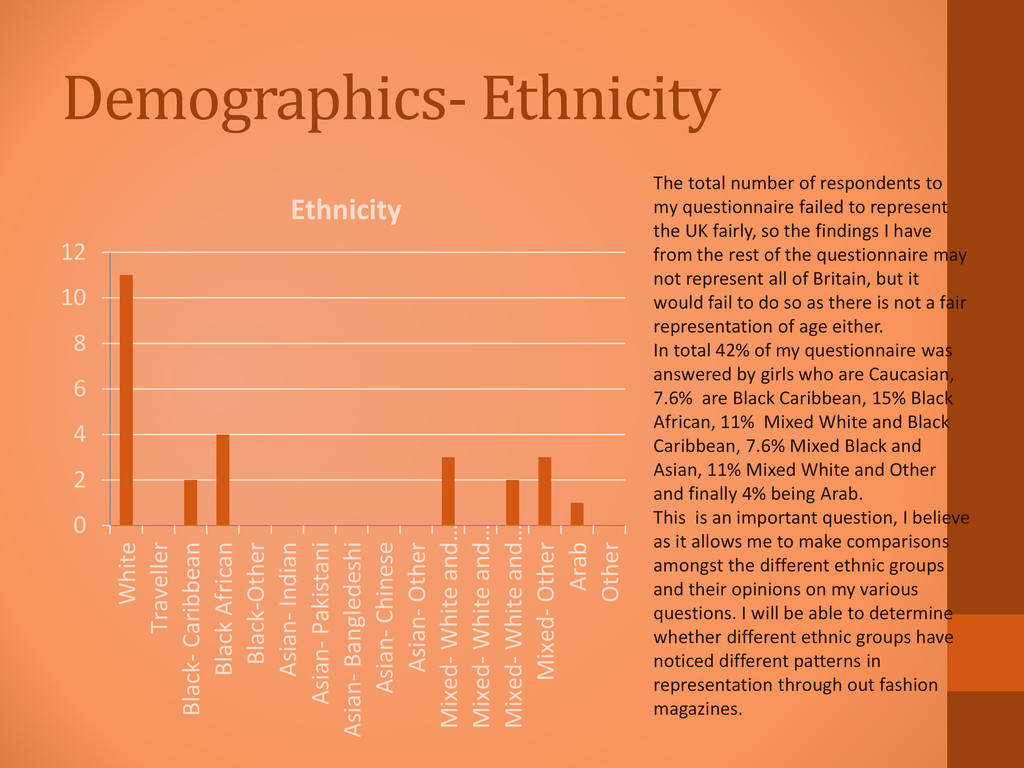
Traveller Black- Caribbean Black African Black-Other Asian- Indian Asian- Pakistani Asian- Bangledeshi Asian- Chinese Asian- Other Mixed- White and… Mixed- White and… Mixed- White and… Mixed- Other Arab Other Ethnicity The total number of respondents to my questionnaire failed to represent the UK fairly, so the findings I have from the rest of the questionnaire may not represent all of Britain, but it would fail to do so as there is not a fair representation of age either. In total 42% of my questionnaire was answered by girls who are Caucasian, 7.6% are Black Caribbean, 15% Black African, 11% Mixed White and Black Caribbean, 7.6% Mixed Black and Asian, 11% Mixed White and Other and finally 4% being Arab. This is an important question, I believe as it allows me to make comparisons amongst the different ethnic groups and their opinions on my various questions. I will be able to determine whether different ethnic groups have noticed different patterns in representation through out fashion magazines.
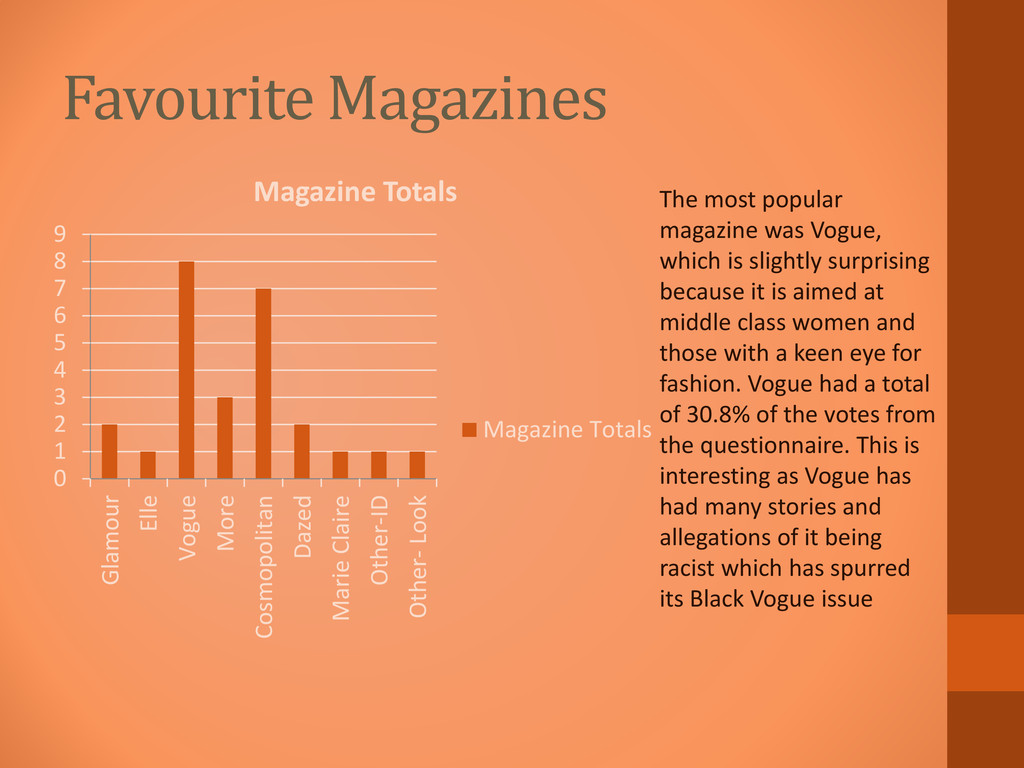
8 9 Glamour Elle Vogue More Cosmopolitan Dazed Marie Claire Other-ID Other- Look Magazine Totals Magazine Totals The most popular magazine was Vogue, which is slightly surprising because it is aimed at middle class women and those with a keen eye for fashion. Vogue had a total of 30.8% of the votes from the questionnaire. This is interesting as Vogue has had many stories and allegations of it being racist which has spurred its Black Vogue issue
favourite fashion magazine by 8 out of 26 people, out of those who did like the magazine, 3 were white with the other 5 being a mixture of 2 mixed white and Asian, 1 mixed white and black Caribbean, 1 mixed other and finally one black African. All those who liked Vogue failed to recognise magazines aimed at other ethnic groups and also only 1 out of the 8 picked the Vogue front cover as a favourite. Considering that 5 out of the 8 were from minority backgrounds, and that Vogue only occasionally feature a black model or celebrity on the cover is an interesting aspect, as it seems the respondents are not aware of the racial representation that Vogue establishes through the magazine.
a Black edition, in hopes of promoting Black models and fashion designers. This was also in hope to quash the stereotypes of racism in fashion. The movement of the Black edition of Vogue Italia was pushed forward by Italian Vogue's editor, Franca Sozzani, who said her decision was influenced by the New York group, of models, designers and agents who are fighting against the claim that black models “don’t sell”, as well as by Barack Obama's success in the US presidential primaries. (Source 2) The success of the Black Vogue goes against the prejudice that the industry has on black , but black models still fail to make a massive impact on the industry. The Black Vogue issue was so popular it required re-printing with women and teenage girls of black ethnic origin buying multiple copies. “ 'We've managed to get 10 more,' she said, as a group of black and mixed-race schoolgirls broke ranks in the queue and doubled back to the shelves, hollering with delight. They have reason to celebrate, and to hope. One of the covers of Vogue Italia features Jourdan Dunn.” (Source 1)
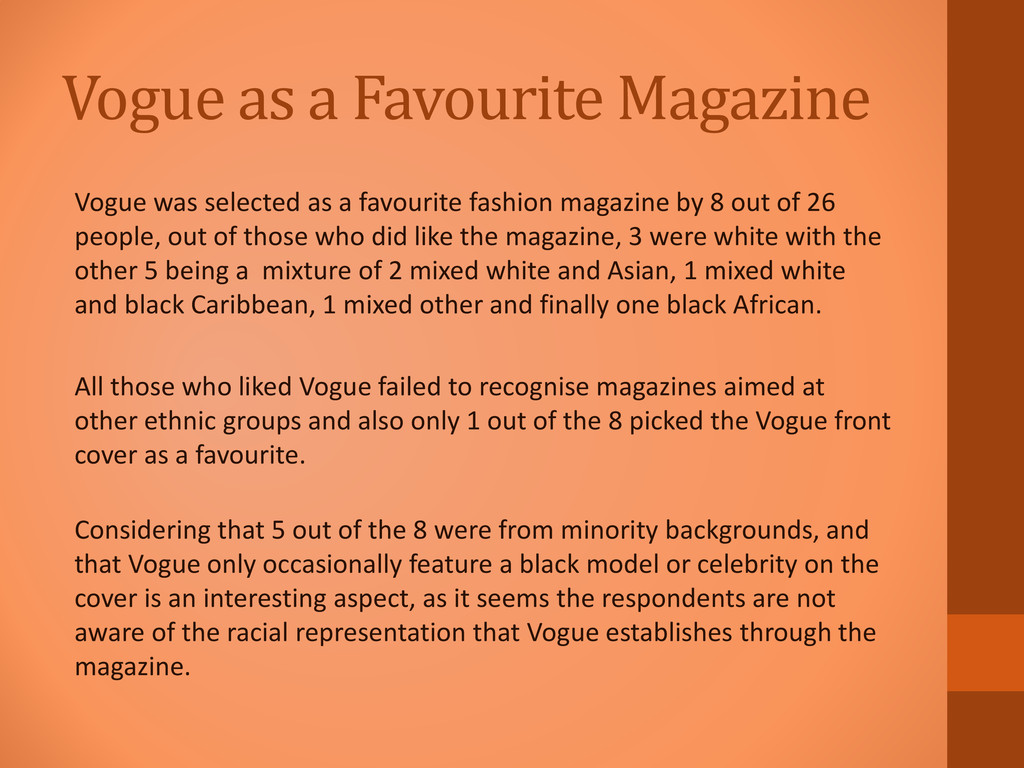
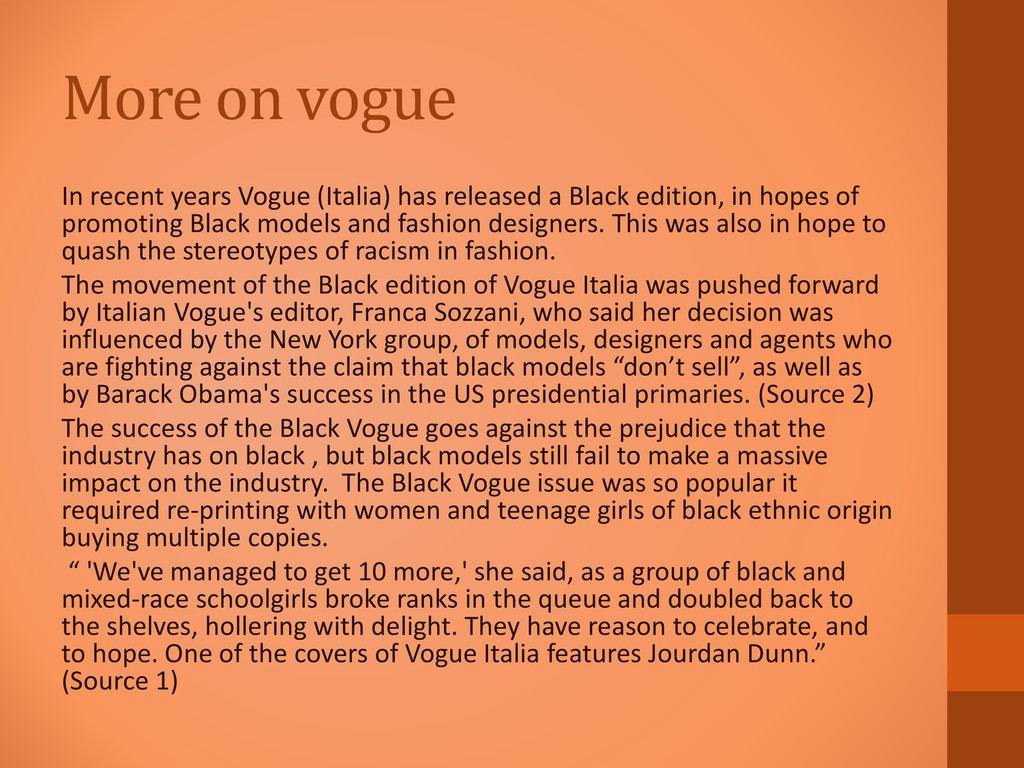
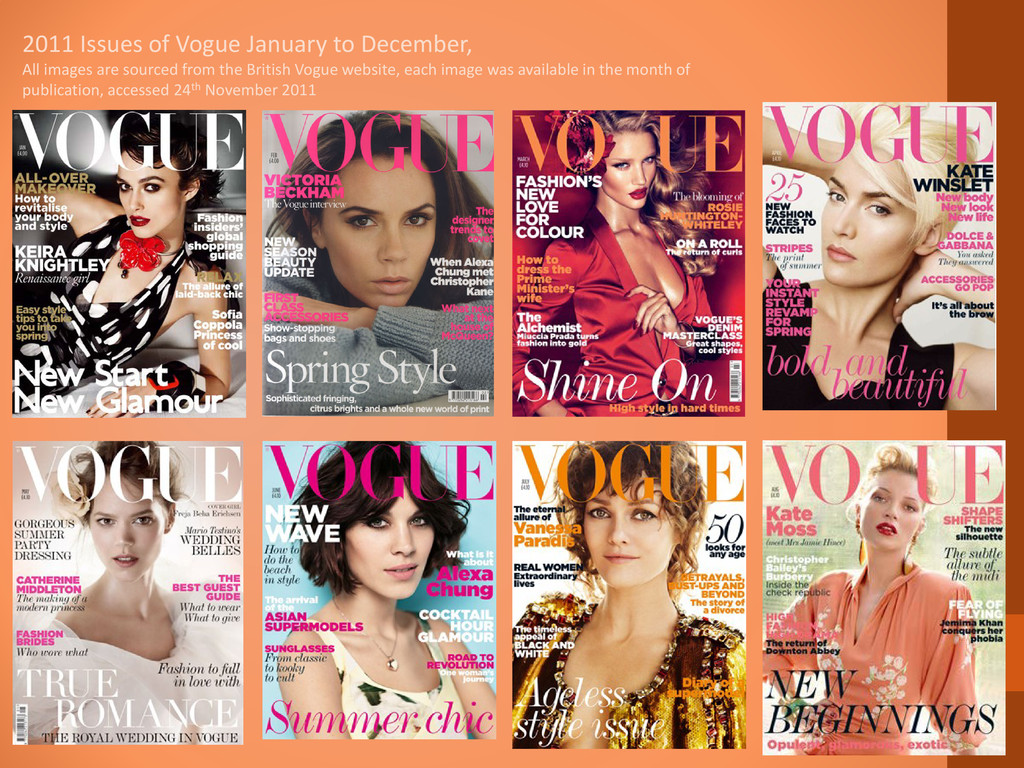
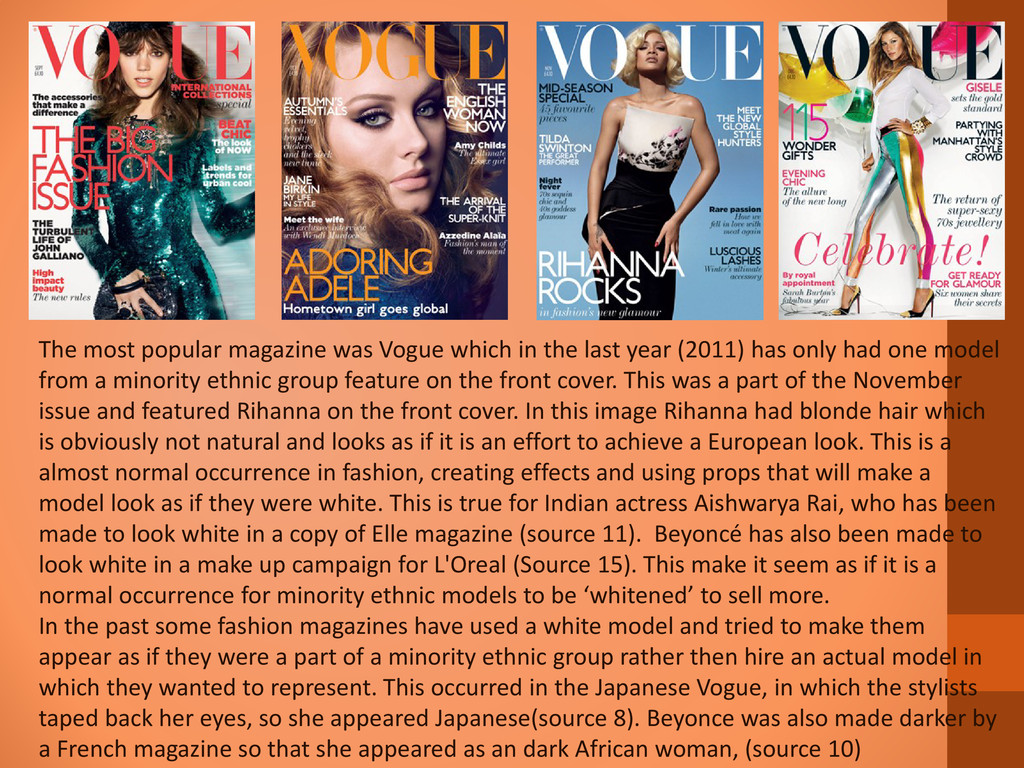
year (2011) has only had one model from a minority ethnic group feature on the front cover. This was a part of the November issue and featured Rihanna on the front cover. In this image Rihanna had blonde hair which is obviously not natural and looks as if it is an effort to achieve a European look. This is a almost normal occurrence in fashion, creating effects and using props that will make a model look as if they were white. This is true for Indian actress Aishwarya Rai, who has been made to look white in a copy of Elle magazine (source 11). Beyoncé has also been made to look white in a make up campaign for L'Oreal (Source 15). This make it seem as if it is a normal occurrence for minority ethnic models to be ‘whitened’ to sell more. In the past some fashion magazines have used a white model and tried to make them appear as if they were a part of a minority ethnic group rather then hire an actual model in which they wanted to represent. This occurred in the Japanese Vogue, in which the stylists taped back her eyes, so she appeared Japanese(source 8). Beyonce was also made darker by a French magazine so that she appeared as an dark African woman, (source 10)
5 participants were able to recognise that there are some magazines aimed at distinct ethnic groups, especially the black ethnic group. The comments made about the magazines were mostly positive as they believed it meant the audience could relate more to the issues being discussed and could gain beauty tips that actually applied to them rather then what is classified as ‘dark’ in a mainstream magazine. Of the 5 who responded yes to the question, three were Black- Caribbean, one was Asian-Indian and the last was white. Those who made comment about magazines, either believed there weren’t many available and those that are, come from America and so have no relevance with a British market. Some respondents believed that magazines should not be aimed at certain ethnic groups but instead cater to all ethnicities.
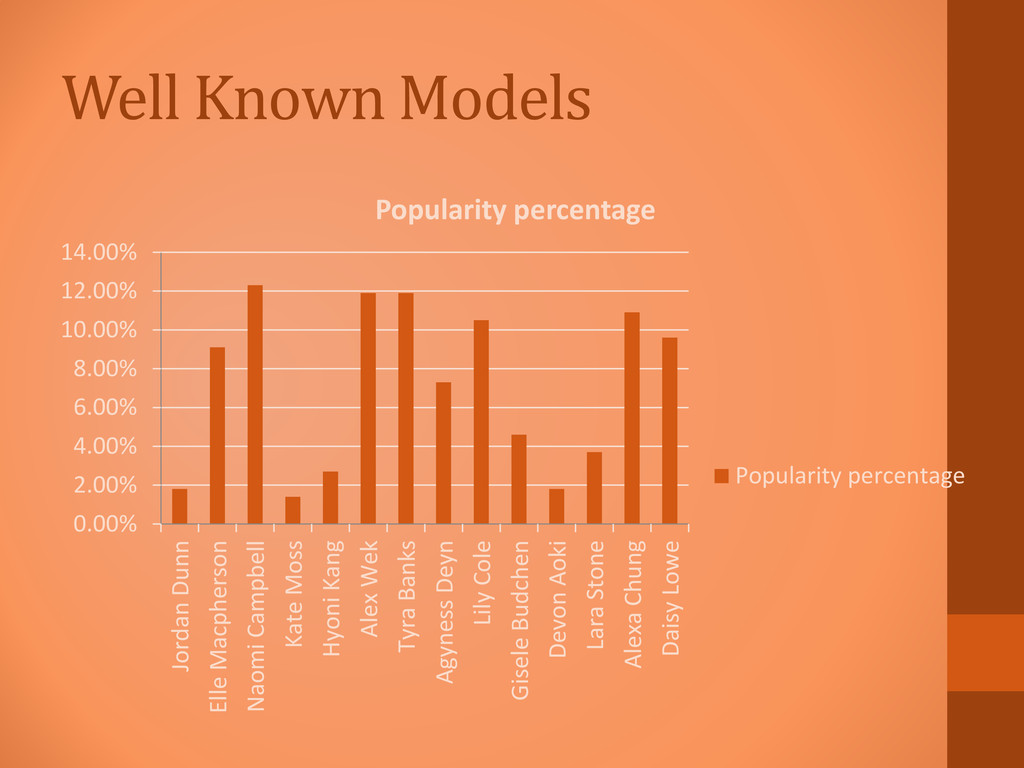
14.00% Jordan Dunn Elle Macpherson Naomi Campbell Kate Moss Hyoni Kang Alex Wek Tyra Banks Agyness Deyn Lily Cole Gisele Budchen Devon Aoki Lara Stone Alexa Chung Daisy Lowe Popularity percentage Popularity percentage
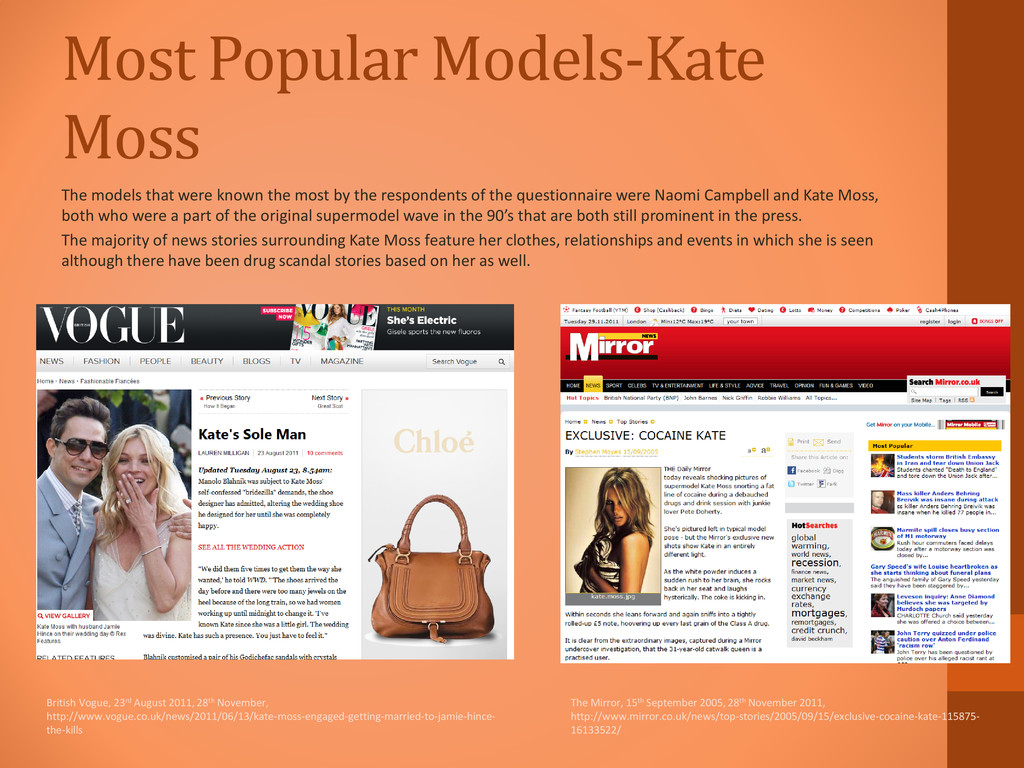
most by the respondents of the questionnaire were Naomi Campbell and Kate Moss, both who were a part of the original supermodel wave in the 90’s that are both still prominent in the press. The majority of news stories surrounding Kate Moss feature her clothes, relationships and events in which she is seen although there have been drug scandal stories based on her as well. British Vogue, 23rd August 2011, 28th November, http://www.vogue.co.uk/news/2011/06/13/kate-moss-engaged-getting-married-to-jamie-hince- the-kills The Mirror, 15th September 2005, 28th November 2011, http://www.mirror.co.uk/news/top-stories/2005/09/15/exclusive-cocaine-kate-115875- 16133522/
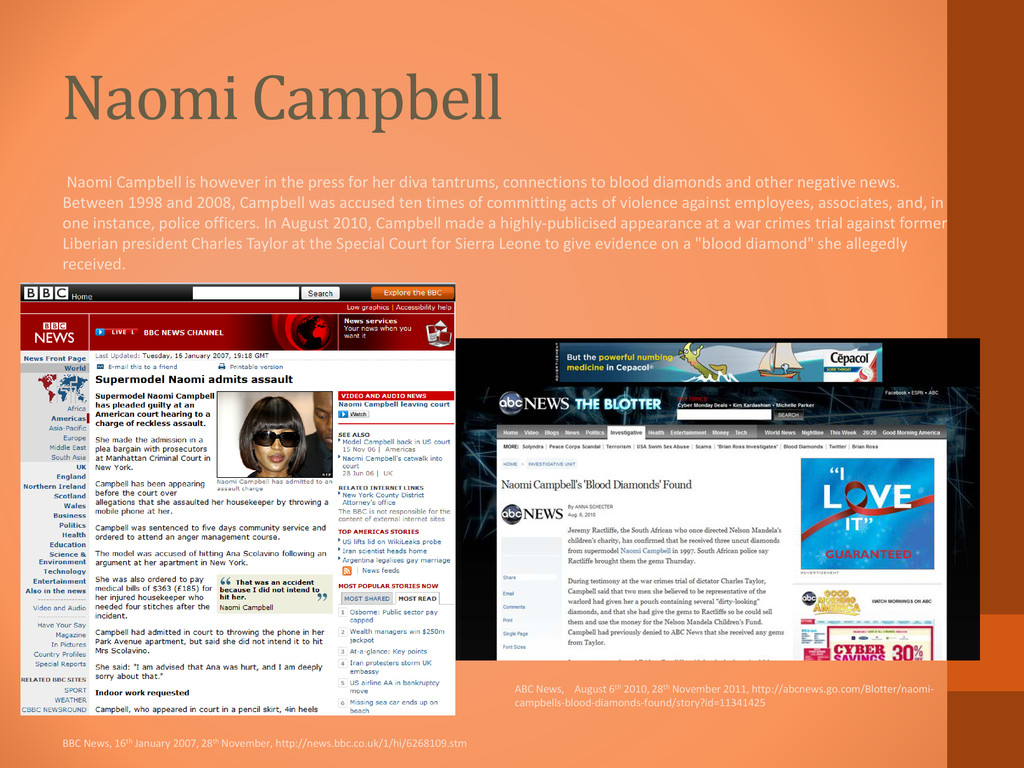
her diva tantrums, connections to blood diamonds and other negative news. Between 1998 and 2008, Campbell was accused ten times of committing acts of violence against employees, associates, and, in one instance, police officers. In August 2010, Campbell made a highly-publicised appearance at a war crimes trial against former Liberian president Charles Taylor at the Special Court for Sierra Leone to give evidence on a "blood diamond" she allegedly received. ABC News, August 6th 2010, 28th November 2011, http://abcnews.go.com/Blotter/naomi- campbells-blood-diamonds-found/story?id=11341425 BBC News, 16th January 2007, 28th November, http://news.bbc.co.uk/1/hi/6268109.stm
Alexa Chung and lily Cole. Tyra banks is well known for her role as the host for the popular TV show America's Next Top Model. Tyra Banks is very rarely seen in British press but is a well known model. Alexa Chung seldom has negative press and is known in Britain as model and television presenter. Most of her press coverage refers to her clothes and styling. Lily Cole is known as model and actress. She has done a variety of campaigns, including Marks and Spencer, being featured on billboards and magazines. Her face is well known making her a popular model. Out of all the top models three out of five are Caucasian and the other two black. That shows the representation of black models and Caucasian models are more frequent then those of any other ethnic model. The models that were least popular were Hyoni Kang, Devon Aoki and Jourdan Dunn. All of these models are from a minority ethnic groups. Jourdan Dunn is a black model, when she first found success as a model there were many articles and profiles about her but as she has continued to model, for large fashion houses, instead of more press coverage there is little if any making her less memorable. A lot of her press coverage was done by magazines aimed at black people, as she became slightly more successful there were articles in other fashion publications such as vogue and style magazine, but as she continues to model word on her has ceased. Hyoni Kang is a Korean model who has modeled for Victoria secret's, vogue, Marc Jacobs and has had campaigns for Lacoste. Although she is in the public eye a fair amount she is not easily recognized. This could be because she has not been advertised or publicized well as she is a model of a minority ethnic group. Devon Aoki is a model with Japanese origin that has starred in films, been the face of Versace, Chanel and has featured on the cover of popular fashion magazine ID. Devon Aoki is well known in the fashion industry and America but not so much England which normally has more emphasis on Caucasian models. Out of the five least well known models two are of oriental origin, two are black and one was white. This helps to prove that the representation of ethnic groups is in favor of those who are white.
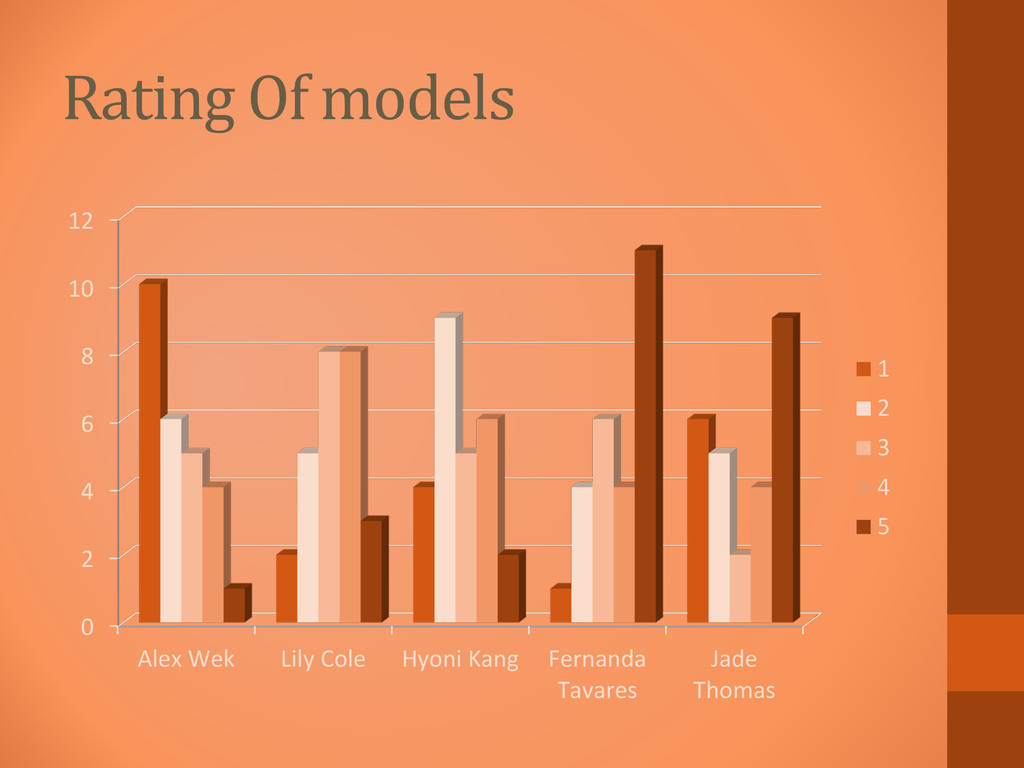
participants to rate 5 models, 1 being the worst and 5 being the best. The maximum rating a single model could receive was a total of 130, with an average of 5. For the model ratings I gave 5 images of models from different ethnic groups. The ethnic groups I included were Asian-Oriental, I used an image of Hyoni Kang. Out of a maximum 130 Kang received was 69 which is an average rating of 2.7 The Black-African model I used was supermodel Alex Wek, who received 58 out of 130 which is an equivalent of an average rating 2.2. I used an image of a Mixed Black and white model, Jade Thompson, who on average received a rating of 3.2 out of 5 or 83out of 130. Lily Cole, a white British model received 83 out of 130, the same as Jade Thompson (the Mixed Black and White model) which mean she also received an average rating of 3.2 The final model was White and was Fernanda Tavares who received the highest score out of 130 with 98 which is an average rating of 3.8. My findings show that the darker the model, the smaller rating she has, The most popular models were white or partially white. Not all of the models in this question were mentioned in question 6 of the questionnaire but those who were (Lily Cole, Hyoni Kang and Alex Wek) nearly mirror the results with popularity and rating. Lily Cole was recognised more so then Alex Wek and Hyoni Kang, with Hyoni Kang being in the 3 least recognised models. Alex Wek and Hyoni Kang had the lowest average rating out of the 5 models with Lily Cole having a joint second highest rating.
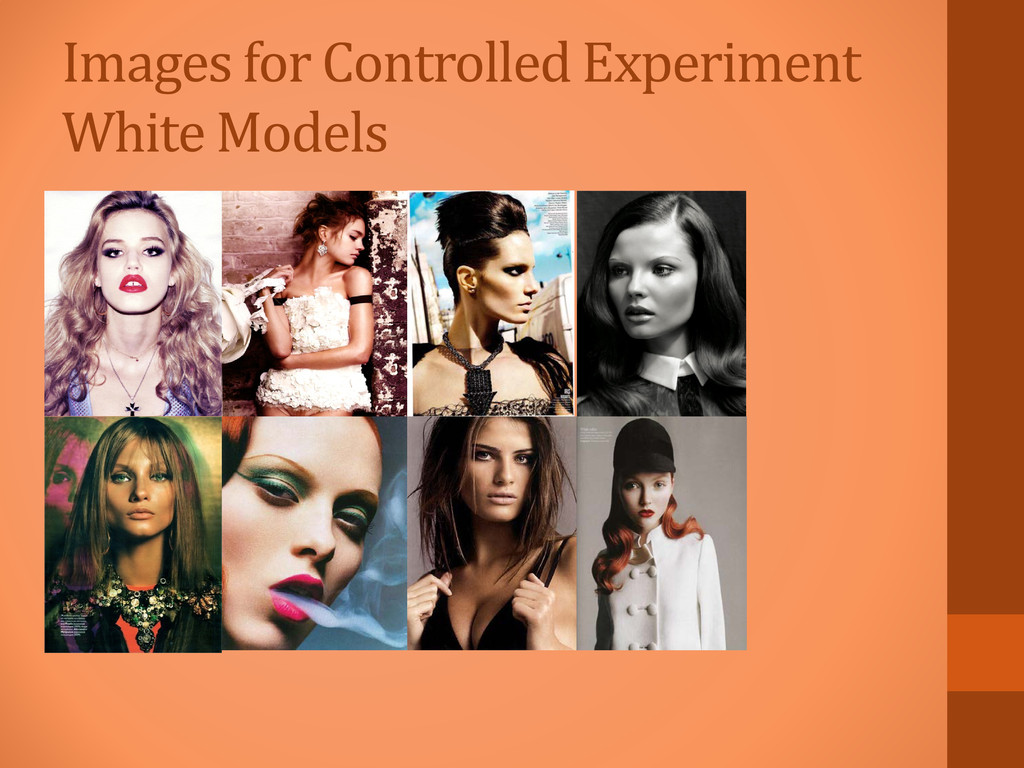
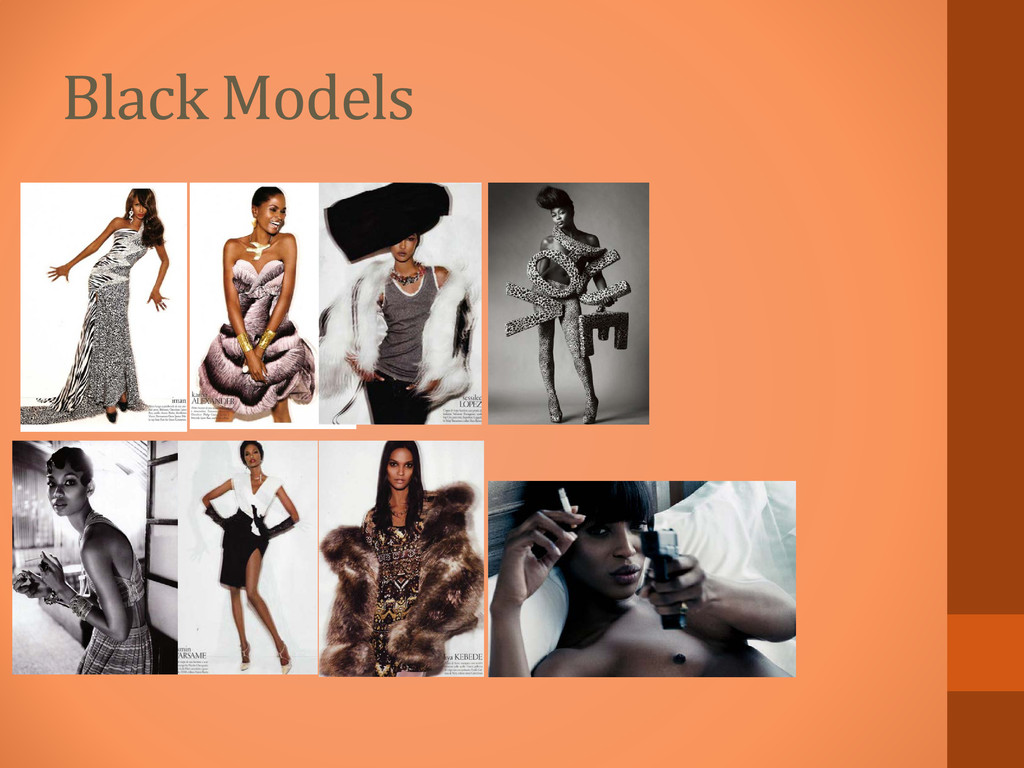
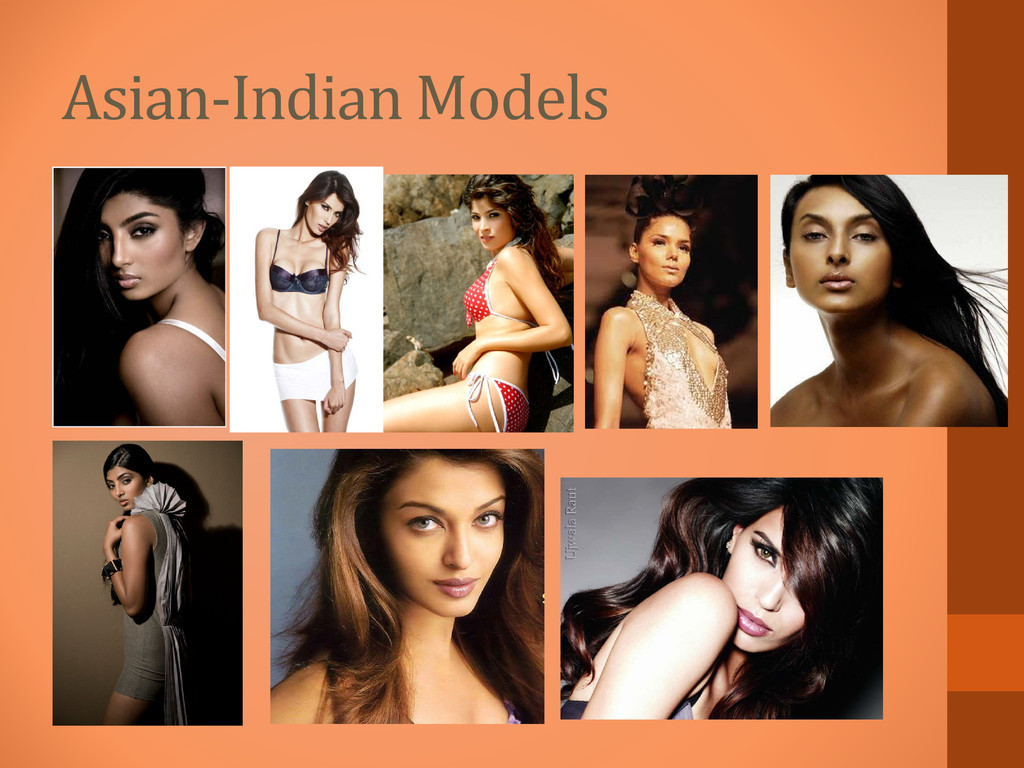
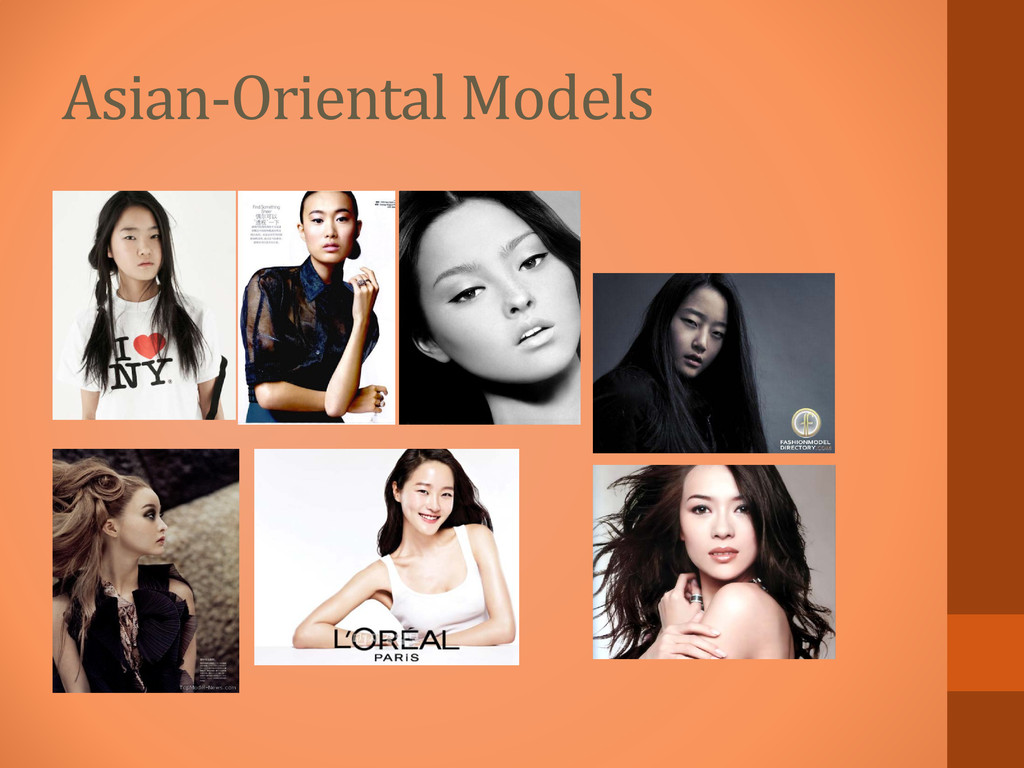
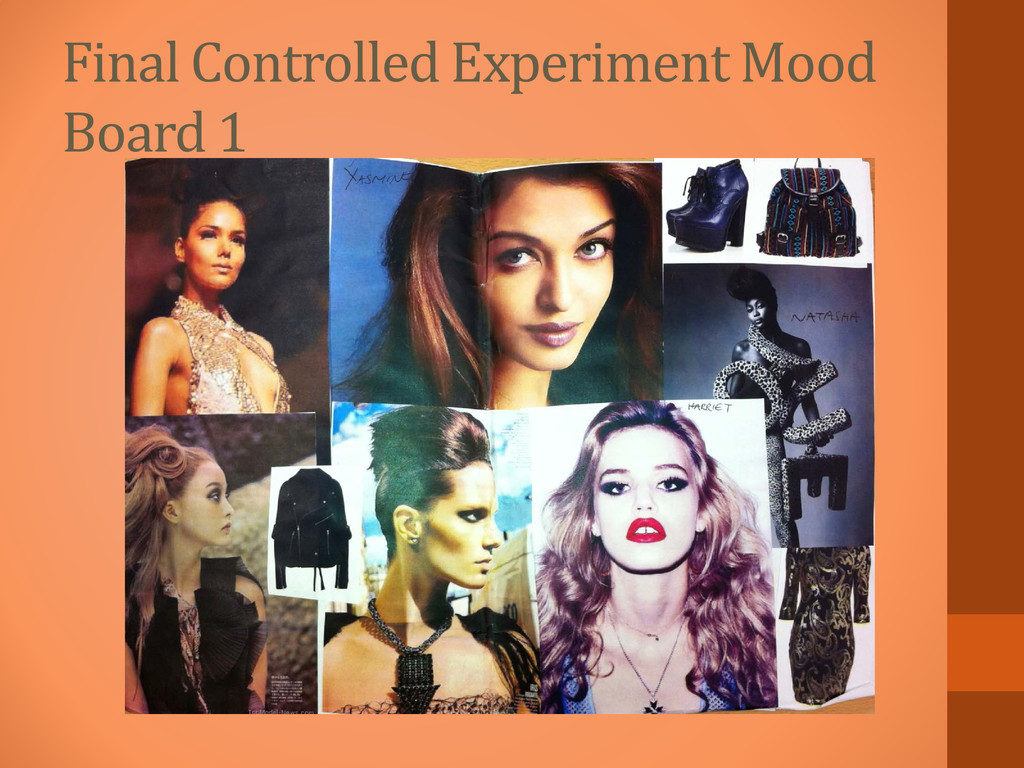
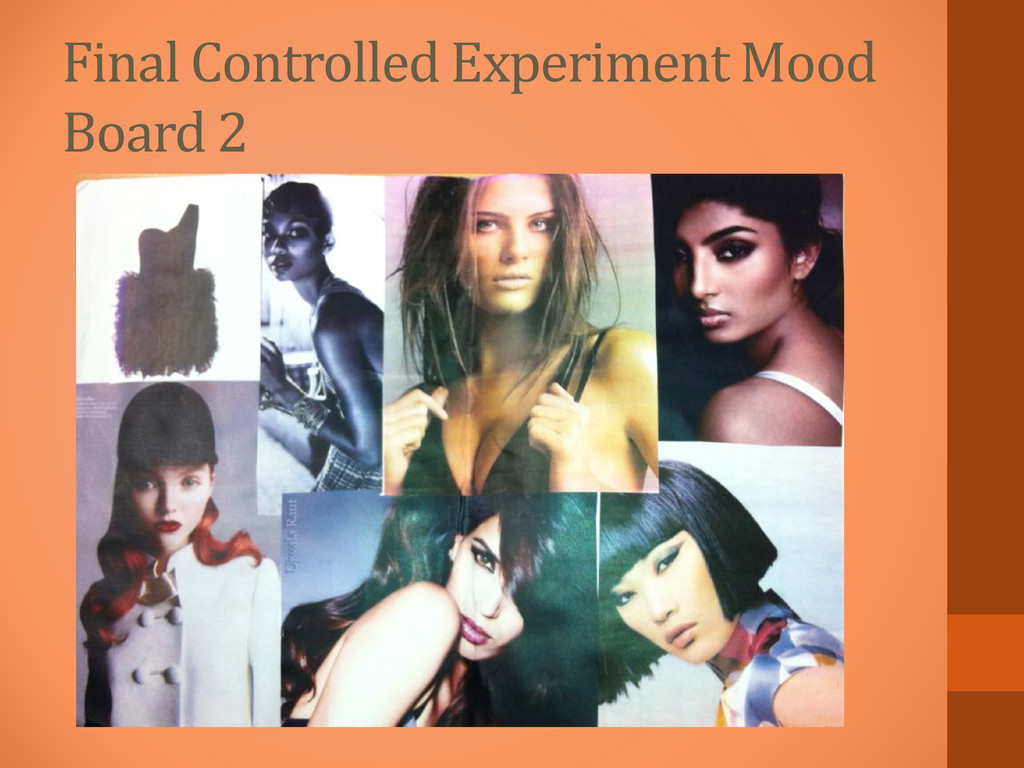
of a similar age that had various interests and different ethnic groups. The group consisted of one Caucasian, one mixed white and black Caribbean and finally one black Caribbean. I gave the girls 32images of various models and additional images of clothes. I asked the girls to make a mood board of their favorite images. For the majority of the time I left the girls alone unless they asked for something such as additional paper. The 32 images of models were chosen for specific reason. I had chosen to represent 4 different ethnicities which were, white, black, Asian-Indian and Asian-Oriental. Each ethnicity had an equal amount of images , eight, to represent them, meaning that the girls could decide on what ratio of representation they wanted for the final collage. The reason I included images of clothes and shoes was so it was not obvious as to what the experiment was and still carried the theme of fashion through out the experiment. I revealed what the point of the experiment was after it was completed so that the participants weren't self conscious of their choices. The time frame for the experiment was 15 minutes. I chose a time that wasn't too long so that the experiment could be completed with out loss of interest from the participants.
total of 4 White models, 4 Asian-Indian models, 2 Asian-Oriental and 2 Black models. Although White models again had more images they were tied with Asian-Indian. This is an interesting find as asian Indian models had the lowest percentage rate in my finding for content analysis. Asian – Indian models are sparsely seen but are obviously appreciated by an audience, this is true to an extent and can be verified as no one that took part in the experiment was of Asian descent.
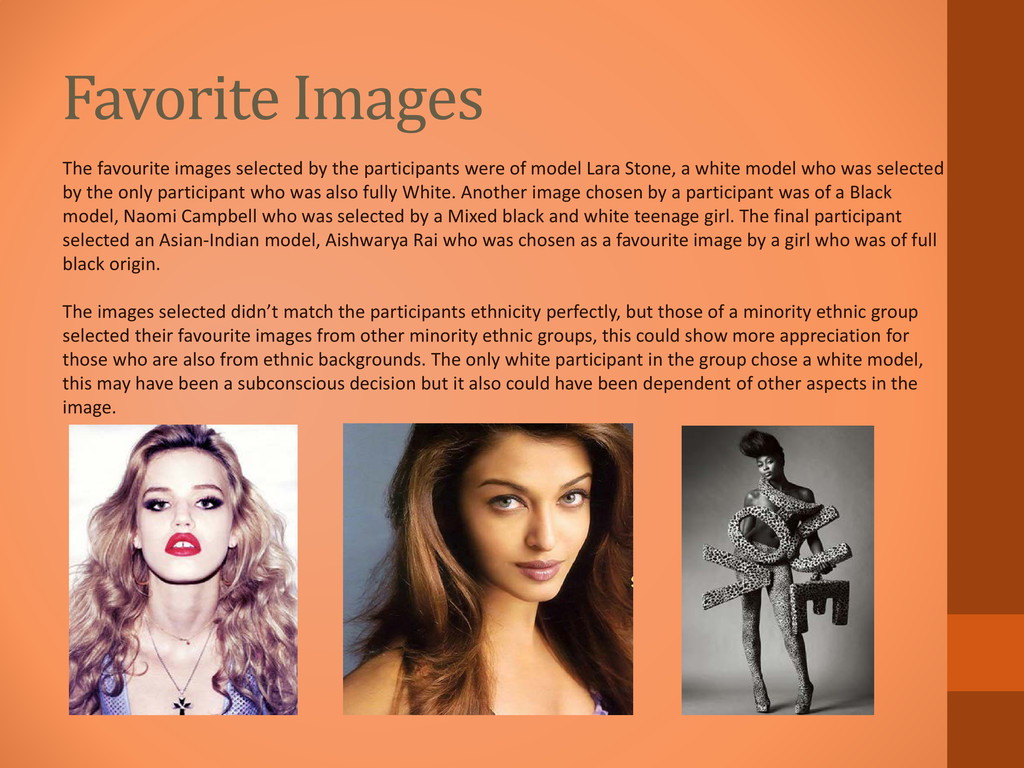
of model Lara Stone, a white model who was selected by the only participant who was also fully White. Another image chosen by a participant was of a Black model, Naomi Campbell who was selected by a Mixed black and white teenage girl. The final participant selected an Asian-Indian model, Aishwarya Rai who was chosen as a favourite image by a girl who was of full black origin. The images selected didn’t match the participants ethnicity perfectly, but those of a minority ethnic group selected their favourite images from other minority ethnic groups, this could show more appreciation for those who are also from ethnic backgrounds. The only white participant in the group chose a white model, this may have been a subconscious decision but it also could have been dependent of other aspects in the image.
unfair to different minority ethnic groups in terms of representation. The vast majority of participants believed that the models shown in modern magazines were white. Models from other ethnic backgrounds had to have a certain look to be considered eligible for publication and wasn’t a true representation of the high calibre of models that are trying to get work in todays industry. On the other hand some participants believed that the representation of different ethnic groups were fair as they often saw models from other ethnic groups or famous ethnic people grace the cover of their favourite publications. Although the participants talked about ethnic representation it was clear that most of them only referred to black models vs. white models rather then the other ethnic groups such as Asian, this could be because Asian models and celebrities are not in the public eye often enough to be considered by the public and so may help to conclude the fact the amount of representation in fashion magazines is unfair. During the vox pop there was some discussion about the separation of ethnic groups in magazines with magazines aimed at certain ethnic groups such as Black hair and Black beauty which will solely focus and feature black models and creatives, where as other magazines will be predominantly Caucasian. A lot of people involved in the vox pops believed that the magazines have improved in recent years but still have a few years until it will be deemed as fair.
October 2011,(Source 1) http://www.telegraph.co.uk/news/worldnews/europe/italy/2162846/italian-vogue-shows- black-models-only.html By Lucy Cockcroft, 20th June 2011, accessed 3rd October 2011, (Source 2) http://en.wikipedia.org/wiki/demography_of_england, accessed on 3rd October 2011, (Source 4) http://uk.lifestyle.yahoo.com/stylist-tapes-models-eyes-back-for-japanese-vogue-photo- shoot.html, 2nd September 2001, accessed on 3rd October 2011, (Source 8) http://www.thecomplexmedia.com/blog/2011/02/art-or-blackface-beyonces-lofficiel-paris- photo-shoot-causing-controversy/, 21st February 2011, accessed 4th October 2011(Source 10) .http://bollywooders.com/bollywood-news/elle-magazine-in-trouble-for-whitening-aishwarya- rais-skin/, 26th December 2010, accessed 4th October 2011, (Source 11) http://www.dailymail.co.uk/tvshowbiz/article-1042675/Beauty-brand-LOreal-accused- whitewashing-Beyonce.html, 8th August 2008, accessed on the 5th November 2011,(Source 15)


 davetheseo
 tammyeverts
 sabderemane
 codingconduct
 tmiket
 palkan
 rabernat
 wjessup
 lauravandoore
 baasie
 sarafernandez
 szymonslowik