for Creativity and Innovation HCID 2012 April 12th, 2012 Sara Jones Centre for HCI Design and Centre for Creativity in Professional Practice City University London [email protected] http://hcid.soi.city.ac.uk/people/Sarajones.html @svjaok
to ‘preserve appropriate elements of existing knowledge work [creative practice] while shaping new technologies and then integrating them into the workplace’ Shneiderman, 2000 let people carry on doing all the good stuff they’re doing, but better
creativity support tools • Ultimate ease of use – the tool should disappear • Make it pleasurable and fun • Give access to examples for inspiration • Provide appropriate primitives for building new things • Allow for sketching, experimentation and what if reasoning • Allow for reflection • Support many different styles, teams with different talents • Allow development of shared representations • Allow transitions from individual to group work and back again • Allow open interchange between tools
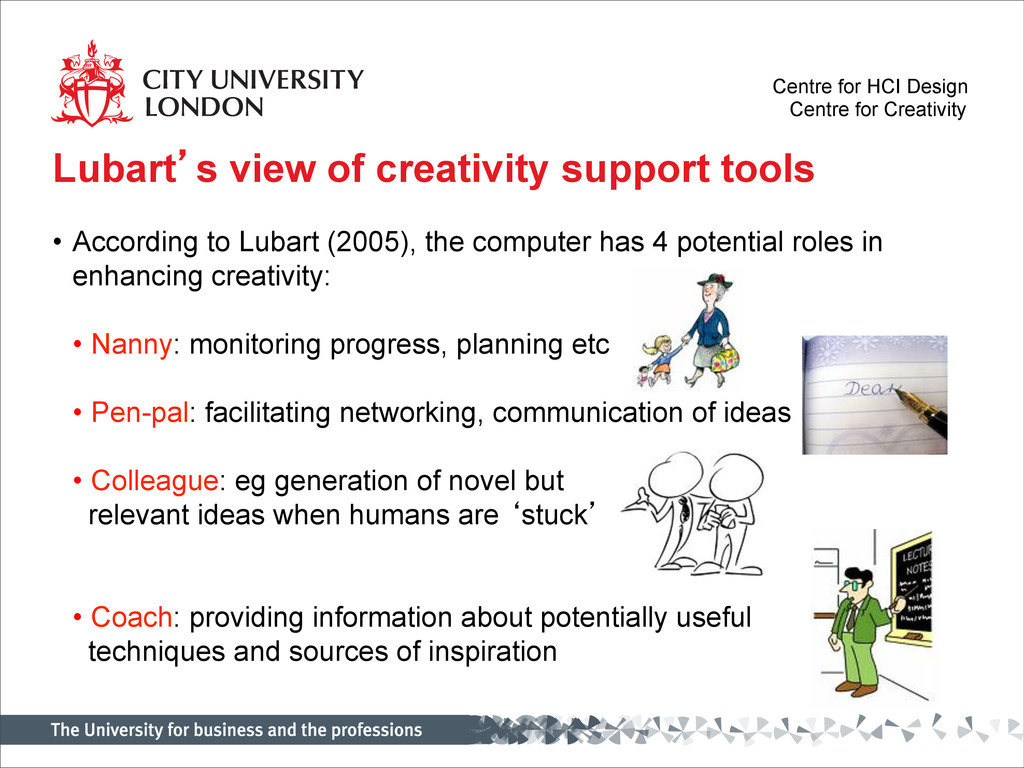
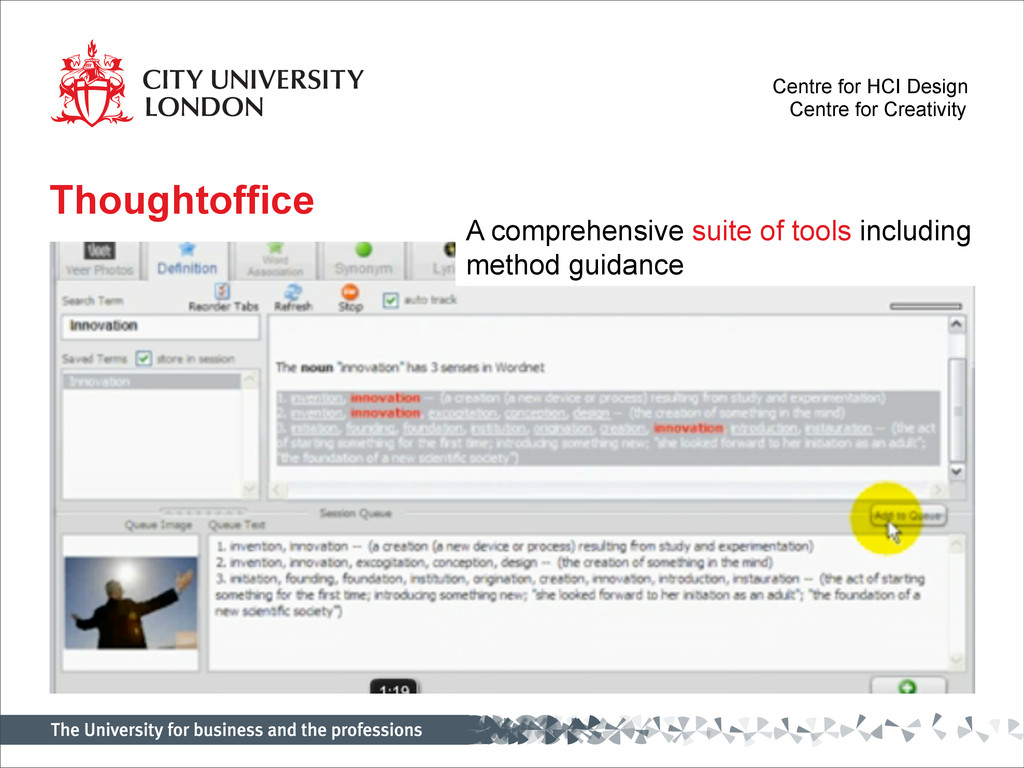
creativity support tools • According to Lubart (2005), the computer has 4 potential roles in enhancing creativity: • Nanny: monitoring progress, planning etc • Pen-pal: facilitating networking, communication of ideas • Colleague: eg generation of novel but relevant ideas when humans are ‘stuck’ • Coach: providing information about potentially useful techniques and sources of inspiration
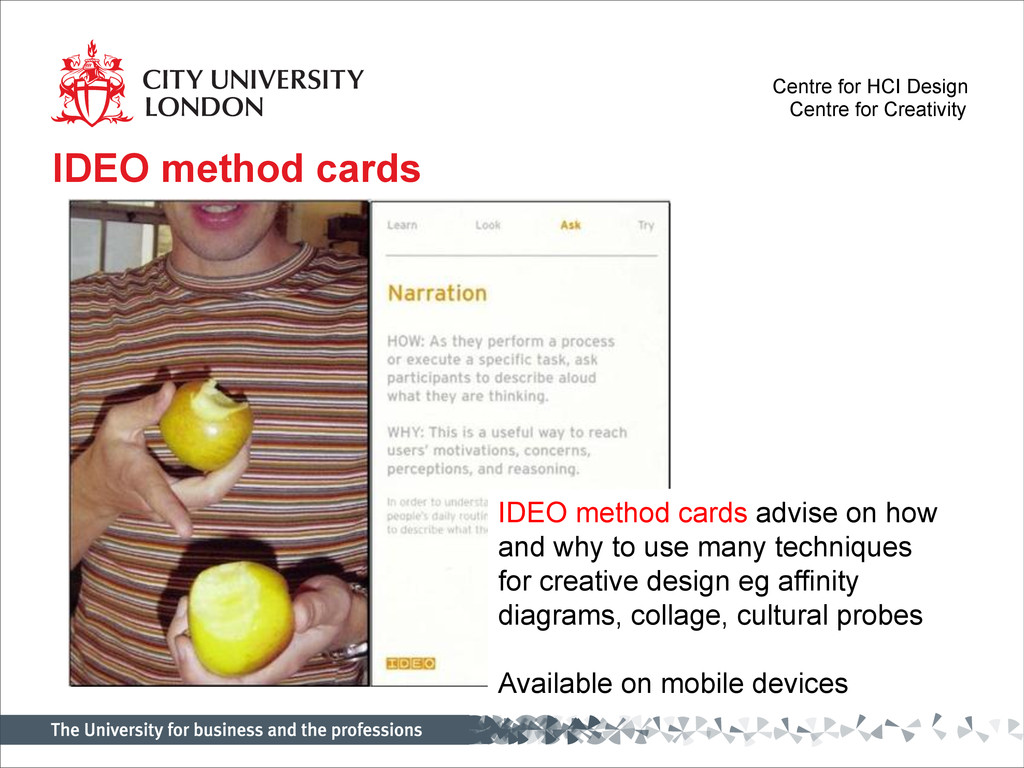
IDEO method cards advise on how and why to use many techniques for creative design eg affinity diagrams, collage, cultural probes Available on mobile devices
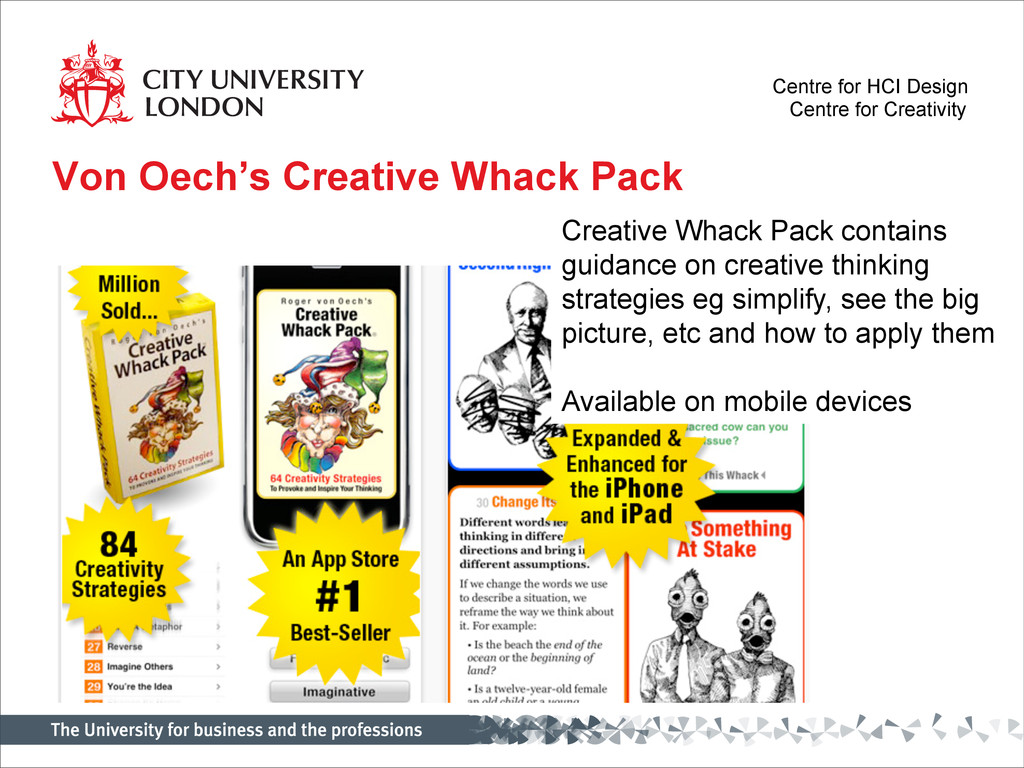
Whack Pack Creative Whack Pack contains guidance on creative thinking strategies eg simplify, see the big picture, etc and how to apply them Available on mobile devices
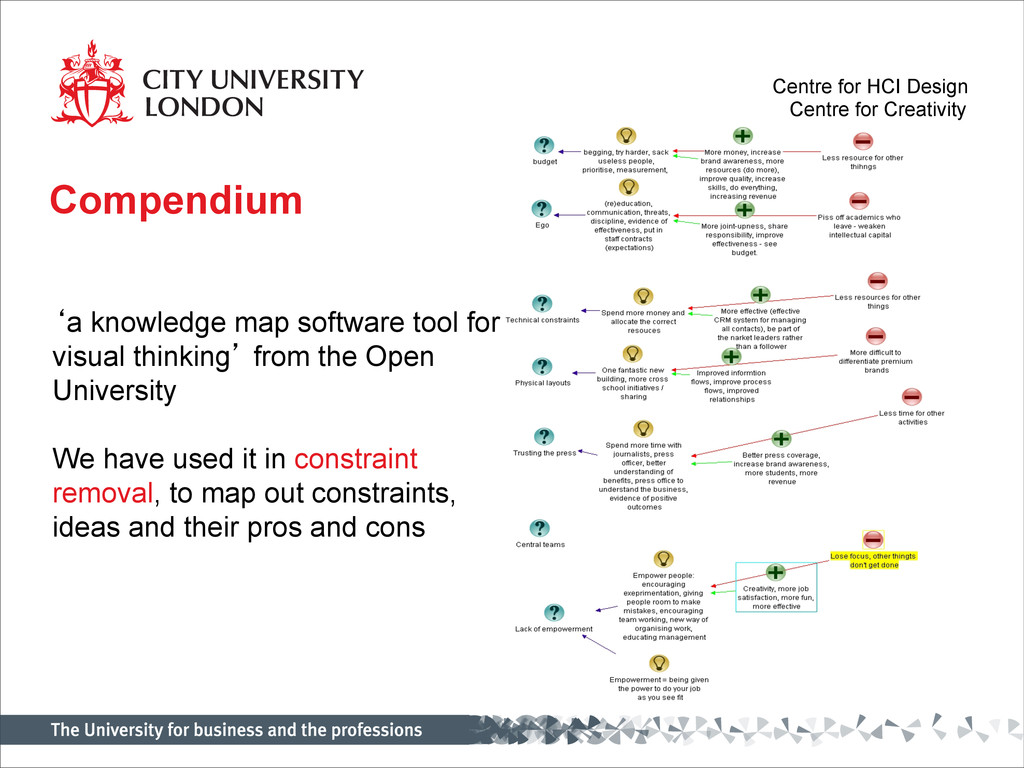
software tool for visual thinking’ from the Open University We have used it in constraint removal, to map out constraints, ideas and their pros and cons Compendium
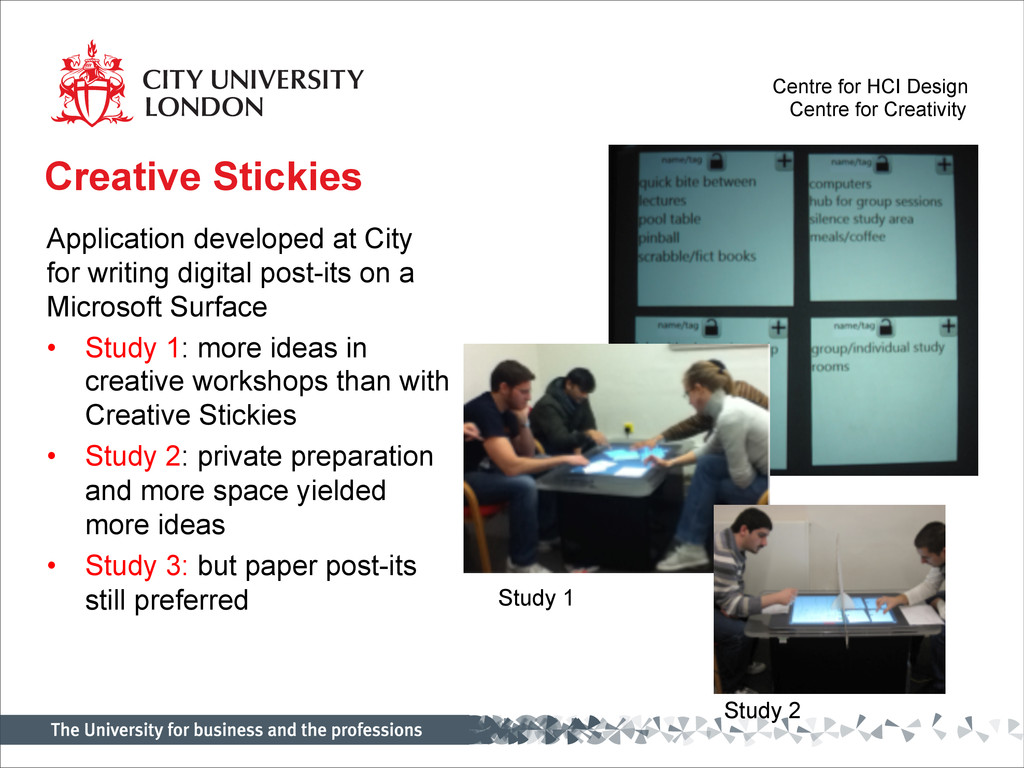
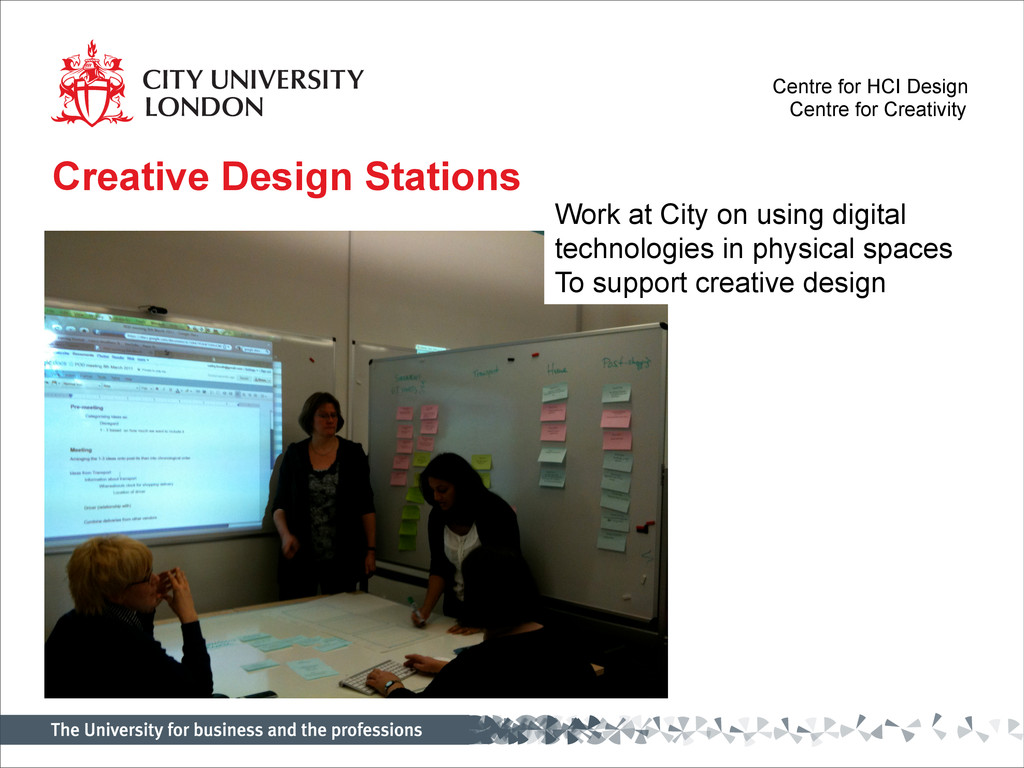
developed at City for writing digital post-its on a Microsoft Surface • Study 1: more ideas in creative workshops than with Creative Stickies • Study 2: private preparation and more space yielded more ideas • Study 3: but paper post-its still preferred Study 1 Study 2
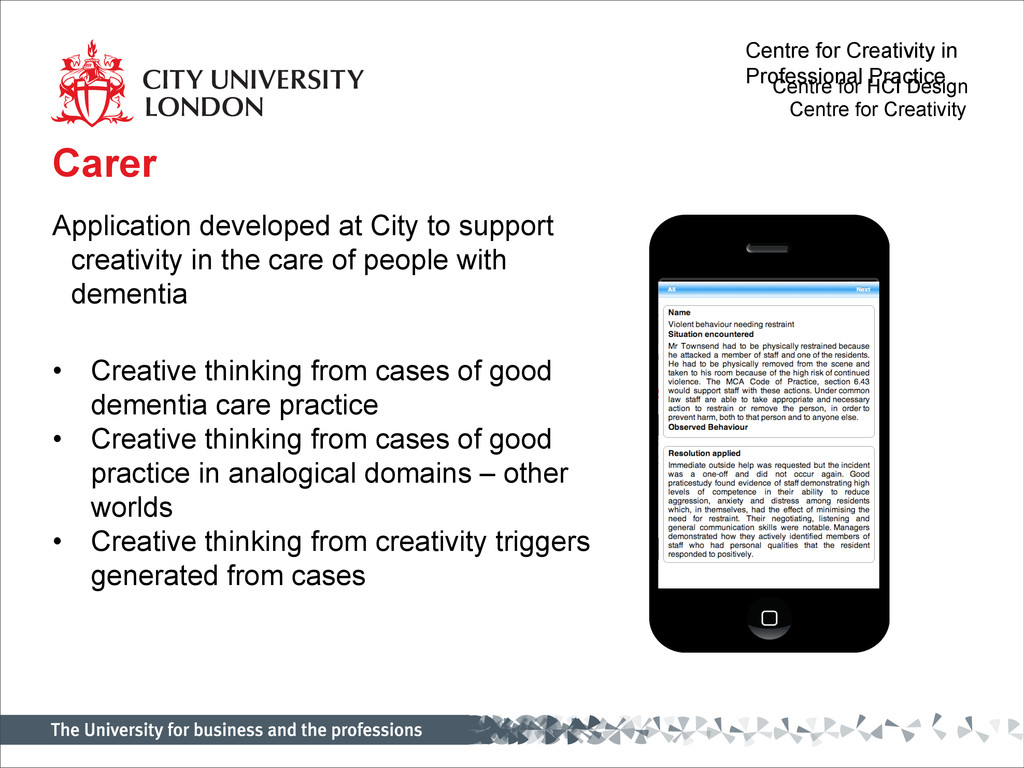
at City to support creativity in the care of people with dementia • Creative thinking from cases of good dementia care practice • Creative thinking from cases of good practice in analogical domains – other worlds • Creative thinking from creativity triggers generated from cases Centre for Creativity in Professional Practice
touch! Sara Jones Centre for HCI Design and Centre for Creativity in Professional Practice City University London [email protected] http://hcid.soi.city.ac.uk/people/Sarajones.html http://creativity.city.ac.uk @svjaok Take a look at our Masters in Innovation, Creativity and Leadership Masters in Human Centred Systems
B., 2000, ‘Creating Creativity: User Interfaces for Supporting Innovation’, ACM Transactions on Computer-Human Interaction, vol 7, no 1, pp114-138 • Lubart, T, 2005, ‘How can computers be partners in the creative process’, Int J Human-Computer Studies 63, pp365-369


 cinteractionlab
 tmiket
 maltzj
 lauravandoore
 elsirapls
 jmmastey
 akihiro_kokubo
 jonoalderson
 jlugia
 notwaldorf
 swwweet
 inesmontani
 mfonobong