not legal advice. This is for entertainment purposes only. Consult an attorney for specific advice. No really don't do anything in a court of law based on the advice of a guy on a stage. fi I am not an attorney and this is not legal advice. This is for entertainment purposes only. Consult an attorney for speci c advice. No really don't do anything in a court of law based on the advice of a guy on a stage.
customs vary around the world. Again, consult an attorney. This is mostly US-centric. Intellectual property laws and customs vary around the world. Again, consult an attorney.
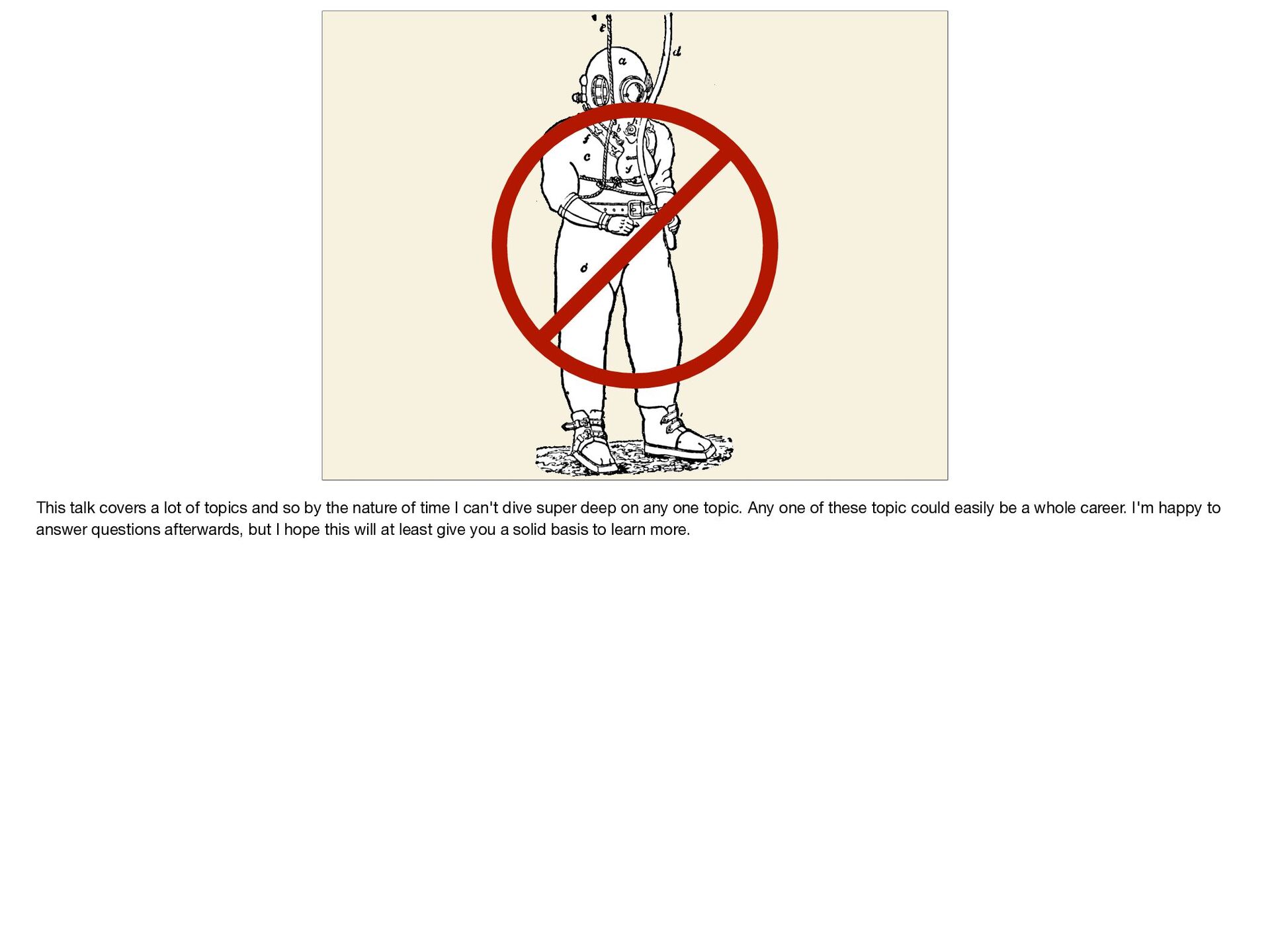
the nature of time I can't dive super deep on any one topic. Any one of these topic could easily be a whole career. I'm happy to answer questions afterwards, but I hope this will at least give you a solid basis to learn more.
property. For our discussion here let's consider property to be an object over which you have some level of exclusive control. In law, this control takes the form of you having certain rights on your property, rights which are exclusive to you. If you own some land, that means you get to say who enters it or builds on it. Not all rights apply in all cases, but roughly speaking that's enough for now.
have property that is intellectual, as opposed to physical. If you paint a painting, you probably own the physical object of the paining, you can sell it, rent it, destroy it, whatever. But you also own the abstract, intellectual component that is your creative work manifested as a painting. And just like with the physical object, you have some rights over the abstract part too.
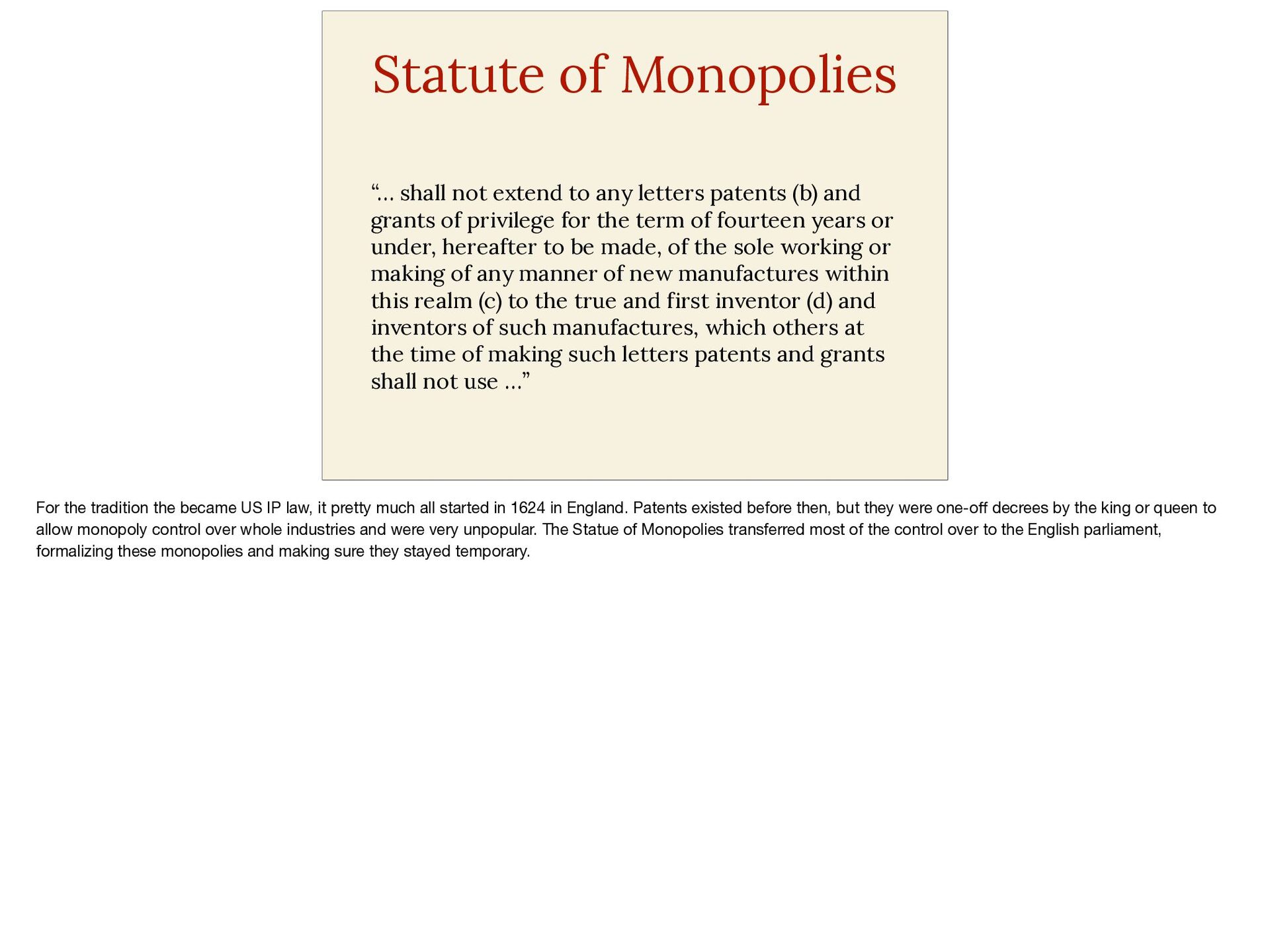
patents (b) and grants of privilege for the term of fourteen years or under, hereafter to be made, of the sole working or making of any manner of new manufactures within this realm (c) to the true and first inventor (d) and inventors of such manufactures, which others at the time of making such letters patents and grants shall not use …” ff For the tradition the became US IP law, it pretty much all started in 1624 in England. Patents existed before then, but they were one-o decrees by the king or queen to allow monopoly control over whole industries and were very unpopular. The Statue of Monopolies transferred most of the control over to the English parliament, formalizing these monopolies and making sure they stayed temporary.
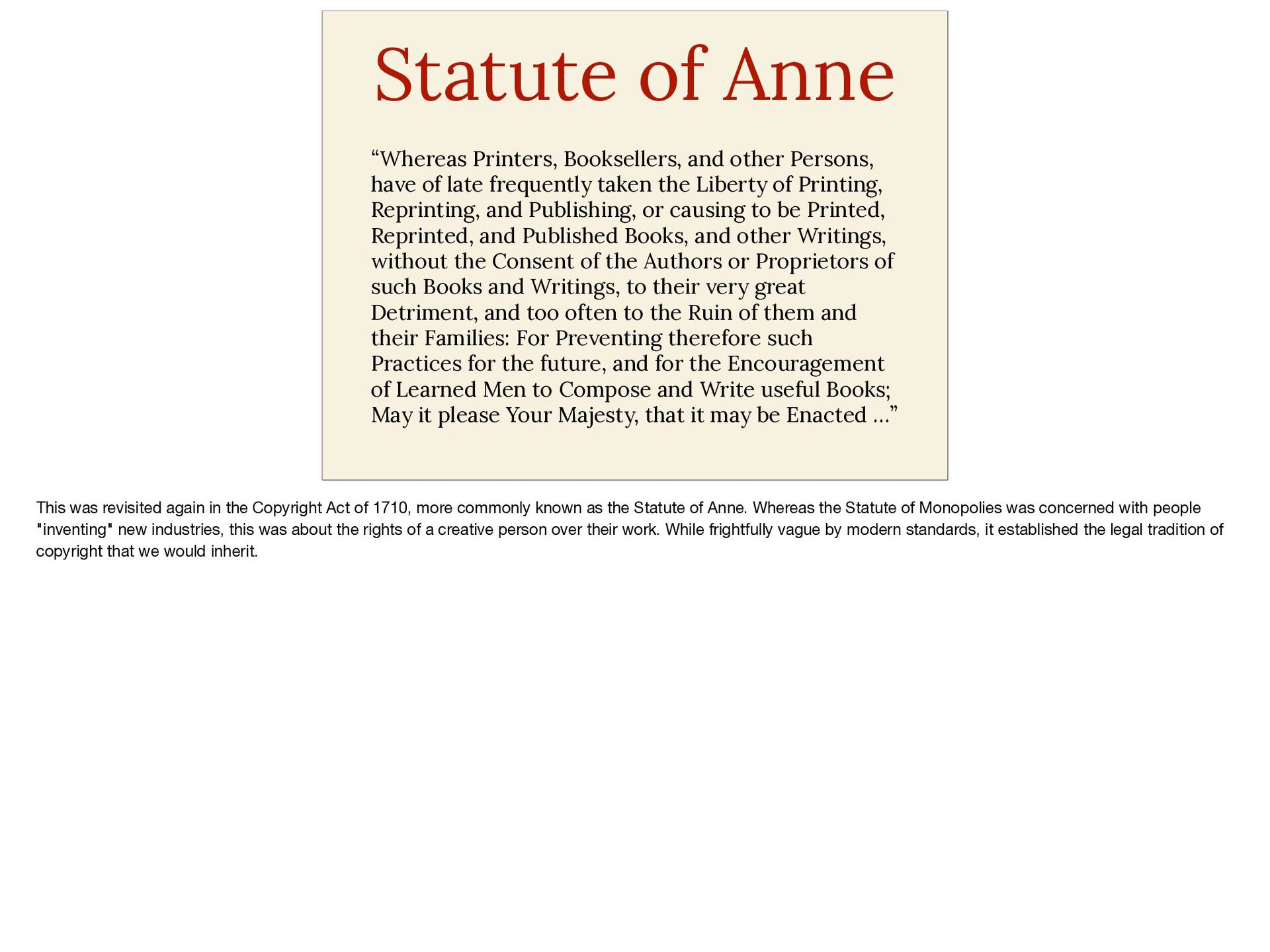
of late frequently taken the Liberty of Printing, Reprinting, and Publishing, or causing to be Printed, Reprinted, and Published Books, and other Writings, without the Consent of the Authors or Proprietors of such Books and Writings, to their very great Detriment, and too often to the Ruin of them and their Families: For Preventing therefore such Practices for the future, and for the Encouragement of Learned Men to Compose and Write useful Books; May it please Your Majesty, that it may be Enacted …” This was revisited again in the Copyright Act of 1710, more commonly known as the Statute of Anne. Whereas the Statute of Monopolies was concerned with people "inventing" new industries, this was about the rights of a creative person over their work. While frightfully vague by modern standards, it established the legal tradition of copyright that we would inherit.
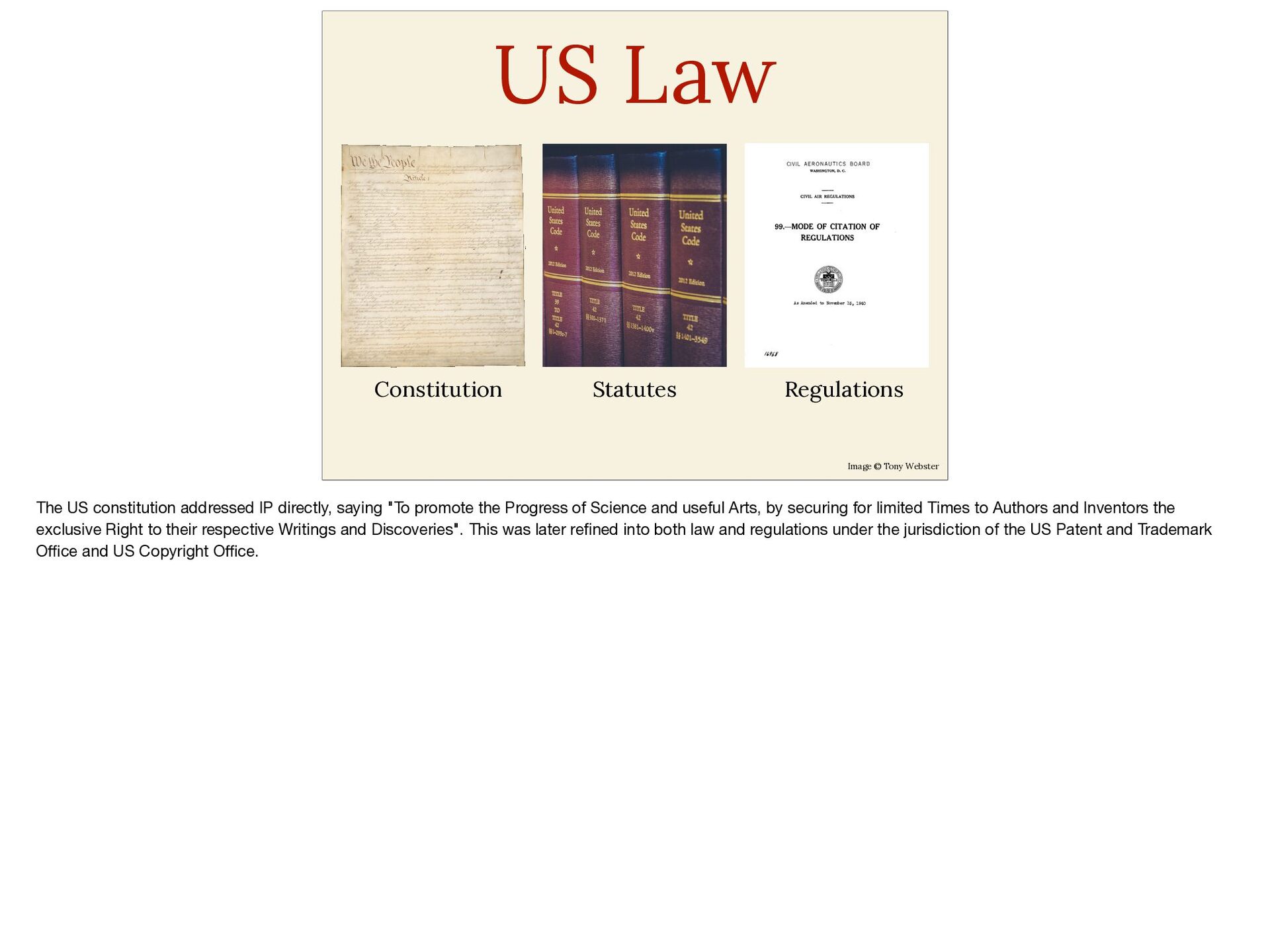
ffi ffi The US constitution addressed IP directly, saying "To promote the Progress of Science and useful Arts, by securing for limited Times to Authors and Inventors the exclusive Right to their respective Writings and Discoveries". This was later re ned into both law and regulations under the jurisdiction of the US Patent and Trademark O ce and US Copyright O ce.
an authors rights to their creation is considered an inherent or moral right. In the US we treat all IP rights as the domain of the law, you have only the rights assigned to you by law and nothing more.
a patchwork of new laws updating the old. In many situations in IP law, the true answer to a question can only be determined by a court, and will be based on not just laws and regulations, but centuries of case law and other writings. I'll try to be careful in my word choice but almost everything I say would need a dozen "except for"s if I was being 100% accurate.
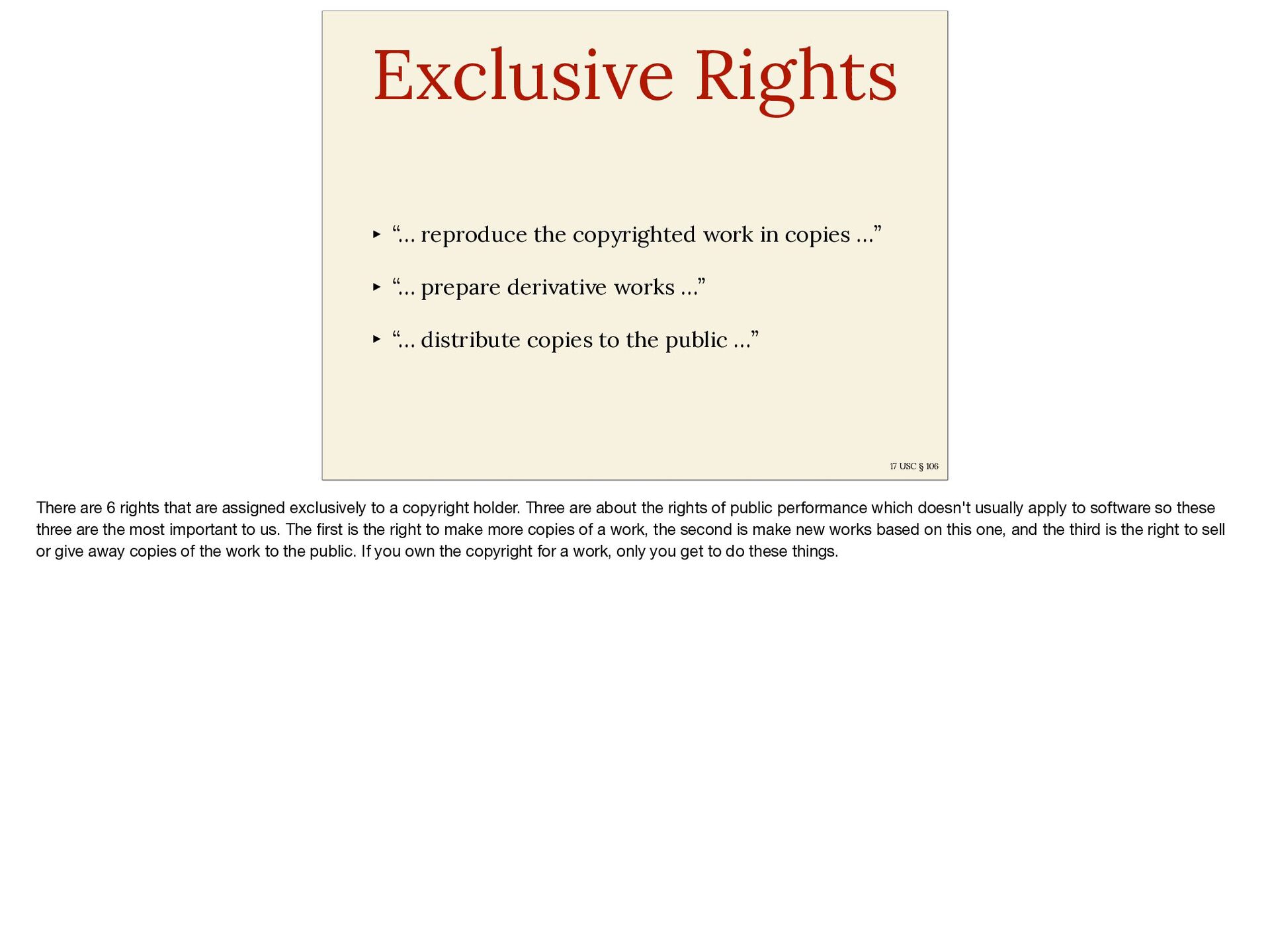
…” ‣ “… prepare derivative works …” ‣ “… distribute copies to the public …” 17 USC § 106 fi There are 6 rights that are assigned exclusively to a copyright holder. Three are about the rights of public performance which doesn't usually apply to software so these three are the most important to us. The rst is the right to make more copies of a work, the second is make new works based on this one, and the third is the right to sell or give away copies of the work to the public. If you own the copyright for a work, only you get to do these things.
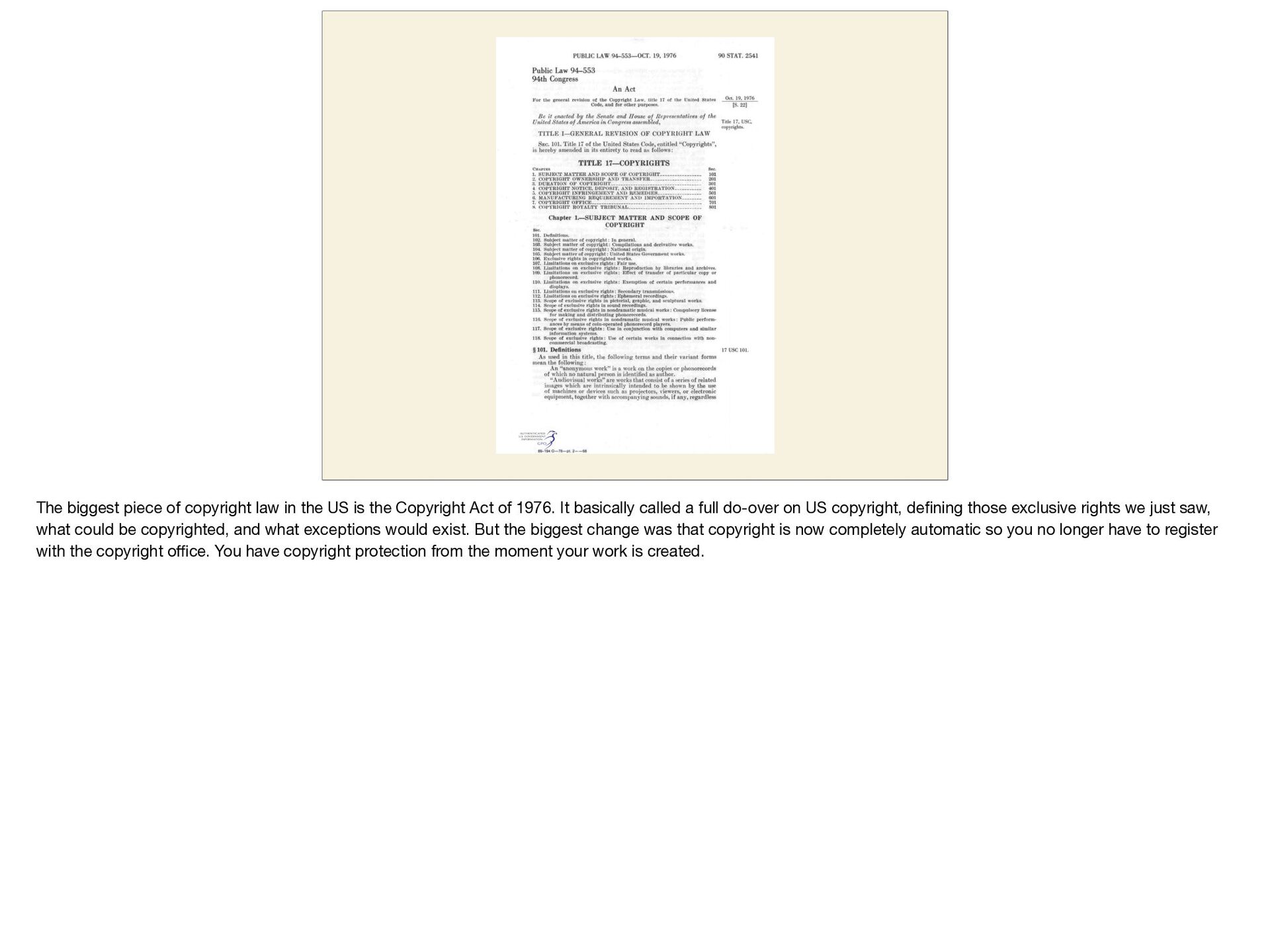
US is the Copyright Act of 1976. It basically called a full do-over on US copyright, de ning those exclusive rights we just saw, what could be copyrighted, and what exceptions would exist. But the biggest change was that copyright is now completely automatic so you no longer have to register with the copyright o ce. You have copyright protection from the moment your work is created.
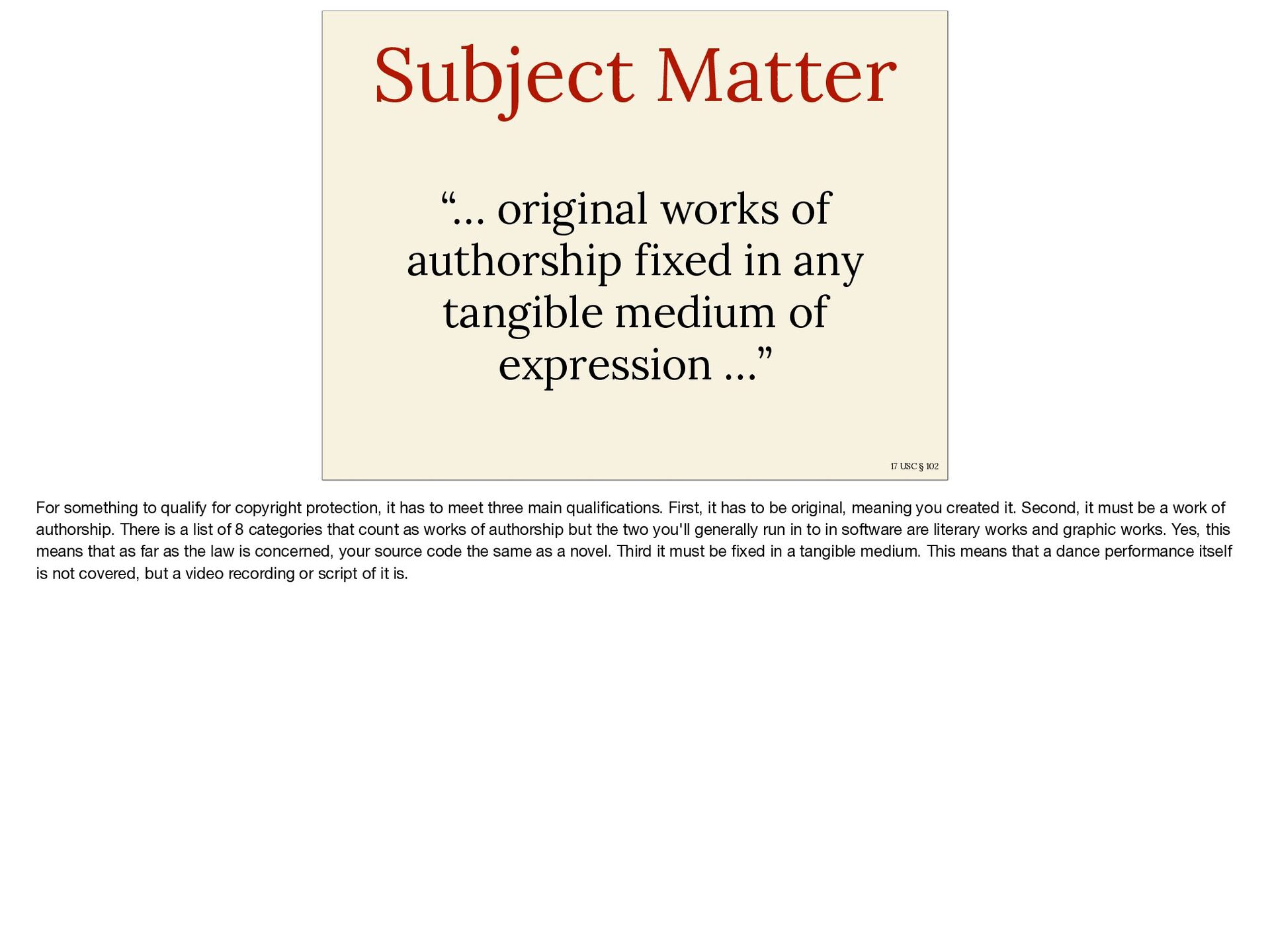
tangible medium of expression …” 17 USC § 102 fi fi For something to qualify for copyright protection, it has to meet three main quali cations. First, it has to be original, meaning you created it. Second, it must be a work of authorship. There is a list of 8 categories that count as works of authorship but the two you'll generally run in to in software are literary works and graphic works. Yes, this means that as far as the law is concerned, your source code the same as a novel. Third it must be xed in a tangible medium. This means that a dance performance itself is not covered, but a video recording or script of it is.
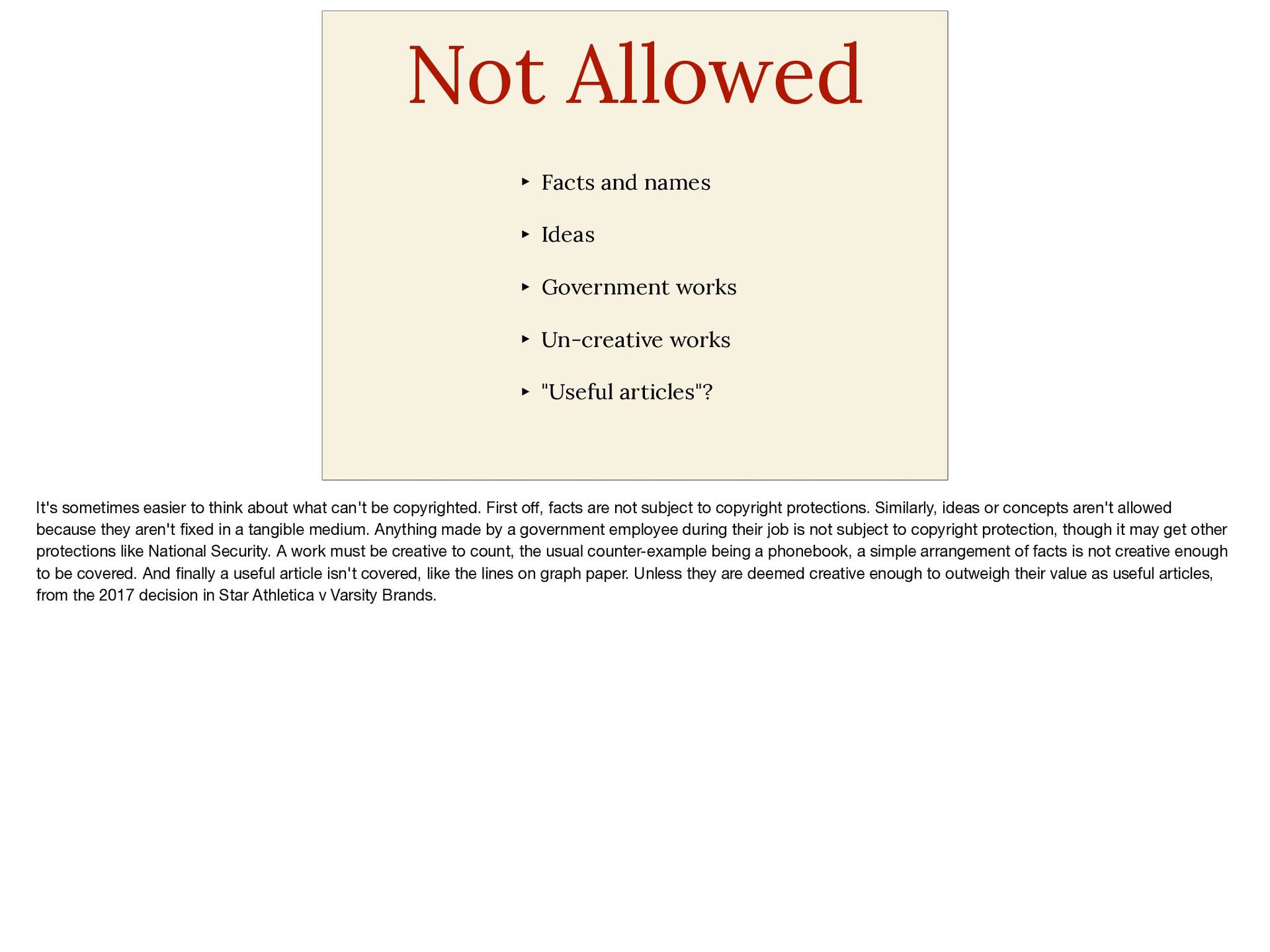
works ‣ Un-creative works ‣ "Useful articles"? ff fi fi It's sometimes easier to think about what can't be copyrighted. First o , facts are not subject to copyright protections. Similarly, ideas or concepts aren't allowed because they aren't xed in a tangible medium. Anything made by a government employee during their job is not subject to copyright protection, though it may get other protections like National Security. A work must be creative to count, the usual counter-example being a phonebook, a simple arrangement of facts is not creative enough to be covered. And nally a useful article isn't covered, like the lines on graph paper. Unless they are deemed creative enough to outweigh their value as useful articles, from the 2017 decision in Star Athletica v Varsity Brands.
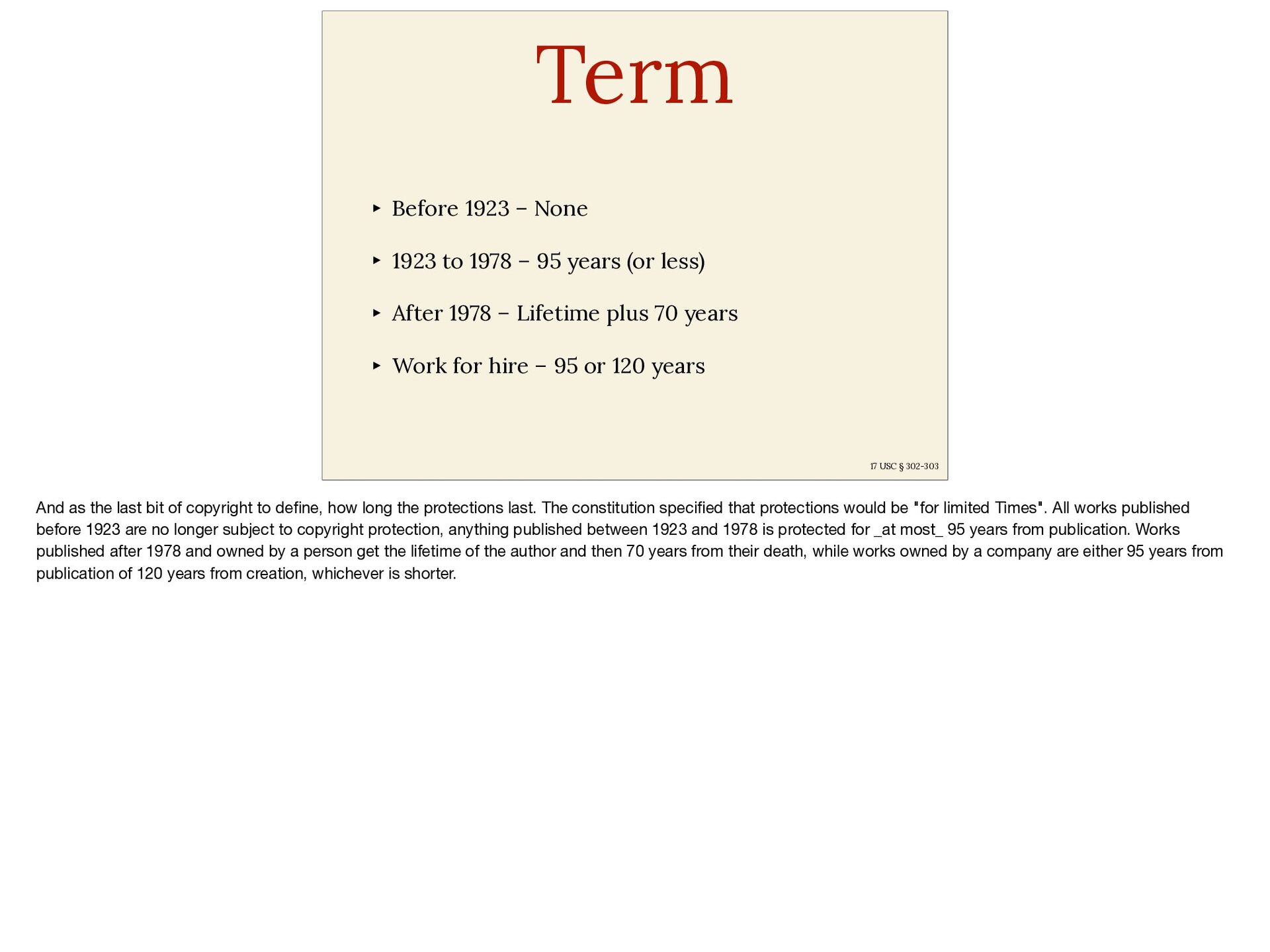
– 95 years (or less) ‣ After 1978 – Lifetime plus 70 years ‣ Work for hire – 95 or 120 years 17 USC § 302-303 fi fi And as the last bit of copyright to de ne, how long the protections last. The constitution speci ed that protections would be "for limited Times". All works published before 1923 are no longer subject to copyright protection, anything published between 1923 and 1978 is protected for _at most_ 95 years from publication. Works published after 1978 and owned by a person get the lifetime of the author and then 70 years from their death, while works owned by a company are either 95 years from publication of 120 years from creation, whichever is shorter.
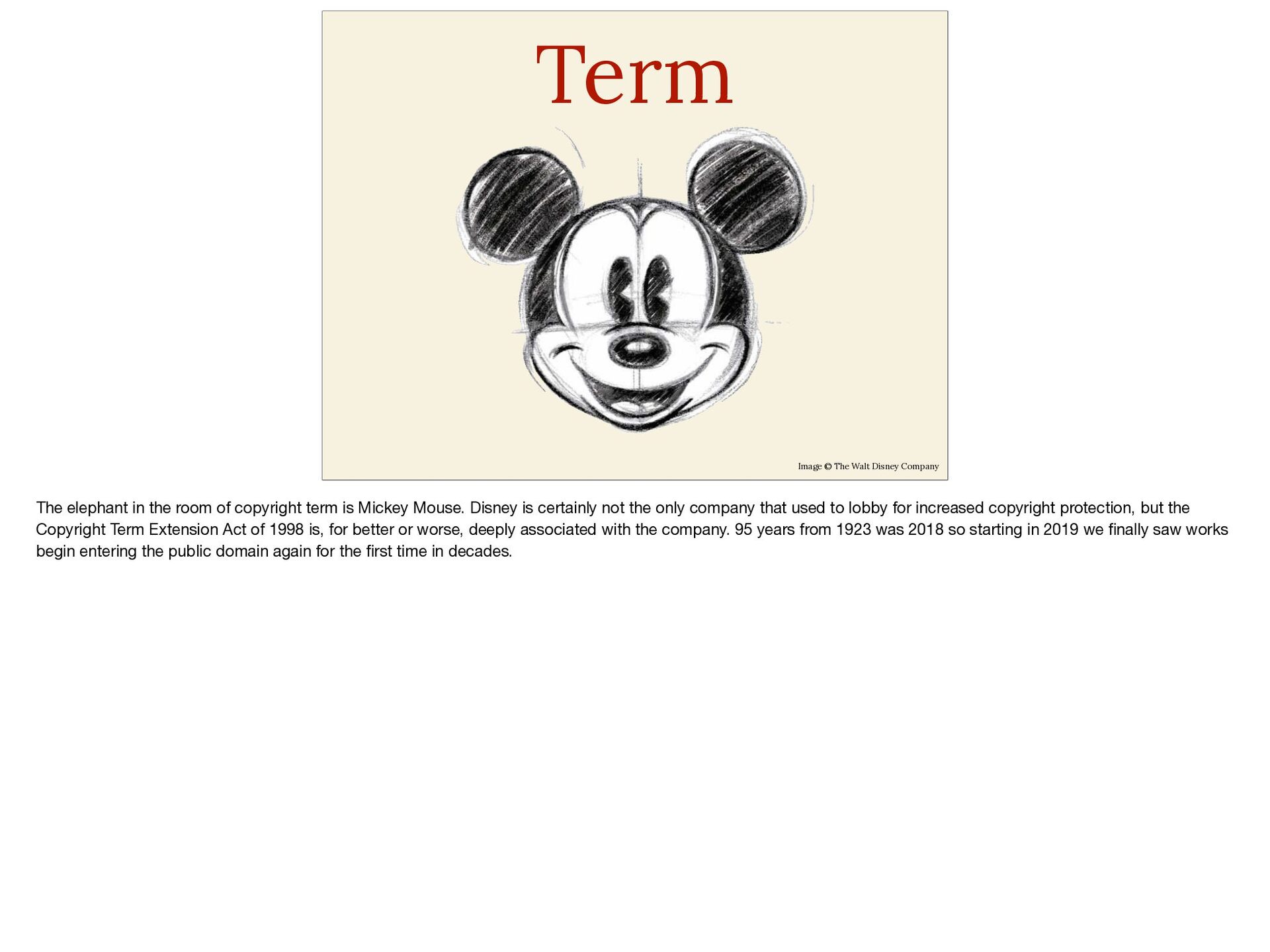
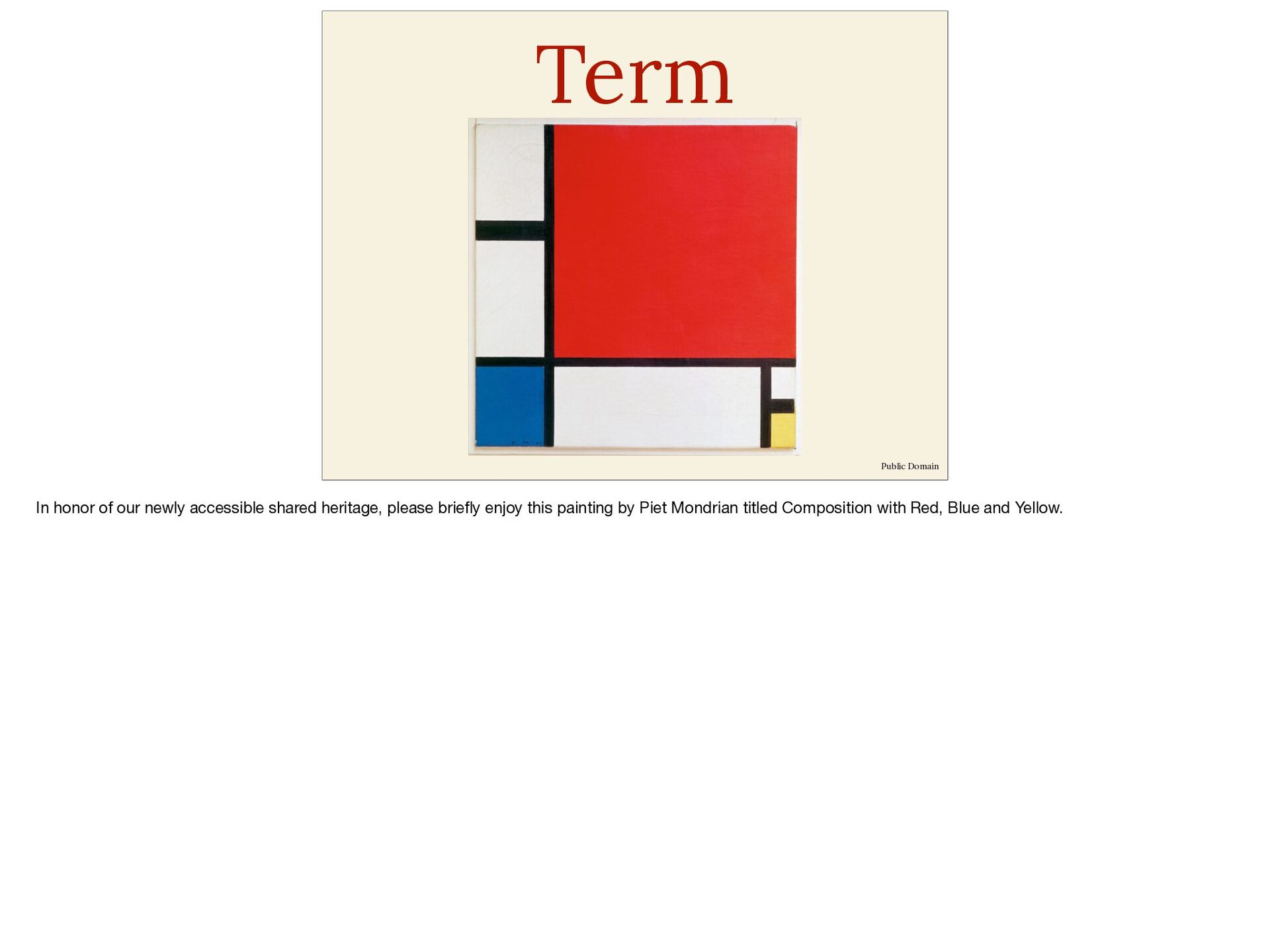
elephant in the room of copyright term is Mickey Mouse. Disney is certainly not the only company that used to lobby for increased copyright protection, but the Copyright Term Extension Act of 1998 is, for better or worse, deeply associated with the company. 95 years from 1923 was 2018 so starting in 2019 we nally saw works begin entering the public domain again for the rst time in decades.
for copyright, the next thing you'll usually see are these words: "all rights reserved". What do these mean? It's an explicit statement that you, the owner, are keeping all 6 of the exclusive rights for yourself. But remember this is also the default state, any right not shared by the owner are exclusive to the owner.
If copyright is automatic, what about things I do at work? Those are classi ed as a "work for hire". In most cases the copyright in any work you are directed to produce in the course of your job automatically belong to your employer. The speci cs will depend in your employment contract in most cases though, as it generally supersedes the default work for hire rules with more speci c provisions.
more detail later on, but brie y a license is a contract between a copyright owner and some other person to allow limited use of one or more of the exclusive rights. In open-source software the other person is usually a generic "anyone". Fair use is a exception that allows the use of a copyrighted work under certain conditions, such as me using the copyrighted Mickey Mouse graphic on the previous slide as part of a comment and critique on Disney.
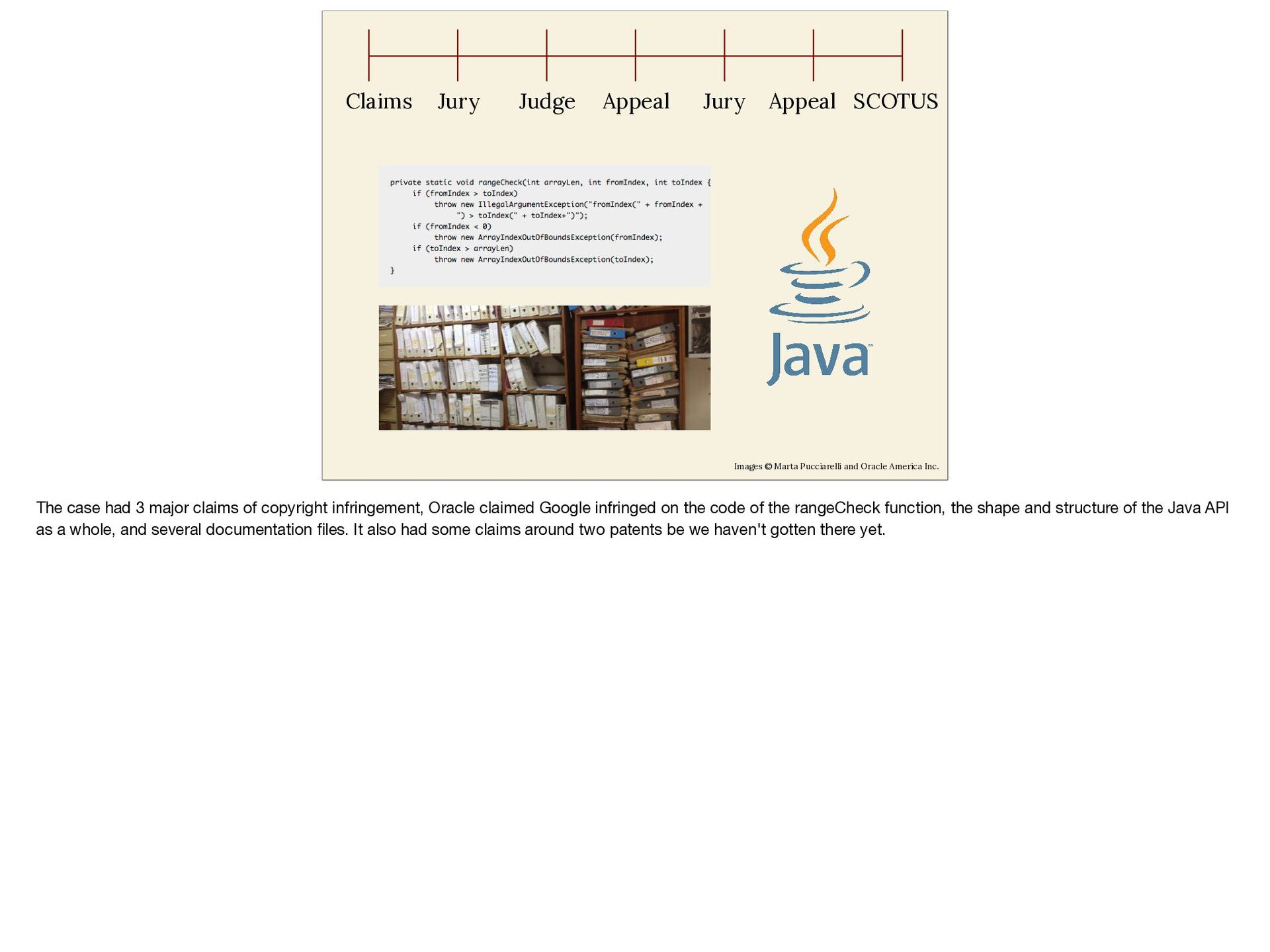
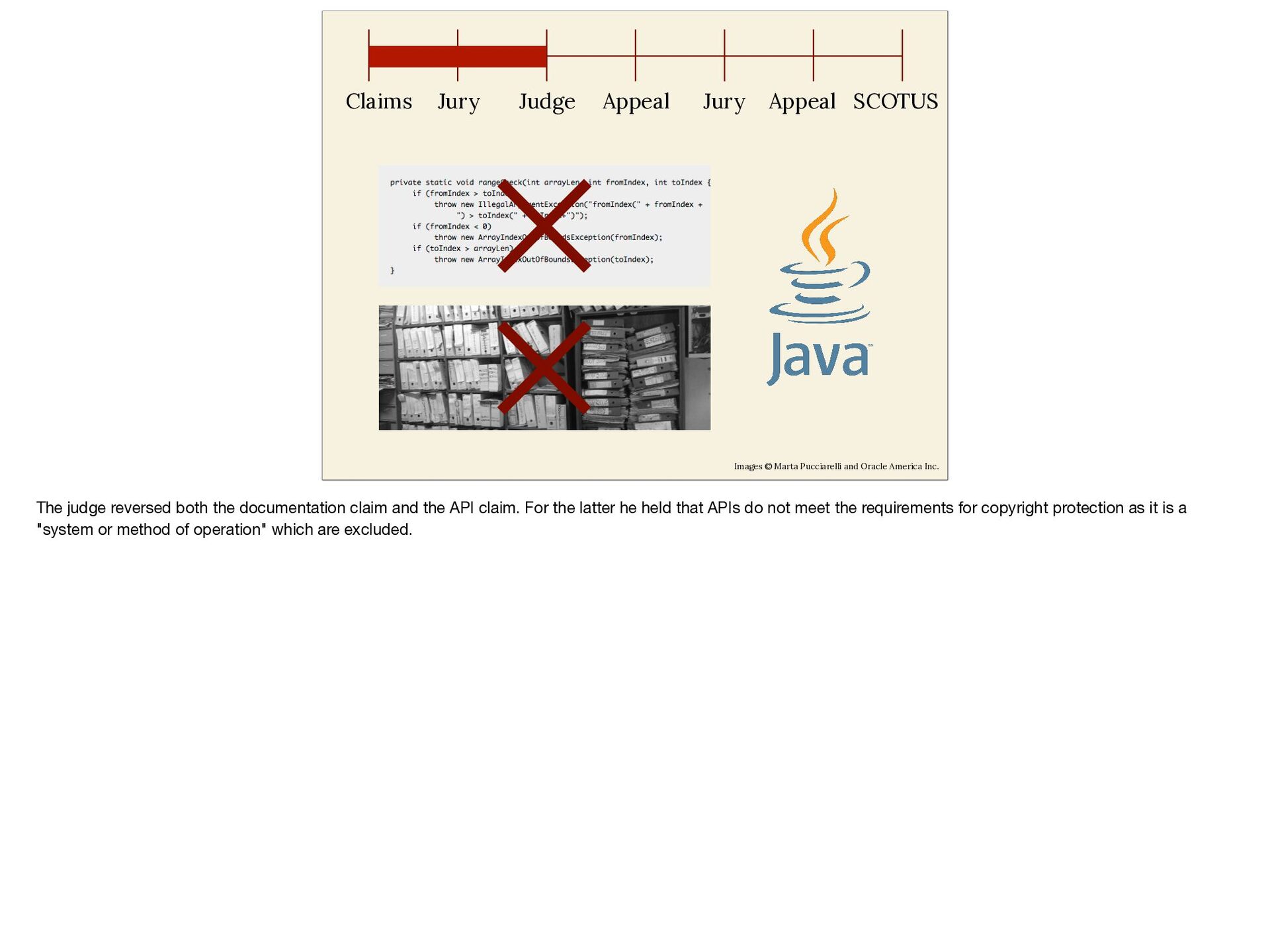
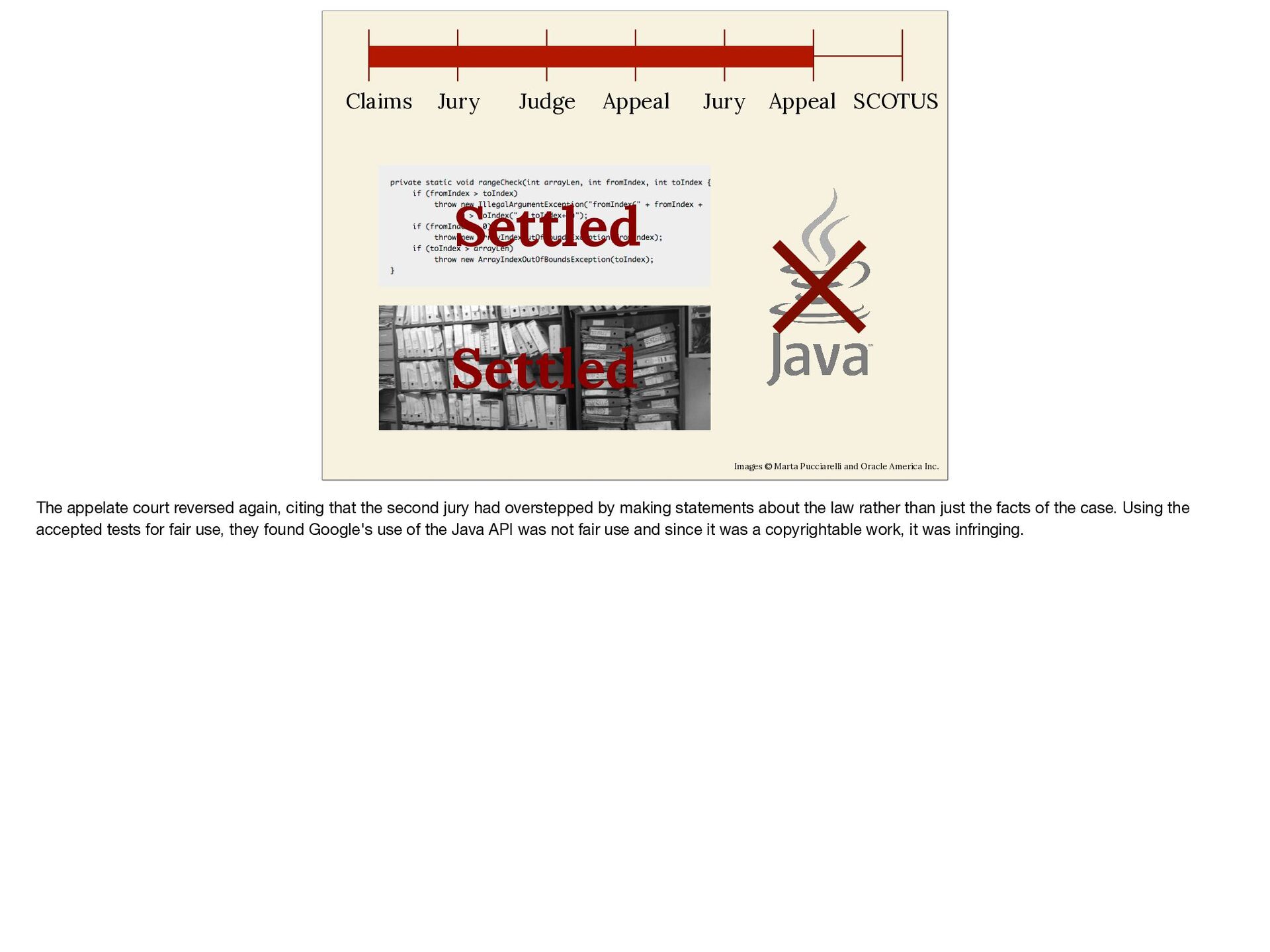
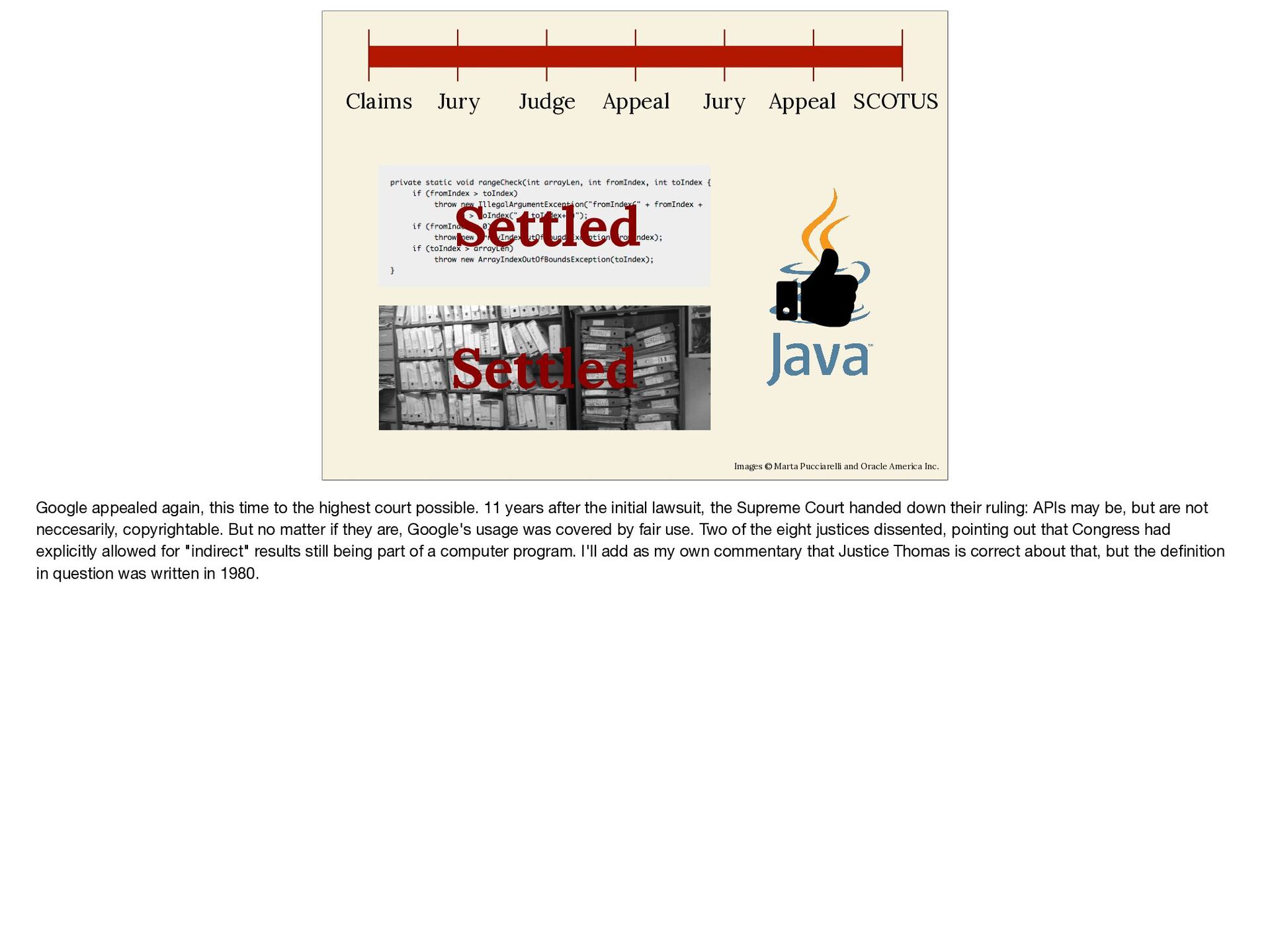
Pucciarelli and Oracle America Inc. fi The case had 3 major claims of copyright infringement, Oracle claimed Google infringed on the code of the rangeCheck function, the shape and structure of the Java API as a whole, and several documentation les. It also had some claims around two patents be we haven't gotten there yet.
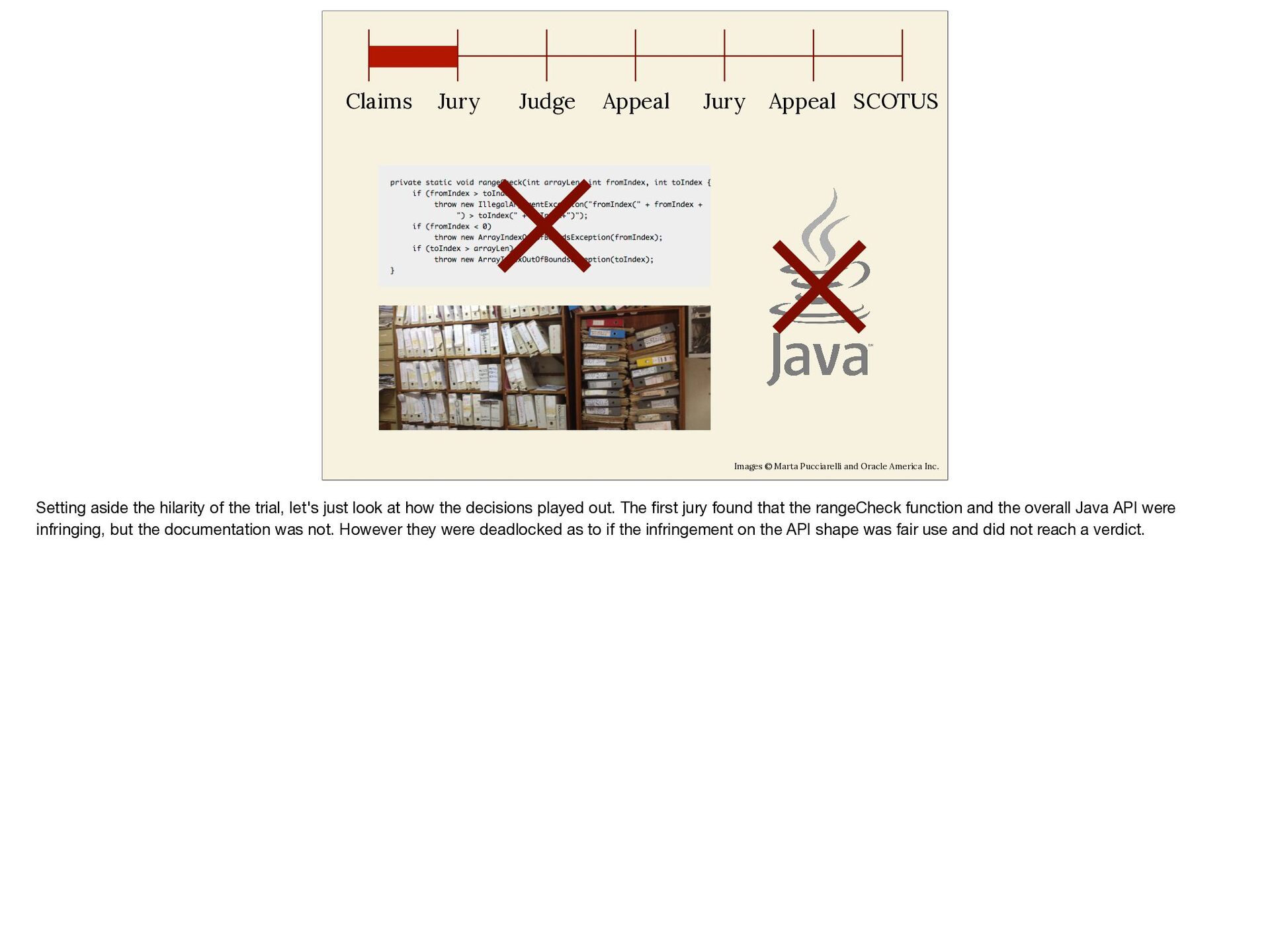
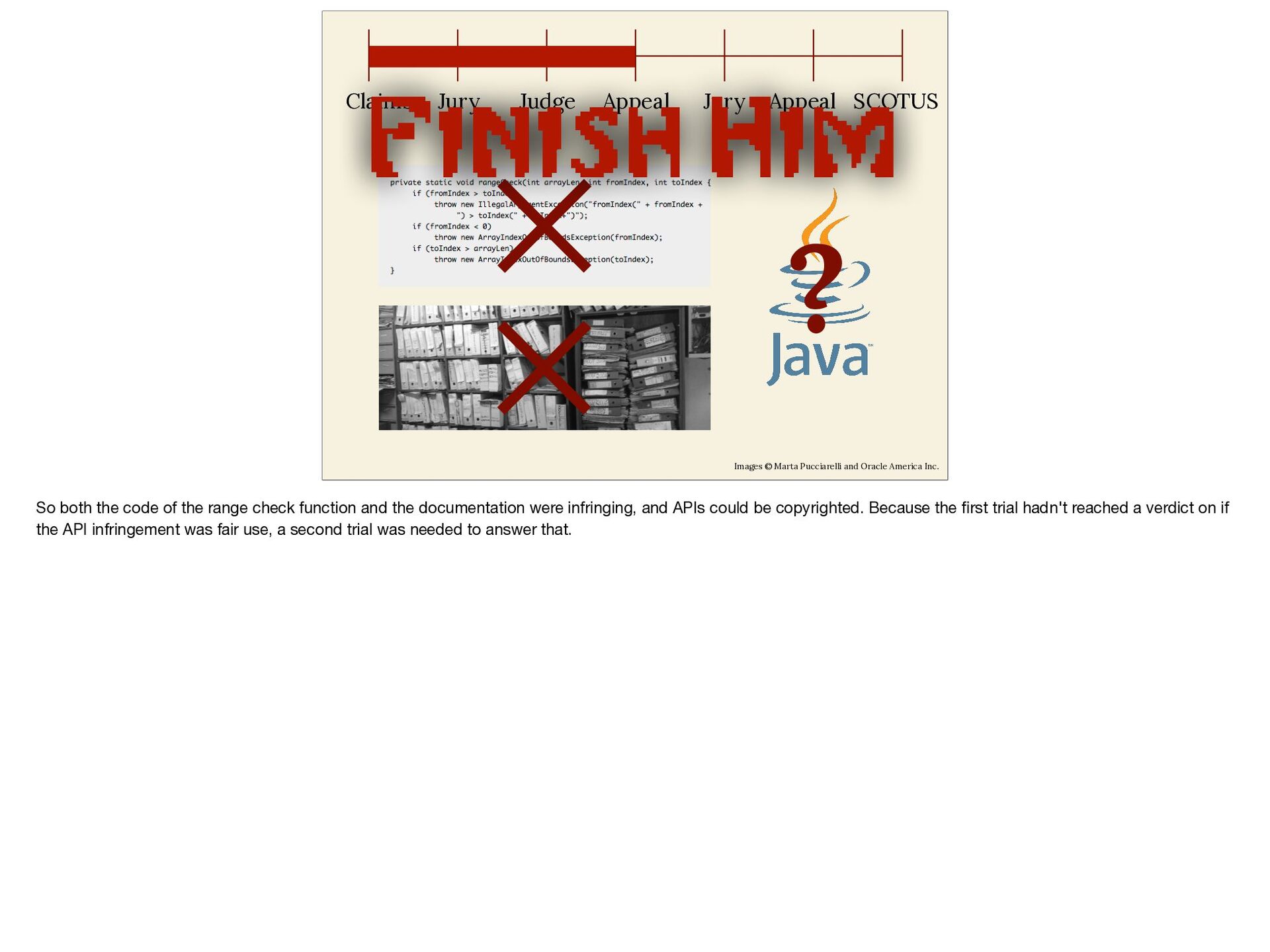
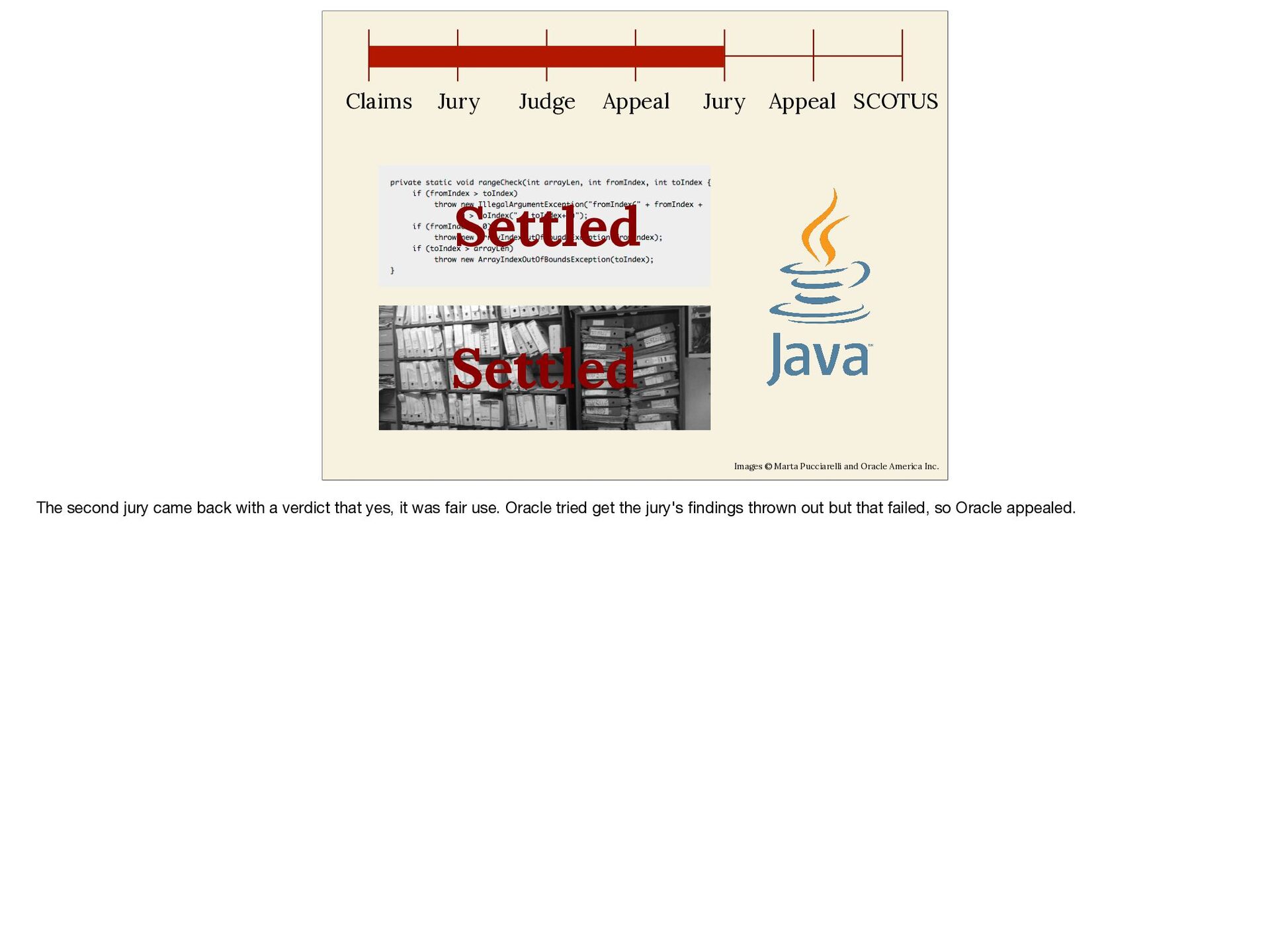
Pucciarelli and Oracle America Inc. fi Setting aside the hilarity of the trial, let's just look at how the decisions played out. The rst jury found that the rangeCheck function and the overall Java API were infringing, but the documentation was not. However they were deadlocked as to if the infringement on the API shape was fair use and did not reach a verdict.
Pucciarelli and Oracle America Inc. The judge reversed both the documentation claim and the API claim. For the latter he held that APIs do not meet the requirements for copyright protection as it is a "system or method of operation" which are excluded.
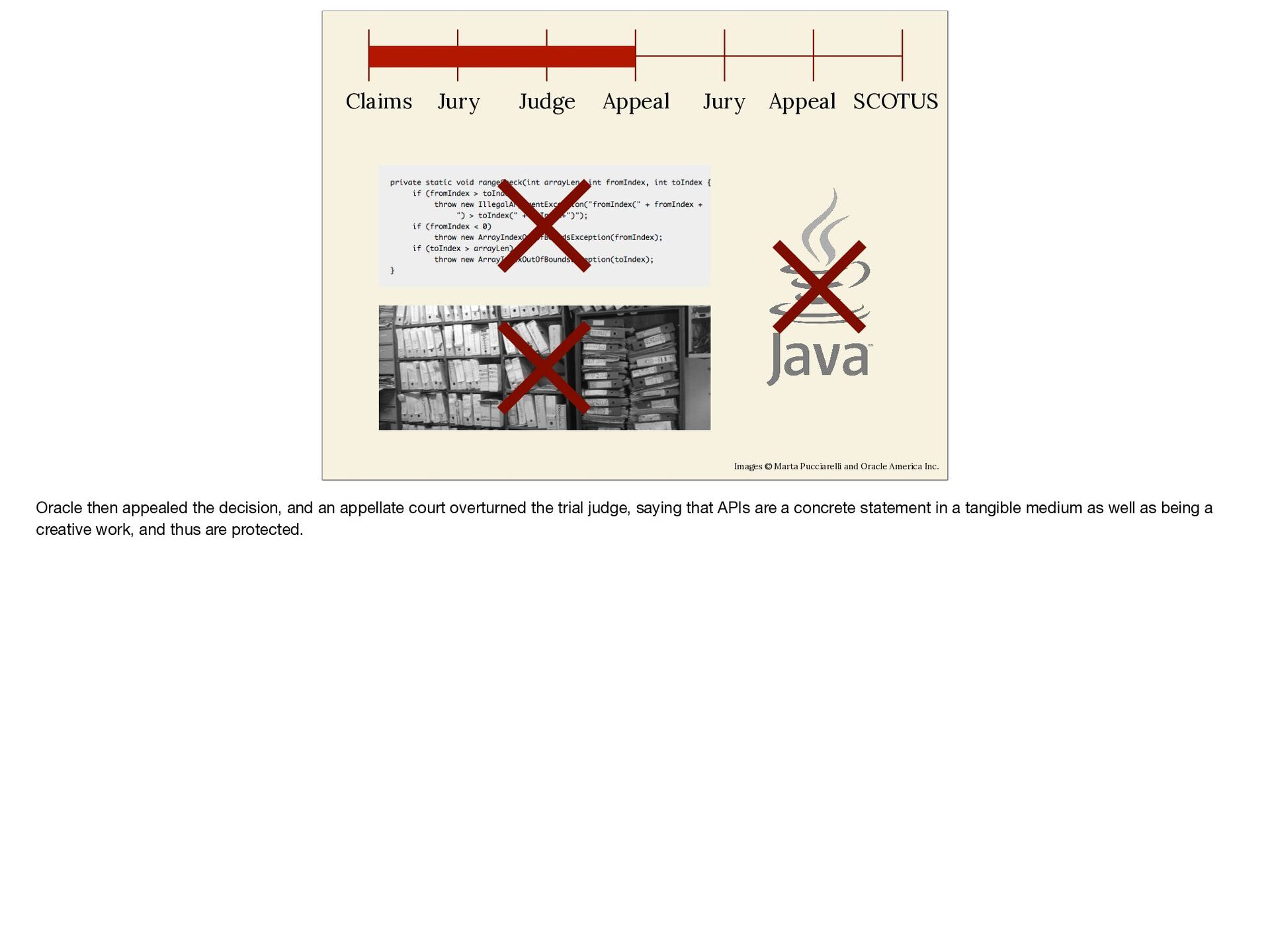
Pucciarelli and Oracle America Inc. Oracle then appealed the decision, and an appellate court overturned the trial judge, saying that APIs are a concrete statement in a tangible medium as well as being a creative work, and thus are protected.
that copyright is really hard. Even though I keep saying answers can only come from a trial, this case shows that even the courts are struggling to understand copyright as applied to software and technology.
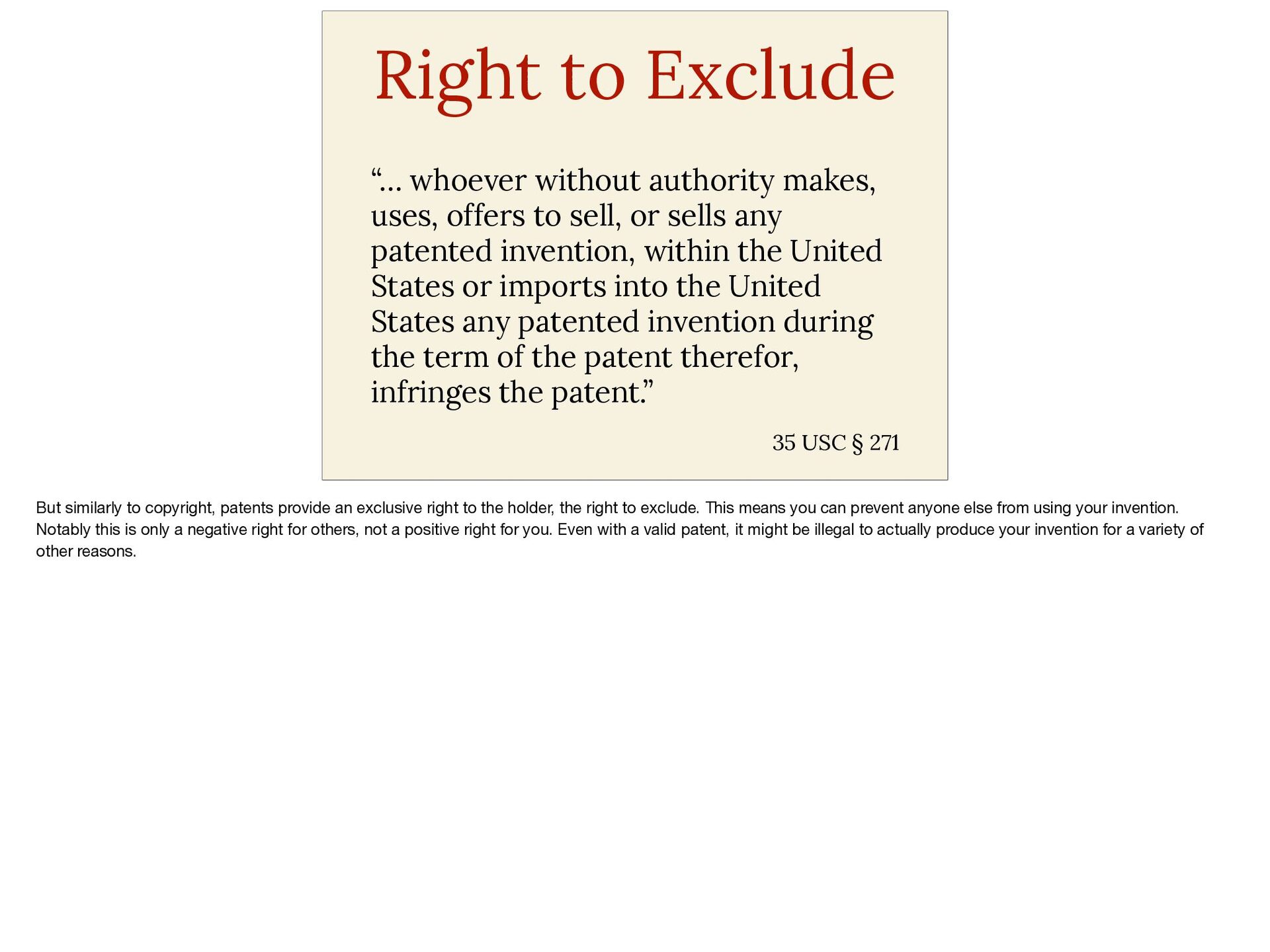
to sell, or sells any patented invention, within the United States or imports into the United States any patented invention during the term of the patent therefor, infringes the patent.” 35 USC § 271 But similarly to copyright, patents provide an exclusive right to the holder, the right to exclude. This means you can prevent anyone else from using your invention. Notably this is only a negative right for others, not a positive right for you. Even with a valid patent, it might be illegal to actually produce your invention for a variety of other reasons.
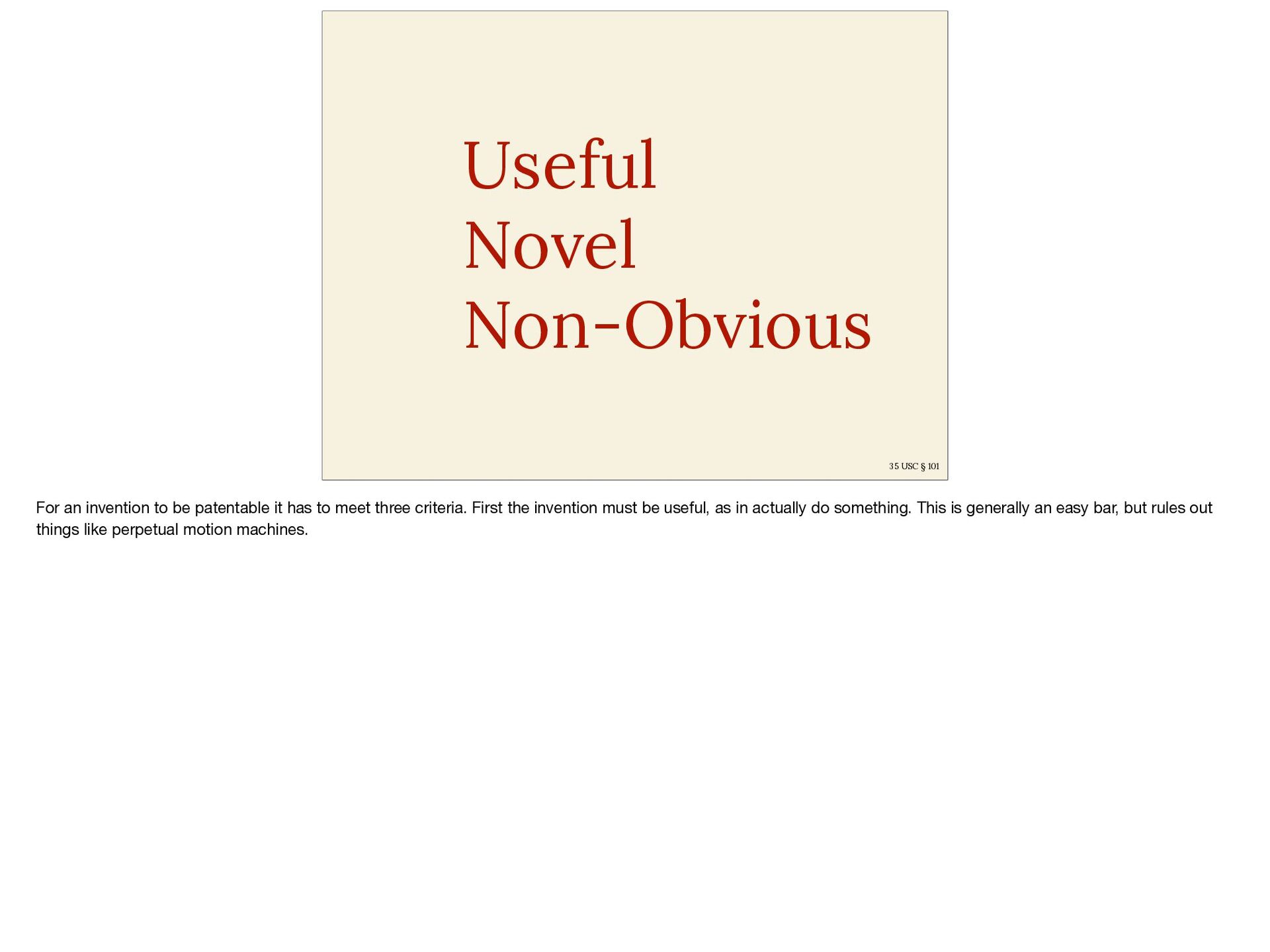
to be patentable it has to meet three criteria. First the invention must be useful, as in actually do something. This is generally an easy bar, but rules out things like perpetual motion machines.
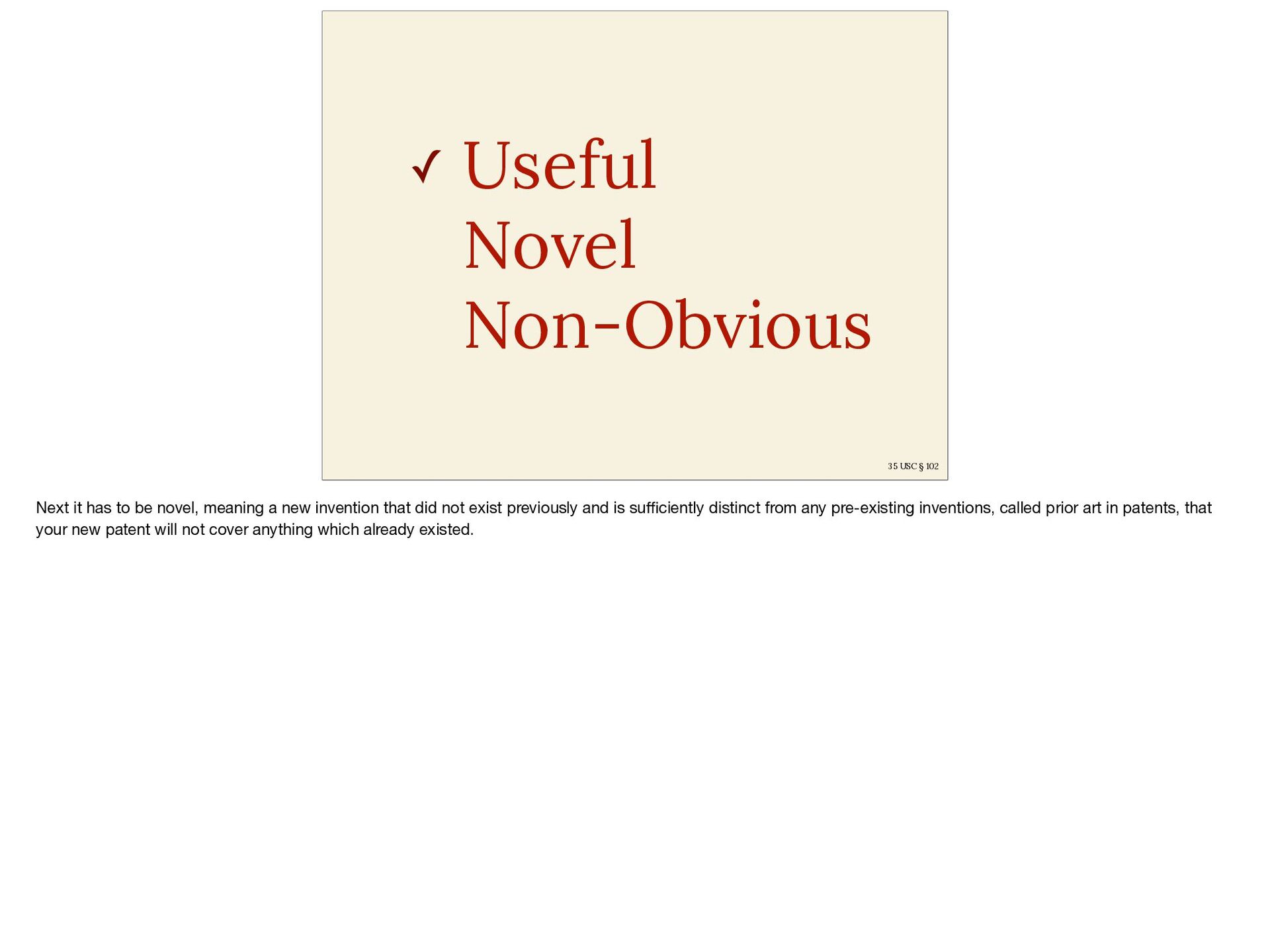
it has to be novel, meaning a new invention that did not exist previously and is su ciently distinct from any pre-existing inventions, called prior art in patents, that your new patent will not cover anything which already existed.
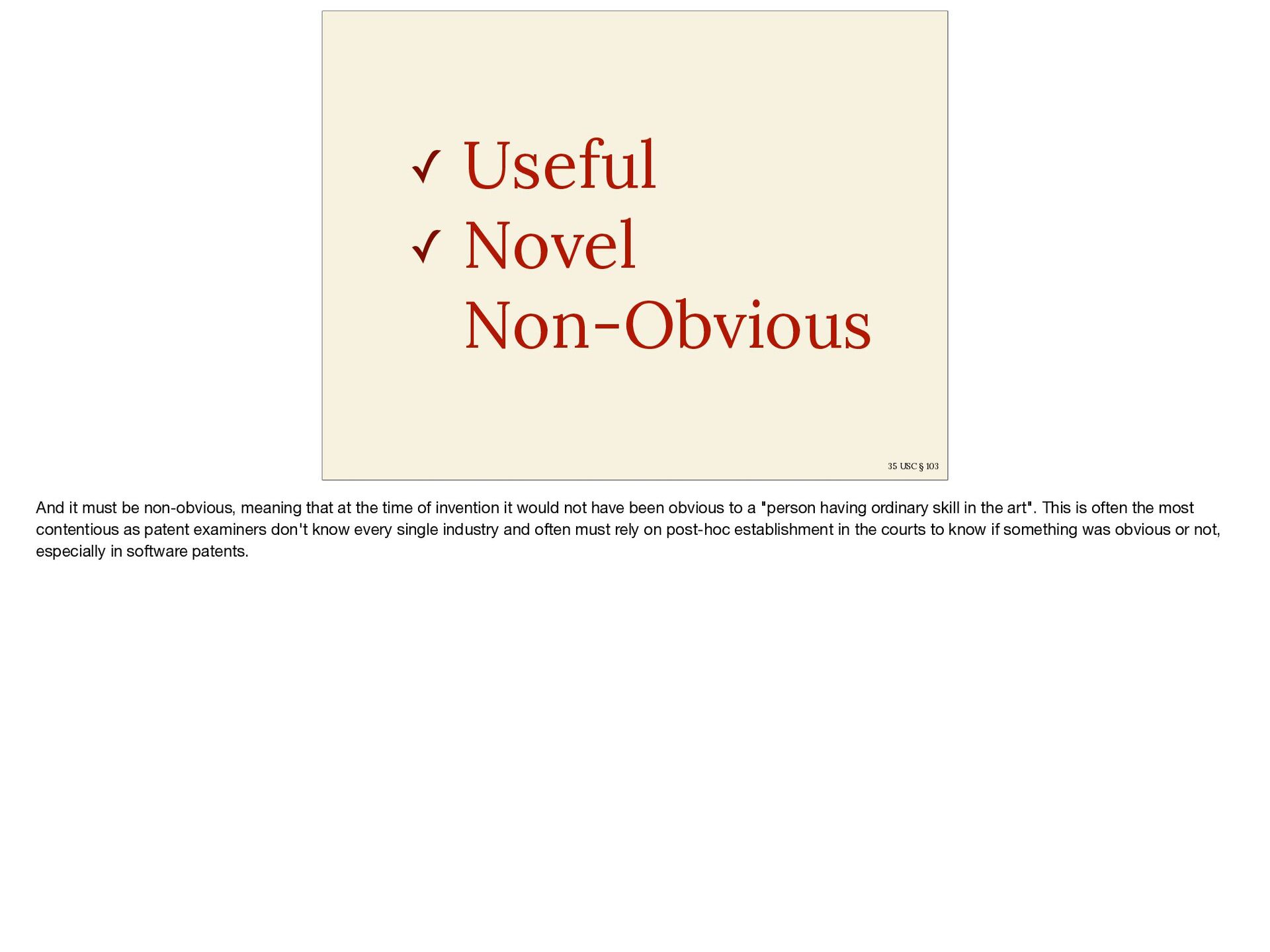
it must be non-obvious, meaning that at the time of invention it would not have been obvious to a "person having ordinary skill in the art". This is often the most contentious as patent examiners don't know every single industry and often must rely on post-hoc establishment in the courts to know if something was obvious or not, especially in software patents.
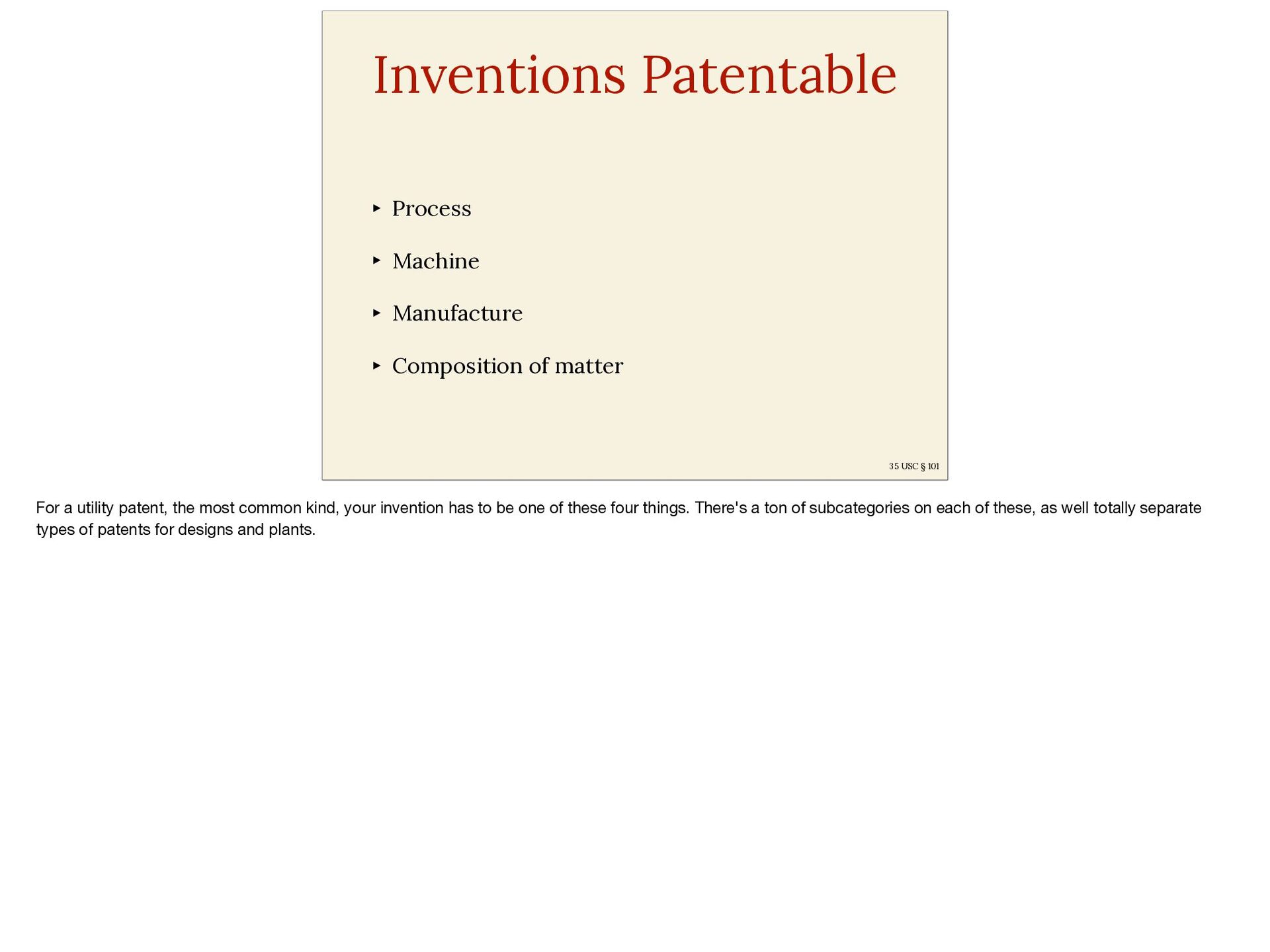
of matter 35 USC § 101 For a utility patent, the most common kind, your invention has to be one of these four things. There's a ton of subcategories on each of these, as well totally separate types of patents for designs and plants.
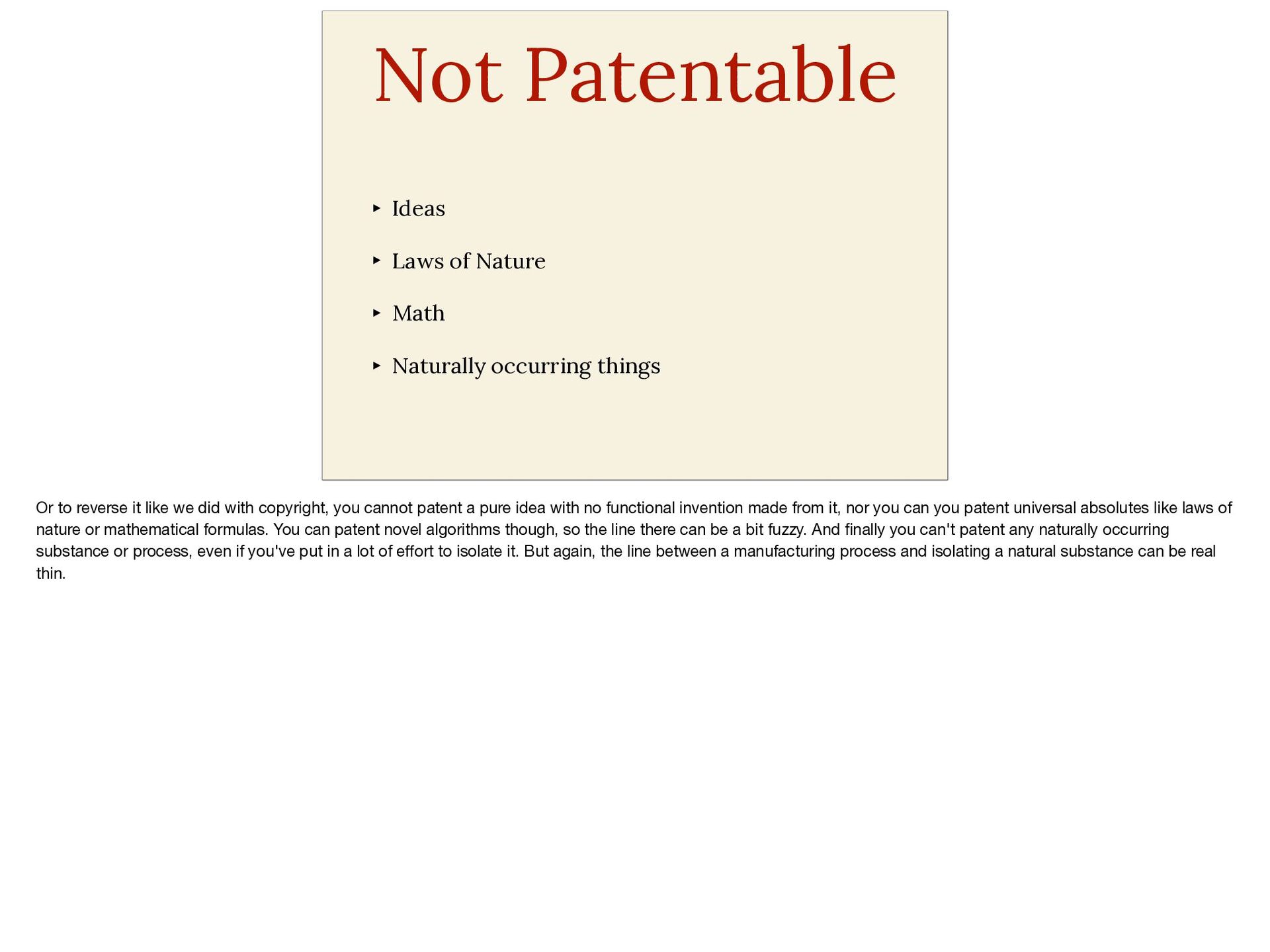
‣ Naturally occurring things fi ff Or to reverse it like we did with copyright, you cannot patent a pure idea with no functional invention made from it, nor you can you patent universal absolutes like laws of nature or mathematical formulas. You can patent novel algorithms though, so the line there can be a bit fuzzy. And nally you can't patent any naturally occurring substance or process, even if you've put in a lot of e ort to isolate it. But again, the line between a manufacturing process and isolating a natural substance can be real thin.
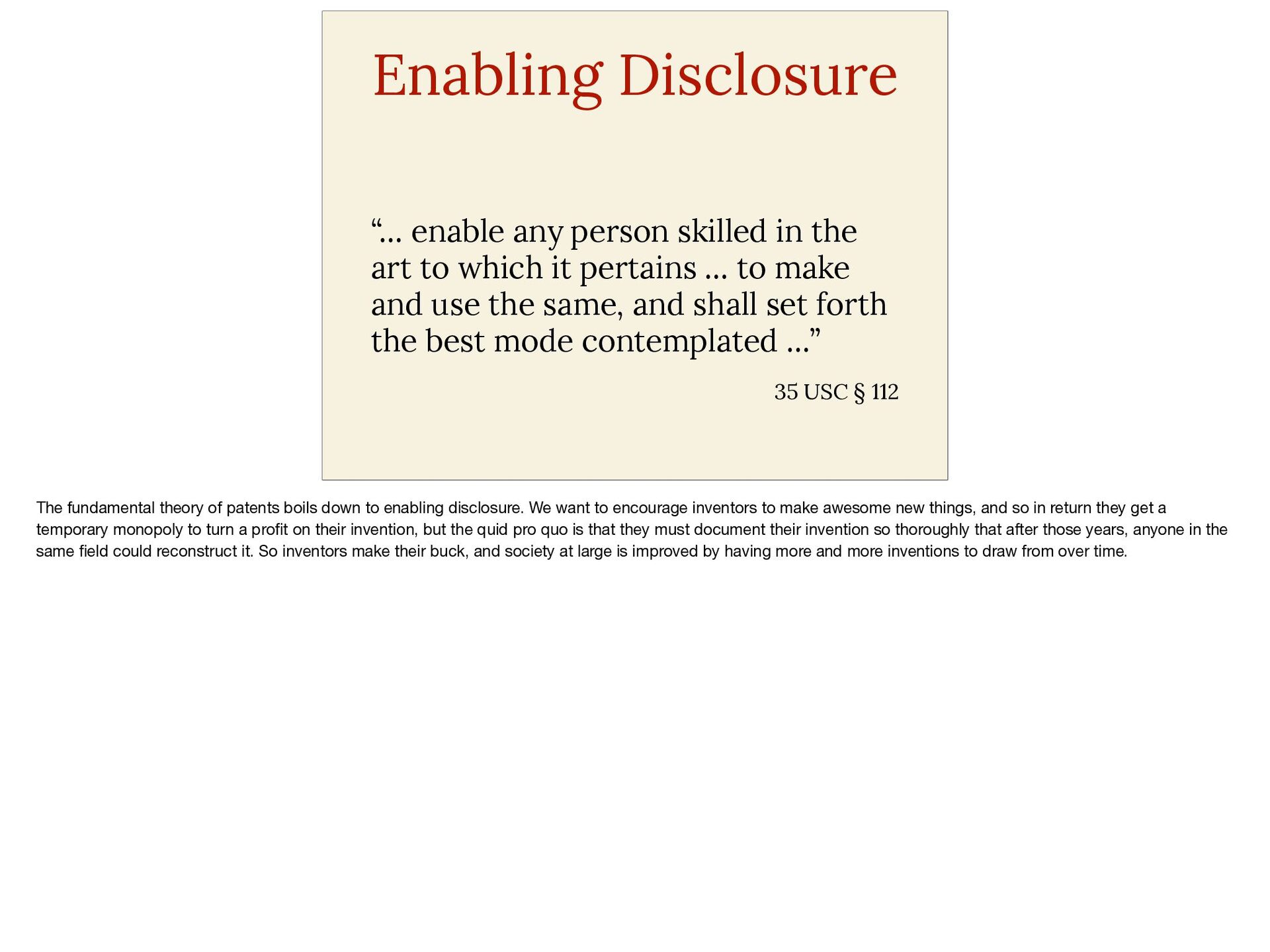
to which it pertains … to make and use the same, and shall set forth the best mode contemplated …” 35 USC § 112 fi fi The fundamental theory of patents boils down to enabling disclosure. We want to encourage inventors to make awesome new things, and so in return they get a temporary monopoly to turn a pro t on their invention, but the quid pro quo is that they must document their invention so thoroughly that after those years, anyone in the same eld could reconstruct it. So inventors make their buck, and society at large is improved by having more and more inventions to draw from over time.
"person having ordinary skill in the art", which we saw before in the Non-Obvious requirement. This is called a legal ction, a made-up person used to make certain points or assumptions in law. This also means we don't have a hard and fast rule as to what quali es as "ordinary skill" so the courts kind of have to make it up as they go.
the most part patents last 20 years from the date of ling. Some extensions exist if the review process takes a long time but usually only adding a year or two. This is a lot shorter than copyright, but companies have worked out ways to slightly tweak designs and le new patents, giving them 40 or 60 years instead.
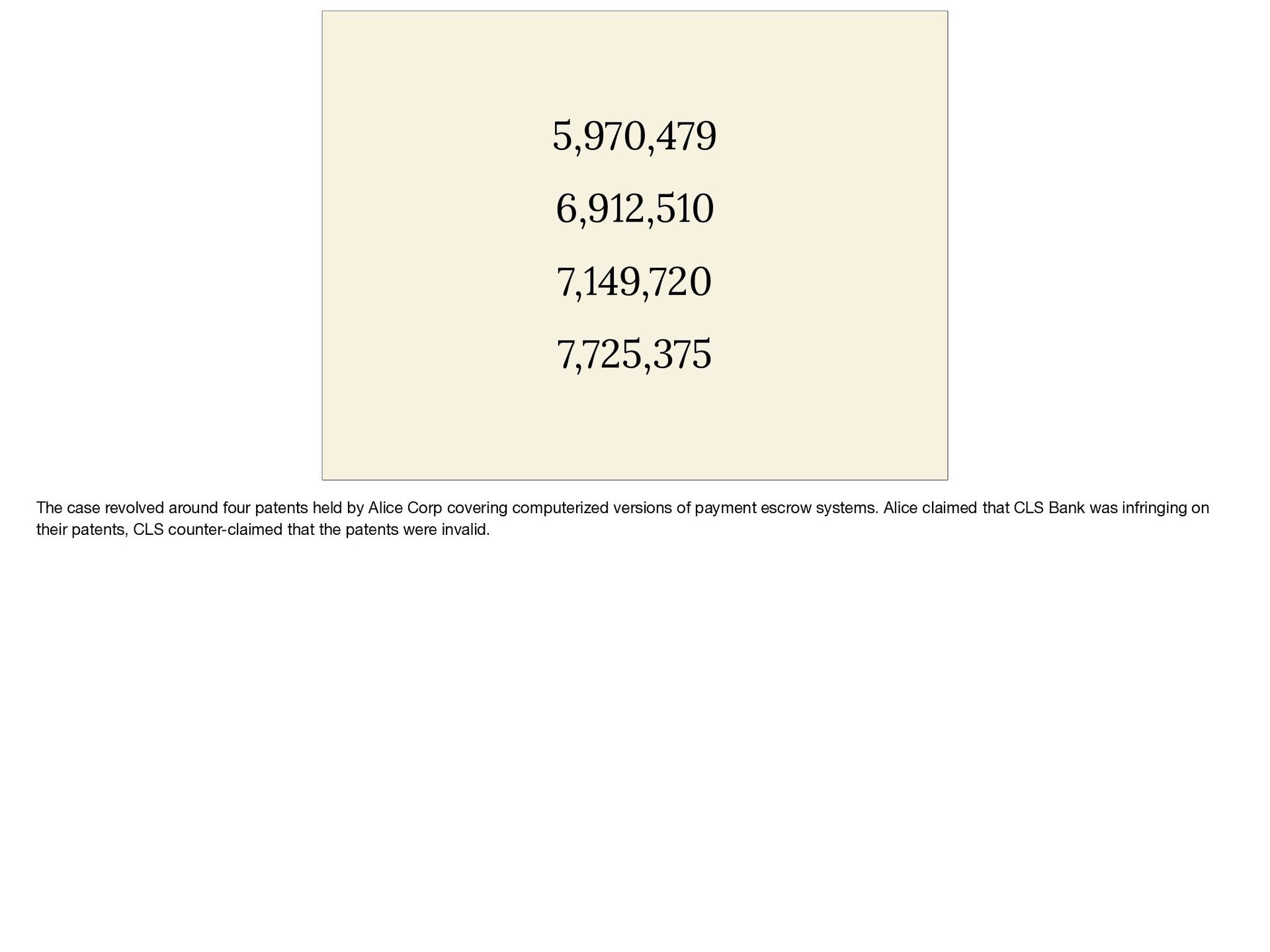
held by Alice Corp covering computerized versions of payment escrow systems. Alice claimed that CLS Bank was infringing on their patents, CLS counter-claimed that the patents were invalid.
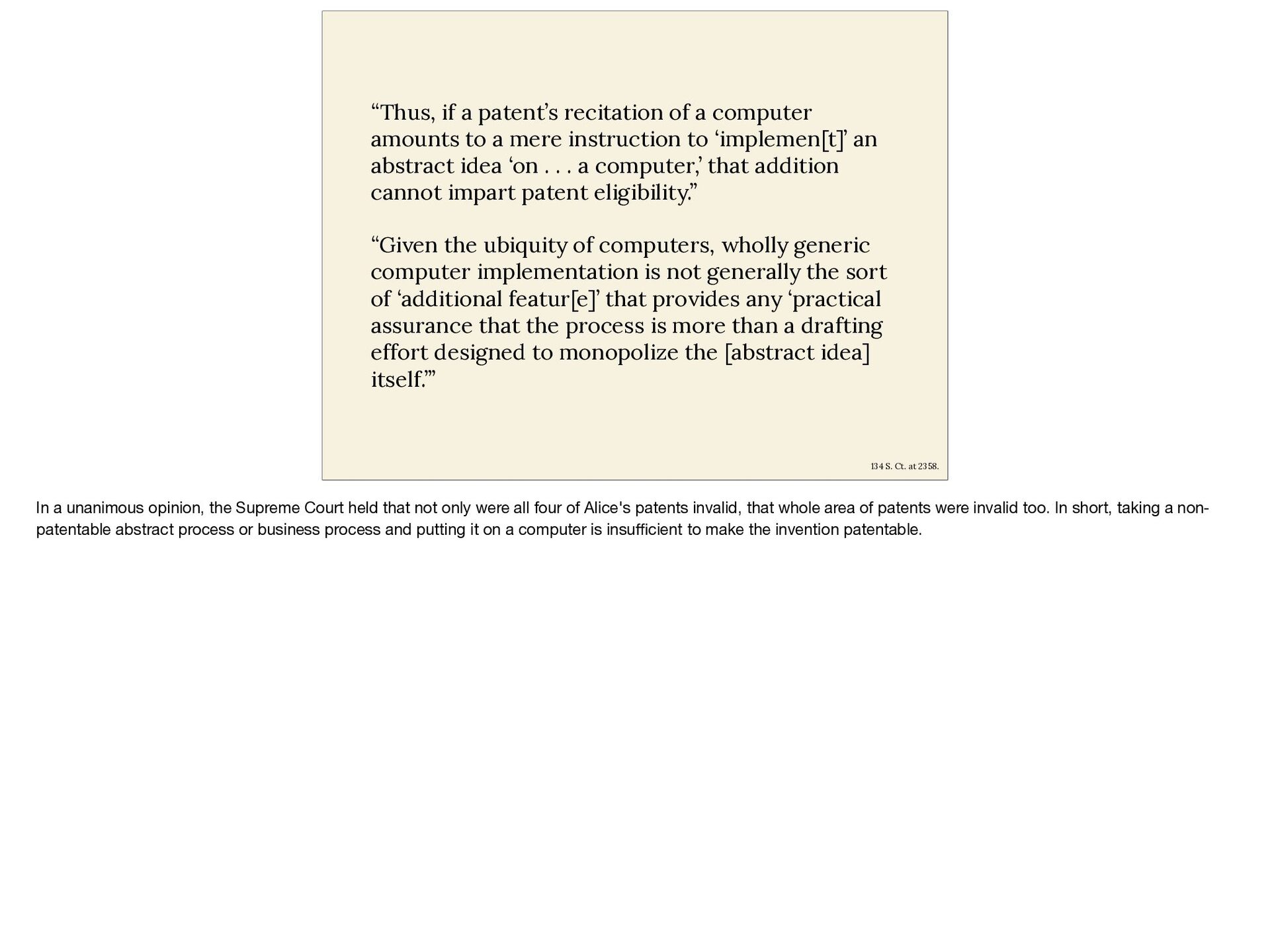
a mere instruction to ‘implemen[t]’ an abstract idea ‘on . . . a computer,’ that addition cannot impart patent eligibility.” “Given the ubiquity of computers, wholly generic computer implementation is not generally the sort of ‘additional featur[e]’ that provides any ‘practical assurance that the process is more than a drafting effort designed to monopolize the [abstract idea] itself.’” 134 S. Ct. at 2358. ffi In a unanimous opinion, the Supreme Court held that not only were all four of Alice's patents invalid, that whole area of patents were invalid too. In short, taking a nonpatentable abstract process or business process and putting it on a computer is insu cient to make the invention patentable.
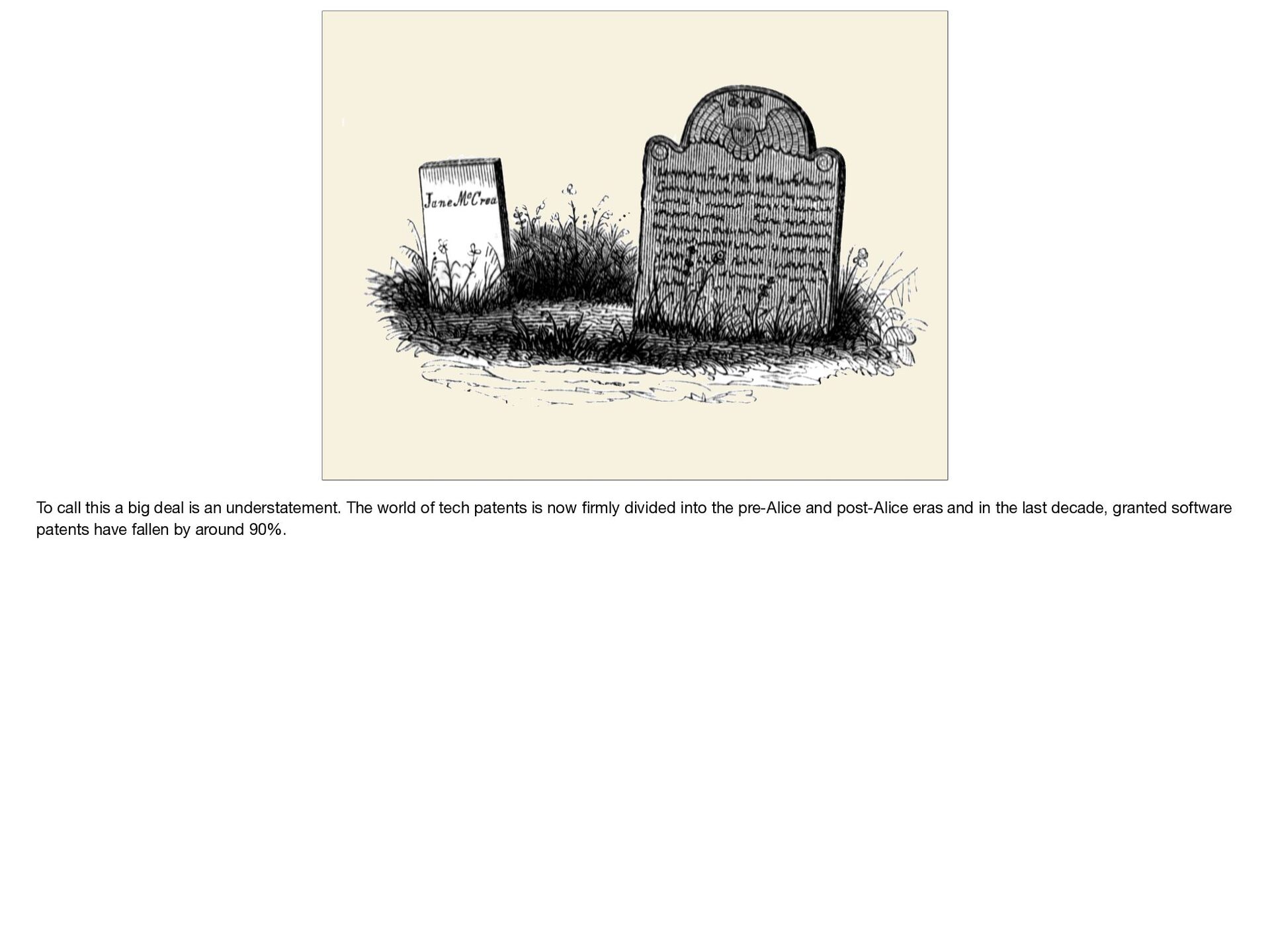
The world of tech patents is now rmly divided into the pre-Alice and post-Alice eras and in the last decade, granted software patents have fallen by around 90%.
about what kind of things are patentable, which is de ned in section 101 of the US Code. This "section 101 analysis" and accompanying "section 101 rejection" have become the new norm for software patents, with most being determined to not be a patentable subject matter.
only going to say trademarks from now on because they are basically the same thing, they protect brands. They identify the source of commercial goods and services so consumers can trust that a thing they purchase is what it says it is. This is a bit di erent from copyrights and patents as it isn't to encourage the creation of new works, but to encourage the creation of brands and thus facilitate commerce.
has a lot of value, people trust it to be a mostly correct encyclopedia and the Wikimedia foundation has put in a lot of work to develop positive feelings towards the brand.
sweet sweet donation cash. I know I can't copy the articles directly because they're protected by copyright, but what if I just name the site MyWikipedia and hope people think it's related to the real one.
i r f In The Wikimedia foundation would obviously not want me using their brand's good will and trust, and so would serve me with a well-deserved trademark infringement lawsuit.
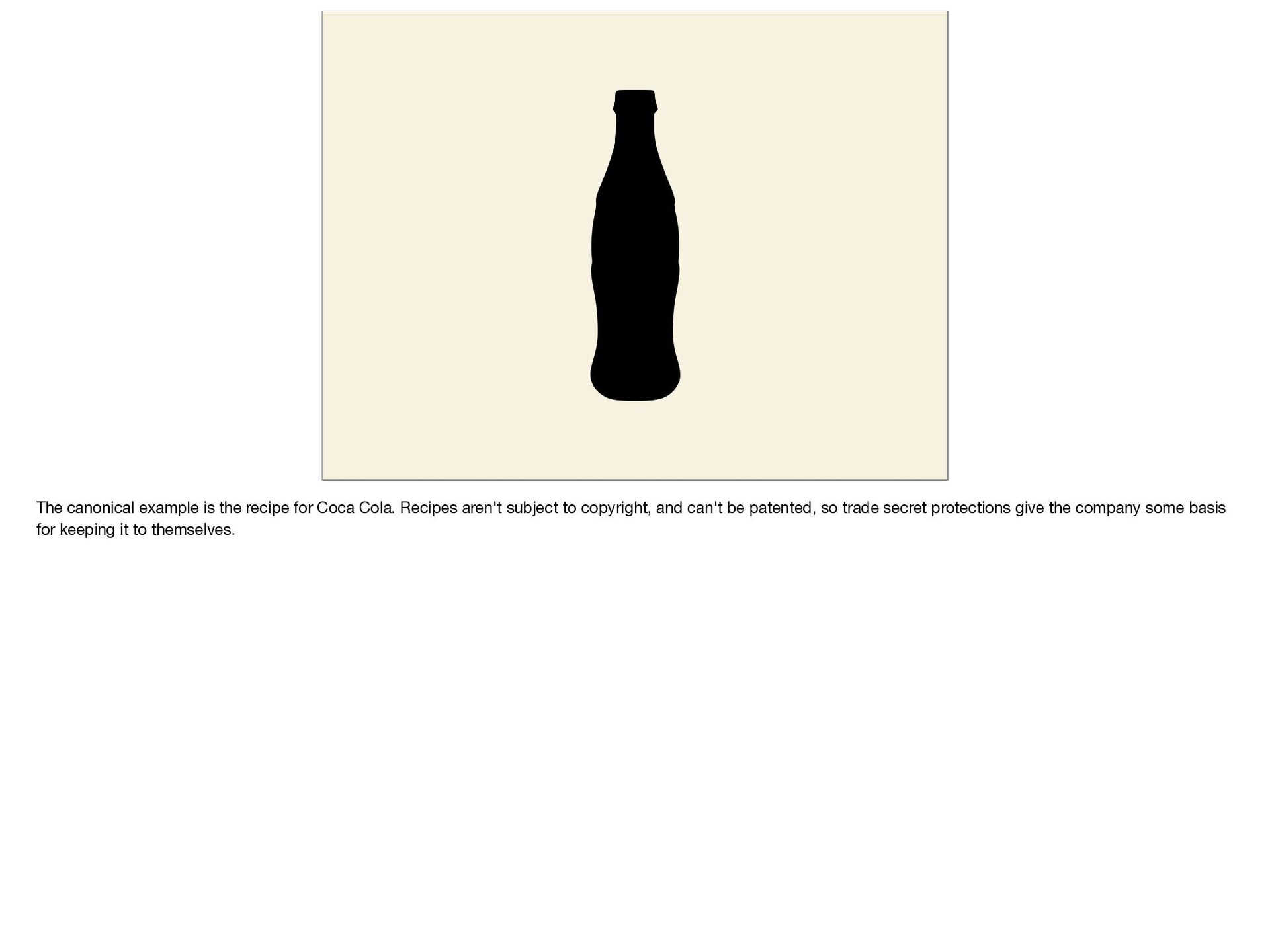
Sounds, shapes, scents 15 USC § 1052 So what can be a trademark? Just about anything. Most marks are words or graphical logos, but anything with a strong brand association can probably be a trademark. This includes the shape of the classic Coca-Cola bottle and MGM lion roar.
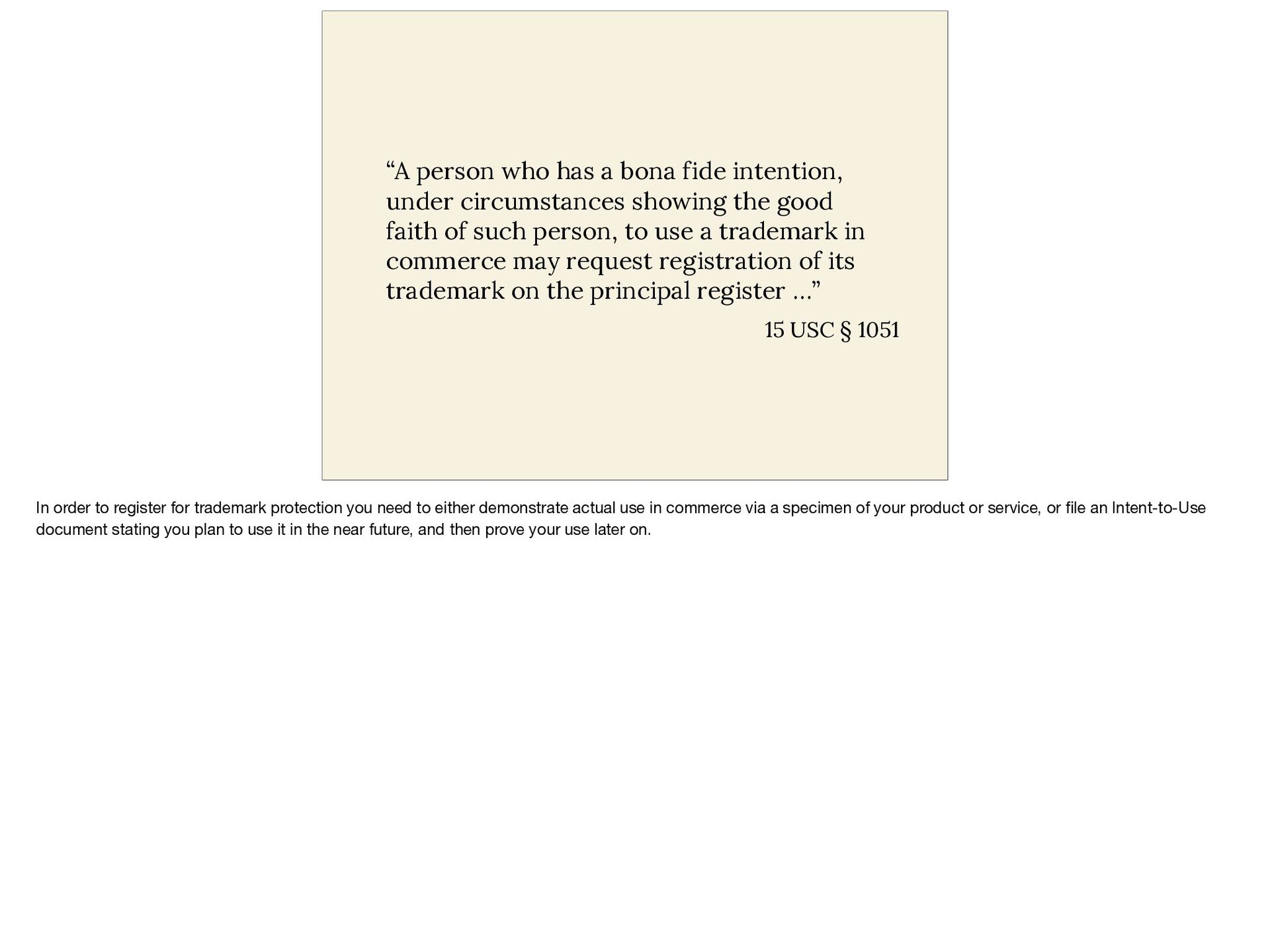
showing the good faith of such person, to use a trademark in commerce may request registration of its trademark on the principal register …” 15 USC § 1051 fi In order to register for trademark protection you need to either demonstrate actual use in commerce via a specimen of your product or service, or le an Intent-to-Use document stating you plan to use it in the near future, and then prove your use later on.
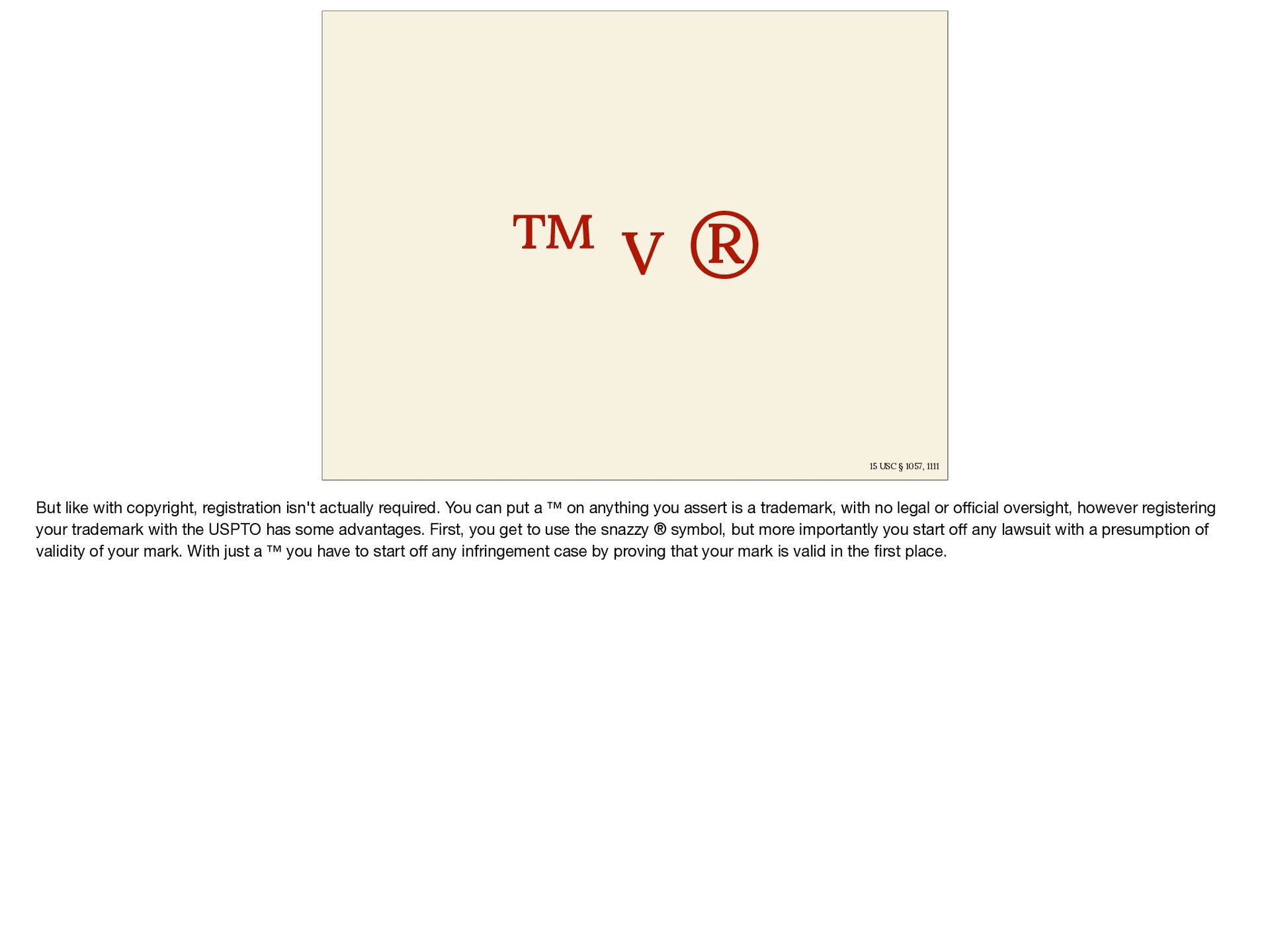
But like with copyright, registration isn't actually required. You can put a ™ on anything you assert is a trademark, with no legal or o cial oversight, however registering your trademark with the USPTO has some advantages. First, you get to use the snazzy ® symbol, but more importantly you start o any lawsuit with a presumption of validity of your mark. With just a ™ you have to start o any infringement case by proving that your mark is valid in the rst place.
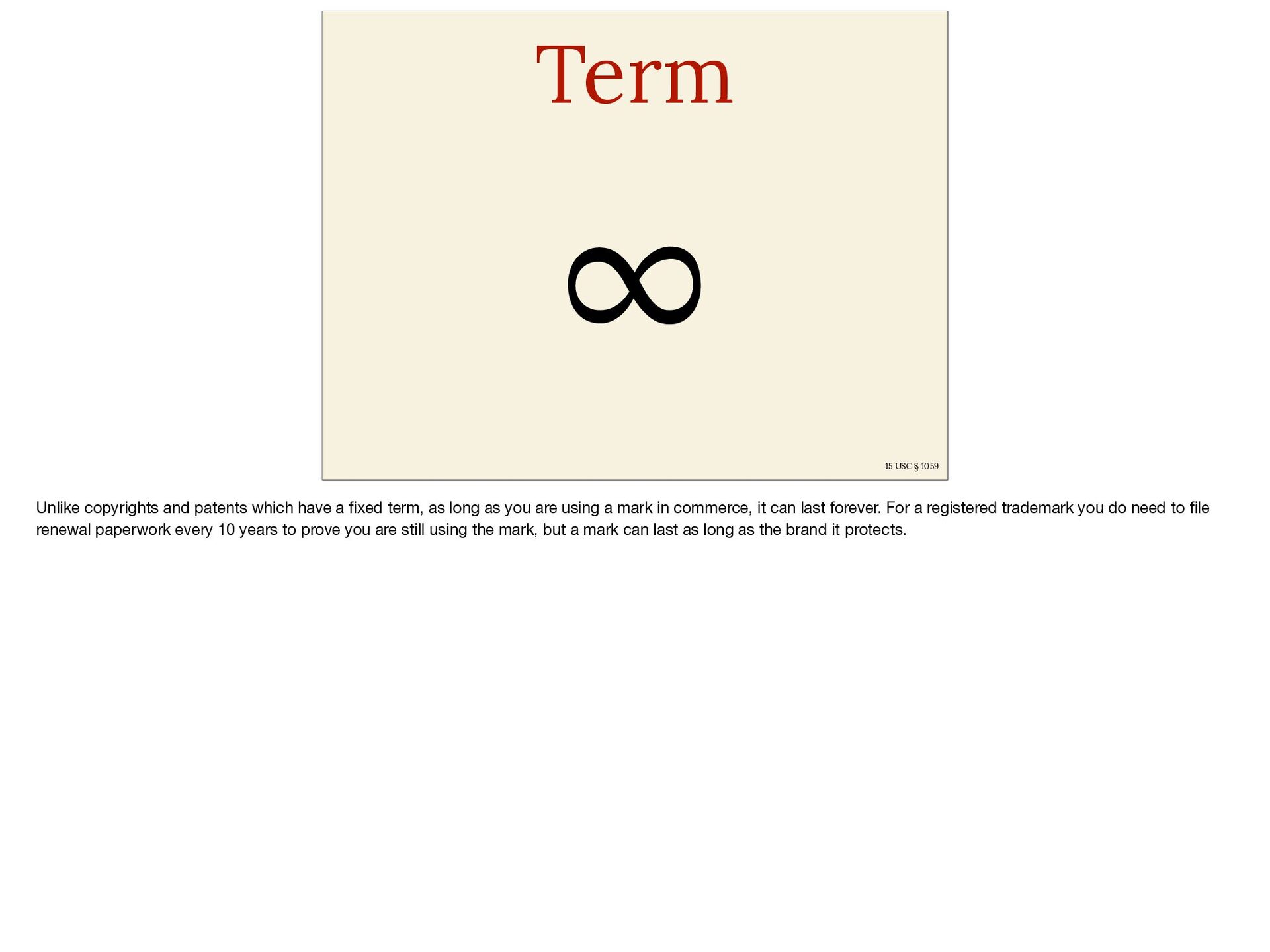
and patents which have a xed term, as long as you are using a mark in commerce, it can last forever. For a registered trademark you do need to le renewal paperwork every 10 years to prove you are still using the mark, but a mark can last as long as the brand it protects.
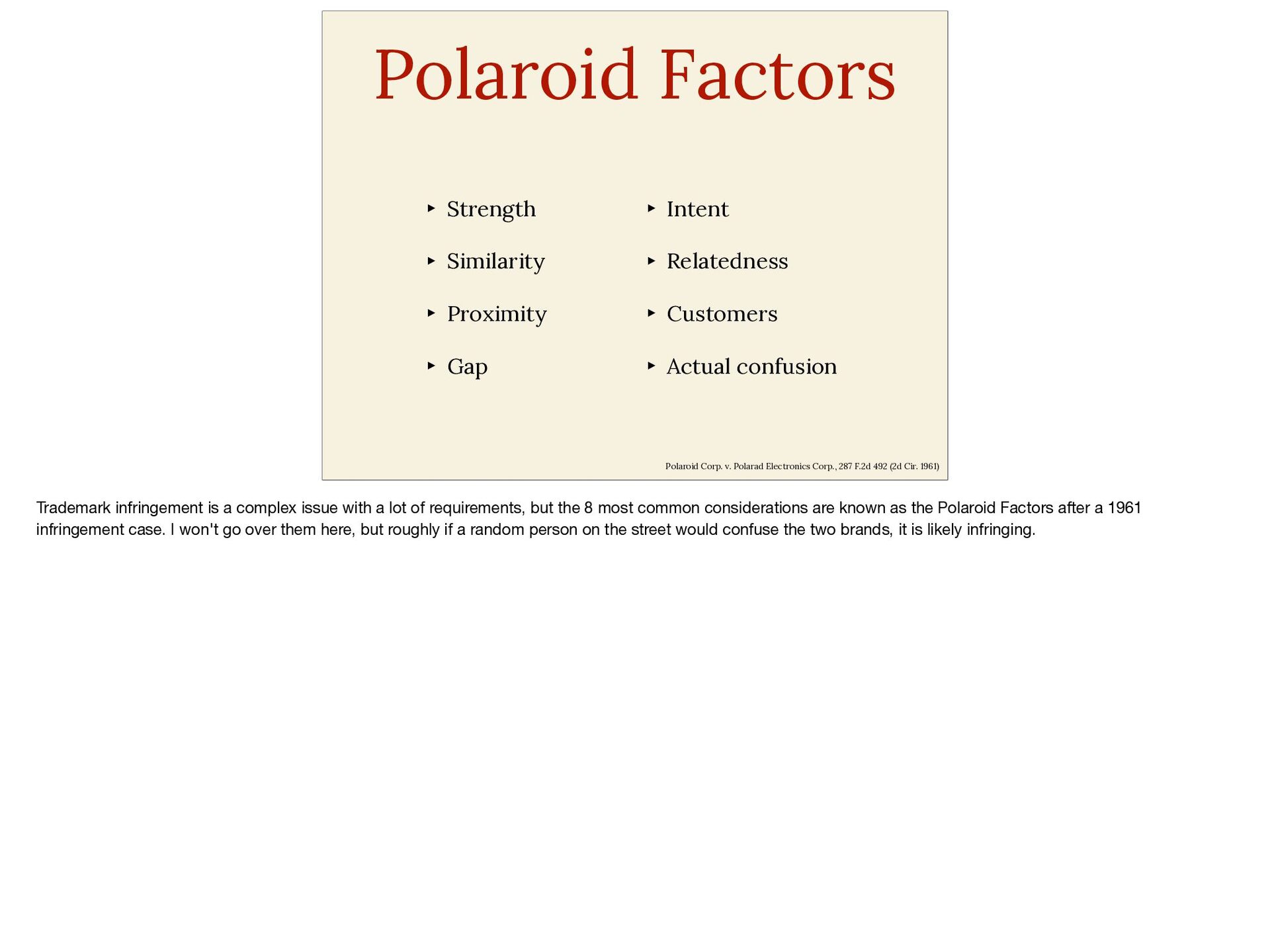
‣ Proximity ‣ Customers ‣ Gap ‣ Actual confusion Polaroid Corp. v. Polarad Electronics Corp., 287 F.2d 492 (2d Cir. 1961) Trademark infringement is a complex issue with a lot of requirements, but the 8 most common considerations are known as the Polaroid Factors after a 1961 infringement case. I won't go over them here, but roughly if a random person on the street would confuse the two brands, it is likely infringing.
may have seen in connection with trademarks is the concept of dilution, or the idea that a mark must be actively defended via litigation to remain valid. This is technically correct, and there are real cases where valuable trademarks have been lost due to dilution like aspirin or escalator, however it is a lot more rare than some news outlets make it sound. As in less than a hundred cases in the history of US trademark law. This is, for example, why Google continues to insist they are not a verb.
technical, economic, or engineering information …” ‣ “… the owner thereof has taken reasonable measures to keep such information secret …” ‣ “… the information derives independent economic value, actual or potential, from not being generally known …” 18 USC § 1839 Very simply, trade secret law protects things you don't want to disclose but are still valuable. Of course you can't make something a secret again, but this gives you a legal basis to sue the leaker.
to qualify as a trade secret, you do need to demonstrate "reasonable measures" taken to ensure it is kept secret. So this isn't a catch all for things you would prefer not be shared.
rst place? If you remember back to the copyright section, by default all rights stay with the owner of the copyright. In practical terms this means that code put somewhere public probably can't be actually used by anyone else in the same way that you can't walk in to an art gallery and start making t-shirts of their copyrighted paintings.
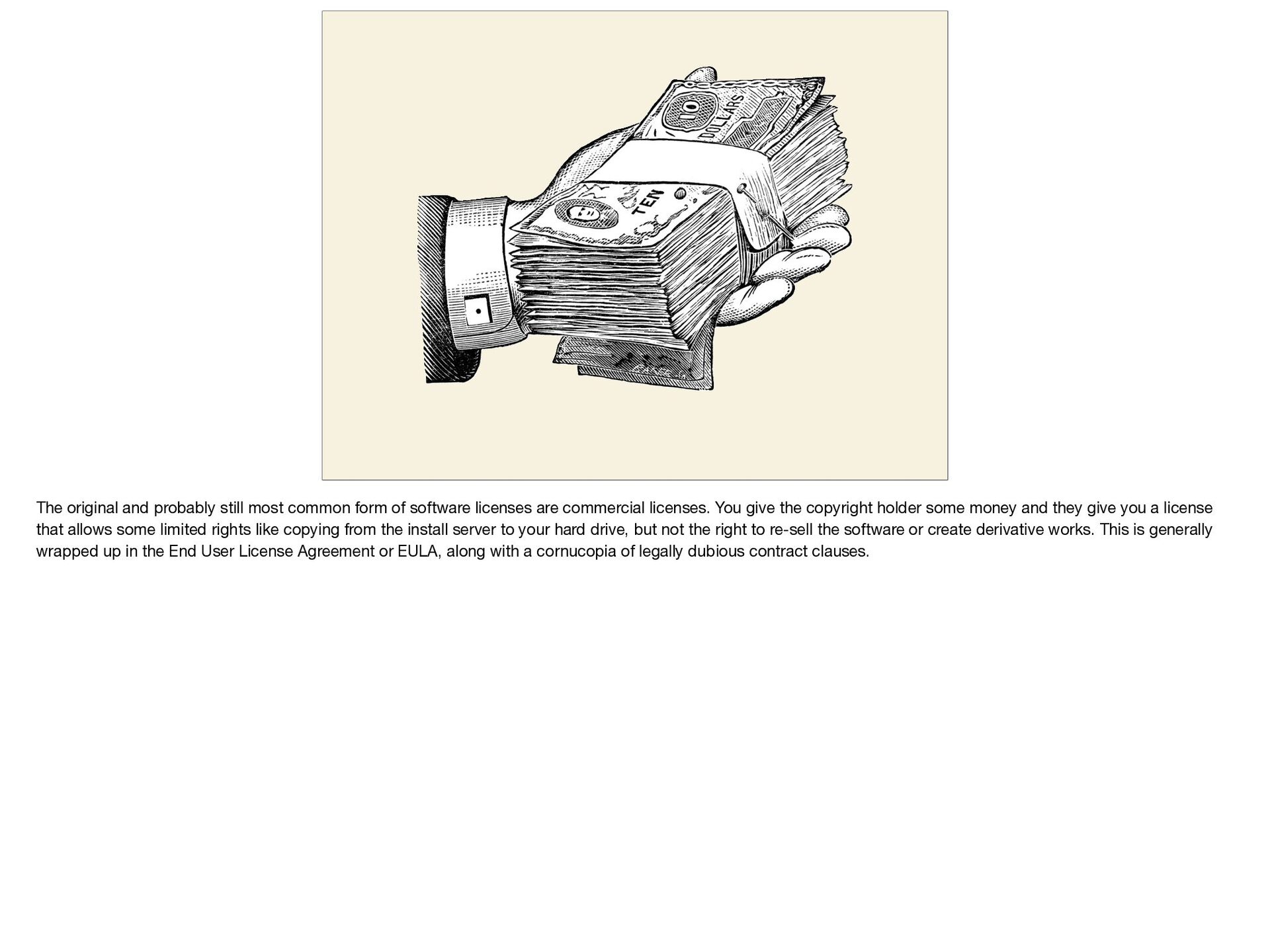
licenses are commercial licenses. You give the copyright holder some money and they give you a license that allows some limited rights like copying from the install server to your hard drive, but not the right to re-sell the software or create derivative works. This is generally wrapped up in the End User License Agreement or EULA, along with a cornucopia of legally dubious contract clauses.
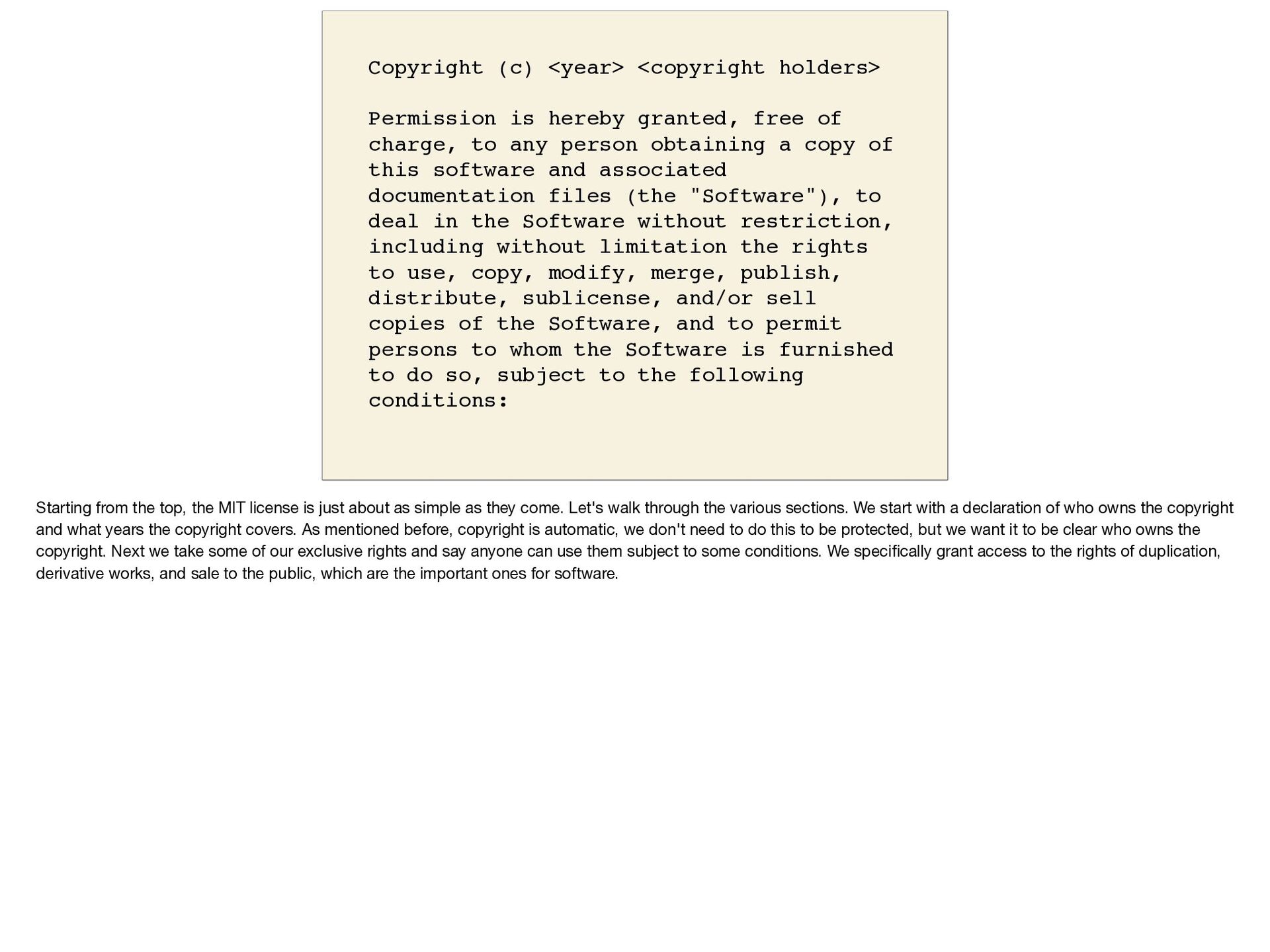
of charge, to any person obtaining a copy of this software and associated documentation files (the "Software"), to deal in the Software without restriction, including without limitation the rights to use, copy, modify, merge, publish, distribute, sublicense, and/or sell copies of the Software, and to permit persons to whom the Software is furnished to do so, subject to the following conditions: fi Starting from the top, the MIT license is just about as simple as they come. Let's walk through the various sections. We start with a declaration of who owns the copyright and what years the copyright covers. As mentioned before, copyright is automatic, we don't need to do this to be protected, but we want it to be clear who owns the copyright. Next we take some of our exclusive rights and say anyone can use them subject to some conditions. We speci cally grant access to the rights of duplication, derivative works, and sale to the public, which are the important ones for software.
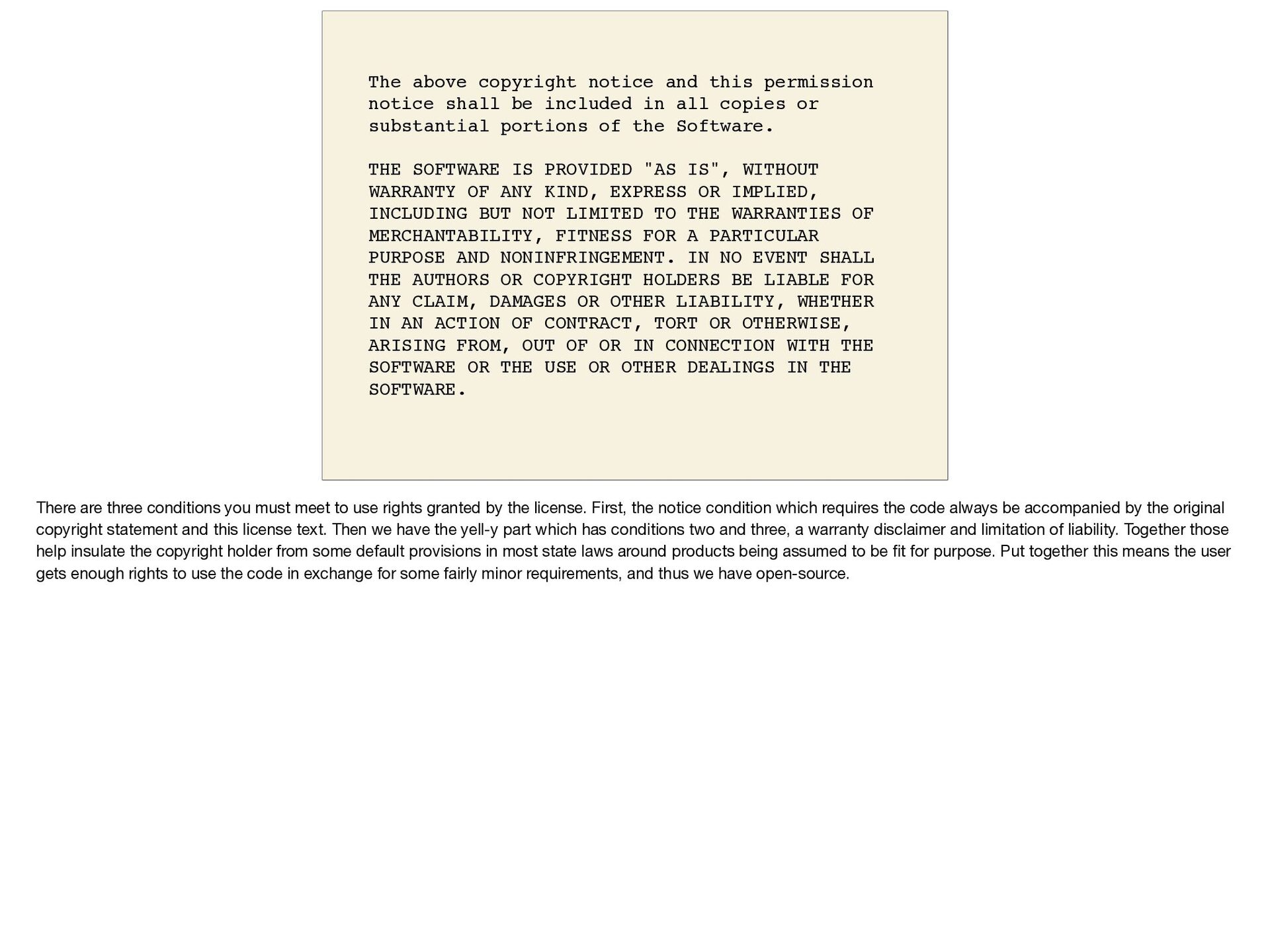
included in all copies or substantial portions of the Software. THE SOFTWARE IS PROVIDED "AS IS", WITHOUT WARRANTY OF ANY KIND, EXPRESS OR IMPLIED, INCLUDING BUT NOT LIMITED TO THE WARRANTIES OF MERCHANTABILITY, FITNESS FOR A PARTICULAR PURPOSE AND NONINFRINGEMENT. IN NO EVENT SHALL THE AUTHORS OR COPYRIGHT HOLDERS BE LIABLE FOR ANY CLAIM, DAMAGES OR OTHER LIABILITY, WHETHER IN AN ACTION OF CONTRACT, TORT OR OTHERWISE, ARISING FROM, OUT OF OR IN CONNECTION WITH THE SOFTWARE OR THE USE OR OTHER DEALINGS IN THE SOFTWARE. fi There are three conditions you must meet to use rights granted by the license. First, the notice condition which requires the code always be accompanied by the original copyright statement and this license text. Then we have the yell-y part which has conditions two and three, a warranty disclaimer and limitation of liability. Together those help insulate the copyright holder from some default provisions in most state laws around products being assumed to be t for purpose. Put together this means the user gets enough rights to use the code in exchange for some fairly minor requirements, and thus we have open-source.
the MIT license is "what about BSD?". The BSD family of licenses are minimalist like MIT, but adding one or two extra conditions around publicity and advertising.
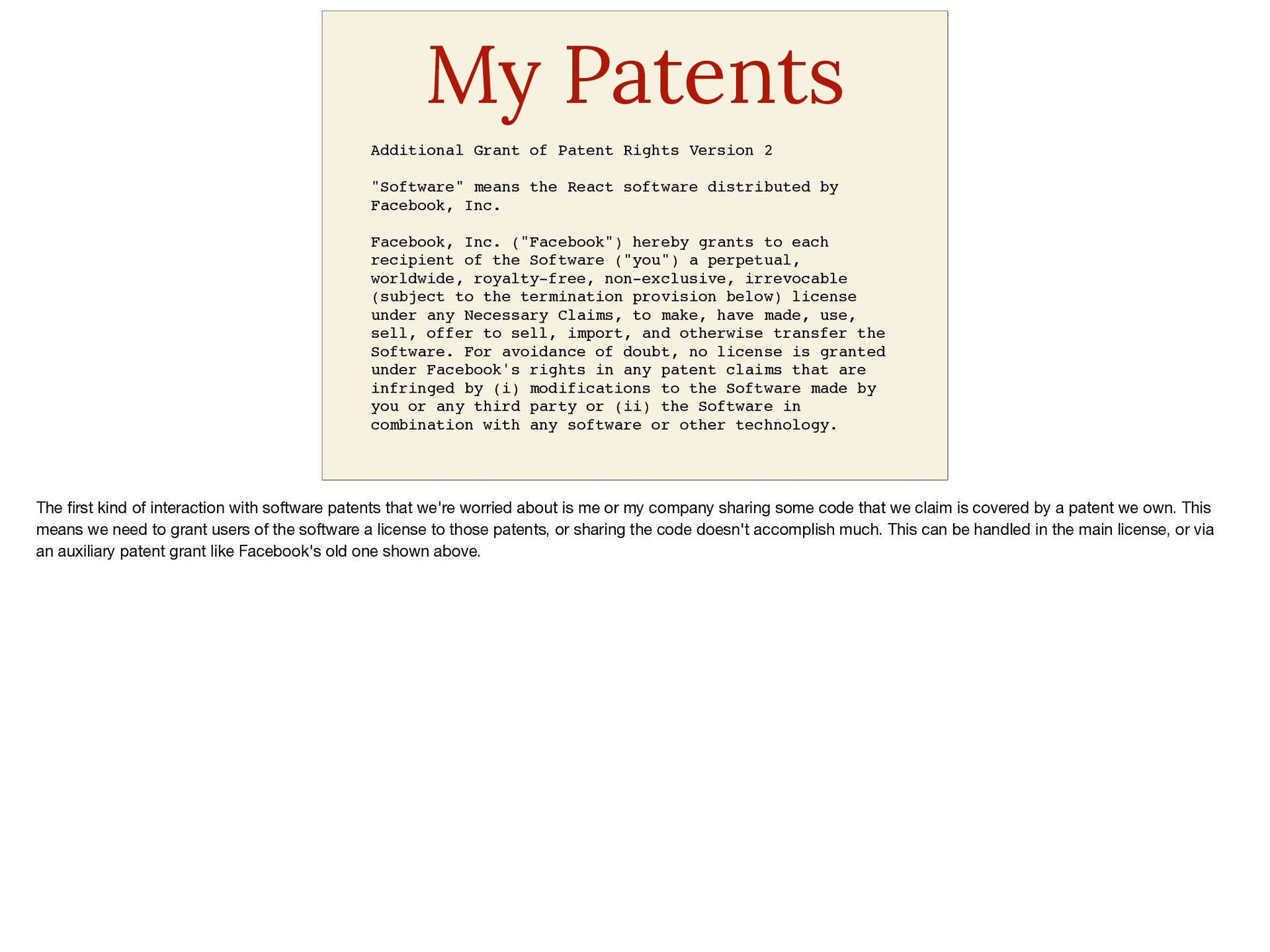
means the React software distributed by Facebook, Inc. Facebook, Inc. ("Facebook") hereby grants to each recipient of the Software ("you") a perpetual, worldwide, royalty-free, non-exclusive, irrevocable (subject to the termination provision below) license under any Necessary Claims, to make, have made, use, sell, offer to sell, import, and otherwise transfer the Software. For avoidance of doubt, no license is granted under Facebook's rights in any patent claims that are infringed by (i) modifications to the Software made by you or any third party or (ii) the Software in combination with any software or other technology. fi The rst kind of interaction with software patents that we're worried about is me or my company sharing some code that we claim is covered by a patent we own. This means we need to grant users of the software a license to those patents, or sharing the code doesn't accomplish much. This can be handled in the main license, or via an auxiliary patent grant like Facebook's old one shown above.
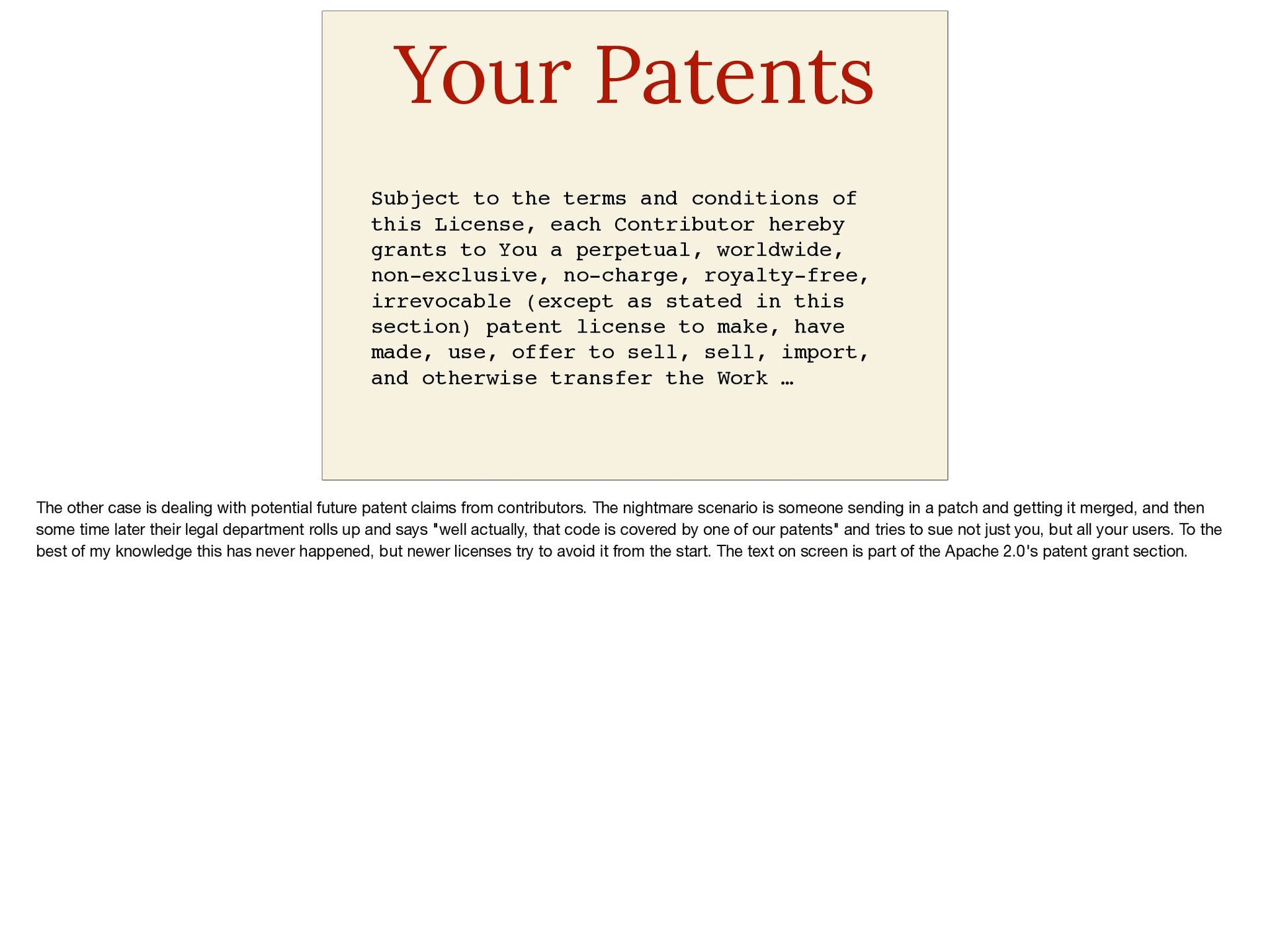
License, each Contributor hereby grants to You a perpetual, worldwide, non-exclusive, no-charge, royalty-free, irrevocable (except as stated in this section) patent license to make, have made, use, offer to sell, sell, import, and otherwise transfer the Work … The other case is dealing with potential future patent claims from contributors. The nightmare scenario is someone sending in a patch and getting it merged, and then some time later their legal department rolls up and says "well actually, that code is covered by one of our patents" and tries to sue not just you, but all your users. To the best of my knowledge this has never happened, but newer licenses try to avoid it from the start. The text on screen is part of the Apache 2.0's patent grant section.
more recent creation than MIT or BSD. It has the patent clause as well as trademark licensing, more precise de nitions of the rights assigned, and has some text around contributor licensing. Like MIT and BSD, it still puts few requirements on any derivative works other than that they maintain attribution and the license text.
of copyleft is a license which allows derivative works but requires those new works to be licensed similarly to the original. Compare this to the MIT license we just saw which grants the right to create derivative works but says nothing about what those look like. This philosophy has led to a whole family of copyleft licenses, mostly varying on what constitutes a derived work and who must be permitted access to source code.
the GNU General Public License, which requires all derivative works be licensed under the GPL or a compatible license and that anyone with access to the software must be provided with the source code if they request it.
of fear and confusion, so let's talk about the two main ones. The rst is the viral condition shared with other copyleft licenses. This means that any derivative or combined work that is based on GPL code must be distributed under a license that places no more restrictions on the user than the GPL license itself. Unfortunately exactly what quali es as a derived work is complex.
under the GPL and modifying it, that is unambiguously a derived work. The tricky cases are linking. The creators of the GPL insist that any linking, static or dynamic, between software components creates a derived work, but that network or le I/O does not.
LGPL, which speci cally allows linking as creating a non-derivative work. That means any modi cations to the library itself need to be GPL compatible but use of the library without modi cation does not.
concrete or permanent ‘form.’ ” Lewis Galoob Toys, Inc. v. Nintendo of America, Inc., 780 F. Supp. 1283 - Dist. Court, ND California 1991 fl Oddly enough the most applicable case law comes from the decision in the case Galoob Toys v Nintendo of America where Nintendo tried to assert that the game genie created a derivative work on the y and thus infringed on their copyright. The court held that no, it didn't. This certainly detracts from the FSF's claim that linking against a GPL library creates a derived work, which would mean it's far less viral than pitched. As always, only a judge can say for sure.
says that any user of GPL'd tools must be able to request the complete source code for software they are using. This ensures the user always has the freedom to modify those tools. With the GPL itself this only applies to people with access to the actual binaries, but another license, the A ero GPL or AGPL, extends it to anyone using a service over the network too.
we've seen a lot of new licenses which break from the normal open-source traditions. Licenses like the Business Software License and Server Side Public License allow access and modi cation to the source code, but have additional restrictions such as reserving the rights to operate a hosted version of the software commercially. Because of these restrictions, these licenses con ict with the de nition of "open source" used by many projects which has created a lot of community friction. But the economic realities of small open-source teams getting scooped by megacorps are also hard to ignore.
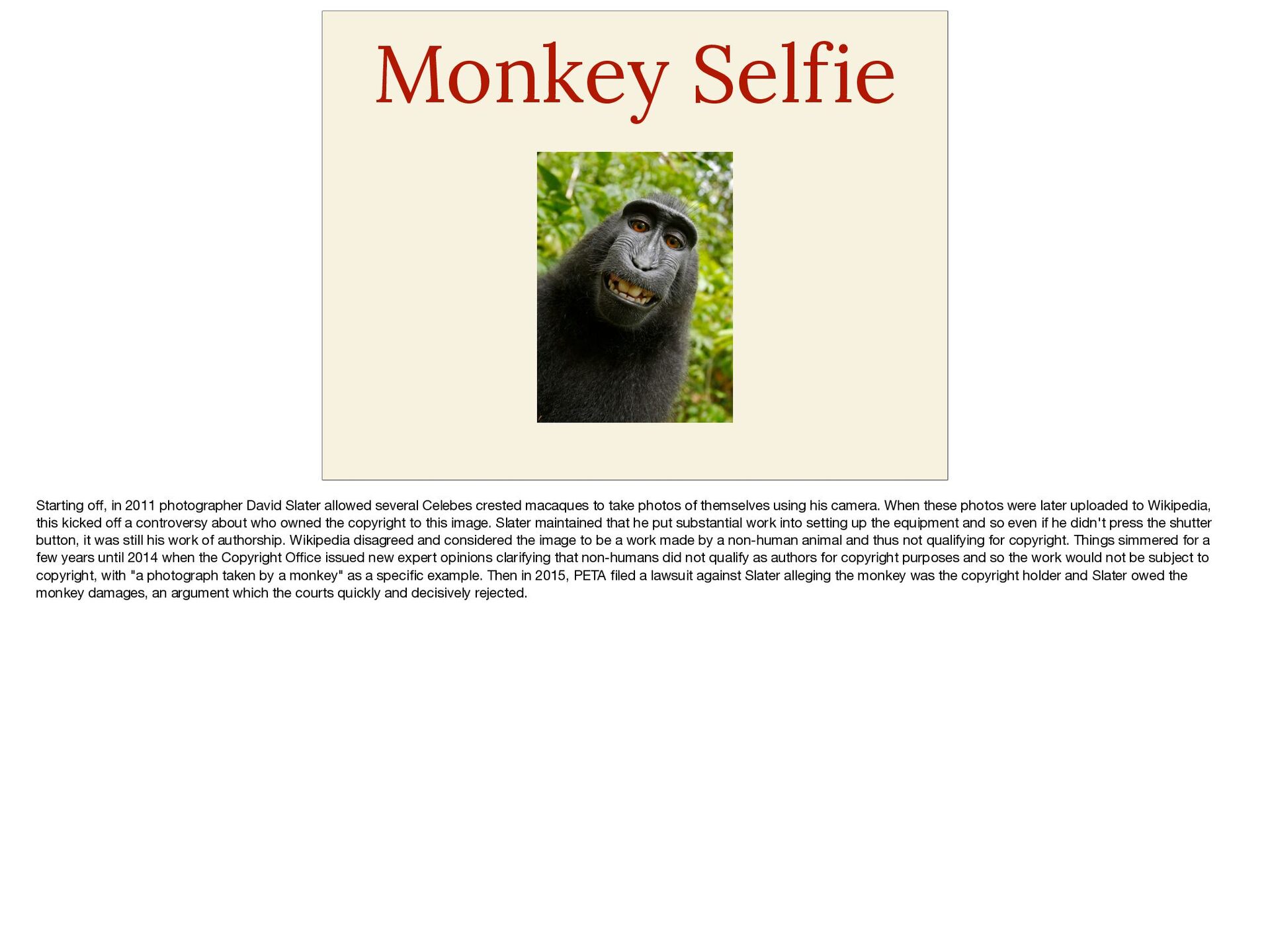
in 2011 photographer David Slater allowed several Celebes crested macaques to take photos of themselves using his camera. When these photos were later uploaded to Wikipedia, this kicked o a controversy about who owned the copyright to this image. Slater maintained that he put substantial work into setting up the equipment and so even if he didn't press the shutter button, it was still his work of authorship. Wikipedia disagreed and considered the image to be a work made by a non-human animal and thus not qualifying for copyright. Things simmered for a few years until 2014 when the Copyright O ce issued new expert opinions clarifying that non-humans did not qualify as authors for copyright purposes and so the work would not be subject to copyright, with "a photograph taken by a monkey" as a speci c example. Then in 2015, PETA led a lawsuit against Slater alleging the monkey was the copyright holder and Slater owed the monkey damages, an argument which the courts quickly and decisively rejected.
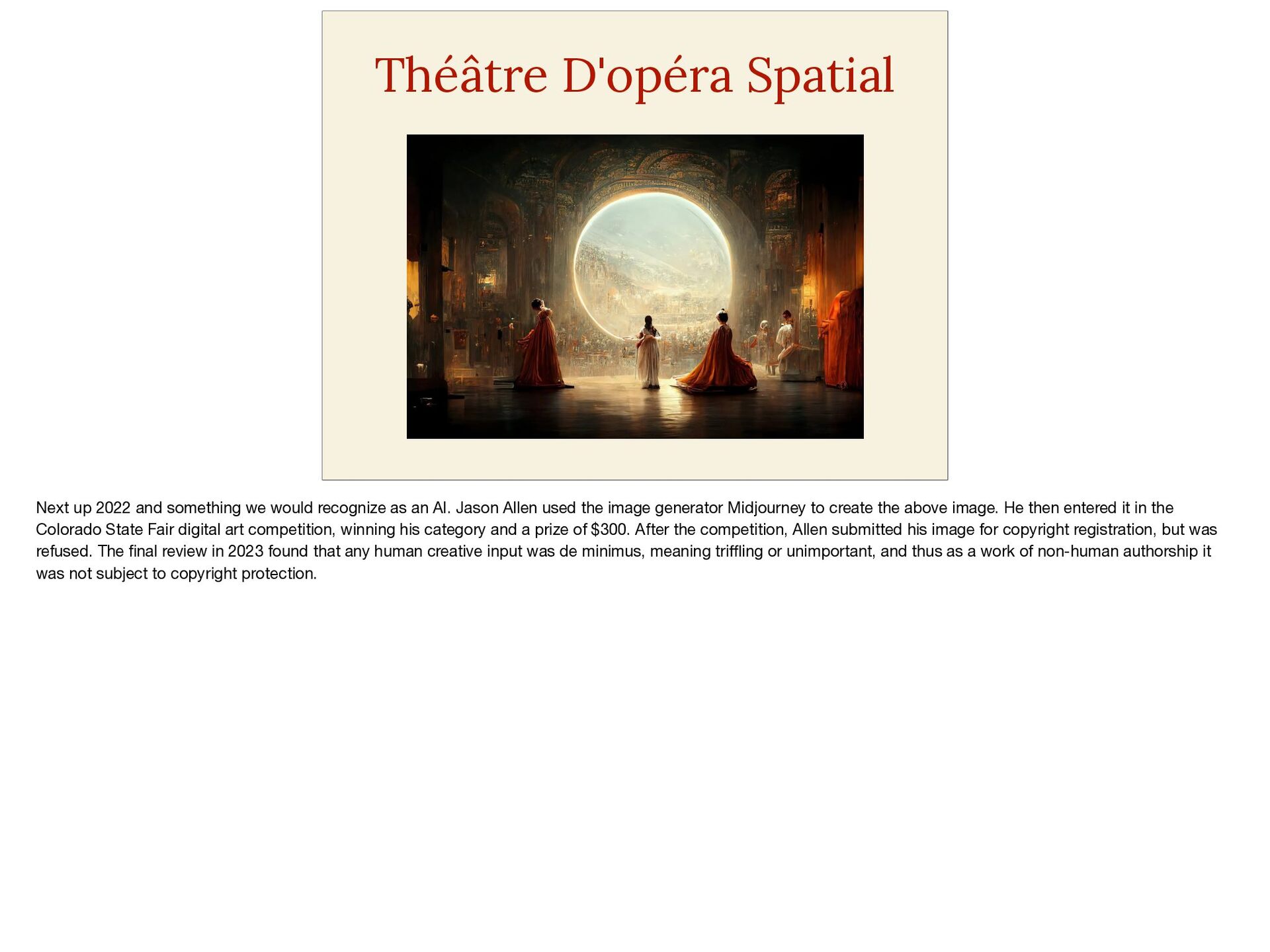
we would recognize as an AI. Jason Allen used the image generator Midjourney to create the above image. He then entered it in the Colorado State Fair digital art competition, winning his category and a prize of $300. After the competition, Allen submitted his image for copyright registration, but was refused. The nal review in 2023 found that any human creative input was de minimus, meaning tri ing or unimportant, and thus as a work of non-human authorship it was not subject to copyright protection.
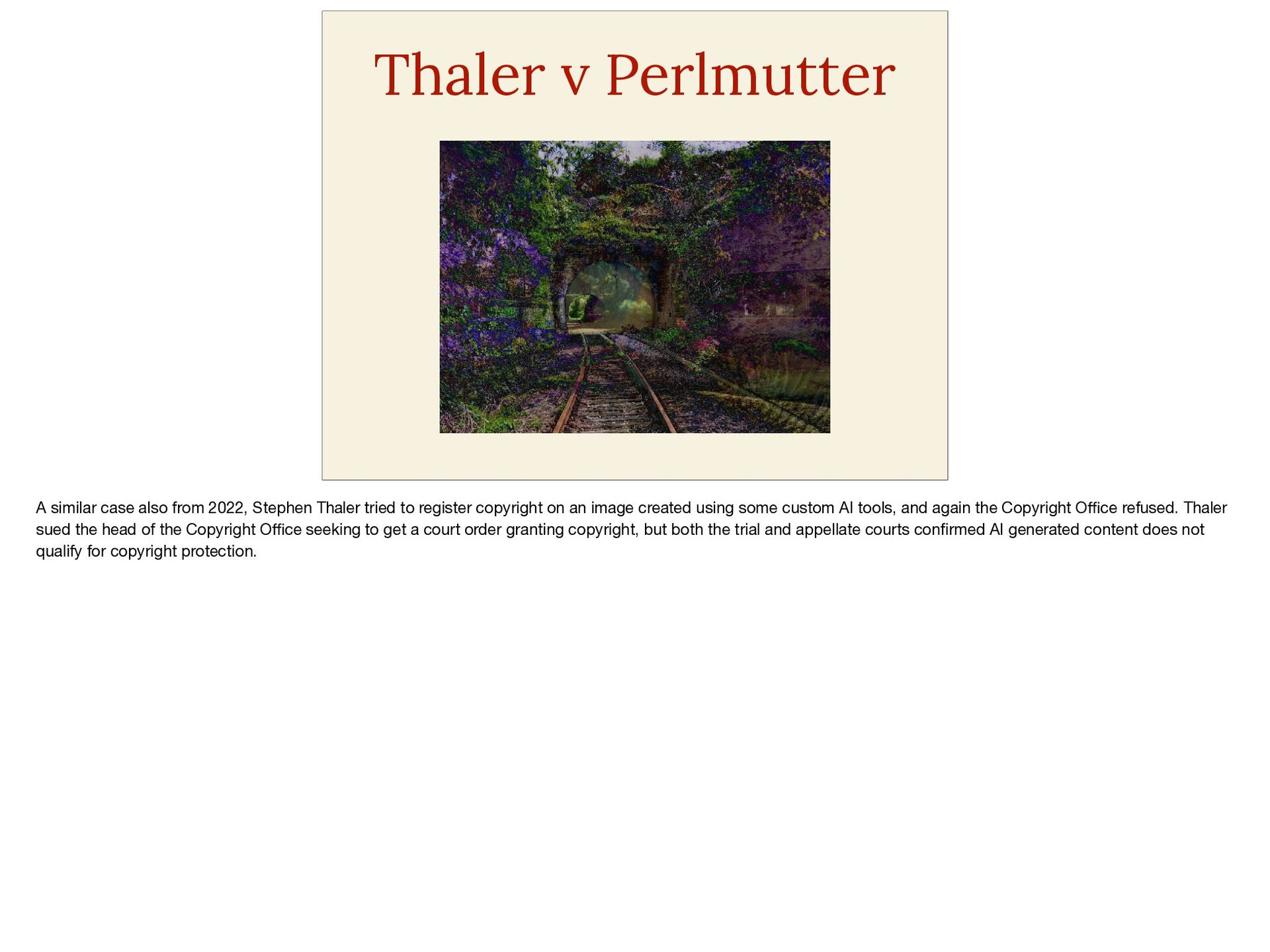
from 2022, Stephen Thaler tried to register copyright on an image created using some custom AI tools, and again the Copyright O ce refused. Thaler sued the head of the Copyright O ce seeking to get a court order granting copyright, but both the trial and appellate courts con rmed AI generated content does not qualify for copyright protection.
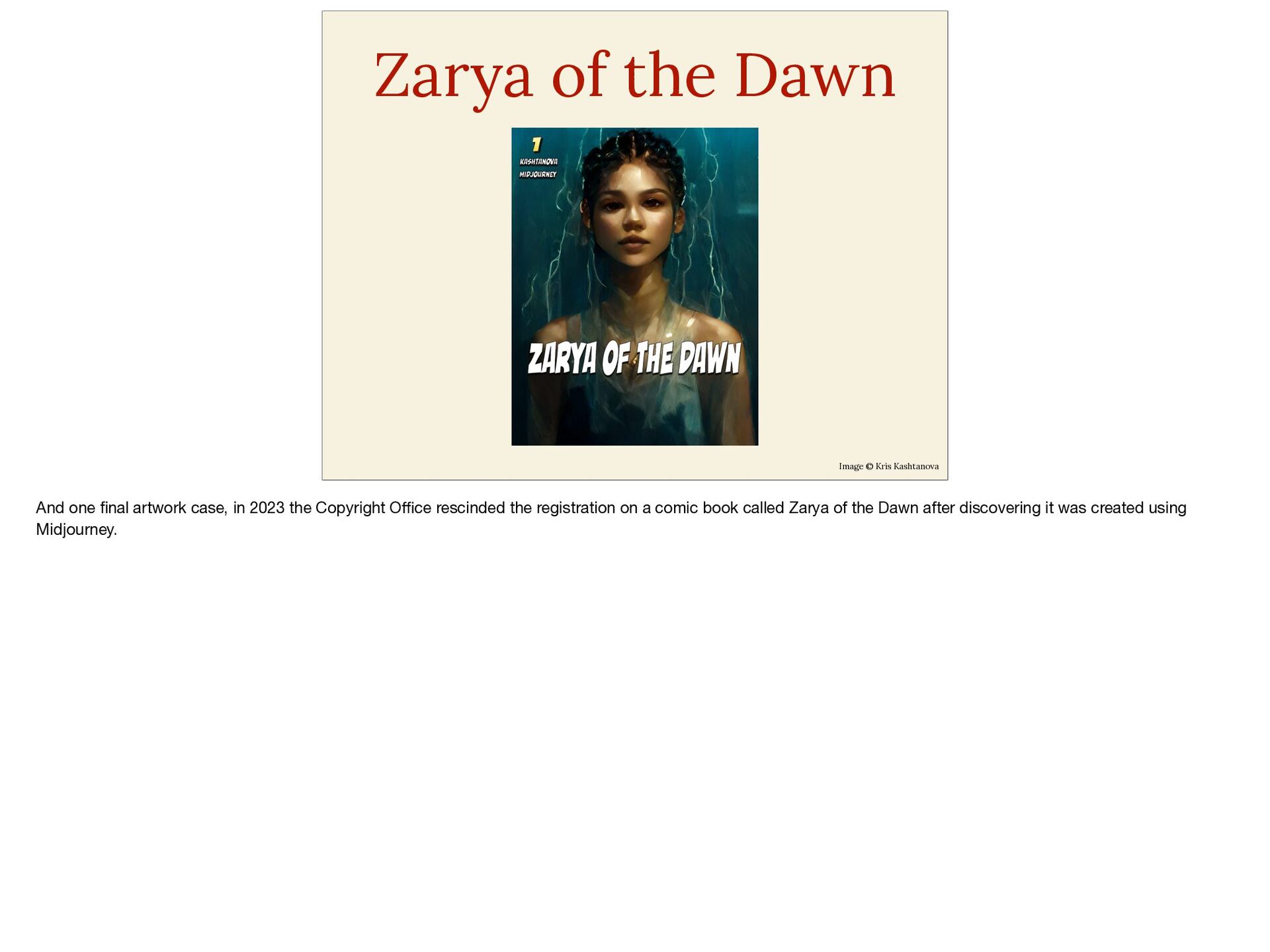
And one nal artwork case, in 2023 the Copyright O ce rescinded the registration on a comic book called Zarya of the Dawn after discovering it was created using Midjourney.
the author of the Work’s text as well as the selection, coordination, and arrangement of the Work’s written and visual elements. That authorship is protected by copyright. However, as discussed below, the images in the Work that were generated by the Midjourney technology are not the product of human authorship.” Re: Zarya of the Dawn (Registration # VAu001480196) After some back and forth the copyright was reinstated but _only_ for the human-written text and composition, not any of the images. While not case law, this does support the position that mixed AI and human works can be partially protected.
alone do not provide sufficient human control to make users of an AI system the authors of the output. Prompts essentially function as instructions that convey unprotectible ideas. While highly detailed prompts could contain the user’s desired expressive elements, at present they do not control how the AI system processes them in generating the output. Copyright and Artificial Intelligence, Part 2: Copyrightability, USCO ffi fi ffi The most recent guidance published by the Copyright O ce in 2025 lays out a few general principles. In the opinion of the Copyright O ce, prompts alone do not create a work of authorship as they are too malleable and a single prompt can generate a nearly in nite number of possible outputs.
audio, video, or a combination of these mediums. Some systems—whether via tools, settings, or prompts—allow inputs to be substantially retained as part of the output. [...], where a human inputs their own copyrightable work and that work is perceptible in the output, they will be the author of at least that portion of the output. Their own creative expression will be protected by copyright, with a scope analogous to that in a derivative work. Copyright and Artificial Intelligence, Part 2: Copyrightability, USCO fi fi They also outlined a rough framework where some inputs to AI tools which are much rmer than prompts, such as inputing a sketch or text le, can result in a partially copyrightable work. But only on the elements which came originally from the human.
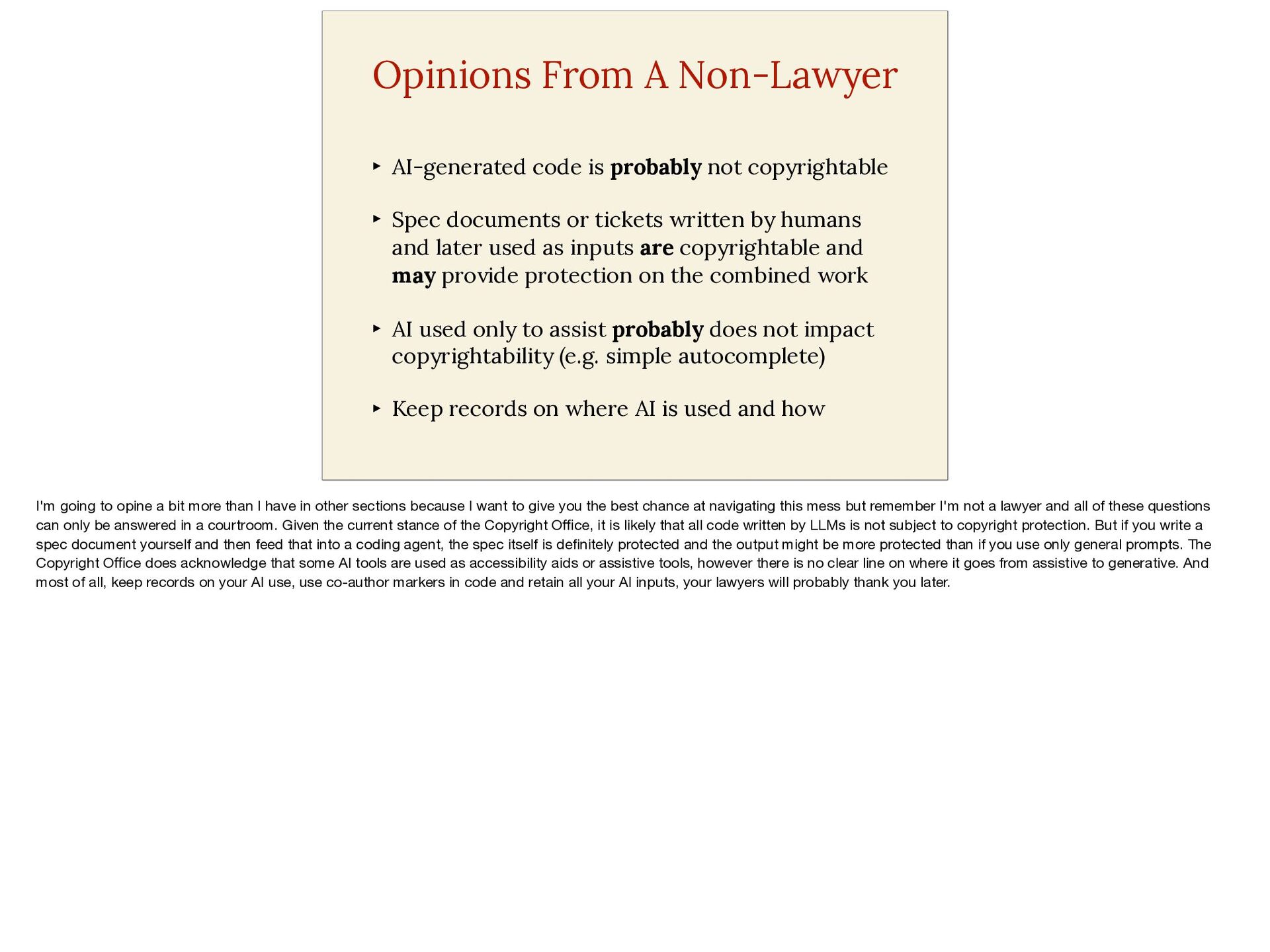
copyrightable ‣ Spec documents or tickets written by humans and later used as inputs are copyrightable and may provide protection on the combined work ‣ AI used only to assist probably does not impact copyrightability (e.g. simple autocomplete) ‣ Keep records on where AI is used and how fi ffi ffi I'm going to opine a bit more than I have in other sections because I want to give you the best chance at navigating this mess but remember I'm not a lawyer and all of these questions can only be answered in a courtroom. Given the current stance of the Copyright O ce, it is likely that all code written by LLMs is not subject to copyright protection. But if you write a spec document yourself and then feed that into a coding agent, the spec itself is de nitely protected and the output might be more protected than if you use only general prompts. The Copyright O ce does acknowledge that some AI tools are used as accessibility aids or assistive tools, however there is no clear line on where it goes from assistive to generative. And most of all, keep records on your AI use, use co-author markers in code and retain all your AI inputs, your lawyers will probably thank you later.
code doesn't need to be protected by copyright to be useful, you could dedicate every line of your software to the public domain and it will still run just ne. Copyright is how we protect ourselves. If someone breaks into your private repository and posts everything for public download, it's copyright that lets you sue them. Similarly copyleft only works so long as the user requires a license grant to access the rights, if not for copyright they have no obligation to follow your terms. Maybe none of that matters to you, but it's dangerous and mostly unexplored territory.
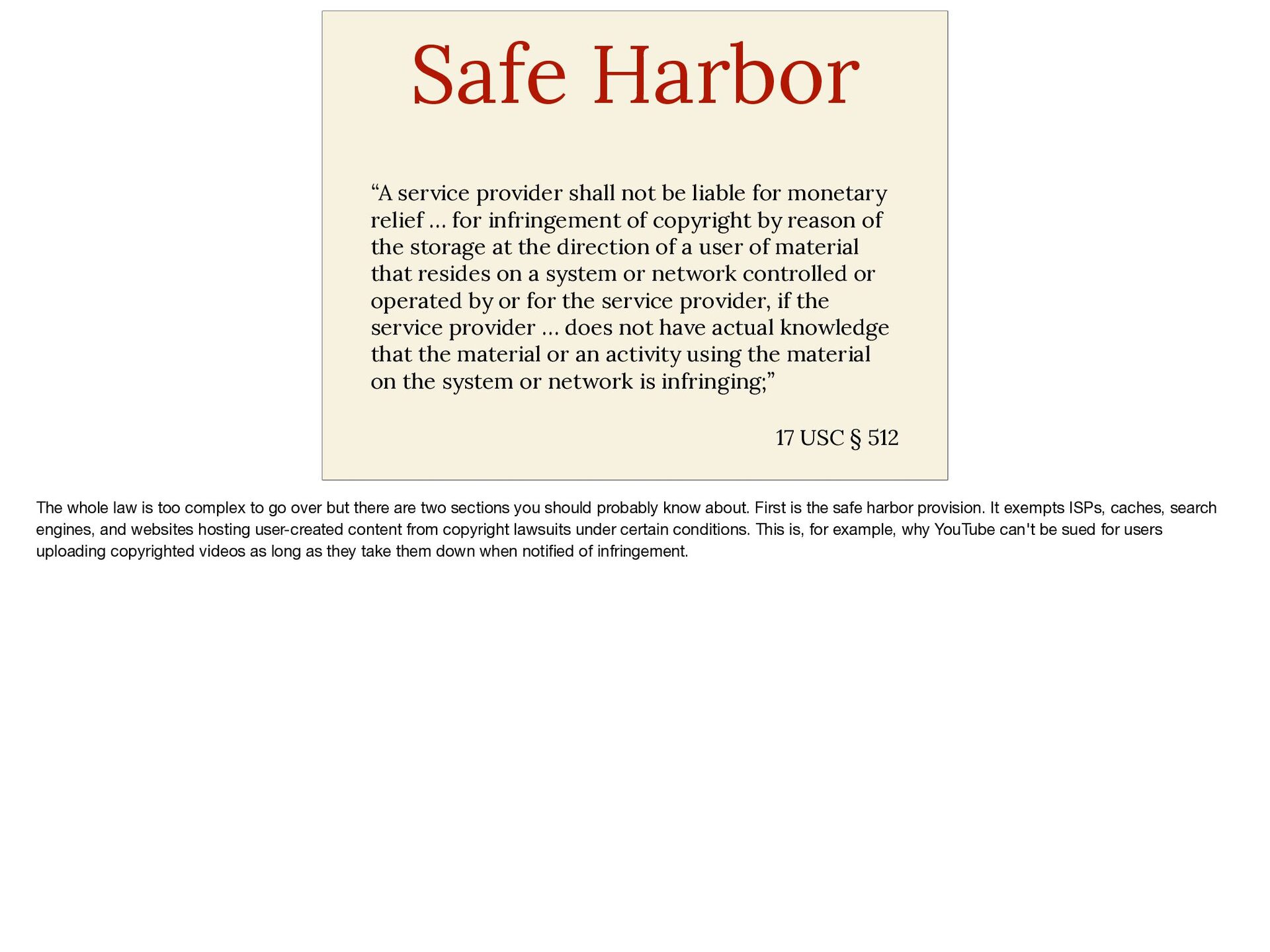
monetary relief … for infringement of copyright by reason of the storage at the direction of a user of material that resides on a system or network controlled or operated by or for the service provider, if the service provider … does not have actual knowledge that the material or an activity using the material on the system or network is infringing;” 17 USC § 512 fi The whole law is too complex to go over but there are two sections you should probably know about. First is the safe harbor provision. It exempts ISPs, caches, search engines, and websites hosting user-created content from copyright lawsuits under certain conditions. This is, for example, why YouTube can't be sued for users uploading copyrighted videos as long as they take them down when noti ed of infringement.
must rst make sure that you have no knowledge of copyright infringement ahead of time. This usually means making sure it is mentioned in your terms of service and that you inform your users that copyright infringement is not okay.
agent. This is done through an online portal run by US Copyright O ce. Generally your registered agent will be your company attorney, but anyone that agrees to receive your notices can be used.
for copyright holders to notify you of infringement, generally called DMCA takedown orders. You need to collect a bunch of speci c info about the alleged infringement, and o er the user responsible the option to counter-claim that it is not infringing.
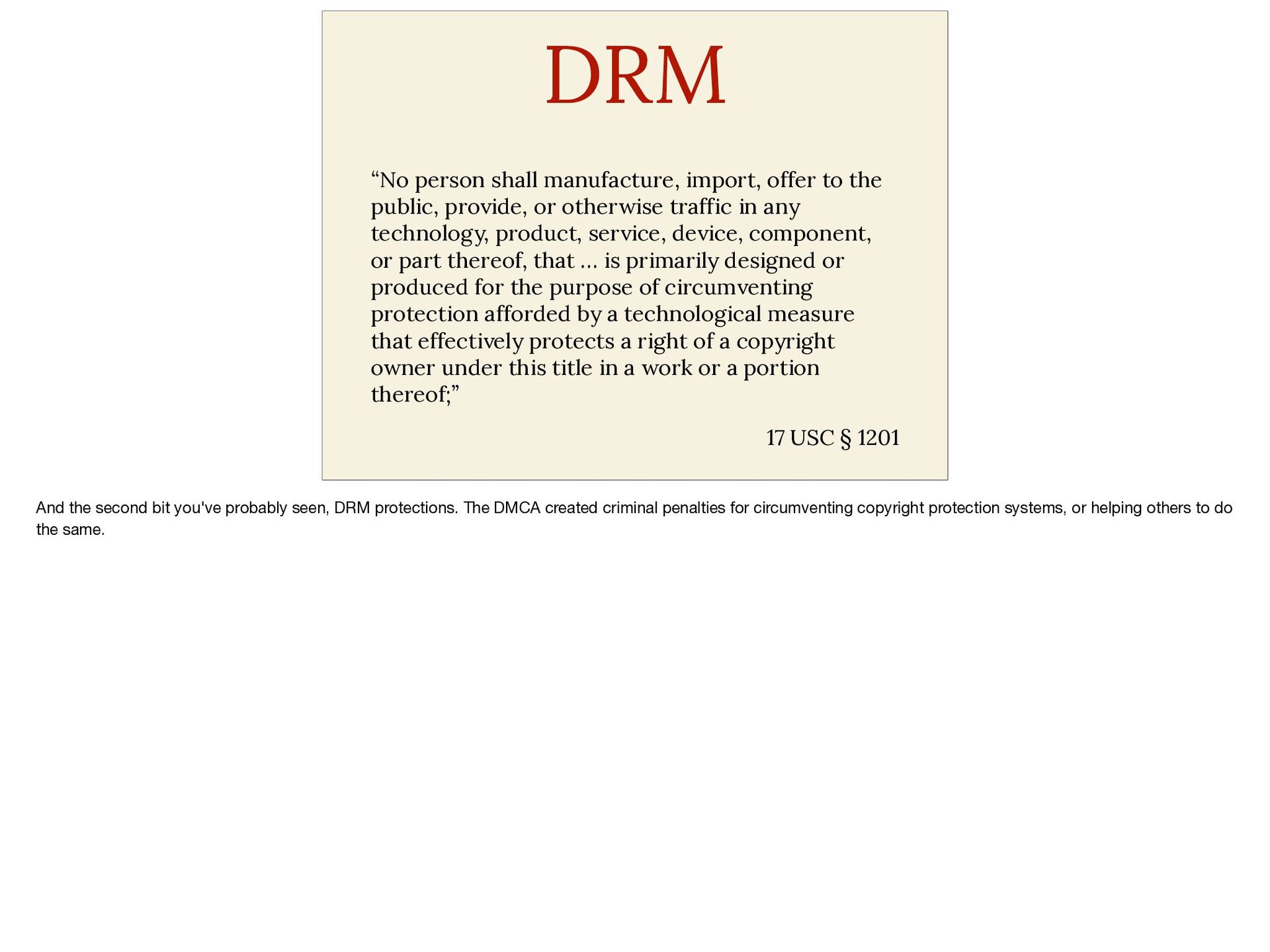
provide, or otherwise traffic in any technology, product, service, device, component, or part thereof, that … is primarily designed or produced for the purpose of circumventing protection afforded by a technological measure that effectively protects a right of a copyright owner under this title in a work or a portion thereof;” 17 USC § 1201 And the second bit you've probably seen, DRM protections. The DMCA created criminal penalties for circumventing copyright protection systems, or helping others to do the same.
fi fi There have been many attempts to use these anti-circumvention laws to prosecute DRM removal tools, with mixed success. The Library of Congress has made it clear some some level of personal DRM circumvention is de nitely allowed as fair use, but it's another ne line situation.
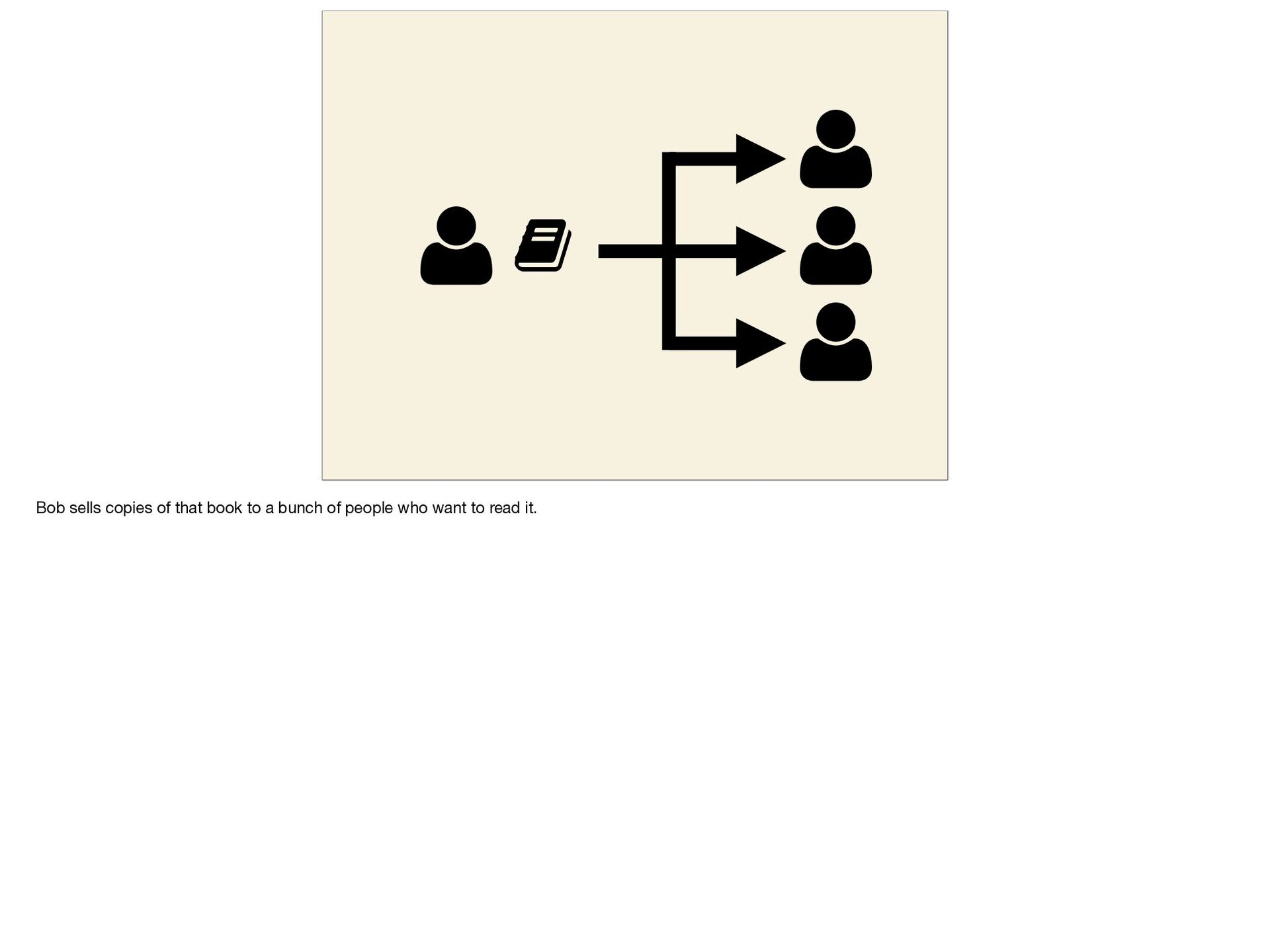
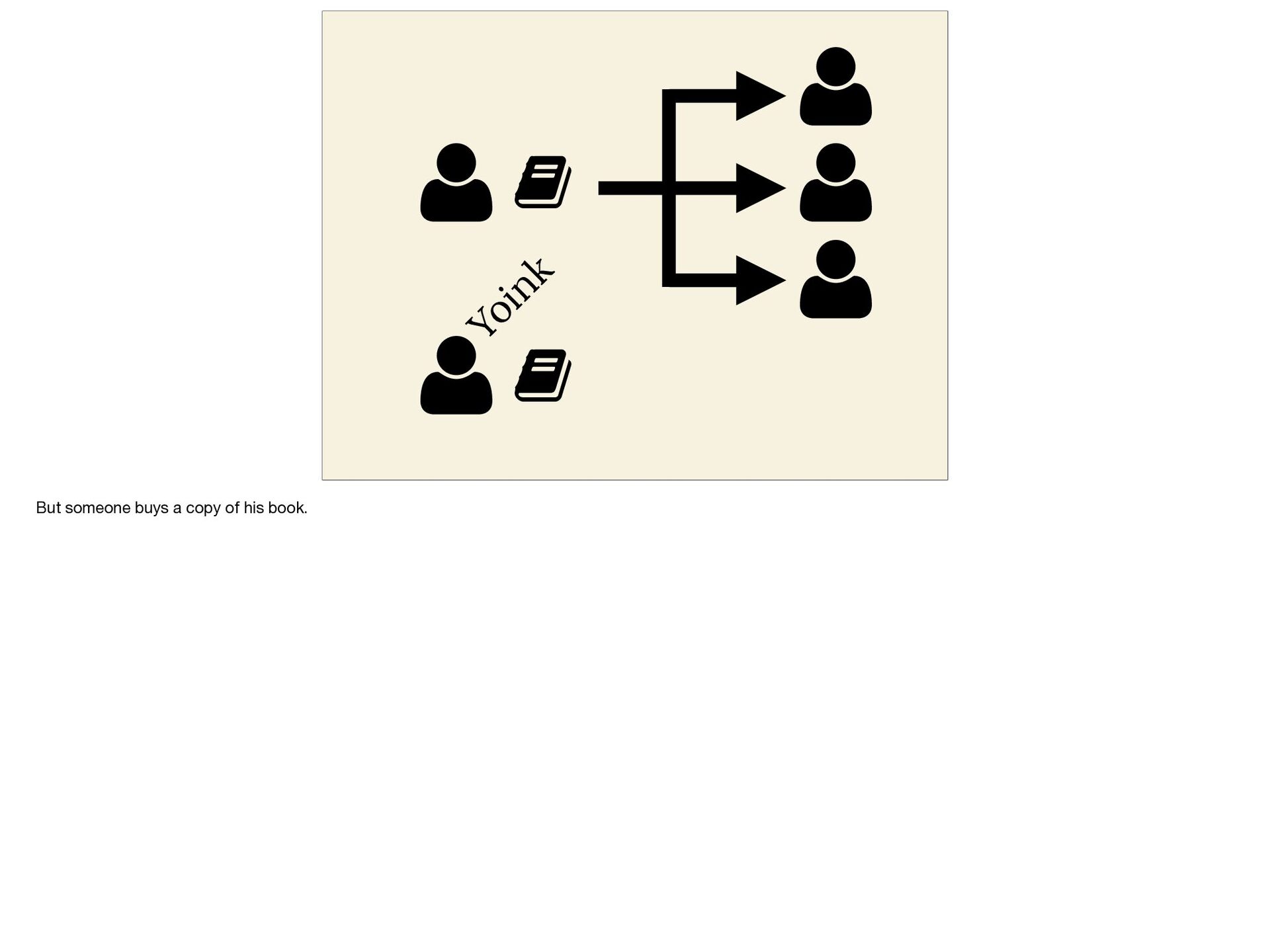
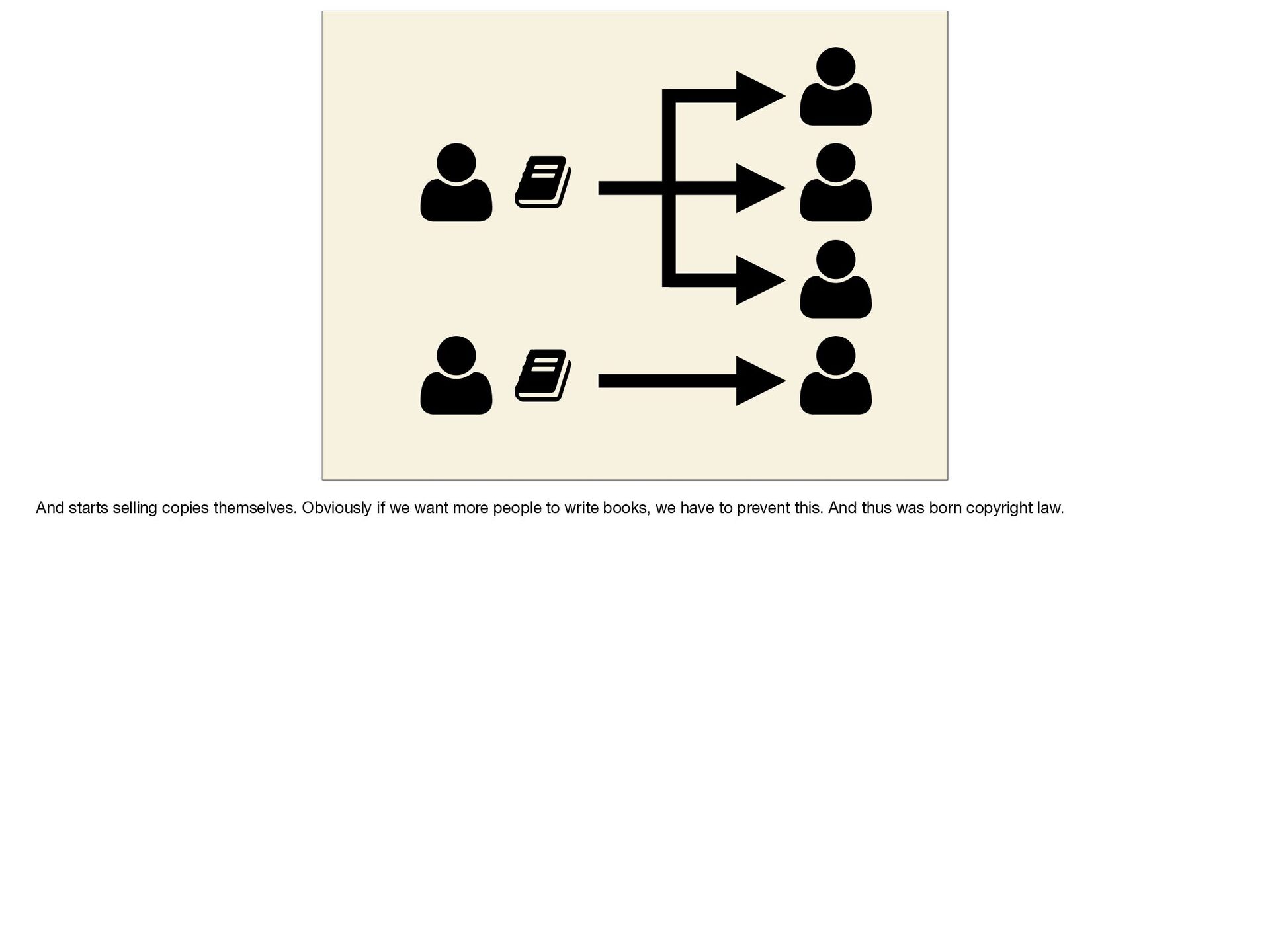
mentioned way back at the start that only the copyright holder of a work has the right to sell or distribute it to the public. A major exception to this is the rst sale doctrine. This holds that while you continue to hold copyright over a work after selling it, you lose most control over the physical object. This means if I buy a book, I can't starting printing more copies and selling them, but I can sell that speci c book.
cantly eroded in recent years. The general opinion of the courts has been the most modern media sells you only a license, not an object that would be subject to rst sale doctrine. A CD counts because it is a thing you own, while an MP3 le might not, depending on very speci c readings of the terms and license of the sale.
to a head in the case of Vernor v Autodesk, when a man tried to resell a copy of some software on eBay, and the court held that no, did not actually own the software and as such could not resell it. The same argument has been used by other cases, and has been generally upheld that digital purchases are the sale of a license, not of the work itself.
in the last few months, Sony has been taking a swing at this too. A group of frustrated customers has led a class action suit in California alleging deceptive marketing practices around purchases and ownership.
are allowed to infringe on the IP of others under certain circumstances. Mostly it is used in the context of copyrights and the use of copyrighted material without the permission of the owner.
common confusion about fair use is that all non-commercial use is automatically okay. While commercialization is a factor, this is not a blanket authorization to infringe on copyright. Cut it out YouTubers.
this using Apple Keynote despite both of those being trademarked terms. Similarly, a news show can use a copyrighted logo when running a story about the company as long as it's there to inform the listener in a nominative way.
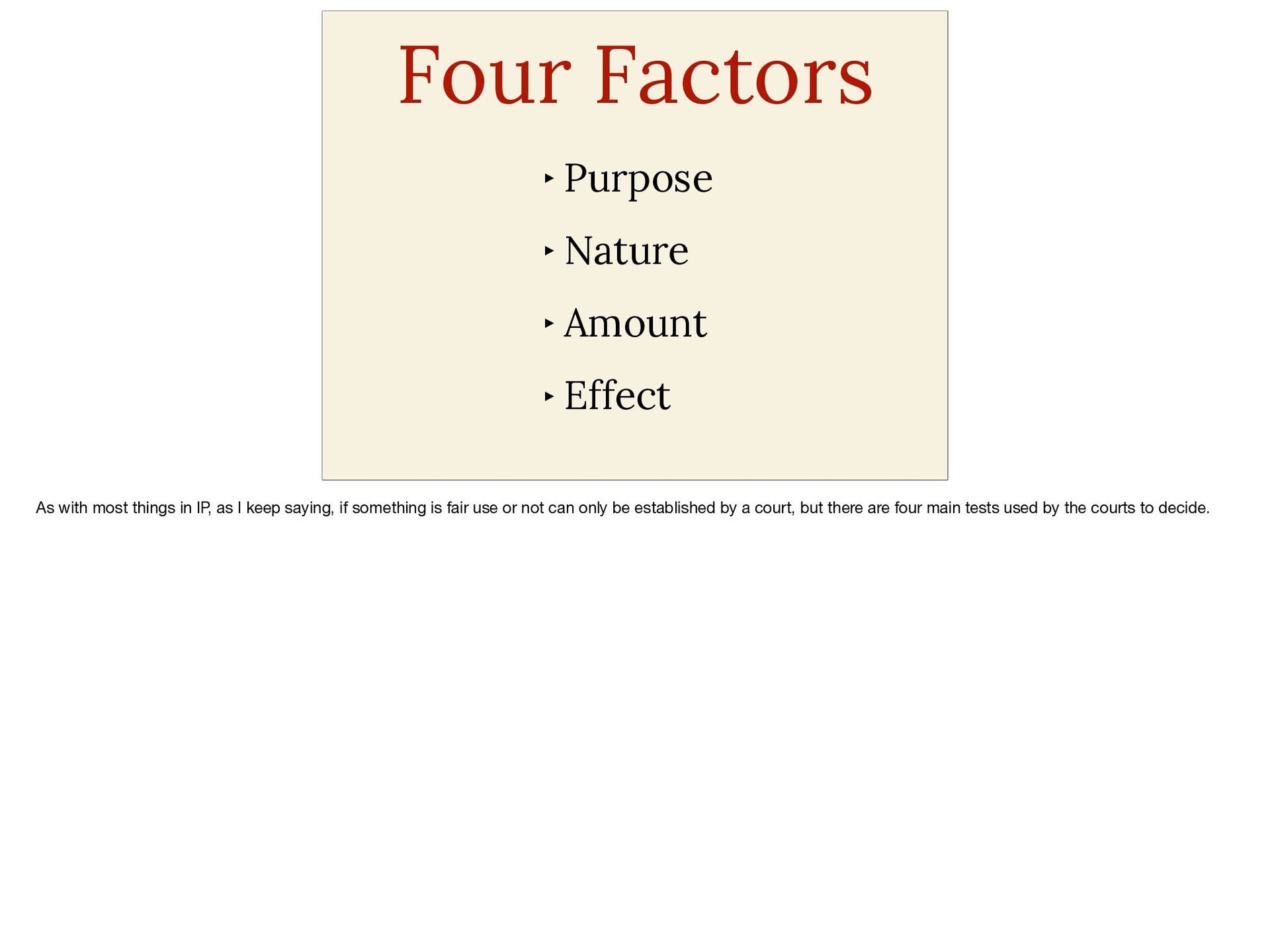
As with most things in IP, as I keep saying, if something is fair use or not can only be established by a court, but there are four main tests used by the courts to decide.
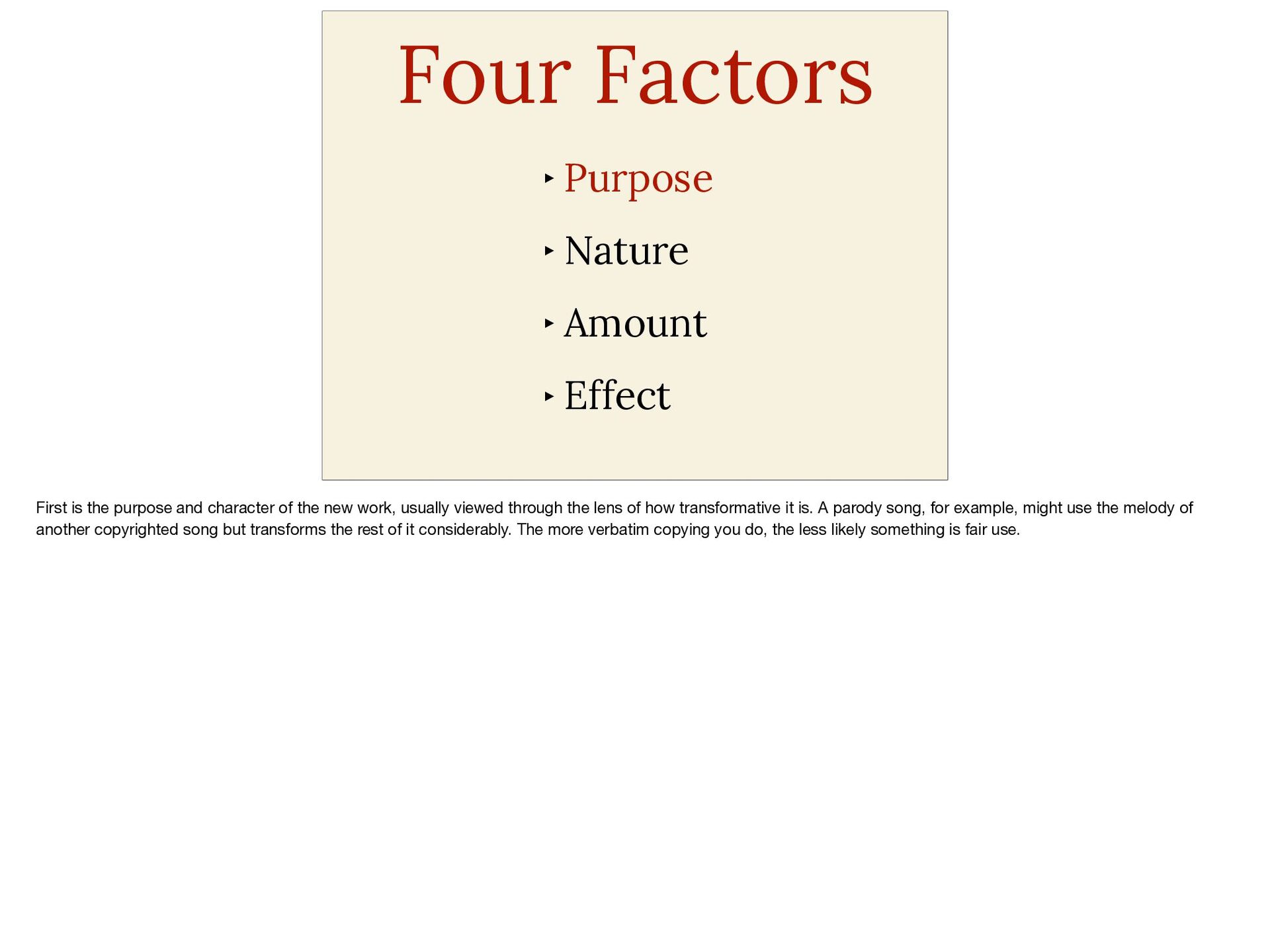
First is the purpose and character of the new work, usually viewed through the lens of how transformative it is. A parody song, for example, might use the melody of another copyrighted song but transforms the rest of it considerably. The more verbatim copying you do, the less likely something is fair use.
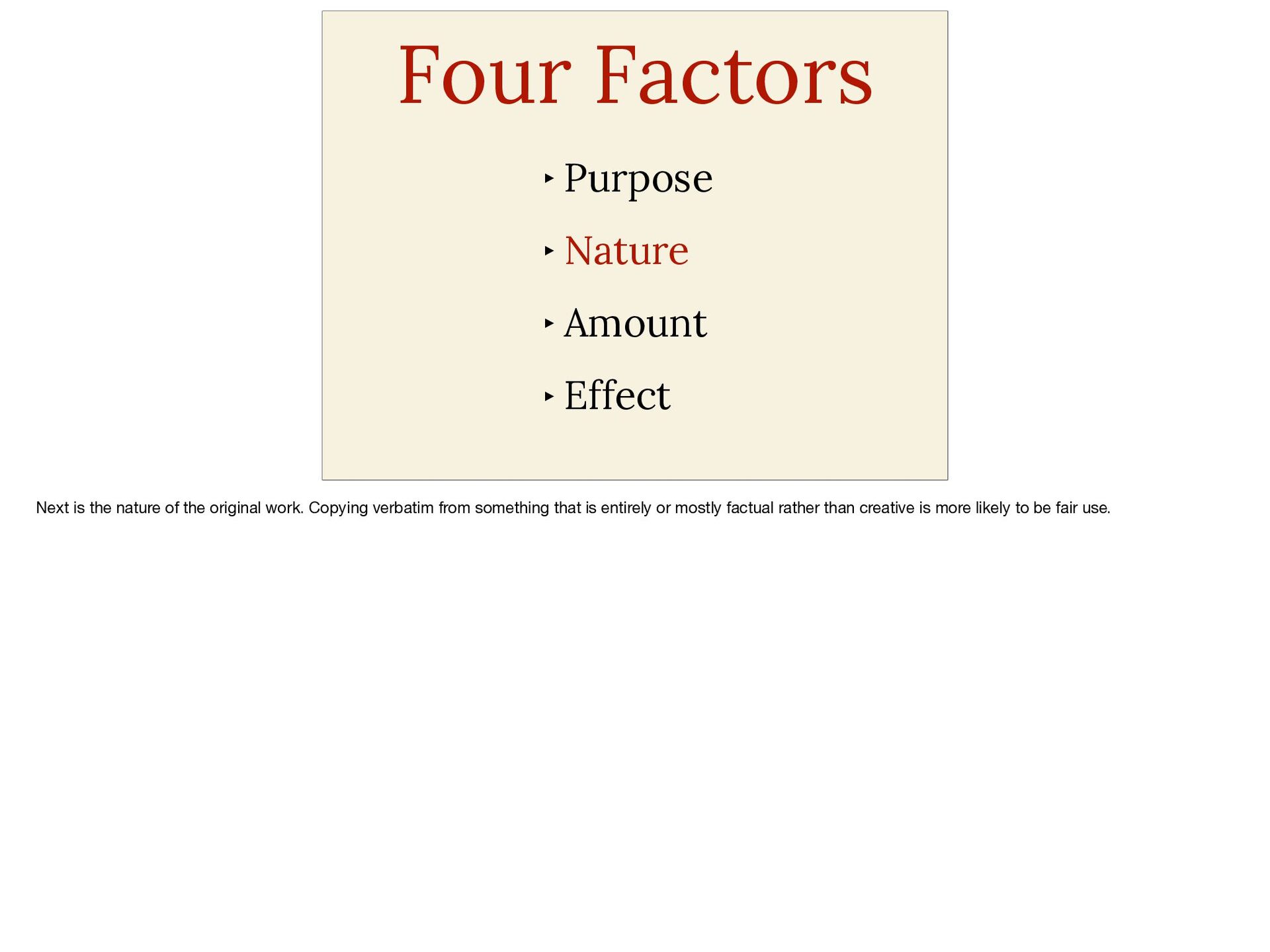
Next is the nature of the original work. Copying verbatim from something that is entirely or mostly factual rather than creative is more likely to be fair use.
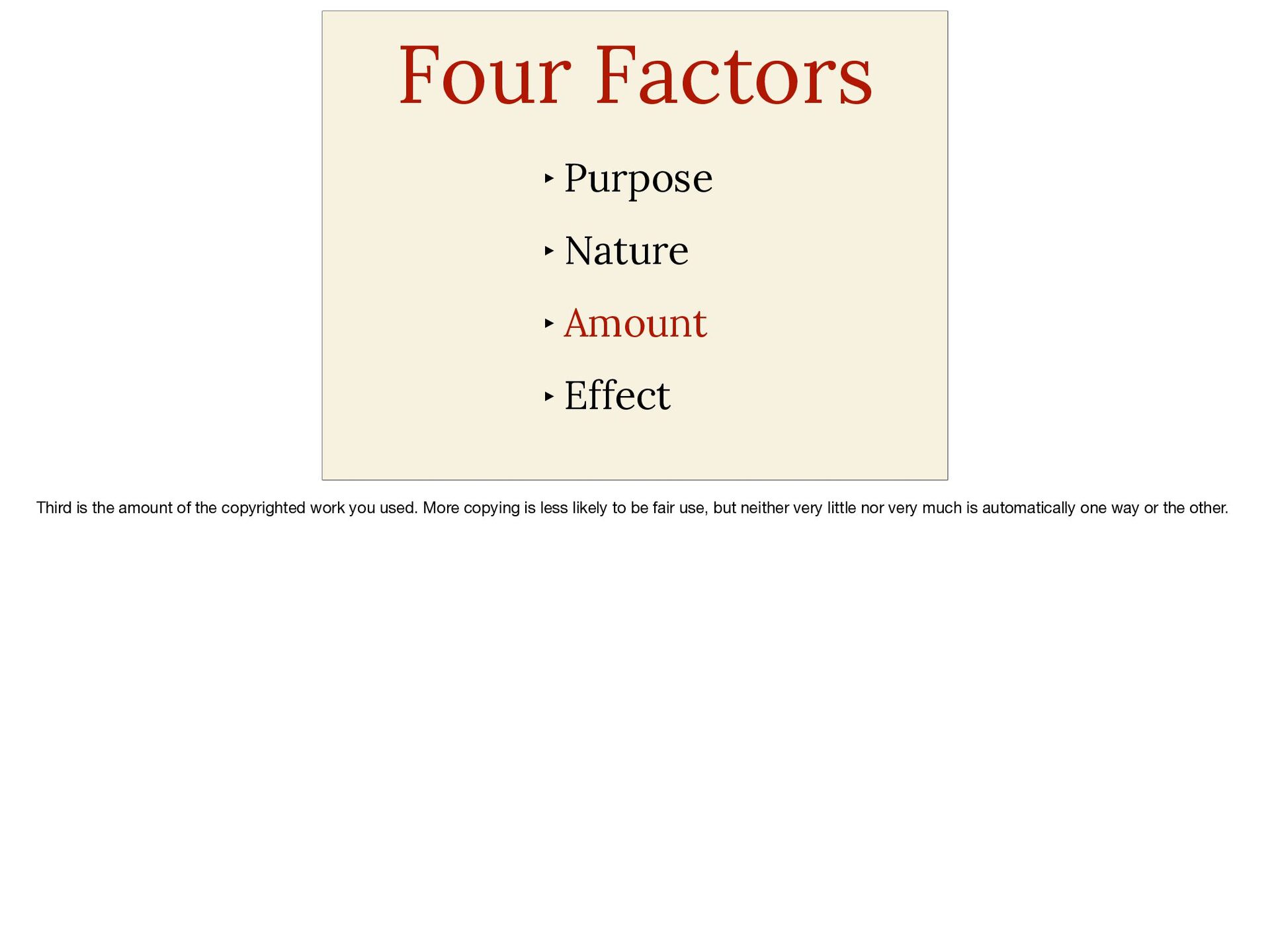
Third is the amount of the copyrighted work you used. More copying is less likely to be fair use, but neither very little nor very much is automatically one way or the other.
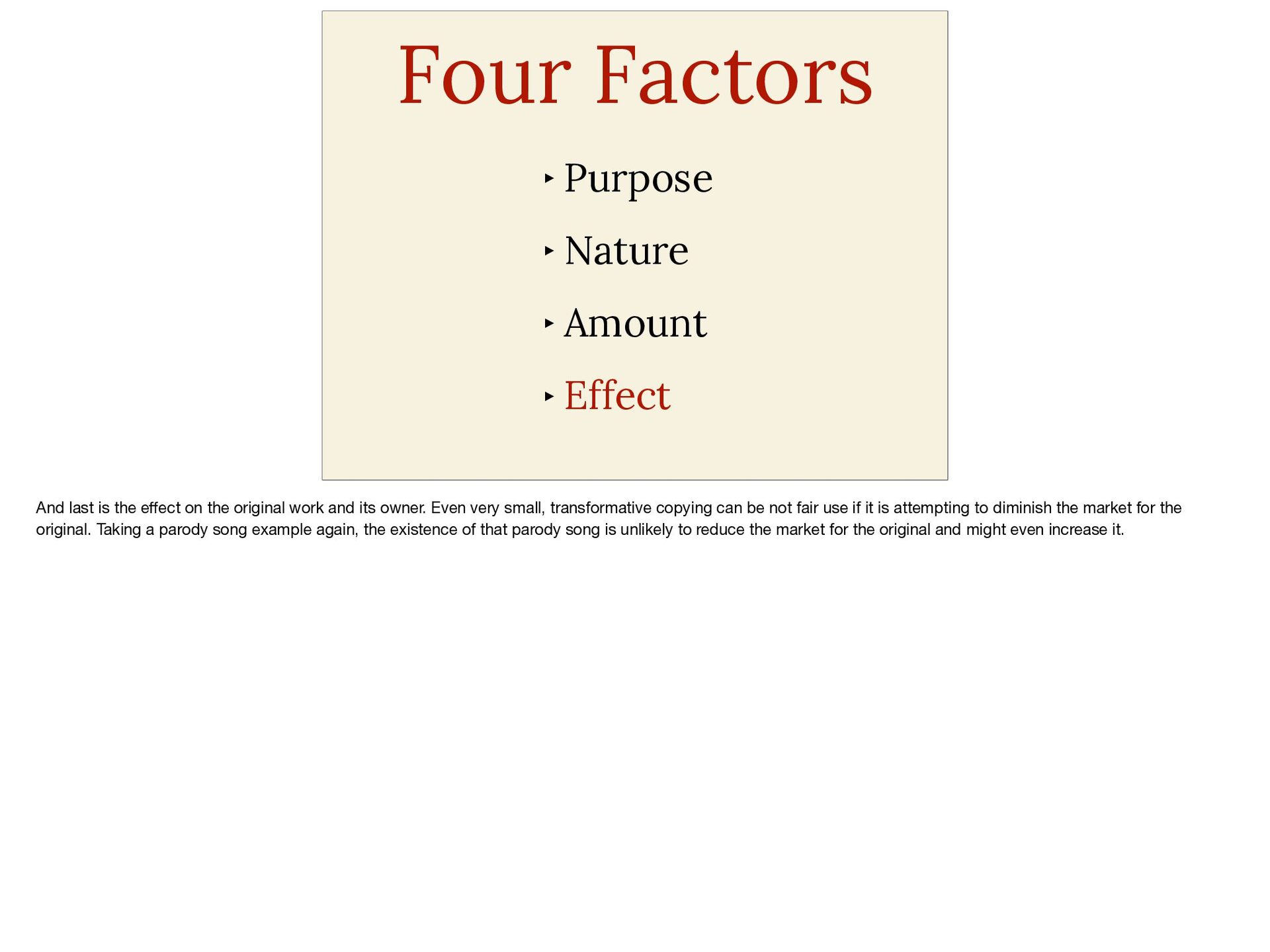
ff And last is the e ect on the original work and its owner. Even very small, transformative copying can be not fair use if it is attempting to diminish the market for the original. Taking a parody song example again, the existence of that parody song is unlikely to reduce the market for the original and might even increase it.
assume you probably won't qualify other than clearly nominative situations. It's safer that way. Then go ask the original author about what license their work is under and if they would consider other licenses.
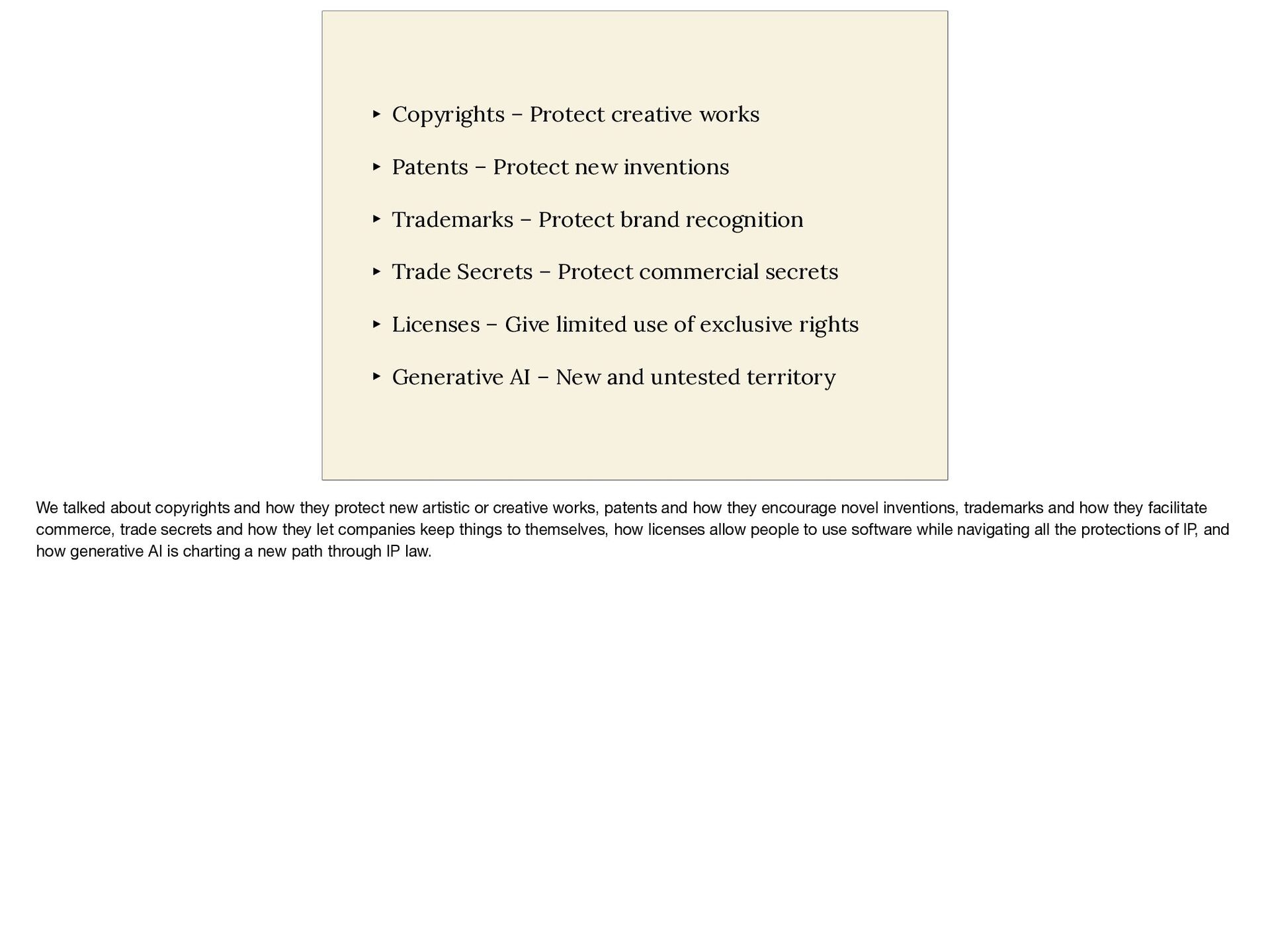
new inventions ‣ Trademarks – Protect brand recognition ‣ Trade Secrets – Protect commercial secrets ‣ Licenses – Give limited use of exclusive rights ‣ Generative AI – New and untested territory We talked about copyrights and how they protect new artistic or creative works, patents and how they encourage novel inventions, trademarks and how they facilitate commerce, trade secrets and how they let companies keep things to themselves, how licenses allow people to use software while navigating all the protections of IP, and how generative AI is charting a new path through IP law.
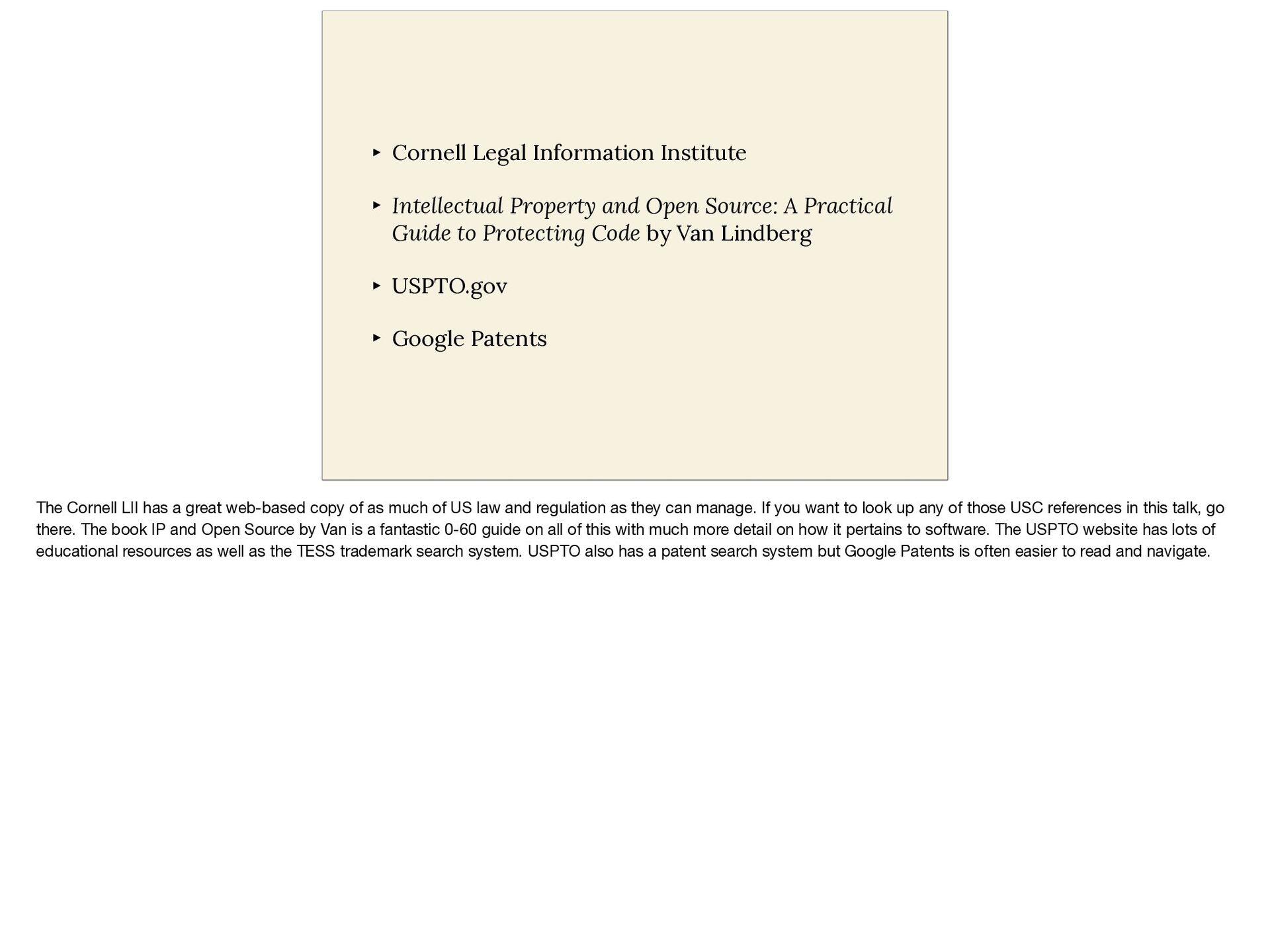
Source: A Practical Guide to Protecting Code by Van Lindberg ‣ USPTO.gov ‣ Google Patents The Cornell LII has a great web-based copy of as much of US law and regulation as they can manage. If you want to look up any of those USC references in this talk, go there. The book IP and Open Source by Van is a fantastic 0-60 guide on all of this with much more detail on how it pertains to software. The USPTO website has lots of educational resources as well as the TESS trademark search system. USPTO also has a patent search system but Google Patents is often easier to read and navigate.


 coderanger
 optim
optim
 lef237
 nokomoro3
 oku053
 minodriven
 timakin
 eed3si9n
 shihochan
 tanahiro2010
 rkaga
rkaga
 skydoves
 ziobrando
 jct
jct
 raygrieselhuber
 rabernat
 akademiya2063
 tammielis
 bermonpainter
 lara
lara
 katarinadahlin
 baasie
 schlessera
 sarafernandez
 ks91
ks91
![Questions? Noah Kantrowitz coderanger.net @[email protected] @coderanger.net](https://files.speakerdeck.com/presentations/a6353a62c36d475891636d9efee7f1a8/slide_144.jpg)