Upgrade to Pro — share decks privately, control downloads, hide ads and more …

Top girls by Caryl Church

Avatar for Delnaz Mostahkamfard Delnaz Mostahkamfard
December 11, 2024
65

Top girls by Caryl Church

Top Girls is a 1982 play by Caryl Churchill. It centres around Marlene, a career-driven woman who is heavily invested in women's success in business. The play examines the roles available to women in modern society, and what it means or takes for a woman to succeed. It also dwells heavily on the cost of ambition and the influence of Thatcherite politics on feminism.

Avatar for Delnaz Mostahkamfard

Delnaz Mostahkamfard

December 11, 2024

Transcript

  1. • Content Type: • Playtext • Genres And Forms: •

    Postmodern theatre, Feminist theatre, British drama, English drama, European drama • Period (First Performed): • Contemporary, 1900-1999, 1981-1990 • Plays: • Top Girls • Playwrights: • Churchill, Caryl • Setting: • Europe, United Kingdom, England, London • Themes: • Ambition, Family, Politics, Power About
  2. •Top Girls is a 1982 play by Caryl Churchill. It

    centres around Marlene, a career-driven woman who is heavily invested in women's success in business. The play examines the roles available to women in modern society, and what it means or takes for a woman to succeed. It also dwells heavily on the cost of ambition and the influence of Thatcherite politics on feminism. Context: Caryl Churchill
  3. o Caryl Churchill studied at Lady Margaret Hall, Oxford -

    a women's college o She wrote radio plays whilst raising her three sons o In 1974 she became resident dramatist at the Royal Court - an experimental o Her 1979 play 'Cloud 9' received great acclaim o Churchill is interested in using 'hyperrealism' or surrealism to explore issues of class, gender, political corruption and how humans communicate o Written and first in 1982 but set in 1980 'Top Girls' is in keeping with her other plays. It was reprised in
  4. 1991 and then 2011. The National Theatre performed it again

    in 2019 - its popularity heightens its relevance today! * In 2010 Churchill was added to the American Theatre Hall of Fame for her contribution to playwrighting Plot Summary • Act I of Top Girls takes place in a hip London restaurant where Marlene is gathering five other women to celebrate her promotion to managing director of Top Girls, the employment agency where she works. This scene is surreal, because Marlene's 5 dinner guests are female figures from
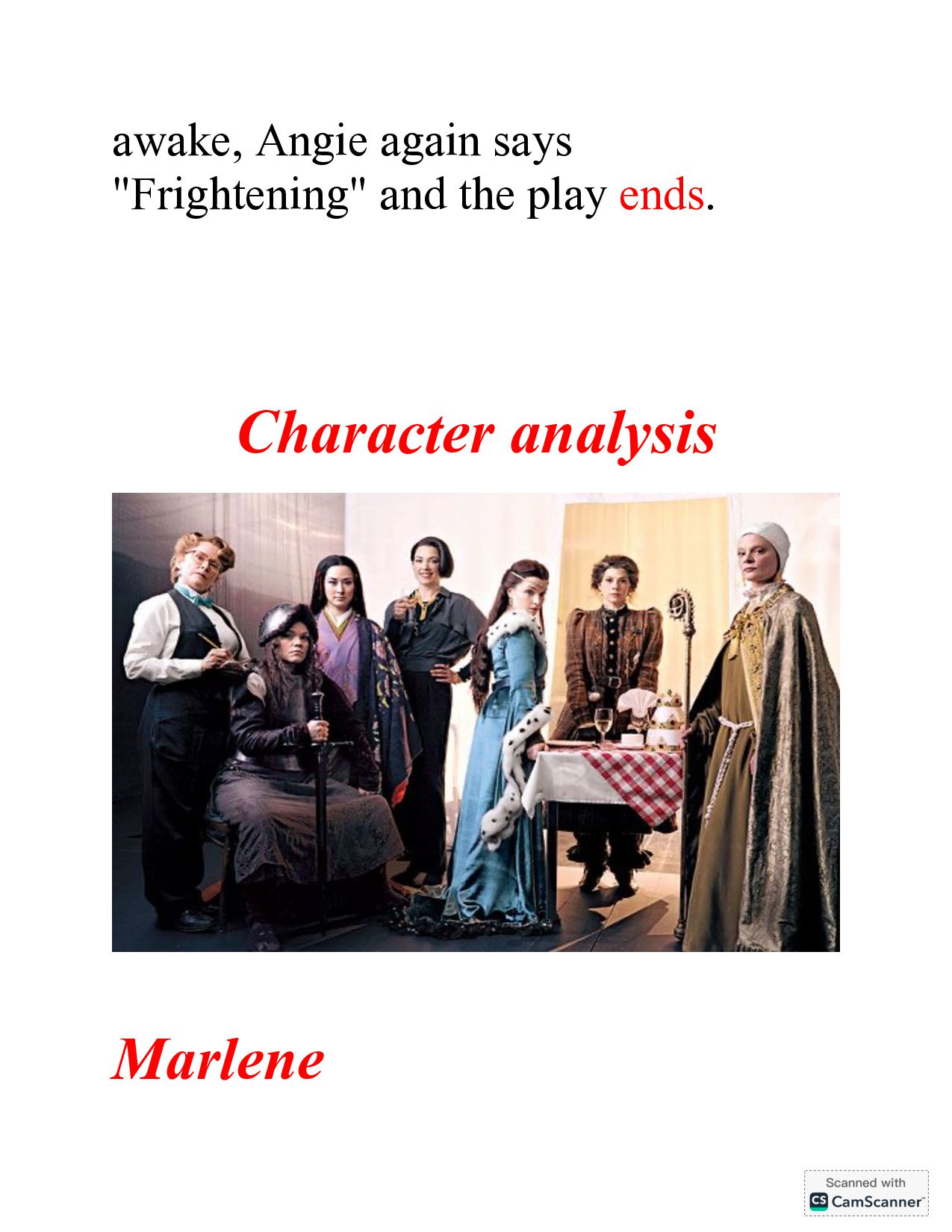
  5. different historical eras: Isabella Bird; a 19th century writer and

    traveller, Lady Nijo; a 13th century courtesan and later, Buddhist nun, Dull Gret; the subject of a Brueghel painting who led an army of women into hell to fight the devils, Pope Joan; a 9th century woman who disguised herself as a man and became Pope, and Patient Griselda; the obedient wife from The Clerk's Tale in Chaucer's The Canterbury Tales. These women are bound together by their struggles against patriarchy and oppression - and Marlene relates to each of them differently.
  6. • Act 2 is set at the Top Girls employment

    agency. Marlene is interviewing a woman named Jeanine who wants a new job because there are no prospects for advancement at her current position. Through her questions, Marlene reveals that she looks down on Jeanine for her desire to get married young, have children, and her uncertainty about her professional future. Marlene only offers Jeanine two openings, one at a company that makes knitwear and the other lampshades - neither of which fulfil Jeanine's request for opportunities and travel. Regardless, Marlene tells Jeanine to be confident and present herself well, because her
  7. performance reflects on Marlene and the agency. • Act 2,

    Scene 3 is set in the Top Girls Employment Agency on a Monday morning. Win and Nell have just arrived to begin work. They are drinking coffee and chatting about the men they dated or had affairs with over the weekend. Marlene arrives and Nell and Win applaud and whistle for her after being promoted over Howard, but Nell also indicates that she envies Marlene's success.Later, Win interviews Louise, who is 46 and feels that it's time to move on from her long-term job.
  8. Louise is frustrated at her lack of a personal life

    due to her sustained commitment to the job, and has watched as younger men are consistently being promoted to better positions while she is never considered. Win tells Louise the reality of the situation: that some companies may value her experience but they are more likely to hire younger men. After the break, the setting reverts to the main office at Top Girls. Angie comes to see Marlene - who does not recognize her niece at first. Angie reveals that she has come to London on a one-way ticket without telling Joyce and will be needing a
  9. place to stay. Angie idolizes Marlene and starts asking questions

    about her job. While Angie is in Marlene's office, Mrs. Kidd enters. She is the wife of Howard Kidd, who lost the promotion to Marlene. Mrs. Kidd tells Marlene that the news has left Howard a nervous wreck and requests Marlene to give up the promotion - since Howard is a man and not he has a family to support. Marlene brushes off Mrs. Kidd and her absurd request - and in response, Mrs. Kidd calls Marlene "one of those ballbreakers" and tells her she'll end up "miserable and lonely."
  10. Act 3 is a flashback scene set at Joyce's home

    on a Sunday evening, three years earlier - the last time Marlene visited Joyce and Angie in Ipswich. One of the gifts Marlene has brought is the dress that Angie wears in Act 1. Joyce grumbles that Marlene's surprise visit has caught her off-guard, and we learn that Angie has orchestrated the visit and invited Marlene without telling Joyce. In this scene, we learn more about Joyce and Marlene's past as the sisters begin sharing a bottle of whisky. At one point, Angie asks wher aunt to tuck her in, and Marlene does.
  11. • When the sisters are alone, Joyce scolds Marlene for

    leaving town when she was younger and leaving Joyce to look after their mother and Angie, who is actually Marlene's biological child. The sisters continue to argue, and it comes out that Marlene got pregnant with Angie at age seventeen, but didn't tell anyone about it until it was too late for an abortion. Joyce and her husband Frank offered to take the child, after being married for three years and having no children of their own. However, Joyce blames the stress of raising Angie for her subsequent miscarriage. Marlene and Joyce begin to argue about British politics, with Marlene taking the pro-
  12. Thatcher conservative side, and Joyce siding with the socialist left

    wing. The two change the subject and begin talking about their parents' working class struggles and difficult marriage. Alone, Marlene sits wrapped in a blanket and pours herself another drink. Angie comes into the room and calls out "Mum?" Marlene says "Angie? What's the matter?" and again Angie calls out "Mum?" Marlene replies, "Not, she's gone to bed. It's Aunty Marlene." Angie then says "Frightening" and when Marlene asks if she's had a bad dream and suggests things are fine now because she's
  13. • The central protagonist of Top Girls, who has just

    been promoted to managing director at the employment agency where she works. Marlene's career ambitions have led her to abandon her family, including her daughter, Angie, who was instead raised by Marlene's sister, Joyce. Isabella Bird • An English woman who lived from 1831-1904. She was an avid explorer and travelled all around the world between the ages of 40 and 70. She wrote extensively about her experiences abroad. Bird married late in life because of her professional aspirations, but her husband died short
  14. of their 5-year anniversary. She is one of Marlene's dinner

    guests in Act I. Jeanine • A twenty-year-old woman who Marlene interviews at Top Girls. Jeanine wants to save money for a wedding and eventually have children. Marlene takes this to mean that Jeanine lacks career ambitions and therefore, Marlene treats her as an inferior. Joyce • Angie's adoptive mother and Marlene's sister. Joyce and Marlene do not get along well. Joyce raised Angie because Marlene wanted to escape
  15. Ipswich and pursue a career. Joyce represents the perspective of

    the working class. However, she is not a particularly sympathetic character and is very resentful of her sister. Angie • Marlene's 16-year-old biological daughter who was adopted by Marlene's sister, Joyce. She is aggressive and unintelligent and spends most of her time with her younger neighbor, Kit. Angie makes an unexpected visit to London to see Marlene (whom she believes to be her aunt) because she aspires to be like her.
  16. Louise • A forty-six-year-old woman interviewing at Top Girls. She

    wants a new job after twenty-one years at a firm that does not truly value her experience, but Win feels that her age will make it difficult to find her a new position. Mrs. Kidd • The wife of Howard Kidd, Marlene's co-worker. Mrs. Kidd visits Marlene at the Top Girls office to request Marlene to give up her promotion since Howard has worked at the firm longer and has a family to look after.
  17. Theme Analysis Women and Careers • The relationship between women

    and work is essential to Top Girls from its opening act. The surrealist dinner party in Act I is a celebration of
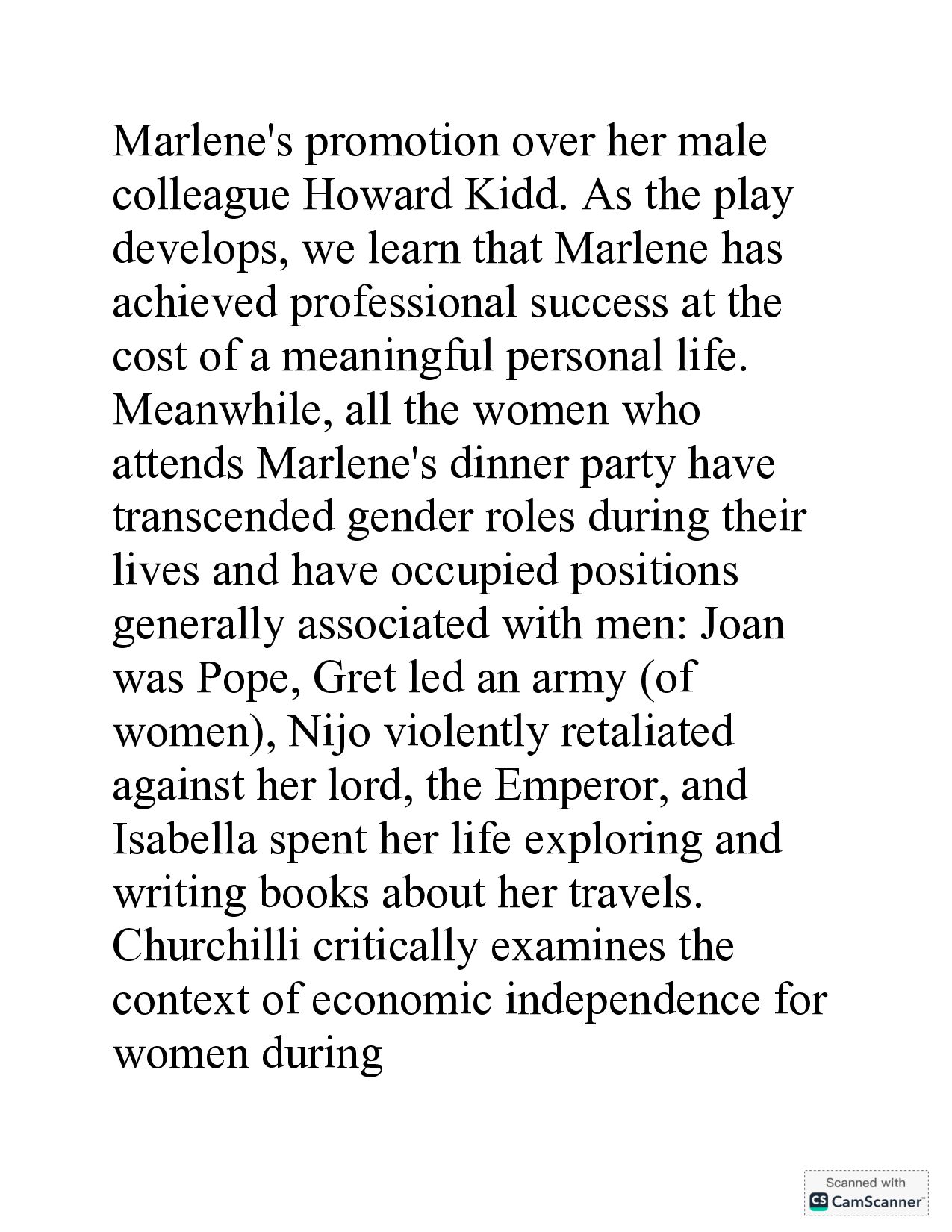
  18. Marlene's promotion over her male colleague Howard Kidd. As the

    play develops, we learn that Marlene has achieved professional success at the cost of a meaningful personal life. Meanwhile, all the women who attends Marlene's dinner party have transcended gender roles during their lives and have occupied positions generally associated with men: Joan was Pope, Gret led an army (of women), Nijo violently retaliated against her lord, the Emperor, and Isabella spent her life exploring and writing books about her travels. Churchilli critically examines the context of economic independence for women during
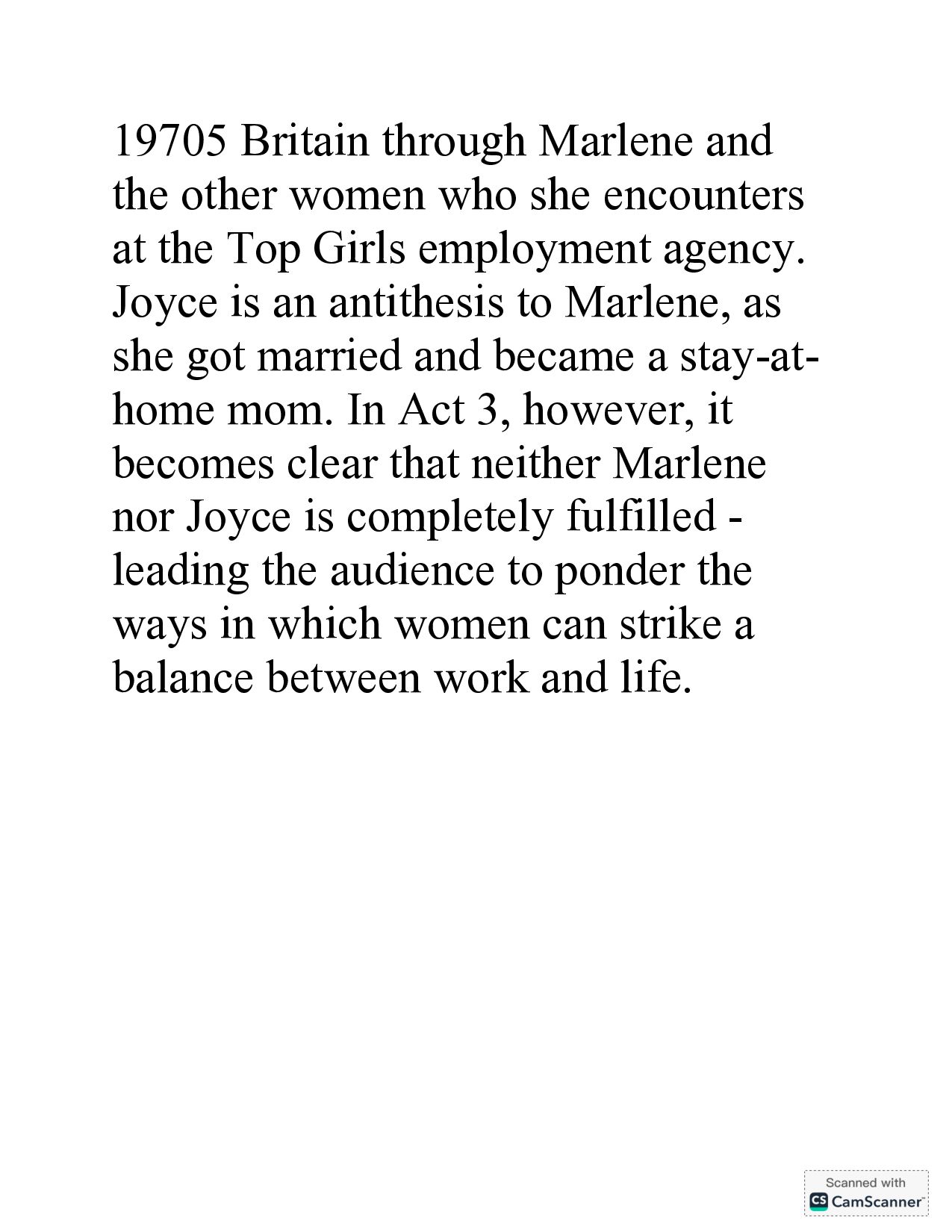
  19. 19705 Britain through Marlene and the other women who she

    encounters at the Top Girls employment agency. Joyce is an antithesis to Marlene, as she got married and became a stay-at- home mom. In Act 3, however, it becomes clear that neither Marlene nor Joyce is completely fulfilled - leading the audience to ponder the ways in which women can strike a balance between work and life.