Upgrade to Pro — share decks privately, control downloads, hide ads and more …

8thDistrictCommunity

 8thDistrictCommunity

Creating Communities out of local congregations

Avatar for RevDrEDCrawford

RevDrEDCrawford

July 27, 2018

More Decks by RevDrEDCrawford

Other Decks in Programming

Transcript

  1. “Creating Community in the Local Church” Presented by: Rev. Dr.

    Erika D. Crawford July 27, 2018 Presented for: 8th District Christian Education Congress Bishop Julius McAllister, Sr., Presiding Prelate Mother Joan McAllister, Episcopal Supervisor Presiding Elder Michelle Goodloe, Host Presiding Elder Rev. Ammie Davis, Host Pastor
  2. Why is Community important? When God formed Adam from the

    dust, he was the only human on the planet, then God said, God said it wasn’t good for man to be alone (Genesis 2:18) and decided to give Adam some company, a companion, community. Think about your local church and ask: ▪ Do your gatherings facilitate the kind of community God desires for the Church? ▪ How can a Church experience deep community with only two gatherings a week?
  3. The Bible gives direct exhortations about how Christians in community

    should relate to each other: ▪ Accept one another (Rom 15:7) ▪ Carry each other’s burdens (Gal. 6:2) ▪ Have equal concern for each other (1 Cor. 12:25) ▪ Watch out for one another (Heb. 3:12-13) ▪ Encourage one another (1 Thess. 4:18; 5:11; Heb. 3:13; 10:25) ▪ Live in harmony with one another (1 Pet. 3:8) ▪ Confess your sins to each other (Jas. 5:16) ▪ Be devoted to one another (Rom. 12:10) ▪ Edify one another (Rom. 14:19; 1 Thess. 5:11) ▪ Consider others better than yourselves (Phil. 2:3) ▪ Bear with one another (Eph. 4:2; Col. 3:13) ▪ Forgive each other (Eph. 4:32) ▪ Honor one another (Rom. 12:10) ▪ Offer hospitality to one another (1 Pet. 4:9) ▪ Be kind and compassionate to one another (Eph. 4:32) ▪ Live in harmony toward one another (Rom. 12:16; 15:5) ▪ Love one another (John 13:34-35; 15:12, 17; Rom. 13:8) ▪ Be members of one body (Rom. 12:5; Eph. 4:25) ▪ Be at peace with each other (Mark 9:50; Eph. 4:3) ▪ Pray for each other (Jas. 5:16) ▪ Serve one another (Gal. 5:13; 1 Pet. 4:10) ▪ Spur one another on to love and good deeds (Heb. 10:24) ▪ Submit to one another (Eph. 5:21; 1 Pet. 5:5) ▪ Teach one another (Col. 3:16)
  4. The office of Presiding Elder was intentionally instituted for the

    purpose of keeping the connection a community and community minded. Establishing and/or strengthening relationship across the denomination on smaller levels than the connection and larger levels than the local church/circuit/station. Sadly, the Church is no longer the default community. We often criticize the larger denomination but the question we must ask ourselves as a local congregation are: • What strength is there in a chain of weak links? • If the local church is weak, how stronger is the PE District, Annual Conference, Episcopal District, Connection? EVERTHING you do in your local church, impacts your Presiding Elder District, Annual Conference, Episcopal District and the Connection! Connecting….
  5. The Difference Between Congregation (or Church) and Community “Christian communities

    continue the work of Jesus. They are sent to be a presence to people who are living in darkness and despair. The people who come into these communities also respond to the call and the cry of the weak and the oppressed. They enter into the covenant with Jesus and the poor, they meet Jesus in them” – Community and Growth by Jean Vanier It’s fairly easy to build a congregation or “church,” because the typical elements are not that hard to find–a gathering place, music and a good message along with some kind of programmatic glue will usually do the trick. Truth be told, if the music and the message are good people will join. However, cultivating real communities is very different because it requires that we find ways to knit hearts together, share life and meals, gather around common purposes while allowing for the wrestling of different perspectives and the igniting a nurturing a spirit of justice and action concurrently with learning to love Jesus, ourselves and others and be loved by Jesus, ourselves, and others requires a whole different way of thinking. Today, active attendance in the church is declining virtually everywhere. In 2016, 73% of Americans said they identify as Christian, but only 31% of them attend church (Barna Group Research) So, we have to intentionally work to move our congregations beyond, “I go here because…. I love the teaching/preaching or I love the music or I love the kids program.'” Our goal must become hearing people say, “I go here because I love the community – which are the people, the called out, the church.”
  6. What’s the difference between “cultivating communities” and “building churches?” •

    cultivating a community requires an extremely high level of relationship and interaction that most of us haven’t learned to do or don’t want to do. • cultivating a community isn’t very easy & requires a long view. • cultivating a community requires breaking down power differentials. • cultivating a community usually doesn’t make money but it will take time. It is possible to go to church without participating in the community of the church. Community is God’s desire for us—and a sign of a mature faith.
  7. Building A Community Before we start cultivating (or re-cultivating) and

    creating (or re-creating) community, the first thing we must accept is that we are NOT all starting from the same place, even if we are all in the same place. …11And they sang responsively with praise and thanksgiving to the LORD: “For He is good; for His loving devotion upon Israel endures forever.” Then all the people gave a great shout of praise to the LORD, because the foundation of the house of the LORD had been laid. 12 But many of the older priests, Levites, and family heads who had seen the first temple wept loudly when they saw the foundation of this temple. Still, many others shouted joyfully. 13 The people could not distinguish the shouts of joy from the sound of weeping, because the people were making so much noise. And the sound was heard from afar. Ezra 3:11-13
  8. Let’s Work Together for Good In building community, we must

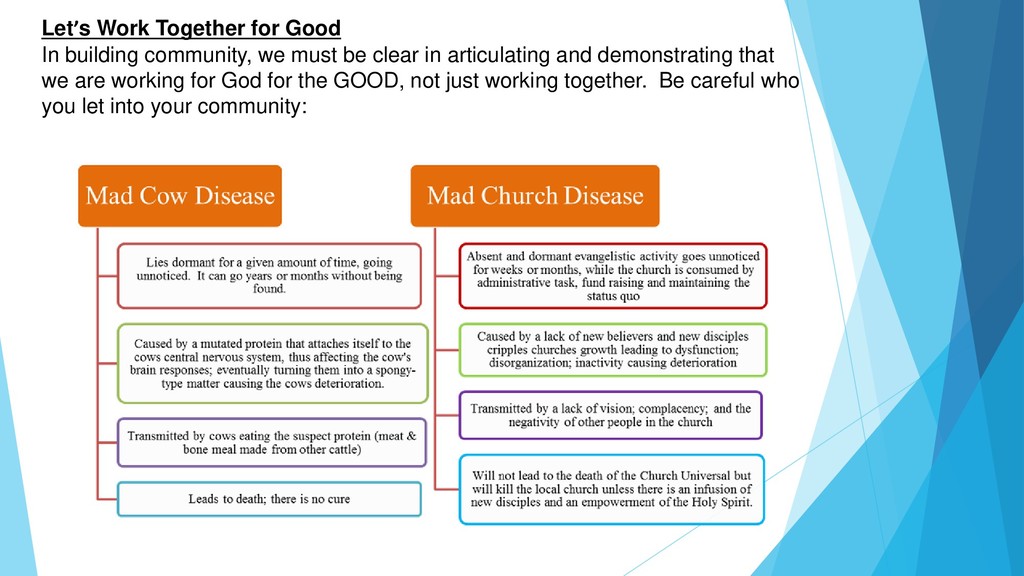
    be clear in articulating and demonstrating that we are working for God for the GOOD, not just working together. Be careful who you let into your community:
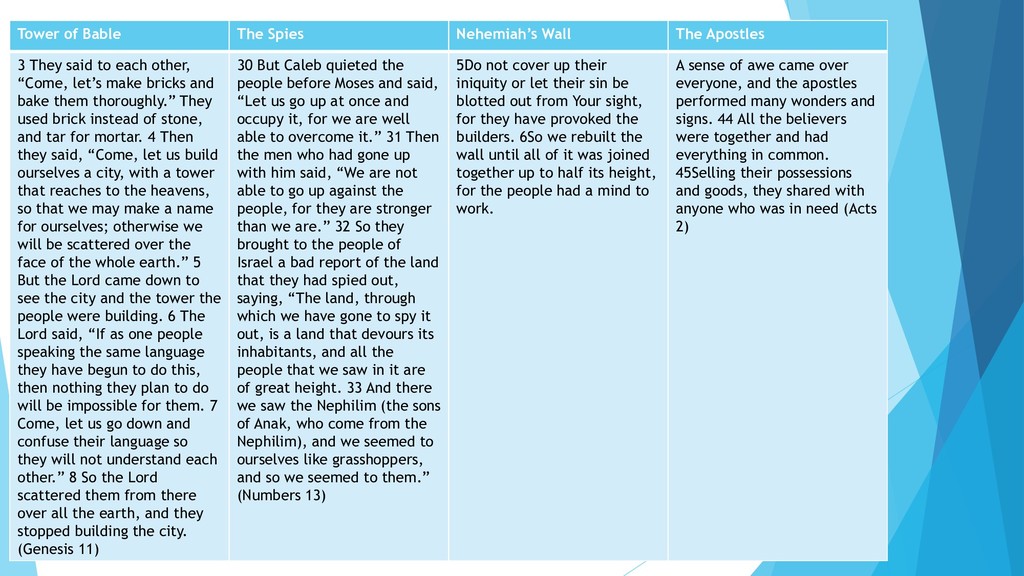
  9. Tower of Bable The Spies Nehemiah’s Wall The Apostles 3

    They said to each other, “Come, let’s make bricks and bake them thoroughly.” They used brick instead of stone, and tar for mortar. 4 Then they said, “Come, let us build ourselves a city, with a tower that reaches to the heavens, so that we may make a name for ourselves; otherwise we will be scattered over the face of the whole earth.” 5 But the Lord came down to see the city and the tower the people were building. 6 The Lord said, “If as one people speaking the same language they have begun to do this, then nothing they plan to do will be impossible for them. 7 Come, let us go down and confuse their language so they will not understand each other.” 8 So the Lord scattered them from there over all the earth, and they stopped building the city. (Genesis 11) 30 But Caleb quieted the people before Moses and said, “Let us go up at once and occupy it, for we are well able to overcome it.” 31 Then the men who had gone up with him said, “We are not able to go up against the people, for they are stronger than we are.” 32 So they brought to the people of Israel a bad report of the land that they had spied out, saying, “The land, through which we have gone to spy it out, is a land that devours its inhabitants, and all the people that we saw in it are of great height. 33 And there we saw the Nephilim (the sons of Anak, who come from the Nephilim), and we seemed to ourselves like grasshoppers, and so we seemed to them.” (Numbers 13) 5Do not cover up their iniquity or let their sin be blotted out from Your sight, for they have provoked the builders. 6So we rebuilt the wall until all of it was joined together up to half its height, for the people had a mind to work. A sense of awe came over everyone, and the apostles performed many wonders and signs. 44 All the believers were together and had everything in common. 45Selling their possessions and goods, they shared with anyone who was in need (Acts 2)
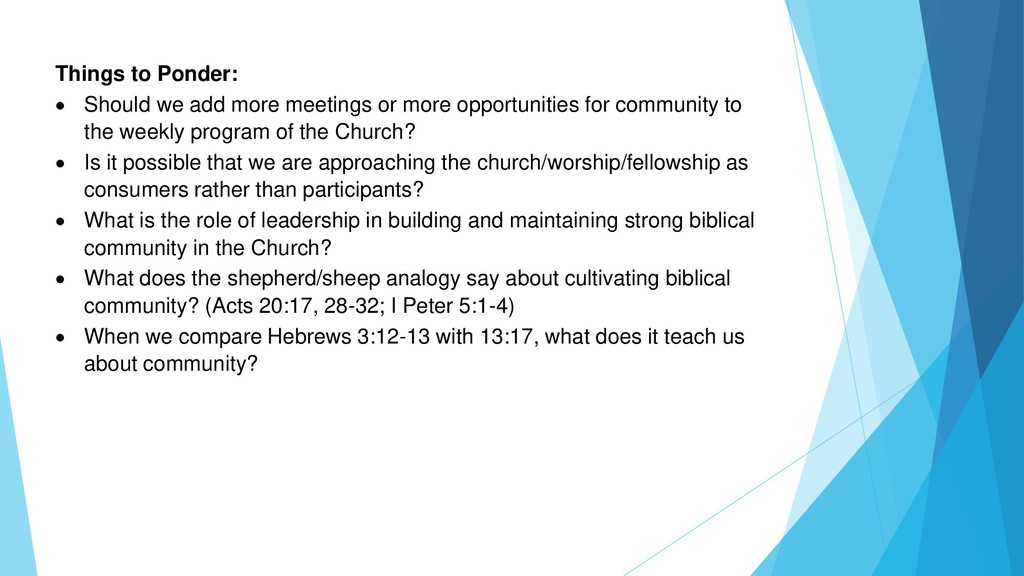
  10. Things to Ponder: • Should we add more meetings or

    more opportunities for community to the weekly program of the Church? • Is it possible that we are approaching the church/worship/fellowship as consumers rather than participants? • What is the role of leadership in building and maintaining strong biblical community in the Church? • What does the shepherd/sheep analogy say about cultivating biblical community? (Acts 20:17, 28-32; I Peter 5:1-4) • When we compare Hebrews 3:12-13 with 13:17, what does it teach us about community?