management_skills_training_complete_guide.pdf
Sponsored
·
 Your Podcast. Everywhere. Effortlessly.
Share. Educate. Inspire. Entertain. You do you. We'll handle the rest.
→
Your Podcast. Everywhere. Effortlessly.
Share. Educate. Inspire. Entertain. You do you. We'll handle the rest.
→

Share
Embed
management_skills_training_complete_guide.pdf

Impact Factory
October 31, 2026
Transcript
10 slides
-
Management Skills Training: A Practical Guide to Managing People, Performance
and Workplace Challenges A comprehensive resource for new managers, experienced team leaders and organisations building stronger management capability Strong management is built through everyday actions: setting clear expectations, listening carefully, making sound decisions and helping people do their best work. Management Skills Training can help managers develop these practical capabilities, turning good intentions into consistent habits that support people and organisational goals. Introduction Moving into management changes the nature of work. A specialist may previously have been judged mainly on individual knowledge, technical quality or personal output. A manager is also responsible for creating the conditions in which other people can contribute. That means clarifying priorities, distributing work, responding to problems, building relationships and keeping a team connected to a shared purpose. These responsibilities are learned; they do not automatically arrive with a new job title. The challenge is not limited to first-time managers. Experienced managers must adapt as teams become more diverse, work becomes more distributed and business priorities change. A technique that worked with one team may not work with another. Good management therefore combines a dependable set of principles with the judgement to apply them to different people and situations. This guide explains the core capabilities involved in managing people well, why they matter and how to strengthen them. It also explores training formats, practical exercises, common mistakes and ways to evaluate progress. The emphasis throughout is on application: what a manager can say, do and practise in real workplace situations. What Is Management Skills Training? A practical definition Management skills training is a structured learning process that helps people develop the knowledge, behaviours and practical techniques needed to manage work and support others. It may cover communication, delegation, feedback, performance conversations, coaching, decision-making, conflict resolution and team development. The aim is not simply to understand management concepts. It is to use them consistently when real people, deadlines and competing priorities are involved. Management and leadership: related, but not identical Management and leadership overlap, but they are not interchangeable. Management gives attention to planning, organising, resourcing, monitoring and delivering work. Leadership gives attention to direction, influence, purpose and change. Teams need both. A manager may set a clear process and allocate responsibilities, while also explaining why the work matters and helping people stay motivated when circumstances shift. Strong development programmes recognise this connection rather than treating management as administration alone. Impact Factory topic resource Page 1 -
MANAGEMENT SKILLS TRAINING | COMPLETE GUIDE Why capability must be
practised Knowing that feedback should be constructive does not guarantee that a manager can deliver it calmly when a deadline has been missed. Understanding delegation does not remove the anxiety of handing an important task to someone else. Training is most useful when participants rehearse realistic situations, receive specific feedback and leave with actions they can test in their own roles. Why Management Skills Matter The manager shapes the day-to-day experience For many employees, organisational culture is experienced through ordinary interactions with their immediate manager: how priorities are explained, whether questions are welcomed, how mistakes are handled and whether good work is recognised. Managers influence the clarity and tone of these interactions. They cannot control every factor affecting morale, but they can create a more predictable, respectful and productive working environment. The effect on performance Clear goals reduce avoidable uncertainty. Appropriate delegation makes better use of team capability. Regular feedback allows problems to be addressed before they become entrenched. Constructive conflict management protects working relationships and helps teams focus on the issue rather than personal blame. Together, these practices can improve coordination and help people spend more time on meaningful work. The effect on retention and development People are more likely to see a future in an organisation when they receive useful guidance, fair treatment and opportunities to grow. Managers contribute by noticing strengths, discussing development goals and making room for learning. Training can also help organisations identify and prepare internal talent for future responsibility, although promotion decisions should always consider capability, performance and role requirements rather than course attendance alone. The Core Skills Every Manager Needs 1. Communication and active listening Effective communication is more than giving instructions. Managers need to explain the outcome required, the reason behind it, the boundaries that matter and the point at which progress should be reviewed. They also need to listen for information that may change the plan. Active listening involves giving attention, asking open questions, checking understanding and summarising what has been heard before deciding what to do. 2. Delegation and accountability Delegation means entrusting responsibility for a defined piece of work while remaining appropriately accountable for the overall result. Good delegation begins with selecting a suitable task and matching it to the person's skills and development needs. The manager explains the expected outcome, available resources, decision-making authority, constraints and check-in points. The team member should understand what they can decide independently and when to escalate an issue. 3. Planning and prioritisation Managers regularly balance urgent requests, long-term objectives, staff capacity and unexpected work. Useful planning starts by distinguishing what is important from what is merely immediate. Break larger outcomes into milestones, identify dependencies and agree which tasks can be delayed or stopped if capacity becomes constrained. A visible priority list can help the team make trade-offs transparently. Impact Factory topic resource Page 2 -
MANAGEMENT SKILLS TRAINING | COMPLETE GUIDE 4. Performance management Performance
management is an ongoing conversation, not just an annual review. It includes agreeing standards, clarifying responsibilities, reviewing progress, recognising effective work and addressing gaps early. Managers should use specific examples and reliable information, avoid assumptions about motivation and give the employee a fair opportunity to explain obstacles. Expectations should be realistic, understood and linked to the role. 5. Coaching and mentoring Coaching helps a person think through a challenge and identify their own next steps. Instead of immediately supplying an answer, a manager might ask: What outcome are you aiming for? What have you tried? What options do you see? What support would help? Mentoring may involve sharing experience and perspective over a longer period. Both approaches support development, but neither removes the manager's responsibility to give clear direction when necessary. 6. Feedback and recognition Useful feedback is timely, specific and focused on behaviour or results that can be acted upon. A manager might say, 'The handover included the client risks and next actions, so the support team could pick it up without delay.' This is more informative than a general 'good job'. When performance needs to improve, describe the gap, explain its impact, invite the employee's perspective and agree a practical next step. 7. Difficult conversations Managers sometimes need to discuss missed expectations, conduct, workload, absence, disagreement or changes that may disappoint people. Avoiding these conversations can allow uncertainty and resentment to grow. Preparation helps: identify the facts, decide the purpose, choose a suitable private setting and consider what a fair outcome might look like. During the discussion, stay calm, ask questions and distinguish observable behaviour from assumptions about intent. 8. Conflict resolution Disagreement is not always harmful. Different perspectives can reveal risks and improve decisions. Conflict becomes difficult when people stop listening, attribute motives or allow issues to become personal. A manager can help by hearing each perspective, identifying the shared problem, agreeing ground rules and focusing on specific actions. Some matters require formal HR, safeguarding or specialist support; managers should understand the limits of their role. 9. Decision-making and problem-solving Good decisions combine evidence, experience, consultation and timely action. First define the problem rather than jumping to a solution. Establish what is known, what remains uncertain and who will be affected. Generate options, assess risks and trade-offs, decide who has authority and communicate the reasoning. After implementation, review what happened and adjust where necessary. 10. Adaptability and self-awareness Managers have different strengths and default behaviours. Some move quickly to action; others seek consensus. Some communicate directly; others prefer to build context first. Self-awareness helps managers recognise how their approach affects different people. Adaptability does not mean being inconsistent or abandoning standards. It means adjusting the route while keeping expectations and values clear. Impact Factory topic resource Page 3 -
MANAGEMENT SKILLS TRAINING | COMPLETE GUIDE Management Skills for Different
Career Stages Aspiring and first-time managers People preparing for management benefit from understanding the difference between individual contribution and responsibility for a team. They should practise setting expectations, running one-to-one meetings, delegating appropriately and giving feedback. Newly promoted managers may also need support in resetting relationships with former peers. Being approachable is valuable, but it should sit alongside fair boundaries and consistent decisions. Middle managers Middle managers often translate organisational priorities into team plans while communicating operational realities upwards. They may coordinate across departments, manage several workstreams and support other managers. Their development can focus on influencing without direct authority, prioritising across competing demands, handling change and coaching team leaders. Senior managers Senior managers need to create clarity across broader areas of responsibility. Their work may include shaping culture, aligning resources, developing future leaders and making decisions with longer-term consequences. Strong listening and communication remain essential, particularly when communicating uncertainty or explaining difficult trade-offs. Managers of remote and hybrid teams Distributed teams need deliberate communication. Managers should agree which channels are used for urgent matters, decisions, collaboration and informal connection. They should make outcomes and ownership visible, avoid measuring contribution solely by online presence and ensure remote colleagues have fair access to information and development. Regular one-to-ones are especially useful when informal contact is limited. Choosing the Right Management Development Format Tailored in-house programmes In-house development can be designed around an organisation's culture, structure, management expectations and current challenges. It is useful when several managers need a shared language or when the organisation wants to work through realistic internal scenarios. The programme should still allow participants to explore different experiences rather than assuming every manager faces identical circumstances. Open courses An open course brings participants from different organisations together. This can expose managers to alternative approaches and provide space to compare experiences outside their immediate workplace. It may suit an individual who wants focused development or an employer seeking a course for one or a small number of people. One-to-one coaching or focused sessions Individual development can be useful when a manager has a specific challenge, such as preparing for a difficult conversation, improving delegation or adjusting to a new role. A focused session should begin with a clear objective and end with actions that can be tested. Coaching is not a substitute for formal organisational processes where those are required. Impact Factory topic resource Page 4 -
MANAGEMENT SKILLS TRAINING | COMPLETE GUIDE Remote, in-person and hybrid
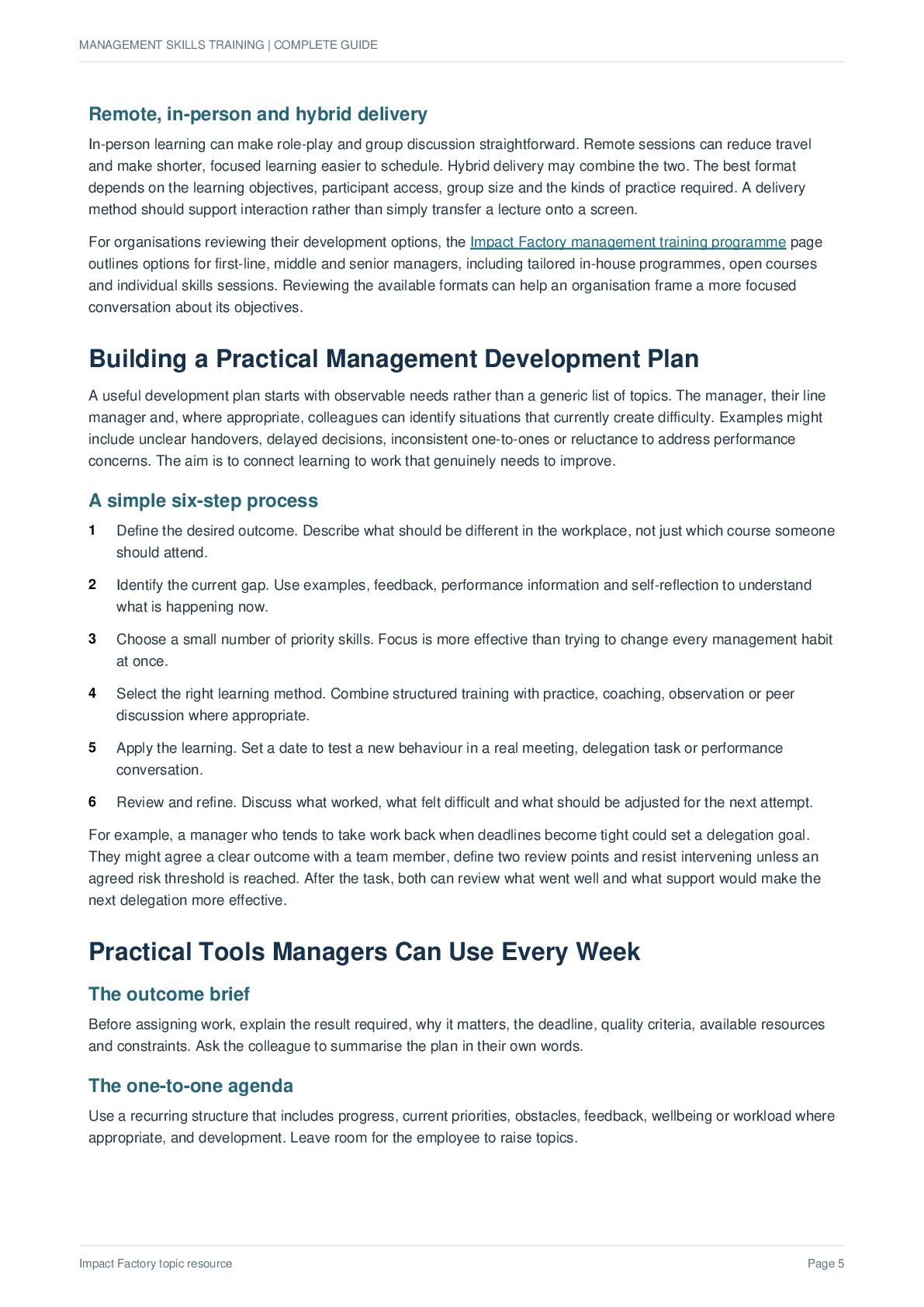
delivery In-person learning can make role-play and group discussion straightforward. Remote sessions can reduce travel and make shorter, focused learning easier to schedule. Hybrid delivery may combine the two. The best format depends on the learning objectives, participant access, group size and the kinds of practice required. A delivery method should support interaction rather than simply transfer a lecture onto a screen. For organisations reviewing their development options, the Impact Factory management training programme page outlines options for first-line, middle and senior managers, including tailored in-house programmes, open courses and individual skills sessions. Reviewing the available formats can help an organisation frame a more focused conversation about its objectives. Building a Practical Management Development Plan A useful development plan starts with observable needs rather than a generic list of topics. The manager, their line manager and, where appropriate, colleagues can identify situations that currently create difficulty. Examples might include unclear handovers, delayed decisions, inconsistent one-to-ones or reluctance to address performance concerns. The aim is to connect learning to work that genuinely needs to improve. A simple six-step process 1 Define the desired outcome. Describe what should be different in the workplace, not just which course someone should attend. 2 Identify the current gap. Use examples, feedback, performance information and self-reflection to understand what is happening now. 3 Choose a small number of priority skills. Focus is more effective than trying to change every management habit at once. 4 Select the right learning method. Combine structured training with practice, coaching, observation or peer discussion where appropriate. 5 Apply the learning. Set a date to test a new behaviour in a real meeting, delegation task or performance conversation. 6 Review and refine. Discuss what worked, what felt difficult and what should be adjusted for the next attempt. For example, a manager who tends to take work back when deadlines become tight could set a delegation goal. They might agree a clear outcome with a team member, define two review points and resist intervening unless an agreed risk threshold is reached. After the task, both can review what went well and what support would make the next delegation more effective. Practical Tools Managers Can Use Every Week The outcome brief Before assigning work, explain the result required, why it matters, the deadline, quality criteria, available resources and constraints. Ask the colleague to summarise the plan in their own words. The one-to-one agenda Use a recurring structure that includes progress, current priorities, obstacles, feedback, wellbeing or workload where appropriate, and development. Leave room for the employee to raise topics. Impact Factory topic resource Page 5 -
MANAGEMENT SKILLS TRAINING | COMPLETE GUIDE The feedback structure Describe
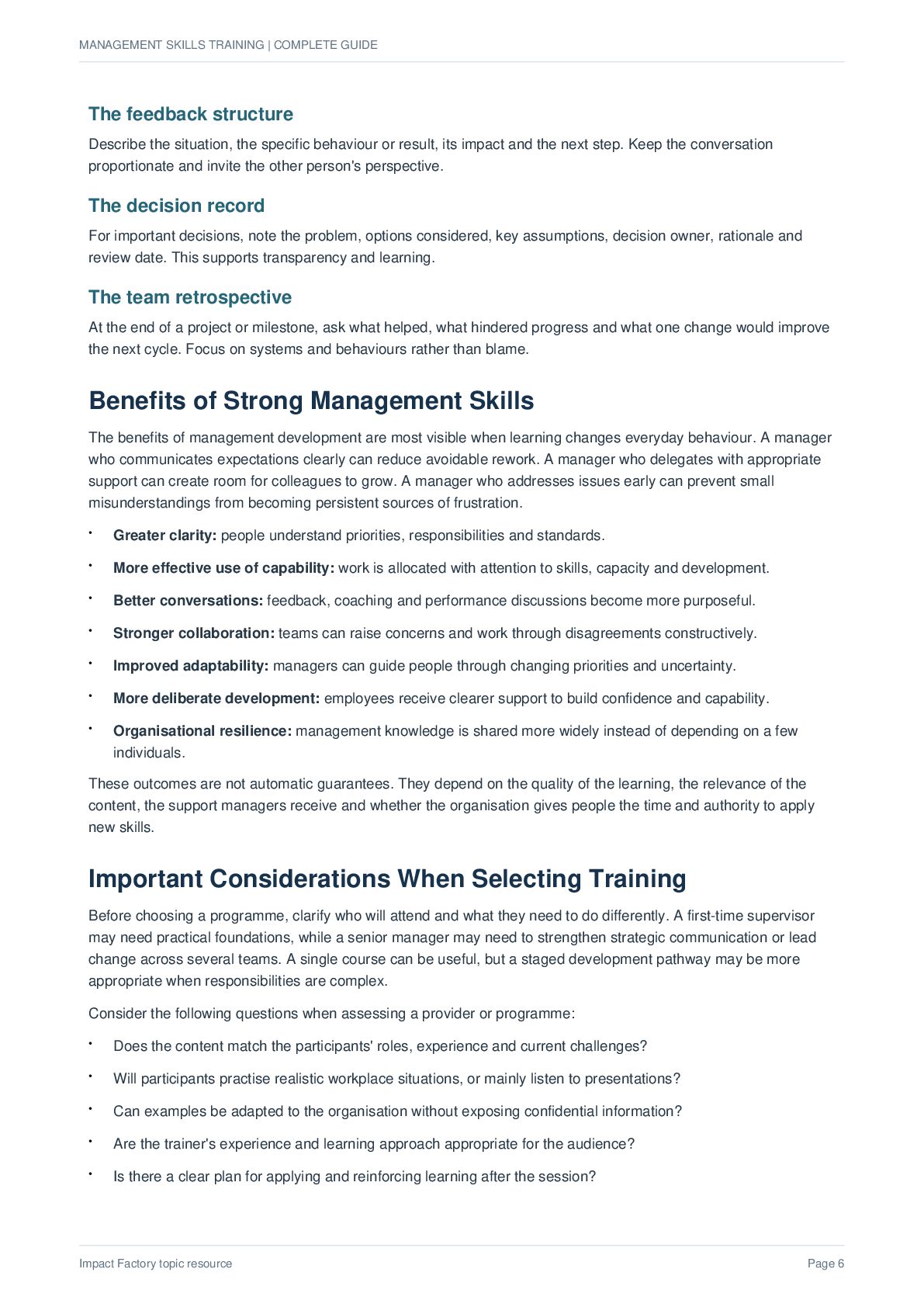
the situation, the specific behaviour or result, its impact and the next step. Keep the conversation proportionate and invite the other person's perspective. The decision record For important decisions, note the problem, options considered, key assumptions, decision owner, rationale and review date. This supports transparency and learning. The team retrospective At the end of a project or milestone, ask what helped, what hindered progress and what one change would improve the next cycle. Focus on systems and behaviours rather than blame. Benefits of Strong Management Skills The benefits of management development are most visible when learning changes everyday behaviour. A manager who communicates expectations clearly can reduce avoidable rework. A manager who delegates with appropriate support can create room for colleagues to grow. A manager who addresses issues early can prevent small misunderstandings from becoming persistent sources of frustration. • Greater clarity: people understand priorities, responsibilities and standards. • More effective use of capability: work is allocated with attention to skills, capacity and development. • Better conversations: feedback, coaching and performance discussions become more purposeful. • Stronger collaboration: teams can raise concerns and work through disagreements constructively. • Improved adaptability: managers can guide people through changing priorities and uncertainty. • More deliberate development: employees receive clearer support to build confidence and capability. • Organisational resilience: management knowledge is shared more widely instead of depending on a few individuals. These outcomes are not automatic guarantees. They depend on the quality of the learning, the relevance of the content, the support managers receive and whether the organisation gives people the time and authority to apply new skills. Important Considerations When Selecting Training Before choosing a programme, clarify who will attend and what they need to do differently. A first-time supervisor may need practical foundations, while a senior manager may need to strengthen strategic communication or lead change across several teams. A single course can be useful, but a staged development pathway may be more appropriate when responsibilities are complex. Consider the following questions when assessing a provider or programme: • Does the content match the participants' roles, experience and current challenges? • Will participants practise realistic workplace situations, or mainly listen to presentations? • Can examples be adapted to the organisation without exposing confidential information? • Are the trainer's experience and learning approach appropriate for the audience? • Is there a clear plan for applying and reinforcing learning after the session? Impact Factory topic resource Page 6 -
MANAGEMENT SKILLS TRAINING | COMPLETE GUIDE • How will progress
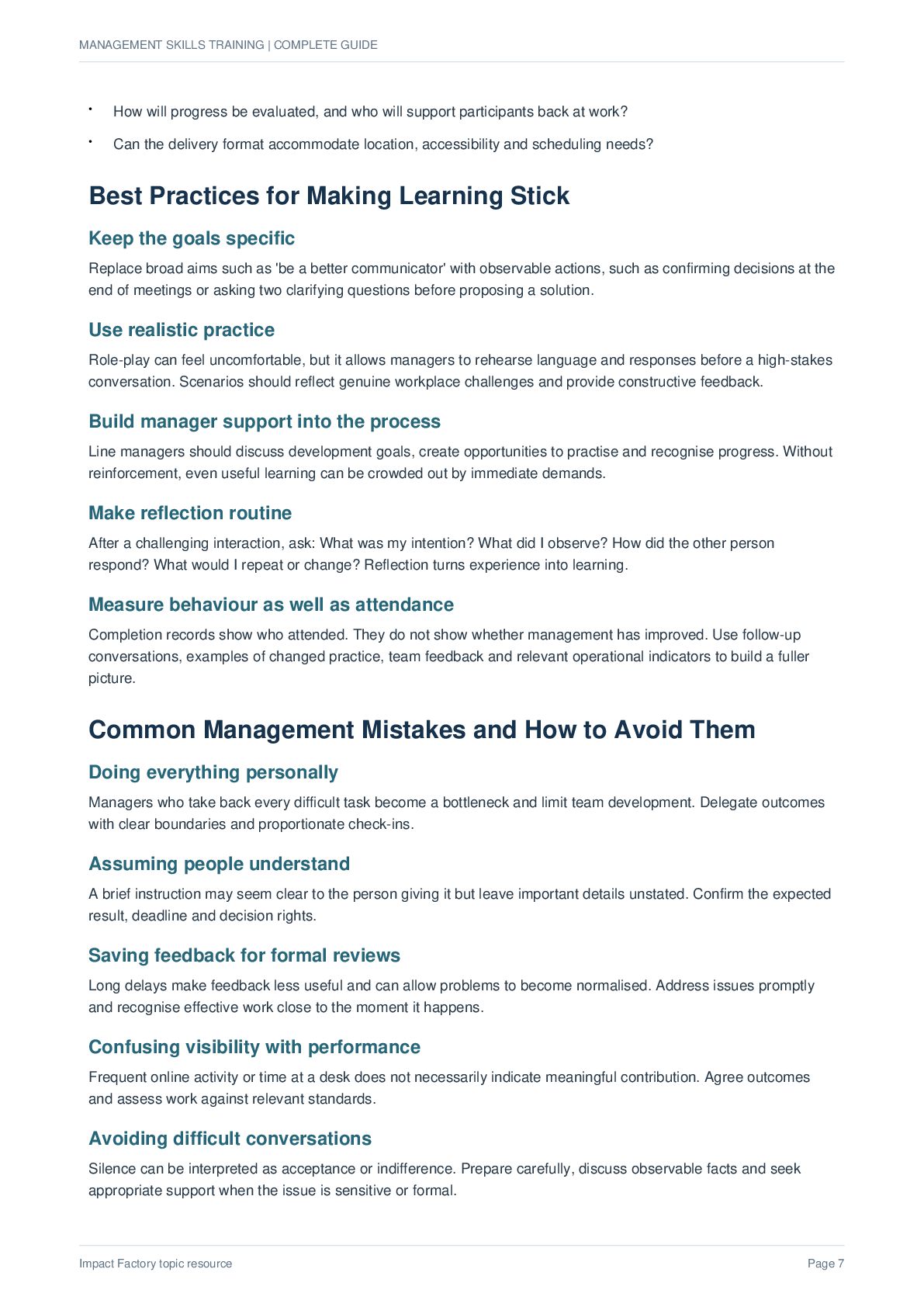
be evaluated, and who will support participants back at work? • Can the delivery format accommodate location, accessibility and scheduling needs? Best Practices for Making Learning Stick Keep the goals specific Replace broad aims such as 'be a better communicator' with observable actions, such as confirming decisions at the end of meetings or asking two clarifying questions before proposing a solution. Use realistic practice Role-play can feel uncomfortable, but it allows managers to rehearse language and responses before a high-stakes conversation. Scenarios should reflect genuine workplace challenges and provide constructive feedback. Build manager support into the process Line managers should discuss development goals, create opportunities to practise and recognise progress. Without reinforcement, even useful learning can be crowded out by immediate demands. Make reflection routine After a challenging interaction, ask: What was my intention? What did I observe? How did the other person respond? What would I repeat or change? Reflection turns experience into learning. Measure behaviour as well as attendance Completion records show who attended. They do not show whether management has improved. Use follow-up conversations, examples of changed practice, team feedback and relevant operational indicators to build a fuller picture. Common Management Mistakes and How to Avoid Them Doing everything personally Managers who take back every difficult task become a bottleneck and limit team development. Delegate outcomes with clear boundaries and proportionate check-ins. Assuming people understand A brief instruction may seem clear to the person giving it but leave important details unstated. Confirm the expected result, deadline and decision rights. Saving feedback for formal reviews Long delays make feedback less useful and can allow problems to become normalised. Address issues promptly and recognise effective work close to the moment it happens. Confusing visibility with performance Frequent online activity or time at a desk does not necessarily indicate meaningful contribution. Agree outcomes and assess work against relevant standards. Avoiding difficult conversations Silence can be interpreted as acceptance or indifference. Prepare carefully, discuss observable facts and seek appropriate support when the issue is sensitive or formal. Impact Factory topic resource Page 7 -
MANAGEMENT SKILLS TRAINING | COMPLETE GUIDE Using one style with
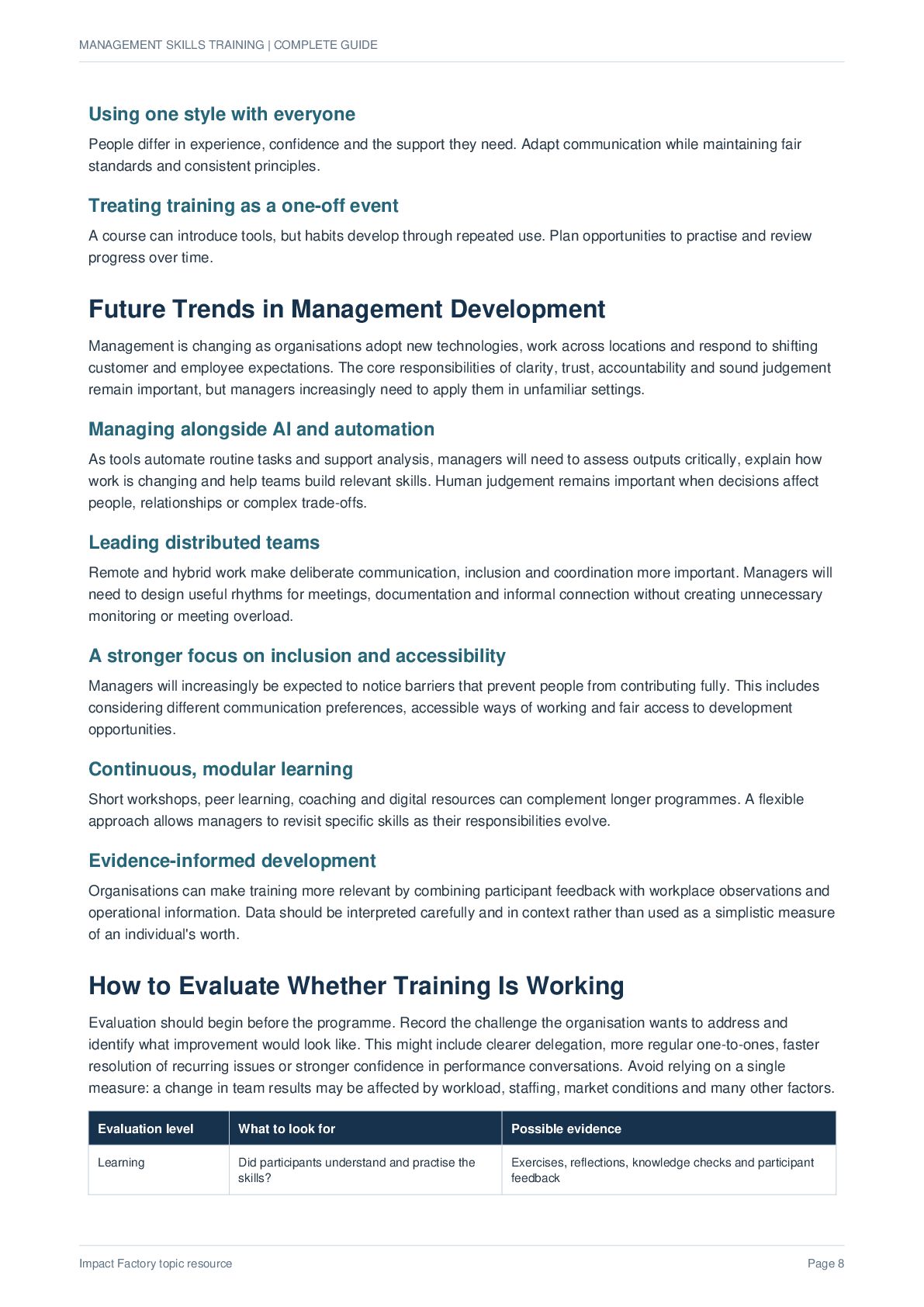
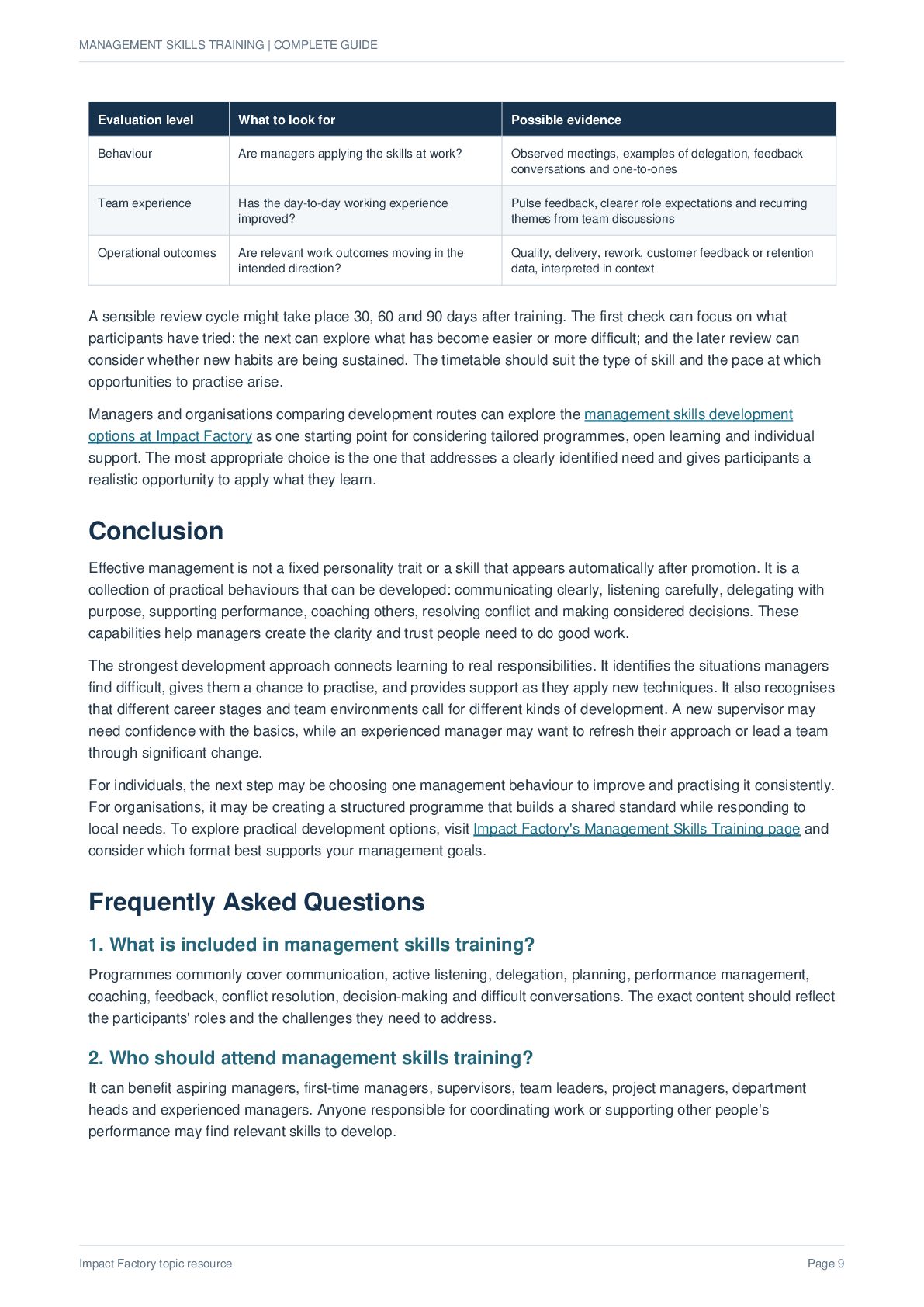
everyone People differ in experience, confidence and the support they need. Adapt communication while maintaining fair standards and consistent principles. Treating training as a one-off event A course can introduce tools, but habits develop through repeated use. Plan opportunities to practise and review progress over time. Future Trends in Management Development Management is changing as organisations adopt new technologies, work across locations and respond to shifting customer and employee expectations. The core responsibilities of clarity, trust, accountability and sound judgement remain important, but managers increasingly need to apply them in unfamiliar settings. Managing alongside AI and automation As tools automate routine tasks and support analysis, managers will need to assess outputs critically, explain how work is changing and help teams build relevant skills. Human judgement remains important when decisions affect people, relationships or complex trade-offs. Leading distributed teams Remote and hybrid work make deliberate communication, inclusion and coordination more important. Managers will need to design useful rhythms for meetings, documentation and informal connection without creating unnecessary monitoring or meeting overload. A stronger focus on inclusion and accessibility Managers will increasingly be expected to notice barriers that prevent people from contributing fully. This includes considering different communication preferences, accessible ways of working and fair access to development opportunities. Continuous, modular learning Short workshops, peer learning, coaching and digital resources can complement longer programmes. A flexible approach allows managers to revisit specific skills as their responsibilities evolve. Evidence-informed development Organisations can make training more relevant by combining participant feedback with workplace observations and operational information. Data should be interpreted carefully and in context rather than used as a simplistic measure of an individual's worth. How to Evaluate Whether Training Is Working Evaluation should begin before the programme. Record the challenge the organisation wants to address and identify what improvement would look like. This might include clearer delegation, more regular one-to-ones, faster resolution of recurring issues or stronger confidence in performance conversations. Avoid relying on a single measure: a change in team results may be affected by workload, staffing, market conditions and many other factors. Evaluation level What to look for Possible evidence Learning Did participants understand and practise the skills? Exercises, reflections, knowledge checks and participant feedback Impact Factory topic resource Page 8 -
MANAGEMENT SKILLS TRAINING | COMPLETE GUIDE Evaluation level What to
look for Possible evidence Behaviour Are managers applying the skills at work? Observed meetings, examples of delegation, feedback conversations and one-to-ones Team experience Has the day-to-day working experience improved? Pulse feedback, clearer role expectations and recurring themes from team discussions Operational outcomes Are relevant work outcomes moving in the intended direction? Quality, delivery, rework, customer feedback or retention data, interpreted in context A sensible review cycle might take place 30, 60 and 90 days after training. The first check can focus on what participants have tried; the next can explore what has become easier or more difficult; and the later review can consider whether new habits are being sustained. The timetable should suit the type of skill and the pace at which opportunities to practise arise. Managers and organisations comparing development routes can explore the management skills development options at Impact Factory as one starting point for considering tailored programmes, open learning and individual support. The most appropriate choice is the one that addresses a clearly identified need and gives participants a realistic opportunity to apply what they learn. Conclusion Effective management is not a fixed personality trait or a skill that appears automatically after promotion. It is a collection of practical behaviours that can be developed: communicating clearly, listening carefully, delegating with purpose, supporting performance, coaching others, resolving conflict and making considered decisions. These capabilities help managers create the clarity and trust people need to do good work. The strongest development approach connects learning to real responsibilities. It identifies the situations managers find difficult, gives them a chance to practise, and provides support as they apply new techniques. It also recognises that different career stages and team environments call for different kinds of development. A new supervisor may need confidence with the basics, while an experienced manager may want to refresh their approach or lead a team through significant change. For individuals, the next step may be choosing one management behaviour to improve and practising it consistently. For organisations, it may be creating a structured programme that builds a shared standard while responding to local needs. To explore practical development options, visit Impact Factory's Management Skills Training page and consider which format best supports your management goals. Frequently Asked Questions 1. What is included in management skills training? Programmes commonly cover communication, active listening, delegation, planning, performance management, coaching, feedback, conflict resolution, decision-making and difficult conversations. The exact content should reflect the participants' roles and the challenges they need to address. 2. Who should attend management skills training? It can benefit aspiring managers, first-time managers, supervisors, team leaders, project managers, department heads and experienced managers. Anyone responsible for coordinating work or supporting other people's performance may find relevant skills to develop. Impact Factory topic resource Page 9 -
MANAGEMENT SKILLS TRAINING | COMPLETE GUIDE 3. Is management training
useful for experienced managers? Yes. Experienced managers face changing teams, technology, expectations and business priorities. Development can help them refresh established habits, strengthen a particular skill, learn from peers and adapt their approach to new circumstances. 4. What is the difference between management training and leadership training? Management training often focuses on organising work, setting expectations, allocating resources and monitoring performance. Leadership development often focuses on direction, influence, purpose and change. In practice, managers need elements of both. 5. Is in-house management training better than an open course? Neither format is automatically better. In-house training can be tailored to an organisation's culture and shared challenges. Open courses can offer perspectives from people in other organisations. The right choice depends on the learning objective, number of participants, budget and desired level of customisation. 6. How long does management skills training take? Duration varies. It may involve a short workshop, a focused remote session, a multi-day course or a longer development programme with follow-up practice. The appropriate length depends on the complexity of the skills and the time available to apply them. 7. How can managers apply what they learn after a course? Choose one or two behaviours to practise, use them in real workplace situations, ask for feedback and reflect on the result. Line-manager support, peer discussion and follow-up sessions can help turn a new technique into a consistent habit. Further Information To learn more about management development formats and how a programme may be shaped around different levels of responsibility, visit the Impact Factory Management Skills Training page or contact its team to discuss your objectives. This guide is intended for general professional development and educational purposes. The examples are illustrative; managers should follow their organisation's policies and seek appropriate HR, legal or specialist advice when dealing with formal employment matters. Impact Factory topic resource Page 10
 holman
 tamaranovitovic
 baasie
 rmw
 honnibal
 rasagy
 frankvandijk
 kneath
 jakevdp
 livdayseo
 seathinner
 3n