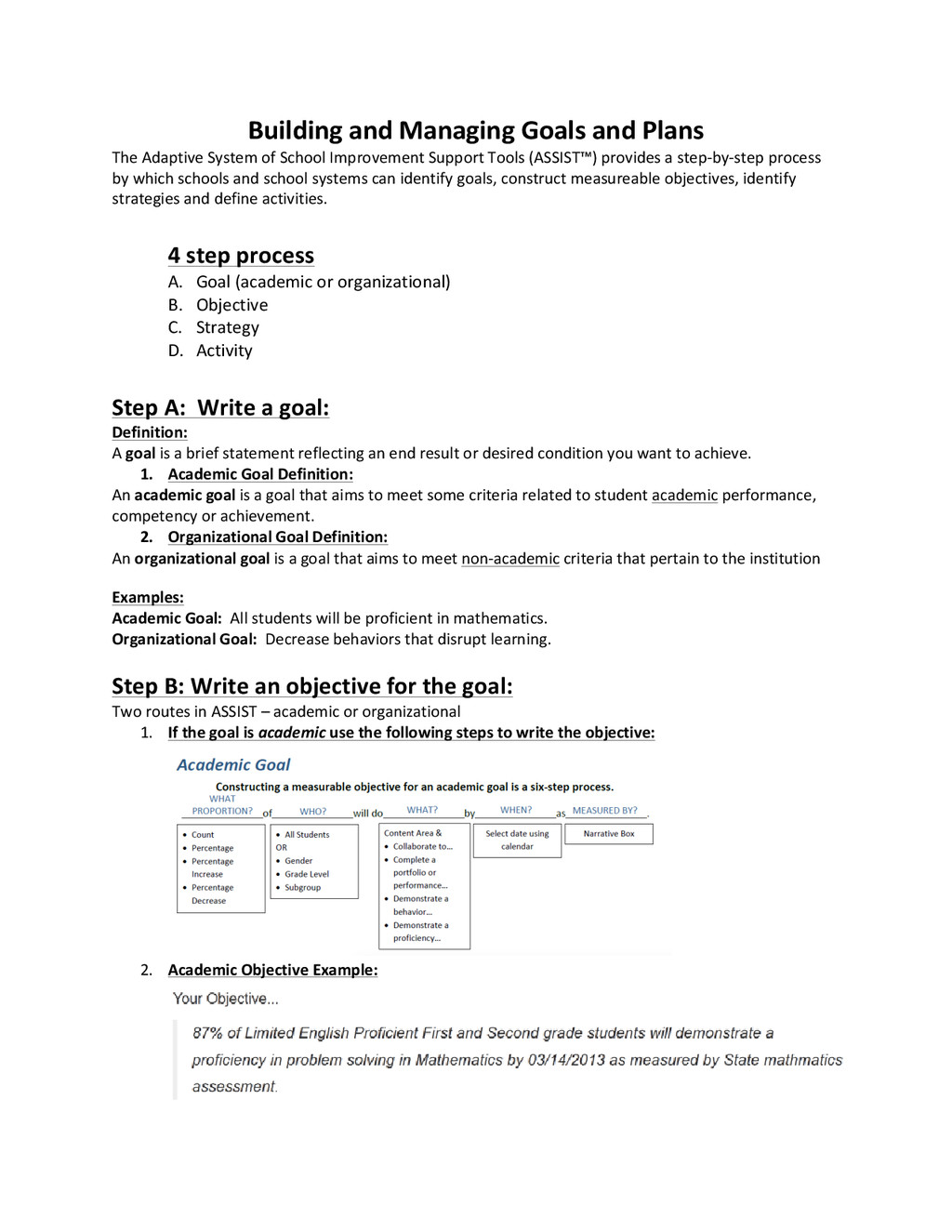
System of School Improvement Support Tools (ASSIST™) provides a step-‐by-‐step process by which schools and school systems can identify goals, construct measureable objectives, identify strategies and define activities. 4 step process A. Goal (academic or organizational) B. Objective C. Strategy D. Activity Step A: Write a goal: Definition: A goal is a brief statement reflecting an end result or desired condition you want to achieve. 1. Academic Goal Definition: An academic goal is a goal that aims to meet some criteria related to student academic performance, competency or achievement. 2. Organizational Goal Definition: An organizational goal is a goal that aims to meet non-‐academic criteria that pertain to the institution Examples: Academic Goal: All students will be proficient in mathematics. Organizational Goal: Decrease behaviors that disrupt learning. Step B: Write an objective for the goal: Two routes in ASSIST – academic or organizational 1. If the goal is academic use the following steps to write the objective: 2. Academic Objective Example:
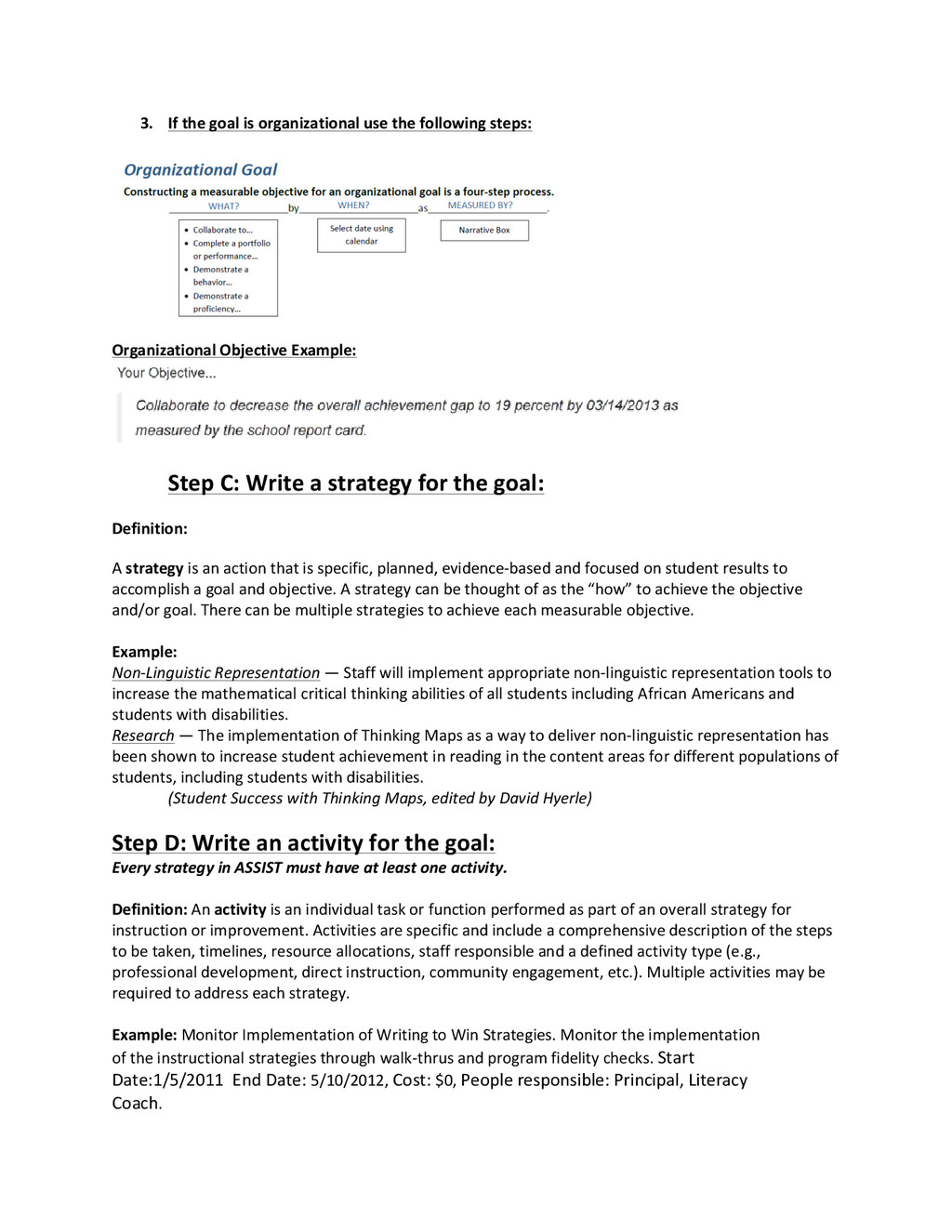
Organizational Objective Example: Step C: Write a strategy for the goal: Definition: A strategy is an action that is specific, planned, evidence-‐based and focused on student results to accomplish a goal and objective. A strategy can be thought of as the “how” to achieve the objective and/or goal. There can be multiple strategies to achieve each measurable objective. Example: Non-‐Linguistic Representation — Staff will implement appropriate non-‐linguistic representation tools to increase the mathematical critical thinking abilities of all students including African Americans and students with disabilities. Research — The implementation of Thinking Maps as a way to deliver non-‐linguistic representation has been shown to increase student achievement in reading in the content areas for different populations of students, including students with disabilities. (Student Success with Thinking Maps, edited by David Hyerle) Step D: Write an activity for the goal: Every strategy in ASSIST must have at least one activity. Definition: An activity is an individual task or function performed as part of an overall strategy for instruction or improvement. Activities are specific and include a comprehensive description of the steps to be taken, timelines, resource allocations, staff responsible and a defined activity type (e.g., professional development, direct instruction, community engagement, etc.). Multiple activities may be required to address each strategy. Example: Monitor Implementation of Writing to Win Strategies. Monitor the implementation of the instructional strategies through walk-‐thrus and program fidelity checks. Start Date:1/5/2011 End Date: 5/10/2012, Cost: $0, People responsible: Principal, Literacy Coach.


 jgraham
 davidcarrasco
 samtorres
 baasie
 afnizarnur
 marcoroth
 andyhume
 akashhashmi
 jacobtomlinson
 holman
 thirion
 katarinadahlin
 twada