I Z E D A I I N F E R E N C E A N D M E M O R Y N E T W O R K B U I L T O N S U I Private AI. Distributed Compute. Persistent Memory. The AI infrastructure layer where compute, memory, and trust are owned by users. P I N A I V U A I I N V E S T O R D E C K J U N E 2 1 , 2 0 2 6
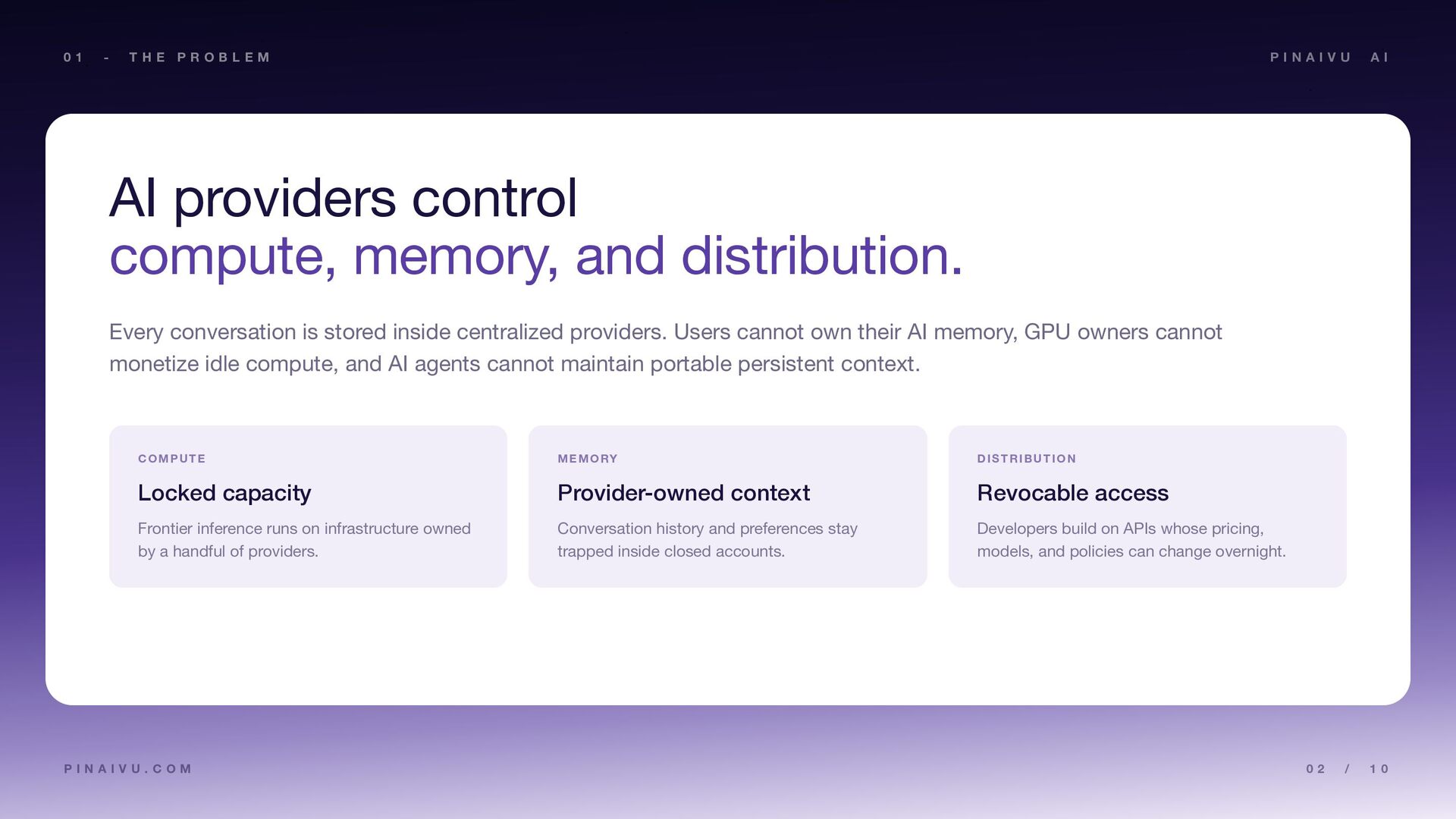
L E M P I N A I V U A I AI providers control compute, memory, and distribution. Every conversation is stored inside centralized providers. Users cannot own their AI memory, GPU owners cannot monetize idle compute, and AI agents cannot maintain portable persistent context. COMPUTE Locked capacity Frontier inference runs on infrastructure owned by a handful of providers. MEMORY Provider-owned context Conversation history and preferences stay trapped inside closed accounts. DISTRIBUTION Revocable access Developers build on APIs whose pricing, models, and policies can change overnight. P I N A I V U . C O M 0 2 / 1 0
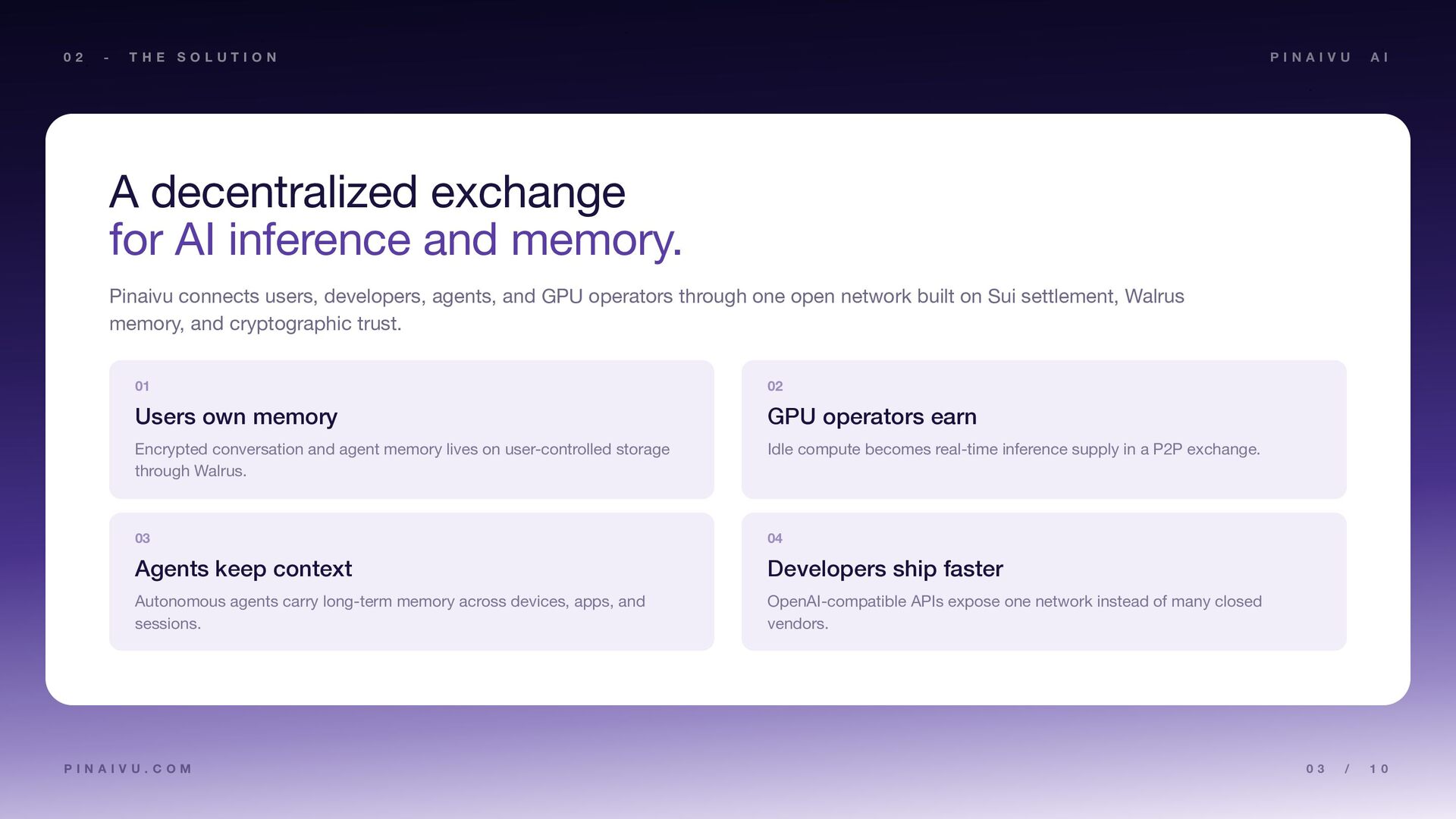
T I O N P I N A I V U A I A decentralized exchange for AI inference and memory. Pinaivu connects users, developers, agents, and GPU operators through one open network built on Sui settlement, Walrus memory, and cryptographic trust. 01 Users own memory Encrypted conversation and agent memory lives on user-controlled storage through Walrus. 02 GPU operators earn Idle compute becomes real-time inference supply in a P2P exchange. 03 Agents keep context Autonomous agents carry long-term memory across devices, apps, and sessions. 04 Developers ship faster OpenAI-compatible APIs expose one network instead of many closed vendors. P I N A I V U . C O M 0 3 / 1 0
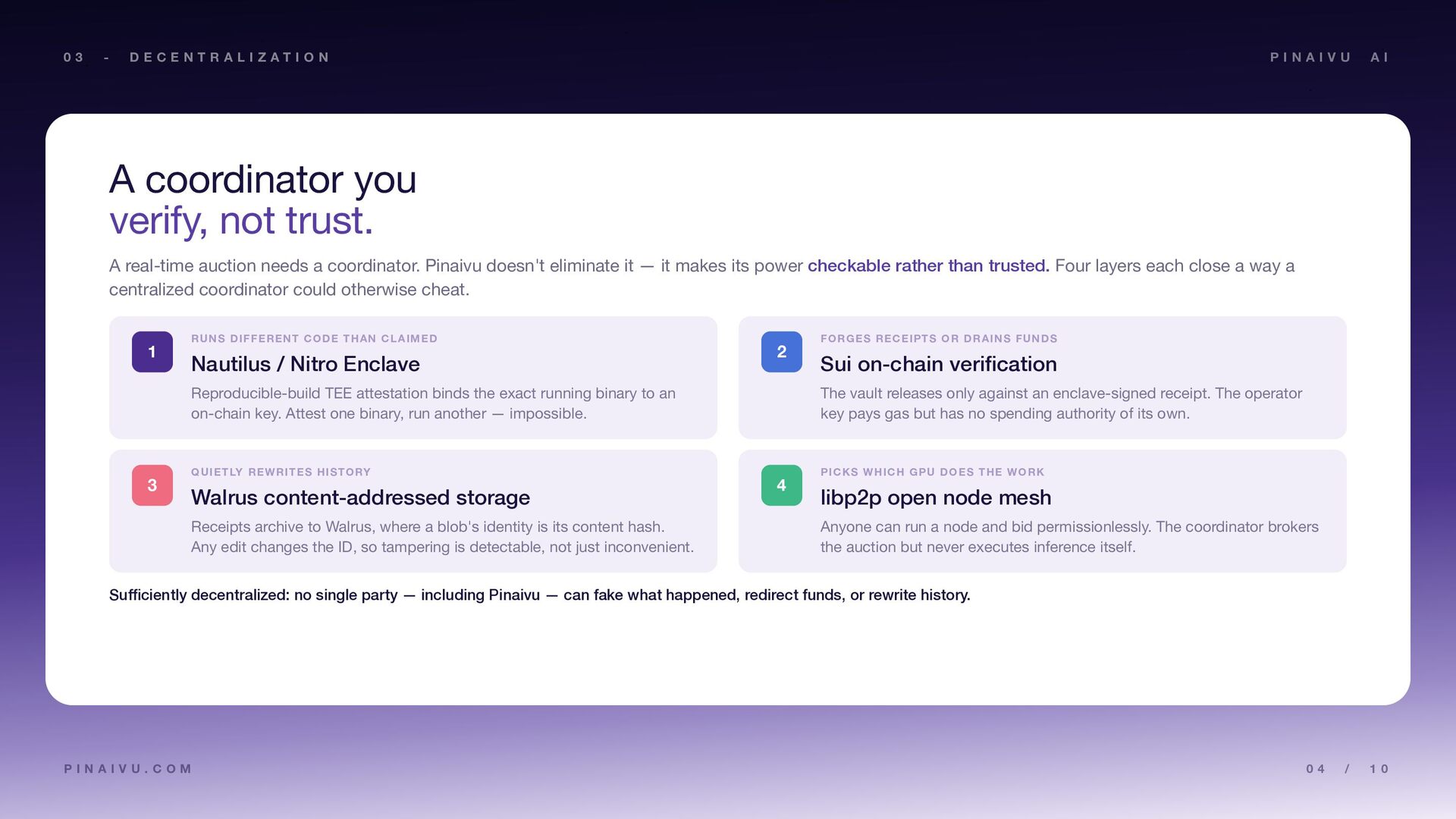
A L I Z A T I O N P I N A I V U A I A coordinator you verify, not trust. A real-time auction needs a coordinator. Pinaivu doesn't eliminate it — it makes its power checkable rather than trusted. Four layers each close a way a centralized coordinator could otherwise cheat. 1 RUNS DIFFERENT CODE THAN CLAIMED Nautilus / Nitro Enclave Reproducible-build TEE attestation binds the exact running binary to an on-chain key. Attest one binary, run another — impossible. 2 FORGES RECEIPTS OR DRAINS FUNDS Sui on-chain verification The vault releases only against an enclave-signed receipt. The operator key pays gas but has no spending authority of its own. 3 QUIETLY REWRITES HISTORY Walrus content-addressed storage Receipts archive to Walrus, where a blob's identity is its content hash. Any edit changes the ID, so tampering is detectable, not just inconvenient. 4 PICKS WHICH GPU DOES THE WORK libp2p open node mesh Anyone can run a node and bid permissionlessly. The coordinator brokers the auction but never executes inference itself. Sufficiently decentralized: no single party — including Pinaivu — can fake what happened, redirect funds, or rewrite history. P I N A I V U . C O M 0 4 / 1 0
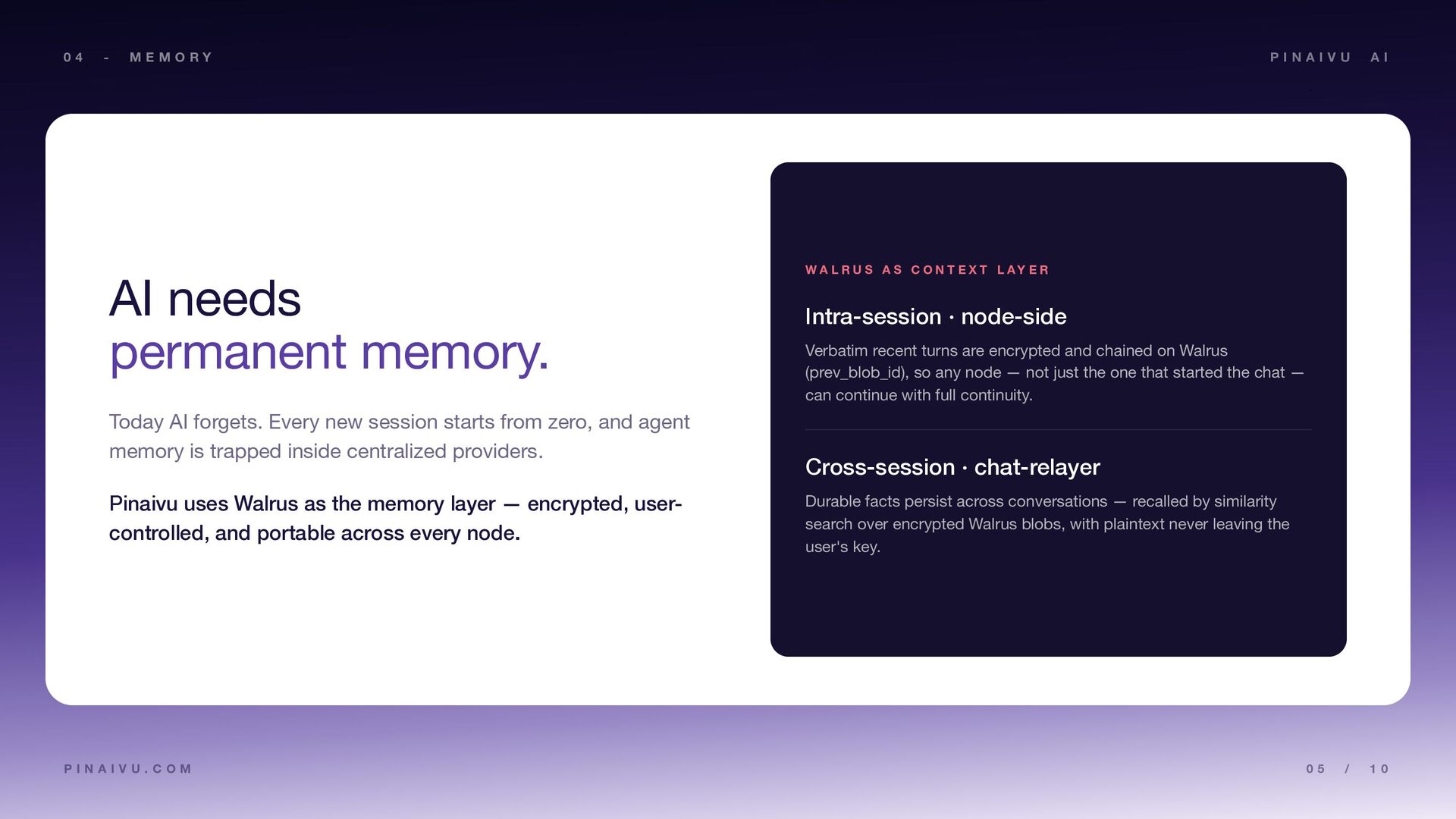
I N A I V U A I AI needs permanent memory. Today AI forgets. Every new session starts from zero, and agent memory is trapped inside centralized providers. Pinaivu uses Walrus as the memory layer — encrypted, user- controlled, and portable across every node. W A L R U S A S C O N T E X T L A Y E R Intra-session · node-side Verbatim recent turns are encrypted and chained on Walrus (prev_blob_id), so any node — not just the one that started the chat — can continue with full continuity. Cross-session · chat-relayer Durable facts persist across conversations — recalled by similarity search over encrypted Walrus blobs, with plaintext never leaving the user's key. P I N A I V U . C O M 0 5 / 1 0
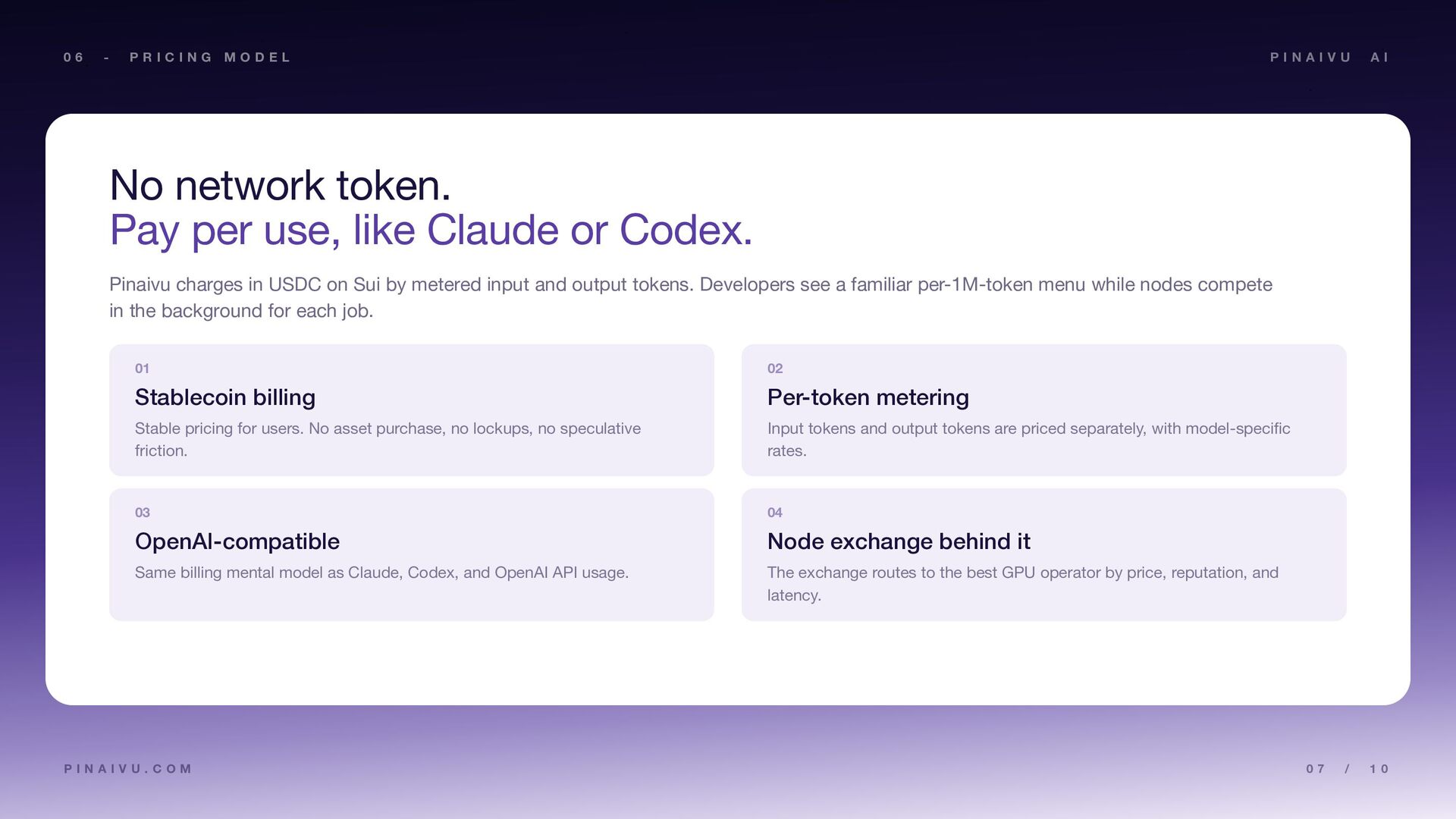
M O D E L P I N A I V U A I No network token. Pay per use, like Claude or Codex. Pinaivu charges in USDC on Sui by metered input and output tokens. Developers see a familiar per-1M-token menu while nodes compete in the background for each job. 01 Stablecoin billing Stable pricing for users. No asset purchase, no lockups, no speculative friction. 02 Per-token metering Input tokens and output tokens are priced separately, with model-specific rates. 03 OpenAI-compatible Same billing mental model as Claude, Codex, and OpenAI API usage. 04 Node exchange behind it The exchange routes to the best GPU operator by price, reputation, and latency. P I N A I V U . C O M 0 7 / 1 0
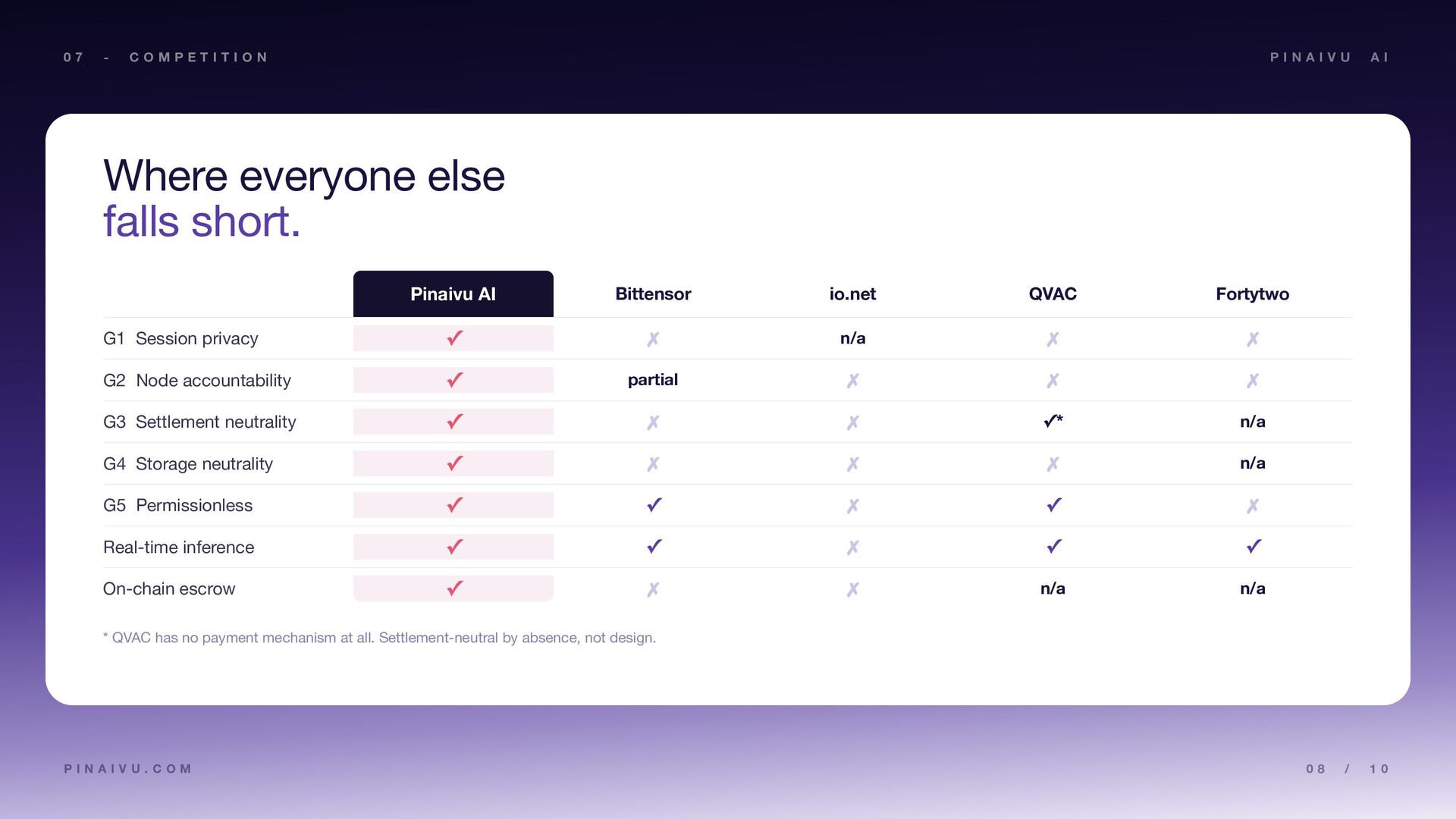
T I O N P I N A I V U A I Where everyone else falls short. Pinaivu AI Bittensor io.net QVAC Fortytwo G1 Session privacy ✓ ✗ n/a ✗ ✗ G2 Node accountability ✓ partial ✗ ✗ ✗ G3 Settlement neutrality ✓ ✗ ✗ ✓* n/a G4 Storage neutrality ✓ ✗ ✗ ✗ n/a G5 Permissionless ✓ ✓ ✗ ✓ ✗ Real-time inference ✓ ✓ ✗ ✓ ✓ On-chain escrow ✓ ✗ ✗ n/a n/a * QVAC has no payment mechanism at all. Settlement-neutral by absence, not design. P I N A I V U . C O M 0 8 / 1 0
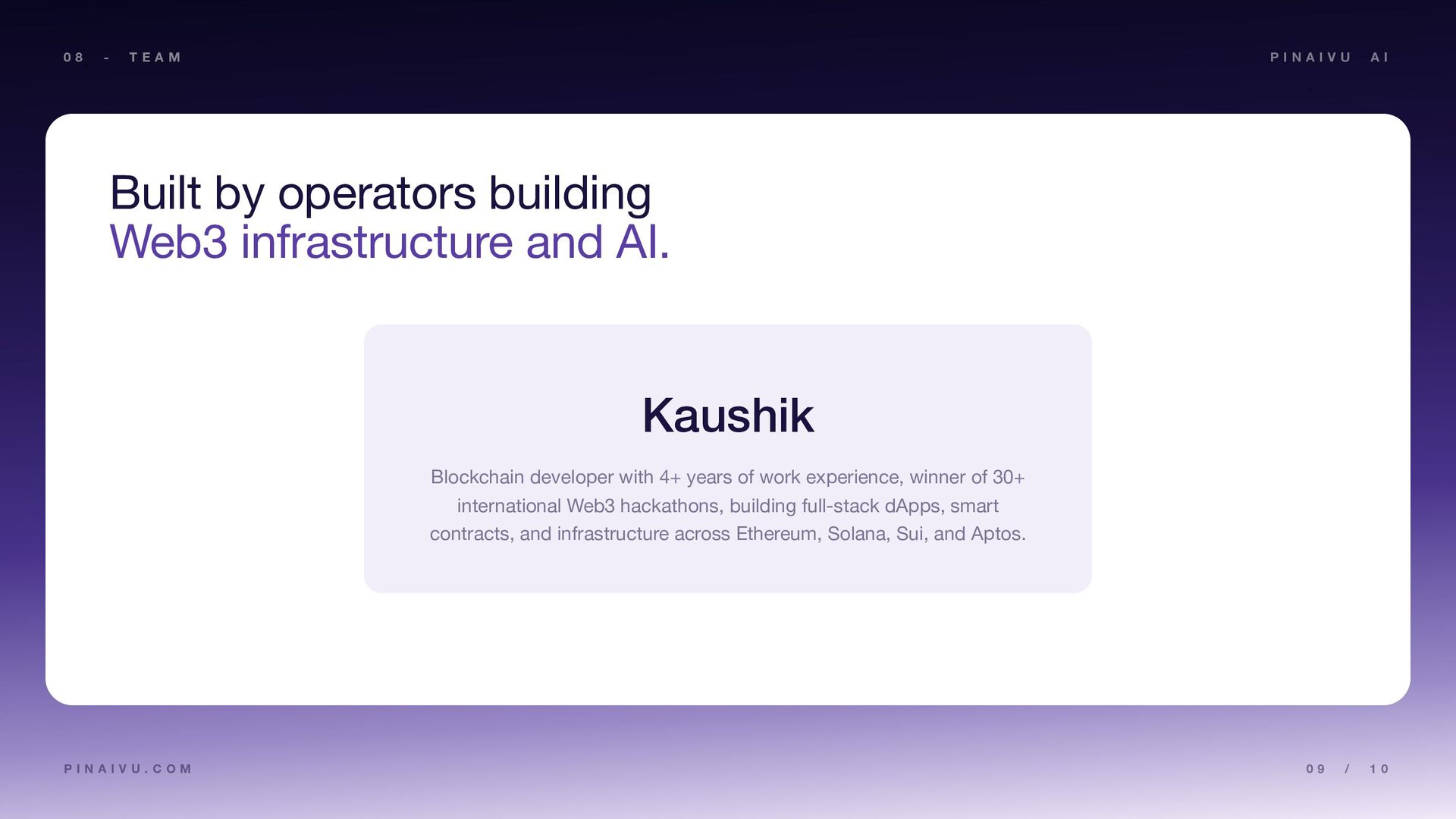
A I V U A I Built by operators building Web3 infrastructure and AI. Kaushik Blockchain developer with 4+ years of work experience, winner of 30+ international Web3 hackathons, building full-stack dApps, smart contracts, and infrastructure across Ethereum, Solana, Sui, and Aptos. P I N A I V U . C O M 0 9 / 1 0
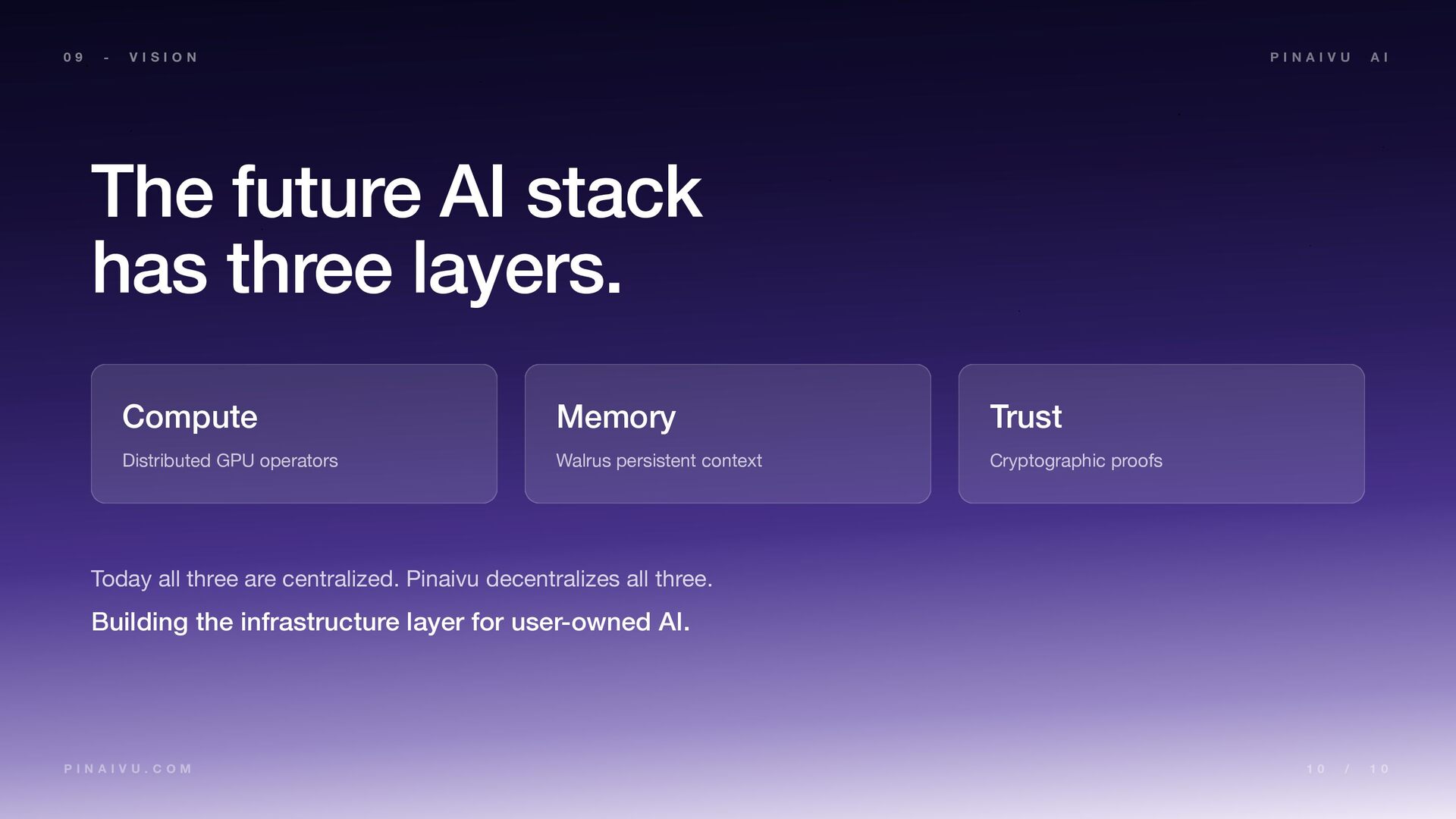
I N A I V U A I The future AI stack has three layers. Compute Distributed GPU operators Memory Walrus persistent context Trust Cryptographic proofs Today all three are centralized. Pinaivu decentralizes all three. Building the infrastructure layer for user-owned AI. P I N A I V U . C O M 1 0 / 1 0


 katiecoart
 ryanjones
 aemeredith
 lara
 chriscoyier
 greggifford
 bcantrill
 csswizardry
 aki_iinuma
 aleyda
 ianozsvald