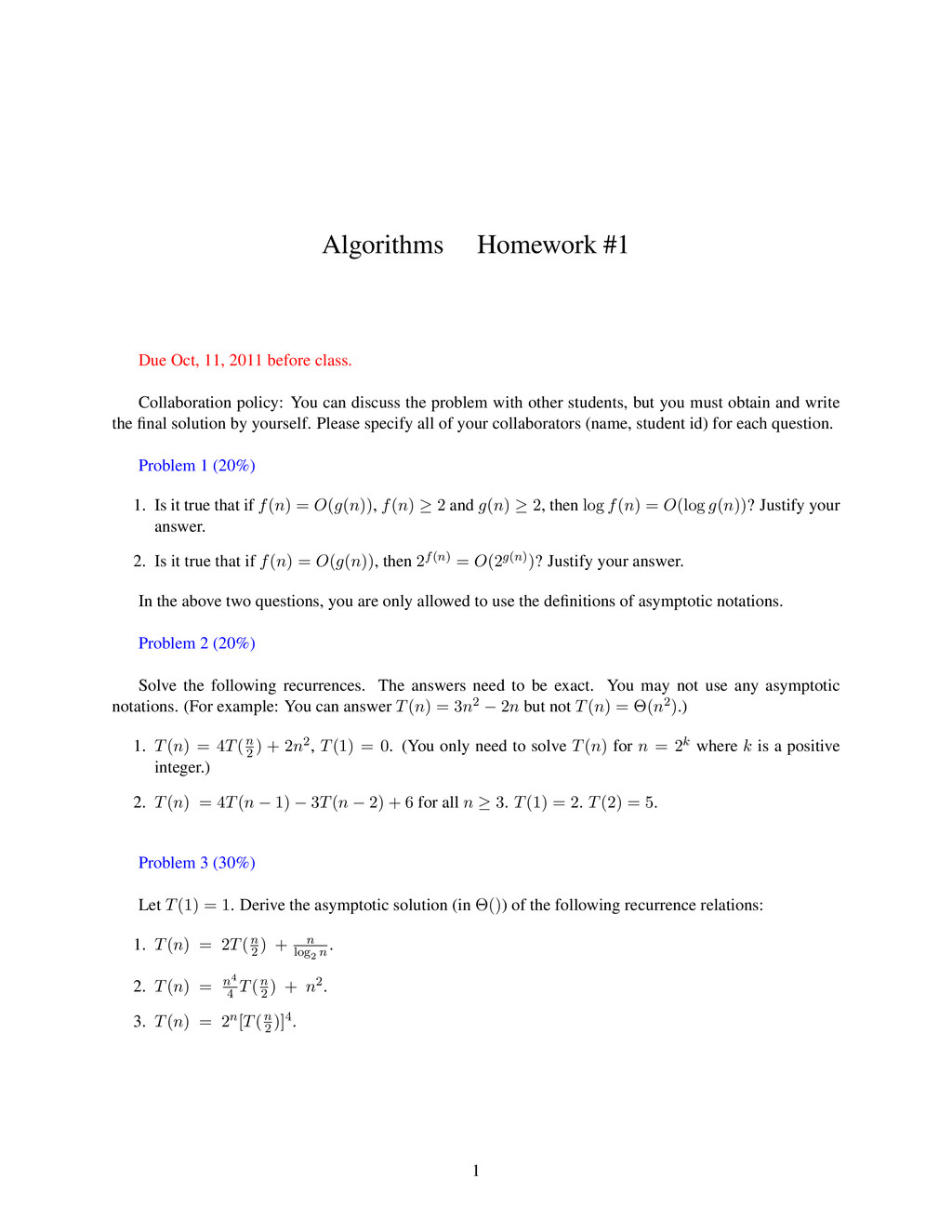
policy: You can discuss the problem with other students, but you must obtain and write the final solution by yourself. Please specify all of your collaborators (name, student id) for each question. Problem 1 (20%) 1. Is it true that if f(n) = O(g(n)), f(n) ≥ 2 and g(n) ≥ 2, then log f(n) = O(log g(n))? Justify your answer. 2. Is it true that if f(n) = O(g(n)), then 2f(n) = O(2g(n))? Justify your answer. In the above two questions, you are only allowed to use the definitions of asymptotic notations. Problem 2 (20%) Solve the following recurrences. The answers need to be exact. You may not use any asymptotic notations. (For example: You can answer T(n) = 3n2 − 2n but not T(n) = Θ(n2).) 1. T(n) = 4T(n 2 ) + 2n2, T(1) = 0. (You only need to solve T(n) for n = 2k where k is a positive integer.) 2. T(n) = 4T(n − 1) − 3T(n − 2) + 6 for all n ≥ 3. T(1) = 2. T(2) = 5. Problem 3 (30%) Let T(1) = 1. Derive the asymptotic solution (in Θ()) of the following recurrence relations: 1. T(n) = 2T(n 2 ) + n log2 n . 2. T(n) = n4 4 T(n 2 ) + n2. 3. T(n) = 2n[T(n 2 )]4. 1
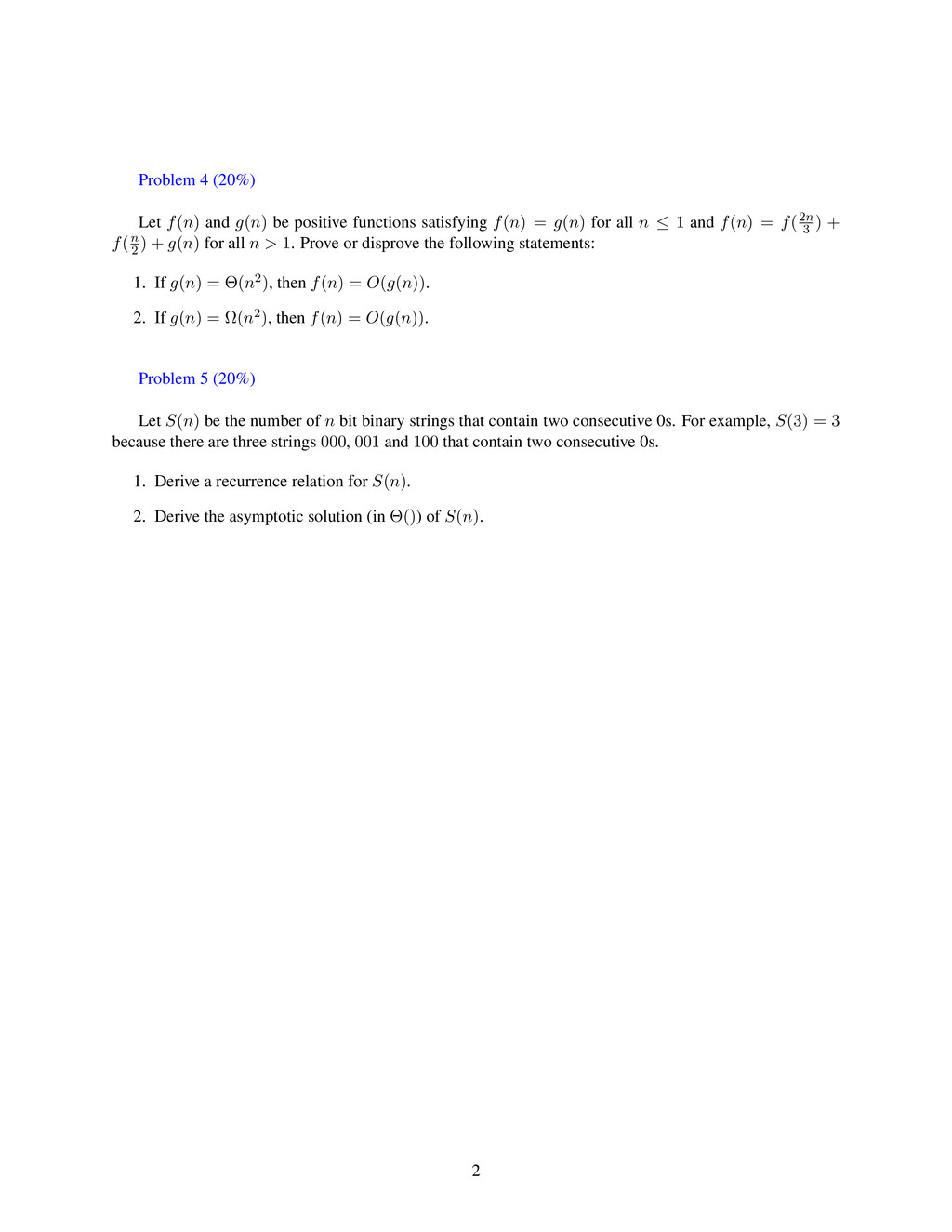
satisfying f(n) = g(n) for all n ≤ 1 and f(n) = f(2n 3 ) + f(n 2 ) + g(n) for all n > 1. Prove or disprove the following statements: 1. If g(n) = Θ(n2), then f(n) = O(g(n)). 2. If g(n) = Ω(n2), then f(n) = O(g(n)). Problem 5 (20%) Let S(n) be the number of n bit binary strings that contain two consecutive 0s. For example, S(3) = 3 because there are three strings 000, 001 and 100 that contain two consecutive 0s. 1. Derive a recurrence relation for S(n). 2. Derive the asymptotic solution (in Θ()) of S(n). 2


 katarinadahlin
 keavy
 michaelherold
 nikkihalliwell
 uxyall
 afnizarnur
 rkaga
 emna__ayadi
 keithpitt
 tapps
 greggifford
 3n