Web Consortium MIT, Cambridge, MA, USA https://www.w3.org/People/Eric/ Dimitris Kontokostas GeoPhy http://kontokostas.com/ Jose Emilio Labra Gayo WESO Research group University of Oviedo, Spain http://labra.weso.es Iovka Boneva LINKS, INRIA & CNRS University of Lille, France http://www.lifl.fr/~boneva/
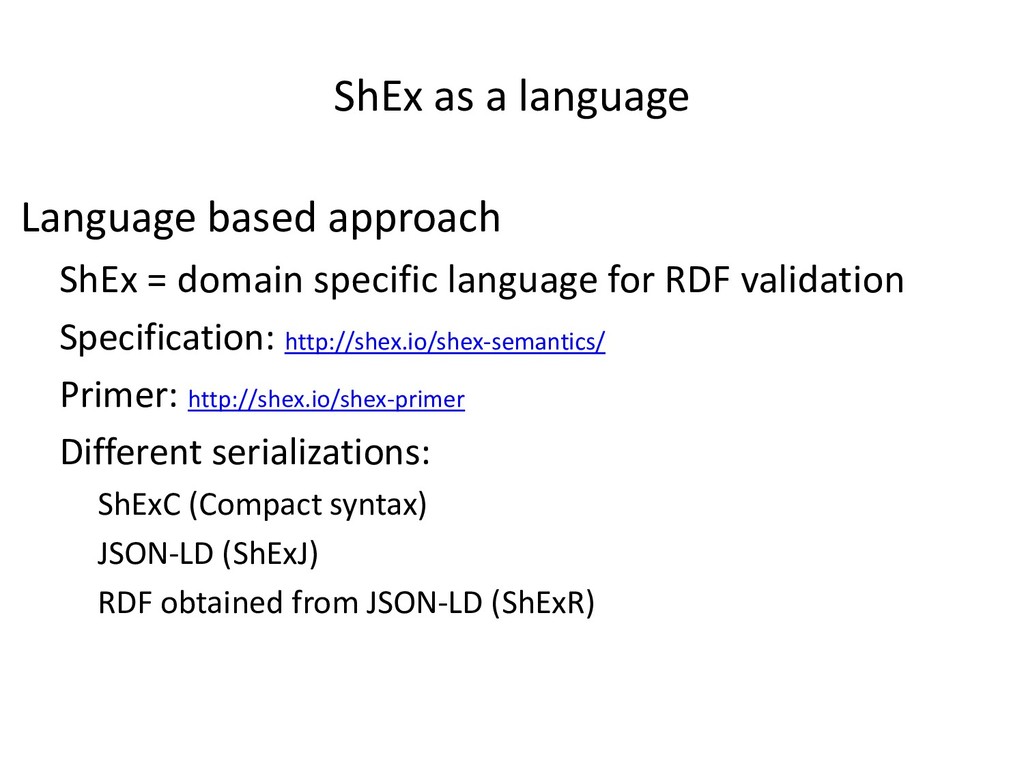
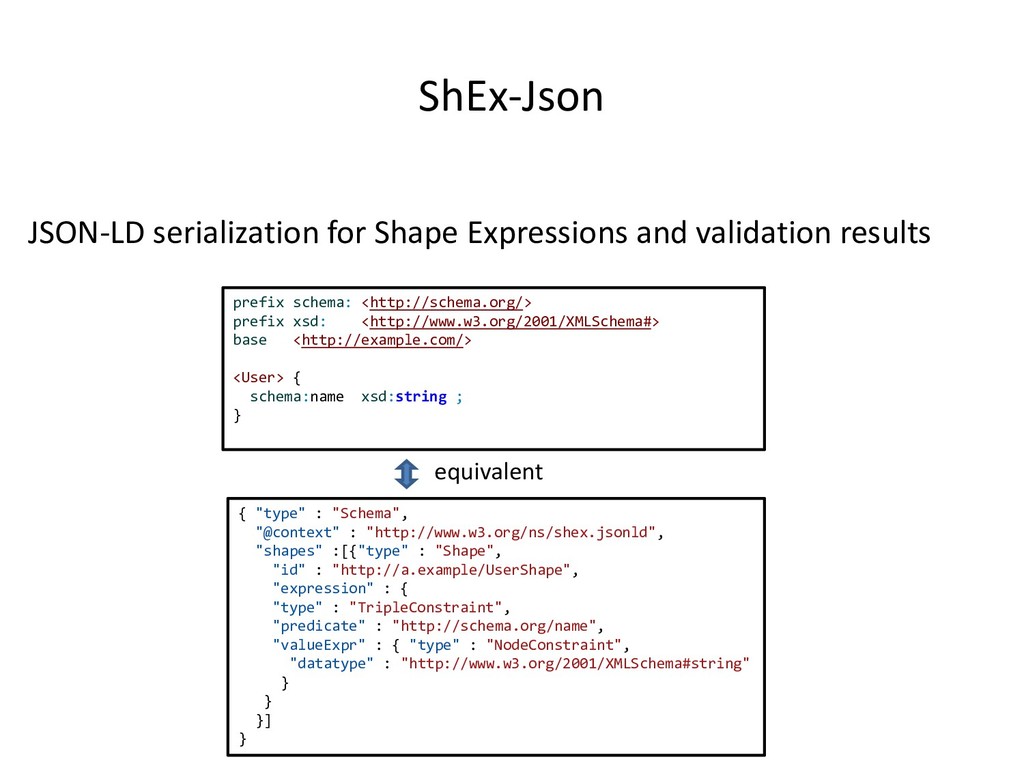
specific language for RDF validation Specification: http://shex.io/shex-semantics/ Primer: http://shex.io/shex-primer Different serializations: ShExC (Compact syntax) JSON-LD (ShExJ) RDF obtained from JSON-LD (ShExR)
"SPARQL queries cannot easily be inspected and understood…" Need of a higher level, concise language Agreement on the term "Shape" 2014 First proposal of Shape Expressions (ShEx 1.0) 2014 - Data Shapes Working Group chartered Mutual influence between SHACL & ShEx 2017 - ShEx Community Group - ShEx 2.0
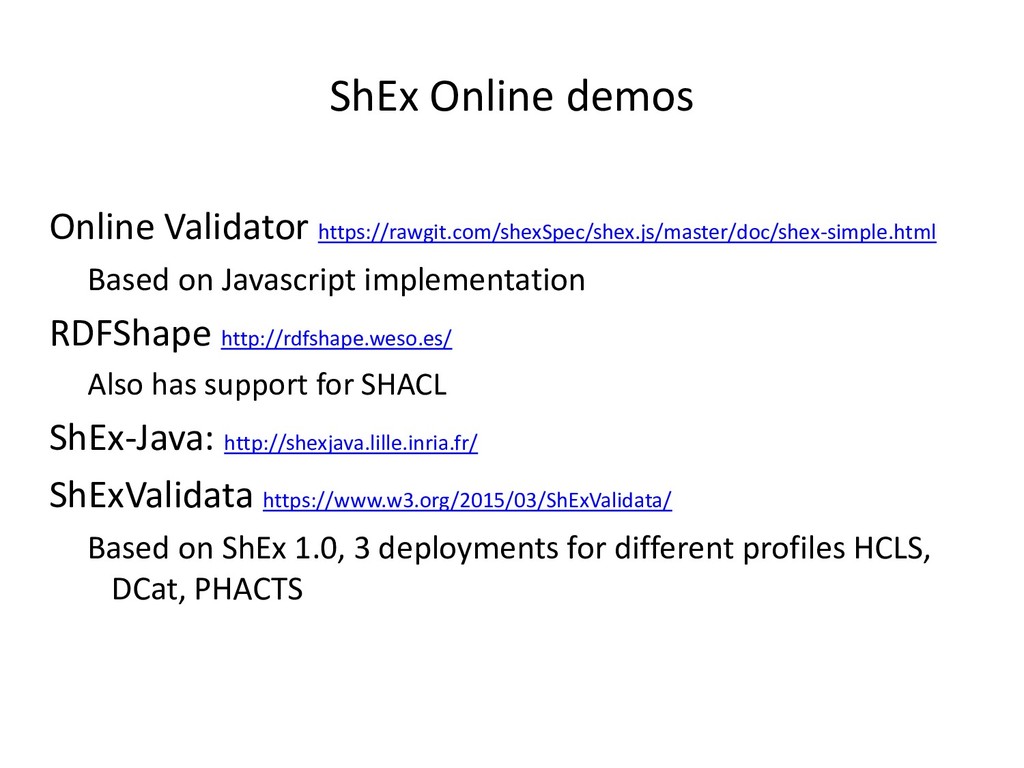
RDFShape http://rdfshape.weso.es/ Also has support for SHACL ShEx-Java: http://shexjava.lille.inria.fr/ ShExValidata https://www.w3.org/2015/03/ShExValidata/ Based on ShEx 1.0, 3 deployments for different profiles HCLS, DCat, PHACTS
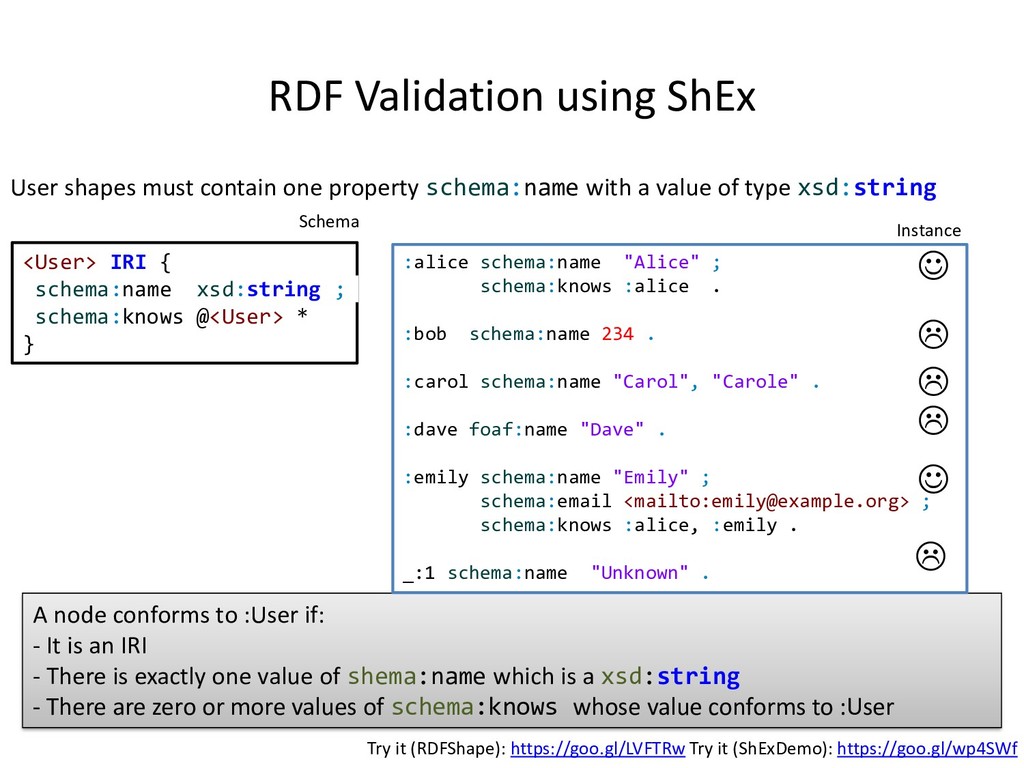
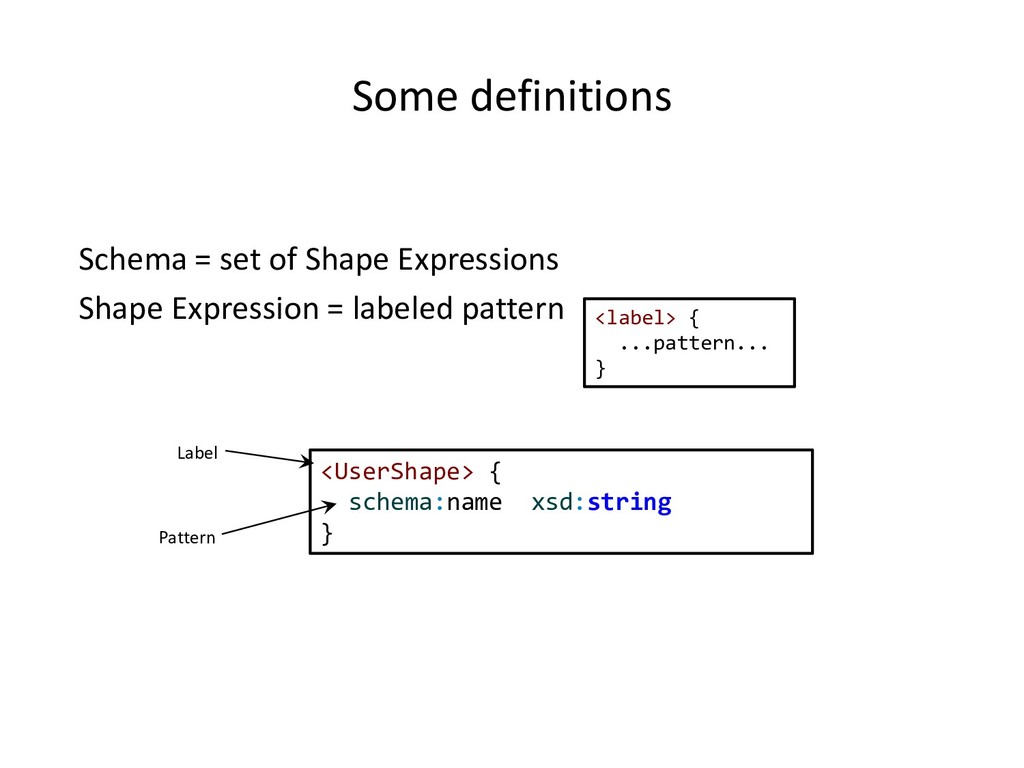
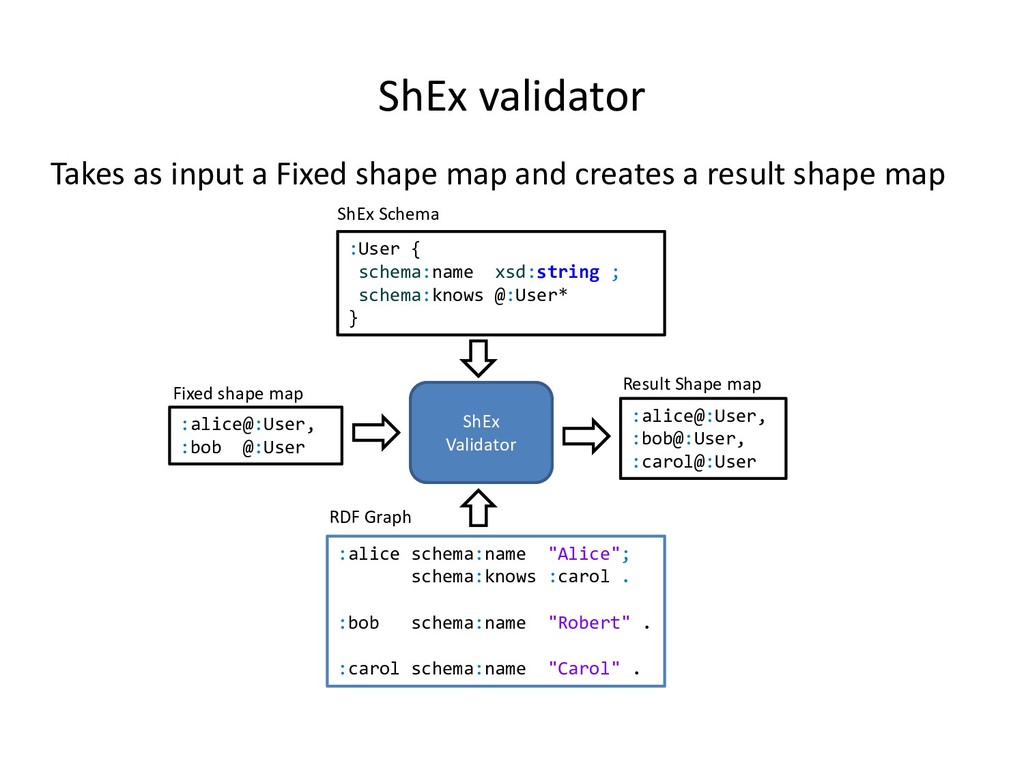
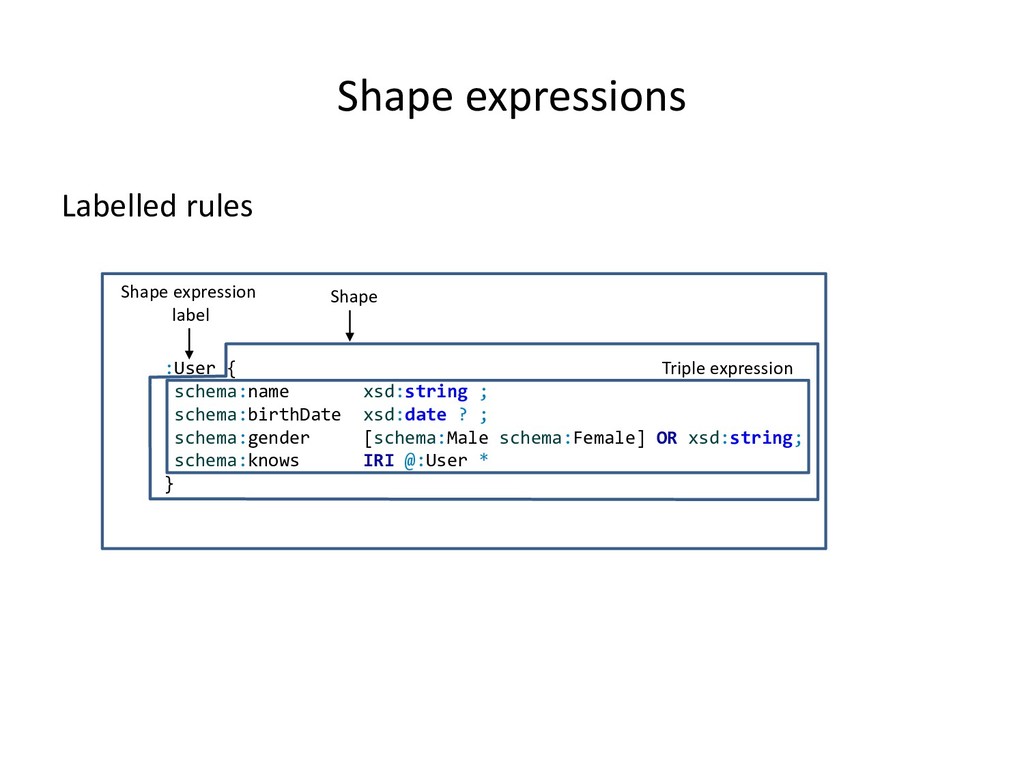
schema:name with a value of type xsd:string prefix schema: <http://schema.org/> prefix xsd: <http://www.w3.org/2001/XMLSchema#> <User> IRI { schema:name xsd:string ; schema:knows @<User> * } Prefix declarations as in Turtle Note: We will omit prefix declarations and use the aliases from: http://prefix.cc
IRI - There is exactly one value of shema:name which is a xsd:string - There are zero or more values of schema:knows whose value conforms to :User RDF Validation using ShEx :alice schema:name "Alice" ; schema:knows :alice . :bob schema:name 234 . :carol schema:name "Carol", "Carole" . :dave foaf:name "Dave" . :emily schema:name "Emily" ; schema:email <mailto:[email protected]> ; schema:knows :alice, :emily . _:1 schema:name "Unknown" . Try it (RDFShape): https://goo.gl/LVFTRw Try it (ShExDemo): https://goo.gl/wp4SWf Schema Instance User shapes must contain one property schema:name with a value of type xsd:string <User> IRI { schema:name xsd:string ; schema:knows @<User> * }
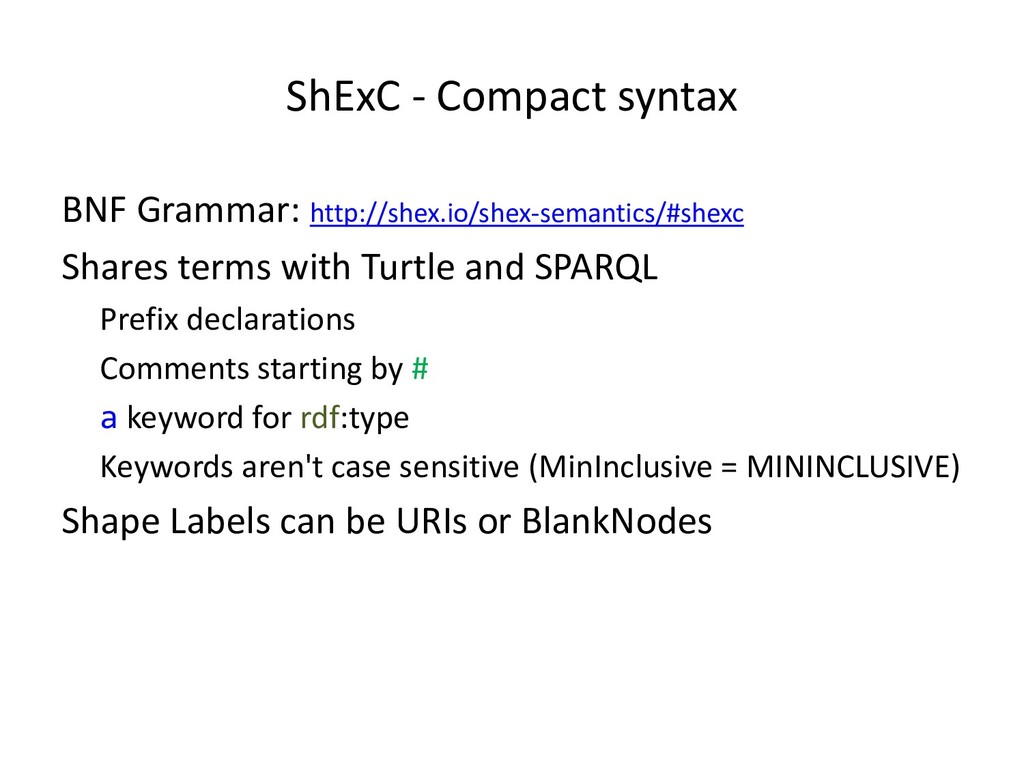
Turtle and SPARQL Prefix declarations Comments starting by # a keyword for rdf:type Keywords aren't case sensitive (MinInclusive = MININCLUSIVE) Shape Labels can be URIs or BlankNodes
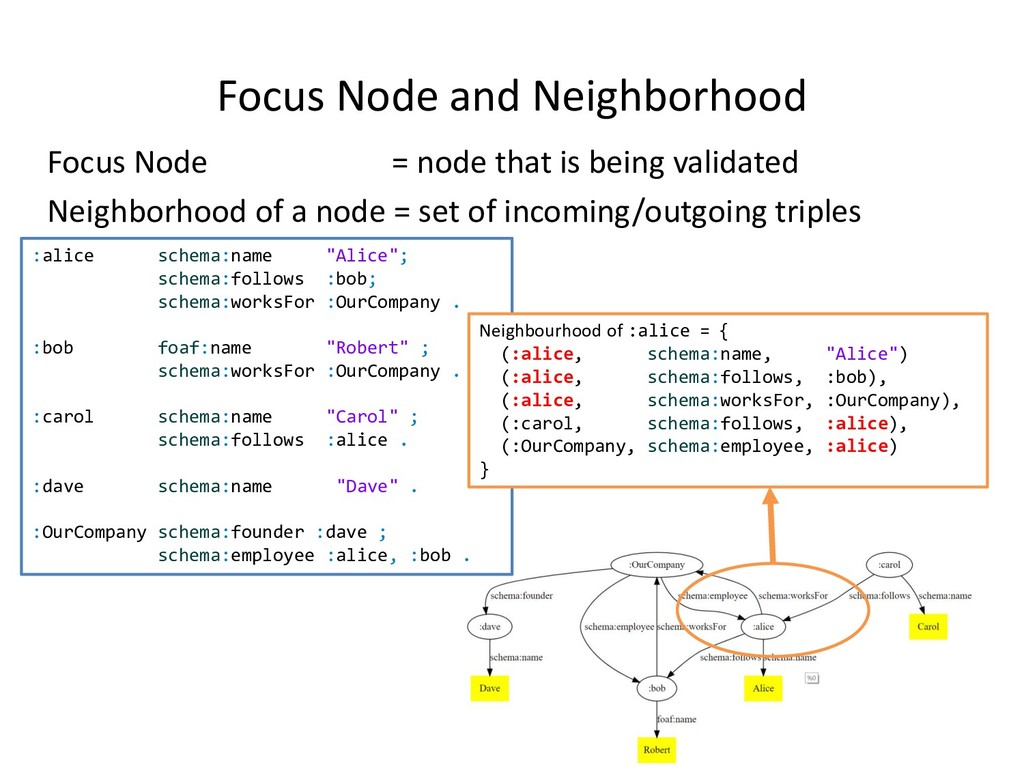
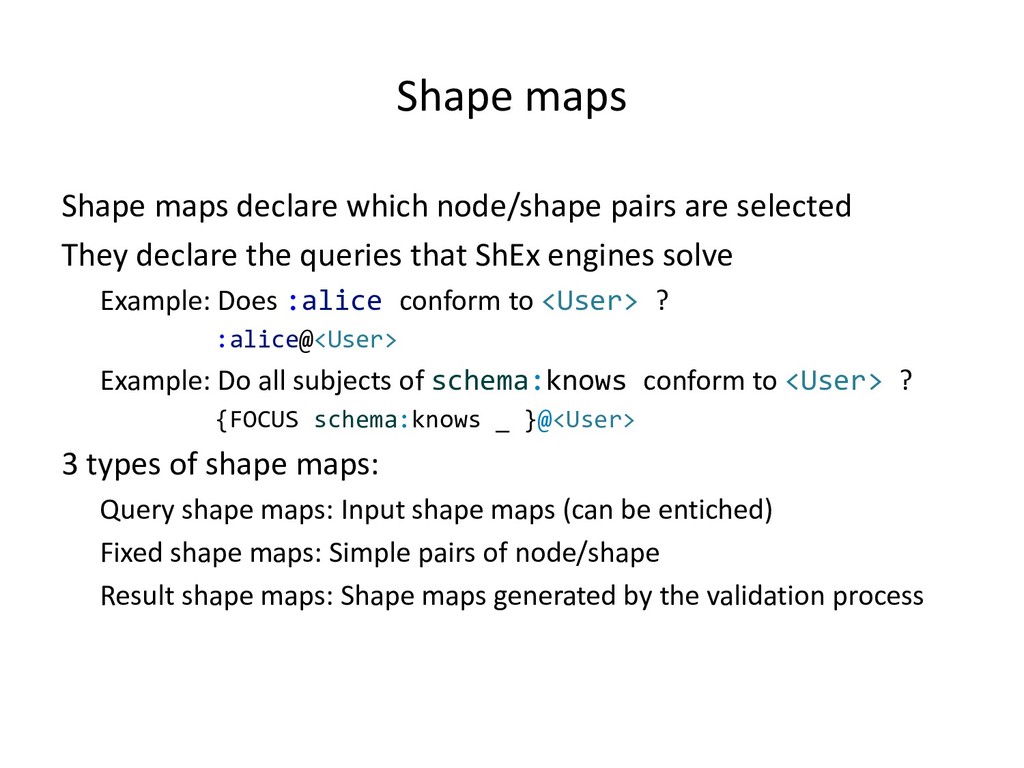
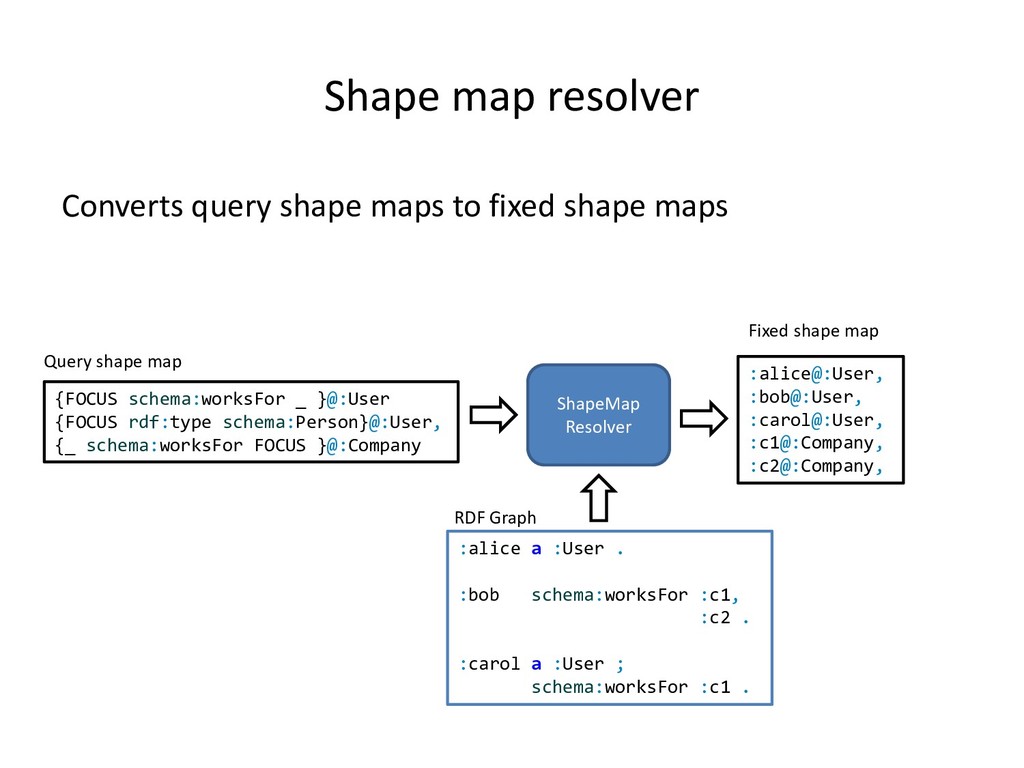
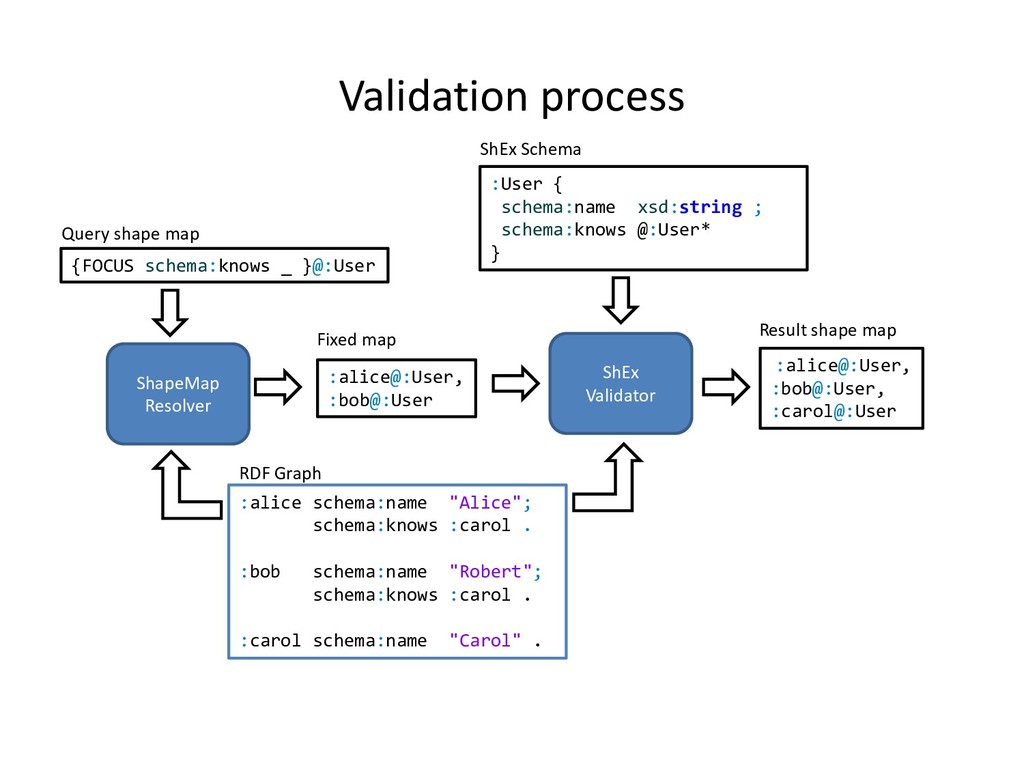
They declare the queries that ShEx engines solve Example: Does :alice conform to <User> ? :alice@<User> Example: Do all subjects of schema:knows conform to <User> ? {FOCUS schema:knows _ }@<User> 3 types of shape maps: Query shape maps: Input shape maps (can be entiched) Fixed shape maps: Simple pairs of node/shape Result shape maps: Shape maps generated by the validation process
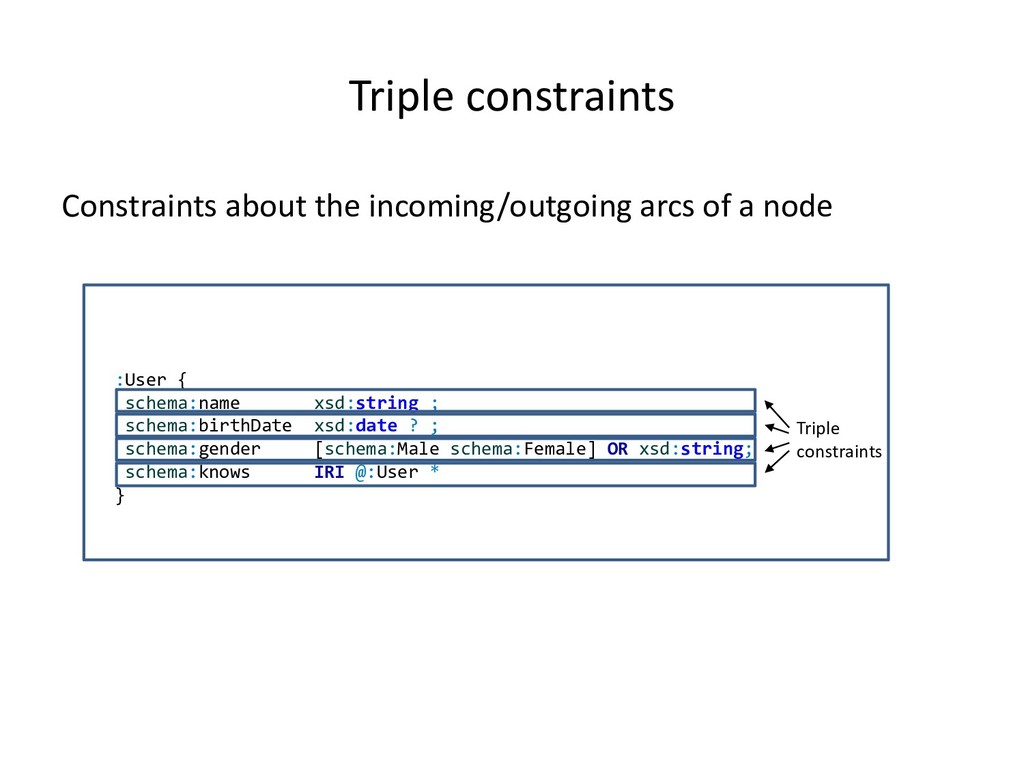
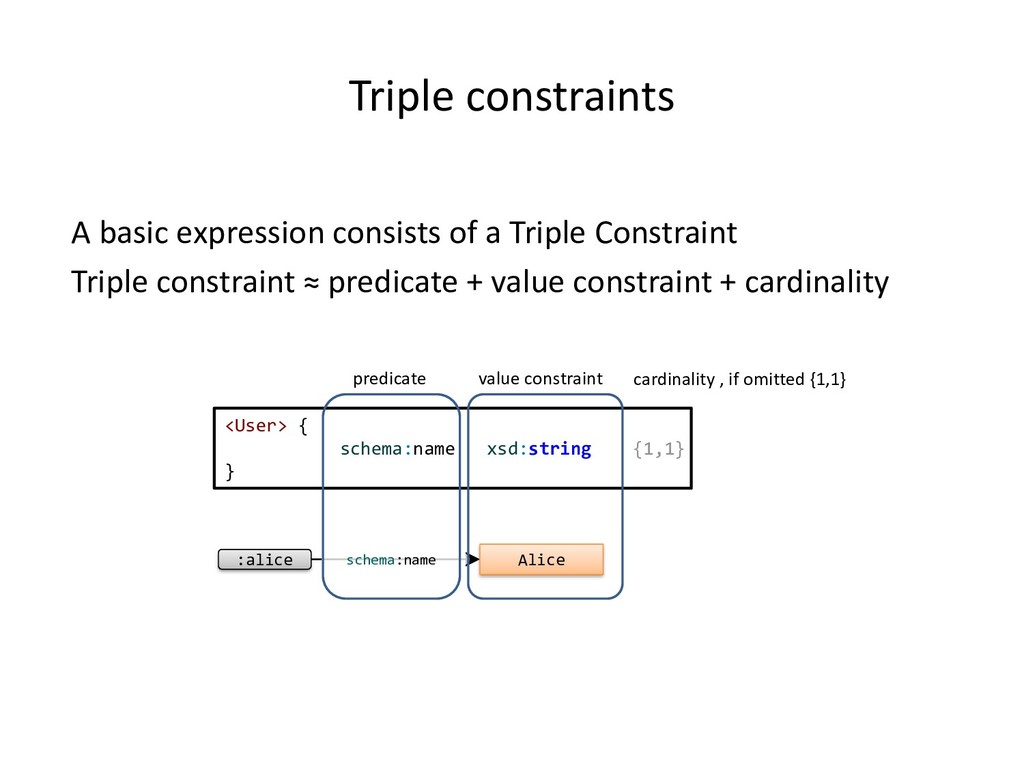
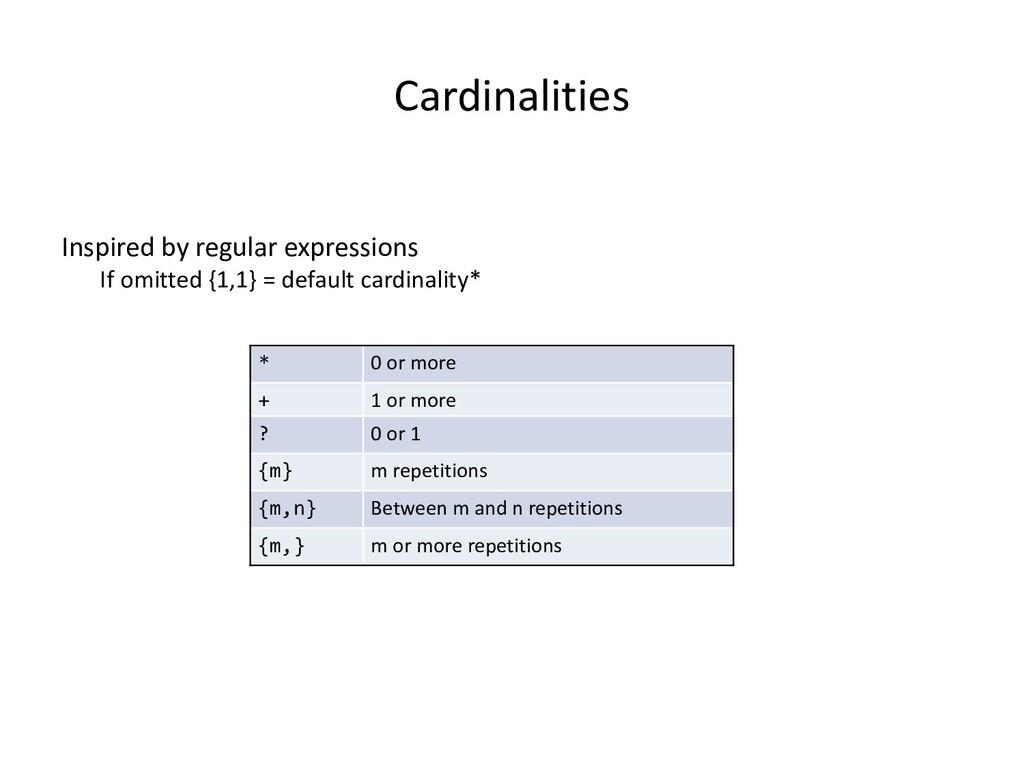
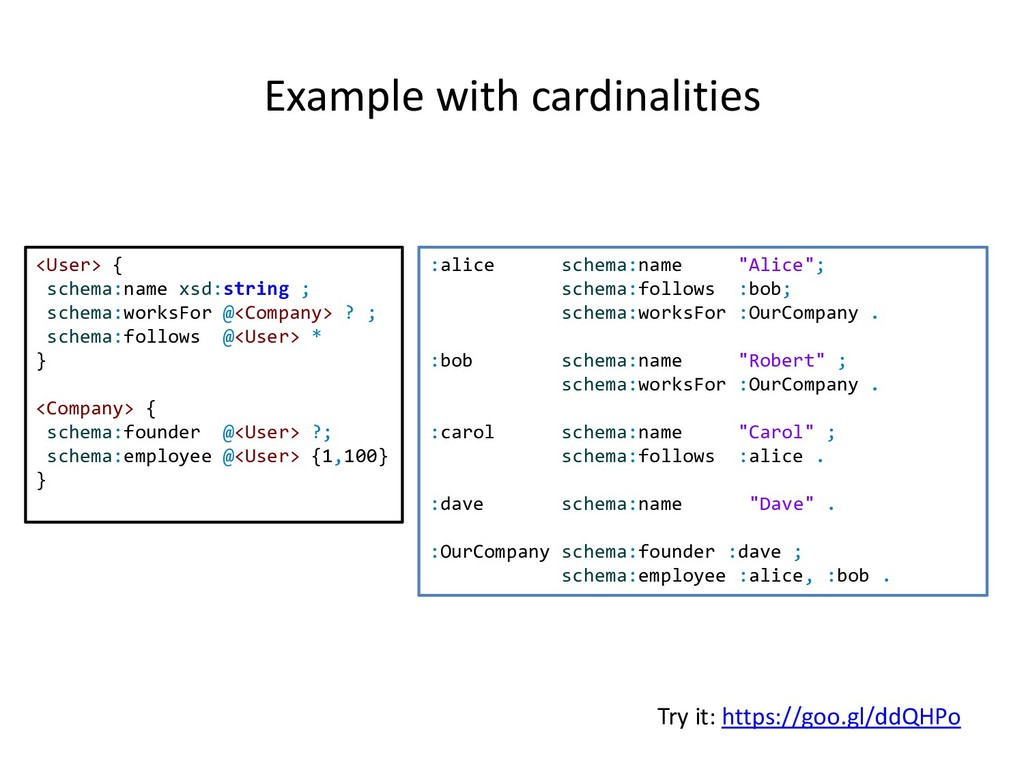
consists of a Triple Constraint Triple constraint ≈ predicate + value constraint + cardinality :alice Alice predicate value constraint schema:name cardinality , if omitted {1,1} {1,1}
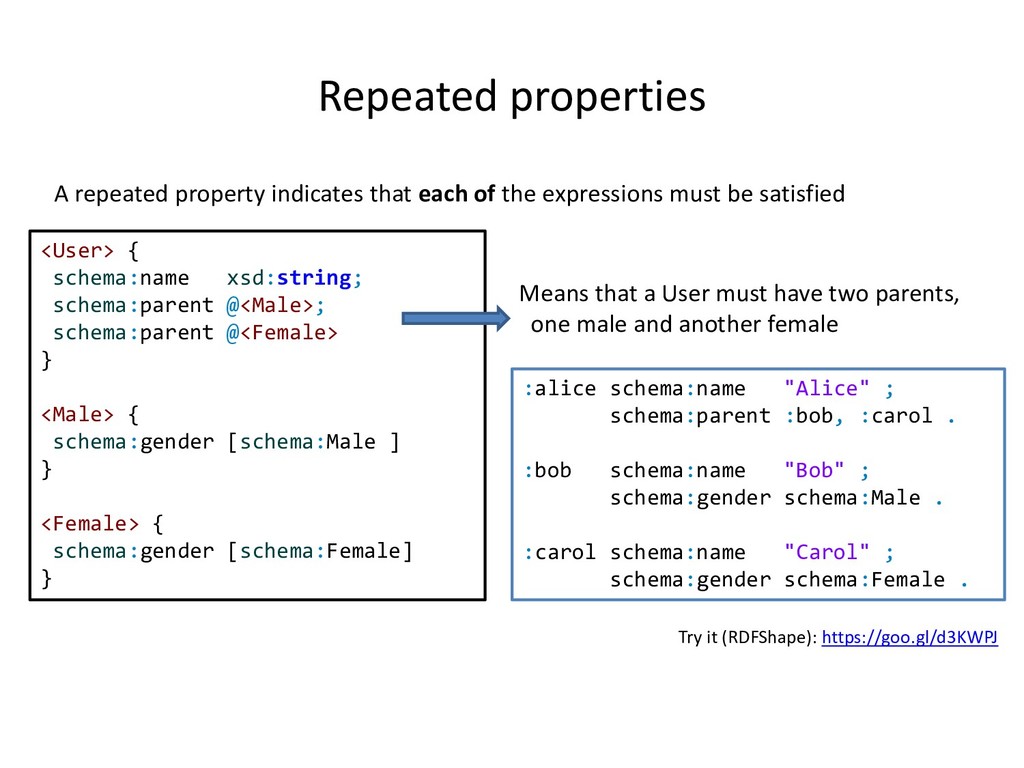
schema:parent @<Male>; schema:parent @<Female> } <Male> { schema:gender [schema:Male ] } <Female> { schema:gender [schema:Female] } :alice schema:name "Alice" ; schema:parent :bob, :carol . :bob schema:name "Bob" ; schema:gender schema:Male . :carol schema:name "Carol" ; schema:gender schema:Female . A repeated property indicates that each of the expressions must be satisfied Means that a User must have two parents, one male and another female
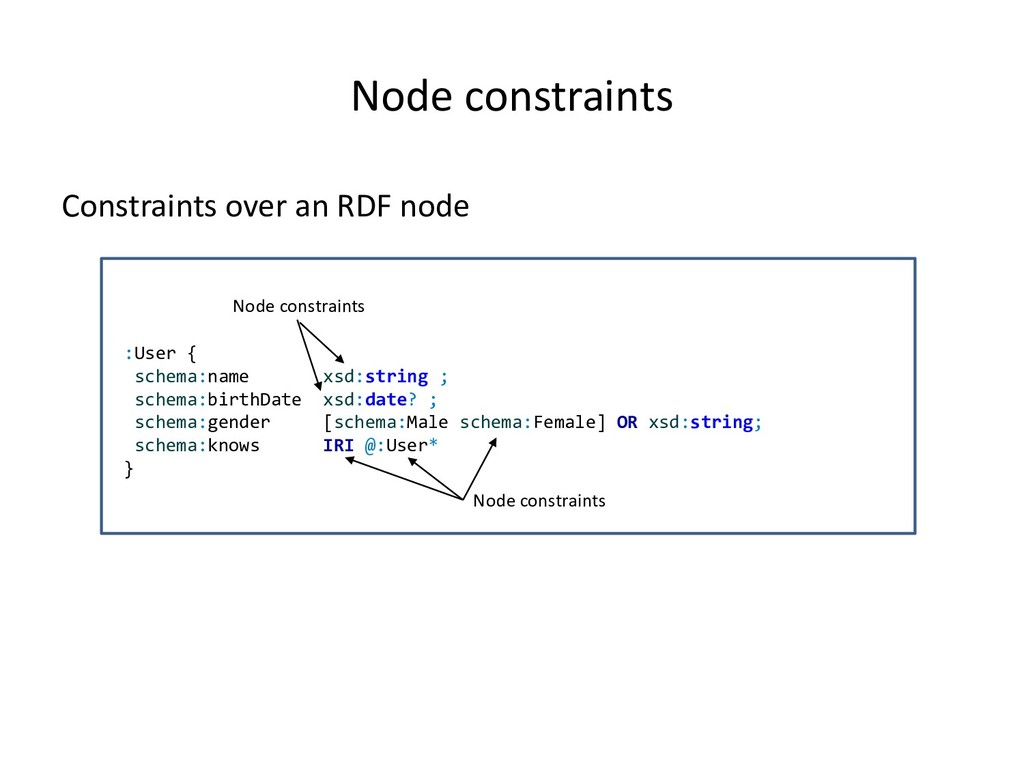
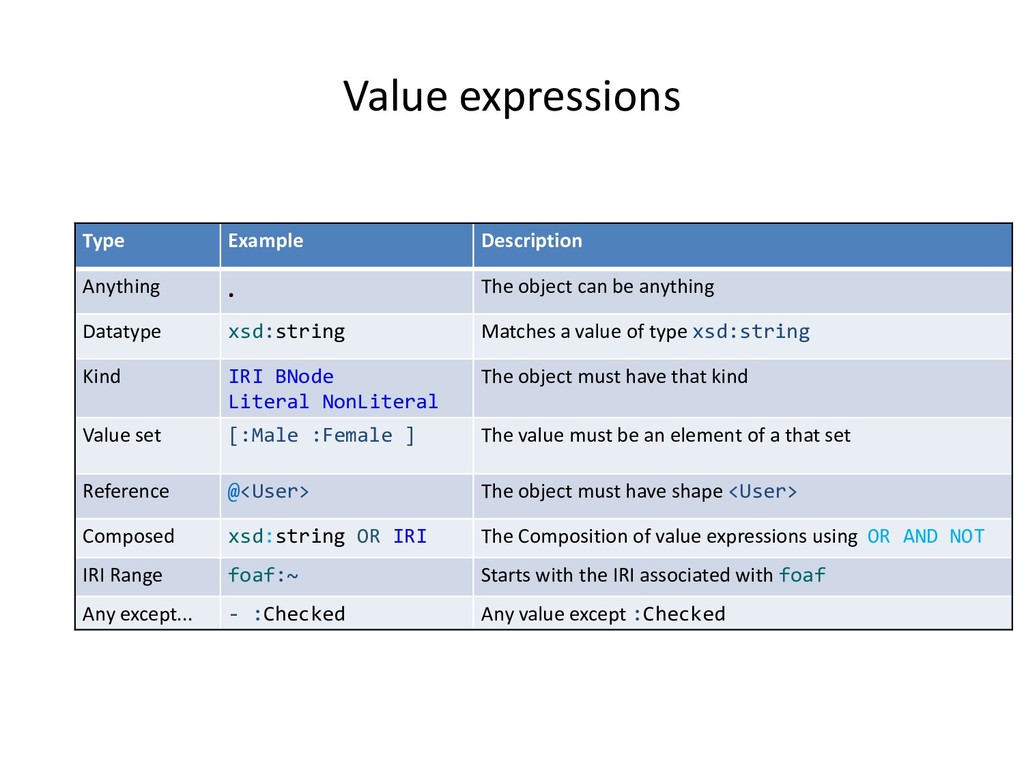
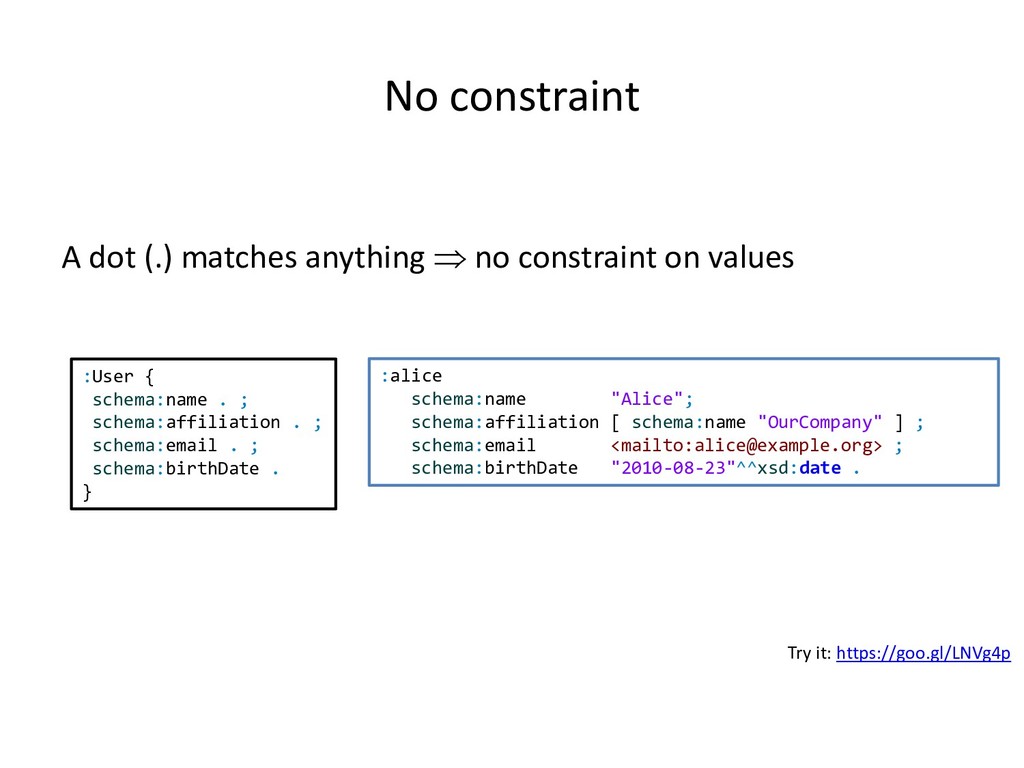
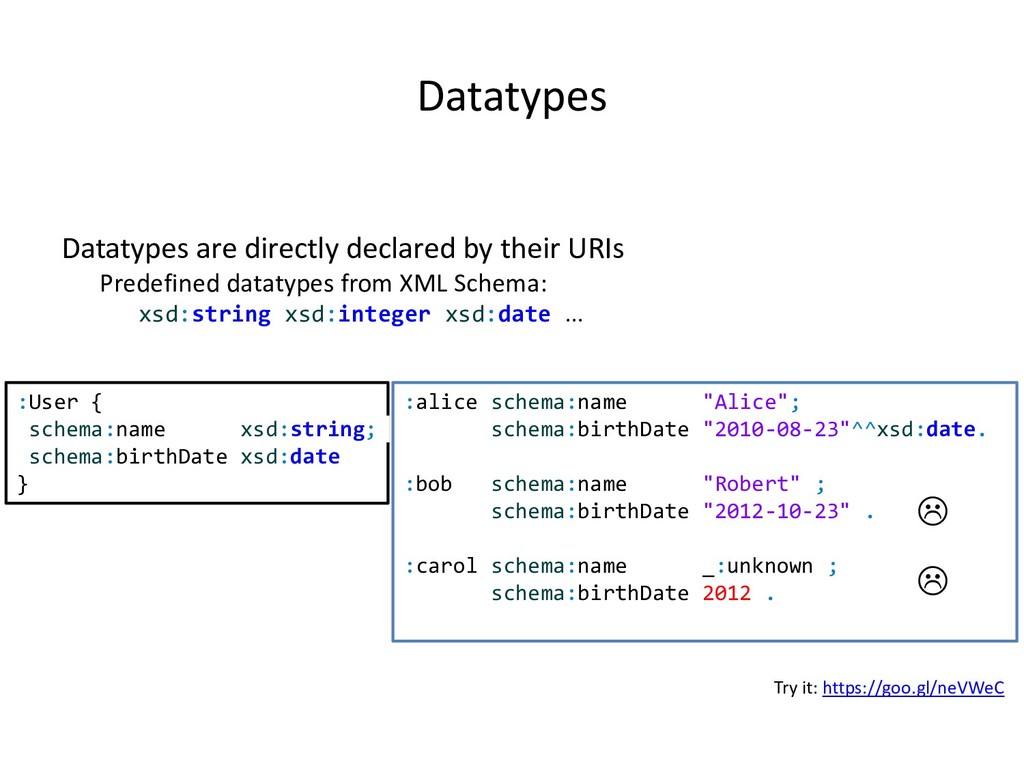
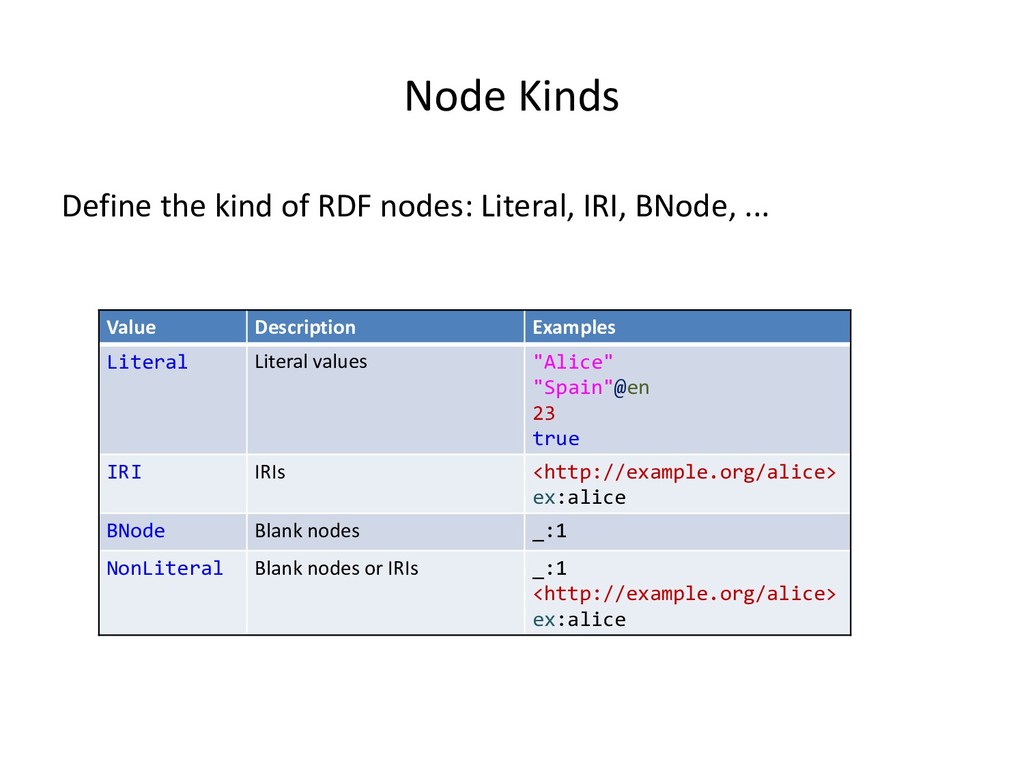
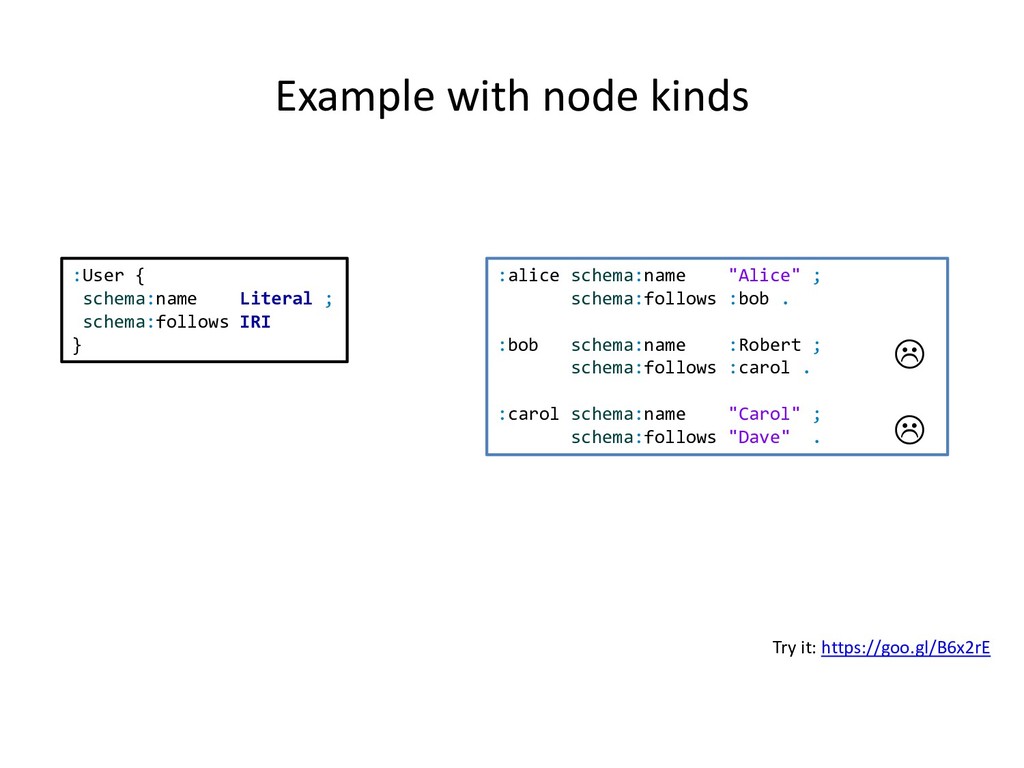
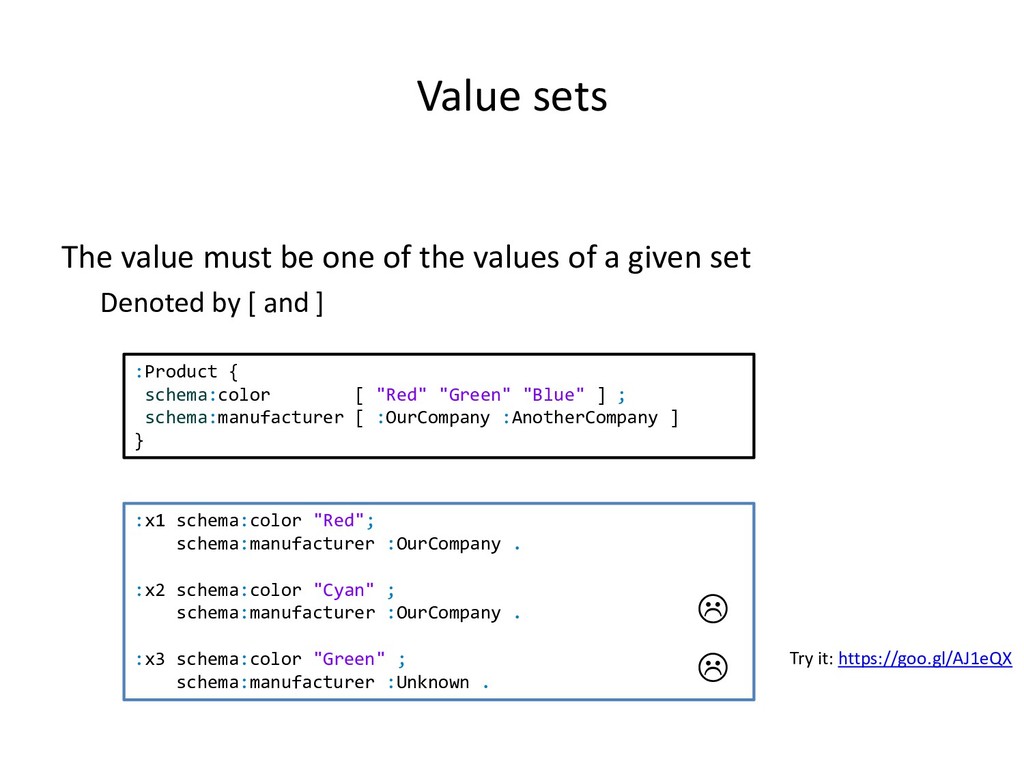
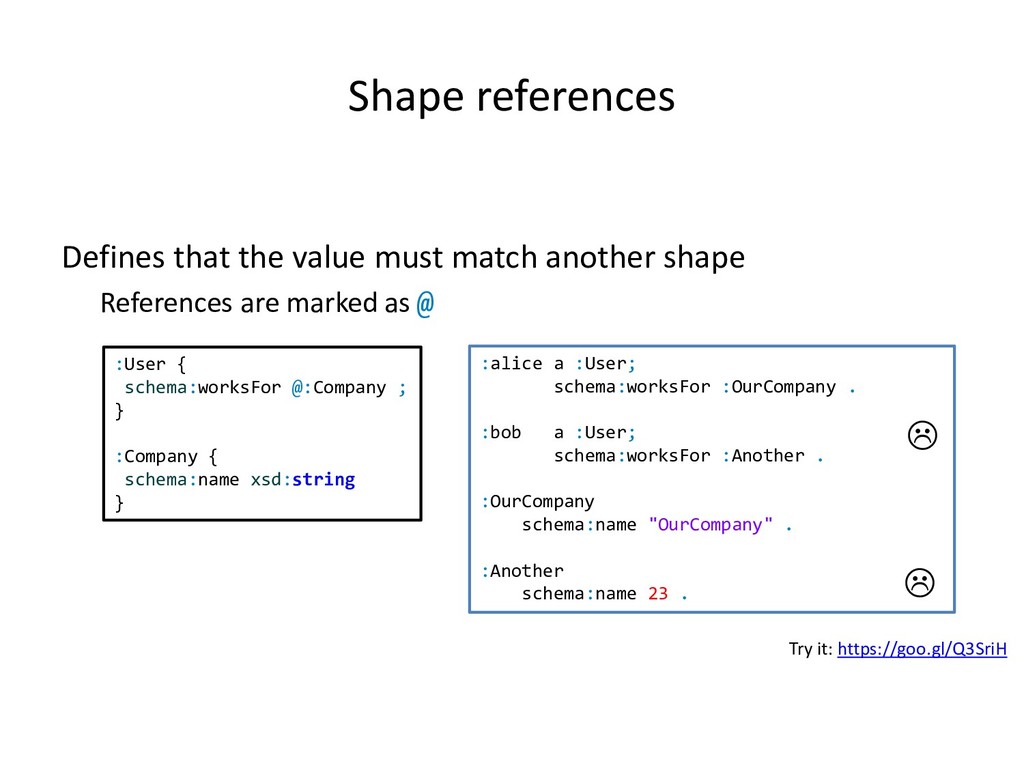
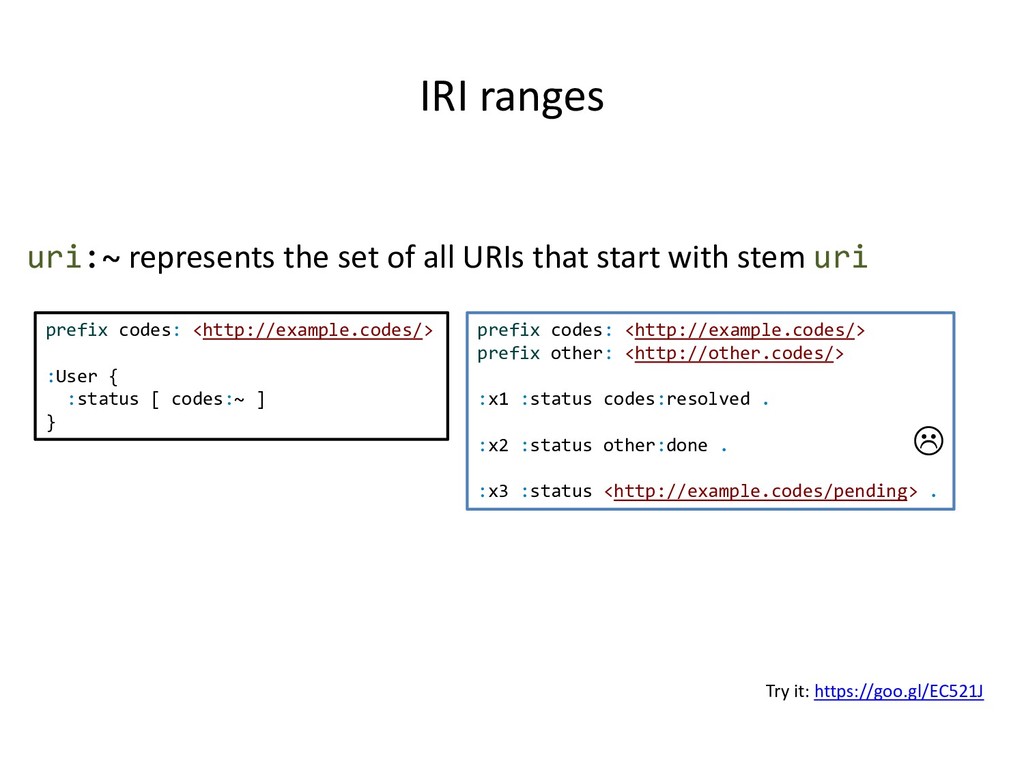
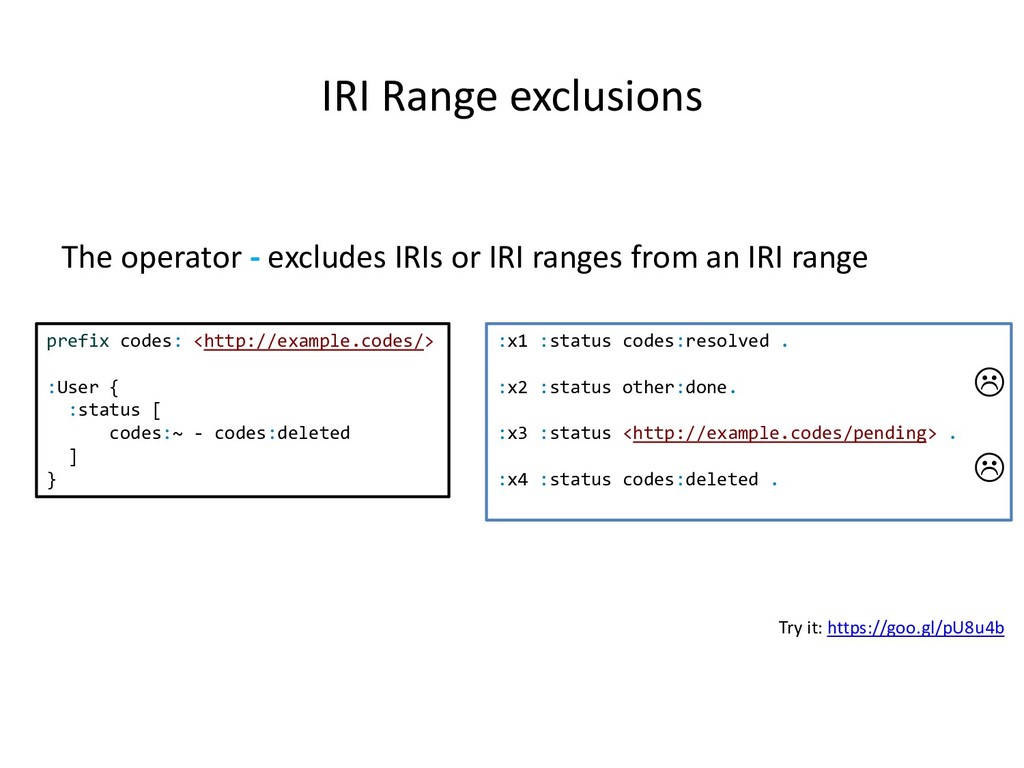
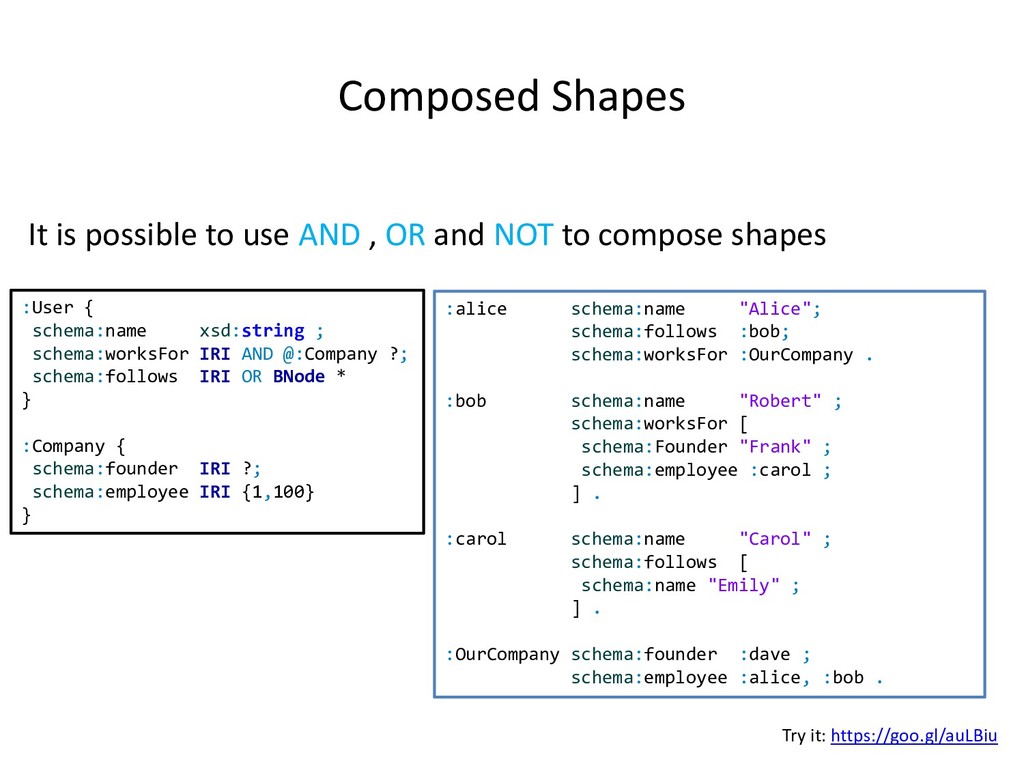
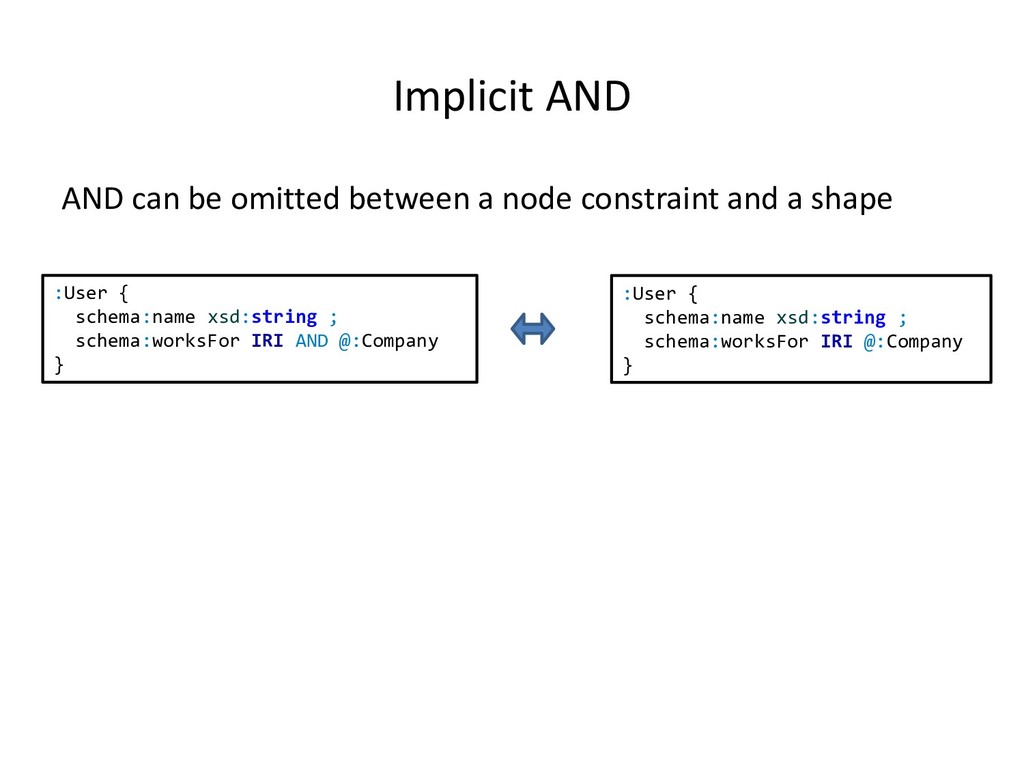
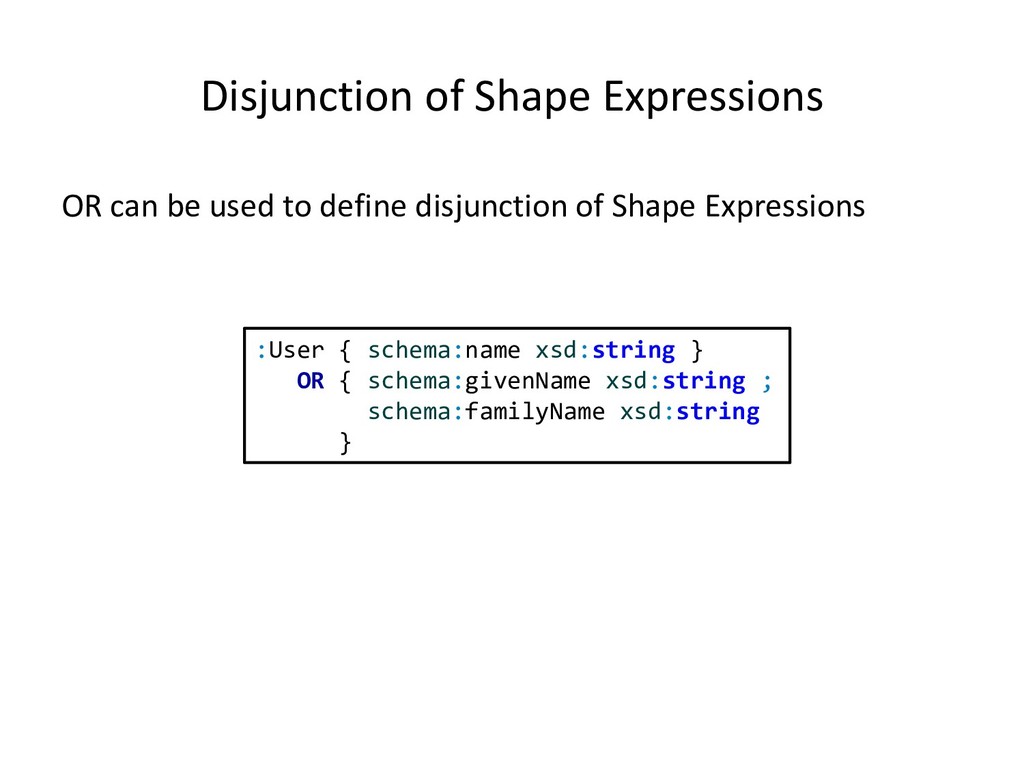
be anything Datatype xsd:string Matches a value of type xsd:string Kind IRI BNode Literal NonLiteral The object must have that kind Value set [:Male :Female ] The value must be an element of a that set Reference @<User> The object must have shape <User> Composed xsd:string OR IRI The Composition of value expressions using OR AND NOT IRI Range foaf:~ Starts with the IRI associated with foaf Any except... - :Checked Any value except :Checked
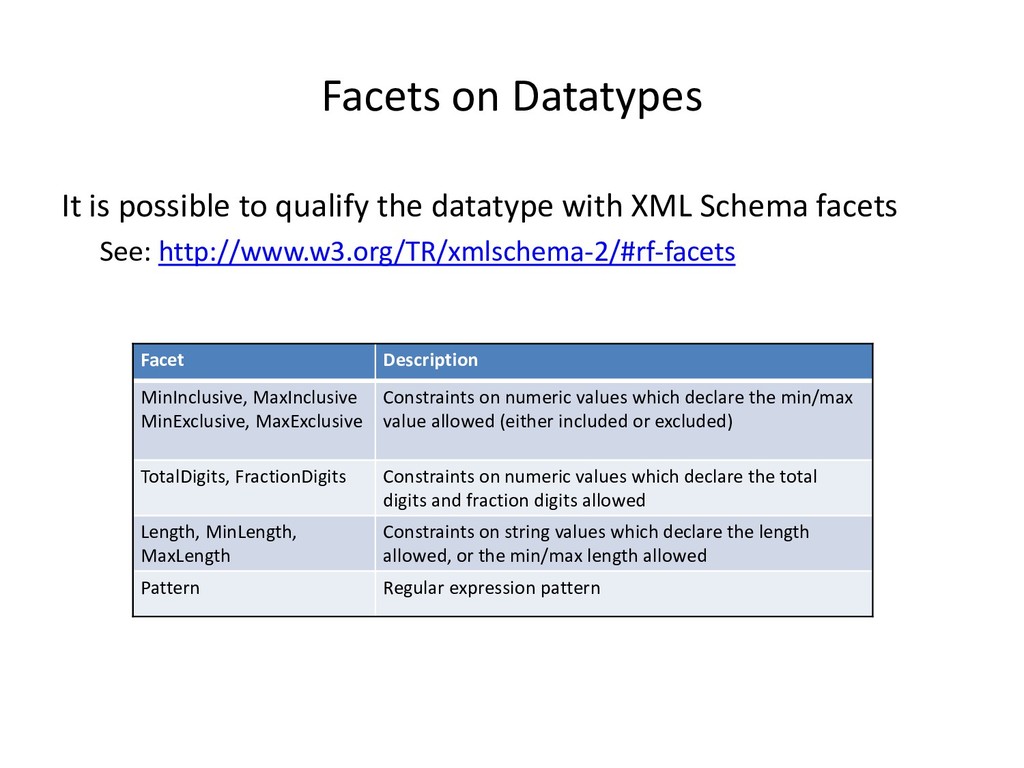
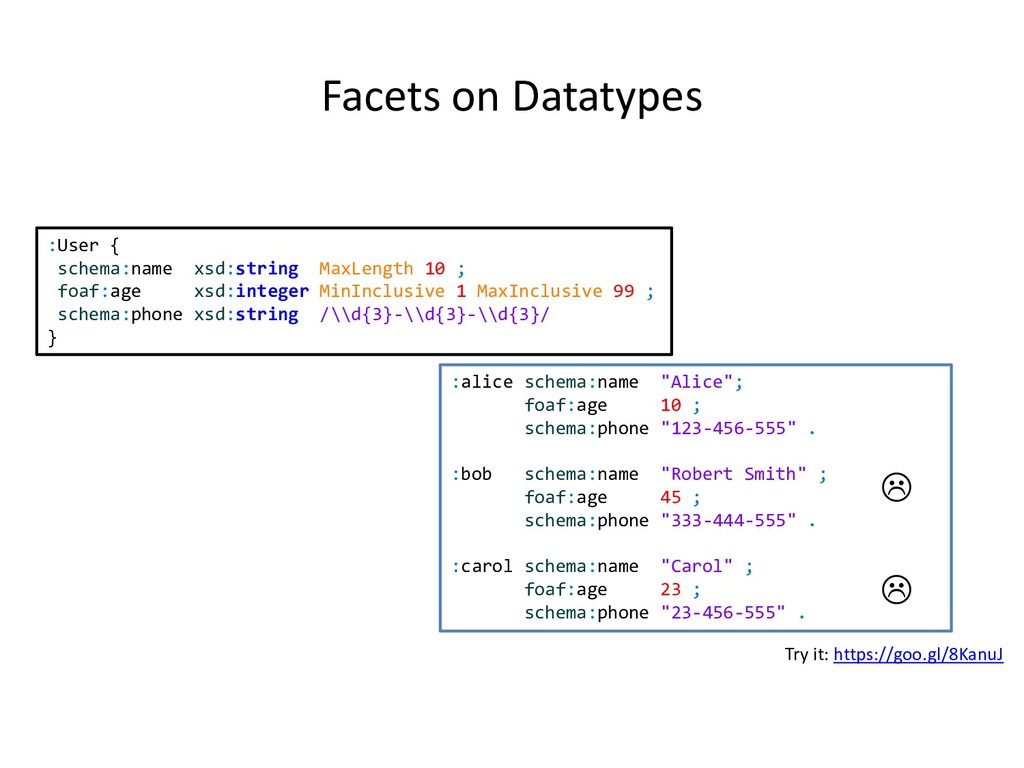
with XML Schema facets See: http://www.w3.org/TR/xmlschema-2/#rf-facets Facet Description MinInclusive, MaxInclusive MinExclusive, MaxExclusive Constraints on numeric values which declare the min/max value allowed (either included or excluded) TotalDigits, FractionDigits Constraints on numeric values which declare the total digits and fraction digits allowed Length, MinLength, MaxLength Constraints on string values which declare the length allowed, or the min/max length allowed Pattern Regular expression pattern
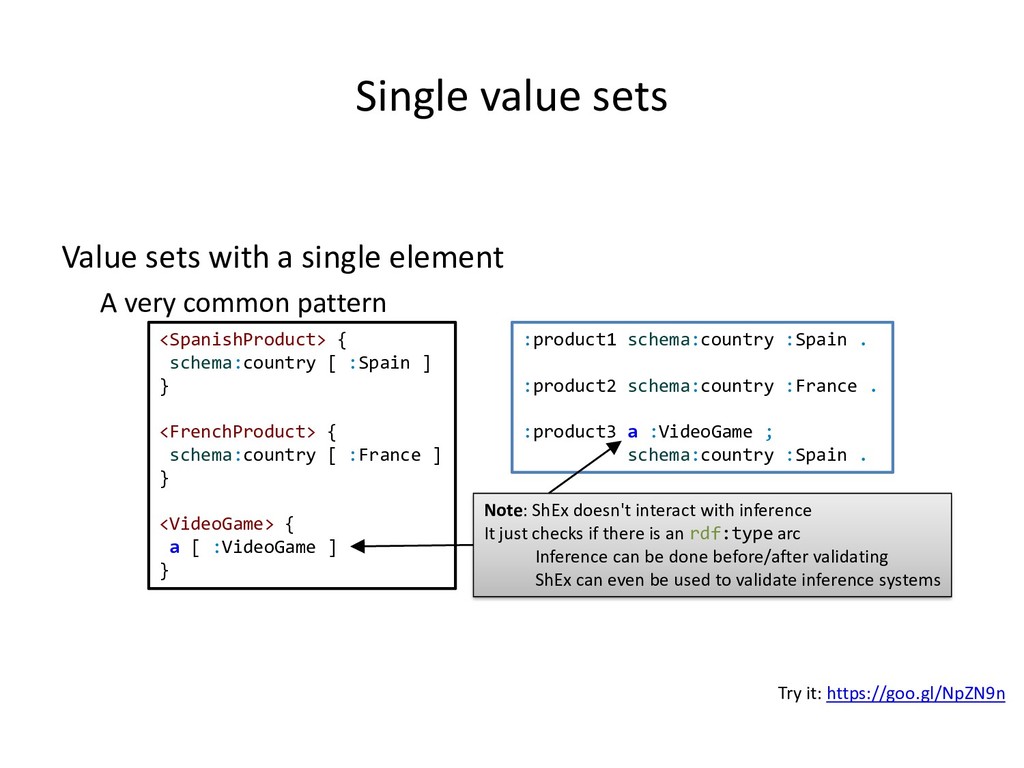
very common pattern Try it: https://goo.gl/NpZN9n <SpanishProduct> { schema:country [ :Spain ] } <FrenchProduct> { schema:country [ :France ] } <VideoGame> { a [ :VideoGame ] } :product1 schema:country :Spain . :product2 schema:country :France . :product3 a :VideoGame ; schema:country :Spain . Note: ShEx doesn't interact with inference It just checks if there is an rdf:type arc Inference can be done before/after validating ShEx can even be used to validate inference systems
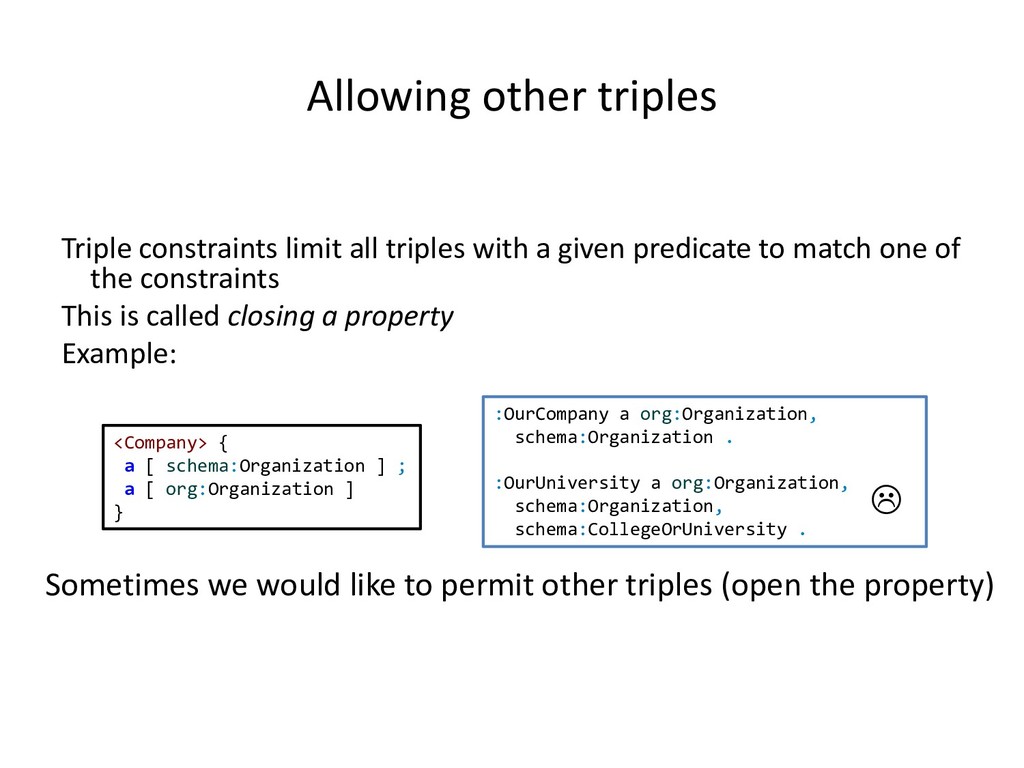
given predicate to match one of the constraints This is called closing a property Example: <Company> { a [ schema:Organization ] ; a [ org:Organization ] } :OurCompany a org:Organization, schema:Organization . :OurUniversity a org:Organization, schema:Organization, schema:CollegeOrUniversity . Sometimes we would like to permit other triples (open the property)
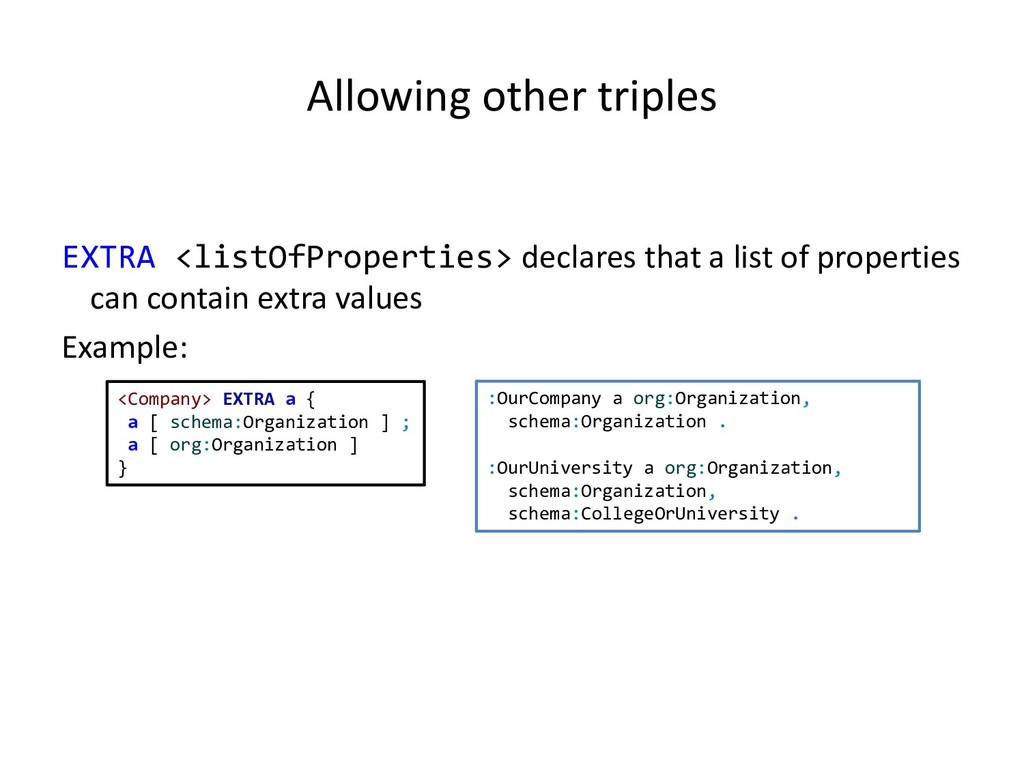
properties can contain extra values Example: <Company> EXTRA a { a [ schema:Organization ] ; a [ org:Organization ] } :OurCompany a org:Organization, schema:Organization . :OurUniversity a org:Organization, schema:Organization, schema:CollegeOrUniversity .
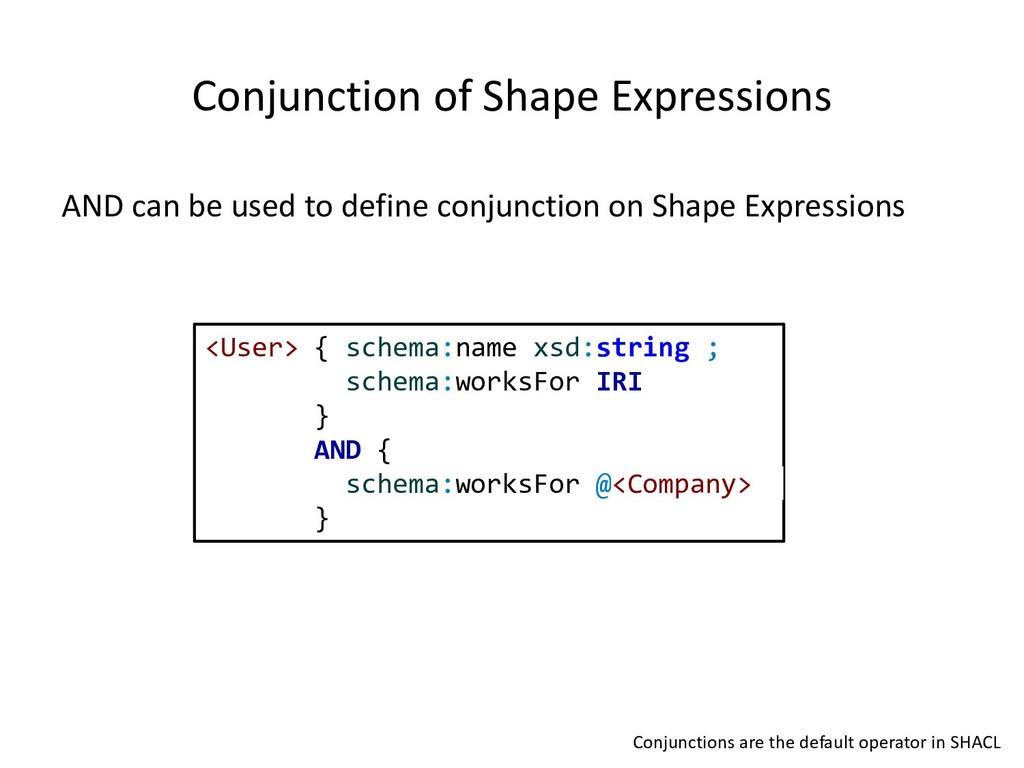
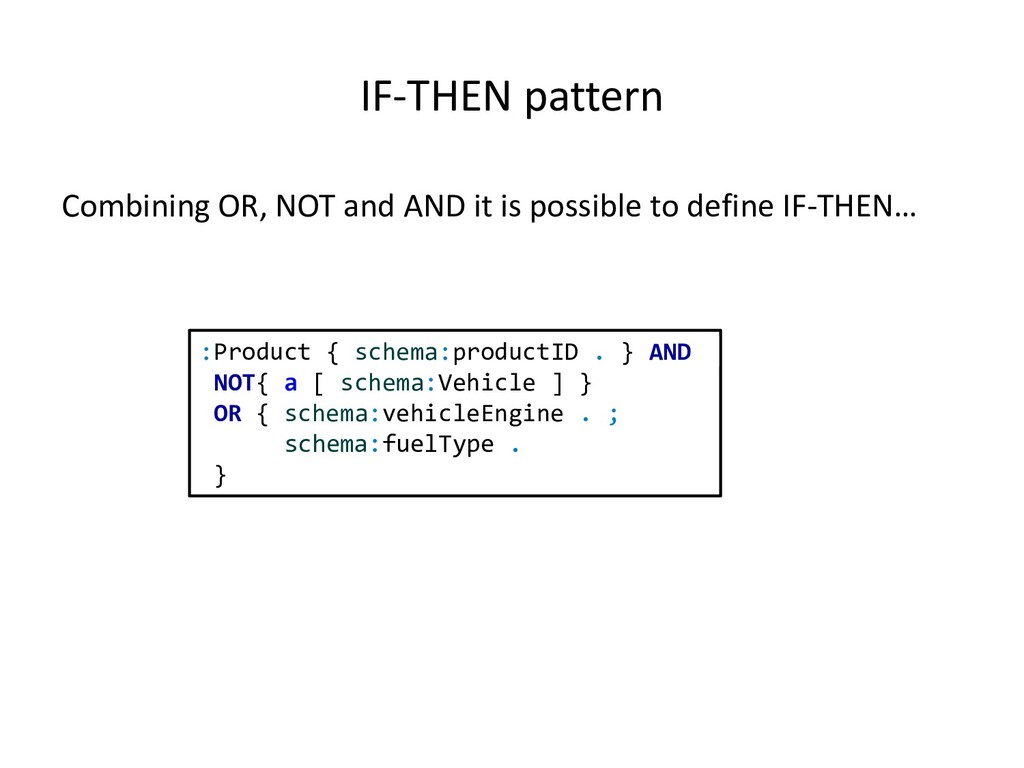
conjunction on Shape Expressions <User> { schema:name xsd:string ; schema:worksFor IRI } AND { schema:worksFor @<Company> } Conjunctions are the default operator in SHACL
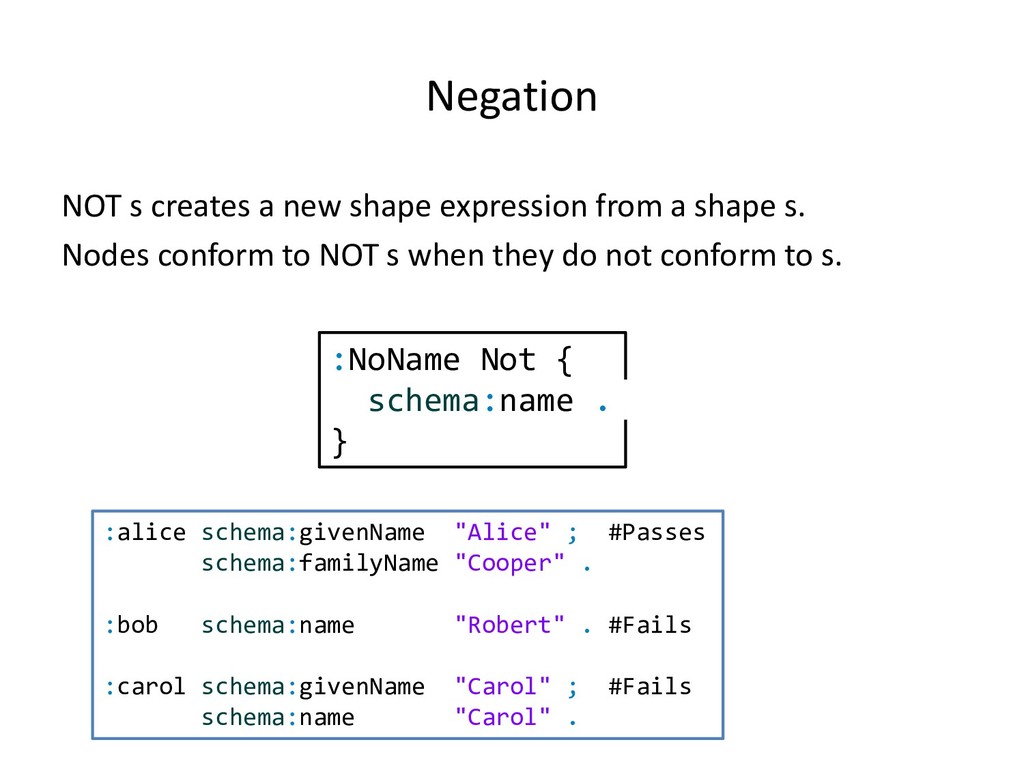
shape s. Nodes conform to NOT s when they do not conform to s. :NoName Not { schema:name . } :alice schema:givenName "Alice" ; #Passes schema:familyName "Cooper" . :bob schema:name "Robert" . #Fails :carol schema:givenName "Carol" ; #Fails schema:name "Carol" .
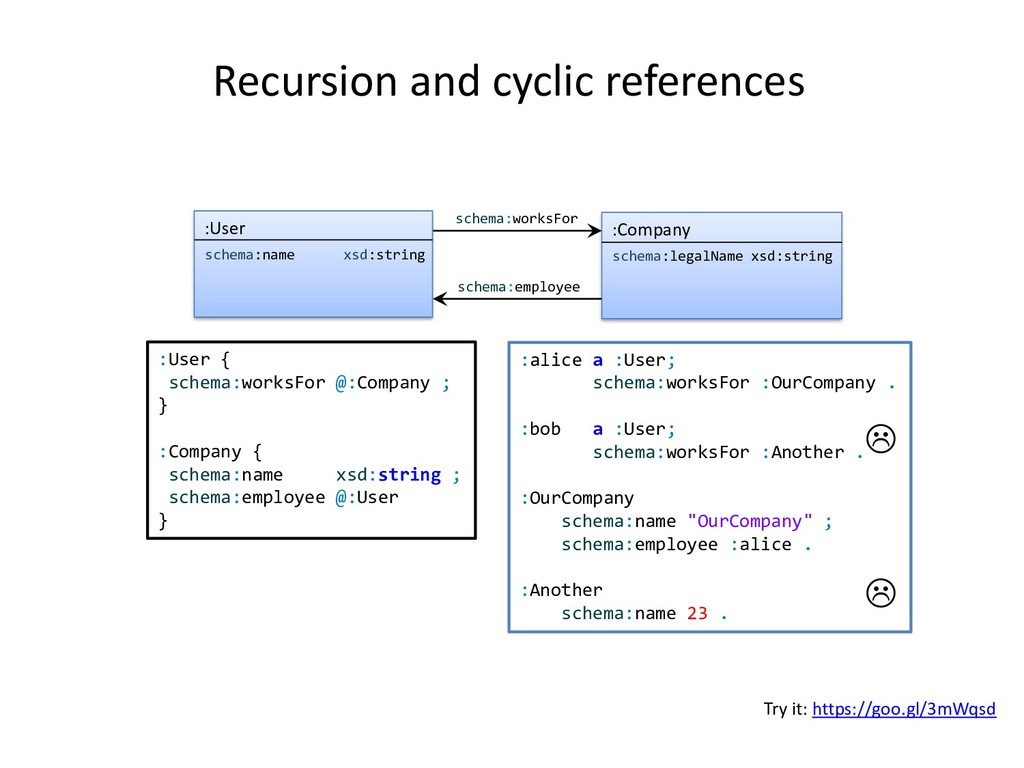
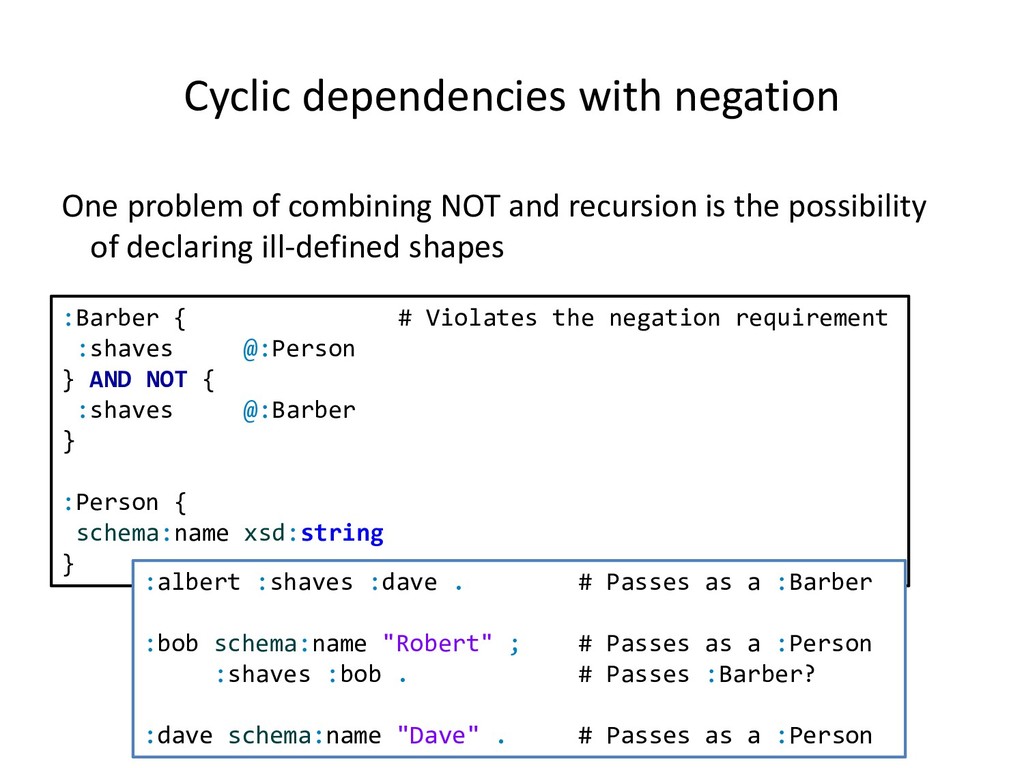
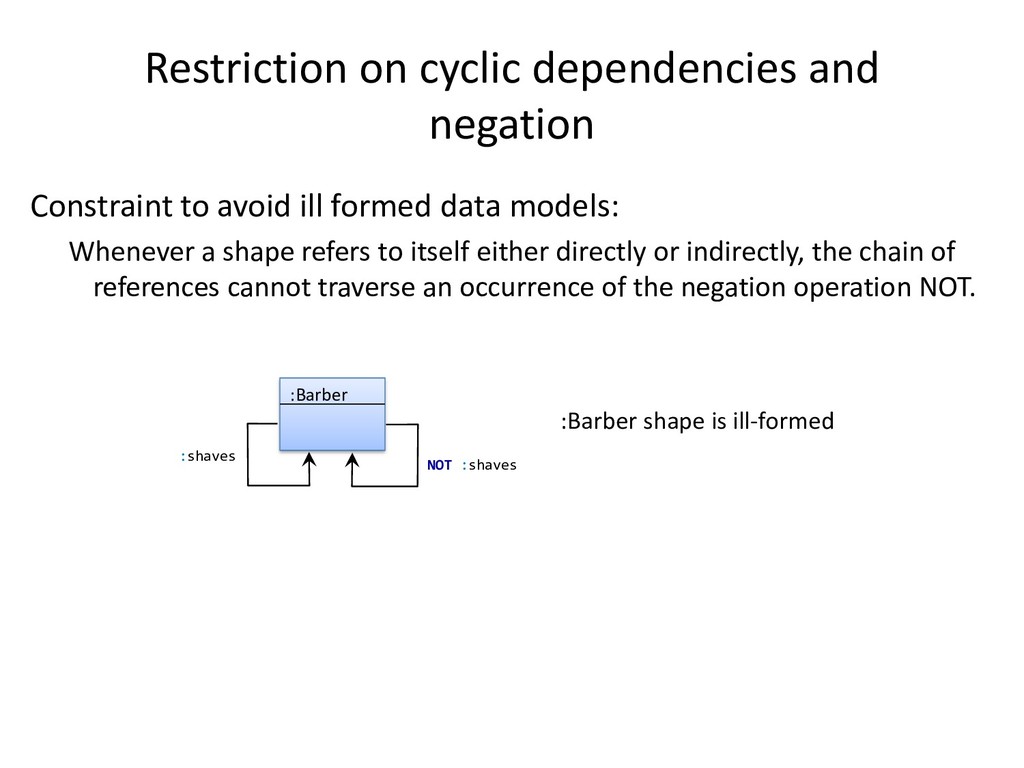
formed data models: Whenever a shape refers to itself either directly or indirectly, the chain of references cannot traverse an occurrence of the negation operation NOT. :Barber NOT :shaves :shaves :Barber shape is ill-formed
active development Curent work Improve error messages Language expressivity (combination of different operators) If you are interested, you can help List of issues: https://github.com/shexSpec/shex/issues


 clockmaker
 yutobara
 rollbear
 tanahiro2010
 syumai
 sylph01
 hollycummins
 deka_morita
 oniak3ibm
 akase244
 andpad
 findyinc
 marktimemedia
.jpg) cargoodrich
cargoodrich
 malarkey
 letsgokoyo
 reverentgeek
 sugarenia
 csswizardry
 rabernat
 scottboms
 codingconduct
 paigeccino
 mayunak