Upgrade to Pro — share decks privately, control downloads, hide ads and more …

ADV Major Group Assignment Group 19

Avatar for Lucy Lucy
June 06, 2020
39

ADV Major Group Assignment Group 19

Avatar for Lucy

Lucy

June 06, 2020

Transcript

  1. A D V 2 0 0 0 1 : A

    D V E R T I S I N G I S S U E S : R E G U L A T I O N , E T H I C S A N D C U L T U R A L C O N S I D E R A T I O N S C O U N T R Y O F C H O I C E : A U S T R A L I A P R E P A R E D B Y L U C Y D I M A G G I O 1 0 2 5 7 8 7 8 7 K Y L E O ' L E A R Y 1 0 2 5 5 9 1 3 5 L U C A M I G N U O L I 1 0 2 5 6 6 0 1 2 D E C L A N G U M L E Y 1 0 2 5 0 7 8 8 8 S T R U A N T H O M S O N 1 0 2 5 7 3 0 0 9 M A J O R T E A M P R O J E C T
  2. T A B L E O F C O N

    T E N T S A G E N D A C U L T U R A L V A L U E S V A L U E S I N A U S T R A L I A & O T H E R C U L T U R E S , V A L U E S I N A D V E R T I S I N G E Q U A L I T Y E Q U A L I T Y I N T H E W O R K F O R C E P O S I T I O N A N D T R E A T M E N T O F M E N A N D W O M E N T R E A T M E N T O F I M M I G R A N T S A N D F O R E I G N R E S I D E N T S T R E A T M E N T A N D A T T I T U D E T O W A R D S L G B T C O M M U N I T Y S T E R E O T Y P E S S T E R E O T Y P E S O F A U S T R A L I A A N D O F A U S T R A L I A N S C U L T U R A L P R O M O T I O N A D V E R T I S I N G A N D M A R K E T I N G A N D A D V E R T I S I N G T O C H I L D R E N C O N C L U S I O N R E F E R E N C E S
  3. The FIFA World Cup is a “prestigious soccer competition”, played

    every four years internationally (Fox Sports, 2020). A new country is selected to host the matches played by the “top 32 national teams in a month long tournament” once in a four year period (Fox Sports, 2020). The purpose of this report is to inform the FIFA Council, also known as the FIFA Executive Committee of why Australia should be chosen as the hosting country of the 2030 FIFA World Cup. As the main “oversight body” of the organisation, it is vital that the Council gain knowledge as to why Australia is such a diverse, multicultural country, hence why it is a great candidate for hosting the FIFA World Cup in 10 years time (FIFA.com, 2020). As the World Cup is often held in the months of November and December, this is the perfect time to hold the event in Australia as the weather is warm. If Australia was to be chosen as the host, the city of Melbourne, in Victoria is the place which would hold the matches.Melbourne is one of the most livable cities in the world, not only is it a remarkable place to host such reputable games, it is also a comfortable and welcoming city to visitors with a vast array of exclusive accommodation right in the heart of Melbourne. This report entails specific features of Australian culture which provide information about certain perceptions and impressions and whether they are truthful or not from an outside standpoint. With the attempt of being unbiased, this report aims to highlight all aspects of the nature of the country in order for the FIFA Executive Committee to fully grasp an understanding of what it means to be Australian. Discussing the cultural values of Australians is just one aspect of the report, illustrating the importance of multiculturalism in a country where individuals of all nationalities can call home. Not only do the values of Australian culture call attention to its positive outlook on its population, it also brings light to the equality found within the country, for all communities including foreign residents, the workforce and the LGBT community. Common stereotypes of Australia and its people are also considered throughout the report as it is quite habitual for other nations who may be uneducated about Australian lifestyle, to fully comprehend how Australia functions as a diverse, historical nation state as part of the Commonwealth. In closing, the FIFA Executive Committee should also take note of the promotional culture provided within the report as it delves into advertising and marketing, specifically the implications of advertising to children and its effects within the nation. A G E N D A Furthermore, this report aims to educate the FIFA Executive Committee of Australian culture in an attempt to persuade the Committee to consider Australia as the host of the FIFA 2030 World Cup. Not only is Australia known to be one of the most distinct lands on the globe, it is also known to be welcoming of all nations, hence why Australian grounds would be honoured to host such a distinguished event. A D V 2 0 0 0 1 P A G E 0 1
  4. The first thing that should be said when discussing Australia’s

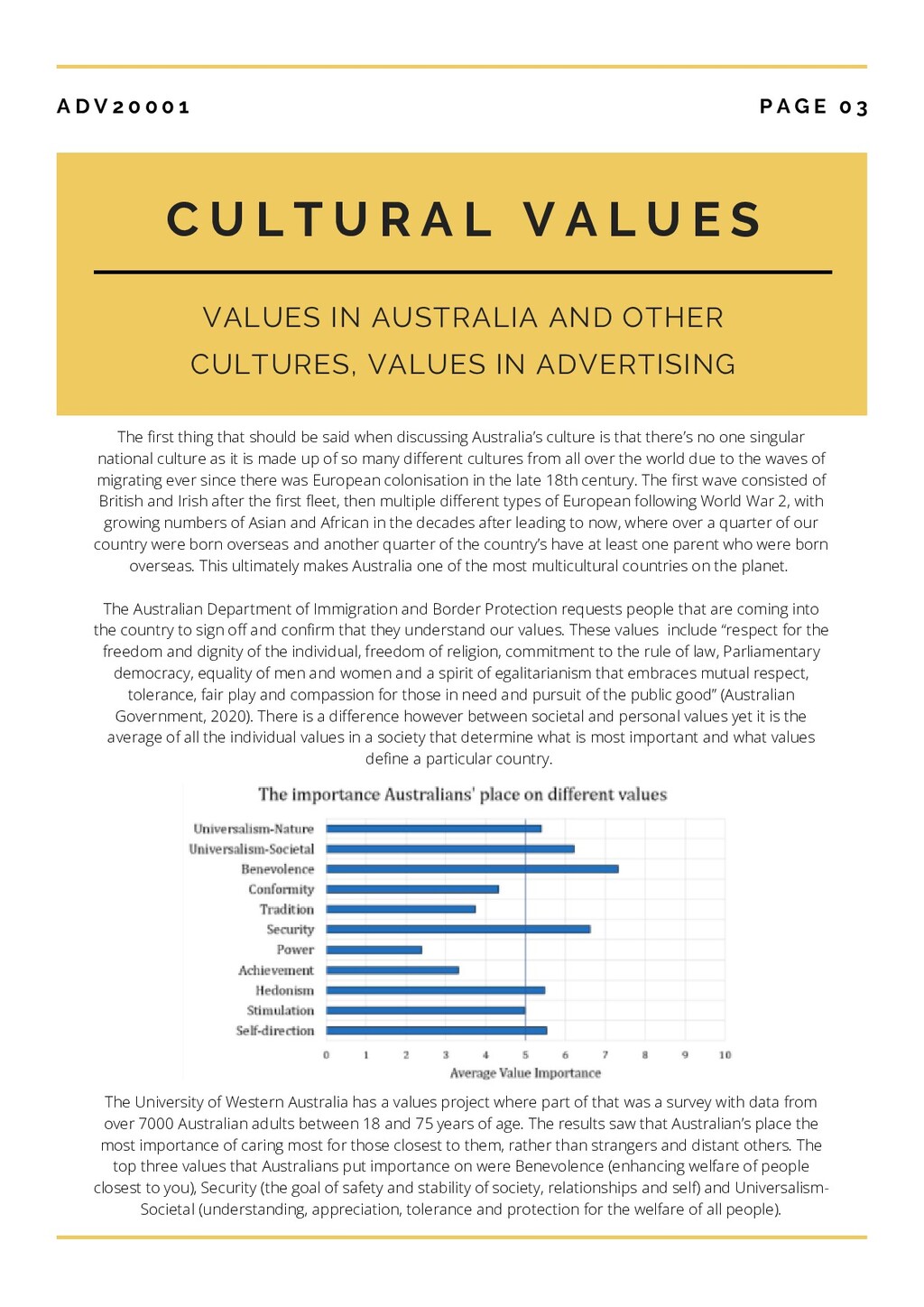
    culture is that there’s no one singular national culture as it is made up of so many different cultures from all over the world due to the waves of migrating ever since there was European colonisation in the late 18th century. The first wave consisted of British and Irish after the first fleet, then multiple different types of European following World War 2, with growing numbers of Asian and African in the decades after leading to now, where over a quarter of our country were born overseas and another quarter of the country’s have at least one parent who were born overseas. This ultimately makes Australia one of the most multicultural countries on the planet. The Australian Department of Immigration and Border Protection requests people that are coming into the country to sign off and confirm that they understand our values. These values include “respect for the freedom and dignity of the individual, freedom of religion, commitment to the rule of law, Parliamentary democracy, equality of men and women and a spirit of egalitarianism that embraces mutual respect, tolerance, fair play and compassion for those in need and pursuit of the public good” (Australian Government, 2020). There is a difference however between societal and personal values yet it is the average of all the individual values in a society that determine what is most important and what values define a particular country. The University of Western Australia has a values project where part of that was a survey with data from over 7000 Australian adults between 18 and 75 years of age. The results saw that Australian’s place the most importance of caring most for those closest to them, rather than strangers and distant others. The top three values that Australians put importance on were Benevolence (enhancing welfare of people closest to you), Security (the goal of safety and stability of society, relationships and self) and Universalism- Societal (understanding, appreciation, tolerance and protection for the welfare of all people). A D V 2 0 0 0 1 P A G E 0 3 C U L T U R A L V A L U E S VALUES IN AUSTRALIA AND OTHER CULTURES, VALUES IN ADVERTISING
  5. The values that showed up as the least important for

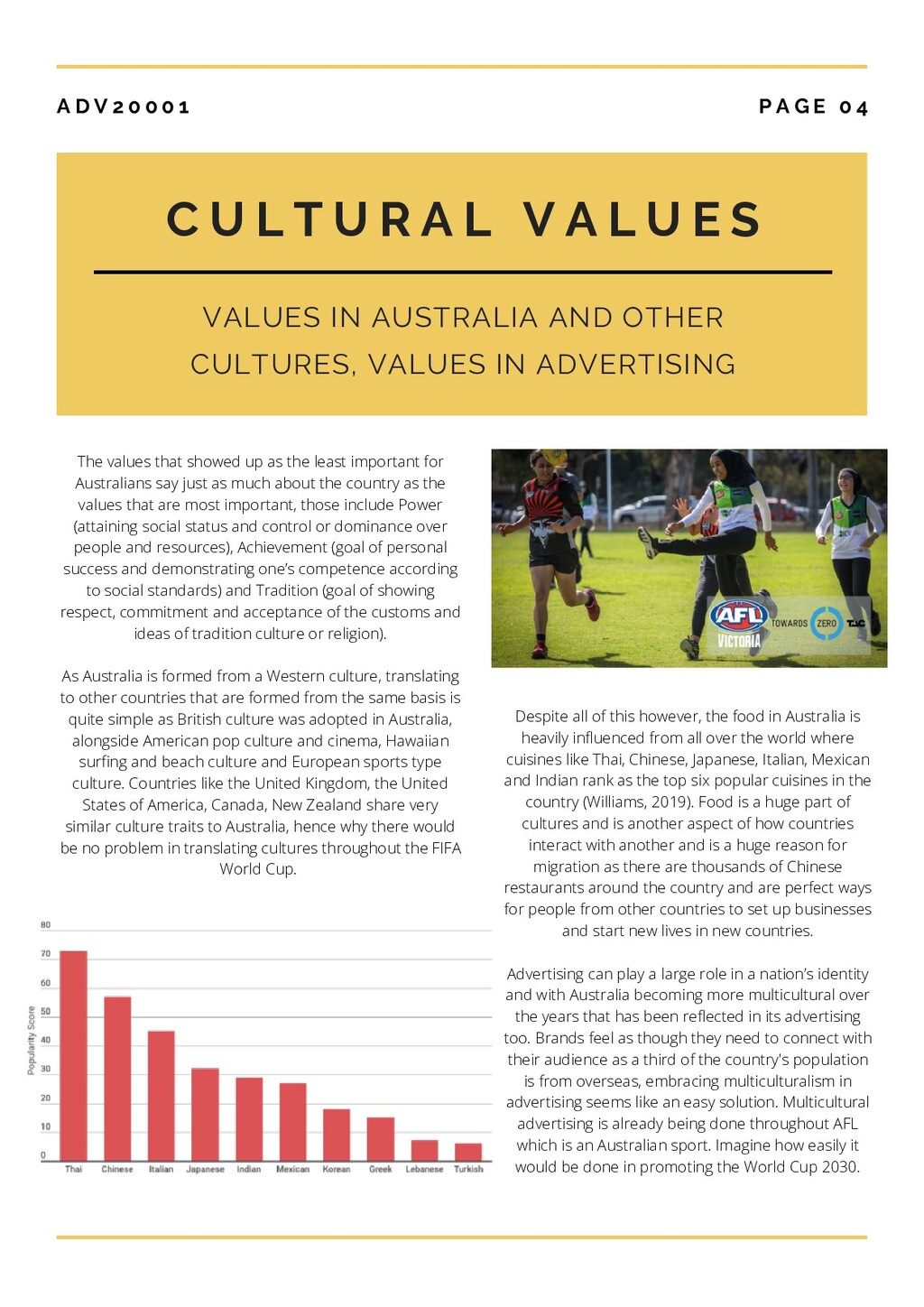
    Australians say just as much about the country as the values that are most important, those include Power (attaining social status and control or dominance over people and resources), Achievement (goal of personal success and demonstrating one’s competence according to social standards) and Tradition (goal of showing respect, commitment and acceptance of the customs and ideas of tradition culture or religion). As Australia is formed from a Western culture, translating to other countries that are formed from the same basis is quite simple as British culture was adopted in Australia, alongside American pop culture and cinema, Hawaiian surfing and beach culture and European sports type culture. Countries like the United Kingdom, the United States of America, Canada, New Zealand share very similar culture traits to Australia, hence why there would be no problem in translating cultures throughout the FIFA World Cup. A D V 2 0 0 0 1 P A G E 0 4 C U L T U R A L V A L U E S VALUES IN AUSTRALIA AND OTHER CULTURES, VALUES IN ADVERTISING Despite all of this however, the food in Australia is heavily influenced from all over the world where cuisines like Thai, Chinese, Japanese, Italian, Mexican and Indian rank as the top six popular cuisines in the country (Williams, 2019). Food is a huge part of cultures and is another aspect of how countries interact with another and is a huge reason for migration as there are thousands of Chinese restaurants around the country and are perfect ways for people from other countries to set up businesses and start new lives in new countries. Advertising can play a large role in a nation’s identity and with Australia becoming more multicultural over the years that has been reflected in its advertising too. Brands feel as though they need to connect with their audience as a third of the country's population is from overseas, embracing multiculturalism in advertising seems like an easy solution. Multicultural advertising is already being done throughout AFL which is an Australian sport. Imagine how easily it would be done in promoting the World Cup 2030.
  6. In Australia one of the main concerns when concentrating on

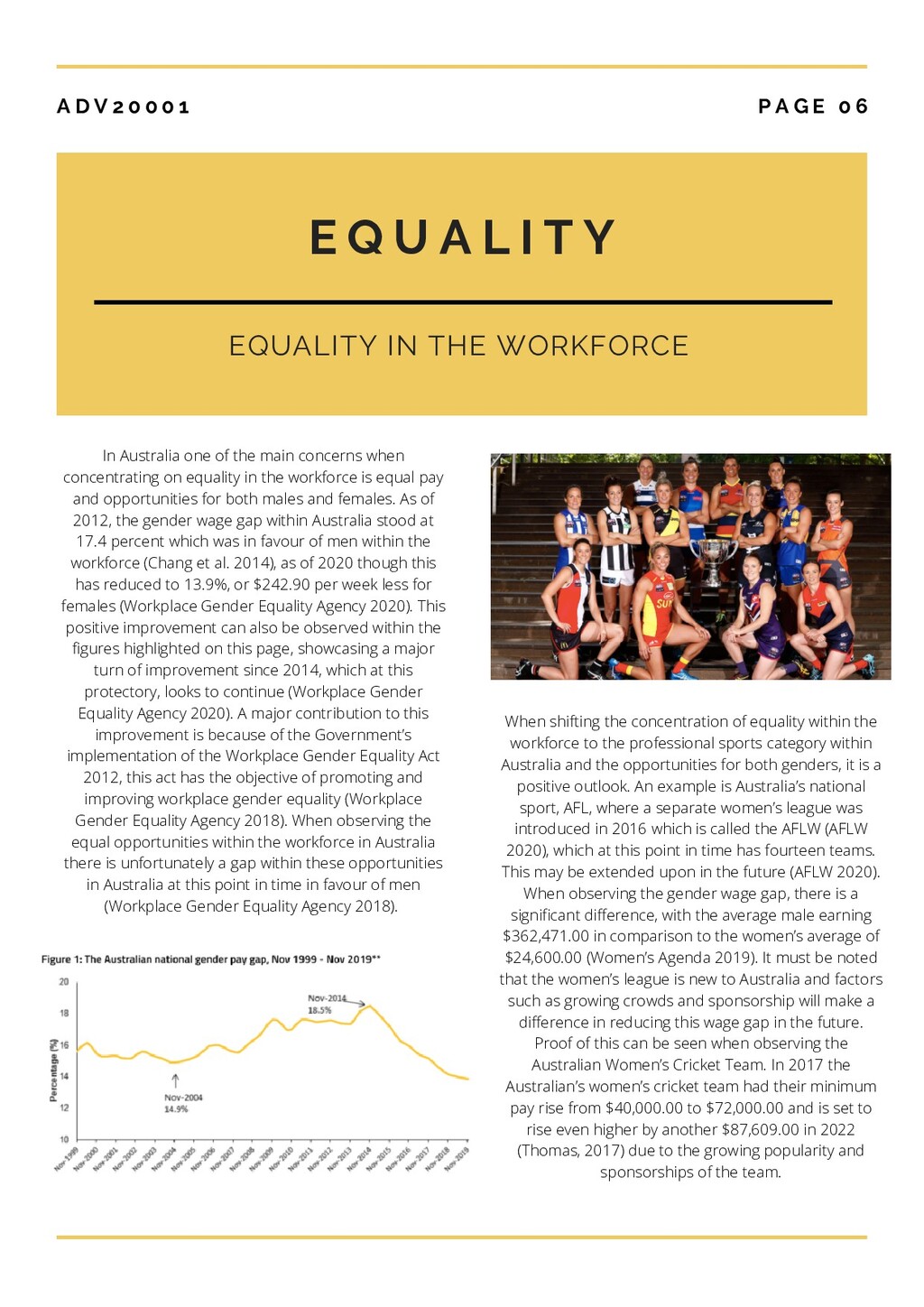
    equality in the workforce is equal pay and opportunities for both males and females. As of 2012, the gender wage gap within Australia stood at 17.4 percent which was in favour of men within the workforce (Chang et al. 2014), as of 2020 though this has reduced to 13.9%, or $242.90 per week less for females (Workplace Gender Equality Agency 2020). This positive improvement can also be observed within the figures highlighted on this page, showcasing a major turn of improvement since 2014, which at this protectory, looks to continue (Workplace Gender Equality Agency 2020). A major contribution to this improvement is because of the Government’s implementation of the Workplace Gender Equality Act 2012, this act has the objective of promoting and improving workplace gender equality (Workplace Gender Equality Agency 2018). When observing the equal opportunities within the workforce in Australia there is unfortunately a gap within these opportunities in Australia at this point in time in favour of men (Workplace Gender Equality Agency 2018). When shifting the concentration of equality within the workforce to the professional sports category within Australia and the opportunities for both genders, it is a positive outlook. An example is Australia’s national sport, AFL, where a separate women’s league was introduced in 2016 which is called the AFLW (AFLW 2020), which at this point in time has fourteen teams. This may be extended upon in the future (AFLW 2020). When observing the gender wage gap, there is a significant difference, with the average male earning $362,471.00 in comparison to the women’s average of $24,600.00 (Women’s Agenda 2019). It must be noted that the women’s league is new to Australia and factors such as growing crowds and sponsorship will make a difference in reducing this wage gap in the future. Proof of this can be seen when observing the Australian Women’s Cricket Team. In 2017 the Australian’s women’s cricket team had their minimum pay rise from $40,000.00 to $72,000.00 and is set to rise even higher by another $87,609.00 in 2022 (Thomas, 2017) due to the growing popularity and sponsorships of the team. A D V 2 0 0 0 1 P A G E 0 6 E Q U A L I T Y EQUALITY IN THE WORKFORCE
  7. A D V 2 0 0 0 1 P A

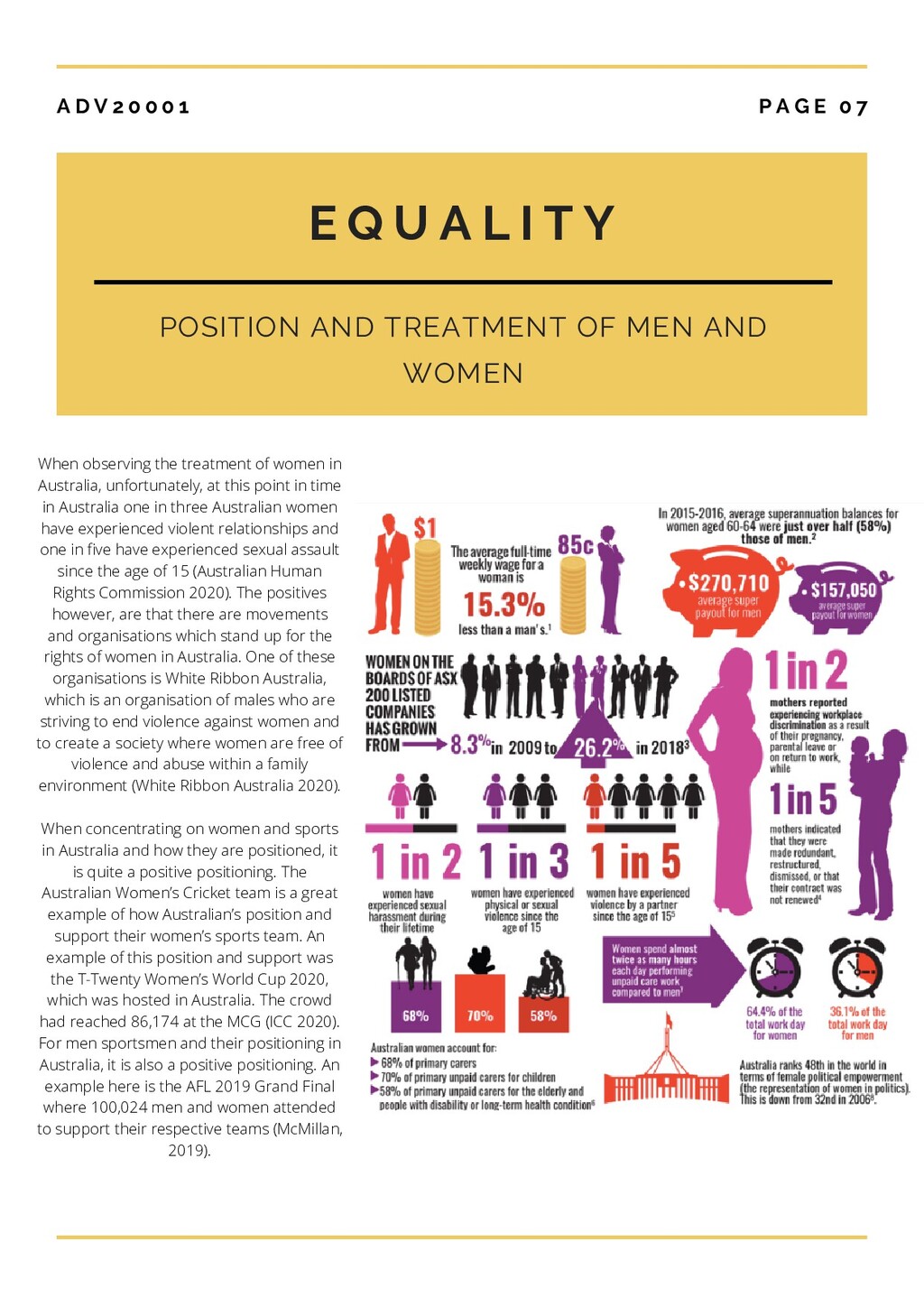
    G E 0 7 E Q U A L I T Y POSITION AND TREATMENT OF MEN AND WOMEN When observing the treatment of women in Australia, unfortunately, at this point in time in Australia one in three Australian women have experienced violent relationships and one in five have experienced sexual assault since the age of 15 (Australian Human Rights Commission 2020). The positives however, are that there are movements and organisations which stand up for the rights of women in Australia. One of these organisations is White Ribbon Australia, which is an organisation of males who are striving to end violence against women and to create a society where women are free of violence and abuse within a family environment (White Ribbon Australia 2020). When concentrating on women and sports in Australia and how they are positioned, it is quite a positive positioning. The Australian Women’s Cricket team is a great example of how Australian’s position and support their women’s sports team. An example of this position and support was the T-Twenty Women’s World Cup 2020, which was hosted in Australia. The crowd had reached 86,174 at the MCG (ICC 2020). For men sportsmen and their positioning in Australia, it is also a positive positioning. An example here is the AFL 2019 Grand Final where 100,024 men and women attended to support their respective teams (McMillan, 2019).
  8. An immigrant refers to “someone who is migrating into another

    country” (Manser, 2011). While Australia has adopted majority of their sporting culture from Britain, with sports such as Cricket and soccer, “immigrants from other countries… [have] enriched many ethnic sports such as bocee, Gaelic football, hurling, vovinam and other forms of martial arts” (Mosely, Cashman, O'Hara, Weatherburn 1997, p. 292) into the Australian sporting industry. Furthermore, sports such as Baseball, softball, basketball and snow sports have been embedded into the Australian sporting industry as a result of immigrants from Europe, North America and Oceania introducing these sports to Australian culture (Mosely, Cashman, O'Hara, Weatherburn 1997, p. 292). Since these sports and cultures surrounding these sports were introduced into Australia, immigrant and ethic groups have significantly participated in Australian sport and the Australian industry. According to statistics, almost a quarter (24.6 per cent) of Australia's population was born overseas and 43.1 percent of people have at least one overseas-born parent (AFL, 2020). As a result of this, current society in Australia represents various cultures and ethnicities that are integrated into ‘normal’ life. This is represented by the idea that there are local restaurants and stores that sell goods and services local to immigrants’ cultures and cuisines. As a result of Australia being a supporting member of the United Nations (UN), they adhere to the Refugees Convention and thus must follow the act of non- refoulement in regard to the treatment of refugees and asylum seekers. Australia must not return an immigrant or asylum seeker back to their originating country if they face a significant risk of violation of human rights under the International Covenant on Civil and Political Rights (ICCPR) , the Convention Against Torture (CAT) and the Convention on the Rights of the Child (CRC). Moreover, Australia must not send people to third countries where they would face a real risk of violation of their human rights (Australian Human rights Commission, 2020). This demonstrates that if spectators from other countries want to come to Australia to watch the FIFA World Cup, that would be a possibility. Additionally, in a study conducted by the University of Queensland, it was noted that the general consensus among Australians in regard to their attitudes towards different ethnicities were that their “threat perceptions [of people] fully mediate the relationships between national identification and distal variables” (Louis, Esses, Lalonde 2013,p. 161). Furthermore, this study also suggested that this psychological process may contribute to “why anti-immigrant attitudes are difficult to shift with intervention programs” (Louis, Esses, Lalonde 2013, p. 161) within Australia. Australia has been quite active in marketing education in Australia to International students in Asia, Europe and America where they can continue to study their course in Australian Universities and thus provide support to the Australian economy. Students from overseas not only represent different cultures in a schooling environment, but also inherit the Australian culture into their daily lives. This results in individuals finding someone they can relate to which leads to inclusiveness and a sense of belonging not only in schooling, but in the Australian lifestyle. However, it has been reported that there are “significant gaps… in health care, legal services, physical safety, community engagement, employment, financial considerations and accommodation” (International Social Service in Australia, 2012) of International students in Australia according to the International Social Service. A D V 2 0 0 0 1 P A G E 0 8 E Q U A L I T Y TREATMENT OF IMMIGRANTS AND FOREIGN RESIDENTS
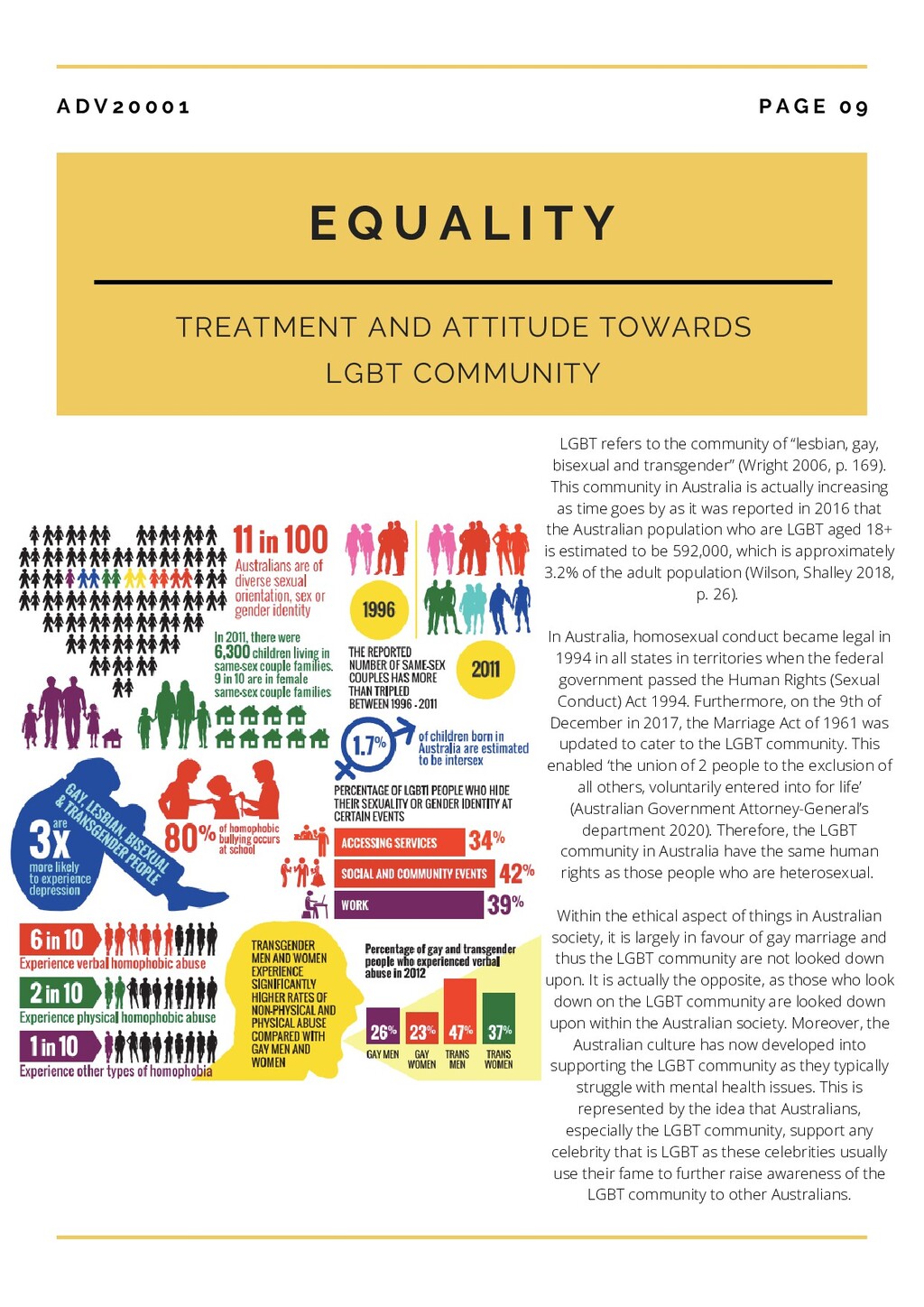
  9. LGBT refers to the community of “lesbian, gay, bisexual and

    transgender” (Wright 2006, p. 169). This community in Australia is actually increasing as time goes by as it was reported in 2016 that the Australian population who are LGBT aged 18+ is estimated to be 592,000, which is approximately 3.2% of the adult population (Wilson, Shalley 2018, p. 26). In Australia, homosexual conduct became legal in 1994 in all states in territories when the federal government passed the Human Rights (Sexual Conduct) Act 1994. Furthermore, on the 9th of December in 2017, the Marriage Act of 1961 was updated to cater to the LGBT community. This enabled ‘the union of 2 people to the exclusion of all others, voluntarily entered into for life’ (Australian Government Attorney-General’s department 2020). Therefore, the LGBT community in Australia have the same human rights as those people who are heterosexual. Within the ethical aspect of things in Australian society, it is largely in favour of gay marriage and thus the LGBT community are not looked down upon. It is actually the opposite, as those who look down on the LGBT community are looked down upon within the Australian society. Moreover, the Australian culture has now developed into supporting the LGBT community as they typically struggle with mental health issues. This is represented by the idea that Australians, especially the LGBT community, support any celebrity that is LGBT as these celebrities usually use their fame to further raise awareness of the LGBT community to other Australians. A D V 2 0 0 0 1 P A G E 0 9 E Q U A L I T Y TREATMENT AND ATTITUDE TOWARDS LGBT COMMUNITY
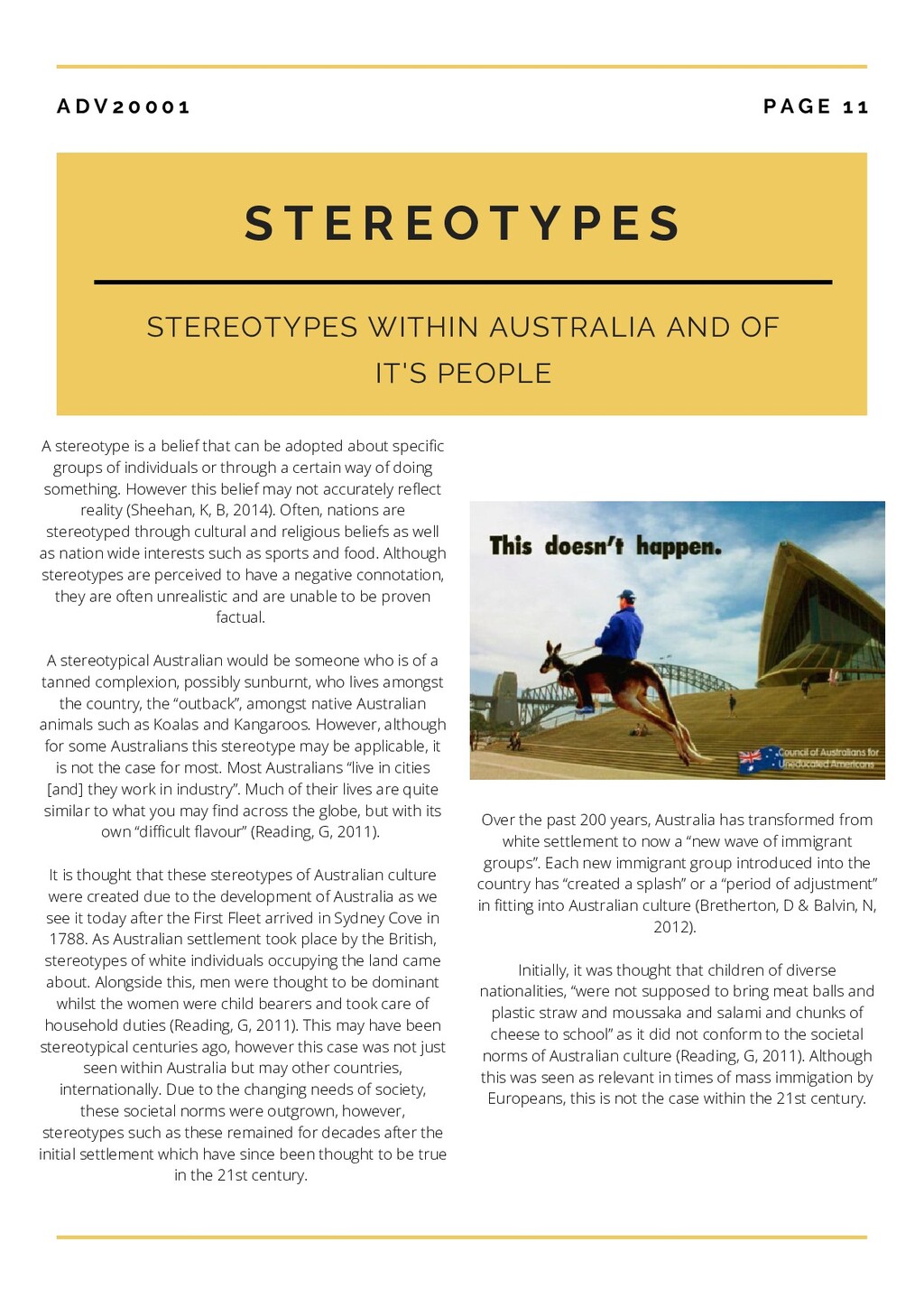
  10. A stereotype is a belief that can be adopted about

    specific groups of individuals or through a certain way of doing something. However this belief may not accurately reflect reality (Sheehan, K, B, 2014). Often, nations are stereotyped through cultural and religious beliefs as well as nation wide interests such as sports and food. Although stereotypes are perceived to have a negative connotation, they are often unrealistic and are unable to be proven factual. A stereotypical Australian would be someone who is of a tanned complexion, possibly sunburnt, who lives amongst the country, the “outback”, amongst native Australian animals such as Koalas and Kangaroos. However, although for some Australians this stereotype may be applicable, it is not the case for most. Most Australians “live in cities [and] they work in industry”. Much of their lives are quite similar to what you may find across the globe, but with its own “difficult flavour” (Reading, G, 2011). It is thought that these stereotypes of Australian culture were created due to the development of Australia as we see it today after the First Fleet arrived in Sydney Cove in 1788. As Australian settlement took place by the British, stereotypes of white individuals occupying the land came about. Alongside this, men were thought to be dominant whilst the women were child bearers and took care of household duties (Reading, G, 2011). This may have been stereotypical centuries ago, however this case was not just seen within Australia but may other countries, internationally. Due to the changing needs of society, these societal norms were outgrown, however, stereotypes such as these remained for decades after the initial settlement which have since been thought to be true in the 21st century. A D V 2 0 0 0 1 P A G E 1 1 S T E R E O T Y P E S STEREOTYPES WITHIN AUSTRALIA AND OF IT'S PEOPLE Over the past 200 years, Australia has transformed from white settlement to now a “new wave of immigrant groups”. Each new immigrant group introduced into the country has “created a splash” or a “period of adjustment” in fitting into Australian culture (Bretherton, D & Balvin, N, 2012). Initially, it was thought that children of diverse nationalities, “were not supposed to bring meat balls and plastic straw and moussaka and salami and chunks of cheese to school” as it did not conform to the societal norms of Australian culture (Reading, G, 2011). Although this was seen as relevant in times of mass immigation by Europeans, this is not the case within the 21st century.
  11. Cuisine is another major stereotype which Australians are subject to.

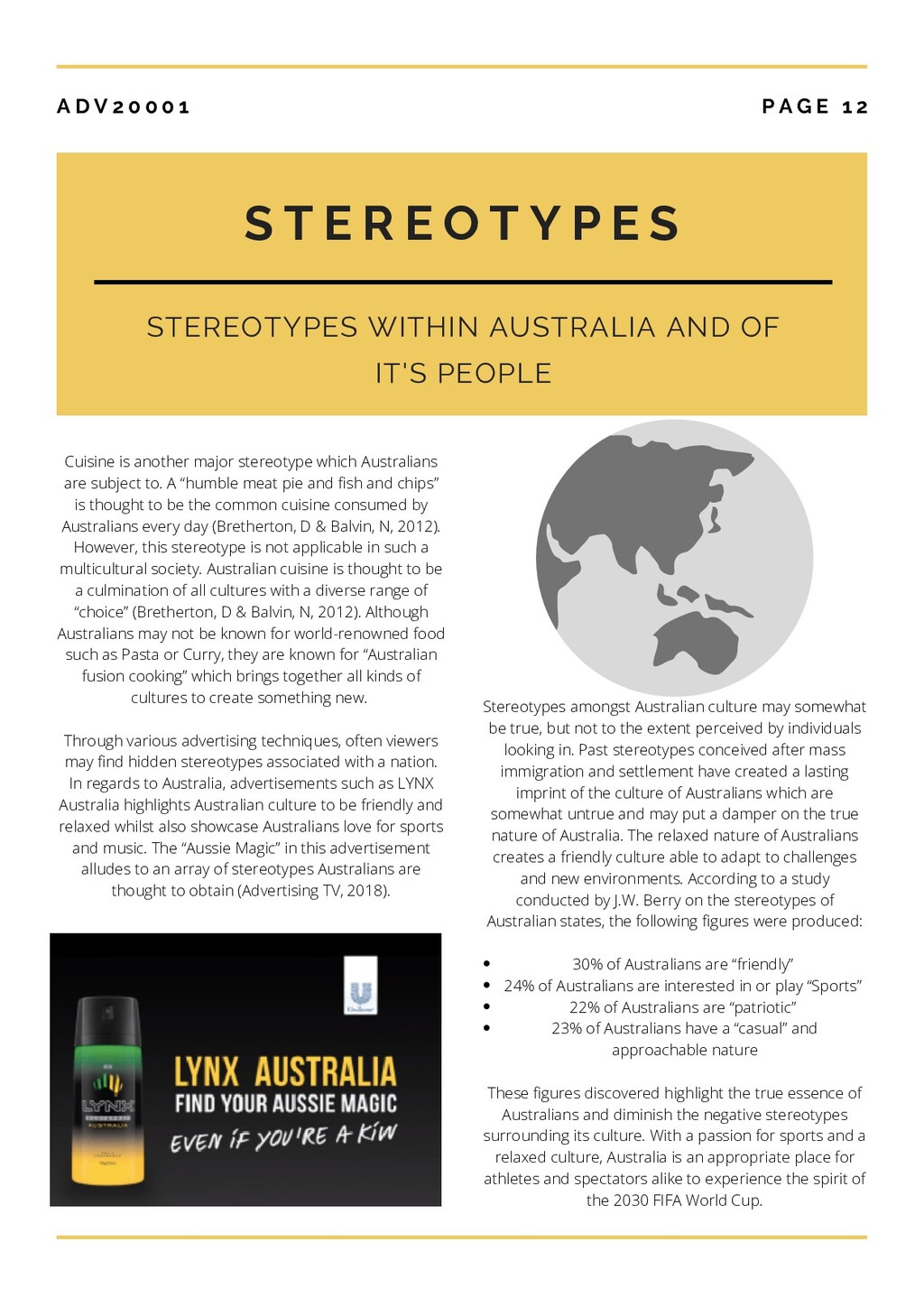
    A “humble meat pie and fish and chips” is thought to be the common cuisine consumed by Australians every day (Bretherton, D & Balvin, N, 2012). However, this stereotype is not applicable in such a multicultural society. Australian cuisine is thought to be a culmination of all cultures with a diverse range of “choice” (Bretherton, D & Balvin, N, 2012). Although Australians may not be known for world-renowned food such as Pasta or Curry, they are known for “Australian fusion cooking” which brings together all kinds of cultures to create something new. Through various advertising techniques, often viewers may find hidden stereotypes associated with a nation. In regards to Australia, advertisements such as LYNX Australia highlights Australian culture to be friendly and relaxed whilst also showcase Australians love for sports and music. The “Aussie Magic” in this advertisement alludes to an array of stereotypes Australians are thought to obtain (Advertising TV, 2018). 30% of Australians are “friendly” 24% of Australians are interested in or play “Sports” 22% of Australians are “patriotic” 23% of Australians have a “casual” and approachable nature Stereotypes amongst Australian culture may somewhat be true, but not to the extent perceived by individuals looking in. Past stereotypes conceived after mass immigration and settlement have created a lasting imprint of the culture of Australians which are somewhat untrue and may put a damper on the true nature of Australia. The relaxed nature of Australians creates a friendly culture able to adapt to challenges and new environments. According to a study conducted by J.W. Berry on the stereotypes of Australian states, the following figures were produced: These figures discovered highlight the true essence of Australians and diminish the negative stereotypes surrounding its culture. With a passion for sports and a relaxed culture, Australia is an appropriate place for athletes and spectators alike to experience the spirit of the 2030 FIFA World Cup. A D V 2 0 0 0 1 P A G E 1 2 S T E R E O T Y P E S STEREOTYPES WITHIN AUSTRALIA AND OF IT'S PEOPLE
  12. C U L T U R A L P R

    O M O T I O N
  13. Australia takes great pride in its diverse culture and wide

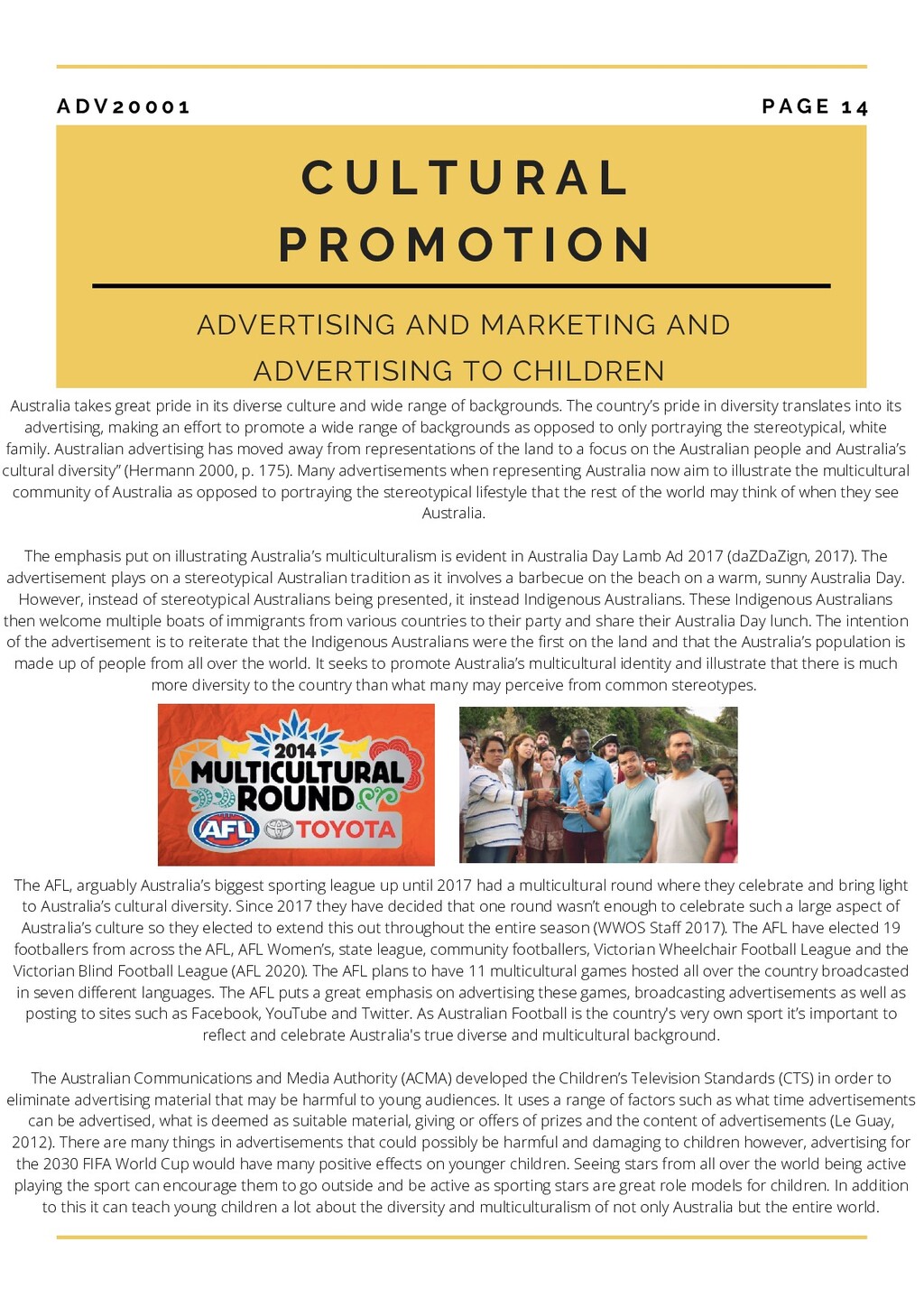
    range of backgrounds. The country’s pride in diversity translates into its advertising, making an effort to promote a wide range of backgrounds as opposed to only portraying the stereotypical, white family. Australian advertising has moved away from representations of the land to a focus on the Australian people and Australia’s cultural diversity” (Hermann 2000, p. 175). Many advertisements when representing Australia now aim to illustrate the multicultural community of Australia as opposed to portraying the stereotypical lifestyle that the rest of the world may think of when they see Australia. The emphasis put on illustrating Australia’s multiculturalism is evident in Australia Day Lamb Ad 2017 (daZDaZign, 2017). The advertisement plays on a stereotypical Australian tradition as it involves a barbecue on the beach on a warm, sunny Australia Day. However, instead of stereotypical Australians being presented, it instead Indigenous Australians. These Indigenous Australians then welcome multiple boats of immigrants from various countries to their party and share their Australia Day lunch. The intention of the advertisement is to reiterate that the Indigenous Australians were the first on the land and that the Australia’s population is made up of people from all over the world. It seeks to promote Australia’s multicultural identity and illustrate that there is much more diversity to the country than what many may perceive from common stereotypes. A D V 2 0 0 0 1 P A G E 1 4 C U L T U R A L P R O M O T I O N ADVERTISING AND MARKETING AND ADVERTISING TO CHILDREN The AFL, arguably Australia’s biggest sporting league up until 2017 had a multicultural round where they celebrate and bring light to Australia’s cultural diversity. Since 2017 they have decided that one round wasn’t enough to celebrate such a large aspect of Australia’s culture so they elected to extend this out throughout the entire season (WWOS Staff 2017). The AFL have elected 19 footballers from across the AFL, AFL Women’s, state league, community footballers, Victorian Wheelchair Football League and the Victorian Blind Football League (AFL 2020). The AFL plans to have 11 multicultural games hosted all over the country broadcasted in seven different languages. The AFL puts a great emphasis on advertising these games, broadcasting advertisements as well as posting to sites such as Facebook, YouTube and Twitter. As Australian Football is the country's very own sport it’s important to reflect and celebrate Australia's true diverse and multicultural background. The Australian Communications and Media Authority (ACMA) developed the Children’s Television Standards (CTS) in order to eliminate advertising material that may be harmful to young audiences. It uses a range of factors such as what time advertisements can be advertised, what is deemed as suitable material, giving or offers of prizes and the content of advertisements (Le Guay, 2012). There are many things in advertisements that could possibly be harmful and damaging to children however, advertising for the 2030 FIFA World Cup would have many positive effects on younger children. Seeing stars from all over the world being active playing the sport can encourage them to go outside and be active as sporting stars are great role models for children. In addition to this it can teach young children a lot about the diversity and multiculturalism of not only Australia but the entire world.
  14. C O N C L U S I O N

    Word Count: 3850 words (excluding in text referencing) After exploration of Australia and its cultural values, the equality it strives for, its stereotypes and the cultural promotion, it is clear that the country should be considered to hold the FIFA World Cup in 2030. Sports is one of the best aspects of Australian culture; it would be the perfect opportunity for sports to grow in Australia which would benefit the sport locally and overseas. As the report demonstrates, Australia advertises sport appropriately and effectively to children, it has an overall and positive growing attitude towards the LGBT community, international sports are welcomed into Australian culture and equality is of enormous importance in Australia. Australia is one of the most multicultural countries on the planet and has never hosted a World Cup before, the FIFA Executive Committee should heavily consider it, especially after declining Australia’s submission for the 2022 World Cup and it would be the perfect country following Qatar in 2022 and Canada in 2026. A D V 2 0 0 0 1 P A G E 1 5
  15. A D V 2 0 0 0 1 P A

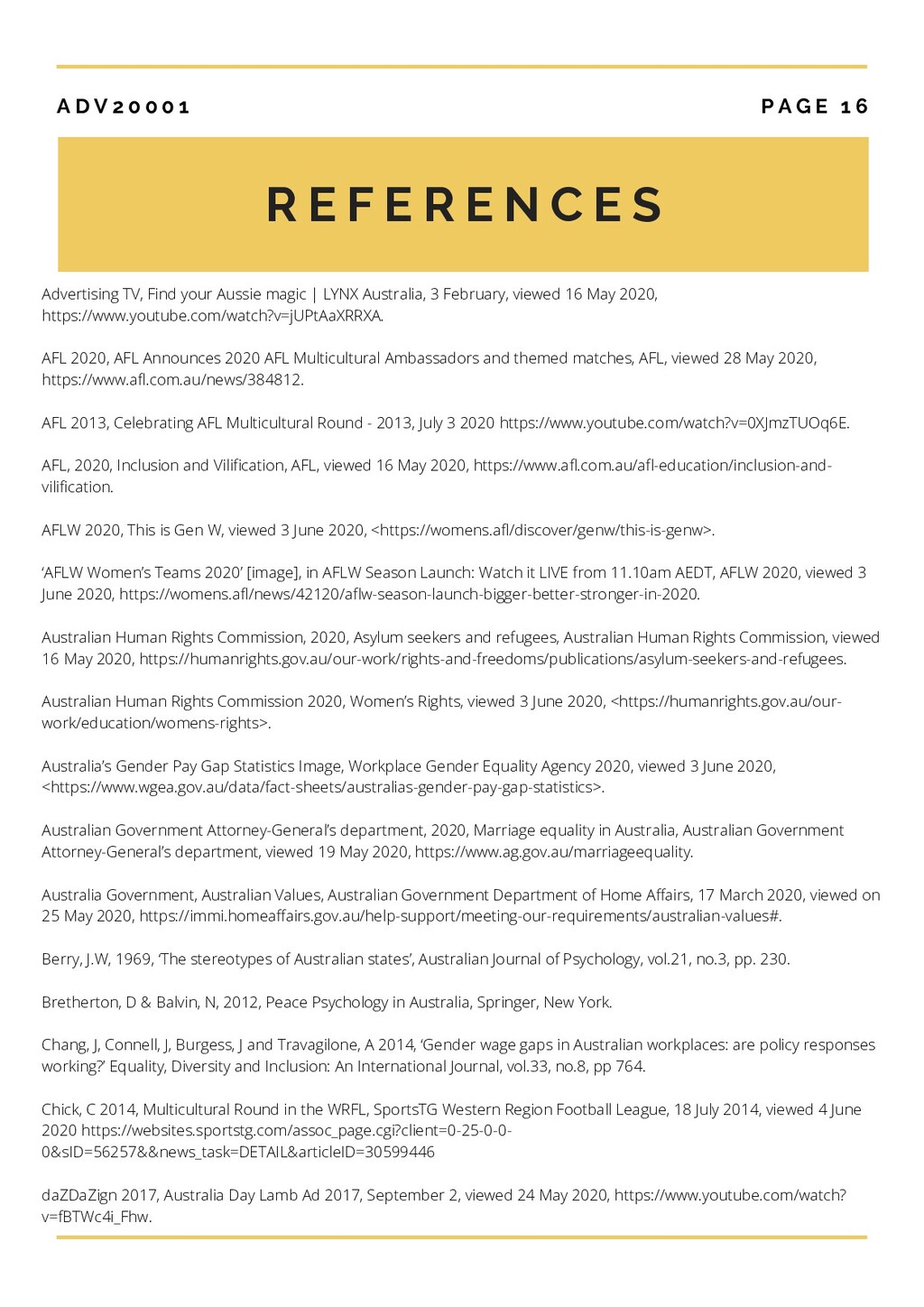
    G E 1 6 R E F E R E N C E S Advertising TV, Find your Aussie magic | LYNX Australia, 3 February, viewed 16 May 2020, https://www.youtube.com/watch?v=jUPtAaXRRXA. AFL 2020, AFL Announces 2020 AFL Multicultural Ambassadors and themed matches, AFL, viewed 28 May 2020, https://www.afl.com.au/news/384812. AFL 2013, Celebrating AFL Multicultural Round - 2013, July 3 2020 https://www.youtube.com/watch?v=0XJmzTUOq6E. AFL, 2020, Inclusion and Vilification, AFL, viewed 16 May 2020, https://www.afl.com.au/afl-education/inclusion-and- vilification. AFLW 2020, This is Gen W, viewed 3 June 2020, <https://womens.afl/discover/genw/this-is-genw>. ‘AFLW Women’s Teams 2020’ [image], in AFLW Season Launch: Watch it LIVE from 11.10am AEDT, AFLW 2020, viewed 3 June 2020, https://womens.afl/news/42120/aflw-season-launch-bigger-better-stronger-in-2020. Australian Human Rights Commission, 2020, Asylum seekers and refugees, Australian Human Rights Commission, viewed 16 May 2020, https://humanrights.gov.au/our-work/rights-and-freedoms/publications/asylum-seekers-and-refugees. Australian Human Rights Commission 2020, Women’s Rights, viewed 3 June 2020, <https://humanrights.gov.au/our- work/education/womens-rights>. Australia’s Gender Pay Gap Statistics Image, Workplace Gender Equality Agency 2020, viewed 3 June 2020, <https://www.wgea.gov.au/data/fact-sheets/australias-gender-pay-gap-statistics>. Australian Government Attorney-General’s department, 2020, Marriage equality in Australia, Australian Government Attorney-General’s department, viewed 19 May 2020, https://www.ag.gov.au/marriageequality. Australia Government, Australian Values, Australian Government Department of Home Affairs, 17 March 2020, viewed on 25 May 2020, https://immi.homeaffairs.gov.au/help-support/meeting-our-requirements/australian-values#. Berry, J.W, 1969, ‘The stereotypes of Australian states’, Australian Journal of Psychology, vol.21, no.3, pp. 230. Bretherton, D & Balvin, N, 2012, Peace Psychology in Australia, Springer, New York. Chang, J, Connell, J, Burgess, J and Travagilone, A 2014, ‘Gender wage gaps in Australian workplaces: are policy responses working?’ Equality, Diversity and Inclusion: An International Journal, vol.33, no.8, pp 764. Chick, C 2014, Multicultural Round in the WRFL, SportsTG Western Region Football League, 18 July 2014, viewed 4 June 2020 https://websites.sportstg.com/assoc_page.cgi?client=0-25-0-0- 0&sID=56257&&news_task=DETAIL&articleID=30599446 daZDaZign 2017, Australia Day Lamb Ad 2017, September 2, viewed 24 May 2020, https://www.youtube.com/watch? v=fBTWc4i_Fhw.
  16. A D V 2 0 0 0 1 P A

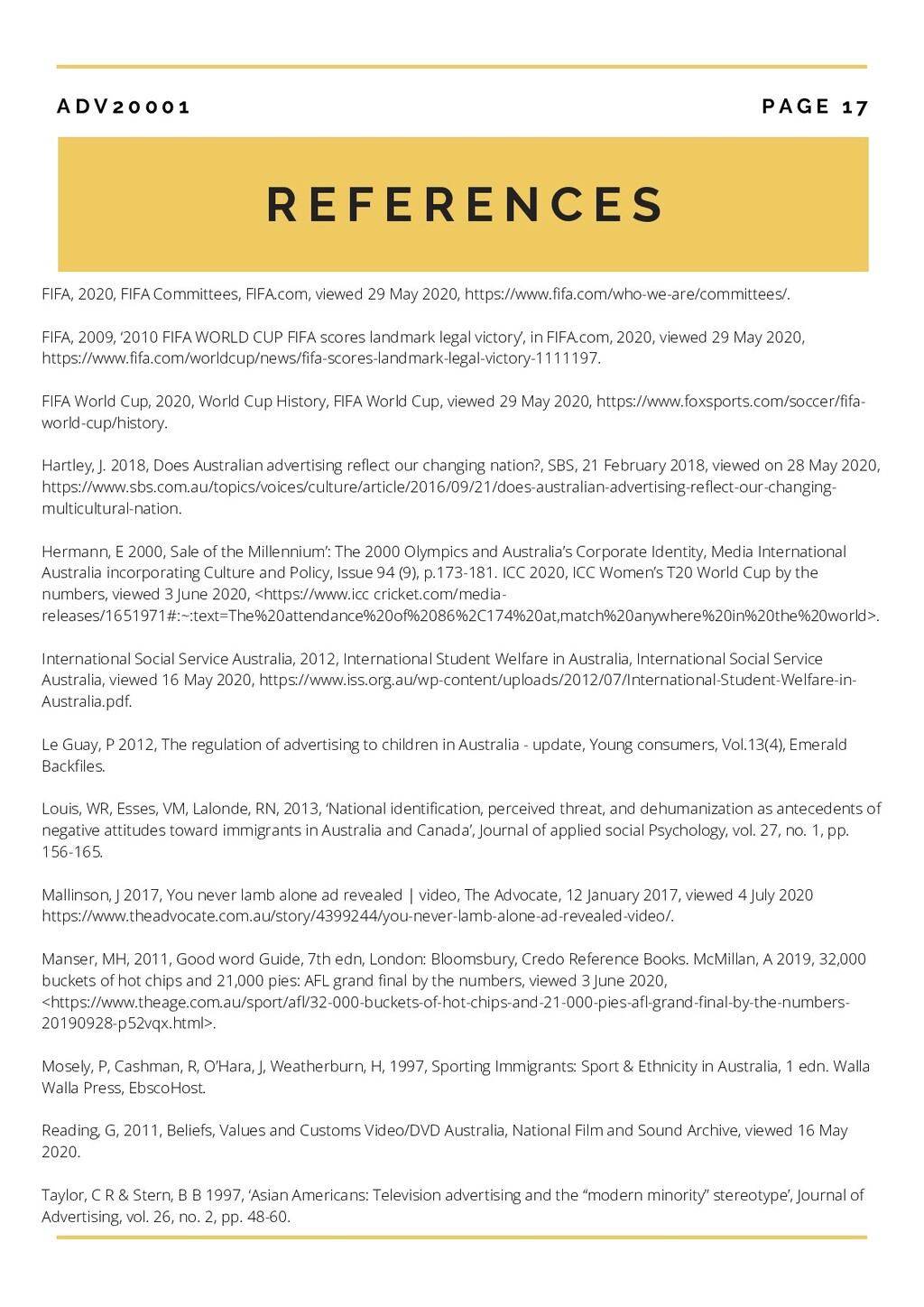
    G E 1 7 R E F E R E N C E S FIFA, 2020, FIFA Committees, FIFA.com, viewed 29 May 2020, https://www.fifa.com/who-we-are/committees/. FIFA, 2009, ‘2010 FIFA WORLD CUP FIFA scores landmark legal victory’, in FIFA.com, 2020, viewed 29 May 2020, https://www.fifa.com/worldcup/news/fifa-scores-landmark-legal-victory-1111197. FIFA World Cup, 2020, World Cup History, FIFA World Cup, viewed 29 May 2020, https://www.foxsports.com/soccer/fifa- world-cup/history. Hartley, J. 2018, Does Australian advertising reflect our changing nation?, SBS, 21 February 2018, viewed on 28 May 2020, https://www.sbs.com.au/topics/voices/culture/article/2016/09/21/does-australian-advertising-reflect-our-changing- multicultural-nation. Hermann, E 2000, Sale of the Millennium’: The 2000 Olympics and Australia’s Corporate Identity, Media International Australia incorporating Culture and Policy, Issue 94 (9), p.173-181. ICC 2020, ICC Women’s T20 World Cup by the numbers, viewed 3 June 2020, <https://www.icc cricket.com/media- releases/1651971#:~:text=The%20attendance%20of%2086%2C174%20at,match%20anywhere%20in%20the%20world>. International Social Service Australia, 2012, International Student Welfare in Australia, International Social Service Australia, viewed 16 May 2020, https://www.iss.org.au/wp-content/uploads/2012/07/International-Student-Welfare-in- Australia.pdf. Le Guay, P 2012, The regulation of advertising to children in Australia - update, Young consumers, Vol.13(4), Emerald Backfiles. Louis, WR, Esses, VM, Lalonde, RN, 2013, ‘National identification, perceived threat, and dehumanization as antecedents of negative attitudes toward immigrants in Australia and Canada’, Journal of applied social Psychology, vol. 27, no. 1, pp. 156-165. Mallinson, J 2017, You never lamb alone ad revealed | video, The Advocate, 12 January 2017, viewed 4 July 2020 https://www.theadvocate.com.au/story/4399244/you-never-lamb-alone-ad-revealed-video/. Manser, MH, 2011, Good word Guide, 7th edn, London: Bloomsbury, Credo Reference Books. McMillan, A 2019, 32,000 buckets of hot chips and 21,000 pies: AFL grand final by the numbers, viewed 3 June 2020, <https://www.theage.com.au/sport/afl/32-000-buckets-of-hot-chips-and-21-000-pies-afl-grand-final-by-the-numbers- 20190928-p52vqx.html>. Mosely, P, Cashman, R, O’Hara, J, Weatherburn, H, 1997, Sporting Immigrants: Sport & Ethnicity in Australia, 1 edn. Walla Walla Press, EbscoHost. Reading, G, 2011, Beliefs, Values and Customs Video/DVD Australia, National Film and Sound Archive, viewed 16 May 2020. Taylor, C R & Stern, B B 1997, ‘Asian Americans: Television advertising and the “modern minority” stereotype’, Journal of Advertising, vol. 26, no. 2, pp. 48-60.
  17. A D V 2 0 0 0 1 P A

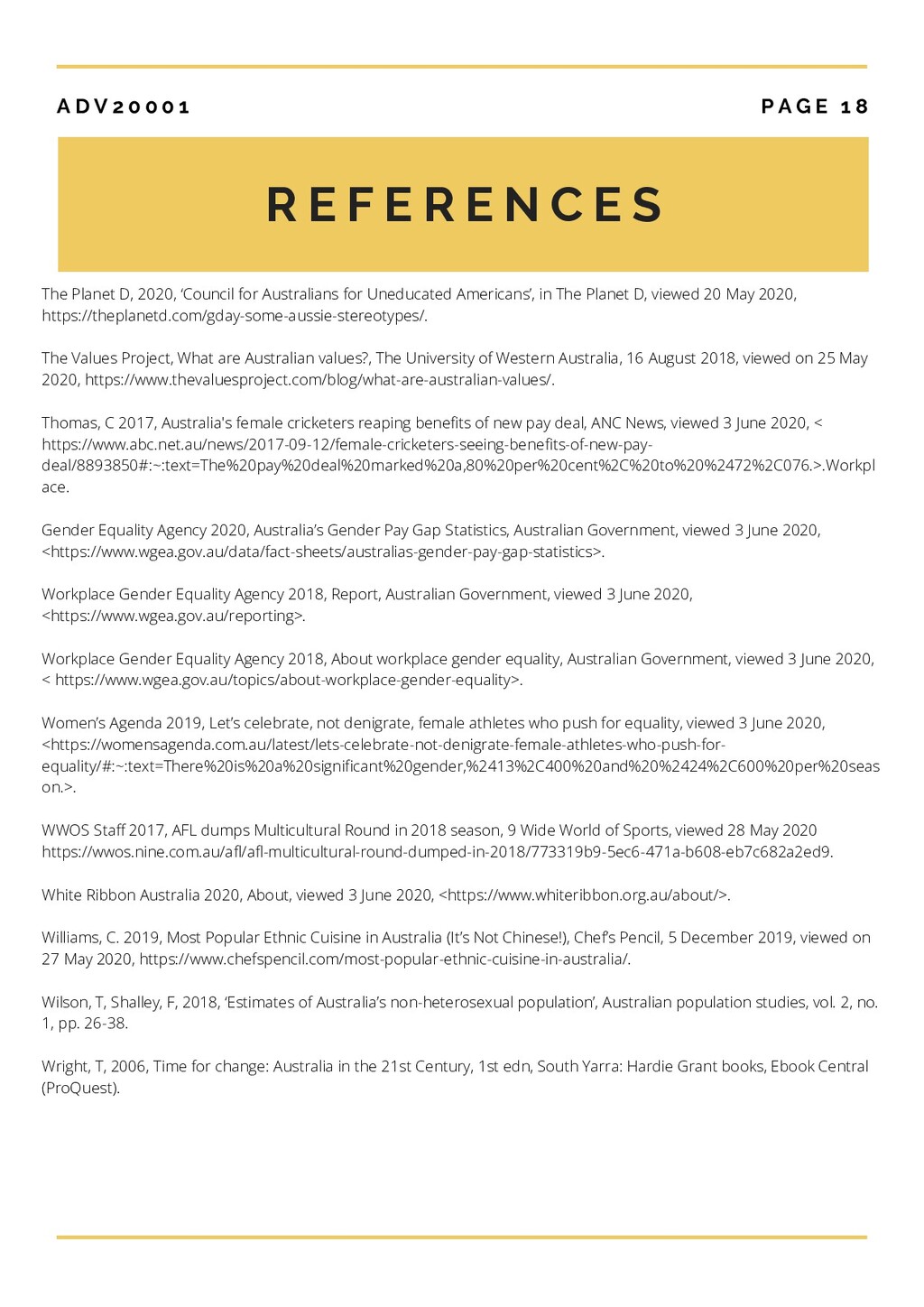
    G E 1 8 R E F E R E N C E S The Planet D, 2020, ‘Council for Australians for Uneducated Americans’, in The Planet D, viewed 20 May 2020, https://theplanetd.com/gday-some-aussie-stereotypes/. The Values Project, What are Australian values?, The University of Western Australia, 16 August 2018, viewed on 25 May 2020, https://www.thevaluesproject.com/blog/what-are-australian-values/. Thomas, C 2017, Australia's female cricketers reaping benefits of new pay deal, ANC News, viewed 3 June 2020, < https://www.abc.net.au/news/2017-09-12/female-cricketers-seeing-benefits-of-new-pay- deal/8893850#:~:text=The%20pay%20deal%20marked%20a,80%20per%20cent%2C%20to%20%2472%2C076.>.Workpl ace. Gender Equality Agency 2020, Australia’s Gender Pay Gap Statistics, Australian Government, viewed 3 June 2020, <https://www.wgea.gov.au/data/fact-sheets/australias-gender-pay-gap-statistics>. Workplace Gender Equality Agency 2018, Report, Australian Government, viewed 3 June 2020, <https://www.wgea.gov.au/reporting>. Workplace Gender Equality Agency 2018, About workplace gender equality, Australian Government, viewed 3 June 2020, < https://www.wgea.gov.au/topics/about-workplace-gender-equality>. Women’s Agenda 2019, Let’s celebrate, not denigrate, female athletes who push for equality, viewed 3 June 2020, <https://womensagenda.com.au/latest/lets-celebrate-not-denigrate-female-athletes-who-push-for- equality/#:~:text=There%20is%20a%20significant%20gender,%2413%2C400%20and%20%2424%2C600%20per%20seas on.>. WWOS Staff 2017, AFL dumps Multicultural Round in 2018 season, 9 Wide World of Sports, viewed 28 May 2020 https://wwos.nine.com.au/afl/afl-multicultural-round-dumped-in-2018/773319b9-5ec6-471a-b608-eb7c682a2ed9. White Ribbon Australia 2020, About, viewed 3 June 2020, <https://www.whiteribbon.org.au/about/>. Williams, C. 2019, Most Popular Ethnic Cuisine in Australia (It’s Not Chinese!), Chef’s Pencil, 5 December 2019, viewed on 27 May 2020, https://www.chefspencil.com/most-popular-ethnic-cuisine-in-australia/. Wilson, T, Shalley, F, 2018, ‘Estimates of Australia’s non-heterosexual population’, Australian population studies, vol. 2, no. 1, pp. 26-38. Wright, T, 2006, Time for change: Australia in the 21st Century, 1st edn, South Yarra: Hardie Grant books, Ebook Central (ProQuest).