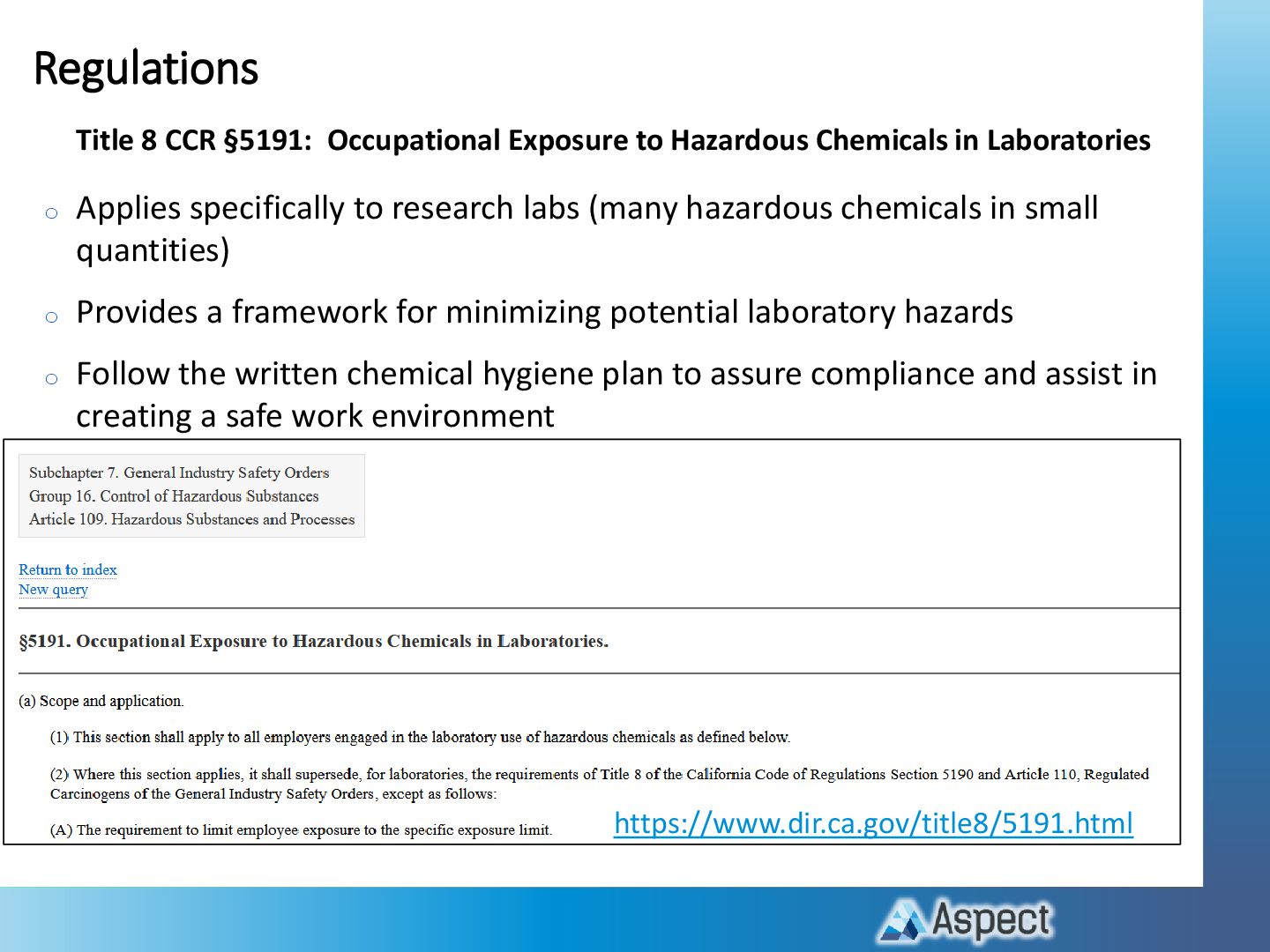
in Laboratories o Applies specifically to research labs (many hazardous chemicals in small quantities) o Provides a framework for minimizing potential laboratory hazards o Follow the written chemical hygiene plan to assure compliance and assist in creating a safe work environment https://www.dir.ca.gov/title8/5191.html
• As part of the Injury and Illness Prevention Program (IIPP) • Applies to all employees who handle hazardous materials • Reviewed and updated as necessary • Includes criteria to determine control measures designed to reduce hazardous chemical exposure • Contains provisions for medical consultation and medical evaluations • Designates responsible persons for chemical hygiene IPP Binder Location: Aspect’s Share Drive G:\Shared drives\Team Safety\10_Fremont Safety
is: Mike Scott Roles and Responsibilities of the CHO: • Assist lab employees in carrying out safe work practices involving hazardous materials • Assist in periodic inspections of laboratory to mitigate chemical safety hazards • Provide Safety Data Sheets and hazard communication labeling for chemicals in the laboratory • Assist with hazardous waste management practices Before bringing a new hazardous substance into the facility, notify the CHO.
to: • Be notified of measured or suspected exposures to harmful substances above legal exposure limits • Request medical consultations and access your medical and exposure records • Refuse to work in unsafe conditions or perform work that could create a hazard to you or your colleagues As an employee, you have a responsibility to: • Follow all provisions of the Chemical Hygiene Plan • Work safely and use good judgment • Report all accidents, injuries, and unsafe conditions immediately to your supervisor • Stop all work that may pose an imminent danger to you or those around you • Be familiar with and follow emergency procedures • Evaluate your own risk of injury and then take steps to minimize this risk
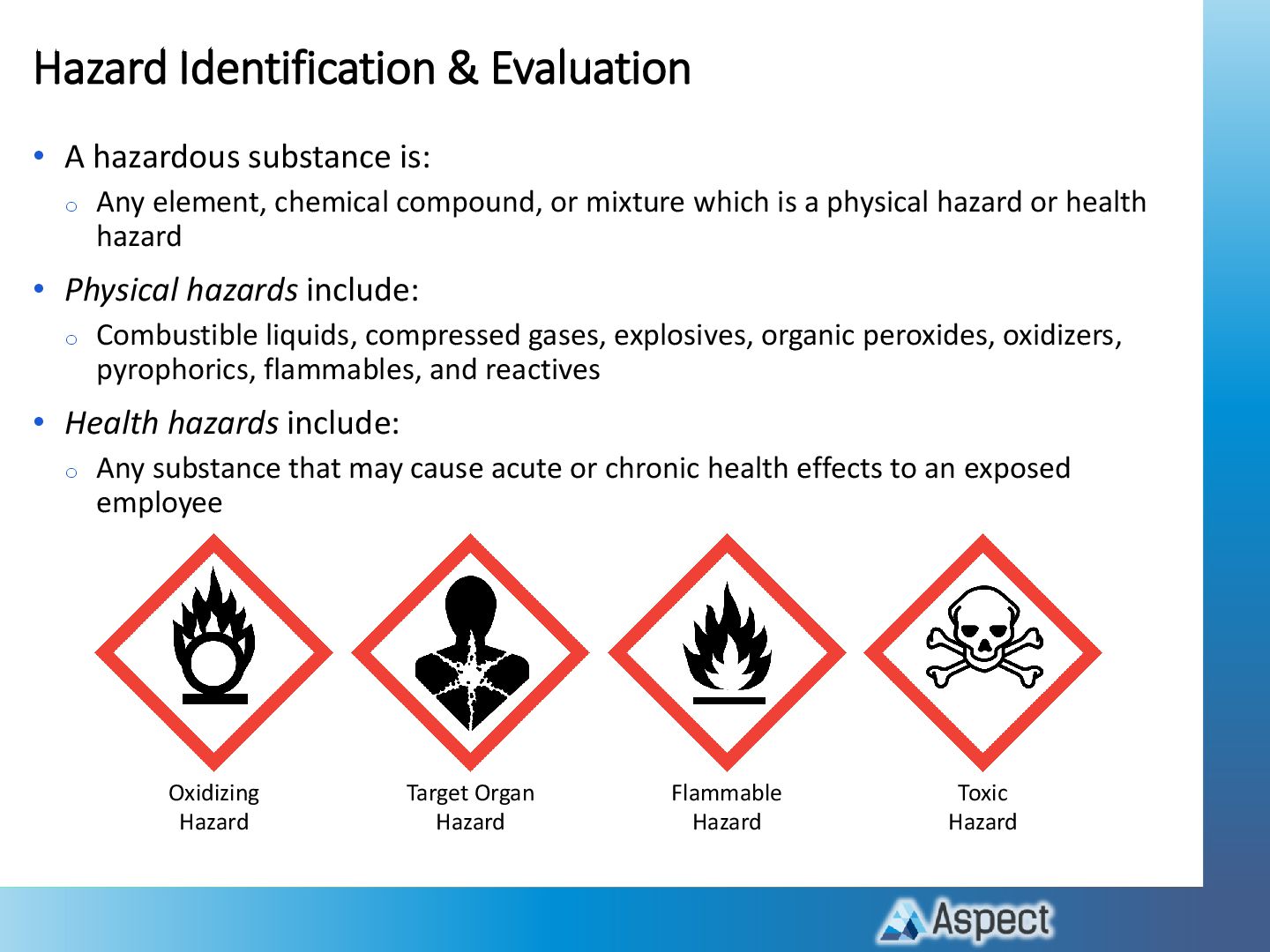
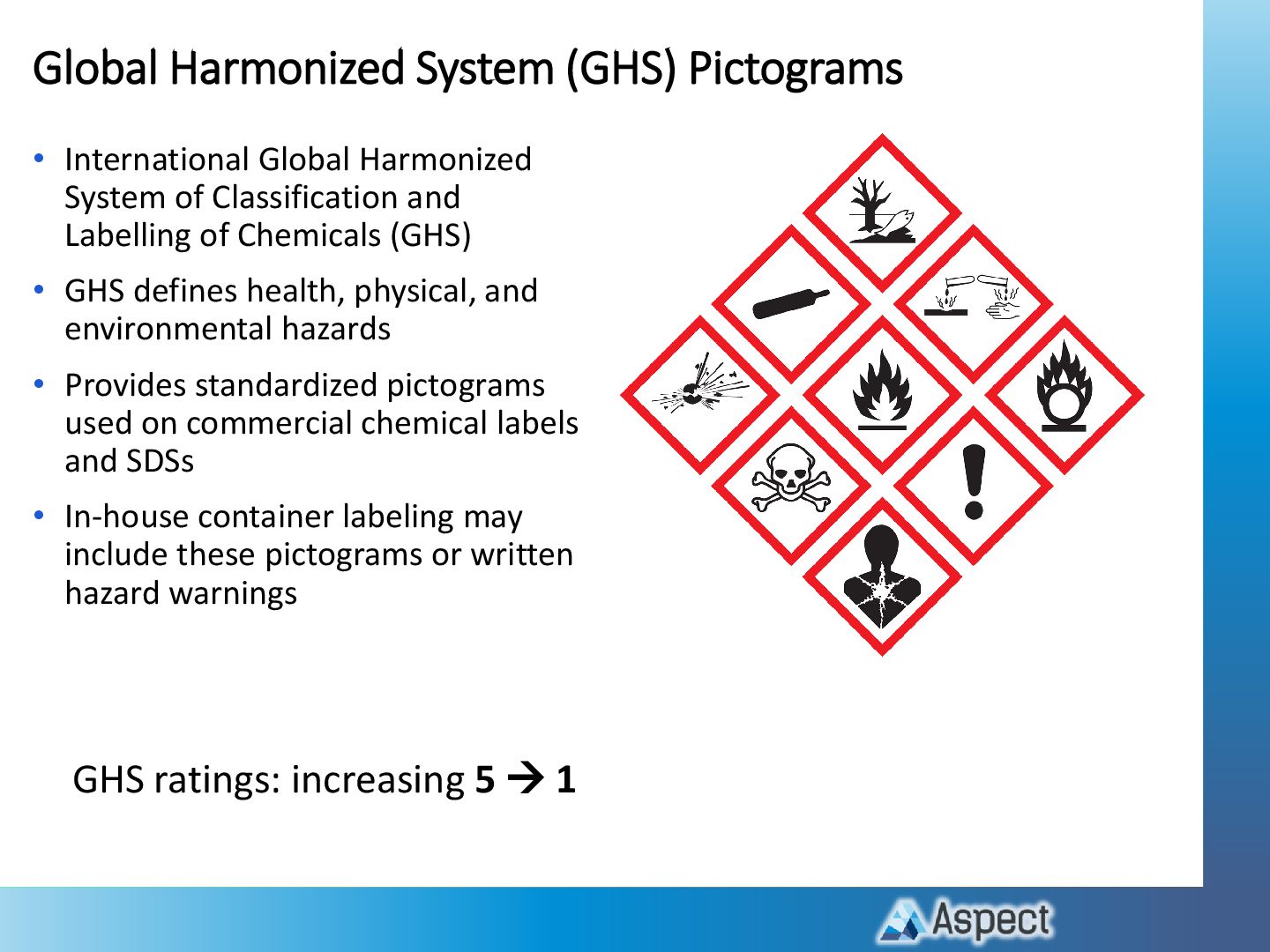
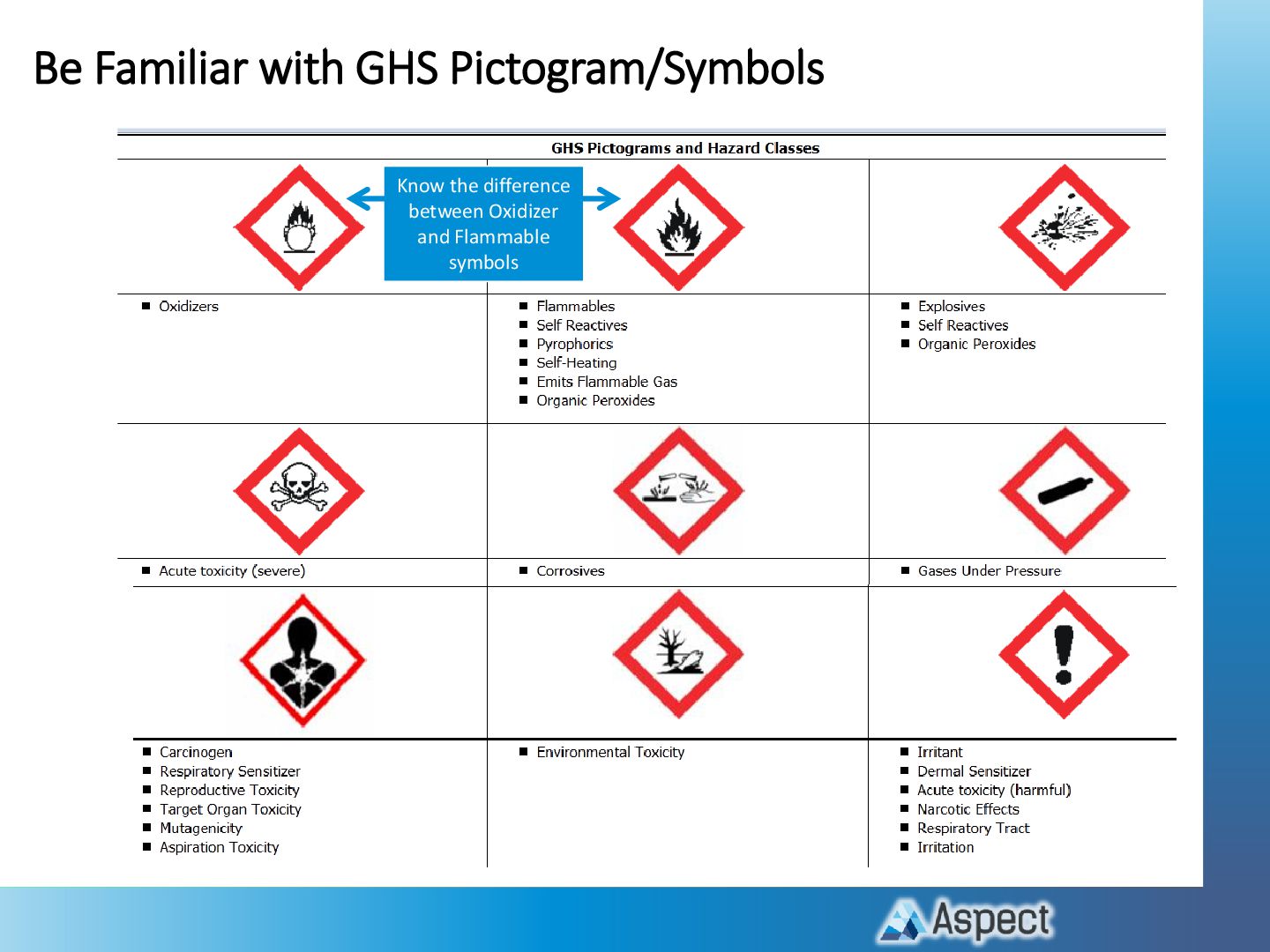
Any element, chemical compound, or mixture which is a physical hazard or health hazard • Physical hazards include: o Combustible liquids, compressed gases, explosives, organic peroxides, oxidizers, pyrophorics, flammables, and reactives • Health hazards include: o Any substance that may cause acute or chronic health effects to an exposed employee Oxidizing Hazard Target Organ Hazard Flammable Hazard Toxic Hazard
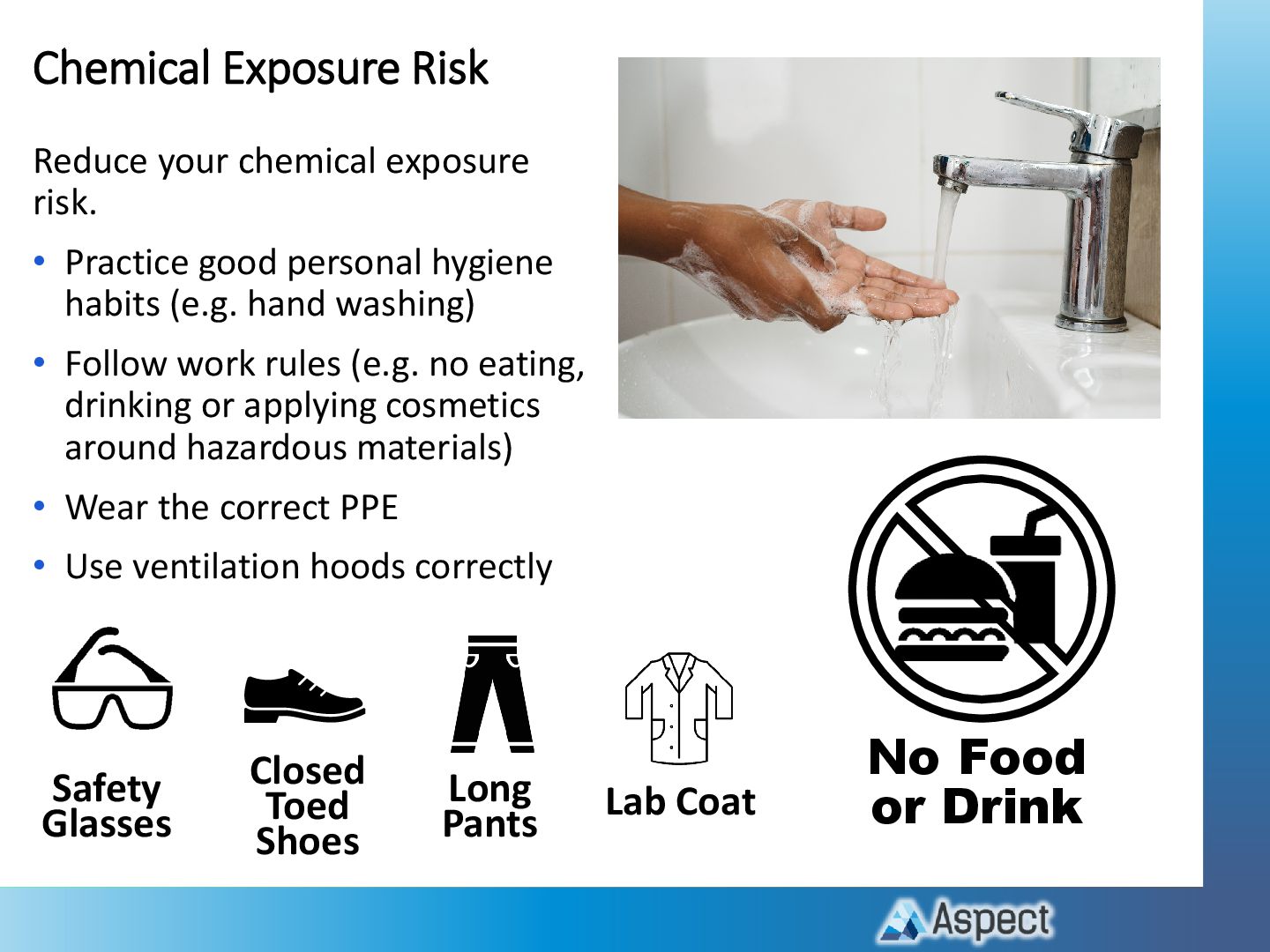
habits (e.g. hand washing) • Follow work rules (e.g. no eating, drinking or applying cosmetics around hazardous materials) • Wear the correct PPE • Use ventilation hoods correctly Chemical Exposure Risk No Food or Drink Long Pants Safety Glasses Closed Toed Shoes Lab Coat
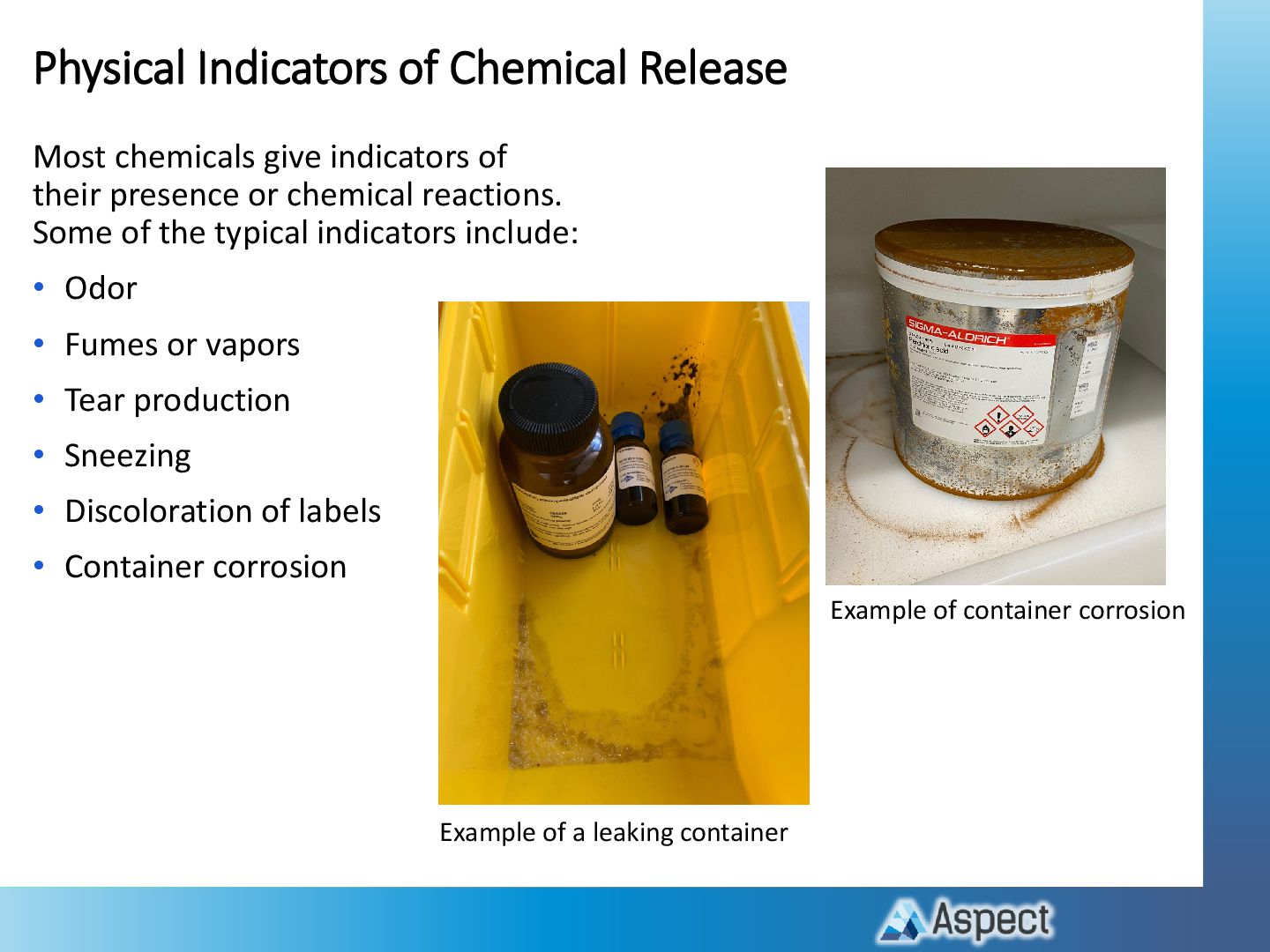
their presence or chemical reactions. Some of the typical indicators include: • Odor • Fumes or vapors • Tear production • Sneezing • Discoloration of labels • Container corrosion Example of container corrosion Example of a leaking container
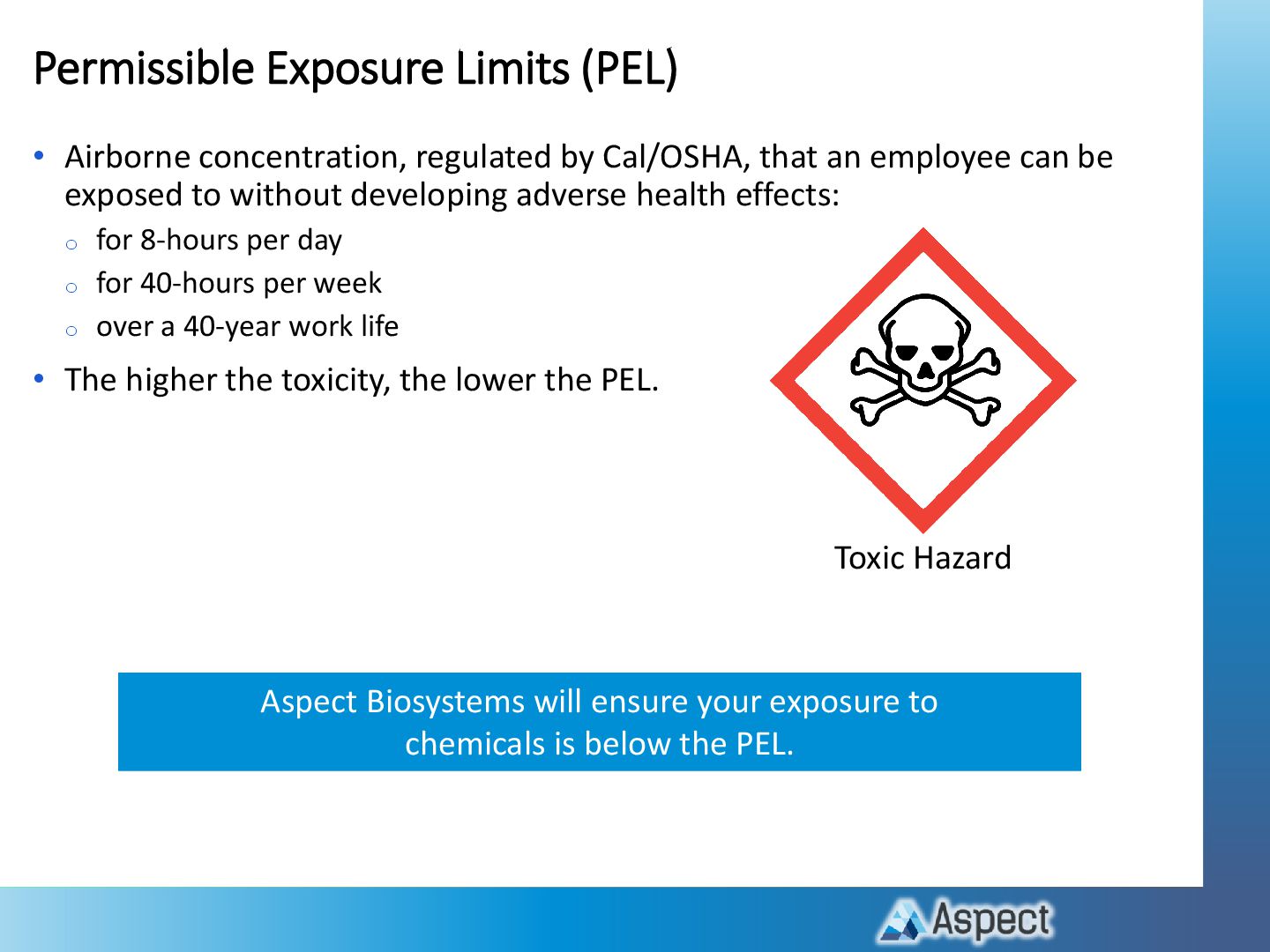
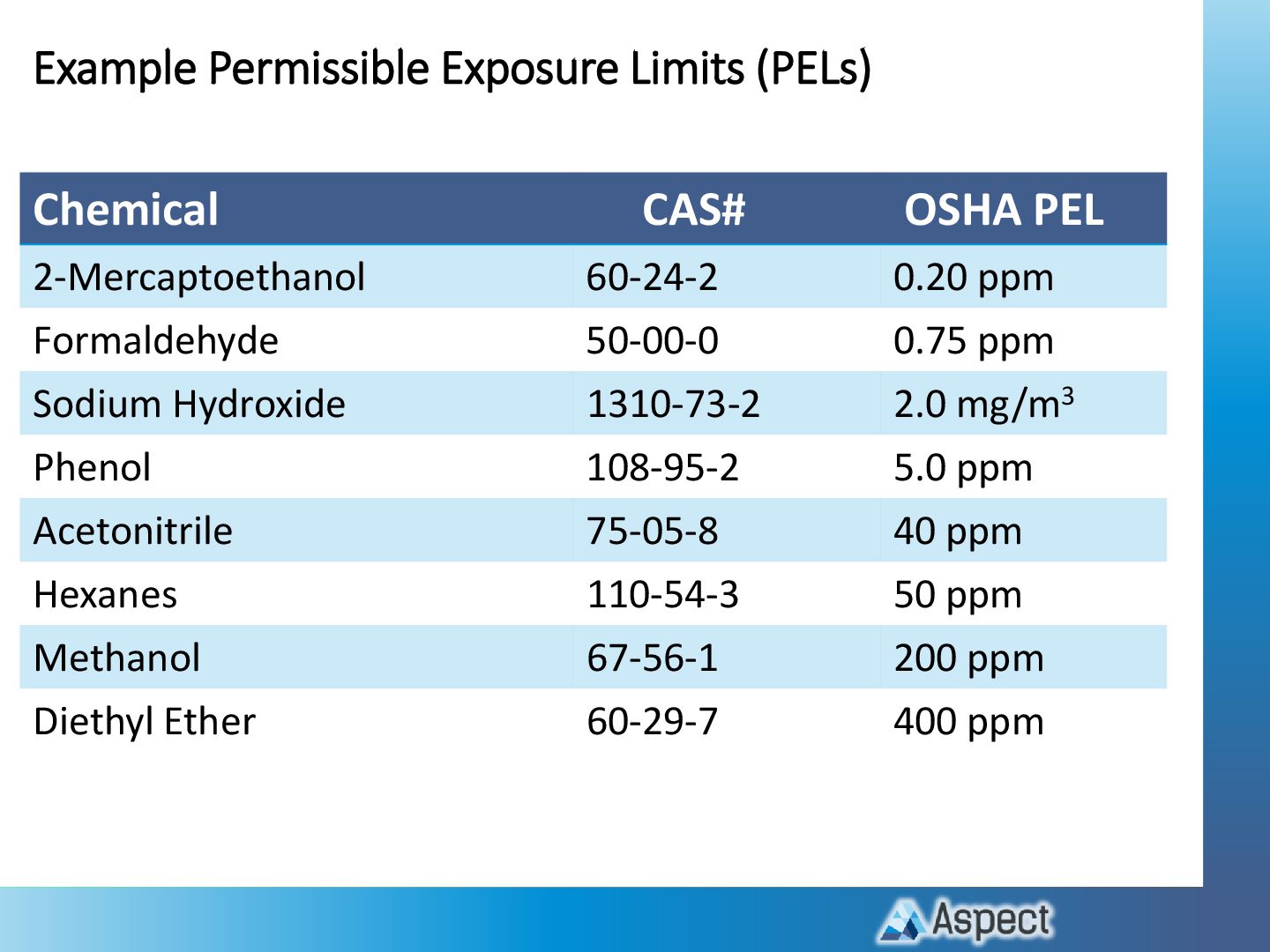
that an employee can be exposed to without developing adverse health effects: o for 8-hours per day o for 40-hours per week o over a 40-year work life • The higher the toxicity, the lower the PEL. Aspect Biosystems will ensure your exposure to chemicals is below the PEL. Toxic Hazard
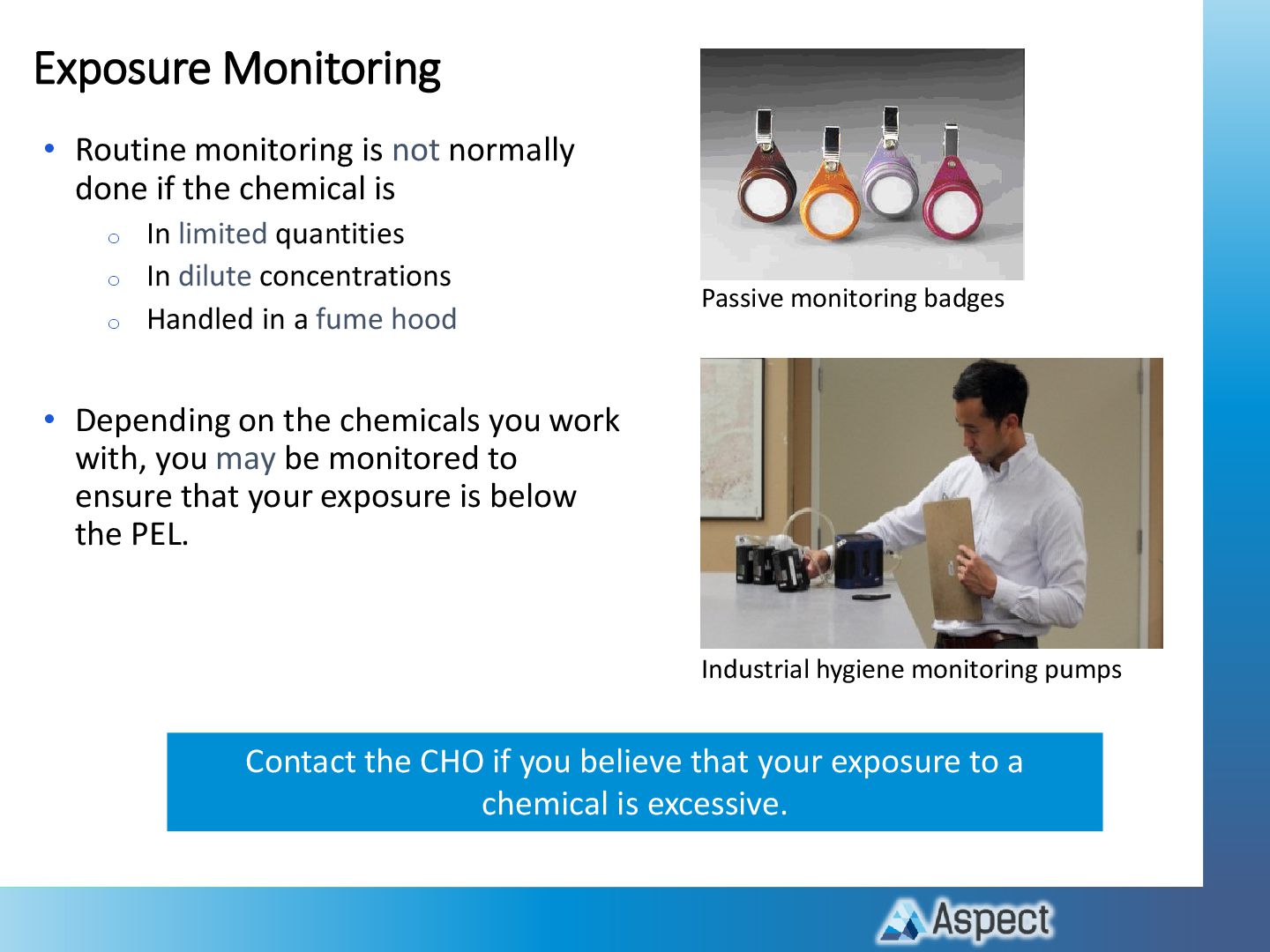
the chemical is o In limited quantities o In dilute concentrations o Handled in a fume hood • Depending on the chemicals you work with, you may be monitored to ensure that your exposure is below the PEL. Contact the CHO if you believe that your exposure to a chemical is excessive. Passive monitoring badges Industrial hygiene monitoring pumps
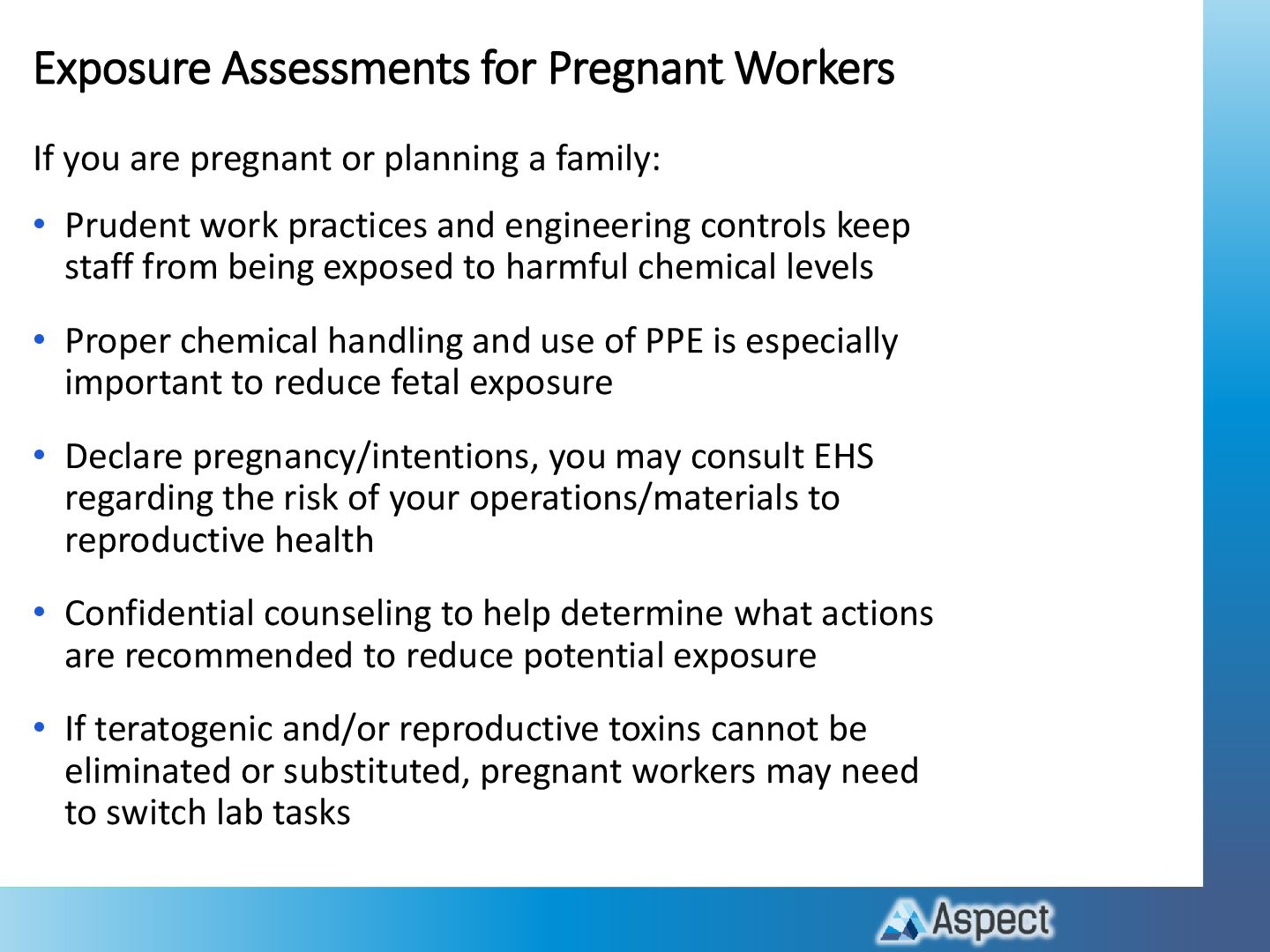
planning a family: • Prudent work practices and engineering controls keep staff from being exposed to harmful chemical levels • Proper chemical handling and use of PPE is especially important to reduce fetal exposure • Declare pregnancy/intentions, you may consult EHS regarding the risk of your operations/materials to reproductive health • Confidential counseling to help determine what actions are recommended to reduce potential exposure • If teratogenic and/or reproductive toxins cannot be eliminated or substituted, pregnant workers may need to switch lab tasks
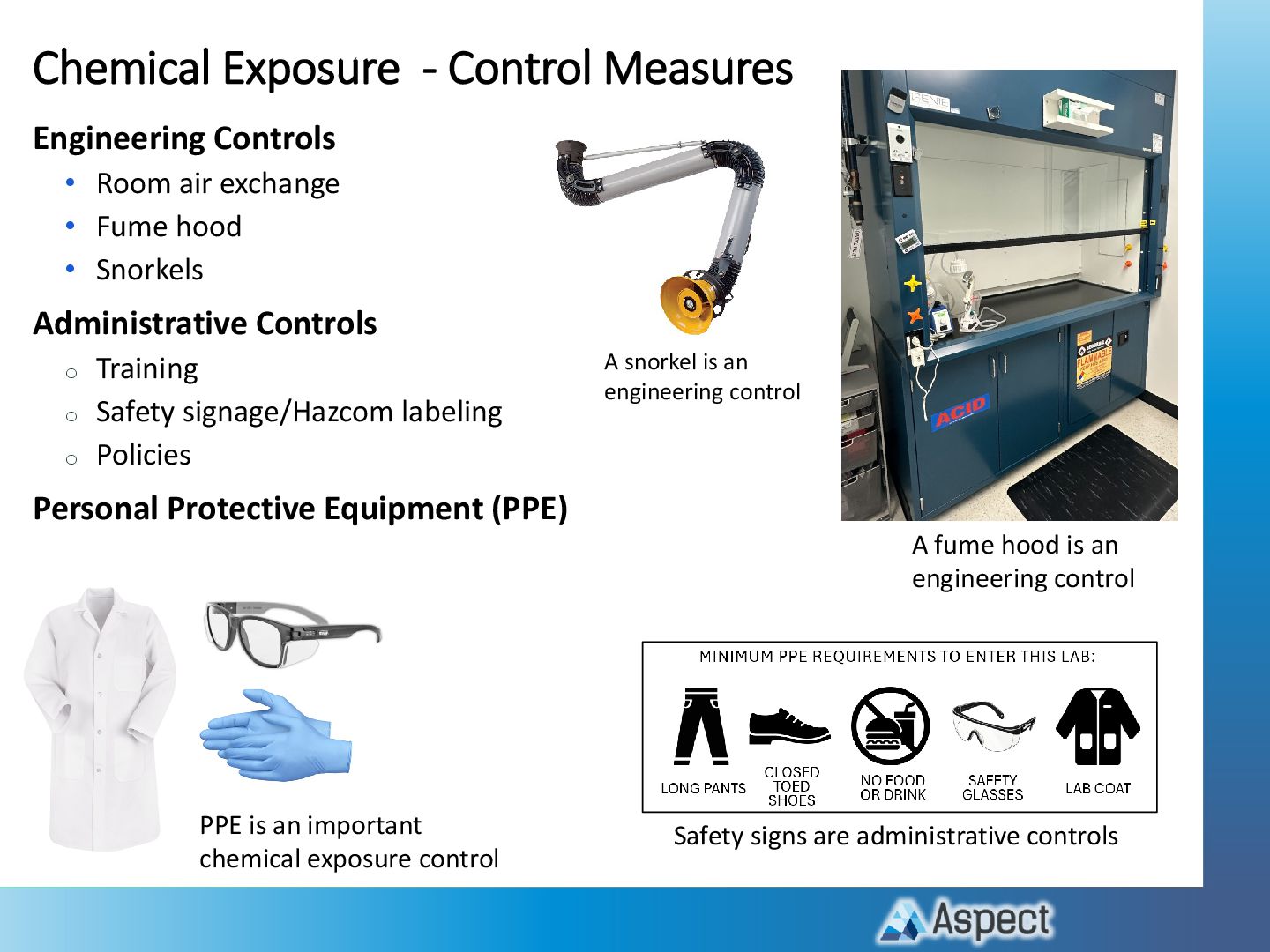
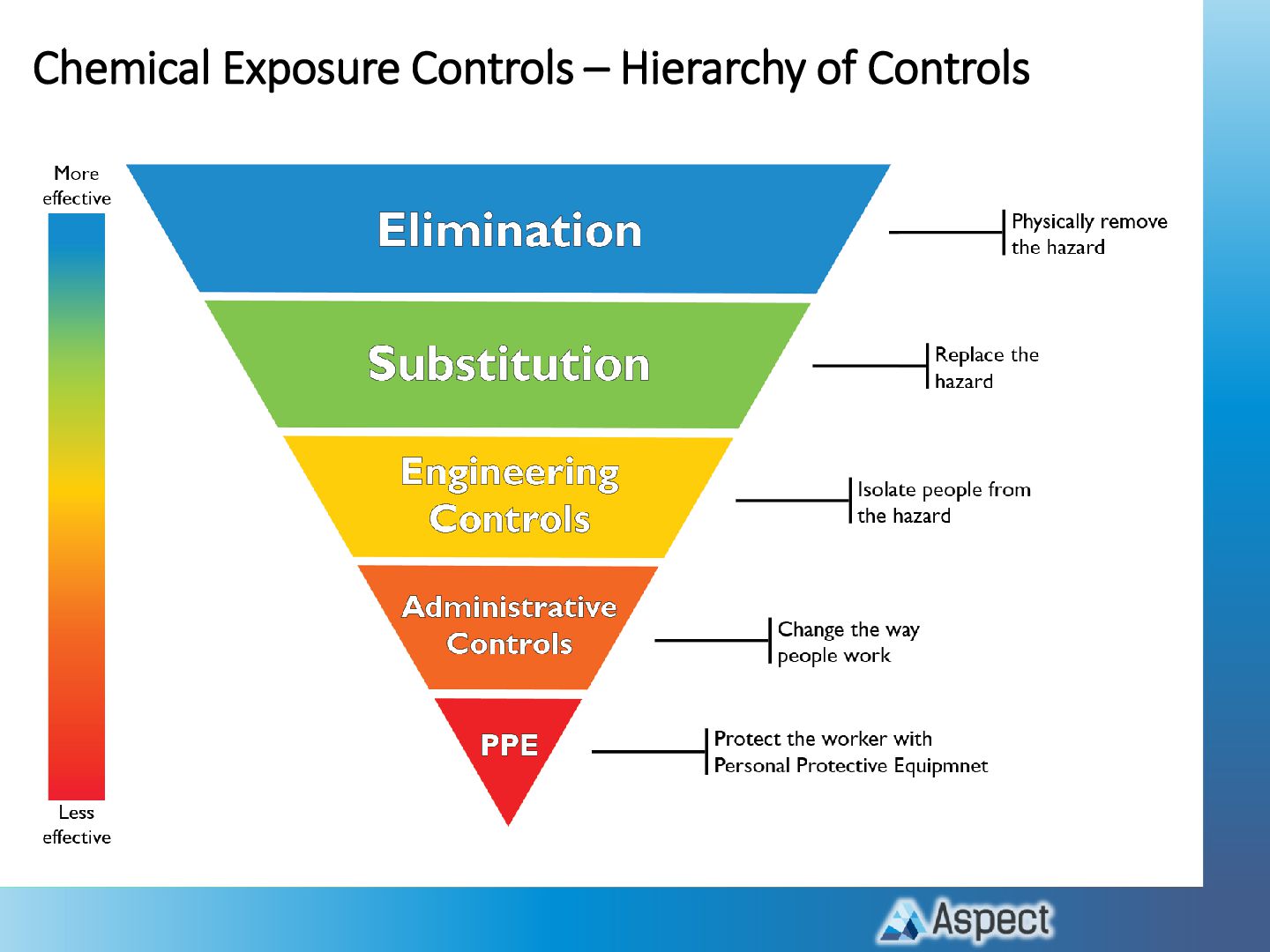
exchange • Fume hood • Snorkels Administrative Controls o Training o Safety signage/Hazcom labeling o Policies Personal Protective Equipment (PPE) A fume hood is an engineering control Safety signs are administrative controls PPE is an important chemical exposure control A snorkel is an engineering control
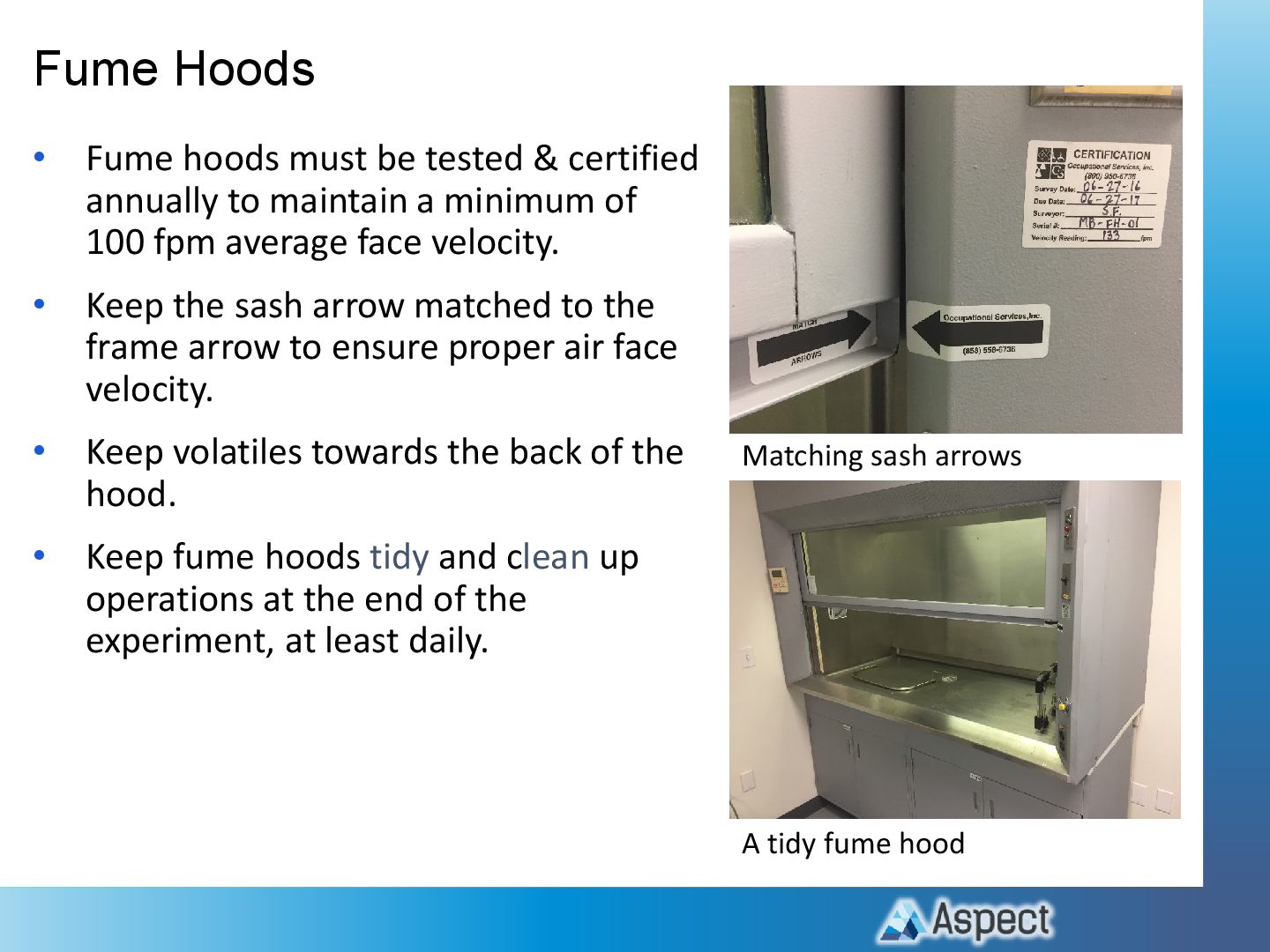
annually to maintain a minimum of 100 fpm average face velocity. • Keep the sash arrow matched to the frame arrow to ensure proper air face velocity. • Keep volatiles towards the back of the hood. • Keep fume hoods tidy and clean up operations at the end of the experiment, at least daily. Matching sash arrows A tidy fume hood
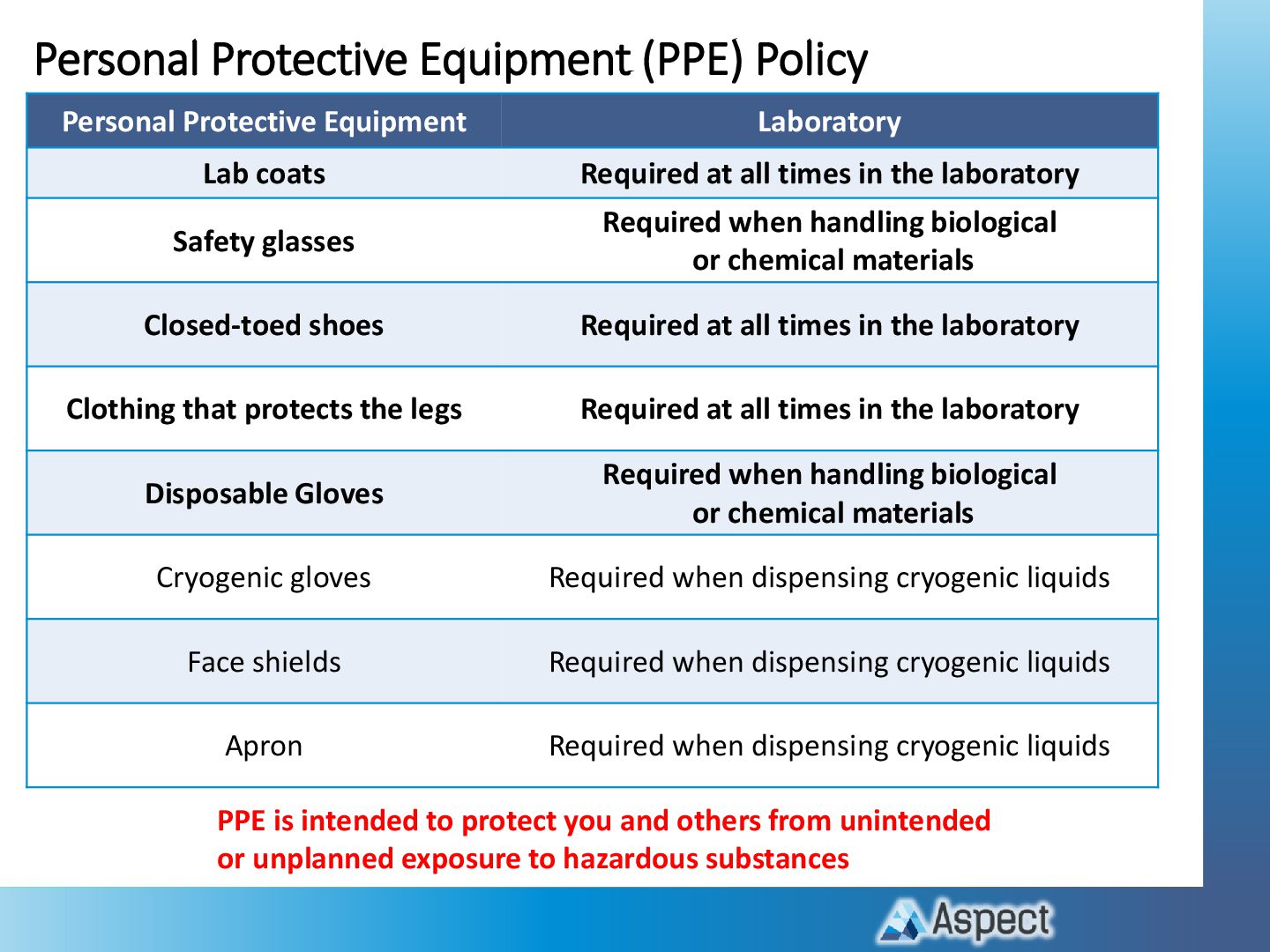
coats Required at all times in the laboratory Safety glasses Required when handling biological or chemical materials Closed-toed shoes Required at all times in the laboratory Clothing that protects the legs Required at all times in the laboratory Disposable Gloves Required when handling biological or chemical materials Cryogenic gloves Required when dispensing cryogenic liquids Face shields Required when dispensing cryogenic liquids Apron Required when dispensing cryogenic liquids PPE is intended to protect you and others from unintended or unplanned exposure to hazardous substances
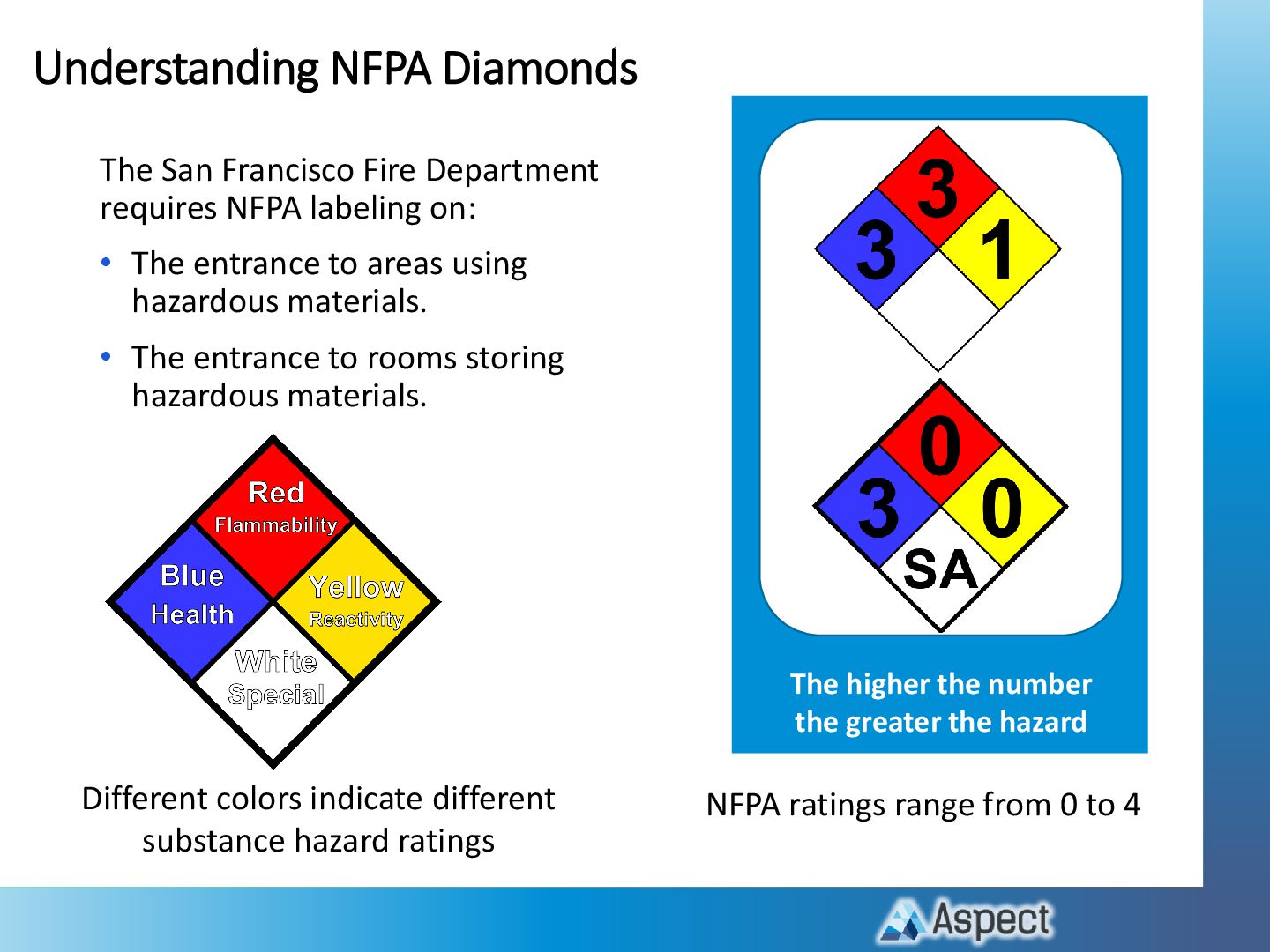
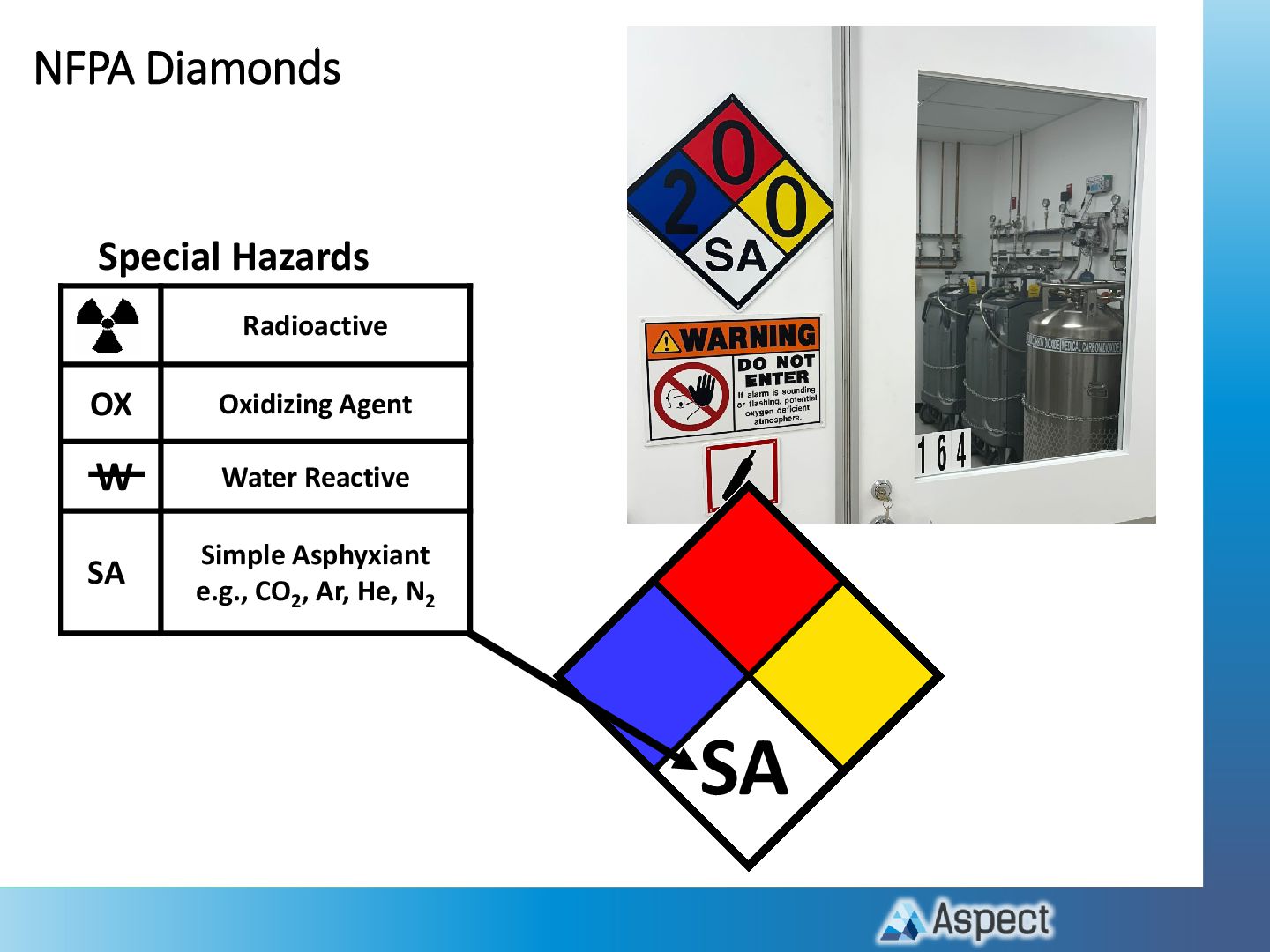
The entrance to areas using hazardous materials. • The entrance to rooms storing hazardous materials. Understanding NFPA Diamonds The higher the number the greater the hazard NFPA ratings range from 0 to 4 Different colors indicate different substance hazard ratings
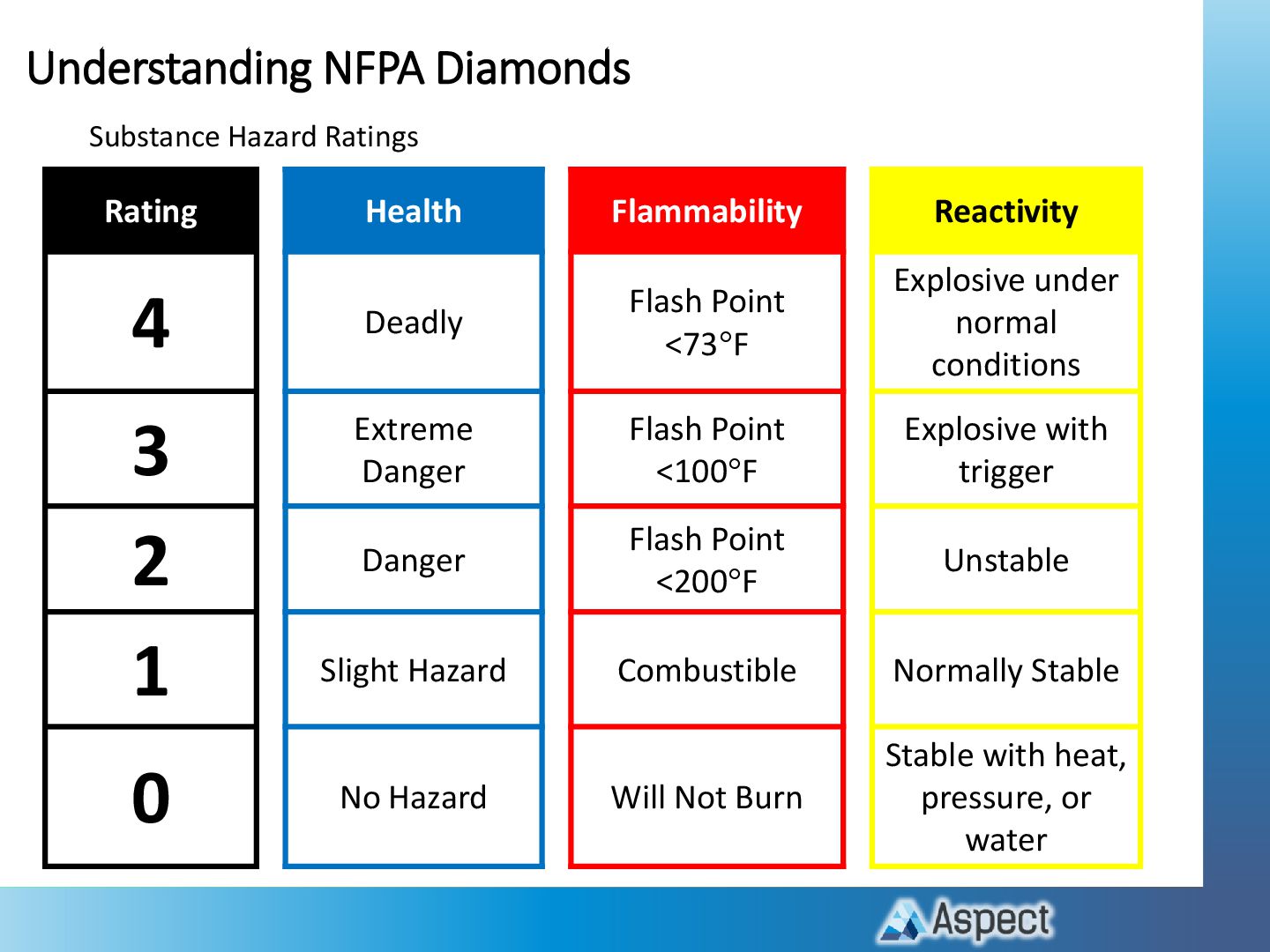
under normal conditions 3 Extreme Danger Flash Point <100°F Explosive with trigger 2 Danger Flash Point <200°F Unstable 1 Slight Hazard Combustible Normally Stable 0 No Hazard Will Not Burn Stable with heat, pressure, or water Understanding NFPA Diamonds Substance Hazard Ratings
Chemicals (GHS) • GHS defines health, physical, and environmental hazards • Provides standardized pictograms used on commercial chemical labels and SDSs • In-house container labeling may include these pictograms or written hazard warnings Global Harmonized System (GHS) Pictograms GHS ratings: increasing 5 1
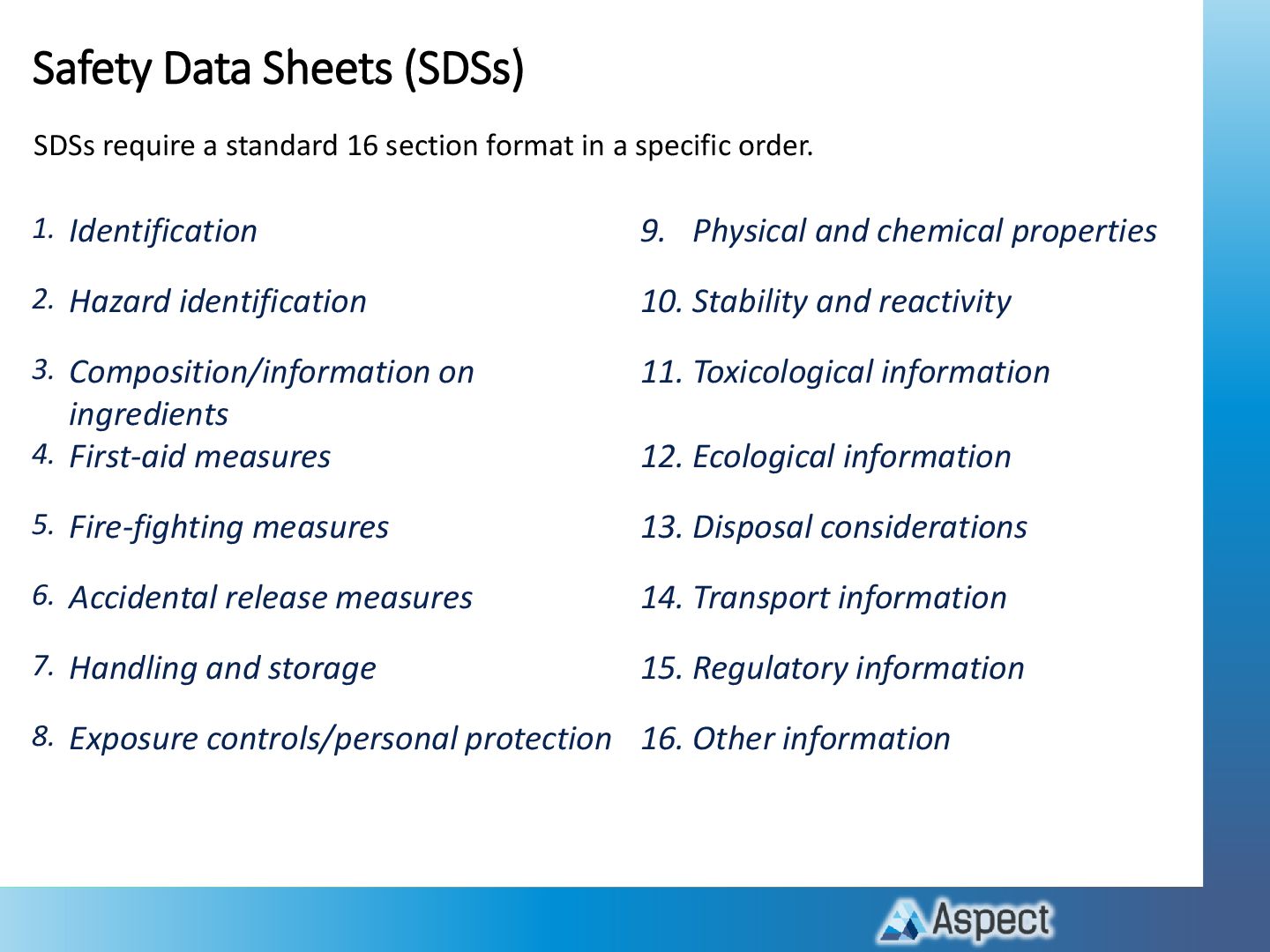
format in a specific order. 1. Identification 9. Physical and chemical properties 2. Hazard identification 10. Stability and reactivity 3. Composition/information on ingredients 11. Toxicological information 4. First-aid measures 12. Ecological information 5. Fire-fighting measures 13. Disposal considerations 6. Accidental release measures 14. Transport information 7. Handling and storage 15. Regulatory information 8. Exposure controls/personal protection 16. Other information
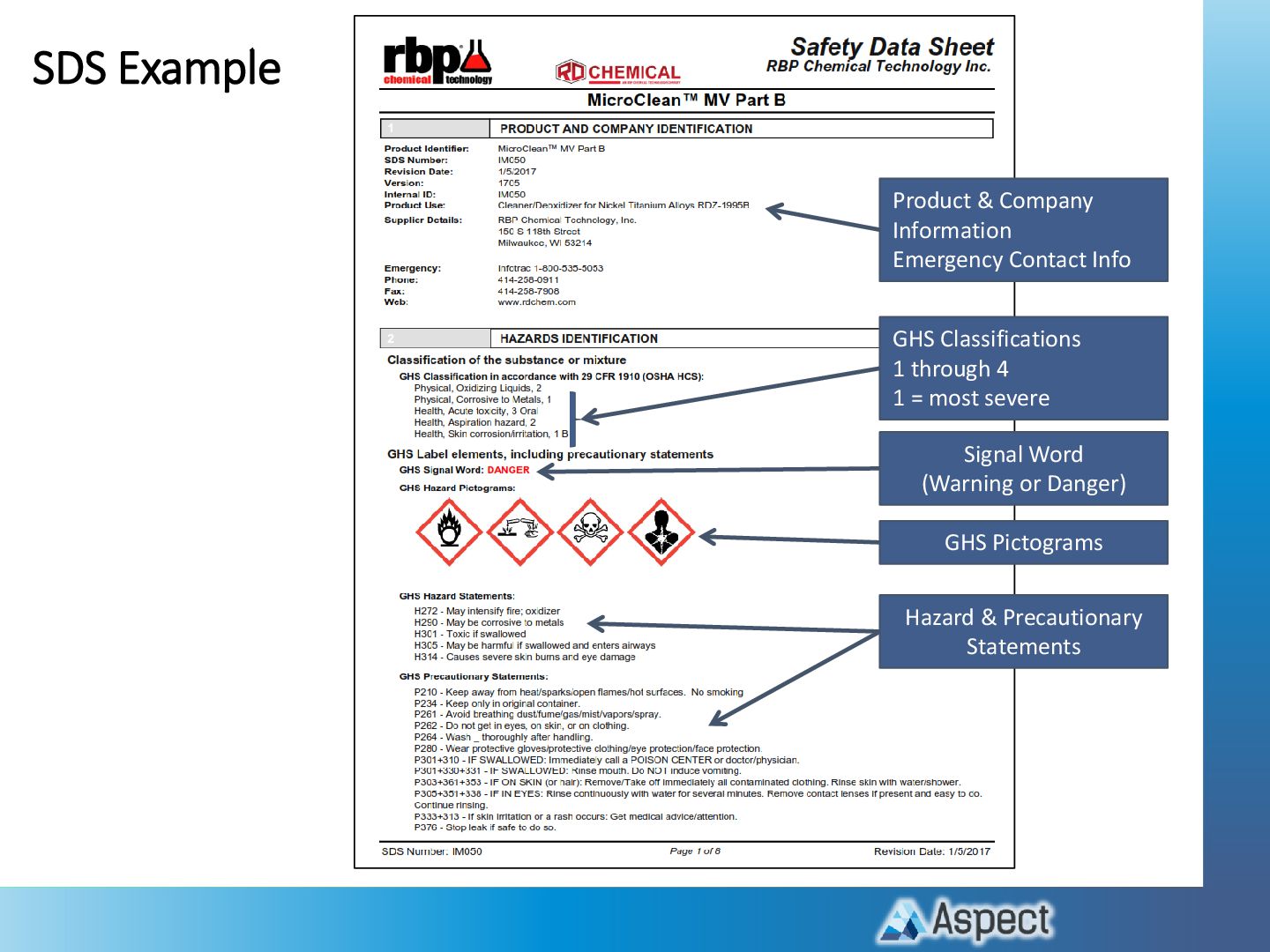
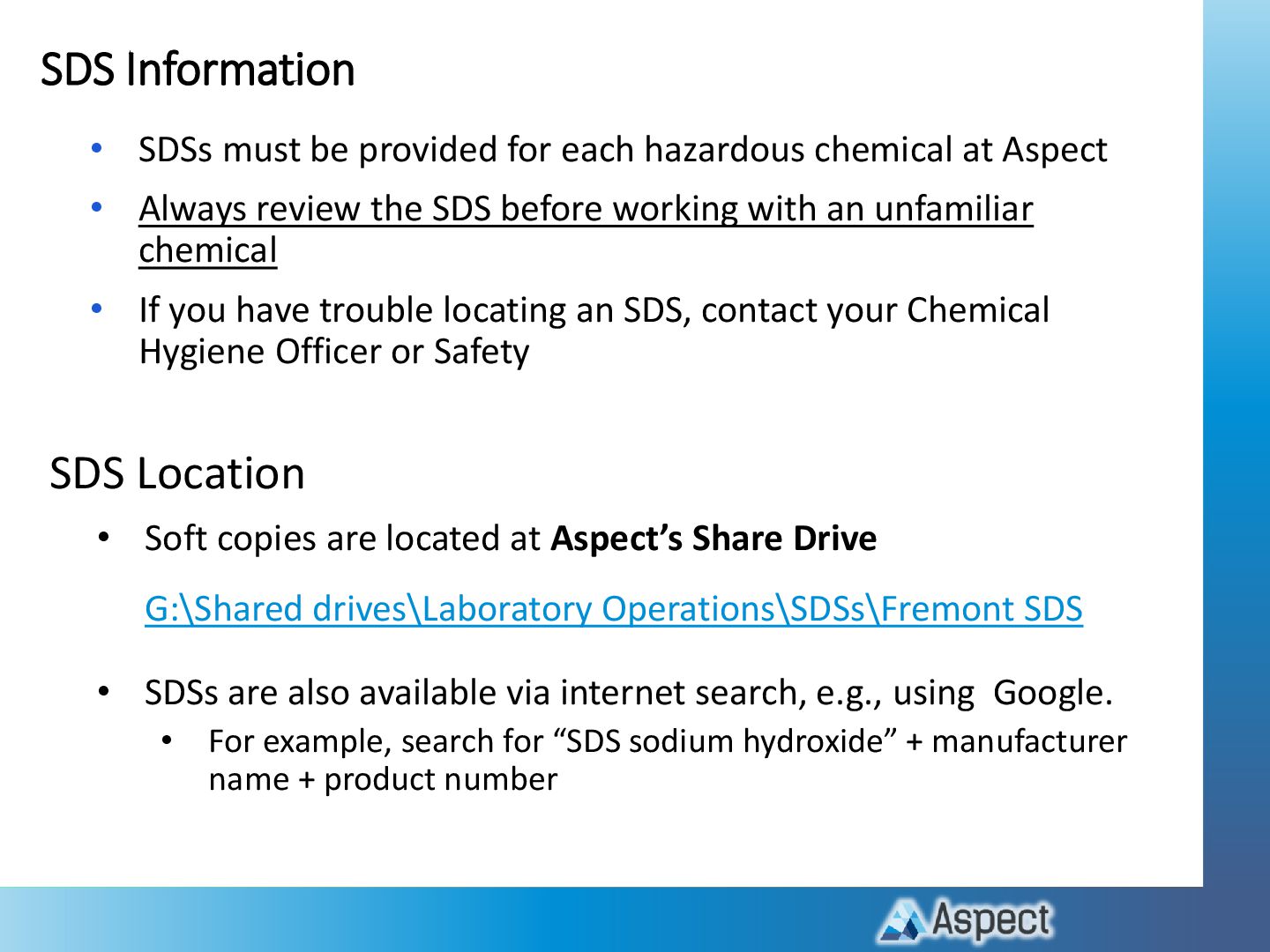
chemical at Aspect • Always review the SDS before working with an unfamiliar chemical • If you have trouble locating an SDS, contact your Chemical Hygiene Officer or Safety SDS Location • Soft copies are located at Aspect’s Share Drive G:\Shared drives\Laboratory Operations\SDSs\Fremont SDS • SDSs are also available via internet search, e.g., using Google. • For example, search for “SDS sodium hydroxide” + manufacturer name + product number
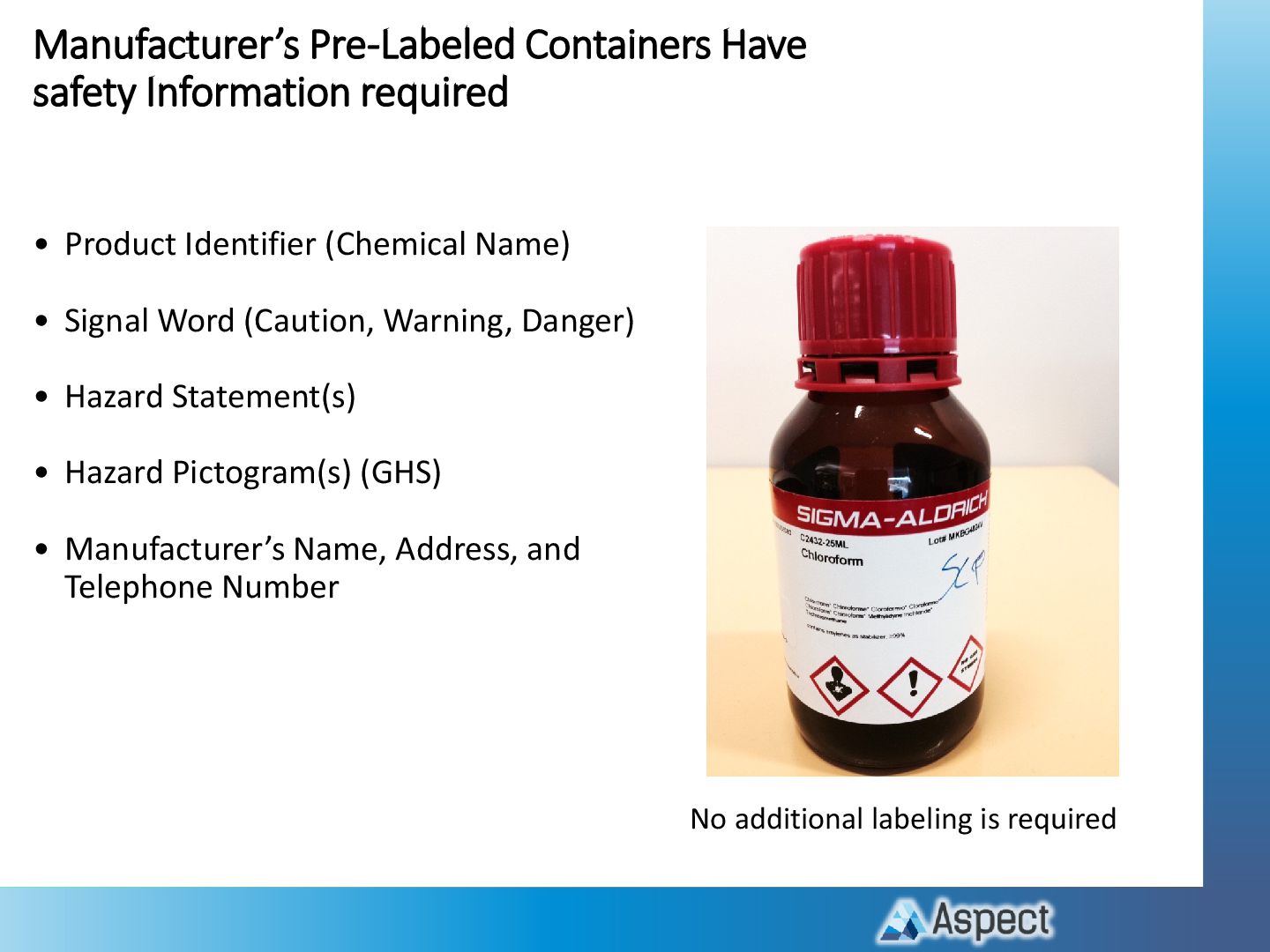
(Chemical Name) • Signal Word (Caution, Warning, Danger) • Hazard Statement(s) • Hazard Pictogram(s) (GHS) • Manufacturer’s Name, Address, and Telephone Number No additional labeling is required
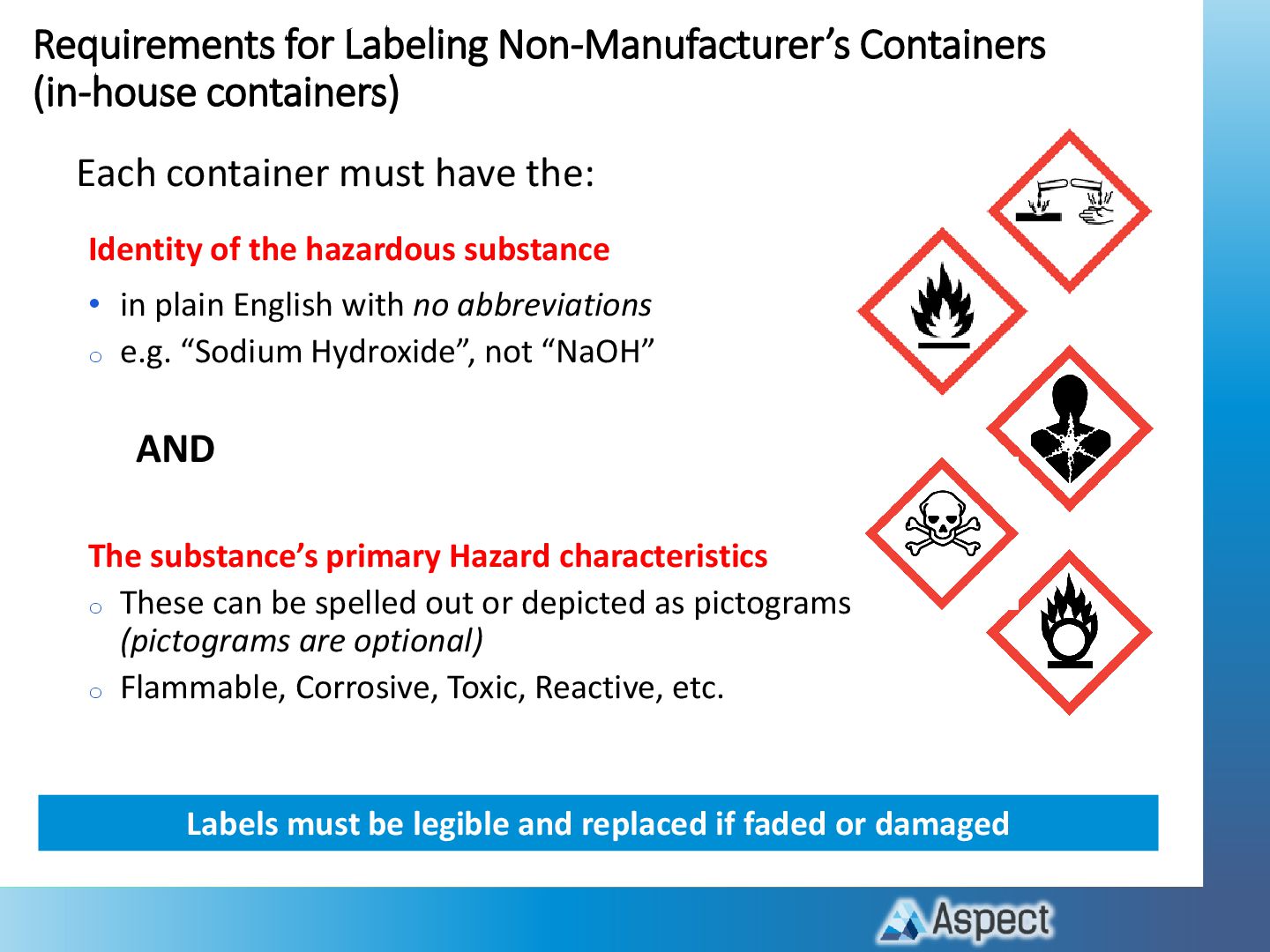
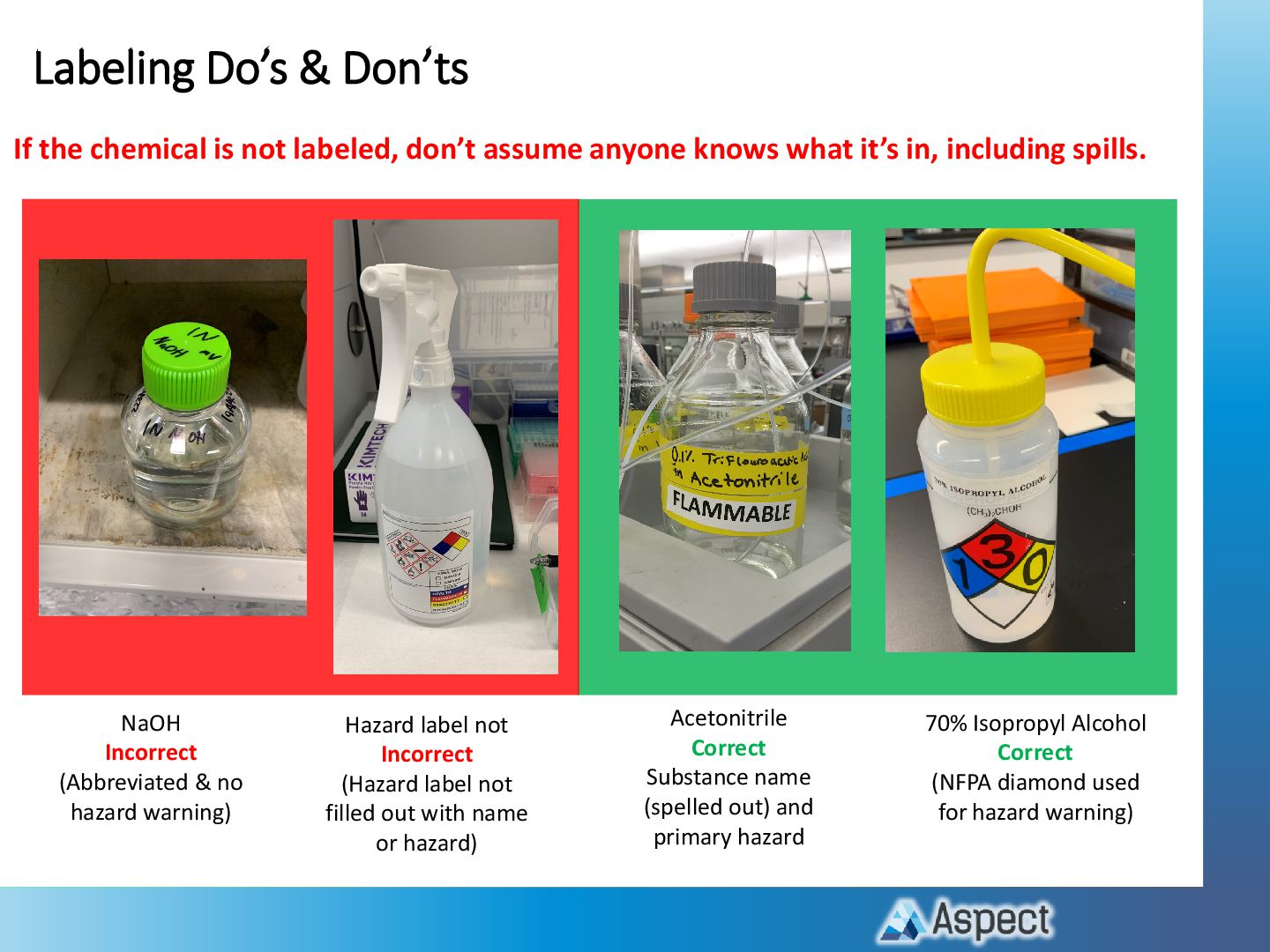
Requirements for Labeling Non-Manufacturer’s Containers (in-house containers) Identity of the hazardous substance • in plain English with no abbreviations o e.g. “Sodium Hydroxide”, not “NaOH” AND The substance’s primary Hazard characteristics o These can be spelled out or depicted as pictograms (pictograms are optional) o Flammable, Corrosive, Toxic, Reactive, etc. Each container must have the:
not filled out with name or hazard) Acetonitrile Correct Substance name (spelled out) and primary hazard NaOH Incorrect (Abbreviated & no hazard warning) 70% Isopropyl Alcohol Correct (NFPA diamond used for hazard warning) If the chemical is not labeled, don’t assume anyone knows what it’s in, including spills.
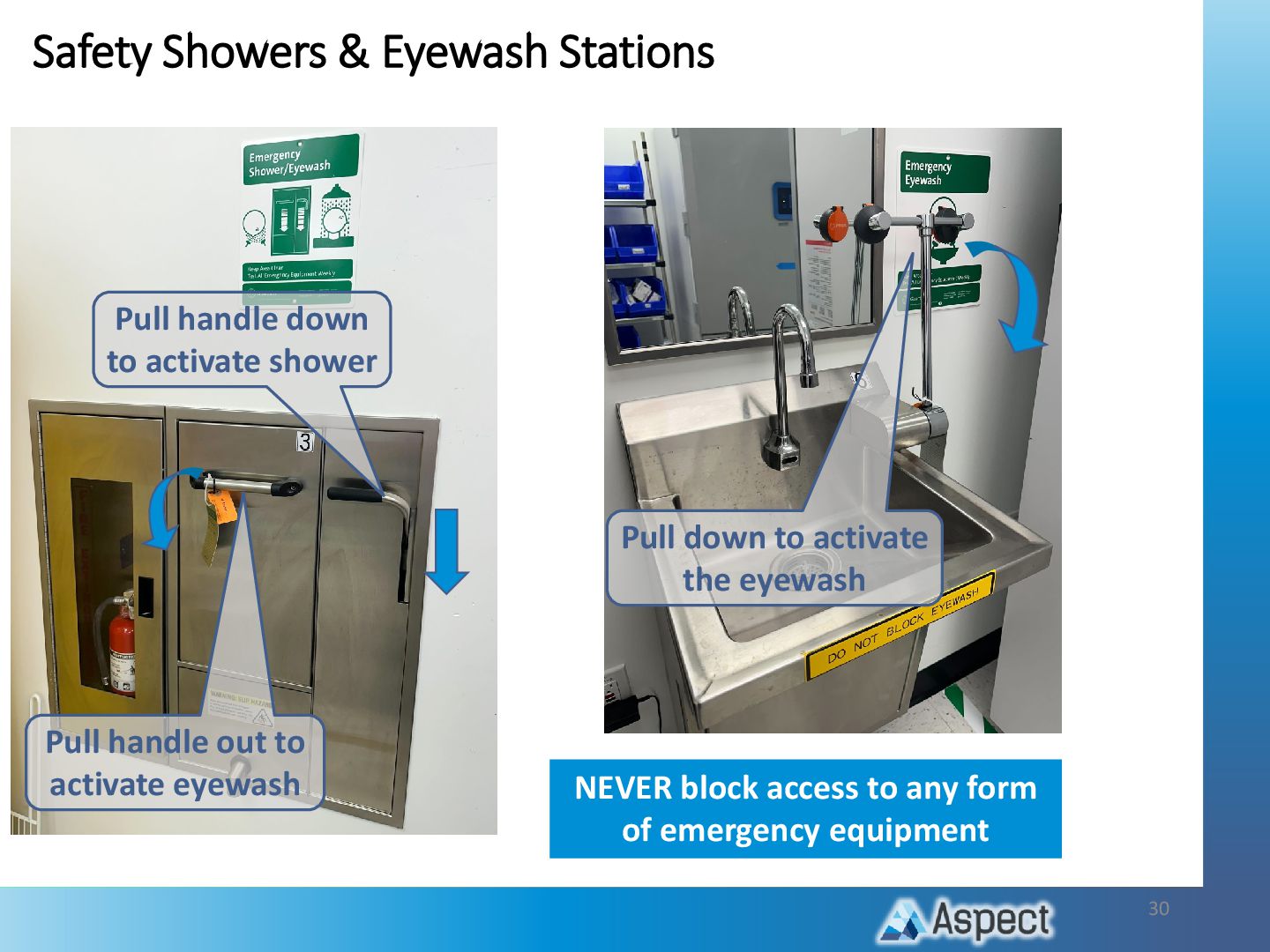
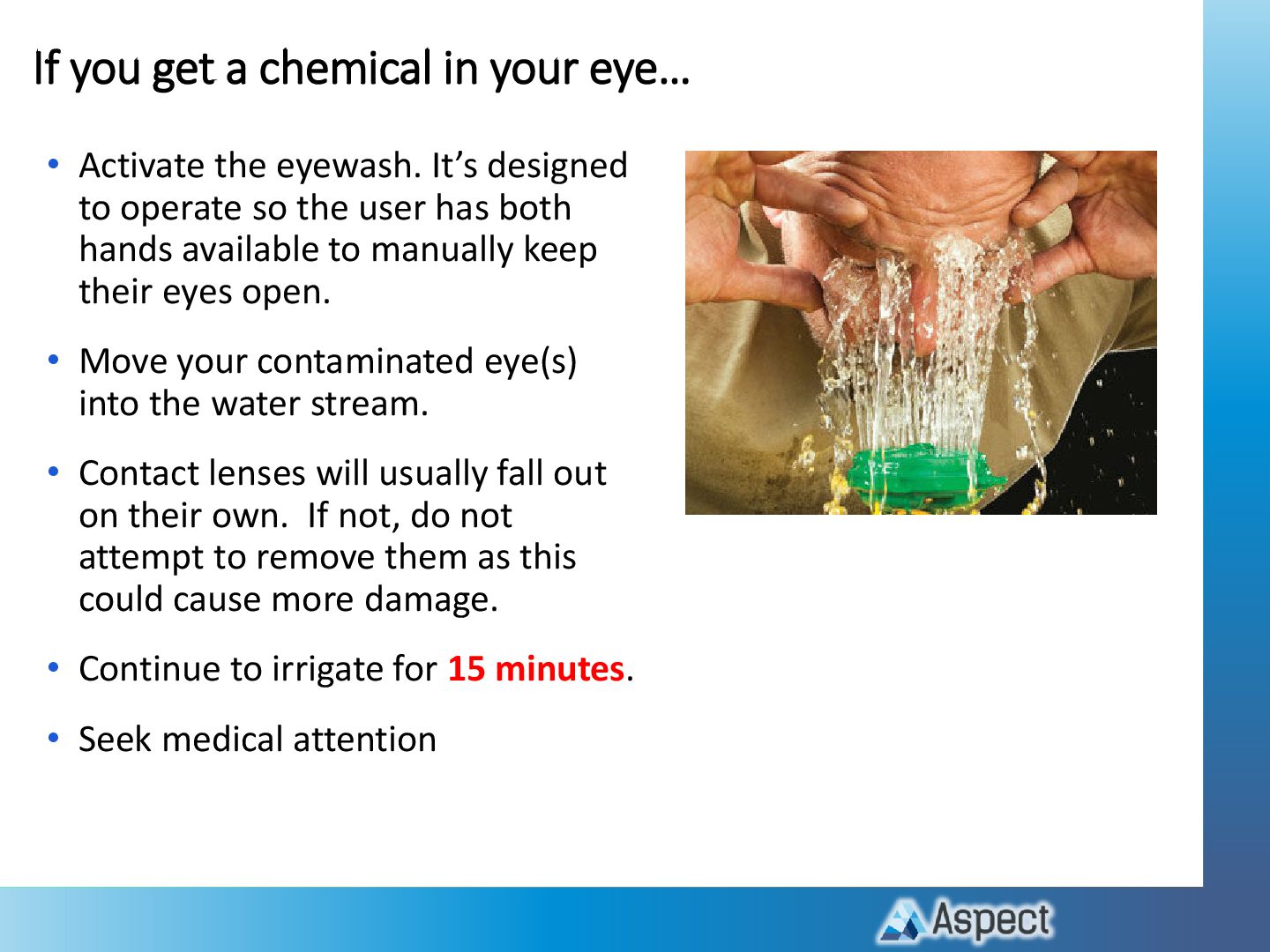
user has both hands available to manually keep their eyes open. • Move your contaminated eye(s) into the water stream. • Contact lenses will usually fall out on their own. If not, do not attempt to remove them as this could cause more damage. • Continue to irrigate for 15 minutes. • Seek medical attention If you get a chemical in your eye…
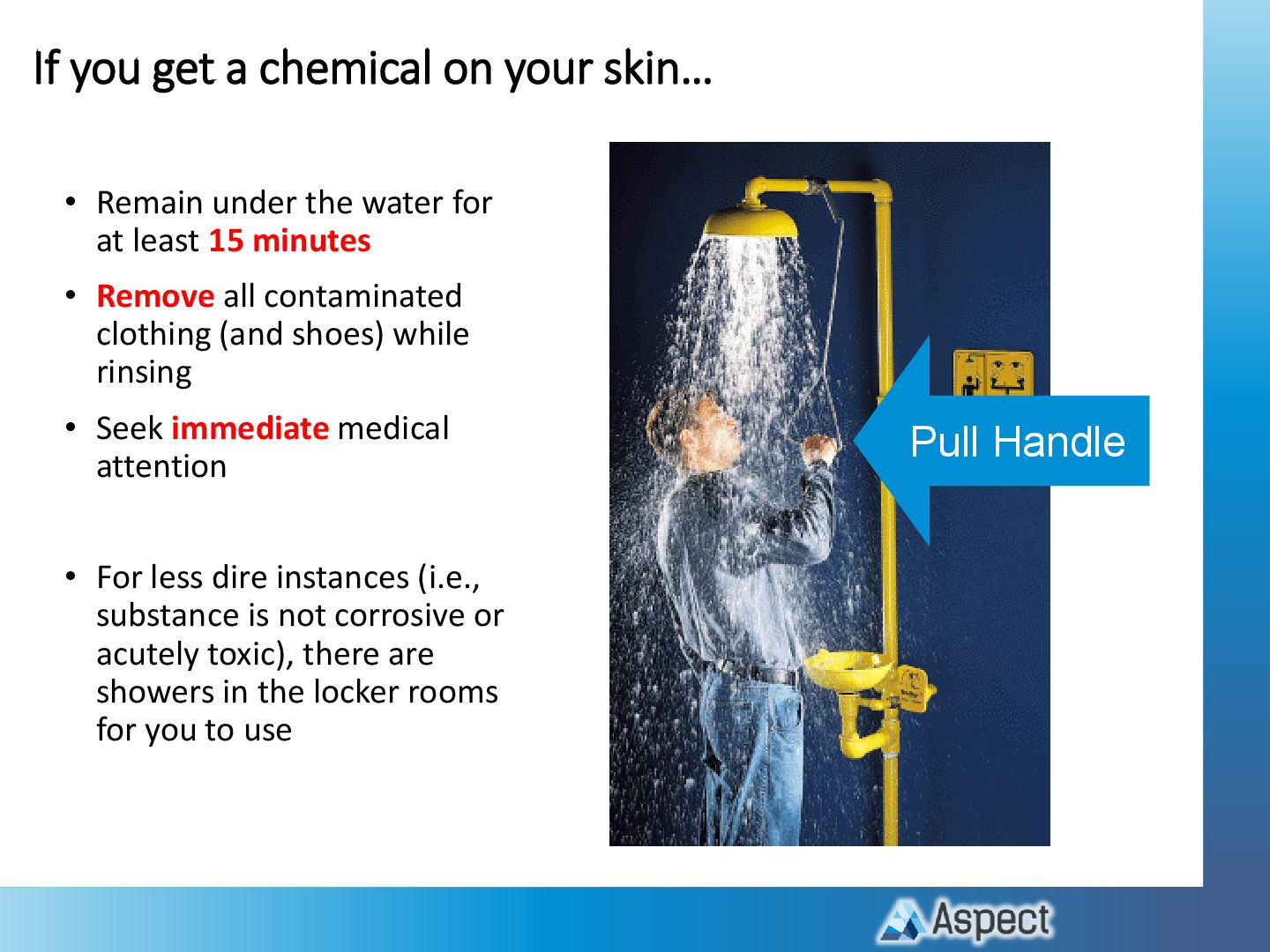
• Remain under the water for at least 15 minutes • Remove all contaminated clothing (and shoes) while rinsing • Seek immediate medical attention • For less dire instances (i.e., substance is not corrosive or acutely toxic), there are showers in the locker rooms for you to use
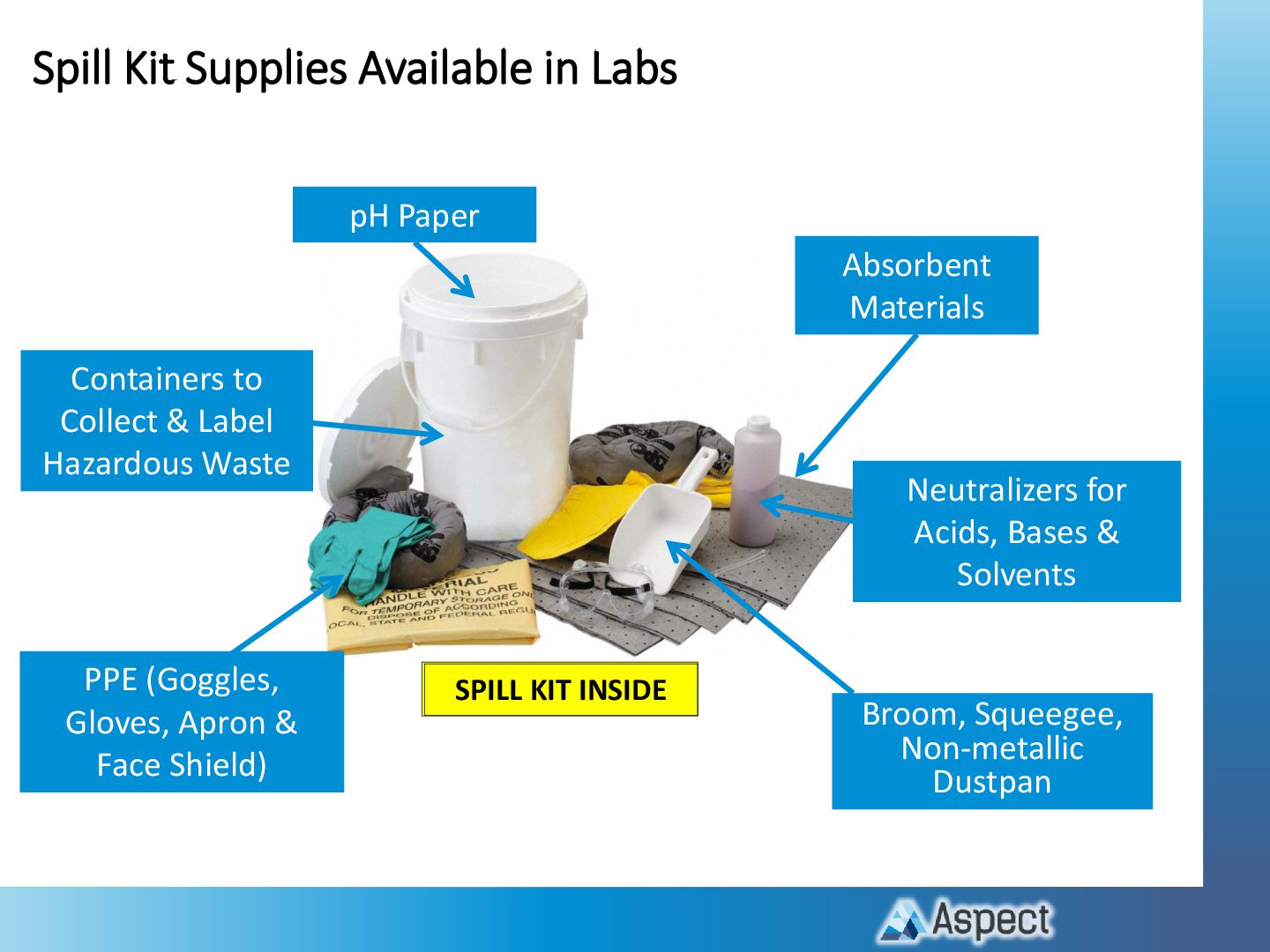
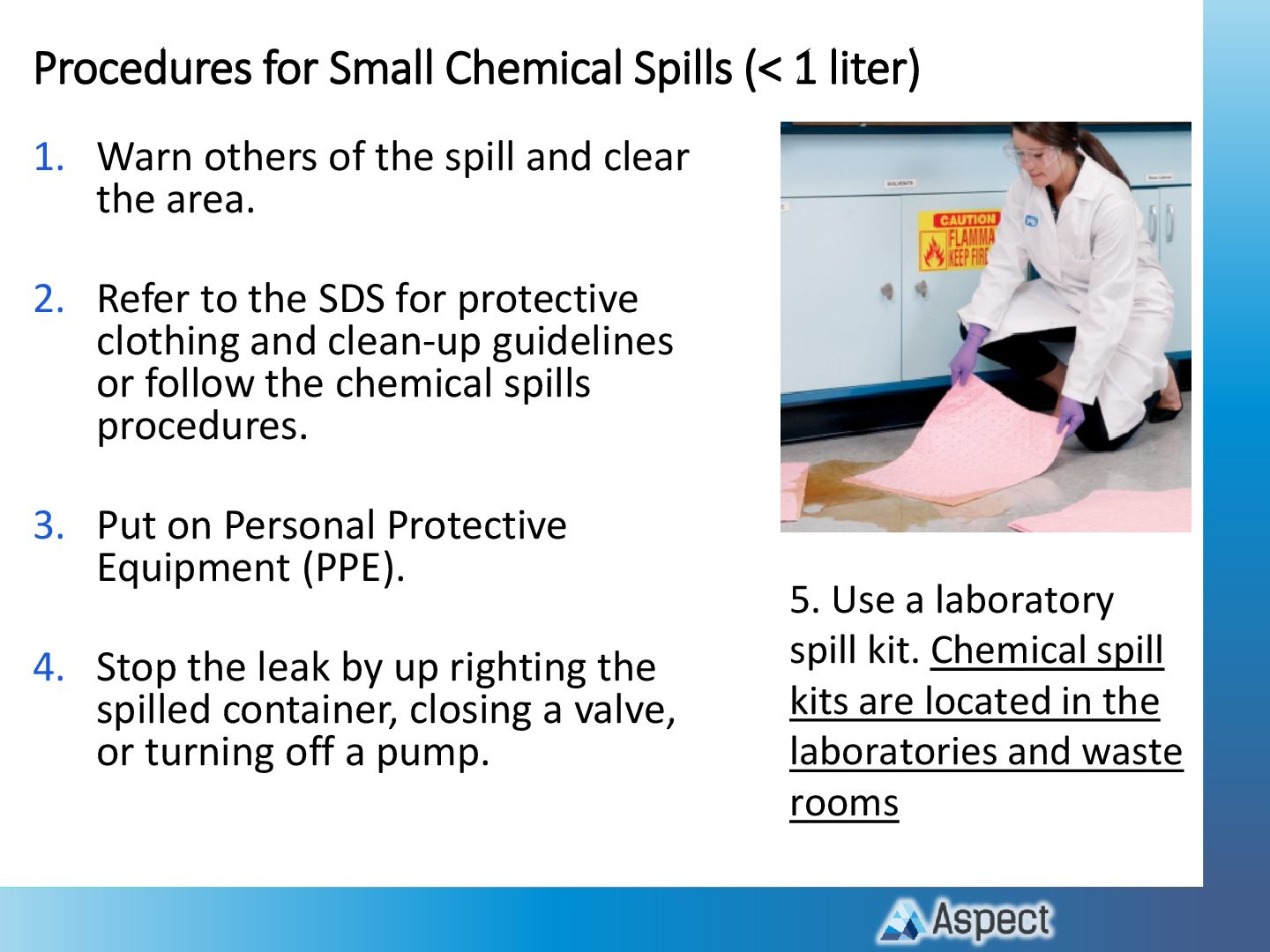
2. Refer to the SDS for protective clothing and clean-up guidelines or follow the chemical spills procedures. 3. Put on Personal Protective Equipment (PPE). 4. Stop the leak by up righting the spilled container, closing a valve, or turning off a pump. 5. Use a laboratory spill kit. Chemical spill kits are located in the laboratories and waste rooms Procedures for Small Chemical Spills (< 1 liter)
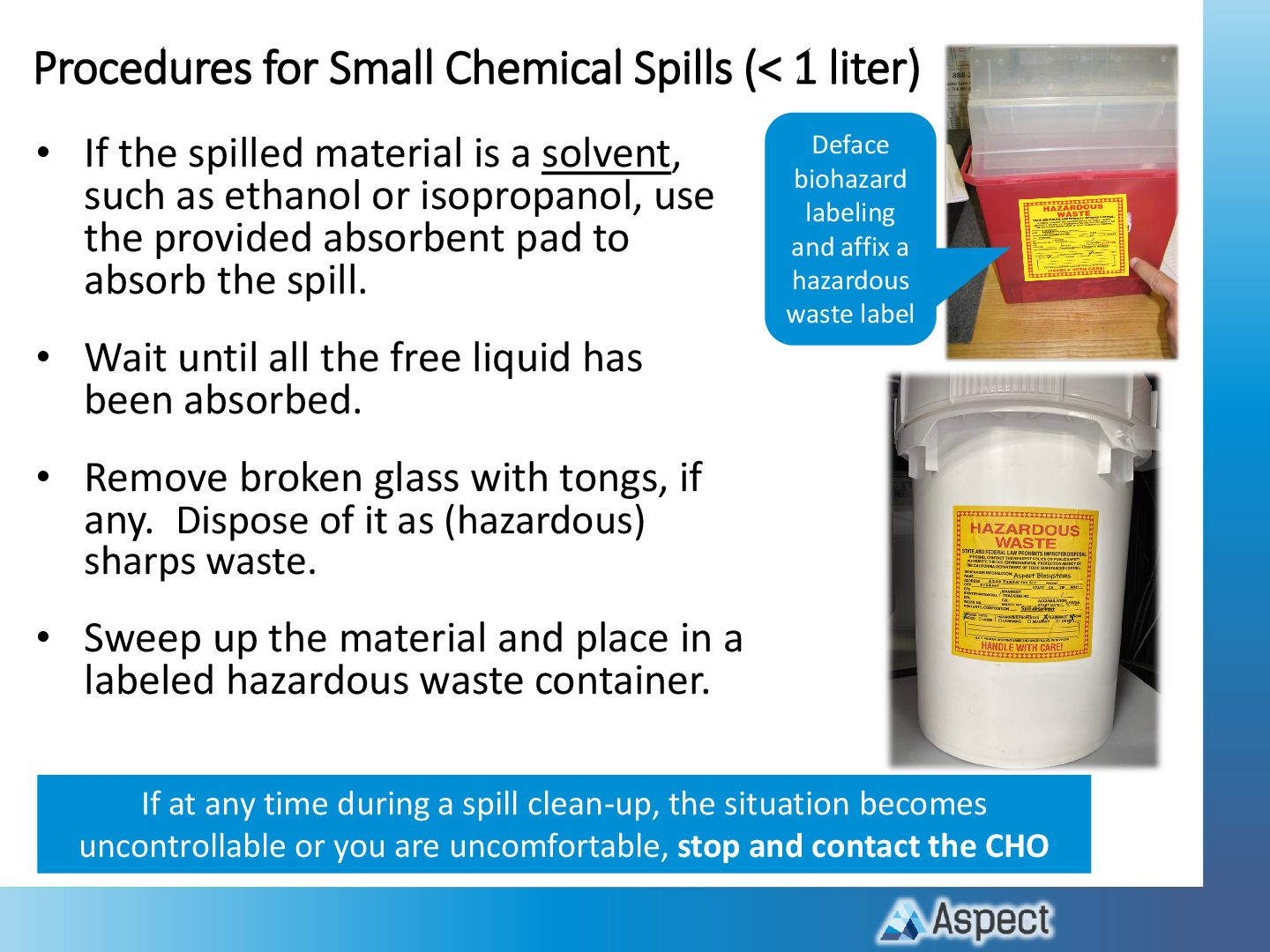
ethanol or isopropanol, use the provided absorbent pad to absorb the spill. • Wait until all the free liquid has been absorbed. • Remove broken glass with tongs, if any. Dispose of it as (hazardous) sharps waste. • Sweep up the material and place in a labeled hazardous waste container. If at any time during a spill clean-up, the situation becomes uncontrollable or you are uncomfortable, stop and contact the CHO Deface biohazard labeling and affix a hazardous waste label Procedures for Small Chemical Spills (< 1 liter) Aspect Biosystems
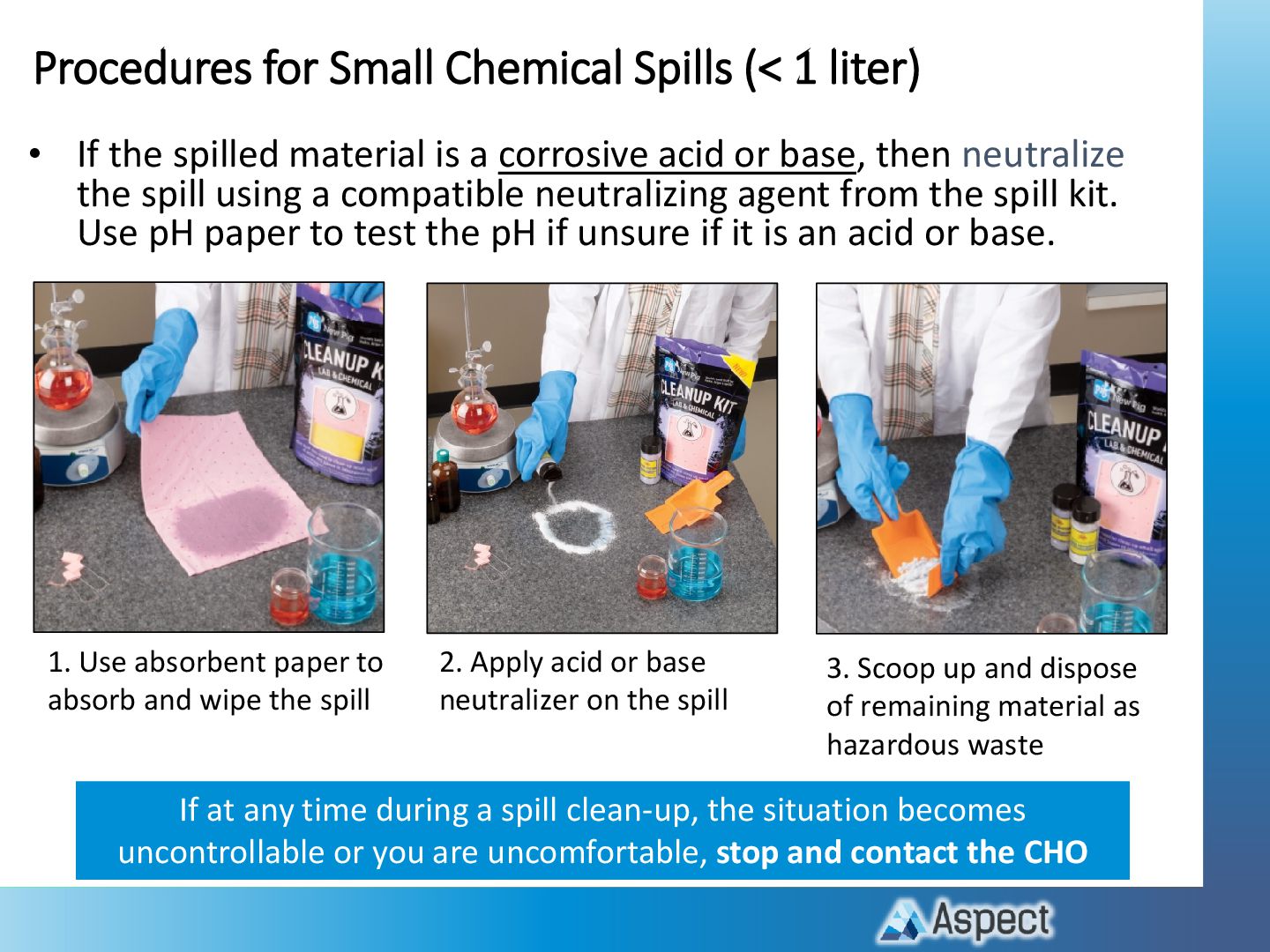
becomes uncontrollable or you are uncomfortable, stop and contact the CHO • If the spilled material is a corrosive acid or base, then neutralize the spill using a compatible neutralizing agent from the spill kit. Use pH paper to test the pH if unsure if it is an acid or base. 1. Use absorbent paper to absorb and wipe the spill 2. Apply acid or base neutralizer on the spill 3. Scoop up and dispose of remaining material as hazardous waste Procedures for Small Chemical Spills (< 1 liter)
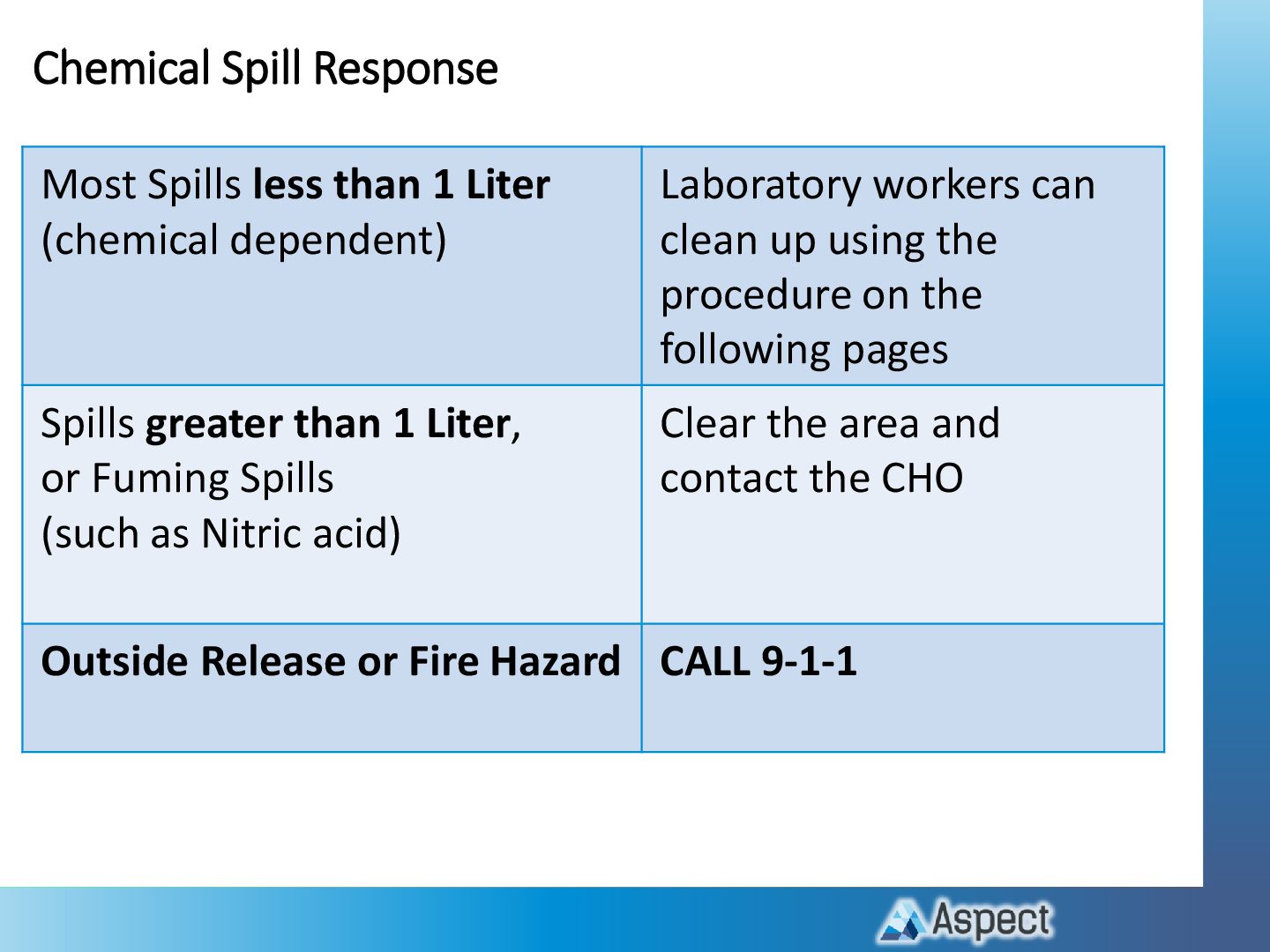
dependent) Laboratory workers can clean up using the procedure on the following pages Spills greater than 1 Liter, or Fuming Spills (such as Nitric acid) Clear the area and contact the CHO Outside Release or Fire Hazard CALL 9-1-1
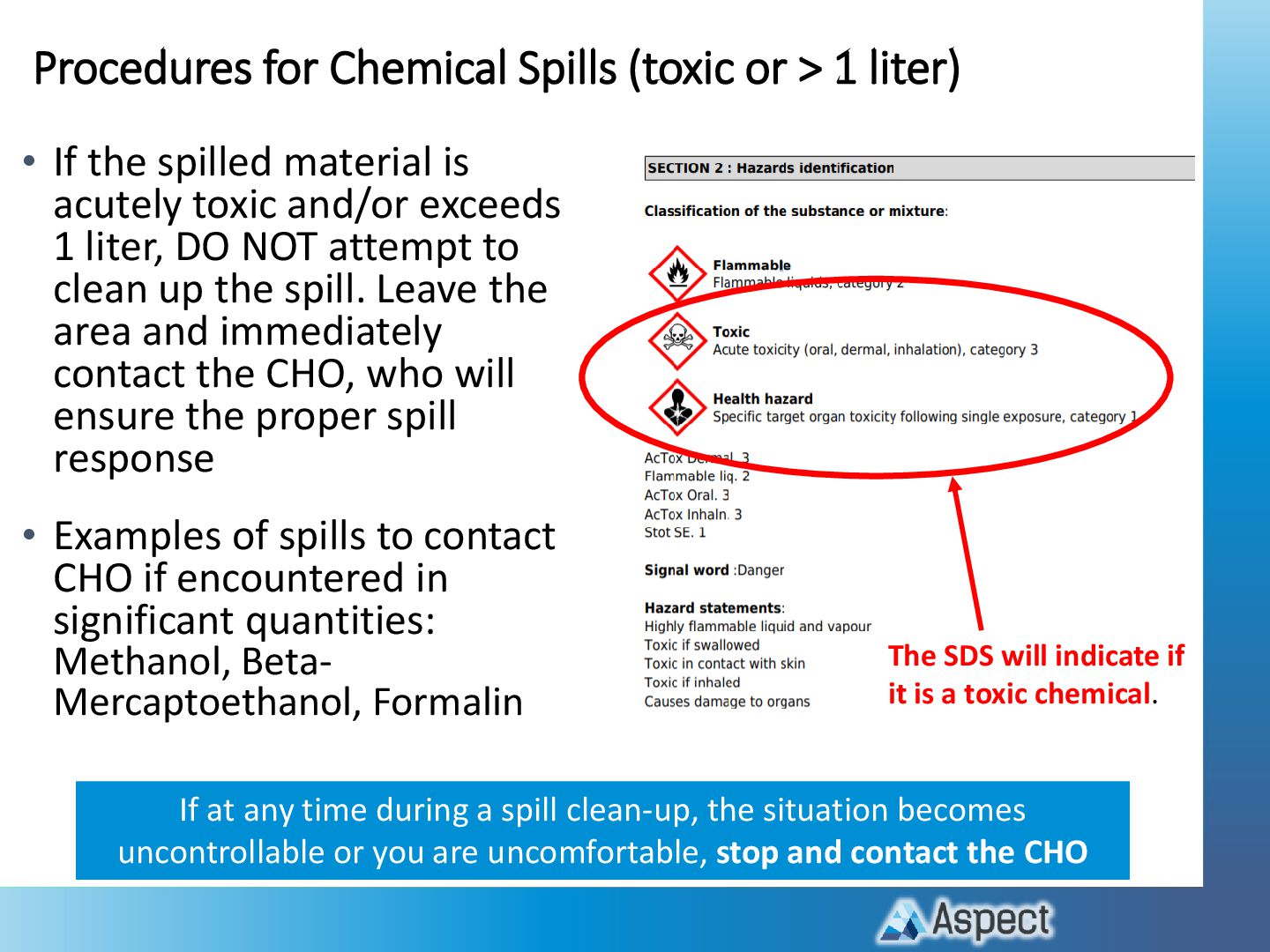
1 liter, DO NOT attempt to clean up the spill. Leave the area and immediately contact the CHO, who will ensure the proper spill response • Examples of spills to contact CHO if encountered in significant quantities: Methanol, Beta- Mercaptoethanol, Formalin The SDS will indicate if it is a toxic chemical. Procedures for Chemical Spills (toxic or > 1 liter) If at any time during a spill clean-up, the situation becomes uncontrollable or you are uncomfortable, stop and contact the CHO
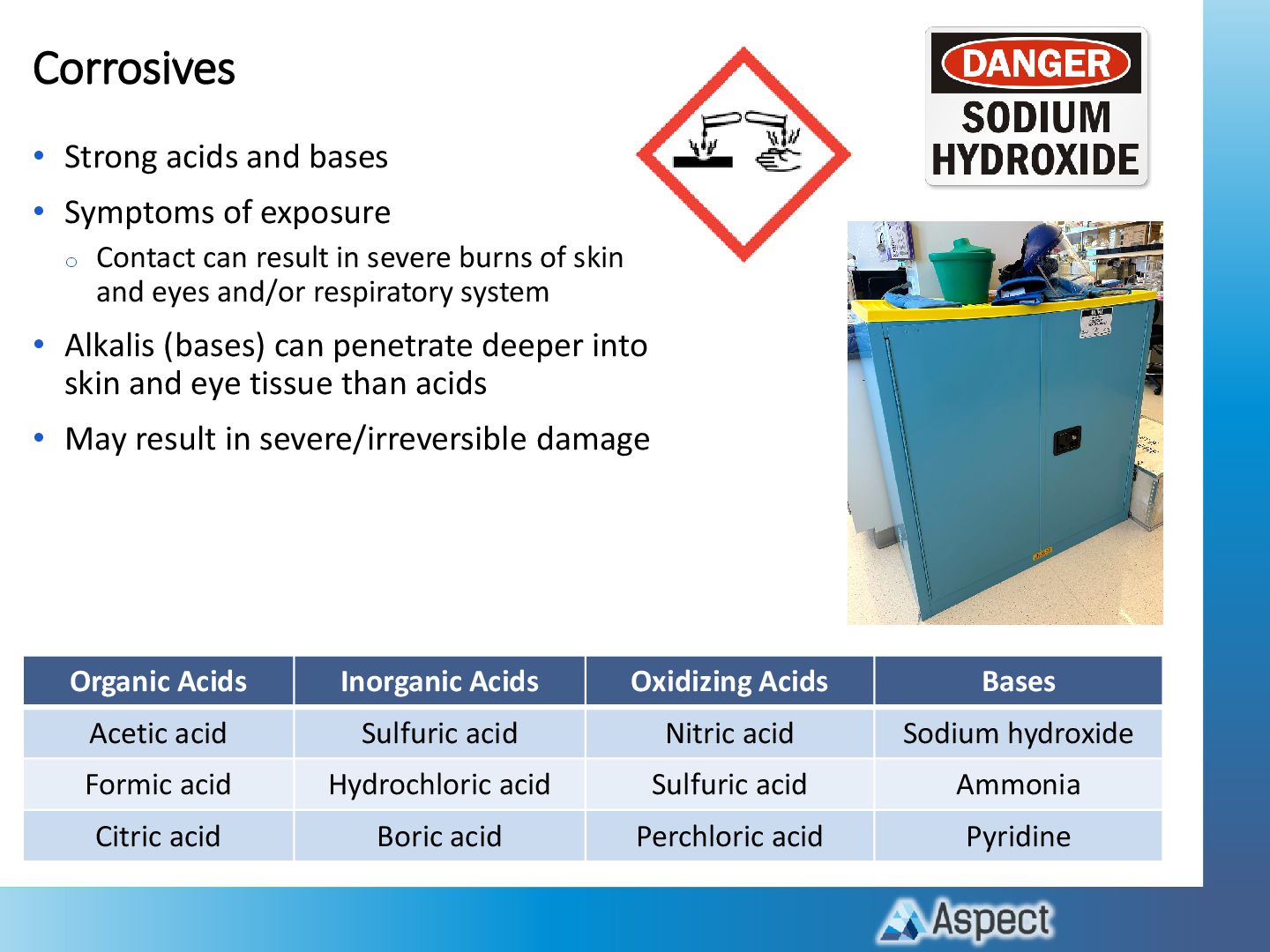
o Contact can result in severe burns of skin and eyes and/or respiratory system • Alkalis (bases) can penetrate deeper into skin and eye tissue than acids • May result in severe/irreversible damage Organic Acids Inorganic Acids Oxidizing Acids Bases Acetic acid Sulfuric acid Nitric acid Sodium hydroxide Formic acid Hydrochloric acid Sulfuric acid Ammonia Citric acid Boric acid Perchloric acid Pyridine
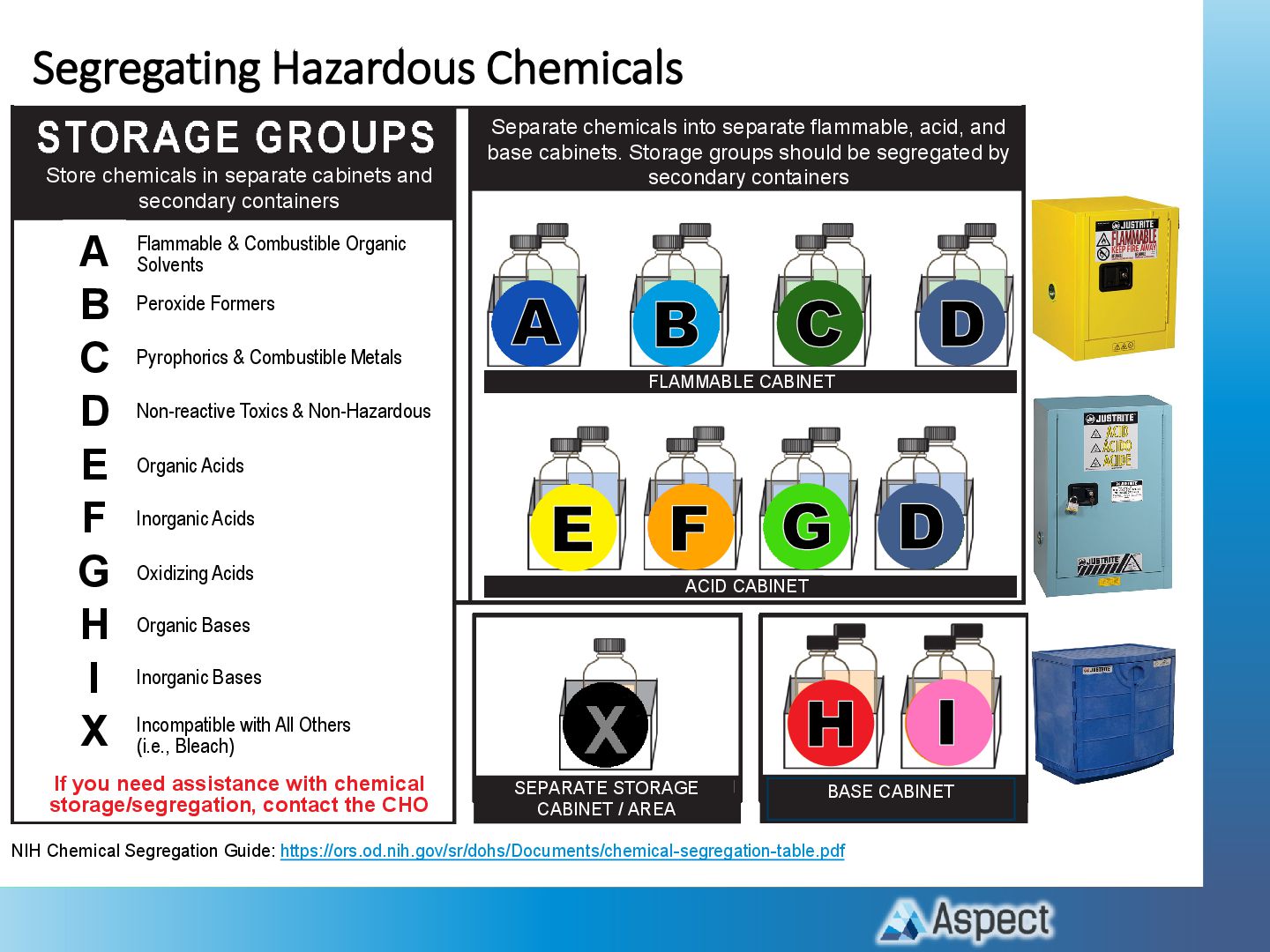
containers Separate chemicals into separate flammable, acid, and base cabinets. Storage groups should be segregated by secondary containers Flammable & Combustible Organic Solvents Pyrophorics & Combustible Metals Peroxide Formers Non-reactive Toxics & Non-Hazardous Organic Acids Inorganic Acids Oxidizing Acids Organic Bases NIH Chemical Segregation Guide: https://ors.od.nih.gov/sr/dohs/Documents/chemical-segregation-table.pdf Inorganic Bases A B C D E F G H I X Incompatible with All Others (i.e., Bleach) If you need assistance with chemical storage/segregation, contact the CHO FLAMMABLE CABINET ACID CABINET BASE CABINET SEPARATE STORAGE CABINET / AREA
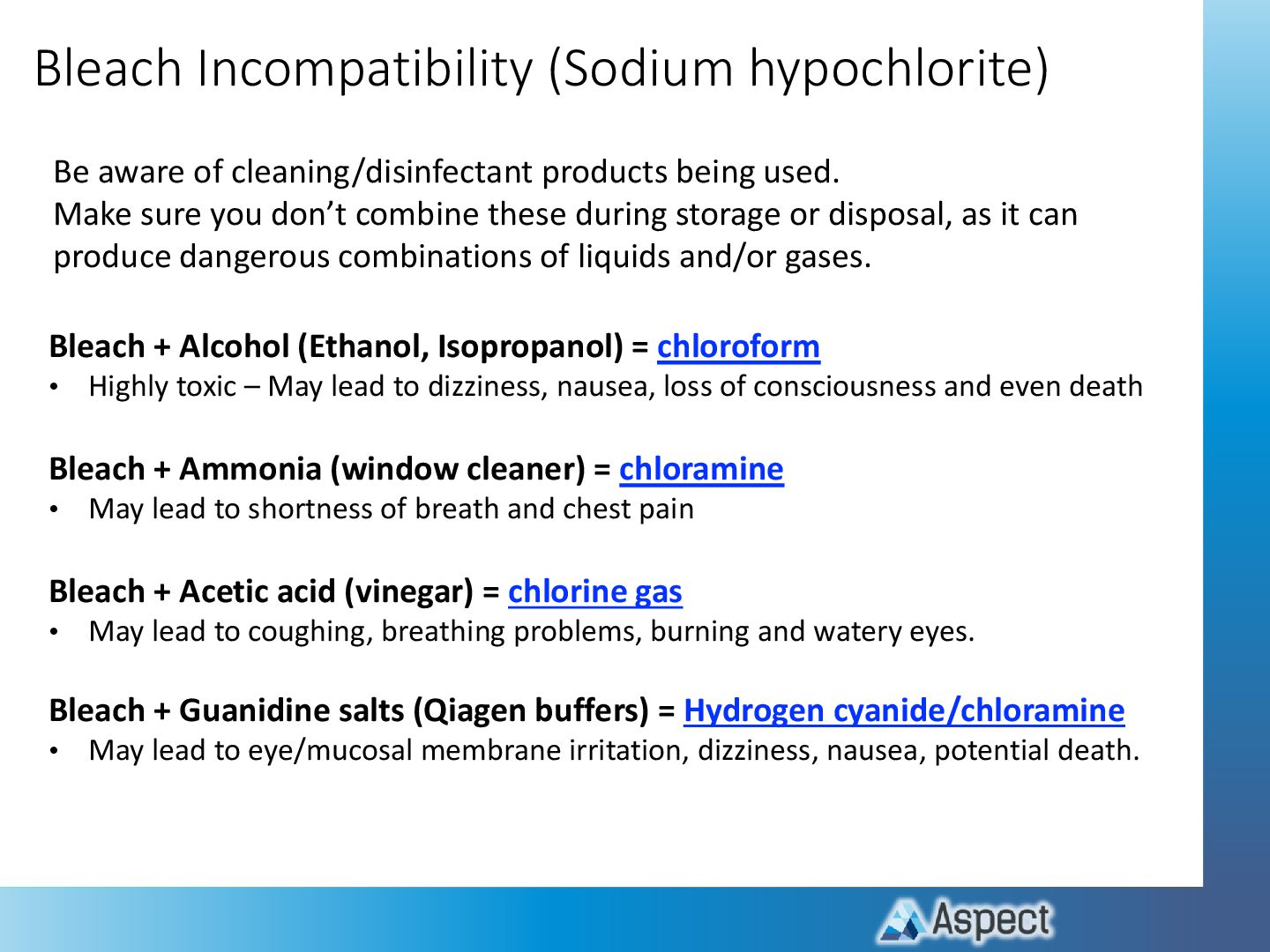
Highly toxic – May lead to dizziness, nausea, loss of consciousness and even death Bleach + Ammonia (window cleaner) = chloramine • May lead to shortness of breath and chest pain Bleach + Acetic acid (vinegar) = chlorine gas • May lead to coughing, breathing problems, burning and watery eyes. Bleach + Guanidine salts (Qiagen buffers) = Hydrogen cyanide/chloramine • May lead to eye/mucosal membrane irritation, dizziness, nausea, potential death. Be aware of cleaning/disinfectant products being used. Make sure you don’t combine these during storage or disposal, as it can produce dangerous combinations of liquids and/or gases. Bleach Incompatibility (Sodium hypochlorite)
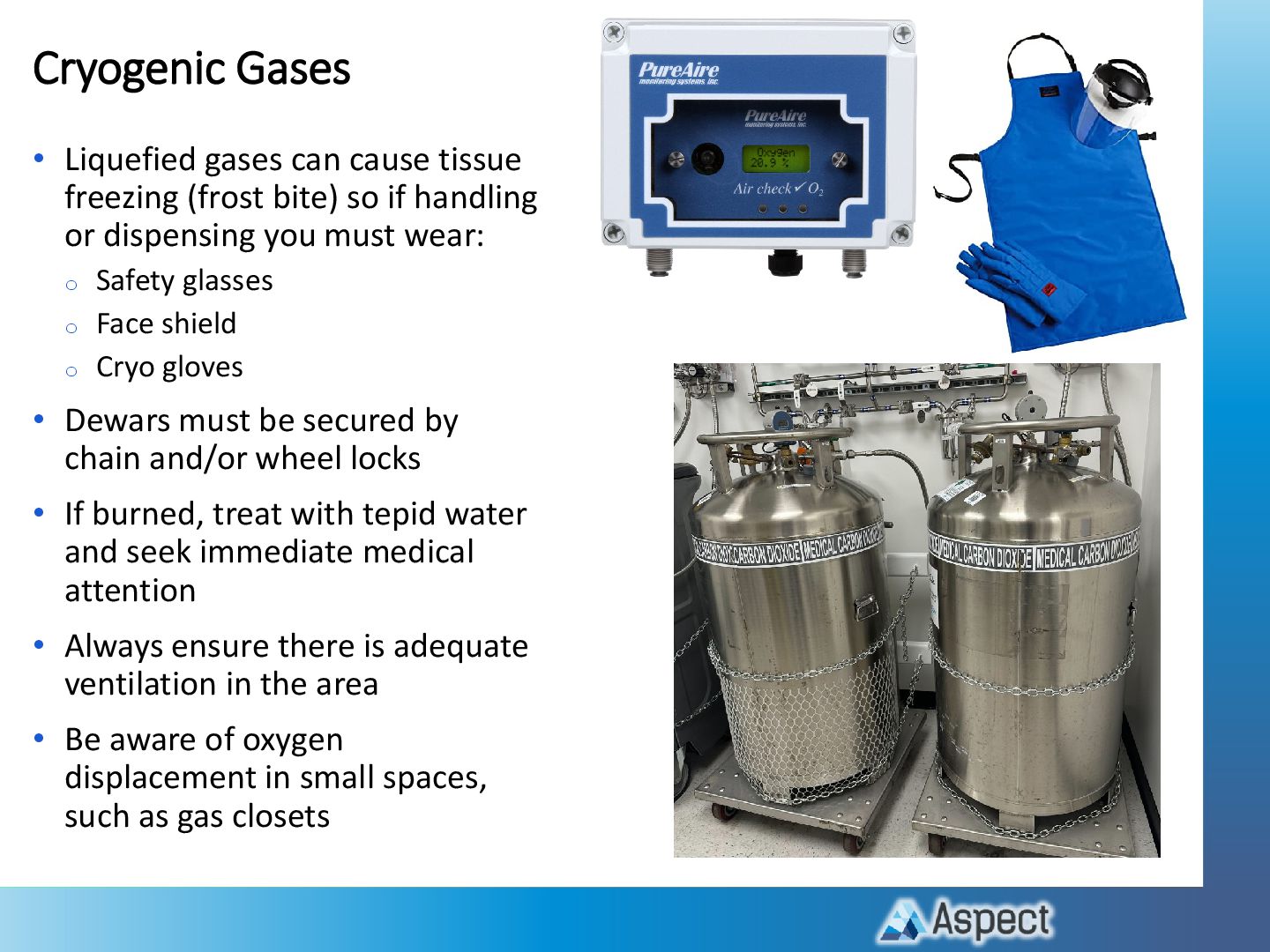
if handling or dispensing you must wear: o Safety glasses o Face shield o Cryo gloves • Dewars must be secured by chain and/or wheel locks • If burned, treat with tepid water and seek immediate medical attention • Always ensure there is adequate ventilation in the area • Be aware of oxygen displacement in small spaces, such as gas closets Cryogenic Gases
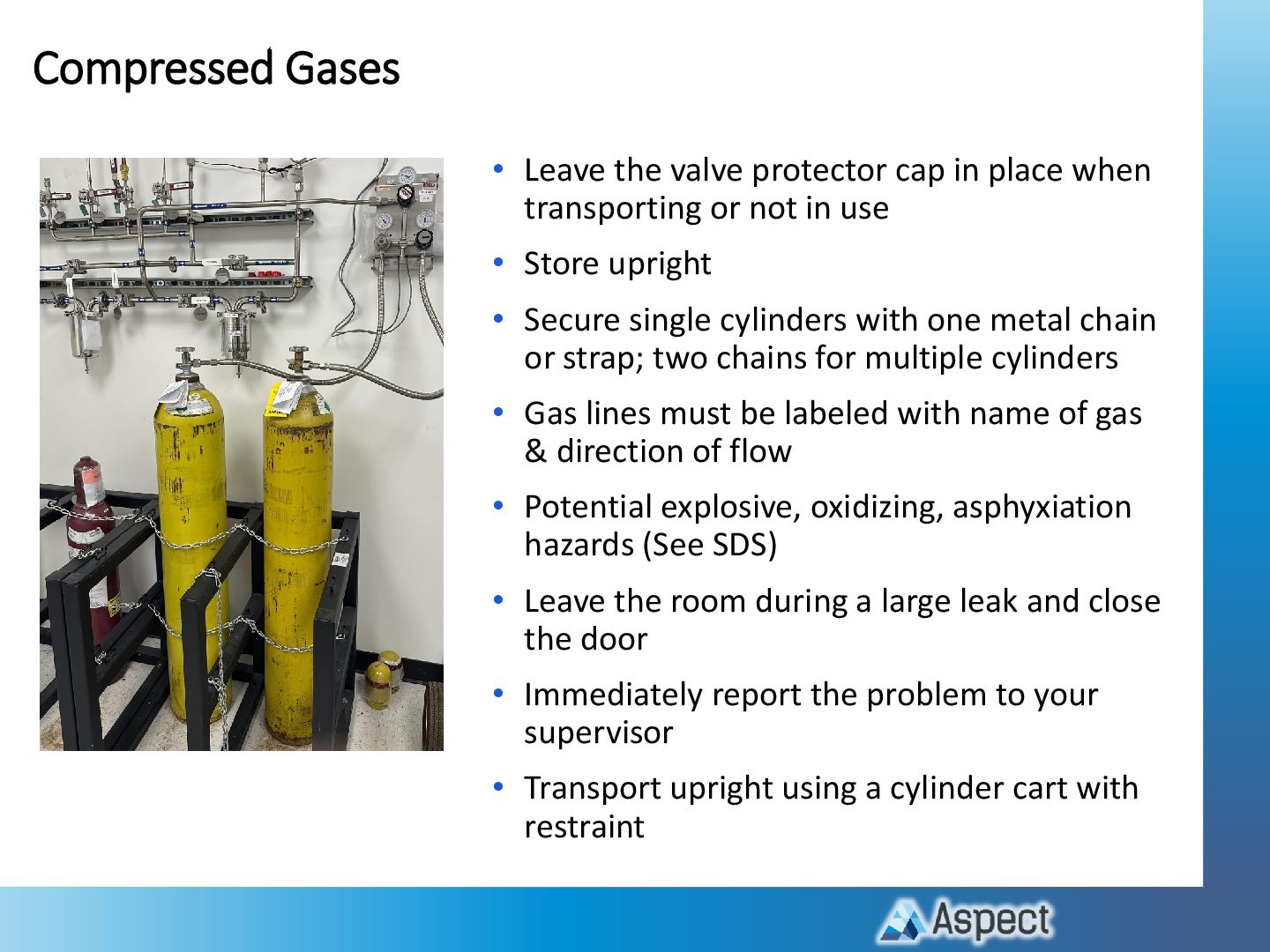
or not in use • Store upright • Secure single cylinders with one metal chain or strap; two chains for multiple cylinders • Gas lines must be labeled with name of gas & direction of flow • Potential explosive, oxidizing, asphyxiation hazards (See SDS) • Leave the room during a large leak and close the door • Immediately report the problem to your supervisor • Transport upright using a cylinder cart with restraint Compressed Gases
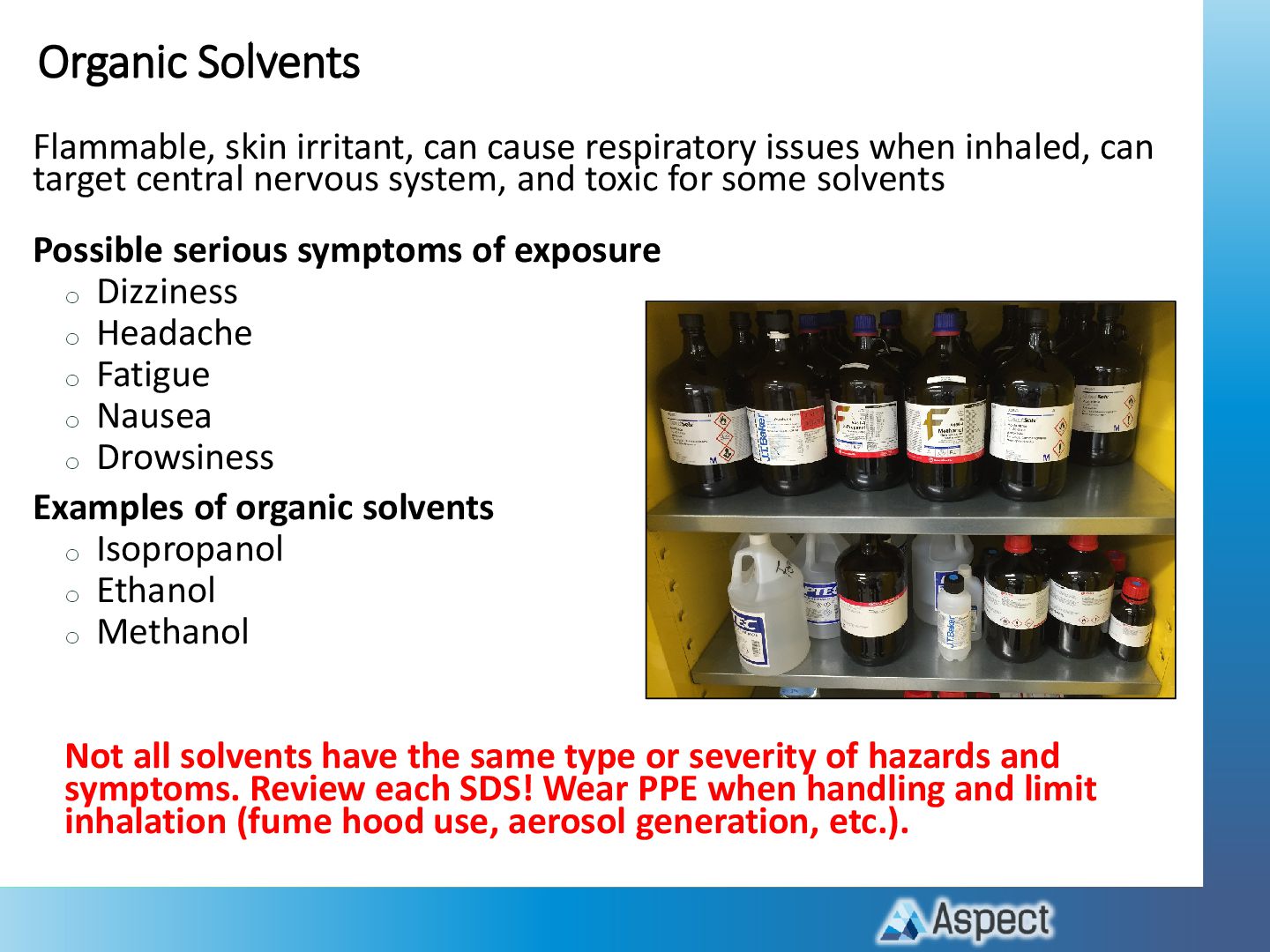
target central nervous system, and toxic for some solvents Possible serious symptoms of exposure o Dizziness o Headache o Fatigue o Nausea o Drowsiness Examples of organic solvents o Isopropanol o Ethanol o Methanol Not all solvents have the same type or severity of hazards and symptoms. Review each SDS! Wear PPE when handling and limit inhalation (fume hood use, aerosol generation, etc.). Organic Solvents
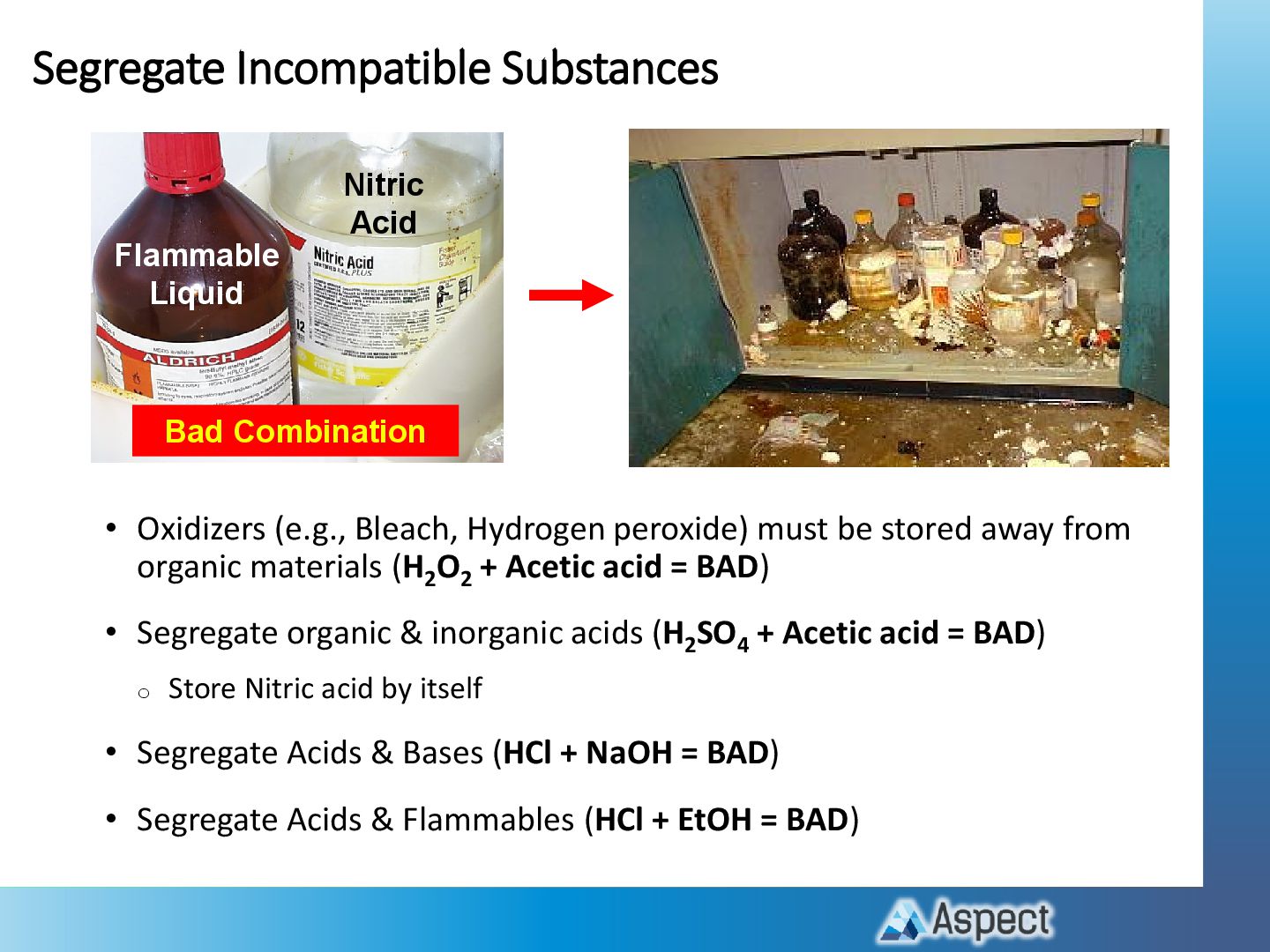
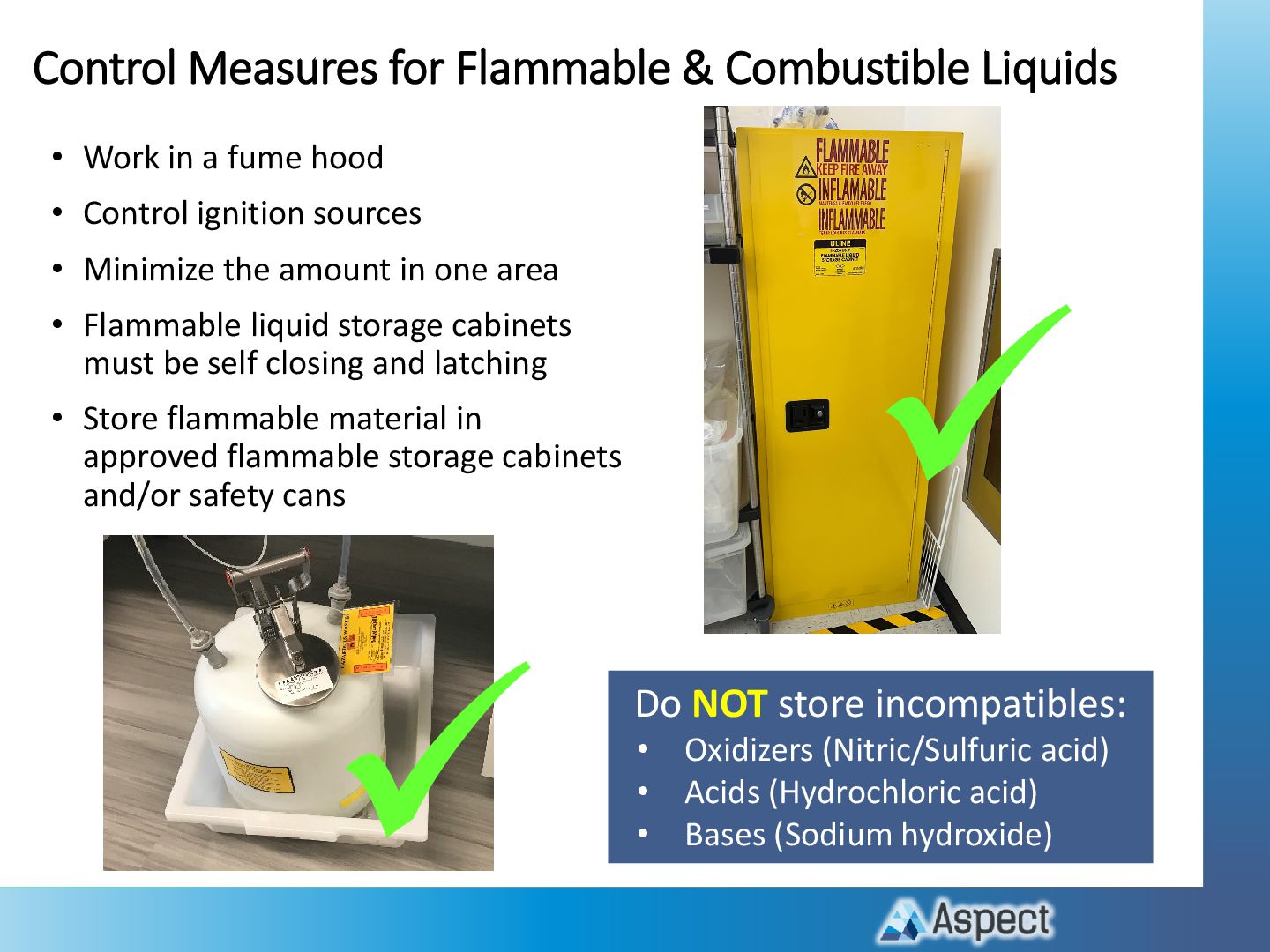
NOT store incompatibles: • Oxidizers (Nitric/Sulfuric acid) • Acids (Hydrochloric acid) • Bases (Sodium hydroxide) • Work in a fume hood • Control ignition sources • Minimize the amount in one area • Flammable liquid storage cabinets must be self closing and latching • Store flammable material in approved flammable storage cabinets and/or safety cans
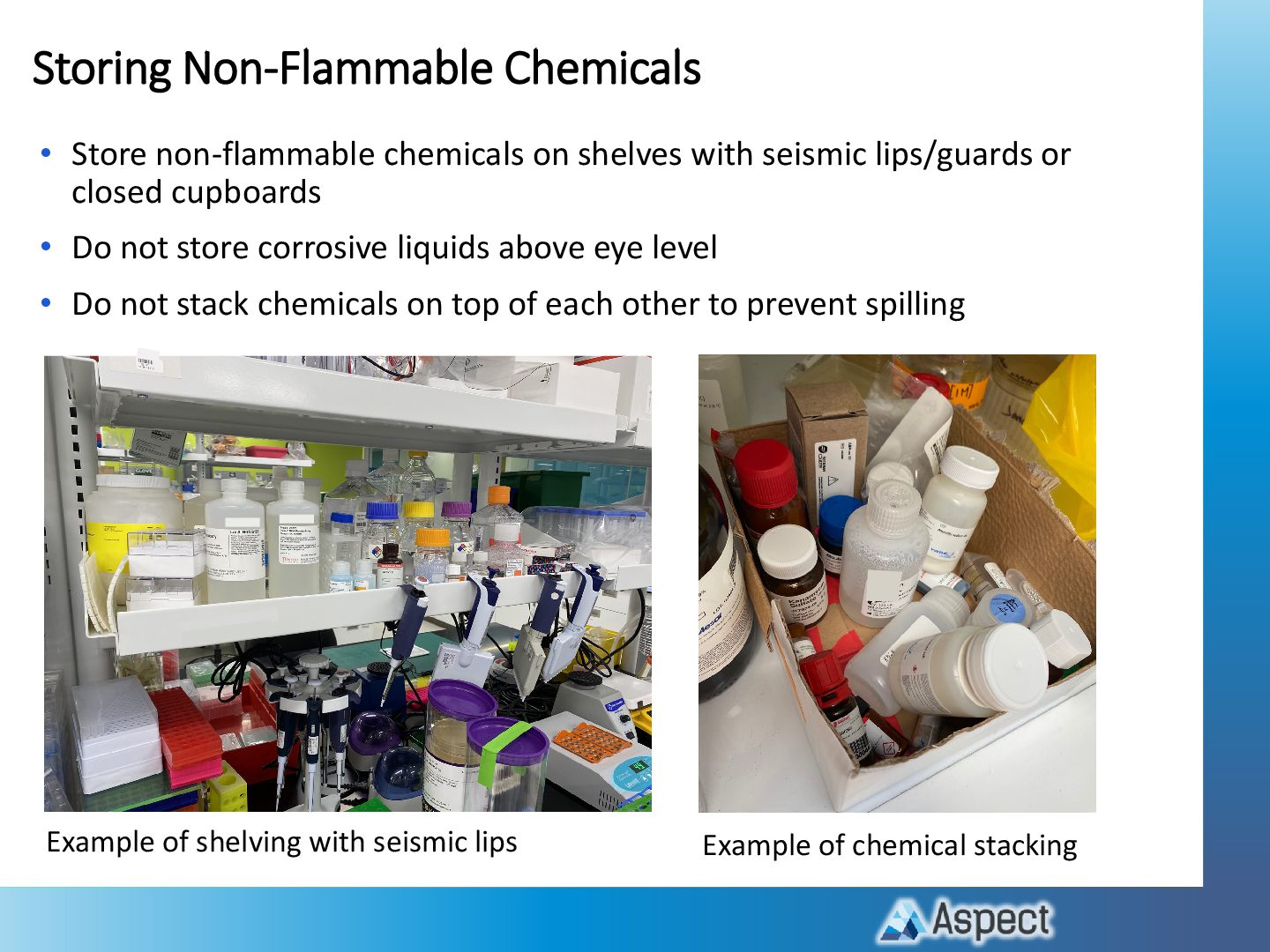
closed cupboards • Do not store corrosive liquids above eye level • Do not stack chemicals on top of each other to prevent spilling Storing Non-Flammable Chemicals Example of shelving with seismic lips Example of chemical stacking
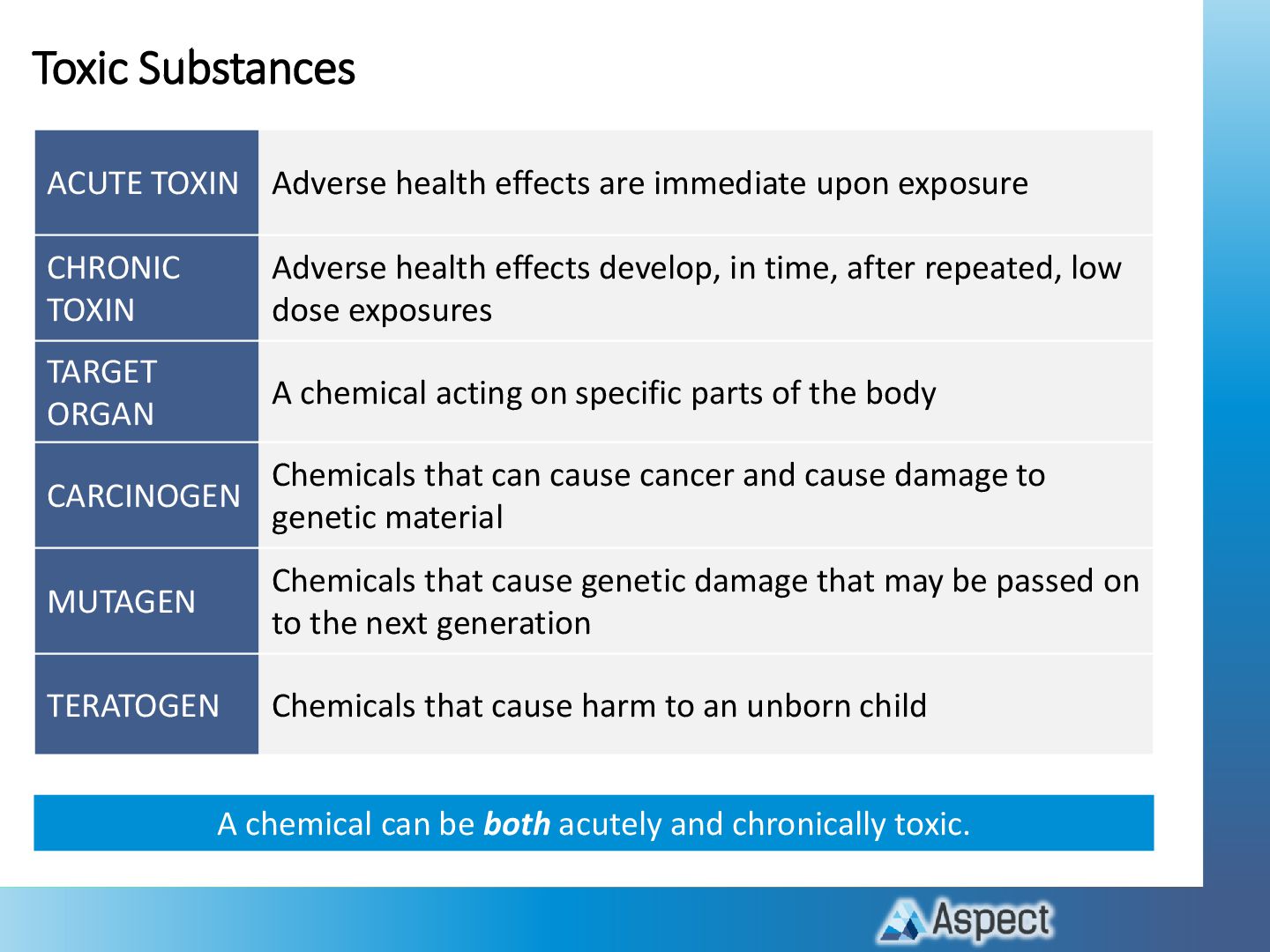
toxic. ACUTE TOXIN Adverse health effects are immediate upon exposure CHRONIC TOXIN Adverse health effects develop, in time, after repeated, low dose exposures TARGET ORGAN A chemical acting on specific parts of the body CARCINOGEN Chemicals that can cause cancer and cause damage to genetic material MUTAGEN Chemicals that cause genetic damage that may be passed on to the next generation TERATOGEN Chemicals that cause harm to an unborn child
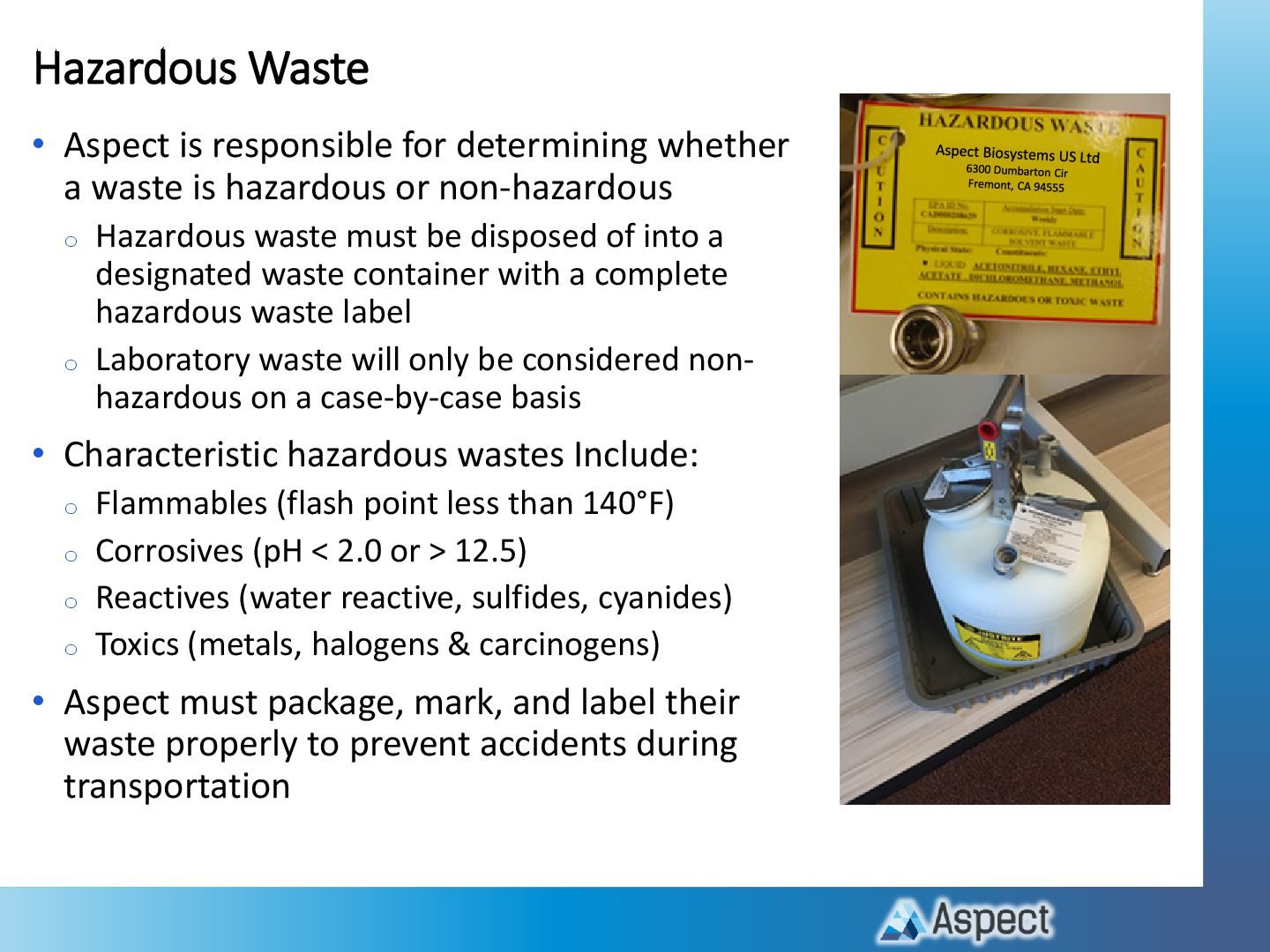
hazardous or non-hazardous o Hazardous waste must be disposed of into a designated waste container with a complete hazardous waste label o Laboratory waste will only be considered non- hazardous on a case-by-case basis • Characteristic hazardous wastes Include: o Flammables (flash point less than 140°F) o Corrosives (pH < 2.0 or > 12.5) o Reactives (water reactive, sulfides, cyanides) o Toxics (metals, halogens & carcinogens) • Aspect must package, mark, and label their waste properly to prevent accidents during transportation Hazardous Waste
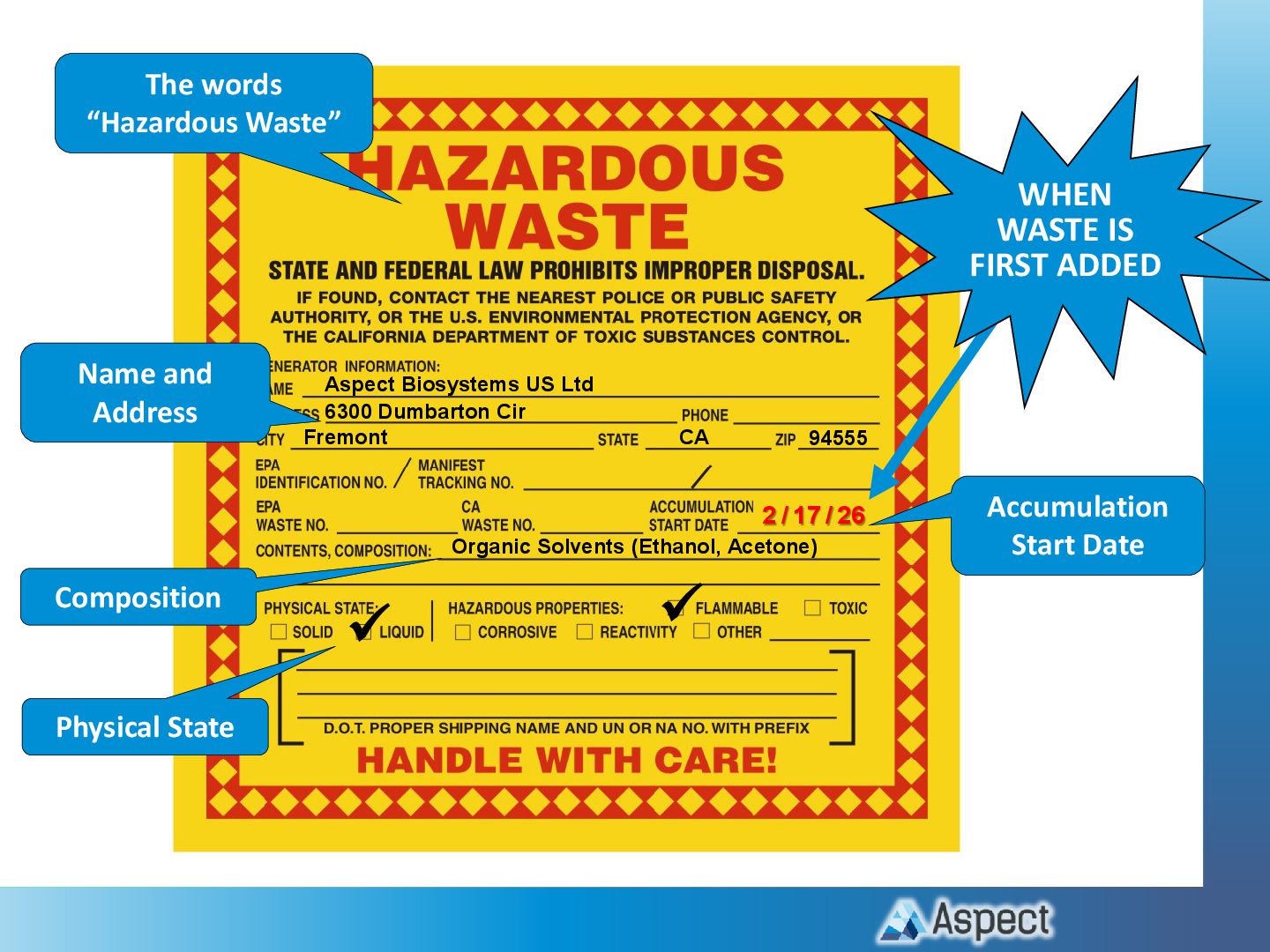
words “Hazardous Waste” WHEN WASTE IS FIRST ADDED Aspect Biosystems US Ltd 6300 Dumbarton Cir Fremont CA 94555 Organic Solvents (Ethanol, Acetone) 2 / 17 / 26
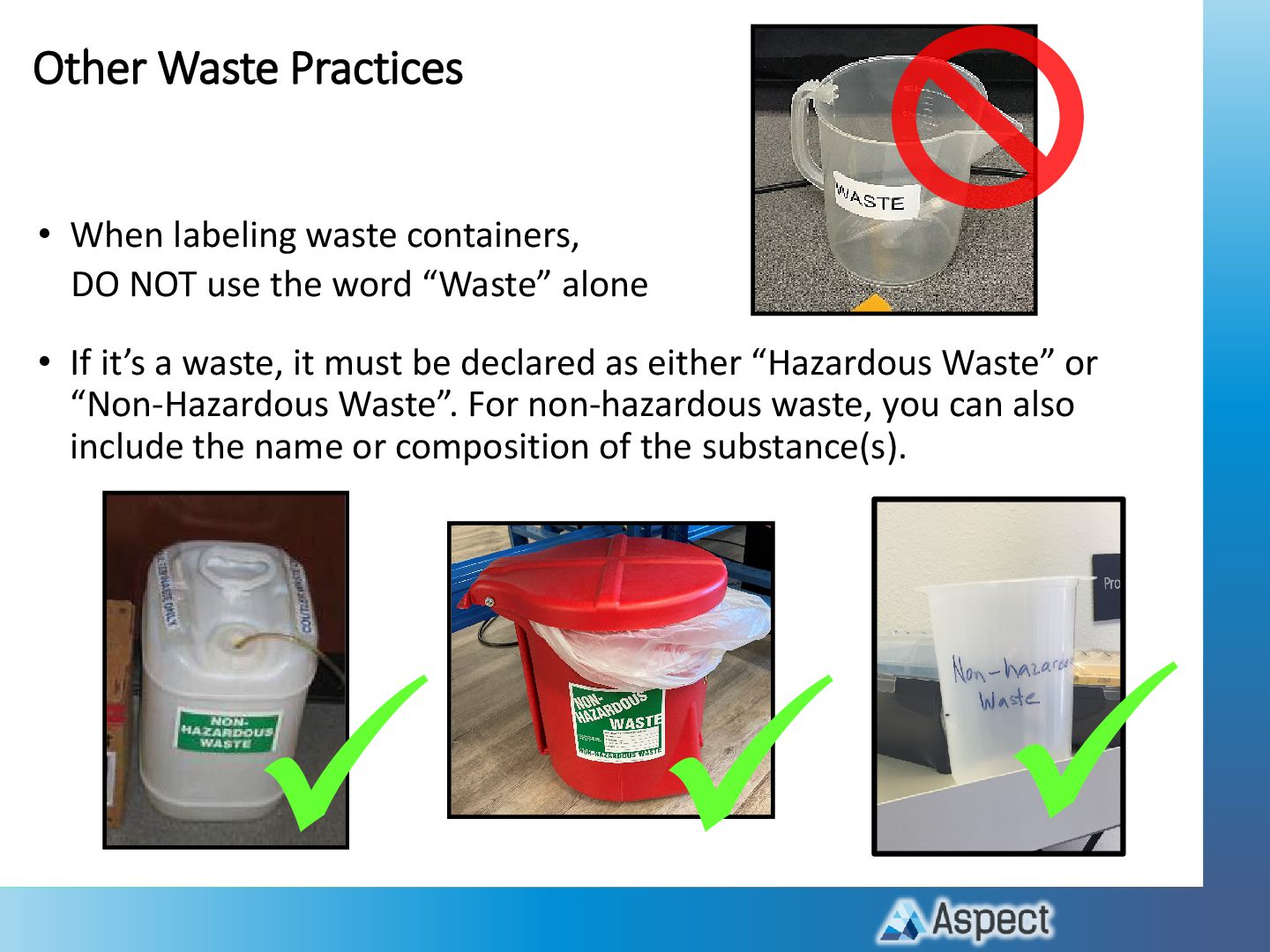
“Waste” alone • If it’s a waste, it must be declared as either “Hazardous Waste” or “Non-Hazardous Waste”. For non-hazardous waste, you can also include the name or composition of the substance(s). Other Waste Practices
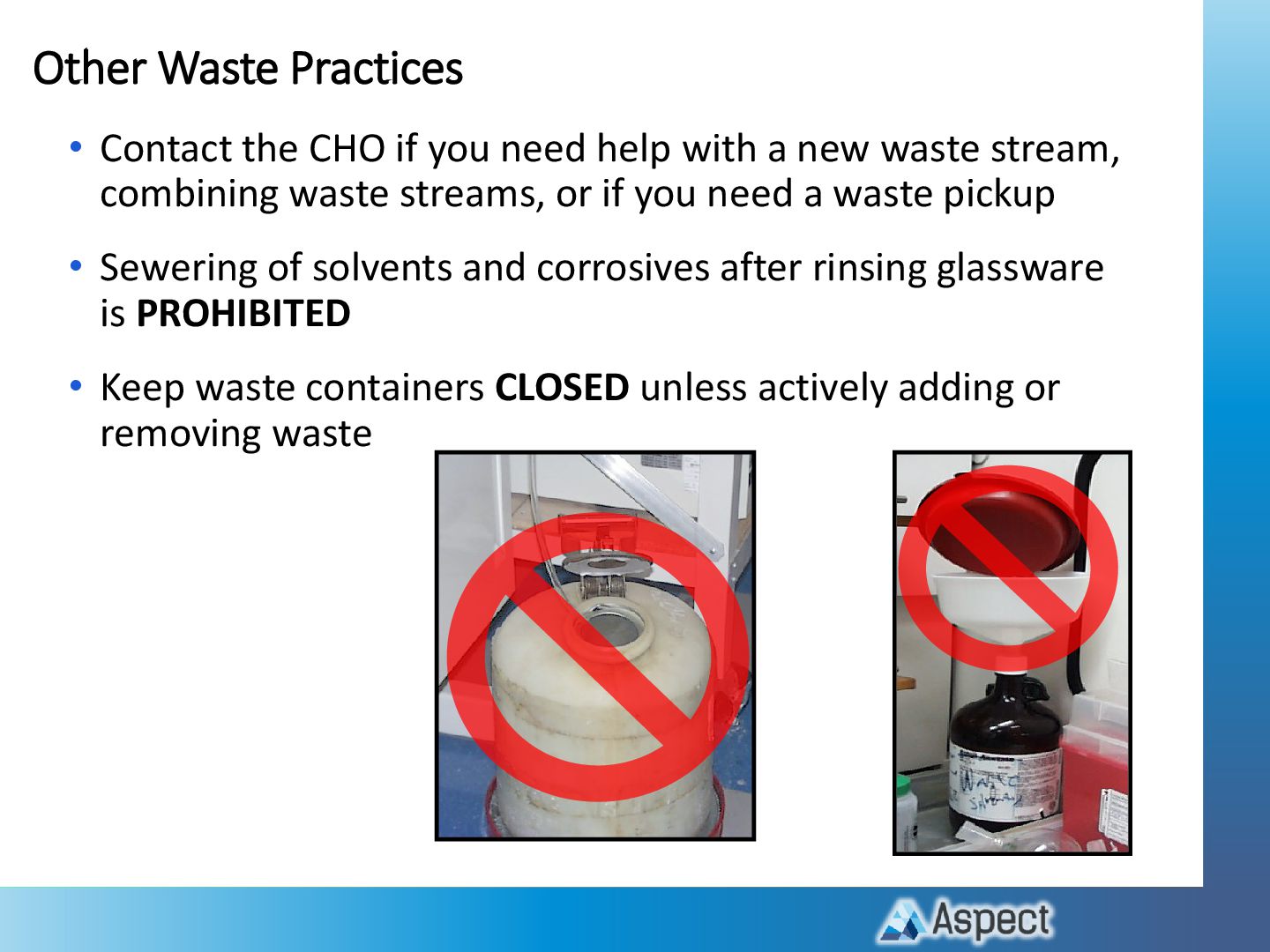
new waste stream, combining waste streams, or if you need a waste pickup • Sewering of solvents and corrosives after rinsing glassware is PROHIBITED • Keep waste containers CLOSED unless actively adding or removing waste Other Waste Practices
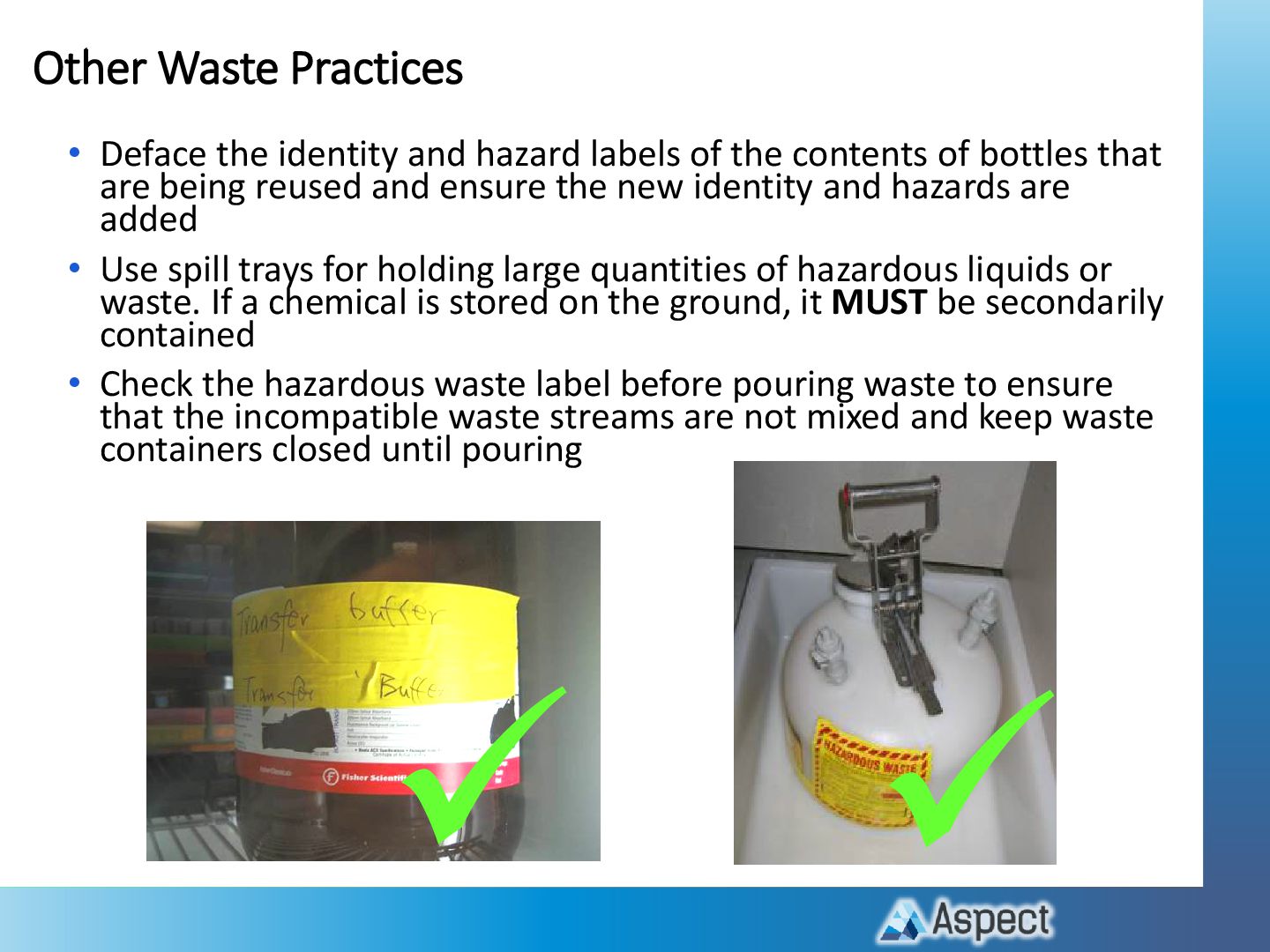
of bottles that are being reused and ensure the new identity and hazards are added • Use spill trays for holding large quantities of hazardous liquids or waste. If a chemical is stored on the ground, it MUST be secondarily contained • Check the hazardous waste label before pouring waste to ensure that the incompatible waste streams are not mixed and keep waste containers closed until pouring Other Waste Practices
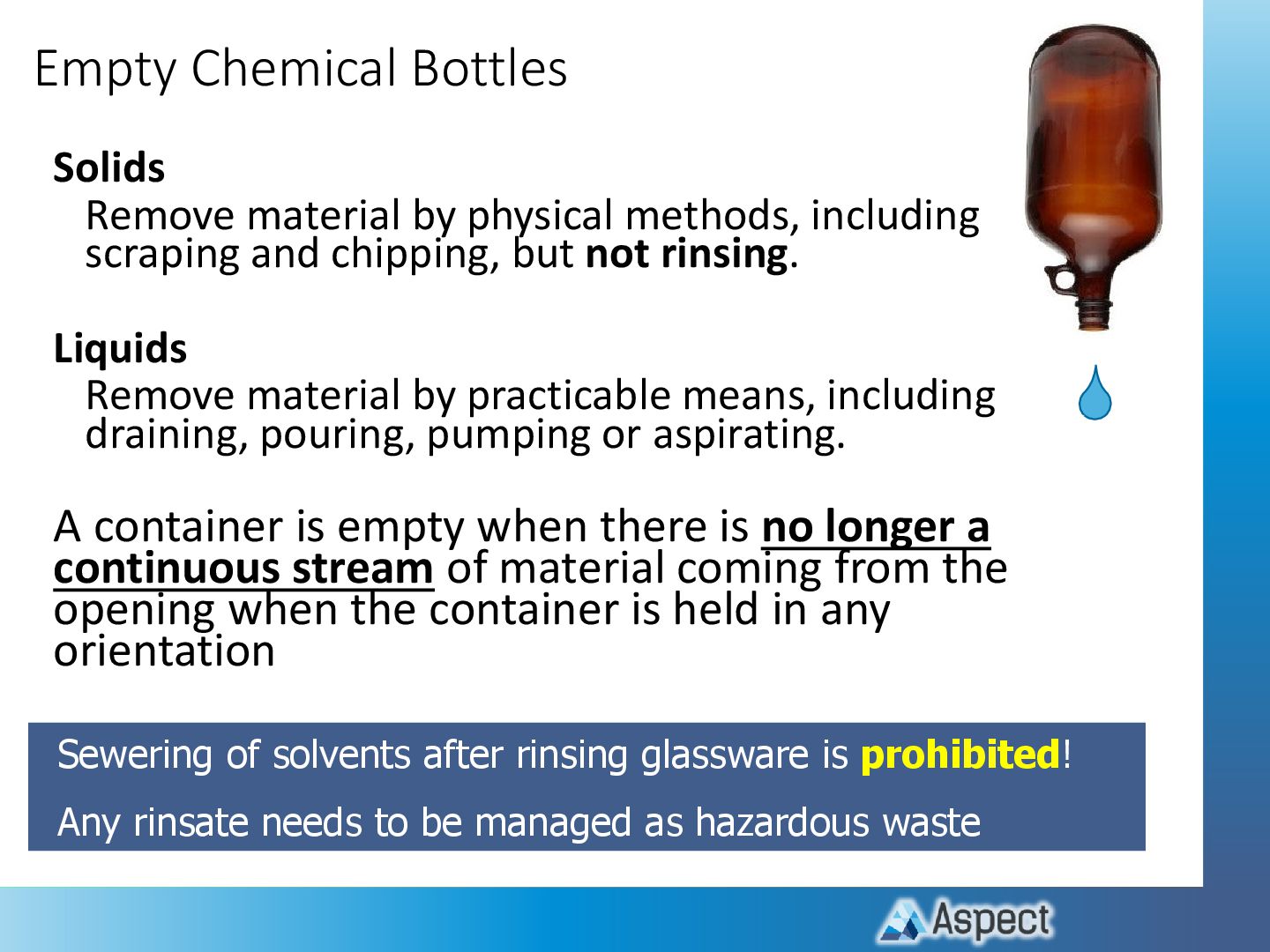
but not rinsing. Liquids Remove material by practicable means, including draining, pouring, pumping or aspirating. A container is empty when there is no longer a continuous stream of material coming from the opening when the container is held in any orientation Sewering of solvents after rinsing glassware is prohibited! Any rinsate needs to be managed as hazardous waste Empty Chemical Bottles
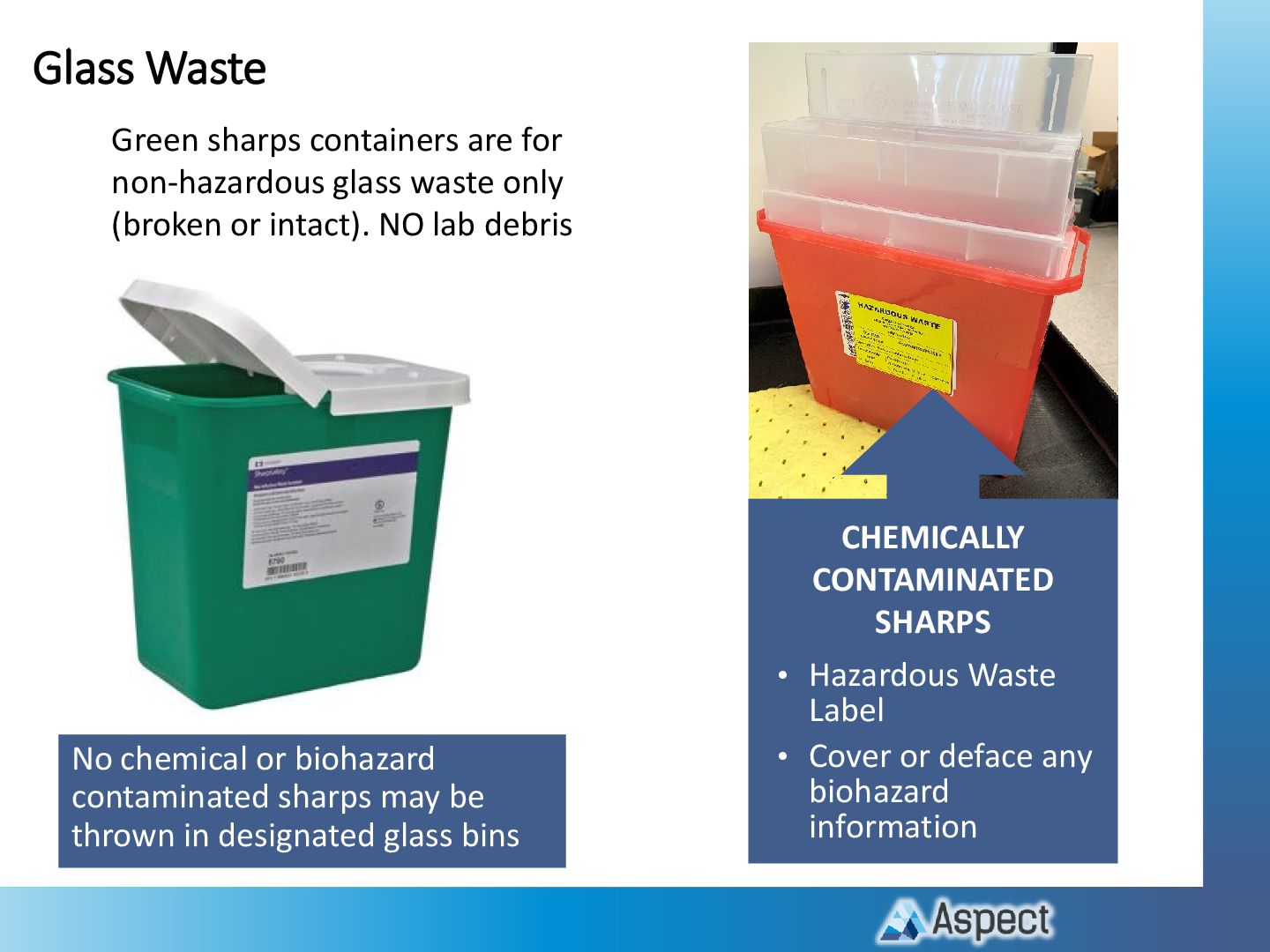
thrown in designated glass bins CHEMICALLY CONTAMINATED SHARPS • Hazardous Waste Label • Cover or deface any biohazard information Green sharps containers are for non-hazardous glass waste only (broken or intact). NO lab debris
post training quiz, click • You will receive an email message from [email protected] showing your score (90% or higher is needed to pass) • Retake the quiz if you receive a failing score • Forward your passing results email to [email protected] Please scroll down and begin taking your post training quiz
or comments regarding the content of this training, please contact: Mike Scott Safety Coordinator Chemical Hygiene Officer [email protected] (858) 539-6038 Matt Banez-Olson EHS Consultant [email protected] (858) 336-0335 Dustin Hollenbeck Hazmat Technician [email protected] (650) 304-8298


 occserv
 bermonpainter
 sabderemane
 bluesmoon
 maggiecrowley
 kimpetersen
 samtorres
 dougneiner
 techseoconnect
 soysaucechin
 pauljervisheath
 katarinadahlin