to familiarize the employee with Pattern Biosciences’ Workplace Violence Prevention Plan, which includes: • How to report workplace violence incidents without fear of retaliation. • Understanding of job-specific violence hazards and preventive measures. • Providing employees with guidance on what to do in certain scenarios involving potential or active workplace violence situations. Training is required initially for all employees and annually thereafter and whenever changes to the Plan occur.
a safe work environment. This Workplace Violence Prevention Plan (WVPP) is designed to comply with California Labor Code section 6401.9 resulting from Senate Bill 553, that went into effect in July 2024. The purpose of the Workplace Violence Prevention Plan (WVPP) is to protect employees at the workplace from any threat of workplace violence and effectively address such incidents should they arise. Pattern Biosciences Workplace Violence Prevention Plan is located in the IIPP Manual
has adopted a “Zero Tolerance Policy” for acts of violence and threats of workplace violence. This policy describes the basic elements of a “Zero Tolerance Policy” for workplace violence. • Acts or threats of physical violence, including intimidation, harassment, and/or coercion which involve or affect Pattern Biosciences, or which occurs in the workplace will not be tolerated. • Employees committing acts of workplace violence will be disciplined up to and including termination.
Employees are required to report all matters of workplace violence immediately to their Manager or the Safety Coordinator. • Leaders, including Management, must immediately report any reports of workplace violence to the Safety Coordinators.
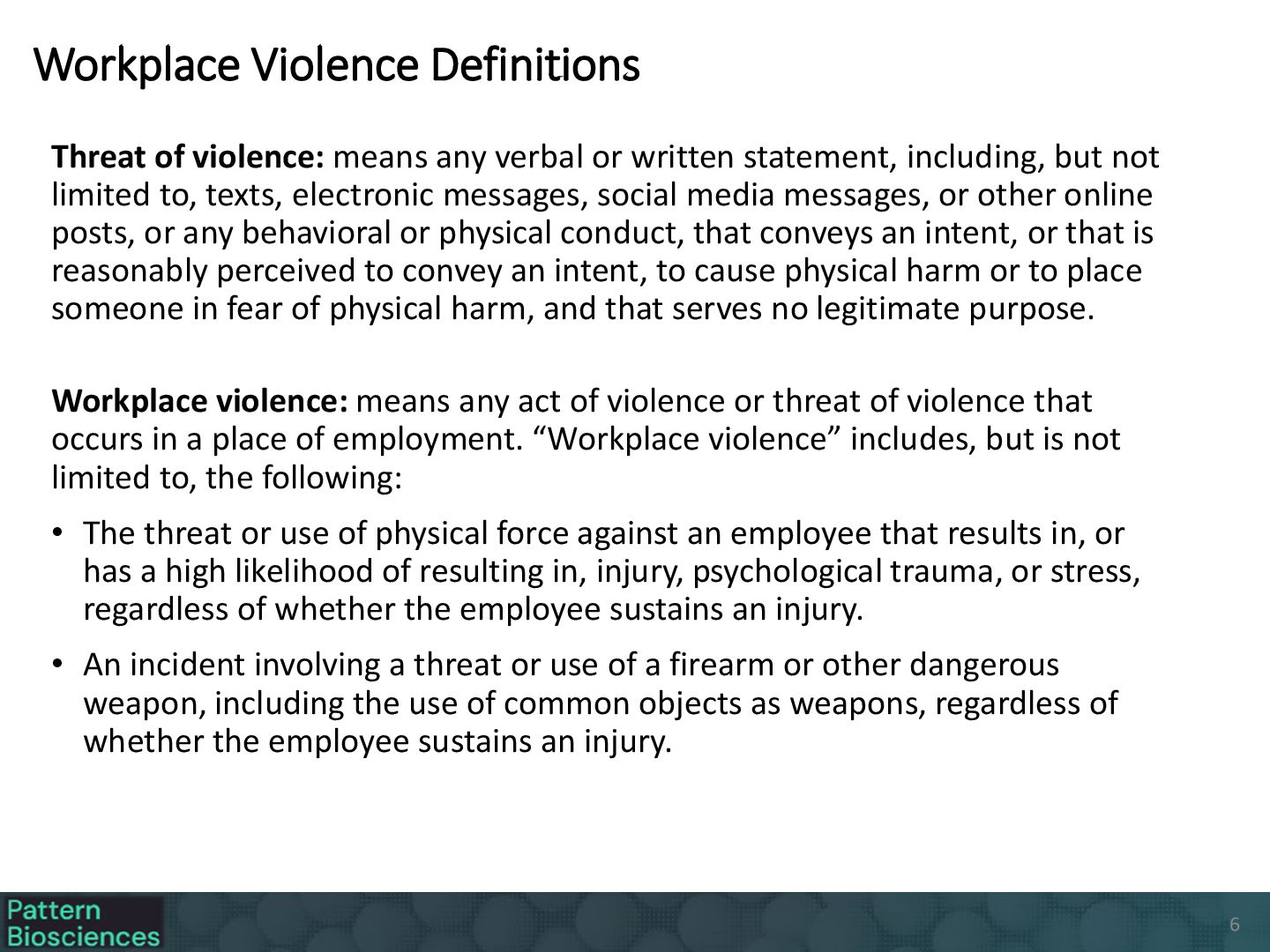
or written statement, including, but not limited to, texts, electronic messages, social media messages, or other online posts, or any behavioral or physical conduct, that conveys an intent, or that is reasonably perceived to convey an intent, to cause physical harm or to place someone in fear of physical harm, and that serves no legitimate purpose. Workplace violence: means any act of violence or threat of violence that occurs in a place of employment. “Workplace violence” includes, but is not limited to, the following: • The threat or use of physical force against an employee that results in, or has a high likelihood of resulting in, injury, psychological trauma, or stress, regardless of whether the employee sustains an injury. • An incident involving a threat or use of a firearm or other dangerous weapon, including the use of common objects as weapons, regardless of whether the employee sustains an injury.
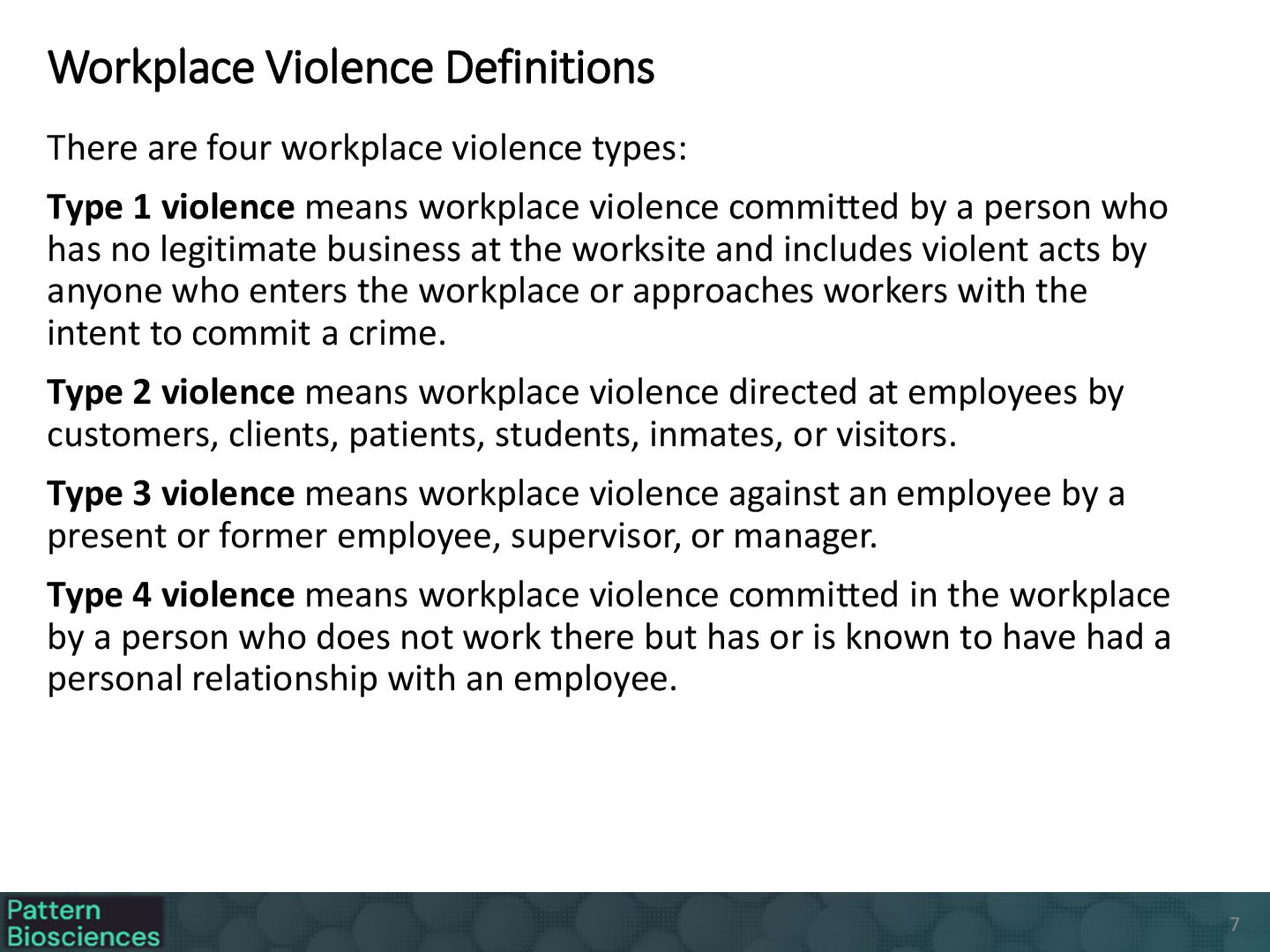
Type 1 violence means workplace violence committed by a person who has no legitimate business at the worksite and includes violent acts by anyone who enters the workplace or approaches workers with the intent to commit a crime. Type 2 violence means workplace violence directed at employees by customers, clients, patients, students, inmates, or visitors. Type 3 violence means workplace violence against an employee by a present or former employee, supervisor, or manager. Type 4 violence means workplace violence committed in the workplace by a person who does not work there but has or is known to have had a personal relationship with an employee.
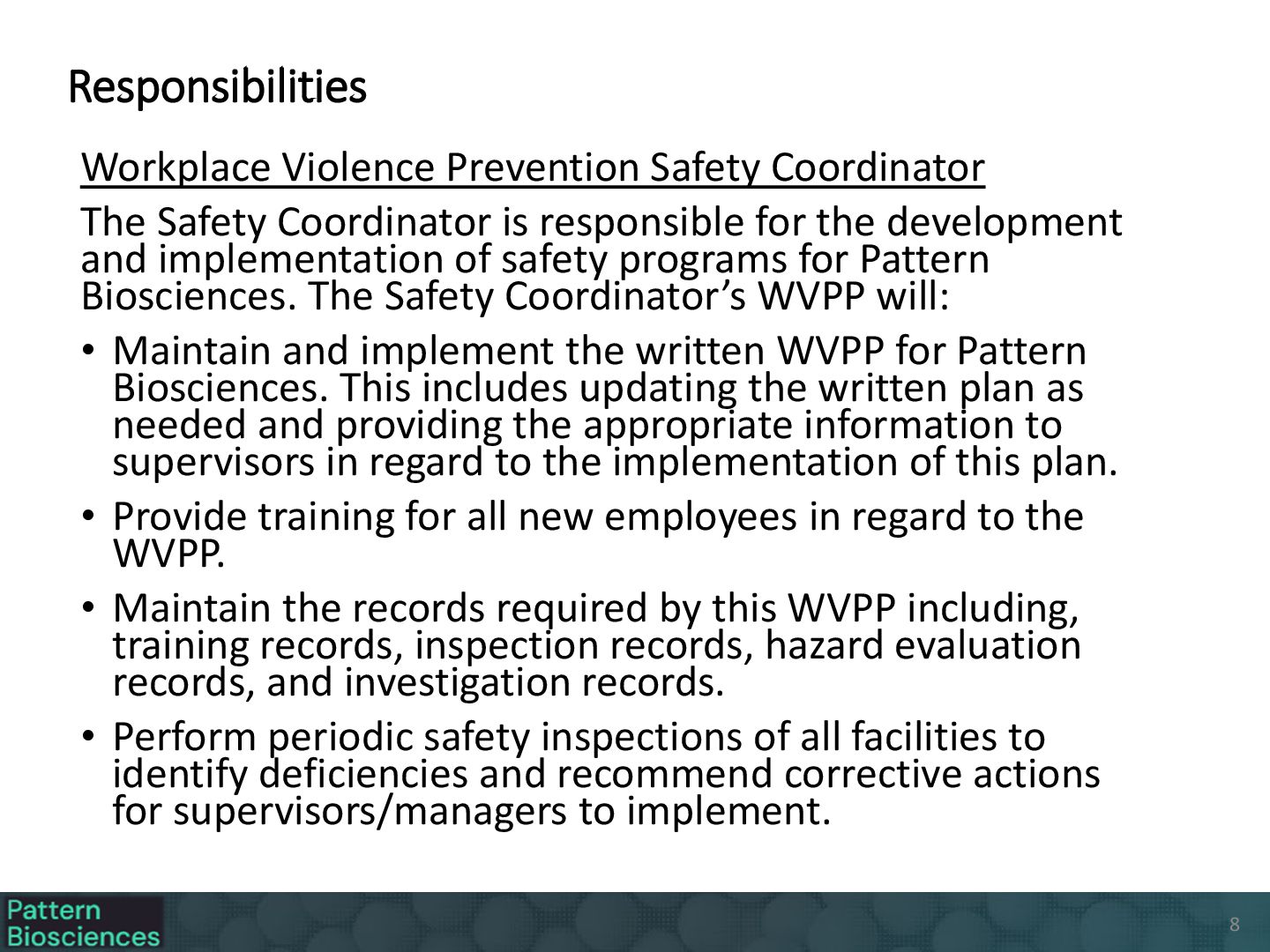
responsible for the development and implementation of safety programs for Pattern Biosciences. The Safety Coordinator’s WVPP will: • Maintain and implement the written WVPP for Pattern Biosciences. This includes updating the written plan as needed and providing the appropriate information to supervisors in regard to the implementation of this plan. • Provide training for all new employees in regard to the WVPP. • Maintain the records required by this WVPP including, training records, inspection records, hazard evaluation records, and investigation records. • Perform periodic safety inspections of all facilities to identify deficiencies and recommend corrective actions for supervisors/managers to implement. 8
program and take the required WVPP training • Report, investigate, and record incidents of workplace violence or threats of workplace violence. • Use safe work practices and follow all directives, policies, and procedures for maintaining a safe environment Pattern Biosciences employees should reach out to the Safety Coordinators to report a workplace violence incident or if there are questions about the WVPP. 10
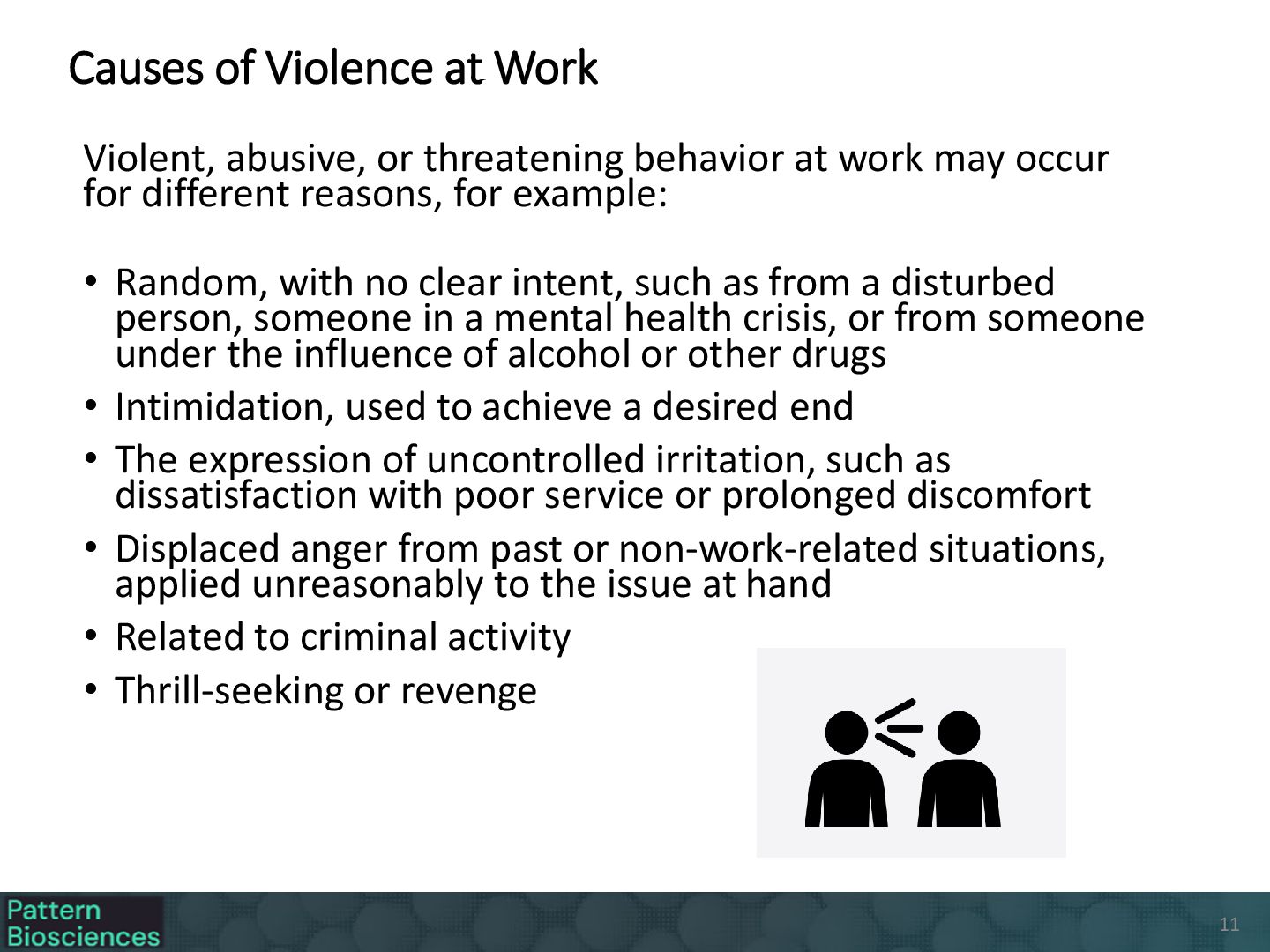
at work may occur for different reasons, for example: • Random, with no clear intent, such as from a disturbed person, someone in a mental health crisis, or from someone under the influence of alcohol or other drugs • Intimidation, used to achieve a desired end • The expression of uncontrolled irritation, such as dissatisfaction with poor service or prolonged discomfort • Displaced anger from past or non-work-related situations, applied unreasonably to the issue at hand • Related to criminal activity • Thrill-seeking or revenge 11
situations that may be observed in a person or within the environment that should be reported: Behavioral/Social/Psychological Factors • Frequent use of hostile language, threats, or intimidation • Extreme and unpredictable shifts in mood or demeanor • Strained relationships among employees or with supervisors • Withdrawal from colleagues, increased isolation, or avoidance of social interactions • Previous instances of violent behavior or involvement in physical altercations • Observable signs of alcohol or drug abuse, which can impair judgment and self-control • Defiance of authority figures, refusal to follow policies or procedures • Unhealthy fixation on or frequent discussions about firearms or other weapons 12
frustration, resentment, or a sense of injustice without seeking resolution • Sudden and drastic changes in personal circumstances, such as financial troubles, relationship issues, or significant life events • Demonstrating an inability to cope with work-related stressors or personal challenges • High levels of stress due to workload, job insecurity, or other factors • Dealing with the public, clients, or customers, especially in high- stress situations • Untreated mental health issues or a history of violent behavior 13
or insufficient training for handling volatile situations • Insufficient security measures, including access control and surveillance • Employees who work in isolation, increasing the risk of becoming targets • An unhealthy work environment or a culture that tolerates aggression, harassment, bullying or disrespectful behavior • Lack of clear policies and procedures for addressing conflicts and unacceptable behavior • Insufficient security measures, including access control and surveillance • Excessive workload, tight deadlines, or a generally stressful workplace culture 14
organizational changes, such as layoffs or restructuring • Constant turnover or job insecurity, which can contribute to a tense work atmosphere • Employees working in isolation, without proper communication and support structures • Lack of clear and transparent communication from management, leading to confusion or frustration among employees • Failure to address employee grievances in a timely and fair manner • Failure to conduct thorough background checks during the hiring process 15
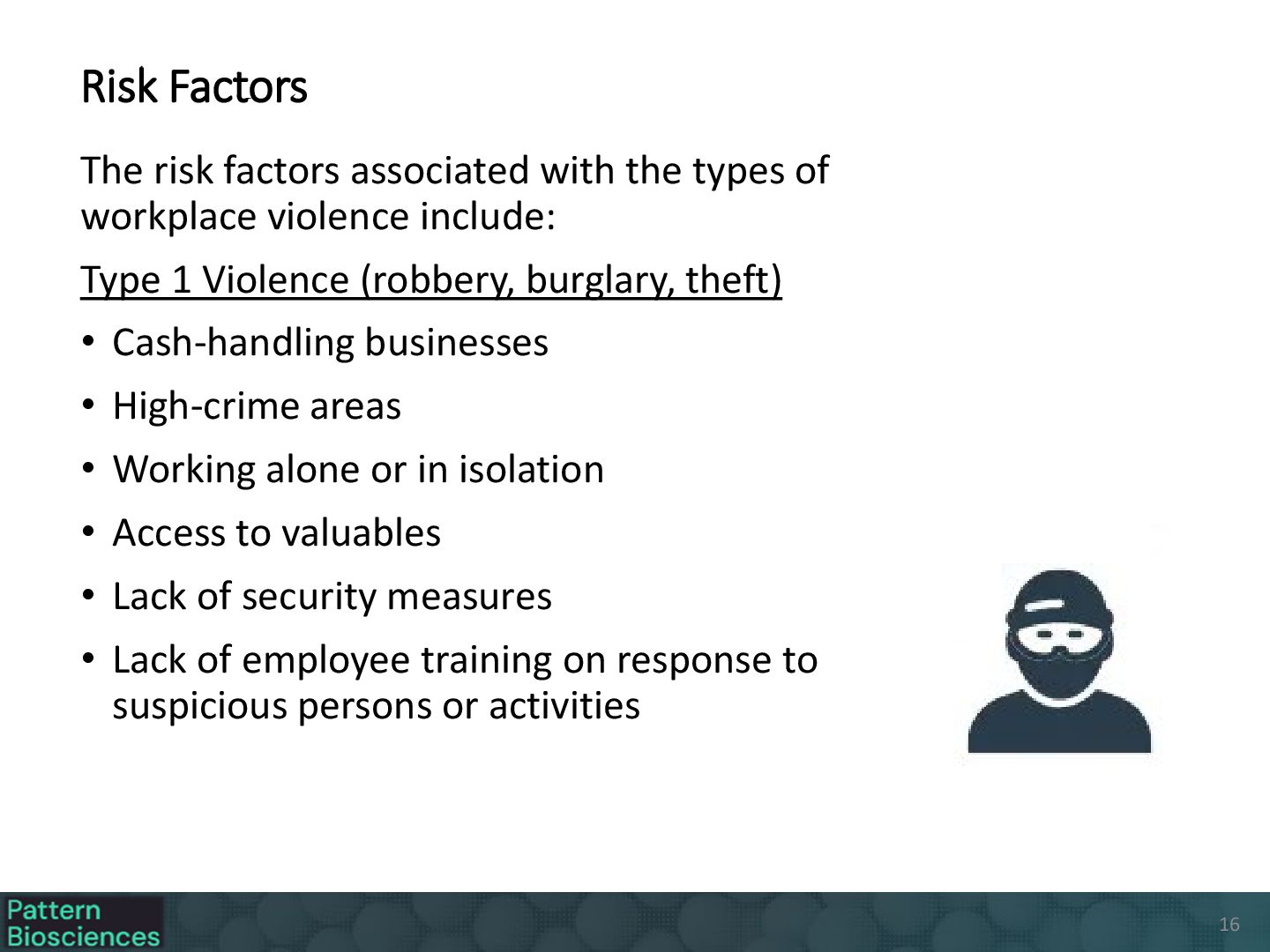
workplace violence include: Type 1 Violence (robbery, burglary, theft) • Cash-handling businesses • High-crime areas • Working alone or in isolation • Access to valuables • Lack of security measures • Lack of employee training on response to suspicious persons or activities 16
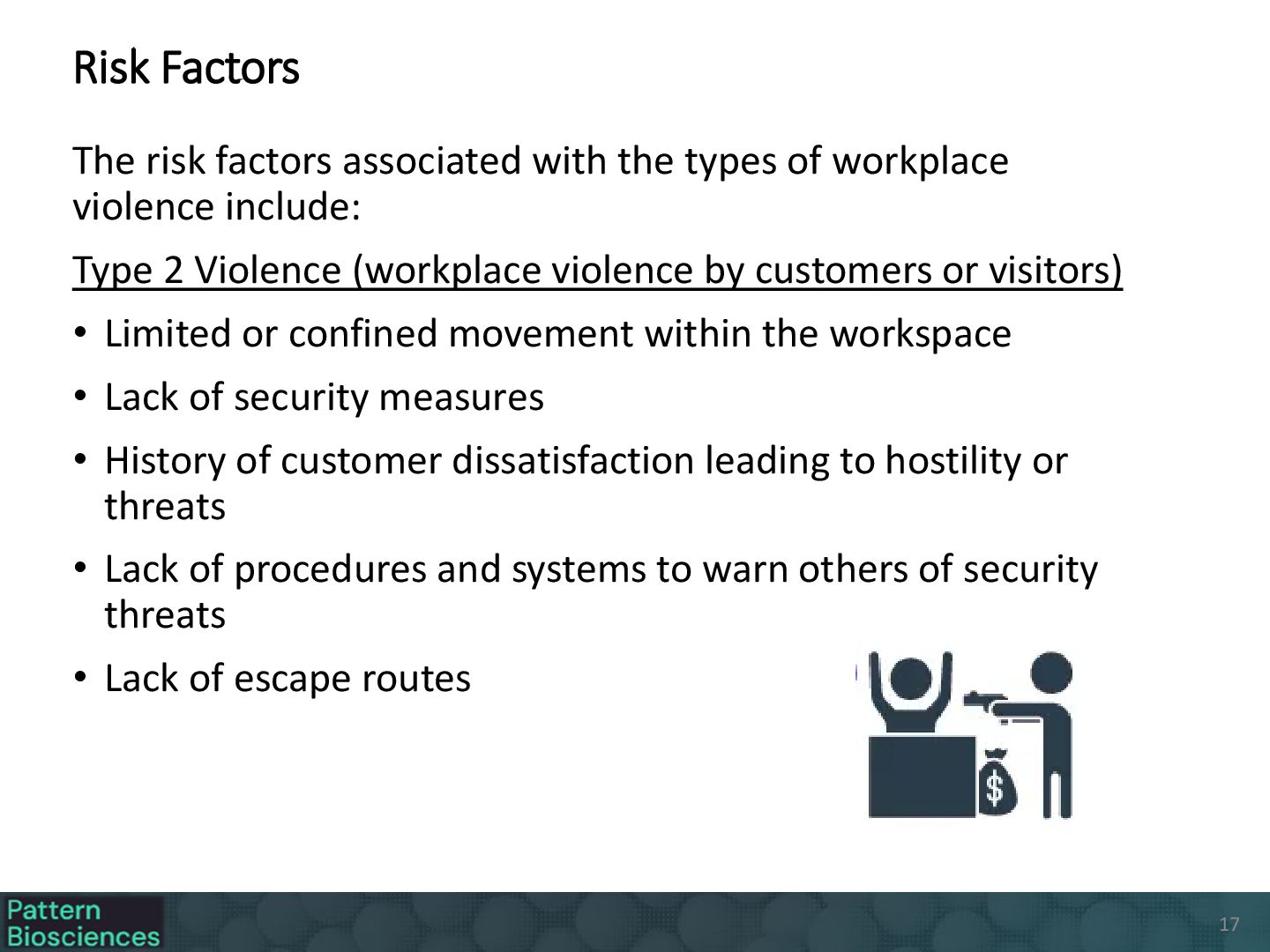
workplace violence include: Type 2 Violence (workplace violence by customers or visitors) • Limited or confined movement within the workspace • Lack of security measures • History of customer dissatisfaction leading to hostility or threats • Lack of procedures and systems to warn others of security threats • Lack of escape routes 17
workplace violence include: Type 3 Violence (workplace violence by present or former employee, supervisor, or manager) • History of worker reports of threats of physical or verbal abuse by managers, supervisors or other workers • History of violent acts, threats of physical violence, verbal abuse, property damage or other signs of strain or pressure in the workplace • Offender’s ability to access and move freely within the workspace • Employees not trained on identifying reportable situations • Lack of communication to employees on the anti-violence policy at Pattern Biosciences 18
workplace violence include: Type 4 Violence (workplace violence by non-employee with personal relationship with an employee) • In addition to the Type 3 risk factors • History of prior threats or violent acts involving physical violence, verbal abuse, property damage or other signs of violence by a person who has a personal relationship with an employee • History of domestic violence situations brought to work • History of worker reports of threats by individuals with history of violent/threatening behavior 19
and related training • Controlling access to the building with keycard access and single lobby entrance. Providing security personnel. Escorting visitors or limiting freedom of movement within the building. • Eliminating areas of employee isolation • Implementing systems to warn others of a security danger or to summon assistance • Posting laws against assault, stalking, or other violent acts • Enforcing the policy of no tolerance for workplace violence • Providing counseling to employees under strain or pressure which may lead to physical or verbal abuse of co-workers 20
threats or acts of violence prohibited under this policy include, but are not limited to, the following: • Hitting or shoving an individual • Threatening to harm an individual or his or her family, friends, associates, or their property • The intentional destruction or threat of destruction of property owned, operated, or controlled by Pattern Biosciences • Making harassing or threatening telephone calls, letters, or other forms of written or electronic communications 21 Examples of Workplace Violence Threats or Acts
employee to do wrongful acts that would affect the health and safety of the employee. • Harassing surveillance, also known as stalking, the willful, malicious, and repeated following of another person and making a credible threat with intent to place the other person in reasonable fear of his or her safety • Making a suggestion that an act to injure persons or property is appropriate, without regard to the location where such suggestion or intimation occurs • Possessing firearms, weapons, or any other dangerous devices on Pattern Biosciences’ property 22 Examples of Workplace Violence Threats or Acts
If you directly encounter an offender at the workplace that is threatening or performing a violent act, use the following strategies to avoid physical harm: • Remain calm and polite • Establish eye contact • Maintain an even tone of voice • Keep a safe distance • Determine an escape route. Upon escaping, shelter in place to a safe location if there is an imminent danger. Keep out of view. 23
violence incident that is an emergency situation, follow these steps: 1. Evacuate the area and shelter in place to a safe location if there is imminent danger. Alert other employees as you evacuate. 2. Call 911 once you are in a safe place. 3. Report the incident to one or both of the Workplace Violence Prevention Safety Coordinators. The Safety Coordinators will immediately notify all employees to evacuate, if not already done. An emergency situation is where there is a potential or known risk of injury or harm, including life-threatening situations. 24
violence incident that is a non- emergency situation: Report the incident immediately to a Safety Coordinator, including the nature and location of the incident. The Safety Coordinator will provide further instructions of how to respond to the incident. 25
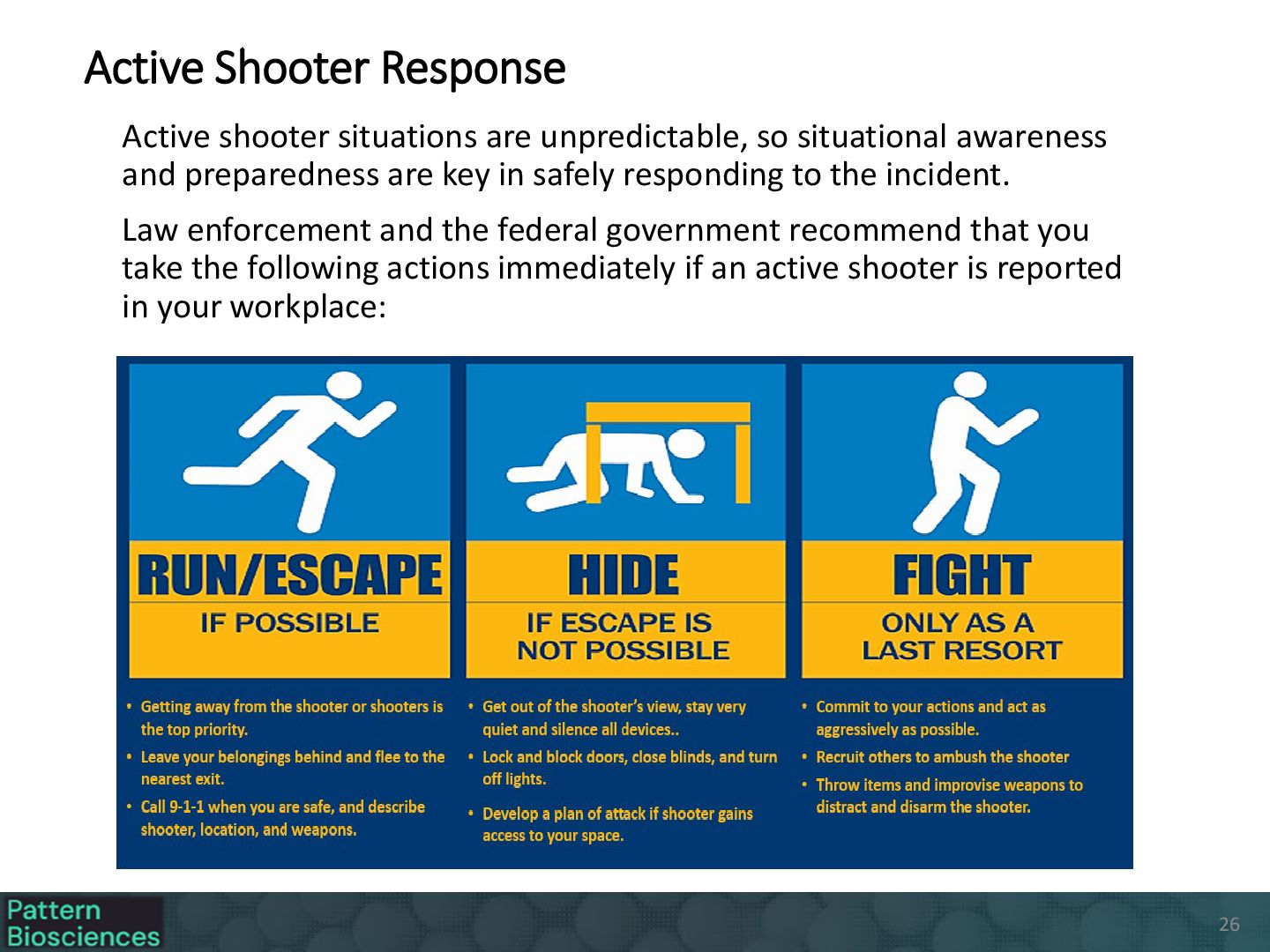
awareness and preparedness are key in safely responding to the incident. Law enforcement and the federal government recommend that you take the following actions immediately if an active shooter is reported in your workplace: 26
to an exit and go to a safe location out of view from any imminent danger. Familiarize yourself with the nearest exit points within the facility before an incident occurs. • Run out of the building and away from the shooter • Every second counts, so leave personal belongings behind. • Encourage coworkers to run with you and DO NOT return to the facility once you are safely away from danger. • Remain at a safe location until law enforcement arrives unless circumstances require you to relocate to a safer area. • Assign a team member to contact the police (911) immediately upon reaching a secure location far from the incident. This individual should be prepared to provide the facility's address, approximate number of assailants (attackers) and building occupants, and any other pertinent details about the situation if available. 27
exits and it’s not safe to run, you should HIDE in the safest possible location. If you are in an exposed area, immediately find an office or room with four walls. Once inside the room, take the following steps: • Encourage others nearby to enter the sheltered room discreetly, avoiding drawing attention with noise. • Once everyone in the immediate vicinity is inside, refrain from leaving the room or opening the door until recognizable law enforcement provides clearance. • Do not exit, even if the fire alarm is activated, as it could be a tactic to prompt evacuation. • Lock the doors to the room, if possible, and close any blinds/shades. • Silence electronics and remain quiet. • Turn off the lights in the shelter room and stay out of view of hallways/windows. • Use available furniture or equipment to barricade the door and seek cover behind any available barriers. Put as many obstacles between yourself and the shooter as possible. • Identify and gather items that could serve as improvised weapons. • Remain in place until given the all clear by identifiable law enforcement. 28
hide, and you are confronted with the shooter, as a last resort you should FIGHT. • Avoid seeking out the shooter for confrontation. • Only fight if absolutely necessary to save lives, including your own. • If unarmed, search for improvised weapons nearby. • If with others, quickly plan a coordinated attack if time allows. • Act aggressively, targeting vulnerable areas (e.g., groin, eyes, throat) until the shooter is incapacitated. • Once the shooter is subdued or injured, focus on leaving the facility swiftly. 29
to the building, employees are to shelter in place in an office away from windows or in a storage closet with the lights turned off and the door(s) locked. Employees are to silence their cell phones and stay alert for any emergency communication(s). Employees should continue to shelter in place until emergency services instruct otherwise. 30
report the incident in writing to a Safety Coordinator, including the time, location, individuals involved, and any witness(es). The Safety Coordinators will document incidents on the Workplace Violence Incident Report Log (located in Appendix 2 of the WVPP). Employees should report workplace violence incidents, threats, or other workplace violence concerns to the Safety Coordinators. Employees will NOT be retaliated against by management or any employee, including the person making the threat, for reporting a workplace violence incident, threat, or concern. Retaliation is strictly prohibited. 31
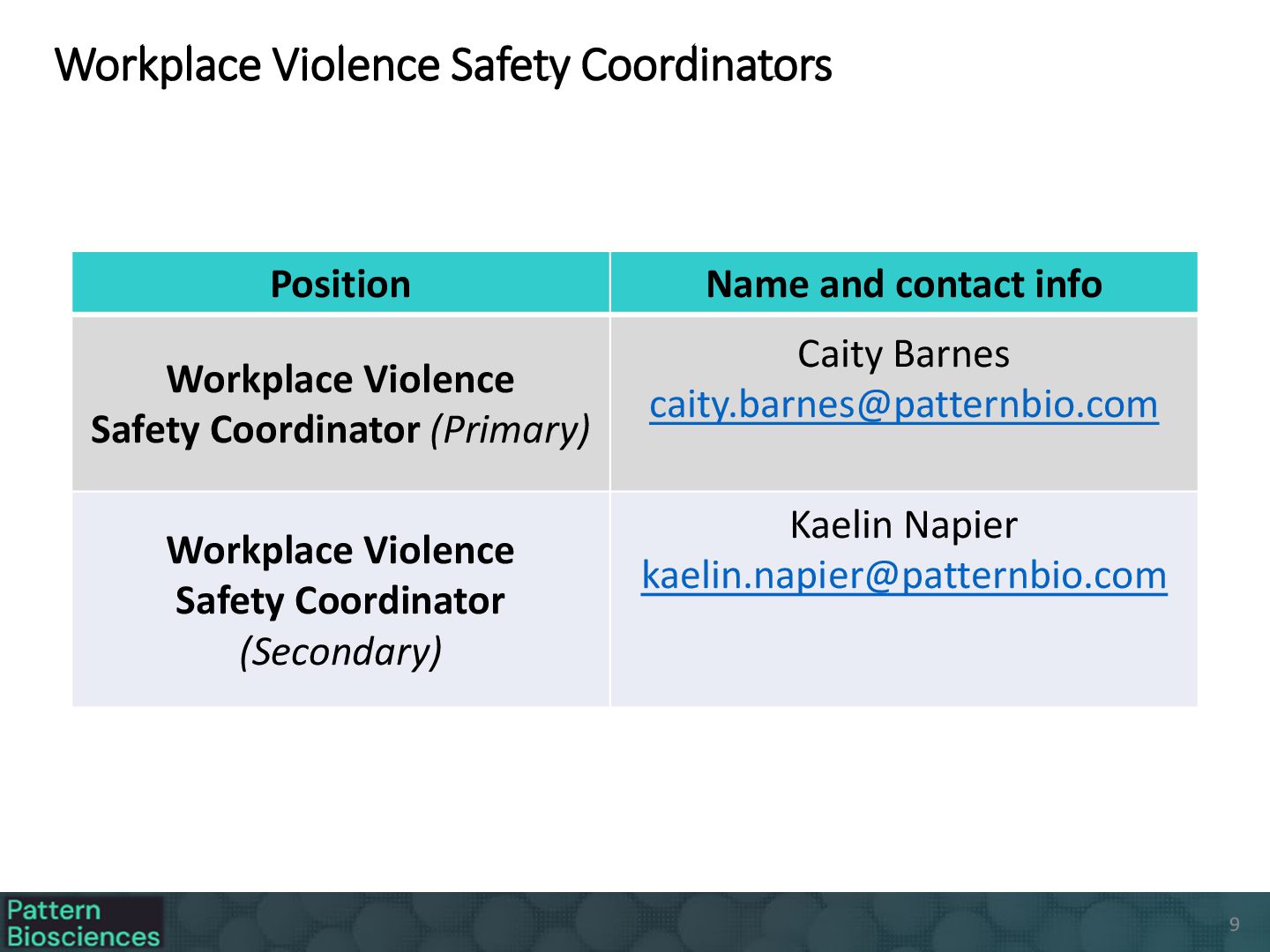
Violence Safety Coordinator (Secondary) Kaelin Napier [email protected] If you have any questions or comments regarding the content of this training, please contact the Safety Coordinators: You Have Completed this Training Course


 occserv
 sferik
 axbom
axbom
 aarron
 marcoroth
 ipullrank
 rocio
rocio
 katiecoart
 reverentgeek
 ryanjones
 pauljervisheath
 maggiecrowley
 philnash

![32 Workplace Violence Safety Coordinator (Primary) Caity Barnes [email protected] Workplace](https://files.speakerdeck.com/presentations/081e645e33524e18b2127f6aa321df74/slide_31.jpg)