protocol for specifying and controlling network traffic by class so that certain types of traffic get precedence - for example, voice traffic, which requires a relatively uninterrupted flow of data, might get precedence over other kinds of traffic. l DSCP is defined in RFC 2474 "Definition of the Differentiated Services Field (DS field) in the IPv4 and IPv6 Headers” l DSCP for Tunnels is governed by RFC 2983 "Differentiated Services and Tunnels" What is DSCP?
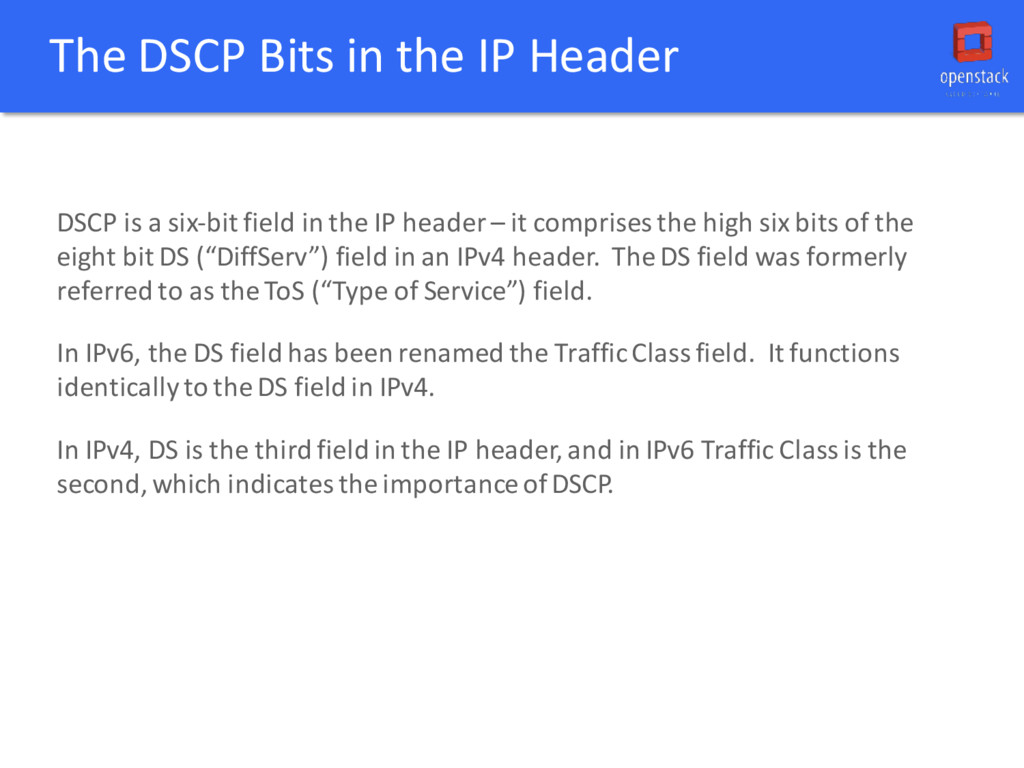
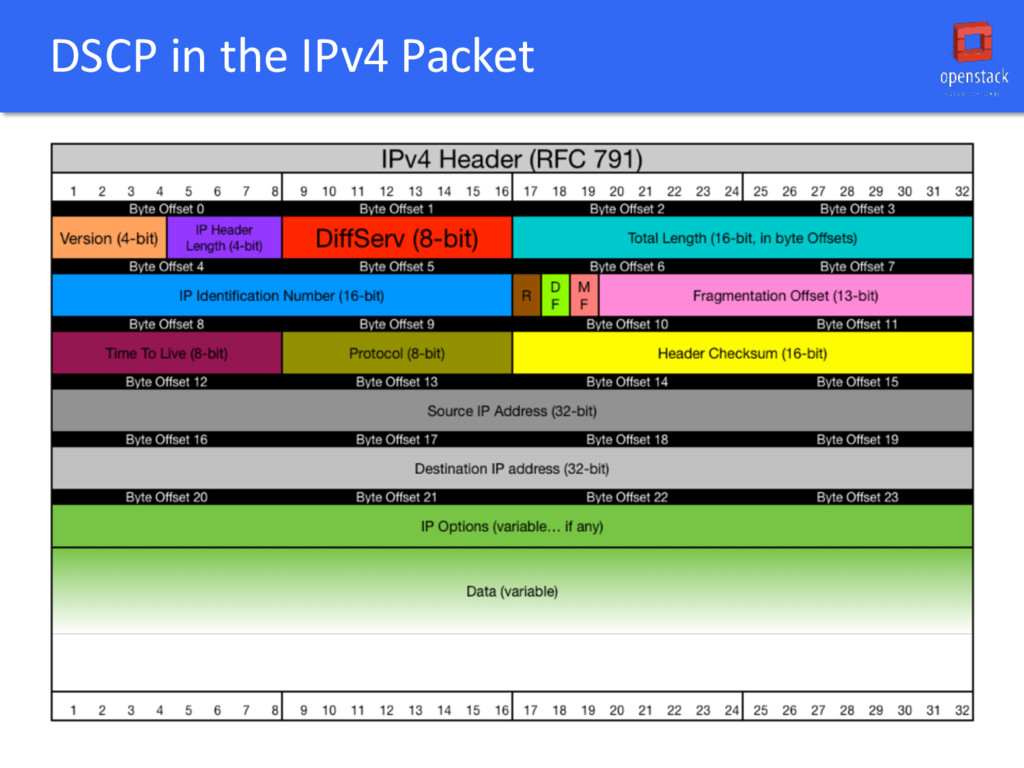
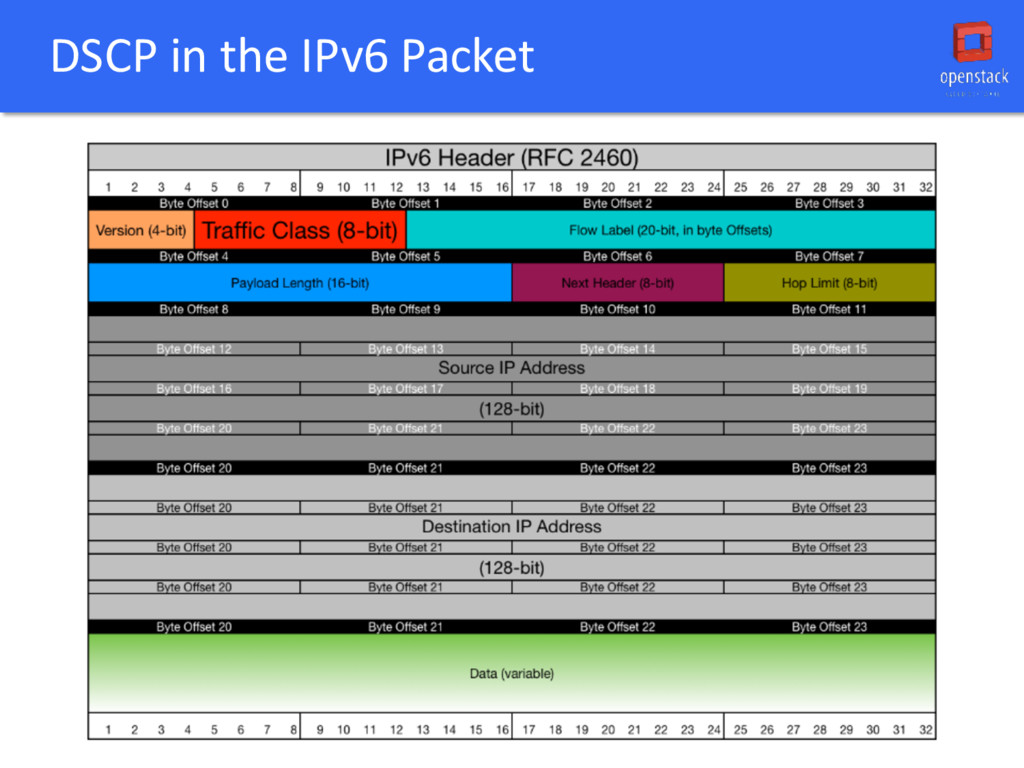
it comprises the high six bits of the eight bit DS (“DiffServ”) field in an IPv4 header. The DS field was formerly referred to as the ToS (“Type of Service”) field. In IPv6, the DS field has been renamed the Traffic Class field. It functions identically to the DS field in IPv4. In IPv4, DS is the third field in the IP header, and in IPv6 Traffic Class is the second, which indicates the importance of DSCP. The DSCP Bits in the IP Header
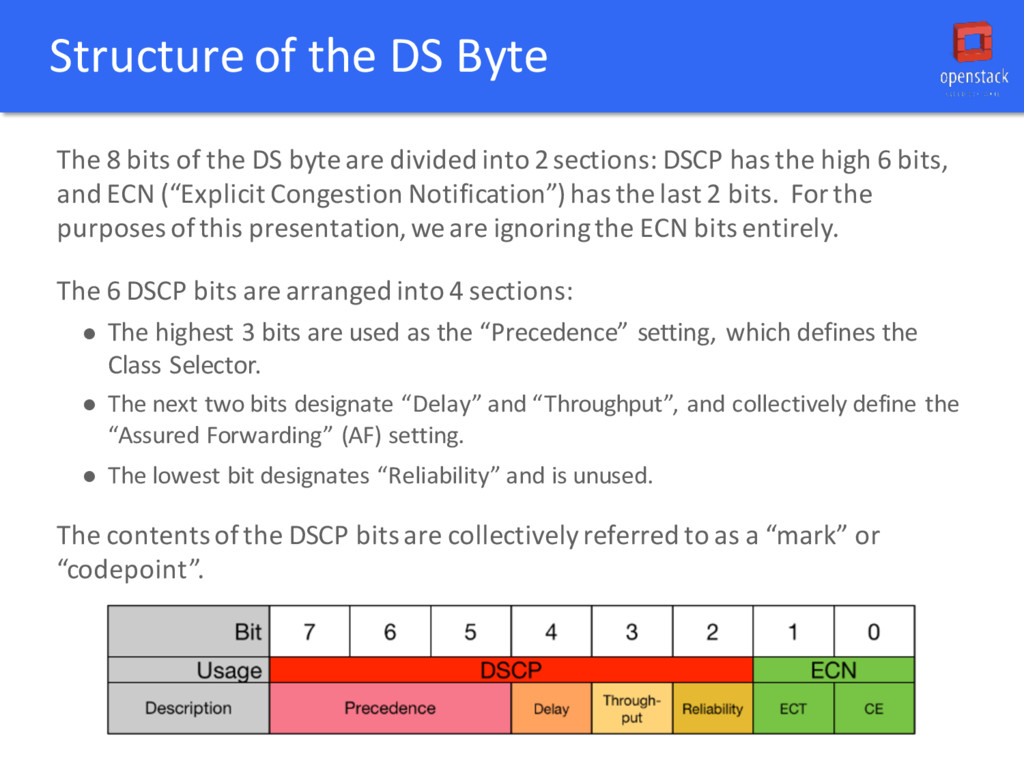
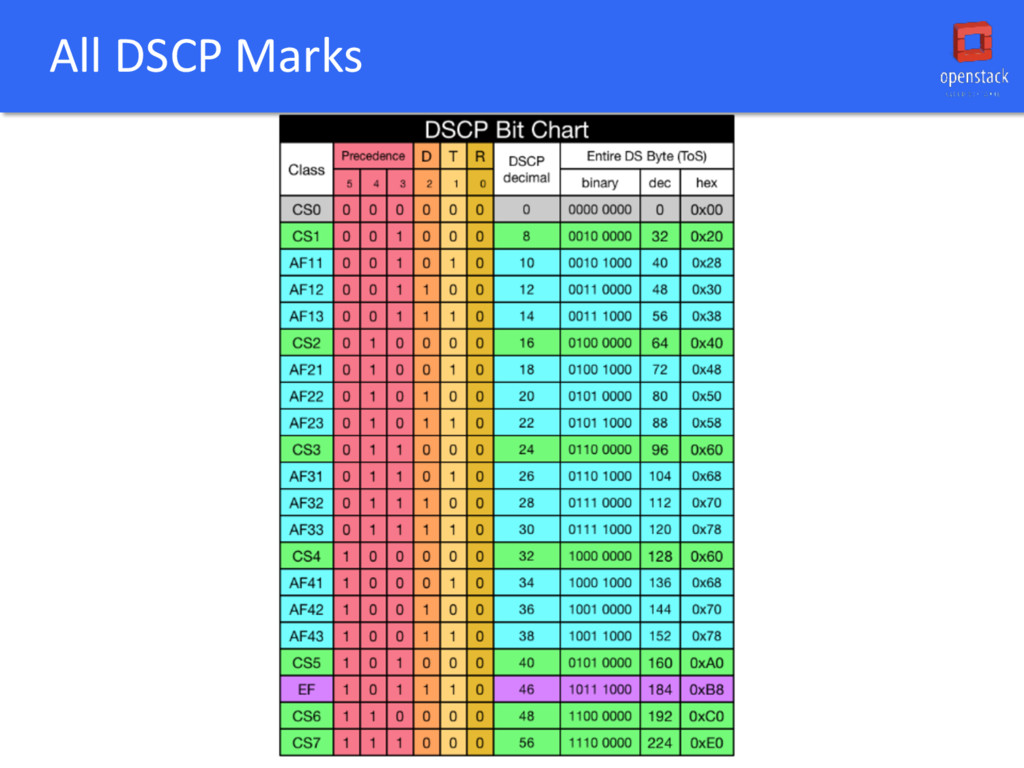
2 sections: DSCP has the high 6 bits, and ECN (“Explicit Congestion Notification”) has the last 2 bits. For the purposes of this presentation, we are ignoring the ECN bits entirely. The 6 DSCP bits are arranged into 4 sections: l The highest 3 bits are used as the “Precedence” setting, which defines the Class Selector. l The next two bits designate “Delay” and “Throughput”, and collectively define the “Assured Forwarding” (AF) setting. l The lowest bit designates “Reliability” and is unused. The contents of the DSCP bits are collectively referred to as a “mark” or “codepoint”. Structure of the DS Byte
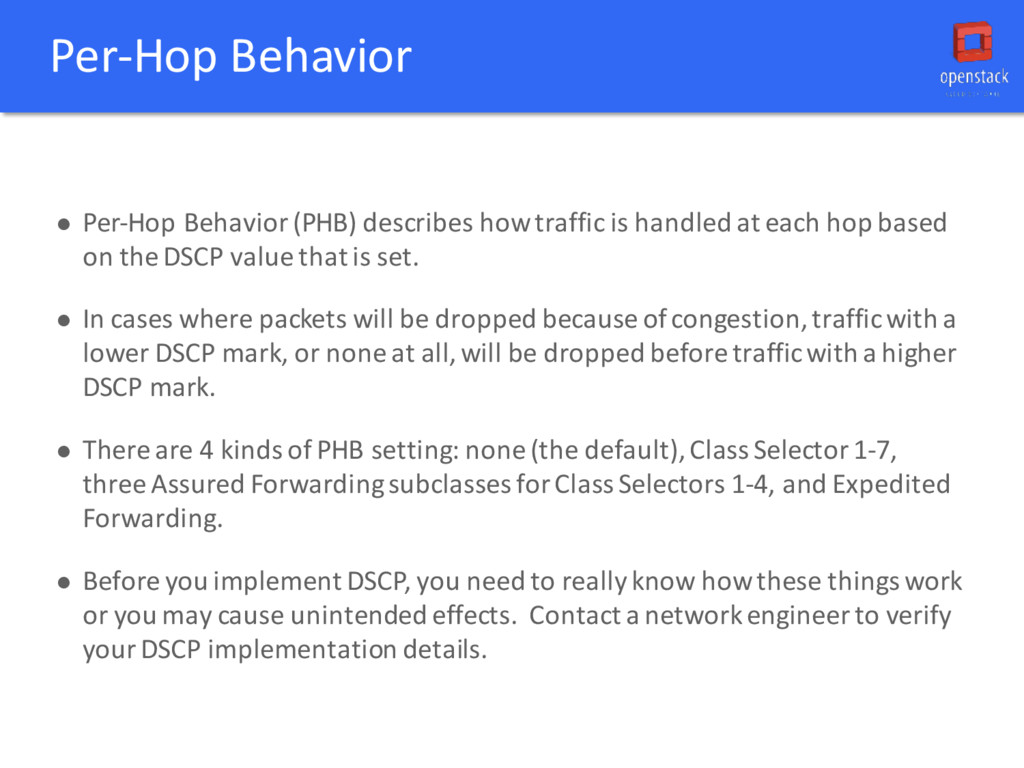
each hop based on the DSCP value that is set. l In cases where packets will be dropped because of congestion, traffic with a lower DSCP mark, or none at all, will be dropped before traffic with a higher DSCP mark. l There are 4 kinds of PHB setting: none (the default), Class Selector 1-7, three Assured Forwarding subclasses for Class Selectors 1-4, and Expedited Forwarding. l Before you implement DSCP, you need to really know how these things work or you may cause unintended effects. Contact a network engineer to verify your DSCP implementation details. Per-Hop Behavior
that all traffic has equal priority and an equal chance of being delivered in a timely manner. When congestion occurs, all traffic has an equal chance of being dropped. DSCP allows you to select specific network traffic for prioritization according to its relative importance and use congestion-management and congestion- avoidance techniques to provide preferential treatment. This is what DSCP was designed for. Use Case 1: Preferential Treatment Under Congestion
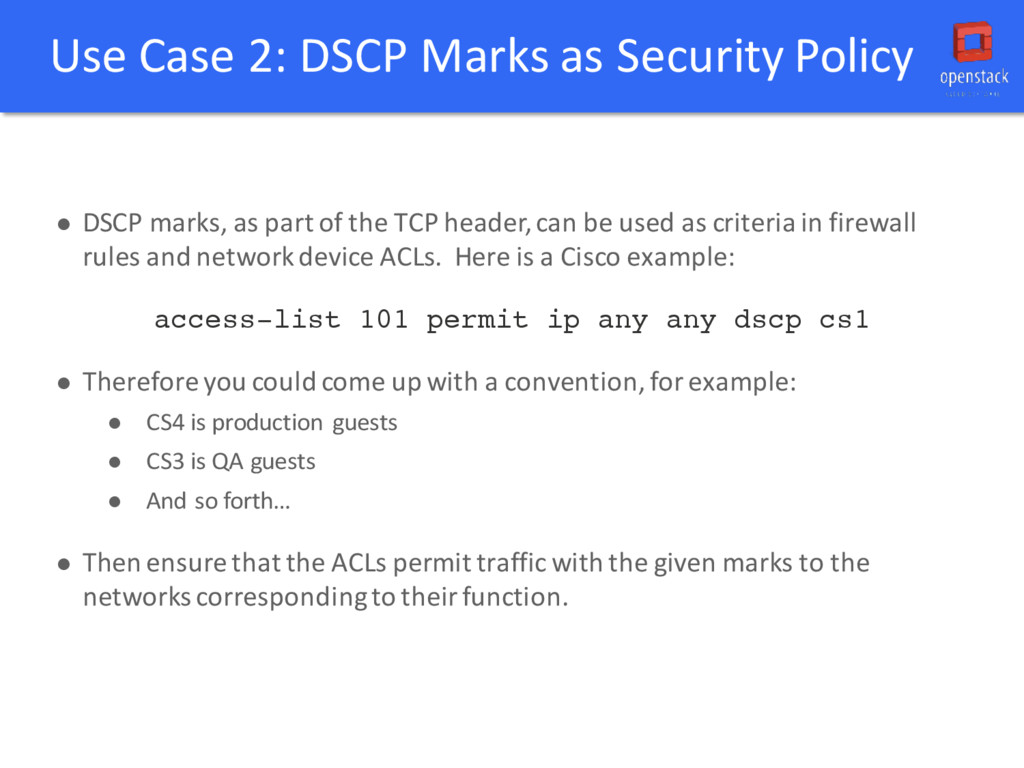
be used as criteria in firewall rules and network device ACLs. Here is a Cisco example: access-list 101 permit ip any any dscp cs1 l Therefore you could come up with a convention, for example: l CS4 is production guests l CS3 is QA guests l And so forth… l Then ensure that the ACLs permit traffic with the given marks to the networks corresponding to their function. Use Case 2: DSCP Marks as Security Policy
Mitaka release of Neutron because of last minute issues. Those issues have been resolved, and the DSCP changes have been merged into Neutron master. DSCP functionality will be available in the Newton release. Newton
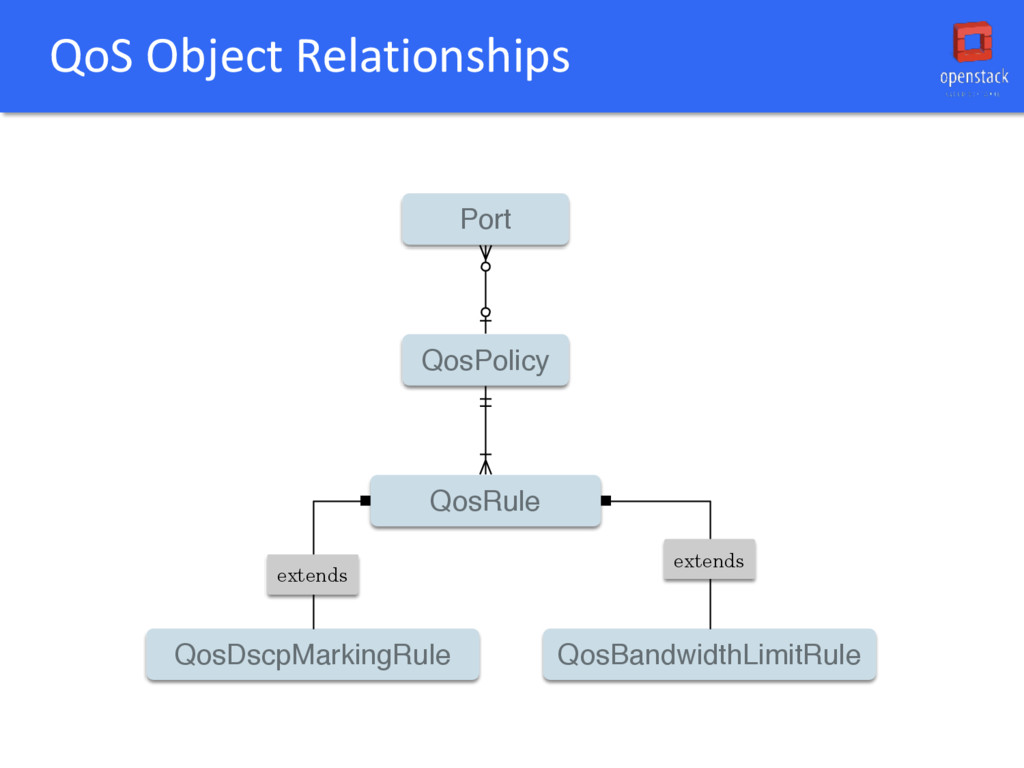
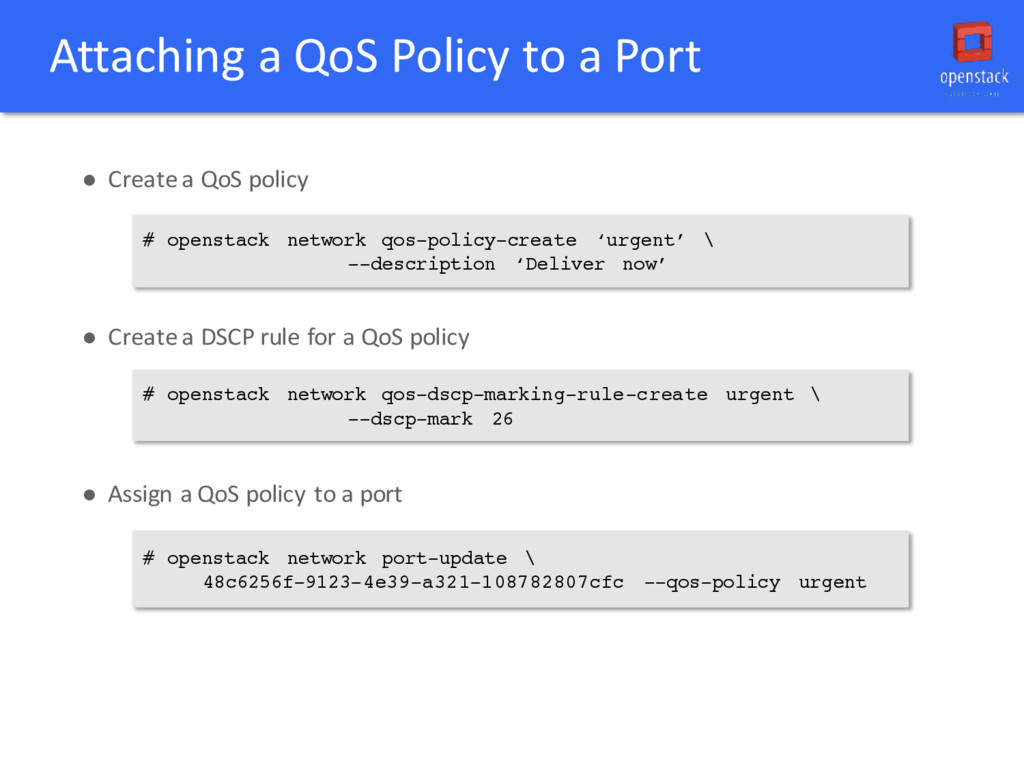
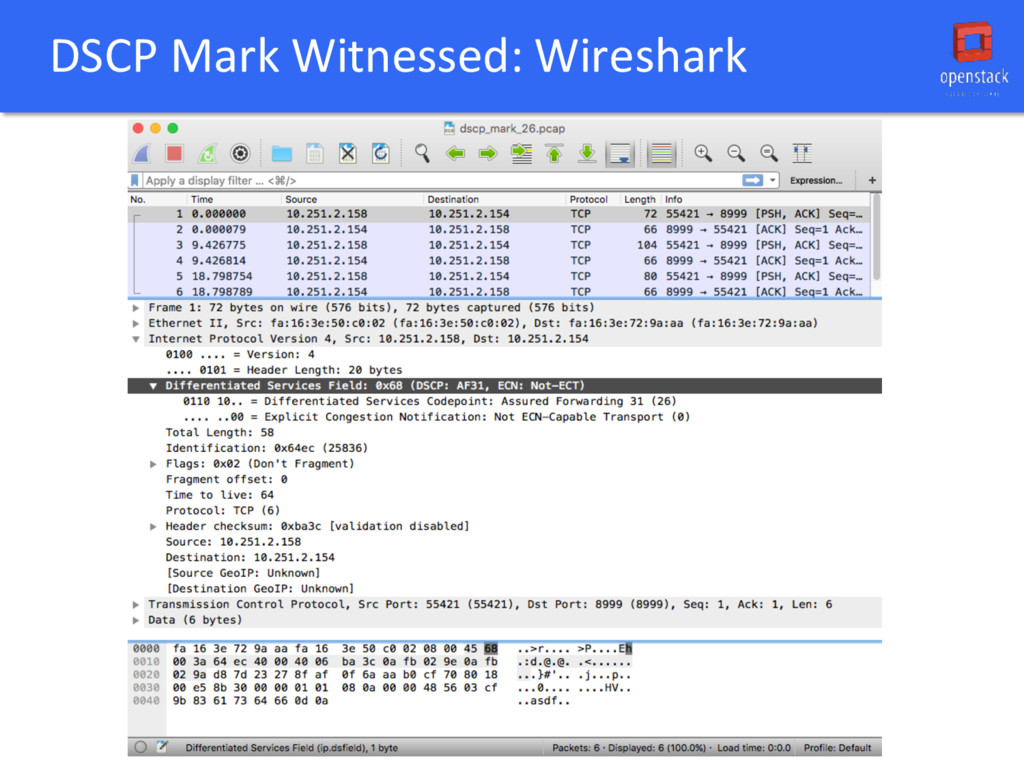
for a QoS policy l Assign a QoS policy to a port Attaching a QoS Policy to a Port # openstack network qos-policy-create ‘urgent’ \ --description ‘Deliver now’ # openstack network qos-dscp-marking-rule-create urgent \ --dscp-mark 26 # openstack network port-update \ 48c6256f-9123-4e39-a321-108782807cfc --qos-policy urgent
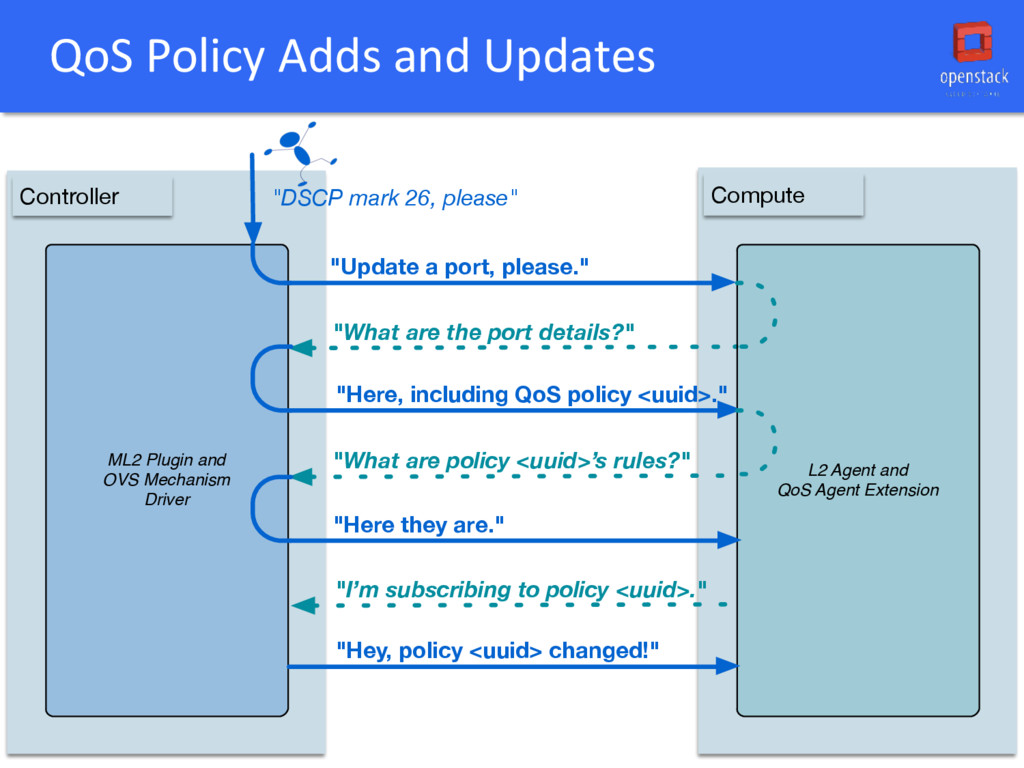
"Update a port, please." "What are the port details?" Compute ML2 Plugin and OVS Mechanism Driver L2 Agent and QoS Agent Extension "Here, including QoS policy <uuid>." "What are policy <uuid>’s rules?" "Here they are." "I’m subscribing to policy <uuid>." "Hey, policy <uuid> changed!"
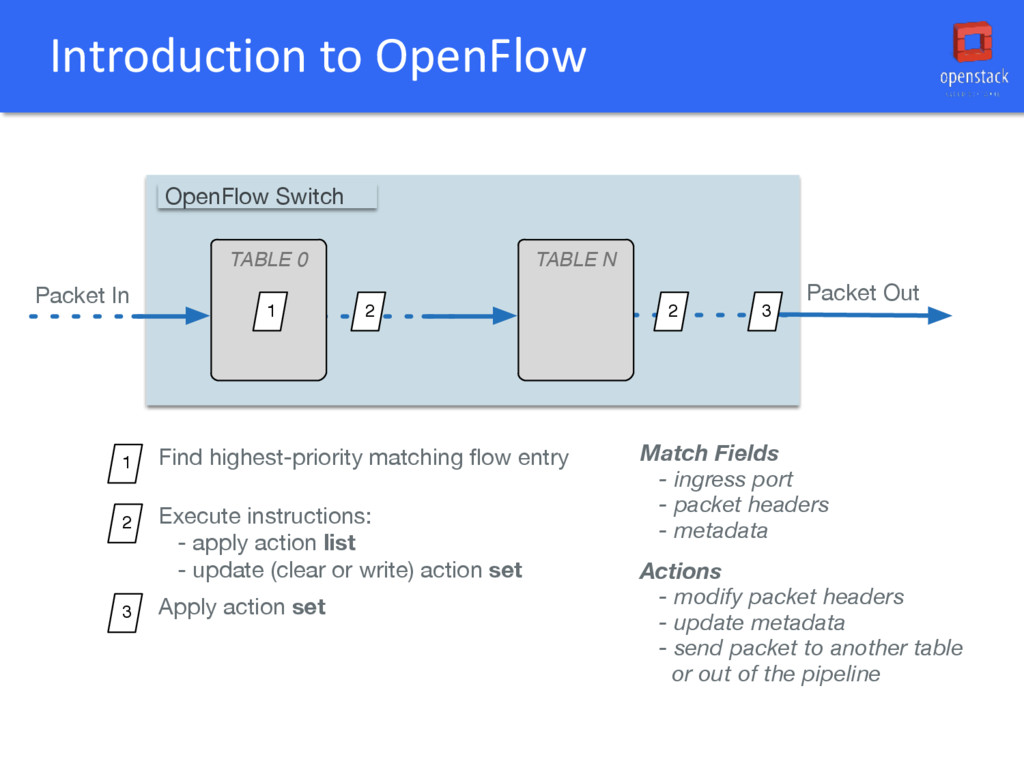
0 1 Find highest-priority matching flow entry 2 Execute instructions: - apply action list - update (clear or write) action set 3 Apply action set Match Fields - ingress port - packet headers - metadata Actions - modify packet headers - update metadata - send packet to another table or out of the pipeline 2 2 3 1 1 TABLE N
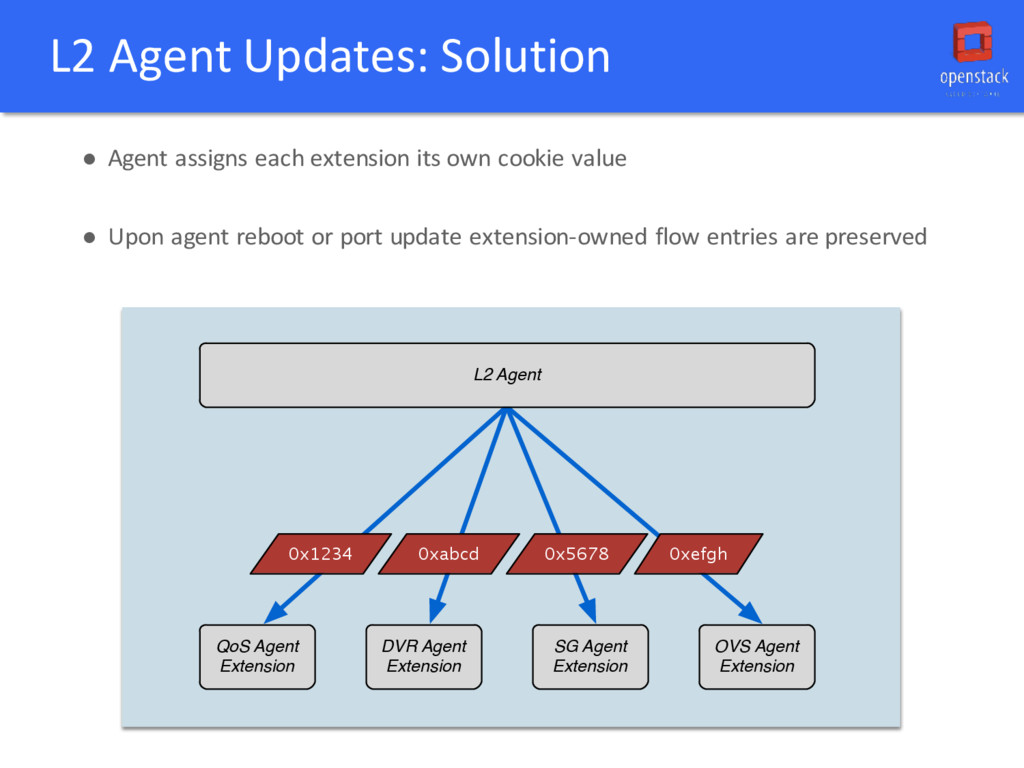
as the cookie value in OVS flow entries l When an L2 agent reboots, modifies a port or updates a firewall it removes any flows which flow_cookie_value != my_session_ID l Because L2 agent extensions, such as the QoS extension, manage their own OVS flow entries, the challenge is to ensure that an agent does not remove extensions’ flow entries L2 Agent Updates: Challenges
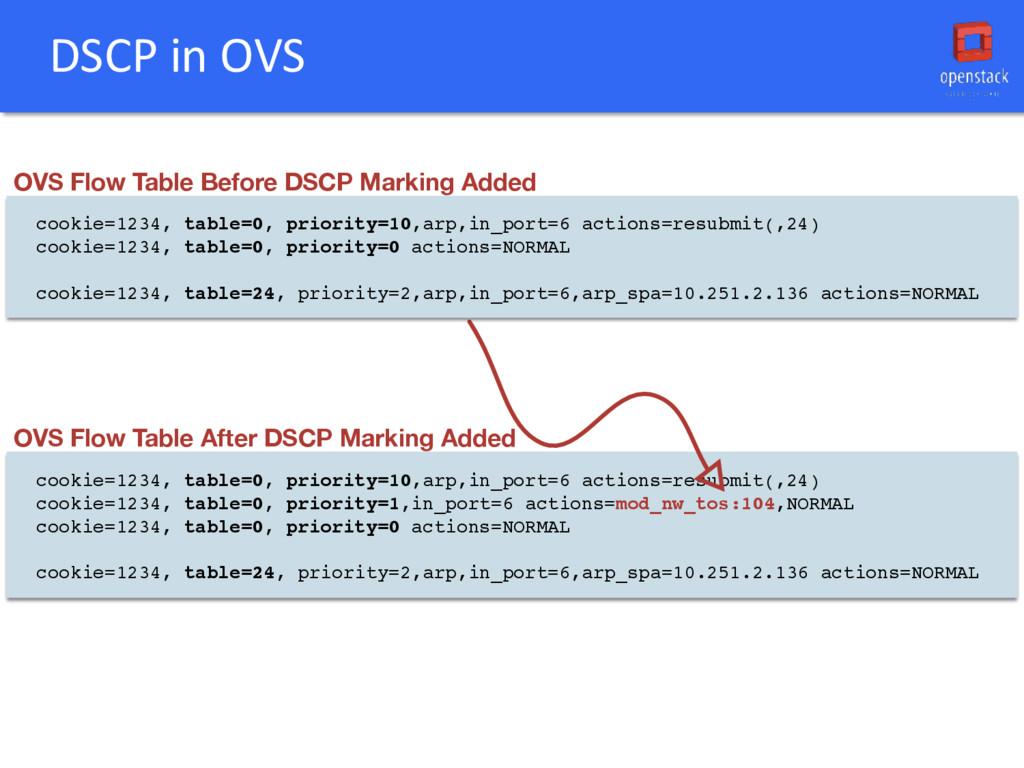
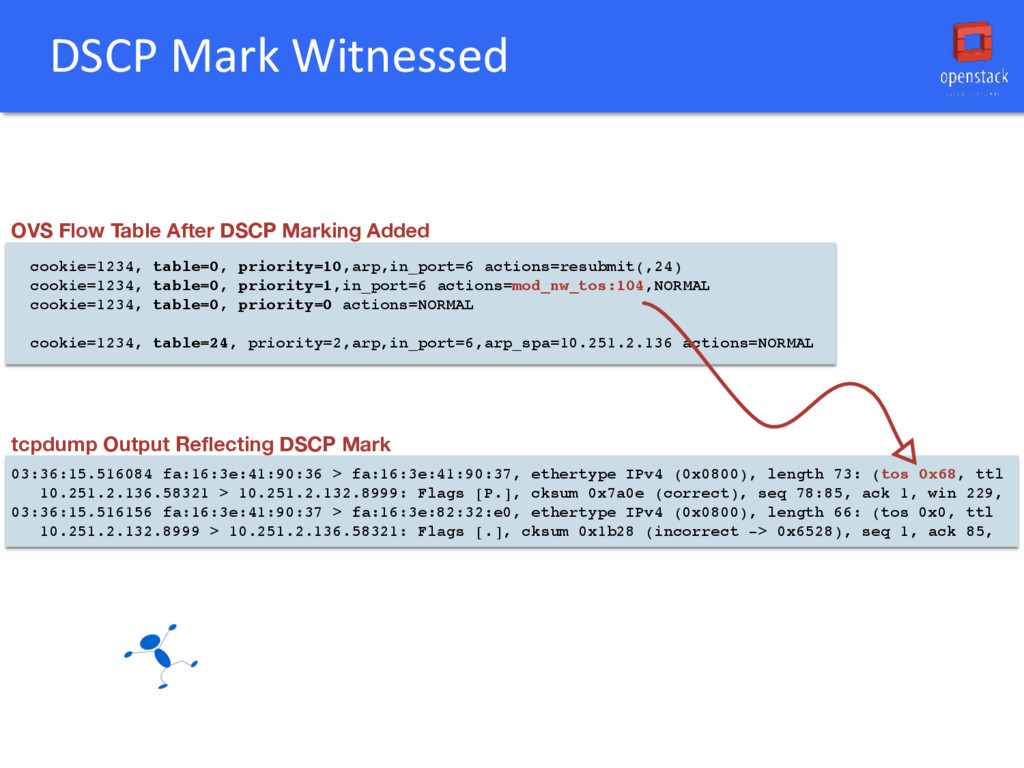
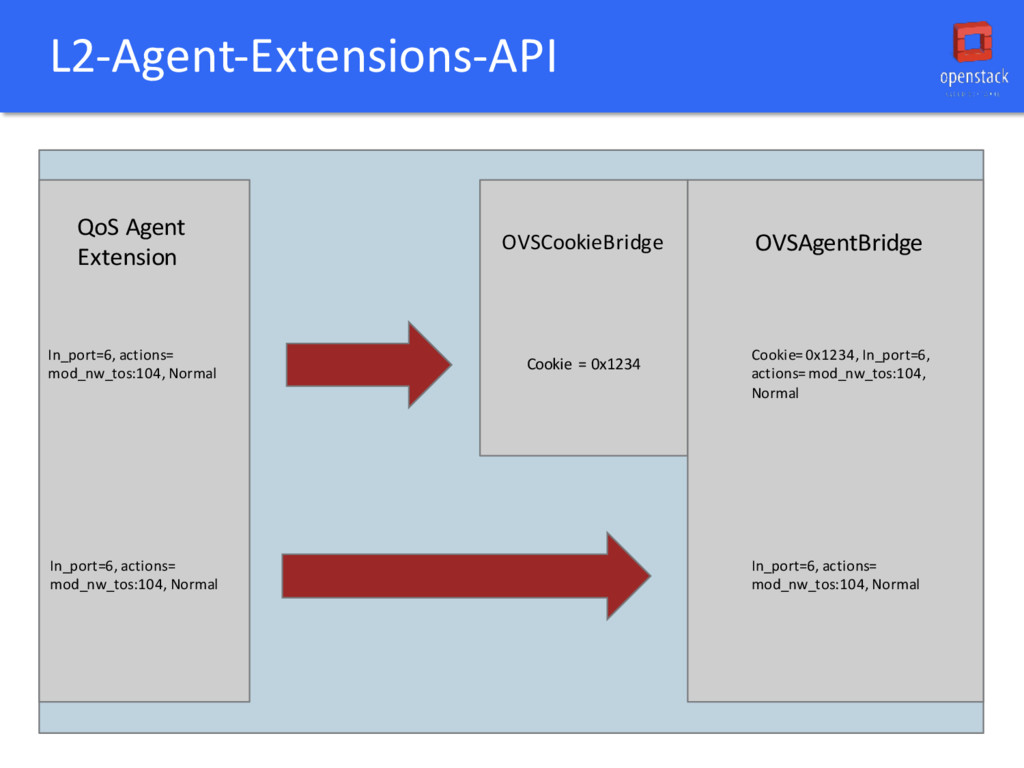
actions= mod_nw_tos:104, Normal In_port=6, actions= mod_nw_tos:104, Normal In_port=6, actions= mod_nw_tos:104, Normal Cookie= 0x1234, In_port=6, actions= mod_nw_tos:104, Normal
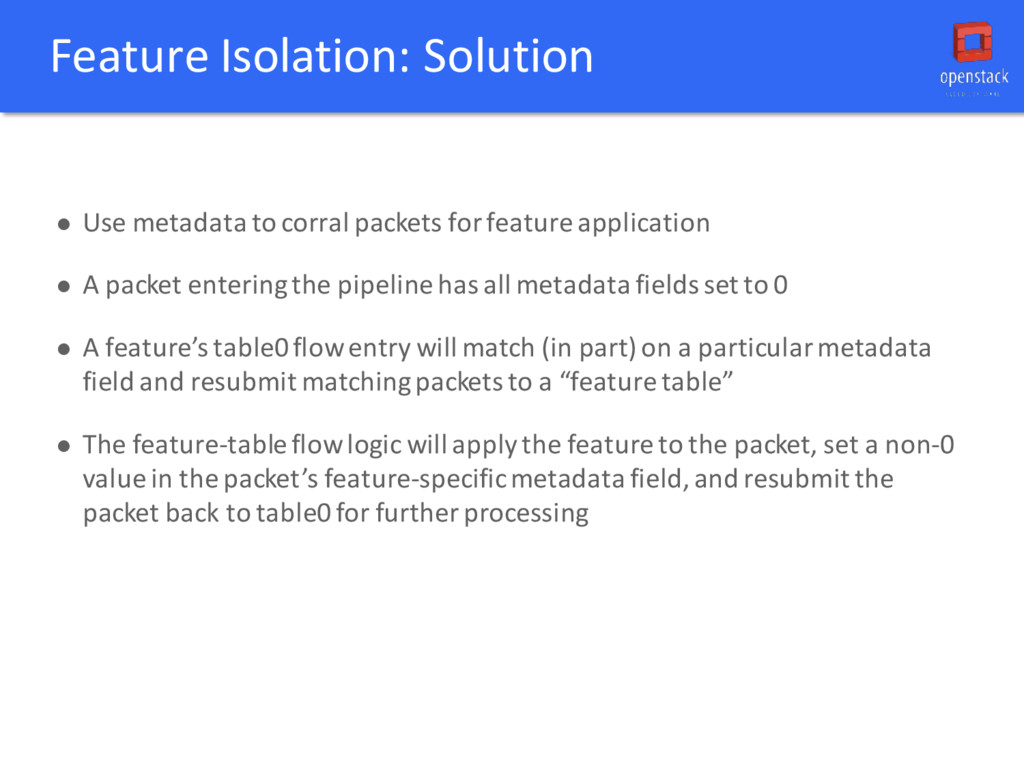
apply multiple features (e.g., DSCP marking and VLAN tagging) to a single packet l We need to ensure that a feature doesn’t hijack other OVS processing by removing a packet from the pipeline l We need to ensure that feature flows don’t affect, and aren’t affected by, any other pipeline processing, including any existing or future features Feature Isolation: Challenges
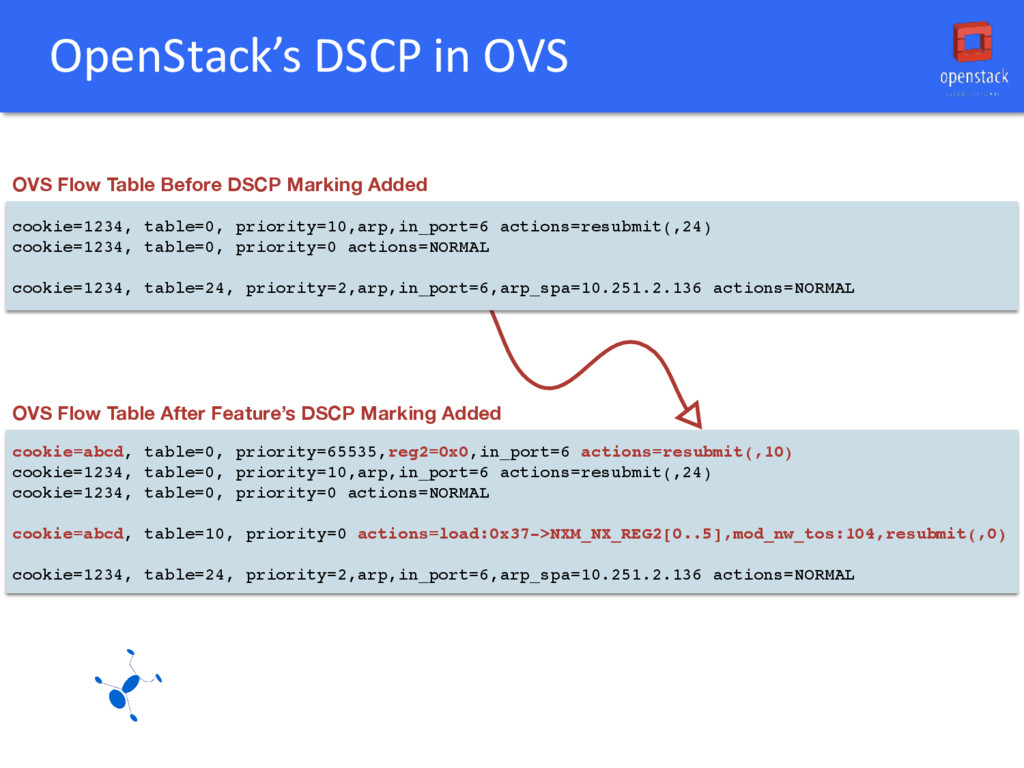
A packet entering the pipeline has all metadata fields set to 0 l A feature’s table0 flow entry will match (in part) on a particular metadata field and resubmit matching packets to a “feature table” l The feature-table flow logic will apply the feature to the packet, set a non-0 value in the packet’s feature-specific metadata field, and resubmit the packet back to table0 for further processing Feature Isolation: Solution
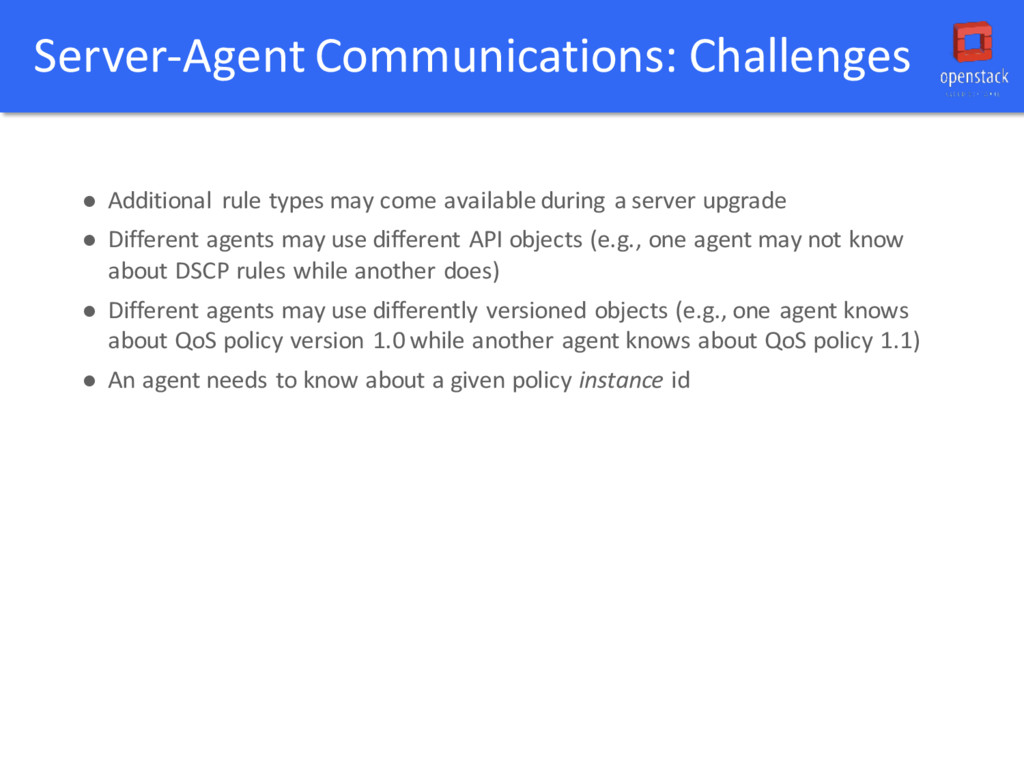
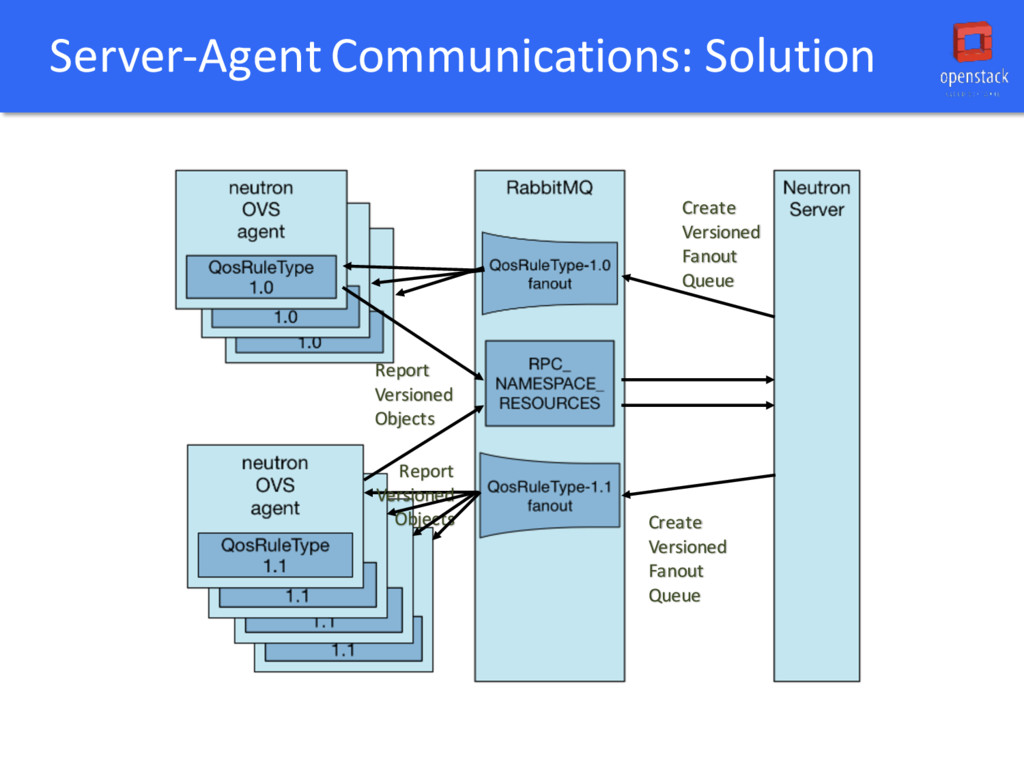
upgrade l Different agents may use different API objects (e.g., one agent may not know about DSCP rules while another does) l Different agents may use differently versioned objects (e.g., one agent knows about QoS policy version 1.0 while another agent knows about QoS policy 1.1) l An agent needs to know about a given policy instance id Server-Agent Communications: Challenges
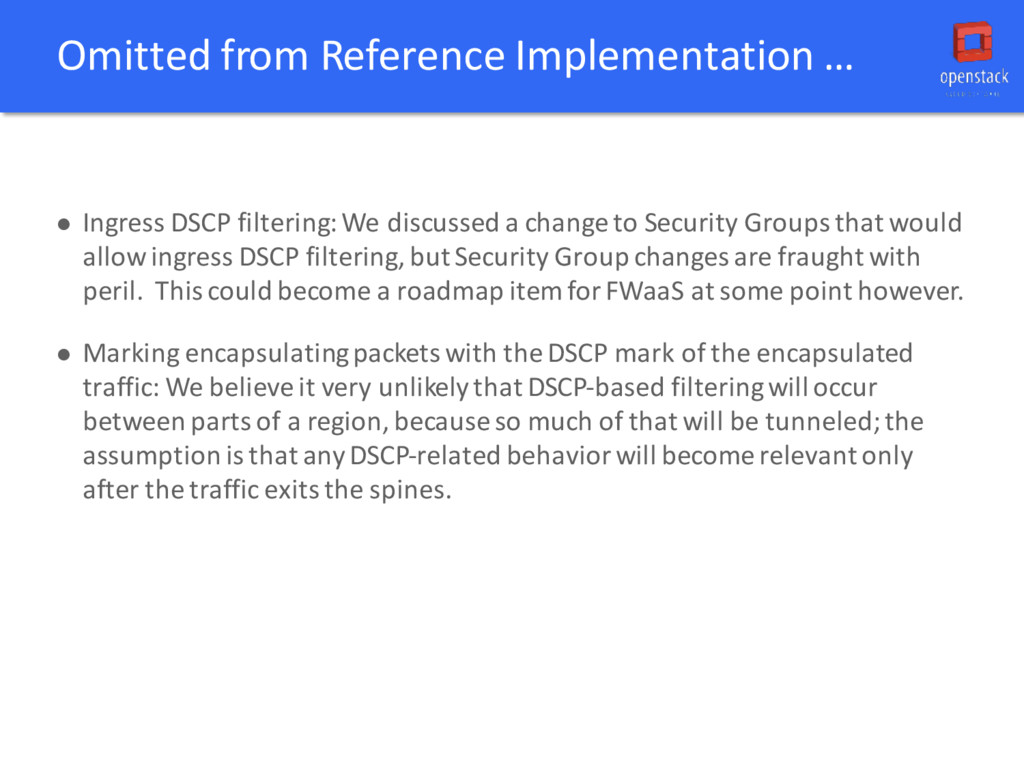
Groups that would allow ingress DSCP filtering, but Security Group changes are fraught with peril. This could become a roadmap item for FWaaS at some point however. l Marking encapsulating packets with the DSCP mark of the encapsulated traffic: We believe it very unlikely that DSCP-based filtering will occur between parts of a region, because so much of that will be tunneled; the assumption is that any DSCP-related behavior will become relevant only after the traffic exits the spines. Omitted from Reference Implementation …
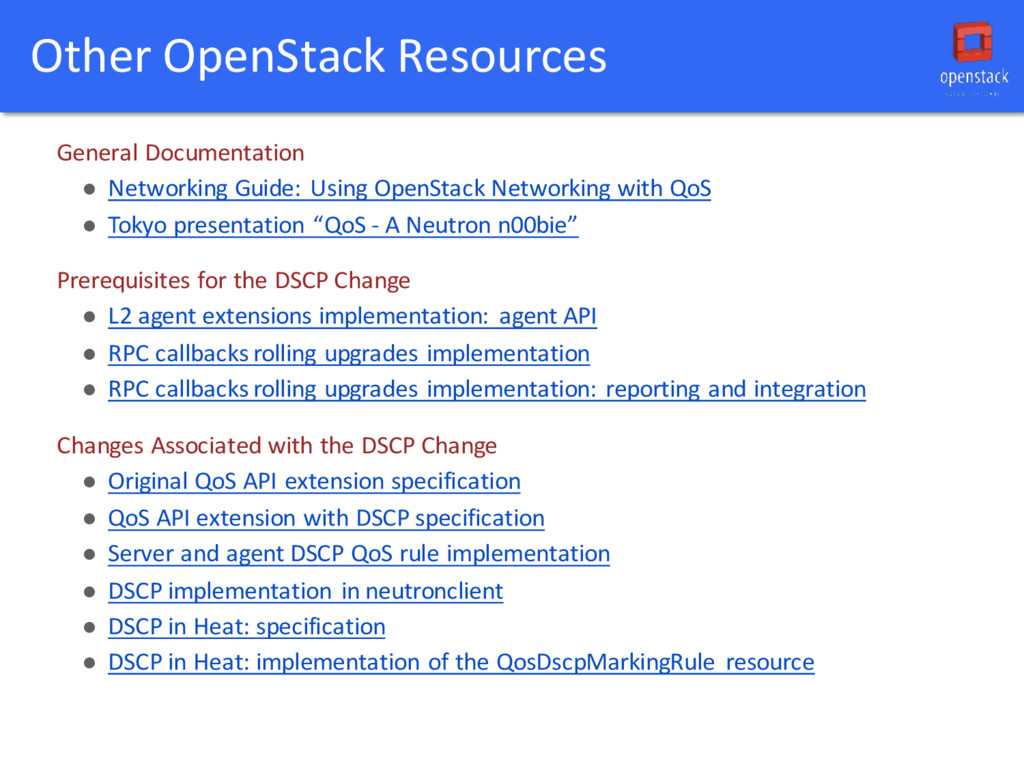
l Tokyo presentation “QoS - A Neutron n00bie” Prerequisites for the DSCP Change l L2 agent extensions implementation: agent API l RPC callbacks rolling upgrades implementation l RPC callbacks rolling upgrades implementation: reporting and integration Changes Associated with the DSCP Change l Original QoS API extension specification l QoS API extension with DSCP specification l Server and agent DSCP QoS rule implementation l DSCP implementation in neutronclient l DSCP in Heat: specification l DSCP in Heat: implementation of the QosDscpMarkingRule resource Other OpenStack Resources
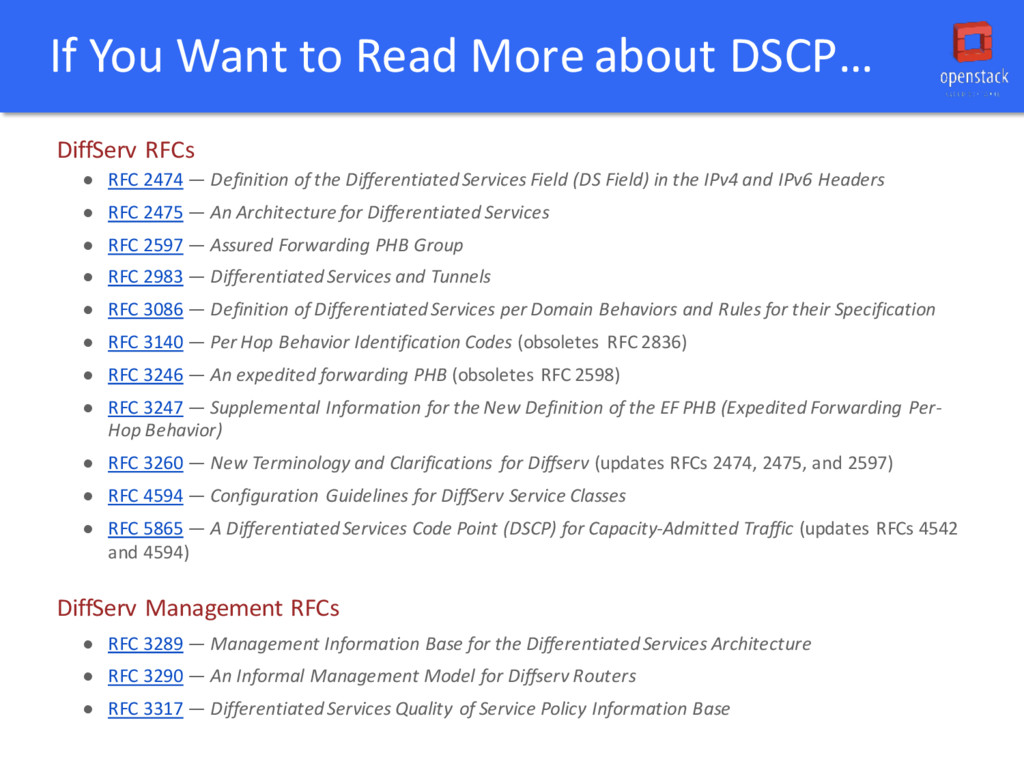
Services Field (DS Field) in the IPv4 and IPv6 Headers l RFC 2475 — An Architecture for Differentiated Services l RFC 2597 — Assured Forwarding PHB Group l RFC 2983 — Differentiated Services and Tunnels l RFC 3086 — Definition of Differentiated Services per Domain Behaviors and Rules for their Specification l RFC 3140 — Per Hop Behavior Identification Codes (obsoletes RFC 2836) l RFC 3246 — An expedited forwarding PHB (obsoletes RFC 2598) l RFC 3247 — Supplemental Information for the New Definition of the EF PHB (Expedited Forwarding Per- Hop Behavior) l RFC 3260 — New Terminology and Clarifications for Diffserv (updates RFCs 2474, 2475, and 2597) l RFC 4594 — Configuration Guidelines for DiffServ Service Classes l RFC 5865 — A Differentiated Services Code Point (DSCP) for Capacity-Admitted Traffic (updates RFCs 4542 and 4594) DiffServ Management RFCs l RFC 3289 — Management Information Base for the Differentiated Services Architecture l RFC 3290 — An Informal Management Model for Diffserv Routers l RFC 3317 — Differentiated Services Quality of Service Policy Information Base If You Want to Read More about DSCP…
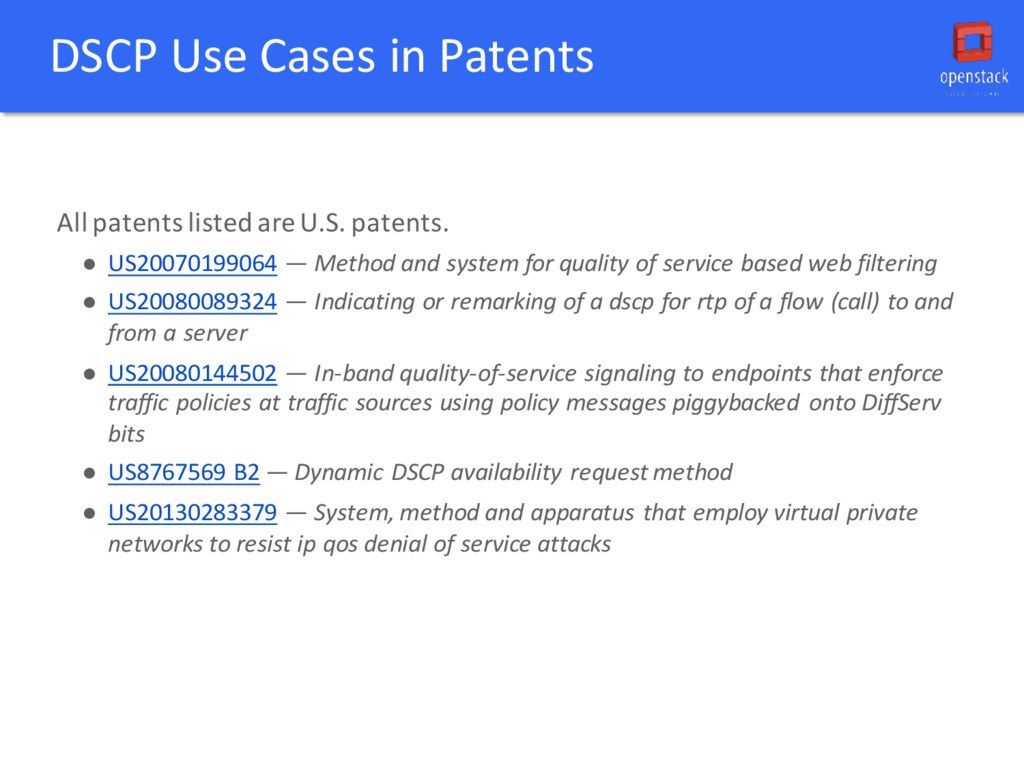
and system for quality of service based web filtering l US20080089324 — Indicating or remarking of a dscp for rtp of a flow (call) to and from a server l US20080144502 — In-band quality-of-service signaling to endpoints that enforce traffic policies at traffic sources using policy messages piggybacked onto DiffServ bits l US8767569 B2 — Dynamic DSCP availability request method l US20130283379 — System, method and apparatus that employ virtual private networks to resist ip qos denial of service attacks DSCP Use Cases in Patents


 endonanana
 kenichiodo
 koukihosaka
 persolserverworks
 kentapapa
 iktakahiro
 riyaamemiya
 tomokusaba
 genda
 shumei_ito
 kaminashi
 pfn
 holman
 iamctodd
 madoxten
 smashingmag
 maltzj
 michaelherold
 akademiya2063
 techseoconnect
 signer
 cromwellryan
 akashhashmi
 elsirapls