Upgrade to Pro — share decks privately, control downloads, hide ads and more …

devops training

Avatar for Pushpa Pushpa Pushpa Pushpa
June 12, 2026
0

devops training

Technology is changing every day. Companies need faster software delivery, better collaboration, and reliable systems — driving surging demand for DevOps professionals across industries. This guide explores the importance of DevOps training, its key concepts and tools, learning path, and career opportunities.

Avatar for Pushpa Pushpa

Pushpa Pushpa

June 12, 2026

Transcript

  1. DevOps Training: A Complete Guide to Building a Successful IT

    Career Technology is changing every day. Companies need faster software delivery, better collaboration, and reliable systems — driving surging demand for DevOps professionals across industries. This guide explores the importance of DevOps training, its key concepts and tools, learning path, and career opportunities. CAREER GROWTH IT SKILLS CLOUD & AUTOMATION
  2. What is DevOps? DevOps is a combination of Development (Dev)

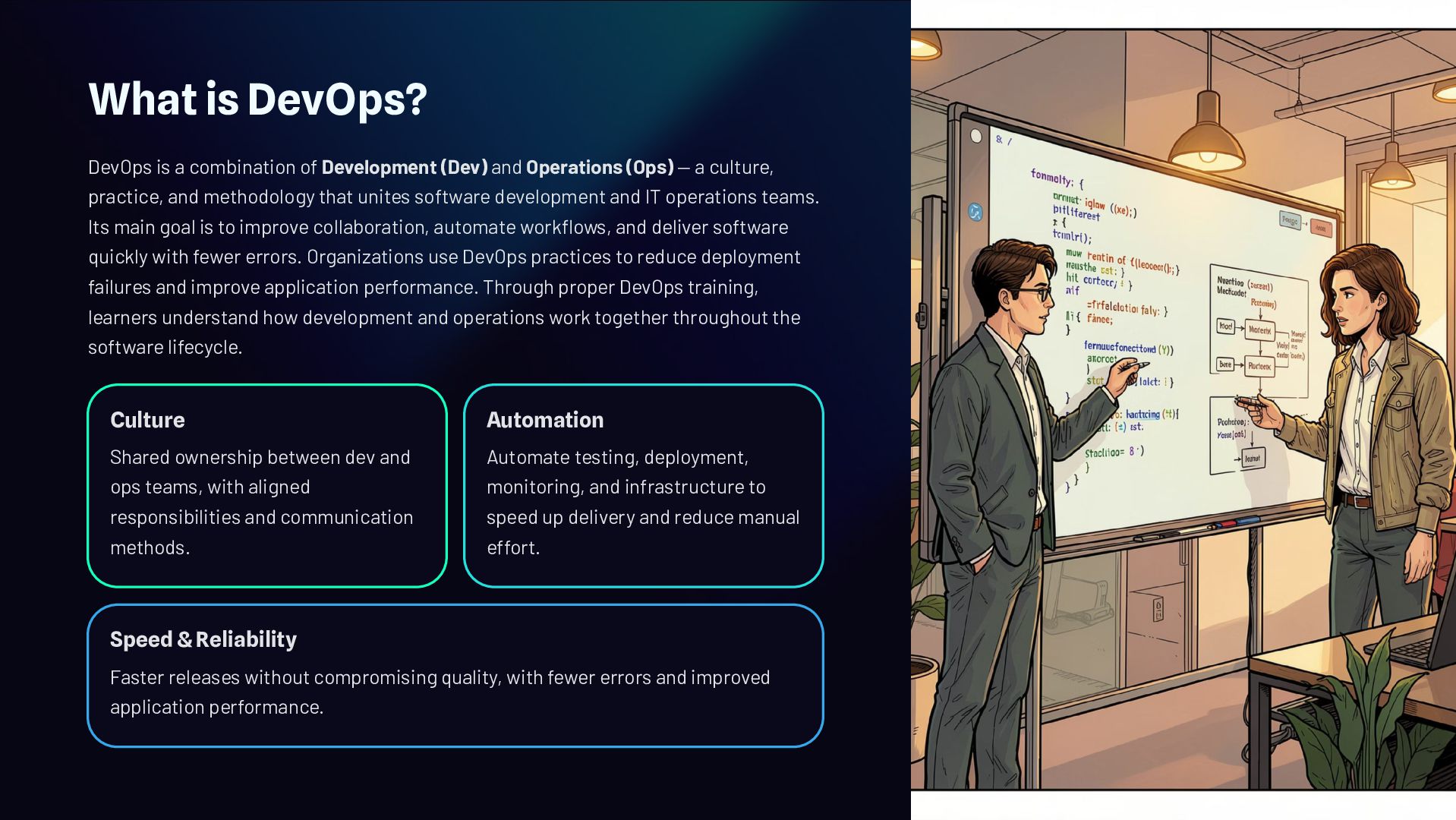
    and Operations (Ops) — a culture, practice, and methodology that unites software development and IT operations teams. Its main goal is to improve collaboration, automate workflows, and deliver software quickly with fewer errors. Organizations use DevOps practices to reduce deployment failures and improve application performance. Through proper DevOps training, learners understand how development and operations work together throughout the software lifecycle. Culture Shared ownership between dev and ops teams, with aligned responsibilities and communication methods. Automation Automate testing, deployment, monitoring, and infrastructure to speed up delivery and reduce manual effort. Speed & Reliability Faster releases without compromising quality, with fewer errors and improved application performance.
  3. Why DevOps Training Matters Modern organizations rely on automation and

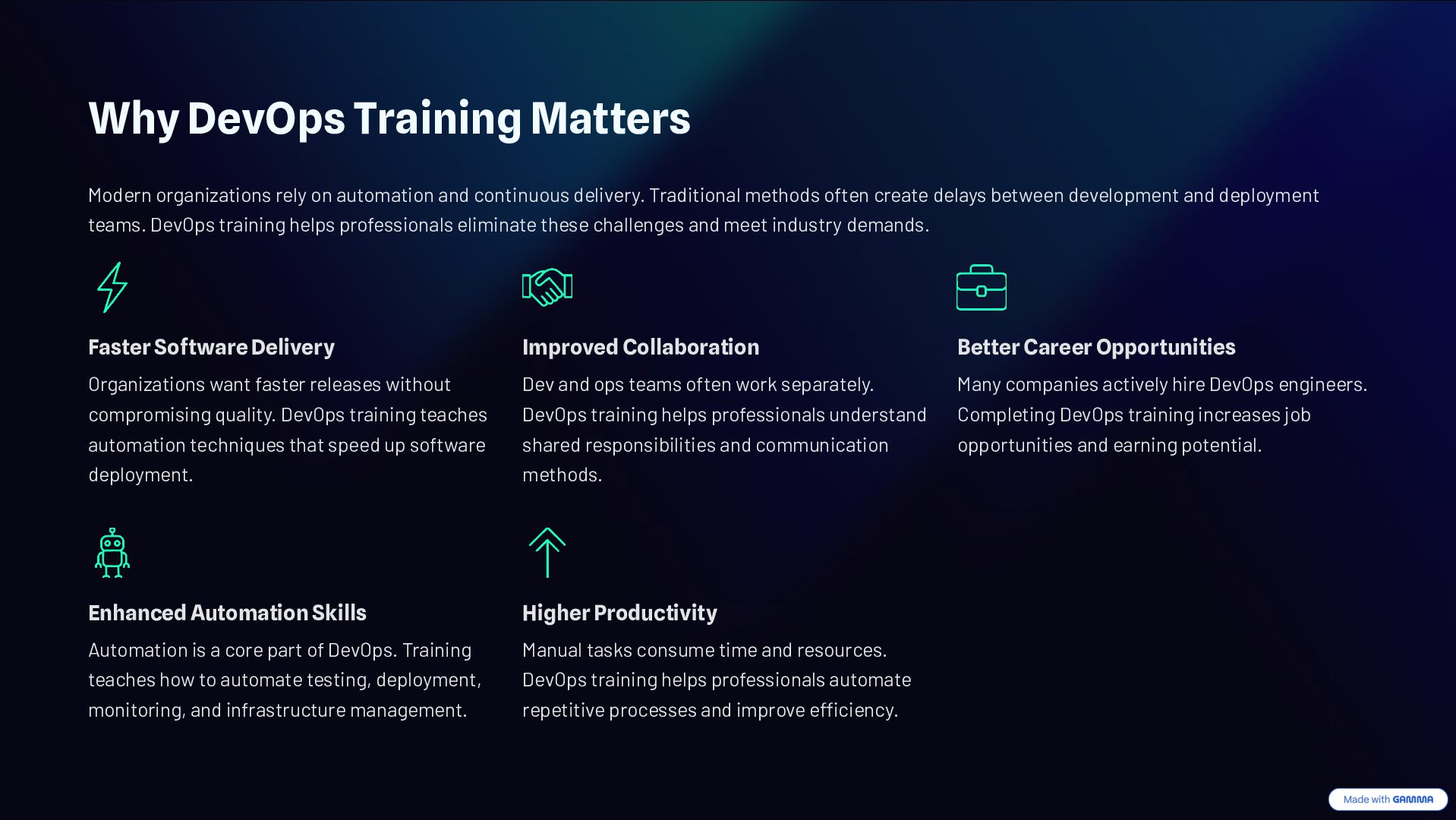
    continuous delivery. Traditional methods often create delays between development and deployment teams. DevOps training helps professionals eliminate these challenges and meet industry demands. Faster Software Delivery Organizations want faster releases without compromising quality. DevOps training teaches automation techniques that speed up software deployment. Improved Collaboration Dev and ops teams often work separately. DevOps training helps professionals understand shared responsibilities and communication methods. Better Career Opportunities Many companies actively hire DevOps engineers. Completing DevOps training increases job opportunities and earning potential. Enhanced Automation Skills Automation is a core part of DevOps. Training teaches how to automate testing, deployment, monitoring, and infrastructure management. Higher Productivity Manual tasks consume time and resources. DevOps training helps professionals automate repetitive processes and improve efficiency.
  4. Key Concepts Covered in DevOps Training A structured DevOps training

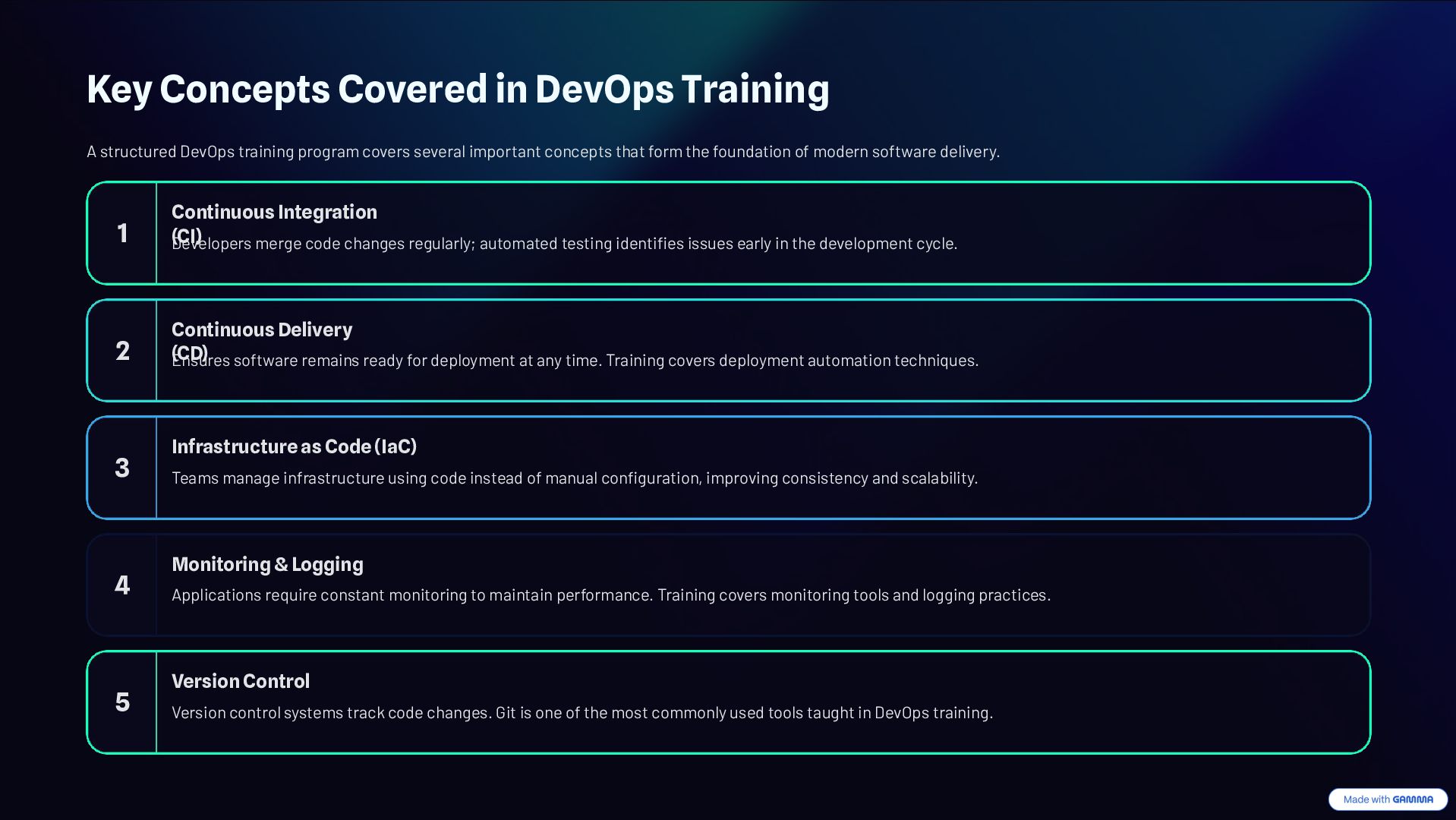
    program covers several important concepts that form the foundation of modern software delivery. 1 Continuous Integration (CI) Developers merge code changes regularly; automated testing identifies issues early in the development cycle. 2 Continuous Delivery (CD) Ensures software remains ready for deployment at any time. Training covers deployment automation techniques. 3 Infrastructure as Code (IaC) Teams manage infrastructure using code instead of manual configuration, improving consistency and scalability. 4 Monitoring & Logging Applications require constant monitoring to maintain performance. Training covers monitoring tools and logging practices. 5 Version Control Version control systems track code changes. Git is one of the most commonly used tools taught in DevOps training.
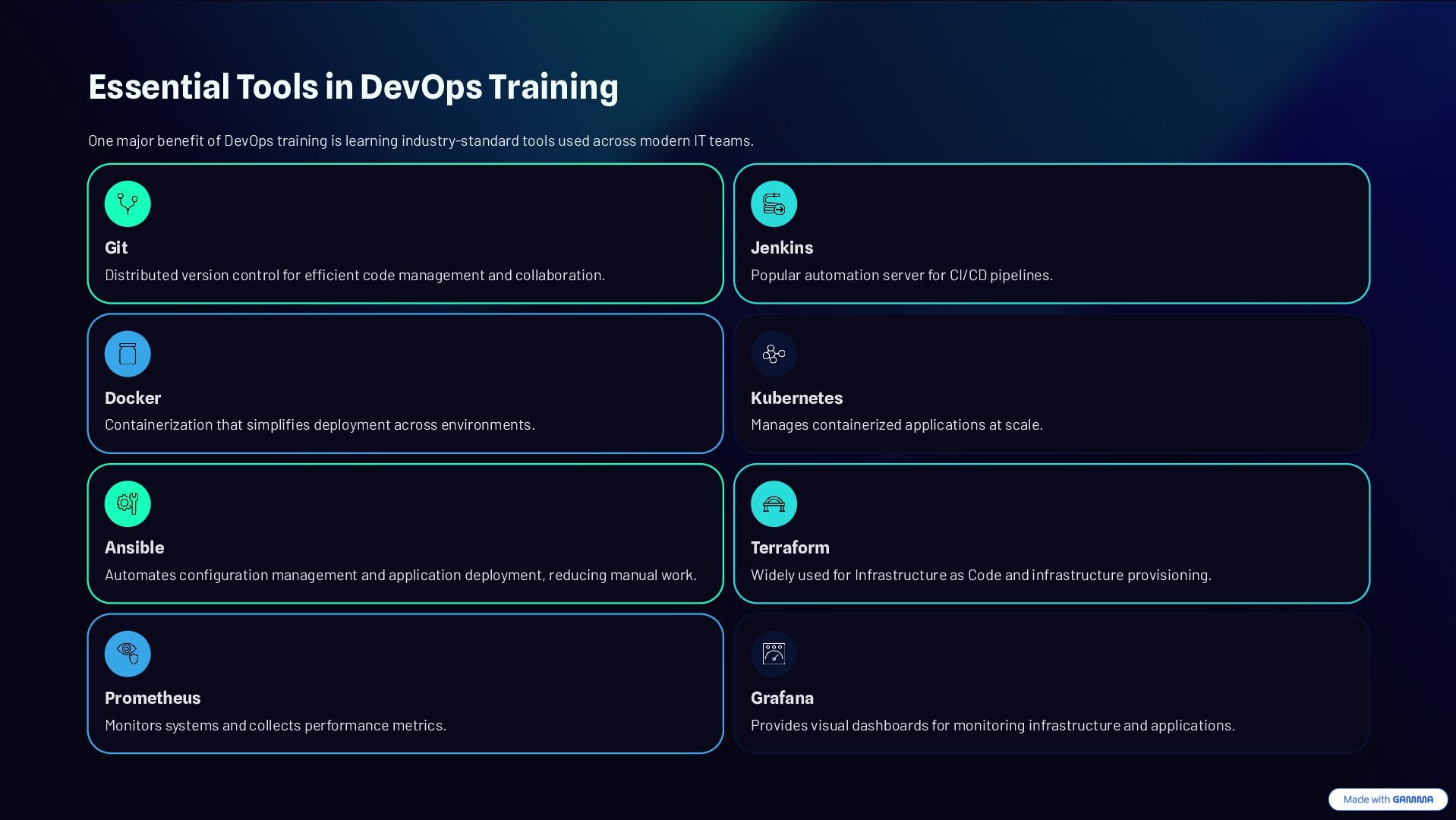
  5. Essential Tools in DevOps Training One major benefit of DevOps

    training is learning industry-standard tools used across modern IT teams. Git Distributed version control for efficient code management and collaboration. Jenkins Popular automation server for CI/CD pipelines. Docker Containerization that simplifies deployment across environments. Kubernetes Manages containerized applications at scale. Ansible Automates configuration management and application deployment, reducing manual work. Terraform Widely used for Infrastructure as Code and infrastructure provisioning. Prometheus Monitors systems and collects performance metrics. Grafana Provides visual dashboards for monitoring infrastructure and applications.
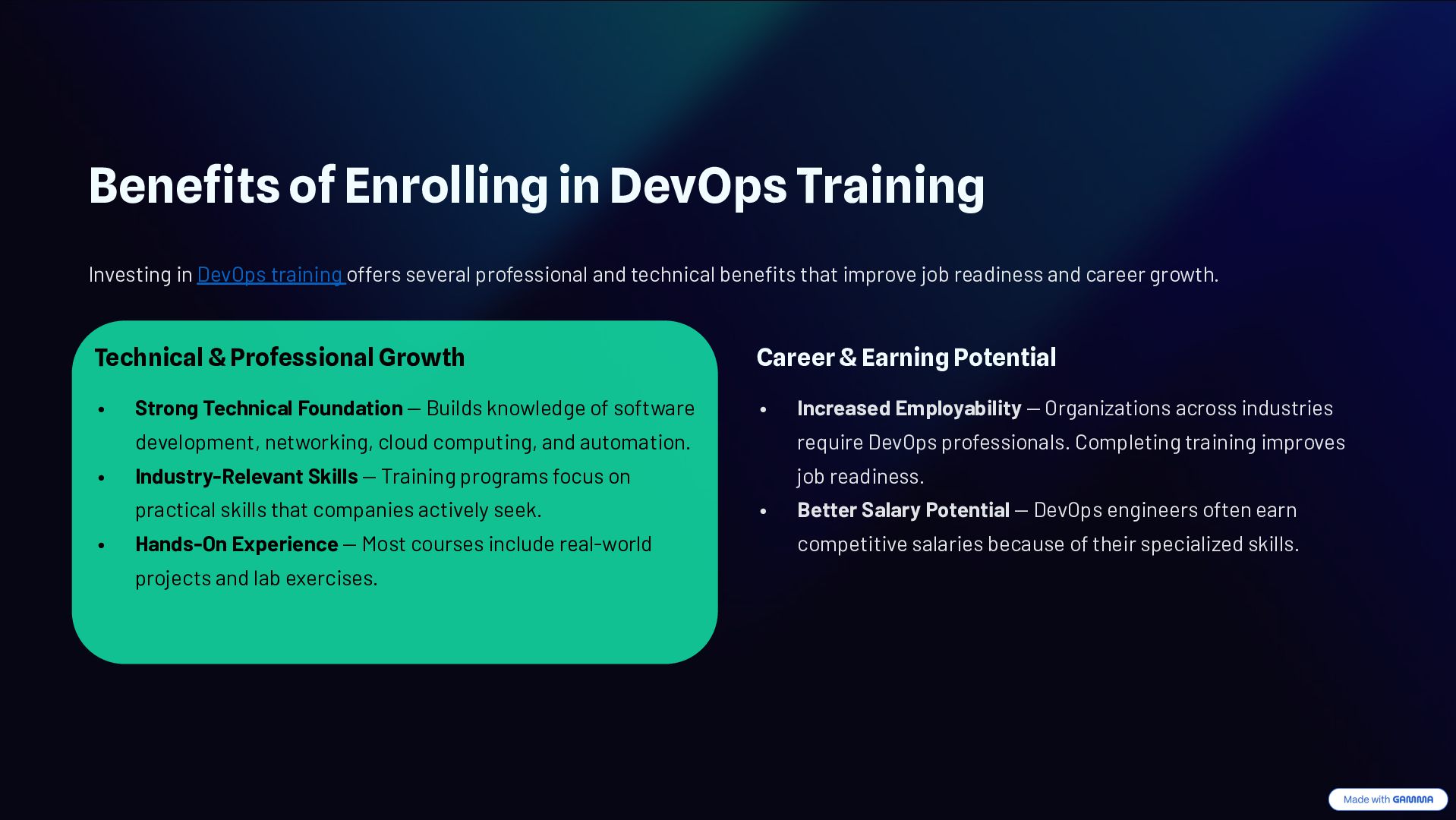
  6. Benefits of Enrolling in DevOps Training Investing in DevOps training

    offers several professional and technical benefits that improve job readiness and career growth. Technical & Professional Growth • Strong Technical Foundation — Builds knowledge of software development, networking, cloud computing, and automation. • Industry-Relevant Skills — Training programs focus on practical skills that companies actively seek. • Hands-On Experience — Most courses include real-world projects and lab exercises. Career & Earning Potential • Increased Employability — Organizations across industries require DevOps professionals. Completing training improves job readiness. • Better Salary Potential — DevOps engineers often earn competitive salaries because of their specialized skills.
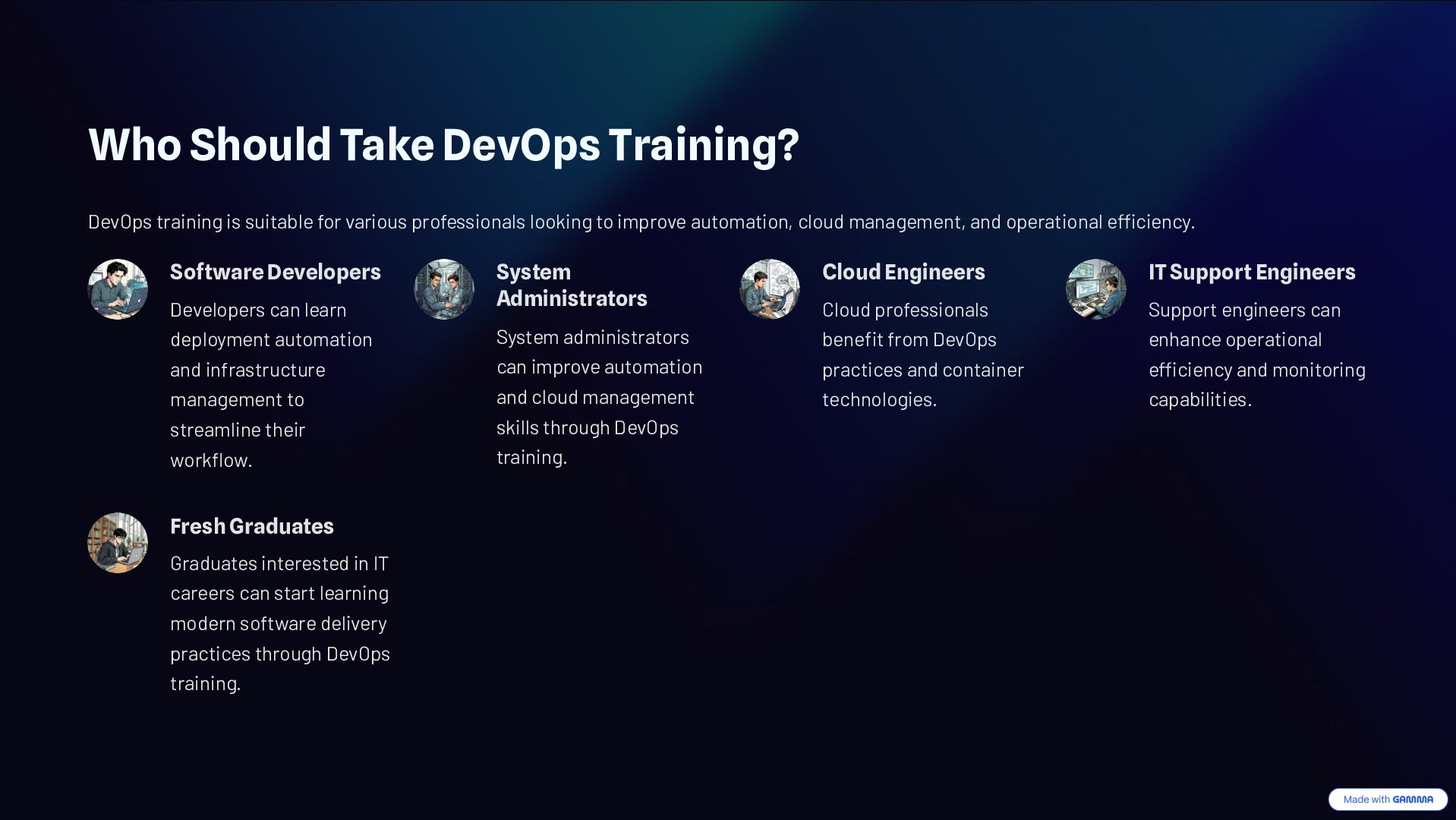
  7. Who Should Take DevOps Training? DevOps training is suitable for

    various professionals looking to improve automation, cloud management, and operational efficiency. Software Developers Developers can learn deployment automation and infrastructure management to streamline their workflow. System Administrators System administrators can improve automation and cloud management skills through DevOps training. Cloud Engineers Cloud professionals benefit from DevOps practices and container technologies. IT Support Engineers Support engineers can enhance operational efficiency and monitoring capabilities. Fresh Graduates Graduates interested in IT careers can start learning modern software delivery practices through DevOps training.
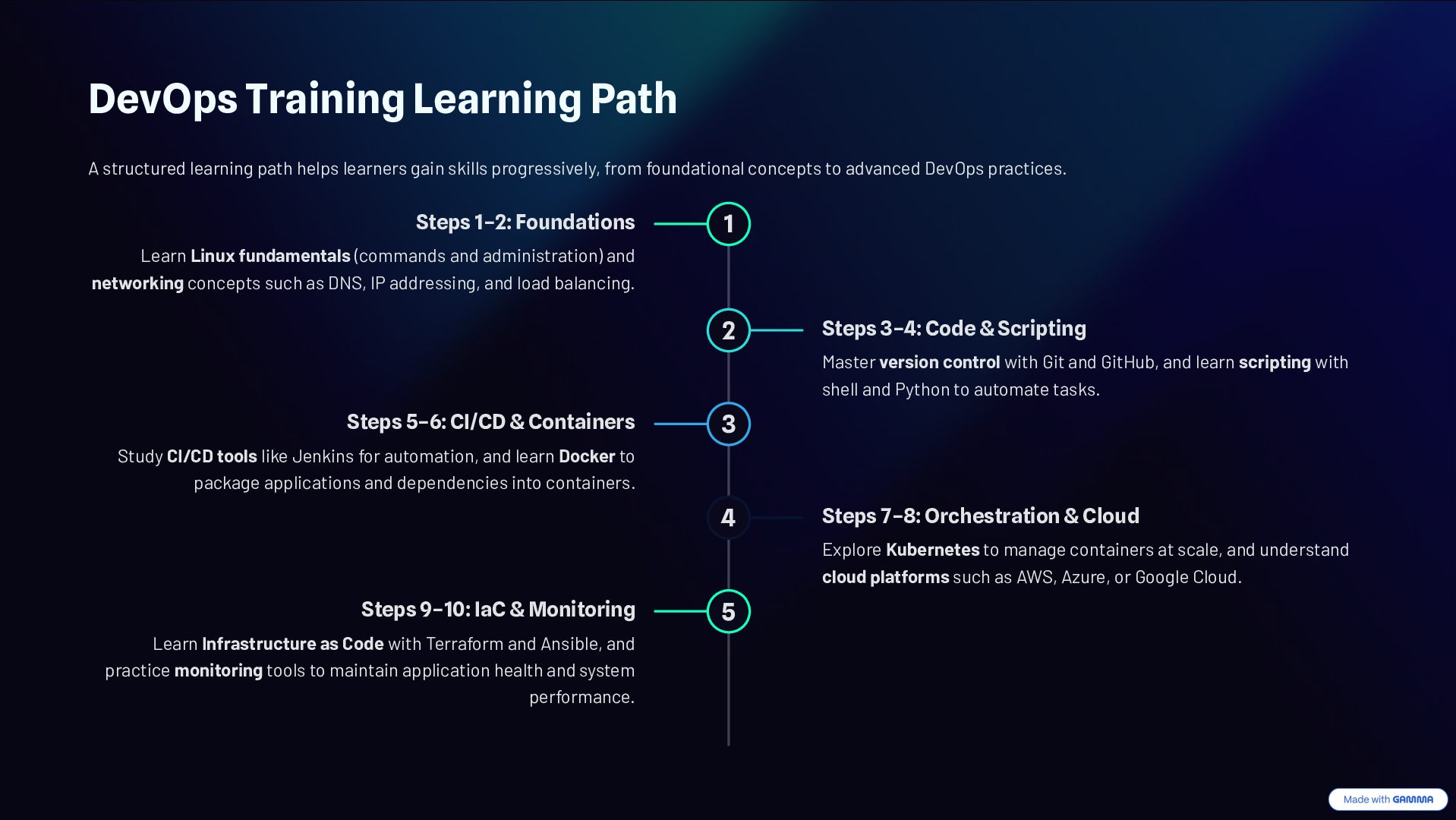
  8. DevOps Training Learning Path A structured learning path helps learners

    gain skills progressively, from foundational concepts to advanced DevOps practices. 1 Steps 1–2: Foundations Learn Linux fundamentals (commands and administration) and networking concepts such as DNS, IP addressing, and load balancing. 2 Steps 3–4: Code & Scripting Master version control with Git and GitHub, and learn scripting with shell and Python to automate tasks. 3 Steps 5–6: CI/CD & Containers Study CI/CD tools like Jenkins for automation, and learn Docker to package applications and dependencies into containers. 4 Steps 7–8: Orchestration & Cloud Explore Kubernetes to manage containers at scale, and understand cloud platforms such as AWS, Azure, or Google Cloud. 5 Steps 9–10: IaC & Monitoring Learn Infrastructure as Code with Terraform and Ansible, and practice monitoring tools to maintain application health and system performance.
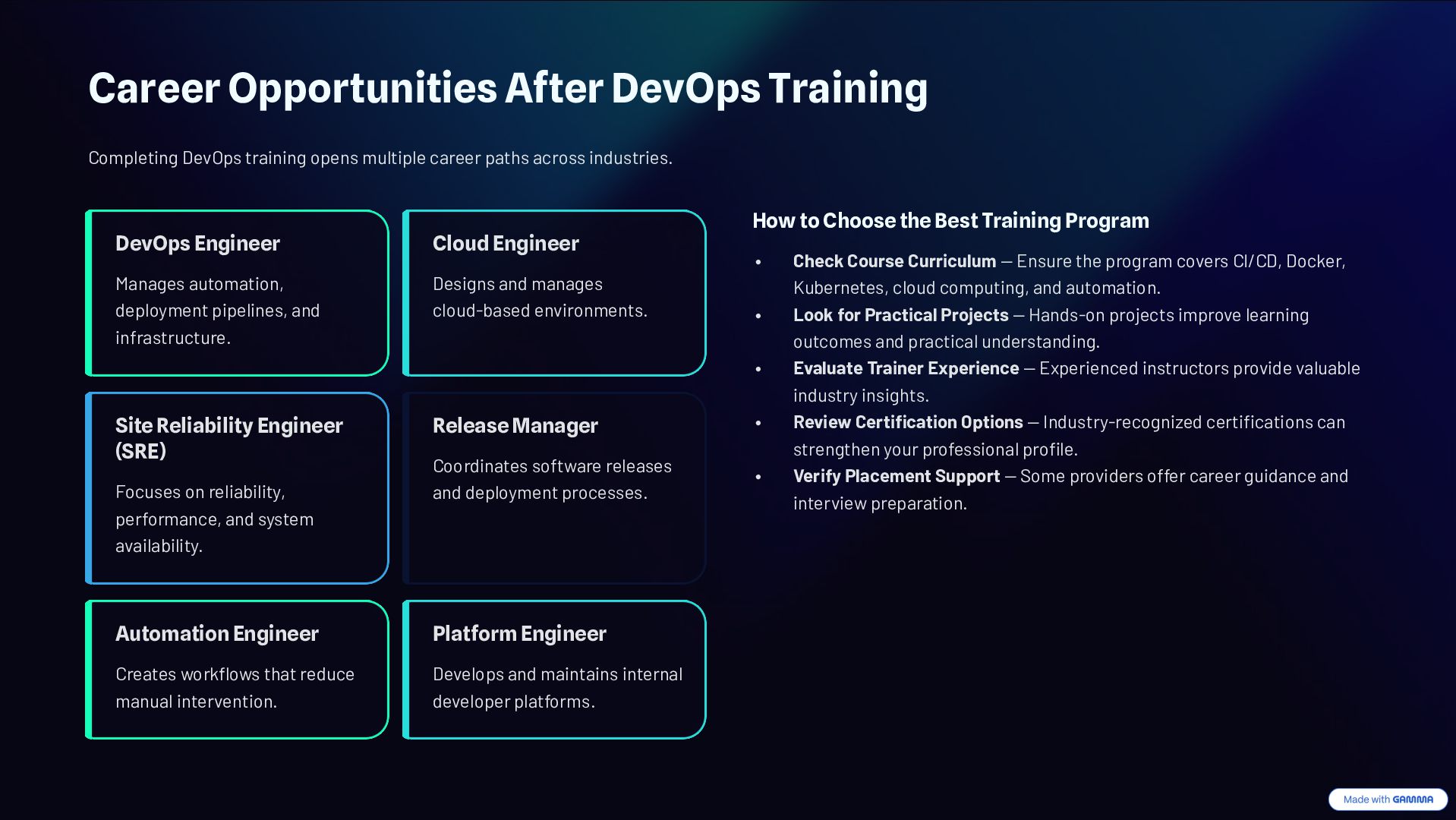
  9. Career Opportunities After DevOps Training Completing DevOps training opens multiple

    career paths across industries. DevOps Engineer Manages automation, deployment pipelines, and infrastructure. Cloud Engineer Designs and manages cloud-based environments. Site Reliability Engineer (SRE) Focuses on reliability, performance, and system availability. Release Manager Coordinates software releases and deployment processes. Automation Engineer Creates workflows that reduce manual intervention. Platform Engineer Develops and maintains internal developer platforms. How to Choose the Best Training Program • Check Course Curriculum — Ensure the program covers CI/CD, Docker, Kubernetes, cloud computing, and automation. • Look for Practical Projects — Hands-on projects improve learning outcomes and practical understanding. • Evaluate Trainer Experience — Experienced instructors provide valuable industry insights. • Review Certification Options — Industry-recognized certifications can strengthen your professional profile. • Verify Placement Support — Some providers offer career guidance and interview preparation.
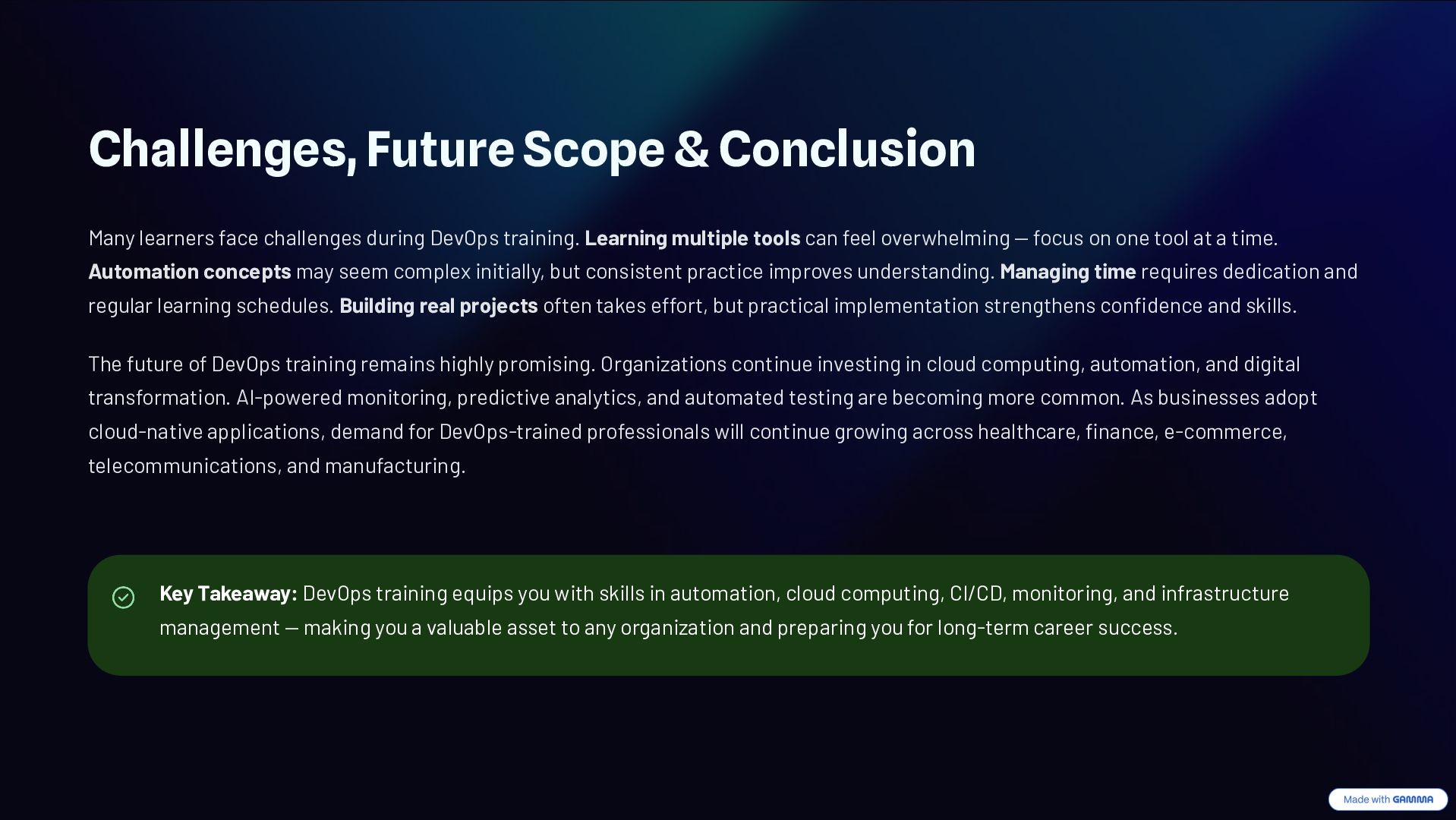
  10. Challenges, Future Scope & Conclusion Many learners face challenges during

    DevOps training. Learning multiple tools can feel overwhelming — focus on one tool at a time. Automation concepts may seem complex initially, but consistent practice improves understanding. Managing time requires dedication and regular learning schedules. Building real projects often takes effort, but practical implementation strengthens confidence and skills. The future of DevOps training remains highly promising. Organizations continue investing in cloud computing, automation, and digital transformation. AI-powered monitoring, predictive analytics, and automated testing are becoming more common. As businesses adopt cloud-native applications, demand for DevOps-trained professionals will continue growing across healthcare, finance, e-commerce, telecommunications, and manufacturing. Key Takeaway: DevOps training equips you with skills in automation, cloud computing, CI/CD, monitoring, and infrastructure management — making you a valuable asset to any organization and preparing you for long-term career success.