technology in supported employment To increase knowledge of current assistive technology that will result in increased productivity, promote self- determination and promote independence in all aspects of work To clarify NCDVR policy of Assistive Technology for Supported Employment clients Learning Objectives
with disabilities. The employment opportunities can be improved, if the technical side is incorporated in the whole framework of supported employment (SE). The term assistive technology means any service that directly assists an individual with a disability in the selection, acquisition or use of assistive technology (AT) devices. (Michael Schneider, March,1999) AT and SE
customary environment selecting, designing, fitting, customizing, adapting, applying, maintaining, or replacing assistive technology devices training in the context of implementing devices; coordinating and using other services with assistive technology devices. Assistive Technology means…
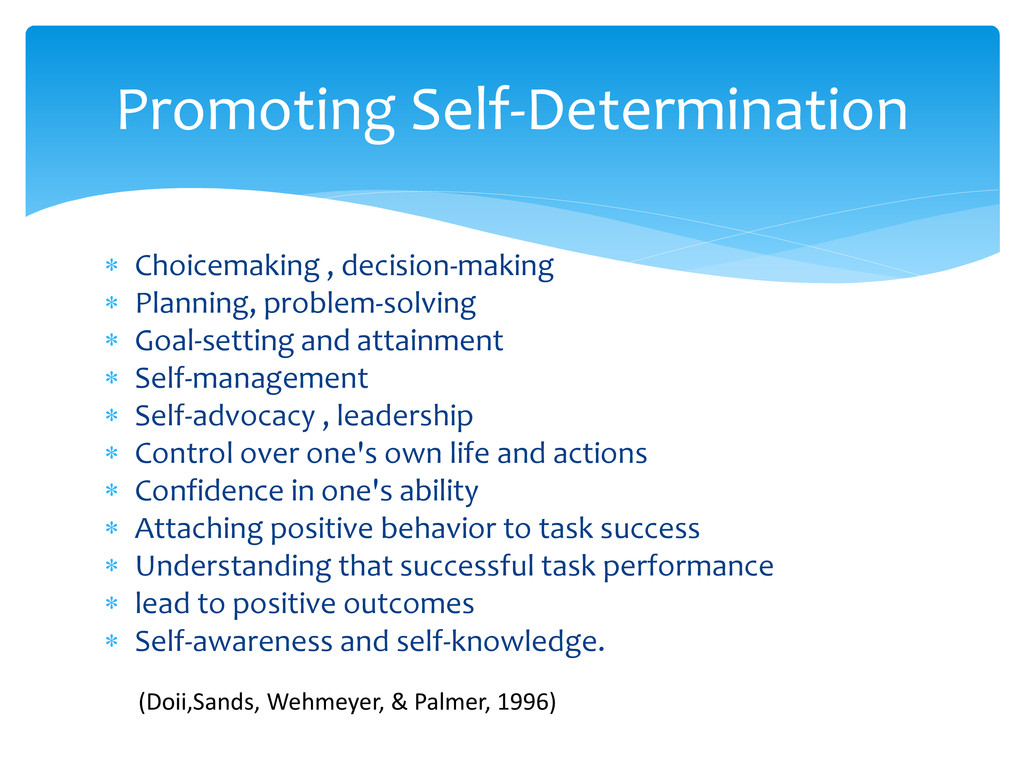
attainment Self-management Self-advocacy , leadership Control over one's own life and actions Confidence in one's ability Attaching positive behavior to task success Understanding that successful task performance lead to positive outcomes Self-awareness and self-knowledge. Promoting Self-Determination (Doii,Sands, Wehmeyer, & Palmer, 1996)
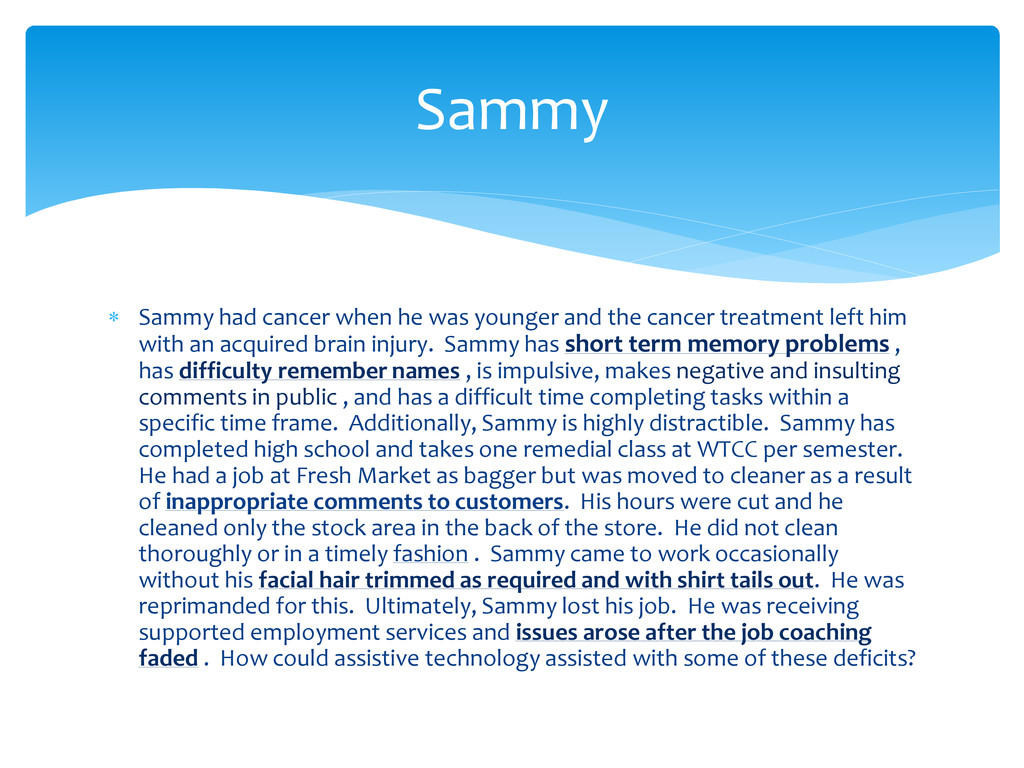
cancer treatment left him with an acquired brain injury. Sammy has short term memory problems , has difficulty remember names , is impulsive, makes negative and insulting comments in public , and has a difficult time completing tasks within a specific time frame. Additionally, Sammy is highly distractible. Sammy has completed high school and takes one remedial class at WTCC per semester. He had a job at Fresh Market as bagger but was moved to cleaner as a result of inappropriate comments to customers. His hours were cut and he cleaned only the stock area in the back of the store. He did not clean thoroughly or in a timely fashion . Sammy came to work occasionally without his facial hair trimmed as required and with shirt tails out. He was reprimanded for this. Ultimately, Sammy lost his job. He was receiving supported employment services and issues arose after the job coaching faded . How could assistive technology assisted with some of these deficits? Sammy
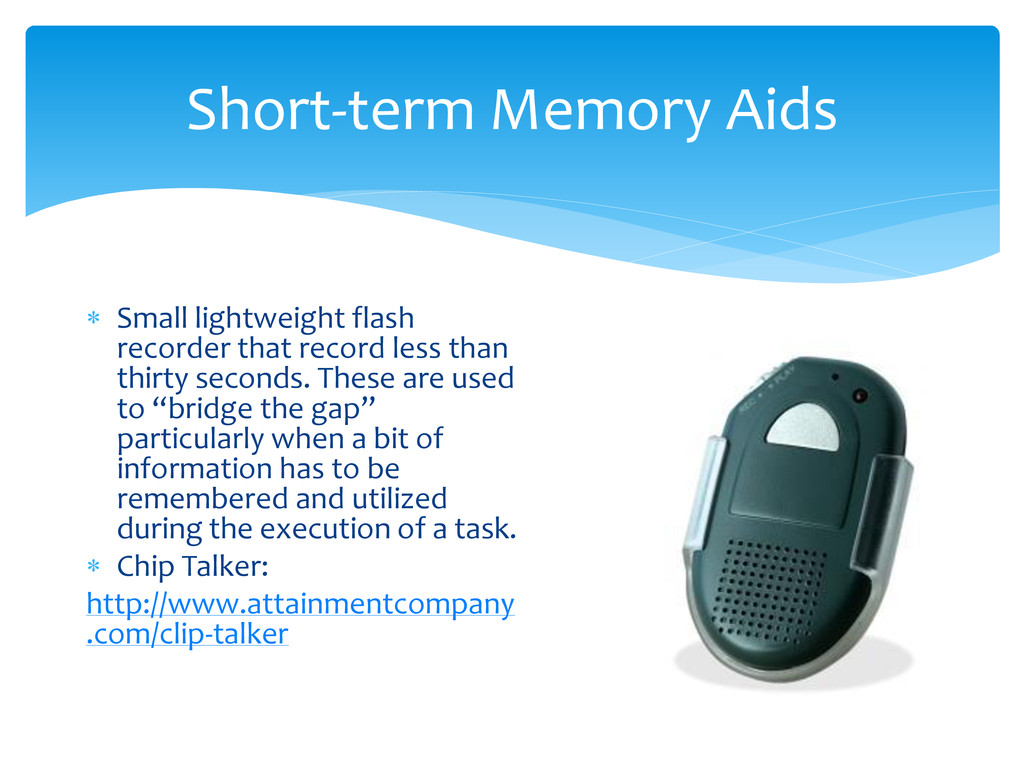
less than thirty seconds. These are used to “bridge the gap” particularly when a bit of information has to be remembered and utilized during the execution of a task. Chip Talker: http://www.attainmentcompany .com/clip-talker
captions on a phone or other mobile device. If the device can read the caption aloud that is also helpful. There are some inherent problems with this approach we should probably discuss. Pictello http://goo.gl/9Q4Hn iPhoto http://goo.gl/MNTjG After Photo http://goo.gl/si4GB Caption It http://goo.gl/u5neB
for the counselor to intervene with one of the social stories or comics that helps this individual think critically about the consequences of these behaviors. Possibly ways to self-monitor the antecedent behaviors. Make Beliefs Comix http://goo.gl/5vRR Pixton http://goo.gl/d839 Example
she was 20 years old and has a moderate intellectual disability. He has much difficulty following multiple step instructions and has been observed to complete one step tasks only . In addition, Donny is very social and wants to make friends with his co- workers. She hugs inappropriately , gives money away , and doesn’t know social boundaries . Julie
directions in a mobile device, especially pictures that show how the job looks when you are done. Using this in the coaching phase would reinforce the concept of “complete job". Visual Impact http://goo.gl/QupzL Video http://goo.gl/BjGgo Step-by-Step http://goo.gl/ZGPpO Video http://goo.gl/7BGVw
break social and other skills down into steps. The provide a holistic, metacognitive view of a particular task as well. Exploring Social Skills http://goo.gl/GLO2s
with Disabilities. He has experienced tremendous personal growth as a result but continues to have substantial impediments to employment and requires supported employment services. Scotty needs assistance in being independent in completion of work tasks . He experiences difficulty if work tasks change throughout the day or if the order of the tasks is different. Scotty engages in self-stimulating behaviors that increase as he becomes stressed . He is aware of the escalation of these behaviors and has a calm down procedure that he practices. He is not independent in this process . Scotty
rehearsal can off-set episodes of aberrant behavior Comprehensive daily planning and task videos for each daily activity Slideshows PowerPoint SonicPics http://goo.gl/IOviv Video http://goo.gl/hKnq5 Functional Planning System http://goo.gl/1NoxP
with schizophrenia. He is disheveled in appearance. He wants to work. Reggie has difficulty keeping track of time , learns tasks slowly, and is often distracted by voices that he hears . He does not tolerate stress and is developing some stress management techniques. Reggie always misses the bus and is late for appointments . Reggie does take his medication regularly, has a high school diploma, and some college training. He is interested in becoming a vet but does not want to return to college. Reggie
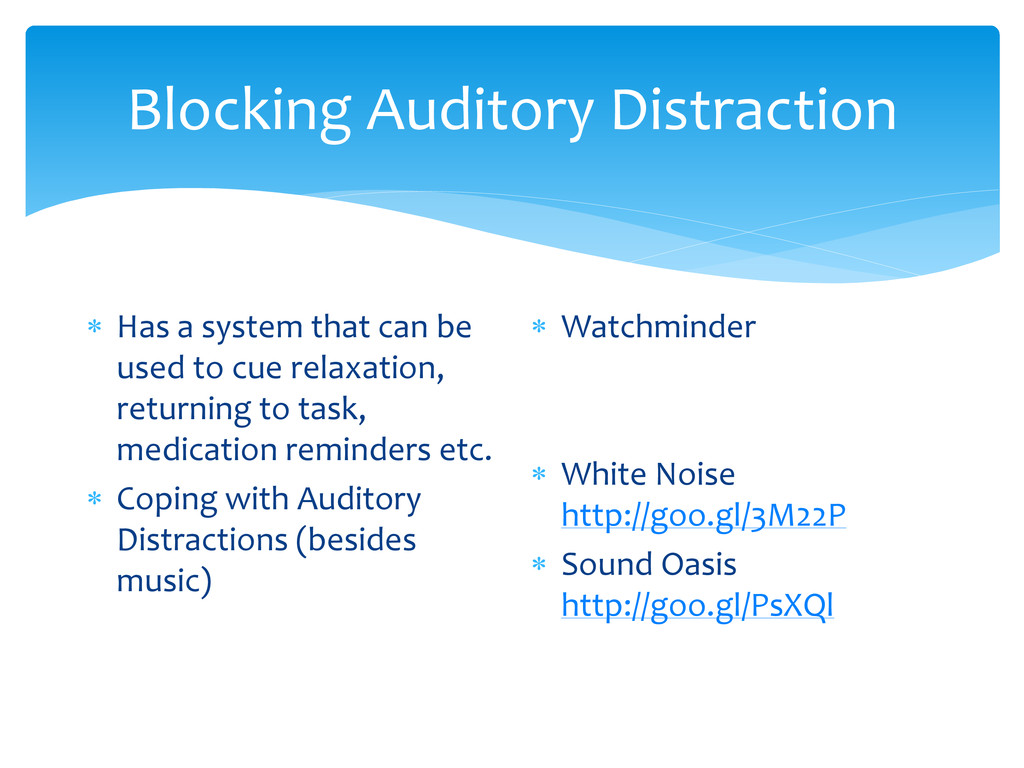
used to cue relaxation, returning to task, medication reminders etc. Coping with Auditory Distractions (besides music) Watchminder White Noise http://goo.gl/3M22P Sound Oasis http://goo.gl/PsXQl
for individuals with disabilities. The employment opportunities can be improved, if the technical side is incorporated in the whole framework of supported employment (SE). The term assistive technology means any service that directly assists an individual with a disability in the selection, acquisition or use of assistive technology (AT) devices. The term includes:(a) evaluating the needs of an individual in the individuals customary environment; (b) selecting, designing, fitting, customising, adapting, applying, maintaining, or replacing assistive technology devices; (c) training in the context of implementing devices; (d) co-ordinating and using other services with assistive technology devices. (Michael Schneider, March 1999)
attainment Self-management Self-advocacy , leadership Control over one’s own life and actions Confidence in one’s ability Attaching positive behavior to task success Understanding that successful task performance lead to positive outcomes Self-awareness and self-knowledge. (Doll,Sands, Wehmeyer, & Palmer, 1996) Promote Self-Determination
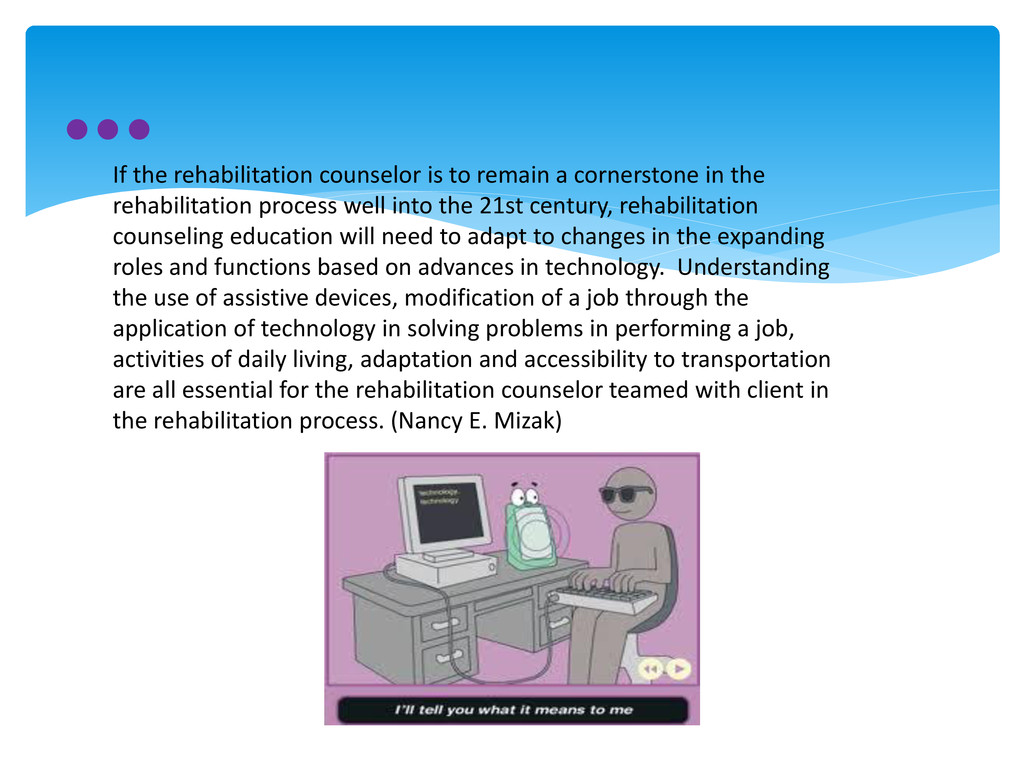
in the rehabilitation process well into the 21st century, rehabilitation counseling education will need to adapt to changes in the expanding roles and functions based on advances in technology. Understanding the use of assistive devices, modification of a job through the application of technology in solving problems in performing a job, activities of daily living, adaptation and accessibility to transportation are all essential for the rehabilitation counselor teamed with client in the rehabilitation process. (Nancy E. Mizak)
Assistive Technology purchases are considered a cost service and financial needs test must be met • Must be planned on the IPE and have a direct impact upon success with the employment goal • Must have the knowledge to use or the ability to be trained to use the application and device ncdvr policy and assistive technology
the educational requirements in a student's IEP as part of IDEA is the legal responsibility of the local education agency; however, Vocational Rehabilitation can consider the assistive technology needs related to the transition/job placement needs of a student with a disability during his/her final year of school. The Division must document that it is not replacing a comparable benefit in transition planning when purchasing assistive technology for a student who has not exited school ncdvr policy continued
NCATP…NCATP will also downloads the apps for the clients they evaluate and charge us the cost.” • If apps are from iTunes, reimburse client for cost of app only. Do not reimburse tax. • If purchasing android or chrome apps, please consult with Debbie Donahoo at [email protected] Want to purchase apps for your client?
your relationships with your Assistive Technologist, blogs, conferences, and professional literature • Refer to ncATp for assistive technology assessments and rely on their expertise for recommendations. Consider referral early in the senior year so student has opportunities for learning how to use the device before becoming employed. • Provide opportunities for your client to practice using their new device. Work closely with your job coaches to ensure they are aware of how the device works. • What is the question???? best practices


 jonoalderson
 mfonobong
 kevinliebholz
 reverentgeek
 sergeychernyshev
 iamctodd
 skipperchong
 eileencodes
 kastner
 aleyda
 raygrieselhuber