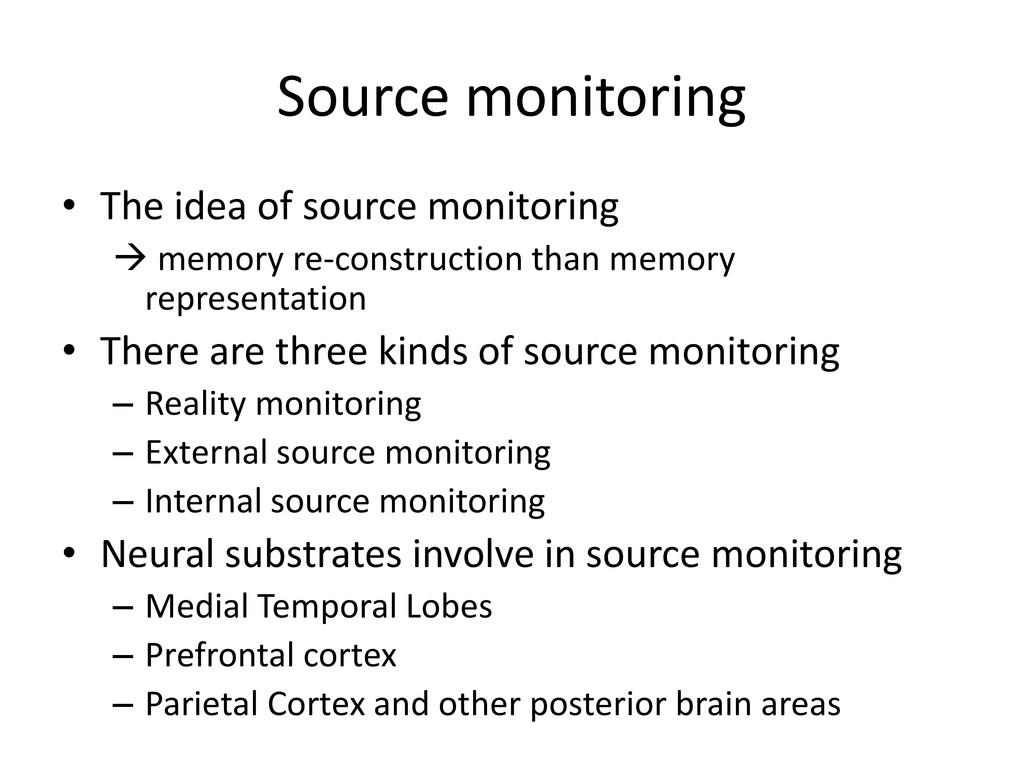
re-construction than memory representation • There are three kinds of source monitoring – Reality monitoring – External source monitoring – Internal source monitoring • Neural substrates involve in source monitoring – Medial Temporal Lobes – Prefrontal cortex – Parietal Cortex and other posterior brain areas
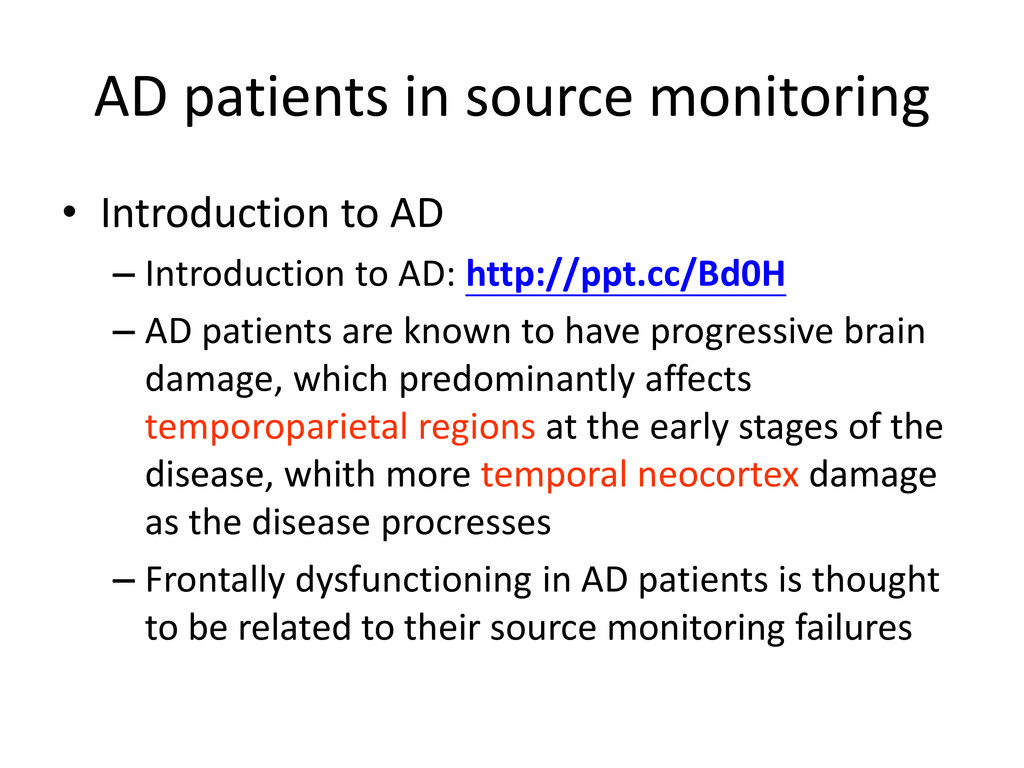
Introduction to AD: http://ppt.cc/Bd0H – AD patients are known to have progressive brain damage, which predominantly affects temporoparietal regions at the early stages of the disease, whith more temporal neocortex damage as the disease procresses – Frontally dysfunctioning in AD patients is thought to be related to their source monitoring failures
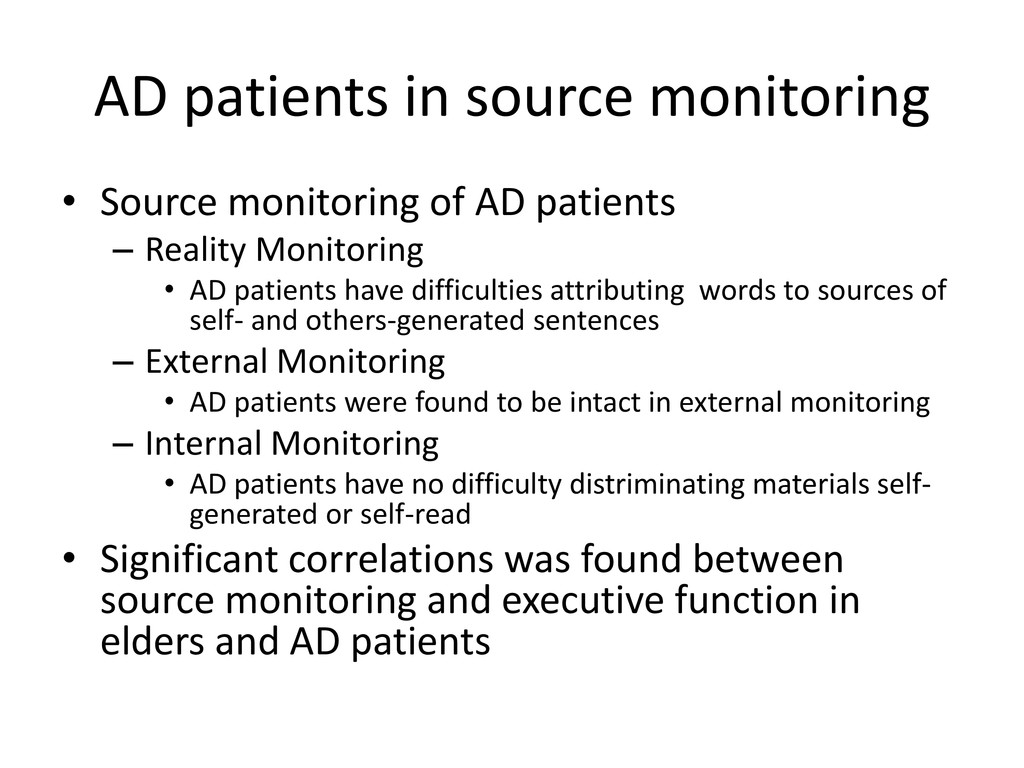
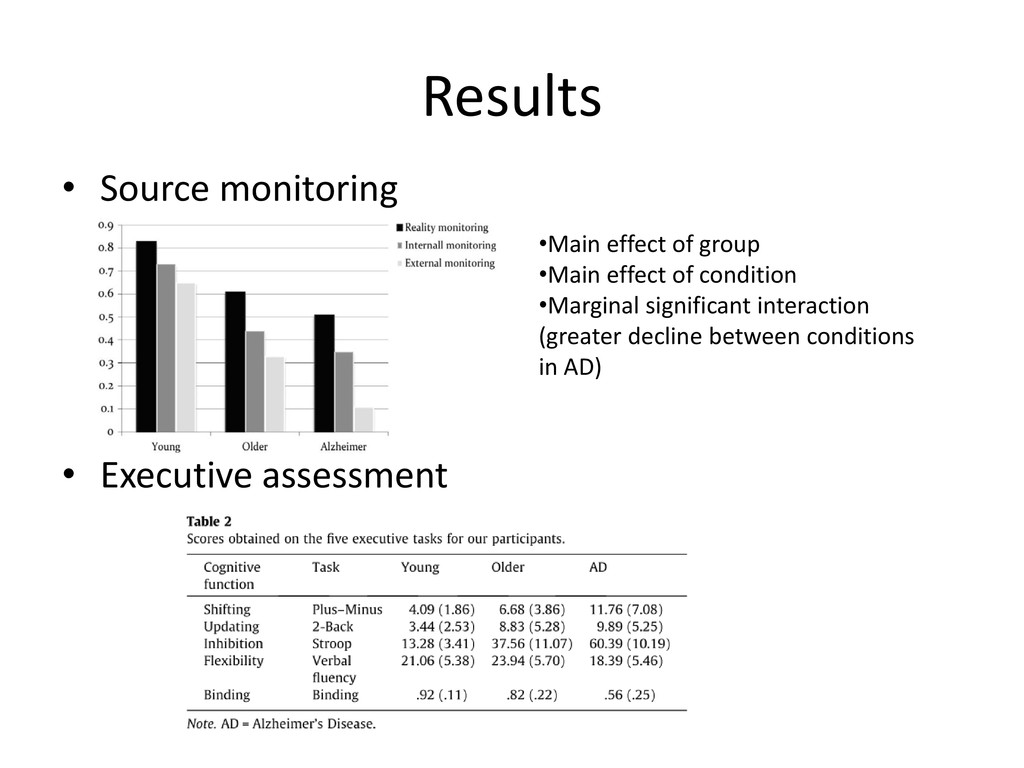
patients – Reality Monitoring • AD patients have difficulties attributing words to sources of self- and others-generated sentences – External Monitoring • AD patients were found to be intact in external monitoring – Internal Monitoring • AD patients have no difficulty distriminating materials self- generated or self-read • Significant correlations was found between source monitoring and executive function in elders and AD patients
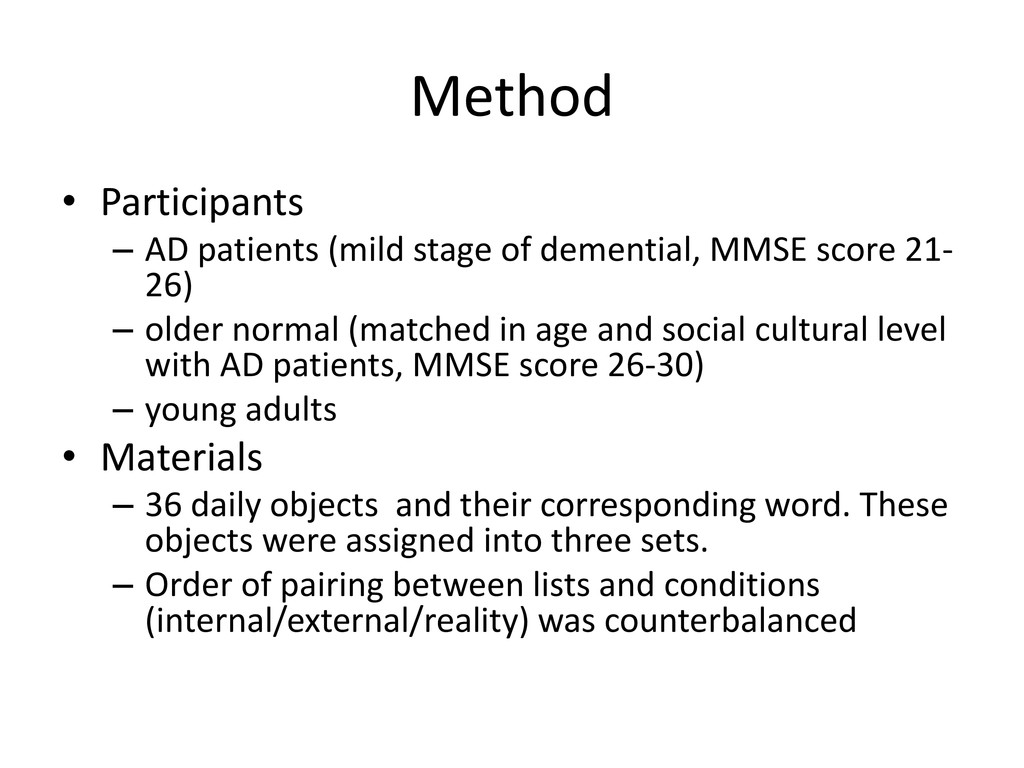
MMSE score 21- 26) – older normal (matched in age and social cultural level with AD patients, MMSE score 26-30) – young adults • Materials – 36 daily objects and their corresponding word. These objects were assigned into three sets. – Order of pairing between lists and conditions (internal/external/reality) was counterbalanced
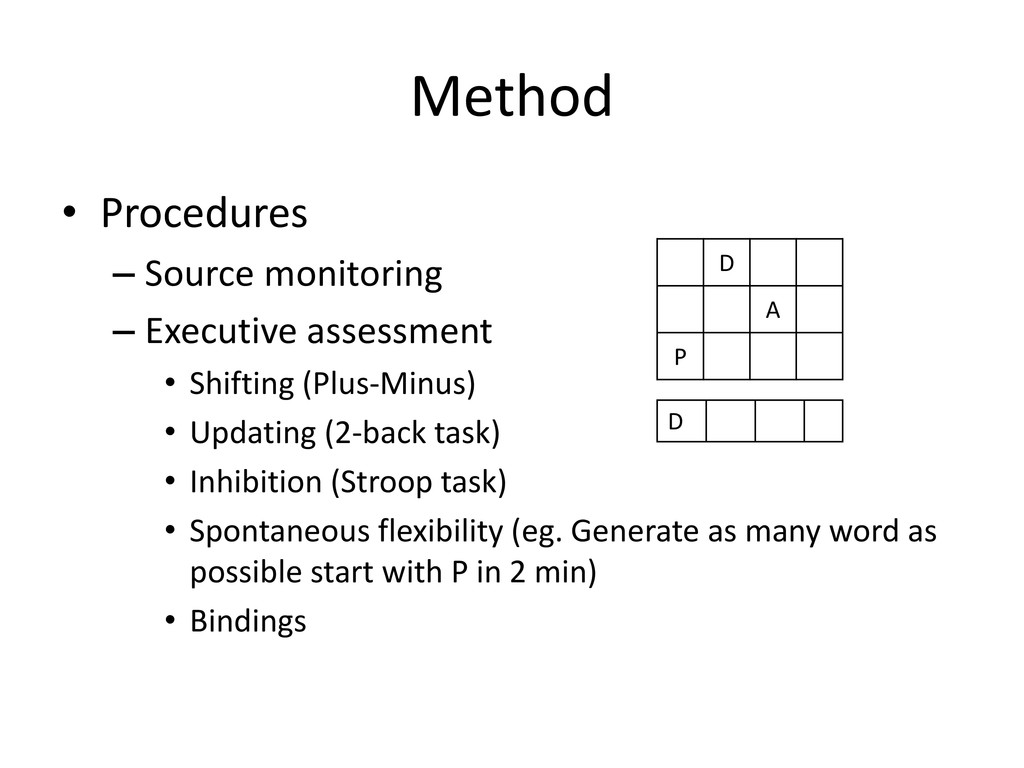
Shifting (Plus-Minus) • Updating (2-back task) • Inhibition (Stroop task) • Spontaneous flexibility (eg. Generate as many word as possible start with P in 2 min) • Bindings D A P D
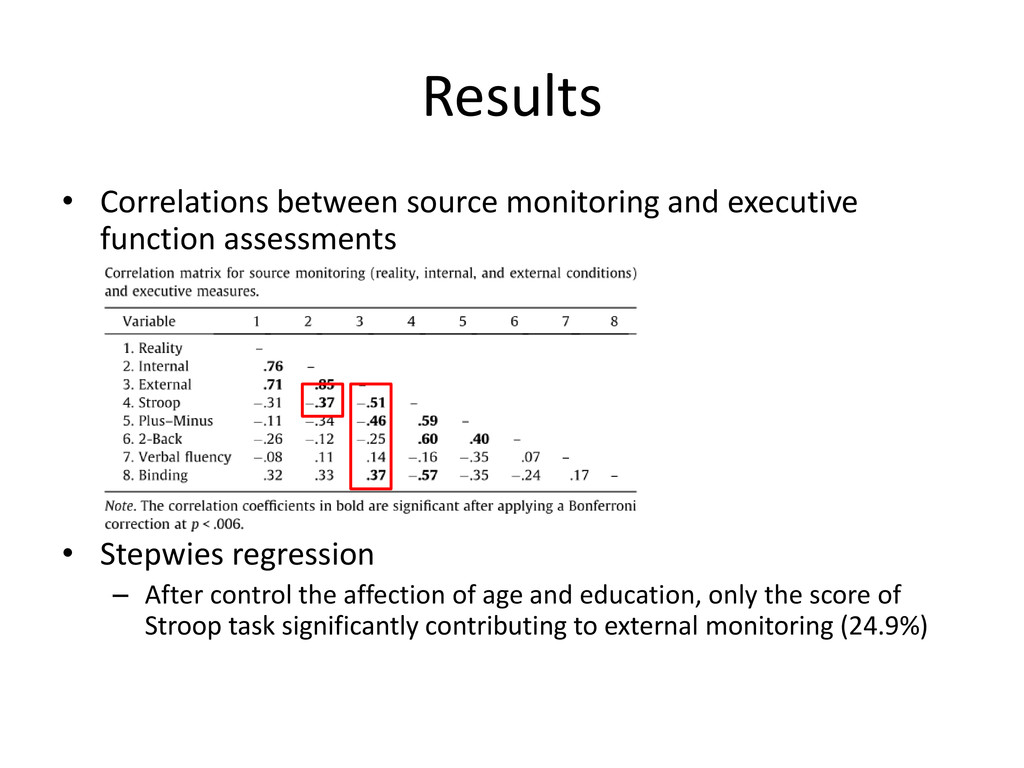
• Stepwies regression – After control the affection of age and education, only the score of Stroop task significantly contributing to external monitoring (24.9%)
reality monitoring which was found previously – Passivity • Correlation between source monitoring and inhibition function – Listig, Hasher, and Zacks (2007) • Limit the range of information entering the focus of attention • Suppress irrelevant information from working memory • Restrain strong but inappropriate response
in external source monitoring… – Shallow encoding in external task – Better to use suppression related task, e.g. directed forgetting • Overlap neural substrates in Stroop and AD – Correlation between Stroop task and left inferior frontal junction (BA6, BA44) – Mitchell et al (2008) found activation in both areas in external source monitoring task. ventrolateral prefrontal cortex as controlling specific source features during encoding (Mitchell and Johnson, 2009)


 coloredviolet
 mfonobong
 mraible
 inesmontani
 elsirapls
 jct
jct
 samtorres
 tammyeverts
 tenderlove
 panda_program
 uxyall
 danielanewman