methods, artificial intelligence (AI), and data analysis, to extract value from data. Those who practice data science are called data scientists, and they combine a range of skills to analyze data collected from the web, smartphones, customers, sensors, and other sources to derive actionable insights. Data science encompasses preparing data for analysis, including cleansing, aggregating, and manipulating the data to perform advanced data analysis. Analytic applications and data scientists can then review the results to uncover patterns and enable business leaders to draw informed insights.
across many functions in order to use data to cut costs, increase efficiency, and increase revenue. When it comes to sales, data analytics may be employed in a variety of ways. And there are a slew of new use cases on the horizon. According to a McKinsey survey of over 1,000 sales organisations around the world, 53 percent of "high performing" enterprises consider themselves to be successful consumers of analytics. Data has become the cornerstone of all industries, and it is critical for sales leaders to manage their businesses efficiently, focus on viable plans, create leads, improve customer experience, and unearth hidden opportunities.
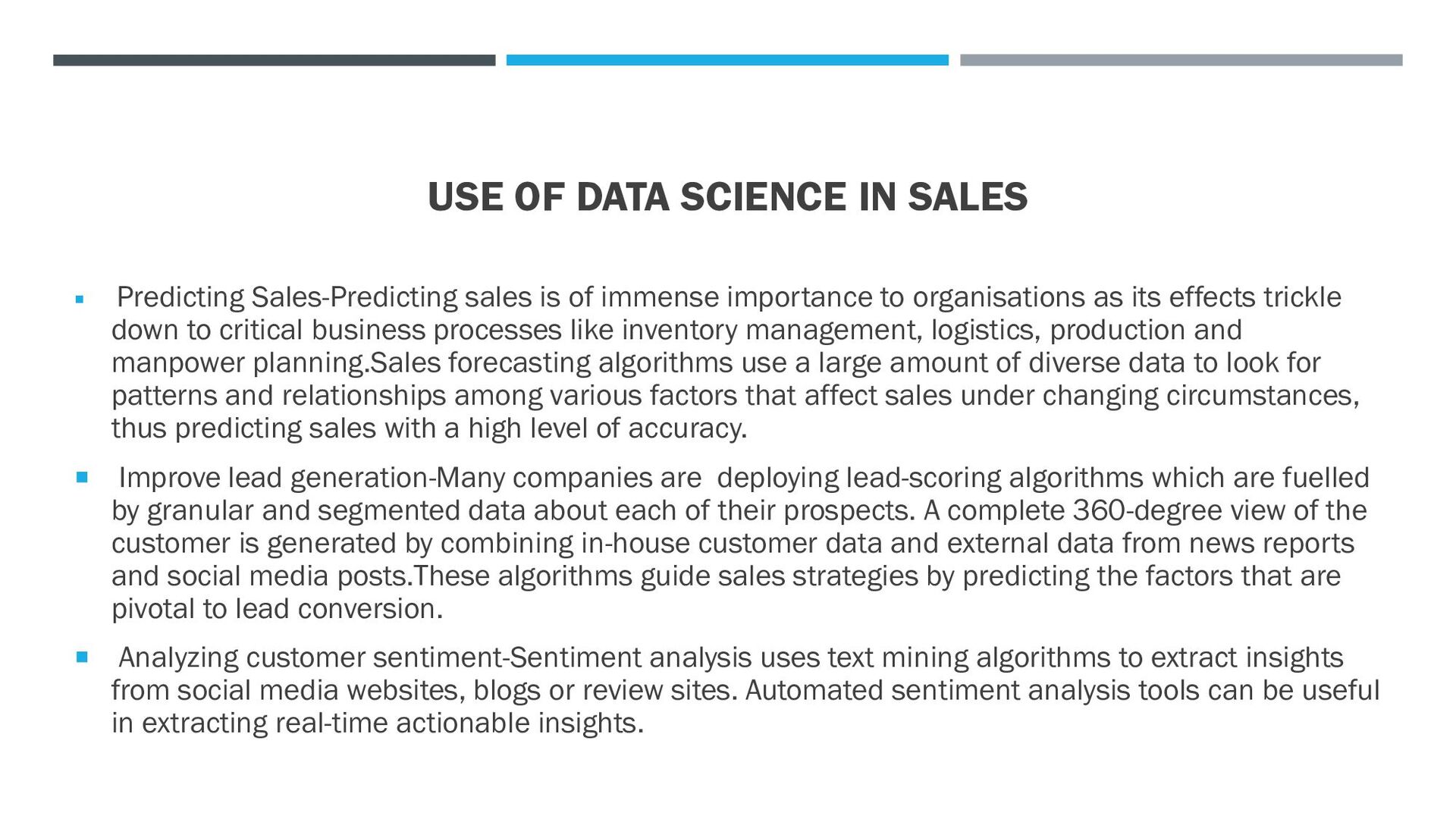
is of immense importance to organisations as its effects trickle down to critical business processes like inventory management, logistics, production and manpower planning.Sales forecasting algorithms use a large amount of diverse data to look for patterns and relationships among various factors that affect sales under changing circumstances, thus predicting sales with a high level of accuracy. Improve lead generation-Many companies are deploying lead-scoring algorithms which are fuelled by granular and segmented data about each of their prospects. A complete 360-degree view of the customer is generated by combining in-house customer data and external data from news reports and social media posts.These algorithms guide sales strategies by predicting the factors that are pivotal to lead conversion. Analyzing customer sentiment-Sentiment analysis uses text mining algorithms to extract insights from social media websites, blogs or review sites. Automated sentiment analysis tools can be useful in extracting real-time actionable insights.
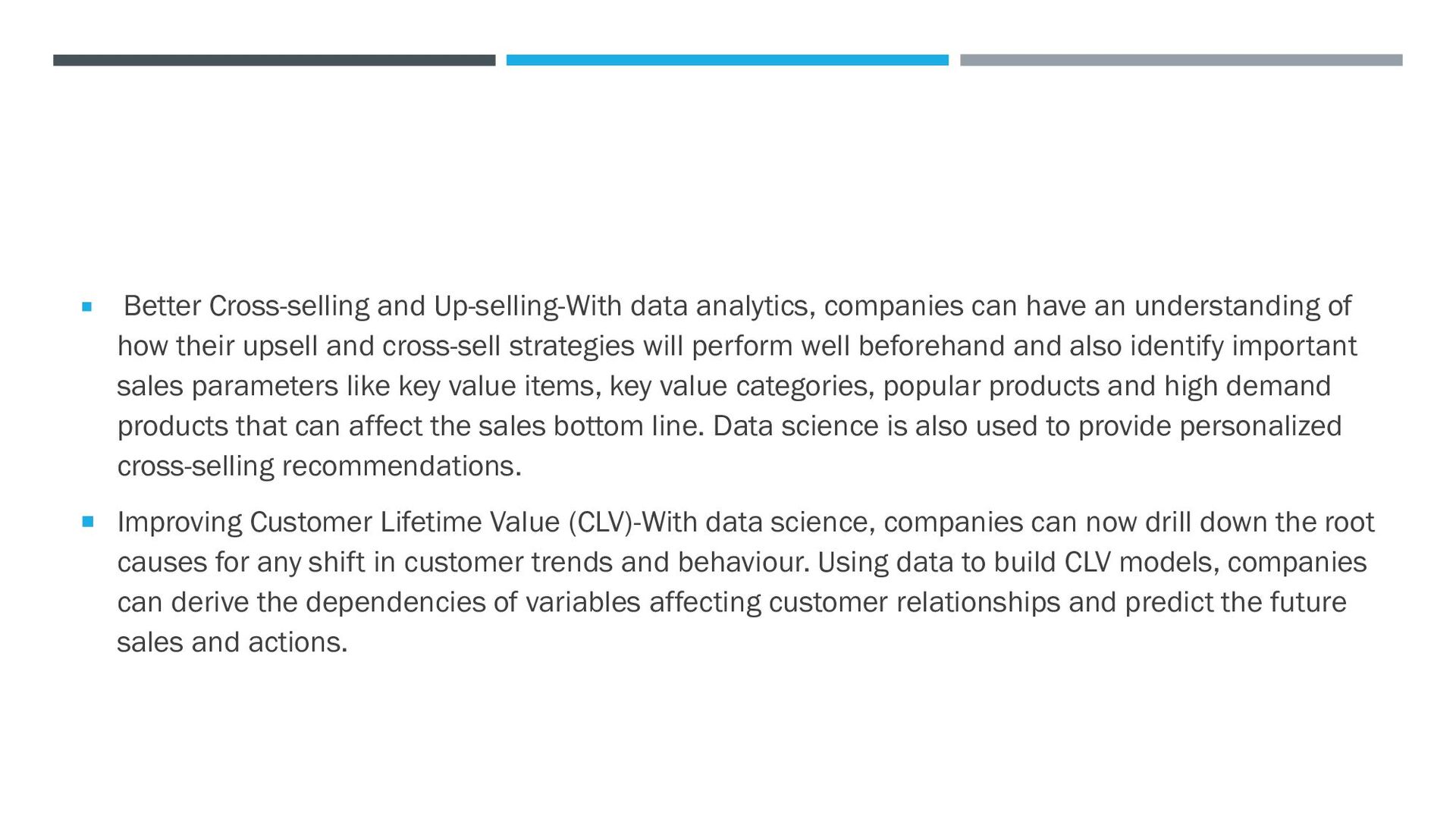
an understanding of how their upsell and cross-sell strategies will perform well beforehand and also identify important sales parameters like key value items, key value categories, popular products and high demand products that can affect the sales bottom line. Data science is also used to provide personalized cross-selling recommendations. Improving Customer Lifetime Value (CLV)-With data science, companies can now drill down the root causes for any shift in customer trends and behaviour. Using data to build CLV models, companies can derive the dependencies of variables affecting customer relationships and predict the future sales and actions.
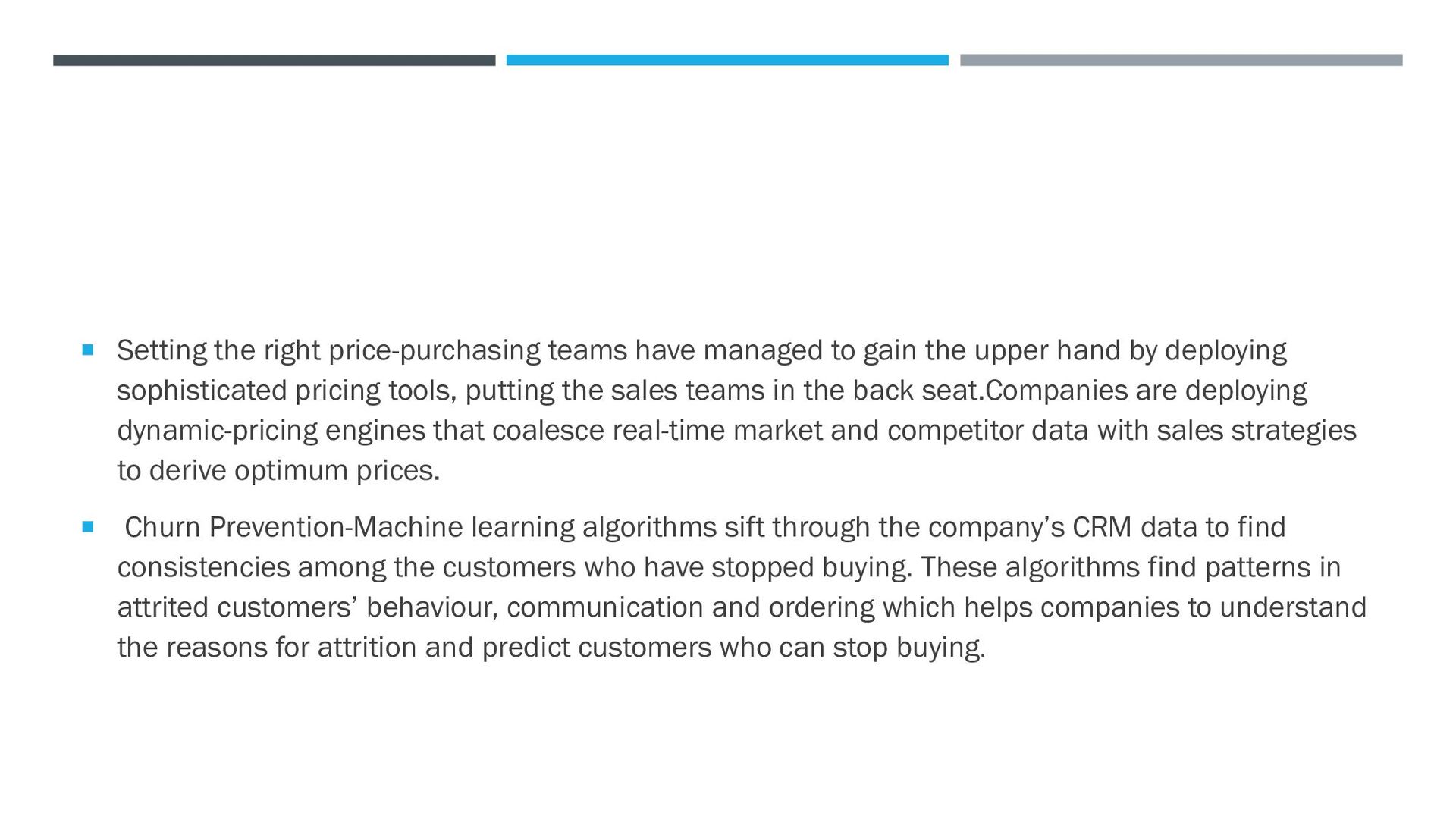
the upper hand by deploying sophisticated pricing tools, putting the sales teams in the back seat.Companies are deploying dynamic-pricing engines that coalesce real-time market and competitor data with sales strategies to derive optimum prices. Churn Prevention-Machine learning algorithms sift through the company’s CRM data to find consistencies among the customers who have stopped buying. These algorithms find patterns in attrited customers’ behaviour, communication and ordering which helps companies to understand the reasons for attrition and predict customers who can stop buying.
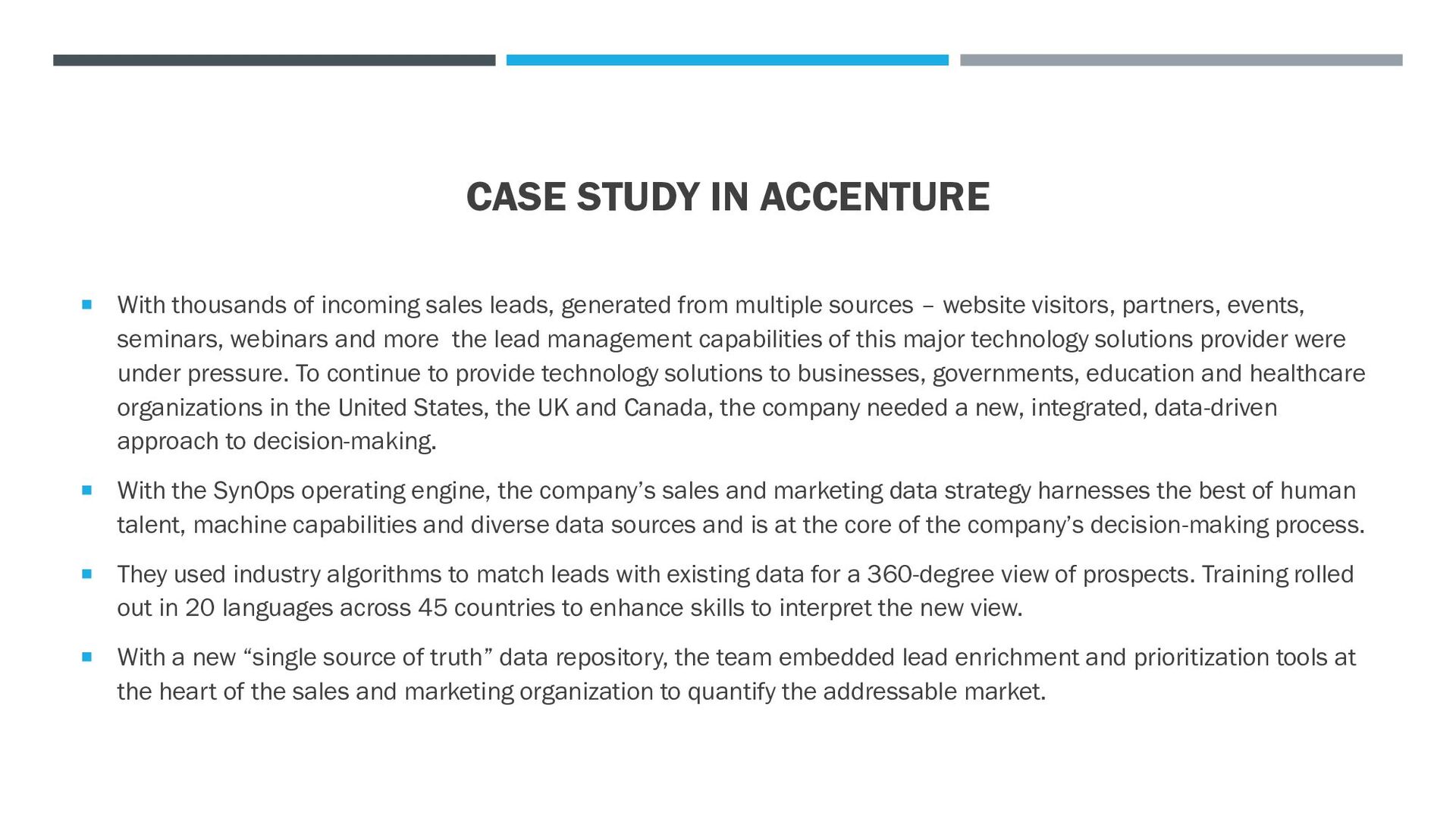
leads, generated from multiple sources – website visitors, partners, events, seminars, webinars and more the lead management capabilities of this major technology solutions provider were under pressure. To continue to provide technology solutions to businesses, governments, education and healthcare organizations in the United States, the UK and Canada, the company needed a new, integrated, data-driven approach to decision-making. With the SynOps operating engine, the company’s sales and marketing data strategy harnesses the best of human talent, machine capabilities and diverse data sources and is at the core of the company’s decision-making process. They used industry algorithms to match leads with existing data for a 360-degree view of prospects. Training rolled out in 20 languages across 45 countries to enhance skills to interpret the new view. With a new “single source of truth” data repository, the team embedded lead enrichment and prioritization tools at the heart of the sales and marketing organization to quantify the addressable market.
management lifecycle from demand generation, to lead categorization, execution, campaign effectiveness measurement and reporting. This technology solution provider’s Sales & Marketing capabilities have been transformed into a new, data-powered growth engine for the business. The organization now has an integrated, multi-channel approach spanning all stakeholders, including teams in marketing & IT. This has given it unprecedented insight into the provenance, potential and performance of every lead entering the system.
the leading online retailers. It enables users across the globe to shop millions of products anytime and anywhere. Amazon is taking the help of Data Science for inventory management. Whenever we want to buy something online from Amazon we visit the website, search for the item and add that item to our cart. After we add that item into our cart, Amazon starts giving us suggestions related to some similar products. With the increasing demands of the customers, they keep adding the products to fulfill the customers’ needs at the right time. All this is done by analyzing a large amount of customer data and predicting future demand patterns.
hub which is known as Data Cafe. The Data Cafe is fed up with more than 40 petabytes of customers data which helps them in understanding the market trend. This advanced analysis indicated the grocery team of Walmart that the sale of a particular item is suddenly reduced because of its irrelevant prices.Thus, this algorithm alerts them whenever there is a sudden decrease in the sales of a product so that appropriate actions can be taken. Now the industries are slowly adapting to the idea of augmented reality for providing the customers with the good of the product without actually owning it.One of the leading Swedish companies, IKEA furniture, and home accessories is enabling the users to scan the products. The customers can scan the products which they like and place them virtually in the house for experiencing its original look. This will help them to feel the product by using image recognition technology.The consumers can clear their doubts regarding the color, size, etc. before purchasing the product. This helps the customers to be sure and make a better purchasing decision. So, the companies have to bear lesser returns and negative sales.


 jlugia
 tammyeverts
 jnunemaker
 cargoodrich
 baasie
 jacobian
 nonsquared
 skoyamalab
 lauravandoore
 helmedeiros
 aleyda
 jakevdp