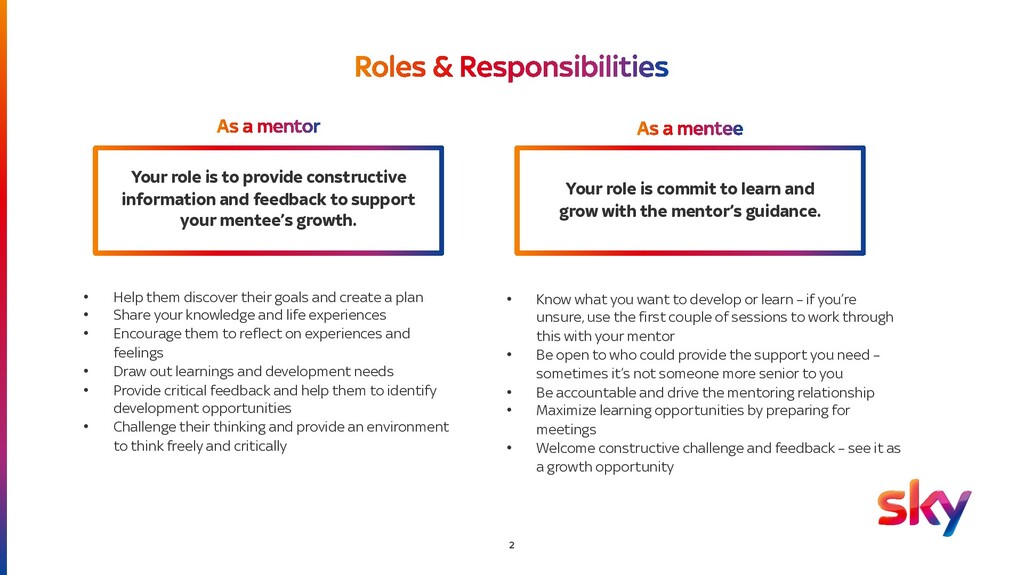
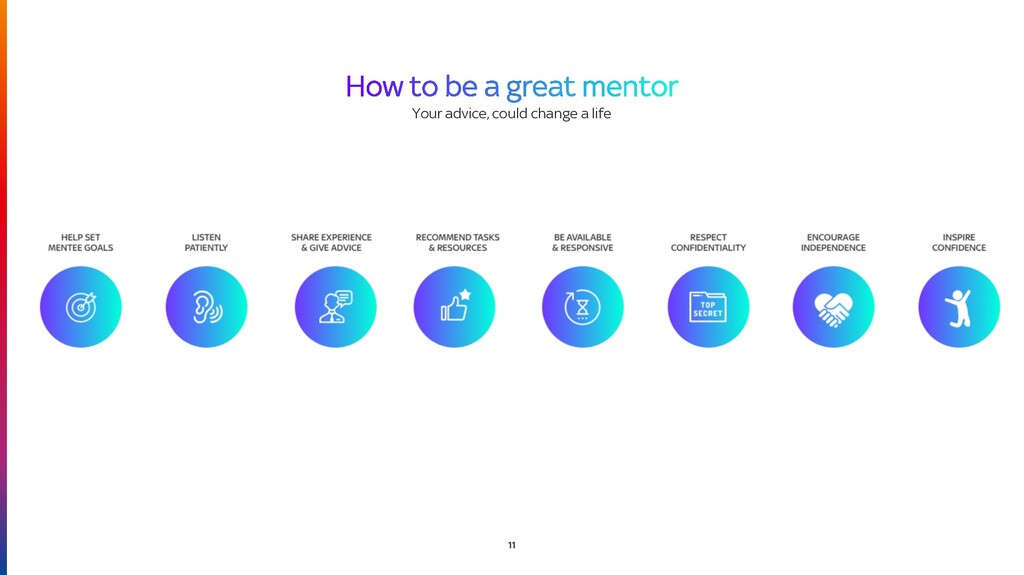
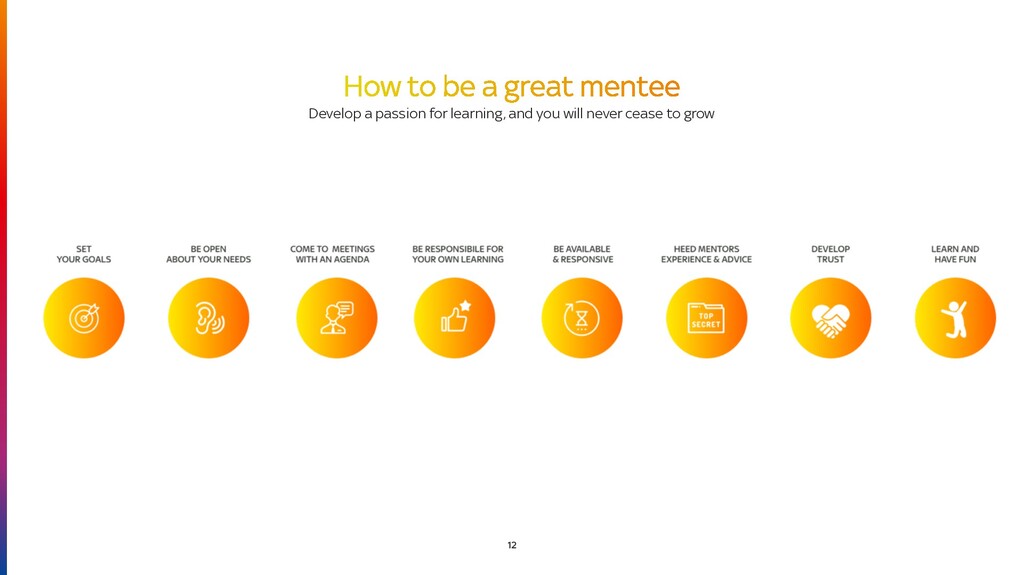
to support your mentee’s growth. Your role is commit to learn and grow with the mentor’s guidance. • Help them discover their goals and create a plan • Share your knowledge and life experiences • Encourage them to reflect on experiences and feelings • Draw out learnings and development needs • Provide critical feedback and help them to identify development opportunities • Challenge their thinking and provide an environment to think freely and critically • Know what you want to develop or learn – if you’re unsure, use the first couple of sessions to work through this with your mentor • Be open to who could provide the support you need – sometimes it’s not someone more senior to you • Be accountable and drive the mentoring relationship • Maximize learning opportunities by preparing for meetings • Welcome constructive challenge and feedback – see it as a growth opportunity
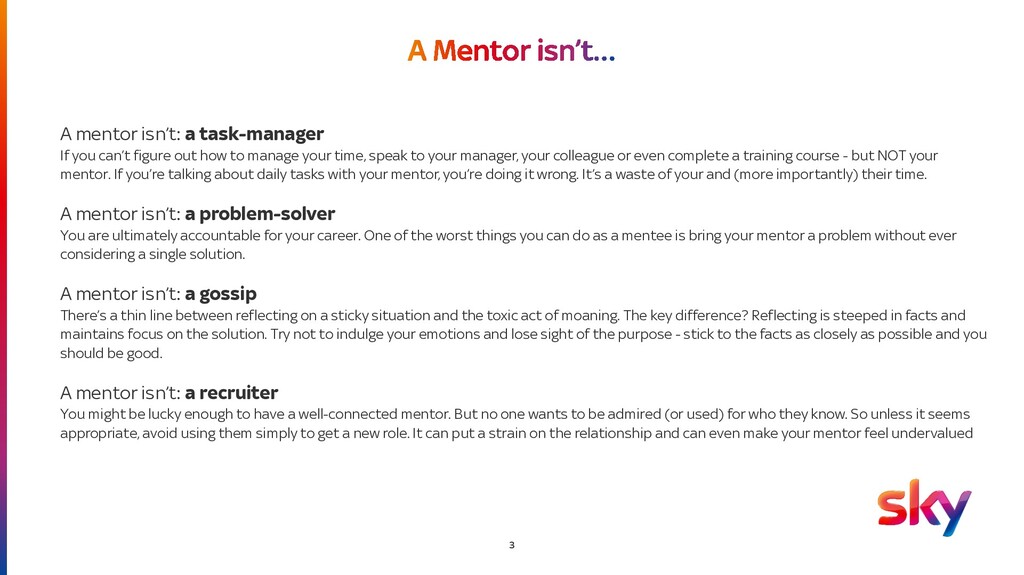
out how to manage your time, speak to your manager, your colleague or even complete a training course - but NOT your mentor. If you’re talking about daily tasks with your mentor, you’re doing it wrong. It’s a waste of your and (more importantly) their time. A mentor isn’t: a problem-solver You are ultimately accountable for your career. One of the worst things you can do as a mentee is bring your mentor a problem without ever considering a single solution. A mentor isn’t: a gossip There’s a thin line between reflecting on a sticky situation and the toxic act of moaning. The key difference? Reflecting is steeped in facts and maintains focus on the solution. Try not to indulge your emotions and lose sight of the purpose - stick to the facts as closely as possible and you should be good. A mentor isn’t: a recruiter You might be lucky enough to have a well-connected mentor. But no one wants to be admired (or used) for who they know. So unless it seems appropriate, avoid using them simply to get a new role. It can put a strain on the relationship and can even make your mentor feel undervalued
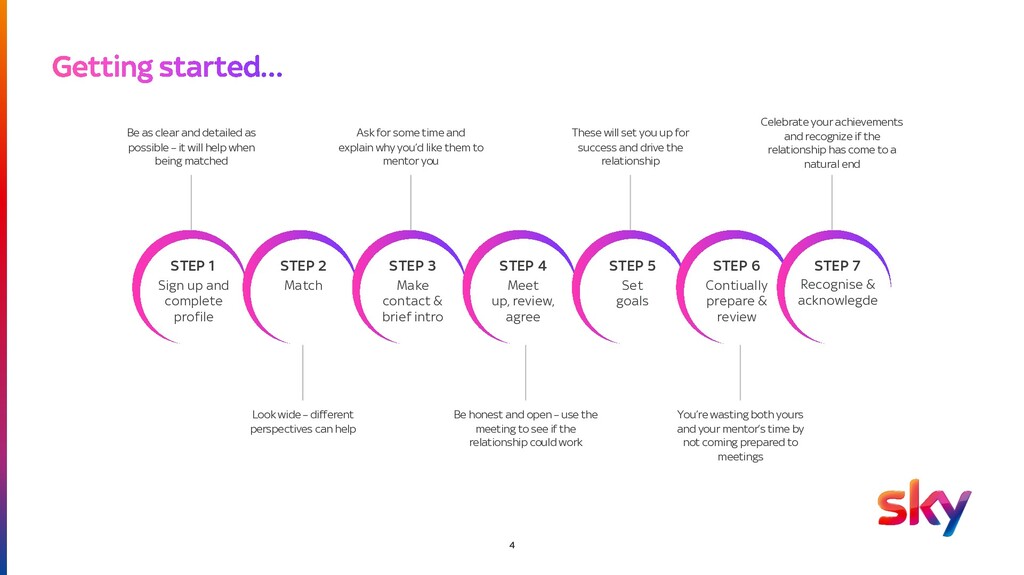
Match STEP 3 Make contact & brief intro STEP 4 Meet up, review, agree STEP 5 Set goals STEP 6 Contiually prepare & review STEP 7 Recognise & acknowlegde Be as clear and detailed as possible – it will help when being matched Look wide – different perspectives can help Ask for some time and explain why you’d like them to mentor you Be honest and open – use the meeting to see if the relationship could work These will set you up for success and drive the relationship You’re wasting both yours and your mentor’s time by not coming prepared to meetings Celebrate your achievements and recognize if the relationship has come to a natural end
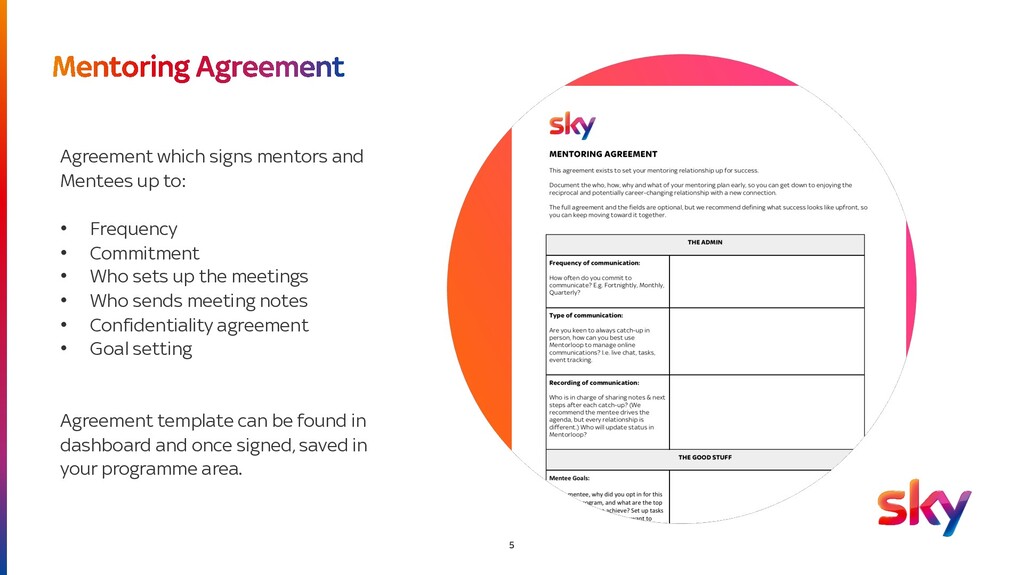
Frequency • Commitment • Who sets up the meetings • Who sends meeting notes • Confidentiality agreement • Goal setting Agreement template can be found in dashboard and once signed, saved in your programme area.
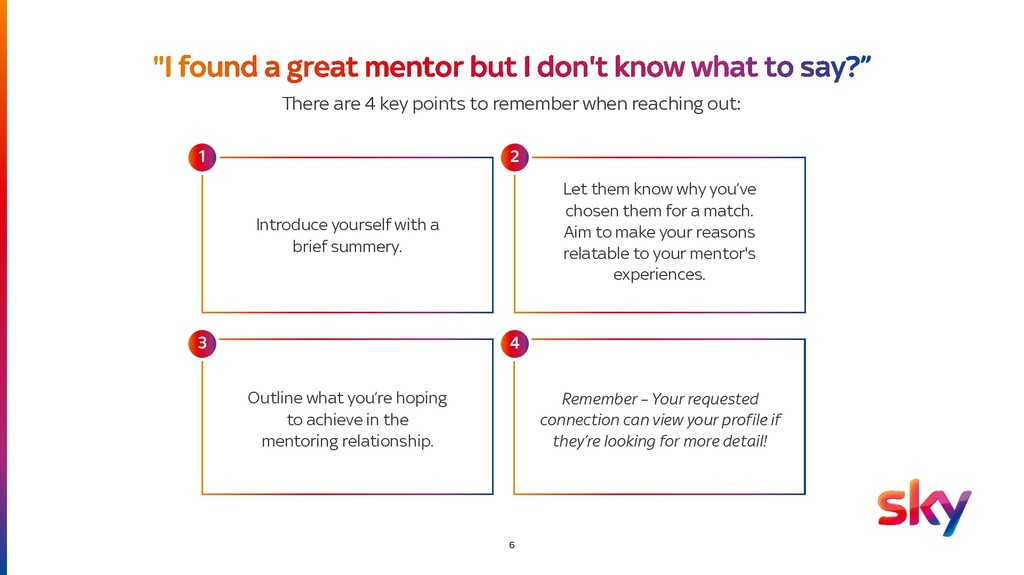
out: Introduce yourself with a brief summery. Let them know why you’ve chosen them for a match. Aim to make your reasons relatable to your mentor's experiences. Outline what you’re hoping to achieve in the mentoring relationship. Remember – Your requested connection can view your profile if they’re looking for more detail! 1 2 3 4
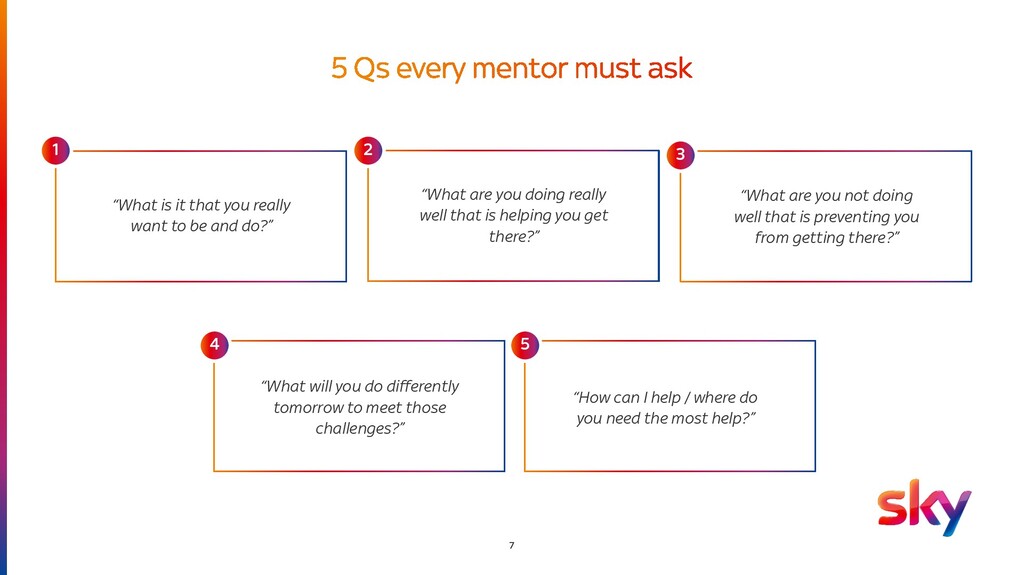
and do?” 1 2 3 4 “What are you doing really well that is helping you get there?” “What are you not doing well that is preventing you from getting there?” “What will you do differently tomorrow to meet those challenges?” 5 “How can I help / where do you need the most help?”
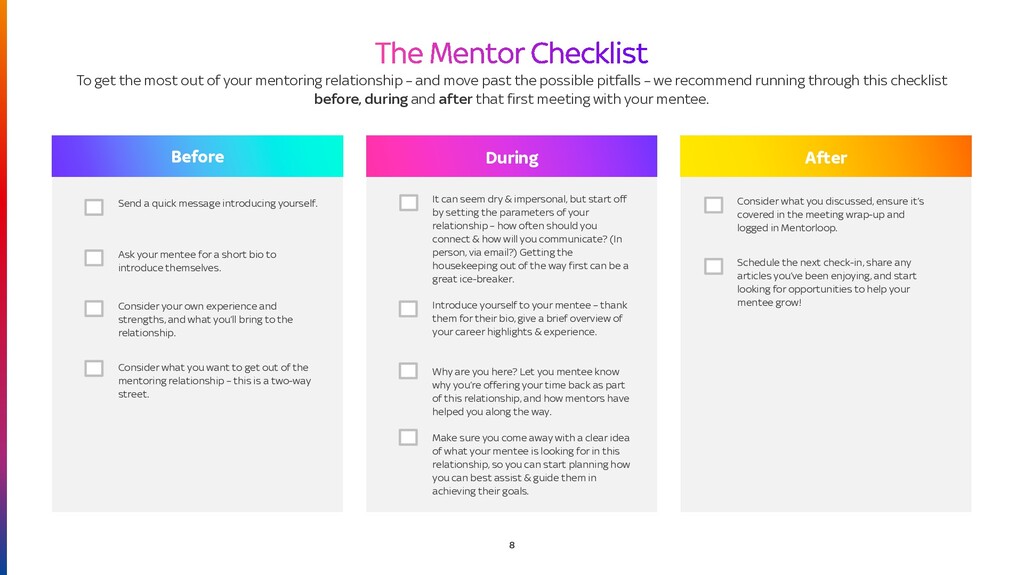
– and move past the possible pitfalls – we recommend running through this checklist before, during and after that first meeting with your mentee. Before During After Send a quick message introducing yourself. Ask your mentee for a short bio to introduce themselves. Consider your own experience and strengths, and what you’ll bring to the relationship. Consider what you want to get out of the mentoring relationship – this is a two-way street. It can seem dry & impersonal, but start off by setting the parameters of your relationship – how often should you connect & how will you communicate? (In person, via email?) Getting the housekeeping out of the way first can be a great ice-breaker. Introduce yourself to your mentee – thank them for their bio, give a brief overview of your career highlights & experience. Why are you here? Let you mentee know why you’re offering your time back as part of this relationship, and how mentors have helped you along the way. Make sure you come away with a clear idea of what your mentee is looking for in this relationship, so you can start planning how you can best assist & guide them in achieving their goals. Consider what you discussed, ensure it’s covered in the meeting wrap-up and logged in Mentorloop. Schedule the next check-in, share any articles you’ve been enjoying, and start looking for opportunities to help your mentee grow!
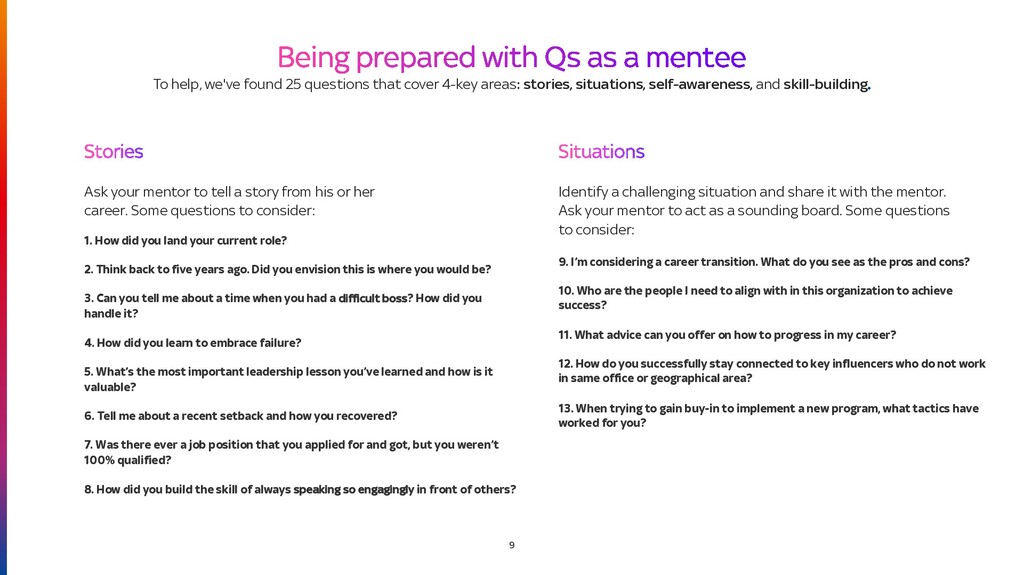
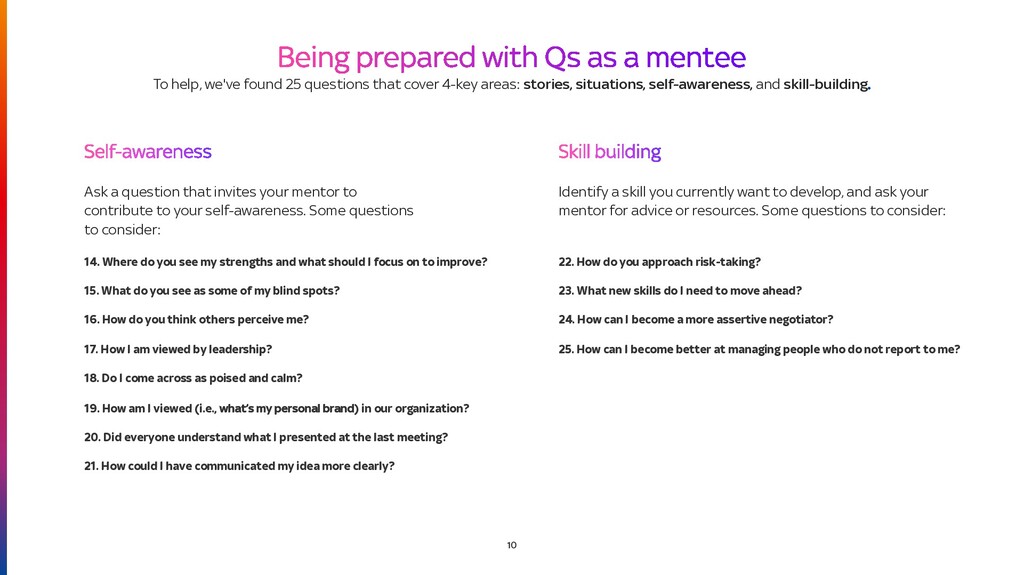
or her career. Some questions to consider: To help, we've found 25 questions that cover 4-key areas: stories, situations, self-awareness, and skill-building 1. How did you land your current role? 2. Think back to five years ago. Did you envision this is where you would be? 3. Can you tell me about a time when you had a difficult boss? How did you handle it? 4. How did you learn to embrace failure? 5. What’s the most important leadership lesson you’ve learned and how is it valuable? 6. Tell me about a recent setback and how you recovered? 7. Was there ever a job position that you applied for and got, but you weren’t 100% qualified? 8. How did you build the skill of always speaking so engagingly in front of others? Identify a challenging situation and share it with the mentor. Ask your mentor to act as a sounding board. Some questions to consider: 9. I’m considering a career transition. What do you see as the pros and cons? 10. Who are the people I need to align with in this organization to achieve success? 11. What advice can you offer on how to progress in my career? 12. How do you successfully stay connected to key influencers who do not work in same office or geographical area? 13. When trying to gain buy-in to implement a new program, what tactics have worked for you?
to your self-awareness. Some questions to consider: To help, we've found 25 questions that cover 4-key areas: stories, situations, self-awareness, and skill-building 14. Where do you see my strengths and what should I focus on to improve? 15. What do you see as some of my blind spots? 16. How do you think others perceive me? 17. How I am viewed by leadership? 18. Do I come across as poised and calm? 19. How am I viewed (i.e., what’s my personal brand) in our organization? 20. Did everyone understand what I presented at the last meeting? 21. How could I have communicated my idea more clearly? Identify a skill you currently want to develop, and ask your mentor for advice or resources. Some questions to consider: 22. How do you approach risk-taking? 23. What new skills do I need to move ahead? 24. How can I become a more assertive negotiator? 25. How can I become better at managing people who do not report to me?
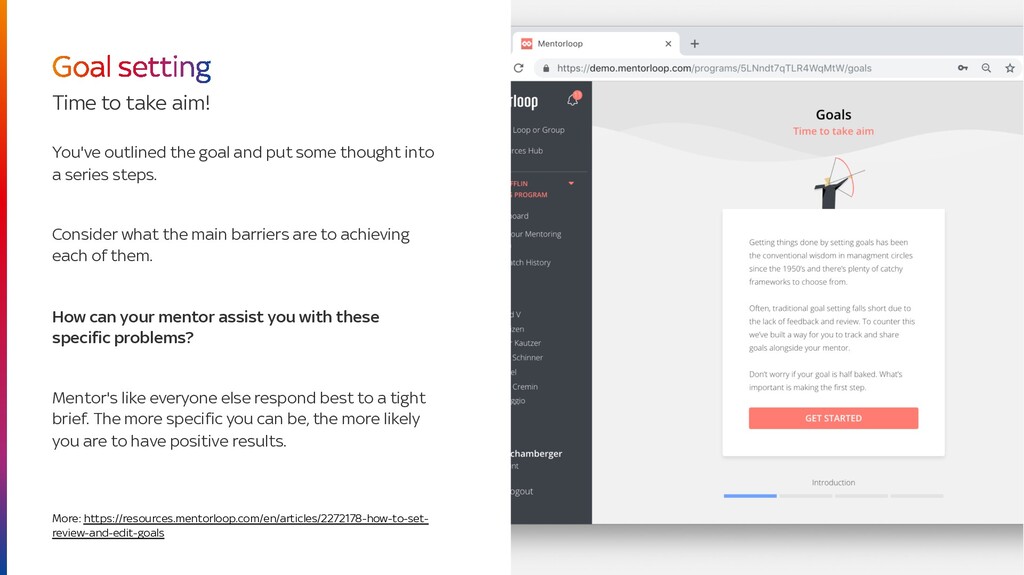
some thought into a series steps. Consider what the main barriers are to achieving each of them. How can your mentor assist you with these specific problems? Mentor's like everyone else respond best to a tight brief. The more specific you can be, the more likely you are to have positive results. More: https://resources.mentorloop.com/en/articles/2272178-how-to-set- review-and-edit-goals
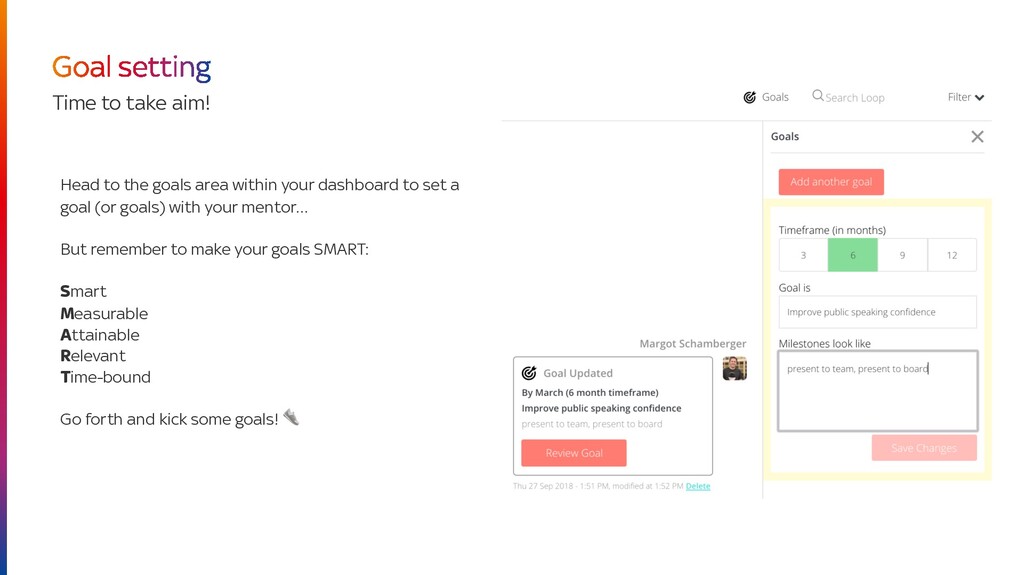
your dashboard to set a goal (or goals) with your mentor… But remember to make your goals SMART: Smart Measurable Attainable Relevant Time-bound Go forth and kick some goals! !
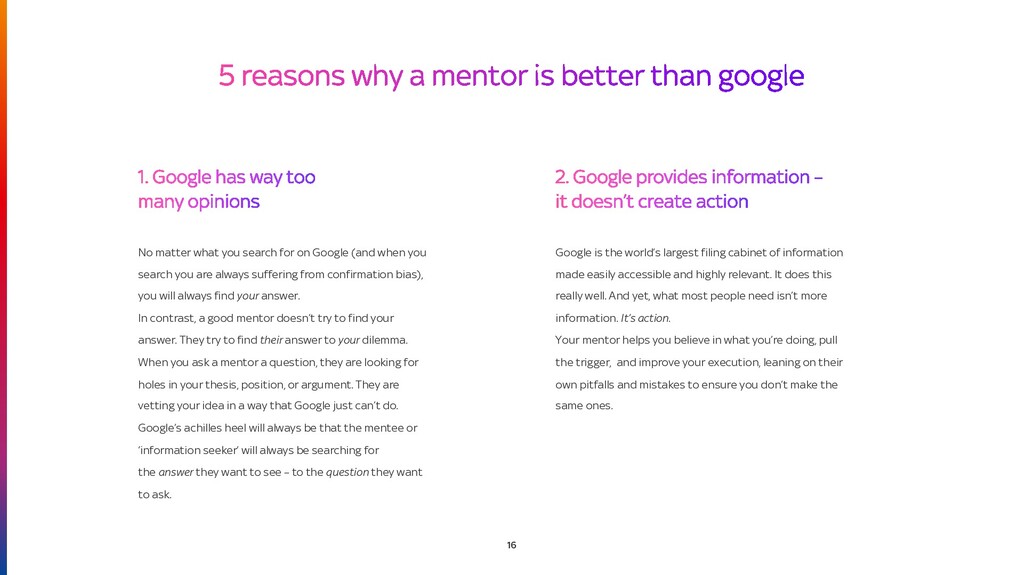
when you search you are always suffering from confirmation bias), you will always find your answer. In contrast, a good mentor doesn’t try to find your answer. They try to find their answer to your dilemma. When you ask a mentor a question, they are looking for holes in your thesis, position, or argument. They are vetting your idea in a way that Google just can’t do. Google’s achilles heel will always be that the mentee or ‘information seeker’ will always be searching for the answer they want to see – to the question they want to ask. Google is the world’s largest filing cabinet of information made easily accessible and highly relevant. It does this really well. And yet, what most people need isn’t more information. It’s action. Your mentor helps you believe in what you’re doing, pull the trigger, and improve your execution, leaning on their own pitfalls and mistakes to ensure you don’t make the same ones.
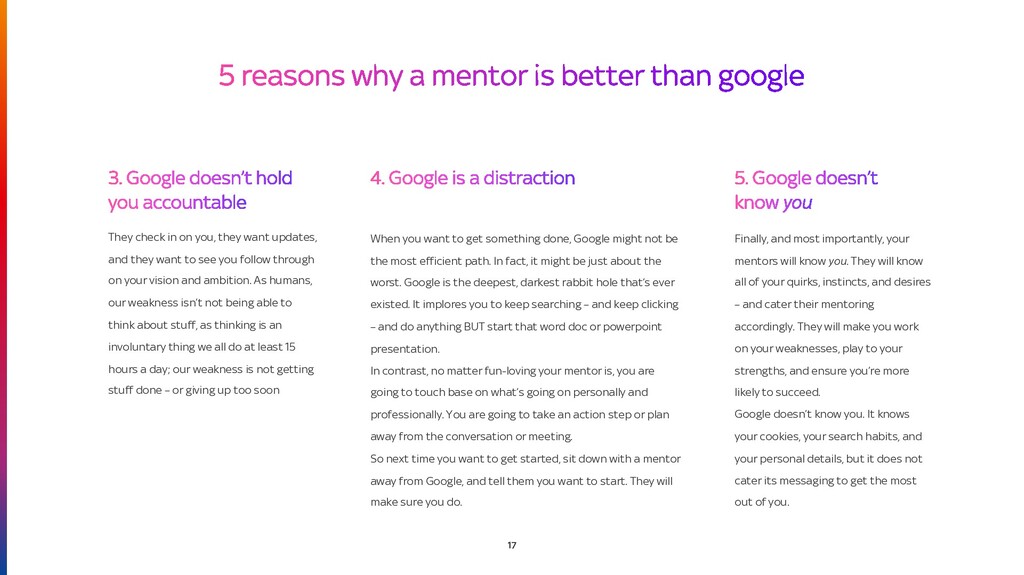
they want to see you follow through on your vision and ambition. As humans, our weakness isn’t not being able to think about stuff, as thinking is an involuntary thing we all do at least 15 hours a day; our weakness is not getting stuff done – or giving up too soon When you want to get something done, Google might not be the most efficient path. In fact, it might be just about the worst. Google is the deepest, darkest rabbit hole that’s ever existed. It implores you to keep searching – and keep clicking – and do anything BUT start that word doc or powerpoint presentation. In contrast, no matter fun-loving your mentor is, you are going to touch base on what’s going on personally and professionally. You are going to take an action step or plan away from the conversation or meeting. So next time you want to get started, sit down with a mentor away from Google, and tell them you want to start. They will make sure you do. Finally, and most importantly, your mentors will know you. They will know all of your quirks, instincts, and desires – and cater their mentoring accordingly. They will make you work on your weaknesses, play to your strengths, and ensure you’re more likely to succeed. Google doesn’t know you. It knows your cookies, your search habits, and your personal details, but it does not cater its messaging to get the most out of you.


 ks91
 vanstee
 tmiket
 smashingmag
 tamaranovitovic
 aleyda
 inesmontani
 pwiseman
 rasagy
 aarron
 samlambert
 addyosmani