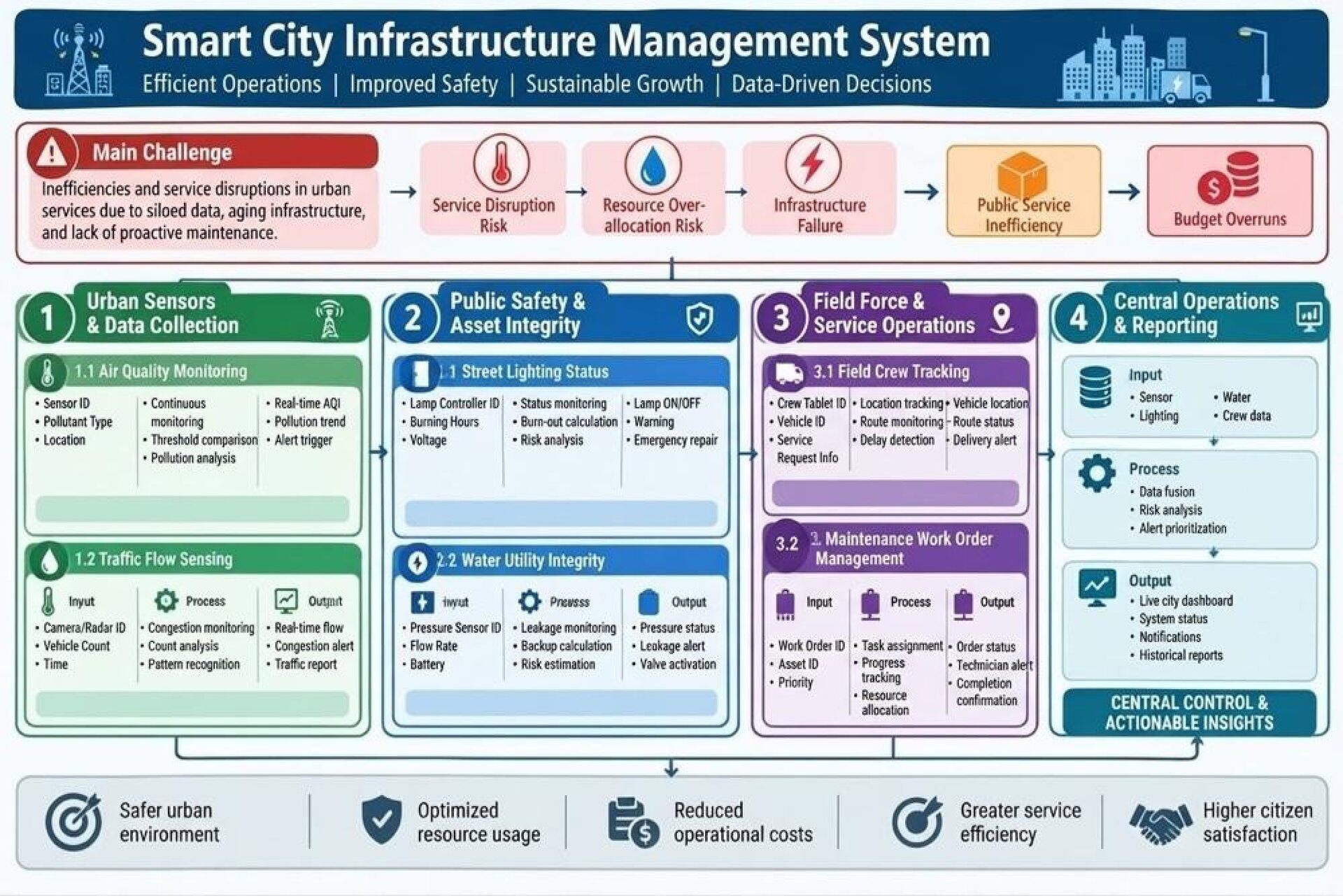
This infographic illustrates the Smart City Infrastructure Management System, designed to drive efficient operations, improved safety, sustainable growth, and data-driven decisions.
The system architecture and its core workflow comprise the following key sections:
Main Challenge: Identifies inefficiencies and service disruptions in urban services caused by siloed data, aging infrastructure, and a lack of proactive management, which lead to service disruption risk, resource over-allocation risk, infrastructure failure, public service inefficiency, and budget overruns.
1. Urban Sensors & Data Collection:
1.1 Air Quality Monitoring: Tracks sensor ID, pollutant type, and location through continuous monitoring, threshold comparison, and pollution analysis to output real-time AQI, pollution trends, and alert triggers.
1.2 Traffic Flow Sensing: Collects camera/radar ID, vehicle counts, and time data, processing congestion monitoring, count analysis, and pattern recognition to deliver real-time flow, congestion alerts, and traffic reports.
2. Public Safety & Asset Integrity:
2.1 Street Lighting Status: Monitors lamp controller IDs, burning hours, and voltage alongside status checks, burn-out calculations, and risk analysis to trigger lamp ON/OFF warnings and emergency repairs.
2.2 Water Utility Integrity: Gathers pressure sensor ID, flow rate, and battery data for leakage monitoring, backup calculations, and risk estimation to report pressure status, leak alerts, and valve activation.
3. Field Force & Service Operations:
3.1 Field Crew Tracking: Manages crew tablet IDs, vehicle IDs, and service request info alongside location tracking, route monitoring, and delay detection to provide vehicle location, route status, and delivery alerts.
3.2 Maintenance Work Order Management: Coordinates work order IDs, asset IDs, and priorities via task assignment, progress tracking, and resource allocation to handle order status, technician alerts, and completion confirmations.
4. Central Operations & Reporting:
Integrates sensor, lighting, water, and crew data through data fusion, risk analysis, and alert prioritization to output live city dashboards, system status updates, notifications, and historical reports for central control and actionable insights.
Final Results: Delivers a safer urban environment, optimized resource usage, reduced operational costs, greater service efficiency, and higher citizen satisfaction.


 baasie
 bluesmoon
 holman
 dougneiner
 hannesfritz
 davidcarrasco
 mclloyd
 akihiro_kokubo
 csswizardry
 sugarenia
 gurzu
 davetheseo