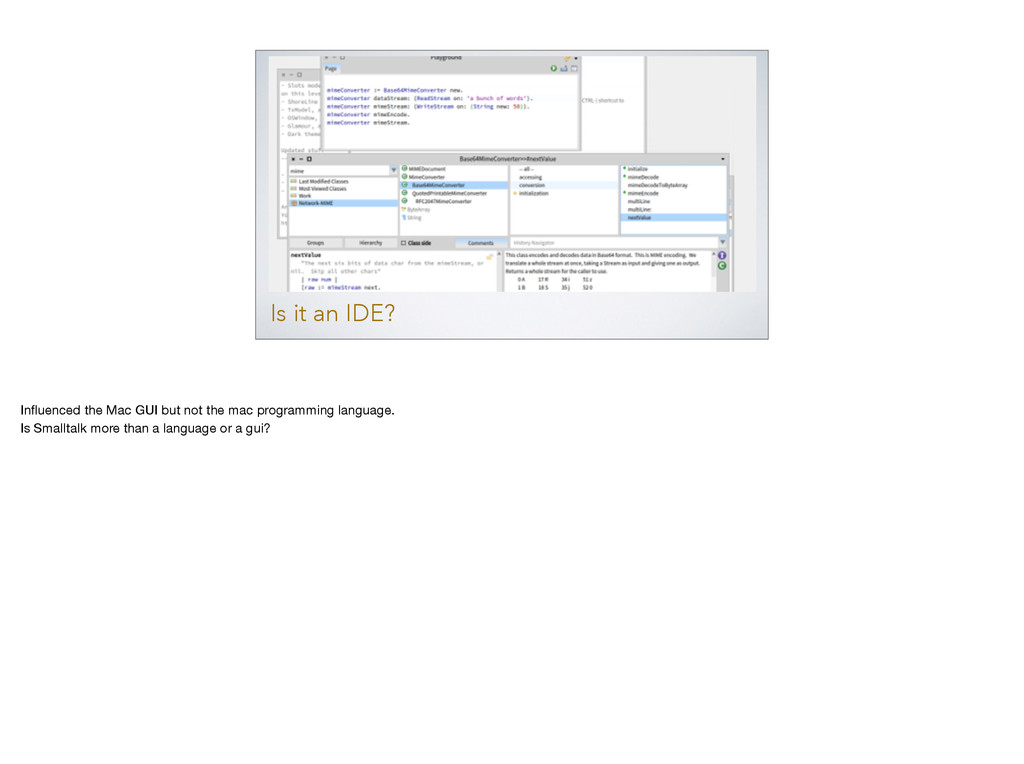
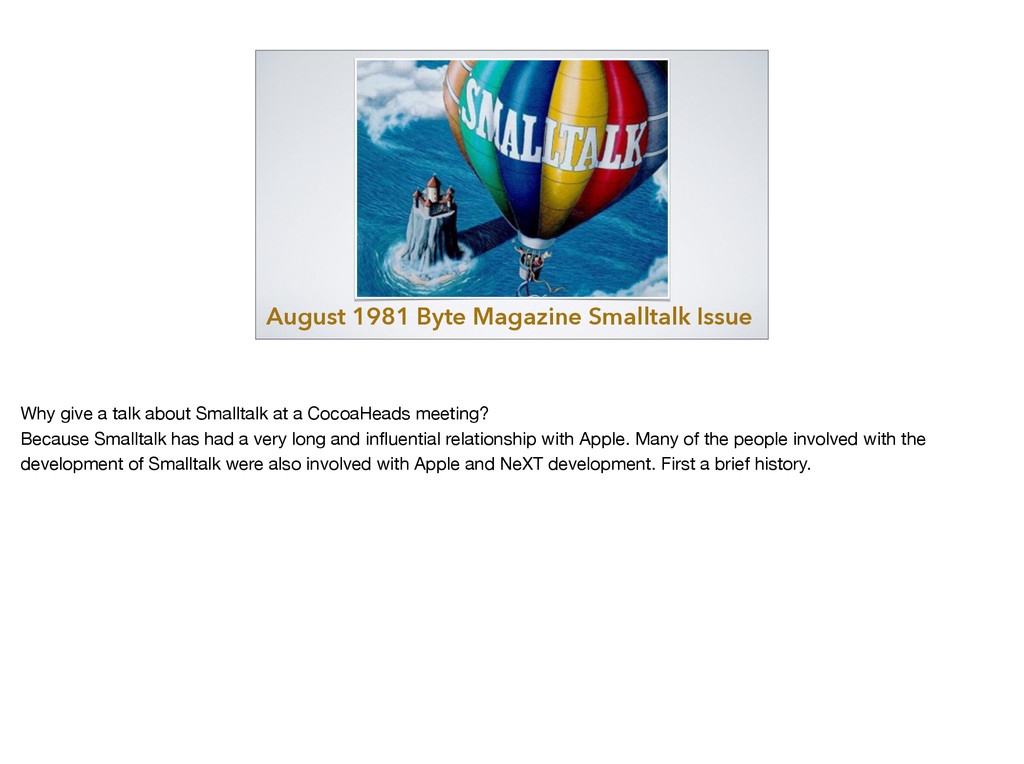
about Smalltalk at a CocoaHeads meeting? Because Smalltalk has had a very long and influential relationship with Apple. Many of the people involved with the development of Smalltalk were also involved with Apple and NeXT development. First a brief history.
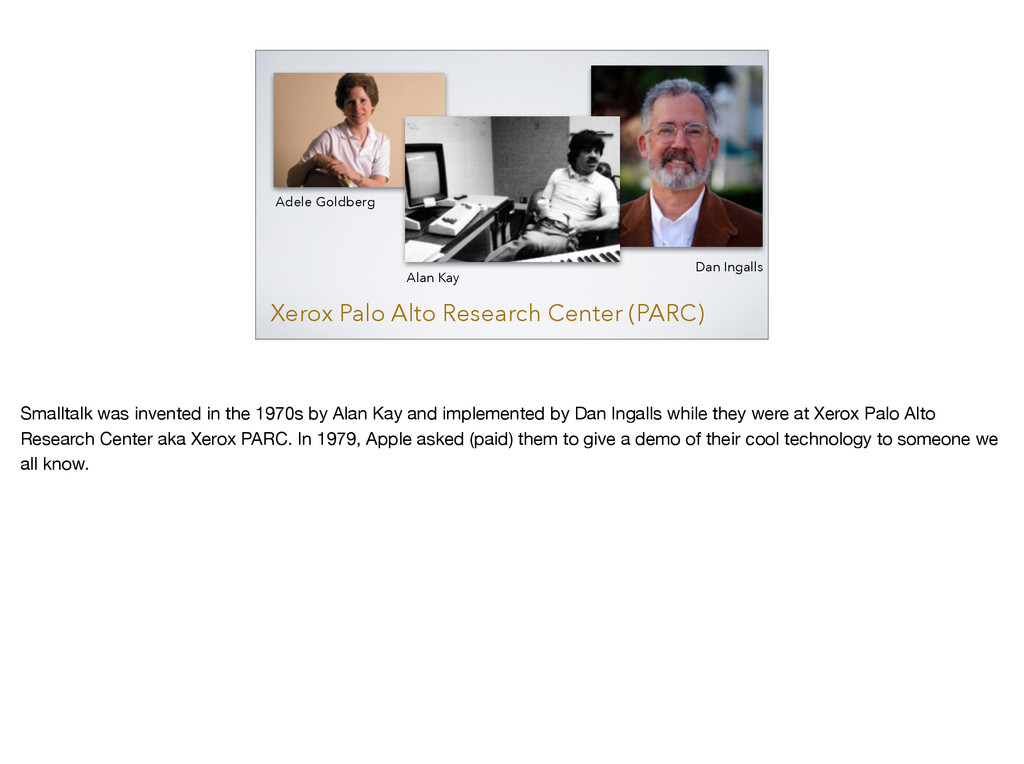
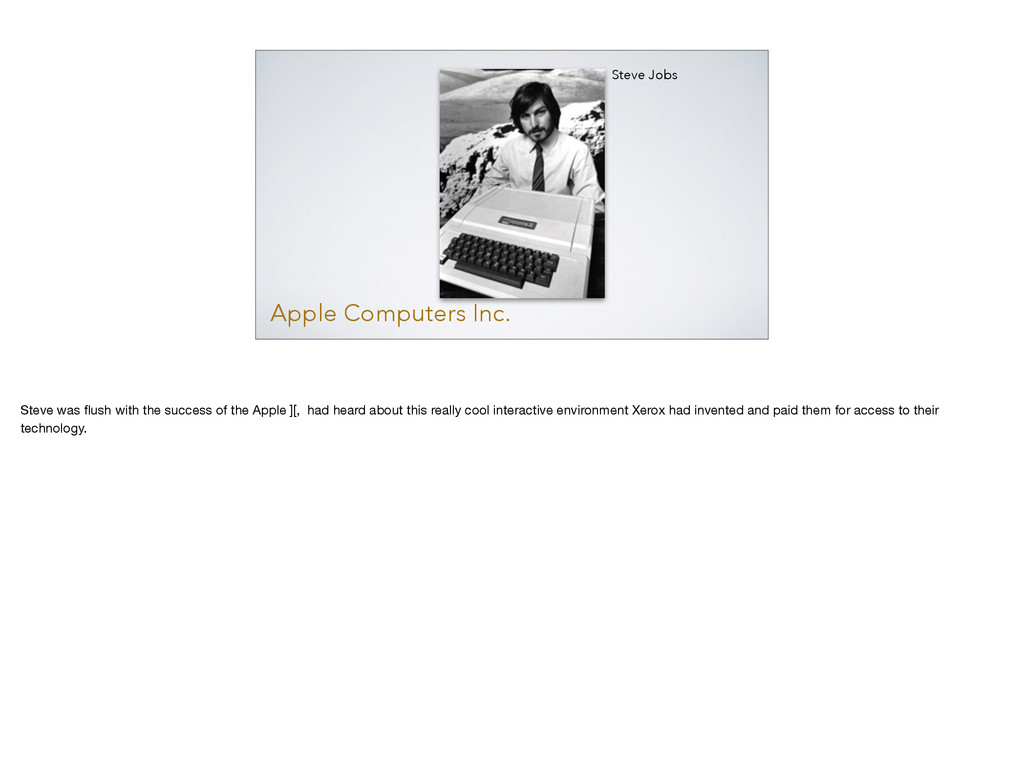
Alan Kay Smalltalk was invented in the 1970s by Alan Kay and implemented by Dan Ingalls while they were at Xerox Palo Alto Research Center aka Xerox PARC. In 1979, Apple asked (paid) them to give a demo of their cool technology to someone we all know.
Steve Jobs said he didn't like the blt-style scrolling we were using and asked if we could do it in a smooth continuous style. In less than a minute Dan found the methods involved, made the (relatively major) changes and scrolling was now continuous! This shocked the visitors, Xerox Smalltalk Demo 1979 From “Early History of Smalltalk by Alan Kay Just words if you don’t know Smalltalk. http://propella.sakura.ne.jp/earlyHistoryST/EarlyHistoryST.html#p38 By now it was already 1979, and we found ourselves doing one of our many demos, but this time for a very interested audience: Steve Jobs, Jeff Raskin, and other technical people from Apple. They had started a project called Lisa but weren't quite sure what it should be like, until Jeff said to Steve, "You should really come over to PARC and see what they are doing." Thus, more than eight years after overlapping windows had been invented and more than six years after the ALTO started running, the people who could really do something about the ideas, finally to to see them. The machine used was the Dorado, a very fast "big brother" of the ALTO, whose Smalltalk microcode had been largely written by Bruce Horn, one of our original "Smalltalk kids" who was still only a teen-ager. Larry Tesler gave the main part of the demo with Dan sitting in the copilot's chair and Adele and I watched from the rear. One of the best parts of the demo was when Steve Jobs said he didn't like the blt-style scrolling we were using and asked if we could do it in a smooth continuous style. In less than a minute Dan found the methods involved, made the (relatively major) changes and scrolling was now continuous! This shocked the visitors, especially the programmers among them, as they had never seen a really powerful incremental system
what Steve would have seen at the demo. To the right is the Apple ][ startup screen from a similar time period. Smalltalk influenced the Mac, Windows Java, Xcode, IDEs, Ruby, Objective-C, NeXT
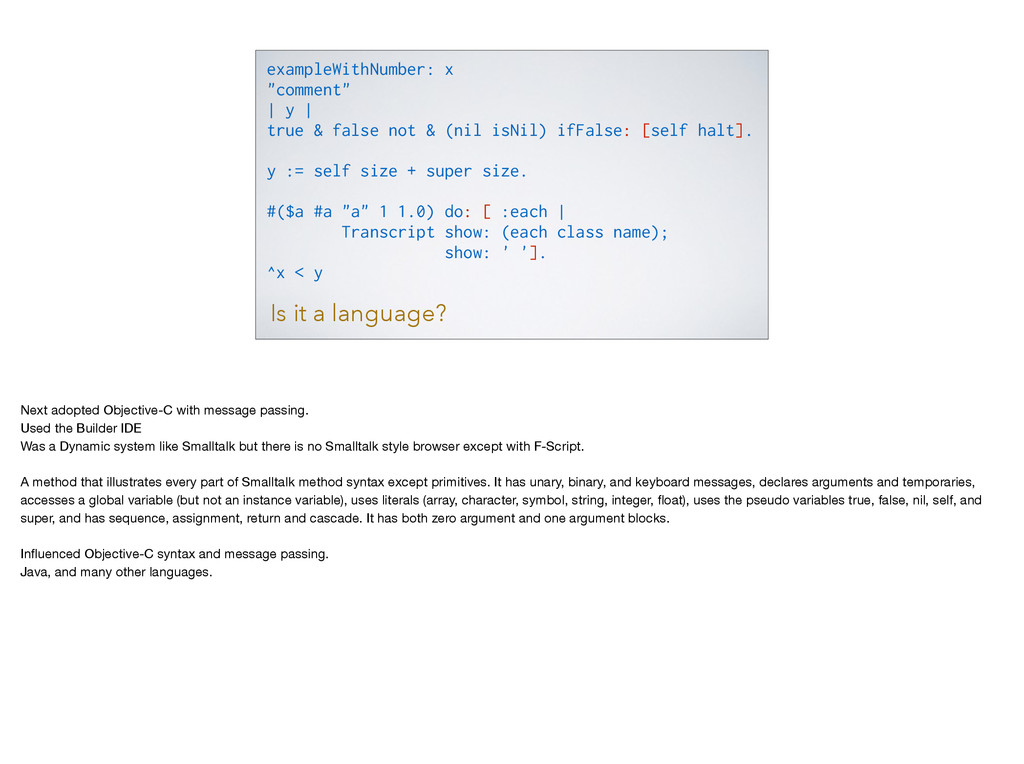
true & false not & (nil isNil) ifFalse: [self halt]. y := self size + super size. #($a #a "a" 1 1.0) do: [ :each | Transcript show: (each class name); show: ' ']. ^x < y Next adopted Objective-C with message passing. Used the Builder IDE Was a Dynamic system like Smalltalk but there is no Smalltalk style browser except with F-Script. A method that illustrates every part of Smalltalk method syntax except primitives. It has unary, binary, and keyboard messages, declares arguments and temporaries, accesses a global variable (but not an instance variable), uses literals (array, character, symbol, string, integer, float), uses the pseudo variables true, false, nil, self, and super, and has sequence, assignment, return and cascade. It has both zero argument and one argument blocks. Influenced Objective-C syntax and message passing. Java, and many other languages.
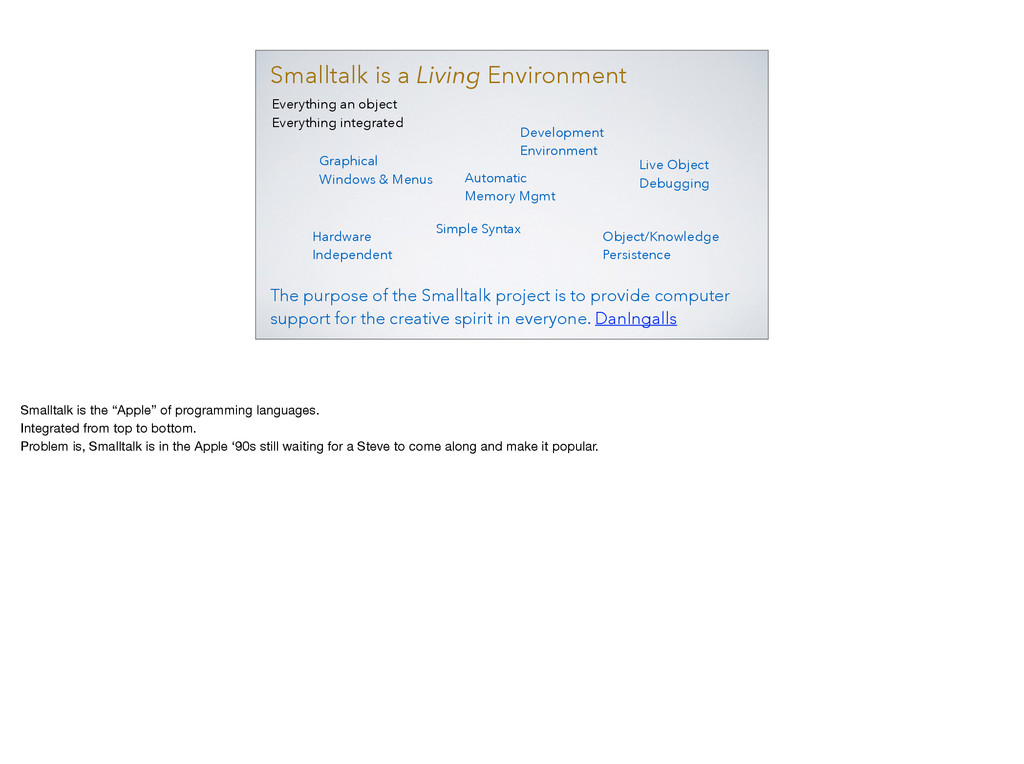
project is to provide computer support for the creative spirit in everyone. DanIngalls Graphical Windows & Menus Simple Syntax Development Environment Object/Knowledge Persistence Hardware Independent Everything an object Everything integrated Live Object Debugging Automatic Memory Mgmt Smalltalk is the “Apple” of programming languages. Integrated from top to bottom. Problem is, Smalltalk is in the Apple ‘90s still waiting for a Steve to come along and make it popular.
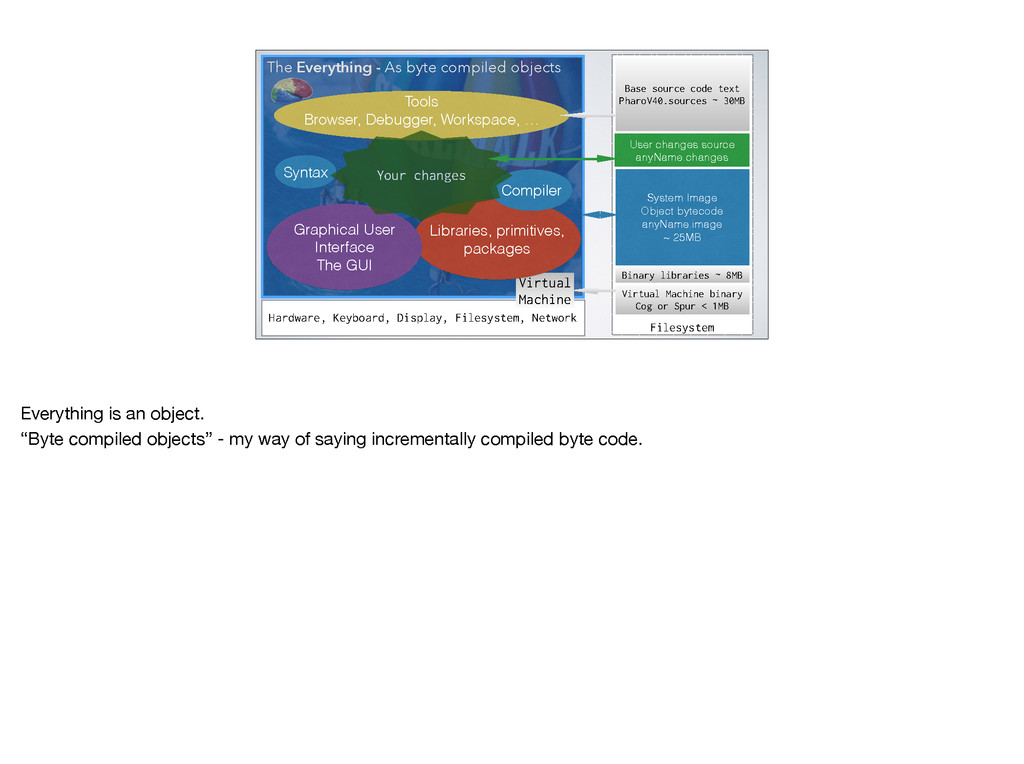
primitives, packages Compiler Graphical User Interface The GUI System Image Object bytecode anyName.image ~ 25MB Tools Browser, Debugger, Workspace, … User changes source anyName.changes Virtual Machine binary Cog or Spur < 1MB Base source code text PharoV40.sources ~ 30MB Your changes Binary libraries ~ 8MB The Everything - As byte compiled objects Everything is an object. “Byte compiled objects” - my way of saying incrementally compiled byte code.
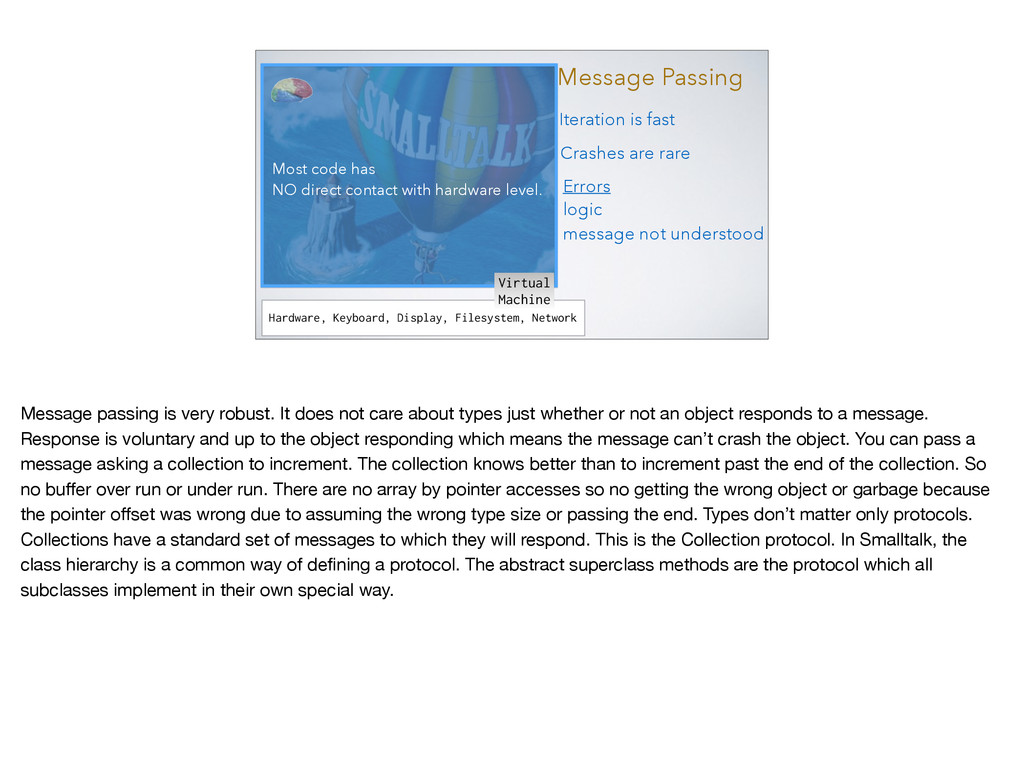
Passing Errors logic message not understood Crashes are rare Iteration is fast Hardware, Keyboard, Display, Filesystem, Network Virtual Machine Message passing is very robust. It does not care about types just whether or not an object responds to a message. Response is voluntary and up to the object responding which means the message can’t crash the object. You can pass a message asking a collection to increment. The collection knows better than to increment past the end of the collection. So no buffer over run or under run. There are no array by pointer accesses so no getting the wrong object or garbage because the pointer offset was wrong due to assuming the wrong type size or passing the end. Types don’t matter only protocols. Collections have a standard set of messages to which they will respond. This is the Collection protocol. In Smalltalk, the class hierarchy is a common way of defining a protocol. The abstract superclass methods are the protocol which all subclasses implement in their own special way.
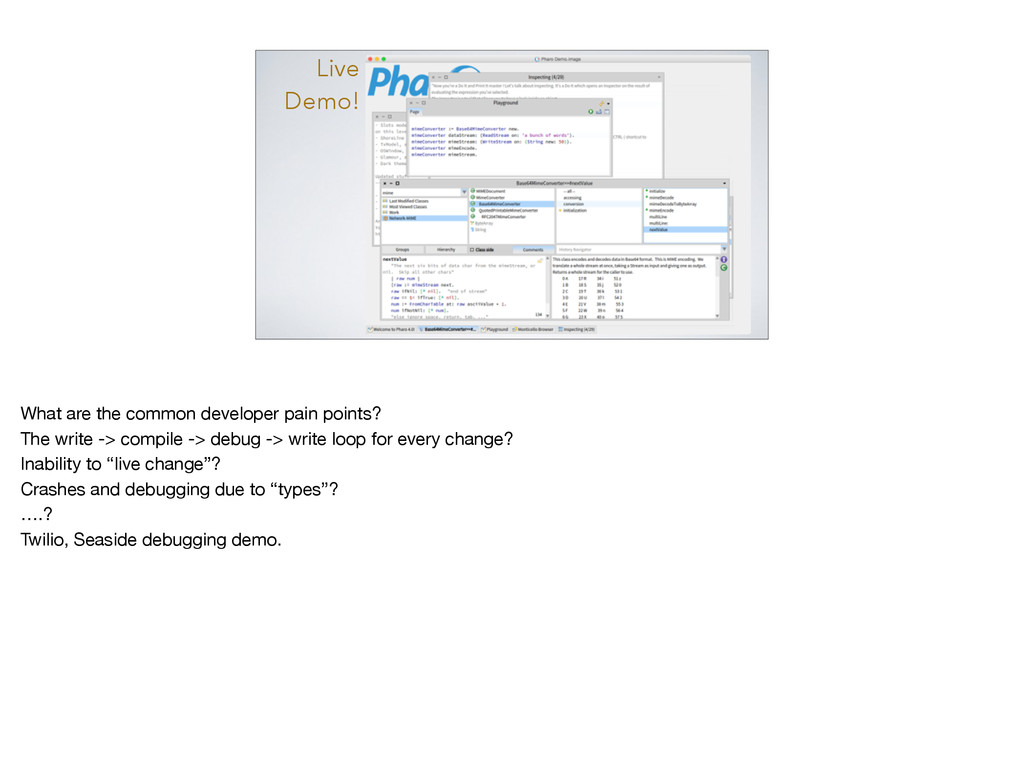
write -> compile -> debug -> write loop for every change? Inability to “live change”? Crashes and debugging due to “types”? ….? Twilio, Seaside debugging demo.
Smalltalk at Xerox Palo Alto Research Center (PARC) 1979 - Xerox PARC demos Smalltalk to Steve Jobs and others 1983 - Objective-C, object oriented C with message passing based on Smalltalk 1984 - Apple introduces the Macintosh Computer with a GUI from Smalltalk (Do It -> Ok) 1988 - NeXT acquires Objective-C 1988 - NeXT creates Interface Builder (& IDE Project Builder?) (Xcode ancestors) 1996 - Apple acquires NeXT (or NeXT takes over Apple :-) 2001 - Apple introduces OS X (Smalltalk -> NeXTStep -> OS X) 2011 - Apple delivers Automatic Reference Counting (ARC) 2011 - OS X Lion includes document and desktop persistence 2011 - Bertrand Serlet leaves Apple, worked at Xerox PARC, NeXT, Apple OS X 2014 - Apple introduces Swift with interactive workspace style “Playgrounds” 2011 - After 32 years, Apple has a computer which fully implements most of the Smalltalk experience for the average user. Note, Apple could of always had “Playgrounds” in Objective-C with a utility like F-Script which allows sending Objective-C runtime messages and introspection of the runtime.
- http://www.cincomsmalltalk.com/main/ Seaside - http://www.seaside.st/ Amber - http://amber-lang.net/ F-Script - http://www.fscript.org/ , https://github.com/Kentzo/F-Script Resources Squeak is an open source direct descendant of Smalltalk. Written by Dan Ingalls the creator of the original Smalltalk implementation. Squeak uses a GPL and so is not commercial use friendly. Pharo is the latest open source Smalltalk good for commercial use. It was ported and re-licensed from the Squeak GNU license to a commercial friendly MIT license. Cincom is a commercial business and owner of the original commercial Smalltalk from Xerox PARC and Digitalk. They sell VisualWorks. Seaside is a web application server framework written for the Smalltalk platform. Includes block continuations and closures. Meaning it handles session information rather than the programmer. Amber is a Javascript implementation of Smalltalk which can be used to implement client or server side javascript interfaces and applications.

 SiteGround - Reliable hosting with speed, security, and support you can count on.


 taun
 shugo
 ludicmind
 codatum
 ykanoh
 hiracky16
 ishikawa_satoru
 gogutan
 yamanoku
 occhi
 codmoninc
 4o1sobblue
 takuroabe
 aleyda
 sabderemane
 marcoroth
 matthewcrist
 axbom
 leimatthew05
 inesmontani
 smashingmag
 jmmastey
 addyosmani
 maggiecrowley
 rkaga
![Smalltalk demo Apple ][ Smalltalk To the left is roughly](https://files.speakerdeck.com/presentations/a21d88655bbd422486b059b09c46f0af/slide_4.jpg)