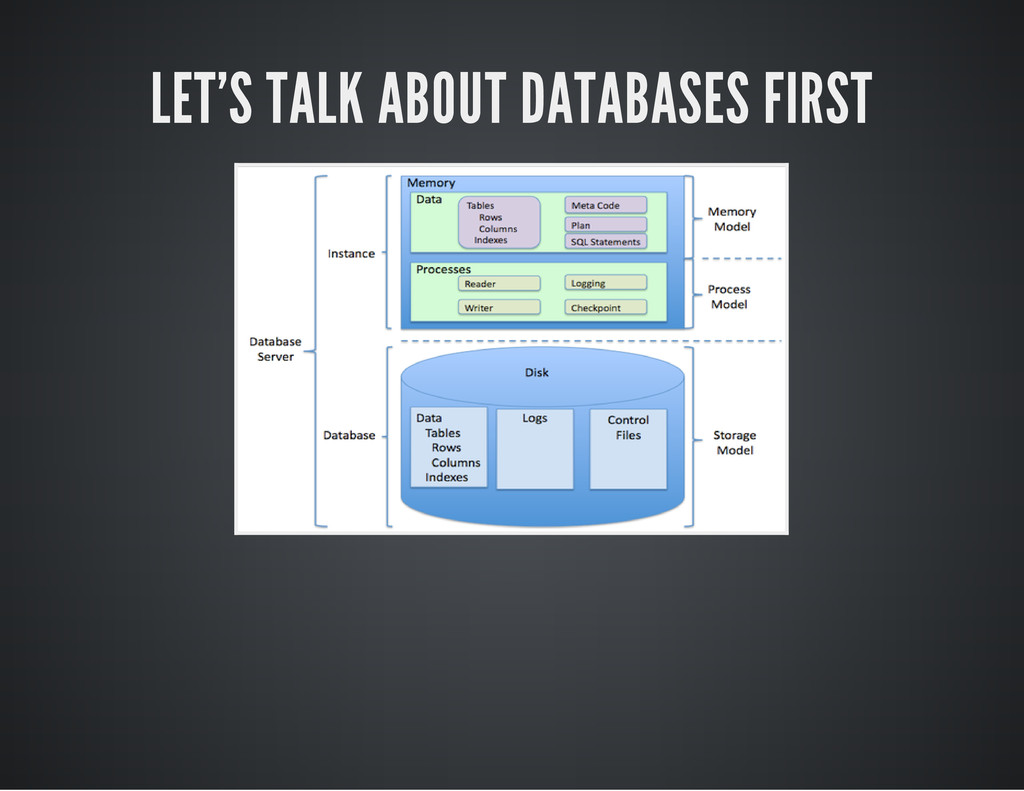
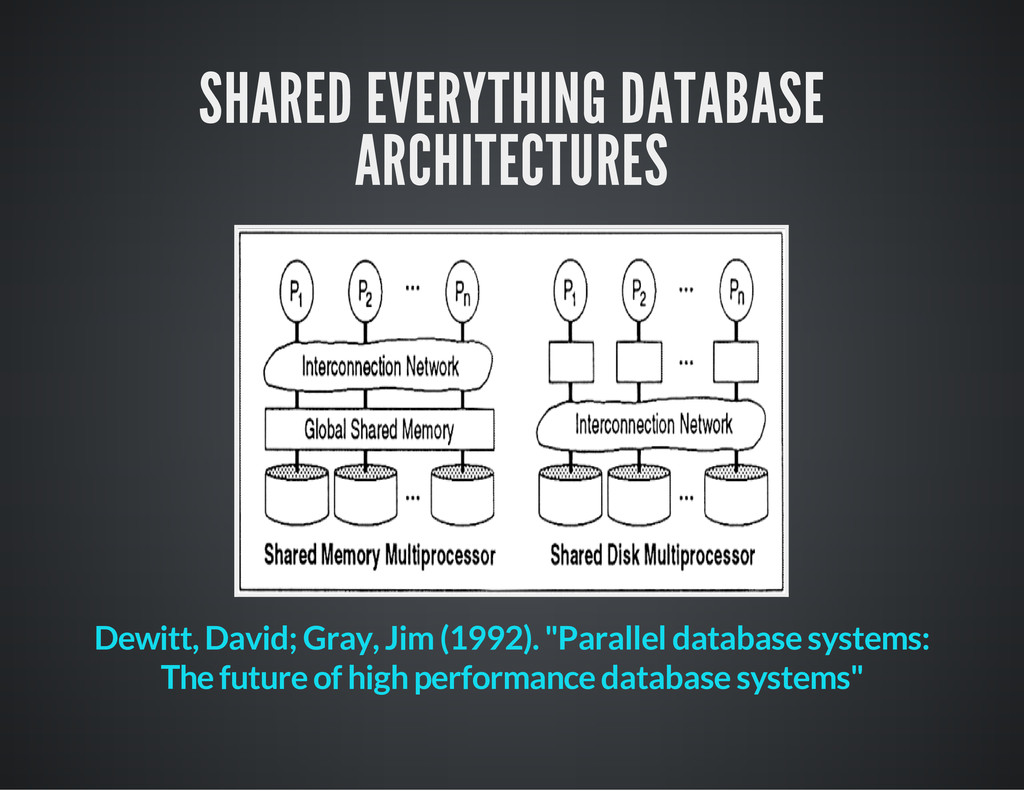
- does not aid a lot in understanding data grids. Nodes have their own memory, and share mass storage. Disk interconnect may be achieved via SANs. OLTP databases like Oracle, IBM DB2, MySQL, PostgreSQL are architected this way.
point of contention. Limits horizontal scaling. Improved performance is achieved through vertical scaling. Faster nodes == better performance. Consistent writes require : disk based lock tables or synchronization among individual nodes. because of the possibility of lost updates.
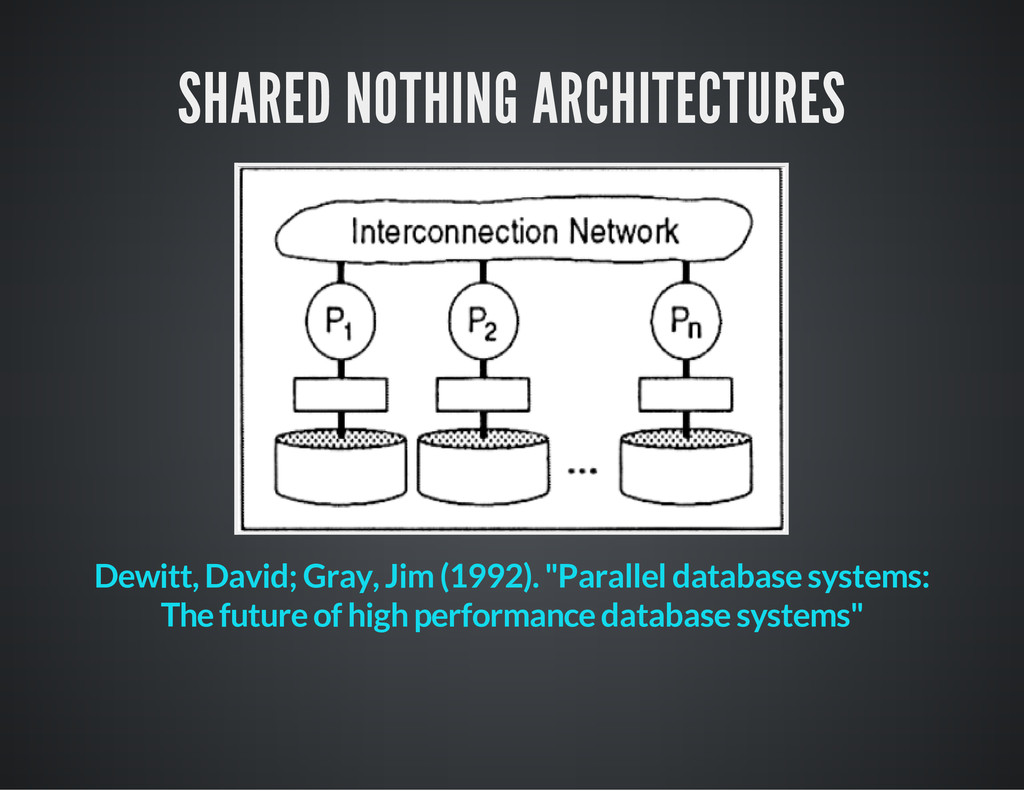
no single point of contention. Horizontal scaling is done by adding more nodes and typically does not come at the cost of performance. A node can typically operate only on data available locally - leads to data partitioning techniques.
on data spanning multiple nodes. (Think access plans for queries spanning nodes or involving joins) Without good data affinity or partitioning techniques, loads will not be uniformly distributed. Without data replication, nodes are single points of failure.
that work together to manage information and related operations – such as computations – in a distributed environment. Cameron Purdy (2008). Defining a Data Grid
characteristics of shared-nothing architectures. Note the lack of a 'relational' qualifier for the database. Data grids typically store objects not tuples.
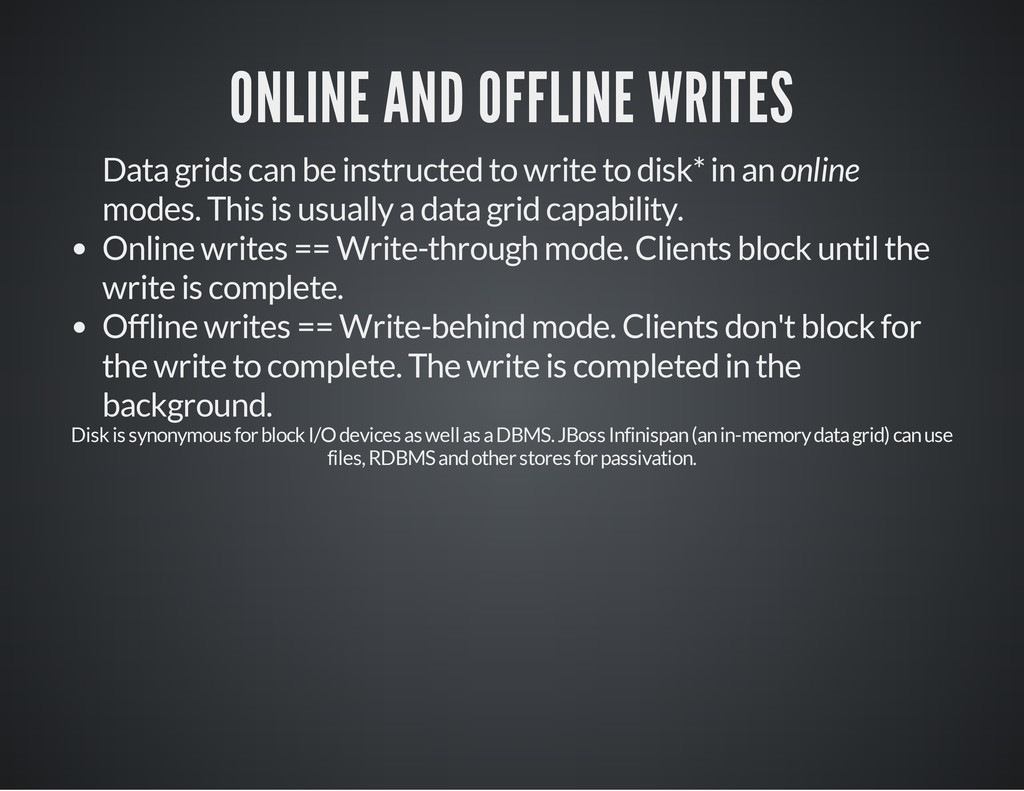
write to disk* in an online modes. This is usually a data grid capability. Online writes == Write-through mode. Clients block until the write is complete. Offline writes == Write-behind mode. Clients don't block for the write to complete. The write is completed in the background. Disk is synonymous for block I/O devices as well as a DBMS. JBoss Infinispan (an in-memory data grid) can use files, RDBMS and other stores for passivation.
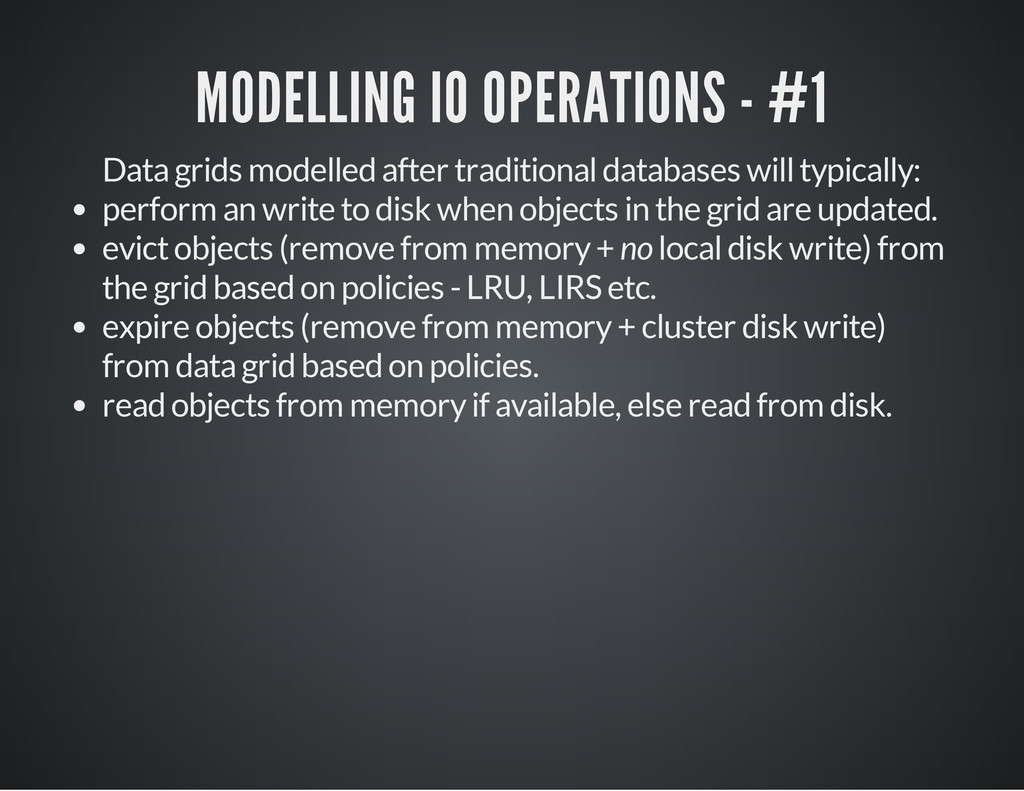
databases will typically: perform an write to disk when objects in the grid are updated. evict objects (remove from memory + no local disk write) from the grid based on policies - LRU, LIRS etc. expire objects (remove from memory + cluster disk write) from data grid based on policies. read objects from memory if available, else read from disk.
data grid implementations may evolve to: perform writes to disk occur only during eviction! ensure HA through replication. Kallman, Robert; et al (2008). H-Store: A High-Performance, Distributed Main Memory Transaction Processing System


 vineetreynolds
 artoy
 sorah
 morizo_1984
 ___akari11
 iwatsukayura
 iwiwi
 akihisaikeda
 nokomoro3
 dske104
 ichirokano2
 mofurune
 siroemk
 reverentgeek
 aleyda
 thekraken
 tmiket
 chriscoyier
 madoxten
 konakalab
 holman
 coloredviolet