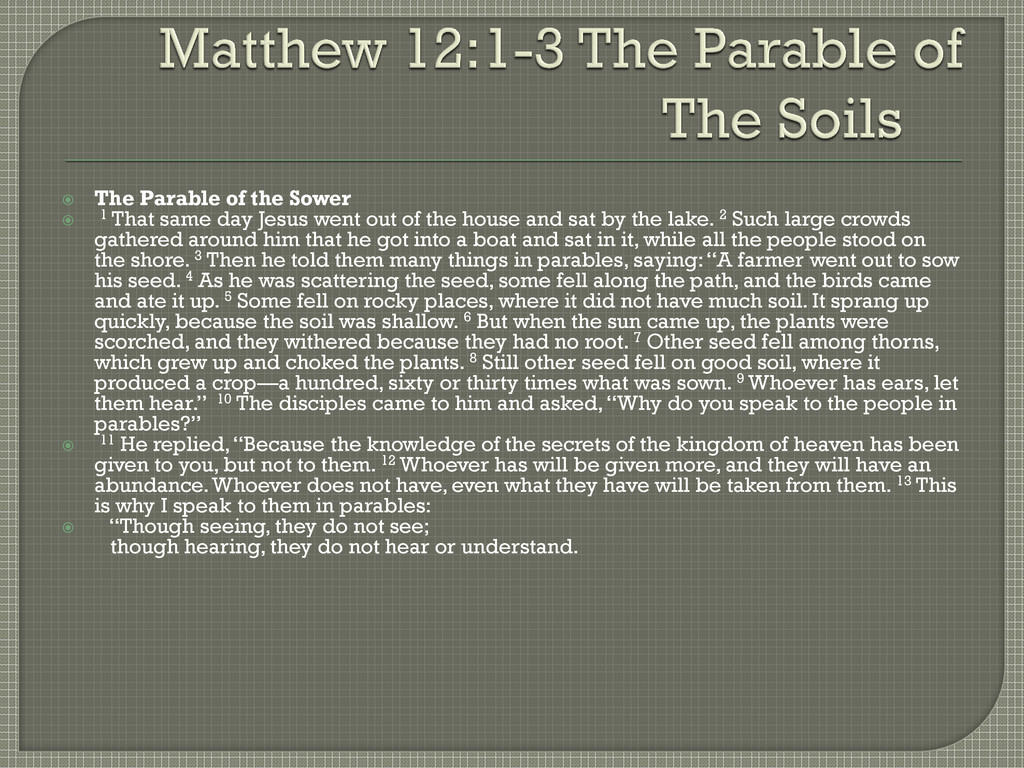
day Jesus went out of the house and sat by the lake. 2 Such large crowds gathered around him that he got into a boat and sat in it, while all the people stood on the shore. 3 Then he told them many things in parables, saying: “A farmer went out to sow his seed. 4 As he was scattering the seed, some fell along the path, and the birds came and ate it up. 5 Some fell on rocky places, where it did not have much soil. It sprang up quickly, because the soil was shallow. 6 But when the sun came up, the plants were scorched, and they withered because they had no root. 7 Other seed fell among thorns, which grew up and choked the plants. 8 Still other seed fell on good soil, where it produced a crop—a hundred, sixty or thirty times what was sown. 9 Whoever has ears, let them hear.” 10 The disciples came to him and asked, “Why do you speak to the people in parables?” 11 He replied, “Because the knowledge of the secrets of the kingdom of heaven has been given to you, but not to them. 12 Whoever has will be given more, and they will have an abundance. Whoever does not have, even what they have will be taken from them. 13 This is why I speak to them in parables: “Though seeing, they do not see; though hearing, they do not hear or understand.
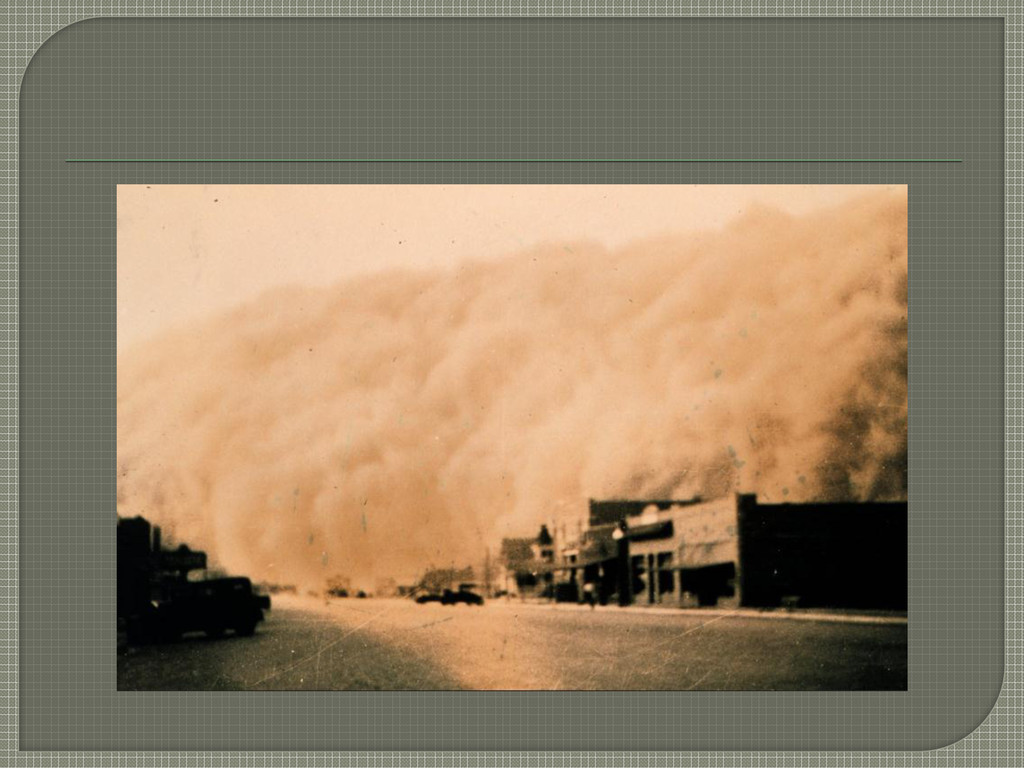
period of severe dust storms causing major ecological and agricultural damage to American and Canadian prairie lands in the 1930s, particularly in 1934 and 1936. The phenomenon was caused by severe drought coupled with decades of extensive farming without crop rotation, fallow fields, cover crops or other techniques to prevent wind erosion.[1] Deep plowing of the virgin topsoil of the Great Plains had displaced the natural deep-rooted grasses that normally kept the soil in place and trapped moisture even during periods of drought and high winds.
keep the soil in place, it dried, turned to dust, and blew away eastward and southward in large dark clouds. At times, the clouds blackened the sky, reaching all the way to East Coast cities such as New York and Washington, D.C. Much of the soil ended up deposited in the Atlantic Ocean, carried by prevailing winds, which were in part created by the dry and bare soil conditions. These immense dust storms—given names such as "black blizzards" and "black rollers"—often reduced visibility to a few feet (around a meter). The Dust Bowl affected 100,000,000 acres (400,000 km2), centered on the panhandles of Texas and Oklahoma, and adjacent parts of New Mexico, Colorado, and Kansas.[2]
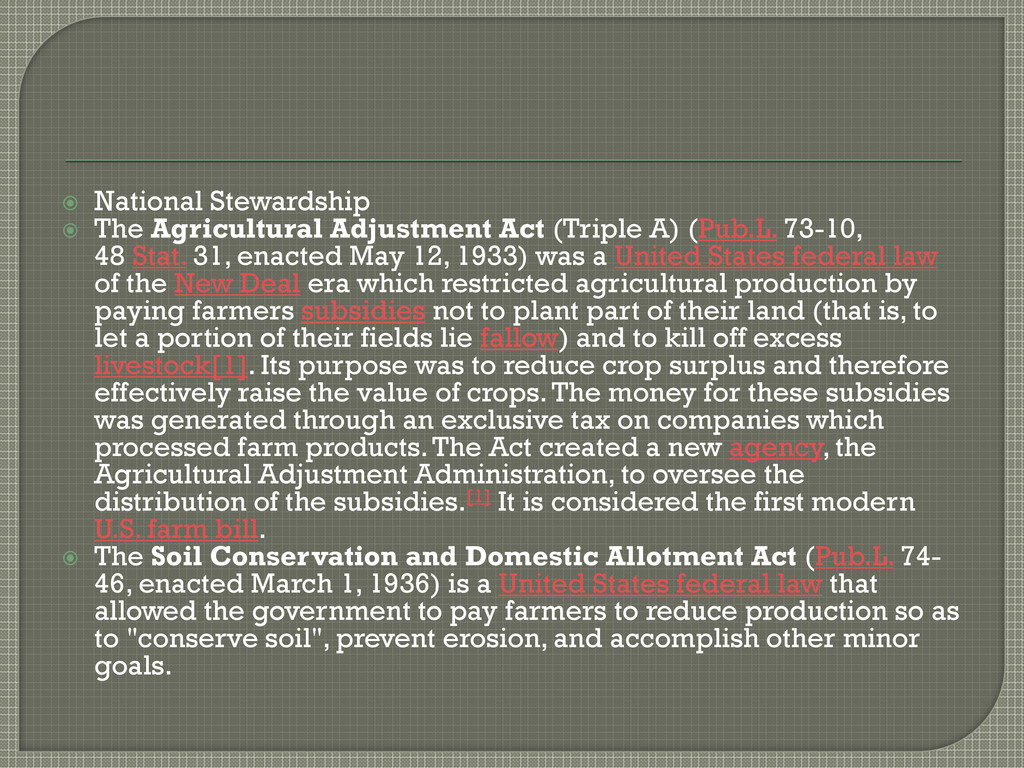
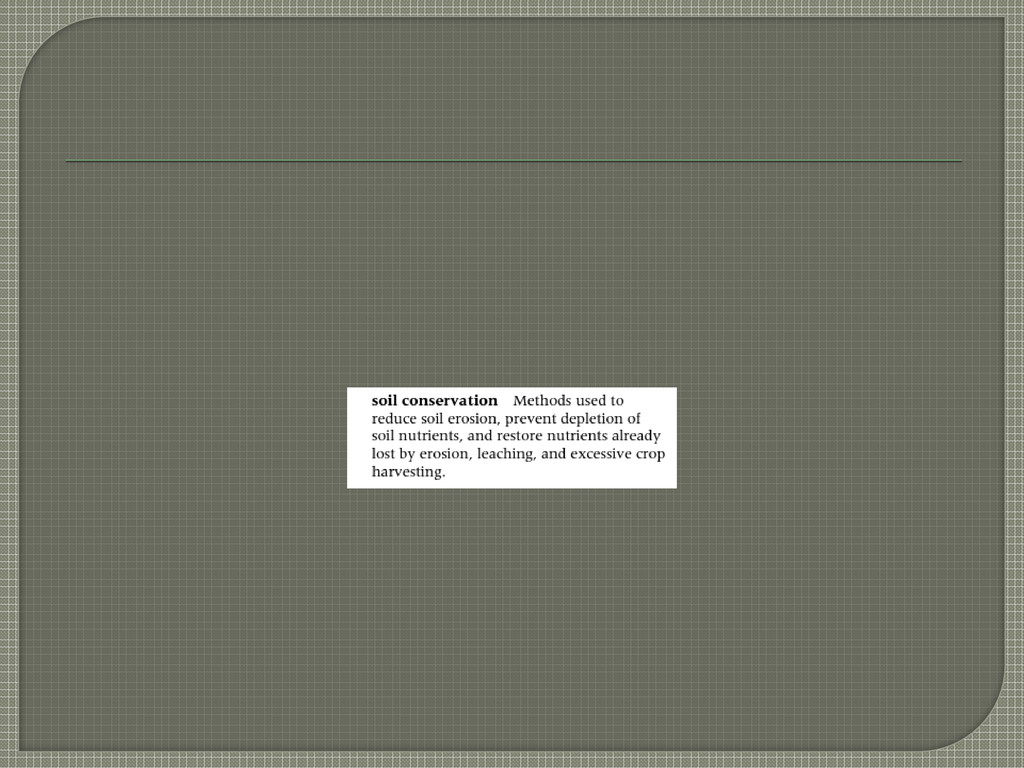
(Pub.L. 73-10, 48 Stat. 31, enacted May 12, 1933) was a United States federal law of the New Deal era which restricted agricultural production by paying farmers subsidies not to plant part of their land (that is, to let a portion of their fields lie fallow) and to kill off excess livestock[1]. Its purpose was to reduce crop surplus and therefore effectively raise the value of crops. The money for these subsidies was generated through an exclusive tax on companies which processed farm products. The Act created a new agency, the Agricultural Adjustment Administration, to oversee the distribution of the subsidies.[1] It is considered the first modern U.S. farm bill. The Soil Conservation and Domestic Allotment Act (Pub.L. 74- 46, enacted March 1, 1936) is a United States federal law that allowed the government to pay farmers to reduce production so as to "conserve soil", prevent erosion, and accomplish other minor goals.
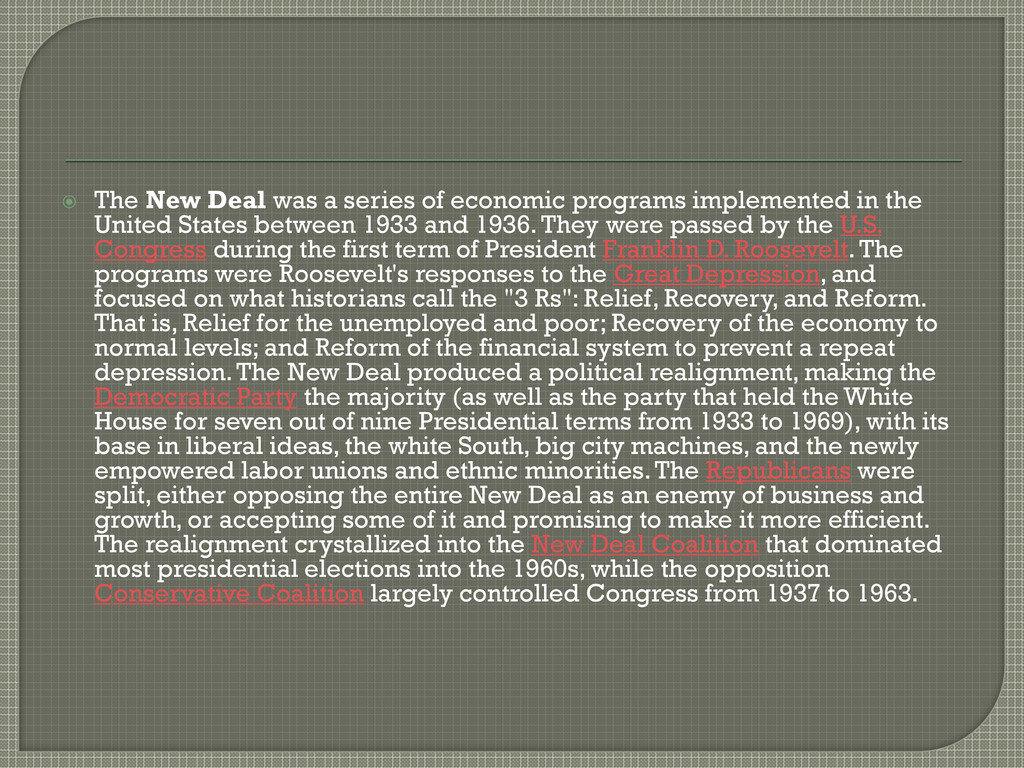
implemented in the United States between 1933 and 1936. They were passed by the U.S. Congress during the first term of President Franklin D. Roosevelt. The programs were Roosevelt's responses to the Great Depression, and focused on what historians call the "3 Rs": Relief, Recovery, and Reform. That is, Relief for the unemployed and poor; Recovery of the economy to normal levels; and Reform of the financial system to prevent a repeat depression. The New Deal produced a political realignment, making the Democratic Party the majority (as well as the party that held the White House for seven out of nine Presidential terms from 1933 to 1969), with its base in liberal ideas, the white South, big city machines, and the newly empowered labor unions and ethnic minorities. The Republicans were split, either opposing the entire New Deal as an enemy of business and growth, or accepting some of it and promising to make it more efficient. The realignment crystallized into the New Deal Coalition that dominated most presidential elections into the 1960s, while the opposition Conservative Coalition largely controlled Congress from 1937 to 1963.
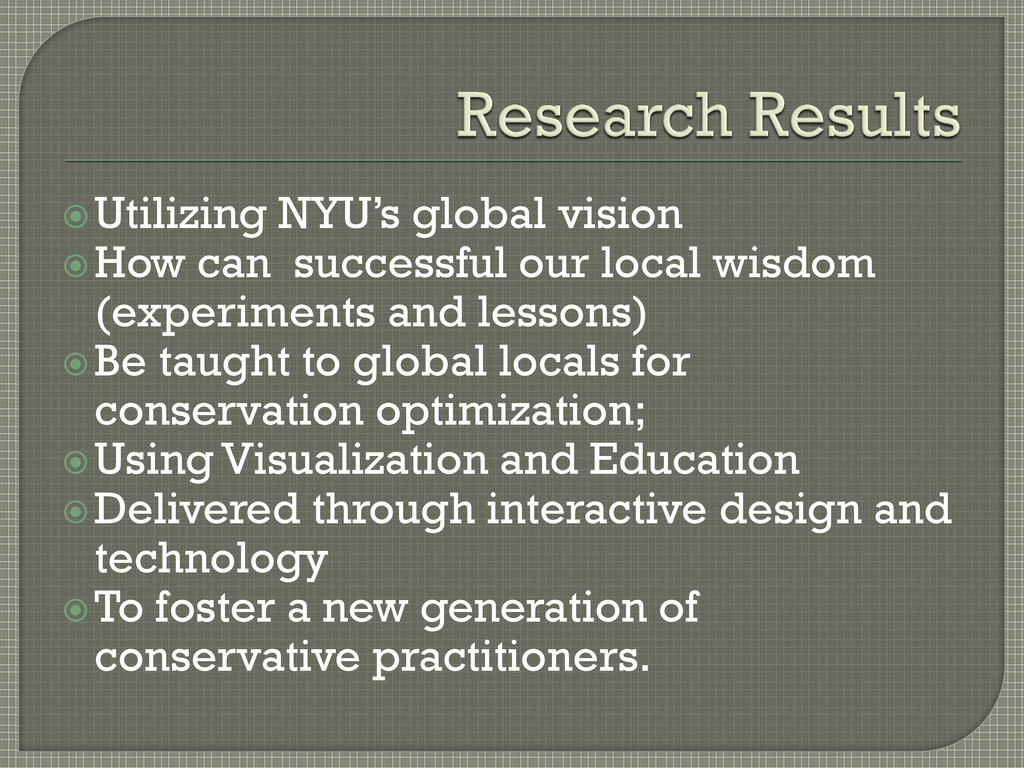
(experiments and lessons) Be taught to global locals for conservation optimization; Using Visualization and Education Delivered through interactive design and technology To foster a new generation of conservative practitioners.


 tmiket
 pauljervisheath
 sergeychernyshev
 aarron
 62gerente
 schroneko
 colly
 soysaucechin
 caitiem20
 nmsamuel
 raygrieselhuber
 varn