insects as child and wanted to be an entomologist • Industrialization eliminated opportunities for future generations of children to also collect bugs • Avid video game enthusiast; spent a lot of time in arcades • Started GameFreak to publicize tips and codes, and then decided to make his own games
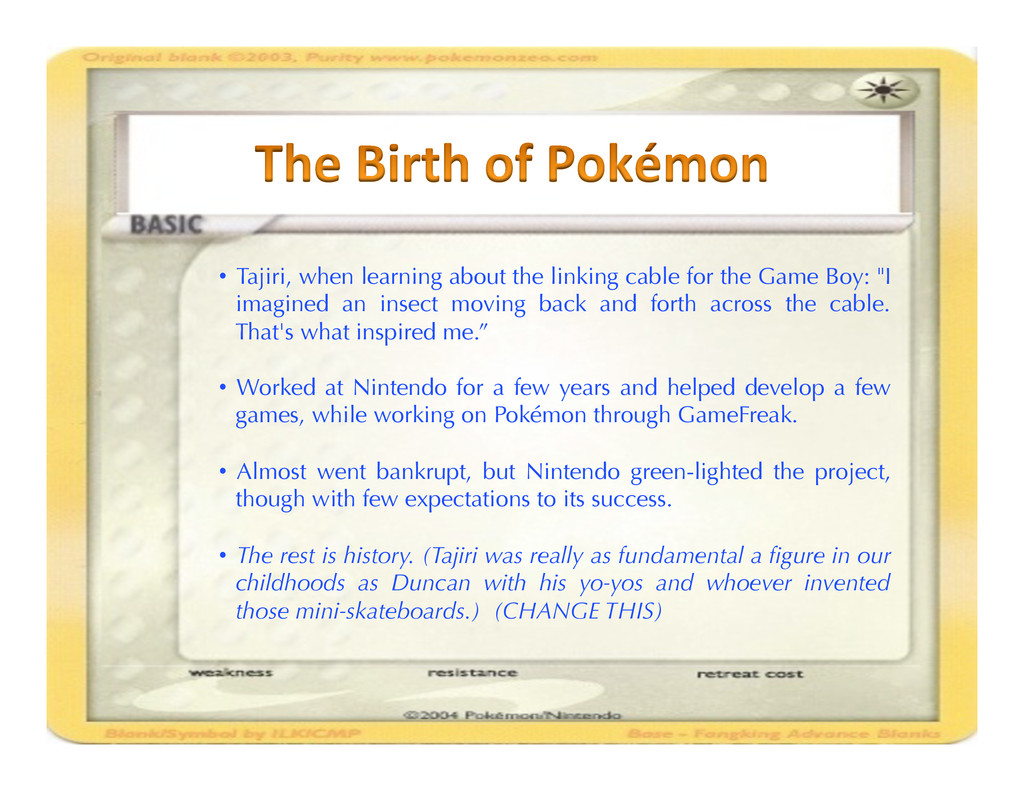
Game Boy: "I imagined an insect moving back and forth across the cable. That's what inspired me.” • Worked at Nintendo for a few years and helped develop a few games, while working on Pokémon through GameFreak. • Almost went bankrupt, but Nintendo green-lighted the project, though with few expectations to its success. • The rest is history. (Tajiri was really as fundamental a figure in our childhoods as Duncan with his yo-yos and whoever invented those mini-skateboards.) (CHANGE THIS)
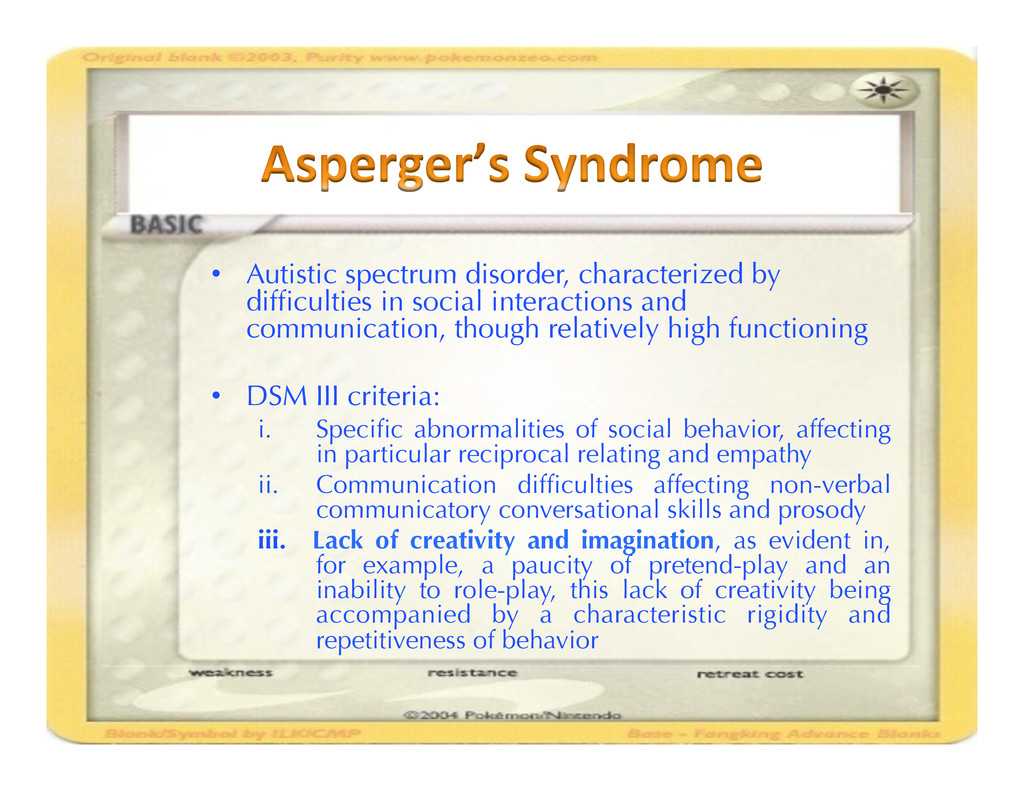
and communication, though relatively high functioning • DSM III criteria: i. Specific abnormalities of social behavior, affecting in particular reciprocal relating and empathy ii. Communication difficulties affecting non-verbal communicatory conversational skills and prosody iii. Lack of creativity and imagination, as evident in, for example, a paucity of pretend-play and an inability to role-play, this lack of creativity being accompanied by a characteristic rigidity and repetitiveness of behavior
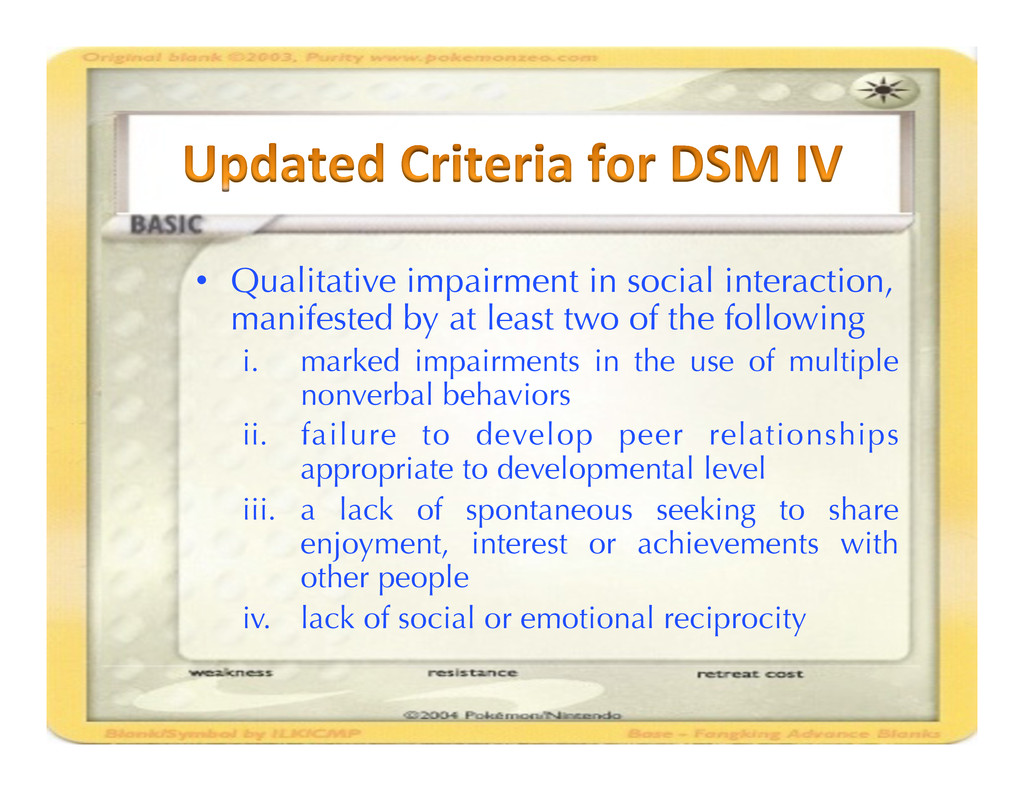
two of the following i. marked impairments in the use of multiple nonverbal behaviors ii. failure to develop peer relationships appropriate to developmental level iii. a lack of spontaneous seeking to share enjoyment, interest or achievements with other people iv. lack of social or emotional reciprocity
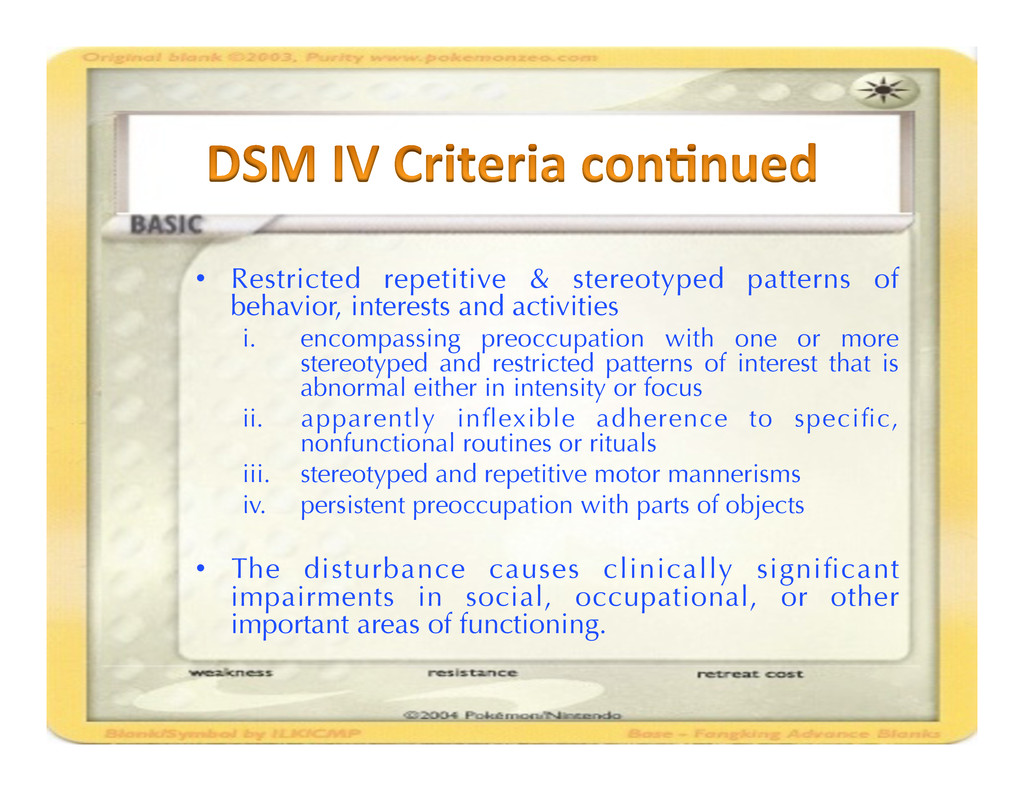
activities i. encompassing preoccupation with one or more stereotyped and restricted patterns of interest that is abnormal either in intensity or focus ii. apparently inflexible adherence to specific, nonfunctional routines or rituals iii. stereotyped and repetitive motor mannerisms iv. persistent preoccupation with parts of objects • The disturbance causes clinically significant impairments in social, occupational, or other important areas of functioning.
they share the stereotypical asocial aspects) – Not engaging in society’s conventions allows creative types in general to think divergently • Get them doing something specific – unlike true creative types, they do not like open-endedness • Specialists vs. Generalists (firm in Denmark example)
• Instead more a byproduct of their unusual viewpoint than intentional • But their ability to fill in what to them are very evident gaps produces creative solutions to real problems

 Your Podcast. Everywhere. Effortlessly.


 schroneko
 tomoyanonymous
 bkeepers
 mkilby
 axbom
 cassininazir
 bryan
 eileencodes
 rasagy
 rocio
 signer
 lemiorhan