Co-Presenter: Linda Nichols
The current state of cloud design and what it takes for an organization to become cloud-native. A look ahead at technologies changing the way cloud software is delivered.
Alex Rhea Director Architecture & DevOps @ ETA - Supported Homeland Security and Civilian sectors with application development, cloud migrations, and DevOps - Designed and implemented CaaS platforms for companies of all sizes in the cloud and on-premises - Proud Hokie, Golf, and Caps fan /alexandermrhea arhea _arhea Linda Nichols Lead Engineer @ ETA - Software Developer and Team Lead for many large-scale government and commercial applications - Founder and organizer of Norfolk.js, NodeBots Norfolk, and RevolutionConf - Open-source and developer community advocate /lynnaloo lynnaloo lynnaloo
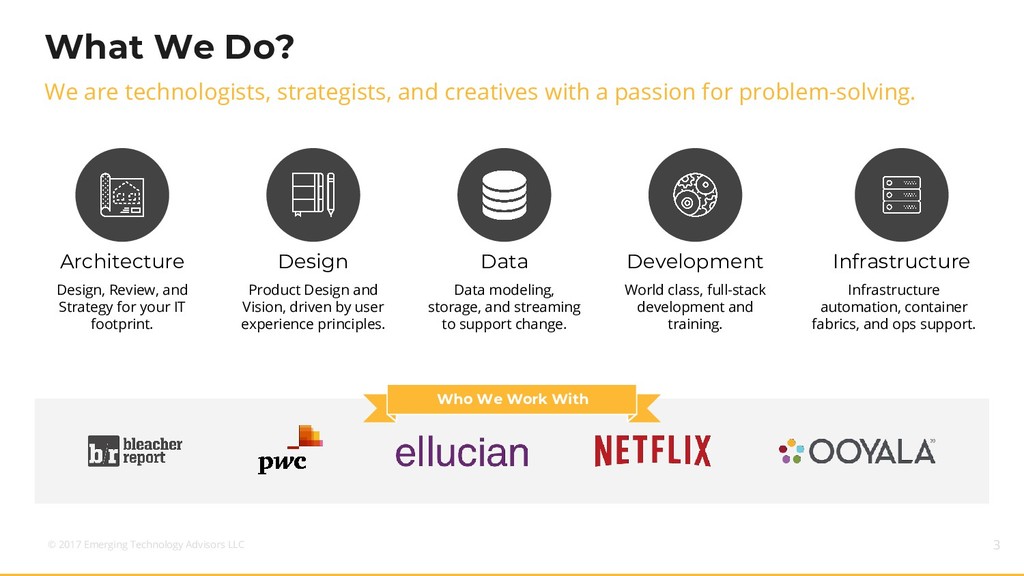
We are technologists, strategists, and creatives with a passion for problem-solving. Architecture Design, Review, and Strategy for your IT footprint. Design Product Design and Vision, driven by user experience principles. Development World class, full-stack development and training. Infrastructure Infrastructure automation, container fabrics, and ops support. Data Data modeling, storage, and streaming to support change. Who We Work With
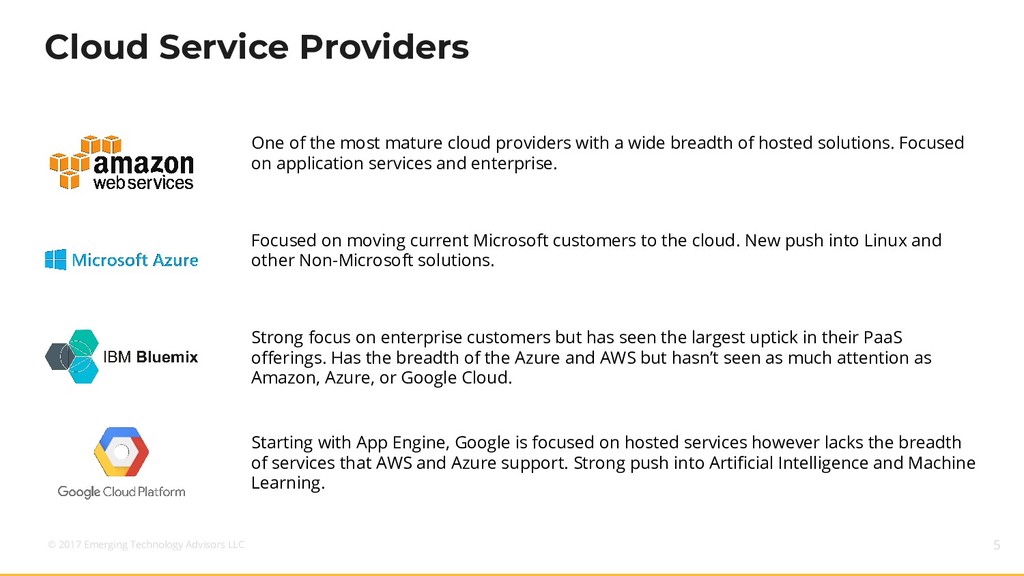
One of the most mature cloud providers with a wide breadth of hosted solutions. Focused on application services and enterprise. Focused on moving current Microsoft customers to the cloud. New push into Linux and other Non-Microsoft solutions. Strong focus on enterprise customers but has seen the largest uptick in their PaaS offerings. Has the breadth of the Azure and AWS but hasn’t seen as much attention as Amazon, Azure, or Google Cloud. Starting with App Engine, Google is focused on hosted services however lacks the breadth of services that AWS and Azure support. Strong push into Artificial Intelligence and Machine Learning.
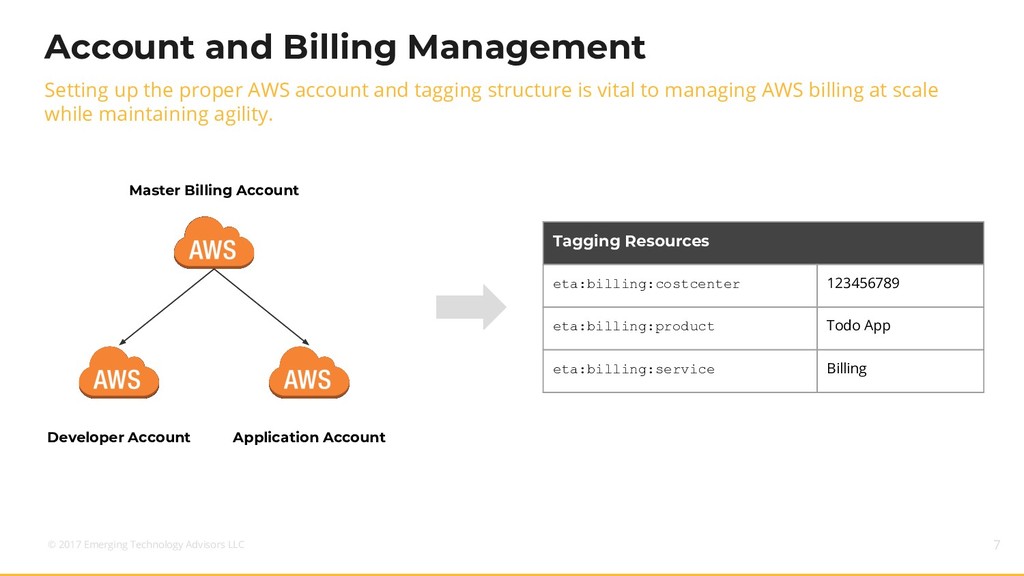
7 Setting up the proper AWS account and tagging structure is vital to managing AWS billing at scale while maintaining agility. Master Billing Account Application Account Developer Account Tagging Resources eta:billing:costcenter 123456789 eta:billing:product Todo App eta:billing:service Billing
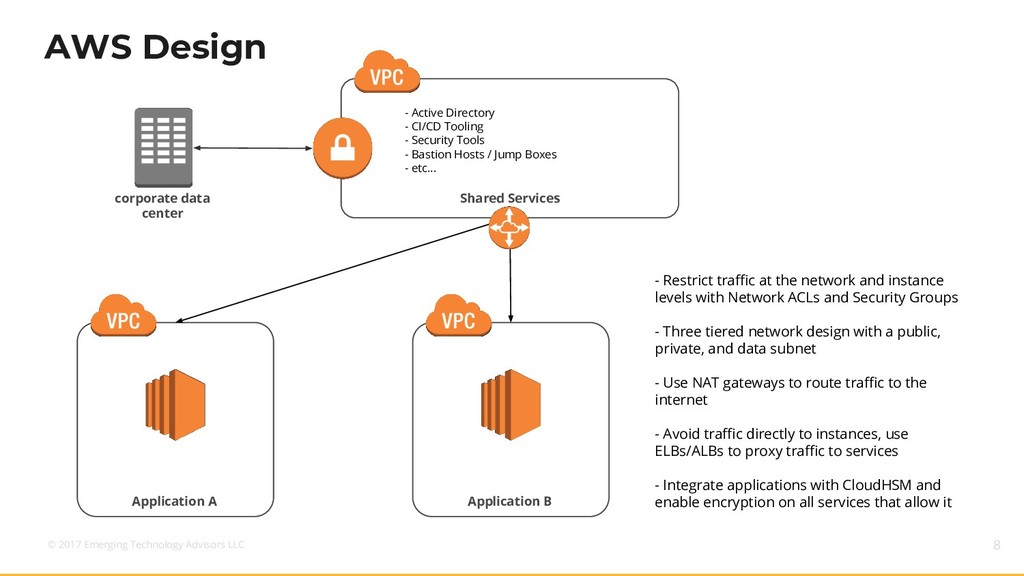
A Application B Shared Services corporate data center - Active Directory - CI/CD Tooling - Security Tools - Bastion Hosts / Jump Boxes - etc... - Restrict traffic at the network and instance levels with Network ACLs and Security Groups - Three tiered network design with a public, private, and data subnet - Use NAT gateways to route traffic to the internet - Avoid traffic directly to instances, use ELBs/ALBs to proxy traffic to services - Integrate applications with CloudHSM and enable encryption on all services that allow it
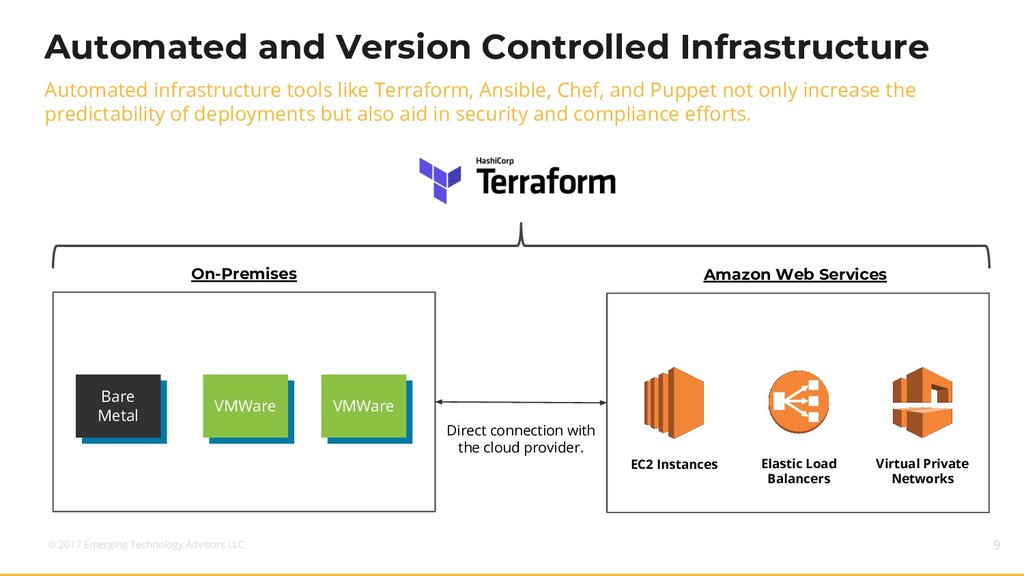
Controlled Infrastructure On-Premises Amazon Web Services Bare Metal VMWare VMWare Direct connection with the cloud provider. Automated infrastructure tools like Terraform, Ansible, Chef, and Puppet not only increase the predictability of deployments but also aid in security and compliance efforts. EC2 Instances Elastic Load Balancers Virtual Private Networks
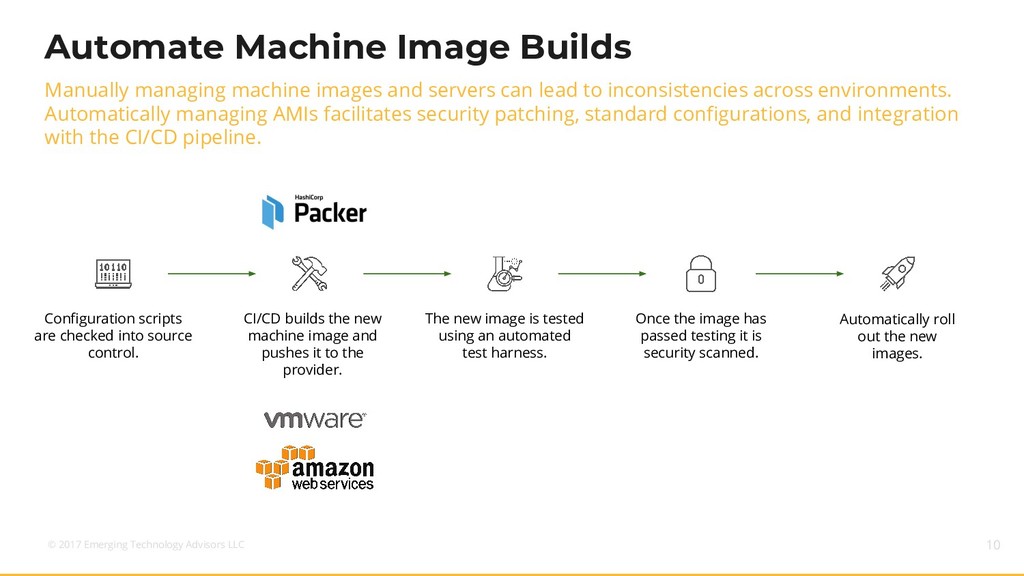
Builds Manually managing machine images and servers can lead to inconsistencies across environments. Automatically managing AMIs facilitates security patching, standard configurations, and integration with the CI/CD pipeline. Configuration scripts are checked into source control. CI/CD builds the new machine image and pushes it to the provider. The new image is tested using an automated test harness. Once the image has passed testing it is security scanned. Automatically roll out the new images.
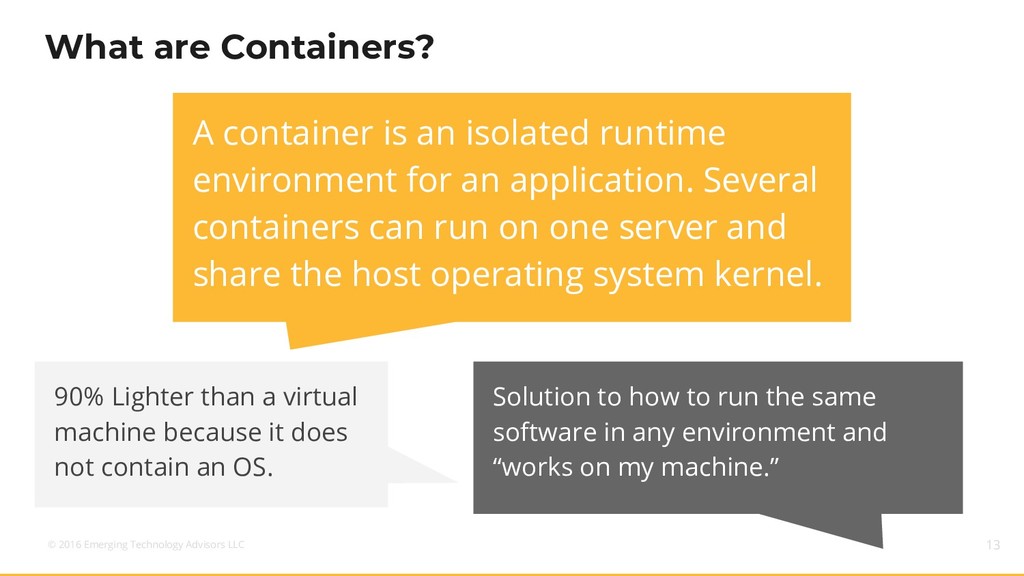
Lighter than a virtual machine because it does not contain an OS. Solution to how to run the same software in any environment and “works on my machine.” A container is an isolated runtime environment for an application. Several containers can run on one server and share the host operating system kernel. 13
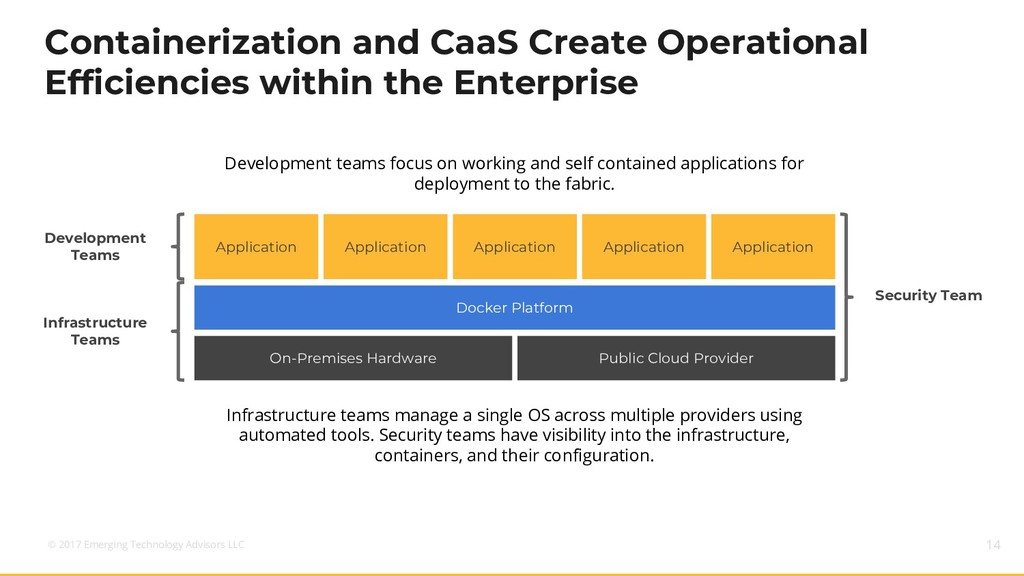
Create Operational Efficiencies within the Enterprise Docker Platform On-Premises Hardware Public Cloud Provider Application Development Teams Infrastructure Teams Application Application Application Application Security Team Infrastructure teams manage a single OS across multiple providers using automated tools. Security teams have visibility into the infrastructure, containers, and their configuration. Development teams focus on working and self contained applications for deployment to the fabric.
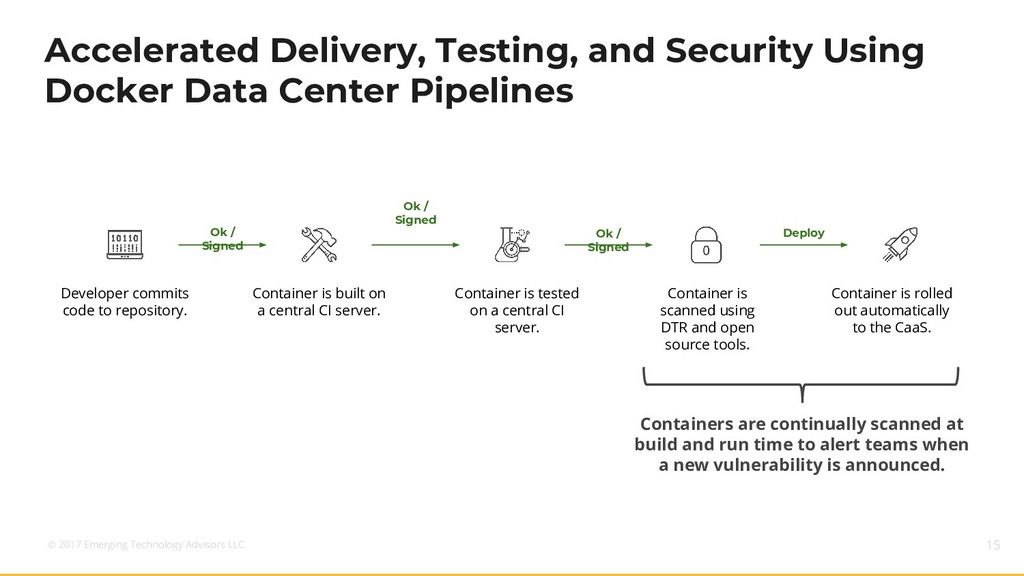
and Security Using Docker Data Center Pipelines Developer commits code to repository. Container is built on a central CI server. Container is tested on a central CI server. Container is scanned using DTR and open source tools. Container is rolled out automatically to the CaaS. Ok / Signed Containers are continually scanned at build and run time to alert teams when a new vulnerability is announced. Ok / Signed Ok / Signed Deploy
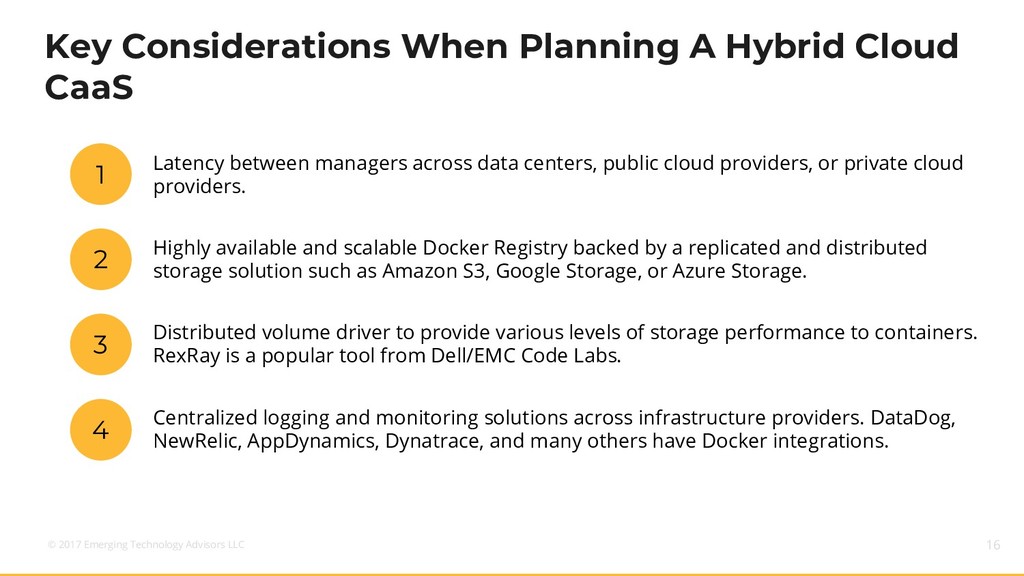
A Hybrid Cloud CaaS 16 1 2 3 Latency between managers across data centers, public cloud providers, or private cloud providers. Highly available and scalable Docker Registry backed by a replicated and distributed storage solution such as Amazon S3, Google Storage, or Azure Storage. Distributed volume driver to provide various levels of storage performance to containers. RexRay is a popular tool from Dell/EMC Code Labs. 4 Centralized logging and monitoring solutions across infrastructure providers. DataDog, NewRelic, AppDynamics, Dynatrace, and many others have Docker integrations.
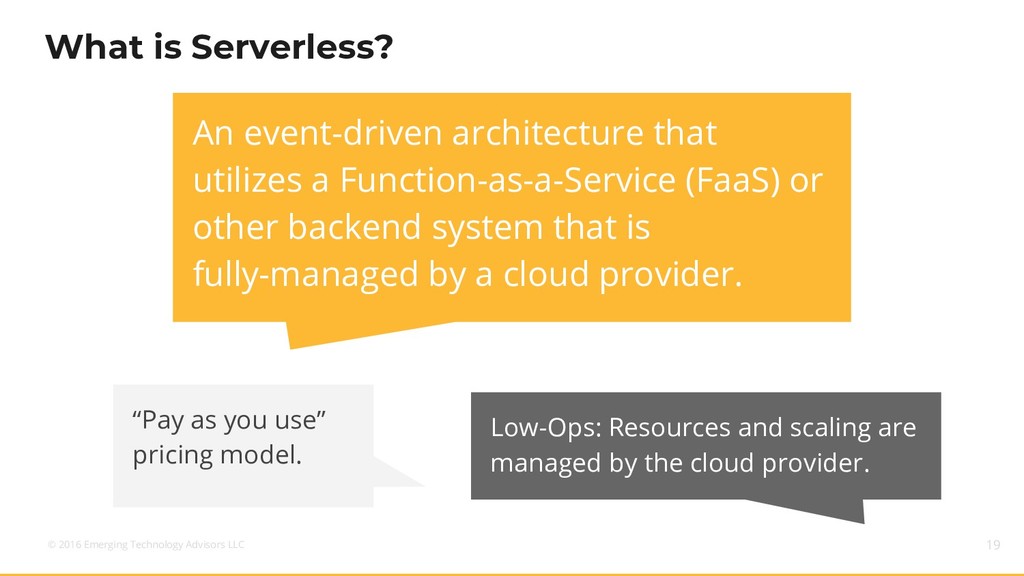
as you use” pricing model. Low-Ops: Resources and scaling are managed by the cloud provider. An event-driven architecture that utilizes a Function-as-a-Service (FaaS) or other backend system that is fully-managed by a cloud provider. 19
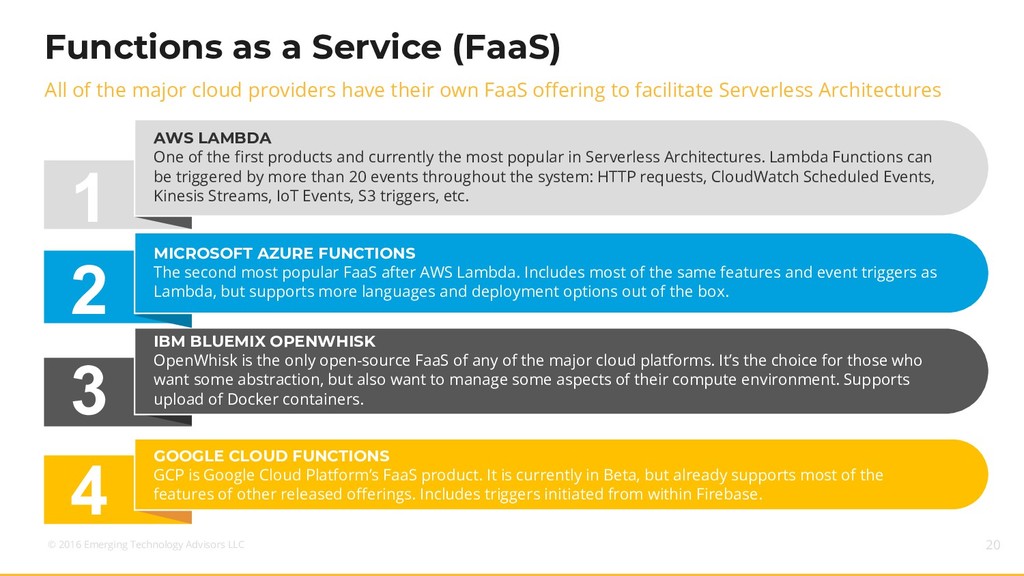
(FaaS) All of the major cloud providers have their own FaaS offering to facilitate Serverless Architectures 1 2 3 4 AWS LAMBDA One of the first products and currently the most popular in Serverless Architectures. Lambda Functions can be triggered by more than 20 events throughout the system: HTTP requests, CloudWatch Scheduled Events, Kinesis Streams, IoT Events, S3 triggers, etc. MICROSOFT AZURE FUNCTIONS The second most popular FaaS after AWS Lambda. Includes most of the same features and event triggers as Lambda, but supports more languages and deployment options out of the box. IBM BLUEMIX OPENWHISK OpenWhisk is the only open-source FaaS of any of the major cloud platforms. It’s the choice for those who want some abstraction, but also want to manage some aspects of their compute environment. Supports upload of Docker containers. GOOGLE CLOUD FUNCTIONS GCP is Google Cloud Platform’s FaaS product. It is currently in Beta, but already supports most of the features of other released offerings. Includes triggers initiated from within Firebase. 20
21 1 2 3 Supports a Microservices Architecture since each function is a single responsibility service Lightweight, containerized runtimes inherit the benefits of a containerized system Event-driven architecture promotes workflows that react to dynamic applications 4 Provisioning, configuration, scaling, and other management services are abstracted from the developers 5 Metered billing means underutilized functions do not cost anything
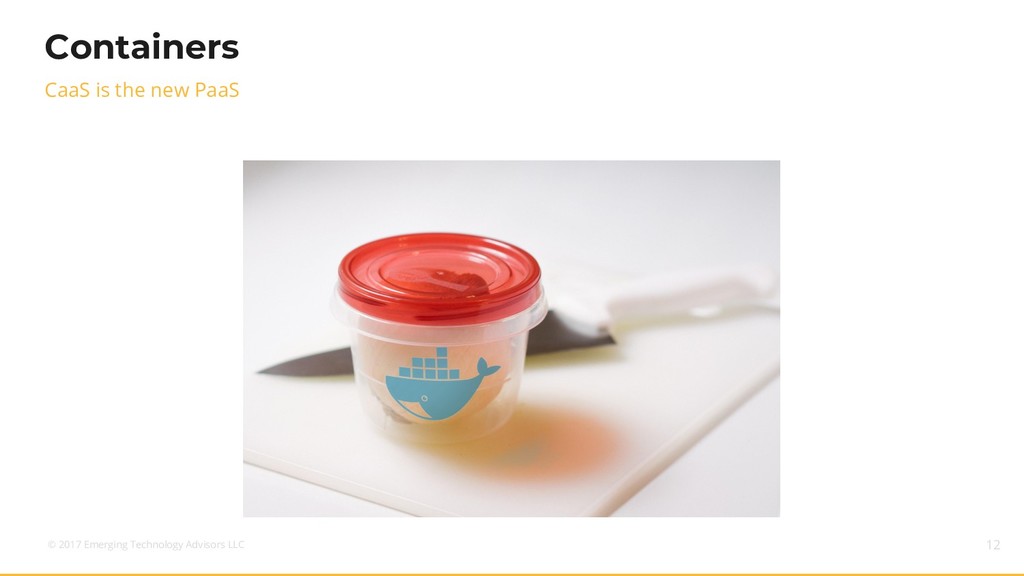
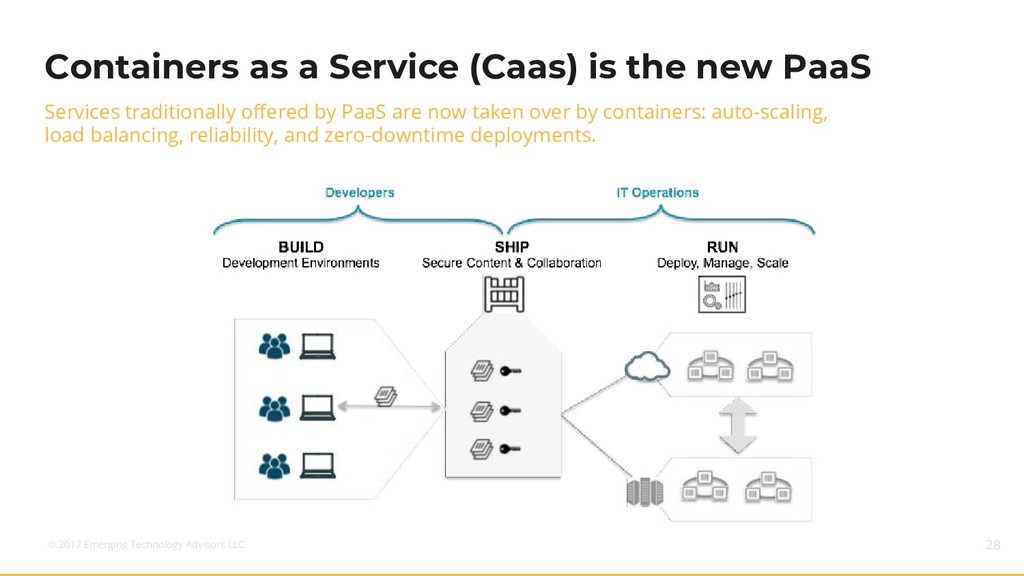
(Caas) is the new PaaS 28 Services traditionally offered by PaaS are now taken over by containers: auto-scaling, load balancing, reliability, and zero-downtime deployments.