Upgrade to Pro — share decks privately, control downloads, hide ads and more …

Structure and Agency in the International Stude...

Sponsored · Your Podcast. Everywhere. Effortlessly. Share. Educate. Inspire. Entertain. You do you. We'll handle the rest. →
Avatar for Blair Matthews Blair Matthews
August 29, 2018
11

Structure and Agency in the International Student Experience

The studying abroad is a transformative experience, involving changes in identity, agency and maturity. In this presentation, I identify a number of features of the international student experience, which condition participants' agency.

Avatar for Blair Matthews

Blair Matthews

August 29, 2018

Transcript

  1. • The International Student Experience is a transformative experience •

    changes in identity (Montgomery, 2010; Hotta and Ting-Toomey, 2013) • agency (Marginson, 2014; Pham and Saltmarsh, 2013; Tran and Vu, 2017; Matthews, 2017; 2018) • maturity (Gu, 2009; Gu, Schweisfurth and Day, 2010; Gu and Schweisfurth, 2015)
  2. • Research on the ISE is subject to conflation in

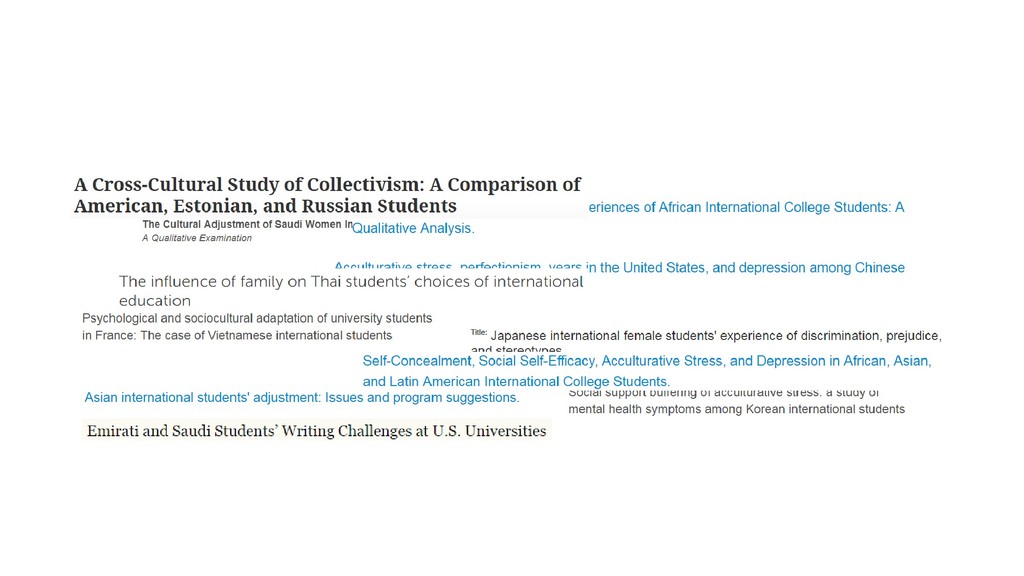
    two main ways: • First, a tendency to problematise the student experience (e.g. culture shock, language difficulties, loneliness) • Second, a tendency to use conceptual frameworks that use culture as a categorising agent (e.g. Acculturation models, cultural dimensions) • Culture and behaviour become entwined, resulting in a deficit model of international students
  3. When I just came here I did not know where

    to find healthy food, so I ate a lot of fast food, and gained a lot of weight. Later, I noticed other college students they lived pretty healthy lifestyle, I mean they have good diet and they went to gym, and I want to like that. So I started to search online and ask my friends. Now I am an expert about finding American healthy food. I never knew how to cook Saudi food anyway. And I know Saudi food is not healthy. Saudi food is all about fat, fat, and fat. It is very bad and people do not exercise either. (Yan and Fitzpatrick, 2015: 4)
  4. When I just came here I did not know where

    to find healthy food, so I ate a lot of fast food, and gained a lot of weight. Later, I noticed other college students they lived pretty healthy lifestyle, I mean they have good diet and they went to gym, and I want to like that. So I started to search online and ask my friends. Now I am an expert about finding American healthy food. I never knew how to cook Saudi food anyway. And I know Saudi food is not healthy. Saudi food is all about fat, fat, and fat. It is very bad and people do not exercise either. (Yan and Fitzpatrick, 2015: 4)
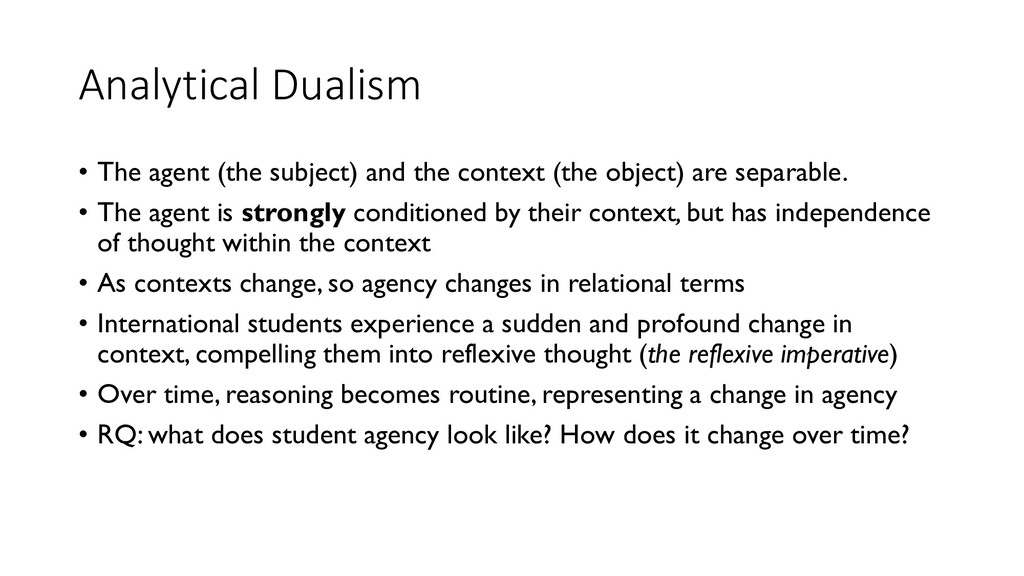
  5. Analytical Dualism • The agent (the subject) and the context

    (the object) are separable. • The agent is strongly conditioned by their context, but has independence of thought within the context • As contexts change, so agency changes in relational terms • International students experience a sudden and profound change in context, compelling them into reflexive thought (the reflexive imperative) • Over time, reasoning becomes routine, representing a change in agency • RQ: what does student agency look like? How does it change over time?
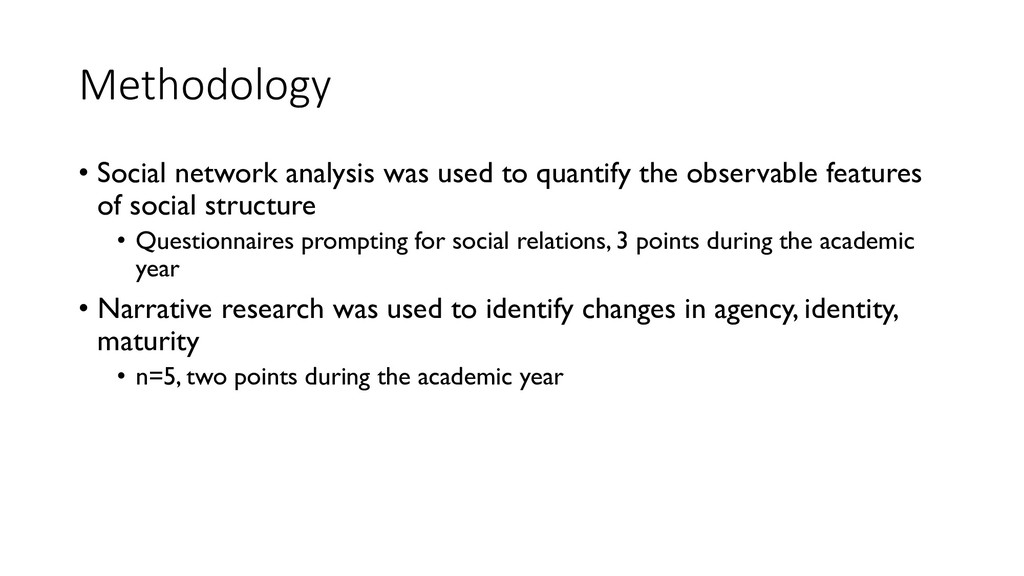
  6. Methodology • Social network analysis was used to quantify the

    observable features of social structure • Questionnaires prompting for social relations, 3 points during the academic year • Narrative research was used to identify changes in agency, identity, maturity • n=5, two points during the academic year
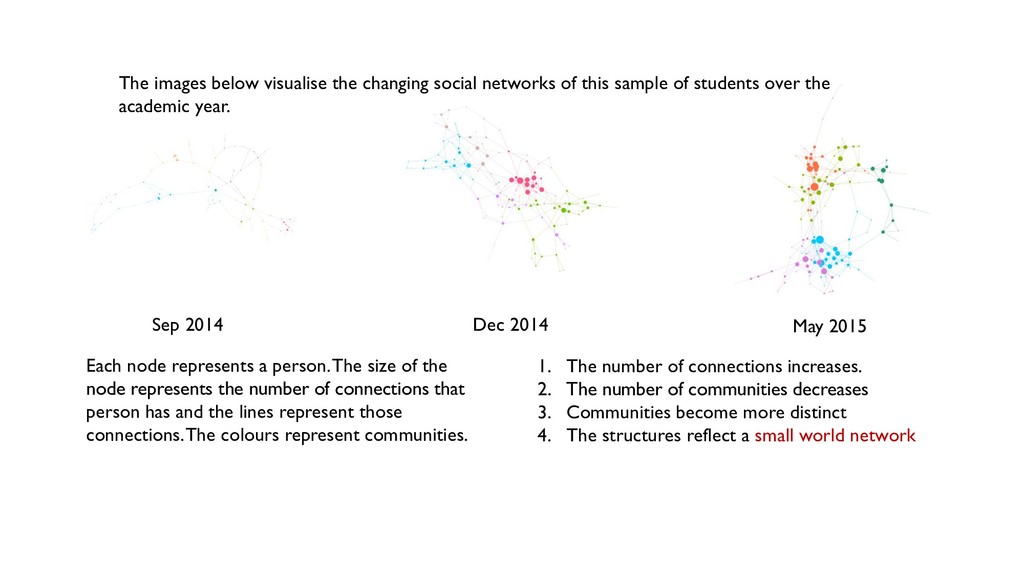
  7. Sep 2014 Dec 2014 May 2015 1. The number of

    connections increases. 2. The number of communities decreases 3. Communities become more distinct 4. The structures reflect a small world network The images below visualise the changing social networks of this sample of students over the academic year. Each node represents a person. The size of the node represents the number of connections that person has and the lines represent those connections. The colours represent communities.
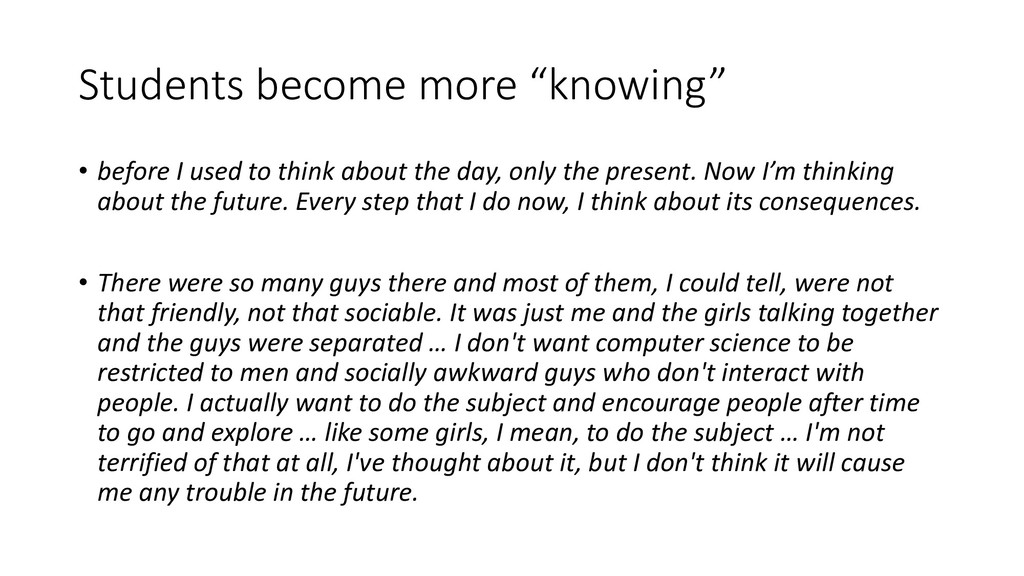
  8. Students become more “knowing” • before I used to think

    about the day, only the present. Now I’m thinking about the future. Every step that I do now, I think about its consequences. • There were so many guys there and most of them, I could tell, were not that friendly, not that sociable. It was just me and the girls talking together and the guys were separated … I don't want computer science to be restricted to men and socially awkward guys who don't interact with people. I actually want to do the subject and encourage people after time to go and explore … like some girls, I mean, to do the subject … I'm not terrified of that at all, I've thought about it, but I don't think it will cause me any trouble in the future.
  9. Students become more independent • when you get in a

    situation and you don’t know what to do, you just use your imagination and try to fix it [emphasis added] • I still want to study and prepare for myself. So I feel that, like, makes me more mature and more independent actually ... you just got be responsible with your things ... it does really make me more responsible.
  10. Difficulties in exercising agency • If they know I don’t

    really have food or anything, I’ll become like, for example with R, how it works, for me it’s perfect and for him probably as well, we have like a studio room, it’s with a kitchen and he just buys food. I cook the food, I clean after myself and after him and I clean the whole kitchen. So he basically does nothing. • sometimes I feel like that’s a bit wrong, but no-one complained about this.
  11. Convergence of behaviours (beliefs, values) • I feel more attached

    to the institution and my classmates, and I’m more familiarised [sic] with the educational environment in the UK
  12. Convergence of behaviours (beliefs, values) • Stacy, she’s a great

    person ::: but I think it’s culturally different that I expect her to be a close friend of mine, and only together, like a special position [but] she actually told me that she’s closer with different people in different periods of time … I was shocked after that sentence, she always tell me that I just have to accept other people’s mindsets. • With Zoe? Yeah, that’s fine, like, the first term it was really good but now, since Juan moved and I started going to (his) place more often, Zoe started getting a little bit mad at me, yeah, that I’m not spending much time with her, but I don’t know, we’re fine. We still talk and everything.
  13. Convergence of behaviours (beliefs, values) • Friends, I can do

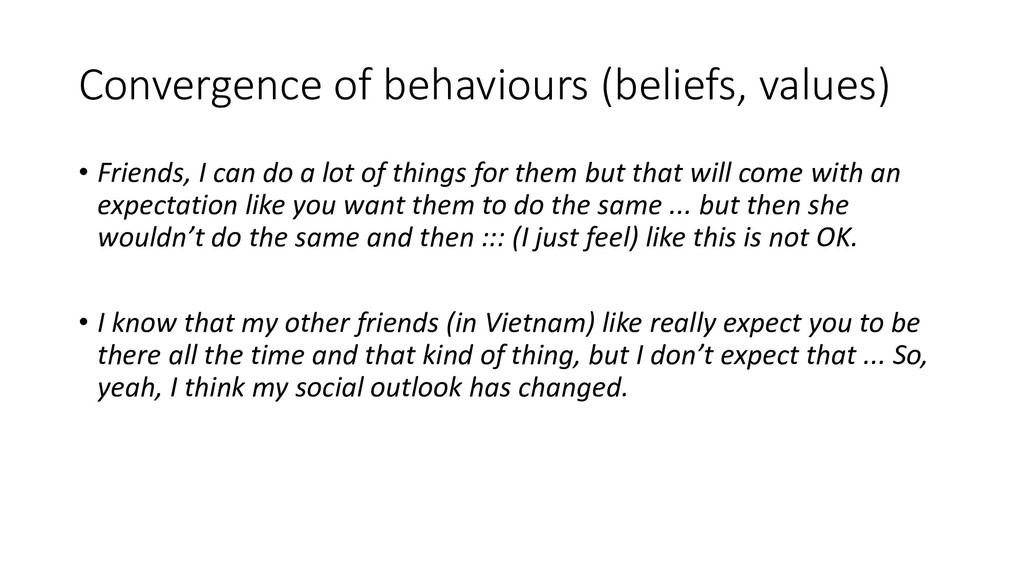
    a lot of things for them but that will come with an expectation like you want them to do the same ... but then she wouldn’t do the same and then ::: (I just feel) like this is not OK. • I know that my other friends (in Vietnam) like really expect you to be there all the time and that kind of thing, but I don’t expect that ... So, yeah, I think my social outlook has changed.
  14. Convergence of behaviours (beliefs, values) • I feel like I’m

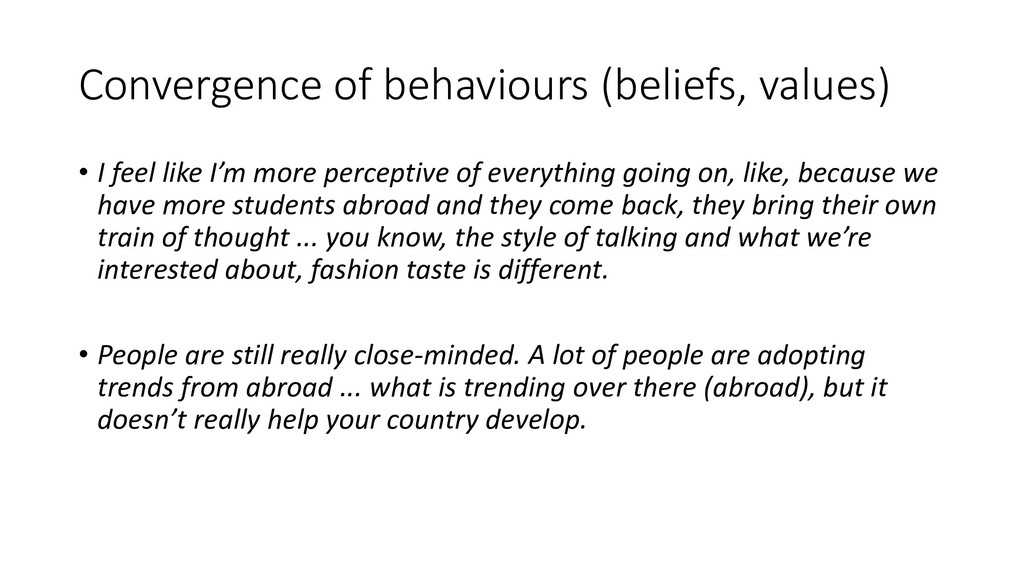
    more perceptive of everything going on, like, because we have more students abroad and they come back, they bring their own train of thought ... you know, the style of talking and what we’re interested about, fashion taste is different. • People are still really close-minded. A lot of people are adopting trends from abroad ... what is trending over there (abroad), but it doesn’t really help your country develop.
  15. Conclusion • International students experience a significant change in the

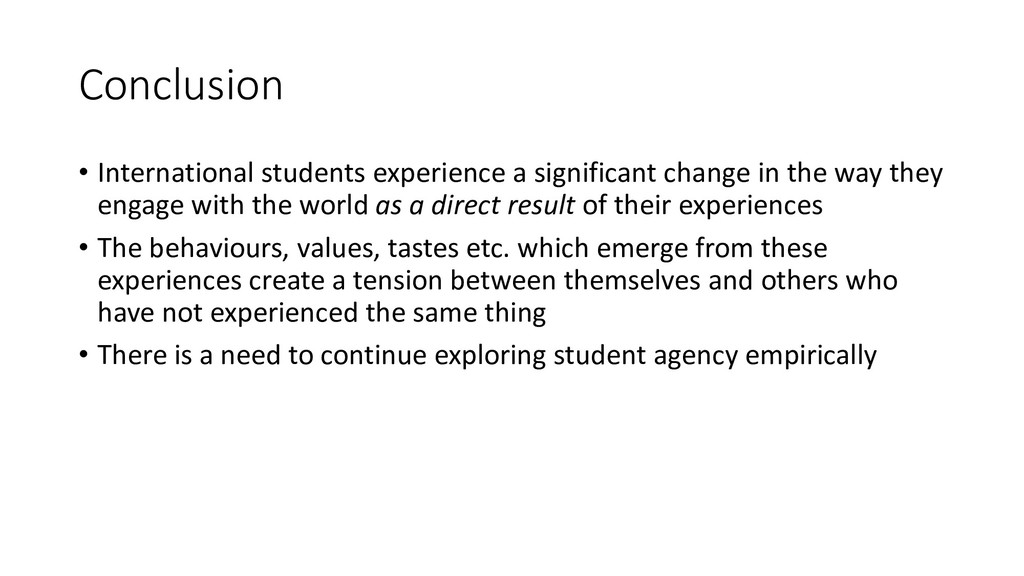
    way they engage with the world as a direct result of their experiences • The behaviours, values, tastes etc. which emerge from these experiences create a tension between themselves and others who have not experienced the same thing • There is a need to continue exploring student agency empirically
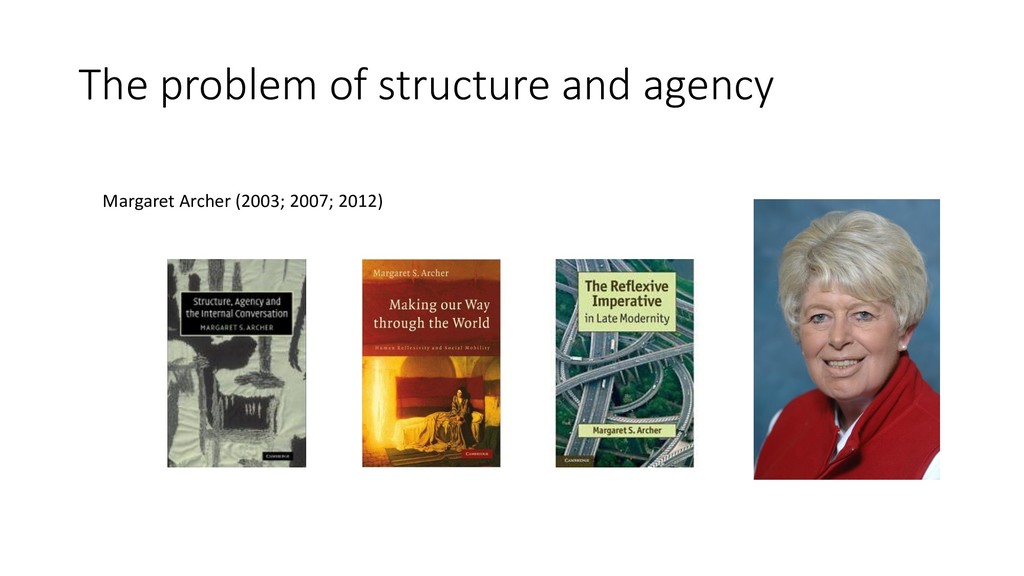
  16. References • Archer MS (2003) Structure, Agency and the Internal

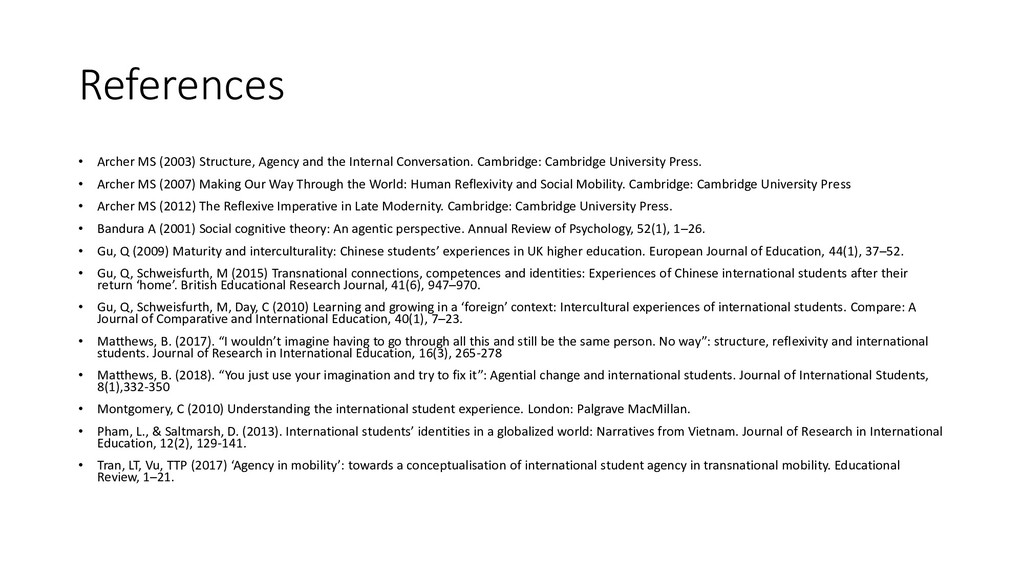
    Conversation. Cambridge: Cambridge University Press. • Archer MS (2007) Making Our Way Through the World: Human Reflexivity and Social Mobility. Cambridge: Cambridge University Press • Archer MS (2012) The Reflexive Imperative in Late Modernity. Cambridge: Cambridge University Press. • Bandura A (2001) Social cognitive theory: An agentic perspective. Annual Review of Psychology, 52(1), 1–26. • Gu, Q (2009) Maturity and interculturality: Chinese students’ experiences in UK higher education. European Journal of Education, 44(1), 37–52. • Gu, Q, Schweisfurth, M (2015) Transnational connections, competences and identities: Experiences of Chinese international students after their return ‘home’. British Educational Research Journal, 41(6), 947–970. • Gu, Q, Schweisfurth, M, Day, C (2010) Learning and growing in a ‘foreign’ context: Intercultural experiences of international students. Compare: A Journal of Comparative and International Education, 40(1), 7–23. • Matthews, B. (2017). “I wouldn’t imagine having to go through all this and still be the same person. No way”: structure, reflexivity and international students. Journal of Research in International Education, 16(3), 265-278 • Matthews, B. (2018). “You just use your imagination and try to fix it”: Agential change and international students. Journal of International Students, 8(1),332-350 • Montgomery, C (2010) Understanding the international student experience. London: Palgrave MacMillan. • Pham, L., & Saltmarsh, D. (2013). International students’ identities in a globalized world: Narratives from Vietnam. Journal of Research in International Education, 12(2), 129-141. • Tran, LT, Vu, TTP (2017) ‘Agency in mobility’: towards a conceptualisation of international student agency in transnational mobility. Educational Review, 1–21.